


 Скачать презентацию Controller design for autonomous and cooperative Generic Model
058ce07f3fa5b24b6c12f0f5c236d59c.ppt
- Количество слайдов: 15
 Controller design for autonomous and cooperative Generic Model Predictive Control Framework for driving and impact assessment on traffic flow Advanced Driver Assistance Systems (ADAS) dynamics Meng Wang Department of Transport & Planning Department of Bio. Mechanical Engineering Supervisor(s): Winnie Daamen, Serge Hoogendoorn, Bart van Arem Challenge the future 1
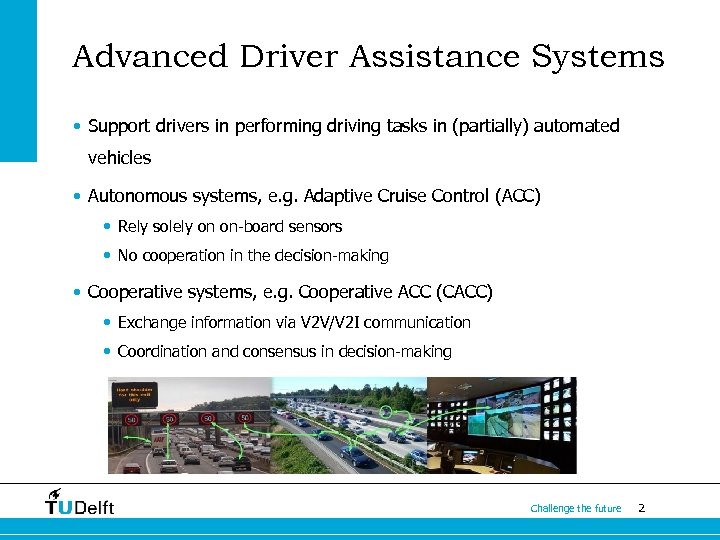 Advanced Driver Assistance Systems • Support drivers in performing driving tasks in (partially) automated vehicles • Autonomous systems, e. g. Adaptive Cruise Control (ACC) • Rely solely on on-board sensors • No cooperation in the decision-making • Cooperative systems, e. g. Cooperative ACC (CACC) • Exchange information via V 2 V/V 2 I communication • Coordination and consensus in decision-making Challenge the future 2
 Relevant for traffic management? ADAS may have far-reaching impacts on: • Individual driver behaviour: car-following and lane-changing, consequently travel time, safety and comfort • Collective traffic flow characteristics: capacity, stability • Sustainability: fuel consumption and emissions It is important to design ADAS to improve collective traffic flow dynamics! Challenge the future 3
 A flexible design approach • Motivation: many control approaches determine ACC/C-ACC accelerations based on simple linear feedback control law • Approaches often miss certain desirable features, such as: • Explicit optimisation • Multiple objectives • Anticipation on (future) driving context • Integration with current traffic management architecture (V 2 I) • Goal: to develop a generic multi-objective control approach based on MPC (Model Predictive Control), while being fast and robust enough for real-time application Challenge the future 4
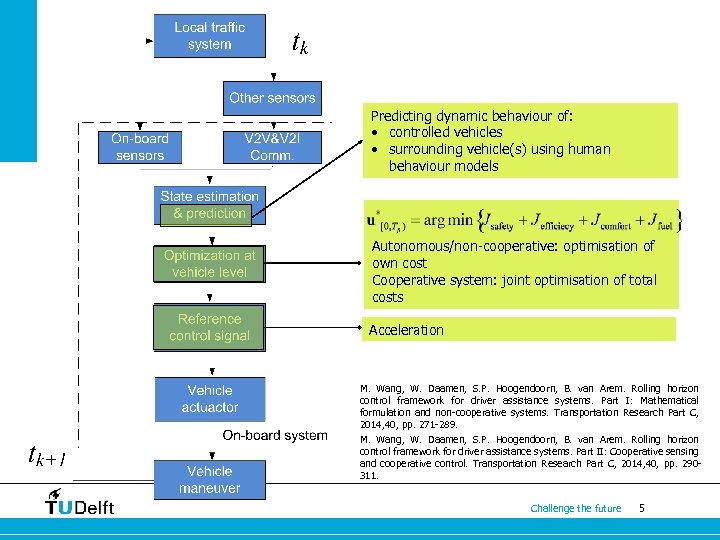 Predicting dynamic behaviour of: • controlled vehicles • surrounding vehicle(s) using human behaviour models Autonomous/non-cooperative: optimisation of own cost Cooperative system: joint optimisation of total costs Acceleration M. Wang, W. Daamen, S. P. Hoogendoorn, B. van Arem. Rolling horizon control framework for driver assistance systems. Part I: Mathematical formulation and non-cooperative systems. Transportation Research Part C, 2014, 40, pp. 271 -289. M. Wang, W. Daamen, S. P. Hoogendoorn, B. van Arem. Rolling horizon control framework for driver assistance systems. Part II: Cooperative sensing and cooperative control. Transportation Research Part C, 2014, 40, pp. 290311. Challenge the future 5
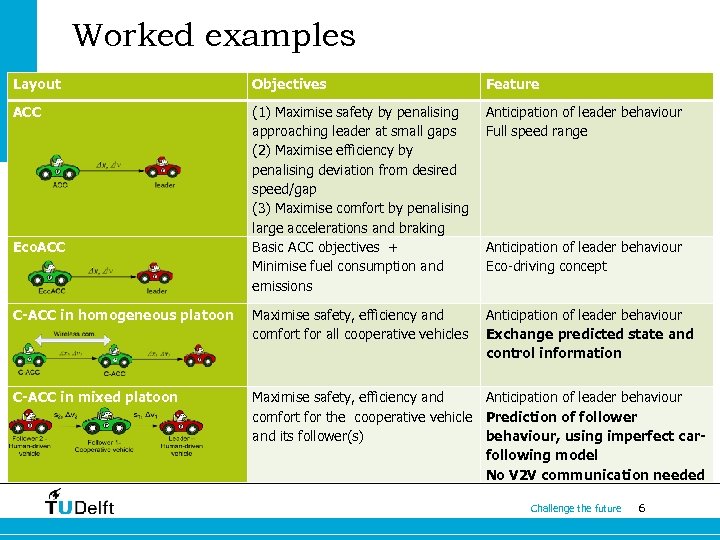 Worked examples Layout Objectives Feature ACC (1) Maximise safety by penalising approaching leader at small gaps (2) Maximise efficiency by penalising deviation from desired speed/gap (3) Maximise comfort by penalising large accelerations and braking Basic ACC objectives + Minimise fuel consumption and emissions Anticipation of leader behaviour Full speed range C-ACC in homogeneous platoon Maximise safety, efficiency and comfort for all cooperative vehicles Anticipation of leader behaviour Exchange predicted state and control information C-ACC in mixed platoon Maximise safety, efficiency and Anticipation of leader behaviour comfort for the cooperative vehicle Prediction of follower and its follower(s) behaviour, using imperfect carfollowing model No V 2 V communication needed Eco. ACC Anticipation of leader behaviour Eco-driving concept Challenge the future 6
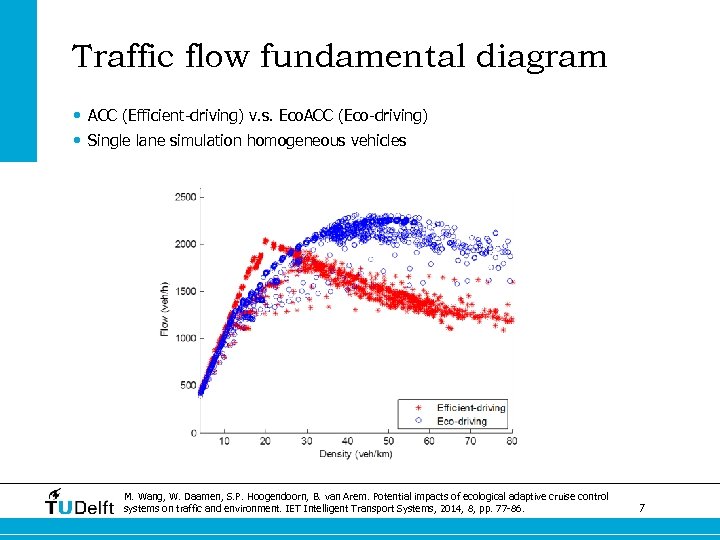 Traffic flow fundamental diagram • ACC (Efficient-driving) v. s. Eco. ACC (Eco-driving) • Single lane simulation homogeneous vehicles M. Wang, W. Daamen, S. P. Hoogendoorn, B. van Arem. Potential impacts of ecological adaptive cruise control systems on traffic and environment. IET Intelligent Transport Systems, 2014, 8, pp. 77 -86. Challenge the future 7
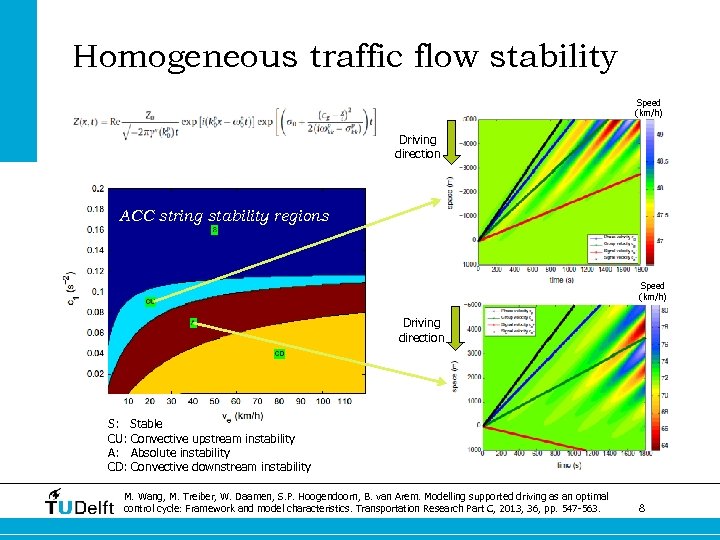 Homogeneous traffic flow stability Speed (km/h) Driving direction ACC string stability regions Speed (km/h) Driving direction S: Stable CU: Convective upstream instability A: Absolute instability CD: Convective downstream instability M. Wang, M. Treiber, W. Daamen, S. P. Hoogendoorn, B. van Arem. Modelling supported driving as an optimal Challenge the future control cycle: Framework and model characteristics. Transportation Research Part C, 2013, 36, pp. 547 -563. 8
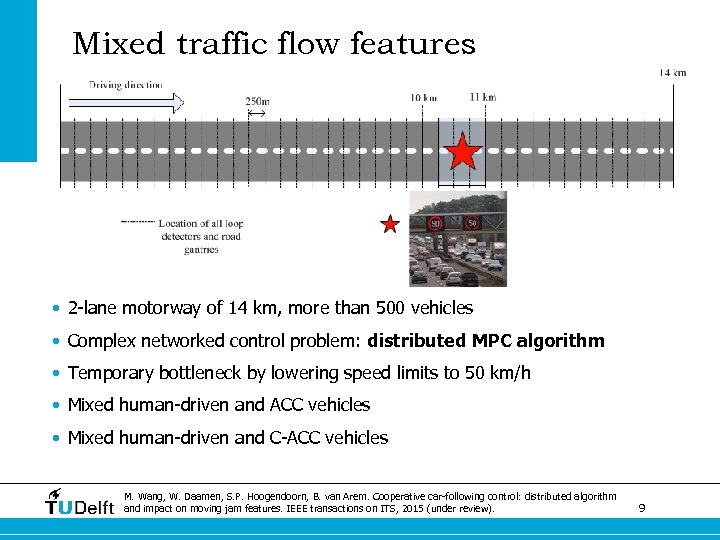 Mixed traffic flow features • 2 -lane motorway of 14 km, more than 500 vehicles • Complex networked control problem: distributed MPC algorithm • Temporary bottleneck by lowering speed limits to 50 km/h • Mixed human-driven and ACC vehicles • Mixed human-driven and C-ACC vehicles M. Wang, W. Daamen, S. P. Hoogendoorn, B. van Arem. Cooperative car-following control: distributed algorithm Challenge the future and impact on moving jam features. IEEE transactions on ITS, 2015 (under review). 9
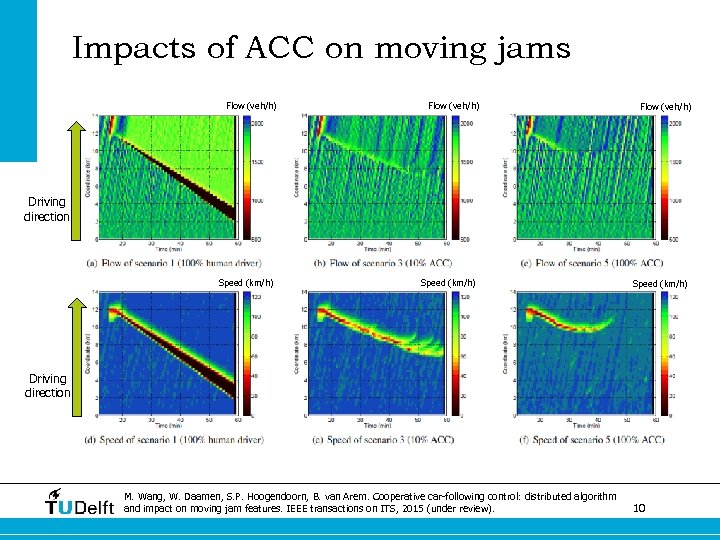 Impacts of ACC on moving jams Flow (veh/h) Driving direction Speed (km/h) Driving direction M. Wang, W. Daamen, S. P. Hoogendoorn, B. van Arem. Cooperative car-following control: distributed algorithm Challenge the future and impact on moving jam features. IEEE transactions on ITS, 2015 (under review). 10
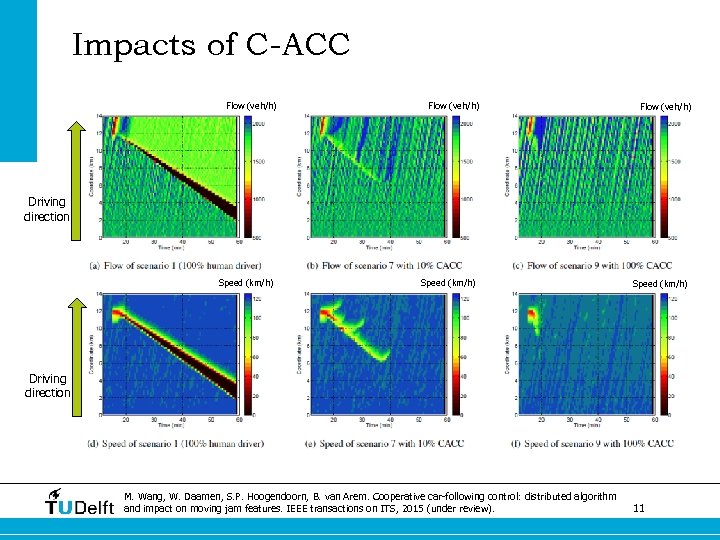 Impacts of C-ACC Flow (veh/h) Driving direction Speed (km/h) Driving direction M. Wang, W. Daamen, S. P. Hoogendoorn, B. van Arem. Cooperative car-following control: distributed algorithm Challenge the future and impact on moving jam features. IEEE transactions on ITS, 2015 (under review). 11
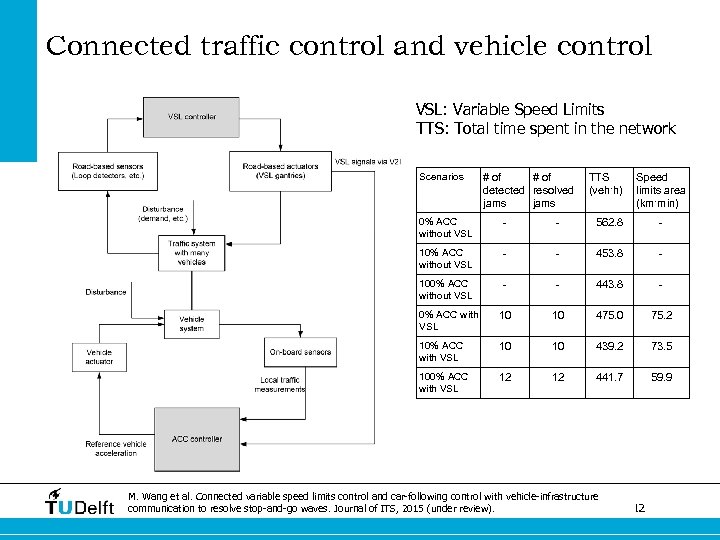 Connected traffic control and vehicle control VSL: Variable Speed Limits TTS: Total time spent in the network Scenarios # of detected resolved jams TTS (veh·h) Speed limits area (km·min) 0% ACC without VSL - - 562. 8 - 10% ACC without VSL - - 453. 8 - 100% ACC without VSL - - 443. 8 - 0% ACC with VSL 10 10 475. 0 75. 2 10% ACC with VSL 10 10 439. 2 73. 5 100% ACC with VSL 12 12 441. 7 59. 9 M. Wang et al. Connected variable speed limits control and car-following control with vehicle-infrastructure Challenge the future communication to resolve stop-and-go waves. Journal of ITS, 2015 (under review). 12
 Summary • A generic control design methodology for a variety of ADAS applications • Implementable algorithms for ACC and C-ACC controllers • Impacts of ACC and C-ACC systems on flow characteristics are substantial, particularly in formation and propagation properties of moving jams • Proposed ACC and C-ACC systems mitigate congestion compared to humandriven vehicles • Connected variable speed limits control with ACC brings extra benefits Challenge the future 13
 Still challenging… • Delay and inaccuracy in the loop • M. Wang, S. P, Hoogendoorn, W. Daamen, B. van Arem, B. Shyrokau, and R. Happee. Delay-compensating strategy to enhance string stability of autonomous vehicle platoons. Transportmetrica B (accepted). • Cooperative merging and lane changing control • M. Wang, S. P, Hoogendoorn, W. Daamen, B. van Arem, and R. Happee. Game theoretic approach for predictive lane-changing and car-following control. Transportation Research Part C, 2015, 58, pp. 73 -92. • Human factors, driver’s role in the future: • Supervising, resume control, safety concern? • Impact assessment • Are microscopic traffic simulation models capable for the job? • Cooperative traffic management • Refine or redesign current traffic management systems? Challenge the future 14
 Thank you! Meng Wang m. wang@tudelft. nl www. mengwang. eu Challenge the future 15