


 Скачать презентацию Controlled Terminologies in Patient Care and Research An
1d3e3452848501fa6a70e3845f656d1c.ppt
- Количество слайдов: 64
 Controlled Terminologies in Patient Care and Research: An Informatics Perspective James J. Cimino, M. D. Department of Biomedical Informatics Columbia University
 Overview • Motivation for data encoding: reuse • Challenges to encoding with controlled terminologies • Approach at Columbia/NY Presbyterian Hospital • Desiderata for controlled terminologies • Successful data reuse at Columbia/NYPH
 Problems We Are Trying to Solve • Collecting data from disparate sources • Aggregating like data • Sharing data • Reusing data – Patient care – Administrative functions – Research – Automated decision support
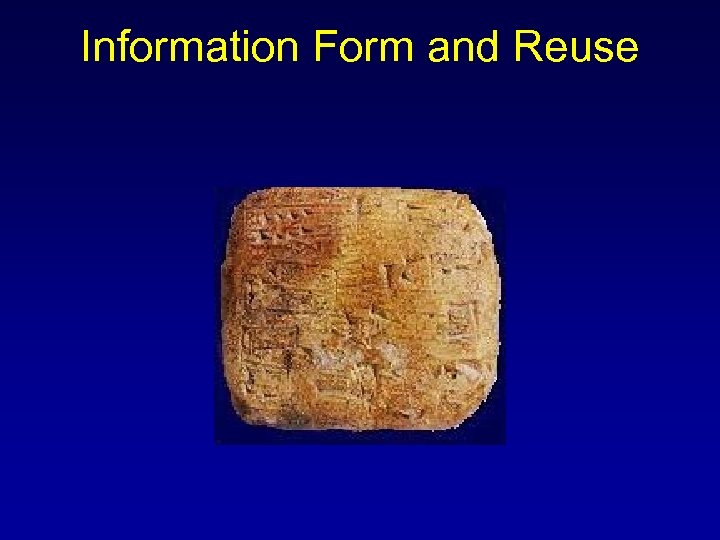 Information Form and Reuse
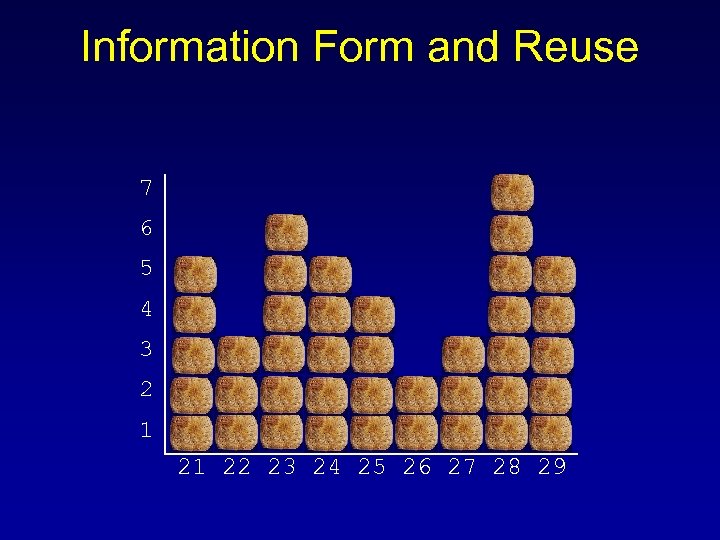 Information Form and Reuse 7 6 5 4 3 2 1 21 22 23 24 25 26 27 28 29
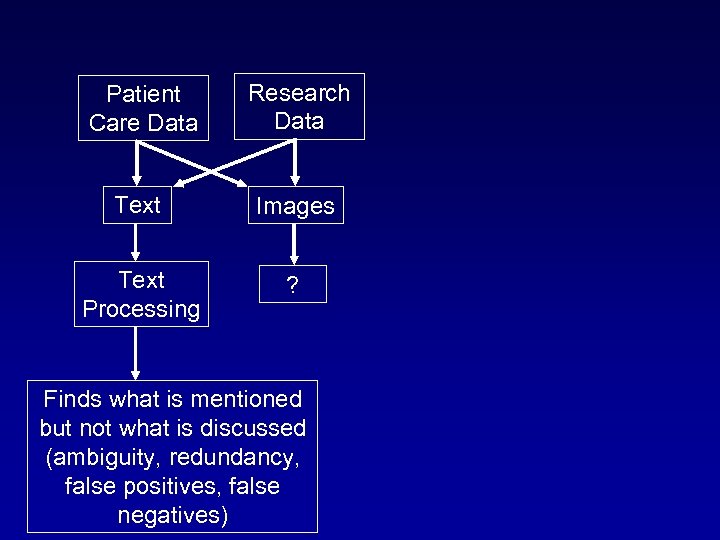 Patient Care Data Research Data Text Images Text Processing ? Finds what is mentioned but not what is discussed (ambiguity, redundancy, false positives, false negatives)
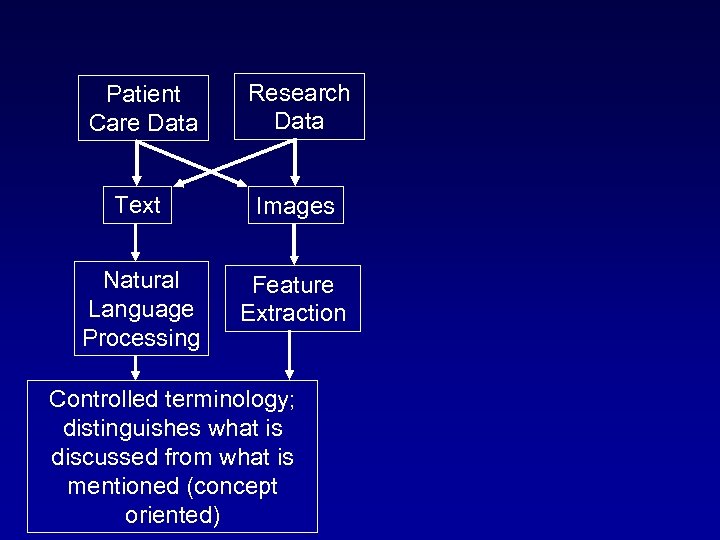 Patient Care Data Research Data Text Images Natural Language Processing Feature Extraction Controlled terminology; distinguishes what is discussed from what is mentioned (concept oriented)
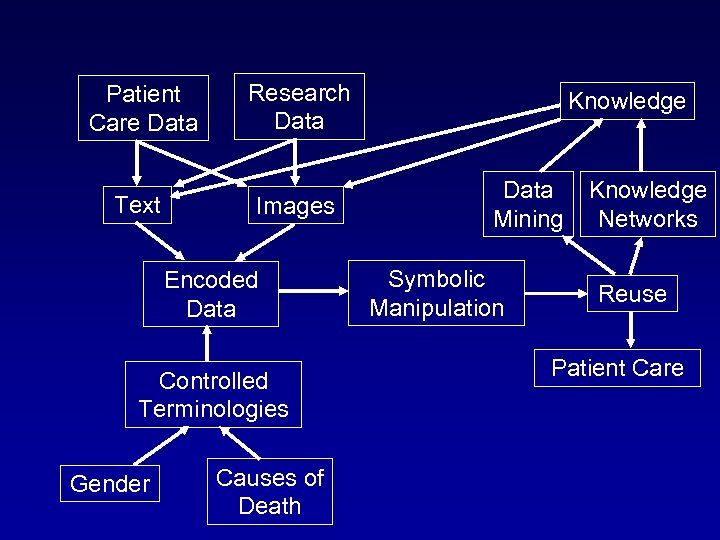 Patient Care Data Text Research Data Images Encoded Data Controlled Terminologies Gender Causes of Death Knowledge Data Mining Symbolic Manipulation Knowledge Networks Reuse Patient Care
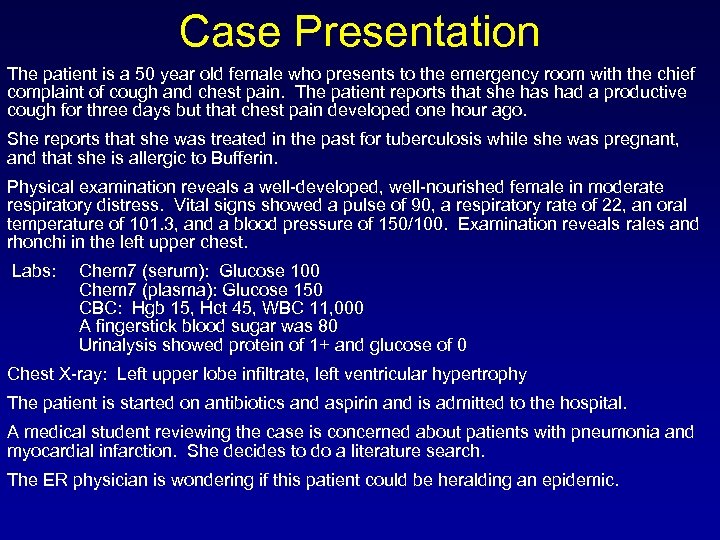 Case Presentation The patient is a 50 year old female who presents to the emergency room with the chief complaint of cough and chest pain. The patient reports that she has had a productive cough for three days but that chest pain developed one hour ago. She reports that she was treated in the past for tuberculosis while she was pregnant, and that she is allergic to Bufferin. Physical examination reveals a well-developed, well-nourished female in moderate respiratory distress. Vital signs showed a pulse of 90, a respiratory rate of 22, an oral temperature of 101. 3, and a blood pressure of 150/100. Examination reveals rales and rhonchi in the left upper chest. Labs: Chem 7 (serum): Glucose 100 Chem 7 (plasma): Glucose 150 CBC: Hgb 15, Hct 45, WBC 11, 000 A fingerstick blood sugar was 80 Urinalysis showed protein of 1+ and glucose of 0 Chest X-ray: Left upper lobe infiltrate, left ventricular hypertrophy The patient is started on antibiotics and aspirin and is admitted to the hospital. A medical student reviewing the case is concerned about patients with pneumonia and myocardial infarction. She decides to do a literature search. The ER physician is wondering if this patient could be heralding an epidemic.
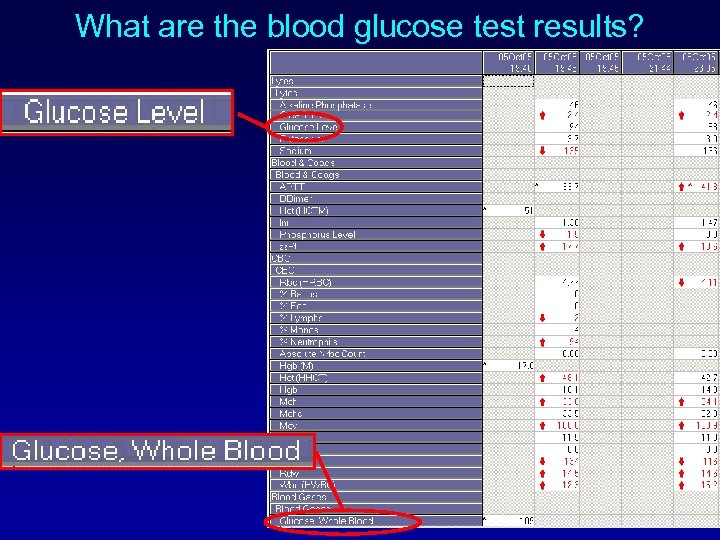
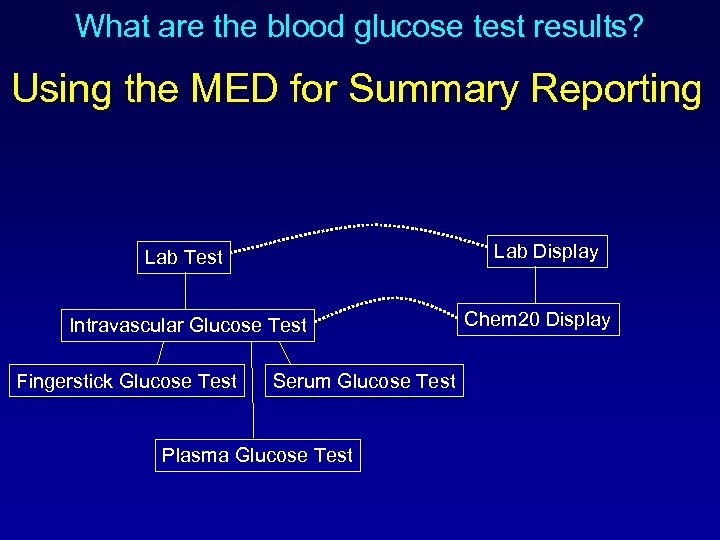
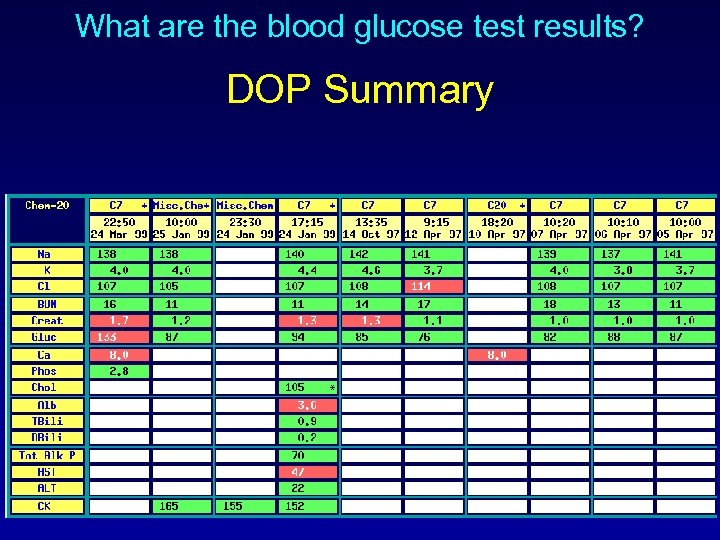
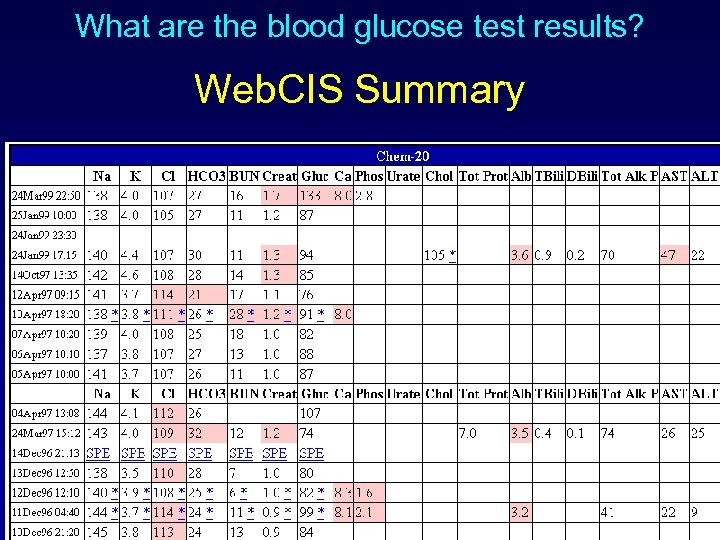
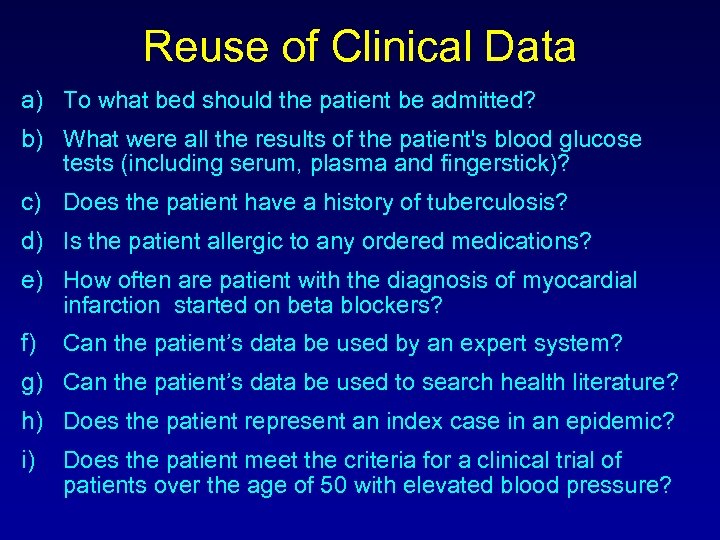 Reuse of Clinical Data a) To what bed should the patient be admitted? b) What were all the results of the patient's blood glucose tests (including serum, plasma and fingerstick)? c) Does the patient have a history of tuberculosis? d) Is the patient allergic to any ordered medications? e) How often are patient with the diagnosis of myocardial infarction started on beta blockers? f) Can the patient’s data be used by an expert system? g) Can the patient’s data be used to search health literature? h) Does the patient represent an index case in an epidemic? i) Does the patient meet the criteria for a clinical trial of patients over the age of 50 with elevated blood pressure?
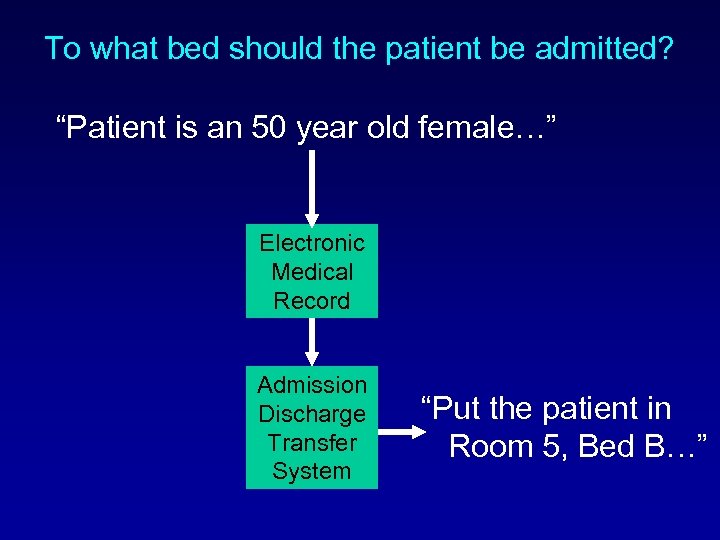 To what bed should the patient be admitted? “Patient is an 50 year old female…” Electronic Medical Record Admission Discharge Transfer System “Put the patient in Room 5, Bed B…”
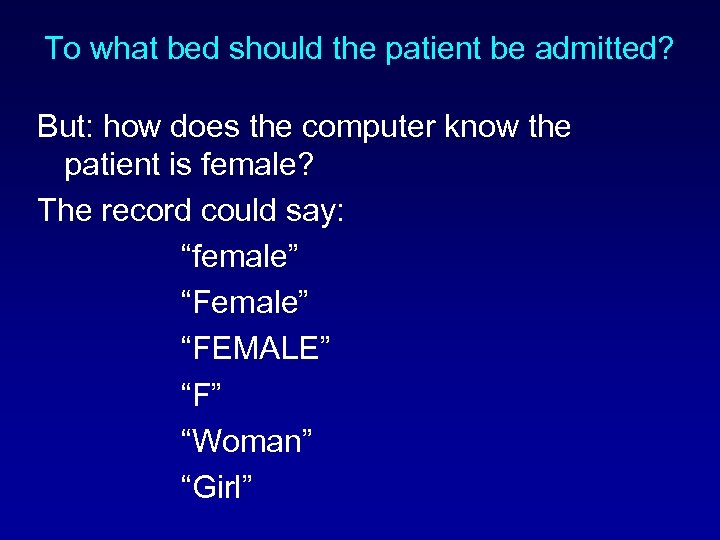 To what bed should the patient be admitted? But: how does the computer know the patient is female? The record could say: “female” “FEMALE” “F” “Woman” “Girl”
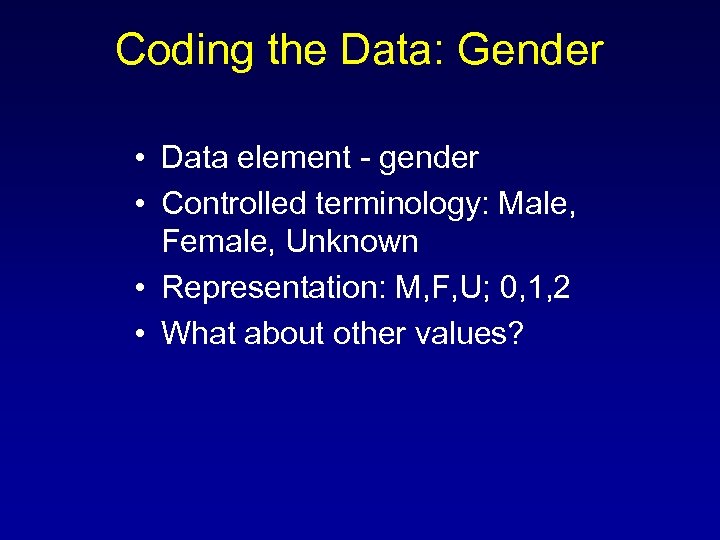 Coding the Data: Gender • Data element - gender • Controlled terminology: Male, Female, Unknown • Representation: M, F, U; 0, 1, 2 • What about other values?
 What’s the Gender?
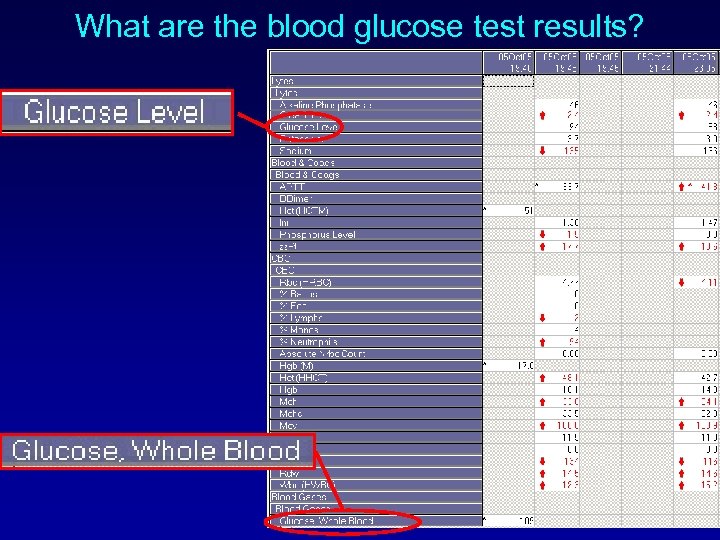 What are the blood glucose test results?
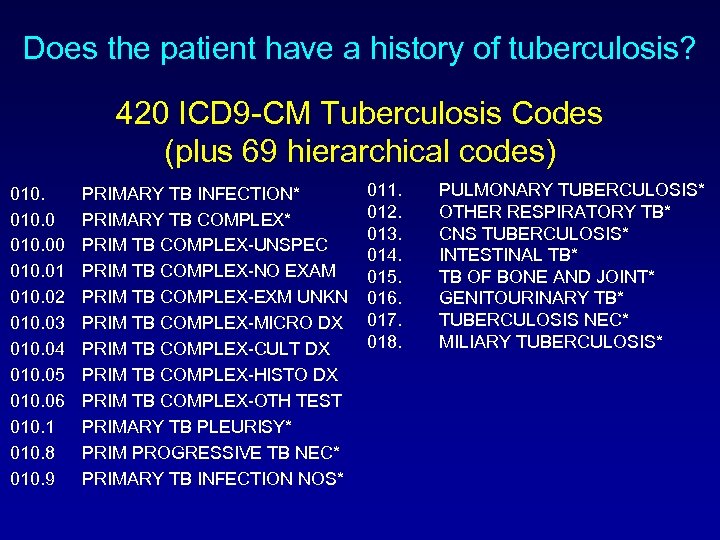 Does the patient have a history of tuberculosis? 420 ICD 9 -CM Tuberculosis Codes (plus 69 hierarchical codes) 010. 01 010. 02 010. 03 010. 04 010. 05 010. 06 010. 1 010. 8 010. 9 PRIMARY TB INFECTION* PRIMARY TB COMPLEX* PRIM TB COMPLEX-UNSPEC PRIM TB COMPLEX-NO EXAM PRIM TB COMPLEX-EXM UNKN PRIM TB COMPLEX-MICRO DX PRIM TB COMPLEX-CULT DX PRIM TB COMPLEX-HISTO DX PRIM TB COMPLEX-OTH TEST PRIMARY TB PLEURISY* PRIM PROGRESSIVE TB NEC* PRIMARY TB INFECTION NOS* 011. 012. 013. 014. 015. 016. 017. 018. PULMONARY TUBERCULOSIS* OTHER RESPIRATORY TB* CNS TUBERCULOSIS* INTESTINAL TB* TB OF BONE AND JOINT* GENITOURINARY TB* TUBERCULOSIS NEC* MILIARY TUBERCULOSIS*
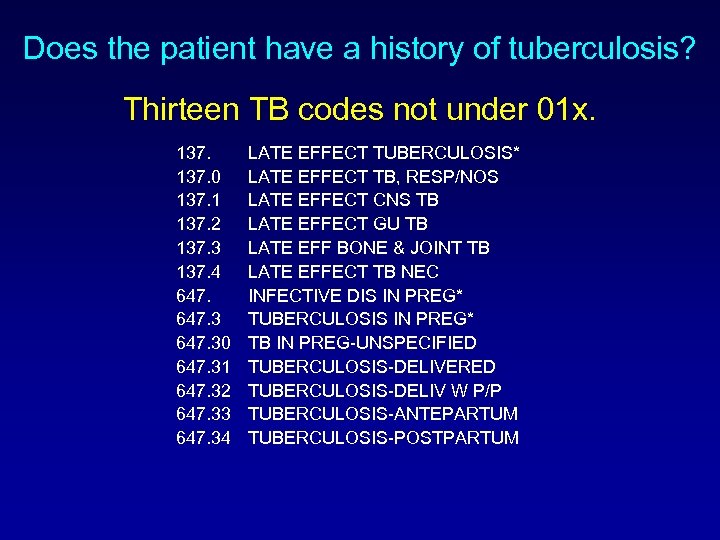 Does the patient have a history of tuberculosis? Thirteen TB codes not under 01 x. 137. 0 137. 1 137. 2 137. 3 137. 4 647. 30 647. 31 647. 32 647. 33 647. 34 LATE EFFECT TUBERCULOSIS* LATE EFFECT TB, RESP/NOS LATE EFFECT CNS TB LATE EFFECT GU TB LATE EFF BONE & JOINT TB LATE EFFECT TB NEC INFECTIVE DIS IN PREG* TUBERCULOSIS IN PREG* TB IN PREG-UNSPECIFIED TUBERCULOSIS-DELIVERED TUBERCULOSIS-DELIV W P/P TUBERCULOSIS-ANTEPARTUM TUBERCULOSIS-POSTPARTUM
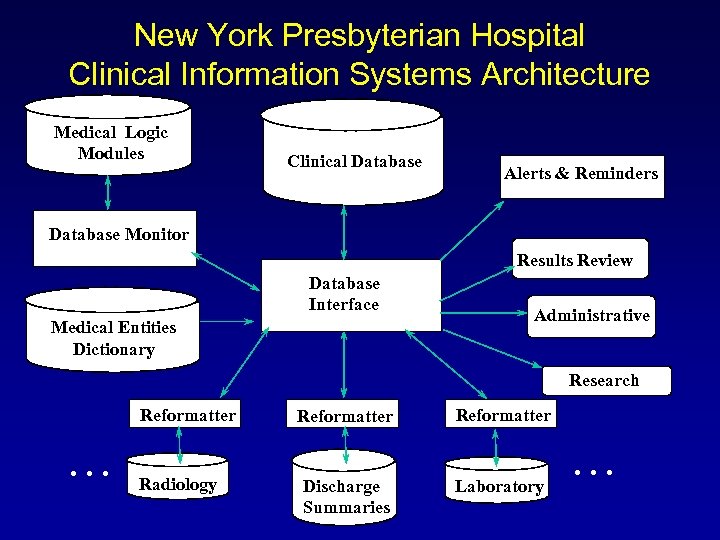 New York Presbyterian Hospital Clinical Information Systems Architecture Medical Logic Modules Clinical Database Alerts & Reminders Database Monitor Results Review Database Interface Medical Entities Dictionary Administrative Research Reformatter . . . Radiology Reformatter Discharge Summaries Reformatter Laboratory . . .
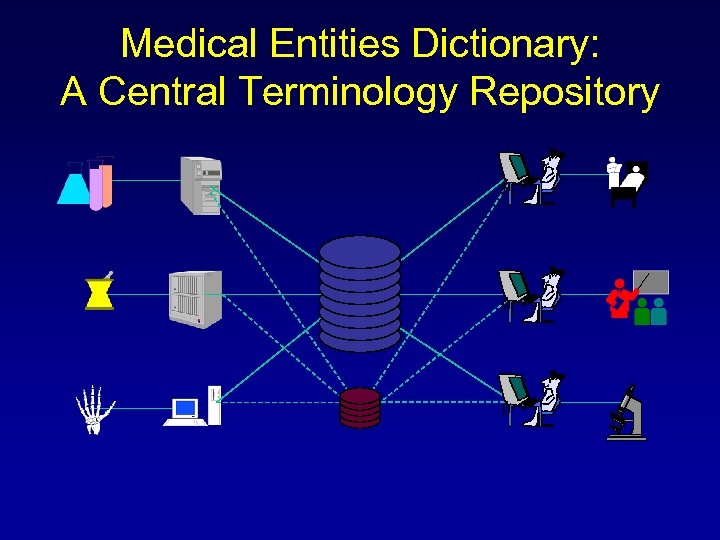 Medical Entities Dictionary: A Central Terminology Repository
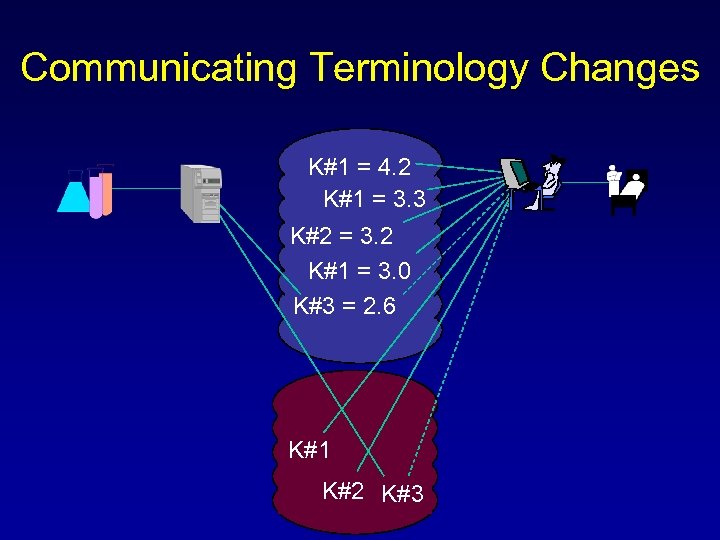 Communicating Terminology Changes K#1 = 4. 2 K#1 = 3. 3 K#2 = 3. 2 K#1 = 3. 0 K#3 = 2. 6 K#1 K#2 K#3
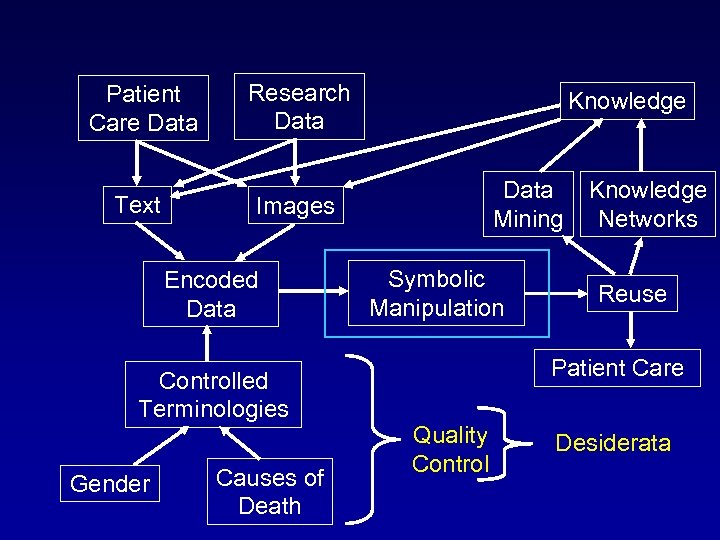 Patient Care Data Text Research Data Mining Images Encoded Data Controlled Terminologies Gender Knowledge Causes of Death Symbolic Manipulation Knowledge Networks Reuse Patient Care Quality Control Desiderata
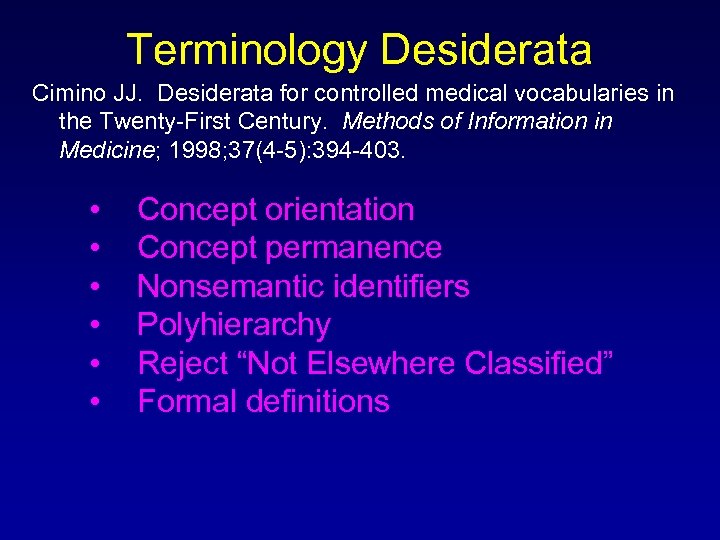 Terminology Desiderata Cimino JJ. Desiderata for controlled medical vocabularies in the Twenty-First Century. Methods of Information in Medicine; 1998; 37(4 -5): 394 -403. • • • Concept orientation Concept permanence Nonsemantic identifiers Polyhierarchy Reject “Not Elsewhere Classified” Formal definitions
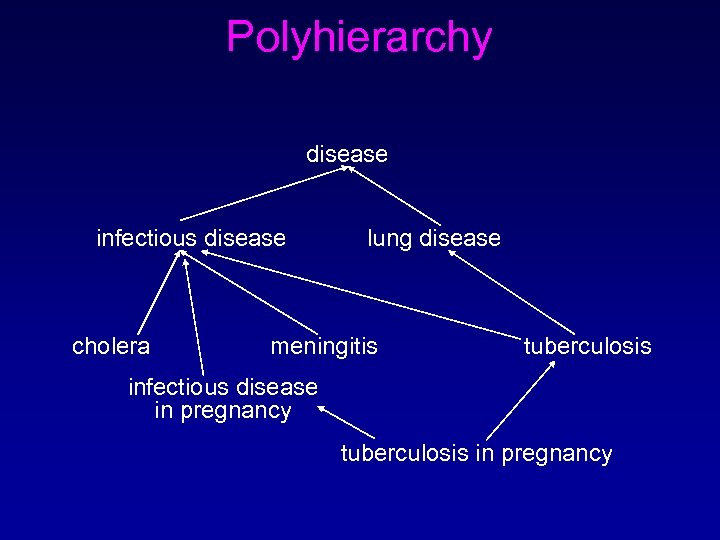 Polyhierarchy disease infectious disease cholera lung disease meningitis tuberculosis infectious disease in pregnancy tuberculosis in pregnancy
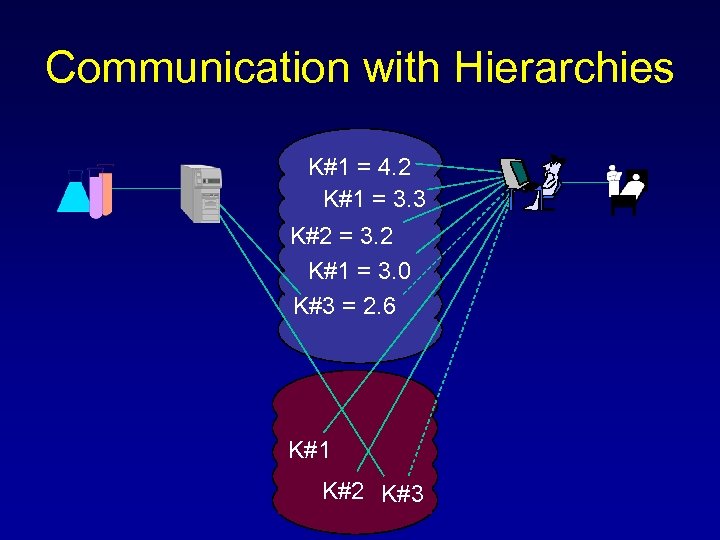 Communication with Hierarchies K#1 = 4. 2 K#1 = 3. 3 K#2 = 3. 2 K#1 = 3. 0 K#3 = 2. 6 K#1 K#2 K#3
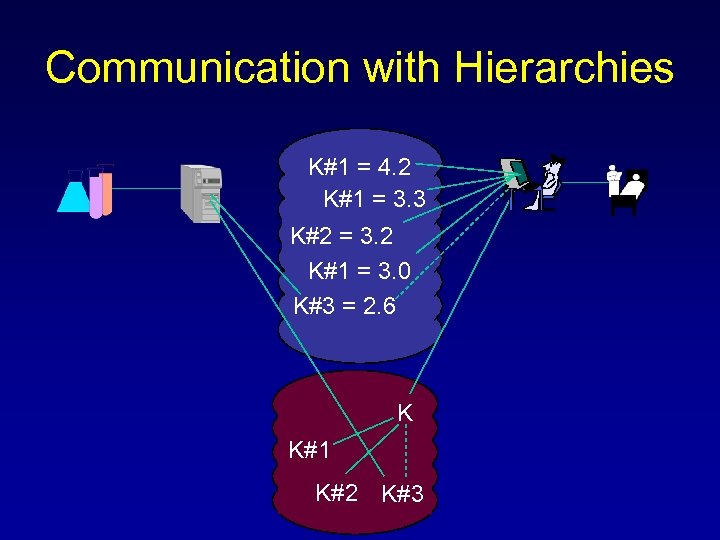 Communication with Hierarchies K#1 = 4. 2 K#1 = 3. 3 K#2 = 3. 2 K#1 = 3. 0 K#3 = 2. 6 K K#1 K#2 K#3
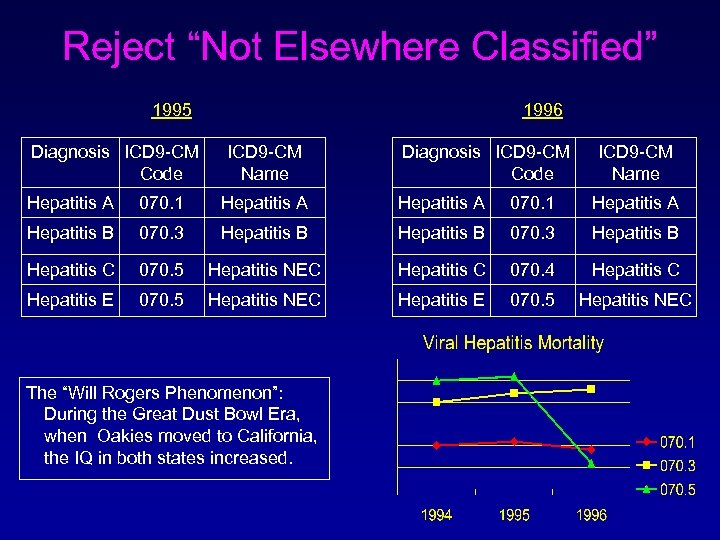 Reject “Not Elsewhere Classified” 1995 Diagnosis ICD 9 -CM Code 1996 ICD 9 -CM Name Diagnosis ICD 9 -CM Code ICD 9 -CM Name Hepatitis A 070. 1 Hepatitis A Hepatitis B 070. 3 Hepatitis B Hepatitis C 070. 5 Hepatitis NEC Hepatitis C 070. 4 Hepatitis C Hepatitis E 070. 5 Hepatitis NEC The “Will Rogers Phenomenon”: During the Great Dust Bowl Era, when Oakies moved to California, the IQ in both states increased.
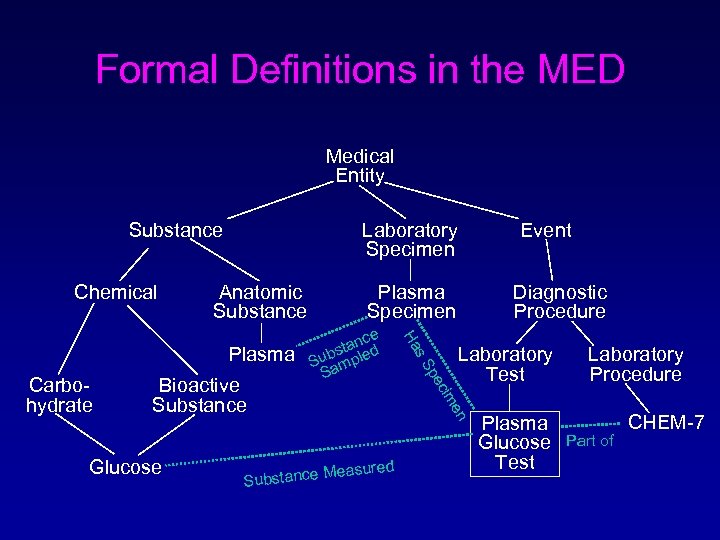 Formal Definitions in the MED Medical Entity Substance Chemical Laboratory Specimen Anatomic Substance sured stance Mea Sub Laboratory Test en Glucose Diagnostic Procedure Laboratory Procedure im Bioactive Substance c pe Carbohydrate ce taned s Sub mpl Sa s. S Ha Plasma Specimen Event Plasma Glucose Test Part of CHEM-7
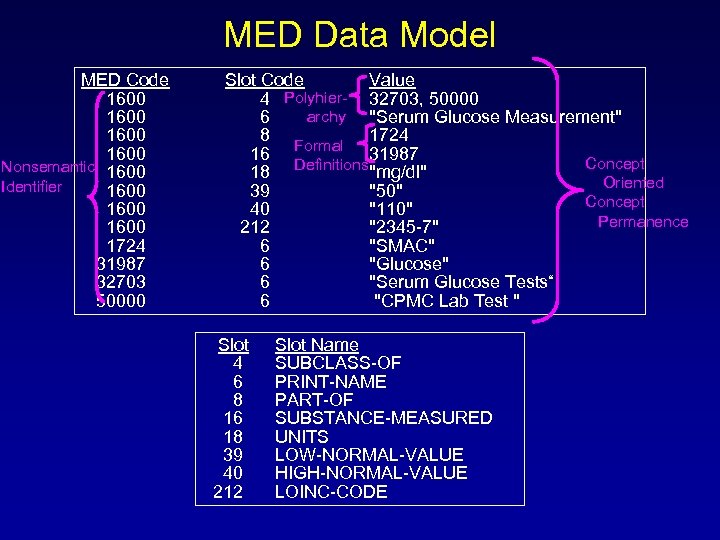 MED Data Model MED Code 1600 Nonsemantic 1600 Identifier 1600 1724 31987 32703 50000 Slot Code Value 4 Polyhier- 32703, 50000 archy "Serum Glucose Measurement" 6 8 1724 Formal 16 31987 Concept Definitions"mg/dl" 18 Oriented 39 "50" Concept 40 "110" Permanence 212 "2345 -7" 6 "SMAC" 6 "Glucose" 6 "Serum Glucose Tests“ 6 "CPMC Lab Test " Slot 4 6 8 16 18 39 40 212 Slot Name SUBCLASS-OF PRINT-NAME PART-OF SUBSTANCE-MEASURED UNITS LOW-NORMAL-VALUE HIGH-NORMAL-VALUE LOINC-CODE
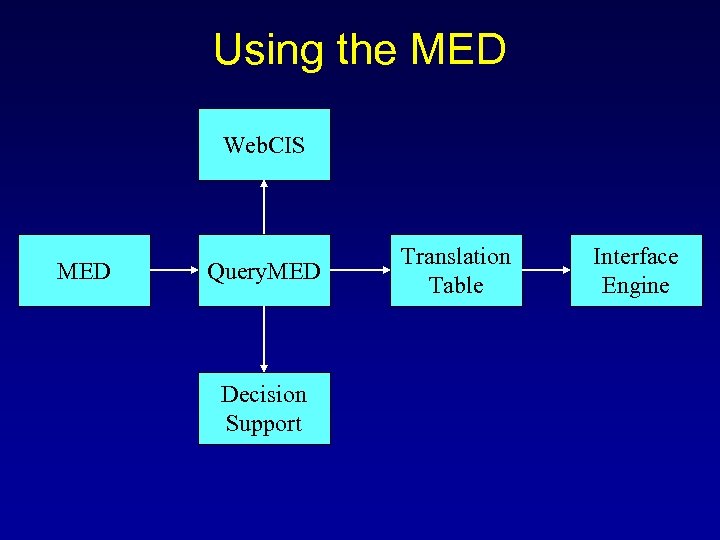 Using the MED Web. CIS MED Query. MED Decision Support Translation Table Interface Engine
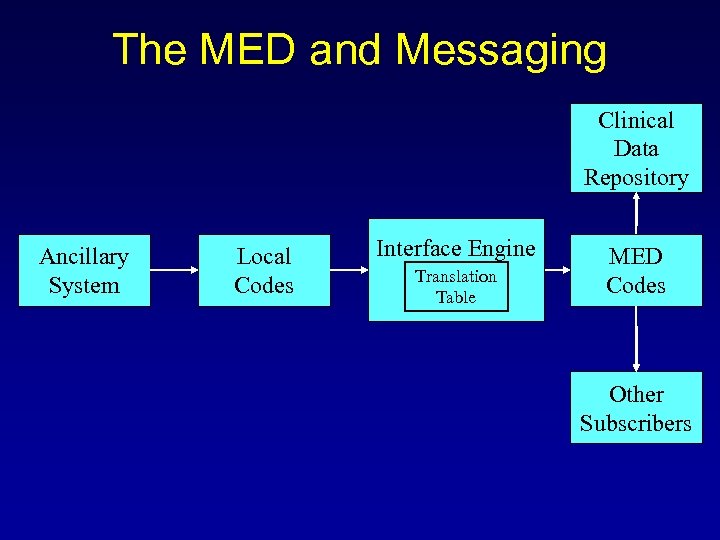 The MED and Messaging Clinical Data Repository Ancillary System Local Codes Interface Engine Translation Table MED Codes Other Subscribers
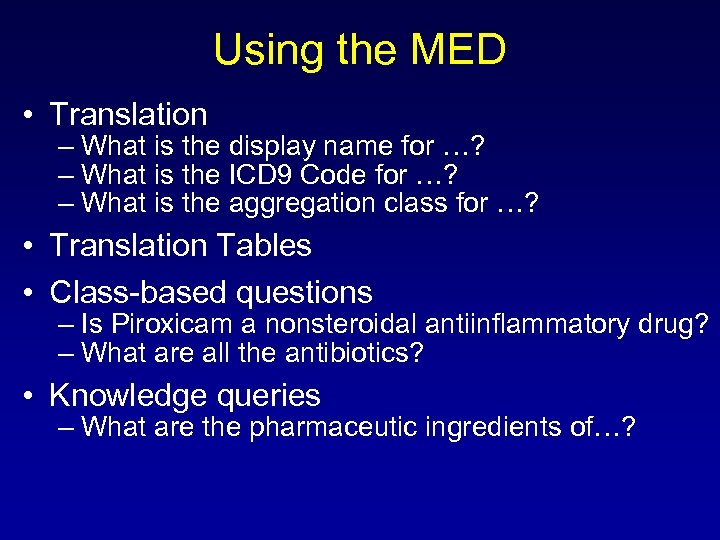 Using the MED • Translation – What is the display name for …? – What is the ICD 9 Code for …? – What is the aggregation class for …? • Translation Tables • Class-based questions – Is Piroxicam a nonsteroidal antiinflammatory drug? – What are all the antibiotics? • Knowledge queries – What are the pharmaceutic ingredients of…?
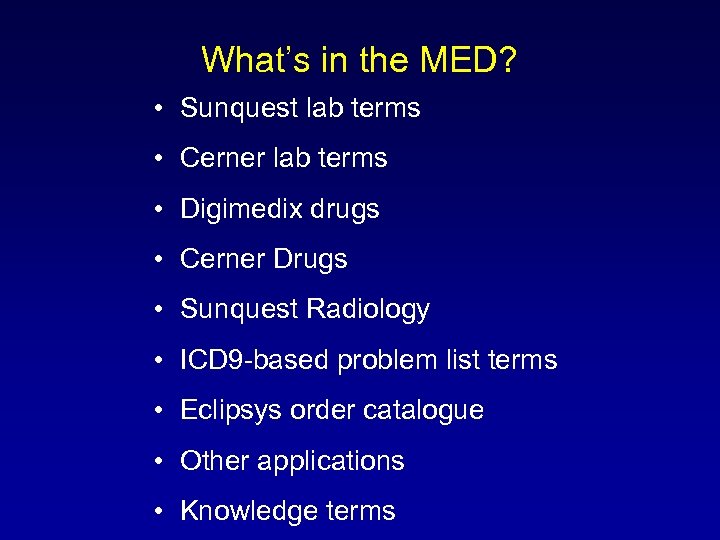 What’s in the MED? • Sunquest lab terms • Cerner lab terms • Digimedix drugs • Cerner Drugs • Sunquest Radiology • ICD 9 -based problem list terms • Eclipsys order catalogue • Other applications • Knowledge terms
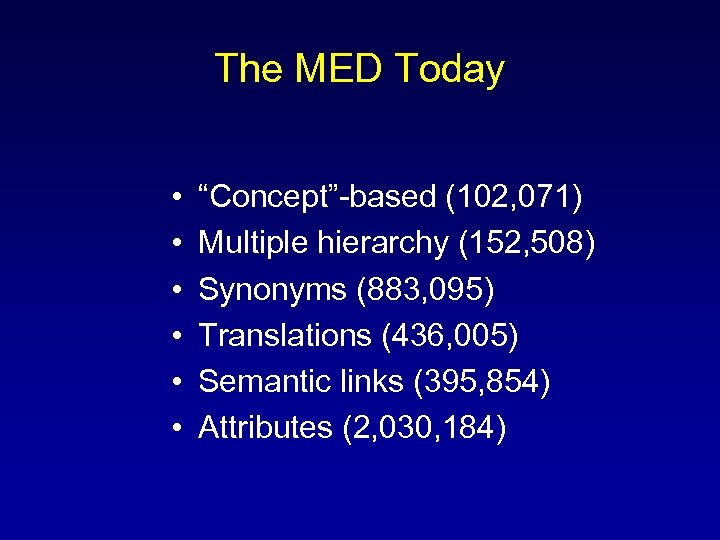 The MED Today • • • “Concept”-based (102, 071) Multiple hierarchy (152, 508) Synonyms (883, 095) Translations (436, 005) Semantic links (395, 854) Attributes (2, 030, 184)
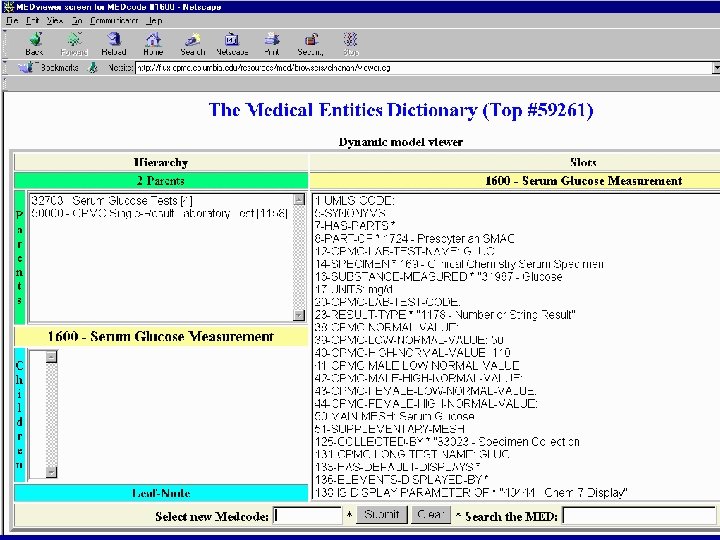
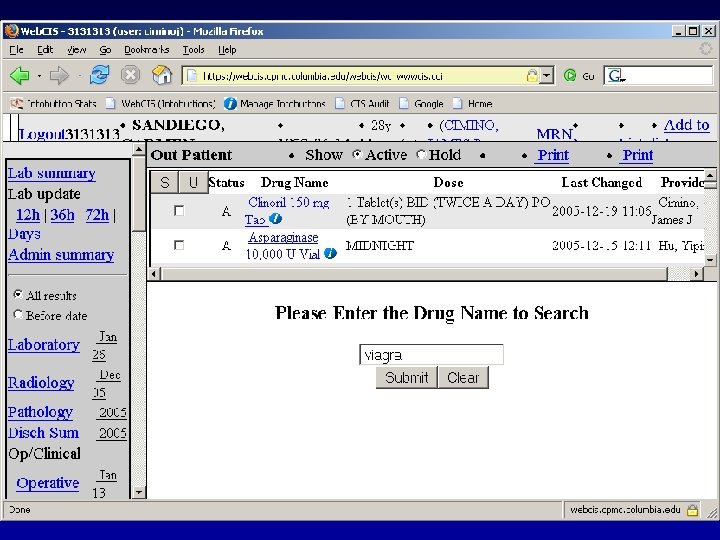
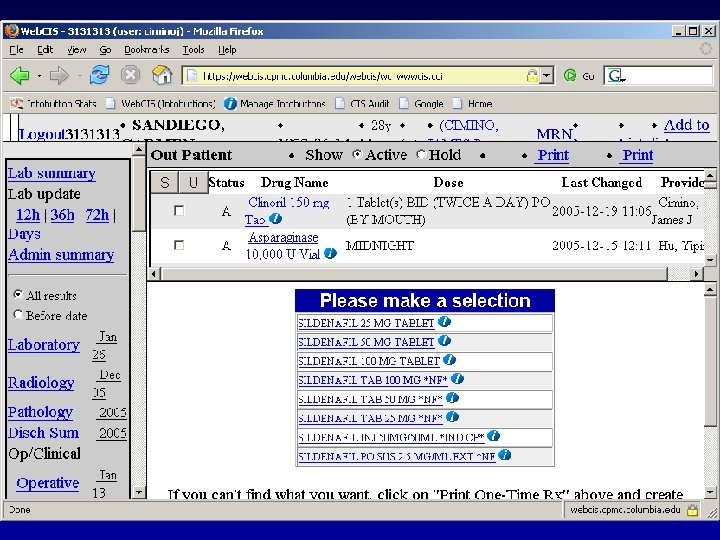
 What are the blood glucose test results?
 What are the blood glucose test results? Using the MED for Summary Reporting Lab Display Lab Test Intravascular Glucose Test Fingerstick Glucose Test Serum Glucose Test Plasma Glucose Test Chem 20 Display
 What are the blood glucose test results? DOP Summary
 What are the blood glucose test results? Web. CIS Summary
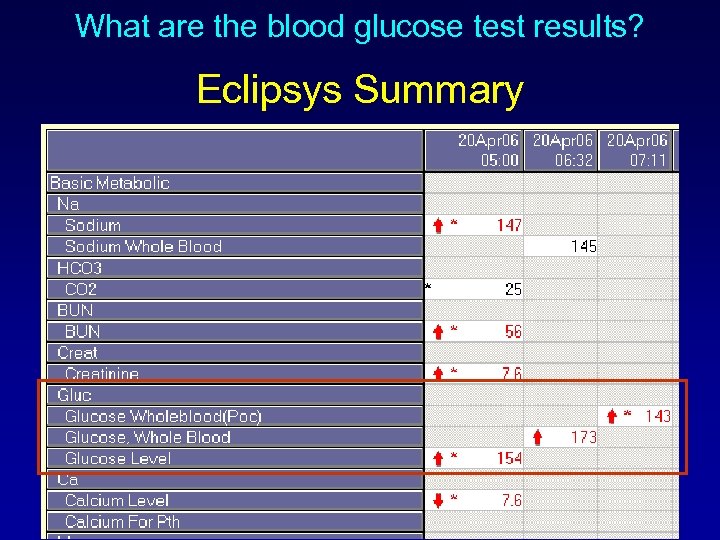 What are the blood glucose test results? Eclipsys Summary
 Adapting to Changing Requirements • • • Labs ordered as panels of tests HCFA will only reimburse for tests Clinicians have to order tests separately But: they want to review them as panels Changing the architecture: – Order tests separately – Group them for display – 2 FTEs – 4 months of work • Solution: 5 minute change in the MED
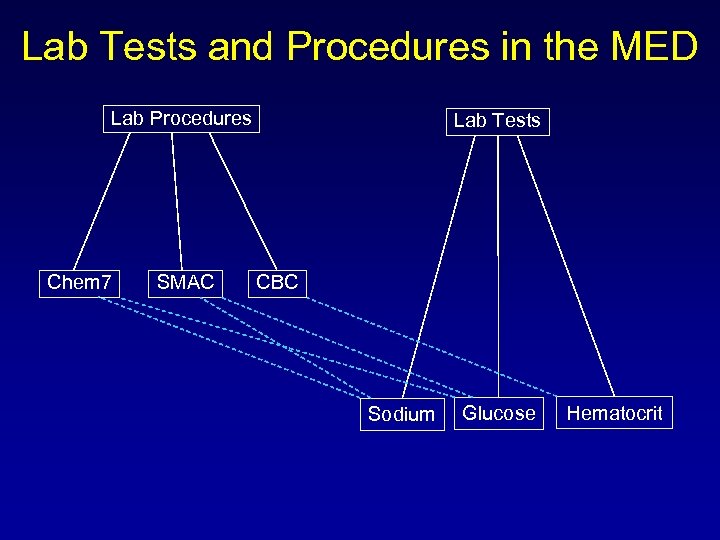 Lab Tests and Procedures in the MED Lab Procedures Chem 7 SMAC Lab Tests CBC Sodium Glucose Hematocrit
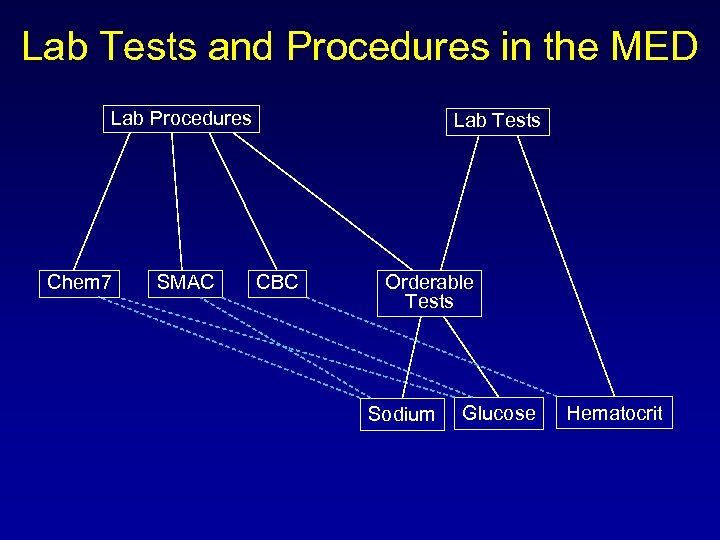 Lab Tests and Procedures in the MED Lab Procedures Chem 7 SMAC Lab Tests CBC Orderable Tests Sodium Glucose Hematocrit
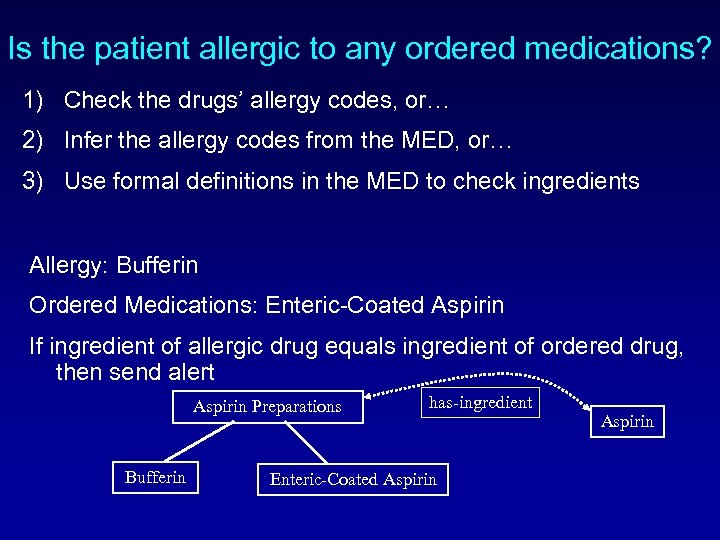 Is the patient allergic to any ordered medications? 1) Check the drugs’ allergy codes, or… 2) Infer the allergy codes from the MED, or… 3) Use formal definitions in the MED to check ingredients Allergy: Bufferin Ordered Medications: Enteric-Coated Aspirin If ingredient of allergic drug equals ingredient of ordered drug, then send alert Aspirin Preparations Bufferin has-ingredient Enteric-Coated Aspirin
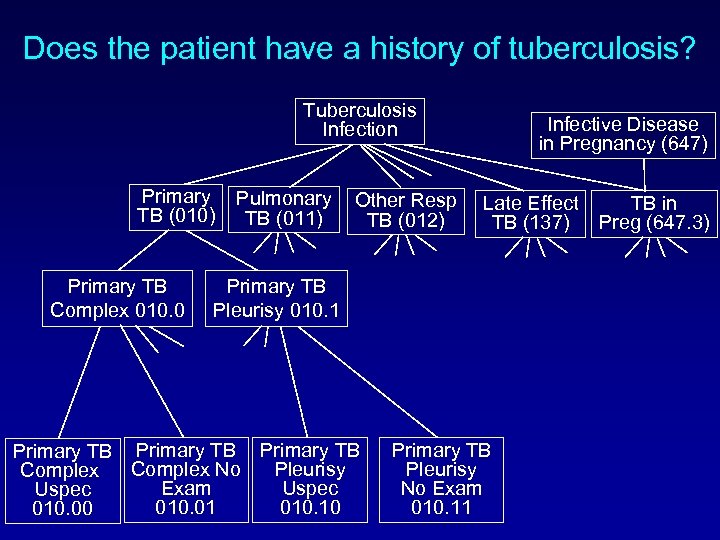 Does the patient have a history of tuberculosis? Tuberculosis Infection Primary TB (010) Primary TB Complex 010. 0 Pulmonary TB (011) Other Resp TB (012) Infective Disease in Pregnancy (647) Late Effect TB (137) Primary TB Pleurisy 010. 1 Primary TB Complex No Pleurisy Complex Exam Uspec 010. 01 010. 10 010. 00 Primary TB Pleurisy No Exam 010. 11 TB in Preg (647. 3)
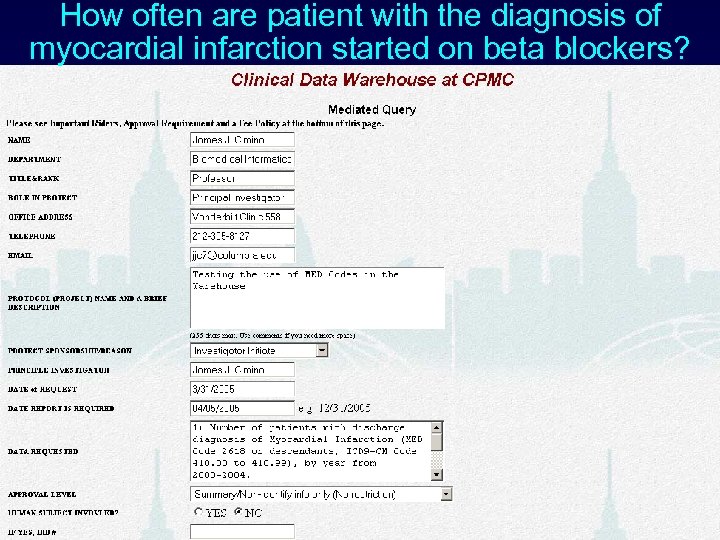 How often are patient with the diagnosis of myocardial infarction started on beta blockers?
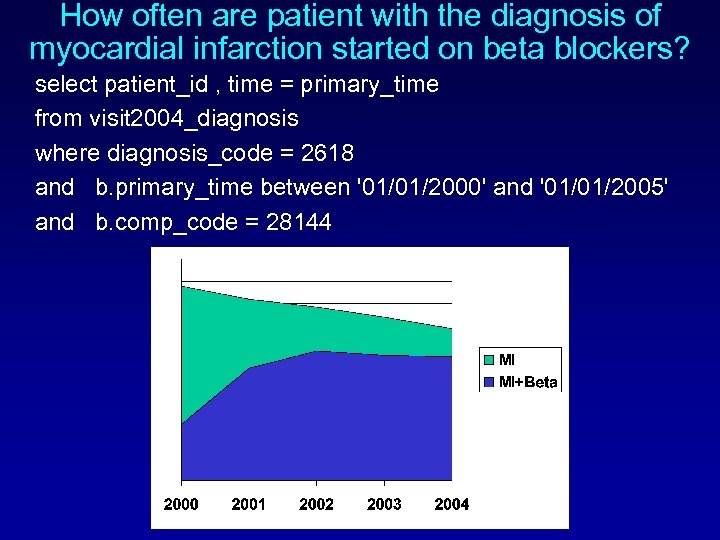 How often are patient with the diagnosis of myocardial infarction started on beta blockers? select patient_id , time = primary_time from visit 2004_diagnosis where diagnosis_code = 2618 and b. primary_time between '01/01/2000' and '01/01/2005' and b. comp_code = 28144
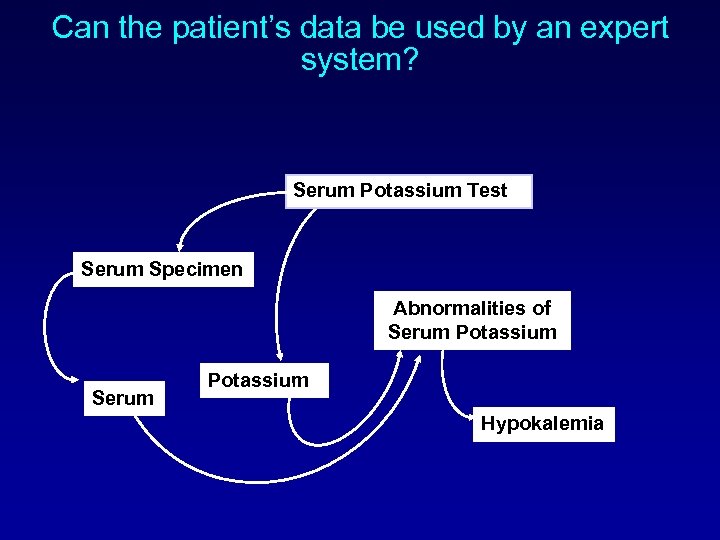 Can the patient’s data be used by an expert system? Serum Potassium Test Serum Specimen Abnormalities of Serum Potassium Hypokalemia
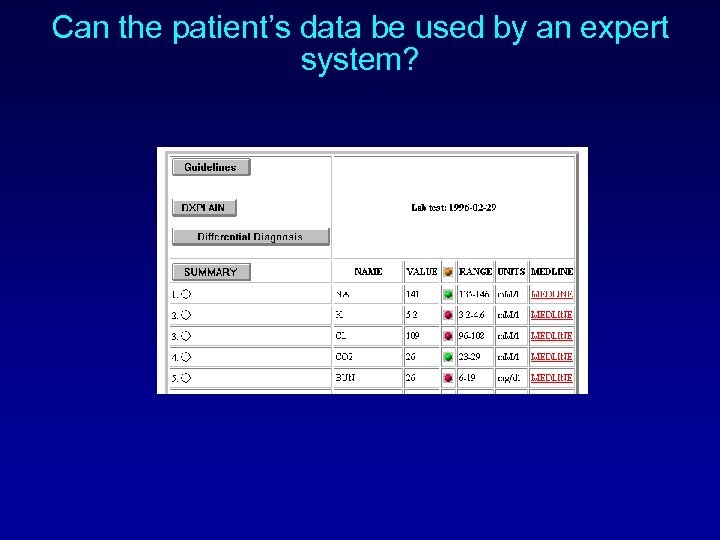 Can the patient’s data be used by an expert system?
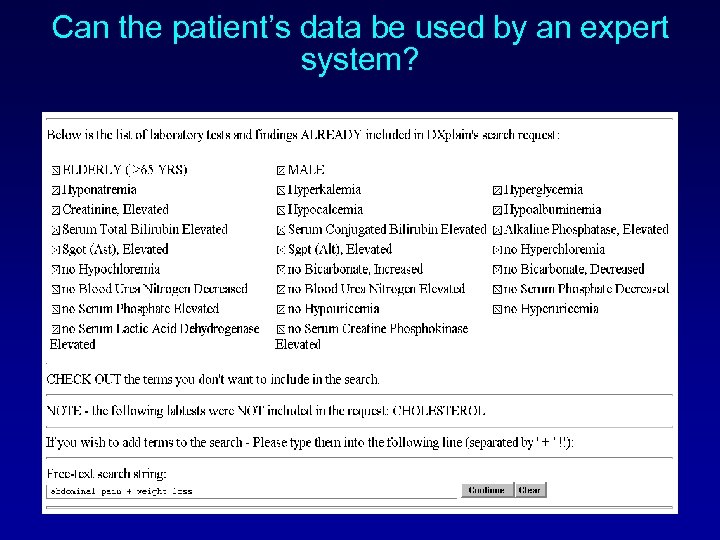 Can the patient’s data be used by an expert system?
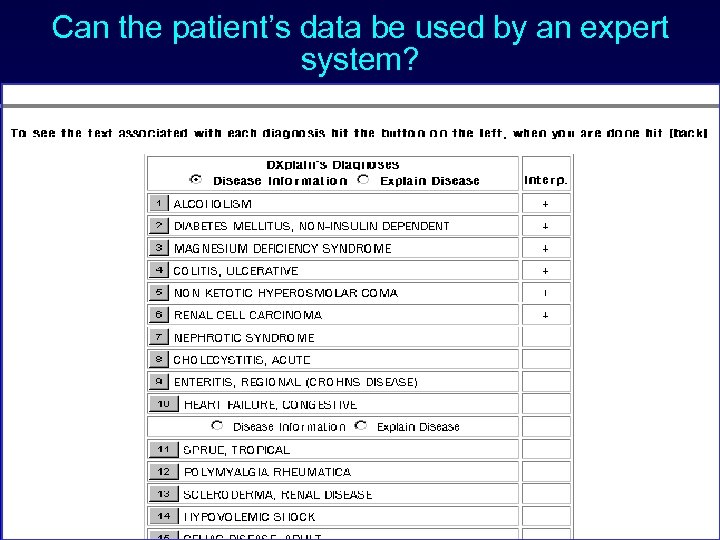 Can the patient’s data be used by an expert system?
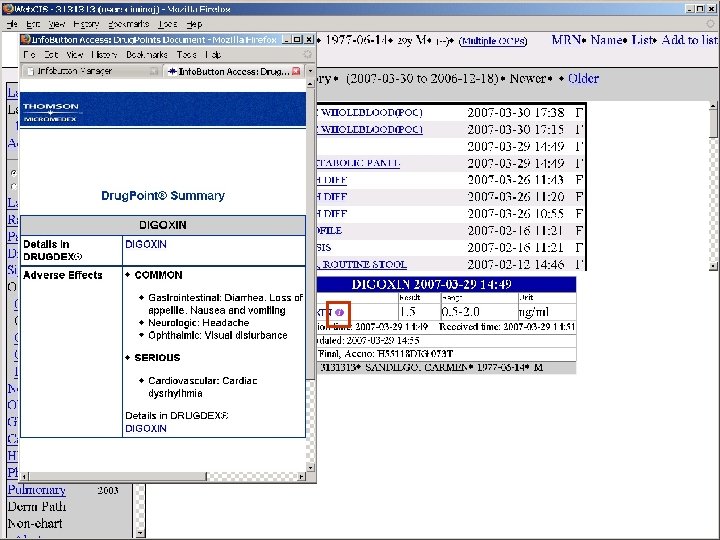
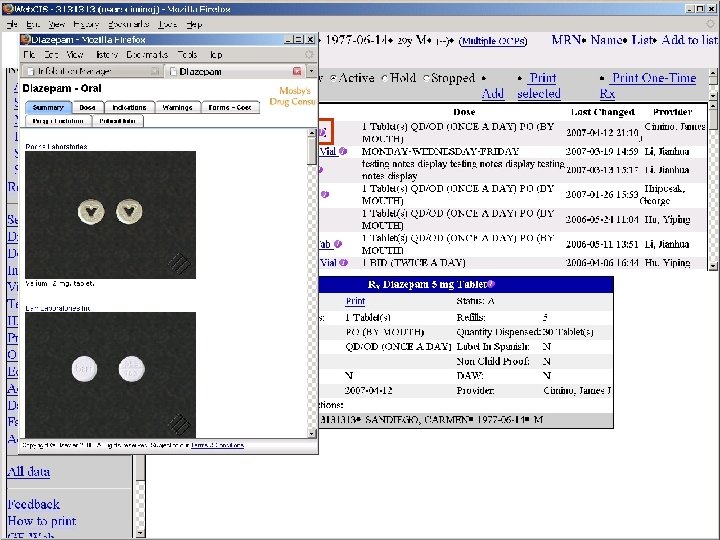
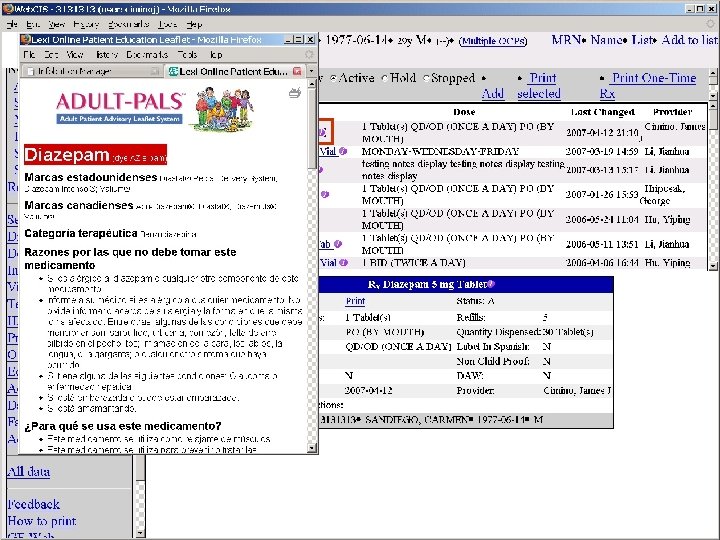
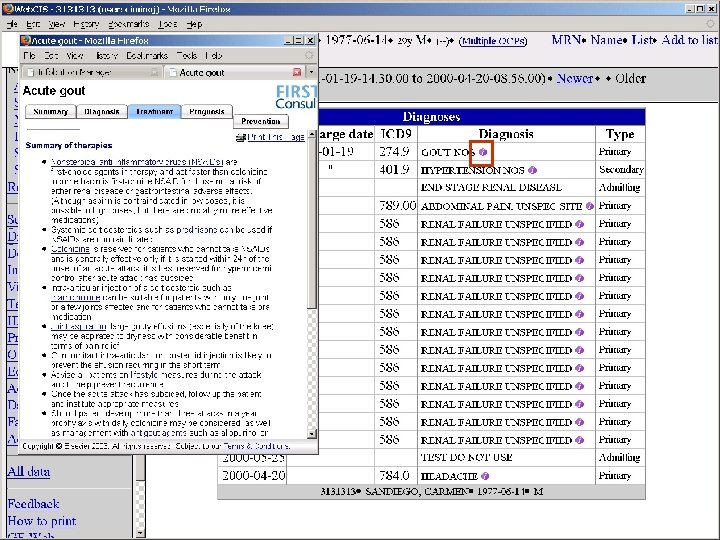
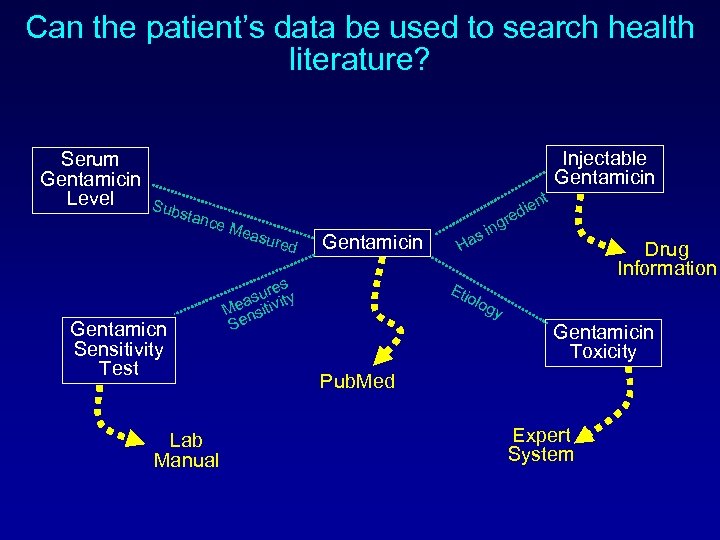 Can the patient’s data be used to search health literature? Serum Gentamicin Level Injectable Gentamicin Sub t stan re ce M easu r ed Gentamicn Sensitivity Test Lab Manual n die Gentamicin es sur vity a Me nsiti Se g s in Ha Drug Information Eti olo gy Gentamicin Toxicity Pub. Med Expert System
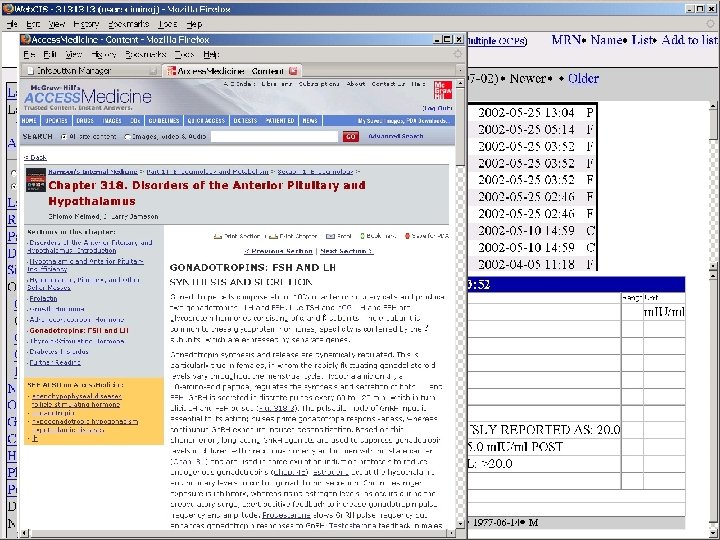
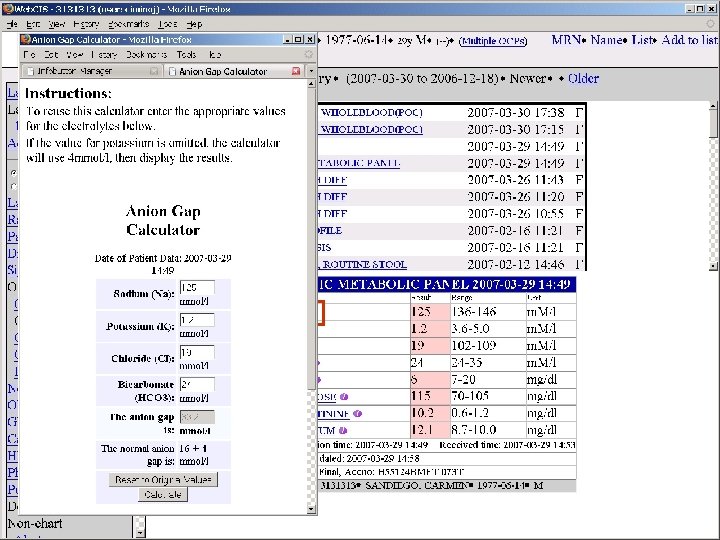
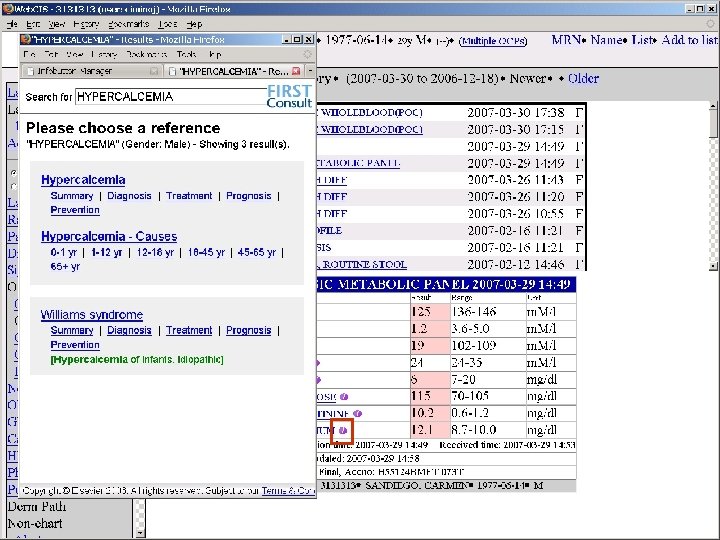
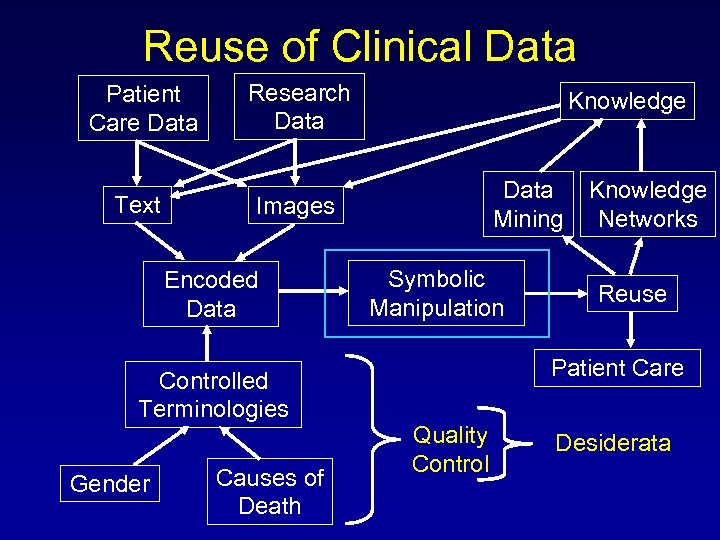 Reuse of Clinical Data Patient Care Data Text Research Data Mining Images Encoded Data Controlled Terminologies Gender Knowledge Causes of Death Symbolic Manipulation Knowledge Networks Reuse Patient Care Quality Control Desiderata
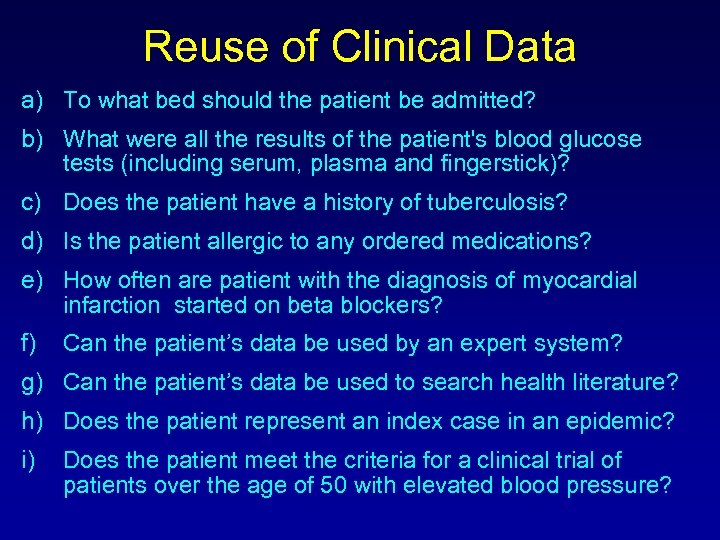 Reuse of Clinical Data a) To what bed should the patient be admitted? b) What were all the results of the patient's blood glucose tests (including serum, plasma and fingerstick)? c) Does the patient have a history of tuberculosis? d) Is the patient allergic to any ordered medications? e) How often are patient with the diagnosis of myocardial infarction started on beta blockers? f) Can the patient’s data be used by an expert system? g) Can the patient’s data be used to search health literature? h) Does the patient represent an index case in an epidemic? i) Does the patient meet the criteria for a clinical trial of patients over the age of 50 with elevated blood pressure?
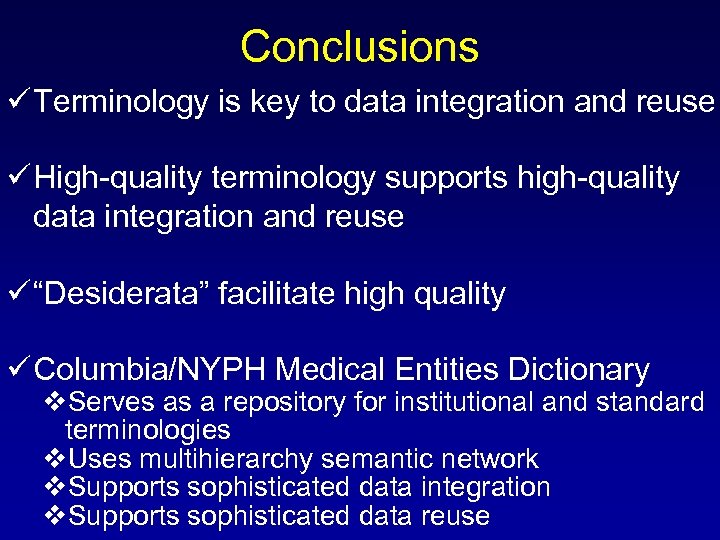 Conclusions ü Terminology is key to data integration and reuse ü High-quality terminology supports high-quality data integration and reuse ü “Desiderata” facilitate high quality ü Columbia/NYPH Medical Entities Dictionary v. Serves as a repository for institutional and standard terminologies v. Uses multihierarchy semantic network v. Supports sophisticated data integration v. Supports sophisticated data reuse
 Questions?