 Скачать презентацию Controllable Growth of Carbon Nano-Onions for Developing High-Performance
bee913687db346bd8bdbdb57906edc06.ppt
- Количество слайдов: 1



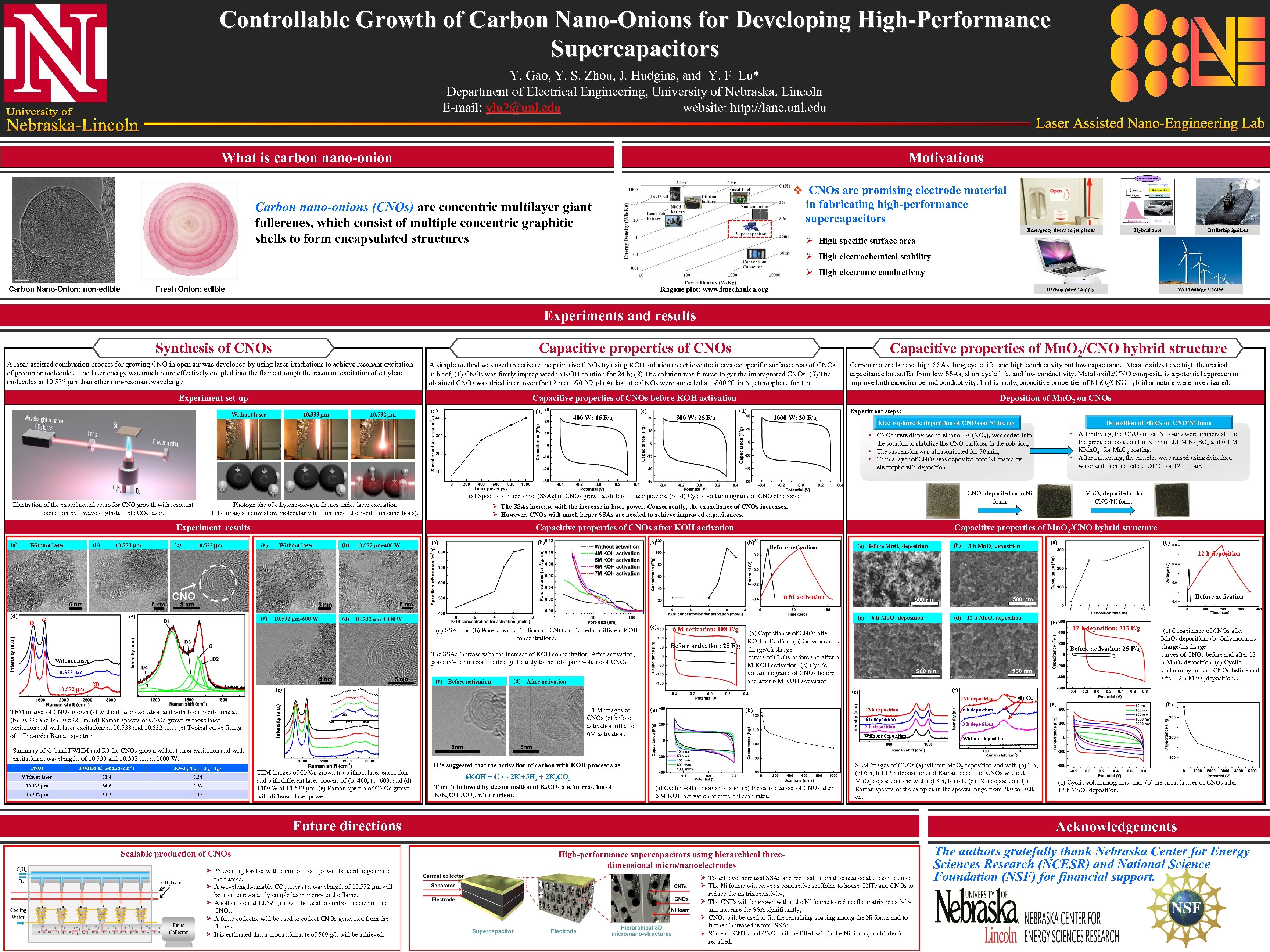
Controllable Growth of Carbon Nano-Onions for Developing High-Performance Supercapacitors Y. Gao, Y. S. Zhou, J. Hudgins, and Y. F. Lu* Department of Electrical Engineering, University of Nebraska, Lincoln E-mail: ylu 2@unl. edu website: http: //lane. unl. edu What is carbon nano-onion Motivations v CNOs are promising electrode material in fabricating high-performance supercapacitors Carbon nano-onions (CNOs) are concentric multilayer giant fullerenes, which consist of multiple concentric graphitic shells to form encapsulated structures Emergency doors on jet planes Hybrid auto Battleship ignition Ø High specific surface area Ø High electrochemical stability Ø High electronic conductivity Carbon Nano-Onion: non-edible Ragone plot: www. imechanica. org Fresh Onion: edible Backup power supply Wind energy storage Experiments and results Capacitive properties of CNOs Synthesis of CNOs A laser-assisted combustion process for growing CNO in open air was developed by using laser irradiations to achieve resonant excitation of precursor molecules. The laser energy was much more effectively coupled into the flame through the resonant excitation of ethylene molecules at 10. 532 µm than other non-resonant wavelength. Capacitive properties of Mn. O 2/CNO hybrid structure A simple method was used to activate the primitive CNOs by using KOH solution to achieve the increased specific surface areas of CNOs. In brief, (1) CNOs was firstly impregnated in KOH solution for 24 h; (2) The solution was filtered to get the impregnated CNOs. (3) The obtained CNOs was dried in an oven for 12 h at ~90 ℃; (4) At last, the CNOs were annealed at ~800 ℃ in N 2 atmosphere for 1 h. Experiment set-up Carbon materials have high SSAs, long cycle life, and high conductivity but low capacitance. Metal oxides have high theoretical capacitance but suffer from low SSAs, short cycle life, and low conductivity. Metal oxide/CNO composite is a potential approach to improve both capacitance and conductivity. In this study, capacitive properties of Mn. O 2/CNO hybrid structure were investigated. Capacitive properties of CNOs before KOH activation 10. 333 m Without laser (a) 10. 532 m (b) 400 W: 16 F/g (c) 800 W: 25 F/g Deposition of Mn. O 2 on CNOs (d) 1000 W: 30 F/g Experiment steps: Deposition of Mn. O 2 on CNO/Ni foam Electrophoretic deposition of CNOs on Ni foams • After drying, the CNO coated Ni foams were immersed into the precursor solution ( mixture of 0. 1 M Na 2 SO 4 and 0. 1 M KMn. O 4) for Mn. O 2 coating. • After immersing, the samples were rinsed using deionized water and then heated at 120 ℃ for 12 h in air. • CNOs were dispersed in ethanol. Al(NO 3)3 was added into the solution to stabilize the CNO particles in the solution; • The suspension was ultrasonicated for 30 min; • Then a layer of CNOs was deposited onto Ni foams by electrophoretic deposition. CNOs deposited onto Ni foam (a) Specific surface areas (SSAs) of CNOs grown at different laser powers. (b - d) Cyclic voltammograms of CNO electrodes. Illustration of the experimental setup for CNO growth with resonant excitation by a wavelength-tunable CO 2 laser. Photographs of ethylene-oxygen flames under laser excitation (The images below show molecular vibration under the excitation conditions). Ø The SSAs increase with the increase in laser power. Consequently, the capacitance of CNOs increases. Ø However, CNOs with much larger SSAs are needed to achieve improved capacitances. Experiment results (a) 10. 333 m (b) Without laser (c) 10. 532 m Capacitive properties of CNOs after KOH activation (a) (b) Without laser 10. 532 µm-400 W (a) (b) Capacitive properties of Mn. O 2/CNO hybrid structure (b) Before activation (d) D (e) G (c) (d) 10. 532 µm-600 W (a) SSAs and (b) Pore size distributions of CNOs activated at different KOH concentrations. (c) 6 M activation: 108 F/g Before activation: 25 F/g The SSAs increase with the increase of KOH concentration. After activation, pores (<= 5 nm) contribute significantly to the total pore volume of CNOs. Without laser 10. 333 m 10. 532 m 5 nm 2 D 5 nm (c) Before activation (d) After activation 5 nm Summary of G-band FWHM and R 3 for CNOs grown without laser excitation and with excitation at wavelengths of 10. 333 and 10. 532 µm at 1000 W. CNOs FWHM of G-band (cm-1) R 3=ID 3/( ID 3 +ID 2 +IG) Without laser 71. 4 0. 24 10. 333 m 64. 6 0. 23 10. 532 m 59. 5 0. 19 (a) 12 h deposition Ø 25 welding torches with 3 mm orifice tips will be used to generate the flames. Ø A wavelength-tunable CO 2 laser at a wavelength of 10. 532 µm will be used to resonantly couple laser energy to the flame. Ø Another laser at 10. 591 µm will be used to control the size of the CNOs. Ø A fume collector will be used to collect CNOs generated from the flames. Ø It is estimated that a production rate of 500 g/h will be achieved. (c) 12 h deposition: 313 F/g (a) Capacitance of CNOs after Mn. O 2 deposition. (b) Galvanostatic charge/discharge curves of CNOs before and after 12 h Mn. O 2 deposition. (c) Cyclic voltammograms of CNOs before and after 12 h Mn. O 2 deposition. . (a) (b) 3 h deposition Without deposition 5 nm 6 KOH + C ↔ 2 K +3 H 2 + 2 K 2 CO 3 Then it followed by decomposition of K 2 CO 3 and/or reaction of K/K 2 CO 3/CO 2, with carbon. (a) Cyclic voltammograms and (b) the capacitances of CNOs after 6 M KOH activation at different scan rates. SEM images of CNOs (a) without Mn. O 2 deposition and with (b) 3 h, (c) 6 h, (d) 12 h deposition. (e) Raman spectra of CNOs without Mn. O 2 deposition and with (b) 3 h, (c) 6 h, (d) 12 h deposition. (f) Raman spectra of the samples in the spectra range from 200 to 1000 cm-1. Future directions Scalable production of CNOs Mn. O 2 6 h deposition Without deposition It is suggested that the activation of carbon with KOH proceeds as TEM images of CNOs grown (a) without laser excitation and with different laser powers of (b) 400, (c) 600, and (d) 1000 W at 10. 532 µm. (e) Raman spectra of CNOs grown with different laser powers. Before activation (f) 6 h deposition 3 h deposition (b) 12 h deposition 500 nm 12 h deposition TEM images of CNOs (c) before activation (d) after 6 M activation. (b) Before activation: 25 F/g (e) TEM images of CNOs grown (a) without laser excitation and with laser excitations at (b) 10. 333 and (c) 10. 532 µm. (d) Raman spectra of CNOs grown without laser excitation and with laser excitations at 10. 333 and 10. 532 µm. (e) Typical curve fitting of a first-order Raman spectrum. (a) 500 nm (d) 12 h Mn. O 2 deposition 6 h Mn. O 2 deposition (a) Capacitance of CNOs after KOH activation. (b) Galvanostatic charge/discharge curves of CNOs before and after 6 M KOH activation. (c) Cyclic voltammograms of CNOs before and after 6 M KOH activation. (e) 3 h Mn. O 2 deposition 500 nm 5 nm (b) (a) Before Mn. O 2 deposition 6 M activation 5 nm Mn. O 2 deposited onto CNO/Ni foam (a) Cyclic voltammograms and (b) the capacitances of CNOs after 12 h Mn. O 2 deposition. Acknowledgements High-performance supercapacitors using hierarchical threedimensional micro/nanoelectrodes Ø To achieve increased SSAs and reduced internal resistance at the same time; Ø The Ni foams will serve as conductive scaffolds to house CNTs and CNOs to reduce the matrix resistivity; Ø The CNTs will be grown within the Ni foams to reduce the matrix resistivity and increase the SSA significantly; Ø CNOs will be used to fill the remaining spacing among the Ni forms and to further increase the total SSA; Ø Since all CNTs and CNOs will be filled within the Ni foams, no binder is required. The authors gratefully thank Nebraska Center for Energy Sciences Research (NCESR) and National Science Foundation (NSF) for financial support.
Скачать презентацию Controllable Growth of Carbon Nano-Onions for Developing High-Performance
bee913687db346bd8bdbdb57906edc06.ppt