 Скачать презентацию Contribution of the Postal Sector to Internet Governance
63c9c5f6ef2b245953270286cd40d979.ppt
- Количество слайдов: 16



Contribution of the Postal Sector to Internet Governance Theresa Swinehart Vice President Global and Strategic Partnerships 8 June 2007 The Postal Sector and the Information Society Bern, Switzerland 1
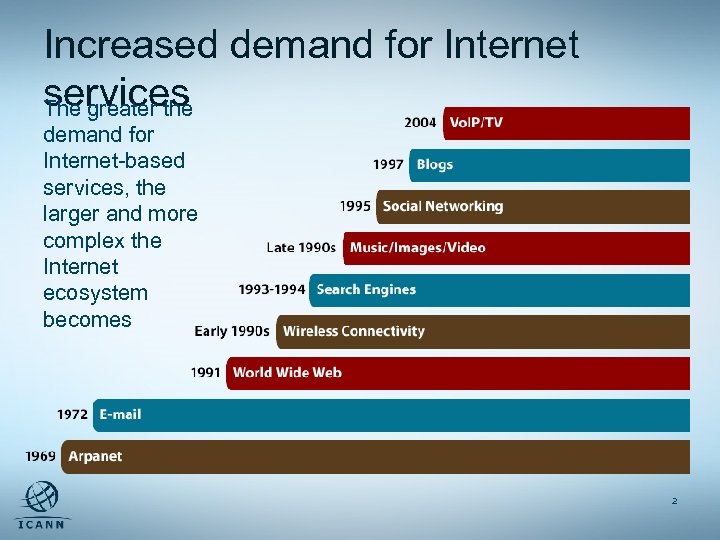
Increased demand for Internet services The greater the demand for Internet-based services, the larger and more complex the Internet ecosystem becomes 2
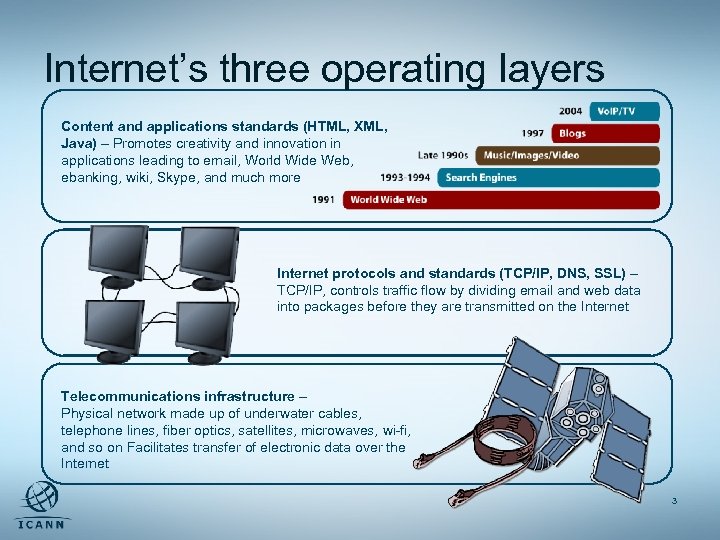
Internet’s three operating layers Content and applications standards (HTML, XML, Java) – Promotes creativity and innovation in applications leading to email, World Wide Web, ebanking, wiki, Skype, and much more Internet protocols and standards (TCP/IP, DNS, SSL) – TCP/IP, controls traffic flow by dividing email and web data into packages before they are transmitted on the Internet Telecommunications infrastructure – Physical network made up of underwater cables, telephone lines, fiber optics, satellites, microwaves, wi-fi, and so on Facilitates transfer of electronic data over the Internet 3
Changing postal environment • Posts evolving in response to demands of technology-driven information society • Posts hosting new ways to communicate and do business – E-mail (communications) – E-commerce (shopping, bill paying) – Improved service quality – package tracking, money transfers, digital postmarks – Other innovations in products and services coming on line – Responding or anticipating consumer and user demands and interests 4
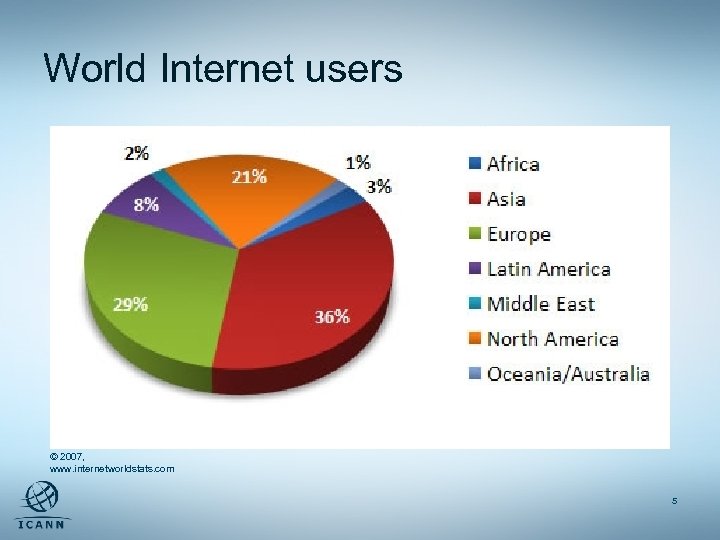
World Internet users © 2007, www. internetworldstats. com 5
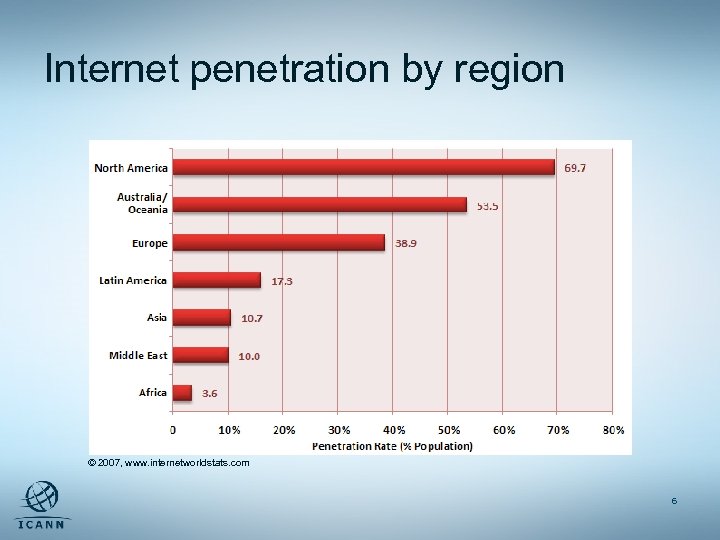
Internet penetration by region © 2007, www. internetworldstats. com 6
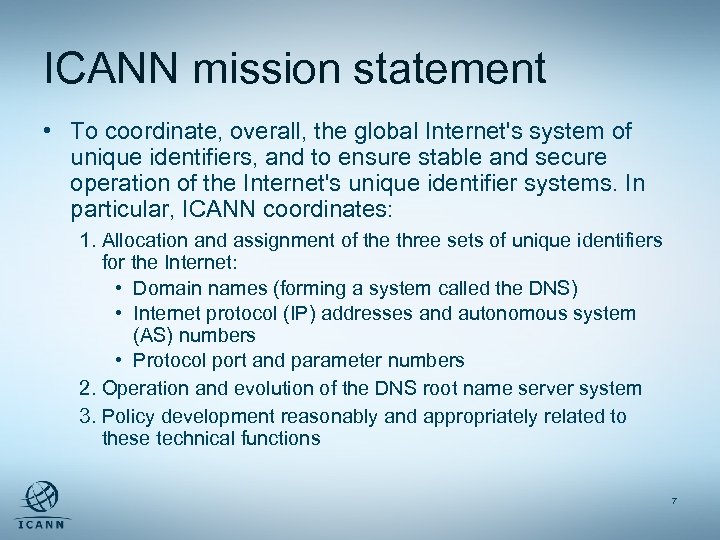
ICANN mission statement • To coordinate, overall, the global Internet's system of unique identifiers, and to ensure stable and secure operation of the Internet's unique identifier systems. In particular, ICANN coordinates: 1. Allocation and assignment of the three sets of unique identifiers for the Internet: • Domain names (forming a system called the DNS) • Internet protocol (IP) addresses and autonomous system (AS) numbers • Protocol port and parameter numbers 2. Operation and evolution of the DNS root name server system 3. Policy development reasonably and appropriately related to these technical functions 7
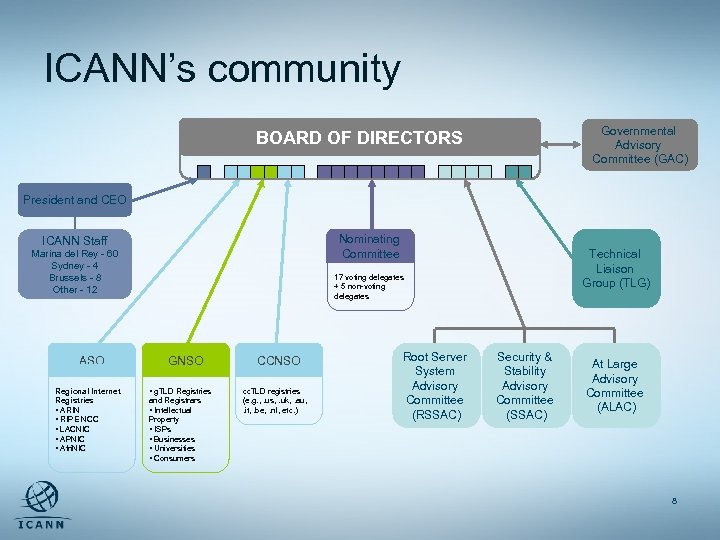
ICANN’s community Governmental Advisory Committee (GAC) BOARD OF DIRECTORS President and CEO Nominating Committee ICANN Staff Marina del Rey - 60 Sydney - 4 Brussels - 8 Other - 12 ASO Regional Internet Registries • ARIN • RIPE NCC • LACNIC • APNIC • Afri. NIC Technical Liaison Group (TLG) 17 voting delegates + 5 non-voting delegates GNSO • g. TLD Registries and Registrars • Intellectual Property • ISPs • Businesses • Universities • Consumers CCNSO cc. TLD registries (e. g. , . us, . uk, . au, . it, . be, . nl, etc. ) Root Server System Advisory Committee (RSSAC) Security & Stability Advisory Committee (SSAC) At Large Advisory Committee (ALAC) 8
Principles of operation 1. Contribute to stability and security of the unique identifiers system and root management 2. Promote competition and choice for registrants and other users 3. Forum for multi-stakeholder bottom-up development of related policy 4. Ensure the opportunity for participation by all interested parties on a global basis 9
Emerging and evolving issues • Security and stability of the Internet overall • Initial and expanded deployment of IDNs • Migration from IPv 4 to IPv 6 – Individual ISPs may not easily handle increased network load – Routing level loads also of concern • • • Introduction of new TLDs Whois database service Registrar data escrow services Registry failover plan Accountability frameworks with cc. TLD managers Review of ICANN accountability and transparency 10
Internet community – a real phenomenon with world changing values technical policy-making and decision-making • Bottom-up • Participation open to all who wish to do so • Legitimacy determined by open participation and the value of the contribution to the joint effort • Consensus-based decision making • Cooperation, coordination and consultation among participants and groups pushing initiatives forward • Yet, very spirited and blunt public debate • Private agreement or contract approach to creating and managing linkages among and to the network • Global efficiency in the allocation of resources such as Internet Protocol addresses 11
Cannot be definitive about the Internet in ten years, but … • Usage limited by access to electricity – 3 billion • Many, perhaps most, will access by mobile devices • Significant increase in broadband access (over 100 mb/sec) • Machine-to-machine Internet overtaking a person-to-person Internet • Billions of Internet-enabled appliances at home, work, in the car, in the pocket/purse • Internet used by third parties to monitor all sorts of activities and utilities – washing machines, to cars, to electricity meters • Geo-location and geo-indexed systems much more common and emergency services will be more precisely dispatched 12
Cannot be definitive about the Internet in ten years, but … • Significant improvement in spoken interaction with Internetbased systems • A wide range of delivery methods for intellectual property (movies, sound tracks, books, etc). Vo. IP will be prevalent and SIP may be the principal protocol means by which calls are set up. Voice communication will be essentially free except perhaps for calls that terminate on traditional PSTN devices including mobiles • Almost no industry will be offline since most will rely on the Net for customer interaction, customer discovery, sales, service, advertising, etc. • Group interaction, collaborative support tools (including distributed games) will be very common • Internationalised Domain Names and much more multilingual Internet content 13
WSIS and Internet governance • Internet governance involves a wide range of topics and issues • Depth of debate in WSIS reflects a conflict of regimes • Reflects importance of understanding the Internet, and ensuring that politics do not drive poor decisions • At risk is 35 years of values and a regime that has created the Internet of today • True aspirations of WSIS as envisioned by the Secretary General have not been explored • All levels involved in issues surrounding the Internet • And all stakeholders need to be involved 14
Moving forward • Globalization of Internet governance must continue to build on existing and evolving international constituencies • One billion-plus users require focus on stability, integrity and security of Internet operations – New players will emerge as key contributors to the Internet space – Geographic and technological – Existing Internet mechanisms and operations must remain independent of day-to-day politics and political influence • Internet’s coordination of unique identifiers must enable the continued innovation at the edge, the stability and integrity of a single interoperable Internet on which business, communication and development rely • All organizations have role 15
Thank You www. icann. org 16
Скачать презентацию Contribution of the Postal Sector to Internet Governance
63c9c5f6ef2b245953270286cd40d979.ppt