 Скачать презентацию Contribution of Medspiration GHRSST products to Mediterranean applications of
846726033f9e78c3b214a7235ec8a02c.ppt
- Количество слайдов: 33



Contribution of Medspiration/GHRSST products to Mediterranean applications of SST Rosalia Santoleri (1) Bruno Buongiorno Nardelli (1) Nadia Pinardi (2) (1) CNR - Istituto di Scienze dell’Atmosfera e del Clima – sezione di Roma (2) Istituto Nazionale di Geofisica e Vulcanologia r. santoleri@isac. cnr. it;
Outline • Mediterranean SST processing chain at GOS & its products • Use of SST in the MFS Mediterranean ocean forecasting system • Dissemination to users • Future Plans
MED-SST Products: GOS involvement in national and international projects/programmes Mediterranean Forecasting System Adricosm Medspiration GODAE Global High Resolution Mersea SST Pilot Project (GHRSST-PP) PRIMI
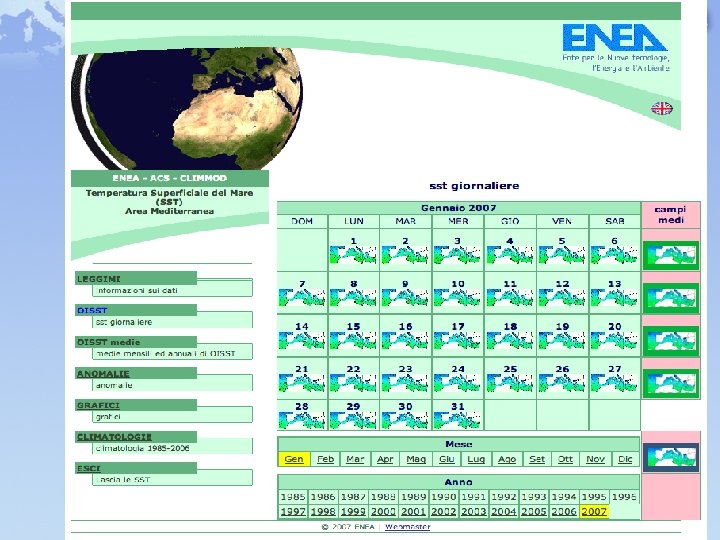
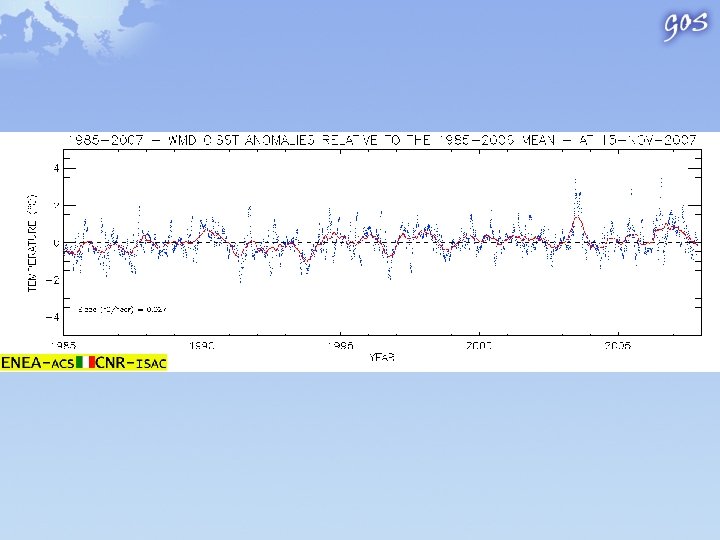
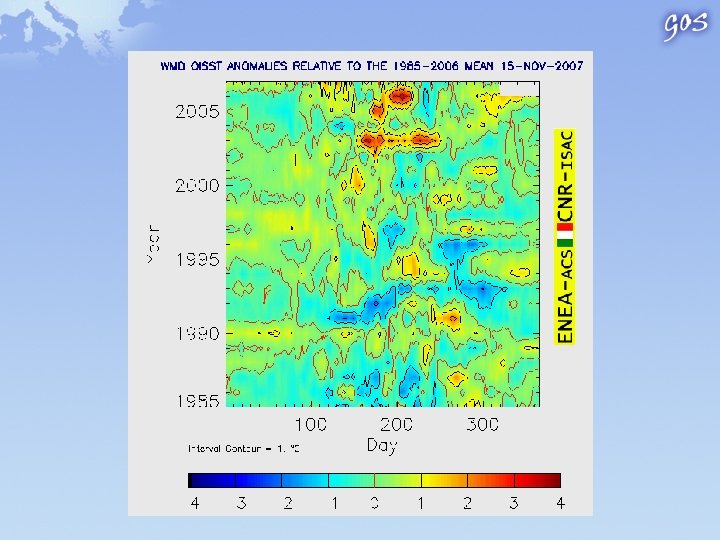
CNR-ISAC-GOS SST processing chain (operative since October 1998) has been designed to provide SST data for assimilation in the MFS forecasting model. MFS_SST are daily optimally Interpolated Sea Surface Temperature (OISST) maps produced in near real time at 5 Km resolution (1/16°x 1/16° MFS model grid) Since July 2006, In the framework of MERSEA, CNRISAC also produces multi-sensors OISST maps merging a variety of sensors (AVHRR, MODIS, SEVERI, AATSR) as contribution to the GODAE/GHRSSTPP The same OI scheme has also been used to perform a Re. Analysis (RAv 0) of AVHRR Pathfinder SST time series, from 1985 to 2005 by CNR-GOS in collaboration with ENEA. This product has also been used to build up a Med SST climatology http: //gos. ifa. rm. cnr. it/
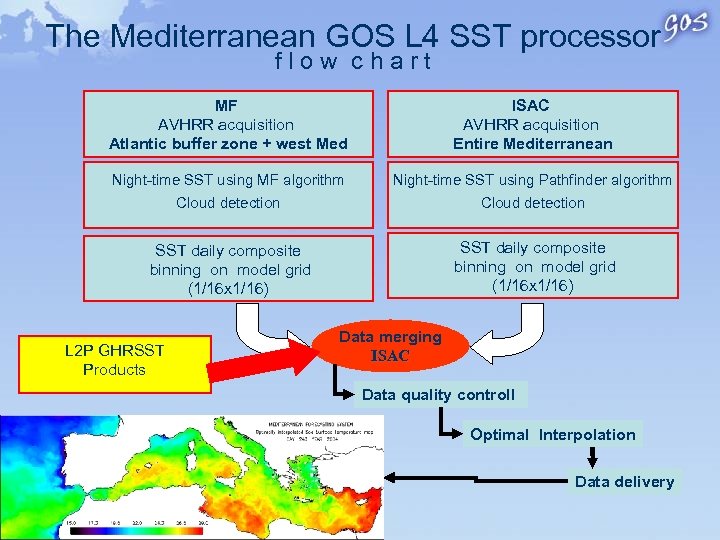
The Mediterranean GOS L 4 SST processor flow chart MF AVHRR acquisition Atlantic buffer zone + west Med ISAC AVHRR acquisition Entire Mediterranean Night-time SST using MF algorithm Night-time SST using Pathfinder algorithm Cloud detection SST daily composite binning on model grid (1/16 x 1/16) L 2 P GHRSST Products Data merging ISAC Data quality controll Optimal Interpolation Data delivery
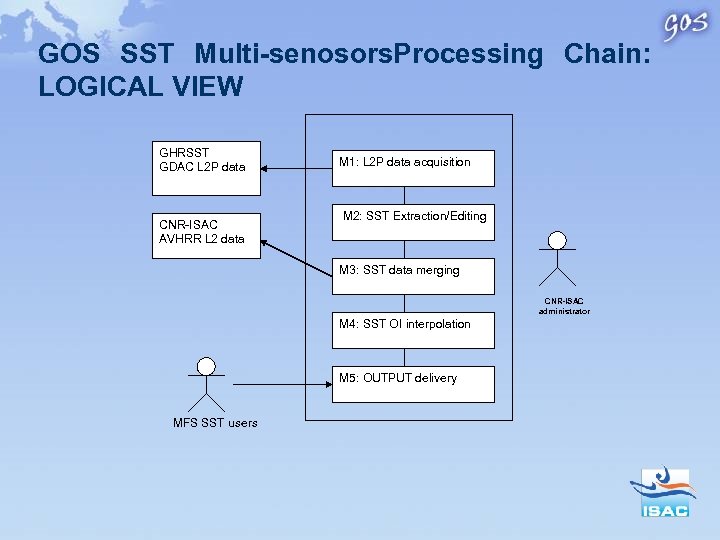
GOS SST Multi-senosors. Processing Chain: LOGICAL VIEW GHRSST GDAC L 2 P data CNR-ISAC AVHRR L 2 data M 1: L 2 P data acquisition M 2: SST Extraction/Editing M 3: SST data merging CNR-ISAC administrator M 4: SST OI interpolation M 5: OUTPUT delivery MFS SST users
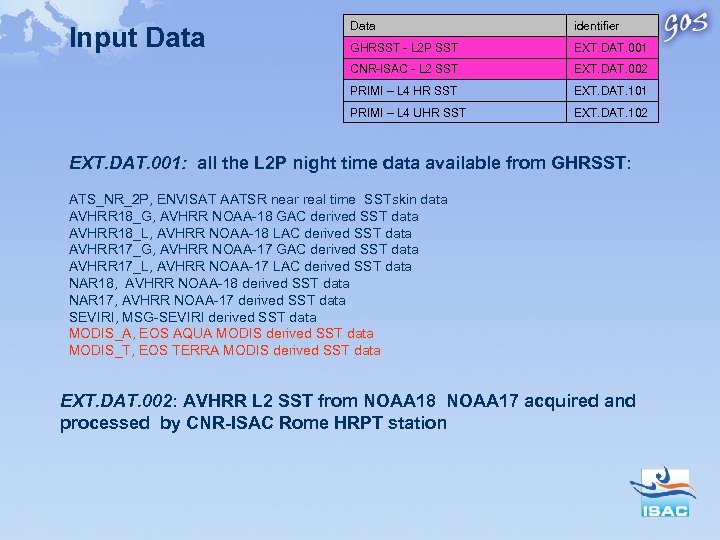
identifier GHRSST - L 2 P SST EXT. DAT. 001 CNR-ISAC - L 2 SST EXT. DAT. 002 PRIMI – L 4 HR SST EXT. DAT. 101 PRIMI – L 4 UHR SST Input Data EXT. DAT. 102 EXT. DAT. 001: all the L 2 P night time data available from GHRSST: ATS_NR_2 P, ENVISAT AATSR near real time SSTskin data AVHRR 18_G, AVHRR NOAA-18 GAC derived SST data AVHRR 18_L, AVHRR NOAA-18 LAC derived SST data AVHRR 17_G, AVHRR NOAA-17 GAC derived SST data AVHRR 17_L, AVHRR NOAA-17 LAC derived SST data NAR 18, AVHRR NOAA-18 derived SST data NAR 17, AVHRR NOAA-17 derived SST data SEVIRI, MSG-SEVIRI derived SST data MODIS_A, EOS AQUA MODIS derived SST data MODIS_T, EOS TERRA MODIS derived SST data EXT. DAT. 002: AVHRR L 2 SST from NOAA 18 NOAA 17 acquired and processed by CNR-ISAC Rome HRPT station
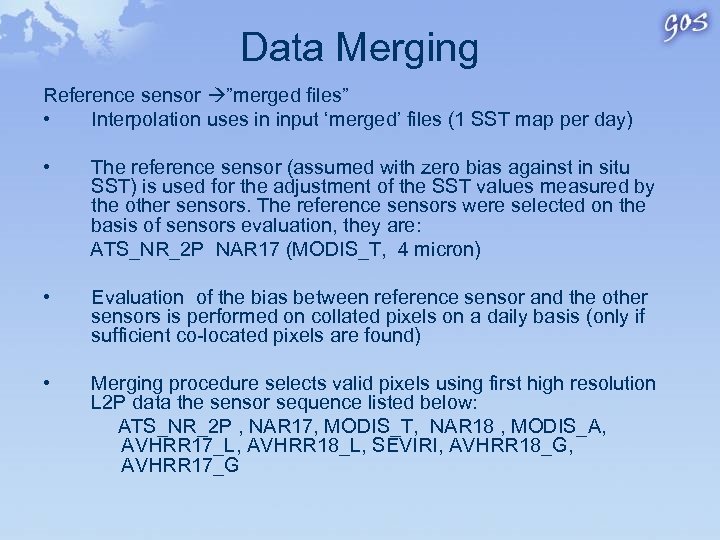
Data Merging Reference sensor ”merged files” • Interpolation uses in input ‘merged’ files (1 SST map per day) • The reference sensor (assumed with zero bias against in situ SST) is used for the adjustment of the SST values measured by the other sensors. The reference sensors were selected on the basis of sensors evaluation, they are: ATS_NR_2 P NAR 17 (MODIS_T, 4 micron) • Evaluation of the bias between reference sensor and the other sensors is performed on collated pixels on a daily basis (only if sufficient co-located pixels are found) • Merging procedure selects valid pixels using first high resolution L 2 P data the sensor sequence listed below: ATS_NR_2 P , NAR 17, MODIS_T, NAR 18 , MODIS_A, AVHRR 17_L, AVHRR 18_L, SEVIRI, AVHRR 18_G, AVHRR 17_G
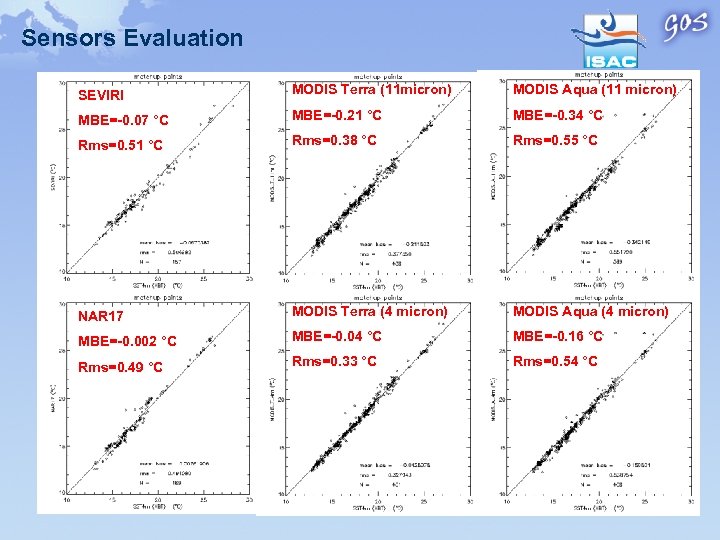
Sensors Evaluation SEVIRI MODIS Terra (11 micron) MODIS Aqua (11 micron) MBE=-0. 07 °C MBE=-0. 21 °C MBE=-0. 34 °C Rms=0. 51 °C Rms=0. 38 °C Rms=0. 55 °C NAR 17 MODIS Terra (4 micron) MODIS Aqua (4 micron) MBE=-0. 002 °C MBE=-0. 04 °C MBE=-0. 16 °C Rms=0. 49 °C Rms=0. 33 °C Rms=0. 54 °C
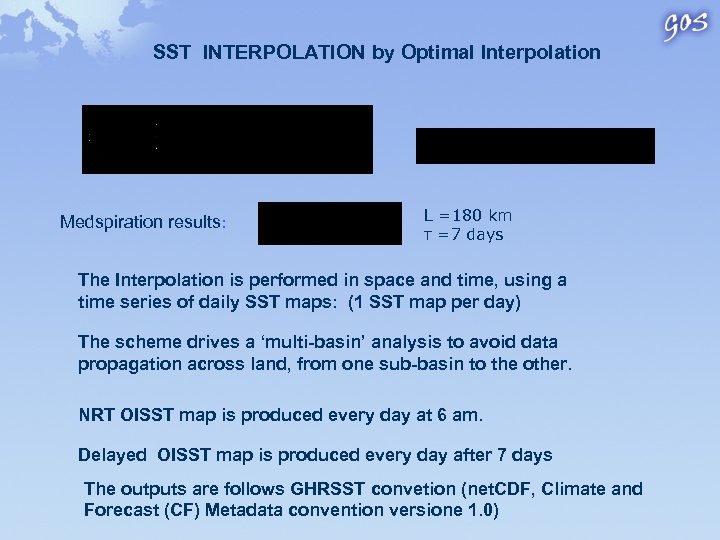
SST INTERPOLATION by Optimal Interpolation Medspiration results: L =180 km τ =7 days The Interpolation is performed in space and time, using a time series of daily SST maps: (1 SST map per day) The scheme drives a ‘multi-basin’ analysis to avoid data propagation across land, from one sub-basin to the other. NRT OISST map is produced every day at 6 am. Delayed OISST map is produced every day after 7 days The outputs are follows GHRSST convetion (net. CDF, Climate and Forecast (CF) Metadata convention versione 1. 0)
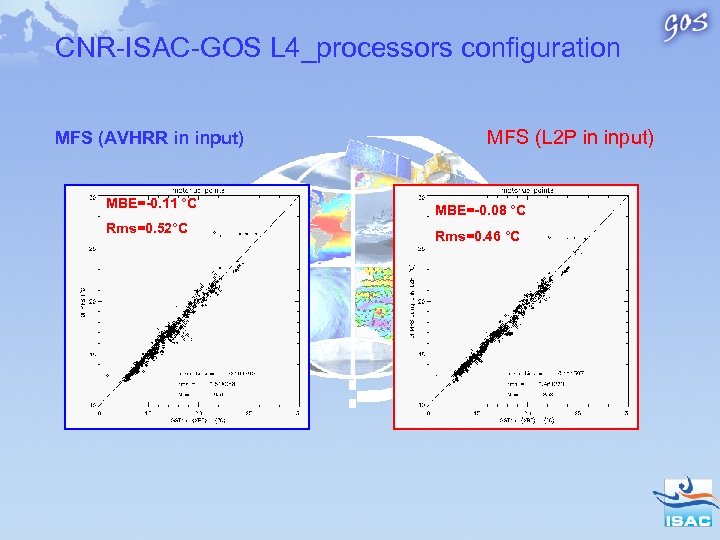
CNR-ISAC-GOS L 4_processors configuration MFS (AVHRR in input) MBE=-0. 26 °C MBE=-0. 11 °C Rms=0. 52°C MFS (L 2 P in input) MBE=-0. 08 °C Rms=0. 46 °C
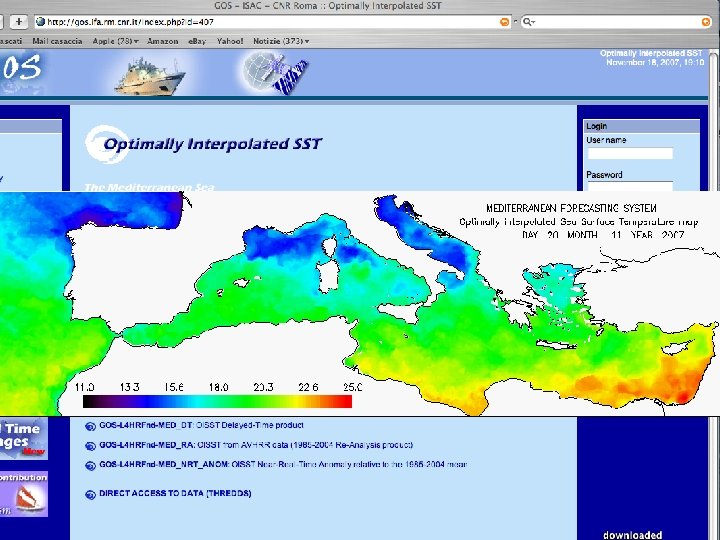
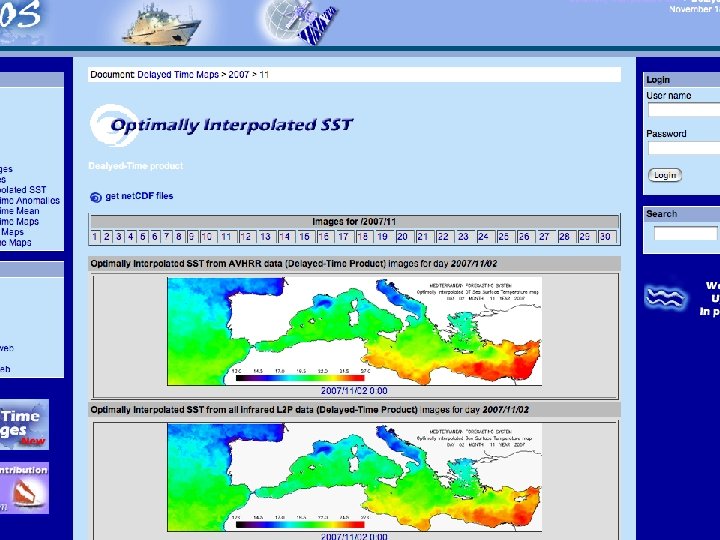
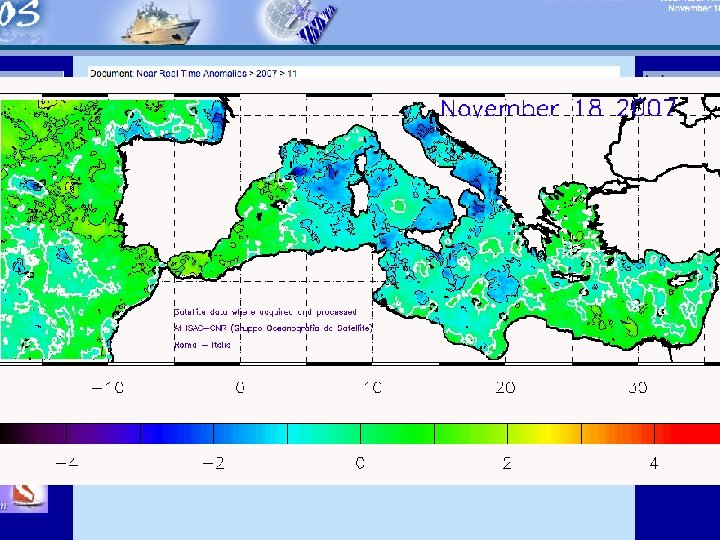
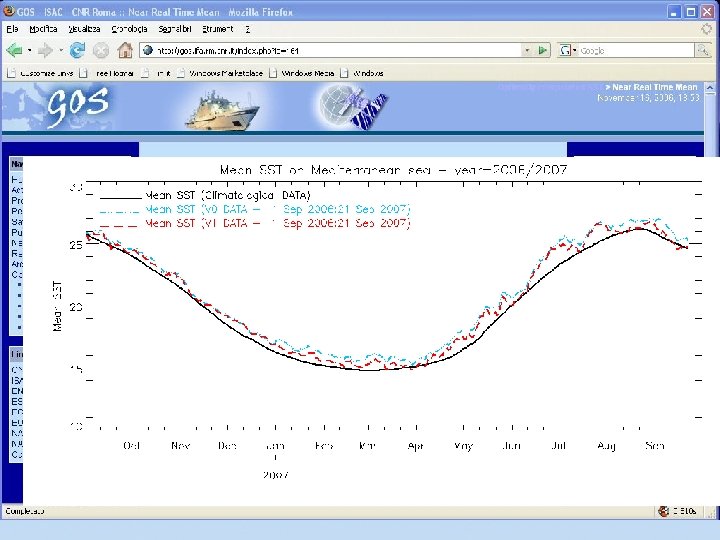
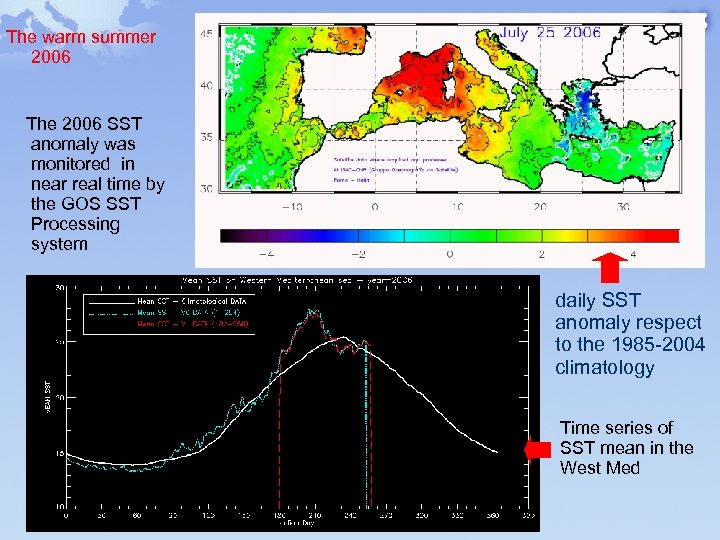
The warm summer 2006 The 2006 SST anomaly was monitored in near real time by the GOS SST Processing system daily SST anomaly respect to the 1985 -2004 climatology Time series of SST mean in the West Med
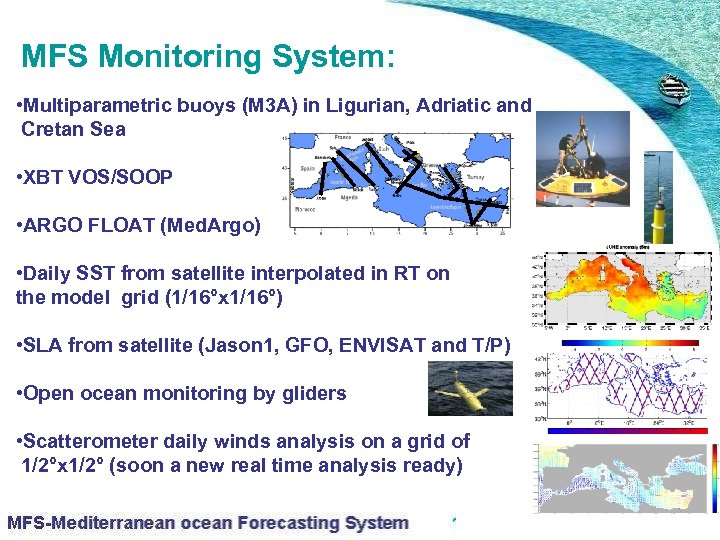
MFS Monitoring System: • Multiparametric buoys (M 3 A) in Ligurian, Adriatic and Cretan Sea • XBT VOS/SOOP • ARGO FLOAT (Med. Argo) • Daily SST from satellite interpolated in RT on the model grid (1/16°x 1/16°) • SLA from satellite (Jason 1, GFO, ENVISAT and T/P) • Open ocean monitoring by gliders • Scatterometer daily winds analysis on a grid of 1/2°x 1/2° (soon a new real time analysis ready)
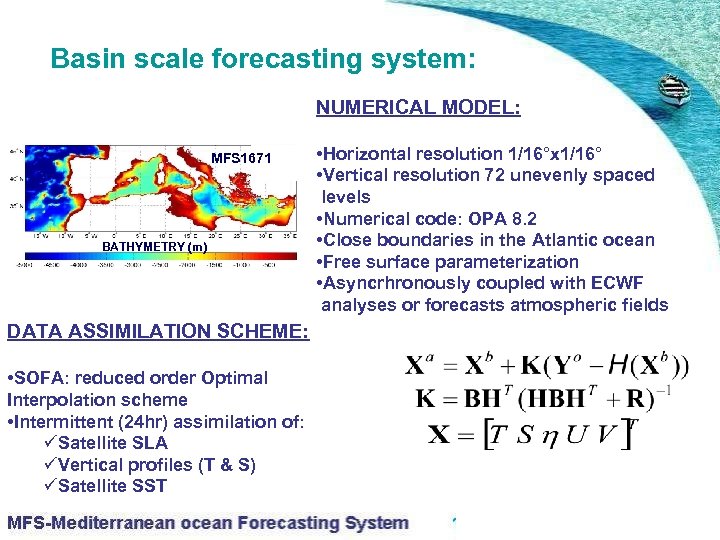
Basin scale forecasting system: NUMERICAL MODEL: MFS 1671 BATHYMETRY (m) DATA ASSIMILATION SCHEME: • SOFA: reduced order Optimal Interpolation scheme • Intermittent (24 hr) assimilation of: üSatellite SLA üVertical profiles (T & S) üSatellite SST • Horizontal resolution 1/16°x 1/16° • Vertical resolution 72 unevenly spaced levels • Numerical code: OPA 8. 2 • Close boundaries in the Atlantic ocean • Free surface parameterization • Asyncrhronously coupled with ECWF analyses or forecasts atmospheric fields
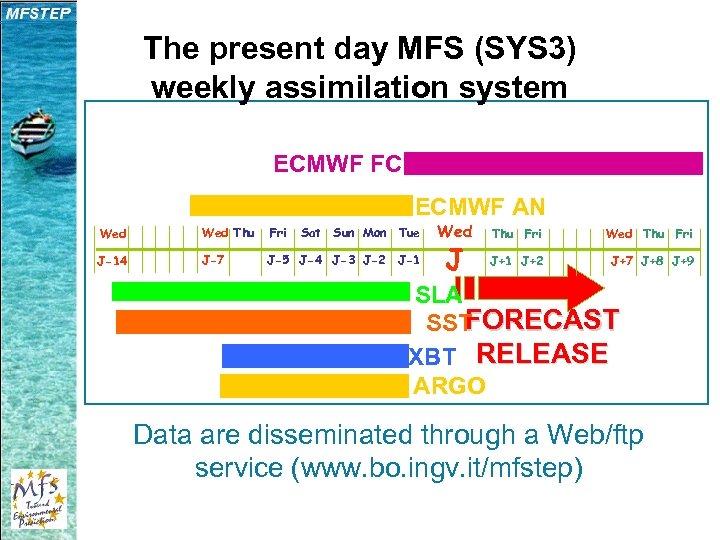
The present day MFS (SYS 3) weekly assimilation system ECMWF FC ECMWF AN Wed Thu Fri Sat Sun Mon Tue J-14 J-7 J-5 J-4 J-3 J-2 J-1 Wed J Thu Fri Wed Thu Fri J+1 J+2 J+7 J+8 J+9 SLA FORECAST SST XBT RELEASE ARGO Data are disseminated through a Web/ftp service (www. bo. ingv. it/mfstep)
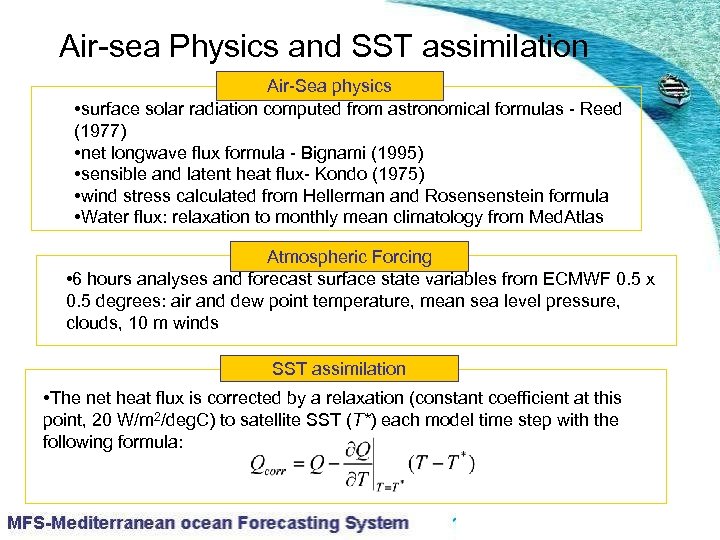
Air-sea Physics and SST assimilation Air-Sea physics • surface solar radiation computed from astronomical formulas - Reed (1977) • net longwave flux formula - Bignami (1995) • sensible and latent heat flux- Kondo (1975) • wind stress calculated from Hellerman and Rosensenstein formula • Water flux: relaxation to monthly mean climatology from Med. Atlas Atmospheric Forcing • 6 hours analyses and forecast surface state variables from ECMWF 0. 5 x 0. 5 degrees: air and dew point temperature, mean sea level pressure, clouds, 10 m winds SST assimilation • The net heat flux is corrected by a relaxation (constant coefficient at this point, 20 W/m 2/deg. C) to satellite SST (T*) each model time step with the following formula:
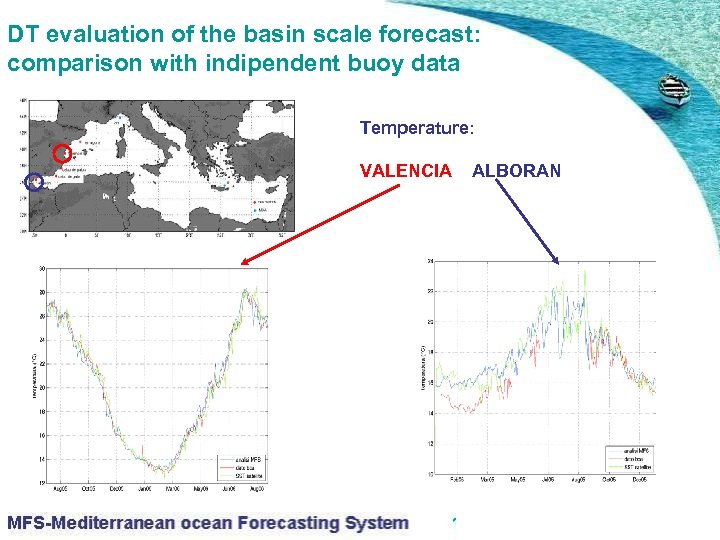
DT evaluation of the basin scale forecast: comparison with indipendent buoy data Temperature: VALENCIA ALBORAN
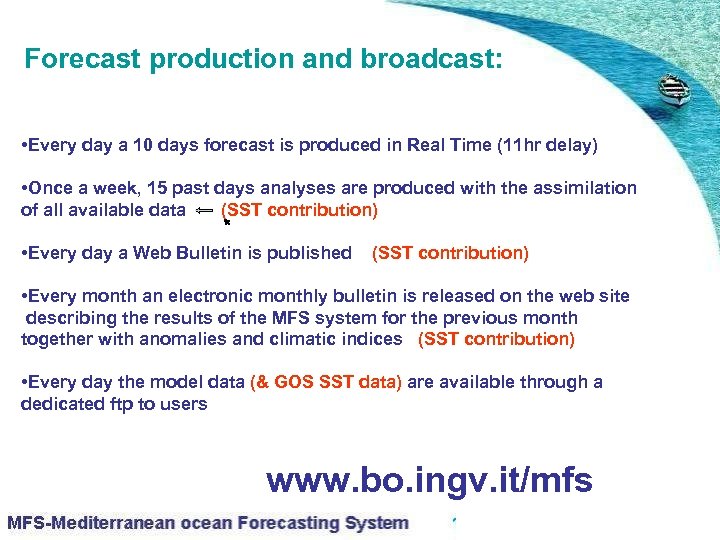
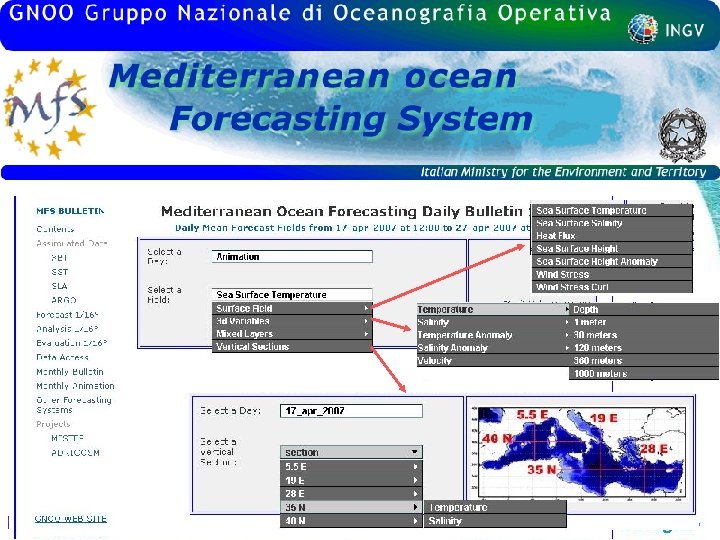
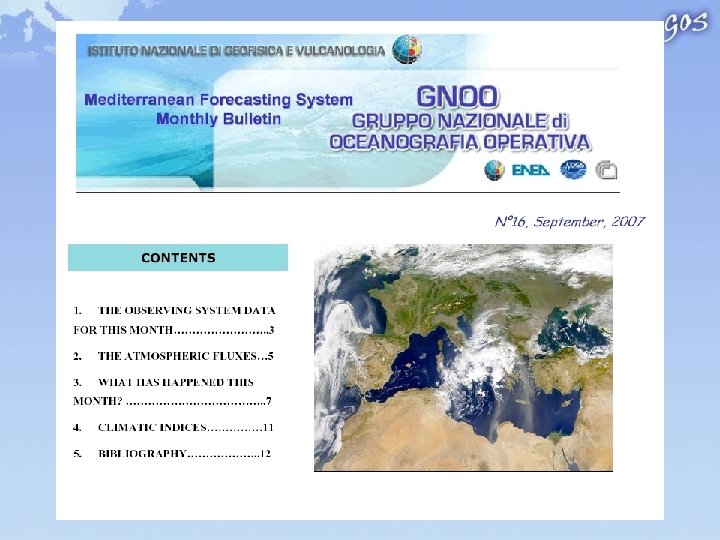
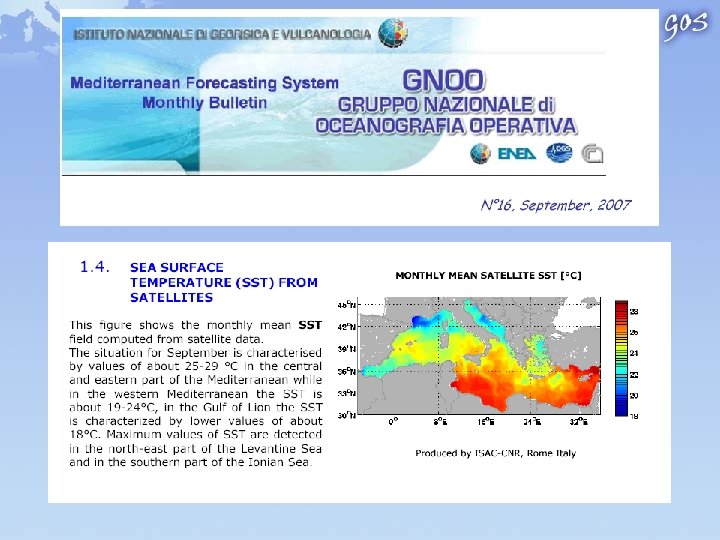
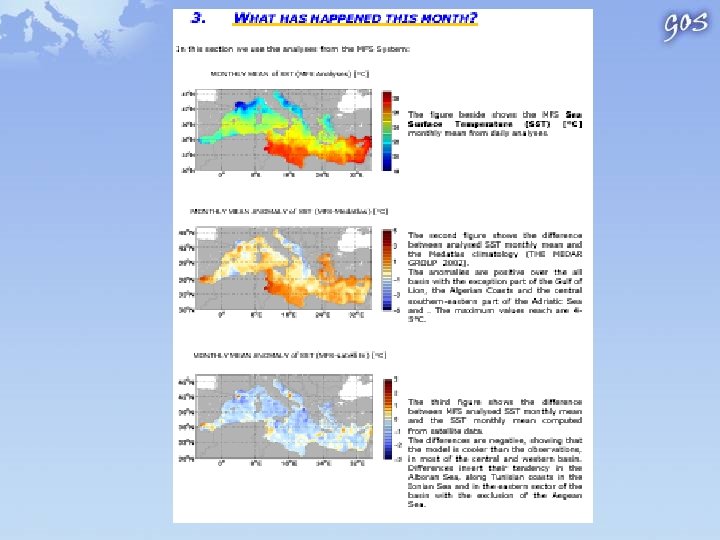
Forecast production and broadcast: • Every day a 10 days forecast is produced in Real Time (11 hr delay) • Once a week, 15 past days analyses are produced with the assimilation of all available data (SST contribution) • Every day a Web Bulletin is published (SST contribution) • Every month an electronic monthly bulletin is released on the web site describing the results of the MFS system for the previous month together with anomalies and climatic indices (SST contribution) • Every day the model data (& GOS SST data) are available through a dedicated ftp to users www. bo. ingv. it/mfs
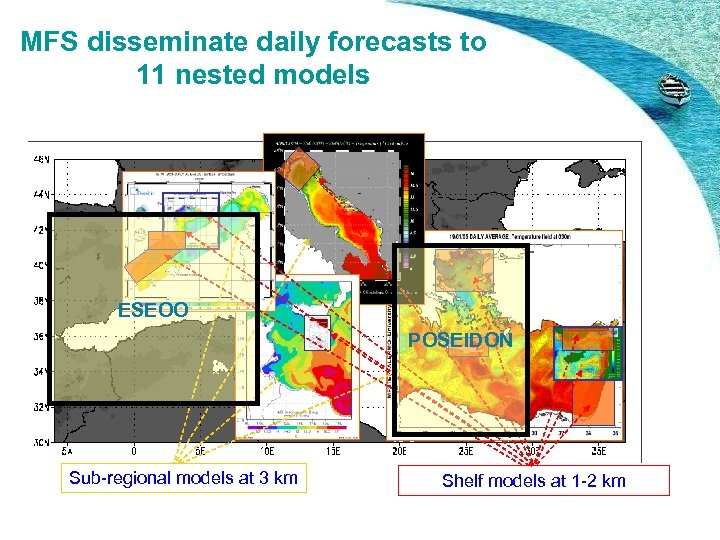
MFS disseminate daily forecasts to 11 nested models ESEOO POSEIDON Sub-regional models at 3 km Shelf models at 1 -2 km
Summary of SST Dissemination to Mediterranean Users • Primary user of SST is the MFS at INGV • National forecasting Systems and MOON operational system throughout MOON Mo. U (31 centres) • Research and educational users (> 200) – Research studies, cruises planning, etc • Commercial Users – ENI-AGIP, Telespazio • Environmental Agency: – EEA (SST contribution Climate change report 2008, contribution to the monthly bulletin in discussion) – UNEP/MAP (draft of the monthly bulletin is already proposed) Mo. U is in discussion – Agreement with Italian Meteorological service for use the SST in their broadcast system is under discussion
Conclusion and Future plans • The Satellite Observing System of the Mediterranean Sea provides NRT, DT, and re-analysis satellite products in agreement with the requirements of the MCS core products • This system will be the MOON component of the SST-TAC of MCS in the framework of My. Ocean • The CNR processing SST chains will be modified to provide also Black Sea products in accordance with the My. Ocean requirements • In the framework of National Projects (Adricosm & PRIMI): – new multi-sensors UHR SST products will be developed for the Italian Sea (Adriatic, Sicily Channel, Tyrrhenian Sea at 1 Km resolution) – the new SST products will be assimilation in the Adriatic, Sicily Channel forecasting models – The SST assimilation scheme will modified to take into account that the characteristics satellite SST (e. g. restoring coefficient depending on wind intensity & regime, e. g. Artale et al. JGR 2002 )
Скачать презентацию Contribution of Medspiration GHRSST products to Mediterranean applications of
846726033f9e78c3b214a7235ec8a02c.ppt