

CONTRASTIVE TYPOLOGY OF THE ENGLISH AND THE UKRAINIAN



 Скачать презентацию CONTRASTIVE TYPOLOGY OF THE ENGLISH AND THE UKRAINIAN
35736-contrastive_typology_aims_and_tasks.ppt
- Количество слайдов: 62
CONTRASTIVE TYPOLOGY OF THE ENGLISH AND THE UKRAINIAN LANGUAGES
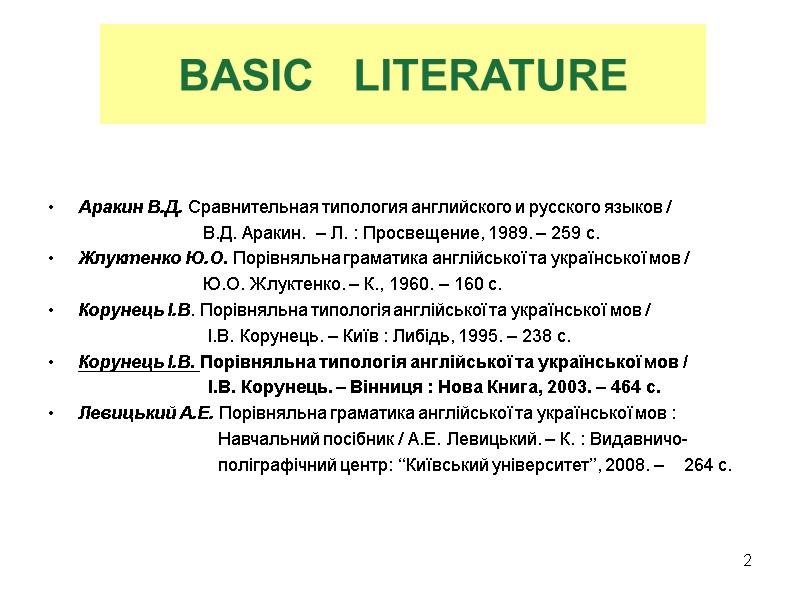
BASIC LITERATURE Аракин В.Д. Сравнительная типология английского и русского языков / В.Д. Аракин. – Л. : Просвещение, 1989. – 259 с. Жлуктенко Ю.О. Порівняльна граматика англійської та української мов / Ю.О. Жлуктенко. – К., 1960. – 160 с. Корунець І.В. Порівняльна типологія англійської та української мов / І.В. Корунець. – Київ : Либідь, 1995. – 238 с. Корунець І.В. Порівняльна типологія англійської та української мов / І.В. Корунець. – Вінниця : Нова Книга, 2003. – 464 с. Левицький А.Е. Порівняльна граматика англійської та української мов : Навчальний посібник / А.Е. Левицький. – К. : Видавничо- поліграфічний центр: ‘‘Київський університет’’, 2008. – 264 с. 2
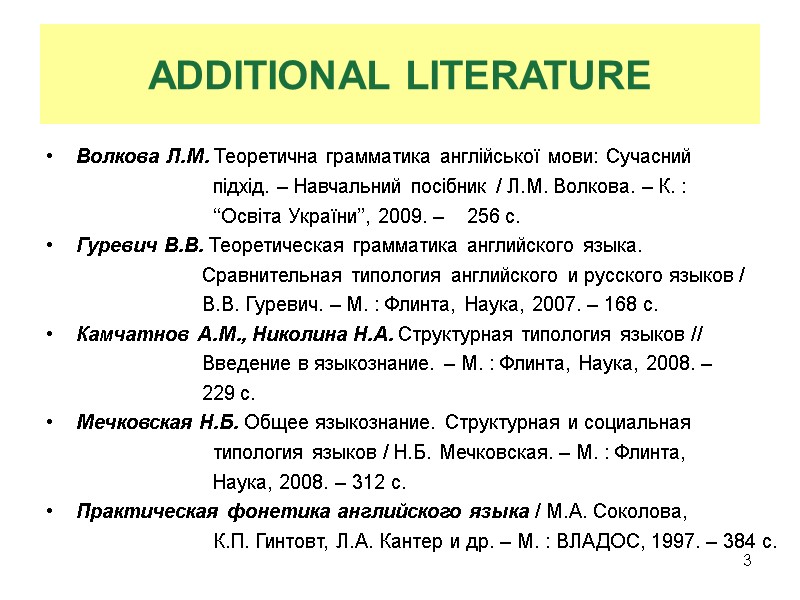
ADDITIONAL LITERATURE Волкова Л.М. Теоретична грамматика англійської мови: Сучасний підхід. – Навчальний посібник / Л.М. Волкова. – К. : ‘‘Освіта України’’, 2009. – 256 с. Гуревич В.В. Теоретическая грамматика английского языка. Сравнительная типология английского и русского языков / В.В. Гуревич. – М. : Флинта, Наука, 2007. – 168 с. Камчатнов А.М., Николина Н.А. Структурная типология языков // Введение в языкознание. – М. : Флинта, Наука, 2008. – 229 c. Мечковская Н.Б. Общее языкознание. Структурная и социальная типология языков / Н.Б. Мечковская. – М. : Флинта, Наука, 2008. – 312 с. Практическая фонетика английского языка / М.А. Соколова, К.П. Гинтовт, Л.А. Кантер и др. – М. : ВЛАДОС, 1997. – 384 с. 3
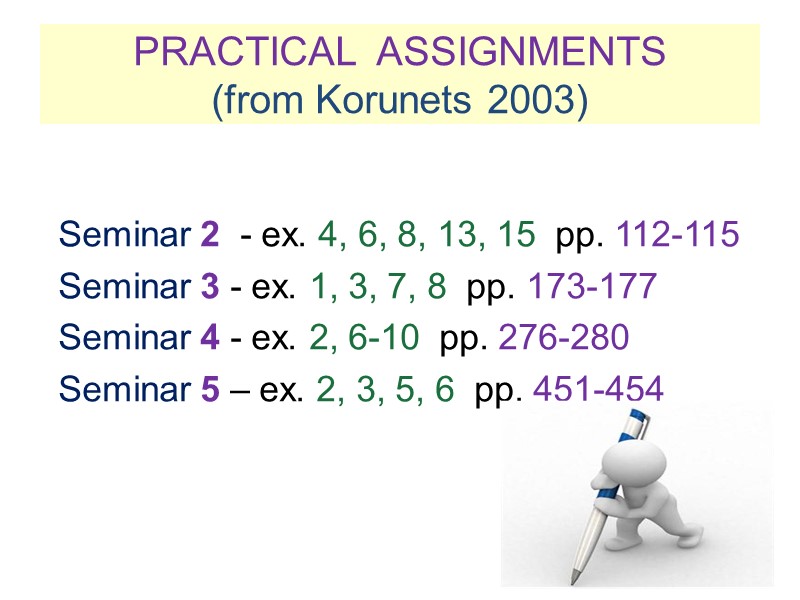
PRACTICAL ASSIGNMENTS (from Korunets 2003) Seminar 2 - ex. 4, 6, 8, 13, 15 pp. 112-115 Seminar 3 - ex. 1, 3, 7, 8 pp. 173-177 Seminar 4 - ex. 2, 6-10 pp. 276-280 Seminar 5 – ex. 2, 3, 5, 6 pp. 451-454 4
5 CONTRASTIVE TYPOLOGY, ITS AIMS AND TASKS. VARIOUS TYPOLOGIES
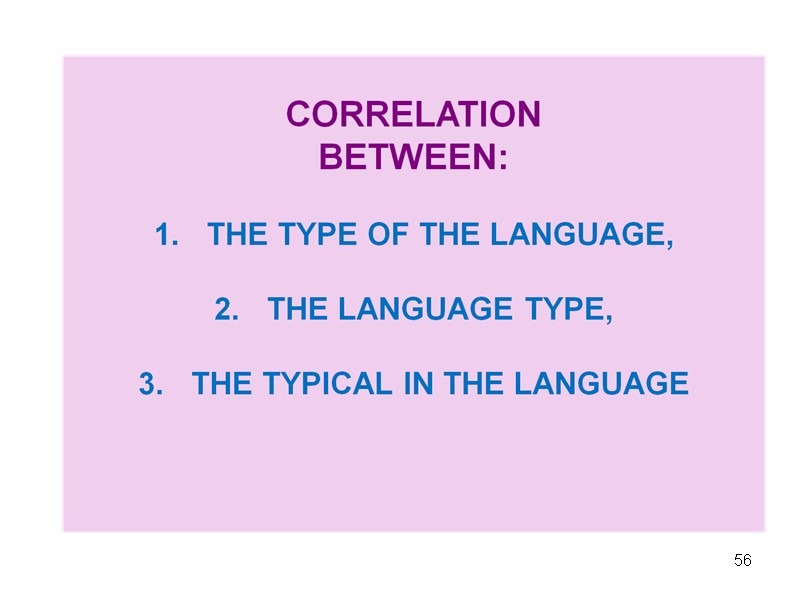
THE OUTLINE The object and the subject of contrastive typology, its aims and tasks. Typological constants of contrastive typology. The main branches of typological investigation. 4. Correlation between 1) the type of the language, 2) the language type, 3) the typical in the languages. 6
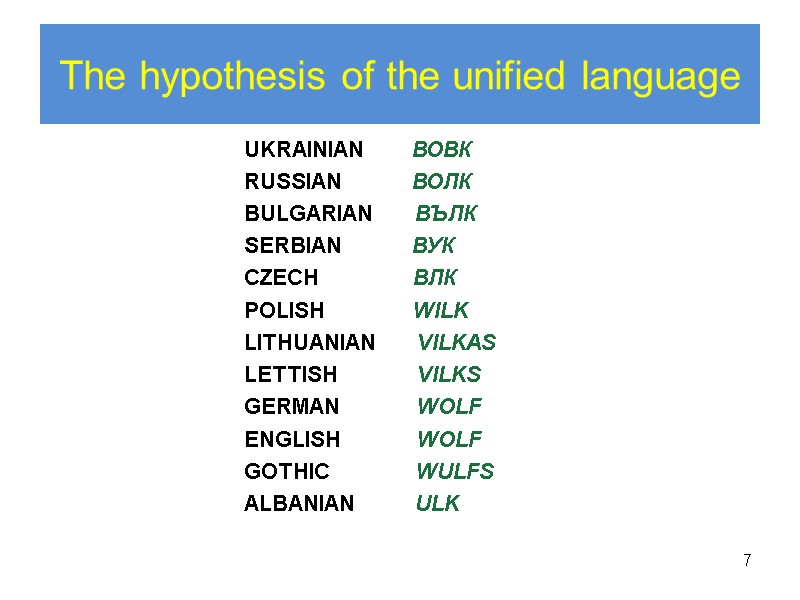
The hypothesis of the unified language UKRAINIAN ВОВК RUSSIAN ВОЛК BULGARIAN ВЪЛК SERBIAN ВУК CZECH ВЛК POLISH WILK LITHUANIAN VILKAS LETTISH VILKS GERMAN WOLF ENGLISH WOLF GOTHIC WULFS ALBANIAN ULK 7
The task the result of typological investigations If we set ourselves a task to show up all regularities (закономірності) and singularities (відмінності) in the languages contrasted, we’ll get a set of characteristics according to which we can distinguish one group of languages from another. 8
Different languages ‘‘Different languages are not different designations of the thing, they are different views (impressions, understandings) of this thing’’ (W. von Humboldt). 9
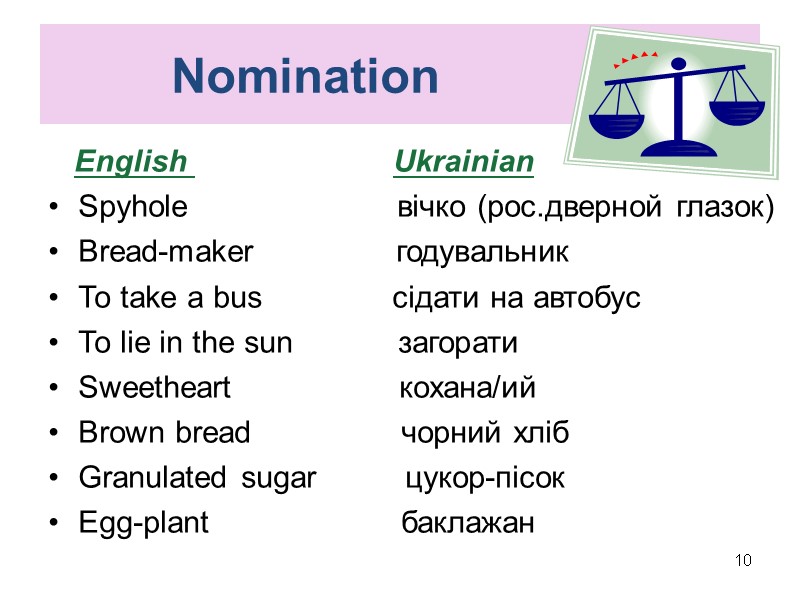
Nomination English Ukrainian Spyhole вічко (рос.дверной глазок) Bread-maker годувальник To take a bus сідати на автобус To lie in the sun загорати Sweetheart кохана/ий Brown bread чорний хліб Granulated sugar цукор-пісок Egg-plant баклажан 10
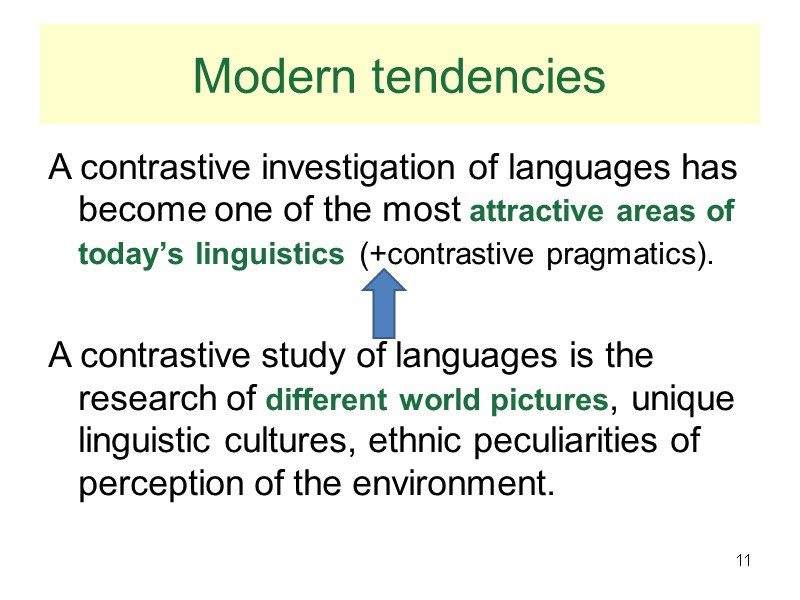
Modern tendencies A contrastive investigation of languages has become one of the most attractive areas of today’s linguistics (+contrastive pragmatics). A contrastive study of languages is the research of different world pictures, unique linguistic cultures, ethnic peculiarities of perception of the environment. 11
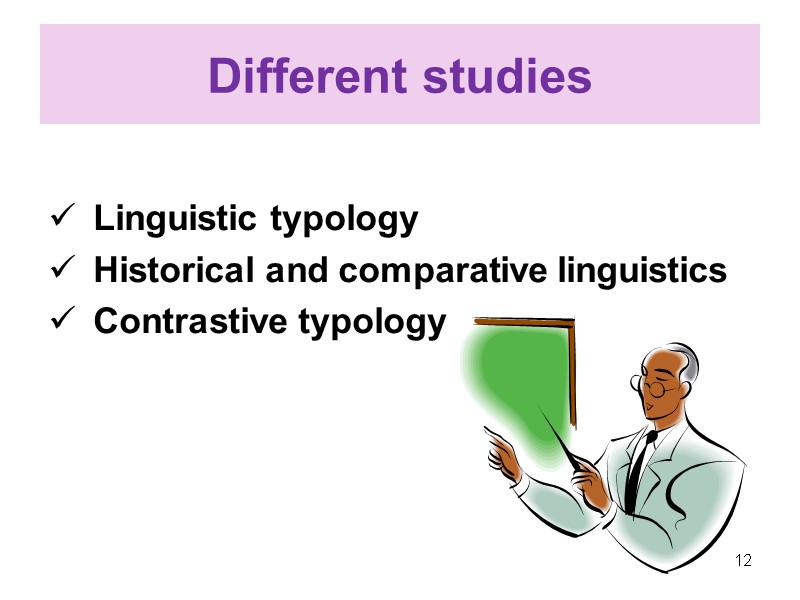
Different studies Linguistic typology Historical and comparative linguistics Contrastive typology 12
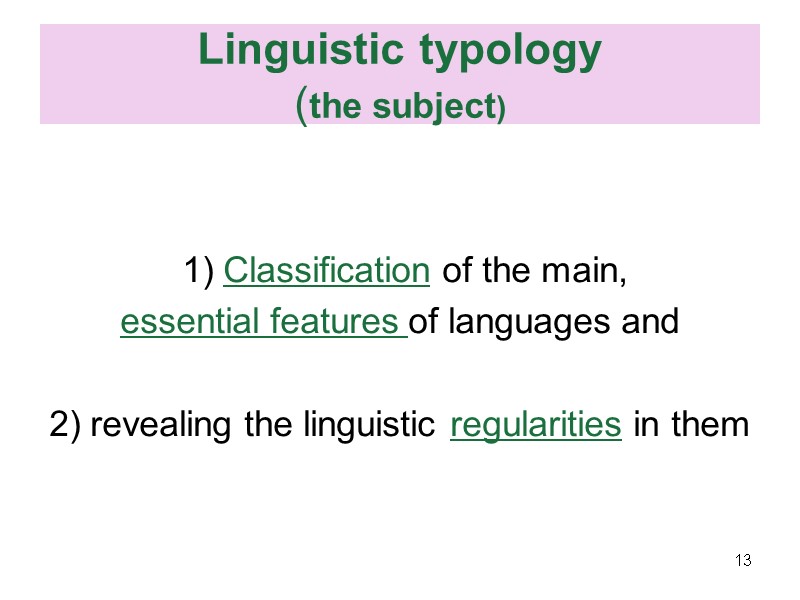
Linguistic typology (the subject) 1) Classification of the main, essential features of languages and 2) revealing the linguistic regularities in them 13
Linguistic typology is the study of types of languages (types of language structures) 14
The aim of Linguistic typology to provide the classification of the languages of different types, irrespective of their genealogical relationship 15
‘‘The language type’’ as the basic notion of linguistic typology can be understood as the language structure with an accent on its dominating features 16
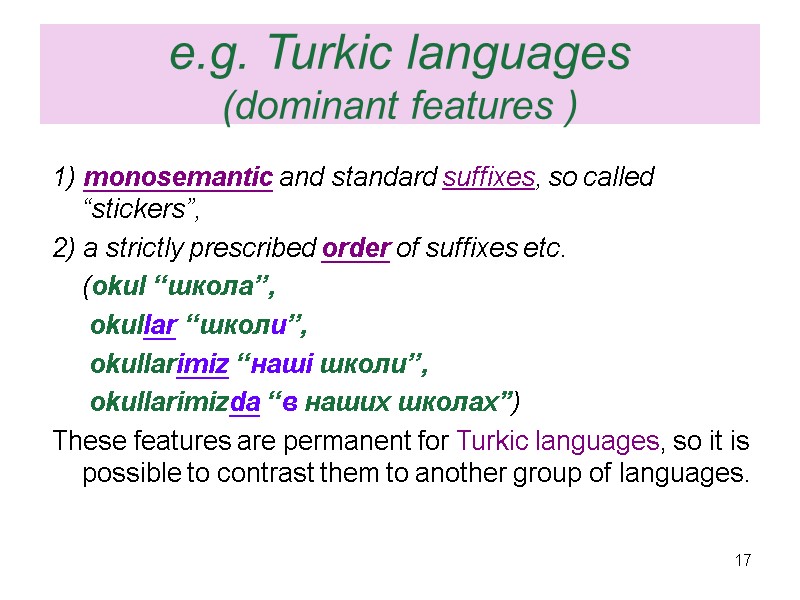
e.g. Turkic languages (dominant features ) 1) monosemantic and standard suffixes, so called ‘‘stickers’’, 2) a strictly prescribed order of suffixes etc. (okul ‘‘школа’’, okullar ‘‘школи’’, okullarimiz ‘‘наші школи’’, okullarimizda ‘‘в наших школах”) These features are permanent for Turkic languages, so it is possible to contrast them to another group of languages. 17
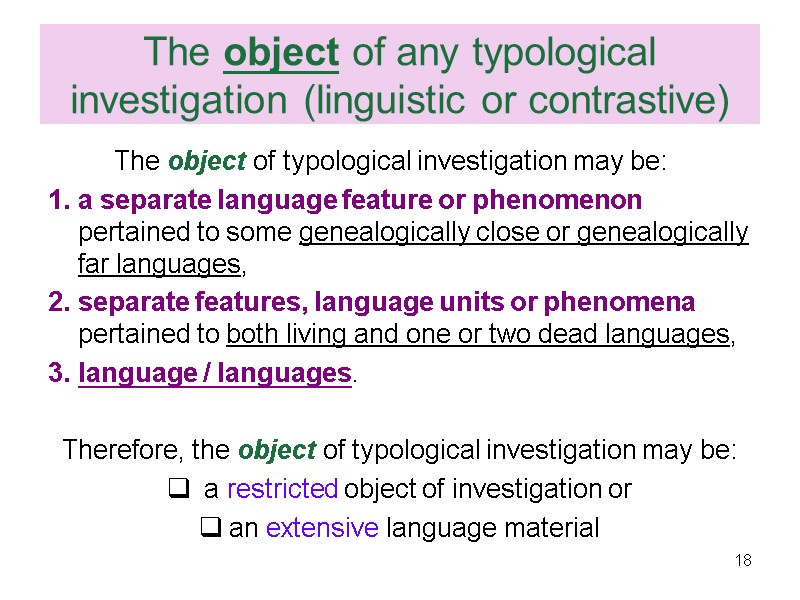
The object of any typological investigation (linguistic or contrastive) The object of typological investigation may be: a separate language feature or phenomenon pertained to some genealogically close or genealogically far languages, separate features, language units or phenomena pertained to both living and one or two dead languages, language / languages. Therefore, the object of typological investigation may be: a restricted object of investigation or an extensive language material 18
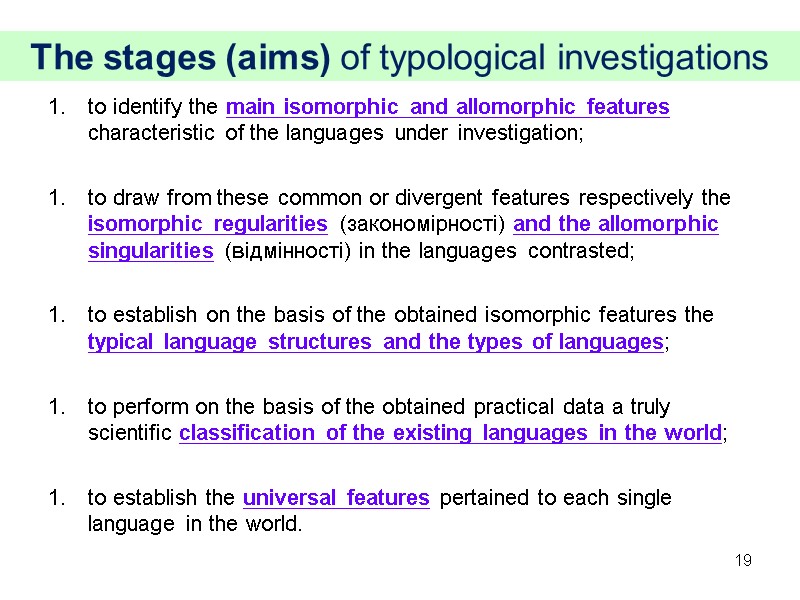
The stages (aims) of typological investigations to identify the main isomorphic and allomorphic features characteristic of the languages under investigation; to draw from these common or divergent features respectively the isomorphic regularities (закономірності) and the allomorphic singularities (відмінності) in the languages contrasted; to establish on the basis of the obtained isomorphic features the typical language structures and the types of languages; to perform on the basis of the obtained practical data a truly scientific classification of the existing languages in the world; to establish the universal features pertained to each single language in the world. 19
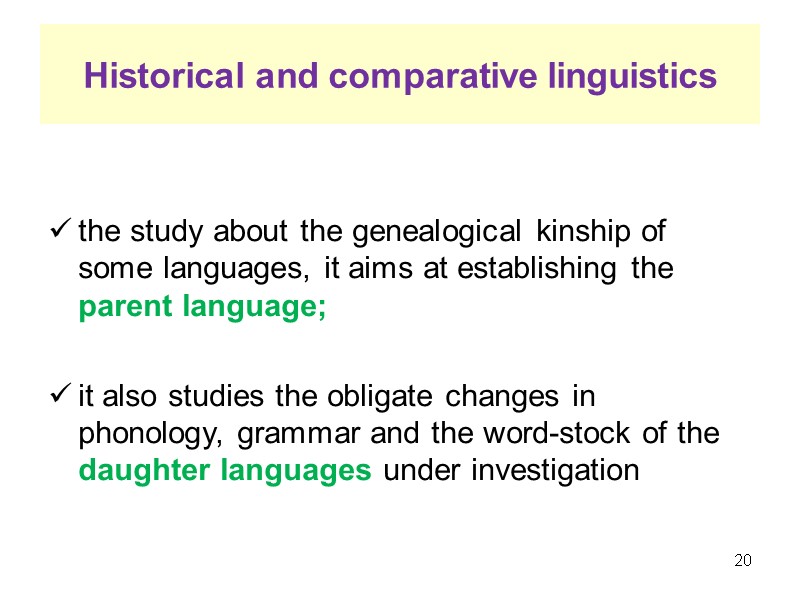
Historical and comparative linguistics the study about the genealogical kinship of some languages, it aims at establishing the parent language; it also studies the obligate changes in phonology, grammar and the word-stock of the daughter languages under investigation 20
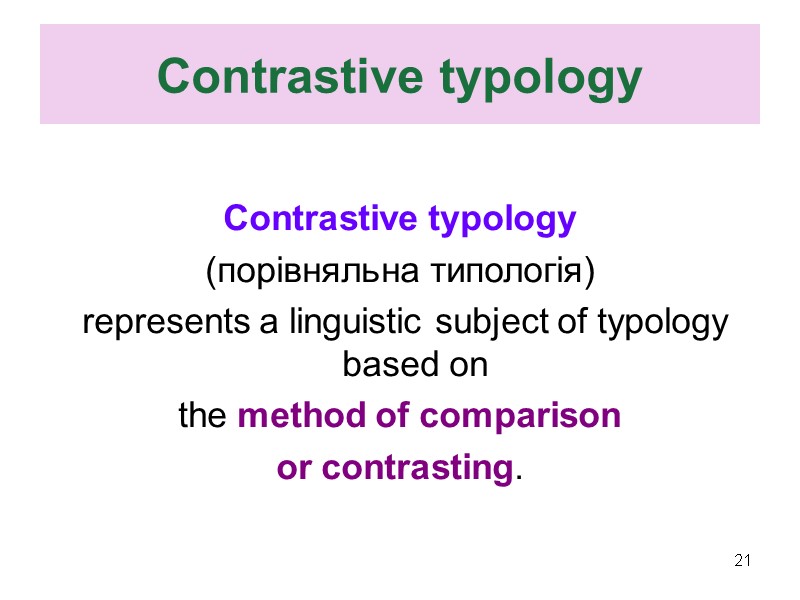
Contrastive typology Contrastive typology (порівняльна типологія) represents a linguistic subject of typology based on the method of comparison or contrasting. 21
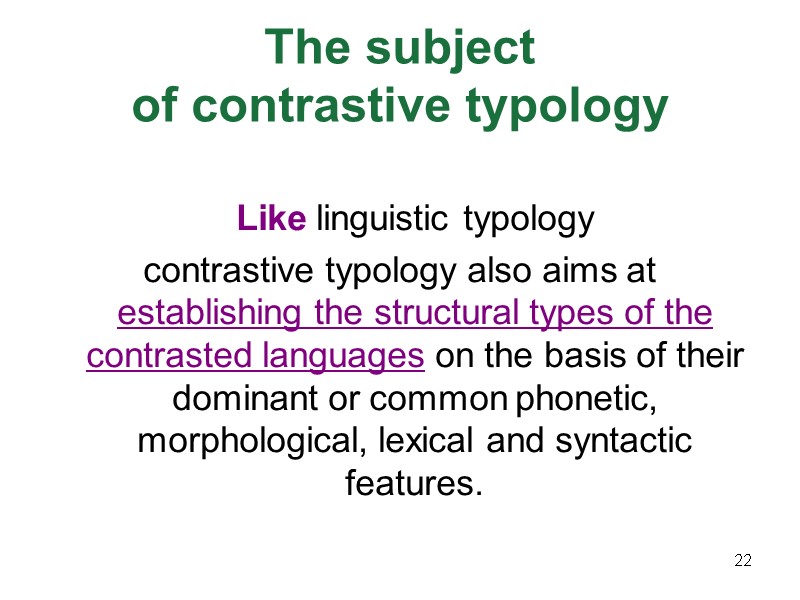
The subject of contrastive typology Like linguistic typology contrastive typology also aims at establishing the structural types of the contrasted languages on the basis of their dominant or common phonetic, morphological, lexical and syntactic features. 22
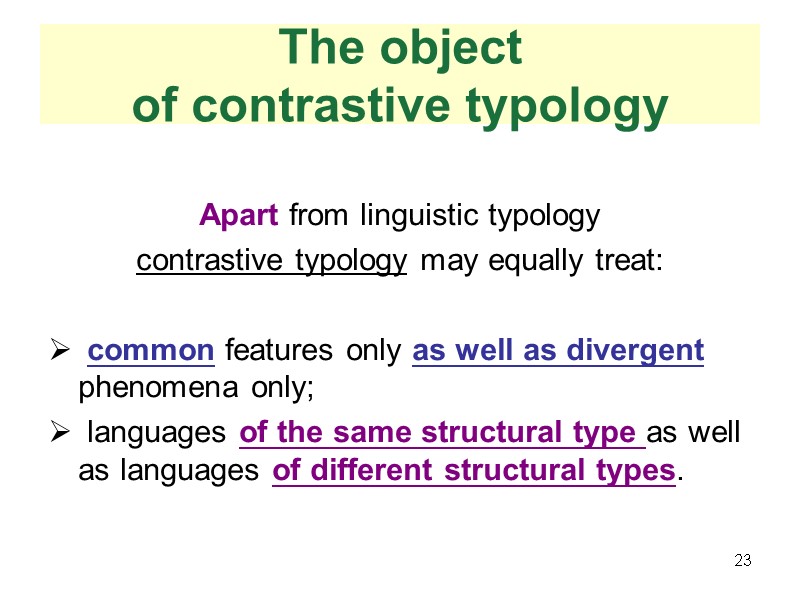
The оbject of contrastive typology Apart from linguistic typology contrastive typology may equally treat: common features only as well as divergent phenomena only; languages of the same structural type as well as languages of different structural types. 23
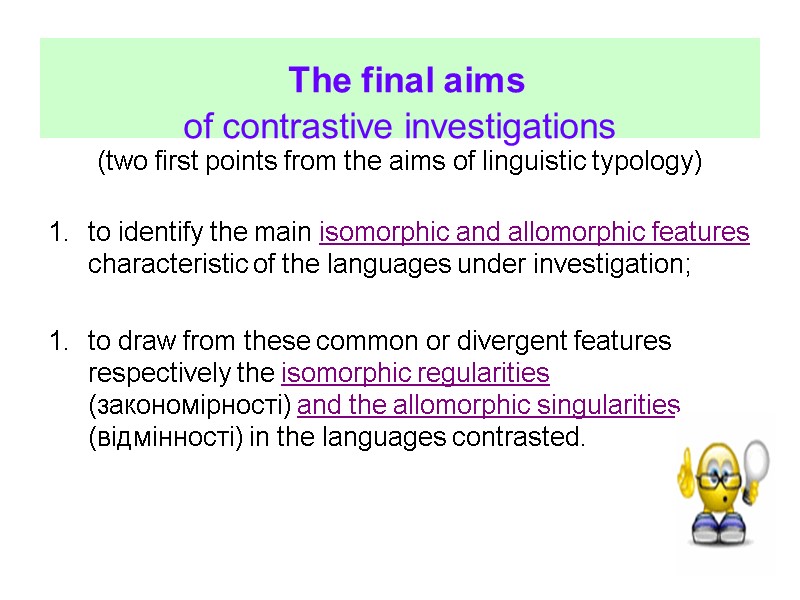
The final aims of contrastive investigations (two first points from the aims of linguistic typology) to identify the main isomorphic and allomorphic features characteristic of the languages under investigation; to draw from these common or divergent features respectively the isomorphic regularities (закономірності) and the allomorphic singularities (відмінності) in the languages contrasted. 24
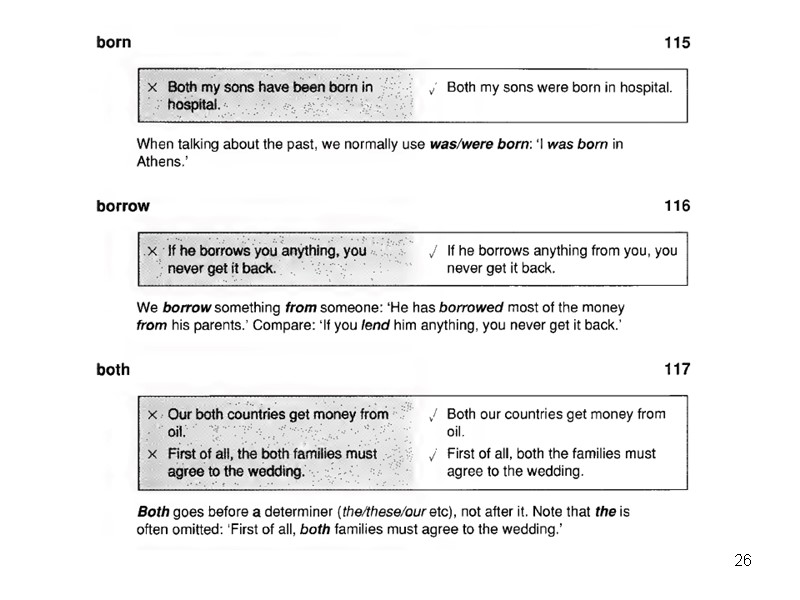
Practical aims of contrastive investigations to supply the ground for translation theory and practice; to foresee and overcome unnecessary interference of languages in teaching practice. e.g. the cases taken from Nigel Turton. The ABC of Common Grammatical errors: 25
26
The number of investigated languages The number of different languages which can be simultaneously subjected to typological contrasting is not limited. 27
The plane of investigation The languages or some of their features / phenomena may be contrasted either synchronically or diachronically. 28
TYPOLOGICAL CONSTANTS (The notion of etalon language. Language universals and their kinds …)
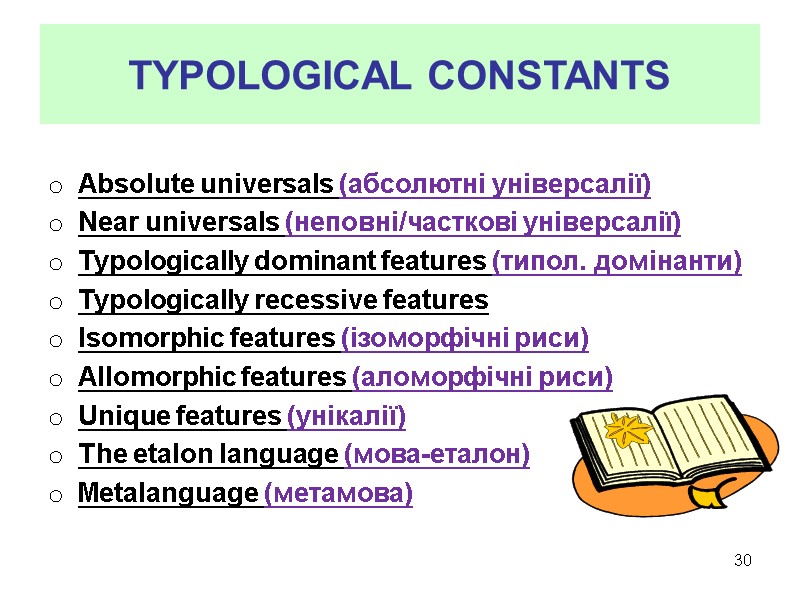
TYPOLOGICAL CONSTANTS Absolute universals (абсолютнi унiверсалiї) Near universals (неповнi/частковi унiверсалiї) Typologically dominant features (типол. домiнанти) Typologically recessive features Isomorphic features (iзоморфічнi риси) Allomorphic features (aломорфічнi риси) Unique features (унiкалiї) The etalon language (мова-еталон) Metalanguage (метамова) 30
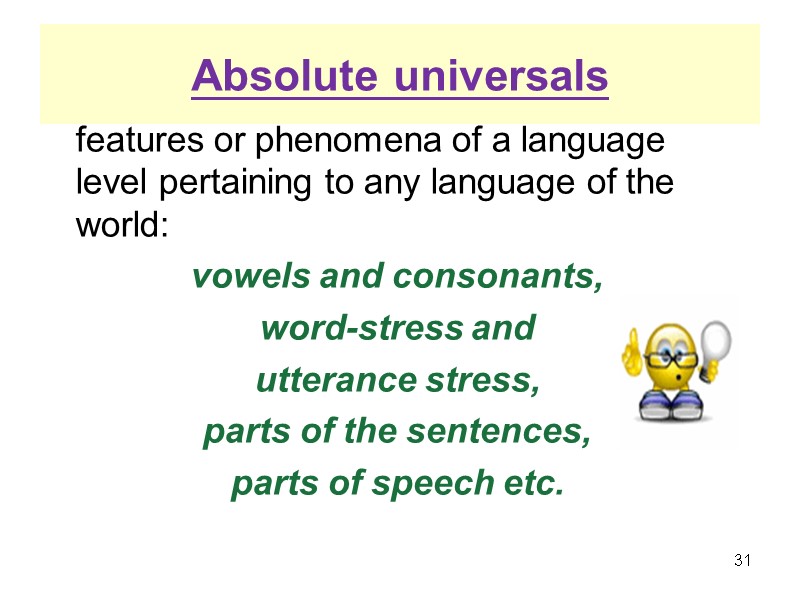
Absolute universals features or phenomena of a language level pertaining to any language of the world: vowels and consonants, word-stress and utterance stress, parts of the sentences, parts of speech etc. 31
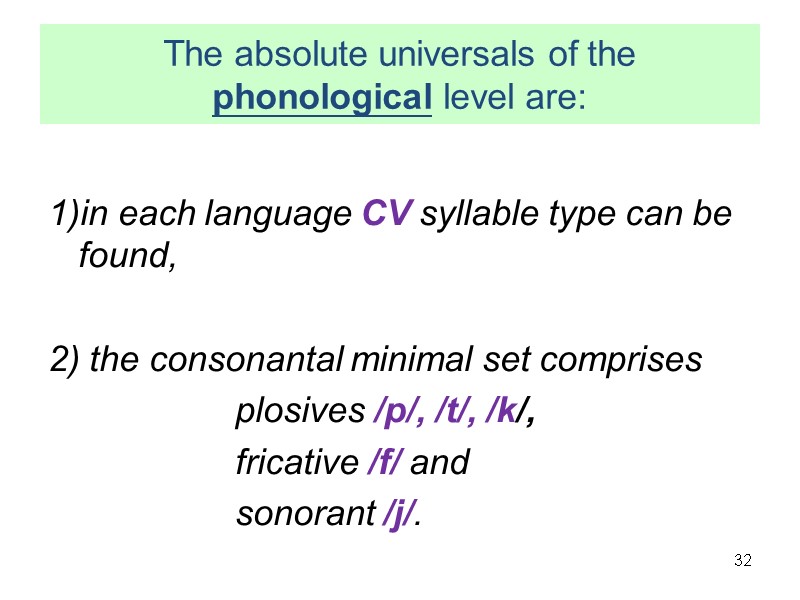
The absolute universals of the phonological level are: in each language CV syllable type can be found, 2) the consonantal minimal set comprises plosives /p/, /t/, /k/, fricative /f/ and sonorant /j/. 32
The absolute universals of the morphological level are: 1) in all languages words can be classified into parts of speech, 2) The most frequent noun category is the category of number, 3) the most frequent verb category is the category of tense, 4) in all languages pronouns are available. 33
The absolute universals of the syntactic level in any language there exist the class of conjunctions, 2) constructions of comparison can be found in any language. 34
Near universals features or phenomena common in many or some languages under typological investigation. For instance, 1) in most languages there is a nasalized consonant, 2) in a great number of languages two vocalic phonemes can be found, 3) if the noun in a language can be characterized by the category of gender, the same category can be applied to analyze the pronoun. 35
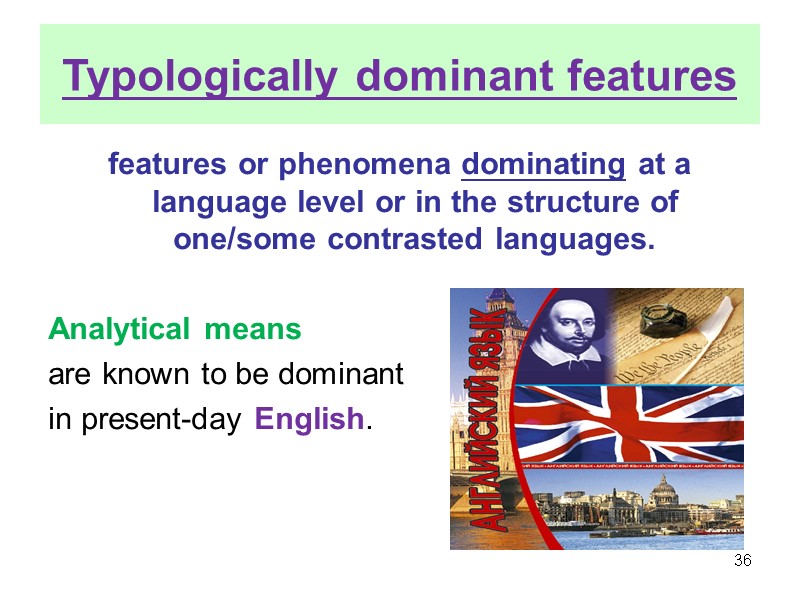
Typologically dominant features features or phenomena dominating at a language level or in the structure of one/some contrasted languages. Analytical means are known to be dominant in present-day English. 36
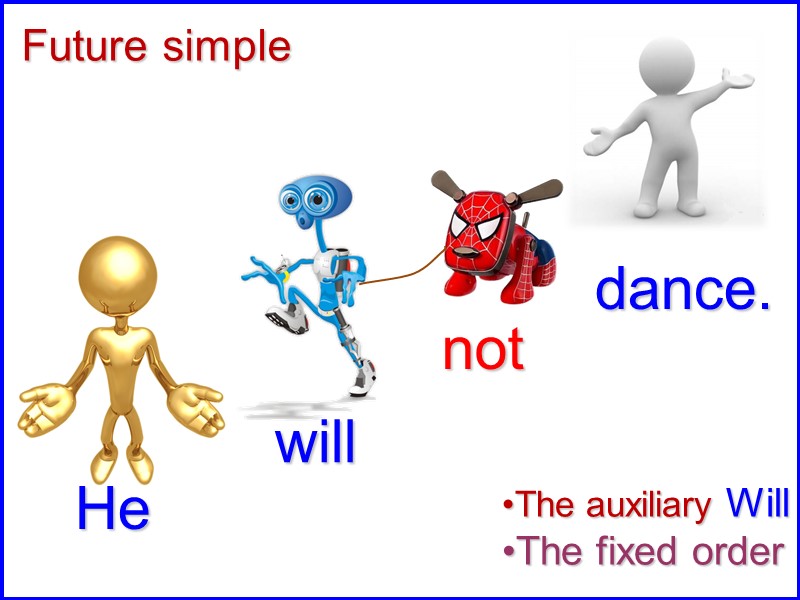
He will not dance. Future simple The auxiliary Will The fixed order
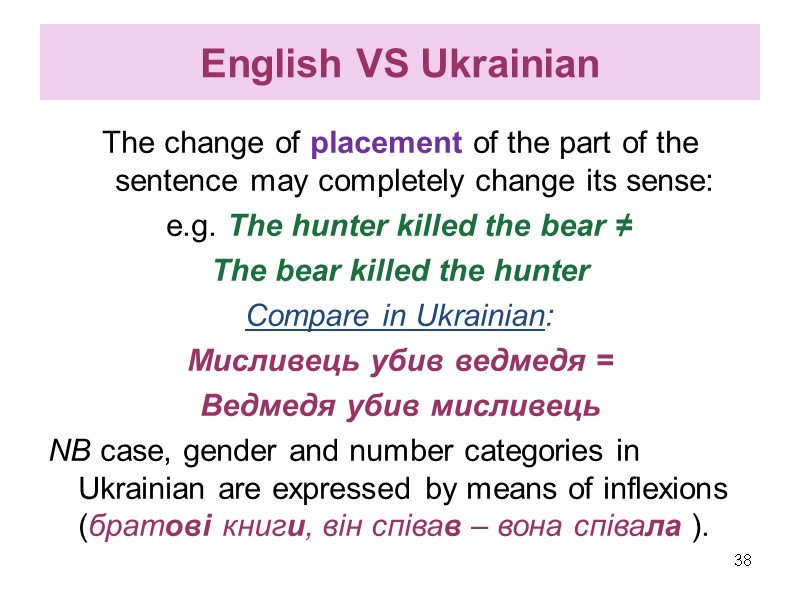
English VS Ukrainian The change of placement of the part of the sentence may completely change its sense: e.g. The hunter killed the bear ≠ The bear killed the hunter Compare in Ukrainian: Мисливець убив ведмедя = Ведмедя убив мисливець NB case, gender and number categories in Ukrainian are expressed by means of inflexions (братові книги, він співав – вона співала ). 38
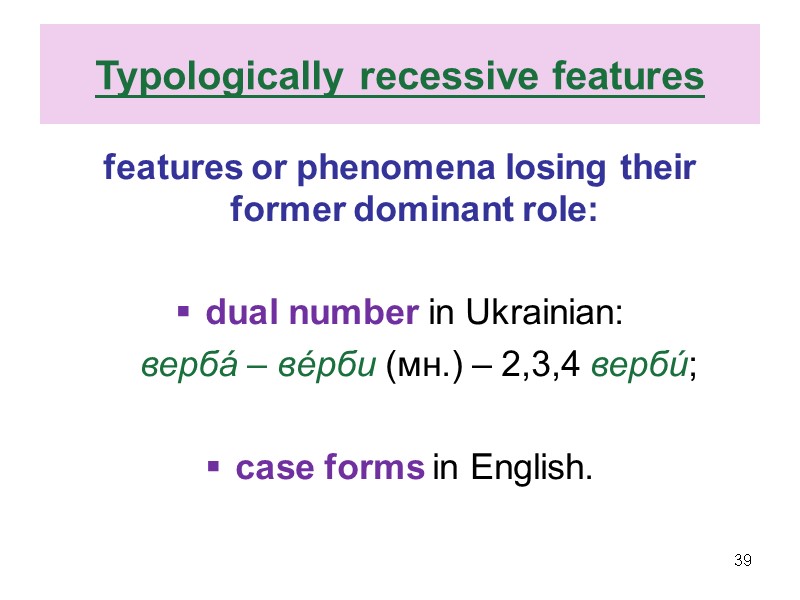
Typologically recessive features features or phenomena losing their former dominant role: dual number in Ukrainian: вербá – вéрби (мн.) – 2,3,4 вербú; case forms in English. 39
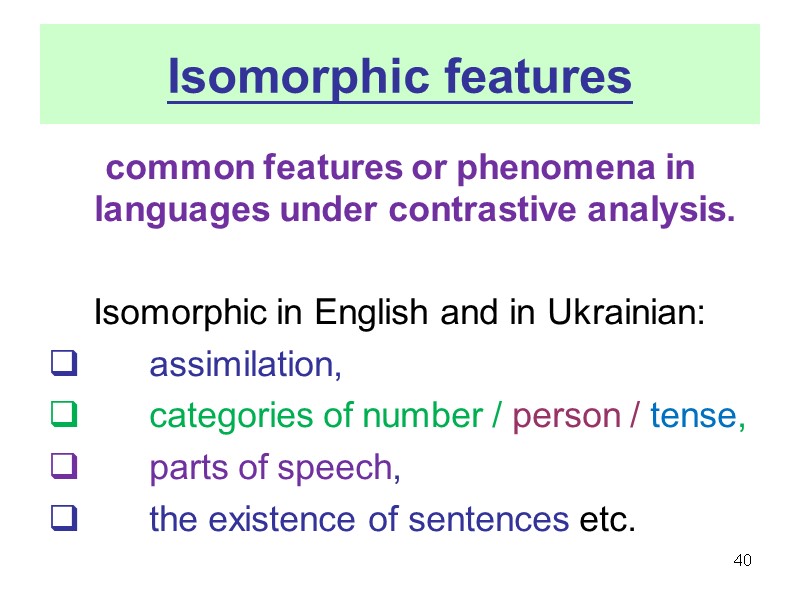
Isomorphic features common features or phenomena in languages under contrastive analysis. Isomorphic in English and in Ukrainian: assimilation, categories of number / person / tense, parts of speech, the existence of sentences etc. 40
Allomorphic features features or phenomena which are observed in one language and missing in the other. For example, English Gerund, Diphthongs, Analytical verb forms are completely missing in Ukrainian. 41
Unique features features or phenomena which can be found only in one definite language and nowhere else. For example, the final position of prepositions in English questions. 42
The etalon language a hypothetic language creatеd by typologists for the sake of conveniencies of contrasting any language. This ‘‘language’’ is supposed to contain exhaustive quantitative and qualitative data or characteristics concerning all existing language units and phenomena. 43
Metalanguage the language on the basis of which the actual presentation of different features of the contrasted languages is carried out. In our case it is English. 44
KINDS OF TYPOLOGICAL INVESTIGATIONS 45
Universal typology investigates all the languages of the world and aims at singling out in them such features/phenomena which are common in all languages (absolute universals). 46
Special or charactereological typology usually investigates concrete languages, as a rule the native tongue. The language on the basis of which the description of isomorphic and allomorphic features is performed is referred to as metalanguage. 47
General typology has for its object of investigation the most general phonetic, morphological, lexical, syntactic or stylistic features. This typological approach was introduced by the German scholar W. Humboldt. 48
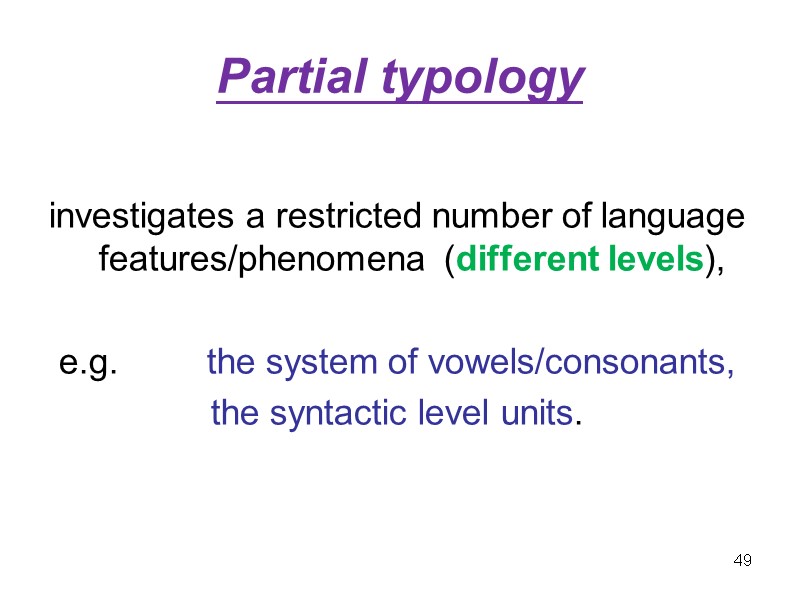
Partial typology investigates a restricted number of language features/phenomena (different levels), e.g. the system of vowels/consonants, the syntactic level units. 49
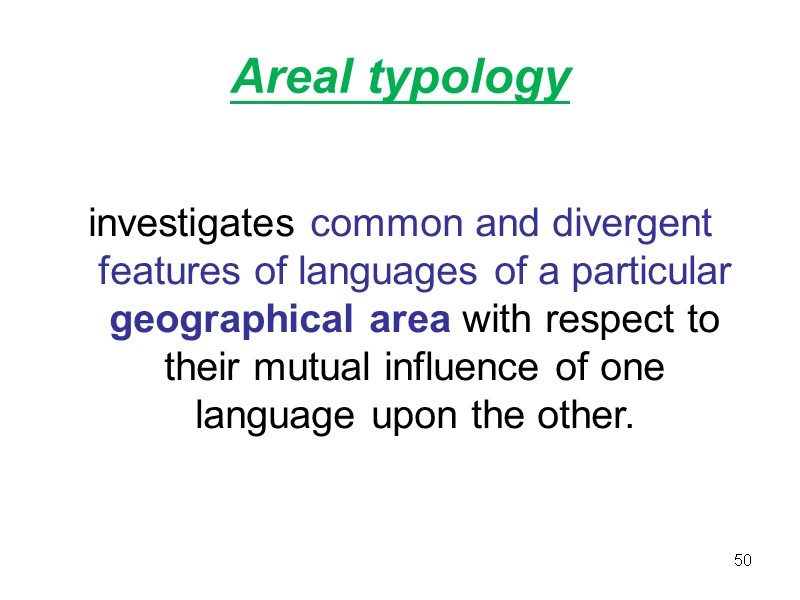
Areal typology investigates common and divergent features of languages of a particular geographical area with respect to their mutual influence of one language upon the other. 50
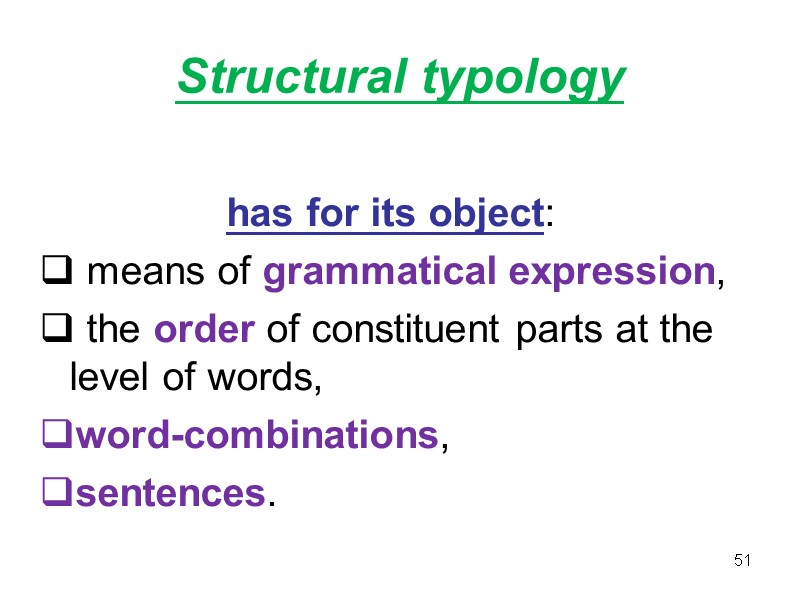
Structural typology has for its object: means of grammatical expression, the order of constituent parts at the level of words, word-combinations, sentences. 51
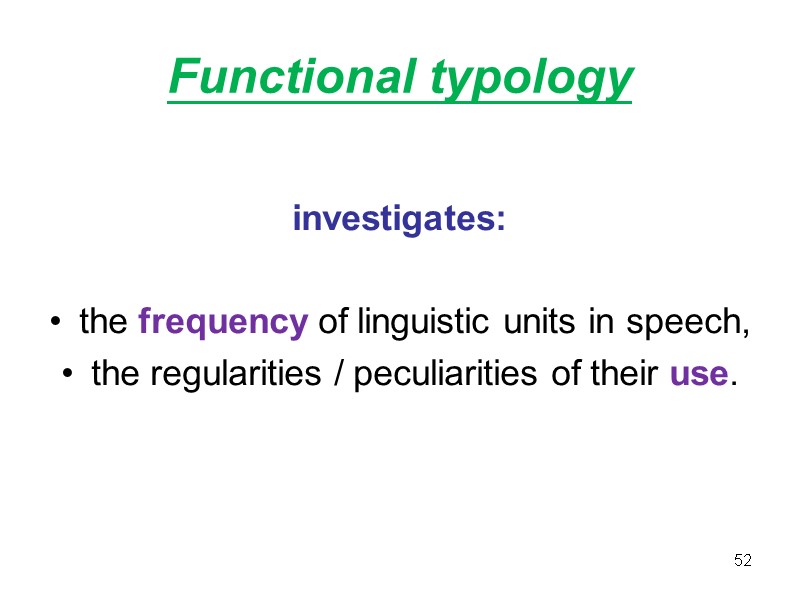
Functional typology investigates: the frequency of linguistic units in speech, the regularities / peculiarities of their use. 52
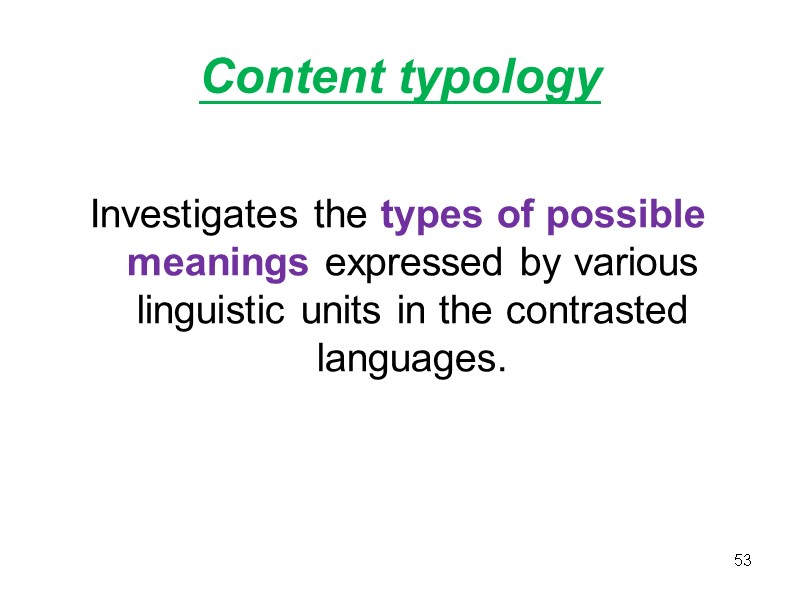
Content typology Investigates the types of possible meanings expressed by various linguistic units in the contrasted languages. 53
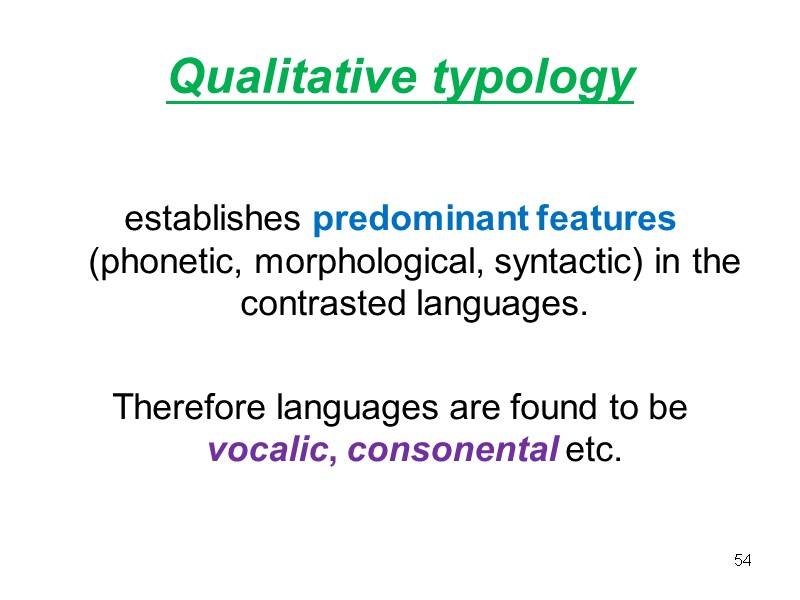
Qualitative typology establishes predominant features (phonetic, morphological, syntactic) in the contrasted languages. Therefore languages are found to be vocalic, consonental etc. 54
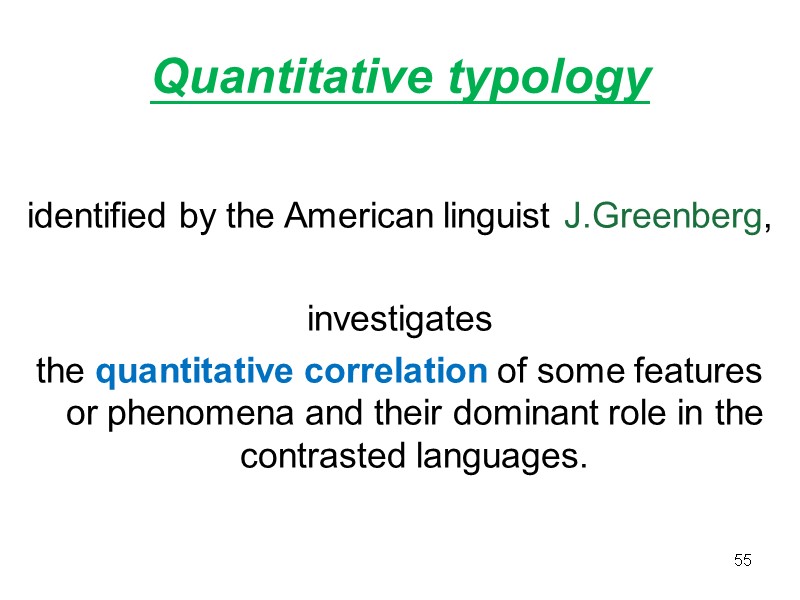
Quantitative typology identified by the American linguist J.Greenberg, investigates the quantitative correlation of some features or phenomena and their dominant role in the contrasted languages. 55
56
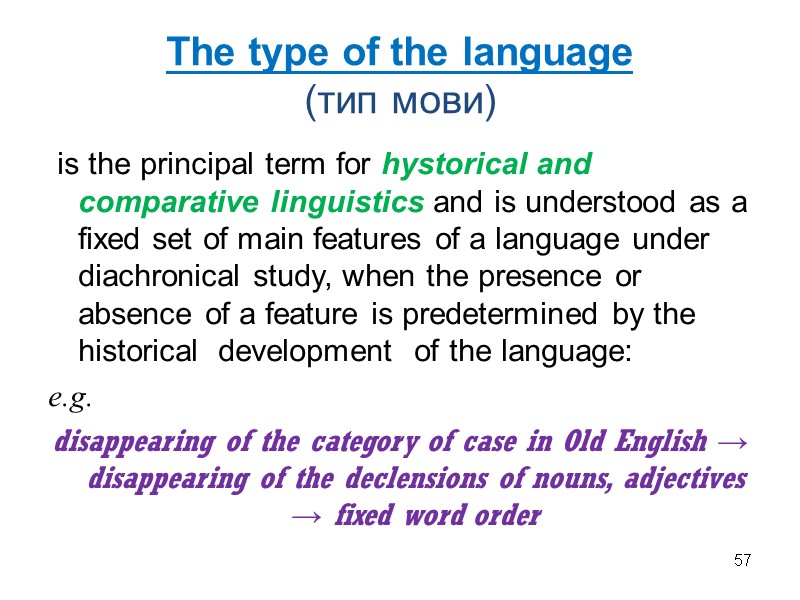
The type of the language (тип мови) is the principal term for hystorical and comparative linguistics and is understood as a fixed set of main features of a language under diachronical study, when the presence or absence of a feature is predetermined by the historical development of the language: e.g. disappearing of the category of case in Old English → disappearing of the declensions of nouns, adjectives → fixed word order 57
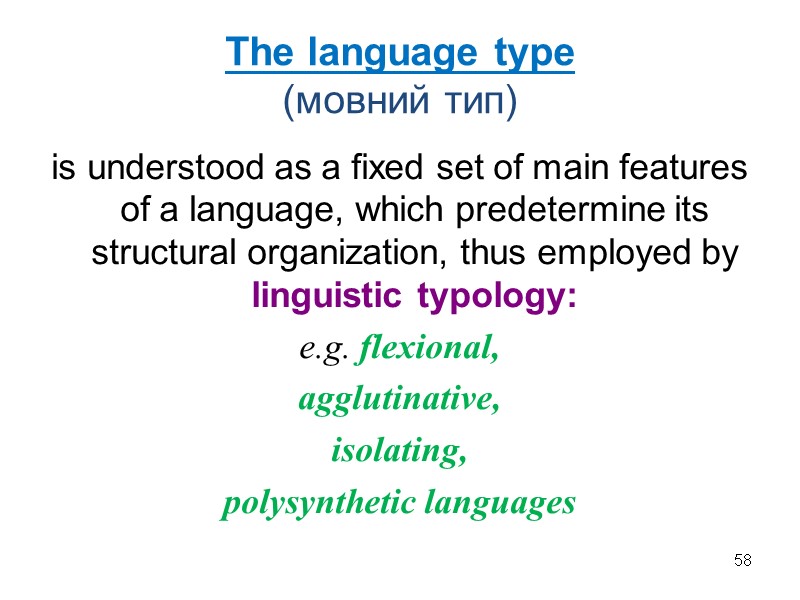
The language type (мовний тип) is understood as a fixed set of main features of a language, which predetermine its structural organization, thus employed by linguistic typology: e.g. flexional, agglutinative, isolating, polysynthetic languages 58
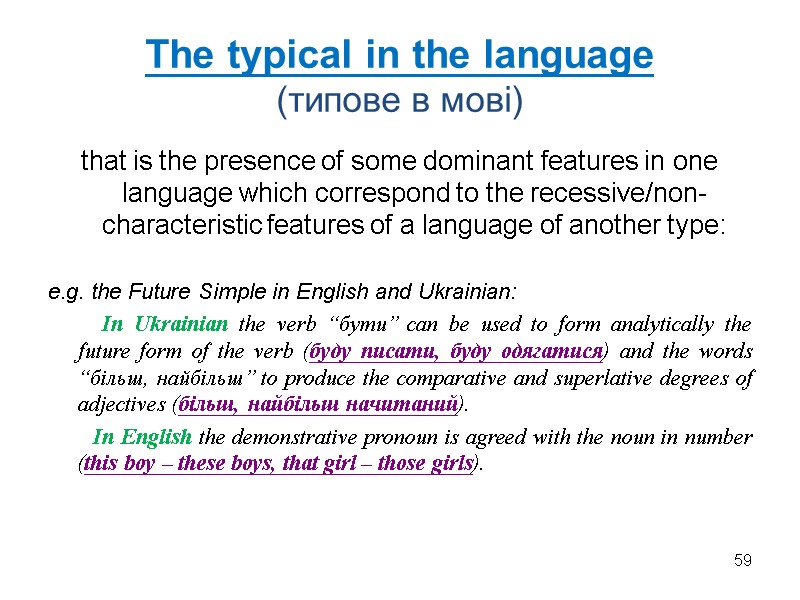
The typical in the language (типове в мовi) that is the presence of some dominant features in one language which correspond to the recessive/non-characteristic features of a language of another type: e.g. the Future Simple in English and Ukrainian: In Ukrainian the verb ‘‘бути’’ can be used to form analytically the future form of the verb (буду писати, буду одягатися) and the words ‘‘бiльш, найбiльш’’ to produce the comparative and superlative degrees of adjectives (бiльш, найбiльш начитаний). In English the demonstrative pronoun is agreed with the noun in number (this boy – these boys, that girl – those girls). 59
The end To be continued… 60
Thanks for your attention!:)
HAVE A NICE DAY !!! 62