


 Скачать презентацию CONTRASTIVE LEXICOLOGY 8 ENGLISH ACADEMIC DISCOURSE ЯЗЫК
Contrastive Lexicology 8.pptx
- Количество слайдов: 32
 CONTRASTIVE LEXICOLOGY 8 ENGLISH ACADEMIC DISCOURSE
 ЯЗЫК НАУКИ (ACADEMIC DISCOURSE) • A functional variety of the language based on a conventional semiotic system realizing the communicative function of conveying information about a given academic subject.
 CODE-SWITCHING IN ACADEMIC COMMUNICATION • This form of communication can be effective only when the speaker and the listener share the content and the language of the given subject or the given trend of investigation. • “Whenever the addresser and / or the addressee need to check up whether they use the same code, speech is focused on the Code: it performs a Metalingual (glossing) function” (R. Jakobson).
 TECHNICAL JARGON • “The program's full extract command was used to process the whole corpus and produce a list of ngrams with the span and the statistical filter set by the user, which in this case as the MI score, with a default minimum of 0. 5. Of the 8, 457 lexical bundles identified by Collocate, 1, 737 met the previously established frequency cut-off of ten instances per million words” • (D. Salazar. Lexical Bundles in Native and Nonnative Writing. John Benjamins, 2014, p. 45)
 ОБЩЕНАУЧНЫЙ СТИЛЬ VS ОБИХОДНО -БЫТОВОЙ СТИЛЬ • В отличие от индивидуально-творческой речи, научное общение между людьми представляет собой сознательно упорядоченное использование данной семиологической системы, что может быть противопоставлено использованию языка в естественных ситуациях общения, например, в разговорной речи. Здесь говорящий не стремится точно определить ту разновидность языка, которой он пользуется. Признак особого стиля является нерелевантным, т. к. язык естественно используется без указания на какую-либо знаковую (семиотическую) его функцию.
 ACADEMIC DISCOURSE • Academic language, is an institutionalized and consciously chosen functional variety. It performs a semiotic function, and signifies a particular communicative situation. It creates a world of its own with emphasis on clarity and precision as well as lucidity of thought and reasoning in argumentation. It presents an optimized wellchosen model which is a result of a conscious effort in constructing speech.
 ПОНЯТИЕ КАК ОСНОВНАЯ ФОРМА НАУЧНОГО МЫШЛЕНИЯ • Функция научного мышления представляет собой познание окружающего нас мира путем создания логических категорий…. • Мысль здесь строго аргументирована. (Н. М. Разинкина Стилистика английской научной речи. – М. , 1972)
 THE COGNITIVE AND EMOTIVE FUNCTIONS • Academic language performs the cognitive function of discovering the phenomena of the world. There is also the cognitive function of thinking where argumentation is implemented in logical categories. • At the same time this language presents a complex combination of emotions in academic disputes and heated discussions with polemic challenges. This is the source of emotionality and expressivity in academic language (the function of impact).
 GENRE ANALYSIS • “Genre analysis is the study of situated linguistic behavior in academic or professional settings defined in terms of typical rhetorical actions, social processes and communicative purposes” • (V. Bhatia, 2014: 24)
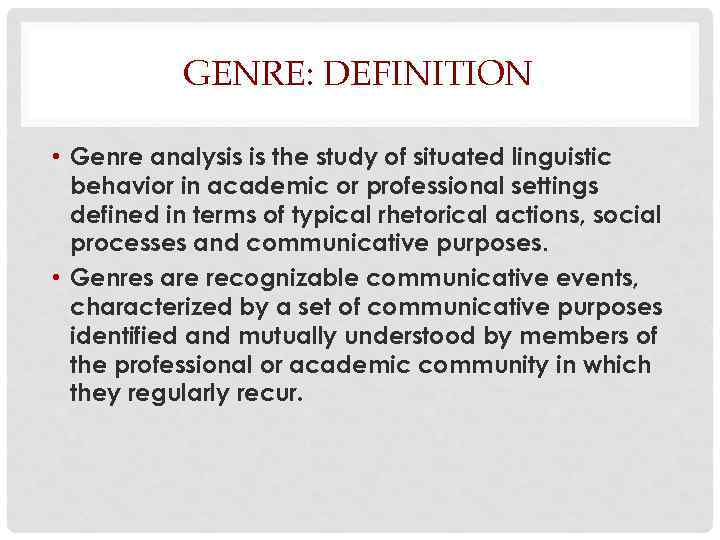 GENRE: DEFINITION • Genre analysis is the study of situated linguistic behavior in academic or professional settings defined in terms of typical rhetorical actions, social processes and communicative purposes. • Genres are recognizable communicative events, characterized by a set of communicative purposes identified and mutually understood by members of the professional or academic community in which they regularly recur.
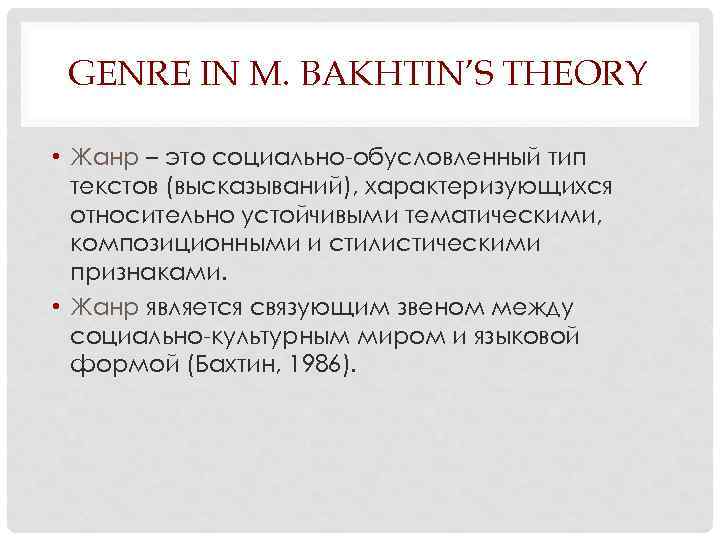 GENRE IN M. BAKHTIN’S THEORY • Жанр – это социально-обусловленный тип текстов (высказываний), характеризующихся относительно устойчивыми тематическими, композиционными и стилистическими признаками. • Жанр является связующим звеном между социально-культурным миром и языковой формой (Бахтин, 1986).
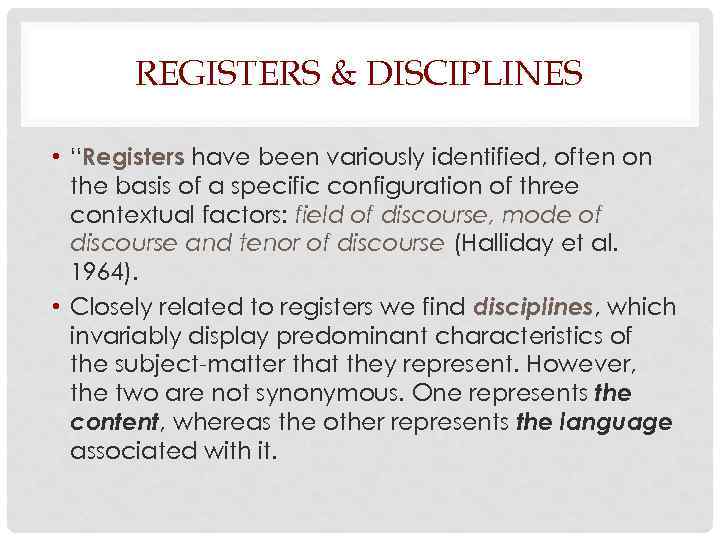 REGISTERS & DISCIPLINES • “Registers have been variously identified, often on the basis of a specific configuration of three contextual factors: field of discourse, mode of discourse and tenor of discourse (Halliday et al. 1964). • Closely related to registers we find disciplines, which invariably display predominant characteristics of the subject-matter that they represent. However, the two are not synonymous. One represents the content, whereas the other represents the language associated with it.
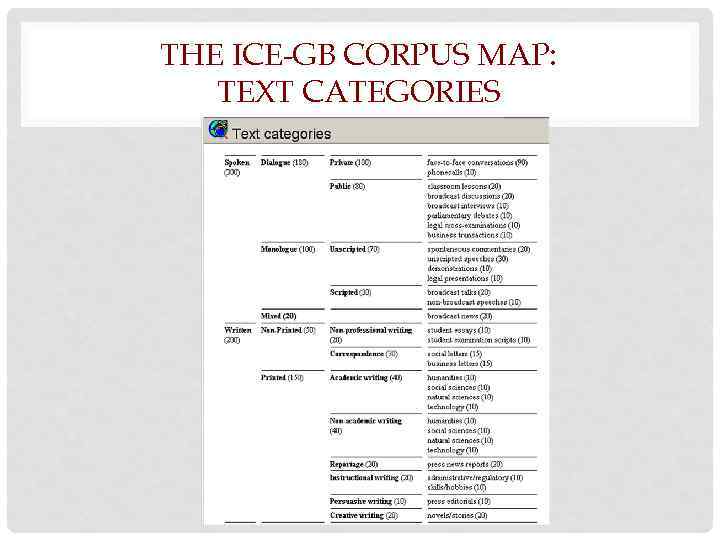 THE ICE-GB CORPUS MAP: TEXT CATEGORIES
 “CONCEPTUAL KNOWLEDGE” (SAMUEL R. LEVIN “METAPHORIC WORDS”, YALE UNIVERSITY, 1988) • The article is part of the author’s monograph on metaphoric words. Its language reveals typical features of academic writing with emphasis on the argumentative and persuasive functions. What he is writing about is not a piece of wellestablished knowledge, but rather the individual deliberation process on the subject of new knowledge in metaphor and poetic language. • This kind of rhetoric is specific to the genre of a monograph as distinct from that of a text-book, where we find a coherent and orderly account of the most fundamental postulates of the discipline. • The author puts forward a hypothesis and formulates a number of arguments to support it. The function of message is closely interrelated with a persuasive appeal to the reader to share and accept the author’s point-of-view.
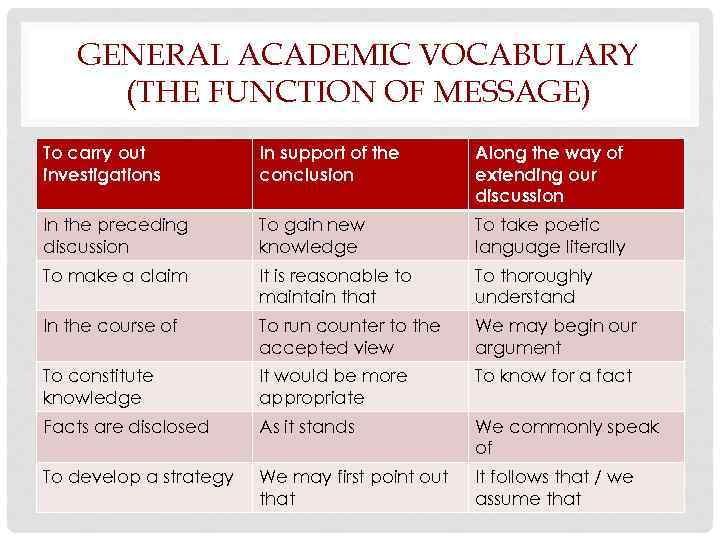 GENERAL ACADEMIC VOCABULARY (THE FUNCTION OF MESSAGE) To carry out investigations In support of the conclusion Along the way of extending our discussion In the preceding discussion To gain new knowledge To take poetic language literally To make a claim It is reasonable to maintain that To thoroughly understand In the course of To run counter to the accepted view We may begin our argument To constitute knowledge It would be more appropriate To know for a fact Facts are disclosed As it stands We commonly speak of To develop a strategy We may first point out that It follows that / we assume that
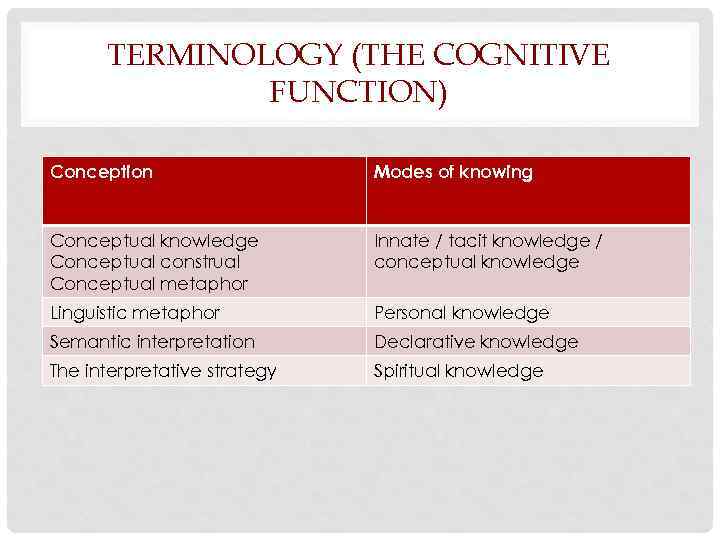 TERMINOLOGY (THE COGNITIVE FUNCTION) Conception Modes of knowing Conceptual knowledge Conceptual construal Conceptual metaphor Innate / tacit knowledge / conceptual knowledge Linguistic metaphor Personal knowledge Semantic interpretation Declarative knowledge The interpretative strategy Spiritual knowledge
 ARGUMENTATION • “Argumentation, as a general notion, is concerned with reasoning; more specifically, with the methodological process of arguing in favour of (or against) a point of view, a course of action, an opinion, etc. ” (Baas Aarts “English Syntax and Argumentation”, Macmillan Press, 1997, p. 157). • The argumentative function presupposes the skill of setting up a coherent argument.
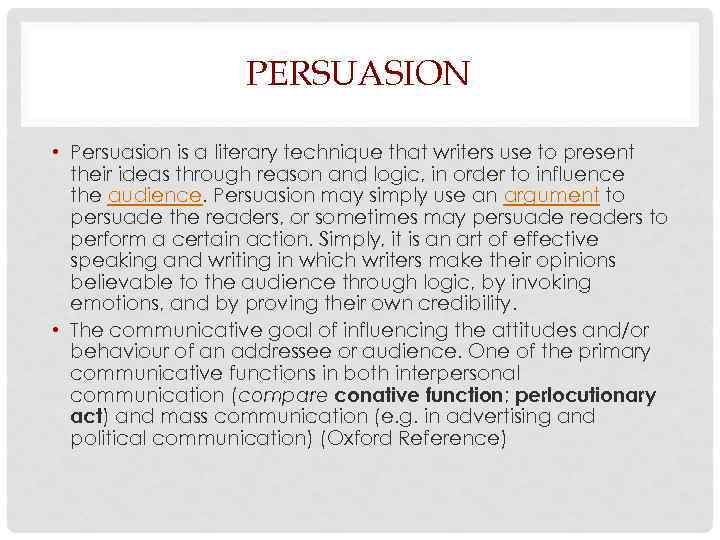 PERSUASION • Persuasion is a literary technique that writers use to present their ideas through reason and logic, in order to influence the audience. Persuasion may simply use an argument to persuade the readers, or sometimes may persuade readers to perform a certain action. Simply, it is an art of effective speaking and writing in which writers make their opinions believable to the audience through logic, by invoking emotions, and by proving their own credibility. • The communicative goal of influencing the attitudes and/or behaviour of an addressee or audience. One of the primary communicative functions in both interpersonal communication (compare conative function; perlocutionary act) and mass communication (e. g. in advertising and political communication) (Oxford Reference)
 A PERSUASIVE ESSAY. THE ARGUMENTATIVE AND PERSUASIVE FUNCTIONS • A persuasive essay is one in which you attempt to get the reader to agree with your point of view. You are trying to present arguments, research, and ideas in order to sway the reader one way or the other. • Persuasion is closely linked to argumentation, but invokes a greater appeal to the emotions of the audience, while the latter uses logic, reasoning, and rationality to prove that the speaker’s words (or their proposal) are credible.
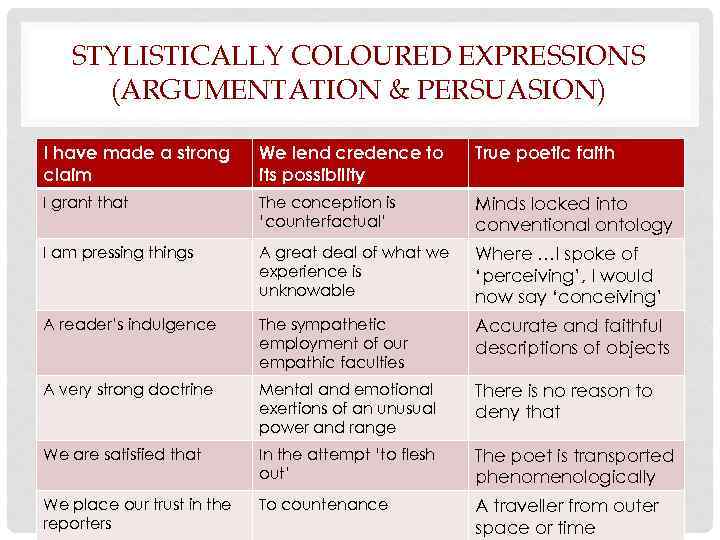 STYLISTICALLY COLOURED EXPRESSIONS (ARGUMENTATION & PERSUASION) I have made a strong claim We lend credence to its possibility True poetic faith I grant that The conception is ‘counterfactual’ Minds locked into conventional ontology I am pressing things A great deal of what we experience is unknowable Where …I spoke of ‘perceiving’, I would now say ‘conceiving’ A reader’s indulgence The sympathetic employment of our empathic faculties Accurate and faithful descriptions of objects A very strong doctrine Mental and emotional exertions of an unusual power and range There is no reason to deny that We are satisfied that In the attempt ‘to flesh out’ The poet is transported phenomenologically We place our trust in the reporters To countenance A traveller from outer space or time
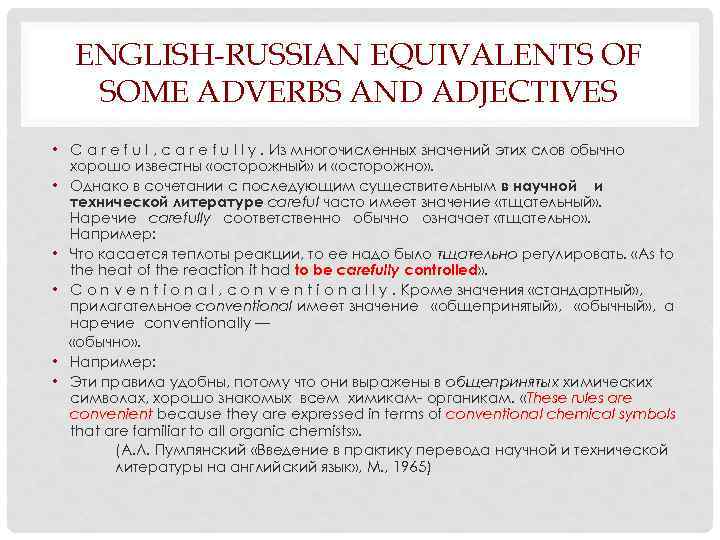 ENGLISH-RUSSIAN EQUIVALENTS OF SOME ADVERBS AND ADJECTIVES • C a r e f u l , c a r e f u l l y. Из многочисленных значений этих слов обычно хорошо известны «осторожный» и «осторожно» . • Однако в сочетании с последующим существительным в научной и технической литературе careful часто имеет значение «тщательный» . Наречие carefully соответственно обычно означает «тщательно» . Например: • Что касается теплоты реакции, то ее надо было тщательно регулировать. «As to the heat of the reaction it had to be carefully controlled» . • C o n v e n t i o n a l , c o n v e n t i o n a l l y. Кроме значения «стандартный» , прилагательное conventional имеет значение «общепринятый» , «обычный» , а наречие conventionally — «обычно» . • Например: • Эти правила удобны, потому что они выражены в общепринятых химических символах, хорошо знакомых всем химикам- органикам. «These rules are convenient because they are expressed in terms of conventional chemical symbols that are familiar to all organic chemists» . (А. Л. Пумпянский «Введение в практику перевода научной и технической литературы на английский язык» , М. , 1965)
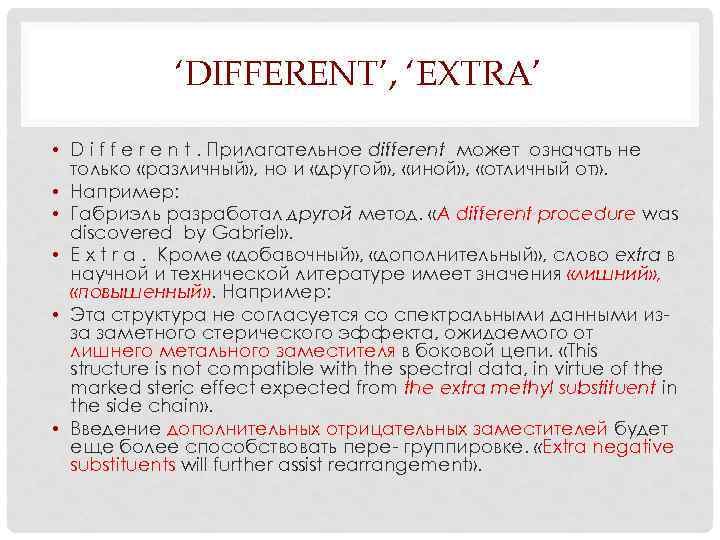 ‘DIFFERENT’, ‘EXTRA’ • D i f f e r e n t. Прилагательное different может означать не только «различный» , но и «другой» , «иной» , «отличный от» . • Например: • Габриэль разработал другой метод. «A different procedure was discovered by Gabriel» . • E x t r a. Кроме «добавочный» , «дополнительный» , слово extra в научной и технической литературе имеет значения «лишний» , «повышенный» . Например: • Эта структура не согласуется со спектральными данными изза заметного стерического эффекта, ожидаемого от лишнего метального заместителя в боковой цепи. «This structure is not compatible with the spectral data, in virtue of the marked steric effect expected from the extra methyl substituent in the side chain» . • Введение дополнительных отрицательных заместителей будет еще более способствовать пере- группировке. «Extra negative substituents will further assist rearrangement» .
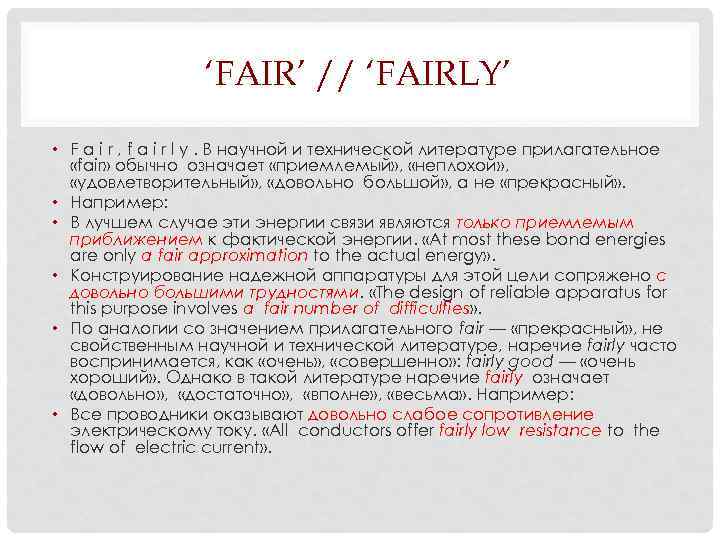 ‘FAIR’ // ‘FAIRLY’ • F a i r , f a i r l y. В научной и технической литературе прилагательное «fair» обычно означает «приемлемый» , «неплохой» , «удовлетворительный» , «довольно большой» , а не «прекрасный» . • Например: • В лучшем случае эти энергии связи являются только приемлемым приближением к фактической энергии. «At most these bond energies are only a fair approximation to the actual energy» . • Конструирование надежной аппаратуры для этой цели сопряжено с довольно большими трудностями. «The design of reliable apparatus for this purpose involves a fair number of difficulties» . • По аналогии со значением прилагательного fair — «прекрасный» , не свойственным научной и технической литературе, наречие fairly часто воспринимается, как «очень» , «совершенно» : fairly good — «очень хороший» . Однако в такой литературе наречие fairly означает «довольно» , «достаточно» , «вполне» , «весьма» . Например: • Все проводники оказывают довольно слабое сопротивление электрическому току. «All conductors offer fairly low resistance to the flow of electric current» .
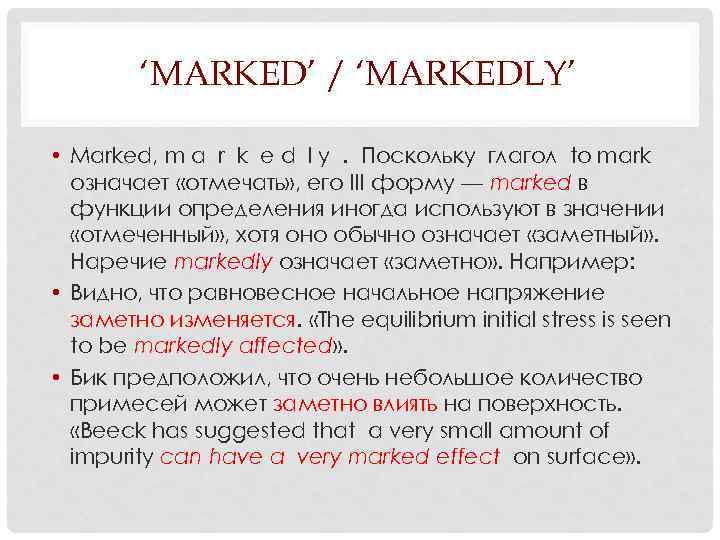 ‘MARKED’ / ‘MARKEDLY’ • Marked, m a r k e d l y. Поскольку глагол to mark означает «отмечать» , его III форму — marked в функции определения иногда используют в значении «отмеченный» , хотя оно обычно означает «заметный» . Наречие markedly означает «заметно» . Например: • Видно, что равновесное начальное напряжение заметно изменяется. «The equilibrium initial stress is seen to be markedly affected» . • Бик предположил, что очень небольшое количество примесей может заметно влиять на поверхность. «Beeck has suggested that a very small amount of impurity can have a very marked effect on surface» .
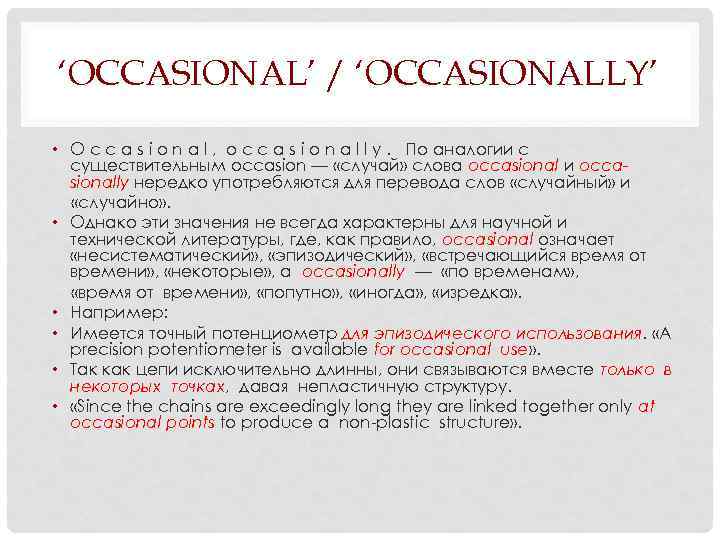 ‘OCCASIONAL’ / ‘OCCASIONALLY’ • O c c a s i o n a l , o c c a s i o n a l l y. По аналогии с существительным occasion — «случай» слова occasional и occasionally нередко употребляются для перевода слов «случайный» и «случайно» . • Однако эти значения не всегда характерны для научной и технической литературы, где, как правило, occasional означает «несистематический» , «эпизодический» , «встречающийся время от времени» , «некоторые» , a occasionally — «по временам» , «время от времени» , «попутно» , «иногда» , «изредка» . • Например: • Имеется точный потенциометр для эпизодического использования. «A precision potentiometer is available for occasional use» . • Так как цепи исключительно длинны, они связываются вместе только в некоторых точках, давая непластичную структуру. • «Since the chains are exceedingly long they are linked together only at occasional points to produce a non-plastic structure» .
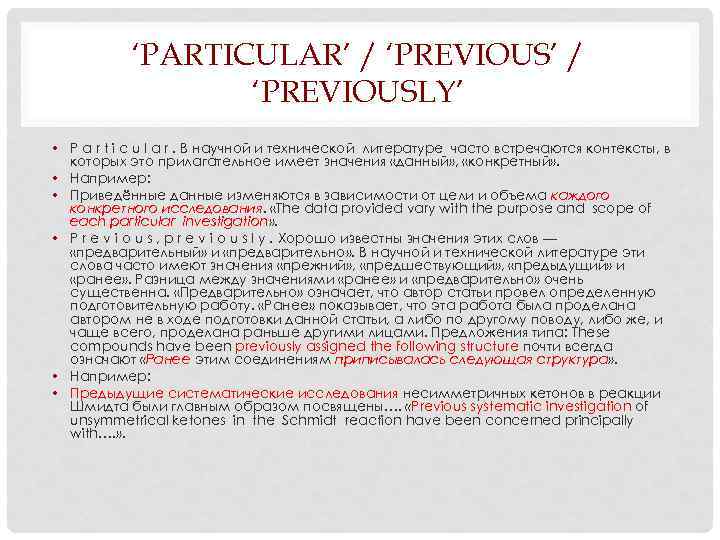 ‘PARTICULAR’ / ‘PREVIOUSLY’ • P a r t i c u l a r. В научной и технической литературе часто встречаются контексты, в которых это прилагательное имеет значения «данный» , «конкретный» . • Например: • Приведённые данные изменяются в зависимости от цели и объема каждого конкретного исследования. «The data provided vary with the purpose and scope of each particular investigation» . • P r e v i o u s , p r e v i o u s l y. Хорошо известны значения этих слов — «предварительный» и «предварительно» . В научной и технической литературе эти слова часто имеют значения «прежний» , «предшествующий» , «предыдущий» и «ранее» . Разница между значениями «ранее» и «предварительно» очень существенна. «Предварительно» означает, что автор статьи провел определенную подготовительную работу. «Ранее» показывает, что эта работа была проделана автором не в ходе подготовки данной статьи, а либо по другому поводу, либо же, и чаще всего, проделана раньше другими лицами. Предложения типа: These compounds have been previously assigned the following structure почти всегда означают «Ранее этим соединениям приписывалась следующая структура» . • Например: • Предыдущие систематические исследования несимметричных кетонов в реакции Шмидта были главным образом посвящены…. «Previous systematic investigation of unsymmetrical ketones in the Schmidt reaction have been concerned principally with…. » .
 ‘REPEATED’ / ‘REPEATEDLY’ / ‘SUITABLE’ • R e p e a t e d , r e p e a t e d l y. По аналогии со значением глагола to repeat — «повторять» прилагательное repeated обычно переводят словом «повторный» . Однако очень часто repeated обозначает многократное действие со значением «неоднократный» и «многократный» , которые также переводятся сочетанием on repeated occasions — «неоднократно» и наречием repeatedly. Например: • Колонки можно использовать неоднократно. «Columns may be used repeatedly» . • S u i t a b l e. В научной и технической литературе это прилагательное очень часто имеет значение «соответствующий» (сравнительная характеристика), в отличие от «подходящий» , «пригодный» (качественная характеристика). • Например: • При действии соответствующих реагентов. «Under the action of suitable reagents» .
 ‘TENTATIVE’ / ‘TENTATIVELY’ • T e n t a t i v e , t e n t a t i v e l y. Прилагательное tentative можно употреблять при переводе русских прилагательных «предварительный» , «пробный» , «временный» , «ориентировочный» . Например: • Наши опыты привели к предварительному выводу, что эти системы смешанных растворителей способствуют реакциям целлюлозы. «Our experiments have led to the tentative conclusion that these mixed solvent systems facilitate cellulose reactions» . • Наречие tentatively, соответственно, можно употребить при • переводе русских наречий «предварительно» , «предположительно» , • «в порядке опыта» , «временно» , «ориентировочно» . Например: Помимо этого, некоторые исследователи отметили слабую полосу и предположительно отнесли ее к добавочному NH поглощению. «In addition, the weak band was noted by some workers and assigned tentatively to an additional NH absorption» .
 ATTITUDINAL ADVERBS • Считают, что эти толкования являются предположительными. • «These interpretations are admittedly conjectural» . • Как сообщают, это очень сильный реагент. «This is, reportedly, a very powerful reagent» . • Очевидно, что группы в трансположении препятствуют этой реакции. «The groups in the «trans position» apparently prevent this reaction» . • Можно предположить, что в качестве промежуточного соединения образовался дибромгидрин VI. «Dibromohydrin VI conceivably could be produced as an intermediate» . • По-видимому, это соединение труднорастворимо в концентрированном растворе гидроокиси аммония. «The compound is seemingly difficultly soluble in concentrated ammonium hydroxide solution» . • Это противоречие, по-видимому, указывает на разные механизмы образования бензола. «This discrepancy seemingly indicates different mechanisms of benzene formation» . • Можно предположить, что имела место частичная рацемизация. «A partial racemization could supposedly take place» . • Для простого случая можно было бы себе представить, что разделение осуществляется посредством очень простого прибора. «In a simple case, a separation could conceivably be carried out with very simple equipment» .
 ‘AGAIN’ / ‘NOW’ • Again. Это наречие нередко имеет не только обычное значение «снова» , но и — «с другой стороны» , «и в этом случае» , «в свою очередь» и может стоять как в начале предложения, так и рядом со сказуемым. Например: • Новая методика дала возможность преодолеть указанные трудности. С другой стороны, произошло неожиданное падение спроса на этот продукт. «The new procedure enabled us to overcome the above difficulties. Again there took place an unexpected drop in the demand for this product» . • И в данном случае это находится в соответствии с экспериментом. «Again this is in accord with the experiment» . • N о w. Это наречие, помимо значения «теперь» , часто употребляется для выражения логической связи между двумя предложениями в значении «далее» , «итак» , «в ходе данной работы» . Например: • Далее, если предположить, что цепь вращается с сохранением валентных углов, то боковые группы будут сближаться. «If the chain is now imagined to be rotated with the preservation of the valency angles, the side groups will become closer together. • Далее эти уравнения будут получены, исходя из статистических законов. «The equations will now be derived on a statistical basis» .
 ‘THUS’ • Thus. Наречие thus очень широко распространено в английской научной и технической литературе. Помимо значений «так» , «таким образом» , оно часто служит для выражения логической связи между двумя предложениями в значении «так, например» , «поэтому» , «следовательно» , «тем самым» . В таком случае thus обычно стоит в начале предложения. Например: • В данном исследовании прибавление калия снижало константу скорости. Следовательно, обмен, повидимому, обусловлен химическими характеристиками. • «In the present study the addition of potassium reduced the rate constant. Thus it appears that the change is due to the chemical characteristics» .
 ‘ALTERNATIVELY’ / ‘BADLY’ • A l t e r n a t i v e l y. Значение этого наречия, очень характерного для научной и технической литературы, можно вывести из значений прилагательного alternative и переводить: «с другой стороны» ; «и наоборот» . Кроме того, это наречие соответствует значению «попеременно» . Например: • С другой стороны, реакция между этиленгликолем и …. . «Alternatively the reaction between ethylene'glycol and …. » . • B a d l y. Исходя из значения прилагательного bad — • «плохой» , наречие badly обычно воспринимается в значении «плохо» . Однако badly очень часто означает «сильно» , «очень» , «весьма» . Единственная смысловая связь между прилагательным bad и наречием badly в данном случае заключается в том, что это наречие обычно употребляется в контексте, указывающем на недостаток чеголибо, на отрицательный результат и т. п. Например: to want badly — «очень нуждаться» , to cut oneself badly — «сильно порезаться» . • Этот метод сильно страдает от влияния помех. «The method suffers badly from disturbance effects» . • Над этой проблемой надо еще очень много работать. «Further work on this problem is badly needed» .