


 Скачать презентацию CONTRASTIVE LEXICOLOGY 2 UNDERSTANDING METAPHORICAL EXPRESSIONS FIGURATIVE
Contrastive Lexicology 2.pptx
- Количество слайдов: 15
 CONTRASTIVE LEXICOLOGY 2 UNDERSTANDING METAPHORICAL EXPRESSIONS
 FIGURATIVE LANGUAGE IN COGNITIVE LINGUISTICS • “Human cognition is fundamentally shaped by various poetic or figurative processes. Metaphor, metonymy, irony, and other tropes are not linguistic distortions of literal mental thought but constitute basic schemes by which people conceptualize their experience and the external world” • (Raymond W. Gibbs “The Poetics of mind”, Cambridge University Press, 1994, p. 1)
 THE PROCESSES OF UNDERSTANDING • While literal meanings are ordinary and primary, figurative expressions may possess many potential meanings. It is the indeterminate nature of much figurative language that makes its meaning seem special (e. g. Marriage is like an icebox). • Understanding of metaphor leading to its adequate translation may roughly be divided into four stages corresponding to linguistic comprehension, recognition, interpretation, and appreciation.
 STAGE 1. COMPREHENSION • Comprehension refers to the immediate process of creating meanings for utterances. This moment-bymoment process is mostly unconscious and involves the analysis of linguistic information (wordmeanings, syntax, phonology). It is facilitated by the context and the shared knowledge that exists between the speaker and the listener. • For example, the metaphor “My marriage is an icebox” may very quickly, without any conscious reflection, be understood as something like “My marriage lacks affection”.
 STAGE 2. RECOGNITION • Recognition refers to the conscious identification of linguistic expressions as types. For example, the meaning of a particular utterance may be consciously recognized as metaphorical. • In natural discourse, listeners do not probably have a conscious recognition that different utterances in conversation are ironic, idiomatic, hyperbolic, literal, and so on. But for the translator, this kind of awareness (whether the expression is literal or metaphorical) is an obligatory stage in searching for the optimal translation equivalent.
 STAGE 3. INTERPRETATION • Interpretation refers to analysis of particular linguistic expressions as tokens, i. e. within a given text, utterance, or context. It operates later than comprehension processes and usually requires conscious reflection about what text or speaker means. • For example, the phrase “My marriage is an icebox” may result in a particular set of entailments about the way that marriages and iceboxes are similar: v. Iceboxes are cold like some marriages v. Iceboxes are small and confining, etc.
 STAGE 4. APPRECIATION • Appreciation refers to some aesthetic judgement given to a linguistic expression as either a type or token. For instance, a reader might appreciate the aptness or aesthetic value of such an expression as “My marriage is an icebox”. • However this process is not an obligatory part of understanding linguistic meaning for an ordinary reader: in natural discourse, listeners can easily comprehend utterances without automatically making an aesthetic judgement about them. • In translation practice, this process may help identify the priority focal points in the text that require special attention.
 CONCLUSION: ORDINARY READERS VS. LANGUAGE RESEARCHERS • During the understanding of figurative language in everyday speech or even in literary texts, ordinary readers may comprehend the meaning of tropes without recognizing that each utterance is metaphorical, ironic, idiomatic, and so on. They often do not require cognitive effort beyond comprehension. • Language researchers and translators, on the contrary, build their analysis on a unique theoretical explanation of all the four stages to ensure a deeper penetration into the context.
 THE CONCEPTUAL VIEW OF METAPHOR • Unlike the anomaly view, the conceptual structure view of metaphor provides an explanation why so many metaphors are understood effortlessly, without a conscious reflection. • Metaphoric understanding is generally not problematic or different from comprehension of literal language, precisely because our conceptual system is structured via metaphorical mappings. • (G. Lakoff, M. Johnson “Metaphors we live by”, Chicago University Press, 1980)
 METAPHOR AS CONCEPTUAL STRUCTURE • “Our ordinary conceptual system, in terms of which we both think and act, is fundamentally metaphoric in nature” (Lakoff, Johnson, 1980, p. 3). • The concept of an argument can be seen in the conventional metaphors: 1. ARGUMENTS ARE BUILDINGS (He constructed a solid argument) 2. ARGUMENTS ARE CONTAINERS (He expressed two new ideas in the argument) 3. ARGUMENT IS WAR (He attacked the weak point of my argument)
 METAPHOR AS A CONCEPTUAL STRUCTURE: THEORIES ARE BUILDINGS • Various expressions specify parts of the conceptual metaphor: • His theory has thousands of little rooms and long, winding corridors (Freud talked of memory as a House Full of Rooms). • Complex theories usually have problems with the plumbing. • These expressions show the complex way in which we conceptualize theories.
 METAPHORS ACROSS CULTURES • Metaphors are primary devices for representation of cultural experience. Metaphors organize our experience through their interpretations. • Even brief ironic remarks can cause public turmoil. John Lennon’s statement “The Beatles are more popular than Jesus Christ” was meant not as a boast, but to convey something like “isn’t this attention ridiculous” (i. e. irony). Yet in the USA religious leaders condemned Lennon for his apparent belief that the Beatles were more important than the spiritual leader of Christianity.
 IS LITERAL TRANSLATION OF METAPHORS POSSIBLE? • Some metaphors are universal, while others are culture-specific. Compare the following descriptive translations of the idioms (‘dead metaphors’) a skeleton in the cupboard and the proof of the pudding is in the eating with their literal renderings at the lexical level (consult the Russian National Corpus).
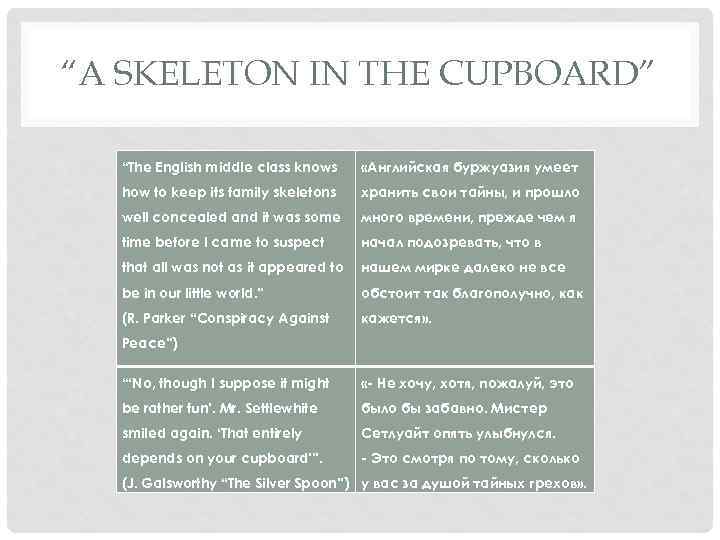 “A SKELETON IN THE CUPBOARD” “The English middle class knows «Английская буржуазия умеет how to keep its family skeletons хранить свои тайны, и прошло well concealed and it was some много времени, прежде чем я time before I came to suspect начал подозревать, что в that all was not as it appeared to нашем мирке далеко не все be in our little world. ” обстоит так благополучно, как (R. Parker “Conspiracy Against кажется» . Peace”) “‘No, though I suppose it might «- Не хочу, хотя, пожалуй, это be rather fun’. Mr. Settlewhite было бы забавно. Мистер smiled again. ‘That entirely Сетлуайт опять улыбнулся. depends on your cupboard’”. - Это смотря по тому, сколько (J. Galsworthy “The Silver Spoon”) у вас за душой тайных грехов» .
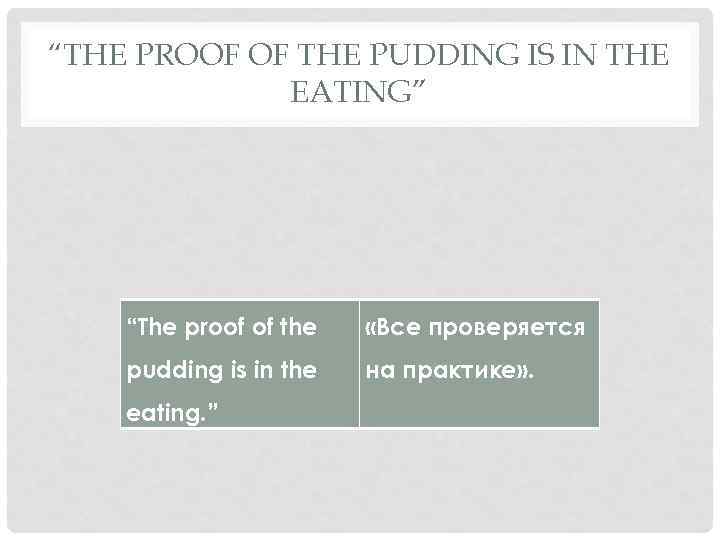 “THE PROOF OF THE PUDDING IS IN THE EATING” “The proof of the «Все проверяется pudding is in the на практике» . eating. ”