


 Скачать презентацию Contractor Supplier Environmental Health Safety Security Awareness Tomahawk
972bdf8f7dc24d6a758f84b16445d9f8.ppt
- Количество слайдов: 62
 Contractor/Supplier Environmental, Health, Safety & Security Awareness Tomahawk Operations
 Contractor Responsibilities • Contractor assumes and has full responsibility and liability for: – safety of its employees. – compliance of subcontractors. – compliance with H-D standards and applicable laws and regulations. – enforcement of Environmental, Safety and Security rules. – ensuring that work is performed in a safe manner. • Contractors who do not conform to these rules and regulations will be required to cease work and depart property.
 Key Site Contacts Telephone numbers for the key site contacts are found in the contractor booklet. • Health, Safety and Environmental personnel and contact numbers for the site: – – Safety Manager: James Sparks Senior Generalist Safety: Darrell Jeffries H&S Coordinator: Mike Volkers H&S Coordinator: Mick Melder (off-shift) Cell: 715 -612 -0208 Desk: 715 -453 -1766 Desk: 715 -453 -1767 Desk: 715 -453 -0253 • Security personnel and contact numbers for the site: – Somo Security (24 x 7) General line: 715 -453 -2191 Emergency Line (Internal Phones only): *999 – Kaphaem Security (24 x 7) General Line: 715 -224 -2900 Emergency Line (Internal Phones only): *999 – Security Supervisor: Mary Smith (Somo & Kaphaem)Cell: 715 -612 -2202 – Security Manager: Michelle Thomas (off-site) Cell: 717 -873 -3775
 Emergency Information • Emergency equipment must remain clear at all times. – First-aid equipment, fire extinguishers, sprinklers, eyewash stations, egress routes, etc. – If you must block or remove, contact the Health & Safety Department • Accidents & First Aid – Non-Serious injury-care available in Health Clinic – Emergency assistance - call Security at *999 (Somo and Kaphaem) • Do not dial 911 – work through Security – H-D Project Champion must be notified immediately of any injury • Fire Emergency – Individuals discovering a fire should activate the fire alarm system by operating a pull station – If you can do it safely, dial *999 (Somo and Kaphaem internal phones only) to report the fire – Evacuate the building
 Emergency Information • Evacuation Emergency – Prior to beginning work on-site, the Evacuation Procedure must be reviewed with all personnel. – Evacuate if you hear an audible alarm and see a strobe. – In the event of an evacuation, report to the assigned or nearest Rally Point for headcount. Follow H-D employees to the Rally Point – If you have a badge, scan it at the mustering point outside. – Notify your site contact of your location. • Hazardous Material Release Emergency – In the event of a hazardous material release • call *999 (Somo and Kaphaem) from an internal phone • call 715 -453 -0202(Somo) or 715 -224 -2904 (Kaphaem) from a cell phone – If the area needs to be evacuated, activate a fire alarm pull station and immediately notify Security of the release.
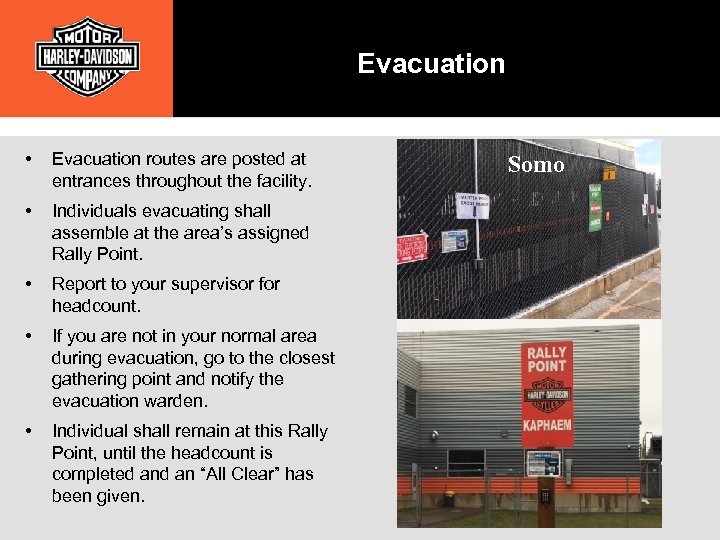 Evacuation • Evacuation routes are posted at entrances throughout the facility. • Individuals evacuating shall assemble at the area’s assigned Rally Point. • Report to your supervisor for headcount. • If you are not in your normal area during evacuation, go to the closest gathering point and notify the evacuation warden. • Individual shall remain at this Rally Point, until the headcount is completed an “All Clear” has been given. Somo Kaphaem
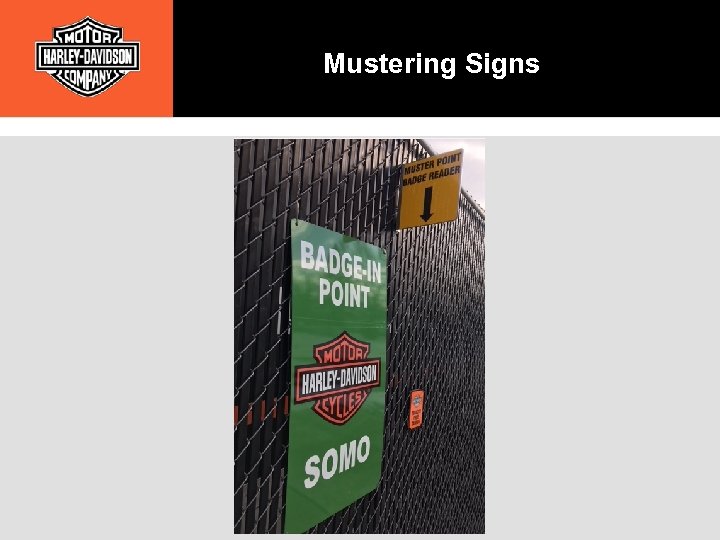 Mustering Signs
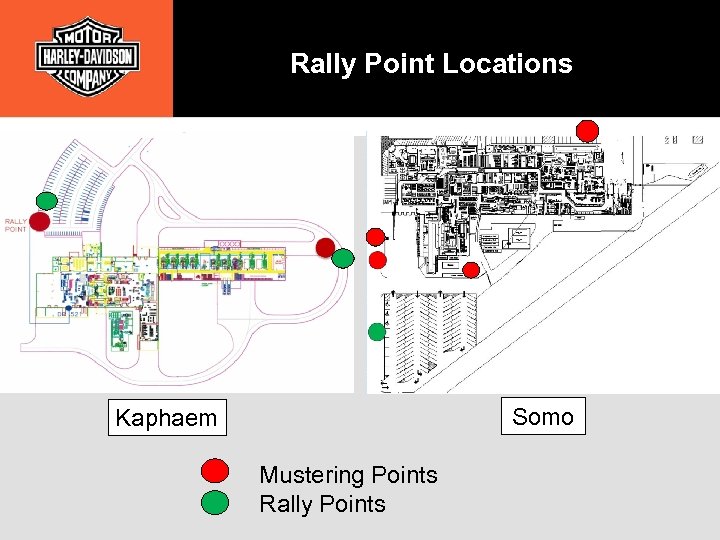 Rally Point Locations Somo Kaphaem Mustering Points Rally Points
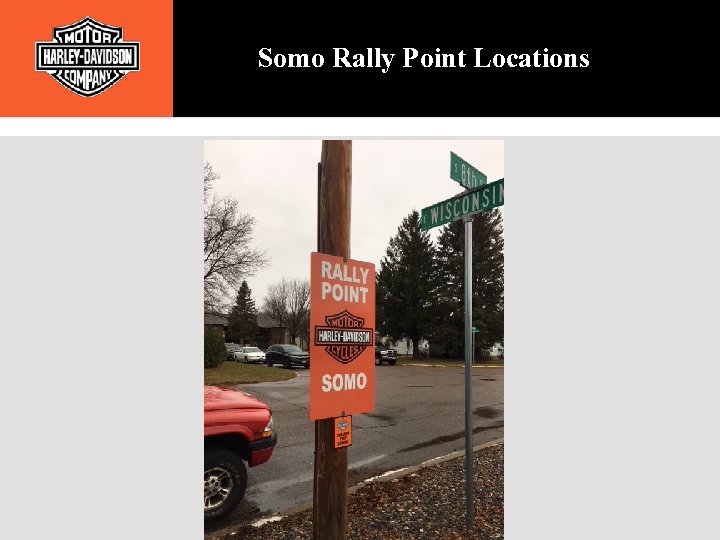 Somo Rally Point Locations
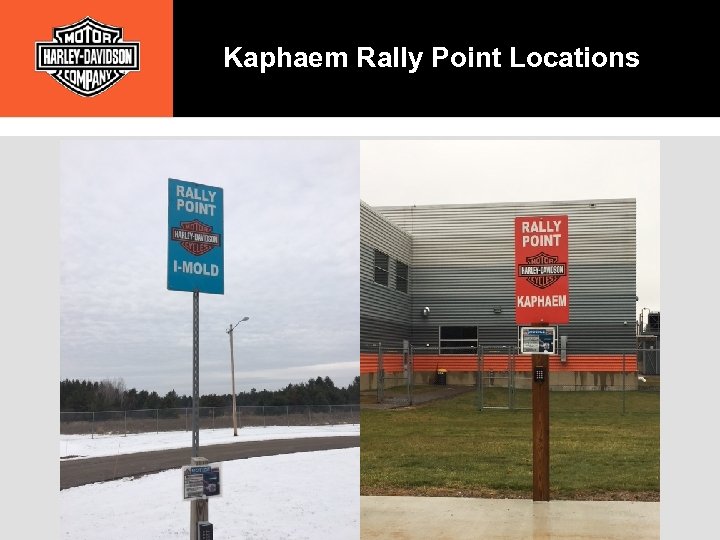 Kaphaem Rally Point Locations
 Access Control - Contractor Facility Access • All contractors are to be directed to Security which is available 24/7. • Contractors will be required to present a valid government issued photo ID. • Contractors will be required to be escorted by their project champion, unless pre-authorization is granted. • Contractors are not permitted to escort another visitor without proper access credentials. • Harley-Davidson Security reserves the right to refuse access to the facility. • Harley-Davidson Security reserves the right to inspect any/all packages, bags, briefcases, purses, tool boxes, equipment, parts, etc. upon entering or exiting the property.
 Access Control - Contractor Gate Access On the occasion when there is a need to drive inside the facility, the following rules need to be observed: • Driving inside the fence line is a privilege, not a right. • Contractors should make every effort to limit the number of vehicles parked inside the fence line. • Driving inside the fence line is reserved for contractors who have a true need to work out of their vehicle. Security will open the gate and wait with them until they are finished. • All vehicles inside the fence line must have a placard/logo on the side with the official company name. • Parking should not block fire lanes or impede traffic, delivery areas, or cause any type of safety issue. • All H-D Safety, Security and Environmental policies must be followed. • All vehicles are subject to search by H-D Security at any time. • NO personal vehicles are permitted. • Any special needs should be brought to the attention of your Project Champion and Security Management.
 Alcohol, Drugs, etc. At no time may individuals be in possession of alcoholic beverages and illegal/non-regulated drugs.
 Asbestos & Lead Paint • Before starting any demolition work ensure Asbestos and Lead testing has been completed on the items to be removed. • Only Certified Asbestos and Lead Paint Contractors are permitted to handle asbestos containing material or lead paint. • Prior to removal of asbestos materials on site – – • approval must be obtained from the Harley-Davidson Safety and Environmental Departments during removal, all applicable Federal, State, and local regulations must be followed Installation of new materials that contain asbestos is prohibited
 Camera Policy Cameras are not permitted within the Harley-Davidson facility without prior approval from the Harley. Davidson Communications Manager. Refer to site specific policies for details about use of camera phones.
 Chemicals • All chemicals, including cleaners, mixtures, lubricants, etc. and compressed gases must be approved prior to being brought on HD property. • Safety Data Sheets and request form must be supplied to the Project Champion who will request approval for use on-site. • You are responsible for providing your employees with Right-To. Know/Hazard Communication training. • Project Champion will review with the contractor the list of H-D chemicals used in the area of construction. • If you find hazardous or unlabeled materials which must be relocated in order to perform work safely, contact the Project Champion.
 Chemicals • All chemical containers must have a label • Any chemicals stored on site must be contained in appropriate storage facilities/cabinets • To dispose of chemicals, contact the Safety/Environmental Department. • Chemical Spills – In the event of a hazardous material release • call Ext. *999 (Somo) or Ext. *999 (Kaphaem) from an internal phone • call 715 -453 -0202(Somo) or 715 -224 -2904 (Kaphaem) from a cell phone – Evacuate the spill area if a safety hazard exists – Attempt to contain spill – You will be liable for all costs incurred for clean-up and disposal
 Flammable & Combustible Liquids • Adequate ventilation must be provided • Extreme caution must be taken when flammable materials are usedno sources of ignition present • Flammable liquids must be dispensed in safety cans with flash screens. • Flammable liquids must be stored in an approved cabinet. The amount stored shall not exceed: – – • 25 gallons of class IA liquids in containers or 125 gallons of class IB, IC, II or III liquids in containers. Acids, alkalines and flammables must not be stored together.
 Bulk Liquids • Bulk deliveries of fuels, oils, coolants, or other materials present an increased risk of spills. Immediately notify site security of any spill or emergency. • Equipment must be in good working order and contractor personnel must remain with their load at all times. • During bulk liquid offloading and loading, wheels must be chocked and contractor must have an emergency communication device. • Please note spill kit locations prior to offloading / loading.
 Hazardous Material Transportation • All applicable federal, state and local requirements for bills of lading, hazardous materials and wastes, manifests and materials of trade must be followed. • Excess chemicals brought on site by Contractor must be removed in a compliant manner, including all applicable DOT requirements.
 Waste Minimization • Bring only enough materials to complete the job. • Contractor is responsible for all housekeeping and proper disposal of materials and wastes while working at H-D. Please consult the Safety/Environmental Department regarding proper disposal of typical waste streams. • All hazardous wastes you generate must be properly packaged, labeled, manifested, transported and disposed of. Wastes which remain the responsibility of H-D must be handled by H-D authorized personnel or contractors. • Numerous containers for recyclables are available throughout H-D facilities. While on site, contractors are expected to observe the signs, labels and posted instructions for recyclables, cardboard, paper, plastic bottles and metals.
 Confined Space Entry • Personnel that perform confined space entry work must have appropriate training. • Project Champion must authorize confined space entry work. • The plant wide Confined Space Entry Policy applies to all contractor personnel. An on site rescue team is required for permit required spaces. • Harley-Davidson has posted warning signs at the entrances of permitrequired confined spaces. • It must be recognized that situations and tasks may create a hazardous atmosphere that will require a permit in non-posted confined spaces. • H-D will not loan or otherwise provide equipment to contractors for confined space entry. Contractors must provide all necessary equipment to enter and perform work in confined spaces.
 Compressed Gas Cylinders • Valve protection caps shall be in place when compressed gas cylinders are transported, moved or stored. • Cylinder valves should be closed when work is finished and when cylinders are emptied or moved. • Compressed gas cylinders shall be secured in an upright position. • Cylinders should be permanently marked or stenciled to identify them.
 Construction Areas • Construction areas must be clearly identified through any use of: – – – barricades ropes stanchions fences cones appropriate signs • Includes any area used by contractor performing work on premises regardless of the length of time required to do work or type of work to be done. • Hard hats must be worn in areas and on projects where there is a danger to the head from falling objects or individuals working overhead.
 Cranes & Hoists • Mobile cranes should not be operated within 50 feet of overhead electrical power lines unless approved by H-D Project Champion. • Accessible areas within the rear-swing radius of the revolving superstructure should be barricaded to keep unauthorized persons away. • Hoisting of equipment over the roof on a H-D building is not allowed unless there is no alternative method and appropriate protections are in place. • You are not permitted to use hoists and lifting apparatus belonging to H-D unless approved by Project Champion.
 Electrical Safety • Non-current carrying metal parts of fixed, portable, or plug-connected equipment should be grounded • No electrical appliances such as crockpots, radios, TV’s, etc. will be allowed. • Extension cords – Three-wire type – Makeshift power extension cords, worn or frayed cords shall not be used – Cords should be properly rated for the job – Cords should not run across aisle ways and corridors – Cords and temporary lighting cords should not be fastened with staples, hung from nails or suspended from wires – GFCIs required in wet areas
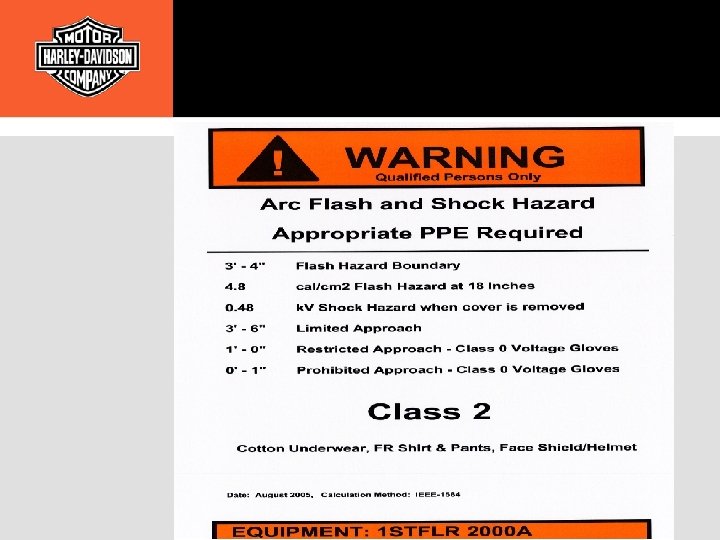
 NFPA 70 E • Managing ARC Flash – Arc flash hazard analysis has been performed at the H-D facility to: • Comply with NFPA 70 E standard • Determine arc flash boundaries • Determine required level of Personal Protective Equipment (PPE) to protect personnel • Working with Energized Circuits – Only “Qualified” personnel are permitted to work on energized electrical equipment. – If work must be performed on electrical conductors or parts that are not placed in an electrically safe work condition, an Energized Electrical Work Permit must be completed prior to performing any work beyond voltage testing and trouble-shooting. – Definition: A qualified person is one who has the technical skills and knowledge related to the construction and operation of the electrical equipment and installations and has received safety training to recognize and avoid the electrical hazards.
 NFPA 70 E • All contractors and suppliers working on energized electrical circuits operating at 50 volts or more at the H-D Facility are required to follow the requirements outlined in NFPA 70 E. • Contractors and suppliers working on energized electrical circuits operating at 50 volts or more will be required to have the appropriate training to classify them as a “Qualified Person. ” Documentation of training is required. • Contractors and Suppliers are required to provide their own Personal Protective Equipment (PPE) and any other equipment required to comply with the NFPA 70 E standard. • H-D requires 8 cal/cm 2 protective clothing to be worn for Hazard Classifications 2 or less.
 NFPA 70 E • A safe electrical work condition must be created including de-energizing all electrical 50 volts or greater inside the electrical box. – The circuit shall be LOCKED OUT AND TAGGED. – A Live Electrical Work Permit must be completed for any energized electrical work. – Trouble-shooting activities are exempt from the permit requirement. • Barriers will be placed around the electrical equipment when there is exposed energized electrical parts. – Unqualified personnel will not be allowed to cross the Limited Approach Boundary. – Qualified electrical personnel will wear PPE appropriate for the task. • Arc flash hazard labels are posted on the electrical equipment to identify the hazard present.
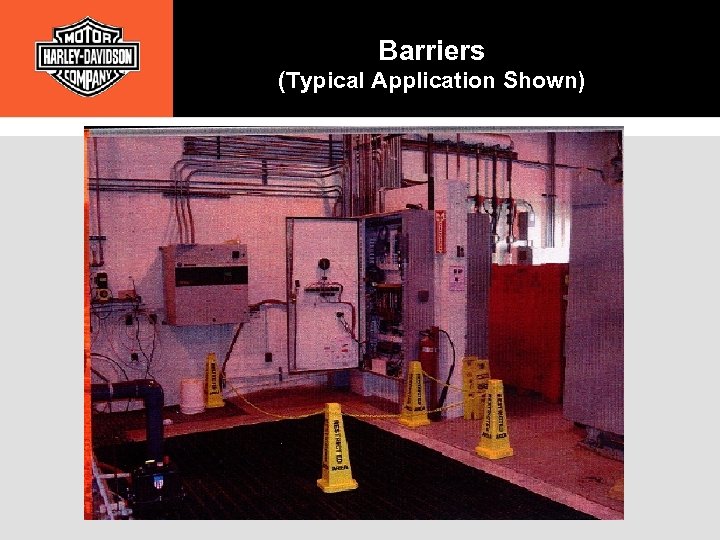 Barriers (Typical Application Shown)
 Lockout/Tag out • Personnel that perform lockout/tagout must have appropriate training and must be considered Authorized to perform lockout/tag out. • You must supply locks and tags for your employees. Their name must be clearly identified on their lock(s) or a tag(s). • Group lockout will need to be performed when working with Harley. Davidson personnel. • Locks must only be removed by the person who applied the lock. • The plant wide Lockout/tagout policy applies to all contractors.
 Excavations and Floor Openings • Floor openings 4 feet or greater to the next level shall be guarded by a standard guardrail, including a top rail, mid-rail, and 4 -inch toe board • Excavations must be guarded by barriers and by lights (at night). • Excavations must be properly shored to prevent cave-ins. • Openings in the ground or in floors (open manholes, pits, sewers, etc. ) must be guarded.
 Hot Work • H-D hot work permit system must be followed. • H-D site Safety Department must notified prior to any welding or cutting. • Non-combustible or flame proof shield or screens must be provided. • You must provide a fire watch equipped with 2 suitable fire extinguishers. • No cutting or welding is permitted in sprinkler equipped buildings while sprinklers are out of service. • Personnel that perform cutting, welding, brazing must have appropriate training. • Plant wide policy applies to all contractor personnel.
 Housekeeping • Material should be carefully stacked in a designated located so that it does not block aisles, doors, fire extinguishers, emergency eye washes/showers, fixed ladders or stairways. • Debris shall be removed after completion of project. Do not through items in the site dumpsters unless approved ahead of time. Certain dumpsters are designated for recyclables. • Combustible scrap, waste materials shall be removed daily. • Overhead storage of debris, tools, equipment, etc. is prohibited. • We are a tobacco-free, smoke-free environment. • Before storage of any materials outside it must be approved by the project champion through the Yellow Tag process.
 Industrial Hygiene • Operations that create excessive noise where H-D employees will be affected are prohibited unless approved by Safety Department. • Operations that create excessive gasoline or diesel engine exhaust in areas where H-D employees will be affected are prohibited unless approved by Safety Department. • Operations that create excessive dust, odors, fumes and vapors in areas where H-D employees will be affected are prohibited unless approved by Safety Department.
 Powered Industrial Vehicles • Personnel that operate powered vehicles must have appropriate training • The Project Champion must authorize the use of powered vehicles in the plant • The plant wide Motorized Vehicle Policy applies to all contractor personnel. • Stop at all intersection and sound the horn. • Speed Limit inside H-D Buildings is 4 mph • Speed Limit outside H-D Buildings, slow enough to maintain safe travel. • Seatbelts must be worn when operating PIV’s that are equipped with them.
 Ladders • Anyone using ladders on H-D site must be trained on the proper use of their ladders. • Do not work from top rung or steps, follow all warning labels • Portable and fixed ladders must be inspected prior to use each day. • The use of ladders with broken rungs or steps, broken handrails or other defective construction is prohibited. • Use of all metal ladders is prohibited. • Portable ladders must be equipped with safety feet. • “Homemade” ladders must not be used. • Ladders must be of appropriate length to safely perform the job. • Extension ladders must extend 3 feet above roof line or level. • H-D facility work instruction for ladders which applies to all contractor personnel. • Fixed ladders: tools must be raised and lowered by rope and bucket method.
 Parking • Employee Parking: – Somo: West and South parking lot. – Kaphaem: Main parking lot. • Visitor Parking: – Somo: West and South parking lot or in short term visitor parking on 8 th St. – Kaphaem: Main parking lot. • Motorcycle parking lots: – Somo: Along Somo Ave and 8 th St. in designated parking area. – Kaphaem: Designated area in front of the building. – DO NOT attempt to park a car or truck in these spaces. • Harley-Davidson is not responsible for damage or theft to vehicles while on Harley-Davidson property. Properly lock your vehicle and store valuables in the trunk or out of plain site.
 Working Safely at Heights • Personnel that perform overhead work must have appropriate training. • The H-D facility Fall Protection work instruction applies to all contractor personnel. • Work areas must be appropriately marked and barricaded where overhead work will be performed. • No overhead work may be performed when there is the possibility of an unprotected contractor or H-D employee at risk of being struck by a falling object. • The plant wide policy applies to all contractor personnel. See the project champion for a copy of the policy.
 Personal Protective Equipment (PPE) • Safety glasses with permanent side shields and steel-toed shoes are required when in manufacturing areas. Other PPE may be required in select area, see postings/warning signage before entering areas. • Sunglasses or tinted lenses are not permitted inside the facility unless required for specialty hazard protection. • All other types of required personal protective equipment, such as metatarsal foot protection, hard hats, goggles and etc. will be determined by the exposure to the potential hazard area. • You are responsible to ensure that your employees are equipped with approved personal protective equipment and shall enforce its use. • High visibility vests are required in “Crush Zones”. – “Crush Zones” have been established and marked in areas where a higher risk exists between Powered Industrial Vehicles and pedestrians. – Typically, dock areas where we are loading and unloading trucks. – Extremely Soiled or dull high visibility clothing must be replaced. You may be asked to wear a site high visibility vest while working at the site
 Roofs • Fall protection must be provided while performing work on unprotected roof edges with a ground-to-eves height greater than 15 feet. • At least 2 people are required on the roof at all times. • Warning lines/markers are to be used when roof work is more than 15 feet from the roof’s edge. • Guardrails, positioning systems or fall arrest systems shall be used when roof work is within 15 feet of the roof edge. • Designated hoisting areas are required. • Extension ladders used to access the roof must be secured to the edge of the building and extend at least 3 feet above the roofline.
 Scaffolds • Upright scaffolds should be plumb, secure, and have firm footing. • Narrow-base portable maintenance staging must be equipped with outriggers. • Platforms and planks shall be secured or cleated to the scaffold to prevent slippage. • Stationary metal upright scaffolds should be secured to the building or other adequate structures. • Planks should be at least 2 planks wide and extend over the supporting surfaces not less than 6 inches or more than 12 inches. • Scaffolds more than 6 feet above the ground must have guardrails and toe boards on all open sides and ends. • After it is in place, scaffolding requires certification by a competent person before use.
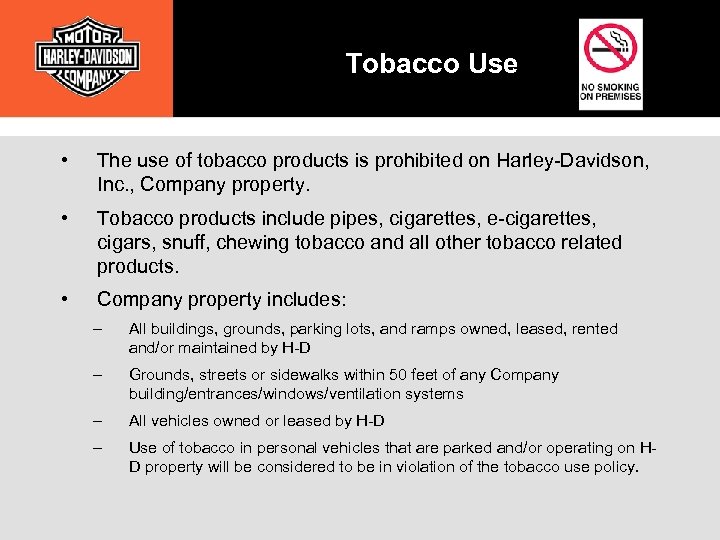 Tobacco Use • The use of tobacco products is prohibited on Harley-Davidson, Inc. , Company property. • Tobacco products include pipes, cigarettes, e-cigarettes, cigars, snuff, chewing tobacco and all other tobacco related products. • Company property includes: – All buildings, grounds, parking lots, and ramps owned, leased, rented and/or maintained by H-D – Grounds, streets or sidewalks within 50 feet of any Company building/entrances/windows/ventilation systems – All vehicles owned or leased by H-D – Use of tobacco in personal vehicles that are parked and/or operating on HD property will be considered to be in violation of the tobacco use policy.
 Tools • Hand power tools should be kept in safe operating condition. • Safety guards must be kept in position and in accordance with OSHA 1910 and 1926. • All power tools and equipment must be grounded or UL approved as double insulated. • Tools operated by explosives are not permitted in H-D facilities without prior approval. • Non-sparking tools may be necessary in certain areas where flammable solvents or materials are handled or where sparks could create an explosion. • The use of H-D tools and equipment is prohibited unless approved by the Project Champion. • Small tools are to be stored within a lockable storage cabinet/box when not in use. This cabinet/box is to be marked with the company logo or other distinguishing mark which identifies the owner. • Larger tools are to be marked with company logo or other distinguishing mark which identifies the property owner. Tag must not be able to be removed from the tool.
 Workplace Violence Policy • Harley-Davidson has an established Workplace Violence Policy with the purpose of establishing and communicating our zero-tolerance towards threats, threatening behavior, or acts of violence conducted by anyone against employees, visitors, guests, or other individuals on Harley-Davidson property including its facilities and parking areas. • If you witness or receive any threats, or if you have been told about a threat a coworker has witnessed or received, notify your Supervisor, Human Resources Representative or Site Security Supervisor immediately. • If you witness any behavior that may be regarded as violent, contact Site Security immediately at *999 or call 911 for outside assistance.
 Workplace Violence Policy • Prohibited conduct on Harley-Davidson property includes, but is not limited to, the following examples: – Physical possession of firearms (including air-pistols and air-rifles), switchblades, spring-loaded knives or other knives not required for one's job, explosive materials, toxic agents, and any other object carried for the purpose of injuring or intimidating others. Please be aware that public law enforcement officers, licensed armored courier services or other officials in the performance of their official duties may be in possession of some of these items while on Harley-Davidson property. – Abusive or threatening language or behavior, including verbal threats, harassing phone calls and stalking. – Unwanted physical contact such as hitting, fighting, pushing, shoving, or throwing of objects. – Damaging property as a result of violent acts. – Possession of a weapon in violation of federal, state or local law.
 Environmental Review
 Environmental Policy • The Company believes in protecting the environment. The Company is committed to the advancement of operating and management practices that minimize, consistent with the Company's business objectives, the impact of its operations on the environment. Accordingly, the Company's environmental and energy guidelines and practices include: • Providing training for employees, emphasizing both individual and corporate responsibility for compliance, sound environmental management and conservation actions. Considering the minimization of energy and water use and the generation and discharge of waste (including air emissions, wastewater and solid waste) in research, design, operating, purchasing and management decisions. Evaluating reuse, recycling and other beneficial uses of waste materials prior to landfill or other means of disposal. Conducting internal environmental & energy audits to promote better operating practices, pollution prevention, energy use, waste management, water management, information exchange, recordkeeping and compliance with regulations. Conducting environmental & energy reviews for new projects, processes and materials to confirm regulatory compliance, assess environmental impact and consider energy efficiency. Establishing operating practices to meet our responsibilities under environmental laws and regulations in all countries where we operate. Supporting the development and implementation of environmental laws and regulations that represent an appropriate balance of the interests of all our stakeholders. Communicating the Company's environmental commitment to employees, contractors and stakeholders. Establishing specific operating and performance targets on a regular basis consistent with the Purpose and Objectives of this policy. Reporting on Harley-Davidson's performance with the goal of continual improvement with respect to Harley-Davidson's commitment to the Purpose and Objectives of this policy. • • •
 Environmental Policy • Responsibilities – Environmental protection is both a leadership responsibility and the job of every employee and contractor.
 Emergency Calls • Before starting work on any Harley. Davidson Operations premise, make sure you are familiar with all emergency calls and procedures as provided by your project champion. • Each site has a system in place to alert building occupants of an emergency. • Contact your site project champion for specific information
 Emergency Procedure • Spills, special needs, or discharge beyond H-D property must be reported immediately! – Somo Security (24 x 7) General line: 715 -453 -2191 Emergency line: Internal Phones *999 – Kaphaem Security (24 x 7) General Line: 715 -224 -2900 Emergency Line: Internal Phones*999
 Recycling Materials Recycled by H-D Tomahawk • • Cardboard (boxes & cores) Metal Electrical Wire All beverage containers (plastic, glass & aluminum) Office paper Scrap metal Pallets (wood) (if unsure of what is recycled, ask)
 Hazardous Waste • ALL Hazardous Waste generated by the contractor is the responsibility of the contractor. • All hazardous waste must be removed from the site at the end of each work day.
 Housekeeping • Harley-Davidson requires a clean as you go policy • Environmental requirements dictate this along with the need to maintain quality of our product and the need to maintain a “Tour Ready” environment.
 Housekeeping Continued • Locate waste receptacles. – Harley-Davidson segregates waste by type. – Ask if you are not sure where to dispose waste. • Daily Sweeping or mopping
 Questions
 Hazard Communication Contractor Expectations
 Right to Know (Site Specific Training) • OSHA law gives the employee the right to know what all the chemicals are and the related information of those chemicals used in the process of their specific work assignment. • As employees move from job assignment to job assignment the employer is responsible to assure that the employee has knowledge of the chemicals and the related chemical information in their new assignment. • Tomahawk uses numerous methods in keeping our employees informed. These tools include training check sheets, work instructions, safety data sheets and personnel protective equipment recommendation charts.
 How to get a Chemical Approved • No Chemicals are allowed on-site without being approved by Harley-Davidson. • If you need a chemical approved: § Provide your Project Champion with the SDS § The Project Champion will fill out a Material Acquisition Request Submittal (MARS) form. § The form must be completed and approved before the new concentration of the chemical can be used.
 Contractor Expectations for Training your Employees • Prior to coming on site at HD, contractors must: § Ensure their employees are trained in the Hazcom standard § Understand how to read an Safety Data Sheet § Provide training documentation through the HD Contractor Safety on-boarding process § Ensure anyone that is on site at HD has read the Contractor Safety Handbook
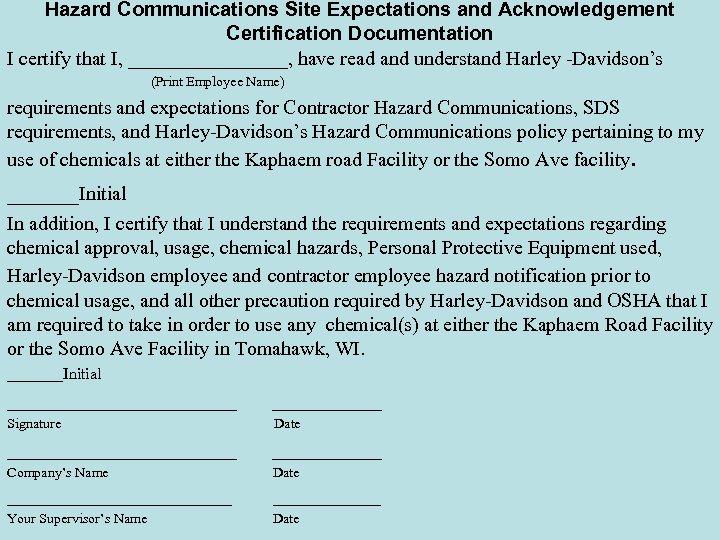 Hazard Communications Site Expectations and Acknowledgement Certification Documentation I certify that I, ________, have read and understand Harley -Davidson’s (Print Employee Name) requirements and expectations for Contractor Hazard Communications, SDS requirements, and Harley-Davidson’s Hazard Communications policy pertaining to my use of chemicals at either the Kaphaem road Facility or the Somo Ave facility. ______Initial In addition, I certify that I understand the requirements and expectations regarding chemical approval, usage, chemical hazards, Personal Protective Equipment used, Harley-Davidson employee and contractor employee hazard notification prior to chemical usage, and all other precaution required by Harley-Davidson and OSHA that I am required to take in order to use any chemical(s) at either the Kaphaem Road Facility or the Somo Ave Facility in Tomahawk, WI. _______Initial ____________ Signature Date ____________ Company’s Name Date _____________ ______ Your Supervisor’s Name Date