 Скачать презентацию Contract Theory and Business Strategy Reoptimization under Changing
3e9013145418d21d6e07b956b8062c7f.ppt
- Количество слайдов: 40



Contract Theory and Business Strategy: Reoptimization under Changing Opportunity Sets Shyam Sunder Yale University IBM Faculty Summit, May 17 -18, 2004
Overview • The problem • A contract model of the firm • How firms work • Role of controls • Necessary conditions for firm to work • What goes wrong? • How do we prevent things from going wrong • Concluding remarks 3/15/2018 (c) Copyright 2004 Shyam Sunder 2
The Problem • Identifying sources of success and failure is difficult • Tendency to extrapolate the past • Model of success yesterday, model of failure today • Guiding framework for continual reoptimization of the firm in changing environment 3/15/2018 (c) Copyright 2004 Shyam Sunder 3
Examples of Failure • Enron • World. Com • Xerox • Barings Bank of London was acquired for $1 by ING Bank • Adelphia 3/15/2018 (c) Copyright 2004 Shyam Sunder 4
Changing Labels for Senior Managers’ Challenge • Long term planning • Business policy • Strategic management • Changing paradigms, metaphors, myths, lexicon? • Essence does not change 3/15/2018 (c) Copyright 2004 Shyam Sunder 5
Firm As a Set of Contracts • Among many individuals – Shareholders – Customers – Employees – Managers – Suppliers – Government – Community, etc. 3/15/2018 (c) Copyright 2004 Shyam Sunder 6
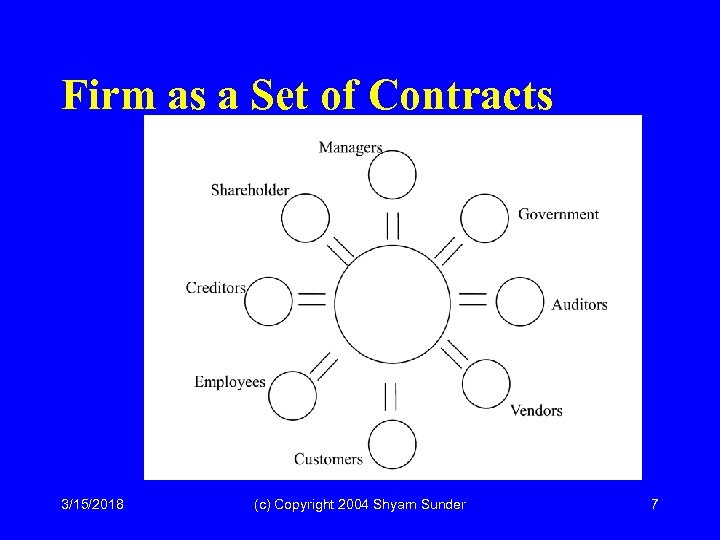
Firm as a Set of Contracts 3/15/2018 (c) Copyright 2004 Shyam Sunder 7
Role of Individuals • Each party contributes resources • Each party receives resources • Each party seeks his own goal through participation in the firm • Firm’s goals are combination of individual goals 3/15/2018 (c) Copyright 2004 Shyam Sunder 8
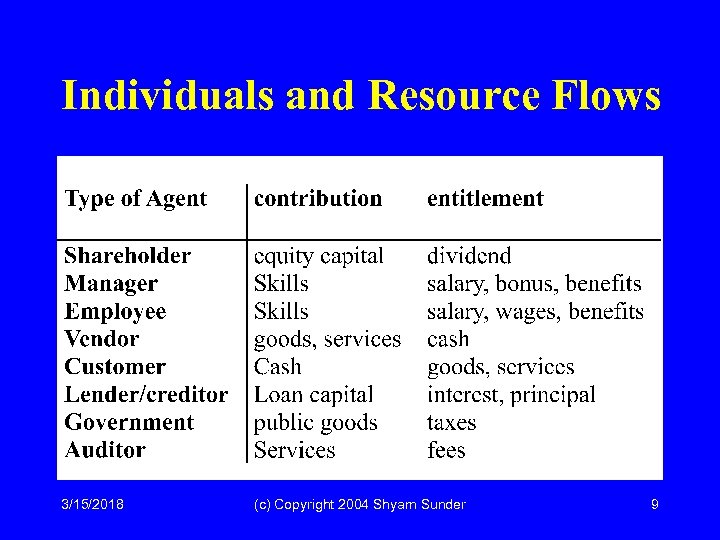
Individuals and Resource Flows 3/15/2018 (c) Copyright 2004 Shyam Sunder 9
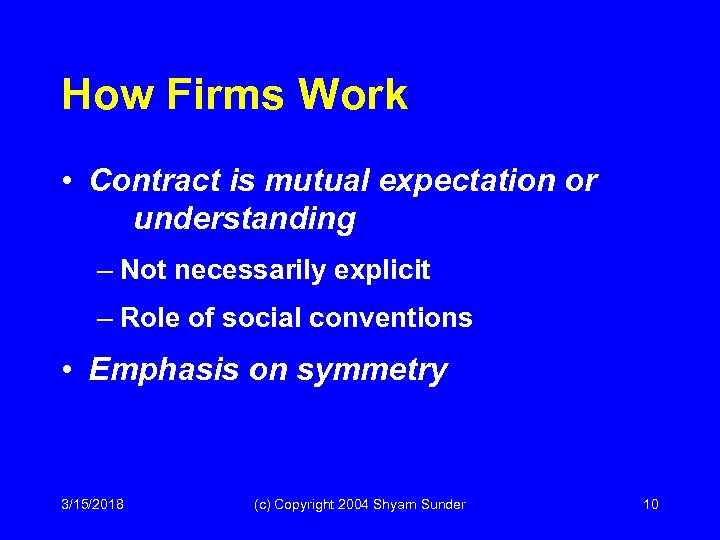
How Firms Work • Contract is mutual expectation or understanding – Not necessarily explicit – Role of social conventions • Emphasis on symmetry 3/15/2018 (c) Copyright 2004 Shyam Sunder 10
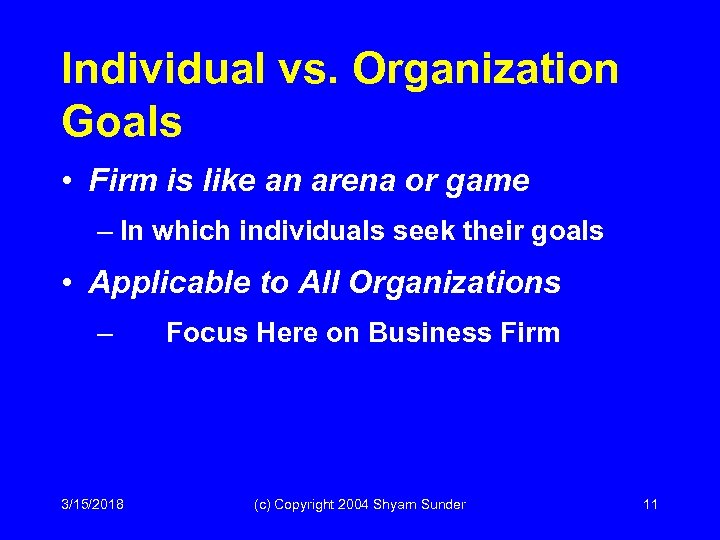
Individual vs. Organization Goals • Firm is like an arena or game – In which individuals seek their goals • Applicable to All Organizations – 3/15/2018 Focus Here on Business Firm (c) Copyright 2004 Shyam Sunder 11
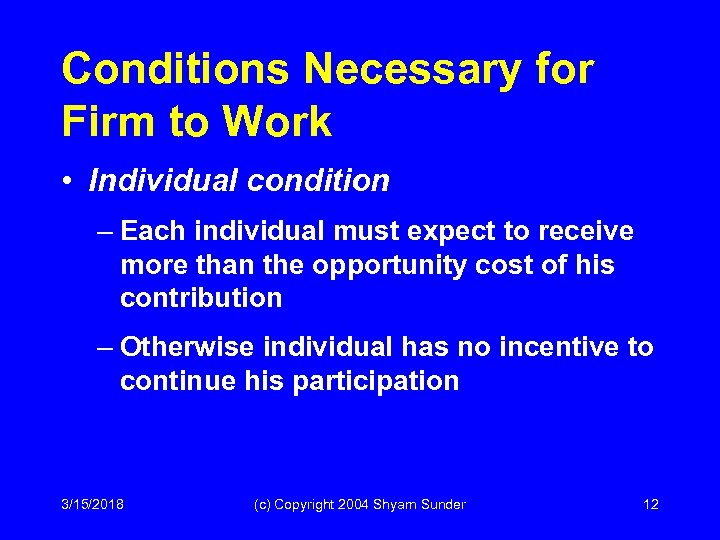
Conditions Necessary for Firm to Work • Individual condition – Each individual must expect to receive more than the opportunity cost of his contribution – Otherwise individual has no incentive to continue his participation 3/15/2018 (c) Copyright 2004 Shyam Sunder 12
Conditions Necessary for Firm to Work • Aggregate Condition – Firm’s production function should be able to produce enough output from resource contributions to satisfy all the individual expectations • Otherwise, expectations of some people will not be fulfilled, and they will quit the firm. • If these people are necessary for the firm’s contract set to function, their departure may result in collapse of the firm 3/15/2018 (c) Copyright 2004 Shyam Sunder 13
Questions for Reviewing Decisions and Events • Will it make any individual contracts infeasible? • Will it make the contract set as a whole infeasible? • Common element in organizational failures 3/15/2018 (c) Copyright 2004 Shyam Sunder 14
Example 1: Feasible Contracts • Six contracting parties • Opportunity cost of 60 for customer • Opportunity cost of 10 for other five for a total of 50 • Total available surplus = 10; feasible in aggregate • Many individually feasible allocations of the surplus possible 3/15/2018 (c) Copyright 2004 Shyam Sunder 15
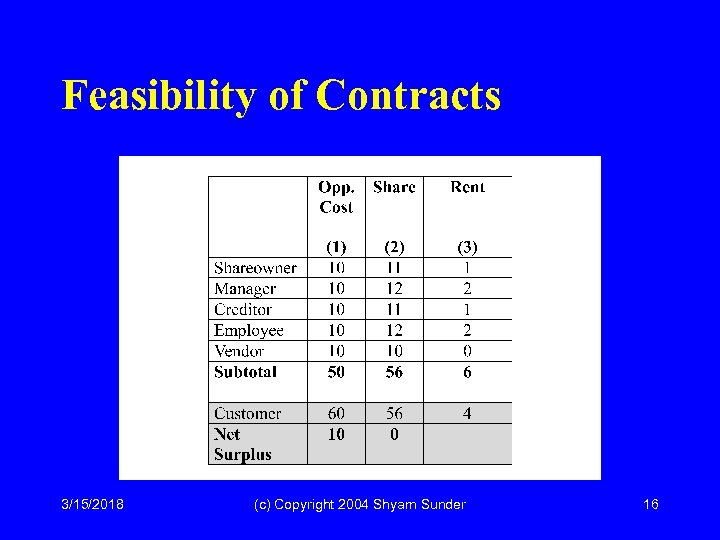
Feasibility of Contracts 3/15/2018 (c) Copyright 2004 Shyam Sunder 16
Two Complications • Agents’ opportunity costs are private – Manager does not know agents’ costs – Except in special case of perfect market – Agents have reasons to keep them private during negotiations – Market imperfection means error in manager’s estimate of agent cost – Agent does not know the total surplus – Negotiation under veil of mutual uncertainty 3/15/2018 (c) Copyright 2004 Shyam Sunder 17
Privacy of Costs – Uncertainty renders outcome less certain – Uncertainty makes success in negotiation more likely – Post-negotiation boasts or complaints leak information for the next round of negotiations 3/15/2018 (c) Copyright 2004 Shyam Sunder 18
Negotiations are Sequential – Manager negotiates with agents, one at a time, in sequence – Each deal brings new information, changes the remaining surplus – This may change the negotiating strategy and even the production plans – Picture changes continually 3/15/2018 (c) Copyright 2004 Shyam Sunder 19
Changing Feasibility of Contracts • Internal and external events affect feasibility of contracts • Senior management must anticipate these changes, adjust contracts and renegotiate them • Long-term planning or business policy or strategic management 3/15/2018 (c) Copyright 2004 Shyam Sunder 20
Sources of Change • Changes in factor and product markets – Capital – Labor – Technology – Product, customer preferences 3/15/2018 (c) Copyright 2004 Shyam Sunder 21
Managing in Changing Markets • Pitfalls of relying on history and experience • False confidence • Wrong kinds of commitments • Old contracts may become infeasible 3/15/2018 (c) Copyright 2004 Shyam Sunder 22
Effect of Changes • Contracts of some agents become infeasible • If the contract is still feasible in aggregate, management may try to renegotiate with some or all agents 3/15/2018 (c) Copyright 2004 Shyam Sunder 23
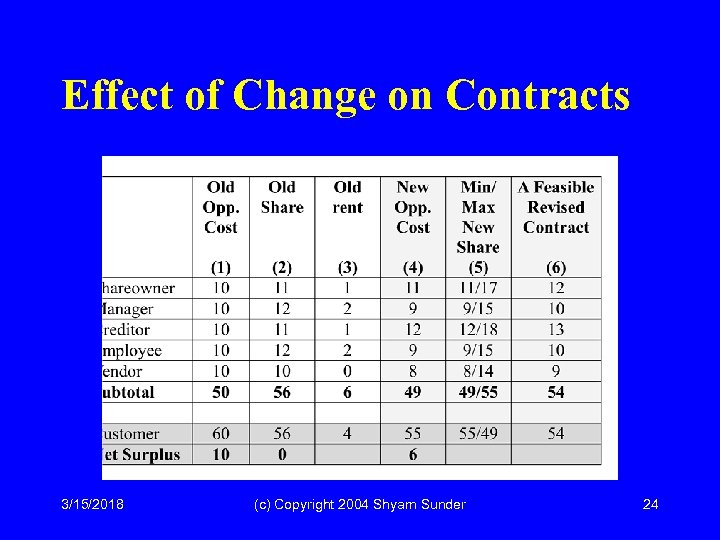
Effect of Change on Contracts 3/15/2018 (c) Copyright 2004 Shyam Sunder 24
Strategic Management? • Anticipating change • Redesigning the contract set to reestablish individual and aggregate feasibility if necessary – Renegotiate with continuing agents – Negotiating termination of contracts – Finding new partners and negotiating their contracts 3/15/2018 (c) Copyright 2004 Shyam Sunder 25
Anticipating Change • Most difficult part of management • Easy to make others look silly ex post • Success may make us less vigilant of our fallibility • Mechanical projections from the past • Value of time gained from foresight 3/15/2018 (c) Copyright 2004 Shyam Sunder 26
Famous Words • The concept is interesting and well-formed, but in order to earn better than a 'C, ' the idea must be feasible. “ A Yale professor on Smith's paper proposing overnight delivery service • "But what. . . is it good for? “ Engineer at the Advanced Computing Systems Division of IBM, 1968, commenting on the microchip. • "There is no reason anyone would want a computer in their home. “ Ken Olson, founder of Digital Equipment Corp. , 1977 3/15/2018 (c) Copyright 2004 Shyam Sunder 27
Famous Words Who the hell wants to hear actors talk? H. M. Warner, Warner Brothers, 1927. We don't like their sound, and guitar music is on the way out. Decca Recording Co. rejecting the Beatles, 1962. Drill for oil? You mean drill into the ground to try and find oil? You're crazy. Financiers to Edwin L. Drake, 1859. Heavier-than-air flying machines are impossible. Lord Kelvin, president, Royal Society, 1895. 3/15/2018 (c) Copyright 2004 Shyam Sunder 28
Dealing with Uncertain Future • Statistical forecasting to use all information available in past data • Delphi Technique to aggregate information available across individuals • Scenario analysis to develop a range of possibilities to prepare for them 3/15/2018 (c) Copyright 2004 Shyam Sunder 29
Redesigning the Contract Set • No unique solution • Column 6 in Example 1 shows one feasible solution • Interdependence demands understanding of the whole picture • An example of aggregate infeasibility • Requires a redesign 3/15/2018 (c) Copyright 2004 Shyam Sunder 30
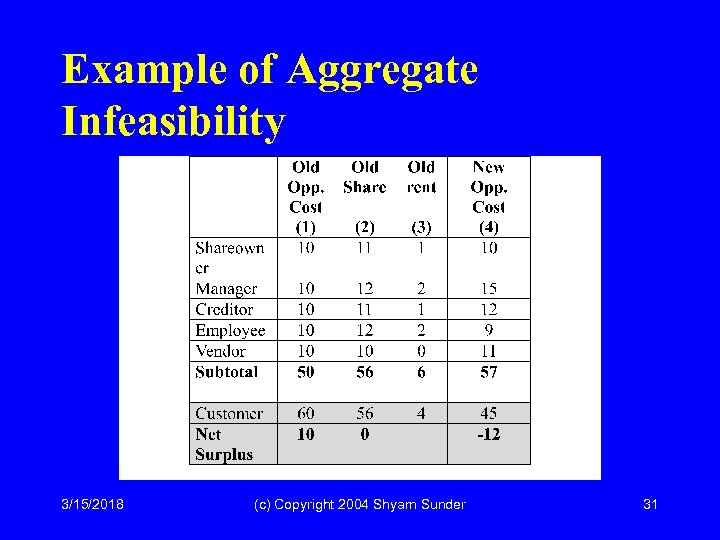
Example of Aggregate Infeasibility 3/15/2018 (c) Copyright 2004 Shyam Sunder 31
Redesigning Contracts • No obvious algorithm for redesign • Search for alternative production technologies, agents, terms of contract • Cannot assume that all agents will continue to participate • Enough slack to deal with uncertainty during negotiations • Continually adjust the design through negotiations 3/15/2018 (c) Copyright 2004 Shyam Sunder 32
Renegotiating with Continuing Participants • Select who will continue • Increased O. C. agents will demand more • Decreased O. C. agents will be reluctant to accept cuts (fairness!) • Asymmetry of information about O. C. and effect on contracts 3/15/2018 (c) Copyright 2004 Shyam Sunder 33
Termination of Contracts • Some agents may not be a part of the revised set • Unhappy agents can impose heavy costs on the firm • Value of foresight in gaining time to deal with them 3/15/2018 (c) Copyright 2004 Shyam Sunder 34
New Agents • Find new agents in respective factor markets • Distribution of “free” information to reduce frictions in factor markets • Advertising in capital, labor and product markets • The cycle never stops 3/15/2018 (c) Copyright 2004 Shyam Sunder 35
Summary • Business unit as a set of contracts • Agents seek personal goals • Contracts define resource exchange relationships • Individual and aggregate feasibility • Internal and external changes disturb feasibility of existing contracts 3/15/2018 (c) Copyright 2004 Shyam Sunder 36
Reengineering Contracts • Managers must anticipate change to buy time • Reengineer and renegotiate contracts to restore feasibility • Try to improve on design 3/15/2018 (c) Copyright 2004 Shyam Sunder 37
Why Reengineering Fails so Often? • Over one half of such efforts fail • Redesign is focused too narrowly to save costs • Interests of the people whose cooperation is necessary for the success is ignored • Many people see the reengineering effort as a threat to their jobs • Deny cooperation, even sabotage the effort 3/15/2018 (c) Copyright 2004 Shyam Sunder 38
Concluding Remarks • Failure to modify the contract sets to changing environment causes failure • A strategic manager scans markets for changes, reengineers contracts to retain Individual and aggregate feasibility • Failures without cooperation of people adversely affected by reengineering • Contract model as a framework for thinking about and reducing such failures 3/15/2018 (c) Copyright 2004 Shyam Sunder 39

Thank You. shyam. sunder@yale. edu
Скачать презентацию Contract Theory and Business Strategy Reoptimization under Changing
3e9013145418d21d6e07b956b8062c7f.ppt