


 Скачать презентацию Continuous Delivery Implementation Internal adoption and Dev Ops
b3a802445402bc617f0dafcae1c5404f.ppt
- Количество слайдов: 22
 Continuous Delivery Implementation Internal adoption and Dev. Ops proceses and tools within enterprise projects Robbie Minshall IBM Software, Rational June 20 2013 © 2013 IBM Corporation
 Agenda https: //jazz. net/wiki/bin/view/Main/Continuous. Delivery. Implementation. Meetings Purpose: Describe and discuss the scope, initial thoughts and working environment for Continuous Delivery Implementation Agenda: § 5 min: [Frank] Welcome and why this is important § 15 min: [Robbie] Project overview and strategy § 25 min: [All] Discussion. Open for all to state a perspective, describe problems or opportunities that they are excited about. 5 min limit per topic. § 10 min: [Robbie] Next steps 2 © 2013 IBM Corporation
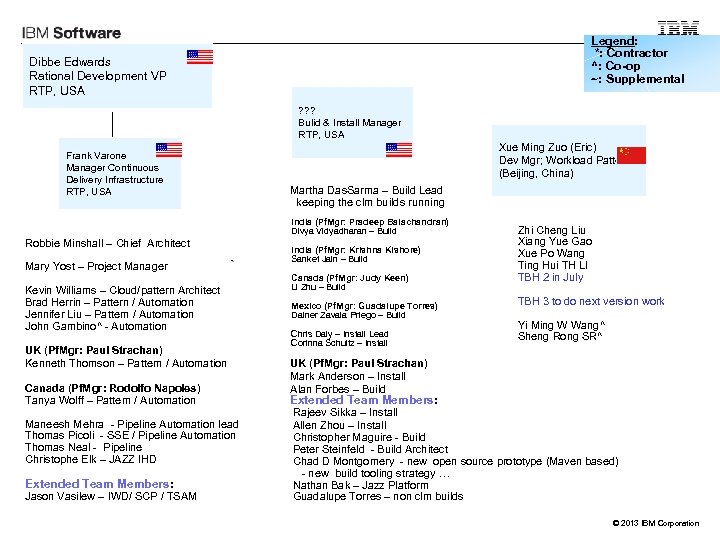 3 Legend: *: Contractor ^: Co-op ~: Supplemental Dibbe Edwards Rational Development VP RTP, USA ? ? ? Bulid & Install Manager RTP, USA Frank Varone Manager Continuous Delivery Infrastructure RTP, USA Xue Ming Zuo (Eric) Dev Mgr; Workload Patterns (Beijing, China) Martha Das. Sarma – Build Lead keeping the clm builds running India (Pf. Mgr: Pradeep Balachandran) Divya Vidyadharan – Build Robbie Minshall – Chief Architect Mary Yost – Project Manager Kevin Williams – Cloud/pattern Architect Brad Herrin – Pattern / Automation Jennifer Liu – Pattern / Automation John Gambino^ - Automation UK (Pf. Mgr: Paul Strachan) Kenneth Thomson – Pattern / Automation Canada (Pf. Mgr: Rodolfo Napoles) Tanya Wolff – Pattern / Automation Maneesh Mehra - Pipeline Automation lead Thomas Picoli - SSE / Pipeline Automation Thomas Neal - Pipeline Christophe Elk – JAZZ IHD Extended Team Members: Jason Vasilew – IWD/ SCP / TSAM India (Pf. Mgr: Krishna Kishore) Sanket Jain – Build Canada (Pf. Mgr: Judy Keen) Li Zhu – Build Mexico (Pf. Mgr: Guadalupe Torres) Dainer Zavala Priego – Build Chris Daly – Install Lead Corinna Schultz – Install Zhi Cheng Liu Xiang Yue Gao Xue Po Wang Ting Hui TH LI TBH 2 in July TBH 3 to do next version work Yi Ming W Wang^ Sheng Rong SR^ UK (Pf. Mgr: Paul Strachan) Mark Anderson – Install Alan Forbes – Build Extended Team Members: Rajeev Sikka – Install Allen Zhou – Install Christopher Maguire - Build Peter Steinfeld - Build Architect Chad D Montgomery - new open source prototype (Maven based) - new build tooling strategy … Nathan Bak – Jazz Platform Guadalupe Torres – non clm builds © 2013 IBM Corporation
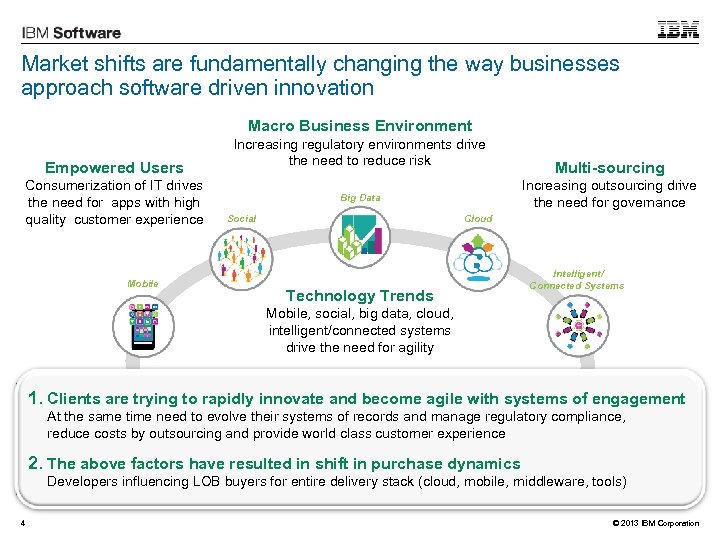 Market shifts are fundamentally changing the way businesses approach software driven innovation Macro Business Environment Empowered Users Consumerization of IT drives the need for apps with high quality customer experience Mobile Increasing regulatory environments drive the need to reduce risk Increasing outsourcing drive the need for governance Big Data Social Multi-sourcing Cloud Technology Trends Intelligent/ Connected Systems Mobile, social, big data, cloud, intelligent/connected systems drive the need for agility 1. Clients are trying to rapidly innovate and become agile with systems of engagement At the same time need to evolve their systems of records and manage regulatory compliance, reduce costs by outsourcing and provide world class customer experience 2. The above factors have resulted in shift in purchase dynamics Developers influencing LOB buyers for entire delivery stack (cloud, mobile, middleware, tools) 4 © 2013 IBM Corporation
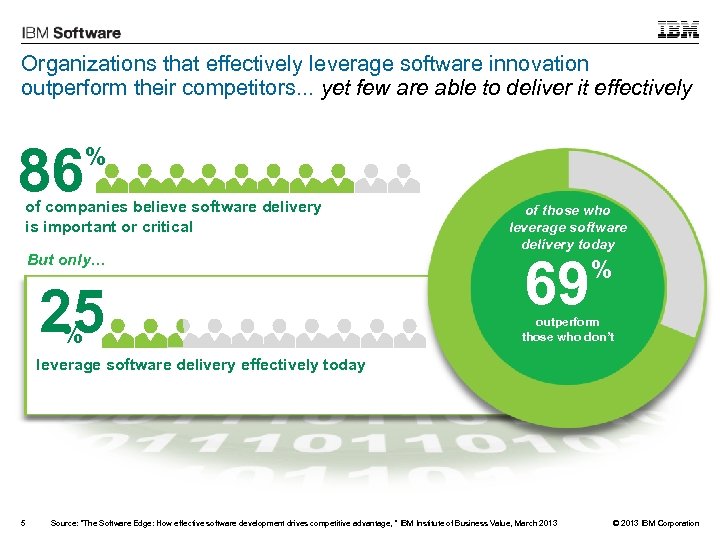 Organizations that effectively leverage software innovation outperform their competitors. . . yet few are able to deliver it effectively 86 % of companies believe software delivery is important or critical But only… 25 % of those who leverage software delivery today 69 % outperform those who don’t leverage software delivery effectively today 5 Source: “The Software Edge: How effective software development drives competitive advantage, ” IBM Institute of Business Value, March 2013 © 2013 IBM Corporation
 Why is this important § This is really hard § Continuous Integration, Test and Delivery of Software within non trivial landscape § CLM Relevance – 4 th Major release – Significant Legacy – Historically this is the point where products struggle to delivery incremental value and innovation § Rational – Customers recognize that innovation is essential to their business and that software is the important part of that (first time that it has ranked top of the list) – Customers are looking for ways to increase speed of software innovation, the developer is king – Rational should be as well positioned in this space. We are not. 6 © 2013 IBM Corporation
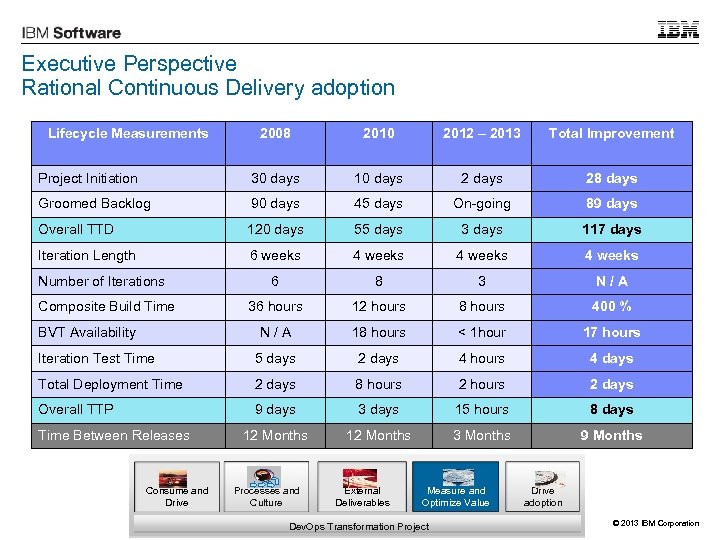 Executive Perspective Rational Continuous Delivery adoption Lifecycle Measurements 2008 2010 2012 – 2013 Total Improvement Project Initiation 30 days 10 days 28 days Groomed Backlog 90 days 45 days On-going 89 days Overall TTD 120 days 55 days 3 days 117 days Iteration Length 6 weeks 4 weeks 6 8 3 N/A 36 hours 12 hours 8 hours 400 % N/A 18 hours < 1 hour 17 hours Iteration Test Time 5 days 2 days 4 hours 4 days Total Deployment Time 2 days 8 hours 2 days Overall TTP 9 days 3 days 15 hours 8 days 12 Months 3 Months 9 Months Number of Iterations Composite Build Time BVT Availability Time Between Releases Consume and Drive Processes and Culture External Deliverables Measure and Optimize Value Dev. Ops Transformation Project Drive adoption © 2013 IBM Corporation
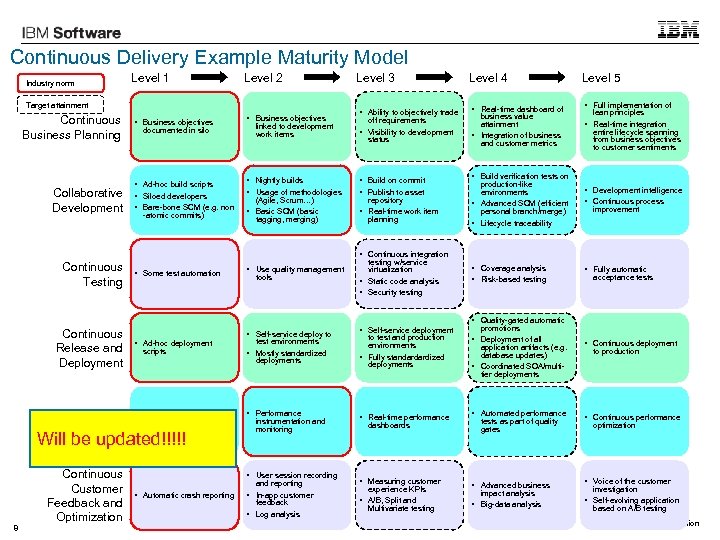 Continuous Delivery Example Maturity Model Industry norm Level 1 Level 2 Target attainment Continuous Business Planning Collaborative Development • Business objectives documented in silo • Ad-hoc build scripts • Siloed developers • Bare-bone SCM (e. g. non -atomic commits) • Business objectives linked to development work items • Nightly builds • Usage of methodologies (Agile, Scrum…) • Basic SCM (basic tagging, merging) Level 3 Level 4 Level 5 • Ability to objectively trade • Real-time dashboard of • Full implementation of off requirements • Visibility to development status business value attainment • Integration of business and customer metrics • Build on commit • Publish to asset lean principles • Build verification tests on repository • Real-time work item planning production-like environments • Advanced SCM (efficient personal branch/merge) • Lifecycle traceability • Real-time integration entire lifecycle spanning from business objectives to customer sentiments • Development intelligence • Continuous process improvement • Continuous integration Continuous Testing • Some test automation • Use quality management tools testing w/service virtualization • Static code analysis • Security testing • Coverage analysis • Risk-based testing • Fully automatic acceptance tests • Quality-gated automatic Continuous Release and Deployment Continuous Monitoring • Self-service deploy to • Ad-hoc deployment scripts resolution (e. g. outage alerts) Will be updated!!!!! 8 8 Continuous Customer Feedback and Optimization • Deployment of all • Mostly standardized • Performance • Real-time performance • Automated performance • Measuring customer • Advanced business test environments instrumentation and monitoring • User session recording and reporting • Automatic crash reporting promotions to test and production environments • Fully standardardized deployments • Reactive performance • Self-service deployment • In-app customer feedback • Log analysis dashboards experience KPIs • A/B, Split and Multivariate testing application artifacts (e. g. database updates) • Coordinated SOA/multitier deployments tests as part of quality gates impact analysis • Big-data analysis • Continuous deployment to production • Continuous performance optimization • Voice of the customer investigation • Self-evolving application based on A/B testing © 2013 IBM Corporation
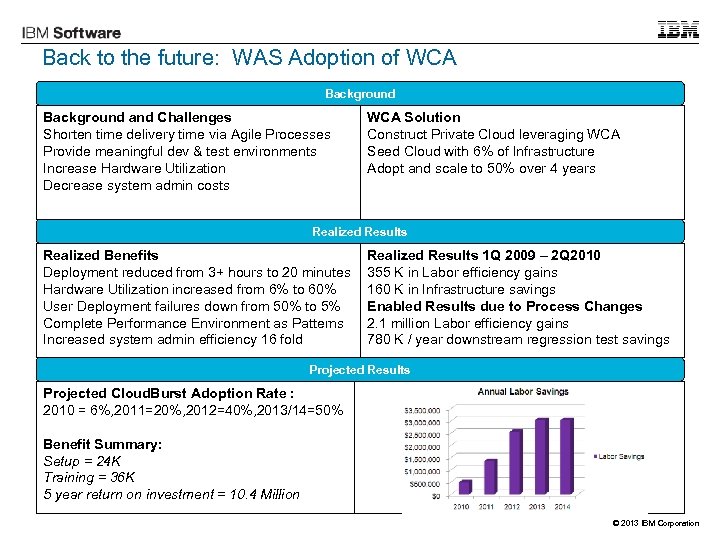 Back to the future: WAS Adoption of WCA Background and Challenges Shorten time delivery time via Agile Processes Provide meaningful dev & test environments Increase Hardware Utilization Decrease system admin costs WCA Solution Construct Private Cloud leveraging WCA Seed Cloud with 6% of Infrastructure Adopt and scale to 50% over 4 years Realized Results Realized Benefits Deployment reduced from 3+ hours to 20 minutes Hardware Utilization increased from 6% to 60% User Deployment failures down from 50% to 5% Complete Performance Environment as Patterns Increased system admin efficiency 16 fold Realized Results 1 Q 2009 – 2 Q 2010 355 K in Labor efficiency gains 160 K in Infrastructure savings Enabled Results due to Process Changes 2. 1 million Labor efficiency gains 780 K / year downstream regression test savings Projected Results Projected Cloud. Burst Adoption Rate : 2010 = 6%, 2011=20%, 2012=40%, 2013/14=50% Benefit Summary: Setup = 24 K Training = 36 K 5 year return on investment = 10. 4 Million © 2013 IBM Corporation
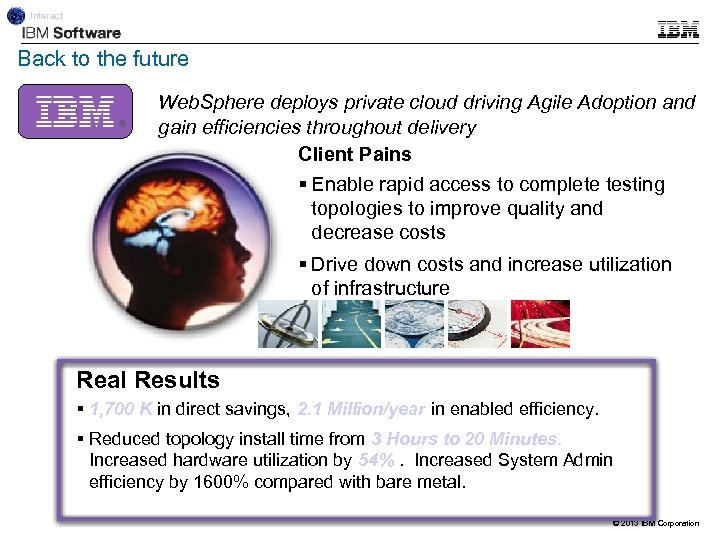 Interact Back to the future Web. Sphere deploys private cloud driving Agile Adoption and gain efficiencies throughout delivery Client Pains § Enable rapid access to complete testing topologies to improve quality and decrease costs § Drive down costs and increase utilization of infrastructure Real Results § 1, 700 K in direct savings, 2. 1 Million/year in enabled efficiency. § Reduced topology install time from 3 Hours to 20 Minutes. Increased hardware utilization by 54%. Increased System Admin efficiency by 1600% compared with bare metal. © 2013 IBM Corporation
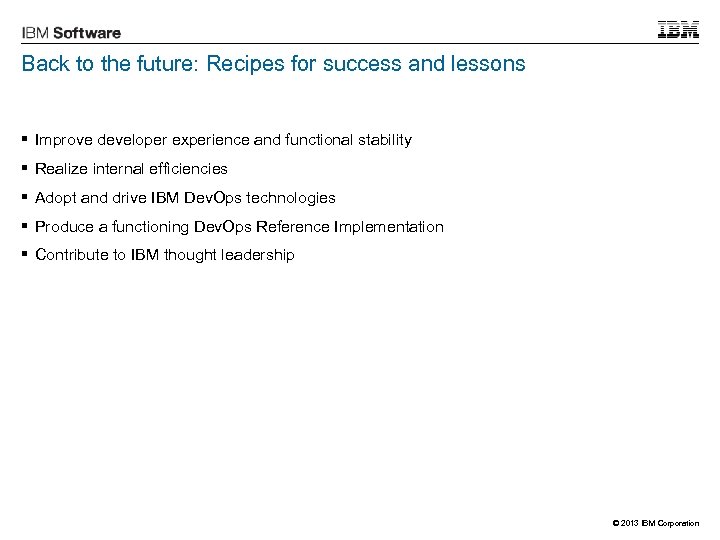 Back to the future: Recipes for success and lessons § Improve developer experience and functional stability § Realize internal efficiencies § Adopt and drive IBM Dev. Ops technologies § Produce a functioning Dev. Ops Reference Implementation § Contribute to IBM thought leadership © 2013 IBM Corporation
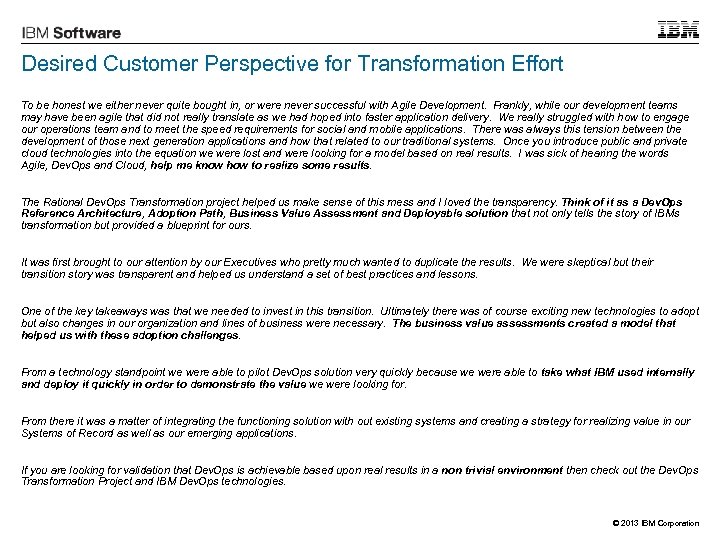 Desired Customer Perspective for Transformation Effort To be honest we either never quite bought in, or were never successful with Agile Development. Frankly, while our development teams may have been agile that did not really translate as we had hoped into faster application delivery. We really struggled with how to engage our operations team and to meet the speed requirements for social and mobile applications. There was always this tension between the development of those next generation applications and how that related to our traditional systems. Once you introduce public and private cloud technologies into the equation we were lost and were looking for a model based on real results. I was sick of hearing the words Agile, Dev. Ops and Cloud, help me know how to realize some results. The Rational Dev. Ops Transformation project helped us make sense of this mess and I loved the transparency. Think of it as a Dev. Ops Reference Architecture, Adoption Path, Business Value Assessment and Deployable solution that not only tells the story of IBMs transformation but provided a blueprint for ours. It was first brought to our attention by our Executives who pretty much wanted to duplicate the results. We were skeptical but their transition story was transparent and helped us understand a set of best practices and lessons. One of the key takeaways was that we needed to invest in this transition. Ultimately there was of course exciting new technologies to adopt but also changes in our organization and lines of business were necessary. The business value assessments created a model that helped us with these adoption challenges. From a technology standpoint we were able to pilot Dev. Ops solution very quickly because we were able to take what IBM used internally and deploy it quickly in order to demonstrate the value we were looking for. From there it was a matter of integrating the functioning solution with out existing systems and creating a strategy for realizing value in our Systems of Record as well as our emerging applications. If you are looking for validation that Dev. Ops is achievable based upon real results in a non trivial environment then check out the Dev. Ops Transformation Project and IBM Dev. Ops technologies. © 2013 IBM Corporation
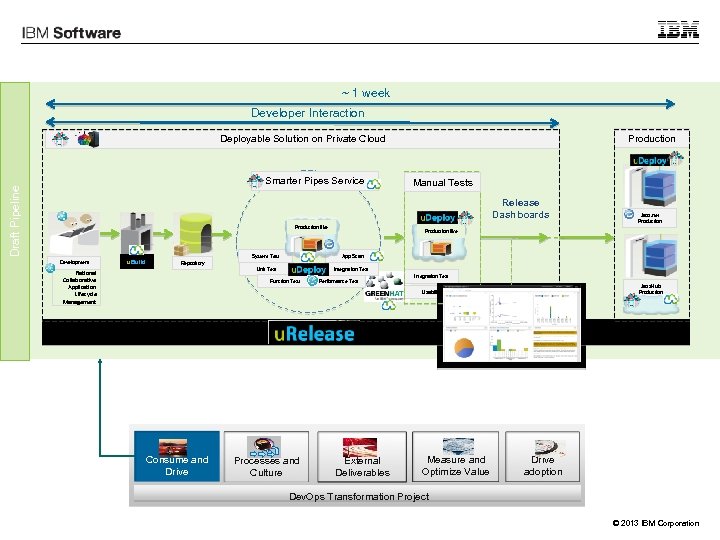 ~ 1 week Developer Interaction Production Deployable Solution on Private Cloud Draft Pipeline Smarter Pipes Service Manual Tests Release Dashboards Production like Development Production like System Test App Scan Unit Test u. Build Jazz. net Production Integration Test Repository Rational Collaborative Application Lifecycle Management Function Test Performance Test Integration Test Jazz. Hub Production Usability Consume and Drive Processes and Culture External Deliverables Measure and Optimize Value Drive adoption Dev. Ops Transformation Project © 2013 IBM Corporation
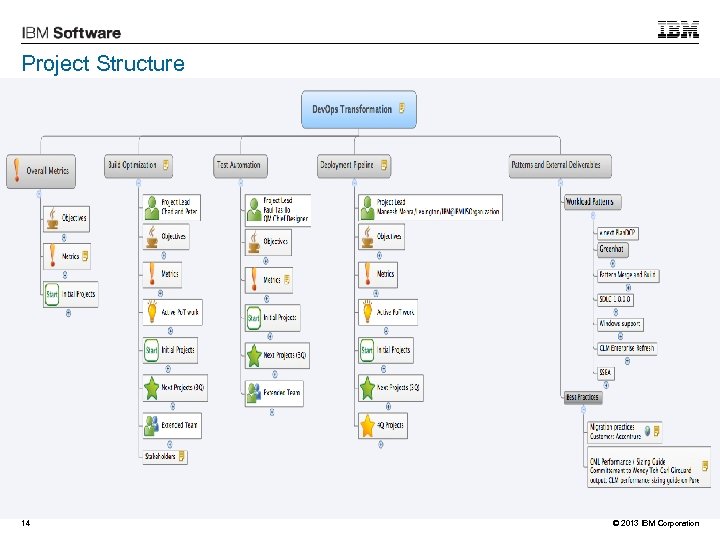 Project Structure 14 © 2013 IBM Corporation
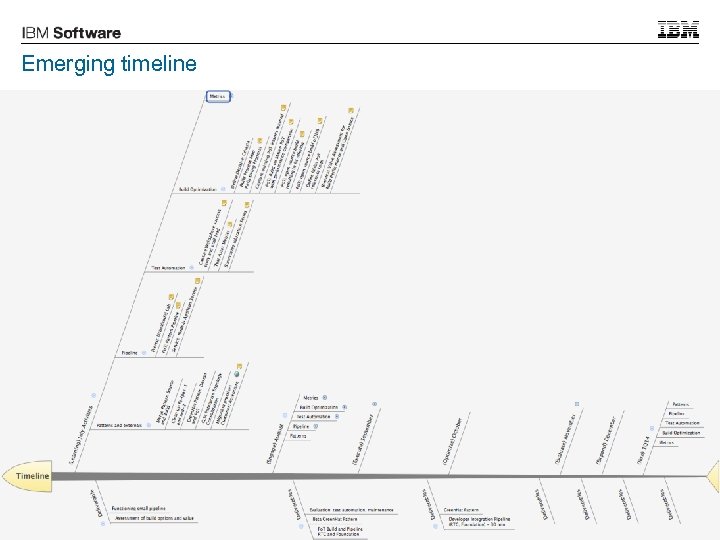 Emerging timeline 15 © 2013 IBM Corporation
 Ways of working § T skills – Deep technical knowledge – Broad awareness and contribution § Deliver – 90% of what YOU do should have a known customer or developer deliverable when you start § Collaborate – Engage the organization § Win – We will be measured by the developer experience 16 © 2013 IBM Corporation
 Discussion 5 minute topics Open for all to state a perspective, describe problems or opportunities that they are excited about. 5 min limit per topic. No Whining 17 © 2013 IBM Corporation
 Discussion Point: Smart Pipes § Problem: static test pipe of increasing complexity/value is too slow for continuous integration § Constantly quantify the value of a test case in terms of it's reliability, it's history of finding defects, the variety of systems that it finds defects in, and whether or not it is related to change sets. For various build/integration purposes have a defined regression window. Within that window dynamically organize the pipeline in the most optimal way to ensure the driver is stable, to find regressions as quickly as possible and to begin expensive or time consuming tests cases such as long runs earlier enough to matter. § Said another way run the best tests to ensure stability, don't run stuff that never matters, run the most relevant tests, run stuff concurrently not linearly, start valuable long running tests as soon as stability is determined. Do all of this within a relevant execution window and provide data and an assurance metric throughout the process. § A smarter pipeline would become an important part of a best of breed Application Release System that is necessary to differentiate IBM from open source ALM and emerging dev. Ops solutions. § Question: With what | Who | When Consume and Drive Processes and Culture External Deliverables Measure and Optimize Value Drive adoption Dev. Ops Transformation Project 18 © 2013 IBM Corporation
 Discussion Point: Delivery mechanisms to Production § Jazz. net § Jazz. Hub § Internal adopters (Hursley, and Rational) § Workload Patterns § Dev. Ops developer. Works portal § Traditional Deploy Repositories Consume and Drive Processes and Culture External Deliverables Measure and Optimize Value Drive adoption Dev. Ops Transformation Project 19 © 2013 IBM Corporation
 Discussion Point: Applying service § How should upgrades and service be applied in Jazz. Hub and Jazz. net environments? – Swim-lanes / Hold Cold – Patch – Rolling upgrades § How are the same mechanisms used within the our delivery pipeline § Do all new project requests get placed on latest available (Jazz. Hub) § How many topology deployments at a time (Jazz. Hub) Consume and Drive Processes and Culture External Deliverables Measure and Optimize Value Drive adoption Dev. Ops Transformation Project 20 © 2013 IBM Corporation
 Next Steps What are the next steps 21 © 2013 IBM Corporation
 Next Steps § June – July (Learning, evaluation and communicating a perspective) § Form mini projects with dedicated resources § Create some initial horizontal teams § Merge various efforts and understand what is not going to be done § Establish baseline business value assessments 22 © 2013 IBM Corporation