


 Скачать презентацию Continuing Professional Development School Placement Tutors Dr Geraldine
d531a48dda470d29973e44d1555f50ad.ppt
- Количество слайдов: 32
 Continuing Professional Development School Placement Tutors Dr. Geraldine Mooney Simmie Academic Coordinator Teaching Practice & Mentoring, Department of Education and Professional Studies, University of Limerick Geraldine. Mooney. Simmie@ul. ie Room DM 042, Main Building Tuesday, 25 th September 2012
 Agenda 9. 30 am to 10. 30 am Teaching Council Guidelines on School Placement 10. 30 am to 11. 00 am Tea/Coffee BREAK 11. 00 am to 12. 00 pm Collaborative Critique of Scheme of Work 12. 00 pm to 12. 30 pm Exploring Issues of Sustainability at the School Deirdre Hogan, UBUNTU, Dept. Education & Professional Studies. 12. 30 pm to 1. 00 pm Meeting Discover Sensors Introduced by Dr. Audrey O’Grady, Lecturer, Life Sciences Department. 1. 00 pm to 1. 50 pm Lunch Break 1. 50 pm to 2. 00 pm Walking across Living Bridge for Photograph at Plassey House with Alan Bunworth, TP Coordinator, Co-Operative Education. 2. 10 pm to 3. 10 pm A Mystery Tour with Historian, Pat Mc Mahon 3. 10 pm to 4. 10 pm Farewell to Alan Bunworth at the Pavillion by Dr. Patrick Ryan, Head, EPS and Dr. Geraldine Mooney Simmie, Academic Coordinator, TP/Mentoring Academic Faculty involved in planning & facilitation: Joanne Broggy; Jennifer Hennessy; Deirdre Hogan: Geraldine Mooney Simmie, Audrey O’Grady; Emmanuel O’Grady; Laura Regan, Ger Slattery, Anne Marie Young.
 Teacher as a Professional Reflective, collaborative and inquiry-oriented
 Teaching Council www. teachingcouncil. ie Number One Goal To support the development of the teacher as a professional • What are the implications of this for teaching practice and for the co-operating teacher in supporting the school placement experience? • What is our role in developing a better school-university partnership with school principals and co-operating teachers? • How can we do this in a way that engages us in a co-inquiry and co-education journey? • The teacher as an activist professional has a political aspect to it. Is the teacher a functionary of the system or are they a public educator and a person who inspires, offers hope, a realistic hope, and who supports the young person mediating the world, a most challenging and rapidly changing world? TEACHING COUNCIL CODES OF PROFESSIONAL CONDUCT TEACHING COUNCIL TEACHING AS A CONTINUUM TEACHING COUNCIL GUIDELINES FOR SCHOOL PLACEMENT
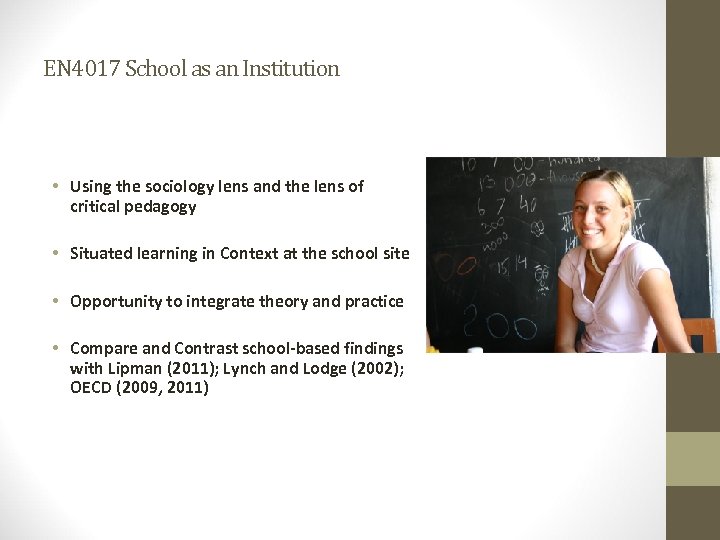 EN 4017 School as an Institution • Using the sociology lens and the lens of critical pedagogy • Situated learning in Context at the school site • Opportunity to integrate theory and practice • Compare and Contrast school-based findings with Lipman (2011); Lynch and Lodge (2002); OECD (2009, 2011)
 Brookfield’s (1995) Lenses Becoming a critically reflective teacher: the need to use four lenses interchangeably on an iterative and on-going basis: • Self-Evaluation interrogation of role of self • Evaluation with a ‘critical friend’ • (peer, co-operating mentor teacher, tutor, other) • Evaluation with Students/Young People • Evaluation from the lens of the Research Literature
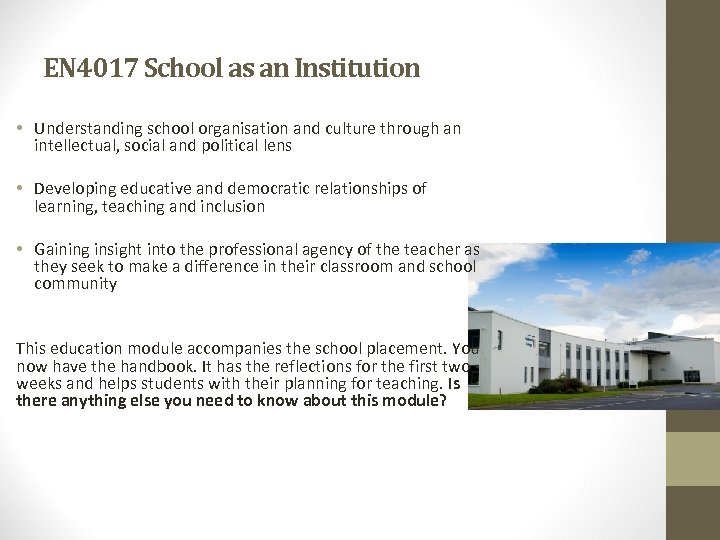 EN 4017 School as an Institution • Understanding school organisation and culture through an intellectual, social and political lens • Developing educative and democratic relationships of learning, teaching and inclusion • Gaining insight into the professional agency of the teacher as they seek to make a difference in their classroom and school community This education module accompanies the school placement. You now have the handbook. It has the reflections for the first two weeks and helps students with their planning for teaching. Is there anything else you need to know about this module?
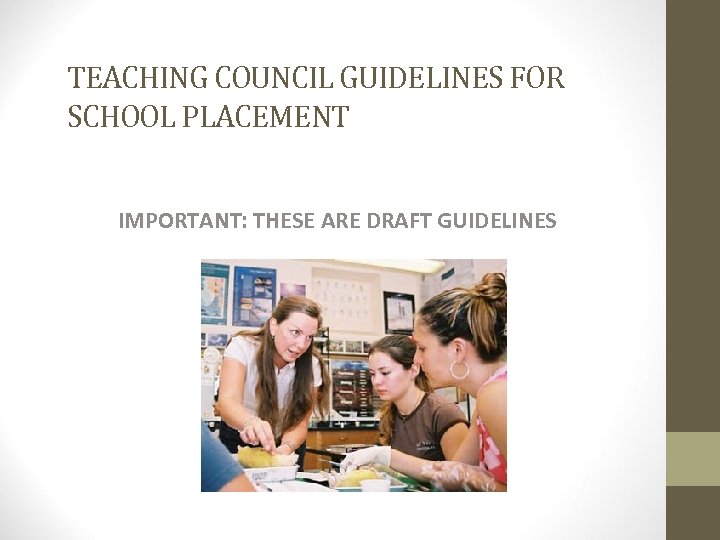 TEACHING COUNCIL GUIDELINES FOR SCHOOL PLACEMENT IMPORTANT: THESE ARE DRAFT GUIDELINES
 TEACHING COUNCIL GUIDELINES FOR SCHOOL PLACEMENT • Schools are dynamic and complex environments and, for that reason, publication of these guidelines and the reconceptualisation of the school placement experience do not represent the end of a journey but, rather, the start of one. The guidelines provide a roadmap for that journey which will guide schools and HEIs as to how existing good practice in school placement can be harnessed and developed incrementally for the benefit of all partners, especially student teachers and learners (p. 5).
 TEACHING COUNCIL GUIDELINES FOR SCHOOL PLACEMENT • Relationships based on mutual respect, trust and inclusion are paramount to the success of the placement. In that context, it is important that student teachers are included and supported by all partners during their school placement. In turn, school teachers must recognise and respect the role of school personnel and have due regard for the policies, protocols and characteristic spirit that underpin the day-to-day life of the school (p. 7).
 TEACHING COUNCIL GUIDELINES FOR SCHOOL PLACEMENT THE THREE I’s • The school placement should be based on the three pillars of innovation, integration and improvement that underpin all stages of the continuum of teacher education in the Council’s Policy on the Continuum of Teacher Education (p. 7).
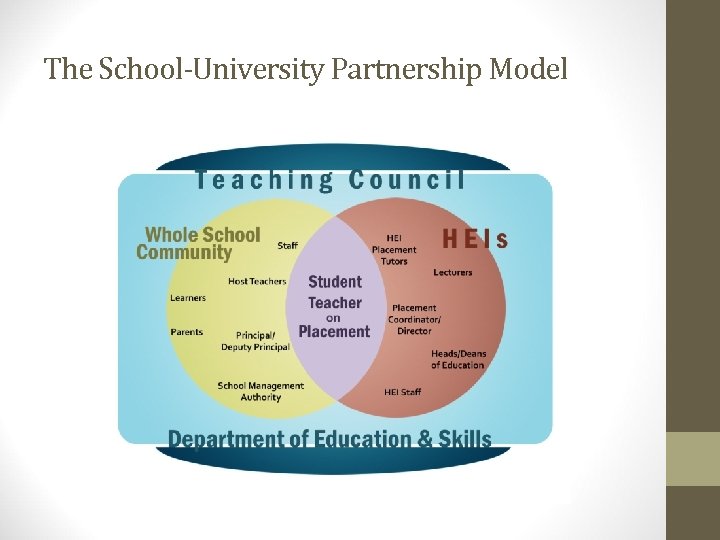 The School-University Partnership Model
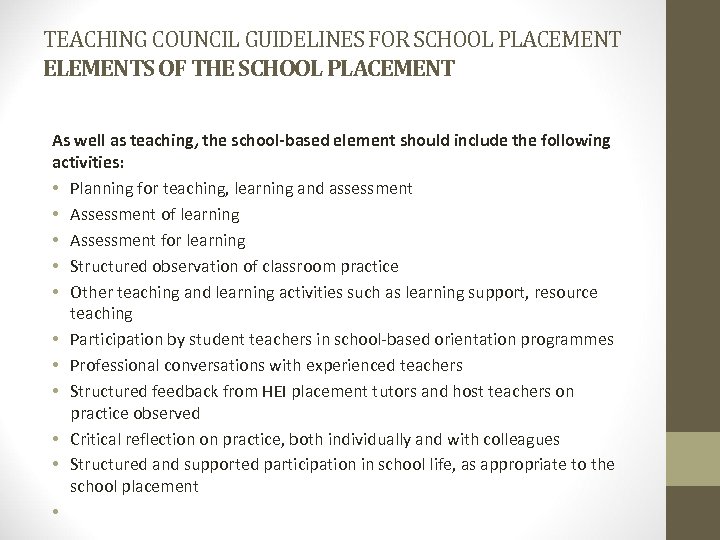 TEACHING COUNCIL GUIDELINES FOR SCHOOL PLACEMENT ELEMENTS OF THE SCHOOL PLACEMENT As well as teaching, the school-based element should include the following activities: • Planning for teaching, learning and assessment • Assessment of learning • Assessment for learning • Structured observation of classroom practice • Other teaching and learning activities such as learning support, resource teaching • Participation by student teachers in school-based orientation programmes • Professional conversations with experienced teachers • Structured feedback from HEI placement tutors and host teachers on practice observed • Critical reflection on practice, both individually and with colleagues • Structured and supported participation in school life, as appropriate to the school placement •
 TEACHING COUNCIL GUIDELINES FOR SCHOOL PLACEMENT ELEMENTS OF THE SCHOOL PLACEMENT • The school-based element may also include, as deemed appropriate by the HEI and the host school, some or all of the following activities: • attendance at staff meetings • school-based research which is relevant to the school placement • supported engagement with parents • engagement with other professionals • HEI-directed placement activities may include: • Micro teaching or equivalent
 TEACHING COUNCIL GUIDELINES FOR SCHOOL PLACEMENT SUPPORTING CROSS-SECTORAL LINKAGES (P. 10) • Experience of cross-sectoral linkages may also be considered, provided they comply with the Teaching Council’s Initial Teacher Education: Criteria and Guidelines for Programme Providers. For example, student teachers at primary level might gain some placement experience in a pre-school and/or a post primary school. Similarly, student teachers at post-primary level might gain some placement experience in a primary school and/or in further education. North/South and Erasmus placements, where possible, also provide valuable teaching and learning experiences for student teachers at both primary and post-primary level. •
 TEACHING COUNCIL GUIDELINES FOR SCHOOL PLACEMENT • The provision of structured support for the student teacher is a key element of school placement. The HEI placement tutor has primary responsibility for the provision of such support, which includes evaluation for assessment purposes. Co-operating/host teachers and the school principal will also provide structured support, having regard to capacity. Additional support may also be provided by other HEI staff, teachers and fellow student teachers (p. 11).
 TEACHING COUNCIL GUIDELINES FOR SCHOOL PLACEMENT • Feedback should be provided in a timely fashion. It should be based on evidence gleaned and be appropriate to the requirements and expectations of the particular placement. The messages should be clear, fair and honest, and communicated in language which is appropriate in a dialogue on teaching and learning, in an encouraging and sensitive manner. The observer should seek to engage the student teacher in critical reflection on his/her practice, so as to identify strengths, areas for improvement, and possible interventions for improving practice (p. 11) • SEE RESEARCH EVIDENCE Hatti (2009) New Zealand
 TEACHING COUNCIL GUIDELINES FOR SCHOOL PLACEMENT • All student teachers on placement should be assigned a suitable cooperating/host teacher who is committed to working with and supporting them. In a post-primary setting, student teachers may have a number of co-operating/host teachers. It is envisaged that, over the course of a school placement on an ITE programme, the student teacher will move gradually from a strongly supported experience in the classroom to teaching independently. While student teachers are teaching independently, co-operating/host teachers will have discretionary time and this will facilitate them engaging with student teachers at other times (p. 12).
 TEACHING COUNCIL GUIDELINES FOR SCHOOL PLACEMENT HEI PLACEMENT TUTORS • Ensure that the student teacher is appropriately supported in all matters pertaining to the placement • Assess the student teacher’s practice in accordance with the HEI’s examination requirements. • Reinforce with the student teacher key considerations regarding teaching and learning in accordance with the HEI policy • Discuss with the co-operating/host teacher good practice in class planning and the use of teaching and learning resources • Support the co-operating/host teacher and student teacher in engaging in reflective dialogue • Collaborate with the co-operating/host teacher(s) and acknowledge his/her role in supporting the student teacher. • Observe the student teacher teaching and engage him/her in a dialogue when giving constructive feedback. • Discuss the student teacher’s practice and experience with the co-operating/host teacher, as appropriate
 TEACHING COUNCIL GUIDELINES FOR SCHOOL PLACEMENT Co-Operating/Host Teachers • Introduce the student teacher to: the learners, the classroom, the teacher’s plan of work for that class, class rules and procedures, and the roles of other staff directly involved with the learners in the class. • Afford the student teacher opportunities to observe their teaching (and that of their colleagues) • Inform the student teacher regarding learners’ needs and attainments. • Assign the teaching of areas of the curriculum to the student teacher while retaining the primary responsibility for the progress of the learners. • Discuss the student teacher’s class plans and resources with him/her, as appropriate • Observe the student teacher’s practice and provide feedback to the student teacher in an encouraging and sensitive manner • Encourage, support and facilitate the student teacher in: critical reflection on his/her practice, the use of a variety of teaching methodologies and in engaging with and responding appropriately to feedback from learners.
 TEACHING COUNCIL GUIDELINES FOR SCHOOL PLACEMENT Student Teacher • Engage constructively and collaboratively in a broad range of professional experiences as part of the school placement process. • In collaboration with the co-operating/host teacher and the whole school community, seek and avail of opportunities to observe and work alongside other teachers. • Take a proactive approach to their own learning and seek and avail of support as a collaborative practitioner. • Engage with constructive feedback from HEI tutors, co-operating/host teachers and principals. • Engage with other student teachers in the context of peer learning, insofar as practicable. • Work towards becoming critically reflective practitioners. • Engage with all in the school community in a respectful and courteous manner. • Recognise that they have much to contribute to the school community. • Have due regard for the ethical values and professional standards which are set out in the Teaching Council’s Code of Professional Conduct for Teachers. • Participate fully in each placement to develop their teaching skills and meet the placement requirements of their HEIs.
 TEACHING COUNCIL GUIDELINES FOR SCHOOL PLACEMENT Appendix 1 - Template School Policy on Placement of Student Teachers • The school’s Policy on School Placement should inform the understanding of the whole school community (management, staff, parents and pupils/ students) regarding the school’s engagement with the initial teacher education programmes – especially the school placement component of those programmes. • Below is a template to assist boards of management in developing a school placement policy. It is important to note, however, that the contents of this template are not in any sense intended to be prescriptive. It is the responsibility of each board of management (in consultation with teachers, parents and students) to devise a policy appropriate to their school’s own particular circumstances – in the context of schools and the teaching profession engaging in the process of teacher education, in partnership with the HEIs.
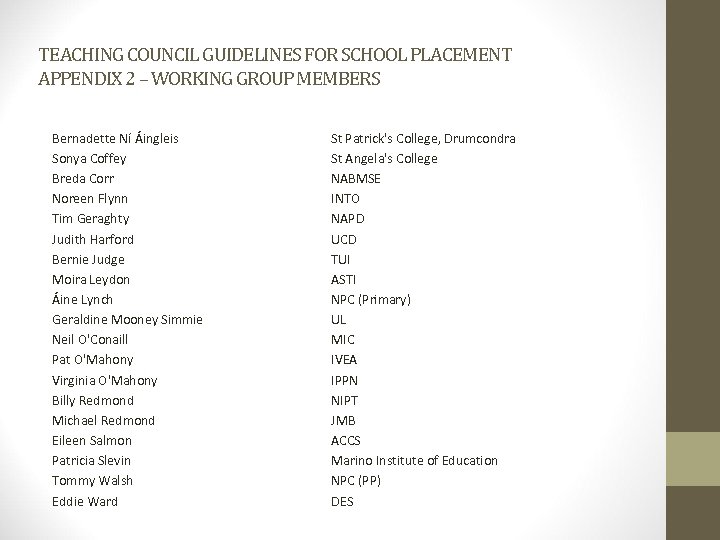 TEACHING COUNCIL GUIDELINES FOR SCHOOL PLACEMENT APPENDIX 2 – WORKING GROUP MEMBERS Bernadette Ní Áingleis Sonya Coffey Breda Corr Noreen Flynn Tim Geraghty Judith Harford Bernie Judge Moira Leydon Áine Lynch Geraldine Mooney Simmie Neil O'Conaill Pat O'Mahony Virginia O'Mahony Billy Redmond Michael Redmond Eileen Salmon Patricia Slevin Tommy Walsh Eddie Ward St Patrick's College, Drumcondra St Angela's College NABMSE INTO NAPD UCD TUI ASTI NPC (Primary) UL MIC IVEA IPPN NIPT JMB ACCS Marino Institute of Education NPC (PP) DES
 Critique of a Scheme of Work What is your philosophical rationale for your teaching?
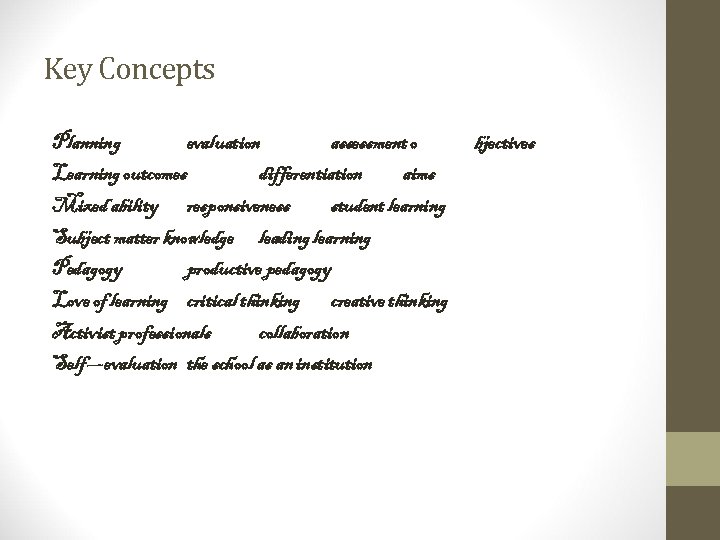 Key Concepts Planning evaluation assessment o Learning outcomes differentiation aims Mixed ability responsiveness student learning Subject matter knowledge leading learning Pedagogy productive pedagogy Love of learning critical thinking creative thinking Activist professionals collaboration Self—evaluation the school as an institution bjectives
 Critique a Scheme of Work • • • What is good about this scheme of work? What is missing from this scheme of work? What is incorrect in this scheme of work? Is there coherence between aims, objectives and assessment? Is there a balance between teacher/student activity? Is there variety in the teaching and learning strategies? Is there a variety of formative assessment opportunities? What do you notice about evaluation? Does this lesson provide sufficient productive intellectual challenge? Is it creative, appealing and relevant to first year students? What advice would you give the student teacher in writing up their weekly planner for this scheme? What are the key features that need to be there?
 A Critical Pedagogy The Teacher as a activist professional
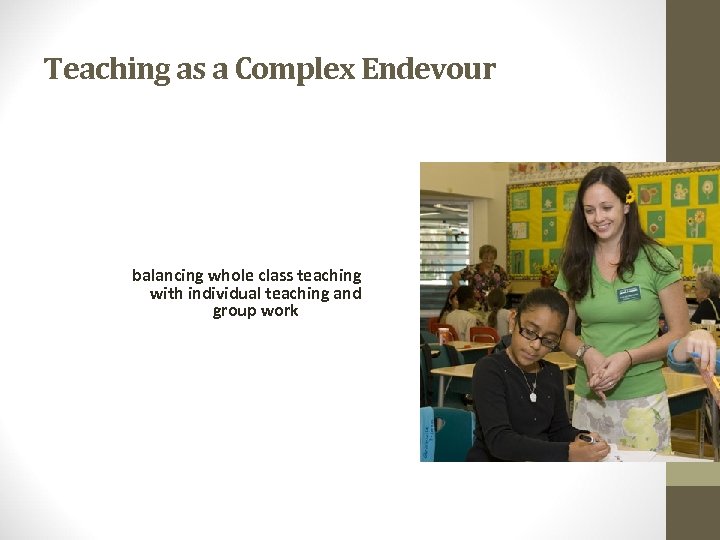 Teaching as a Complex Endevour balancing whole class teaching with individual teaching and group work
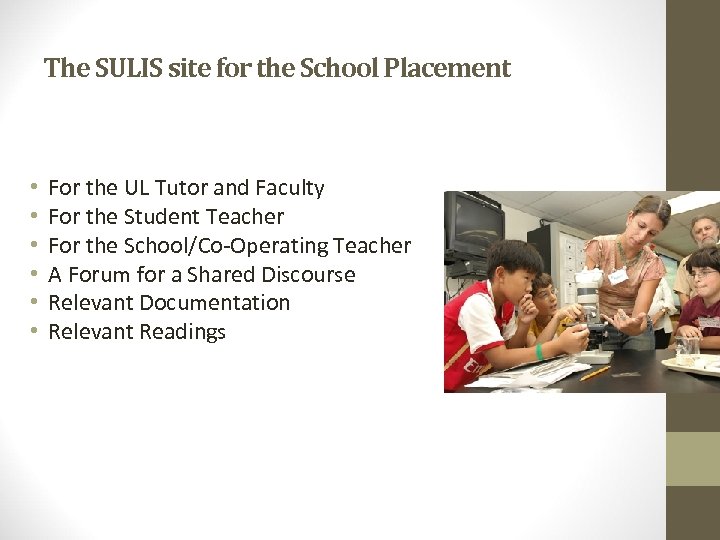 The SULIS site for the School Placement • • • For the UL Tutor and Faculty For the Student Teacher For the School/Co-Operating Teacher A Forum for a Shared Discourse Relevant Documentation Relevant Readings
 ACADEMIC REGULATIONS/ PROCEDURES 2. 1 Teacher Education Programmes (Department of Education and Professional Studies) The following regulations apply to teaching practice modules on all undergraduate and graduate diploma teacher education programmes Grading of Teaching Practice 2. 2 Students who fail teaching practice shall be awarded an F grade 2. 3. The compensating fail grades D 1 and D 2 should not be awarded for teaching practice modules Repeat of Teaching Practice 2. 4 Provision of annual repeats for students who fail a professional placement module (clinical placement, teaching practice) will be at the discretion of the relevant Examination Board 2. 5 One additional placement is normally provided to students who fail a teaching practice module, subject to the provision in 2. 4 above Non-repeatable Teaching Practice Modules 2. 6 Where a teaching practice module is designated as non-repeatable, a repeat of the module is normally provided on a link-in basis in the next academic year, subject to the provision in 2. 4 above
 ACADEMIC REGULATIONS/ PROCEDURES Preparation and Professional Conduct on Teaching Practice 2. 7 A student who is deemed to be unprepared for teaching practice will not be permitted to proceed to the school placement 2. 8 Where a student is not permitted to proceed to the school placement, a fail grade (F/NG) is awarded 2. 9 A student who fails to observe regulations with regard to professional conduct, safety, preparation, attendance or punctuality may be withdrawn from teaching practice 2. 10 A student who is withdrawn from teaching practice is awarded a fail grade (F/NG)
 Bibliography • University of Limerick (September 2012) Teaching Practice Handbook, Limerick: University of Limerick. • University of Limerick (September 2012) Planning Document, Limerick: University of Limerick. • Brookfield, S. (1995) Becoming a Critically Reflective Teacher, Jossey. Bass. • Taber, K. S. (2007) Classroom-based Research and Evidence-based Practice A Guide for Teachers, Sage Publications Ltd. • Stenhouse, L. (1975) An Introduction to Curriculum Research and Development, London: Heinemann