 Скачать презентацию Contextualization an Abstraction Mechanism for Conceptual Modeling Joint
e260fa31d324954ce39d87fc931a171f.ppt
- Количество слайдов: 29



Contextualization: an Abstraction Mechanism for Conceptual Modeling Joint work by: Manos Theodorakis Anastasia Analyti Nicolas Spyratos Panos Constantopoulos Institute of Computer Science FORTH-ICS Greece 1
Outline ü ü ü ü FORTH-ICS Why we need contexts Context definition Structuring the contents of a context Formal Theory Operations on contexts Applications Future Work Conclusions 2
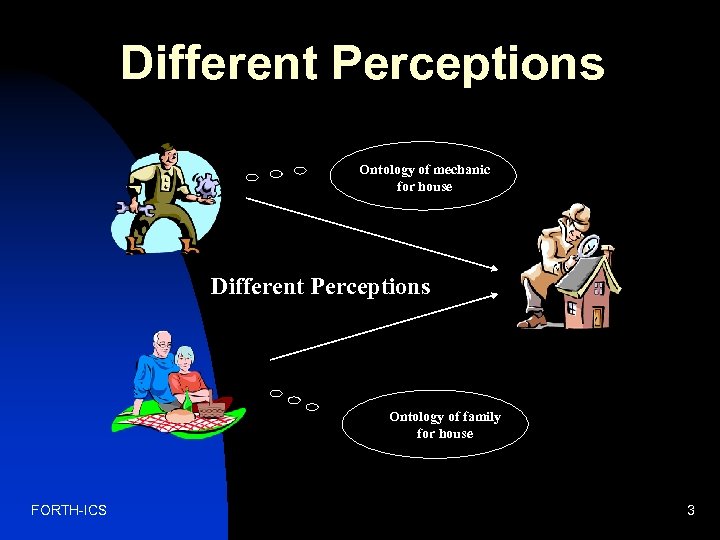
Different Perceptions Ontology of mechanic for house Different Perceptions Ontology of family for house FORTH-ICS 3
Other examples of context n Distributed databases u u n Natural language u n Travel agencies Anatomical map Ambiguity resolution Organization of large databases FORTH-ICS 4
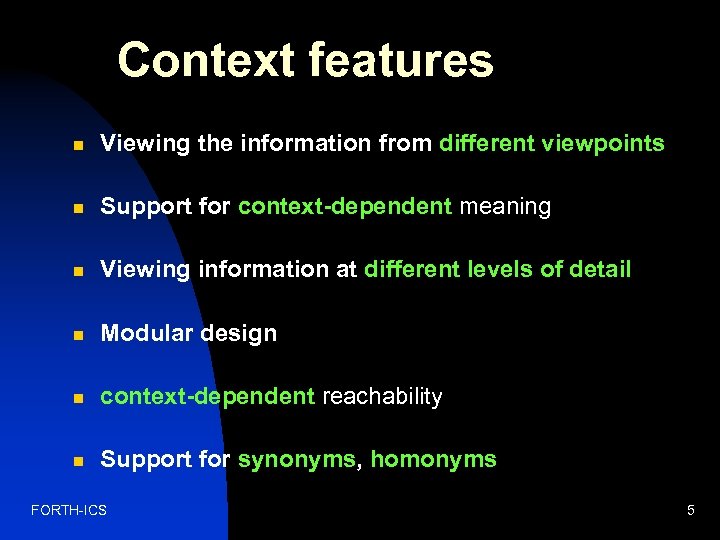
Context features n Viewing the information from different viewpoints n Support for context-dependent meaning n Viewing information at different levels of detail n Modular design n context-dependent reachability n Support for synonyms, homonyms FORTH-ICS 5
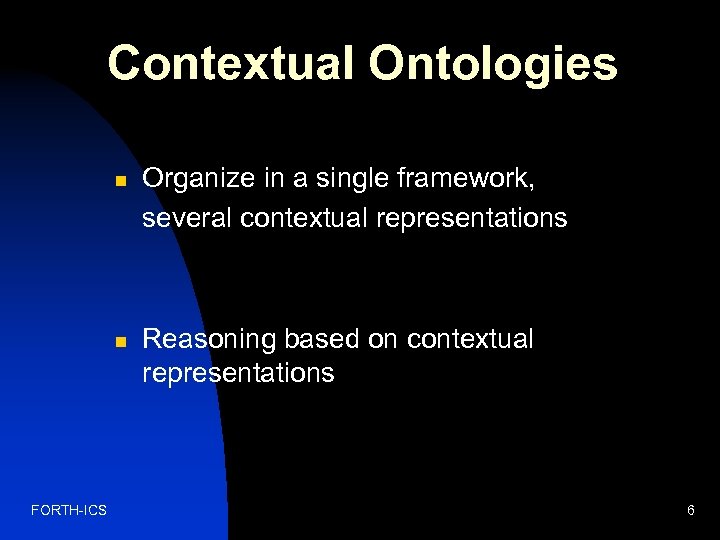
Contextual Ontologies n n FORTH-ICS Organize in a single framework, several contextual representations Reasoning based on contextual representations 6
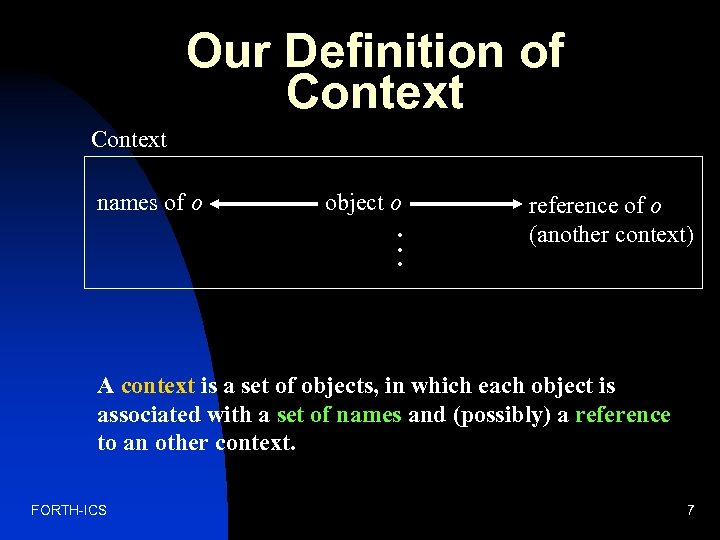
Our Definition of Context names of o object o. . . reference of o (another context) A context is a set of objects, in which each object is associated with a set of names and (possibly) a reference to an other context. FORTH-ICS 7
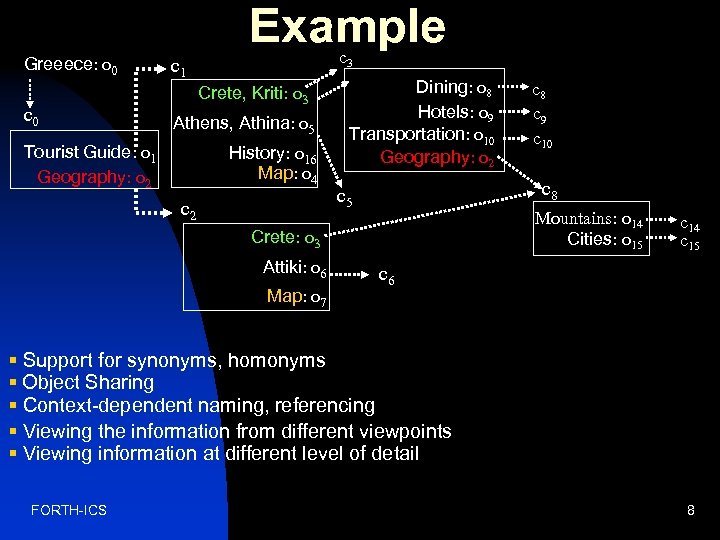
Example Greeece: o 0 c 3 c 1 Crete, Kriti: o 3 Athens, Athina: o 5 Tourist Guide: o 1 Geography: o 2 History: o 16 Map: o 4 c 2 Dining: o 8 Hotels: o 9 Transportation: o 10 Geography: o 2 c 8 c 5 Mountains: o 14 Cities: o 15 Crete: o 3 Attiki: o 6 Map: o 7 c 8 c 9 c 10 c 14 c 15 c 6 § Support for synonyms, homonyms § Object Sharing § Context-dependent naming, referencing § Viewing the information from different viewpoints § Viewing information at different level of detail FORTH-ICS 8
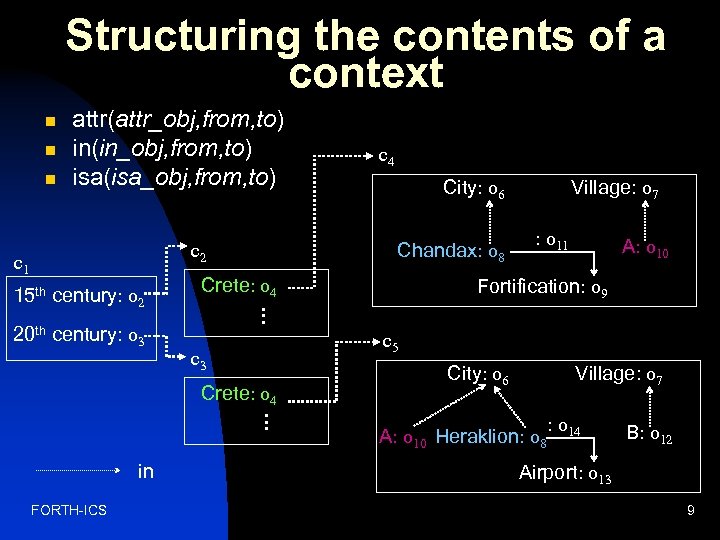
Structuring the contents of a context n n n attr(attr_obj, from, to) in(in_obj, from, to) isa(isa_obj, from, to) 15 th century: o 2 20 th century: o 3 Crete: o 4 : o 11 A: o 10 c 5 c 3. . . FORTH-ICS Village: o 7 Fortification: o 9 . . . Crete: o 4 in City: o 6 Chandax: o 8 c 2 c 1 c 4 City: o 6 Village: o 7 A: o 10 Heraklion: o 8 : o 14 B: o 12 Airport: o 13 9
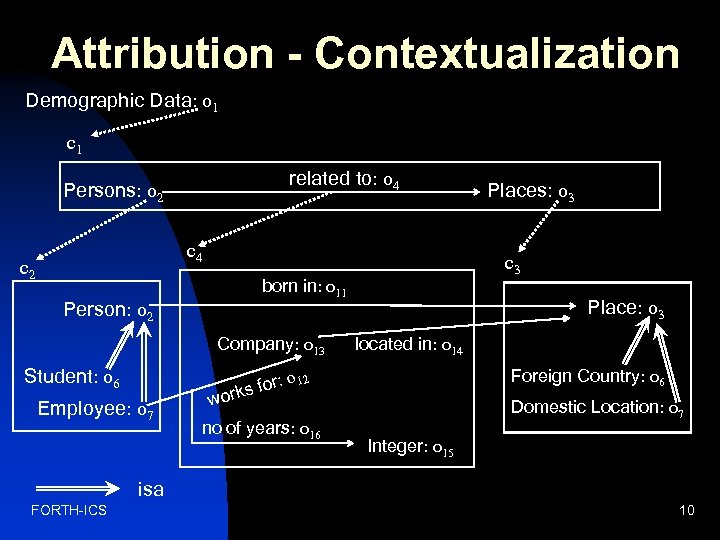
Attribution - Contextualization Demographic Data: o 1 c 1 related to: o 4 Persons: o 2 c 4 c 2 Company: o 13 Student: o 6 Employee: o 7 c 3 born in: o 11 Person: o 2 or rks f o w Place: o 3 located in: o 14 Foreign Country: o 6 : o 12 no of years: o 16 Places: o 3 Domestic Location: o 7 Integer: o 15 isa FORTH-ICS 10
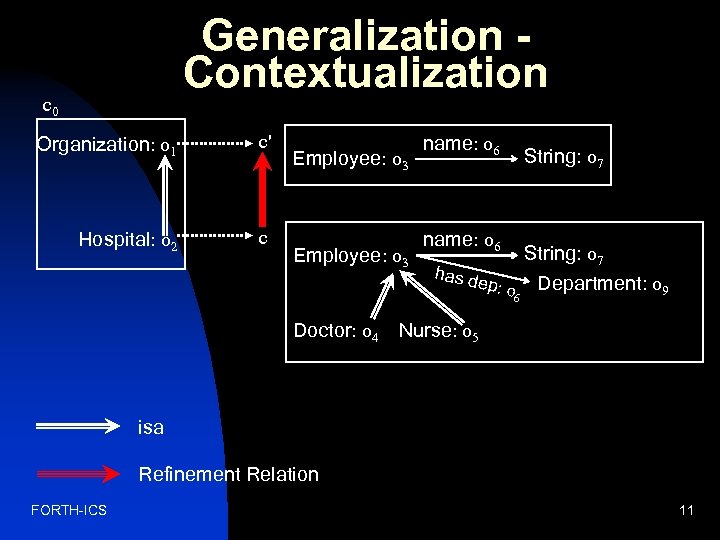
Generalization Contextualization c 0 Organization: o 1 c' Hospital: o 2 c Employee: o 3 name: o 6 String: o 7 has d ep: o 6 Department: o 9 Doctor: o 4 Nurse: o 5 isa Refinement Relation FORTH-ICS 11
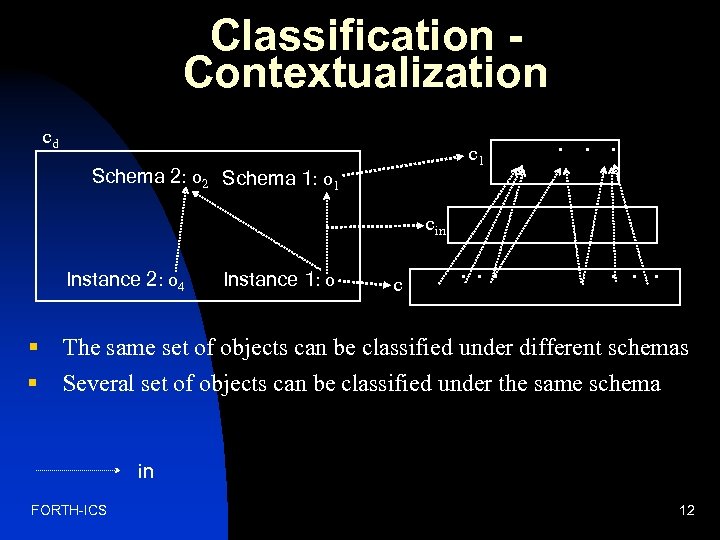
Classification Contextualization cd c 1 Schema 2: o 2 Schema 1: o 1 . . . cin Instance 2: o 4 Instance 1: o c . . . § The same set of objects can be classified under different schemas § Several set of objects can be classified under the same schema in FORTH-ICS 12
Context theory n Formal definitions n Model theory n Set of sound & complete inference rules. FORTH-ICS 13
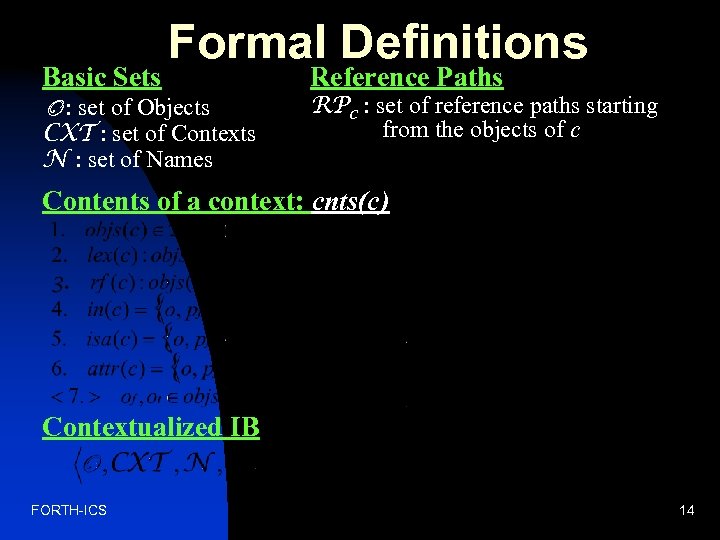
Basic Sets Formal Definitions O : set of Objects CXT : set of Contexts N : set of Names Reference Paths RPc : set of reference paths starting from the objects of c Contents of a context: cnts(c) Contextualized IB FORTH-ICS 14
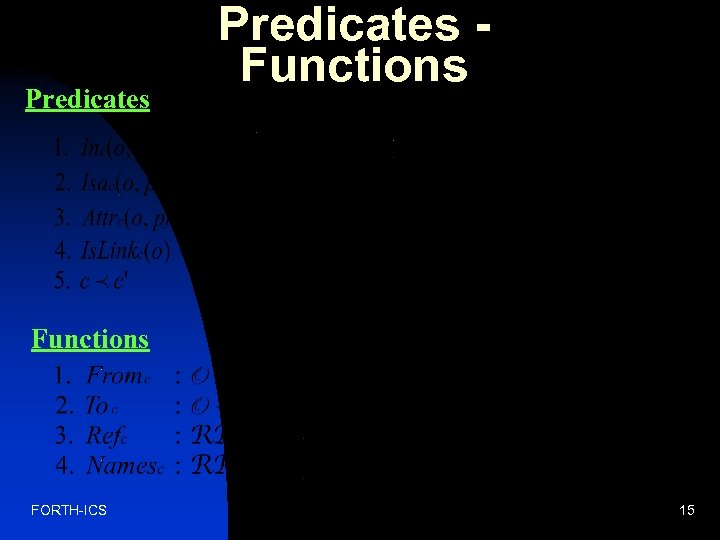
Predicates Functions FORTH-ICS 15
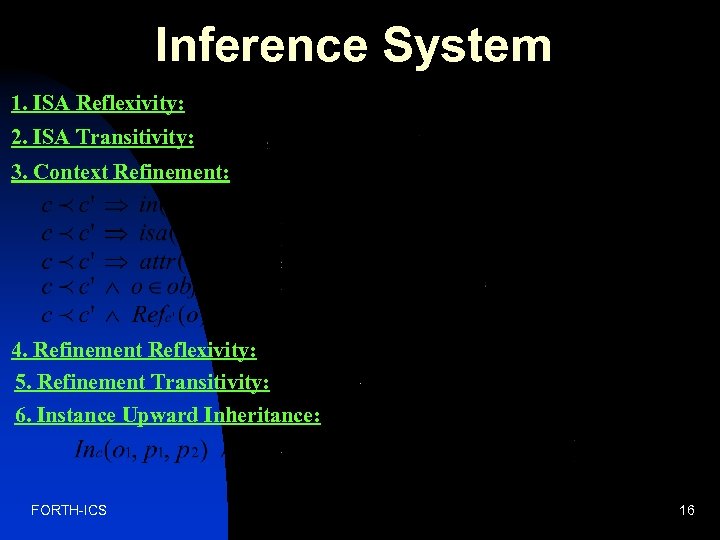
Inference System 1. ISA Reflexivity: 2. ISA Transitivity: 3. Context Refinement: 4. Refinement Reflexivity: 5. Refinement Transitivity: 6. Instance Upward Inheritance: FORTH-ICS 16
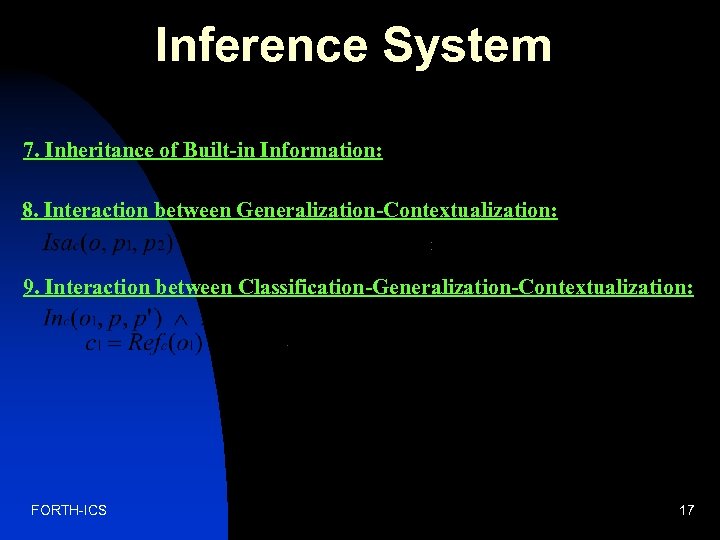
Inference System 7. Inheritance of Built-in Information: 8. Interaction between Generalization-Contextualization: 9. Interaction between Classification-Generalization-Contextualization: FORTH-ICS 17
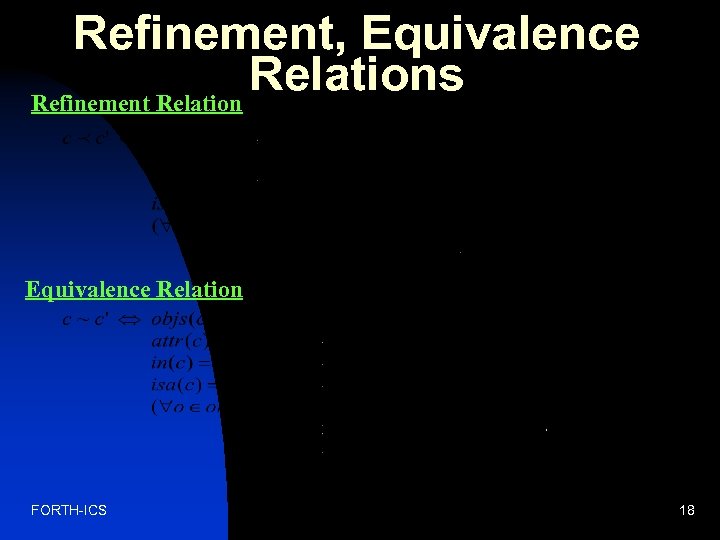
Refinement, Equivalence Relations Refinement Relation Equivalence Relation FORTH-ICS 18
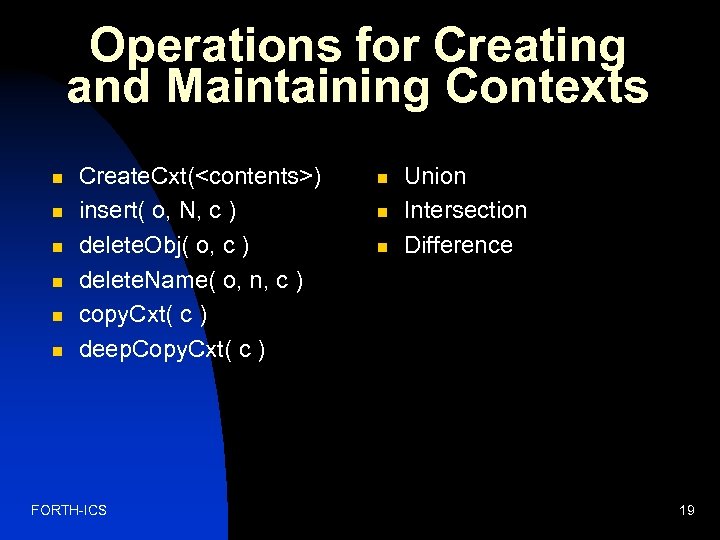
Operations for Creating and Maintaining Contexts n n n Create. Cxt(<contents>) insert( o, N, c ) delete. Obj( o, c ) delete. Name( o, n, c ) copy. Cxt( c ) deep. Copy. Cxt( c ) FORTH-ICS n n n Union Intersection Difference 19
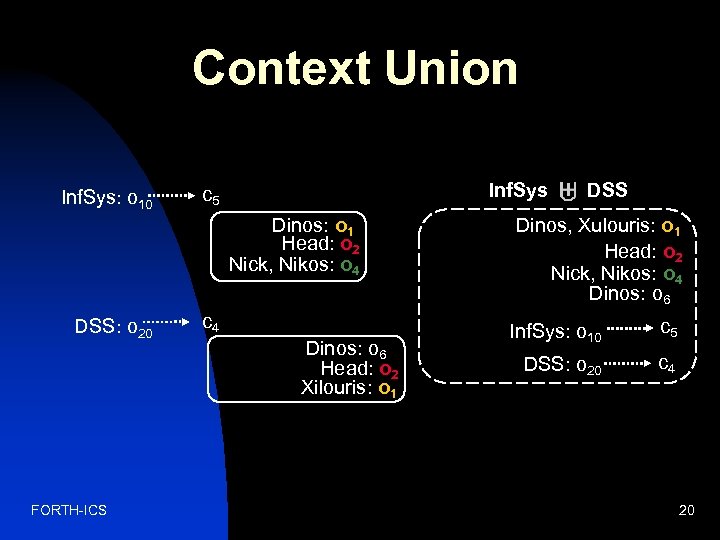
Context Union Inf. Sys: o 10 Inf. Sys c 5 Dinos: o 1 Head: o 2 Nick, Nikos: o 4 DSS: o 20 FORTH-ICS c 4 Dinos: o 6 Head: o 2 Xilouris: o 1 DSS Dinos, Xulouris: o 1 Head: o 2 Nick, Nikos: o 4 Dinos: o 6 Inf. Sys: o 10 c 5 DSS: o 20 c 4 20
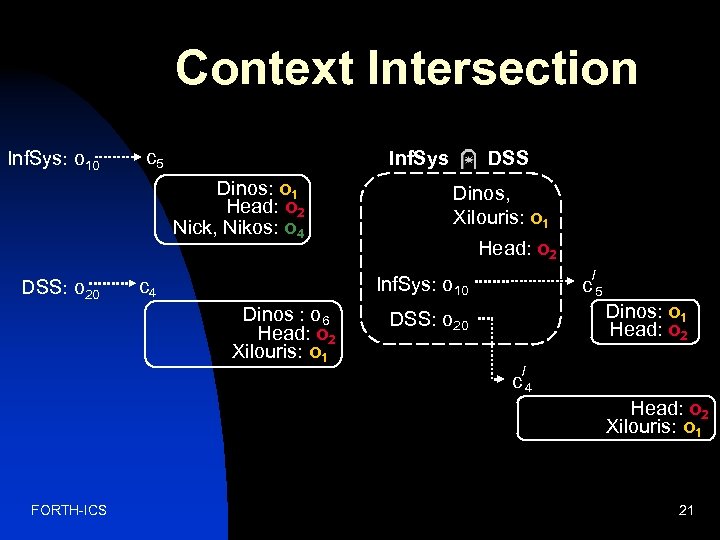
Context Intersection Inf. Sys: o 10 c 5 Inf. Sys Dinos: o 1 Head: o 2 Nick, Nikos: o 4 DSS: o 20 DSS Dinos, Xilouris: o 1 Head: o 2 / Inf. Sys: o 10 c 4 Dinos : o 6 Head: o 2 Xilouris: o 1 c 5 Dinos: o 1 Head: o 2 DSS: o 20 / c 4 Head: o 2 Xilouris: o 1 FORTH-ICS 21
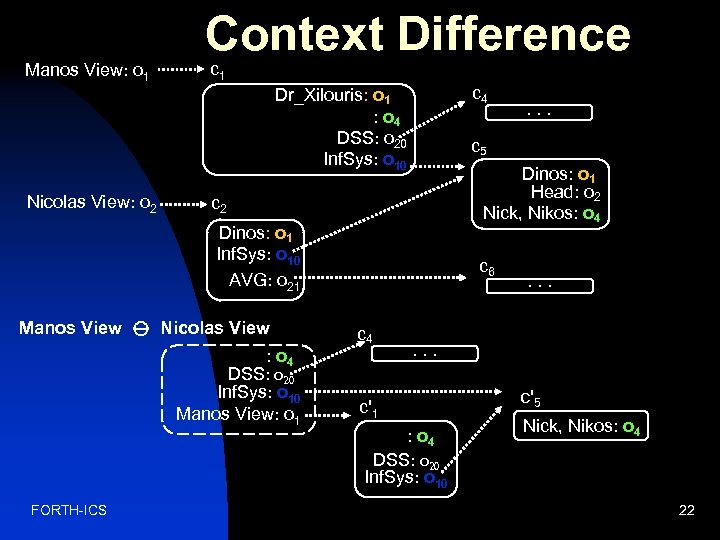
Manos View: o 1 Context Difference c 1 c 4 Dr_Xilouris: o 1 : o 4 DSS: o 20 Inf. Sys: o 10 Nicolas View: o 2 c 5 Dinos: o 1 Head: o 2 Nick, Nikos: o 4 c 2 Dinos: o 1 Inf. Sys: o 10 AVG: o 21 Manos View y Nicolas View : o 4 DSS: o 20 Inf. Sys: o 10 Manos View: o 1 FORTH-ICS c 6 c 4 . . c'1 : o 4 DSS: o 20 Inf. Sys: o 10 c'5 Nick, Nikos: o 4 22
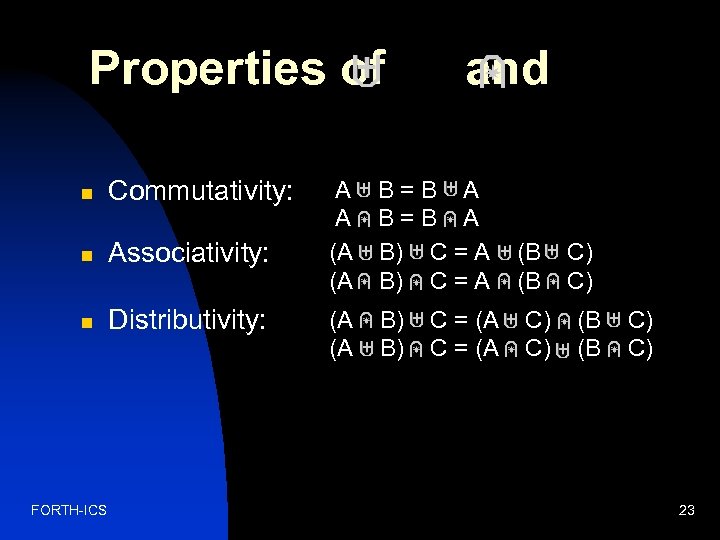
Properties of n Commutativity: n Associativity: n Distributivity: FORTH-ICS and A A (A (A B=B A B) C = A (A (A B) B) C = (A (B (B C) C) 23
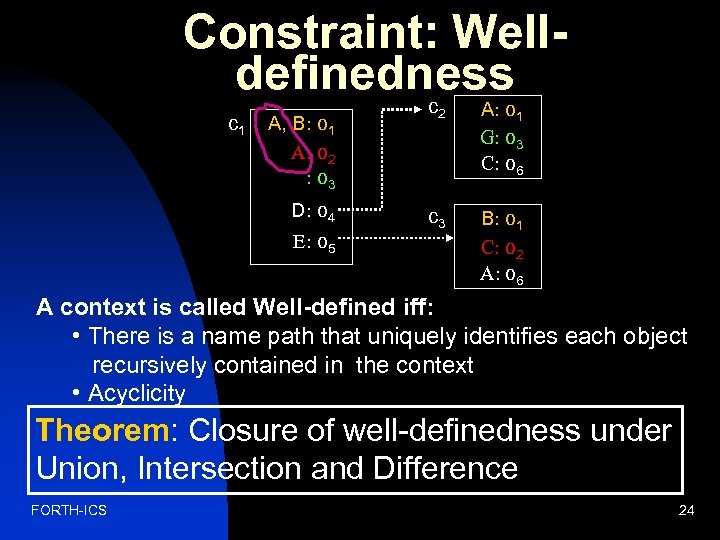
Constraint: Welldefinedness c 1 A, B: o 1 A: o 2 : o 3 D: o 4 E: o 5 c 2 A: o 1 G: o 3 C: o 6 c 3 B: o 1 C: o 2 A: o 6 A context is called Well-defined iff: • There is a name path that uniquely identifies each object recursively contained in the context • Acyclicity Theorem: Closure of well-definedness under Union, Intersection and Difference FORTH-ICS 24
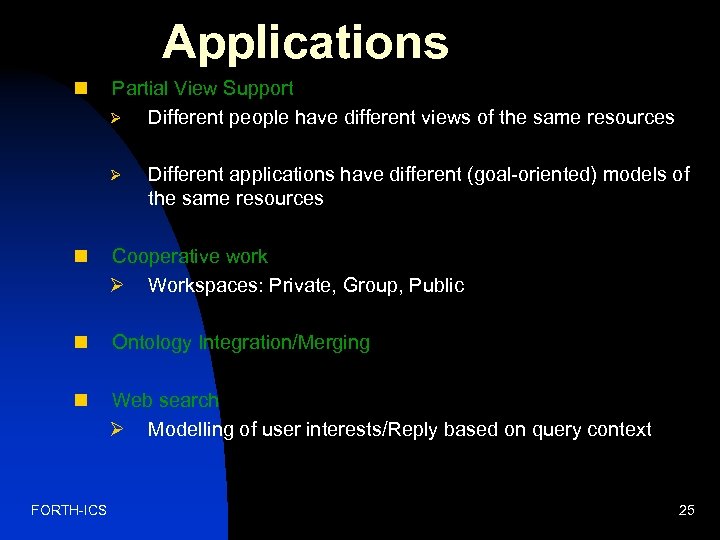
Applications n Partial View Support Ø Different people have different views of the same resources Ø Different applications have different (goal-oriented) models of the same resources n Cooperative work Ø Workspaces: Private, Group, Public n Ontology Integration/Merging n Web search Ø Modelling of user interests/Reply based on query context FORTH-ICS 25
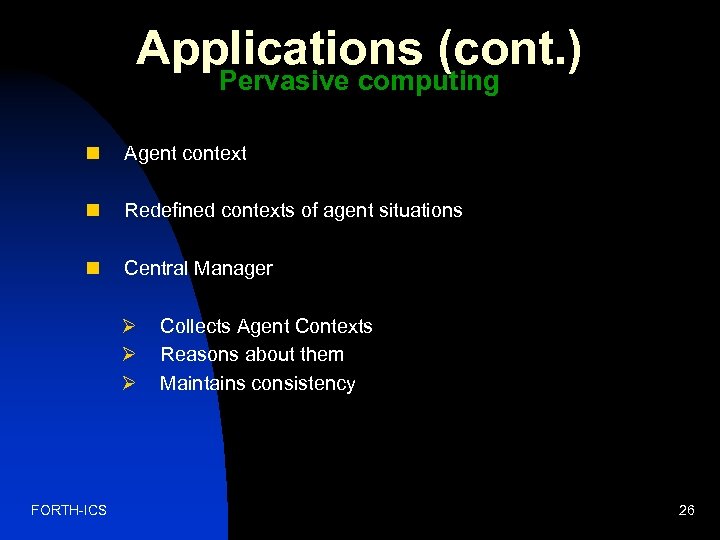
Applications (cont. ) Pervasive computing n Agent context n Redefined contexts of agent situations n Central Manager Ø Ø Ø FORTH-ICS Collects Agent Contexts Reasons about them Maintains consistency 26
Future Work n n Extension of the web ontology languages RDF and OWL with contexts Querying and reasoning with: contextualized RDF u contextualized OWL u FORTH-ICS 27
Conclusions n A formal notion of context in information modeling Ø Formal definition Ø Core axioms Ø Operations n Supported features Ø Partial views Ø Relative semantics Ø Modular design FORTH-ICS 28

Thank you! FORTH-ICS 29
Скачать презентацию Contextualization an Abstraction Mechanism for Conceptual Modeling Joint
e260fa31d324954ce39d87fc931a171f.ppt