


 Скачать презентацию Contextual information for Of Mice and Men What
c7885b0847baaac858bc899e8f8e766d.ppt
- Количество слайдов: 8
 Contextual information for Of Mice and Men What do we mean by context? ? ?
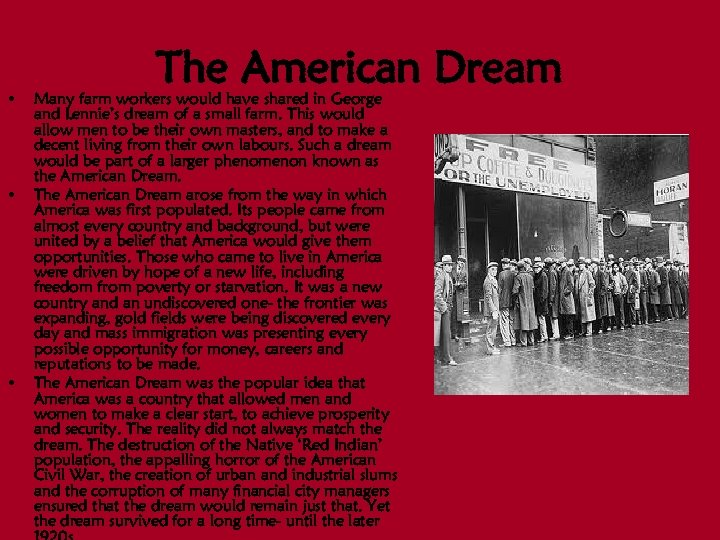 • • • The American Dream Many farm workers would have shared in George and Lennie’s dream of a small farm. This would allow men to be their own masters, and to make a decent living from their own labours. Such a dream would be part of a larger phenomenon known as the American Dream. The American Dream arose from the way in which America was first populated. Its people came from almost every country and background, but were united by a belief that America would give them opportunities. Those who came to live in America were driven by hope of a new life, including freedom from poverty or starvation. It was a new country and an undiscovered one- the frontier was expanding, gold fields were being discovered every day and mass immigration was presenting every possible opportunity for money, careers and reputations to be made. The American Dream was the popular idea that America was a country that allowed men and women to make a clear start, to achieve prosperity and security. The reality did not always match the dream. The destruction of the Native ‘Red Indian’ population, the appalling horror of the American Civil War, the creation of urban and industrial slums and the corruption of many financial city managers ensured that the dream would remain just that. Yet the dream survived for a long time- until the later
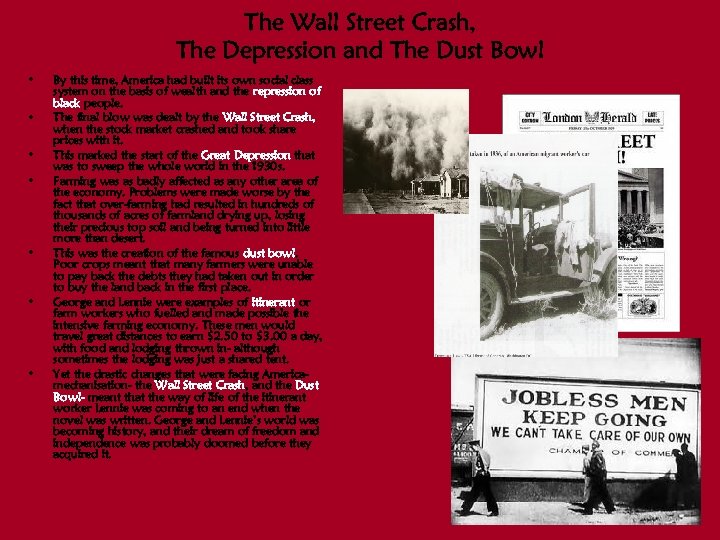 The Wall Street Crash, The Depression and The Dust Bowl • • By this time, America had built its own social class system on the basis of wealth and the repression of black people. The final blow was dealt by the Wall Street Crash, when the stock market crashed and took share prices with it. This marked the start of the Great Depression that was to sweep the whole world in the 1930 s. Farming was as badly affected as any other area of the economy. Problems were made worse by the fact that over-farming had resulted in hundreds of thousands of acres of farmland drying up, losing their precious top soil and being turned into little more than desert. This was the creation of the famous dust bowl. Poor crops meant that many farmers were unable to pay back the debts they had taken out in order to buy the land back in the first place. George and Lennie were examples of itinerant or farm workers who fuelled and made possible the intensive farming economy. These men would travel great distances to earn $2. 50 to $3. 00 a day, with food and lodging thrown in- although sometimes the lodging was just a shared tent. Yet the drastic changes that were facing Americamechanisation- the Wall Street Crash, and the Dust Bowl- meant that the way of life of the itinerant worker Lennie was coming to an end when the novel was written. George and Lennie’s world was becoming history, and their dream of freedom and independence was probably doomed before they acquired it.
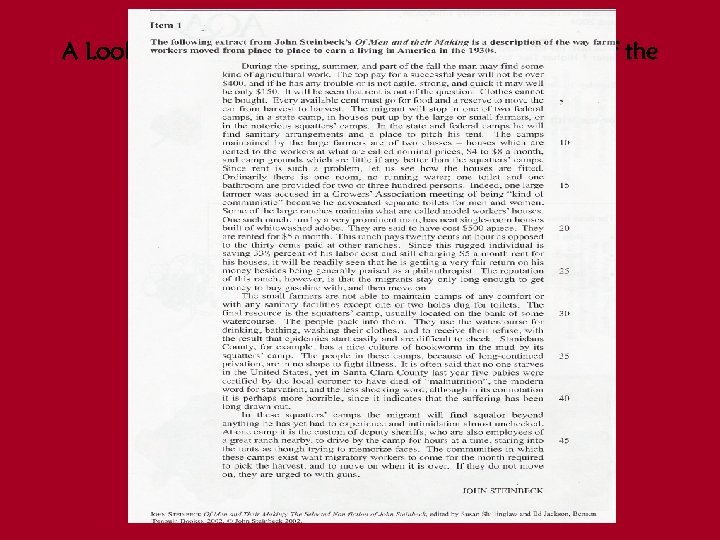 A Look at what Steinbeck thought about the Plight of the Itinerant Worker
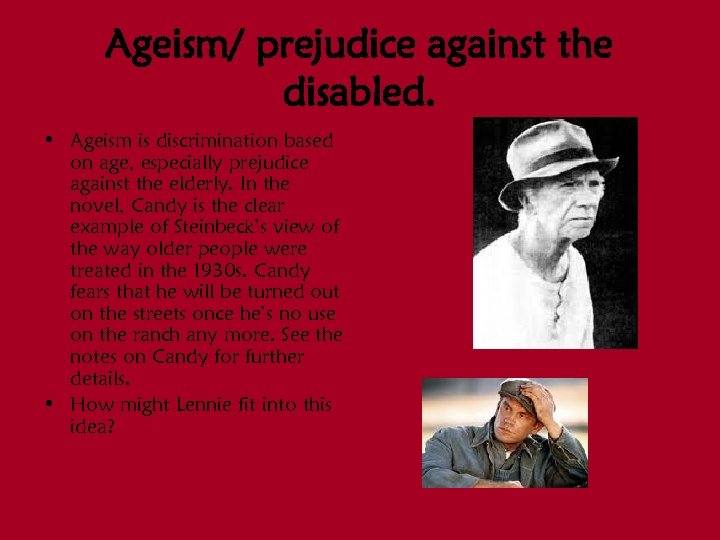 Ageism/ prejudice against the disabled. • Ageism is discrimination based on age, especially prejudice against the elderly. In the novel, Candy is the clear example of Steinbeck’s view of the way older people were treated in the 1930 s. Candy fears that he will be turned out on the streets once he’s no use on the ranch any more. See the notes on Candy for further details. • How might Lennie fit into this idea?
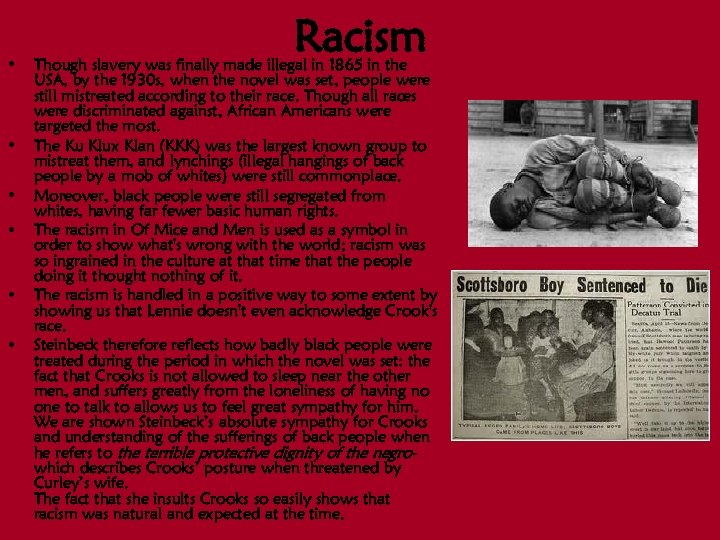 • • • Racism Though slavery was finally made illegal in 1865 in the USA, by the 1930 s, when the novel was set, people were still mistreated according to their race. Though all races were discriminated against, African Americans were targeted the most. The Ku Klux Klan (KKK) was the largest known group to mistreat them, and lynchings (illegal hangings of back people by a mob of whites) were still commonplace. Moreover, black people were still segregated from whites, having far fewer basic human rights. The racism in Of Mice and Men is used as a symbol in order to show what's wrong with the world; racism was so ingrained in the culture at that time that the people doing it thought nothing of it. The racism is handled in a positive way to some extent by showing us that Lennie doesn't even acknowledge Crook's race. Steinbeck therefore reflects how badly black people were treated during the period in which the novel was set: the fact that Crooks is not allowed to sleep near the other men, and suffers greatly from the loneliness of having no one to talk to allows us to feel great sympathy for him. We are shown Steinbeck’s absolute sympathy for Crooks and understanding of the sufferings of back people when he refers to the terrible protective dignity of the negrowhich describes Crooks’ posture when threatened by Curley’s wife. The fact that she insults Crooks so easily shows that racism was natural and expected at the time.
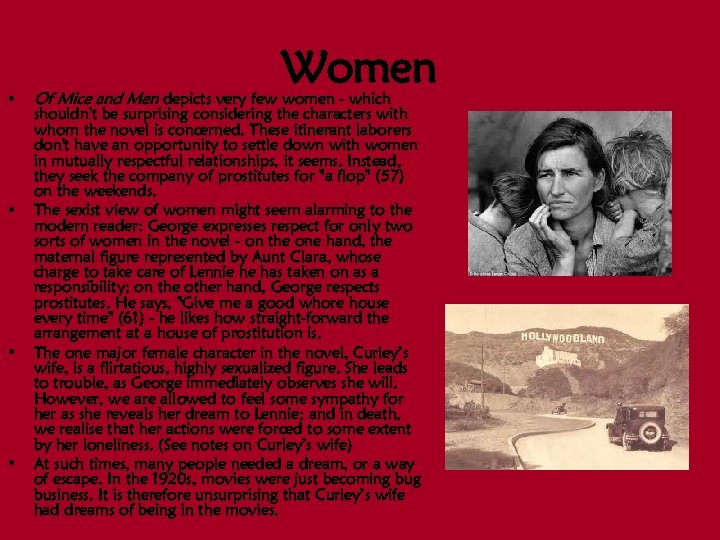 • • Women Of Mice and Men depicts very few women - which shouldn't be surprising considering the characters with whom the novel is concerned. These itinerant laborers don't have an opportunity to settle down with women in mutually respectful relationships, it seems. Instead, they seek the company of prostitutes for "a flop" (57) on the weekends. The sexist view of women might seem alarming to the modern reader: George expresses respect for only two sorts of women in the novel - on the one hand, the maternal figure represented by Aunt Clara, whose charge to take care of Lennie he has taken on as a responsibility; on the other hand, George respects prostitutes. He says, "Give me a good whore house every time" (61) - he likes how straight-forward the arrangement at a house of prostitution is. The one major female character in the novel, Curley’s wife, is a flirtatious, highly sexualized figure. She leads to trouble, as George immediately observes she will. However, we are allowed to feel some sympathy for her as she reveals her dream to Lennie; and in death, we realise that her actions were forced to some extent by her loneliness. (See notes on Curley’s wife) At such times, many people needed a dream, or a way of escape. In the 1920 s, movies were just becoming business. It is therefore unsurprising that Curley’s wife had dreams of being in the movies.
 How do I use this in the exam? • Begin any essay with a very brief paragraph about The Great Depression and the American Dream. • If the question is on Crooks… • If it is on Candy… • If it is Curley’s wife… • If it is George or Lennie… • If it is on one of the other itinerant workers… P E E L!