 Скачать презентацию Context-Aware Negotiation in E-commerce Reyhan AYDOĞAN reyhan aydogan boun
206eb4e05fa12588020b4c7a359411ca.ppt
- Количество слайдов: 28



Context-Aware Negotiation in E-commerce Reyhan AYDOĞAN reyhan. aydogan@boun. edu. tr 25/11/2005 Context-Aware Negotiation in E-commerce 1
OUTLINE • • Introduction Matchmaking Negotiation Proposed Negotiation Scheme Architecture Learning Discussion 25/11/2005 Context-Aware Negotiation in E-commerce 2
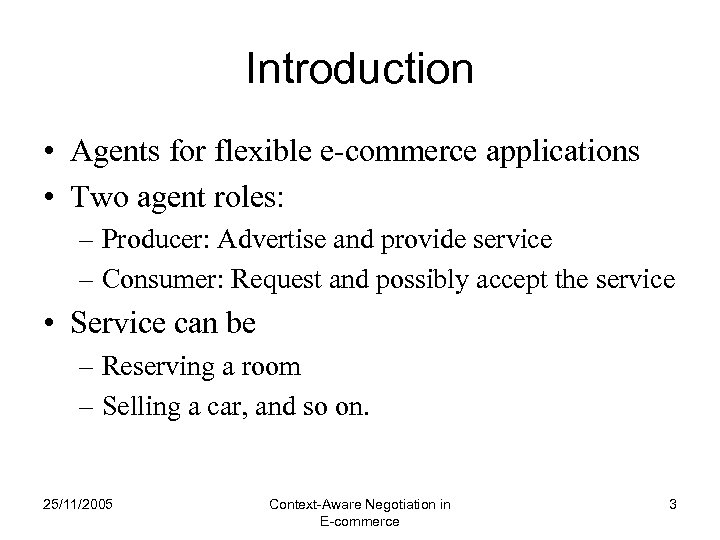
Introduction • Agents for flexible e-commerce applications • Two agent roles: – Producer: Advertise and provide service – Consumer: Request and possibly accept the service • Service can be – Reserving a room – Selling a car, and so on. 25/11/2005 Context-Aware Negotiation in E-commerce 3
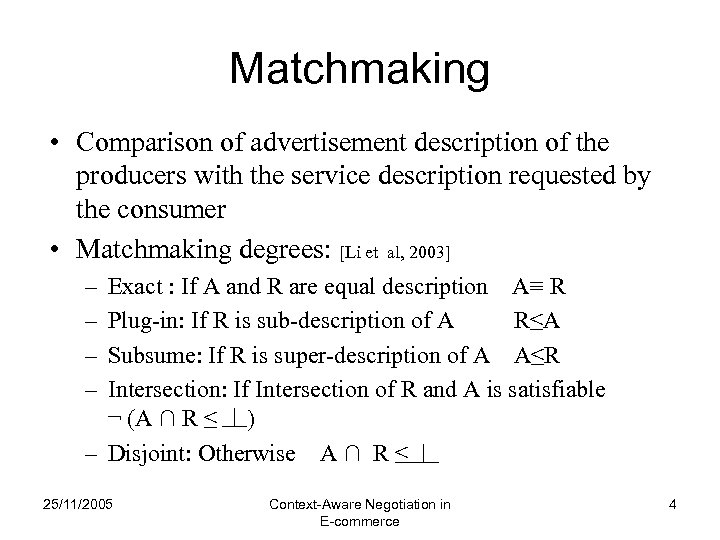
Matchmaking • Comparison of advertisement description of the producers with the service description requested by the consumer • Matchmaking degrees: [Li et al, 2003] – – Exact : If A and R are equal description A≡ R Plug-in: If R is sub-description of A R≤A Subsume: If R is super-description of A A≤R Intersection: If Intersection of R and A is satisfiable ¬ (A ∩ R ≤ ) – Disjoint: Otherwise A ∩ R ≤ 25/11/2005 Context-Aware Negotiation in E-commerce 4
![Matchmaking Cont. Taken from [ Broens, 2004] R = request S= service provided m=](https://present5.com/presentation/206eb4e05fa12588020b4c7a359411ca/image-5.jpg "Matchmaking Cont. Taken from [ Broens, 2004] R = request S= service provided m=")
Matchmaking Cont. Taken from [ Broens, 2004] R = request S= service provided m= # of missing properties 25/11/2005 Context-Aware Negotiation in E-commerce Taken from [] 5
![Negotiation • When no exact matched service, negotiation starts • Negotiation mechanism [Debenham, 2002]](https://present5.com/presentation/206eb4e05fa12588020b4c7a359411ca/image-6.jpg "Negotiation • When no exact matched service, negotiation starts • Negotiation mechanism [Debenham, 2002]")
Negotiation • When no exact matched service, negotiation starts • Negotiation mechanism [Debenham, 2002] – Single issue negotiation • Auction ( i. e. Vickrey Auction) – One-to-one negotiation (bargaining) • Alternating offers mechanism • Single-round, “one-hit” mechanism 25/11/2005 Context-Aware Negotiation in E-commerce 6
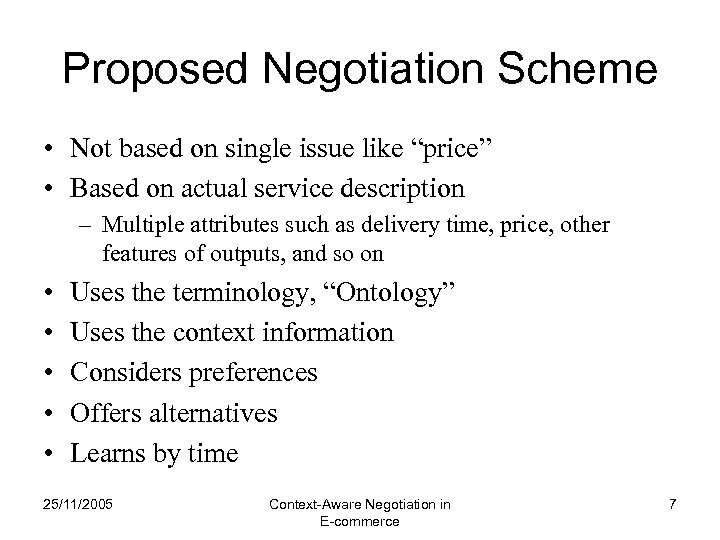
Proposed Negotiation Scheme • Not based on single issue like “price” • Based on actual service description – Multiple attributes such as delivery time, price, other features of outputs, and so on • • • Uses the terminology, “Ontology” Uses the context information Considers preferences Offers alternatives Learns by time 25/11/2005 Context-Aware Negotiation in E-commerce 7
![Ontology • Common understanding of knowledge concerning the domain of interest [Fensel, 2003] •](https://present5.com/presentation/206eb4e05fa12588020b4c7a359411ca/image-8.jpg "Ontology • Common understanding of knowledge concerning the domain of interest [Fensel, 2003] •")
Ontology • Common understanding of knowledge concerning the domain of interest [Fensel, 2003] • Describe concepts and specify properties of concepts • Establish relationships among concepts • E. g. Car ontology – Car is a concept. – Price, color, brand, model are some properties of car concept. – Vehicle is another concept. – Car is a type-of vehicle or Car is-a vehicle. 25/11/2005 Context-Aware Negotiation in E-commerce 8
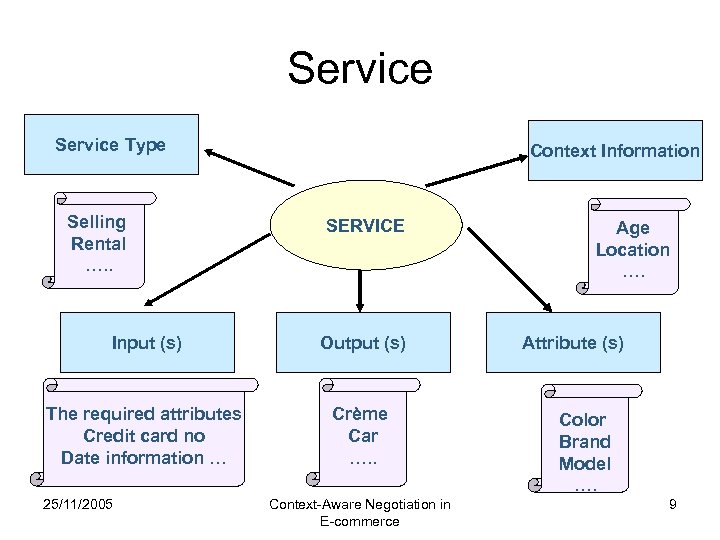
Service Type Selling Rental …. . Context Information SERVICE Input (s) Output (s) The required attributes Credit card no Date information … Crème Car …. . 25/11/2005 Context-Aware Negotiation in E-commerce Age Location …. Attribute (s) Color Brand Model …. 9
Context Information • Enables to provide better service to consumer agents • Related with the products and customer information • E. g. – Special Beauty Crème requires age information. – Location information may be used. 25/11/2005 Context-Aware Negotiation in E-commerce 10
Preferences • Consumer’s preference – E. g. Which one is more important for consumer? • Price versus delivery time? • Color versus brand ? – Can be specified as a number at range [0 -1] – Known or learned by time? • Producer’s preference – Business Policy 25/11/2005 Context-Aware Negotiation in E-commerce 11
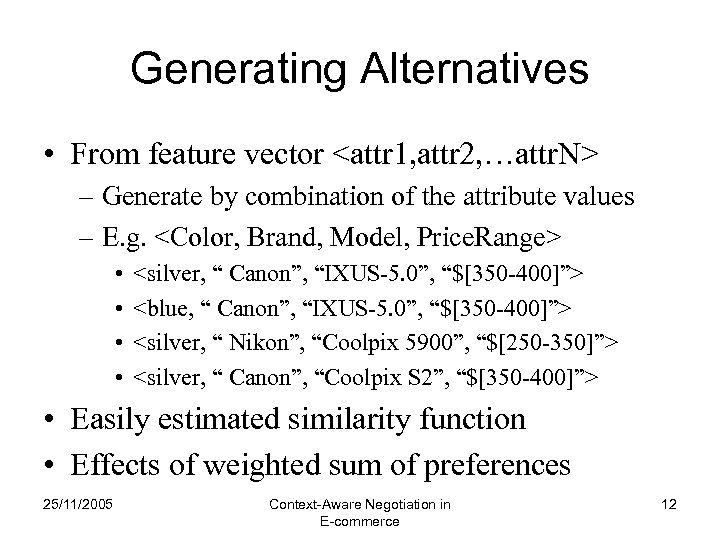
Generating Alternatives • From feature vector <attr 1, attr 2, …attr. N> – Generate by combination of the attribute values – E. g. <Color, Brand, Model, Price. Range> • • <silver, “ Canon”, “IXUS-5. 0”, “$[350 -400]”> <blue, “ Canon”, “IXUS-5. 0”, “$[350 -400]”> <silver, “ Nikon”, “Coolpix 5900”, “$[250 -350]”> <silver, “ Canon”, “Coolpix S 2”, “$[350 -400]”> • Easily estimated similarity function • Effects of weighted sum of preferences 25/11/2005 Context-Aware Negotiation in E-commerce 12
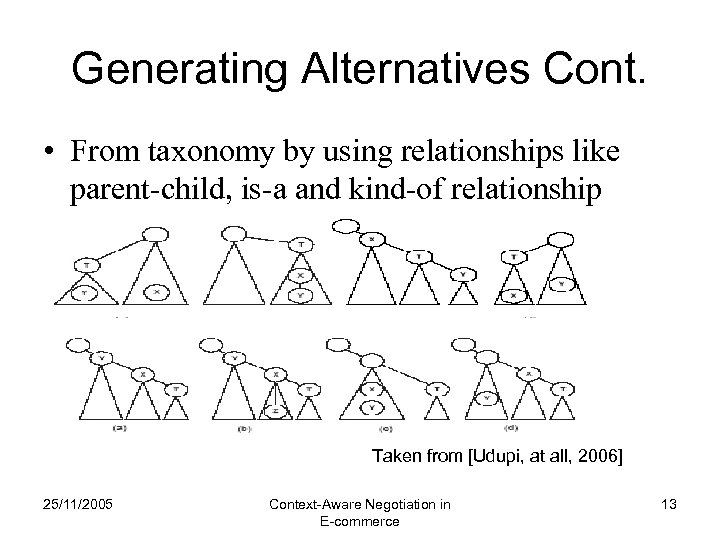
Generating Alternatives Cont. • From taxonomy by using relationships like parent-child, is-a and kind-of relationship Taken from [Udupi, at all, 2006] 25/11/2005 Context-Aware Negotiation in E-commerce 13
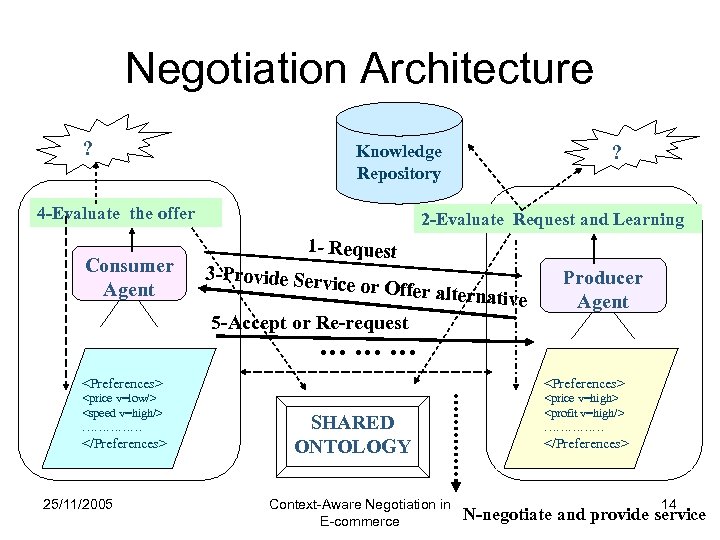
Negotiation Architecture ? Knowledge Repository 4 -Evaluate the offer Consumer Agent ? 2 -Evaluate Request and Learning 1 - Request 3 -Provide Ser vice or Offer a lternative 5 -Accept or Re-request Producer Agent ……… <Preferences> <price v=low/> <speed v=high/> …………… <price v=high> <profit v=high/> …………… </Preferences> 25/11/2005 SHARED ONTOLOGY Context-Aware Negotiation in E-commerce </Preferences> 14 N-negotiate and provide service
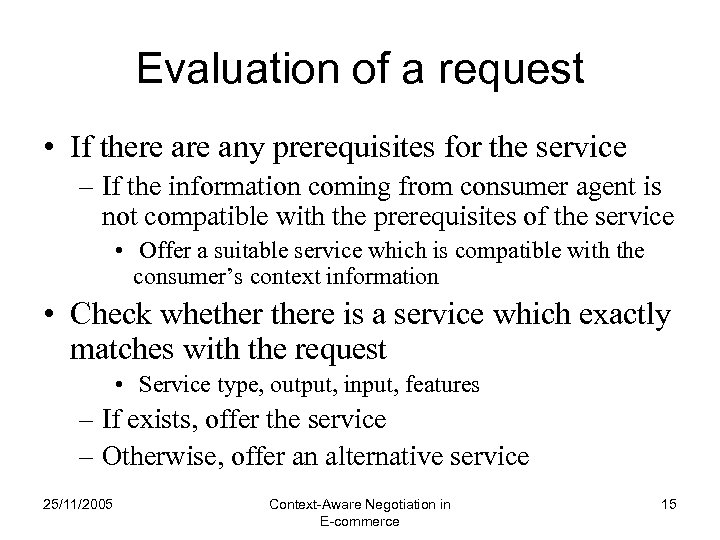
Evaluation of a request • If there any prerequisites for the service – If the information coming from consumer agent is not compatible with the prerequisites of the service • Offer a suitable service which is compatible with the consumer’s context information • Check whethere is a service which exactly matches with the request • Service type, output, input, features – If exists, offer the service – Otherwise, offer an alternative service 25/11/2005 Context-Aware Negotiation in E-commerce 15
![Matching Taken from [ Broens, 2004] 25/11/2005 Context-Aware Negotiation in E-commerce 16](https://present5.com/presentation/206eb4e05fa12588020b4c7a359411ca/image-16.jpg "Matching Taken from [ Broens, 2004] 25/11/2005 Context-Aware Negotiation in E-commerce 16")
Matching Taken from [ Broens, 2004] 25/11/2005 Context-Aware Negotiation in E-commerce 16
Offer Alternative • Which offer will be first? • A utility function which based on both producer’s and customer’s preferences – A weighted sum of preferences with the similarity value of the services – Estimate similarity of the feature vector of the service with the request • Hamming Distance or Manhattan Distance 25/11/2005 Context-Aware Negotiation in E-commerce 17
Offer Alternative Cont. • What are the producer preferences? – If two products have the same functionality • The expiration date? • The number of product affect the preference? – Consider Business Strategies • Customer preferences may not be known – Learn during the interaction • Version Space • Default Logic • Learned preferences will affect the order of the alternatives 25/11/2005 Context-Aware Negotiation in E-commerce 18
Inductive Learning • The goal of the consumer agent is not stable • The system should learn the best behavior • Inductive learning includes learning from example – Positive examples: Request of consumer agent – Negative examples: Counter offer not accepted • Version space 25/11/2005 Context-Aware Negotiation in E-commerce 19
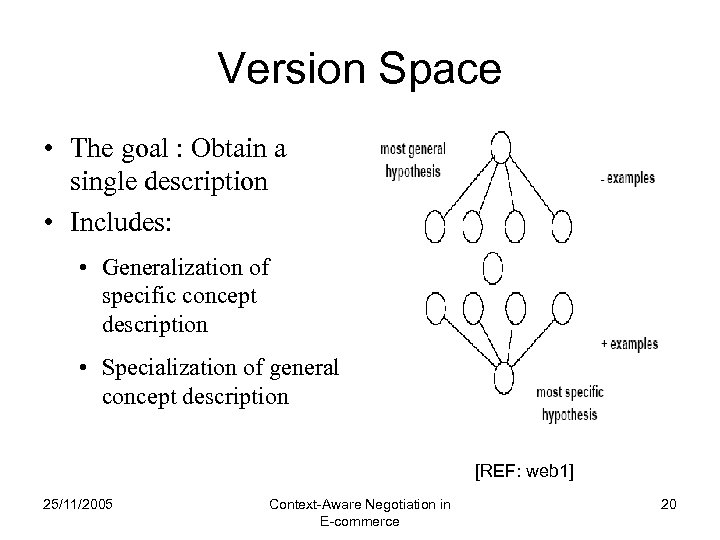
Version Space • The goal : Obtain a single description • Includes: • Generalization of specific concept description • Specialization of general concept description [REF: web 1] 25/11/2005 Context-Aware Negotiation in E-commerce 20
![Version Space Cont. Taken from [Mitchell , 1982 ] 25/11/2005 Context-Aware Negotiation in E-commerce](https://present5.com/presentation/206eb4e05fa12588020b4c7a359411ca/image-21.jpg "Version Space Cont. Taken from [Mitchell , 1982 ] 25/11/2005 Context-Aware Negotiation in E-commerce")
Version Space Cont. Taken from [Mitchell , 1982 ] 25/11/2005 Context-Aware Negotiation in E-commerce 21
![Version Space Cont. Taken from [Mitchell , 1982 ] 25/11/2005 Context-Aware Negotiation in E-commerce](https://present5.com/presentation/206eb4e05fa12588020b4c7a359411ca/image-22.jpg "Version Space Cont. Taken from [Mitchell , 1982 ] 25/11/2005 Context-Aware Negotiation in E-commerce")
Version Space Cont. Taken from [Mitchell , 1982 ] 25/11/2005 Context-Aware Negotiation in E-commerce 22
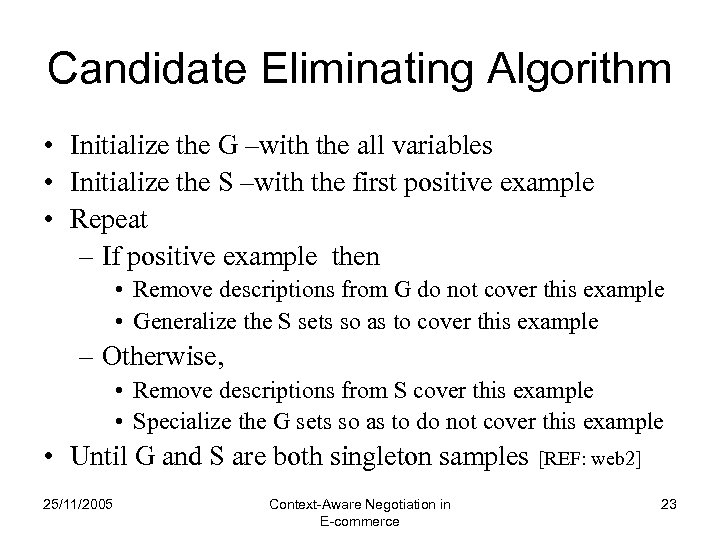
Candidate Eliminating Algorithm • Initialize the G –with the all variables • Initialize the S –with the first positive example • Repeat – If positive example then • Remove descriptions from G do not cover this example • Generalize the S sets so as to cover this example – Otherwise, • Remove descriptions from S cover this example • Specialize the G sets so as to do not cover this example • Until G and S are both singleton samples [REF: web 2] 25/11/2005 Context-Aware Negotiation in E-commerce 23
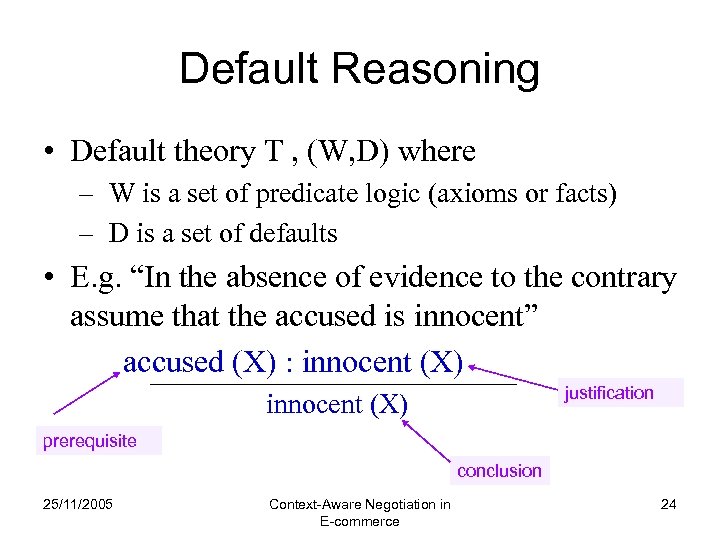
Default Reasoning • Default theory T , (W, D) where – W is a set of predicate logic (axioms or facts) – D is a set of defaults • E. g. “In the absence of evidence to the contrary assume that the accused is innocent” accused (X) : innocent (X) justification innocent (X) prerequisite conclusion 25/11/2005 Context-Aware Negotiation in E-commerce 24
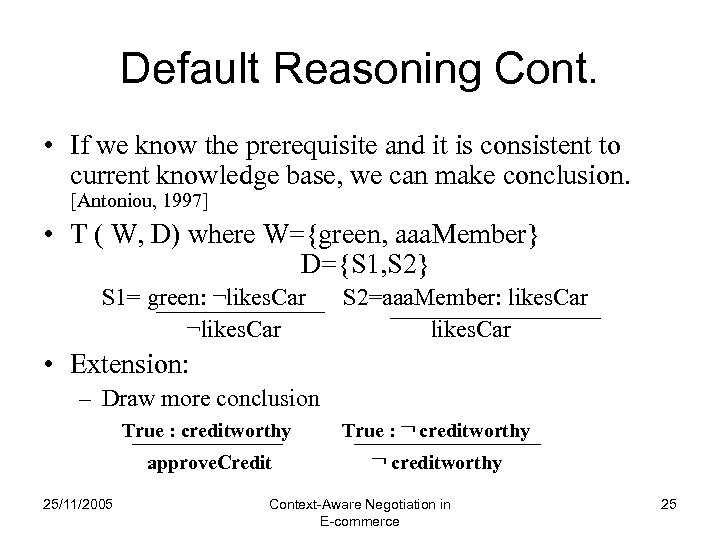
Default Reasoning Cont. • If we know the prerequisite and it is consistent to current knowledge base, we can make conclusion. [Antoniou, 1997] • T ( W, D) where W={green, aaa. Member} D={S 1, S 2} S 1= green: ¬likes. Car S 2=aaa. Member: likes. Car • Extension: – Draw more conclusion True : creditworthy approve. Credit 25/11/2005 True : ¬ creditworthy Context-Aware Negotiation in E-commerce 25
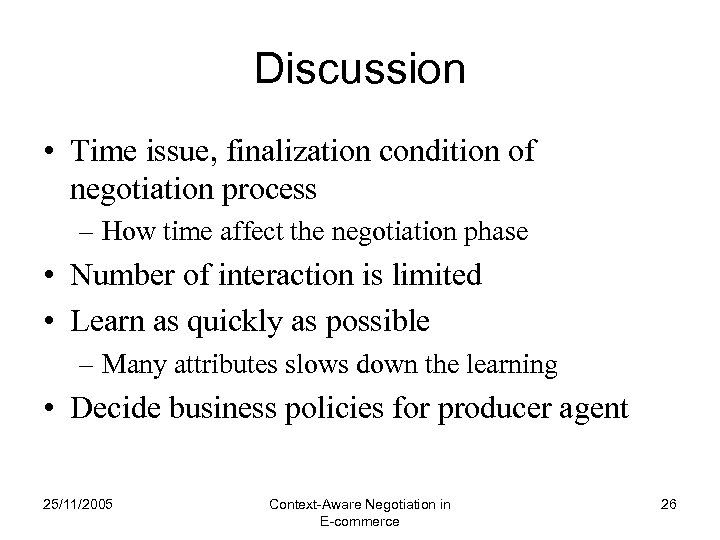
Discussion • Time issue, finalization condition of negotiation process – How time affect the negotiation phase • Number of interaction is limited • Learn as quickly as possible – Many attributes slows down the learning • Decide business policies for producer agent 25/11/2005 Context-Aware Negotiation in E-commerce 26
References Udupi, Y. B. and Singh, M. P. , “Multidimensional Service Matching and Selection ”, AAMAS’ 06, May 8 -12, Japan, 2006 Broens , T. Context-aware, Ontology based, Semantic Service Discovery (2004). Master thesis, University of Twente, the Netherlands USA. Fensel D. , J. Hendler, H. Lieberman and W. Wahlster. Spinning the Semantic Web. The MIT Press, Cambridge, Massachusetts, London, England. 2003. Lei Li and Ian Horrocks. A software framework for matchmaking based on Semantic web technology. In Proceedings of the Twelfth International World Wide Web Conference (WWW 2003), 2003 25/11/2005 Context-Aware Negotiation in E-commerce 27
References Cont. J. K. Debenham. ‘Managing e-Market Negotiation in Context with a Multiagent System’. In: Proceedings. Twenty First International. Conference on Knowledge Based Systems and Applied Artificial Intelligence, ES’ 2002: Applications and Innovations in Expert Systems X, Cambridge UK, December 2002. Antoniou, G. 1997. Nonmonotonic Reasoning. MIT Press, Cambridge, Massachusetts, London, England. 1997 Mitchell, TM. Generalization as search. Artificial Intelligence, 18: 203 --226, 1982 [Ref: web 1] http: //www. cs. cornell. edu/courses/CS 472/ 2004 fa/Materials/2004/8 version-space 4 up. pdf [Ref: web 2] http: //www. cs. cf. ac. uk/Dave/AI 2/node 146. html#SECTION 00016120000000 25/11/2005 Context-Aware Negotiation in E-commerce 28
Скачать презентацию Context-Aware Negotiation in E-commerce Reyhan AYDOĞAN reyhan aydogan boun
206eb4e05fa12588020b4c7a359411ca.ppt