


 Скачать презентацию CONTENTS 14 -1 Noun clauses introduction 14 -2
24393b5a612bf9b961f81d7e6cff4854.ppt
- Количество слайдов: 82
 CONTENTS 14 -1 Noun clauses: introduction 14 -2 Noun clauses that begin with a question word 14 -3 Noun clauses with who, what, whose + be 14 -4 Noun clauses that begin with if or whether 14 -5 Noun clauses that begin with that 14 -6 Other uses of that-clauses 14 -7 Substituting so for a that-clause in conversational. . . 14 -8 Quoted speech 14 -9 Quoted speech vs. reported speech 14 -10 Verb forms in quoted speech 14 -11 Common reporting verbs: tell, ask, answer/reply 1
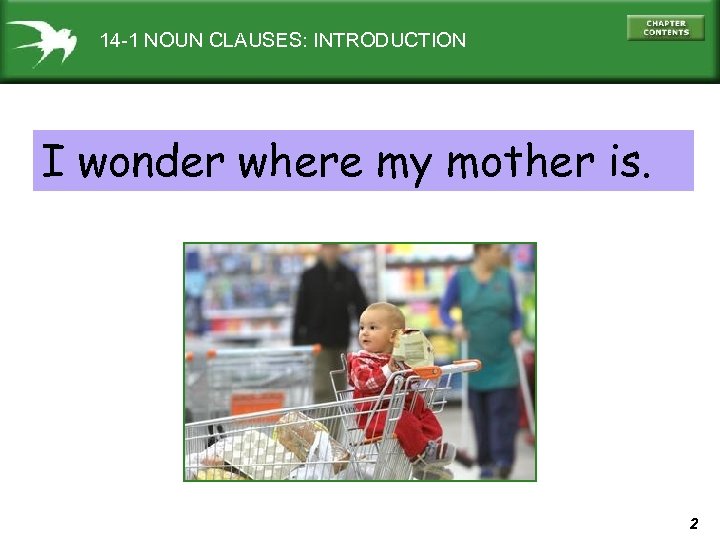 14 -1 NOUN CLAUSES: INTRODUCTION I wonder where my mother is. 2
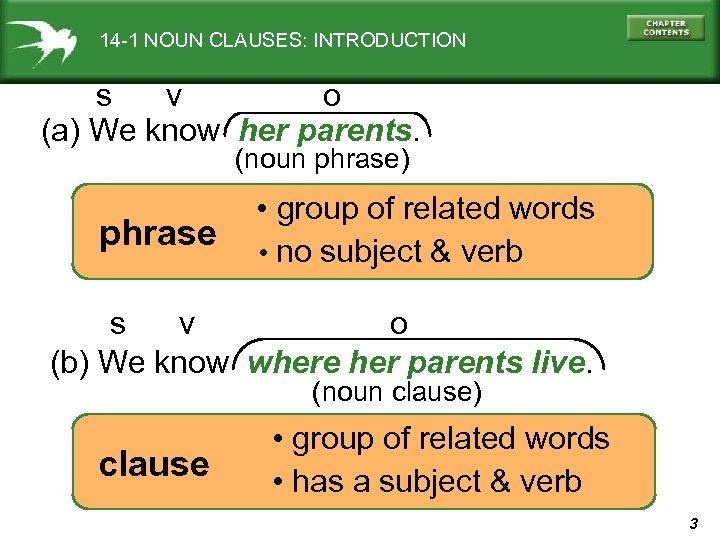 14 -1 NOUN CLAUSES: INTRODUCTION s v o (a) We know her parents. (noun phrase) phrase • group of related words • no subject & verb s v o (b) We know where her parents live. (noun clause) clause • group of related words • has a subject & verb 3
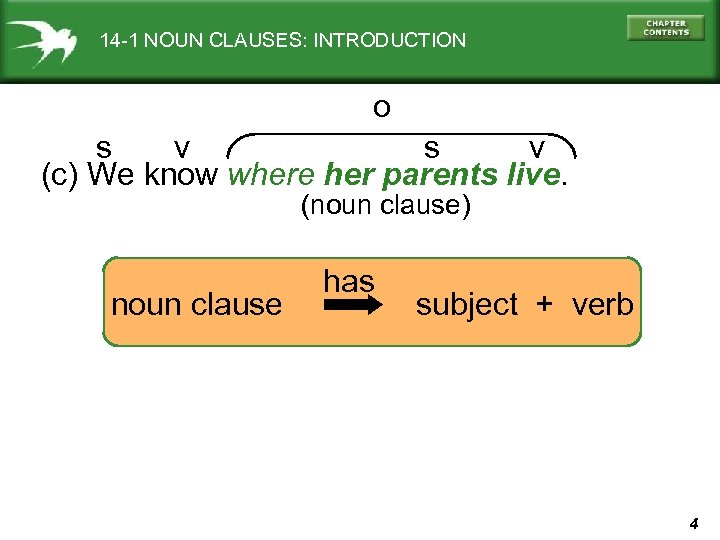 14 -1 NOUN CLAUSES: INTRODUCTION o s v (c) We know where her parents live. (noun clause) noun clause has subject + verb 4
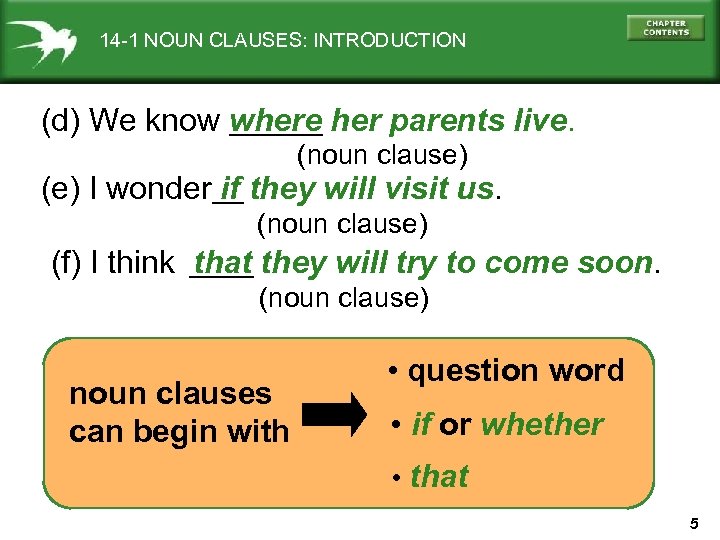 14 -1 NOUN CLAUSES: INTRODUCTION (d) We know where her parents live. (noun clause) (e) I wonder if they will visit us. (noun clause) (f) I think that they will try to come soon. (noun clause) noun clauses can begin with • question word • if or whether • that 5
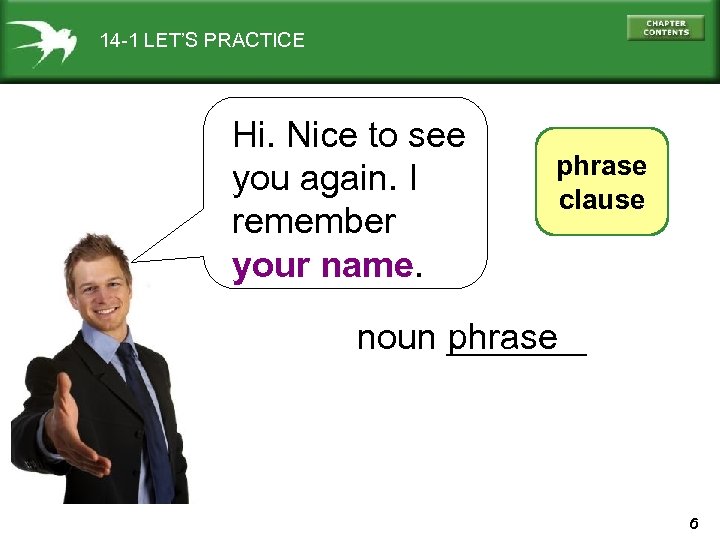 14 -1 LET’S PRACTICE Hi. Nice to see you again. I remember your name. phrase clause phrase noun _______ 6
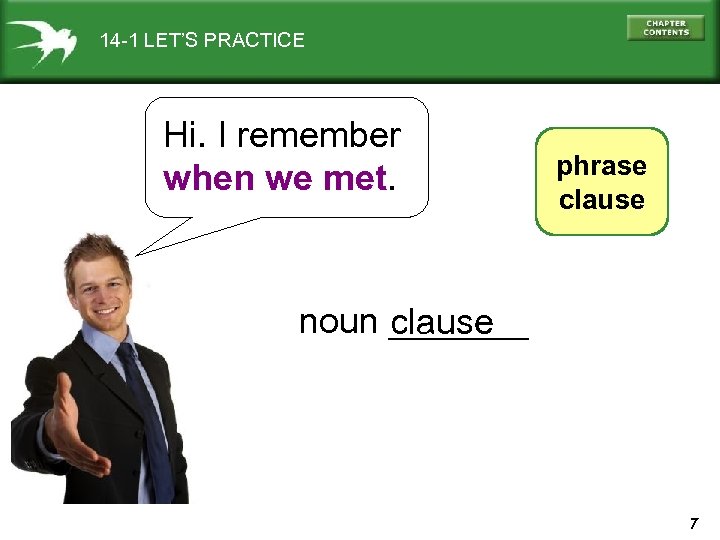 14 -1 LET’S PRACTICE Hi. I remember when we met. phrase clause noun _______ clause 7
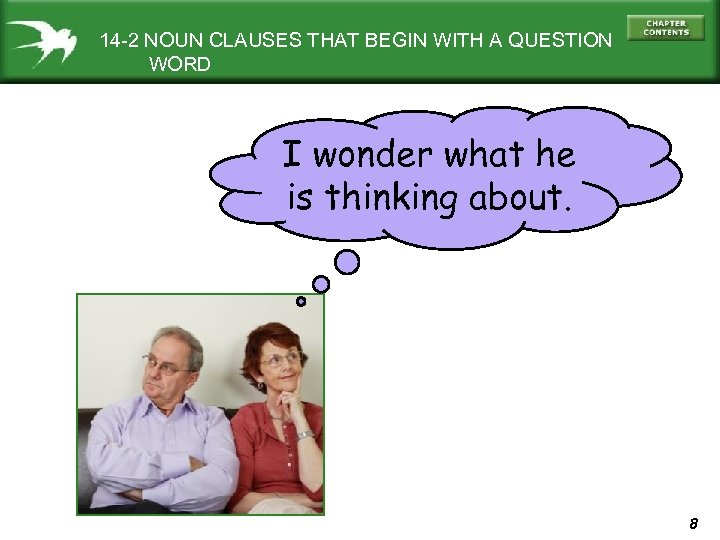 14 -2 NOUN CLAUSES THAT BEGIN WITH A QUESTION WORD I wonder what he is thinking about. 8
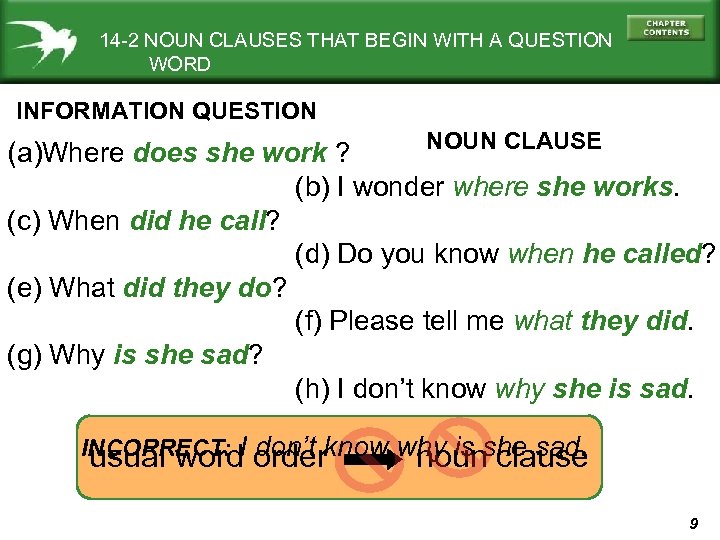 14 -2 NOUN CLAUSES THAT BEGIN WITH A QUESTION WORD INFORMATION QUESTION NOUN CLAUSE (a)Where does she work ? (b) I wonder where she works. (c) When did he call? (d) Do you know when he called? (e) What did they do? (f) Please tell me what they did. (g) Why is she sad? (h) I don’t know why she is sad. INCORRECT: I orderknow why is she sad. usual word don’t noun clause 9
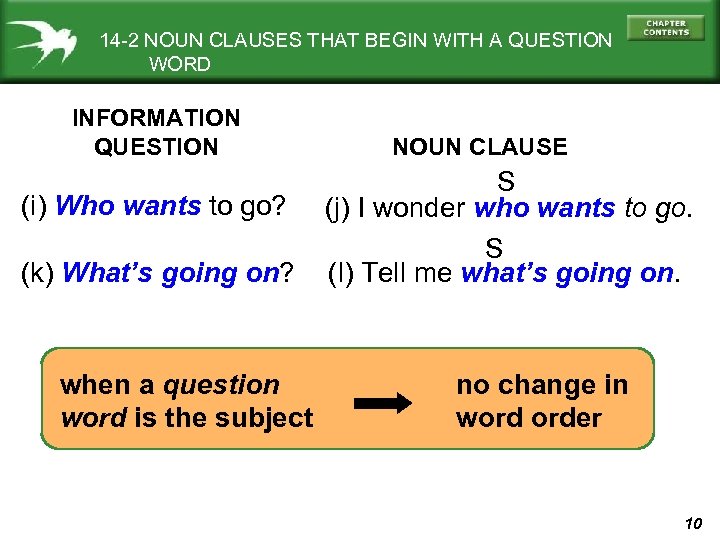 14 -2 NOUN CLAUSES THAT BEGIN WITH A QUESTION WORD INFORMATION QUESTION (i) Who wants to go? (k) What’s going on? when a question word is the subject NOUN CLAUSE S (j) I wonder who wants to go. S (l) Tell me what’s going on. no change in word order 10
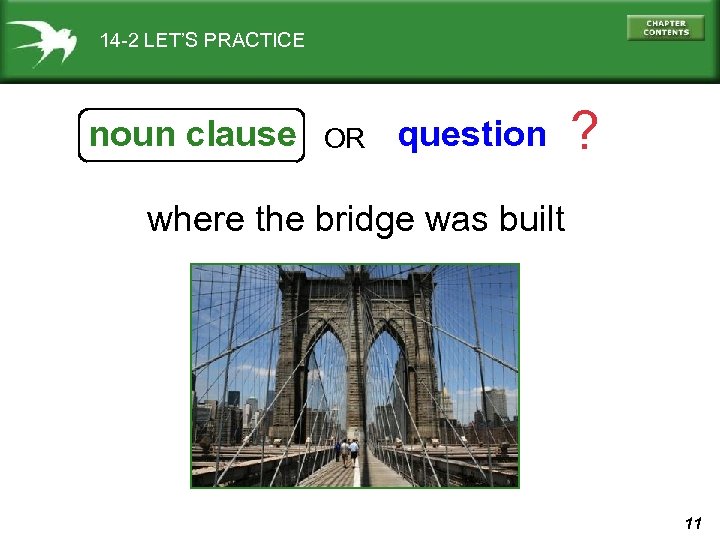 14 -2 LET’S PRACTICE noun clause OR question ? where the bridge was built 11
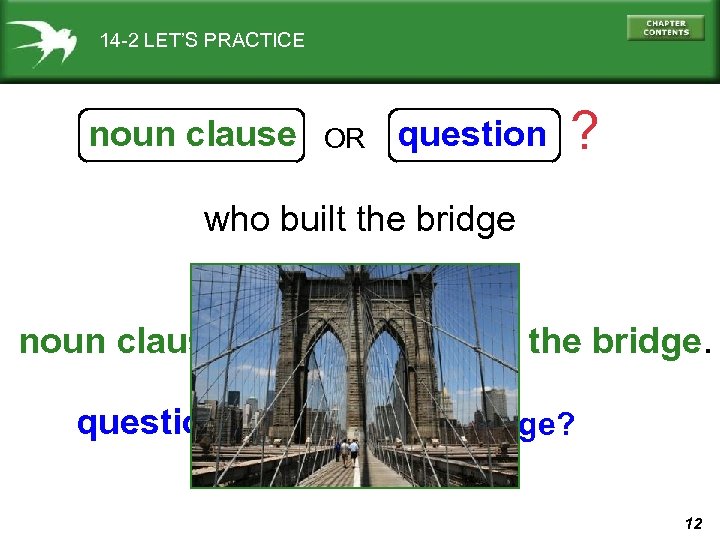 14 -2 LET’S PRACTICE noun clause OR question ? who built the bridge noun clause: I know who built the bridge. question: Who built the bridge? 12
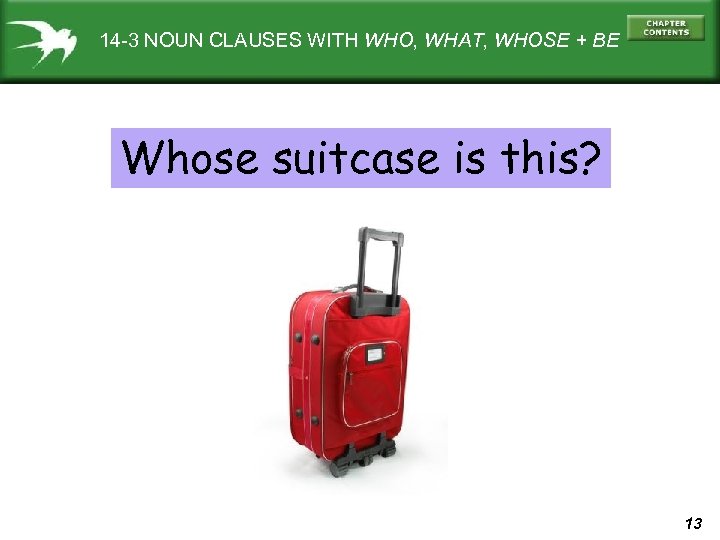 14 -3 NOUN CLAUSES WITH WHO, WHAT, WHOSE + BE Whose suitcase is this? 13
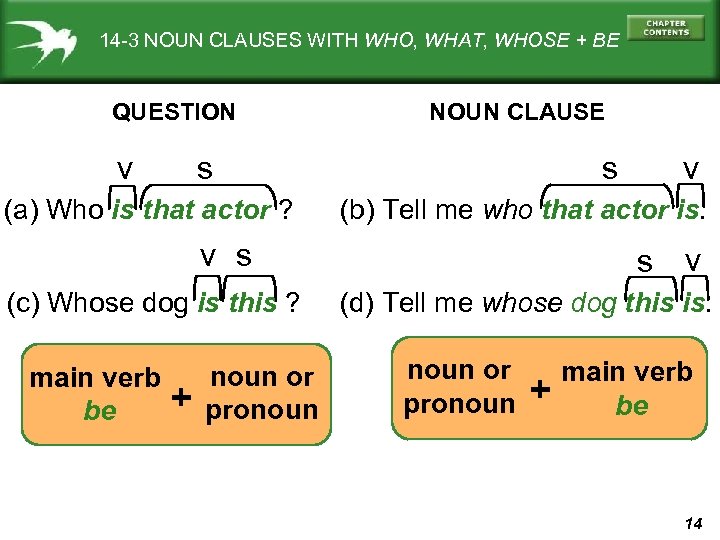 14 -3 NOUN CLAUSES WITH WHO, WHAT, WHOSE + BE QUESTION v NOUN CLAUSE s (a) Who is that actor ? s (b) Tell me who that actor is. v s (c) Whose dog is this ? main verb be + noun or pronoun v s v (d) Tell me whose dog this is. noun or pronoun + main verb be 14
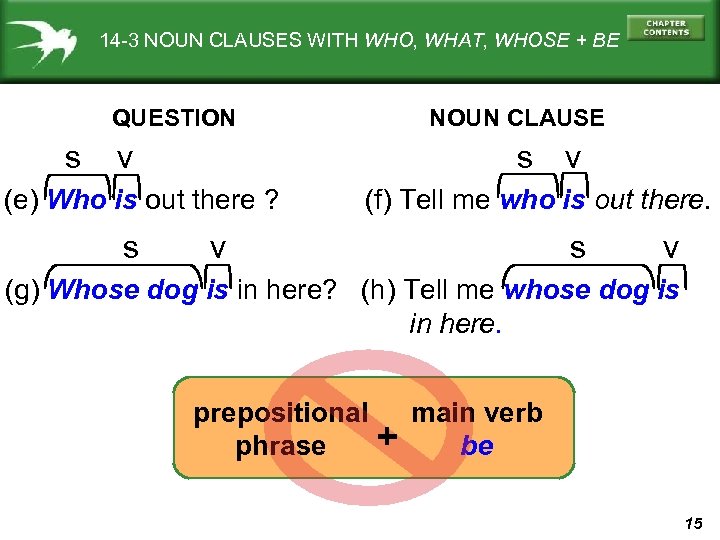 14 -3 NOUN CLAUSES WITH WHO, WHAT, WHOSE + BE QUESTION s v s (e) Who is out there ? s NOUN CLAUSE v (f) Tell me who is out there. v s v (g) Whose dog is in here? (h) Tell me whose dog is in here. prepositional main verb + phrase be 15
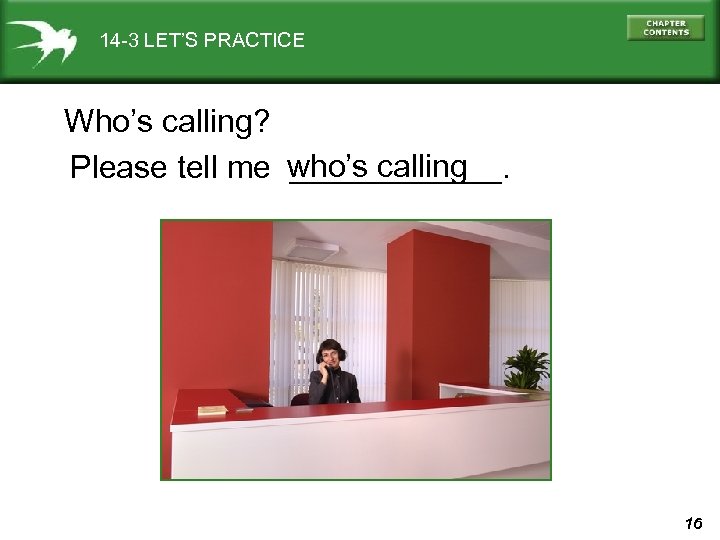 14 -3 LET’S PRACTICE Who’s calling? Please tell me who’s calling ______. 16
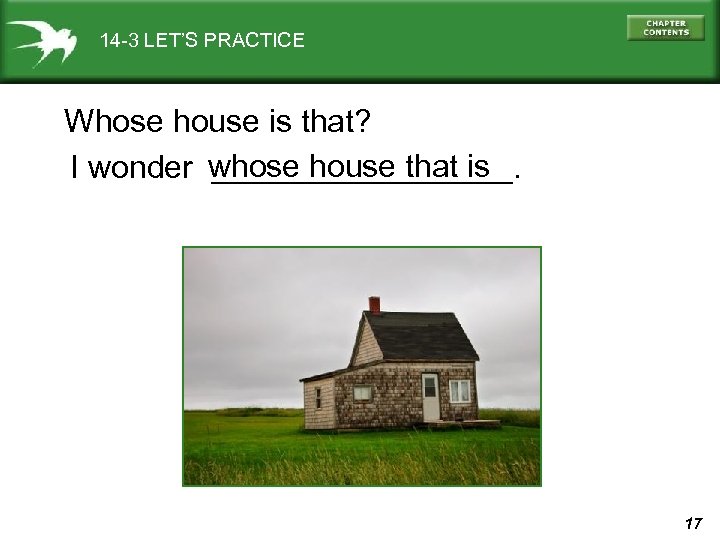 14 -3 LET’S PRACTICE Whose house is that? I wonder whose house that is _________. 17
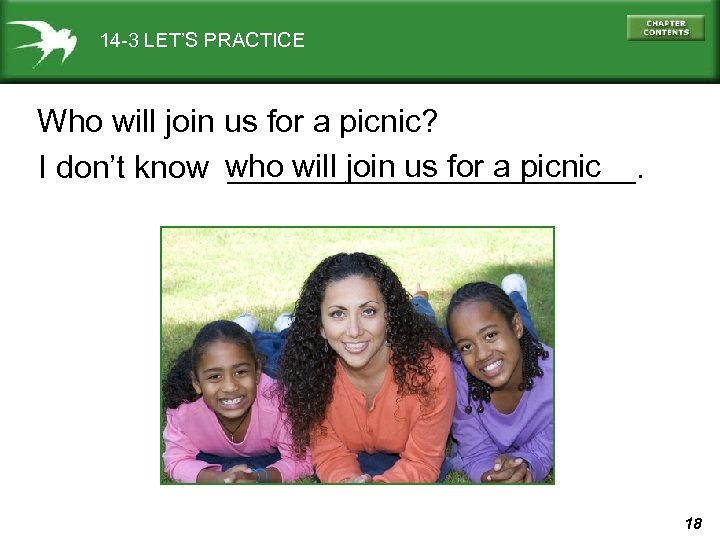 14 -3 LET’S PRACTICE Who will join us for a picnic? I don’t know who will join us for a picnic ____________. 18
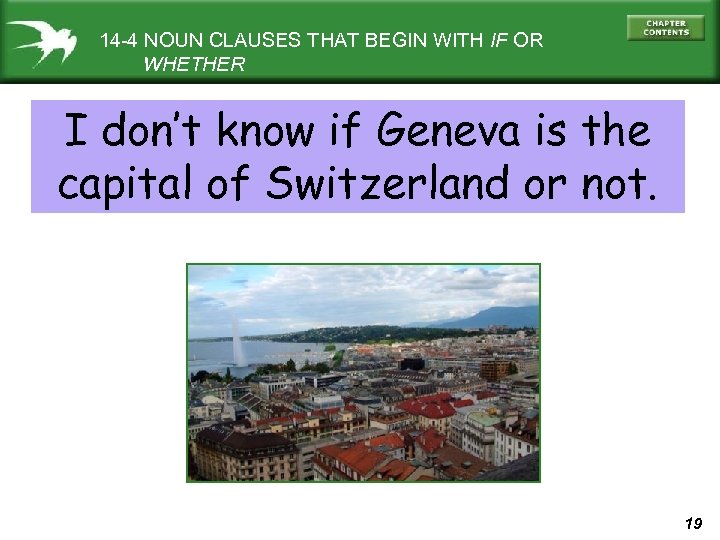 14 -4 NOUN CLAUSES THAT BEGIN WITH IF OR WHETHER I don’t know if Geneva is the capital of Switzerland or not. 19
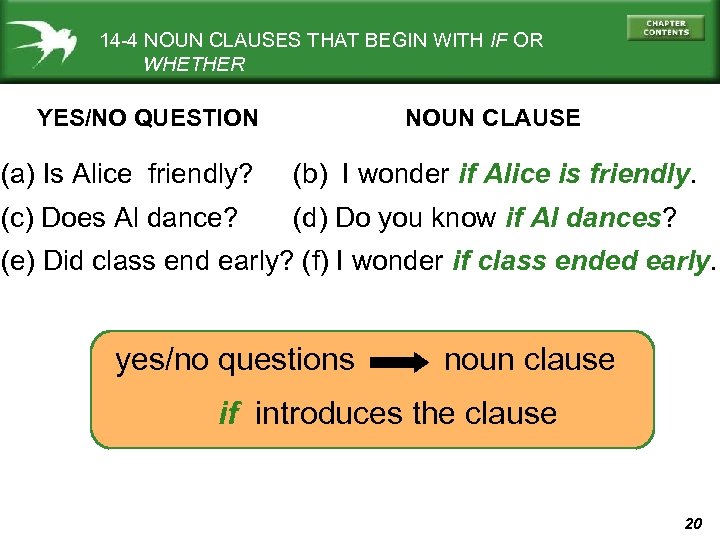 14 -4 NOUN CLAUSES THAT BEGIN WITH IF OR WHETHER YES/NO QUESTION NOUN CLAUSE (a) Is Alice friendly? (b) I wonder if Alice is friendly. (c) Does Al dance? (d) Do you know if Al dances? (e) Did class end early? (f) I wonder if class ended early. yes/no questions noun clause if introduces the clause 20
 14 -4 NOUN CLAUSES THAT BEGIN WITH IF OR WHETHER (g) I don’t know if class ended early or not. if + clause + or not 21
 14 -4 NOUN CLAUSES THAT BEGIN WITH IF OR WHETHER (g) I don’t know if class ended early or not. (h) I don’t know whether class ended early or not. if = whether 22
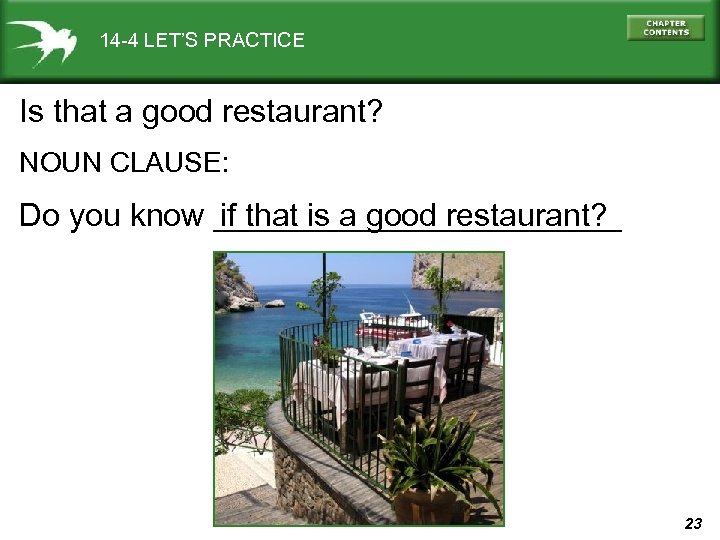 14 -4 LET’S PRACTICE Is that a good restaurant? NOUN CLAUSE: Do you know ____________ if that is a good restaurant? 23
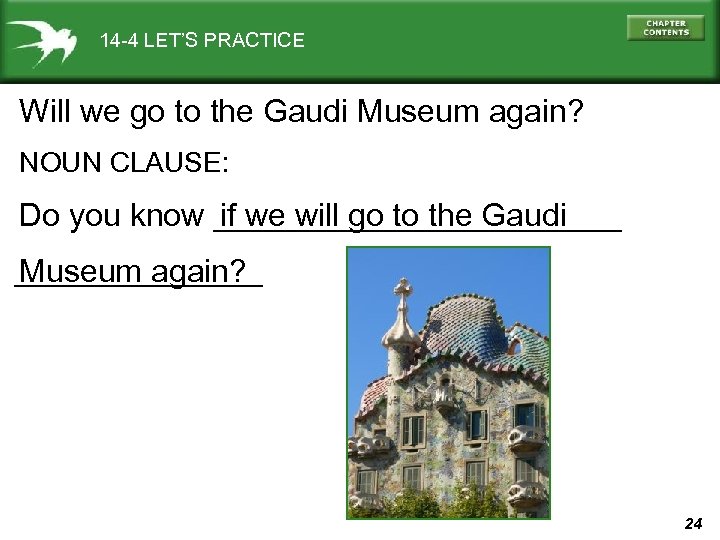 14 -4 LET’S PRACTICE Will we go to the Gaudi Museum again? NOUN CLAUSE: Do you know ____________ if we will go to the Gaudi _______ Museum again? 24
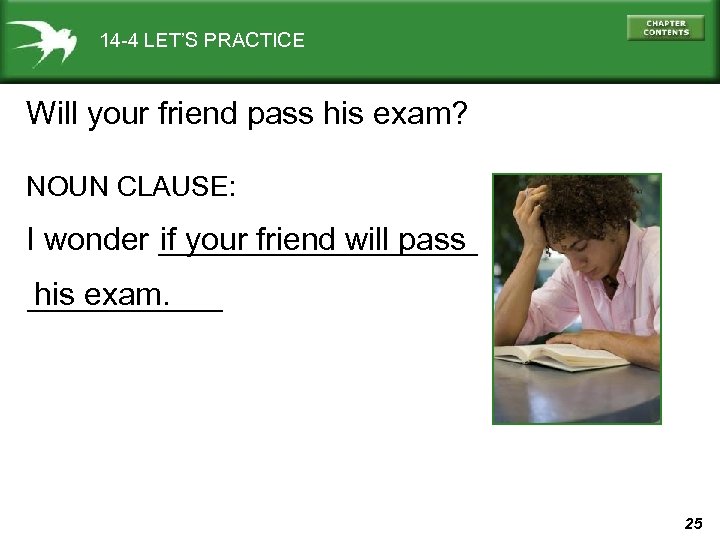 14 -4 LET’S PRACTICE Will your friend pass his exam? NOUN CLAUSE: I wonder _________ if your friend will pass his exam. ______ 25
 14 -5 NOUN CLAUSES THAT BEGIN WITH THAT I was sad when I found out that my friend was ill. 26
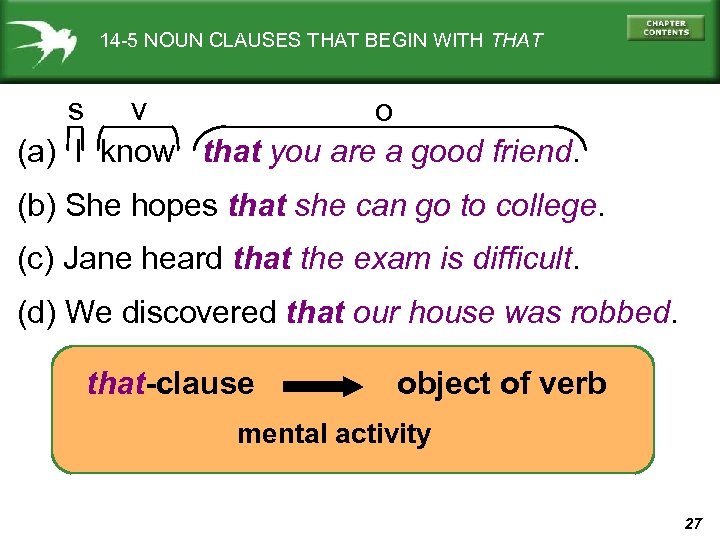 14 -5 NOUN CLAUSES THAT BEGIN WITH THAT s v o (a) I know that you are a good friend. (b) She hopes that she can go to college. (c) Jane heard that the exam is difficult. (d) We discovered that our house was robbed. that-clause object of verb mental activity 27
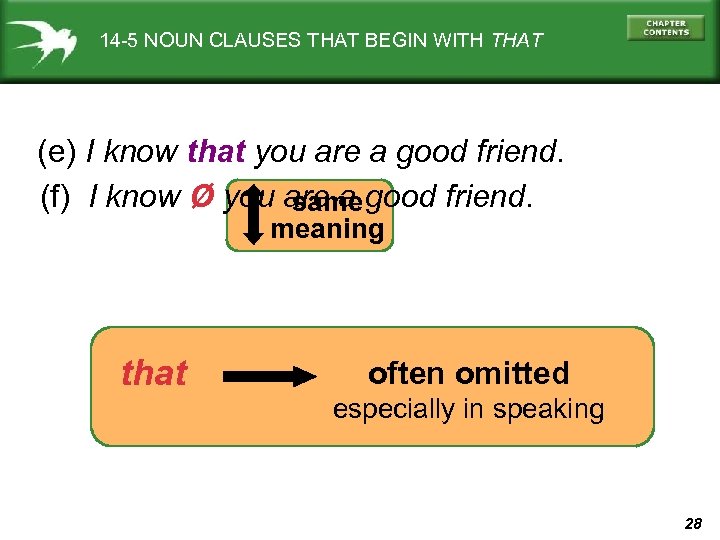 14 -5 NOUN CLAUSES THAT BEGIN WITH THAT (e) I know that you are a good friend. (f) I know Ø you are a good friend. same meaning that often omitted especially in speaking 28
 14 -5 LET’S PRACTICE CORRECT OR INCORRECT ? I hope that you can come to dinner tomorrow. 29
 14 -5 LET’S PRACTICE CORRECT OR INCORRECT ? I hope you can come to dinner tomorrow. 30
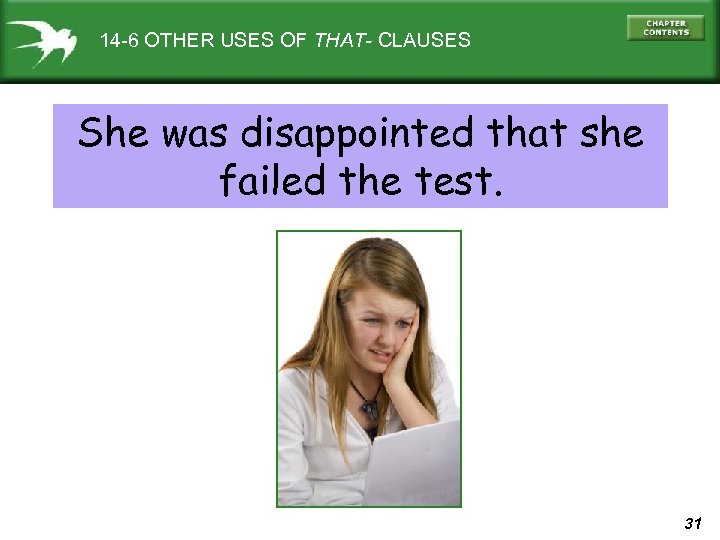 14 -6 OTHER USES OF THAT- CLAUSES She was disappointed that she failed the test. 31
 14 -6 OTHER USES OF THAT- CLAUSES (a) I’m certain that you will like this class. (b) I’m happy that you joined us. (c) You are fortunate that the weather was good. (d) She was surprised that he proposed. certain expressions: be + adjective OR be + past participle + that-clause 32
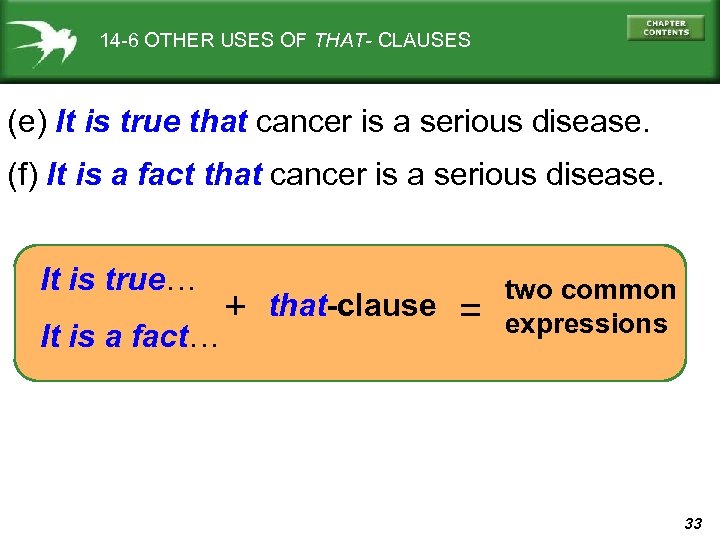 14 -6 OTHER USES OF THAT- CLAUSES (e) It is true that cancer is a serious disease. (f) It is a fact that cancer is a serious disease. It is true… It is a fact… + that-clause = two common expressions 33
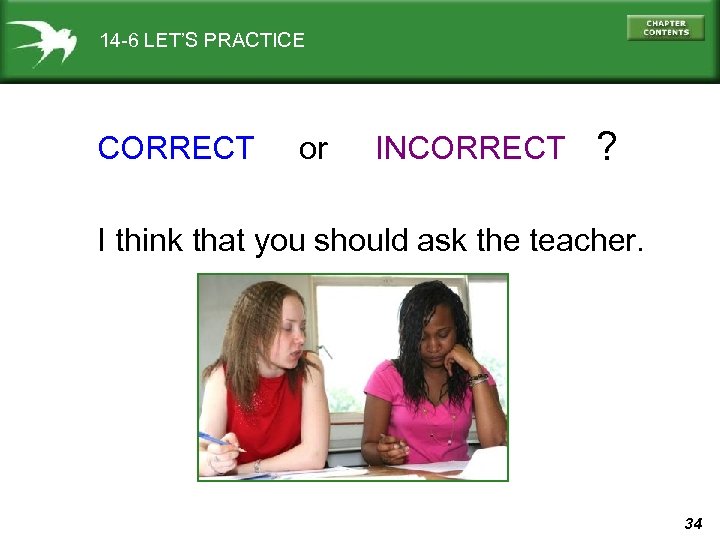 14 -6 LET’S PRACTICE CORRECT or INCORRECT ? I think that you should ask the teacher. 34
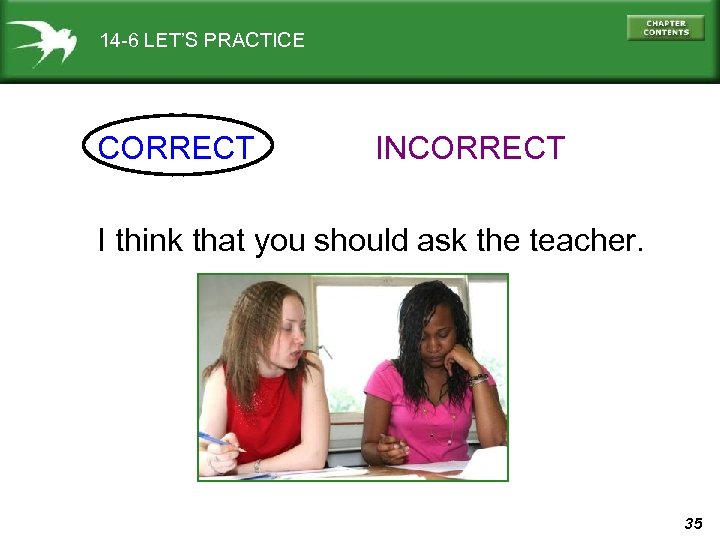 14 -6 LET’S PRACTICE CORRECT INCORRECT I think that you should ask the teacher. 35
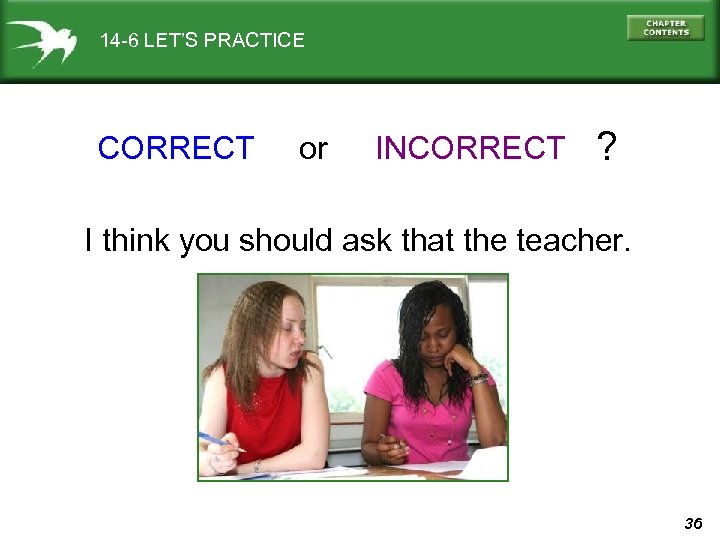 14 -6 LET’S PRACTICE CORRECT or INCORRECT ? I think you should ask that the teacher. 36
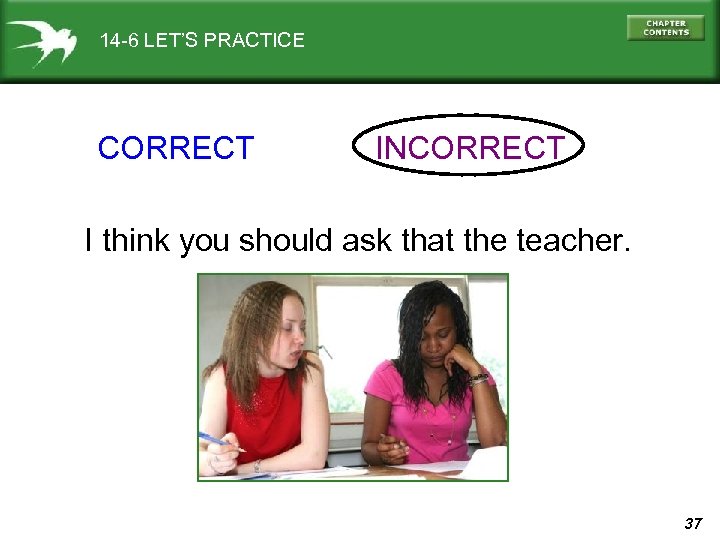 14 -6 LET’S PRACTICE CORRECT INCORRECT I think you should ask that the teacher. 37
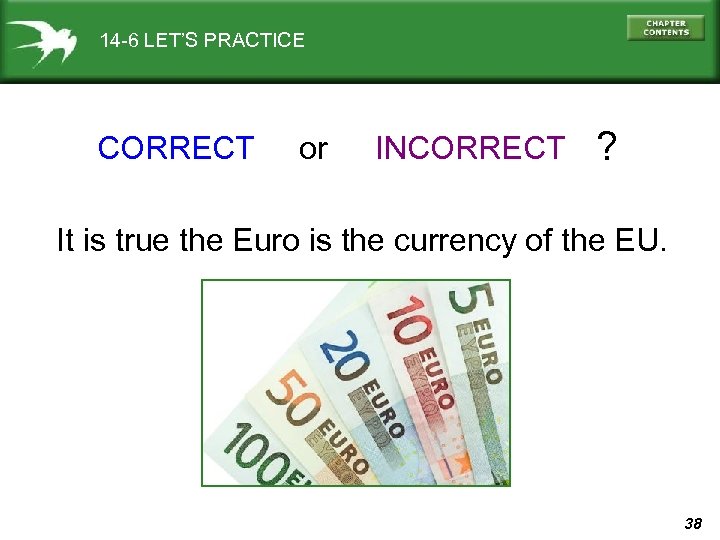 14 -6 LET’S PRACTICE CORRECT or INCORRECT ? It is true the Euro is the currency of the EU. 38
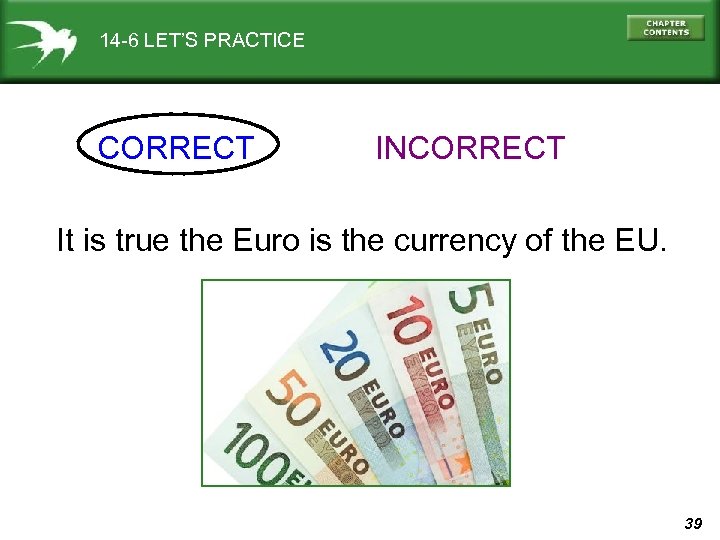 14 -6 LET’S PRACTICE CORRECT INCORRECT It is true the Euro is the currency of the EU. 39
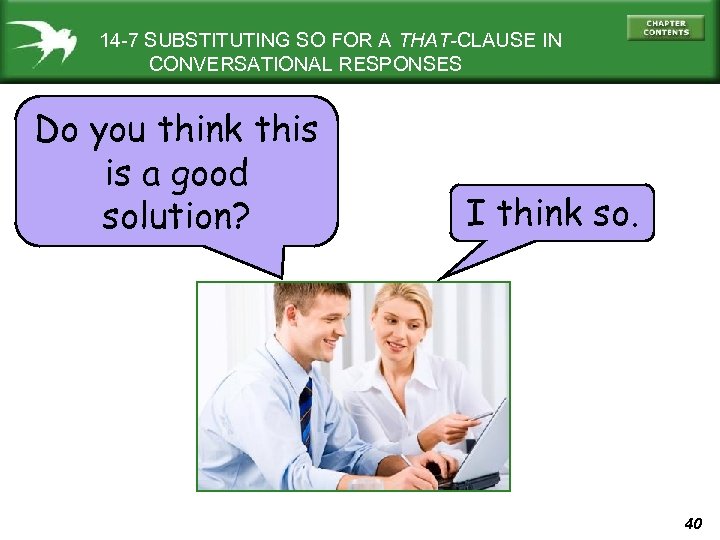 14 -7 SUBSTITUTING SO FOR A THAT-CLAUSE IN CONVERSATIONAL RESPONSES Do you think this is a good solution? I think so. 40
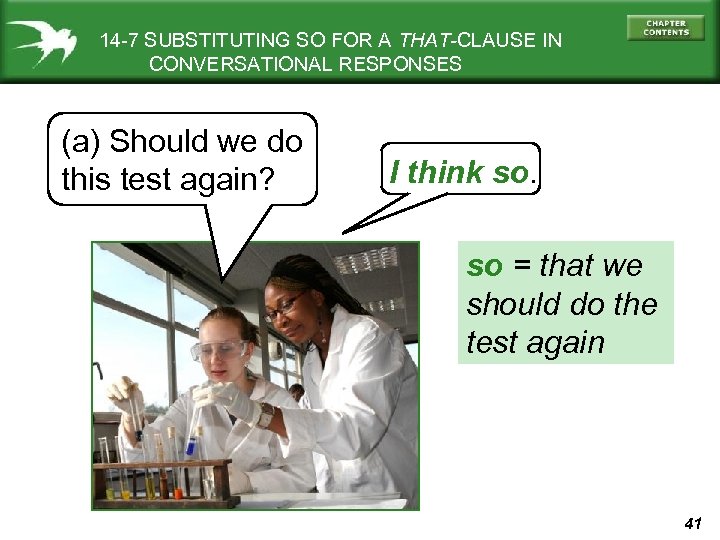 14 -7 SUBSTITUTING SO FOR A THAT-CLAUSE IN CONVERSATIONAL RESPONSES (a) Should we do this test again? I think so. so = that we should do the test again 41
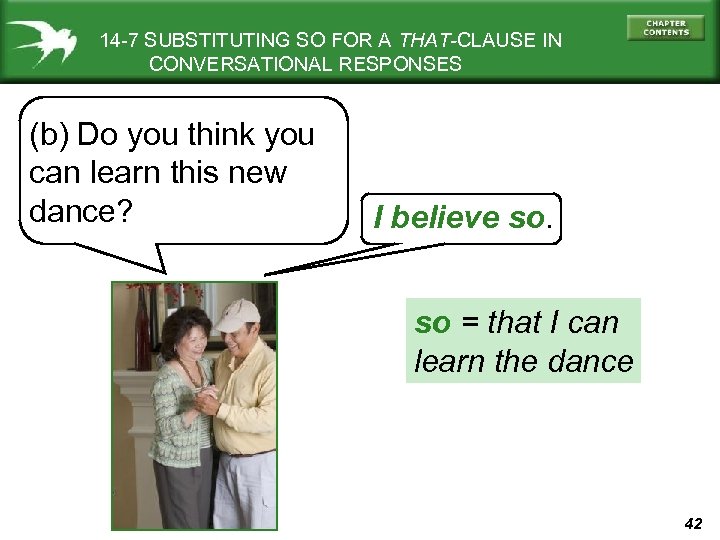 14 -7 SUBSTITUTING SO FOR A THAT-CLAUSE IN CONVERSATIONAL RESPONSES (b) Do you think you can learn this new dance? I believe so. so = that I can learn the dance 42
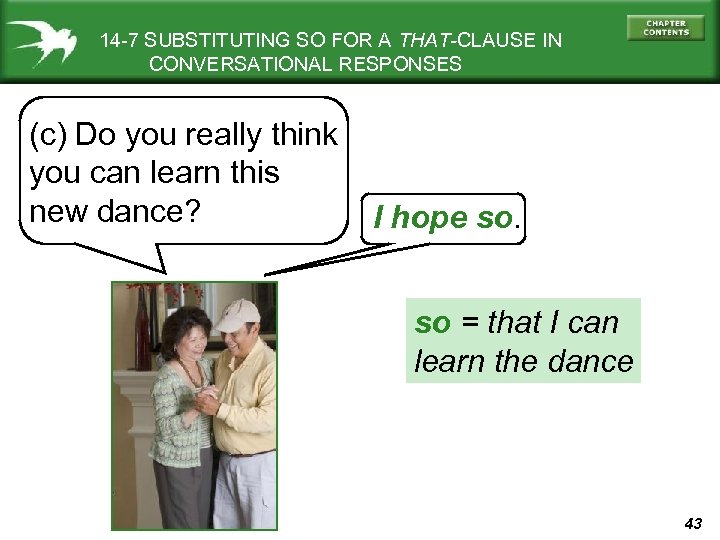 14 -7 SUBSTITUTING SO FOR A THAT-CLAUSE IN CONVERSATIONAL RESPONSES (c) Do you really think you can learn this new dance? I hope so. so = that I can learn the dance 43
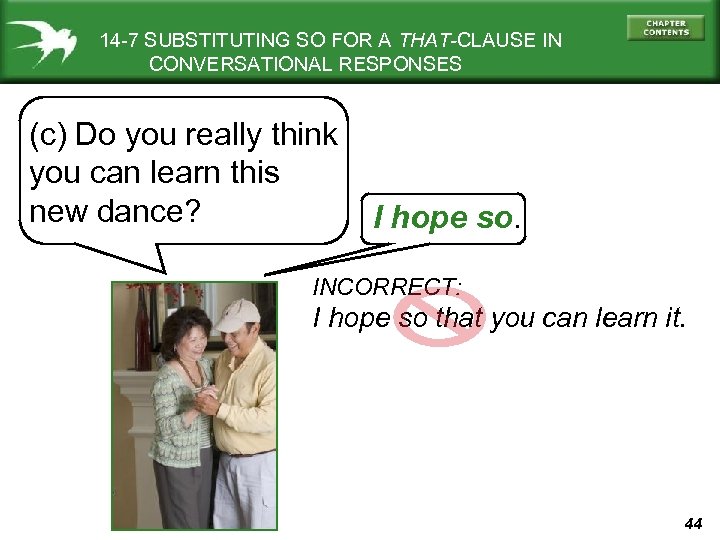 14 -7 SUBSTITUTING SO FOR A THAT-CLAUSE IN CONVERSATIONAL RESPONSES (c) Do you really think you can learn this new dance? I hope so. INCORRECT: I hope so that you can learn it. 44
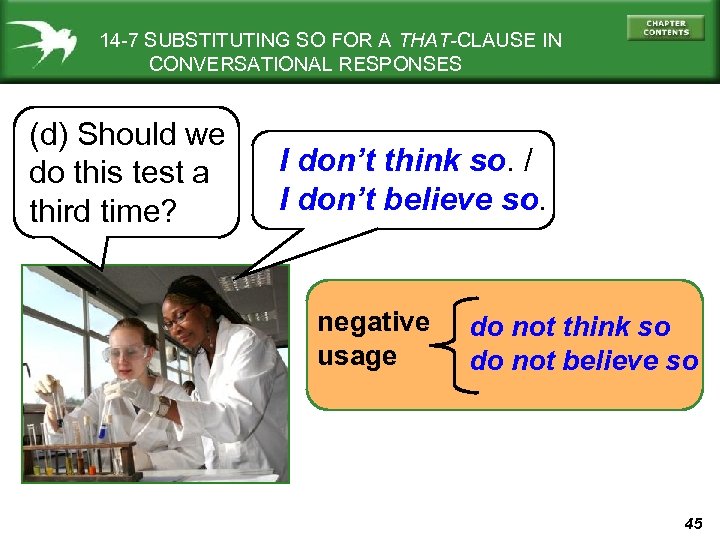 14 -7 SUBSTITUTING SO FOR A THAT-CLAUSE IN CONVERSATIONAL RESPONSES (d) Should we do this test a third time? I don’t think so. / I don’t believe so. negative usage do not think so do not believe so 45
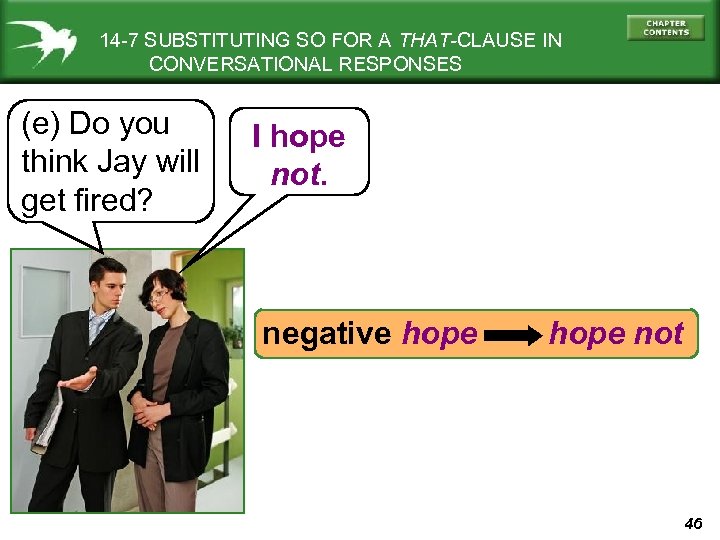 14 -7 SUBSTITUTING SO FOR A THAT-CLAUSE IN CONVERSATIONAL RESPONSES (e) Do you think Jay will get fired? I hope not. negative hope not 46
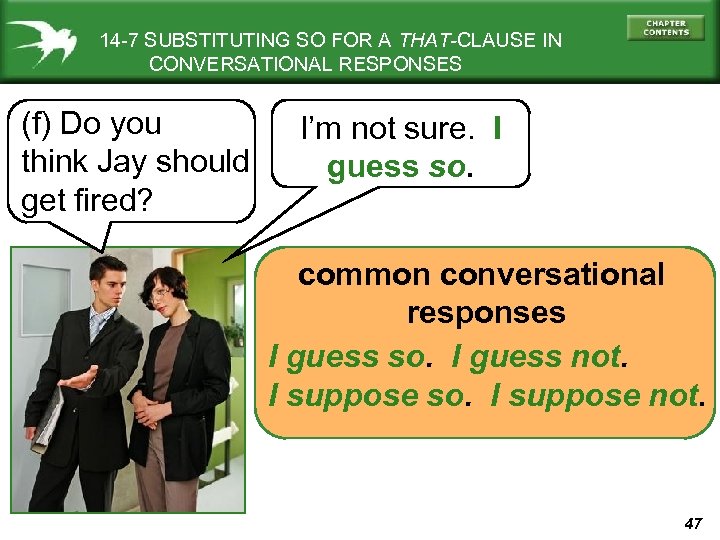 14 -7 SUBSTITUTING SO FOR A THAT-CLAUSE IN CONVERSATIONAL RESPONSES (f) Do you think Jay should get fired? I’m not sure. I guess so. common conversational responses I guess so. I guess not. I suppose so. I suppose not. 47
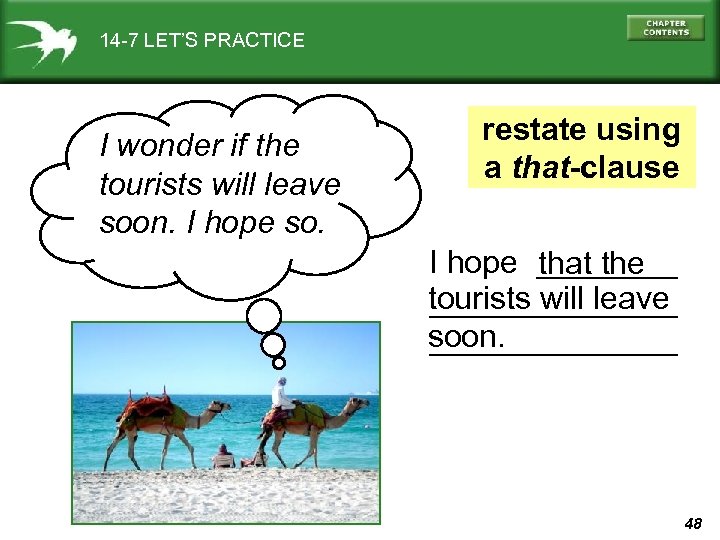 14 -7 LET’S PRACTICE I wonder if the tourists will leave soon. I hope so. restate using a that-clause I hope ____ that the tourists will leave _______ soon. _______ 48
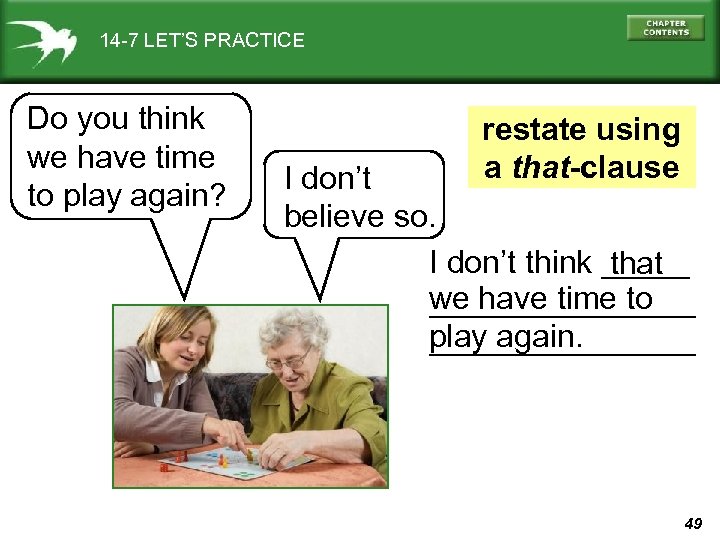 14 -7 LET’S PRACTICE Do you think we have time to play again? restate using a that-clause I don’t believe so. I don’t think _____ that we have time to ________ play again. ________ 49
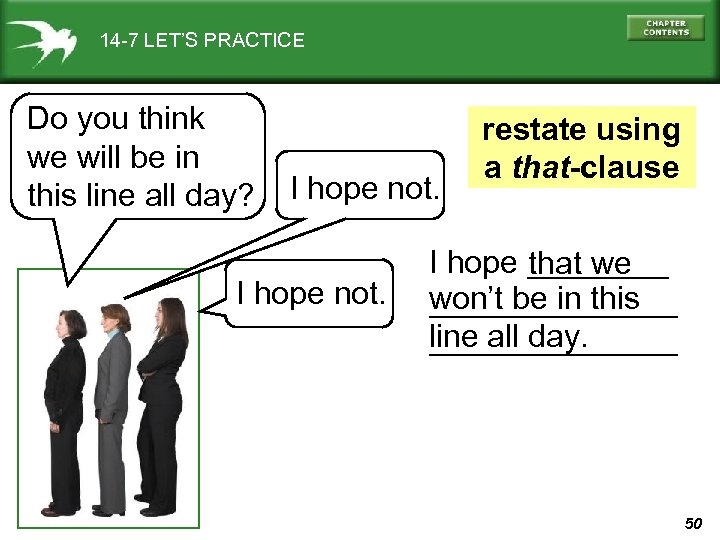 14 -7 LET’S PRACTICE Do you think we will be in this line all day? I hope not. restate using a that-clause I hope ____ that we won’t be in this _______ line all day. _______ 50
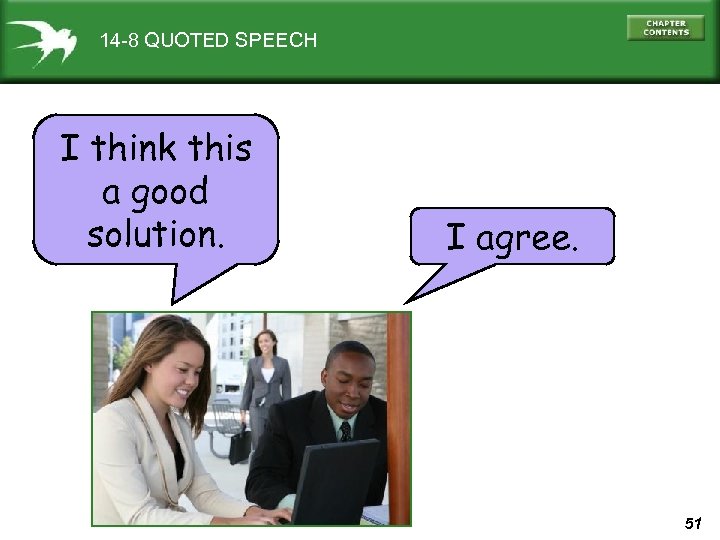 14 -8 QUOTED SPEECH I think this a good solution. I agree. 51
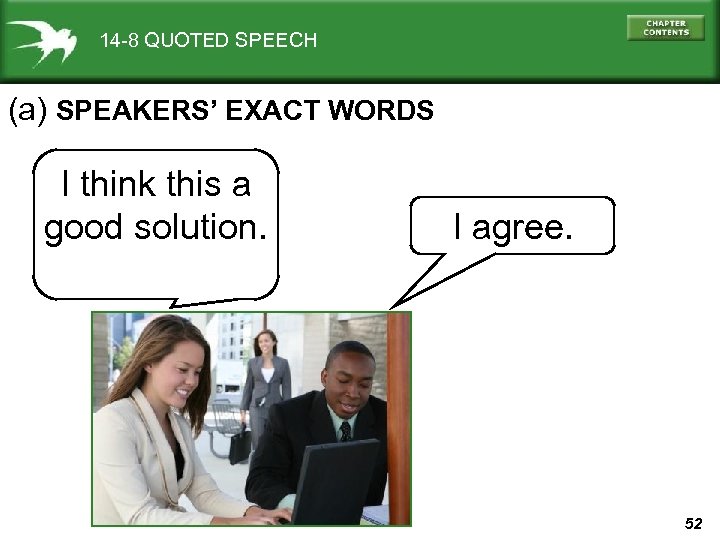 14 -8 QUOTED SPEECH (a) SPEAKERS’ EXACT WORDS I think this a good solution. I agree. 52
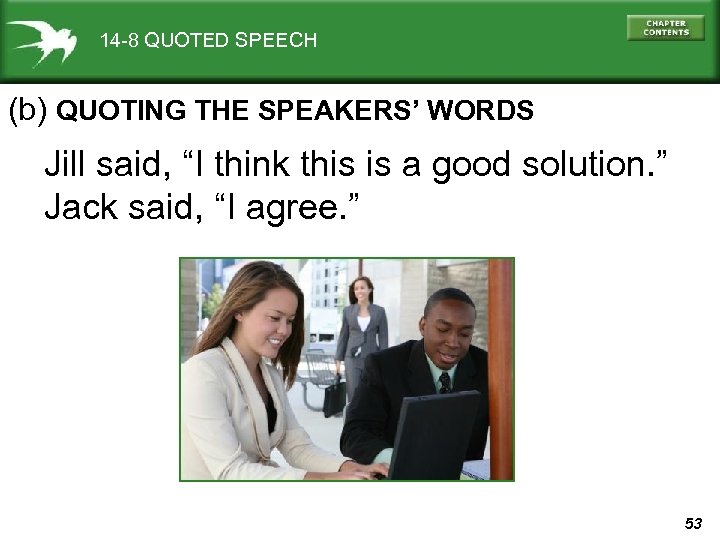 14 -8 QUOTED SPEECH (b) QUOTING THE SPEAKERS’ WORDS Jill said, “I think this is a good solution. ” Jack said, “I agree. ” 53
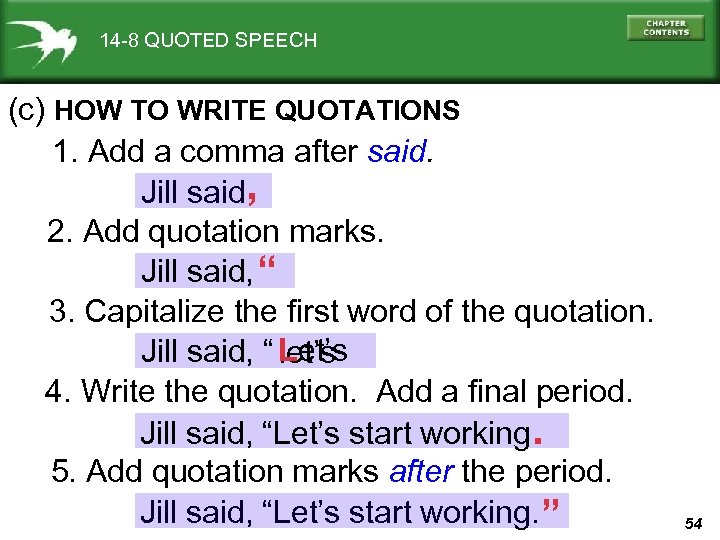 14 -8 QUOTED SPEECH (c) HOW TO WRITE QUOTATIONS 1. Add a comma after said. Jill said , 2. Add quotation marks. Jill said, “ 3. Capitalize the first word of the quotation. Jill said, “ Let’s let’s 4. Write the quotation. Add a final period. Jill said, “Let’s start working 5. Add quotation marks after the period. Jill said, “Let’s start working. . 54 “
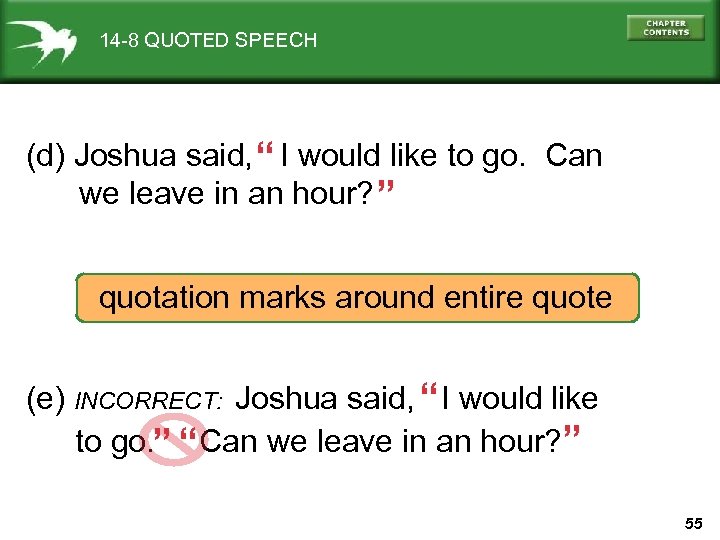 14 -8 QUOTED SPEECH (d) Joshua said, “ I would like to go. Can we leave in an hour? “ quotation marks around entire quote (e) INCORRECT: Joshua said, “ I would like to go. “ Can we leave in an hour? “ 55 “
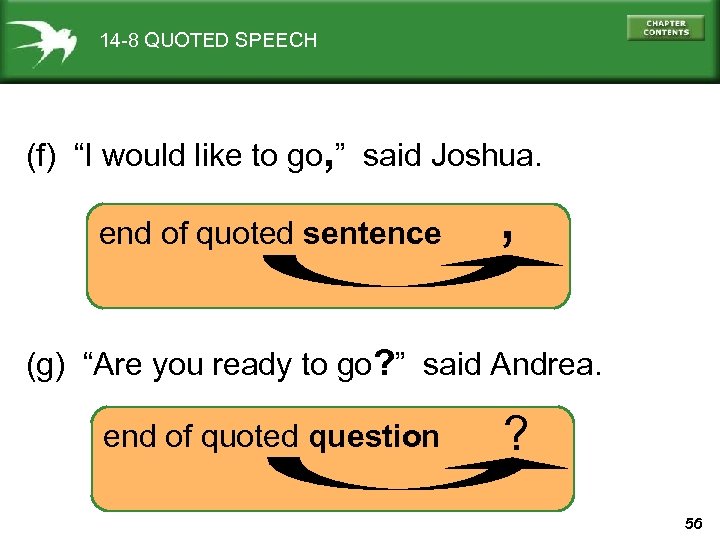 14 -8 QUOTED SPEECH (f) “I would like to go, ” said Joshua. end of quoted sentence , (g) “Are you ready to go? ” said Andrea. end of quoted question ? 56
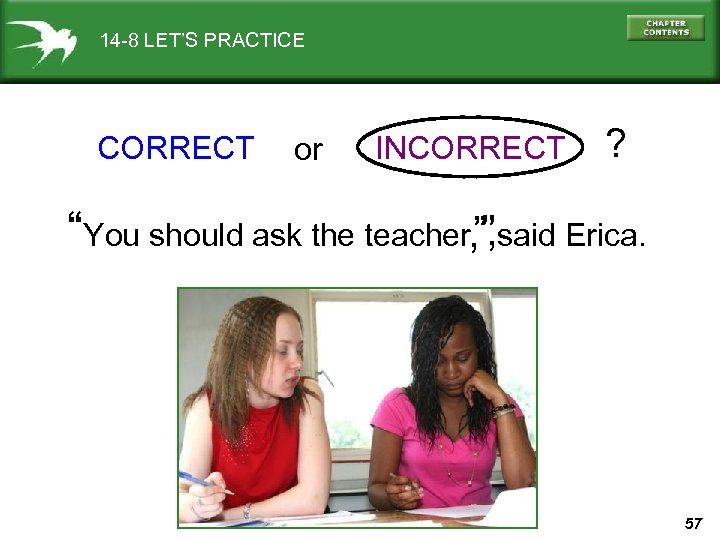 14 -8 LET’S PRACTICE CORRECT or INCORRECT ? ” “You should ask the teacher, ”, said Erica. 57
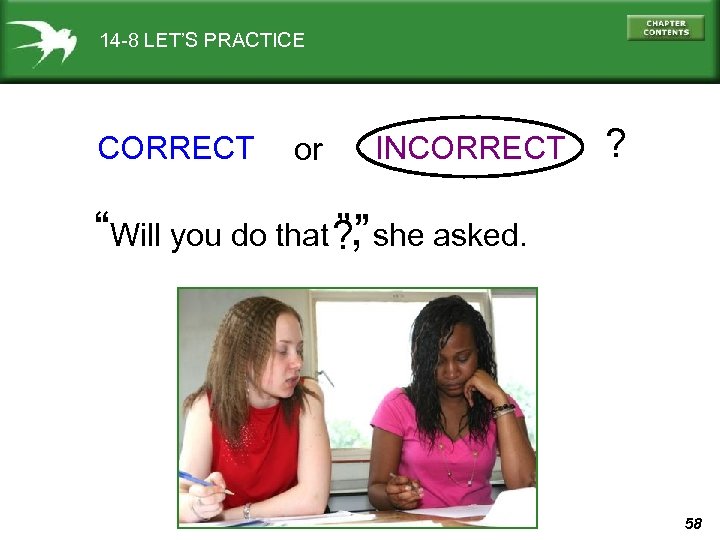 14 -8 LET’S PRACTICE CORRECT or INCORRECT ? ”” “Will you do that ? , she asked. 58
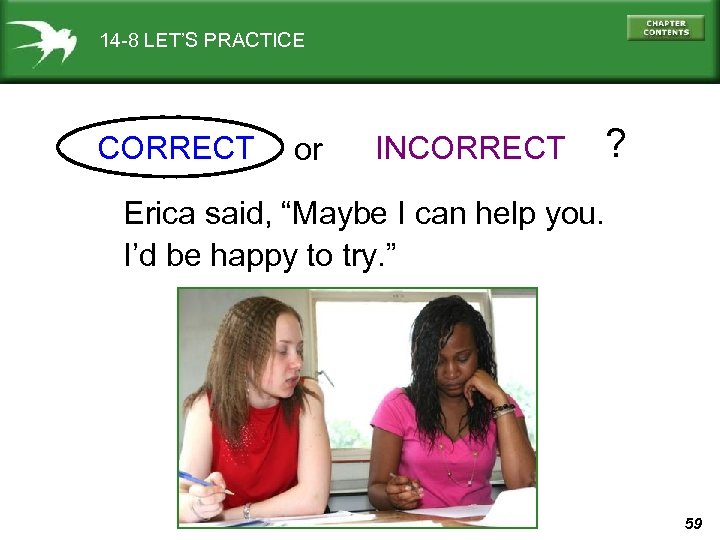 14 -8 LET’S PRACTICE CORRECT or INCORRECT ? Erica said, “Maybe I can help you. I’d be happy to try. ” 59
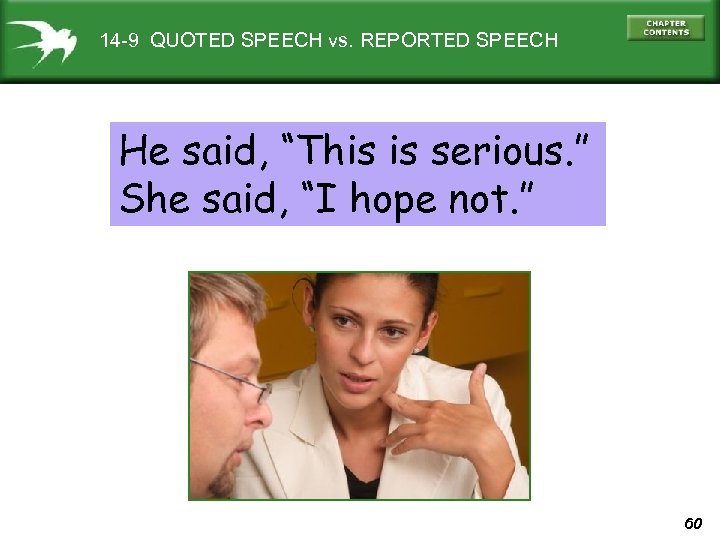 14 -9 QUOTED SPEECH vs. REPORTED SPEECH He said, “This is serious. ” She said, “I hope not. ” 60
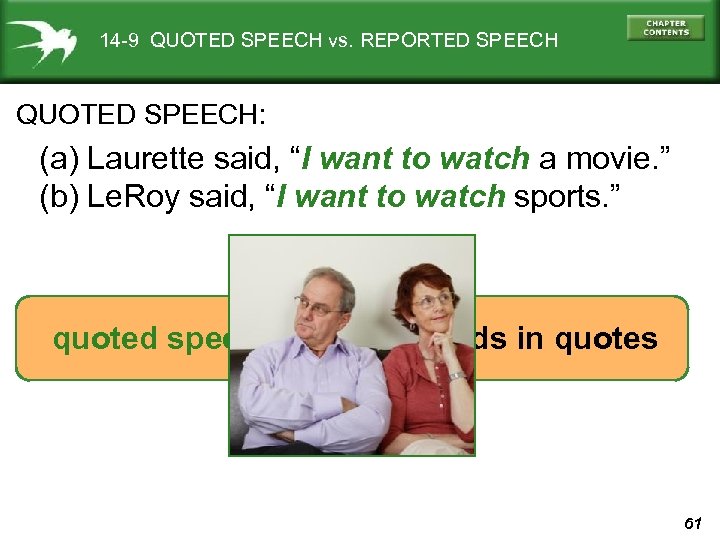 14 -9 QUOTED SPEECH vs. REPORTED SPEECH QUOTED SPEECH: (a) Laurette said, “I want to watch a movie. ” (b) Le. Roy said, “I want to watch sports. ” quoted speech = exact words in quotes 61
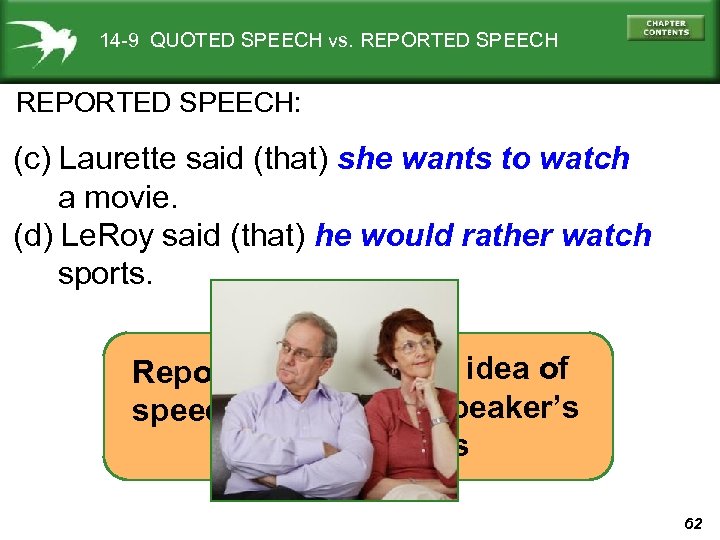 14 -9 QUOTED SPEECH vs. REPORTED SPEECH: (c) Laurette said (that) she wants to watch a movie. (d) Le. Roy said (that) he would rather watch sports. Reported speech = basic idea of the speaker’s words 62
 14 -9 LET’S PRACTICE QUOTED SPEECH: Nazan said, “I wish this class were longer. ” REPORTED SPEECH: Nazan said ____ he _______ this class were that wished longer. 63
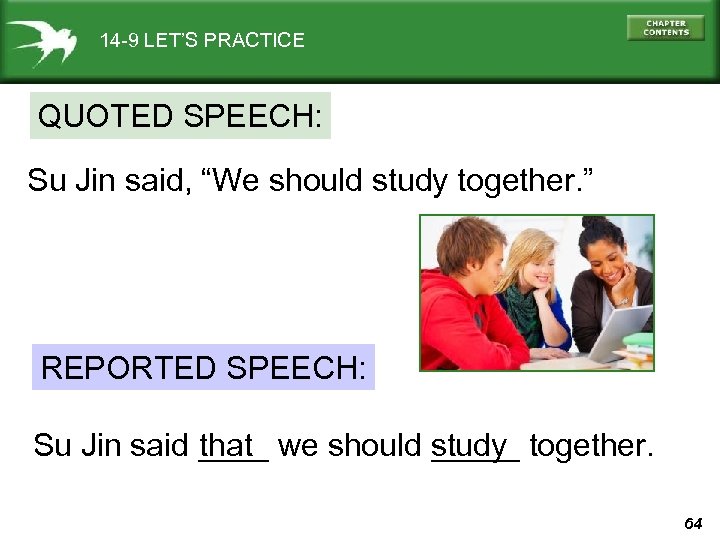 14 -9 LET’S PRACTICE QUOTED SPEECH: Su Jin said, “We should study together. ” REPORTED SPEECH: Su Jin said ____ we should study together. that _____ 64
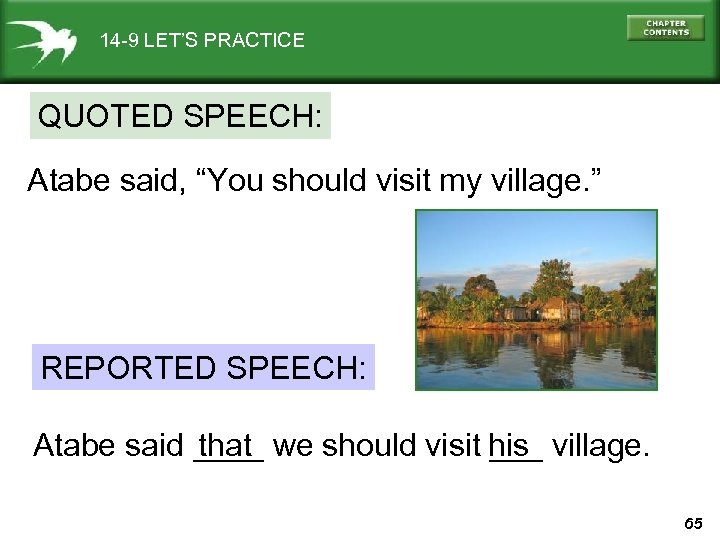 14 -9 LET’S PRACTICE QUOTED SPEECH: Atabe said, “You should visit my village. ” REPORTED SPEECH: Atabe said ____ we should visit his village. that ___ 65
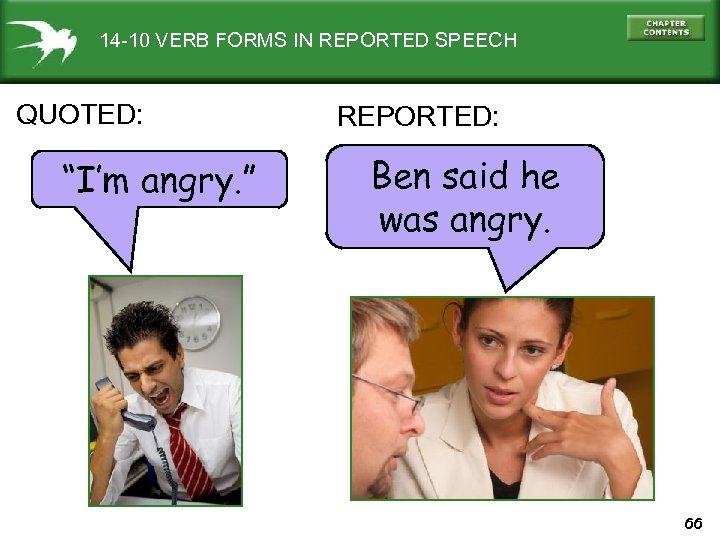 14 -10 VERB FORMS IN REPORTED SPEECH QUOTED: “I’m angry. ” REPORTED: Ben said he was angry. 66
 14 -10 VERB FORMS IN REPORTED SPEECH (a) QUOTED: Mary said, “I enjoy yoga. ” (b) REPORTED: Mary said that she enjoyed yoga. (c) QUOTED: David said, “I love tennis. ” (d) REPORTED: David said that he loved tennis. reporting in past FORMAL ENGLISH verb often noun clause verb in past 67
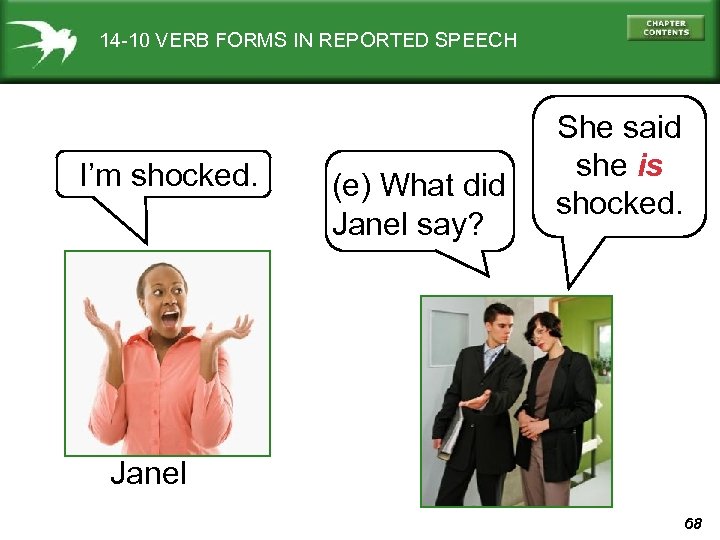 14 -10 VERB FORMS IN REPORTED SPEECH I’m shocked. (e) What did Janel say? She said she is shocked. Janel 68
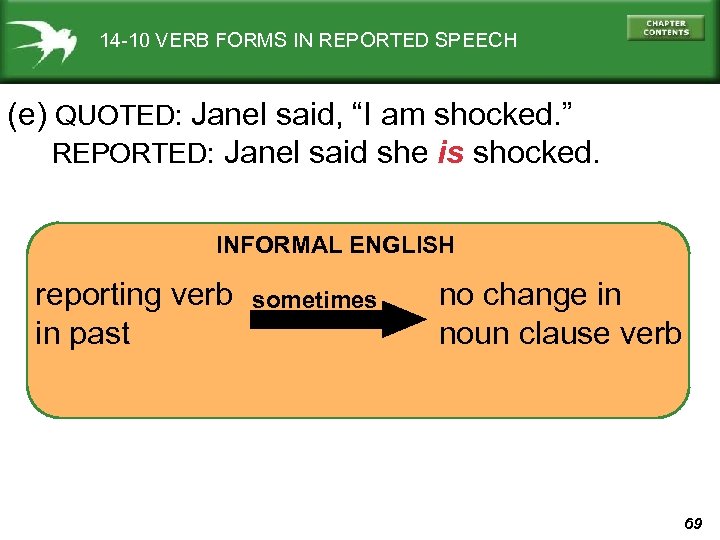 14 -10 VERB FORMS IN REPORTED SPEECH (e) QUOTED: Janel said, “I am shocked. ” REPORTED: Janel said she is shocked. INFORMAL ENGLISH reporting verb in past sometimes no change in noun clause verb 69
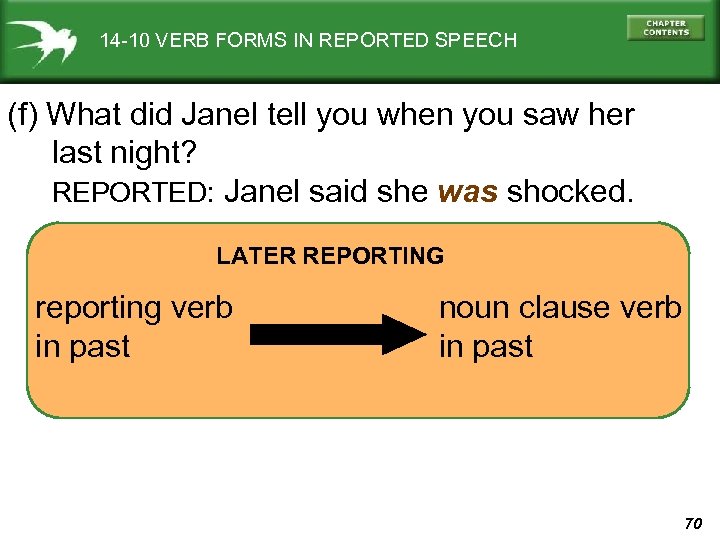 14 -10 VERB FORMS IN REPORTED SPEECH (f) What did Janel tell you when you saw her last night? REPORTED: Janel said she was shocked. LATER REPORTING reporting verb in past noun clause verb in past 70
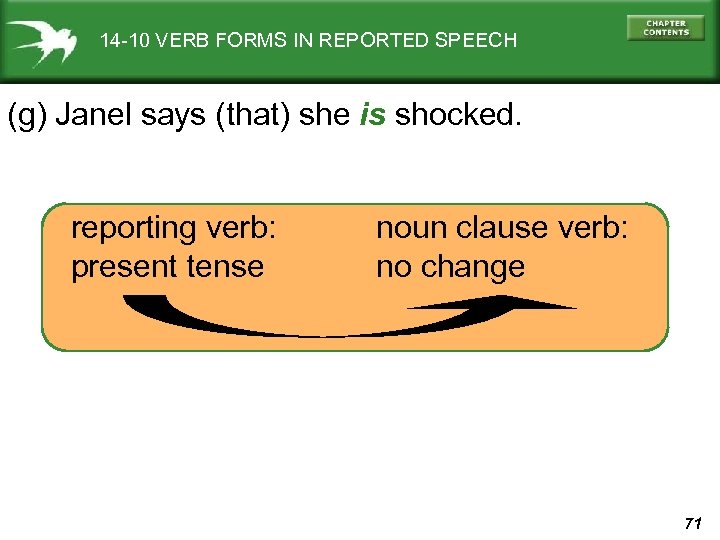 14 -10 VERB FORMS IN REPORTED SPEECH (g) Janel says (that) she is shocked. reporting verb: present tense noun clause verb: no change 71
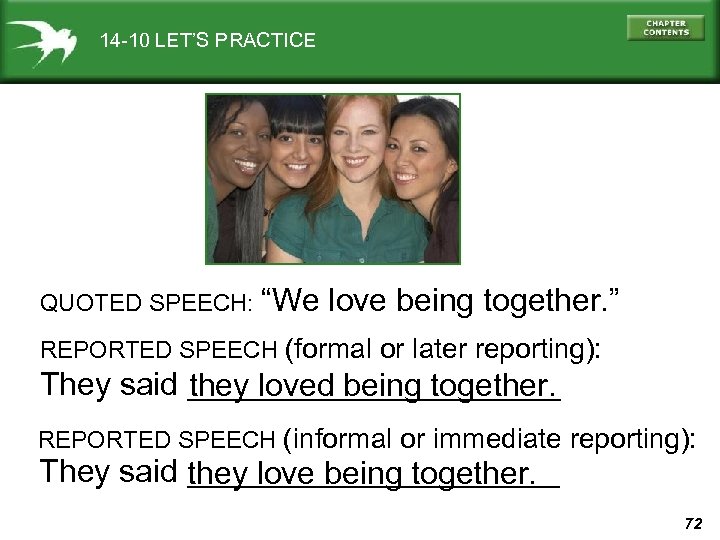 14 -10 LET’S PRACTICE QUOTED SPEECH: “We love being together. ” REPORTED SPEECH (formal or later reporting): They said ___________ they loved being together. REPORTED SPEECH (informal or immediate reporting): They said ___________ they love being together. 72
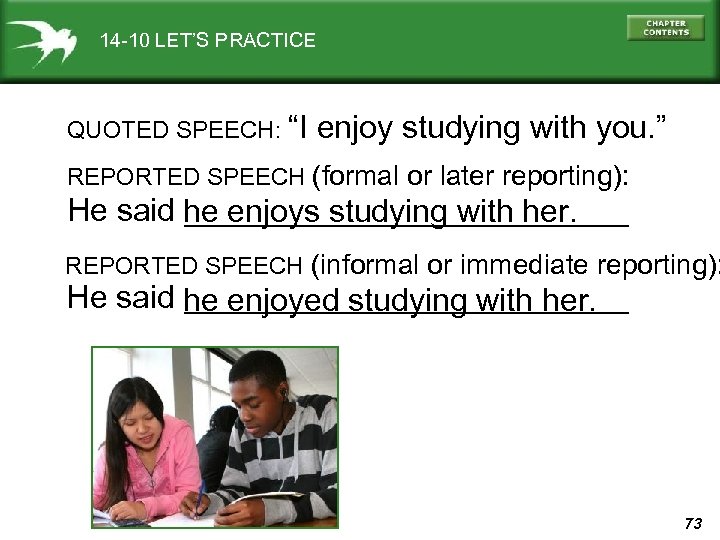 14 -10 LET’S PRACTICE QUOTED SPEECH: “I enjoy studying with you. ” REPORTED SPEECH (formal or later reporting): He said he enjoys studying with her. _____________ REPORTED SPEECH (informal or immediate reporting): He said he enjoyed studying with her. _____________ 73
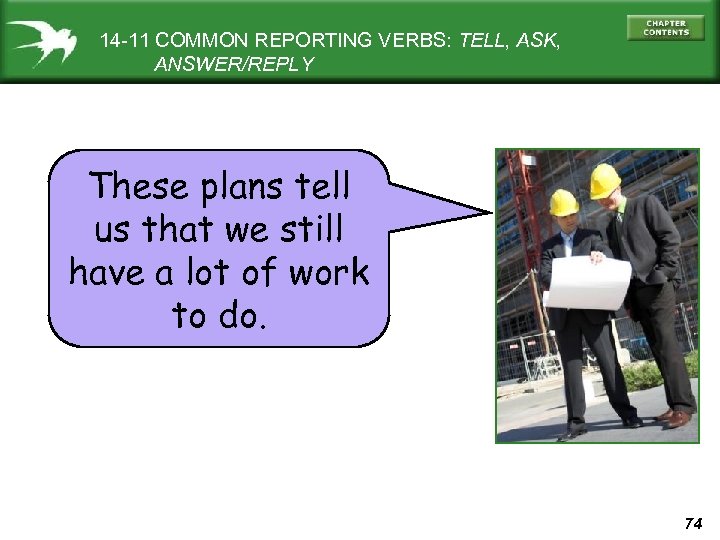 14 -11 COMMON REPORTING VERBS: TELL, ASK, ANSWER/REPLY These plans tell us that we still have a lot of work to do. 74
 14 -11 COMMON REPORTING VERBS: TELL, ASK, ANSWER/REPLY (a) Janel said that she was shocked. say = reporting verb say + noun clause 75
 14 -11 COMMON REPORTING VERBS: TELL, ASK, ANSWER/REPLY (b) Janel told me that she was shocked. (c) Janel told Amy that she was shocked. tell = reporting verb tell + object + noun clause INCORRECT: Janel told that she was shocked. INCORRECT: Janel said me that she was shocked. 76
 14 -11 COMMON REPORTING VERBS: TELL, ASK, ANSWER/REPLY (d) QUOTED: Su Lin said (to me), “Are you sad? ” REPORTED: Su Lin asked (me) if I was sad. (e) Su Lin wanted to know if I was sad. Su Lin wondered if I was sad. Su Lin inquired whether or not I was sad. asked (said) report questions want to know wonder inquire report questions 77
 14 -11 COMMON REPORTING VERBS: TELL, ASK, ANSWER/REPLY (f) QUOTED: Su Lin said (to me), “Are you sad? ” REPORTED: I answered/replied that I wasn’t sad. answer, reply report replies 78
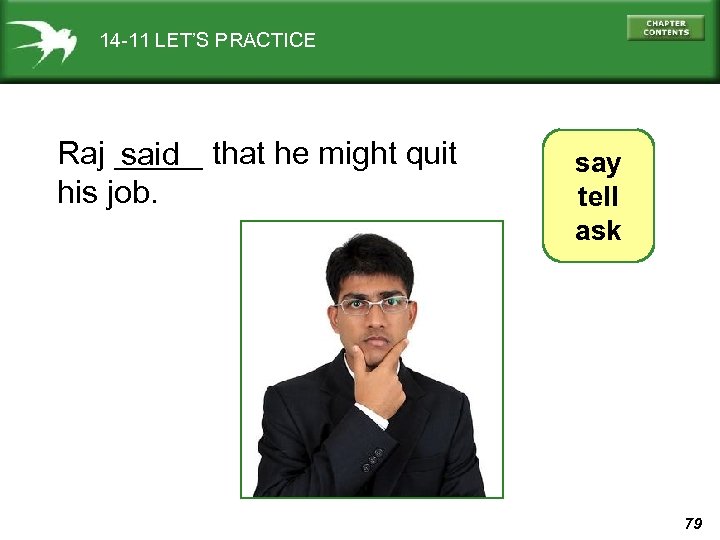 14 -11 LET’S PRACTICE Raj _____ that he might quit said his job. say tell ask 79
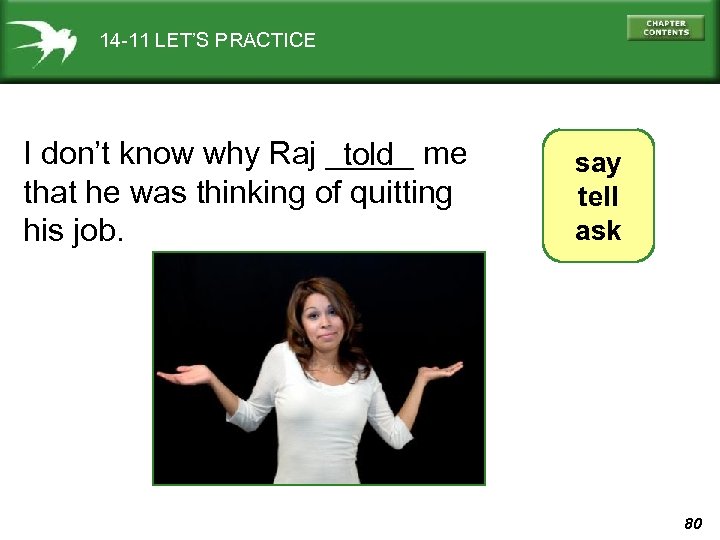 14 -11 LET’S PRACTICE I don’t know why Raj _____ me told that he was thinking of quitting his job. say tell ask 80
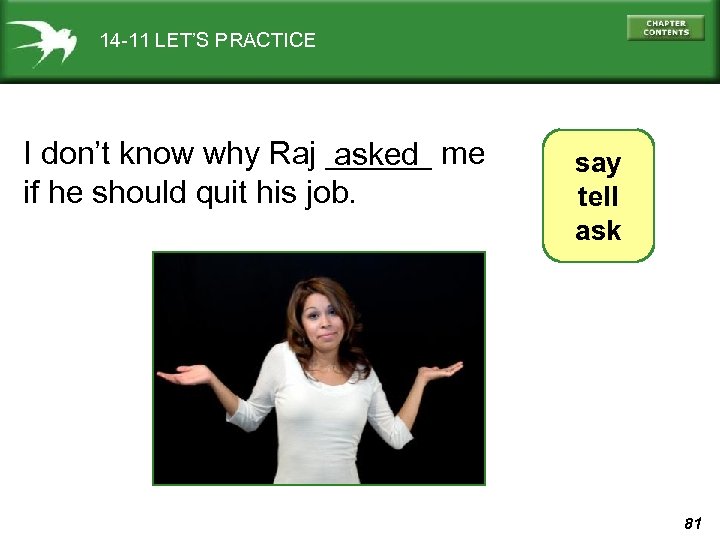 14 -11 LET’S PRACTICE I don’t know why Raj ______ me asked if he should quit his job. say tell ask 81
 PHOTO CREDITS Copyright © 2008 Pearson Education and its licensors. All rights reserved. Images used under license from: • Shutterstock, Inc. • Clipart, Inc. 82 82