


 Скачать презентацию Content sharing in the Vehicle Grid Comp Science
b8b07af972dbed0b9eb128bcea22d936.ppt
- Количество слайдов: 62
 Content sharing in the Vehicle Grid Comp Science Dept Retreat Oct 20, 2006 Mario Gerla www. cs. ucla. edu/NRL In collaboration with Uichin Lee and Dr. JS Park
 Outline • Opportunistic “Ad Hoc” Wireless Networks • The emerging Vehicular Grid • V 2 V applications – Car Torrent – Mob. Eyes – Autonomous evacuation • Network layer optimization – Network Coding • Conclusions
 New Roles for Vehicles on the road • Vehicle as a producer of geo-referenced data about its environment – Pavement condition – Probe data for traffic management – Weather data – Physiological condition of passengers, …. • Vehicle as Information Gateway – Internet access, infotainment, dynamic route guidance, ……
 Vehicle Roles (cont) • Vehicle & Vehicle, Vehicle & Roadway as collaborators – Cooperative Active Safety • Forward Collision Warning, Blind Spot Warning, Intersection Collision Warning……. – In-Vehicle Advisories • “Ice on bridge”, “Congestion ahead”, …. • All of these roles demand efficient communications
 The urban wireless options • Cellular telephony – 2 G (GSM, CDMA), 2. 5 G, 3 G • Wireless LAN (IEEE 802. 11) access – Wi. FI, Mesh Nets, WIMAX • Ad hoc wireless nets (manly based on 802. 11) – Set up in an area with no infrastructure; to respond to a specific, time limited need
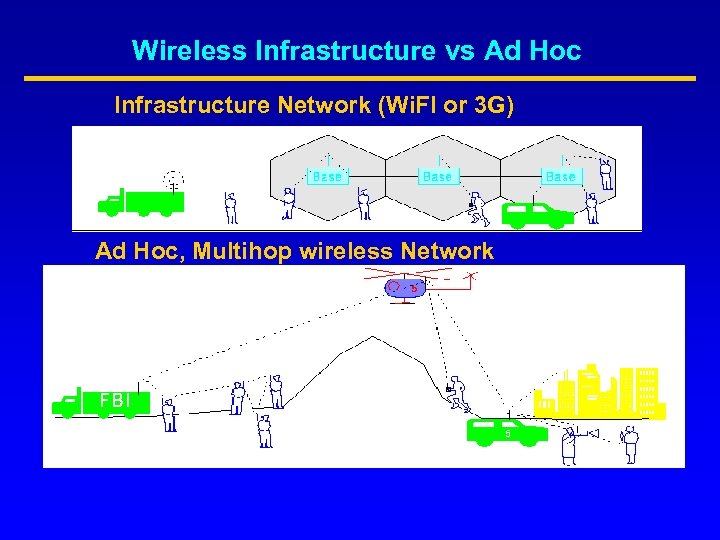 Wireless Infrastructure vs Ad Hoc Infrastructure Network (Wi. FI or 3 G) Ad Hoc, Multihop wireless Network
 Ad Hoc Network Characteristics • Instantly deployable, re-configurable (No fixed infrastructure) • Created to satisfy a “temporary” need • Portable (eg sensors), mobile (eg, cars) • Multi-hopping ( to save power, overcome obstacles, etc. )
 Typical Ad Hoc Network Applications Military – Automated battlefield Civilian – – – Disaster Recovery (flood, fire, earthquakes etc) Law enforcement (crowd control) Homeland defense Search and rescue in remote areas Environment monitoring (sensors) Space/planet exploration
 Ad hoc nets in battle • In 1971 (two years after ARPANET), DARPA starts the Packet Radio Program • DARPA, Army and Navy support ad hoc net research • Over the years, ad hoc net technology has climbed to high sophistication and to “large scale” • Virtually all funding comes from Defense
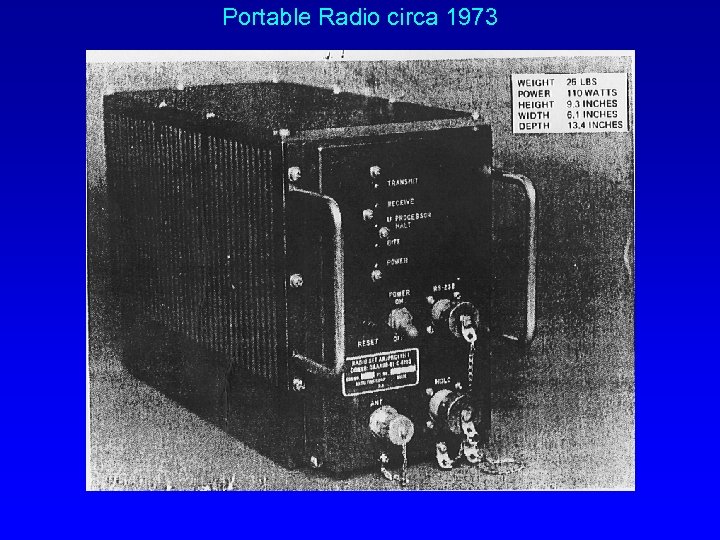 Portable Radio circa 1973
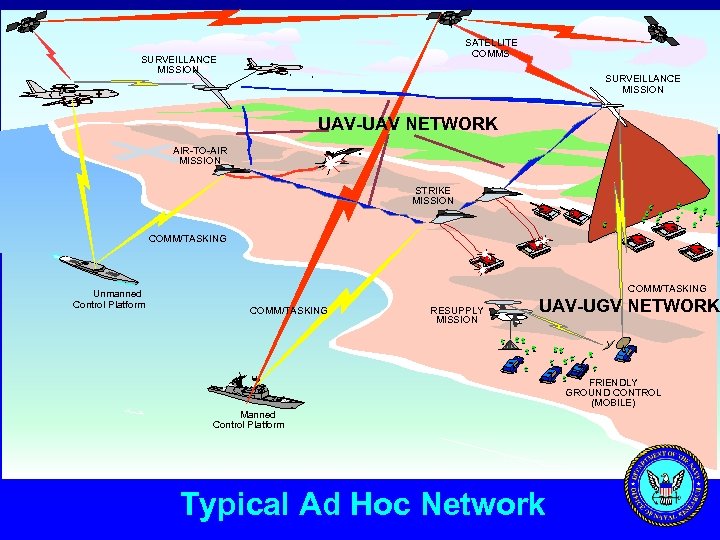 SATELLITE COMMS SURVEILLANCE MISSION UAV-UAV NETWORK AIR-TO-AIR MISSION STRIKE MISSION COMM/TASKING Unmanned Control Platform COMM/TASKING RESUPPLY MISSION UAV-UGV NETWORK FRIENDLY GROUND CONTROL (MOBILE) Manned Control Platform Typical Ad Hoc Network
 Traditional ad hoc net characteristics • Tactical battlefield: – No infrastructure – Instant deployment – Specialized missions (eg, UAV scouting) • Civilian emergency: – infrastructure, if present, was destroyed • Critical: scalability, survivability, Qo. S, jam protection • Non critical: Cost, Standards, Privacy • These architectures are not suitable for “every day” urban vehicular communications • Enter: “Opportunistic” Ad Hoc Networks
 New Trend: “Opportunistic” ad hoc nets – Driven by “commercial” application needs • Indoor W-LAN extended coverage • Group of friends sharing 3 G via Bluetooth • Peer 2 peer networking in the vehicle grid – Cost is a major issue – Access to Internet: – available, but; – “bypass it” with “ad hoc” if too costly or inadequate – Critical: Standards -> cost reduction and interoperability – Critical: Privacy, security
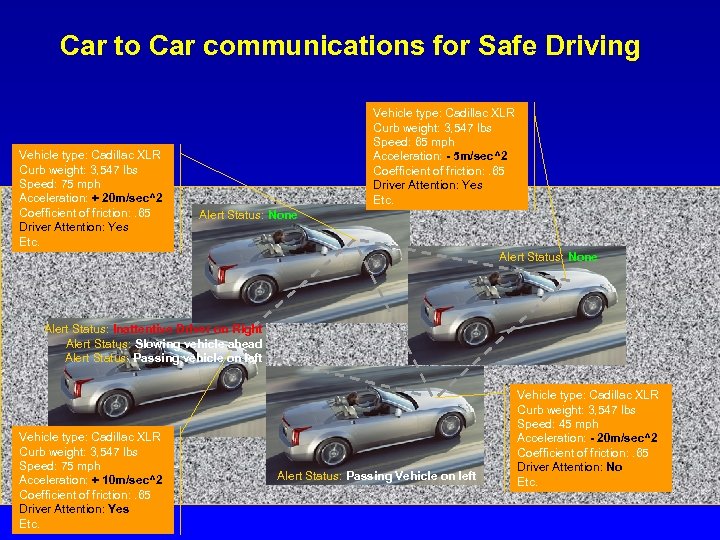 Car to Car communications for Safe Driving Vehicle type: Cadillac XLR Curb weight: 3, 547 lbs Speed: 75 mph Acceleration: + 20 m/sec^2 Coefficient of friction: . 65 Driver Attention: Yes Etc. Vehicle type: Cadillac XLR Curb weight: 3, 547 lbs Speed: 65 mph Acceleration: - 5 m/sec^2 Coefficient of friction: . 65 Driver Attention: Yes Etc. Alert Status: None Alert Status: Inattentive Driver on Right Alert Status: Slowing vehicle ahead Alert Status: Passing vehicle on left Vehicle type: Cadillac XLR Curb weight: 3, 547 lbs Speed: 75 mph Acceleration: + 10 m/sec^2 Coefficient of friction: . 65 Driver Attention: Yes Etc. Alert Status: Passing Vehicle on left Vehicle type: Cadillac XLR Curb weight: 3, 547 lbs Speed: 45 mph Acceleration: - 20 m/sec^2 Coefficient of friction: . 65 Driver Attention: No Etc.
 The emerging vehicle communications standards
 Convergence to a Standard: • Fed Communications Commission creates DSRC – The record in this proceeding overwhelmingly supports the allocation of spectrum for DSRC based ITS applications to increase traveler safety, reduce fuel consumption and pollution, and continue to advance the nations economy. • FCC Report and Order, October 22, 1999, FCC 99 -305 • Amendment with licensing rules in December 2003 • IEEE creates IEEE 802. 11 p – http: //grouper. ieee. org/groups/scc 32/dsrc/ • Automotive companies create Vehicle Safety Communications Consortium (VSCC) – Final Report Submitted January 2005 • USDOT/CAMP creates Cooperative Intersection Collision Avoidance (CICAS) Consortium – http: //www. its. dot. gov/cicas_workshop. htm
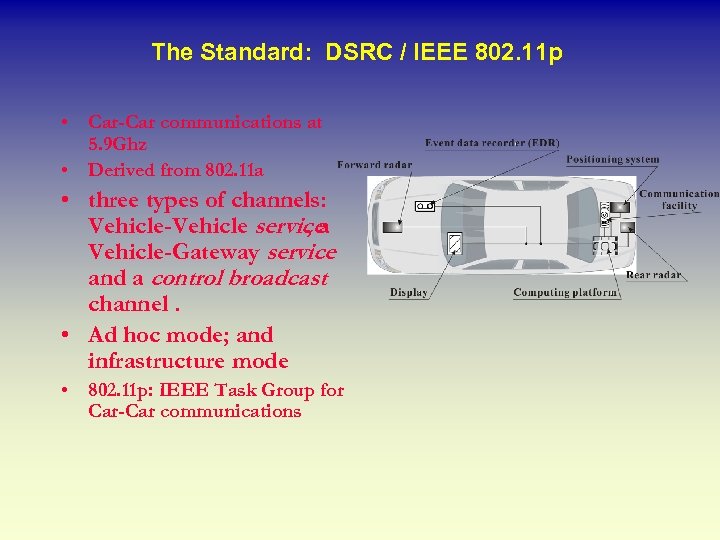 The Standard: DSRC / IEEE 802. 11 p • Car-Car communications at 5. 9 Ghz • Derived from 802. 11 a • three types of channels: Vehicle-Vehicle service , a Vehicle-Gateway service and a control broadcast channel. • Ad hoc mode; and infrastructure mode • 802. 11 p: IEEE Task Group for Car-Car communications
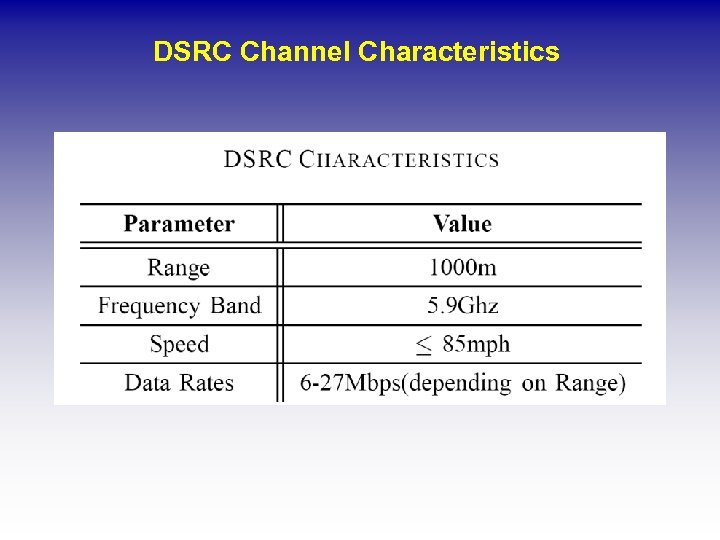 DSRC Channel Characteristics
 Car. Torrent : Opportunistic Ad Hoc networking to download large multimedia files Alok Nandan, Shirshanka Das Giovanni Pau, Mario Gerla WONS 2005
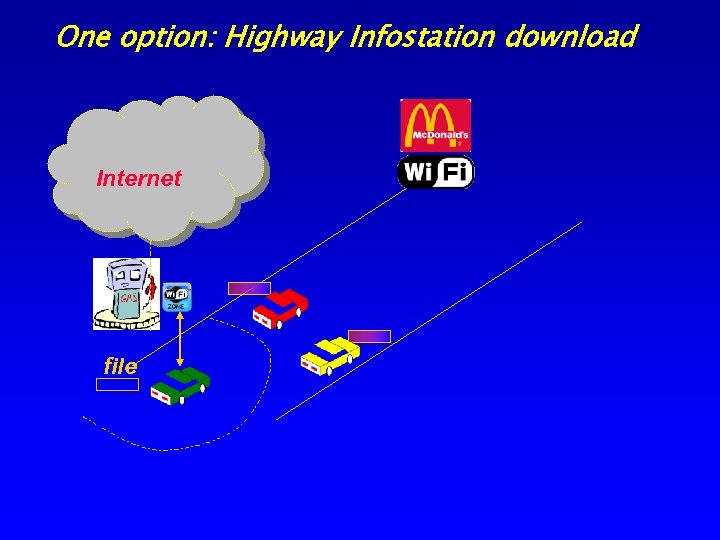
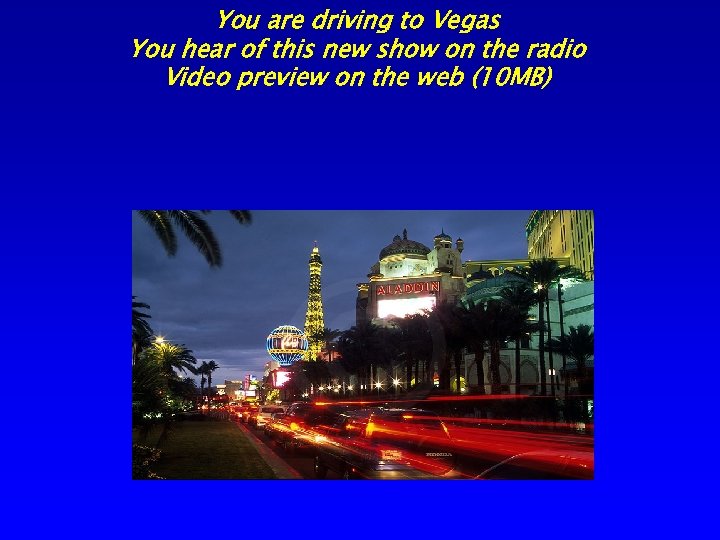 You are driving to Vegas You hear of this new show on the radio Video preview on the web (10 MB)
 One option: Highway Infostation download Internet file
 Incentive for opportunistic “ad hoc networking” Problems: Stopping at gas station for full download is a nuisance Downloading from GPRS/3 G too slow and quite expensive Observation: many other drivers are interested in download sharing (like in the Internet) Solution: Co-operative P 2 P Downloading via Car-Torrent
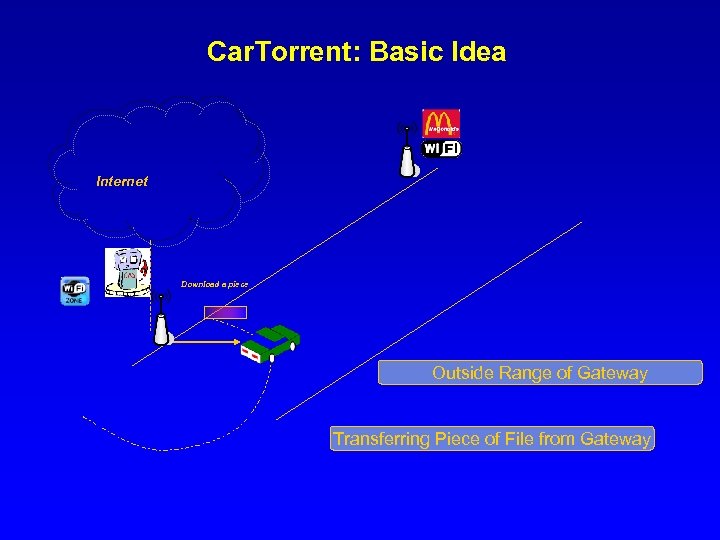 Car. Torrent: Basic Idea Internet Download a piece Outside Range of Gateway Transferring Piece of File from Gateway
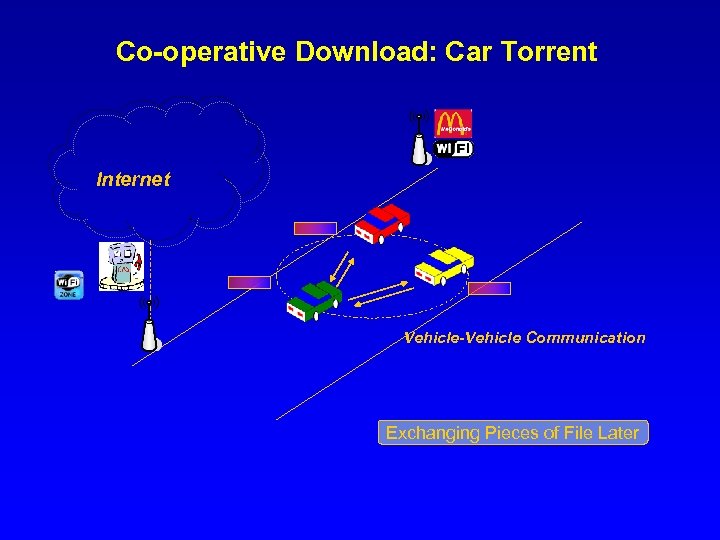 Co-operative Download: Car Torrent Internet Vehicle-Vehicle Communication Exchanging Pieces of File Later
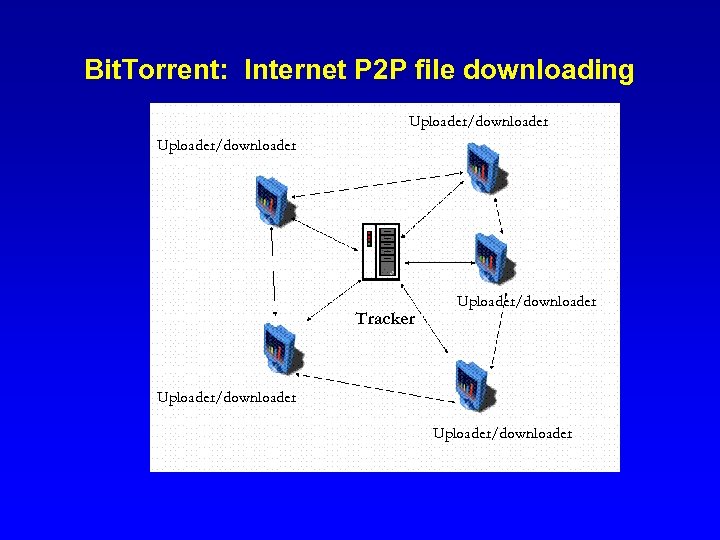 Bit. Torrent: Internet P 2 P file downloading Uploader/downloader Tracker Uploader/downloader
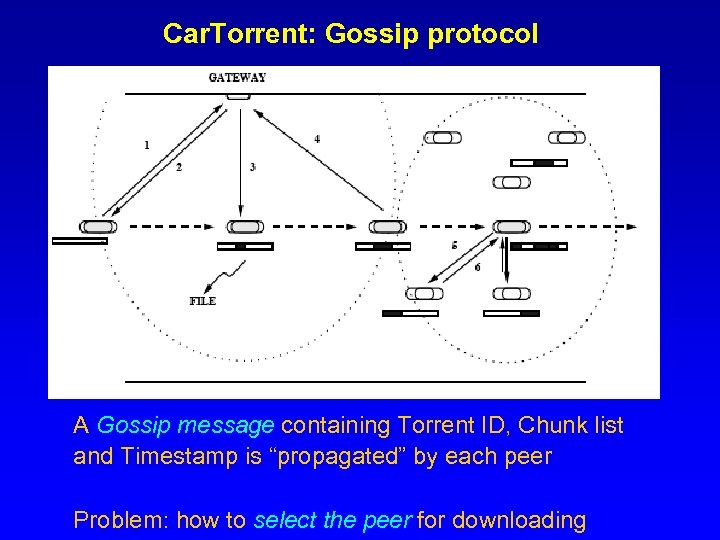 Car. Torrent: Gossip protocol A Gossip message containing Torrent ID, Chunk list and Timestamp is “propagated” by each peer Problem: how to select the peer for downloading
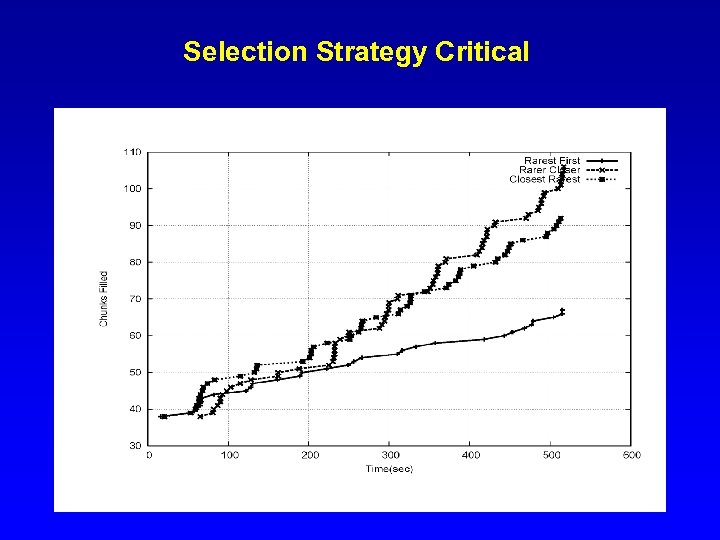 Selection Strategy Critical
 Car. Torrent with Network Coding • Limitations of Car Torrent – Piece selection critical – Frequent failures due to loss, path breaks • New Approach –network coding – “Mix and encode” the packet contents at intermediate nodes – Random mixing (with arbitrary weights) will do the job!
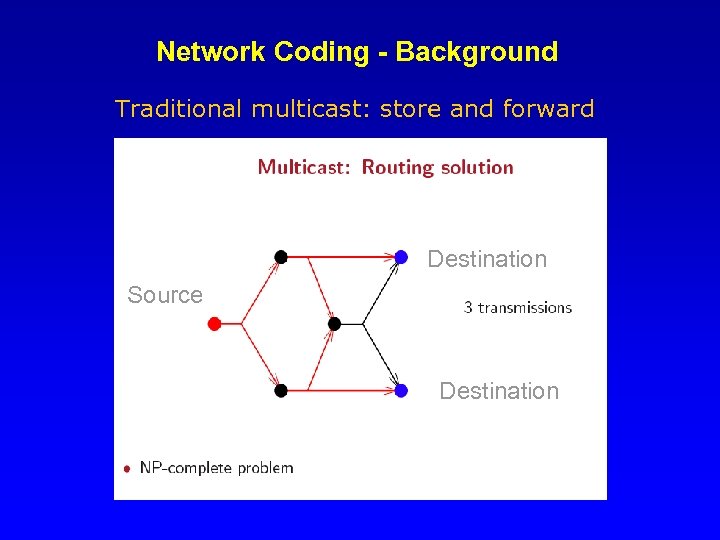 Network Coding - Background Traditional multicast: store and forward Destination Source Destination
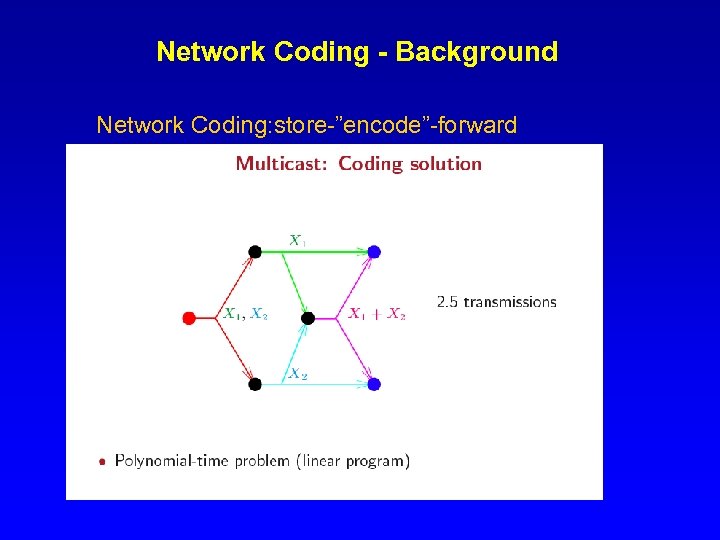 Network Coding - Background Network Coding: store-”encode”-forward
![“Random Linear” Network Coding e = [e 1 e 2 e 3 e 4]](https://present5.com/presentation/b8b07af972dbed0b9eb128bcea22d936/image-31.jpg "“Random Linear” Network Coding e = [e 1 e 2 e 3 e 4]") “Random Linear” Network Coding e = [e 1 e 2 e 3 e 4] encoding vector tells how packet was mixed (e. g. coded packet p = ∑eixi where xi is original packet) buffer Receiver recovers original by matrix inversion random mixing Intermediate nodes
“Random Linear” Network Coding e = [e 1 e 2 e 3 e 4] encoding vector tells how packet was mixed (e. g. coded packet p = ∑eixi where xi is original packet) buffer Receiver recovers original by matrix inversion random mixing Intermediate nodes
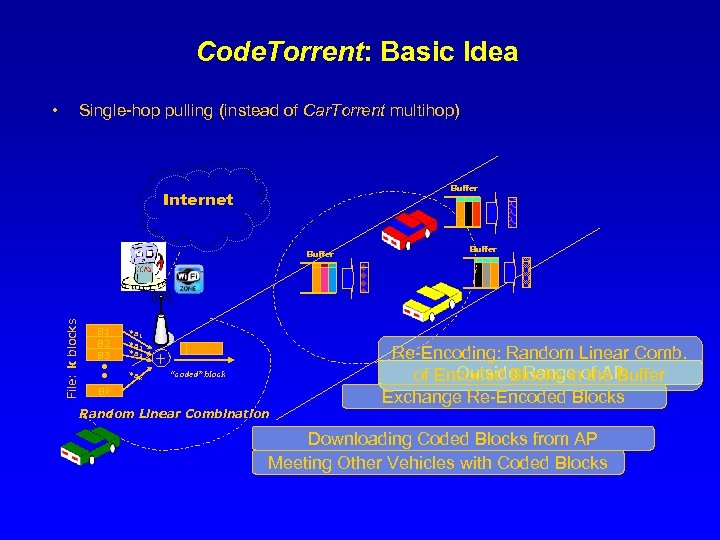 Code. Torrent: Basic Idea • Single-hop pulling (instead of Car. Torrent multihop) Buffer Internet File: k blocks Buffer B 1 B 2 B 3 *a 1 *a 2 *a 3 *ak + “coded” block Bk Random Linear Combination Buffer Re-Encoding: Random Linear Comb. Outside Range the Buffer of Encoded Blocks inof AP Exchange Re-Encoded Blocks Downloading Coded Blocks from AP Meeting Other Vehicles with Coded Blocks
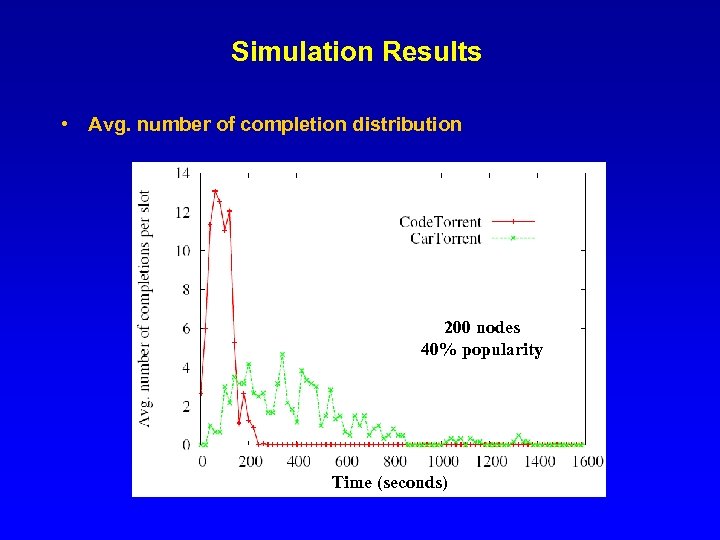 Simulation Results • Avg. number of completion distribution 200 nodes 40% popularity Time (seconds)
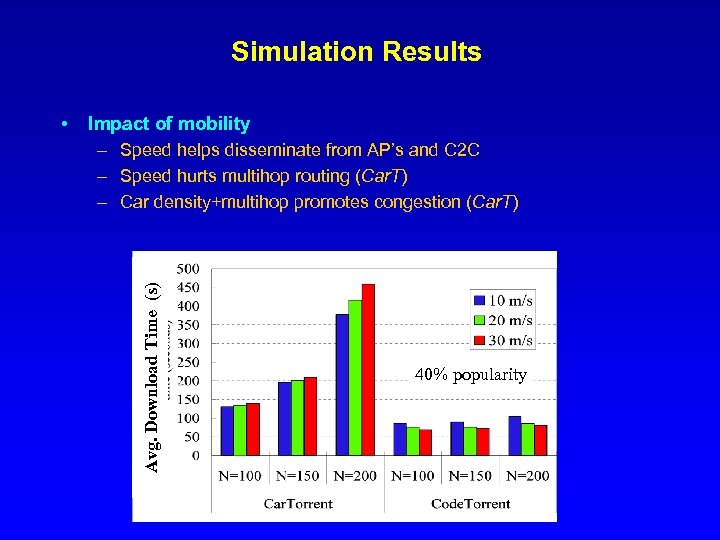 Simulation Results Impact of mobility – Speed helps disseminate from AP’s and C 2 C – Speed hurts multihop routing (Car. T) – Car density+multihop promotes congestion (Car. T) Avg. Download Time (s) • 40% popularity
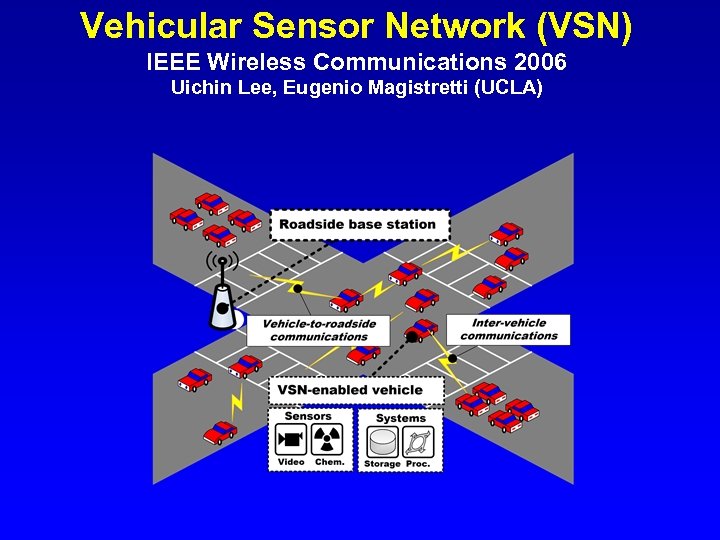 Vehicular Sensor Network (VSN) IEEE Wireless Communications 2006 Uichin Lee, Eugenio Magistretti (UCLA)
 Vehicular Sensor Applications • Environment – Traffic congestion monitoring – Urban pollution monitoring • Civic and Homeland security – Forensic accident or crime site investigations – Terrorist alerts
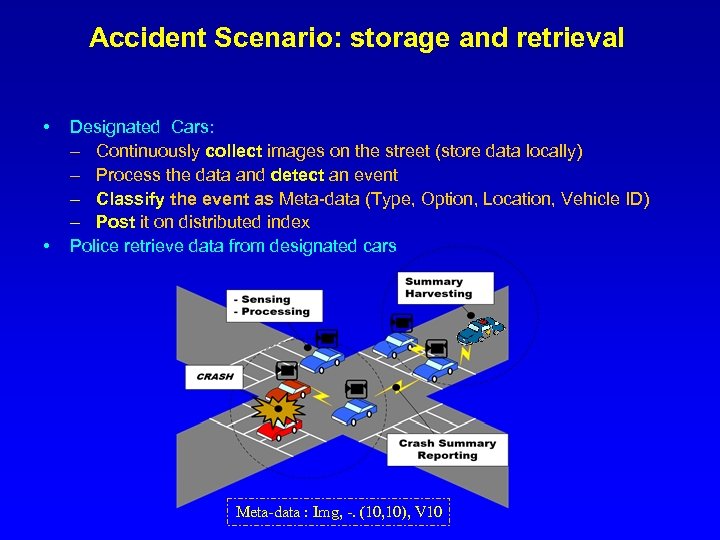 Accident Scenario: storage and retrieval • • Designated Cars: – Continuously collect images on the street (store data locally) – Process the data and detect an event – Classify the event as Meta-data (Type, Option, Location, Vehicle ID) – Post it on distributed index Police retrieve data from designated cars Meta-data : Img, -. (10, 10), V 10
 How to retrieve the data? • “Epidemic diffusion” : – Mobile nodes periodically broadcast meta-data of events to their neighbors – A mobile agent (the police) queries nodes and harvests events – Data dropped when stale and/or geographically irrelevant
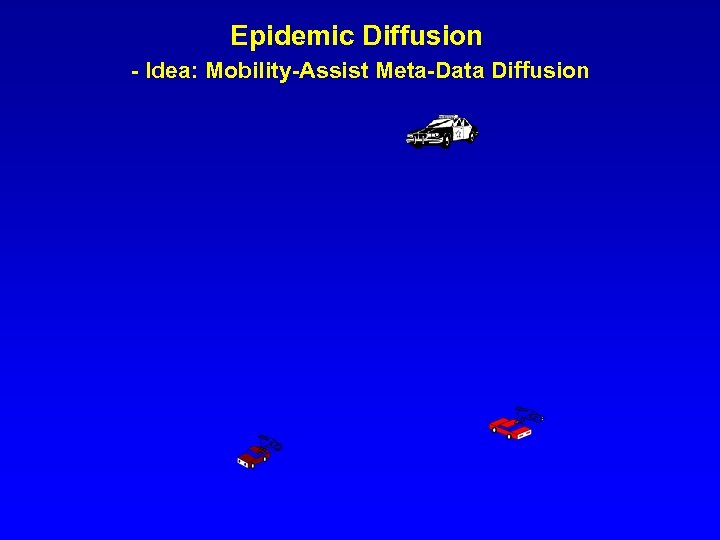 Epidemic Diffusion - Idea: Mobility-Assist Meta-Data Diffusion
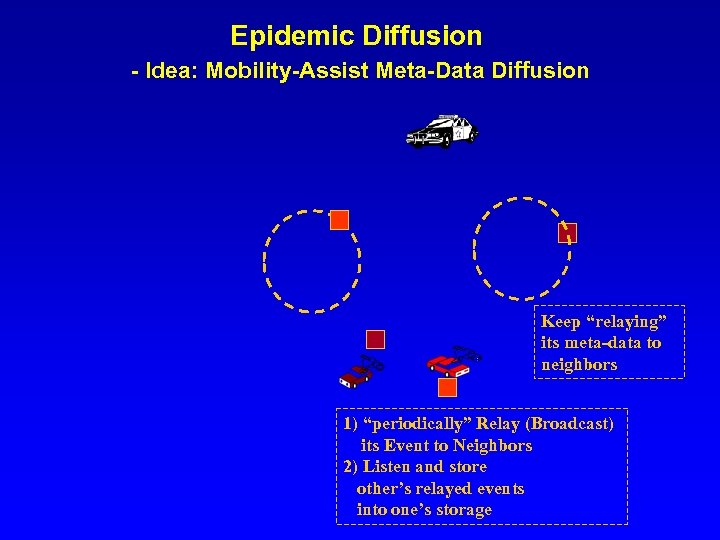 Epidemic Diffusion - Idea: Mobility-Assist Meta-Data Diffusion Keep “relaying” its meta-data to neighbors 1) “periodically” Relay (Broadcast) its Event to Neighbors 2) Listen and store other’s relayed events into one’s storage
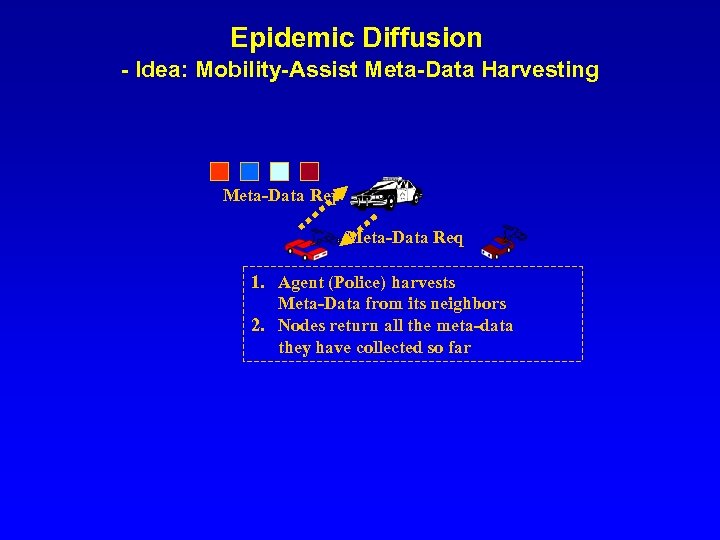 Epidemic Diffusion - Idea: Mobility-Assist Meta-Data Harvesting Meta-Data Rep Meta-Data Req 1. Agent (Police) harvests Meta-Data from its neighbors 2. Nodes return all the meta-data they have collected so far
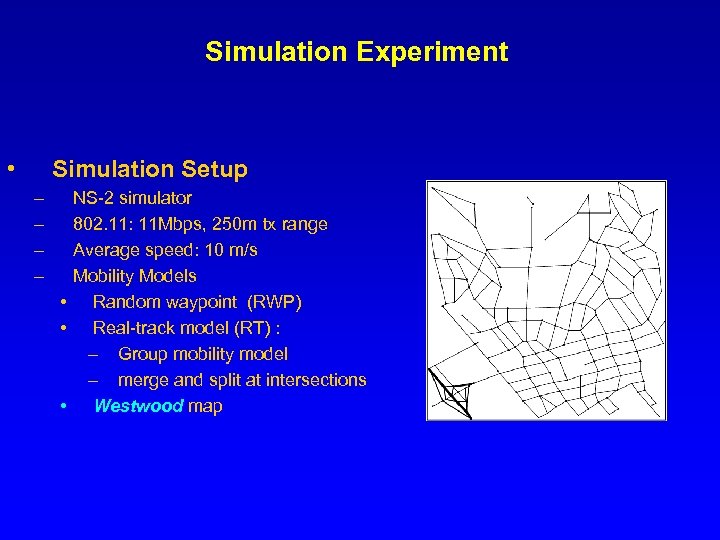 Simulation Experiment • Simulation Setup – – NS-2 simulator 802. 11: 11 Mbps, 250 m tx range Average speed: 10 m/s Mobility Models • Random waypoint (RWP) • Real-track model (RT) : – Group mobility model – merge and split at intersections • Westwood map
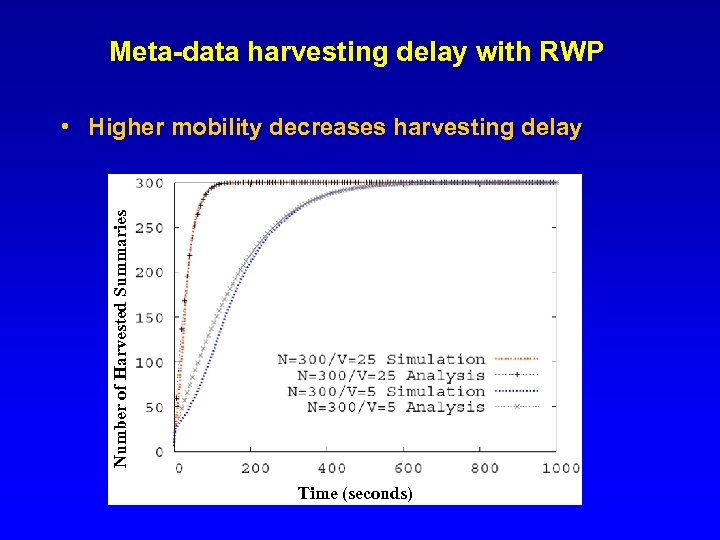 Meta-data harvesting delay with RWP Number of Harvested Summaries • Higher mobility decreases harvesting delay Time (seconds)
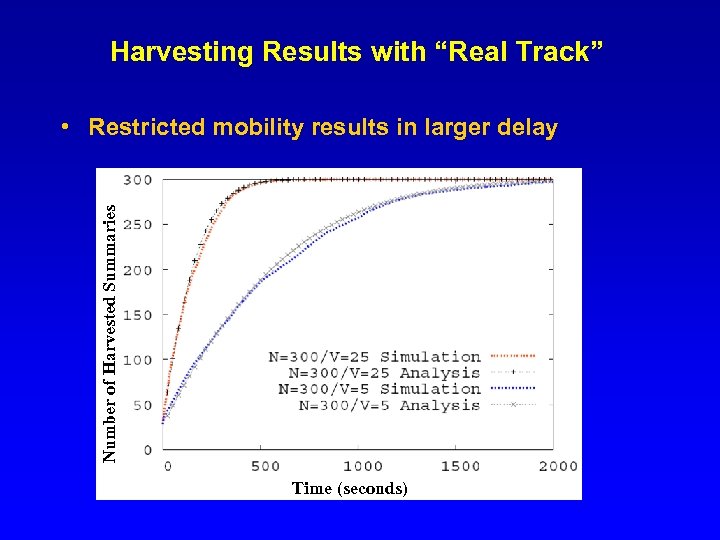 Harvesting Results with “Real Track” Number of Harvested Summaries • Restricted mobility results in larger delay Time (seconds)
 Protecting vehicles against road perils
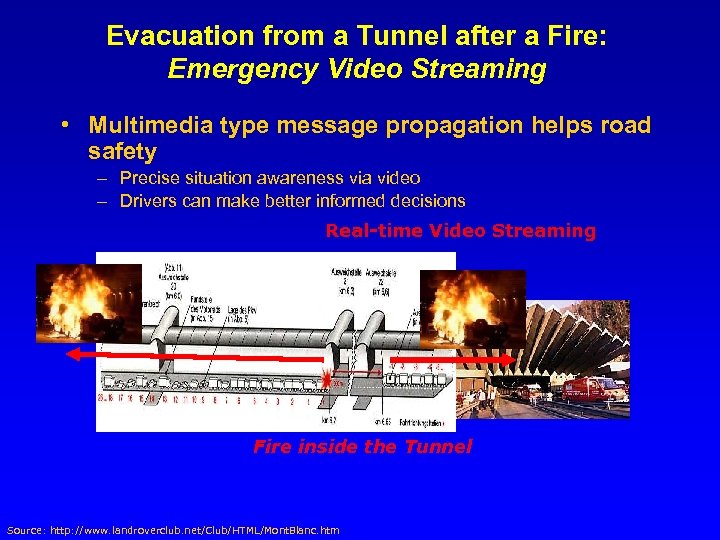 Evacuation from a Tunnel after a Fire: Emergency Video Streaming • Multimedia type message propagation helps road safety – Precise situation awareness via video – Drivers can make better informed decisions Real-time Video Streaming Fire inside the Tunnel Source: http: //www. landroverclub. net/Club/HTML/Mont. Blanc. htm
 Emergency Video Streaming • Problems – Potential volume of multimedia traffic – Unreliable wireless channel • Multimedia data delivery service must be reliable and efficient at the same time • Our Approach: Random network coding
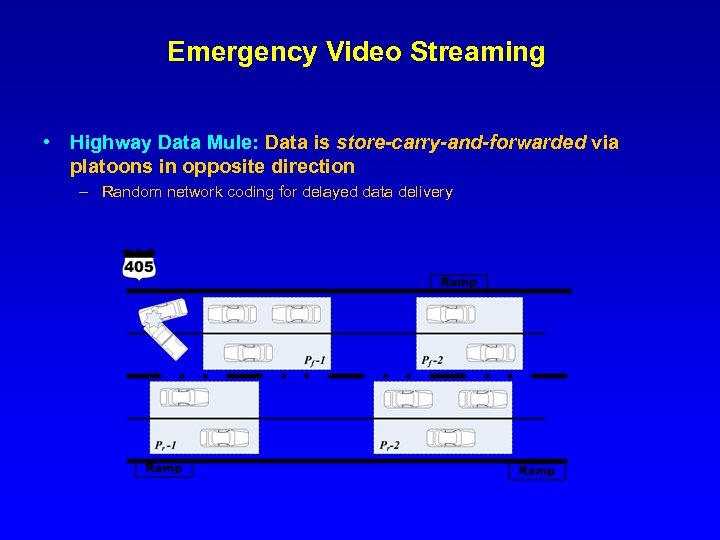 Emergency Video Streaming • Highway Data Mule: Data is store-carry-and-forwarded via platoons in opposite direction – Random network coding for delayed data delivery
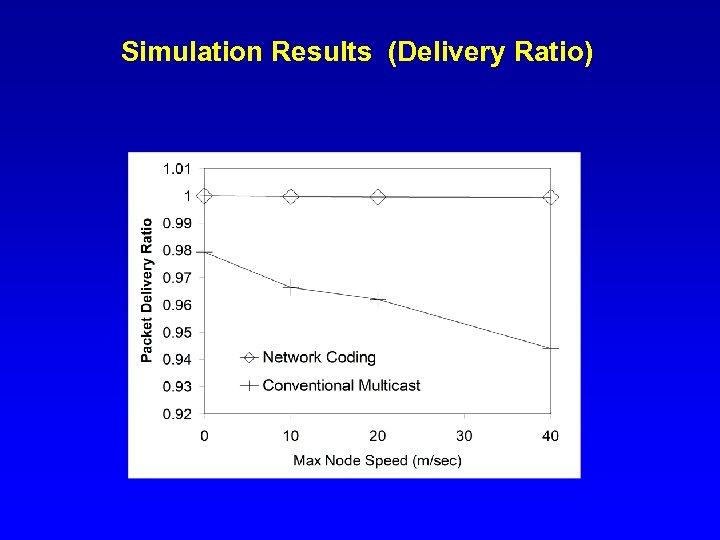 Simulation Results (Delivery Ratio)
 U -V e T Ucla - Vehicular Testbed E. Giordano, A. Ghosh, G. Marfia, S. Ho, J. S. Park, Ph. D System Design: Giovanni Pau, Ph. D Advisor: Mario Gerla, Ph. D
 Project Goals • Provide: – A platform to support car-to-car experiments in various traffic conditions and mobility patterns – A shared virtualized environment to test new protocols and applications – Remote access to U-Ve. T through web interface – Extendible to 1000’s of vehicles through WHYNET emulator – potential integration in the GENI infrastructure • Allow: – Collection of mobility traces and network statistics – Experiments on a real vehicular network
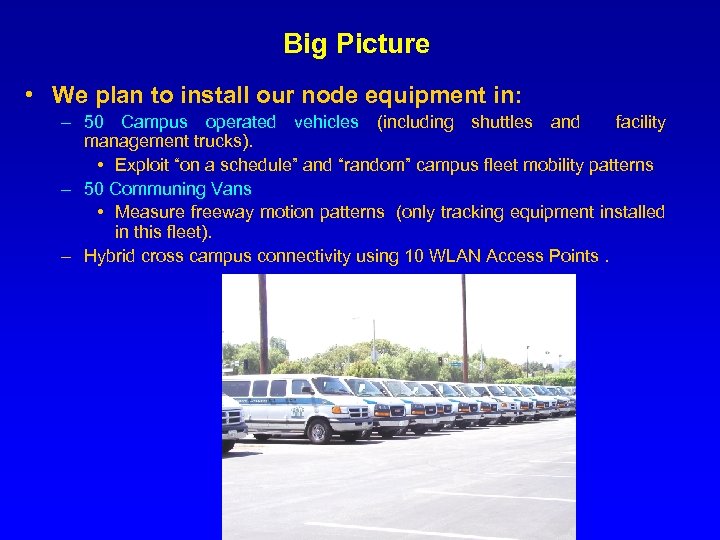 Big Picture • We plan to install our node equipment in: – 50 Campus operated vehicles (including shuttles and facility management trucks). • Exploit “on a schedule” and “random” campus fleet mobility patterns – 50 Communing Vans • Measure freeway motion patterns (only tracking equipment installed in this fleet). – Hybrid cross campus connectivity using 10 WLAN Access Points.
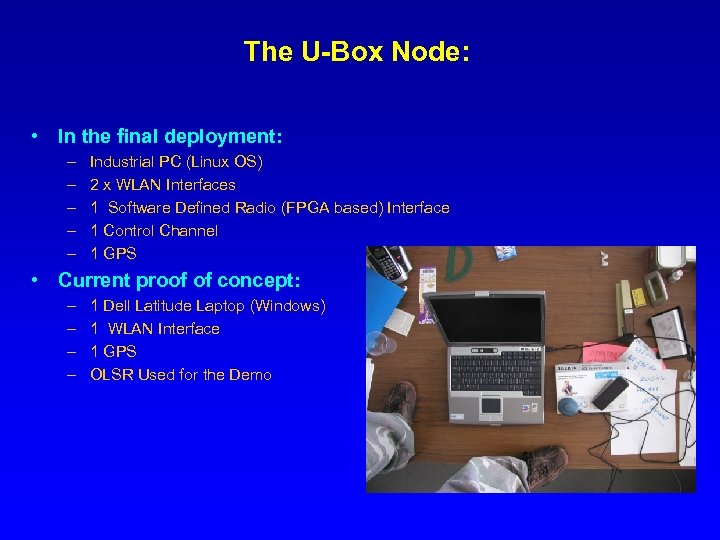 The U-Box Node: • In the final deployment: – – – Industrial PC (Linux OS) 2 x WLAN Interfaces 1 Software Defined Radio (FPGA based) Interface 1 Control Channel 1 GPS • Current proof of concept: – – 1 Dell Latitude Laptop (Windows) 1 WLAN Interface 1 GPS OLSR Used for the Demo
 The Demo: • Equipment: – – – 6 Cars running in Campus Clocks are in synch with the GPS OLSR for the WLAN routing 1 Ev. DO interface in the Lead Car 1 Remote Monitor connected through the Internet • Experiments: – Connectivity map though OLSR – Rough loss analysis though ping. – On/OFF traffic using Iperf
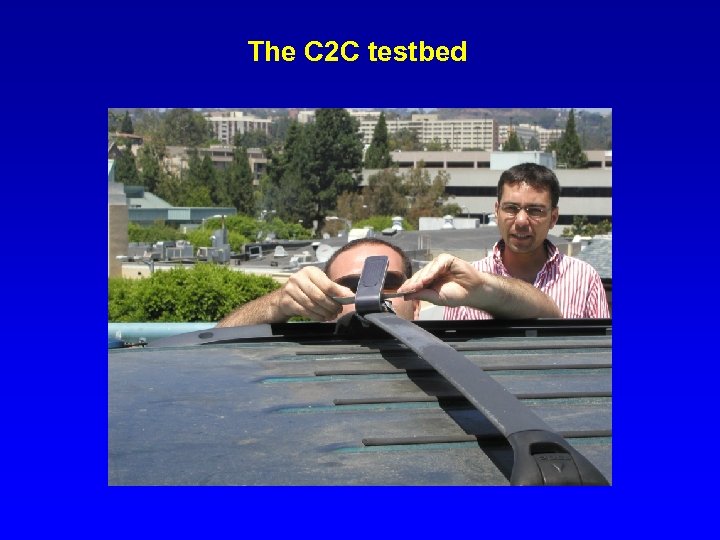 The C 2 C testbed
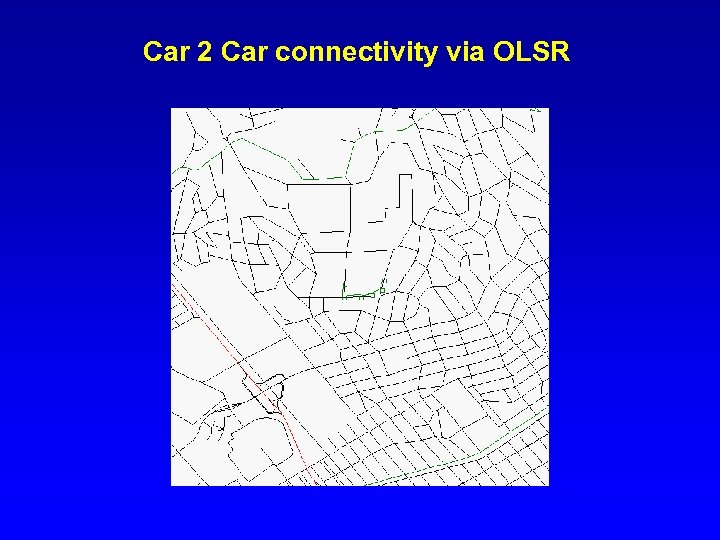 Car 2 Car connectivity via OLSR
 Related Car to Car Projects • UMass. Diesel (UMass) – A Bus-based Disruption Tolerant Network (DTN) – http: //signl. cs. umass. edu/diesel • VEDAS (UMBC) – A Mobile and Distributed Data Stream Mining System for Real-Time Vehicle Monitoring and diagnostics – http: //www. cs. umbc. edu/~hillol/vedas. html • Car. Tel (MIT) – Vehicular Sensor Network for traffic conditions and car performance – http: //cartel. csail. mit. edu • Recognizing. Cars (UCSD) – License Plate, Make, and Model Recognition – Video based car surveillance – http: //vision. ucsd. edu/car_rec. html
 Publications Uichin Lee, Eugenio Magistretti, Biao Zhou, Mario Gerla, Paolo Bellavista, Antonio Corradi. Mob. Eyes: Smart Mobs for Urban Monitoring with a Vehicular Sensor Network. IEEE Wireless Communications, Sept 2006. J. -S. Park, D. Lun, Y. Yi, M. Gerla, M. Medard. Code. Cast: A Network Coding based Ad hoc Multicast Protocol. IEEE Wireless Communications, Oct 2006. J. -S. Park, D. Lun, M. Gerla, M. Medard. Performance Evaluation of Network Coding in multicast MANET. Proc. IEEE MILCOM 2006. U. Lee, J. -S. Park, J. Yeh, G. Pau, M. Gerla. Code. Torrent: Content Distribution using Network Coding in VANET. Proc. of Mobi. Share, Los Angeles, Sept 2006.
 Support This work was supported by: ARMY MURI Project “DAWN” (PI JJ Garcia) 2005 -2008; UCLA Co. PI: Rajive Bagrodia ARMY Grant under the IBM - TITAN Project (PI, Dinesh Verma, IBM) 2006 -2011; UCLA Co. PIs: Deborah Estrin, Mani Srivastava NSF Ne. TS Grant - Emergency Ad Hoc Networking Using Programmable Radios and Intelligent Swarms; 2005 -2009; PI: Gerla, UCLA Co. PIs - Soatto, Fitz, Pau
 Conclusions • Vehicular Communications offer opportunities beyond safe navigation: – – – Dynamic content sharing/delivery: Car Torrent Pervasive, mobile sensing: Mob. Eyes Autonomous Evacuation Ad Torrent Massive Network games Homeland defense • Research Challenges: – – – New routing/transport models: epidemic dissemination, P 2 P Network Coding Congestion Control Interaction with the Infrastructure Searching massive mobile storage Security, privacy, incentives
 Future Work • • Extending the P 2 P sharing concepts to pedestrians Health Networking Security, privacy in vehicular content sharing Network Coding – Implement Code. Cast congestion control and ETE recovery above UDP • If loss used as feedback, key problem is discrimination between random error and congestion – Network Coding solutions for intermittent connectivity – Models that include mobility • Vehicular tesbed experiments
 The End Thank You