


 Скачать презентацию Content Listening and speaking Reading Grammar Writing Culture
082d80a556dea032fe013af365b5670e.ppt
- Количество слайдов: 154

 Content Listening and speaking Reading Grammar Writing Culture express
 Listening and speaking Reading Grammar Writing Listening and speaking l Pronunciation and listening skills l Conversations l Passage Culture express
 Listening and speaking Reading Grammar Writing Culture express Pronouncing plosives properly Listen to a song and fill in the blanks with what you hear. Tips 在英语朗读中,遇到爆破音+爆破音时,前一个爆破音 只作发音姿势,刚要发出时,立即发出第二个爆破音。 如:what time,goodbye。遇到爆破音+摩擦音时,前 一个爆破音作好发音姿势,刚发出即过渡到摩擦音。爆 破音发出的声音非常轻微,有时甚至听不出来。如: picture,good child。
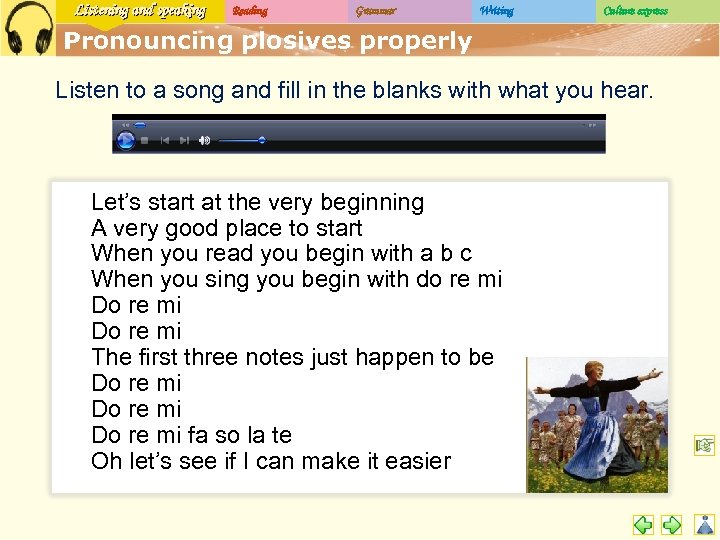 Listening and speaking Reading Grammar Writing Culture express Pronouncing plosives properly Listen to a song and fill in the blanks with what you hear. Let’s start at the very beginning A very good place to start When you read you begin with a b c When you sing you begin with do re mi Do re mi The first three notes just happen to be Do re mi fa so la te Oh let’s see if I can make it easier
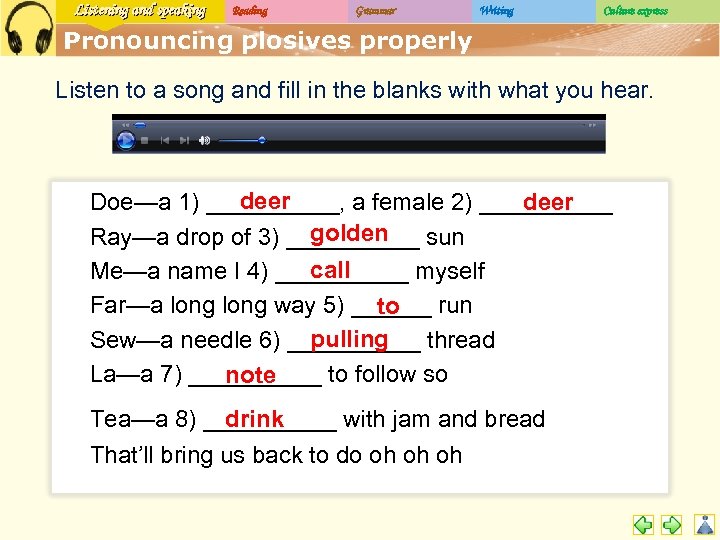 Listening and speaking Reading Grammar Writing Culture express Pronouncing plosives properly Listen to a song and fill in the blanks with what you hear. deer Doe—a 1) _____, a female 2) _____ golden Ray—a drop of 3) _____ sun call Me—a name I 4) _____ myself Far—a long way 5) ______ run to pulling Sew—a needle 6) _____ thread La—a 7) _____ to follow so note drink Tea—a 8) _____ with jam and bread That’ll bring us back to do oh oh oh
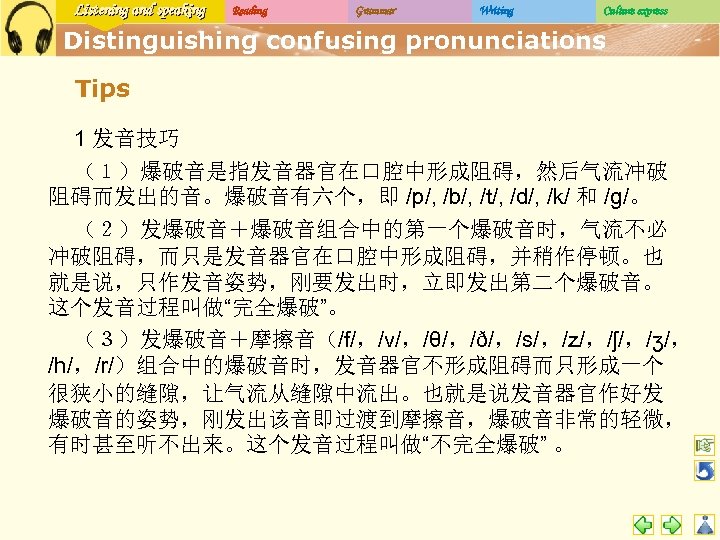 Listening and speaking Reading Grammar Writing Culture express Distinguishing confusing pronunciations Tips 1 发音技巧 (1)爆破音是指发音器官在口腔中形成阻碍,然后气流冲破 阻碍而发出的音。爆破音有六个,即 /p/, /b/, /t/, /d/, /k/ 和 /g/。 (2)发爆破音+爆破音组合中的第一个爆破音时,气流不必 冲破阻碍,而只是发音器官在口腔中形成阻碍,并稍作停顿。也 就是说,只作发音姿势,刚要发出时,立即发出第二个爆破音。 这个发音过程叫做“完全爆破”。 (3)发爆破音+摩擦音(/f/,/v/,/θ/,/ð/,/s/,/z/,/ʃ/,/ʒ/, /h/,/r/)组合中的爆破音时,发音器官不形成阻碍而只形成一个 很狭小的缝隙,让气流从缝隙中流出。也就是说发音器官作好发 爆破音的姿势,刚发出该音即过渡到摩擦音,爆破音非常的轻微, 有时甚至听不出来。这个发音过程叫做“不完全爆破” 。
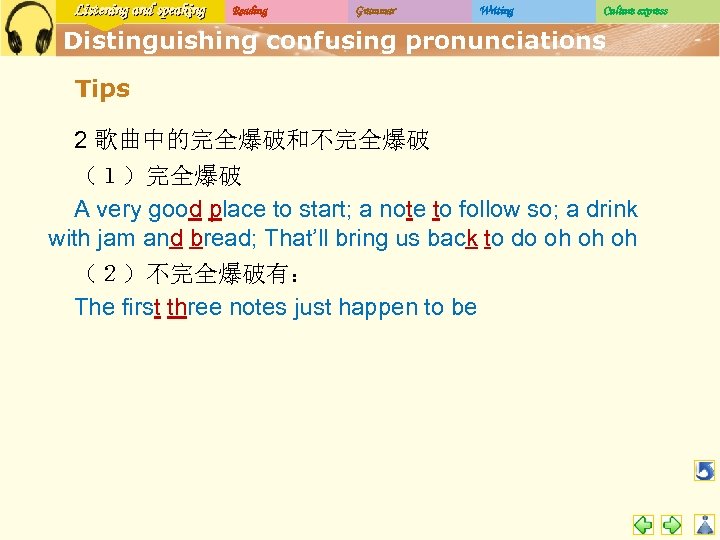 Listening and speaking Reading Grammar Writing Culture express Distinguishing confusing pronunciations Tips 2 歌曲中的完全爆破和不完全爆破 (1)完全爆破 A very good place to start; a note to follow so; a drink with jam and bread; That’ll bring us back to do oh oh oh (2)不完全爆破有: The first three notes just happen to be
 Listening and speaking Reading Grammar Writing Conversations l Conversation 1 Exercises Functional language l Conversation 2 Exercises Functional language Culture express
 Listening and speaking Reading Grammar Writing Culture express Conversation 1 - Expressing worries & responses 1. Listen to a conversation and choose the best answer to each of the following questions. Word tips particularly adv. 特别;尤其 slim adj. 苗条的 diet v. 节食 lifestyle n. 生活方式
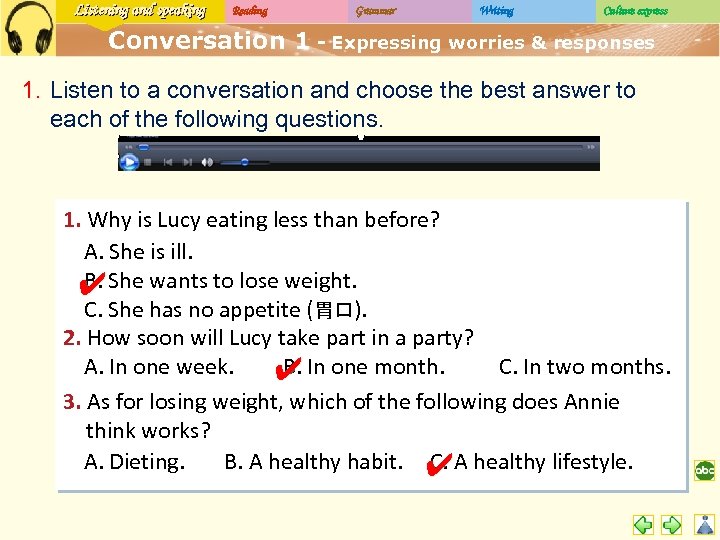 Listening and speaking Reading Grammar Writing Culture express Conversation 1 - Expressing worries & responses 1. Listen to a conversation and choose the best answer to each of the following questions. 1. Why is Lucy eating less than before? A. She is ill. B. She wants to lose weight. ✔ C. She has no appetite (胃口). 2. How soon will Lucy take part in a party? A. In one week. B. In one month. C. In two months. ✔ 3. As for losing weight, which of the following does Annie think works? A. Dieting. B. A healthy habit. ✔ C. A healthy lifestyle.
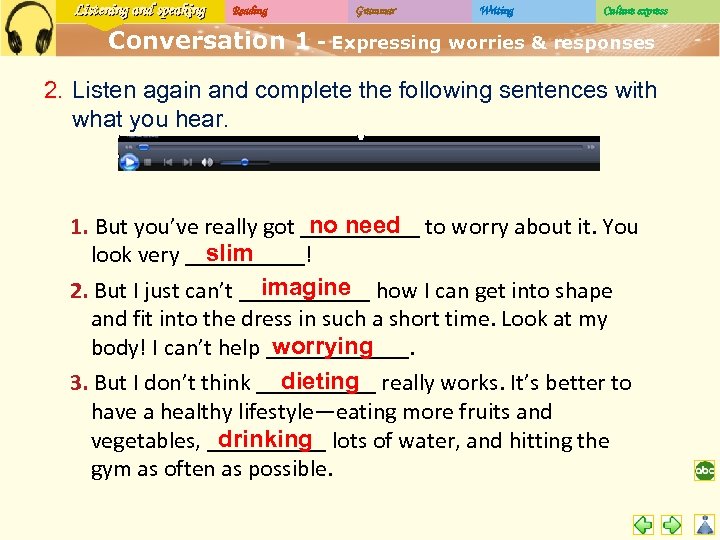 Listening and speaking Reading Grammar Writing Culture express Conversation 1 - Expressing worries & responses 2. Listen again and complete the following sentences with what you hear. no need 1. But you’ve really got _____ to worry about it. You slim look very _____! imagine 2. But I just can’t ______ how I can get into shape and fit into the dress in such a short time. Look at my worrying body! I can’t help ______. dieting 3. But I don’t think _____ really works. It’s better to have a healthy lifestyle—eating more fruits and drinking vegetables, _____ lots of water, and hitting the gym as often as possible.
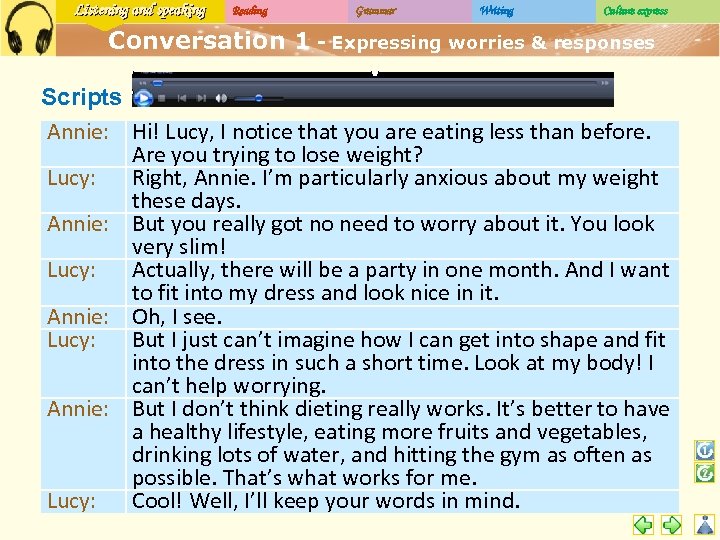 Listening and speaking Reading Grammar Writing Culture express Conversation 1 - Expressing worries & responses Scripts Annie: Hi! Lucy, I notice that you are eating less than before. Are you trying to lose weight? Lucy: Right, Annie. I’m particularly anxious about my weight these days. Annie: But you really got no need to worry about it. You look very slim! Lucy: Actually, there will be a party in one month. And I want to fit into my dress and look nice in it. Annie: Oh, I see. Lucy: But I just can’t imagine how I can get into shape and fit into the dress in such a short time. Look at my body! I can’t help worrying. Annie: But I don’t think dieting really works. It’s better to have a healthy lifestyle, eating more fruits and vegetables, drinking lots of water, and hitting the gym as often as possible. That’s what works for me. Lucy: Cool! Well, I’ll keep your words in mind.
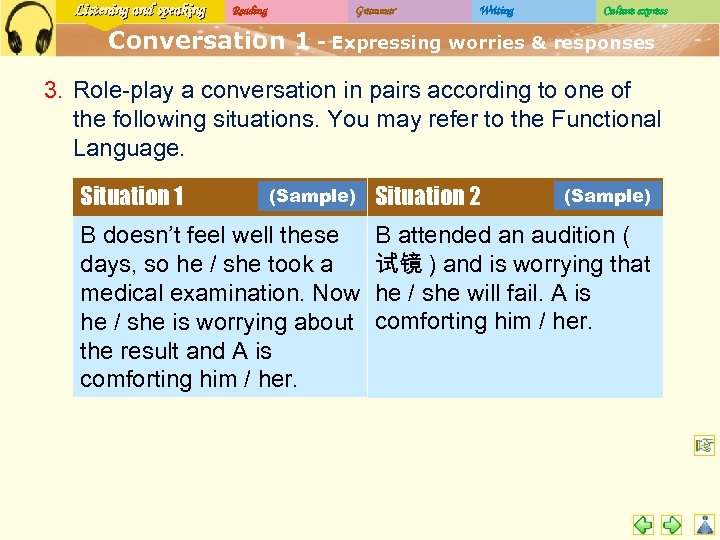 Listening and speaking Reading Grammar Writing Culture express Conversation 1 - Expressing worries & responses 3. Role-play a conversation in pairs according to one of the following situations. You may refer to the Functional Language. Situation 1 (Sample) B doesn’t feel well these days, so he / she took a medical examination. Now he / she is worrying about the result and A is comforting him / her. Situation 2 (Sample) B attended an audition ( 试镜 ) and is worrying that he / she will fail. A is comforting him / her.
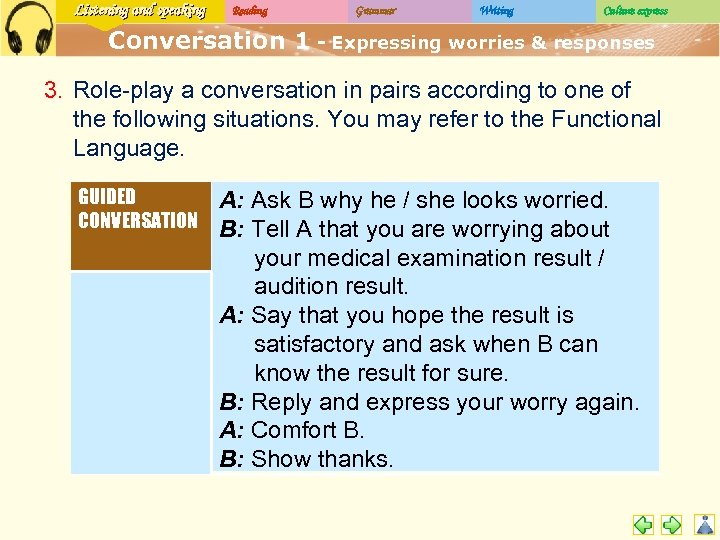 Listening and speaking Reading Grammar Writing Culture express Conversation 1 - Expressing worries & responses 3. Role-play a conversation in pairs according to one of the following situations. You may refer to the Functional Language. GUIDED CONVERSATION A: Ask B why he / she looks worried. B: Tell A that you are worrying about your medical examination result / audition result. A: Say that you hope the result is satisfactory and ask when B can know the result for sure. B: Reply and express your worry again. A: Comfort B. B: Show thanks.
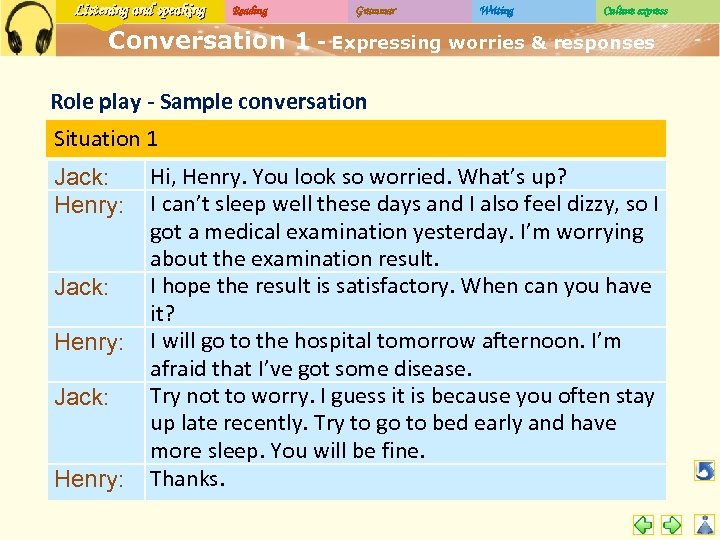 Listening and speaking Reading Grammar Writing Culture express Conversation 1 - Expressing worries & responses Role play - Sample conversation Situation 1 Jack: Henry: Hi, Henry. You look so worried. What’s up? I can’t sleep well these days and I also feel dizzy, so I got a medical examination yesterday. I’m worrying about the examination result. I hope the result is satisfactory. When can you have it? I will go to the hospital tomorrow afternoon. I’m afraid that I’ve got some disease. Try not to worry. I guess it is because you often stay up late recently. Try to go to bed early and have more sleep. You will be fine. Thanks.
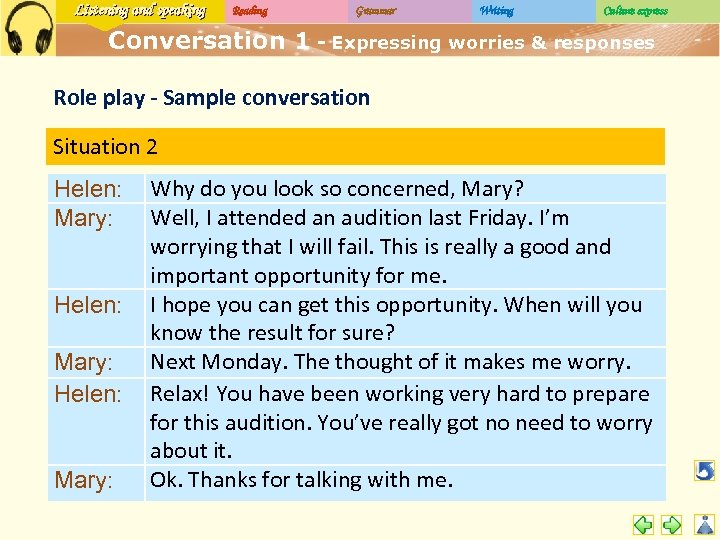 Listening and speaking Reading Grammar Writing Culture express Conversation 1 - Expressing worries & responses Role play - Sample conversation Situation 2 Helen: Mary: Why do you look so concerned, Mary? Well, I attended an audition last Friday. I’m worrying that I will fail. This is really a good and important opportunity for me. I hope you can get this opportunity. When will you know the result for sure? Next Monday. The thought of it makes me worry. Relax! You have been working very hard to prepare for this audition. You’ve really got no need to worry about it. Ok. Thanks for talking with me.
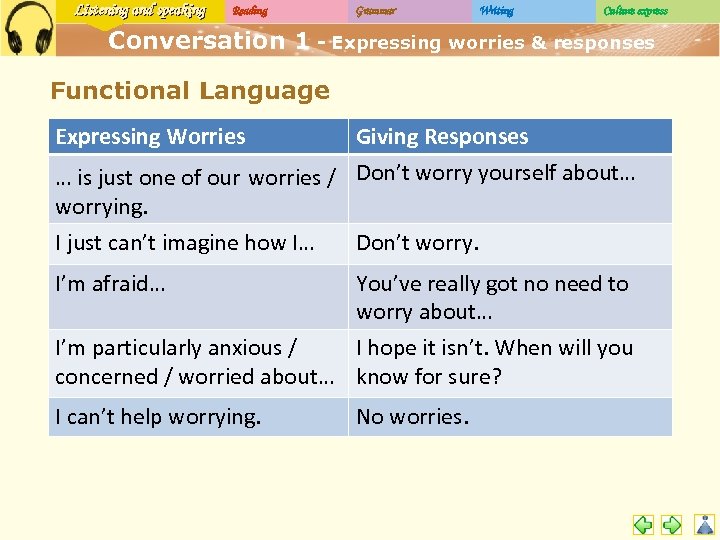 Listening and speaking Reading Grammar Writing Culture express Conversation 1 - Expressing worries & responses Functional Language Expressing Worries Giving Responses … is just one of our worries / Don’t worry yourself about… worrying. I just can’t imagine how I… Don’t worry. I’m afraid… You’ve really got no need to worry about… I’m particularly anxious / I hope it isn’t. When will you concerned / worried about… know for sure? I can’t help worrying. No worries.
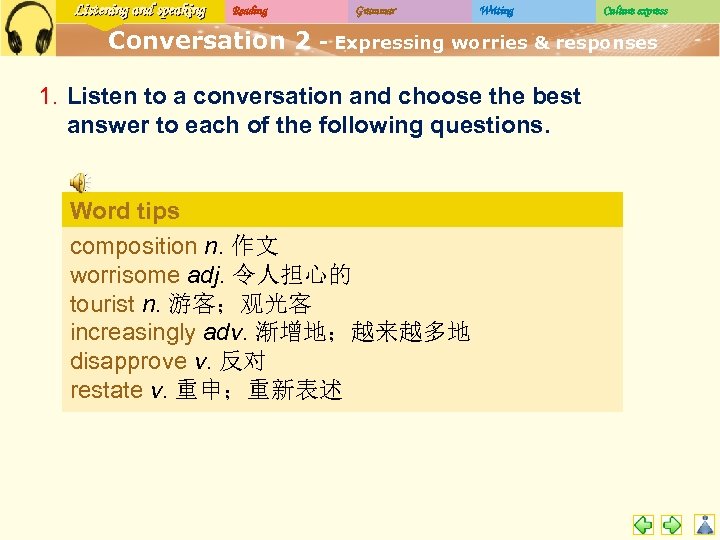 Listening and speaking Reading Conversation 2 Grammar Writing Culture express - Expressing worries & responses 1. Listen to a conversation and choose the best answer to each of the following questions. Word tips composition n. 作文 worrisome adj. 令人担心的 tourist n. 游客;观光客 increasingly adv. 渐增地;越来越多地 disapprove v. 反对 restate v. 重申;重新表述
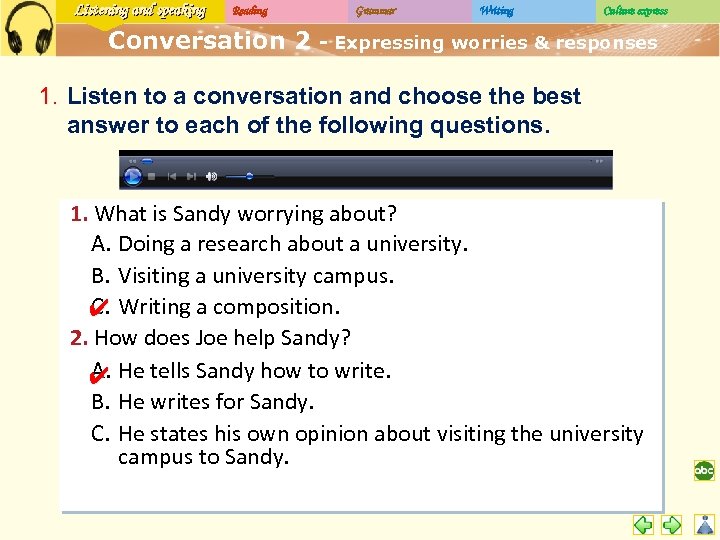 Listening and speaking Reading Conversation 2 Grammar Writing Culture express - Expressing worries & responses 1. Listen to a conversation and choose the best answer to each of the following questions. 1. What is Sandy worrying about? A. Doing a research about a university. B. Visiting a university campus. C. ✔ Writing a composition. 2. How does Joe help Sandy? A. ✔ He tells Sandy how to write. B. He writes for Sandy. C. He states his own opinion about visiting the university campus to Sandy.
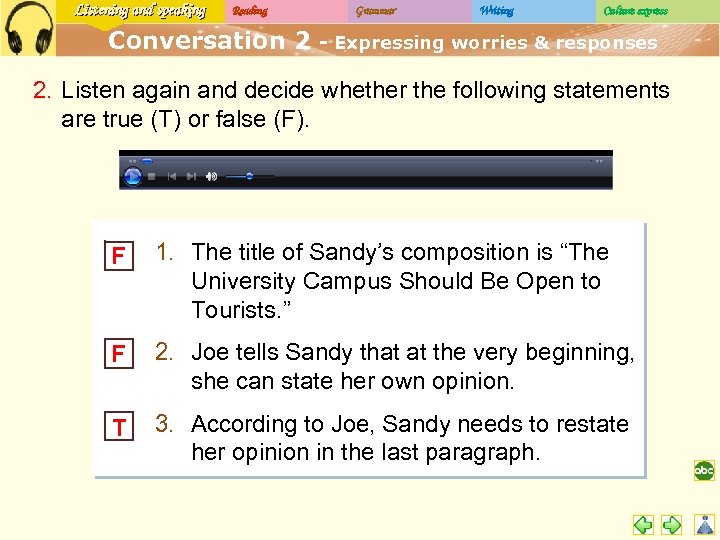 Listening and speaking Reading Conversation 2 Grammar Writing Culture express - Expressing worries & responses 2. Listen again and decide whether the following statements are true (T) or false (F). F 1. The title of Sandy’s composition is “The University Campus Should Be Open to Tourists. ” F 2. Joe tells Sandy that at the very beginning, she can state her own opinion. T 3. According to Joe, Sandy needs to restate her opinion in the last paragraph.
 Listening and speaking Reading Conversation 2 Grammar Writing Culture express - Expressing worries & responses Scripts Joe: Sandy: Joe: Sandy, what’s the matter? You don’t look well. Oh, Joe, I’m worried about my homework. What is it? Is it very difficult to do? At least it is not easy for me. It is a composition. We need to hand it in tomorrow morning. It’s really worrisome. There is nothing to worry about. Tell me what it is about. The title of the composition is “Should the university campus be open to tourists? ”. Just the thought of writing such a composition makes me worry.
 Listening and speaking Reading Conversation 2 Grammar Writing Culture express - Expressing worries & responses Scripts Joe: Sandy: Try not to worry. I’ll give you a hand. In the first paragraph you can just state that visiting universities has become increasingly popular. But I don’t think that university campus should be open to tourists. OK. Very good. Then state your own opinion in the following part. And give your reasons why you disapprove. Two or three reasons should be enough. In the last paragraph, just restate your opinion. That doesn’t sound so hard. I’ll try it. Thank you for your help.
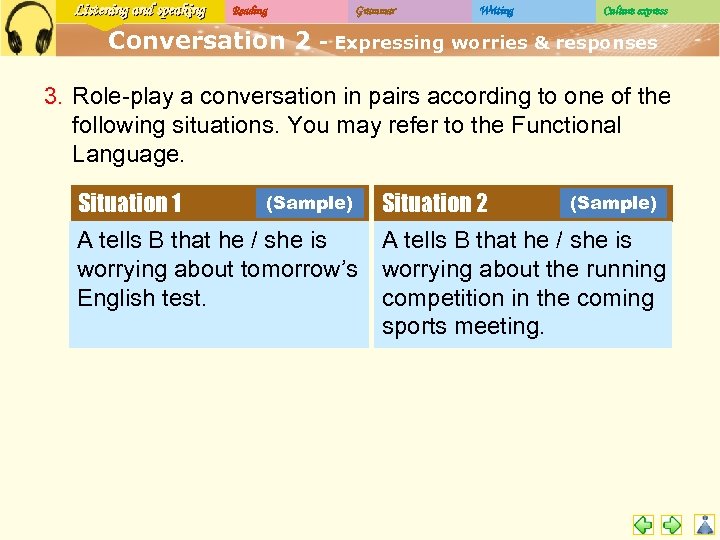 Listening and speaking Reading Conversation 2 Grammar Writing Culture express - Expressing worries & responses 3. Role-play a conversation in pairs according to one of the following situations. You may refer to the Functional Language. Situation 1 (Sample) Situation 2 A tells B that he / she is worrying about tomorrow’s worrying about the running competition in the coming English test. sports meeting. (Sample)
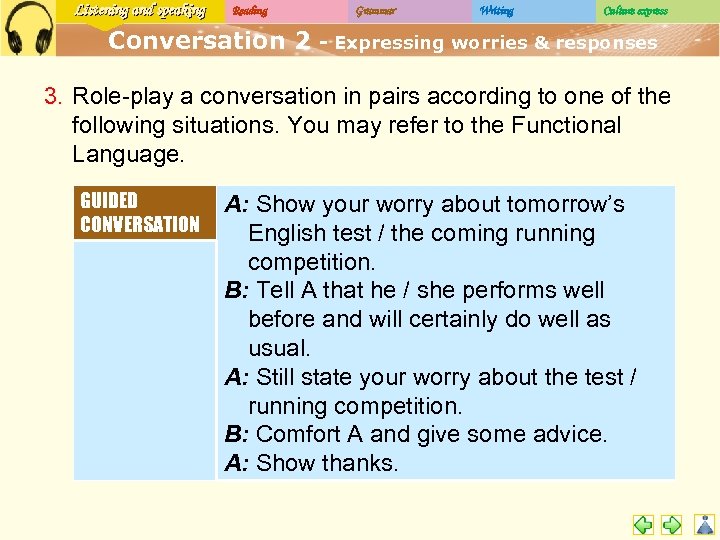 Listening and speaking Reading Conversation 2 Grammar Writing Culture express - Expressing worries & responses 3. Role-play a conversation in pairs according to one of the following situations. You may refer to the Functional Language. GUIDED CONVERSATION A: Show your worry about tomorrow’s English test / the coming running competition. B: Tell A that he / she performs well before and will certainly do well as usual. A: Still state your worry about the test / running competition. B: Comfort A and give some advice. A: Show thanks.
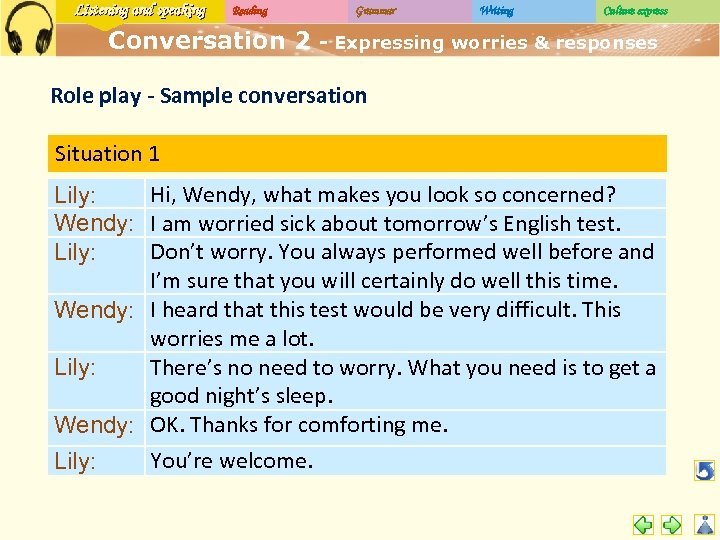 Listening and speaking Reading Conversation 2 Grammar Writing Culture express - Expressing worries & responses Role play - Sample conversation Situation 1 Hi, Wendy, what makes you look so concerned? Lily: Wendy: I am worried sick about tomorrow’s English test. Don’t worry. You always performed well before and Lily: I’m sure that you will certainly do well this time. Wendy: I heard that this test would be very difficult. This worries me a lot. There’s no need to worry. What you need is to get a Lily: good night’s sleep. Wendy: OK. Thanks for comforting me. You’re welcome. Lily:
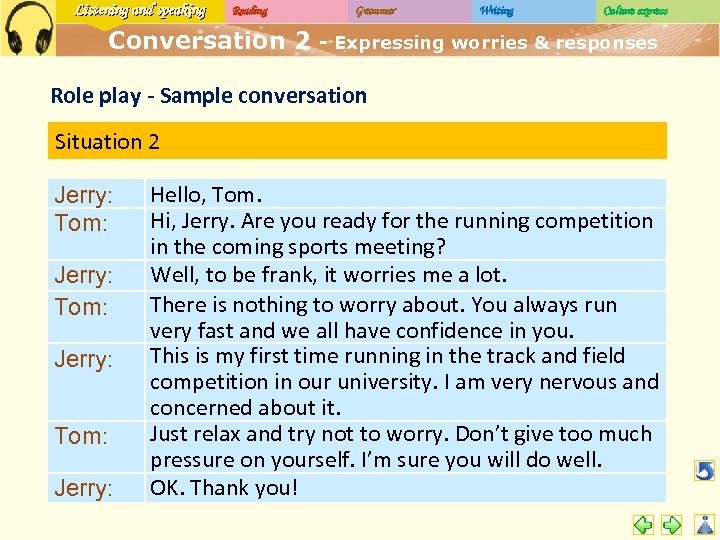 Listening and speaking Reading Conversation 2 Grammar Writing Culture express - Expressing worries & responses Role play - Sample conversation Situation 2 Jerry: Tom: Jerry: Hello, Tom. Hi, Jerry. Are you ready for the running competition in the coming sports meeting? Well, to be frank, it worries me a lot. There is nothing to worry about. You always run very fast and we all have confidence in you. This is my first time running in the track and field competition in our university. I am very nervous and concerned about it. Just relax and try not to worry. Don’t give too much pressure on yourself. I’m sure you will do well. OK. Thank you!
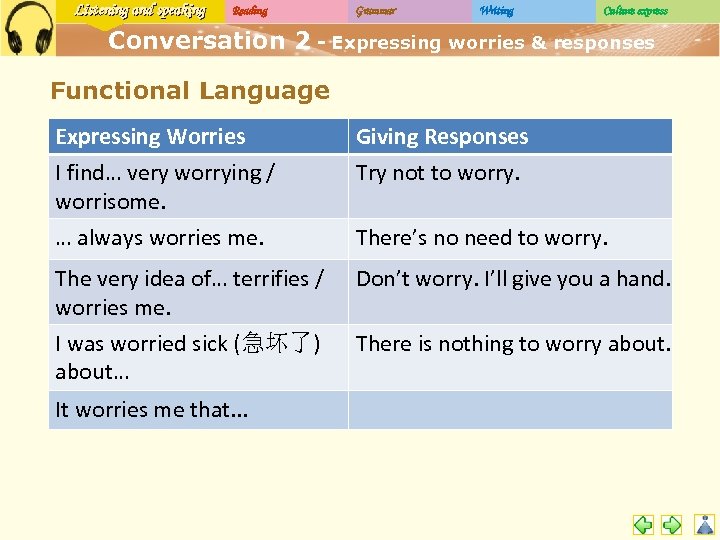 Listening and speaking Reading Grammar Writing Culture express Conversation 2 - Expressing worries & responses Functional Language Expressing Worries I find… very worrying / worrisome. Giving Responses Try not to worry. … always worries me. There’s no need to worry. The very idea of… terrifies / worries me. Don’t worry. I’ll give you a hand. I was worried sick (急坏了) about… There is nothing to worry about. It worries me that. . .
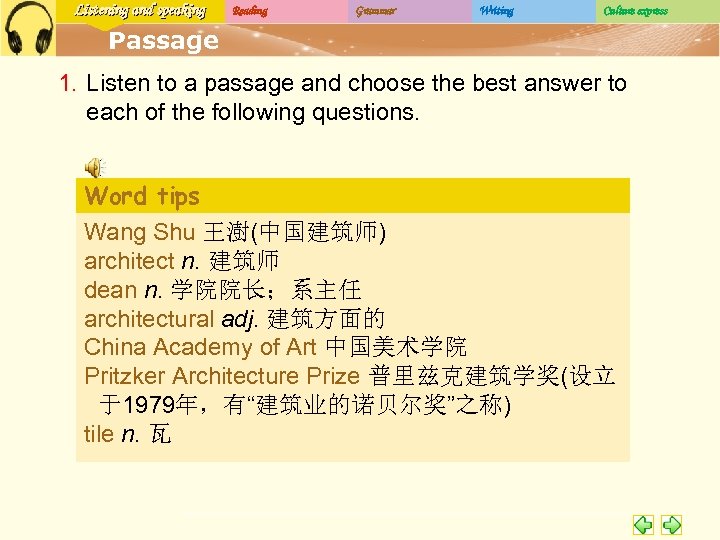 Listening and speaking Reading Grammar Writing Culture express Passage 1. Listen to a passage and choose the best answer to each of the following questions. Word tips Wang Shu 王澍(中国建筑师) architect n. 建筑师 dean n. 学院院长;系主任 architectural adj. 建筑方面的 China Academy of Art 中国美术学院 Pritzker Architecture Prize 普里兹克建筑学奖(设立 于1979年,有“建筑业的诺贝尔奖”之称) tile n. 瓦
 Listening and speaking Reading Grammar Writing Culture express Passage 1. Listen to a passage and choose the best answer to each of the following questions. 1 When was Wang Shu born? A On November 4 th, 1963. ✔ B On November 14 th, 1963. C On November 4 th, 1936. 2 When did Wang win the Pritzker Architecture Prize? A In 2002. ✔ B In 2012. C In 1992. 3 What does Wang use to create modern buildings? A Chinese history and culture. B A new language for Chinese architecture. C Traditional Chinese materials and techniques. ✔
 Listening and speaking Reading Grammar Writing Culture express Passage 2. Listen again and decide whether the following statements are true (T) or false (F). T 1. Chinese people never won the Pritzker Architecture Prize before Wang did. F 2. In order to design architecture with his own feature, Wang looks toward the West for inspiration. T 3. Wang’s success will hopefully inspire other Chinese architects to follow in his footsteps— pay more attention to Chinese history and culture.
 Listening and speaking Reading Grammar Writing Culture express Passage Scripts Wang Shu, born on November 4 th, 1963 in Urumqi, Xinjiang, is a famous architect in China. He is also the dean of the School of Architectural Art of the China Academy of Art. In 2012, Wang became the first Chinese citizen to win the Pritzker Architecture Prize, the world’s top prize in architecture. Instead of looking toward the west for inspiration, Wang tries to develop a new language for Chinese architecture. He roots his works in Chinese history and culture, and creates modern buildings by making use of traditional materials and techniques. For instance, the Xiangshan campus of Hangzhou’s China Academy of Art he designed, has a roof built with 2, 000 tiles collected from traditional houses. Wang’s success, to some extent, can inspire other Chinese architects to follow in his footsteps.
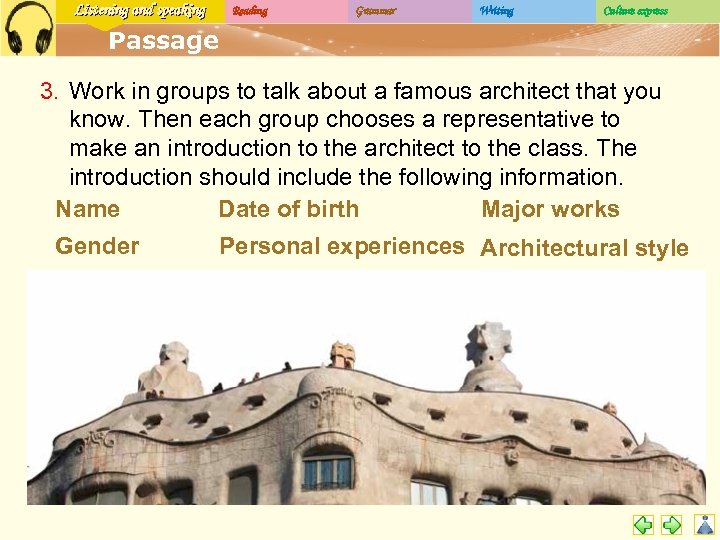 Listening and speaking Reading Grammar Writing Culture express Passage 3. Work in groups to talk about a famous architect that you know. Then each group chooses a representative to make an introduction to the architect to the class. The introduction should include the following information. Name Date of birth Major works Gender Personal experiences Architectural style
 Listening and speaking Reading Grammar Writing Culture express Passage 3. Work in groups to talk about a famous architect that you know. Then each group chooses a representative to make an introduction to the architect to the class. The introduction should include the following information. The architect that I’m going to introduce is Jorn Utzon, the architect who designed the Sydney Opera House. Jorn Utzon was born on April 9, 1918 in Copenhagen, Denmark. He received his Diploma in Architecture from the Royal Danish Academy of Fine Arts, Copenhagen. He once worked in Sweden until the end of World War II and returned to Copenhagen in 1950 to open his own architectural practice. Jorn Utzon died in Copenhagen on November 29, 2008.
 Listening and speaking Reading Grammar Writing Culture express Passage 3. Work in groups to talk about a famous architect that you know. Then each group chooses a representative to make an introduction to the architect to the class. The introduction should include the following information. His legacy lives on through the Sydney Opera House as well as the many other magnificent structures he designed around the world, like Bagsvaerd Church and the Paustian Furniture Store in Copenhagen. Utzon always considers site conditions and program requirements before he designs each building. He transcends architecture as art and develops his forms into poetic inventions that possess thoughtful programming, structural integrity, and sculptural harmony.
 Listening and speaking Reading Grammar Writing Culture express l Passage A Chinese architect wins major prize l Passage B The Great Wall
 Listening and speaking Reading Grammar Writing Culture express Passage A Chinese architect wins major prize l Lead-in l Text study l Exercises
 Listening and speaking Reading Passage A Grammar Writing Culture express – Chinese architect wins major prize Lead-in l Architecture appreciation l Extended reading l Pre-reading questions
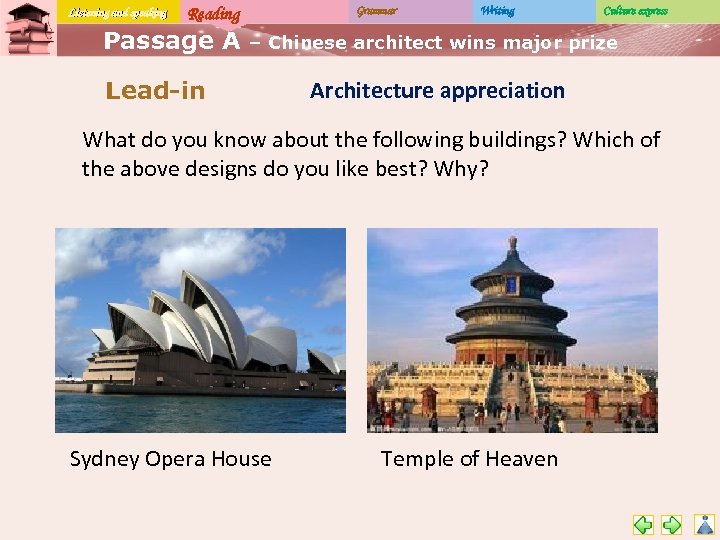 Listening and speaking Reading Passage A Grammar Writing Culture express – Chinese architect wins major prize Lead-in Architecture appreciation What do you know about the following buildings? Which of the above designs do you like best? Why? Sydney Opera House Temple of Heaven
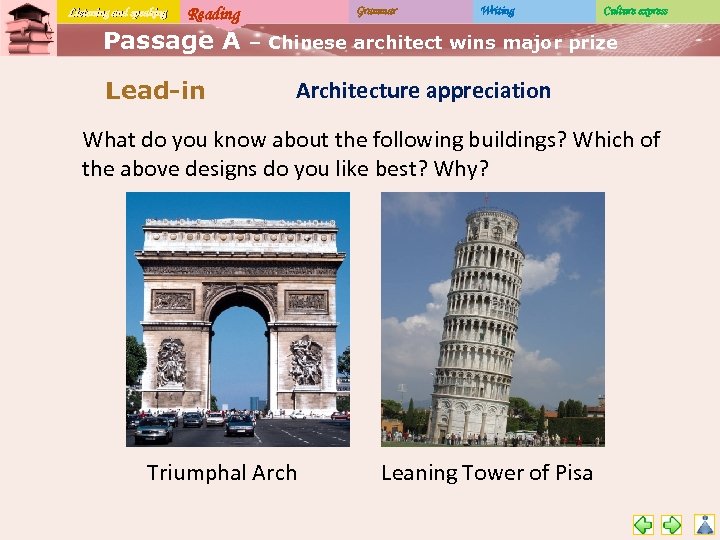 Listening and speaking Reading Passage A Lead-in Grammar Writing Culture express – Chinese architect wins major prize Architecture appreciation What do you know about the following buildings? Which of the above designs do you like best? Why? Triumphal Arch Leaning Tower of Pisa
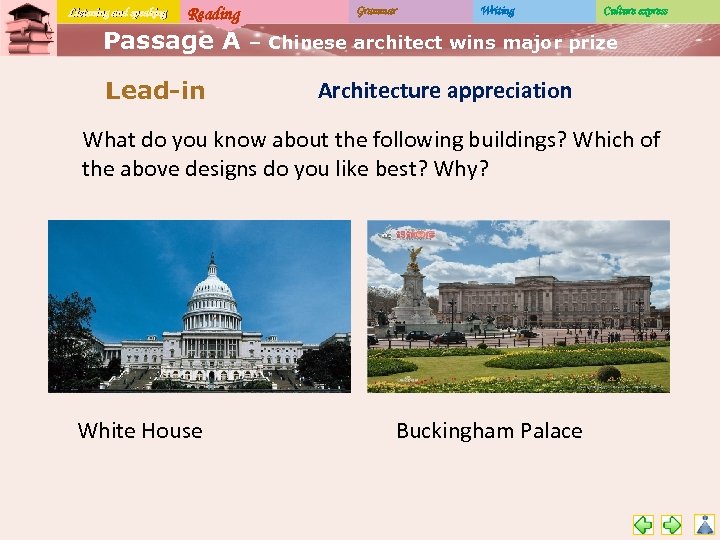 Listening and speaking Reading Passage A Lead-in Grammar Writing Culture express – Chinese architect wins major prize Architecture appreciation What do you know about the following buildings? Which of the above designs do you like best? Why? White House Buckingham Palace
 Listening and speaking Reading Passage A Lead-in Grammar Writing Culture express – Chinese architect wins major prize - Extended reading An Unusual Architect—Leoh Ming Pei 非凡的建筑师—贝聿铭 Leoh Ming Pei, the 1983 Laureate of the Pritzker Architecture Prize, is a founding partner of I. M. Pei & Partners based in New York City. He was born in China in 1917, the son of a prominent banker. He came to the United States in 1935 to study architecture at the Massachusetts Institute of Technology (B. Arch. 1940) and the Harvard Graduate School of Design (M. Arch. 1946). 贝聿铭: 1983年普里茨克尔建筑奖的获得者,是纽约贝聿铭 股份公司的创建人之一。他 1917年生于中国,其父是一位出色的 银行家。1935年他来到美国,在麻省理 学院(1940年获建筑学 学士)和哈佛设计研究生院(1946年获建筑学硕士)学习建筑。
 Listening and speaking Reading Passage A Lead-in Grammar Writing Culture express – Chinese architect wins major prize - Extended reading Pei has designed over forty projects in this country and abroad, twenty of which have been award winners. His more prominent commissions have included the East Building of the National Gallery of Art, Washington, D. C. ; the John Fitzgerald Kennedy Library near Boston; the National Center for Atmospheric Research, Boulder, Colorado; the Dallas City Hall in Texas; 贝聿铭在国内外设计了四十多个建筑项目。其中二十项 曾获奖。更为出色的受委托项目包括华盛顿国家艺术馆东楼; 波斯顿附近的约翰 • 菲茨杰拉德 • 肯尼迪图书馆;科罗拉多博 耳德的国家大气研究中心;德克萨斯的达拉斯市政厅;
 Listening and speaking Reading Passage A Lead-in Grammar Writing Culture express – Chinese architect wins major prize - Extended reading the Oversea-Chinese Banking Corporation Centre (OCBC) and Raffles City in Singapore; the West Wing of the Museum of Fine Arts, Boston; the Fragrant Hill Hotel near Beijing, China, designed to graft advanced technology onto the roofs of indigenous building and thereby sow the seed of a new , distinctly Chinese form of modern architecture; the Everson Museum of Art, Syracuse , New York; and the Texas Commerce Tower in Houston. 海外华人银行业务中心股份有限公司(OCBC)及新加坡的莱 弗斯城;波士顿美术博物馆西翼;中国北京附近的香山饭店, 该设计将先进技术用于传统的屋顶上从而开创出一种新的, 有鲜明中国特色的现代建筑形式;纽约州锡拉丘兹的埃弗松 艺术博物馆;以及休斯敦的德克萨斯商业城。
 Listening and speaking Reading Passage A Lead-in Grammar Writing Culture express – Chinese architect wins major prize - Extended reading He has designed arts facilities and university buildings on the campuses of the Massachusetts Institute of Technology, the University of Rochester, Cornell University, the Choate School, Syracuse University, New York University and the University of Hawaii. He has been selected to design the headquarters for the Bank of China in Hong Kong. 在麻省理 学院、罗切斯特大学、康奈尔大学、乔 特学校、锡拉丘兹大学、乔特学校、锡拉丘兹大学、纽 约大学和夏威夷大学的校园里,他曾设计了艺术场所和 大学建筑。他还被选中设计了香港中国银行总部。
 Listening and speaking Reading Passage A Lead-in Grammar Writing Culture express – Chinese architect wins major prize - Extended reading Pei is currently a member of the National Council on the Arts, and previously served on the National Council on the Humanities. He is a Fellow of the American Institute of Architects, a member of the Royal Institute of British Architects, and an elected member of the American Academy of Arts and Letters (of which he served a term as Chancellor), the American Academy of Arts and Sciences, and the National Academy of Design. He is a member of the Corporation of the Massachusetts Institue of Technology. 贝聿铭目前是国家艺术理事会成员,此前他任职于人文 学科全国理事会。他是美国建筑师协会会员、英国建筑师皇 家研究院成员、美国艺术与文学学院(其间他任了一届的名 誉院长)、美国艺术与科学学院和国家设计学院的推举成员。 他是麻省理 学院校务委员会成员。
 Listening and speaking Reading Passage A Grammar Writing Culture express – Chinese architect wins major prize Pre-reading questions 1. Do you know any famous architects? Can you introduce us about their personal experiences, architectural style and their major works? 2. What do you know about Chinese architecture? 3. Can you list some famous architecture in the world? 4. Which Chinese architecture is of greatest architectural interest to you? Do you know its stories or histories?
 Listening and speaking Reading Passage A Grammar Writing Culture express – Chinese architect wins major prize Text study l Text reading l Language points
 Listening and speaking Reading Grammar Writing Culture express Passage A Chinese architect wins major prize 1. I_____________________ was delighted to hear the recent news that the Chinese architect, Wang Shu, had been awarded the ________________________ Pritzker Architecture Prize. ____________ 2 A. _______________________ As a Canadian architect working on many projects throughout China over the last 15 years, I have been ________________________ fortunate to work together with many great Chinese architects and artists. I was not so surprised to hear the ________________________ news as I have witnessed a cultural renaissance in the _________________________ arts in China, in particular, in the fields of contemporary art and architecture. ________________
 Listening and speaking Reading Grammar Writing Culture express Passage A Chinese architect wins major prize 2 B. I continue to be amazed by the hunger in the creative community here for individual and cultural expression. Walking through Beijing’s 798 Art District, you can almost feel an energy in contemporary art and culture. I think the award is also timely, as we witness the “coming home” of a highly educated generation of Chinese architects. They have learned their craft both abroad and in China. This generation no longer needs to envy foreign architects for designing leading projects in their homeland.
 Listening and speaking Reading Grammar Writing Culture express Passage A Chinese architect wins major prize 3. Sure, we live in a global culture, and there will always be an interest in international cooperation in China. But ___ the days of Chinese architects sitting in the background _________________________ with the task of working out the construction details of _________________________ someone else’s vision are quickly coming to an end. _______________________ Wang’s award is a very positive sign for China. Who can interpret the regional and cultural forces better than those living among them?
 Listening and speaking Reading Grammar Writing Culture express Passage A Chinese architect wins major prize 4 A. _________________________ Perhaps we are witnessing a turning point, a time when _______________________ China can draw upon its own culture-makers, rather than depending on the ideas and cultural interpretations _________________________ of China from those abroad. I am particularly pleased ____________ that, of all the great architectural talent in China, Wang was given the nod. For me, his greatest contribution is ________________ in how he uses his creative power to balance the ______________________ interpretation of regional and cultural influences with his _________________________ His designs are bold highly artful and personal vision. contemporary solutions, yet tap into the memory and history of place.
 Listening and speaking Reading Grammar Writing Culture express Passage A Chinese architect wins major prize 4 B. I am sometimes troubled by what I see being built in _______________________ cities like Beijing, Shanghai, and elsewhere in China, ________________________ which have almost become a foreign architect’s playground. The designs are often featureless, and _____ could easily have been built in Houston, Amsterdam, or Vancouver. Wang’s work stands as an example of what China needs to be doing more of: providing buildings that speak to the land, culture, people, and sense of place.
 Listening and speaking Reading Grammar Writing Culture express Passage A Chinese architect wins major prize 5. It is interesting to see that the tables have now turned. In the past, young Chinese architects have been eagerly learning from Western works. Now foreign architects are being inspired and influenced by Wang’s works. 6. This award will surely inspire young Chinese designers to have confidence in themselves. They no longer need to look abroad to decide what kind of creative “language” is suitable for China’s bright future.
 Listening and speaking Reading Passage A Grammar Writing Culture express – Chinese architect wins major prize I was delighted to hear the recent news that the Chinese architect, Wang Shu, had been awarded the Pritzker Architecture Prize. (Line 1, Para. 1) 中国建筑师王澍近日荣获普里兹克建筑学奖,喜讯传 来,我非常欣喜。 be delighted to 很高兴做某事 I was delighted to see my old friend. delighted 是由动词delight 加-ed 构成的形容词。有类 似用法的单词还有surprise + ed=surprised, amaze + ed=amazed,astonish + ed=astonished。 the recent news 后面接了一个that 引导的同位语从句。
 Listening and speaking Reading Passage A Grammar Writing Culture express – Chinese architect wins major prize As a Canadian architect working on many projects throughout China over the last 15 years, I have been fortunate to work together with many great Chinese architects and artists. (Line 1, Para. 2) 作为一名加拿大建筑师,我在过去的15年间参与了中 国各地的众多 程项目,曾有幸与中国许多杰出的建 筑师和艺术家们一起 作。 as 用作介词,意思为作为;以···的身份 作为大学的校长,斯密斯教授非常负责任。 As the president of this university, Prof. Smith is very responsible.
 Listening and speaking Reading Passage A Grammar Writing Culture express – Chinese architect wins major prize I was not so surprised to hear the news as I have witnessed a cultural renaissance in the arts in China, in particular, in the fields of contemporary art and architecture. (Line 4, Para. 2) 听到这个消息我并不感到意外,因为我亲眼目睹了中 国艺术界的一场“文化复兴”,尤其是在当代艺术和 建筑领域。 as 用作连词,意思为由于;因为 因为你不在那里,我留了个信息。 As you weren’t there, I left a message.
 Listening and speaking Reading Passage A Grammar Writing Culture express – Chinese architect wins major prize But the days of Chinese architects sitting in the background with the task of working out the construction details of someone else’s vision are quickly coming to an end. (Line 2, Para. 3) 但是,过去中国建筑设计师坐在幕后兢兢业业为别人 的梦想而打点细枝末节的日子就要一去不复返了。 这句话的主语是 the days,谓语是 are coming to an end。the days 后的of 引导的介词短语作后置定语, 修饰the days。 sitting in the background 是现在分词短语作定语,修 饰Chinese architects;with the task of. . . 表伴随, 作动词sit 的伴随状语。
 Listening and speaking Reading Passage A Grammar Writing Culture express – Chinese architect wins major prize Perhaps we are witnessing a turning point, a time when China can draw upon its own culture-makers, rather than depending on the ideas and cultural interpretations of China from those abroad. (Line 1, Para. 4) 也许我们正见证着一个转折,在这个时代中,中国不 再依赖于国外人士对其理念和文化的阐释,转而寄希 望于本国的文化制造者。 a time 后面接了一个when 引导的定语从句。 rather than 而不是 鲍勃决定退出,而不是接受新规则。 Bob decided to quit rather than accept the new rules.
 Listening and speaking Reading Passage A Grammar Writing Culture express – Chinese architect wins major prize For me, his greatest contribution is in how he uses his creative power to balance the interpretation of regional and cultural influences with his highly artful and personal vision. (Line 5, Para. 4) 在我看来,他最大的贡献在于他是如何运用自己的创 造力和有独特品味的个人视角,找到了诠释地域和文 化影响的平衡点。 in 在这里表示在···方面。文中in 后面接了一个宾语从 句,该从句使用的是陈述语序。 balance sth. with sth. : 使···和···均衡,协调 他们需要协调好伐木 作和森林生态系统。 They need to find a balance between logging jobs and the forest ecosystem.
 Listening and speaking Reading Passage A Grammar Writing Culture express – Chinese architect wins major prize I am sometimes troubled by what I see being built in cities like Beijing, Shanghai, and elsewhere in China, which have almost become a foreign architect’s playground. (Line 10, Para. 4) 我有时会为自己在北京、上海及其他一些中国城市所 看到的在建项目而忧虑,因为那些地方俨然已成了外 国建筑设计师的游乐园。 介词by 之后跟了一个what 引导的宾语从句。 She was shocked by what she had seen. which 在句中引导了一个非限制性定语从句,先行词 是cities。
 Listening and speaking Reading Passage A award Grammar Writing Culture express – Chinese architect wins major prize (Line 2, Para. 1) 1) v. to give sb. a prize or other reward because he / she has achieved sth. 授予;给予; 冠军被授予了金牌。 The champion was awarded the gold medal. 2) n. a prize or money given to sb. for sth. that he / she has achieved 奖;奖金 孩子接过奖品时对老师微笑。 The child smiled at his teacher as he received the award.
 Listening and speaking Reading Passage A witness Grammar Writing Culture express – Chinese architect wins major prize (Line 5, Para. 2) 1) v. to see sth. happen, especially an accident or a crime 亲眼 看到;目击 有谁目击了这场交通事故? Did anyone witness the traffic accident? 2) n. sb. who saw an accident or a crime 目击者正在讲述整个事故的过程。 The witness was telling about the whole accident.
 Listening and speaking Reading Passage A hunger Grammar Writing Culture express – Chinese architect wins major prize (Line 7, Para. 2) 1) n. a strong need or desire forsth. 渴求;渴望 他对求知的强烈渴望驱使他上图书馆。 His hunger for knowledge drove him to the library. 2) vt. & vi. make hungry (使)饥饿 没有食物了, 他们不得不让孩子们挨饿。 There is no food; they have to hunger the children.
 Listening and speaking Reading Passage A individual Grammar Writing Culture express – Chinese architect wins major prize (Line 8, Para. 2) 1) adj. belonging to or intended for one person rather than a group 个人的 他们等待团体作决定而不是各自作出决定。 They wait for the group to decide rather than making individual decisions. 2) n. [C] single human being 个人 孩子的个体意识在入学前的几年中逐渐增强。 A child's awareness of being an individual grows in stages during the pre-school years.
 Listening and speaking Reading Passage A interpret Grammar Writing Culture express – Chinese architect wins major prize (Line 1, Para. 3) 1) vt. to explain or decide on the meaning of an event, statement, etc. 说明;阐明 她把他的沉默解释为傲慢。 She interpret his silence as arrogance. 2) vt. & vi. to change words spoken in one language into another 口译 在联合国做口译是件难 度很大的差事。 To interpret at the UN is a difficult task.
 Listening and speaking Reading Passage A draw upon Grammar Writing Culture express – Chinese architect wins major prize (Line 2, Para. 4) to use your money, experiences, etc. to help you do sth. 利用; 使用 她将不得不拿出自己全部的勇气和决心。 She would have to draw upon all her courage and determination. 作为 演员 ,你必须 利用自己的经验 去塑造可信的角色。 As an actor, you have to draw upon your experience to create believable characters.
 Listening and speaking Reading Passage A tap into Grammar Writing Culture express – Chinese architect wins major prize (Line 9, Para. 4) to use or take what you need from a supply of sth. 利用;开发 我很想探寻 海外市场 。 I'd really like to tap into the overseas market. 你如何才能利用好这 些资 源呢? How can you tap into this resource?
 Listening and speaking Reading Passage A turn the tables Grammar Writing Culture express – Chinese architect wins major prize (Line 1, Para. 5) to change a situation completely so that sb. loses an advantage and you gain one 扭转局面;转败为胜 这 能够让 他以让 人惊讶 的方式转败为胜 。 This enables him to turn the tables in a surprising way. 希望在下场 比赛 后我们 能扭转 局面并再次获 得胜 利。 Hopefully we can turn the tables in the next race and fight for a win again.
 Listening and speaking Reading Passage A Grammar Writing – Exercises l Comprehension l Vocabulary & Structure l Translation Culture express
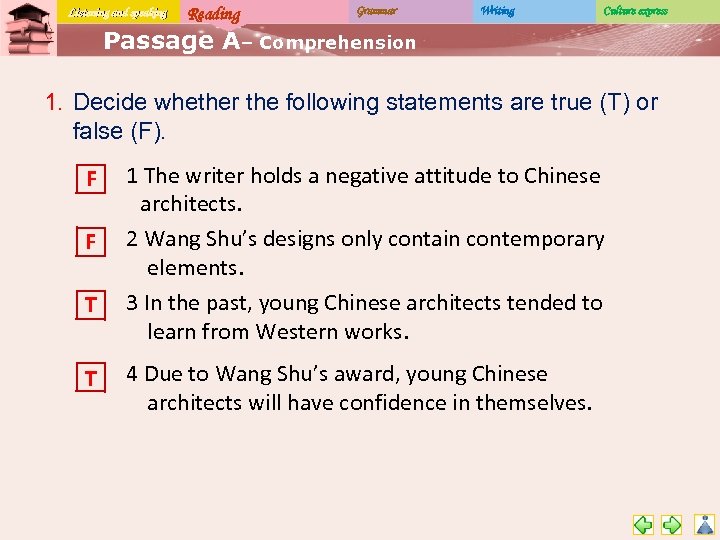 Listening and speaking Reading Grammar Writing Culture express Passage A– Comprehension 1. Decide whether the following statements are true (T) or false (F). F F T T 1 The writer holds a negative attitude to Chinese architects. 2 Wang Shu’s designs only contain contemporary elements. 3 In the past, young Chinese architects tended to learn from Western works. 4 Due to Wang Shu’s award, young Chinese architects will have confidence in themselves.
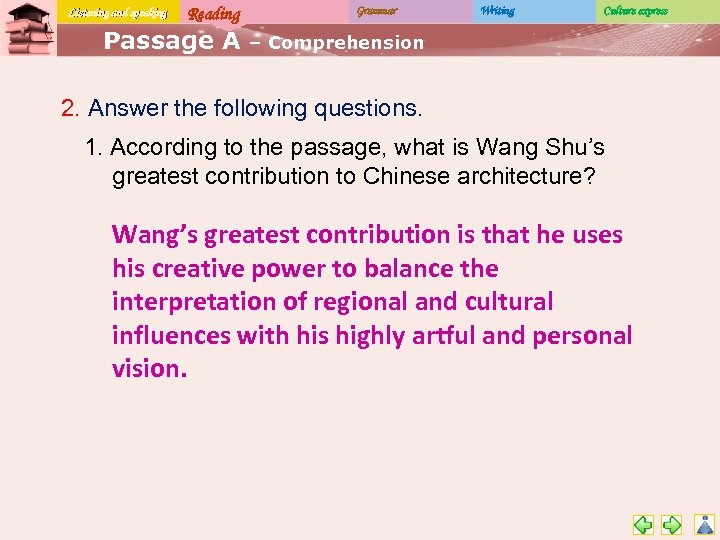 Listening and speaking Reading Passage A Grammar Writing Culture express – Comprehension 2. Answer the following questions. 1. According to the passage, what is Wang Shu’s greatest contribution to Chinese architecture? Wang’s greatest contribution is that he uses his creative power to balance the interpretation of regional and cultural influences with his highly artful and personal vision.
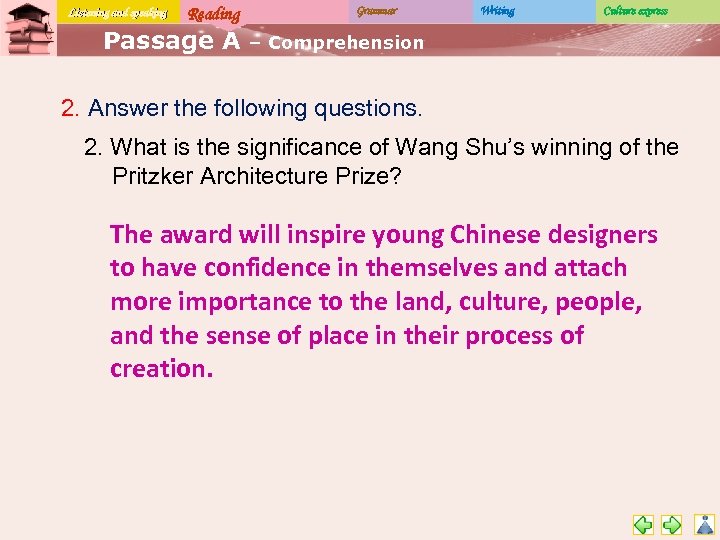 Listening and speaking Reading Passage A Grammar Writing Culture express – Comprehension 2. Answer the following questions. 2. What is the significance of Wang Shu’s winning of the Pritzker Architecture Prize? The award will inspire young Chinese designers to have confidence in themselves and attach more importance to the land, culture, people, and the sense of place in their process of creation.
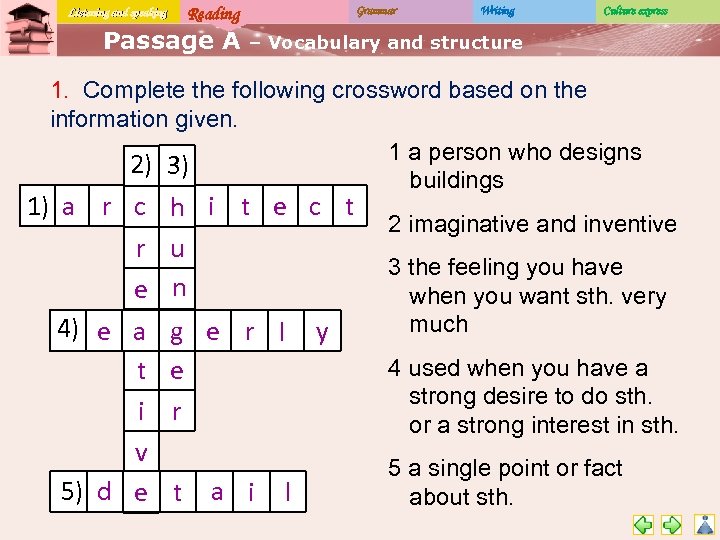 Listening and speaking Reading Passage A Grammar Writing Culture express – Vocabulary and structure 1. Complete the following crossword based on the information given. 1 a person who designs 2) 3) buildings 1) a r c h i t e c t r u e n 4) e a g e r l y t e i r v 5) d e t a i l 2 imaginative and inventive 3 the feeling you have when you want sth. very much 4 used when you have a strong desire to do sth. or a strong interest in sth. 5 a single point or fact about sth.
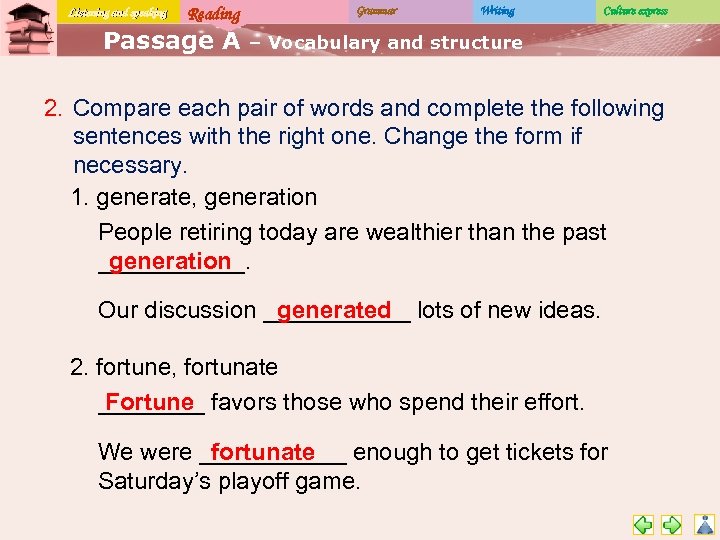 Listening and speaking Reading Passage A Grammar Writing Culture express – Vocabulary and structure 2. Compare each pair of words and complete the following sentences with the right one. Change the form if necessary. 1. generate, generation People retiring today are wealthier than the past generation ______. Our discussion ______ lots of new ideas. generated 2. fortune, fortunate ____ favors those who spend their effort. Fortune We were ______ enough to get tickets fortunate Saturday’s playoff game.
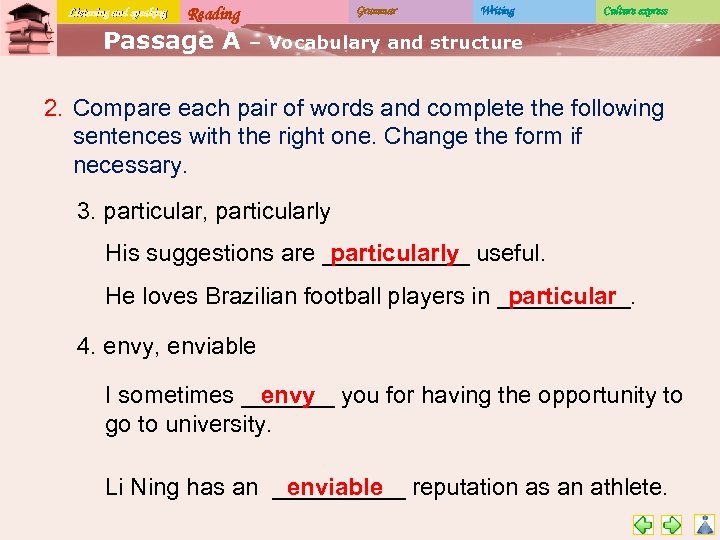 Listening and speaking Reading Passage A Grammar Writing Culture express – Vocabulary and structure 2. Compare each pair of words and complete the following sentences with the right one. Change the form if necessary. 3. particular, particularly His suggestions are ______ useful. He loves Brazilian football players in _____. particular 4. envy, enviable I sometimes _______ you for having the opportunity to envy go to university. Li Ning has an _____ reputation as an athlete. enviable
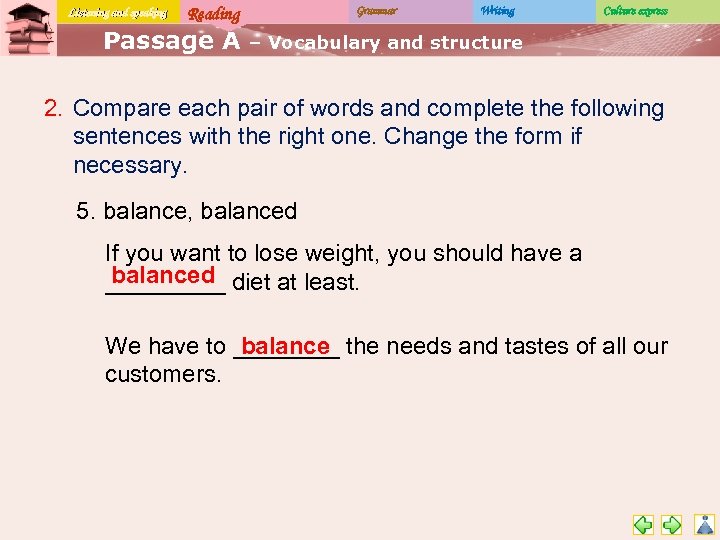 Listening and speaking Reading Passage A Grammar Writing Culture express – Vocabulary and structure 2. Compare each pair of words and complete the following sentences with the right one. Change the form if necessary. 5. balance, balanced If you want to lose weight, you should have a balanced _____ diet at least. We have to ____ the needs and tastes of all our balance customers.
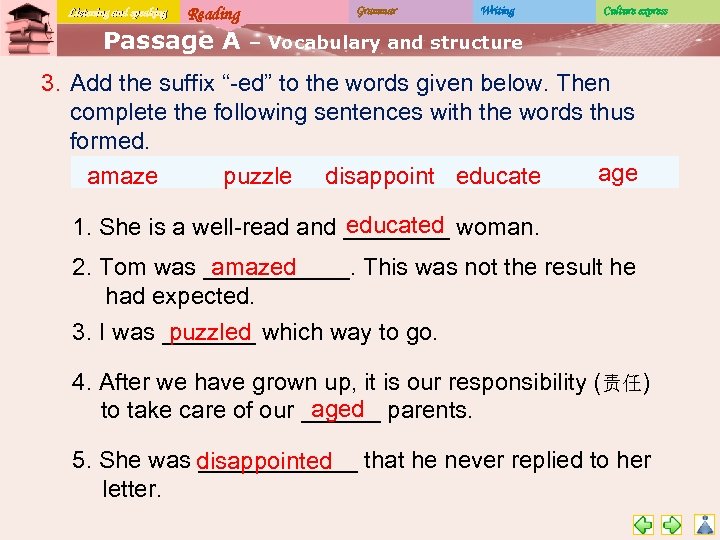 Listening and speaking Reading Passage A Grammar Writing Culture express – Vocabulary and structure 3. Add the suffix “-ed” to the words given below. Then complete the following sentences with the words thus formed. age amaze puzzle disappoint educated 1. She is a well-read and ____ woman. 2. Tom was ______. This was not the result he amazed had expected. 3. I was _______ which way to go. puzzled 4. After we have grown up, it is our responsibility (责任) aged to take care of our ______ parents. 5. She was disappointed that he never replied to her ______ letter.
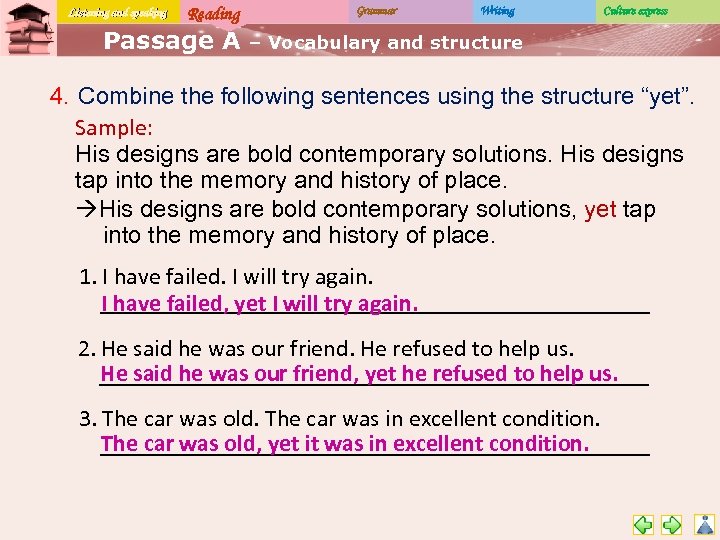 Listening and speaking Reading Passage A Grammar Writing Culture express – Vocabulary and structure 4. Combine the following sentences using the structure “yet”. Sample: His designs are bold contemporary solutions. His designs tap into the memory and history of place. His designs are bold contemporary solutions, yet tap into the memory and history of place. 1. I have failed. I will try again. _______________________ I have failed, yet I will try again. 2. He said he was our friend. He refused to help us. He said he was our friend, yet he refused to help us. _______________________ 3. The car was old. The car was in excellent condition. The car was old, yet it was in excellent condition. _______________________
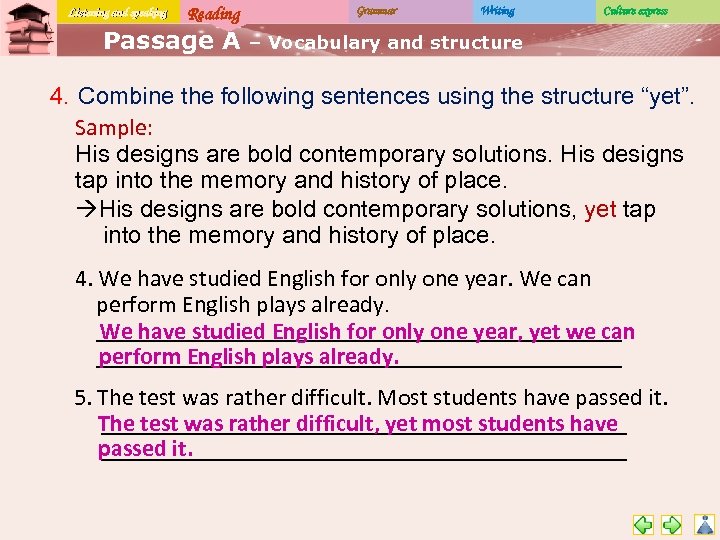 Listening and speaking Reading Passage A Grammar Writing Culture express – Vocabulary and structure 4. Combine the following sentences using the structure “yet”. Sample: His designs are bold contemporary solutions. His designs tap into the memory and history of place. His designs are bold contemporary solutions, yet tap into the memory and history of place. 4. We have studied English for only one year. We can perform English plays already. ______________________ We have studied English for only one year, yet we can ______________________ perform English plays already. 5. The test was rather difficult. Most students have passed it. The test was rather difficult, yet most students have ______________________ passed it. ______________________
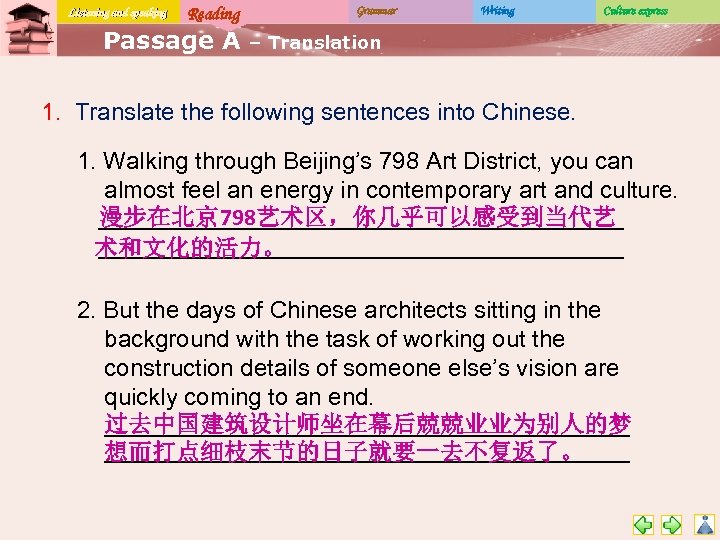 Listening and speaking Reading Passage A Grammar Writing Culture express – Translation 1. Translate the following sentences into Chinese. 1. Walking through Beijing’s 798 Art District, you can almost feel an energy in contemporary art and culture. 漫步在北京 798艺术区,你几乎可以感受到当代艺 ____________________________________________ 术和文化的活力。 2. But the days of Chinese architects sitting in the background with the task of working out the construction details of someone else’s vision are quickly coming to an end. 过去中国建筑设计师坐在幕后兢兢业业为别人的梦 ____________________________________________ 想而打点细枝末节的日子就要一去不复返了。
 Listening and speaking Reading Passage A Grammar Writing Culture express – Translation 2. Translate the following Chinese sentences into English with the help of the words or phrases given in brackets. 1. 我们有必要权衡 作和家庭生活两者的需求。 (balance) balance the demands of the work with those of family life. There is a need for us to 2. 有了因特网,全世界的信息都可以为你所用。(tap into) tap into all the information of With the Internet you can the world. 3. 我想借这个机会,对你们的帮助表示感谢。(draw upon) I’d like to draw upon this opportunity to express my thanks for your help.
 Listening and speaking Reading Grammar Writing Passage B The Great Wall l Lead-in l Text study l Exercises Culture express
 Listening and speaking Reading Passage B Grammar Writing – The Great Wall Lead-in l Pre-reading activity l Legends About The Great Wall l Video appreciation Culture express
 Listening and speaking Reading Passage B Grammar Writing Culture express – The Great Wall Pre-reading Work in groups to discuss the following questions. 1. As the old saying goes, he who has never been to the Great Wall is not a true man. Have you ever been to the Great Wall? Yes, I haven been to the great wall. It was a fantastic experience. Standing on the top of the Great Wall, I could get an overview of the beautiful scenery around it. Moreover, climbing up to the top of the Great Wall takes great efforts, and I am proud of achieving this.
 Listening and speaking Reading Passage B Grammar Writing Culture express – The Great Wall Pre-reading Work in groups to discuss the following questions. 2. What do you know about the Great Wall, e. g. when it was built, who built it, what it was made of, and what it was used for in the past? The Great Wall was built over 2, 000 years ago around 221 B. C. It was started by Emperor Qin in order to protect his empire from attacks along it’s northern front.
 Listening and speaking Reading Passage B Grammar Writing Culture express – The Great Wall Legends About The Great Wall In the north of China, there lies a 6, 700 -kilometer-long (4, 161 -mile-long) ancient wall. Now well-known as the Great Wall of China, it starts at the Jiayuguan Pass of Gansu Province in the west and ends at the Shanhaiguan Pass of Hebei Province in the east. As one of the Eight Wonders in the world, the Great Wall of China has become the symbol of the Chinese nation and its culture. Lots of beautiful legends and stories about the Great Wall took place following along the construction, and since that time these stories have spread around the country. Those that happened during construction are abundant, such as Meng Jiangnu's story and the legend of the Jiayuguan Pass.
 Listening and speaking Reading Passage B Grammar Writing Culture express – The Great Wall Legends About The Great Wall Meng Jiangnu's story is the most famous and widely spread of all the legends about the Great Wall. The story happened during the Qin Dynasty (221 BC-206 BC). It tells of how Meng Jiangnu's bitter weeping made a section of the Great Wall collapse. Meng Jiangnu's husband Fan Qiliang was caught by federal officials and sent to build the Great Wall. Meng Jiangnu heard nothing from him after his departure, so she set out to look for him. Unfortunately, by the time she reached the great wall, she discovered that her husband had already died. Hearing the bad news, she cried her heart out. Her howl caused the collapse of a part of the Great Wall. This story indicates that the Great Wall is the production of tens of thousands of Chinese commoners.
 Listening and speaking Reading Passage B Grammar Writing Culture express – The Great Wall Legends About The Great Wall Another legend about the Jiayuguan Pass tells of a workman named Yi Kaizhan in the Ming Dynasty (1368 BC 1644 BC) who was proficient in arithmetic. He calculated that it would need 99, 999 bricks to build the Jiayuguan Pass. The supervisor did not believe him and said if they miscalculated by even one brick, then all the workmen would be punished to do hard work for three years. After the completion of the project, one brick was left behind the Xiwong city gate. The supervisor was happy at the sight of the brick and ready to punish them. However Yi Kaizhan said with deliberation that the brick was put there by a supernatural being to fix the wall. A tiny move would cause the collapse of the wall. Therefore the brick was kept there and never moved. It can still be found there today on the tower of the Jiayuguan Pass.
 Listening and speaking Reading Passage B Grammar Writing Culture express – The Great Wall Legends About The Great Wall In addition to the above-mentioned stories about the construction of the Great Wall, there also plenty of stories about current scenic spots. A famous one is the legend of the Beacon Tower. This story happened during the Western Zhou Dynasty (11 th century BC-711 BC). King You had a queen named Bao Si, who was very pretty. King You liked her very much, however Bao Si never smiled. An official gave a suggestion that setting the beacon tower on fire would frighten the King's subjects, and might make the queen smile. King You liked the idea. The subjects were fooled and Bao Si smiled at the sight of the chaos. Later enemies invaded Western Zhou, King You set the beacon tower on fire to ask for help. No subjects came to help because they had been fooled once before. Thus, King Zhou was killed by the enemy and Western Zhou came to an end.
 Listening and speaking Reading Passage B Grammar Writing Culture express – The Great Wall Legends About The Great Wall Beautiful stories and legends about the Great Wall help to keep alive Chinese history and culture. In each dynasty after the building of the Great Wall, many more stories were created and spread.
 Listening and speaking Reading Passage B Lead-in Grammar Writing – The Great Wall - Video appreciation 慕田峪长城 Culture express
 Listening and speaking Reading Passage B Grammar – The Great Wall Text study l Text reading l Language points Writing Culture express
 Listening and speaking Reading Grammar Writing Culture express Passage B The Great Wall 1. _________________________ Early civilizations summoned large quantities of strength and wealth to create structures that would exist beyond _________________________ time. There is no better example of this than the Great Wall. 2. The Great Wall is one of the most important man-made wonders and the largest building project ever attempted in the world. _____________________ In fact, it stands as the most time-consuming, material consuming, labor-intensive construction project in __________________________ human history. _______
 Listening and speaking Reading Grammar Writing Culture express Passage B The Great Wall 3. An Englishman, William Lindesay, may be the only person on Earth who has traveled on foot for 2, 470 kilometers by following the ruins of the Great Wall from Shanhaiguan to ___________________ Jiayuguan. When he finished he felt more relieved than ___________________ happy; it had been such a long adventure. Yet his interest in the Great Wall has grown even stronger since the trip. In fact, he was so crazy about it that he bought a farmhouse near one of the most beautiful locations along _____________________ the Wall. He now thinks the farmhouse is home and that he is really living his dream. ________________
 Listening and speaking Reading Grammar Writing Culture express Passage B The Great Wall 4. The Great Wall snakes across China’s landscape like a __________________________ huge sleeping dragon, rising and falling with the contours __________________________ of the countryside. William believes the Great Wall is the ________ world’s greatest open-air museum, and when people walk on it they are walking on history, which is totally unique and makes the Great Wall a real wonder of the world.
 Listening and speaking Reading Grammar Writing Culture express Passage B The Great Wall 5 A. The person responsible for this great world wonder was Emperor Qin. During his time, the map of China _______________ looked like a seven-piece jigsaw puzzle formed from _______________________ the seven kingdoms fighting for power. _________________ One of these kingdoms, the Qin kingdom, conquered the other six to create what is regarded as the first united empire in Chinese history. Emperor Qin was self-important and ______________________________________ ambitious, but he knew he could never defeat the ruthless horse-riding warriors to the north, the Huns. _______________________
 Listening and speaking Reading Grammar Writing Culture express Passage B The Great Wall 5 B. He decided that a wall should be built to prevent the Huns from invading again. And it took Emperor Qin about seven years to achieve his goal. It is worth mentioning that the project was built by using nothing more than bare hands and simple tools. And for the next 2, 000 years or so, Chinese dynasties kept on building walls. In the end a whole network of walls ________________ spread across the northern part of the country, _____________________ extending about 20 thousand kilometers in total. _____________________
 Listening and speaking Reading Grammar Writing Culture express Passage B The Great Wall 6. In the past, the Great Wall of China served very real, _______________________ practical needs to defend the country. _________________ Now it is regarded as a symbol of the Chinese nation. The Great Wall brought William to China, and now keeps him here. He has dedicated more than 10 years of his life to researching the Wall, understanding the Wall, and coming to truly appreciate what makes it such a historical marvel. 7. We modern people may wonder if our best work still lies ahead. What will we build? Where will we build it? __________________________ Whatever we do, it will need to be spectacular to top this significant man-made wonder—the Great Wall. _____________________
 Listening and speaking Reading Passage B Grammar Writing Culture express – The Great Wall Early civilizations summoned large quantities of strength and wealth to create structures that would exist beyond time. (Line 1, Para. 1) 早期的文明社会运用大量的力量和财富,创造了沉淀 岁月的不朽建筑。 large quantities of (大量的)后面可以接可数名词,也可以接不可数名词。 他这个夏天送给我们很多书。 He sent large quantities of books to us this summer. beyond time: 超越时间
 Listening and speaking Reading Passage B Grammar Writing Culture express – The Great Wall In fact, it stands as the most time-consuming, materialconsuming, labor-intensive construction project in human history. (Line 2, Para. 3) 事实上,它是人类历史上最耗时、耗资、耗力的建筑 程。 time-consuming 和material-consuming 都是合成形容词, 由“名词 + 动词的现在分词形式”构成。英语中有不少类 似的合成形容词。 e. g. record-breaking 创纪录的 man-eating 吃人的 labor-intensive: adj. 劳动密集型的 -intensive 的意思是“……密集型的”。 e. g. capital-intensive 资本密集型的 knowledge-intensive 知识密集型的
 Listening and speaking Reading Passage B Grammar Writing Culture express – The Great Wall When he finished he felt more relieved than happy; it had been such a long adventure. (Line 3, Para. 3) 当他完成这次跋涉时,与其说是兴奋,不如说是如 释 重负,这可是一次漫长的冒险。 more…than… 更多的是···,而不是··· I was more amused than shocked by what she told me. What she did was more of a mistake than a crime. 分号后面的句子it had been such a long adventure. 是对 前面he felt more relieved than happy 的原因的解释说明。
 Listening and speaking Reading Passage B Grammar Writing Culture express – The Great Wall He now thinks the farmhouse is home and that he is really living his dream. (Line 8, Para. 3) 他现在认为这个农舍是他的家,他正在践行自己的梦想。 动 词 thinks 后 面 接 了 两 个 宾 语 从 句 , 一 个 是 the farmhouse is home,另一个是that he is really living his dream。这两个宾语从句是并列关系,第一个从 句中的关系代词that 可以省去,但第二个从句中的 关系代词that 不可省去。 live one’s dream 实践某人的梦想;实现梦想 He began living his dream of going to the U. S. for further study during his last year in law school.
 Listening and speaking Reading Passage B Grammar Writing Culture express – The Great Wall snakes across China’s landscape like a huge sleeping dragon, rising and falling with the contours of the countryside. (Line 1, Para. 4) 长城就像一条沉睡的巨龙,绵延于中国大地,随着乡 间的地形起起伏伏。 sleeping 是现在分词作定语,修饰dragon。现在分词作 定语修饰名词在英语中很常见,如:a running car, a barking dog,boiling water。 rising 和falling 是现在分词作伴随状语,其逻辑主语为 the Great Wall,伴随着动作snake across 而发生。
 Listening and speaking Reading Passage B Grammar Writing Culture express – The Great Wall During his time, the map of China looked like a seven-piece jigsaw puzzle formed from the seven kingdoms fighting for power. (Line 2, Para. 5) 那时,中国地图就像一块由七个争夺霸权的王国组成 的拼图。 formed from the seven kingdoms 是过去分词短语作定 语,修饰jigsaw puzzle。 fight for sth. 为···而战斗 Every young man fought for the country at that time.
 Listening and speaking Reading Passage B Grammar Writing Culture express – The Great Wall Emperor Qin was self-important and ambitious, but he knew he could never defeat the ruthless horse-riding warriors to the north, the Huns. (Line 6, Para. 5) 秦始皇妄自尊大,野心勃勃,但他知道他永远也无法 战胜北方那些骑在马背上的残忍的匈奴士兵。 方位词前面加介词in,on 和 to 的三种情况为: A 如果用in,表示前者在后者范围之内。 e. g. Zhejiang Province is in the east of China. B 如果用on,表示前者不在后者范围内,但是两者接壤。 e. g. Zhejiang is on the north of Fujian. C 如果用to,则表示前者不在后者范围内,且两者也不 接壤。e. g. Japan lies to the east of China. the Huns 是horse-riding warriors to the north 的同位语。
 Listening and speaking Reading Passage B Grammar Writing Culture express – The Great Wall In the end a whole network of walls spread across the northern part of the country, extending about 20 thousand kilometers in total. (Line 14, Para. 5) 最后形成了一个横亘中国北部的城墙网,总长大约两 万多千米。 spread across / over 遍布;覆盖 There are many community college spread across California. in total 总计;总共 There were probably 40 people attending this lecture in total.
 Listening and speaking Reading Passage B Grammar Writing Culture express – The Great Wall In the past, the Great Wall of China served very real, practical needs to defend the country. (Line 1, Para. 6) 过去,中国长城一直发挥着保卫国家的实用功能。 serve 适合(作···用) A large wooden box will serve the purpose. These scientists are developing research projects to serve the needs of industry.
 Listening and speaking Reading Passage B Grammar Writing Culture express – The Great Wall Whatever we do, it will need to be spectacular to top this significant man-made wonder—the Great Wall. (Line 2, Para. 7) 无论我们建造什么,要想超过长城这一伟大的人造奇 迹,它必须无比壮观。 top 优于;胜过;超过 那位红衣女子的外貌要胜过这位女演员。 The appearance of the lady in red topped that of this actress.
 Listening and speaking Reading Passage B summon Grammar Writing Culture express – The Great Wall (Line 1, Para. 1) 1) v. to make a great effort to use your strength, courage, etc. 使出(力气等);鼓起(勇气) 我最后鼓足勇气向父亲借车。 I finally summoned the courage to ask my father to lend me the car. 2) v. to order sb. to come to a particular place 召见;传唤 把学生召集到学校的礼堂里。 Summon the pupils together in the school hall.
 Listening and speaking Reading Passage B attempt Grammar Writing Culture express – The Great Wall (Line 2, Para. 2) 1) v. to try to do sth. , especially sth. difficult 努力;尝试 她决心要打破世界纪录。 She will attempt to beat the world record. 2) n. an effort made to do sth. 尝试, 试图, 企图 我没有打算要和她做朋友。 I made no attempt to make friends with her.
 Listening and speaking Reading Passage B relieved Grammar Writing Culture express – The Great Wall (Line 4, Para. 3) adj. feeling happy because sth. bad did not happen or is finished 如释重负的 情况好转了,她看来放心了。 She seemed relieved that things were better. 她很高兴汤姆没有认出她来。 She was extremely relieved that Tom hadn’t recognized her.
 Listening and speaking Reading Passage B ambitious Grammar Writing Culture express – The Great Wall (Line 7, Para. 5) adj. having a strong desire to be successful or powerful 有雄 心的;有抱负的 她渴望在她的舞台生涯中获得成功。 She is ambitious of success in her stage career. 我们对此宏伟规划感到兴奋。 We felt an animation about the ambitious plan.
 Listening and speaking Reading Passage B invade Grammar Writing Culture express – The Great Wall (Line 10, Para. 5) v. to enter a place using military force 入侵;侵略 敌军准备进犯。 The enemy troops are ready to invade. 短语:invade one’s country 入侵某国 invade one’s privacy 侵犯了某人的隐私权 invade one’s private life 干涉某人的私生活 invade one’s rights 侵犯了某人的权利
 Listening and speaking Reading Passage B nothing more than Grammar Writing Culture express – The Great Wall (Line 12, Para. 5) only; no more or less than 只;仅仅 只不过下了场阵雨。 It was nothing more than a shower. 管理不外是调动人的积极性。 Management is nothing more than motivating people.
 Listening and speaking Reading Passage B extend Grammar Writing Culture express – The Great Wall (Line 15, Para. 5) v. to cover a particular distance or area 延伸;伸展 我们的操场延伸到那些树前。 Our playing fields extend as far as those trees. 商业区从市中心延伸了约 9英里。 The business area extends about nine miles from the center of town. 短语:extend into 扩大或延长到… extend over 遍及; 覆盖 extend to (使)达到, 伸展到
 Listening and speaking Reading Passage B Grammar Writing Culture express – The Great Wall dedicate… to (doing) sth. (Line 4, Para. 6) to give all your attention and effort to one thing 致力于(做) 某事 贝茜已倾其一生照顾他人。 Bessie has dedicated her life to caring for others. 回到岛上后,他便投身于政治。 Back on the island, he dedicated himself to politics.
 Listening and speaking Reading Passage B Grammar Writing – Exercises l Comprehension l Vocabulary & structure l Translation l Oral work Culture express
 Listening and speaking Reading Passage B Grammar Writing Culture express – Comprehension 1. Choose the best answer to each of the following questions. 1. Which is NOT true about the Great Wall? B A It is a time-consuming project. B Its construction was completed in the Qin Dynasty. C All of its construction was done by using hands and simple tools. D It is one of the world’s greatest architectural wonders.
 Listening and speaking Reading Passage B Grammar Writing Culture express – Comprehension 1. Choose the best answer to each of the following questions. 2. Why did William Lindesay buy a farmhouse near the Great Wall? D A He worked nearby. B He wanted to provide tourists with a rest area. C He thought the farmhouse will attract more foreign tourists to the Great Wall. D He was attracted by the Great Wall and wanted to live nearby.
 Listening and speaking Reading Passage B Grammar Writing Culture express – Comprehension 1. Choose the best answer to each of the following questions. 3. Why did Emperor Qin build the Great Wall? C A To create a wonder in the world. B To punish the people who disobeyed him. C To protect his empire from attack. D To show off the strength of his empire.
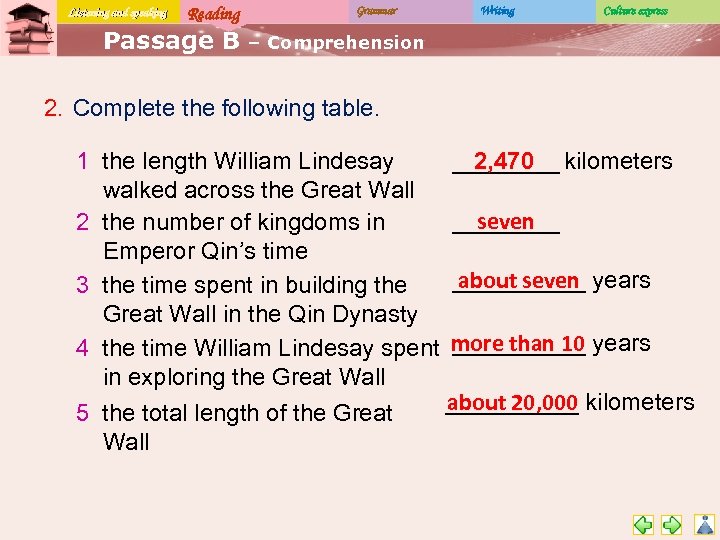 Listening and speaking Reading Passage B Grammar Writing Culture express – Comprehension 2. Complete the following table. 1 the length William Lindesay walked across the Great Wall 2 the number of kingdoms in Emperor Qin’s time 3 the time spent in building the Great Wall in the Qin Dynasty 4 the time William Lindesay spent in exploring the Great Wall 5 the total length of the Great Wall 2, 470 ____ kilometers ____ seven about seven _____ years _____ more than 10 years _____ kilometers about 20, 000
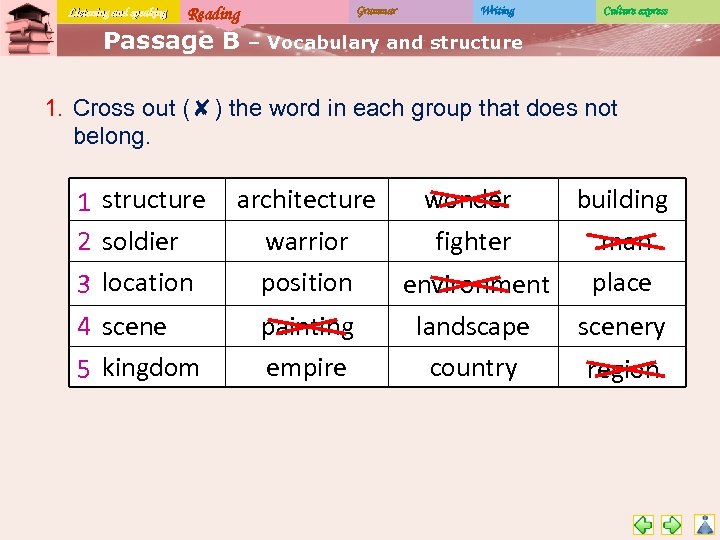 Listening and speaking Reading Passage B Grammar Writing Culture express – Vocabulary and structure 1. Cross out (✘) the word in each group that does not belong. structure 1 2 soldier location 3 architecture wonder building warrior position fighter environment man place 4 scene kingdom 5 painting empire landscape country scenery region
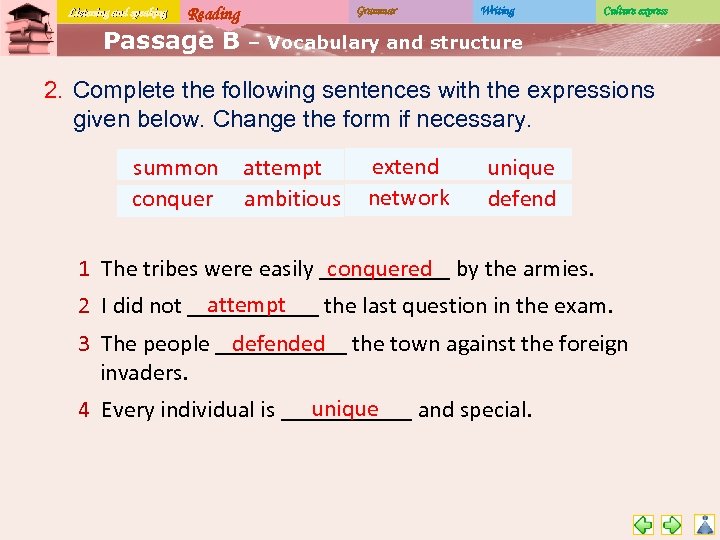 Listening and speaking Reading Passage B Grammar Writing Culture express – Vocabulary and structure 2. Complete the following sentences with the expressions given below. Change the form if necessary. summon conquer attempt ambitious extend network unique defend 1 The tribes were easily ______ by the armies. conquered attempt 2 I did not ______ the last question in the exam. 3 The people ______ the town against the foreign defended invaders. unique 4 Every individual is ______ and special.
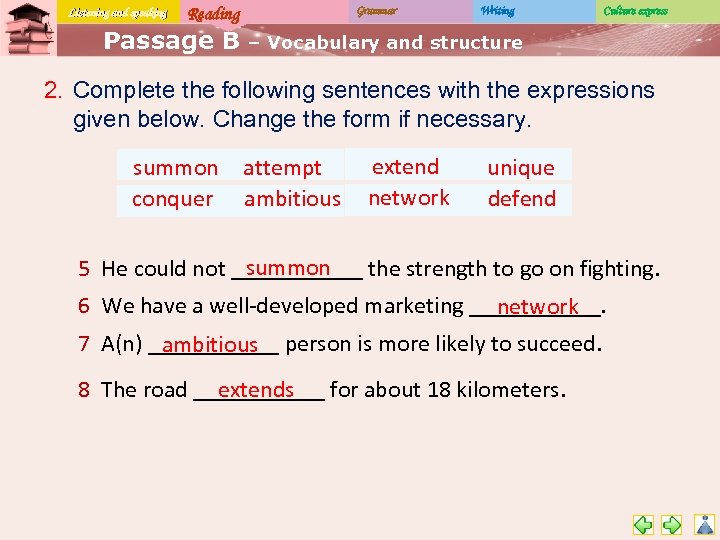 Listening and speaking Reading Passage B Grammar Writing Culture express – Vocabulary and structure 2. Complete the following sentences with the expressions given below. Change the form if necessary. summon conquer attempt ambitious extend network unique defend summon 5 He could not ______ the strength to go on fighting. 6 We have a well-developed marketing ______. network 7 A(n) ______ person is more likely to succeed. ambitious extends 8 The road ______ for about 18 kilometers.
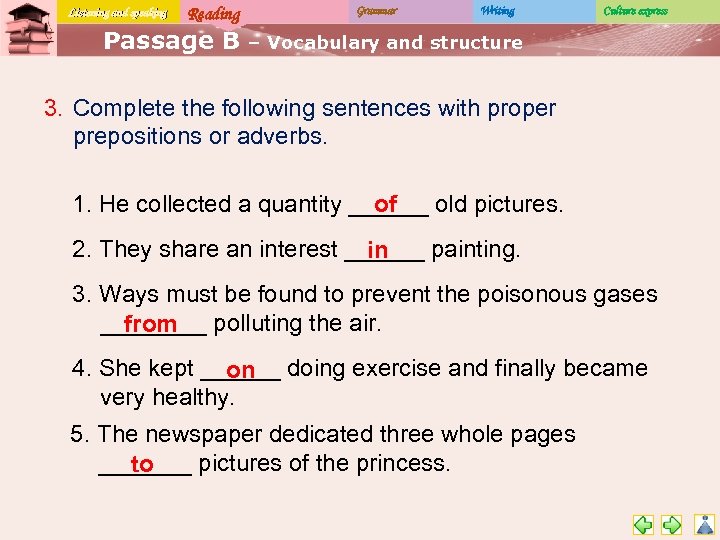 Listening and speaking Reading Passage B Grammar Writing Culture express – Vocabulary and structure 3. Complete the following sentences with proper prepositions or adverbs. of 1. He collected a quantity ______ old pictures. 2. They share an interest ______ painting. in 3. Ways must be found to prevent the poisonous gases ____ polluting the air. from 4. She kept ______ doing exercise and finally became on very healthy. 5. The newspaper dedicated three whole pages _______ pictures of the princess. to
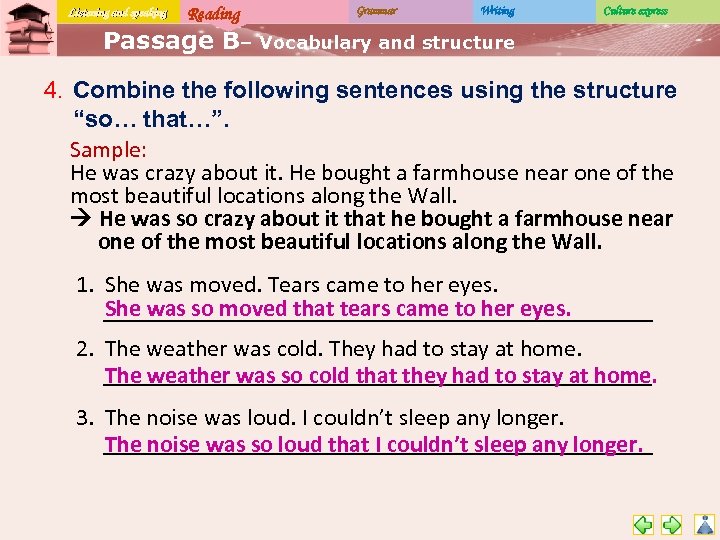 Listening and speaking Reading Grammar Writing Culture express Passage B– Vocabulary and structure 4. Combine the following sentences using the structure “so… that…”. Sample: He was crazy about it. He bought a farmhouse near one of the most beautiful locations along the Wall. He was so crazy about it that he bought a farmhouse near one of the most beautiful locations along the Wall. 1. She was moved. Tears came to her eyes. She was so moved that tears came to her eyes. _______________________ 2. The weather was cold. They had to stay at home. _______________________ The weather was so cold that they had to stay at home. 3. The noise was loud. I couldn’t sleep any longer. _______________________ The noise was so loud that I couldn’t sleep any longer.
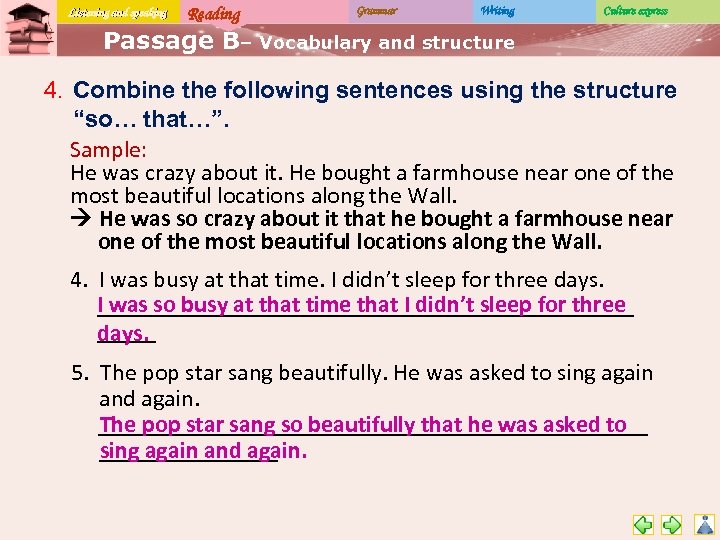 Listening and speaking Reading Grammar Writing Culture express Passage B– Vocabulary and structure 4. Combine the following sentences using the structure “so… that…”. Sample: He was crazy about it. He bought a farmhouse near one of the most beautiful locations along the Wall. He was so crazy about it that he bought a farmhouse near one of the most beautiful locations along the Wall. 4. I was busy at that time. I didn’t sleep for three days. I was so busy at that time that I didn’t sleep for three _______________________ days. 5. The pop star sang beautifully. He was asked to sing again and again. _______________________ The pop star sang so beautifully that he was asked to ________ sing again and again.
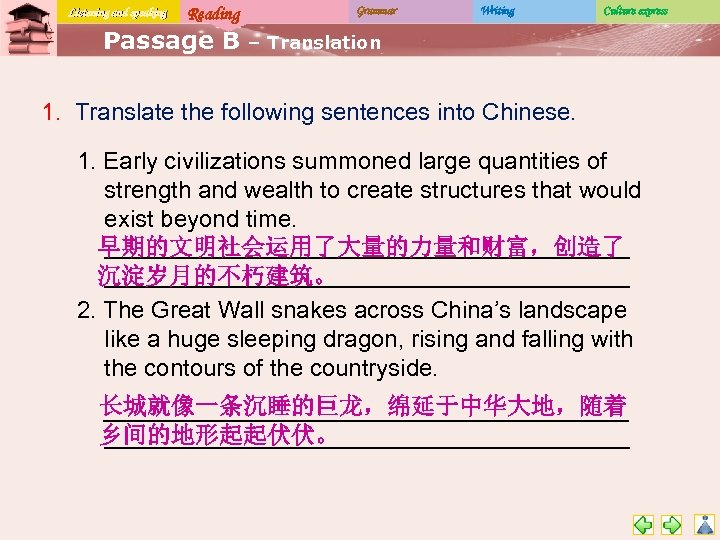 Listening and speaking Reading Passage B Grammar Writing Culture express – Translation 1. Translate the following sentences into Chinese. 1. Early civilizations summoned large quantities of strength and wealth to create structures that would exist beyond time. ______________________ 早期的文明社会运用了大量的力量和财富,创造了 ______________________ 沉淀岁月的不朽建筑。 2. The Great Wall snakes across China’s landscape like a huge sleeping dragon, rising and falling with the contours of the countryside. 长城就像一条沉睡的巨龙,绵延于中华大地,随着 ______________________ 乡间的地形起起伏伏。 ______________________
 Listening and speaking Reading Passage B Grammar Writing Culture express – Translation 2. Translate the following Chinese sentences into English with the help of the words or phrases given in brackets. 1. 他最后终于出现时,我松了一口气。(relieved) ______ when he finally turned up. I felt relieved 2. 他想在画画上投入更多的时间。(dedicate… to…) He wants to ________________. dedicate more time to painting 3. 她希望别人仅仅把她当作普通女孩来看待。(nothing more than) nothing more than an She wishes to be treated as __________ ordinary girl. _____________________.
 Listening and speaking Reading Passage B Grammar Writing Culture express – Oral work Work in groups to do the following activities. 1 Do you know other world-famous buildings? Please list them. 2 Suppose you are a tour guide, choose one building in the list and introduce it to your group members. Include the following aspects: its designer, year of construction, location, style, building materials, characteristics, and significance. 3 Work with the class and vote for the best tour guide.
 Listening and speaking Reading Passage B Grammar Writing Culture express – Oral work Work in groups to do the following activities. 1 Do you know other world-famous buildings? Please list them. Other world-famous buildings I know include St Paul’s Cathedral in London, the White House in Washington, the Leaning Tower of Pisa in Italy and the Sydney Opera House in Australia.
 Listening and speaking Reading Passage B Grammar Writing Culture express – Oral work Work in groups to do the following activities. 2 Suppose you are a tour guide, choose one building in the list and introduce it to your group members. Include the following aspects: its designer, year of construction, location, style, building materials, characteristics, and significance. Hi, everybody. Welcome to St. Paul’s Cathedral, one of the most iconic buildings in London. I’m your tour guide, Lisa. The Cathedral, dating from the late 17 th century, was designed in the English Baroque style by Sir Christopher Wren. It sits at the top of Ludgate Hill, the highest point in the city of London. Its famous dome is among the highest in the world, measuring about 110 meters high.
 Listening and speaking Reading Passage B Grammar Writing Culture express – Oral work Work in groups to do the following activities. 2 Suppose you are a tour guide, choose one building in the list and introduce it to your group members. Include the following aspects: its designer, year of construction, location, style, building materials, characteristics, and significance. The original church on the site was founded in A. D. 604. Work on the present English Baroque church began in the 17 th Century by Christopher Wren as part of a major rebuilding program after the 1666 Great Fire of London. Wren started working on St Paul’s in 1668, his designs for the cathedral taking a decade to complete and the actual construction taking a further 40 years. St Paul’s Cathedral has played an integral part of London life ever since—as part of the many elements of the city’s skyline and a center for tourism and religious worship.
 Listening and speaking Reading Grammar Writing l The present perfect tense & the past perfect tense ( 现在完成时和过去完成时) l Exercises Culture express
 Listening and speaking Grammar Reading Grammar - Writing Culture express The present perfect tense & the past perfect tense 一、现在完成时表示动作发生在过去,但与现在的情况有关 系,即用一个发生在过去的动作来说明现在的情况。现 在完成时由“助动词 have / has + 动词的过去分词”构成。 现在完成时主要有以下几种用法: 1 表示在过去完成的动作,强调这一动作与现在的关系, 如对现在产生的结果、影响等。常和时间副词 already,never,always,yet 等连用。如: 1) I have washed my car. 2) The rain has already stopped. 3) They haven’t finished their work yet.
 Listening and speaking Grammar Reading Grammar - Writing Culture express The present perfect tense & the past perfect tense 2 表示动作发生在过去,但一直延续到现在,甚至还 可能继续延续下去。常和 for(后加时间段)及 since (后加时间点)引导的状语或 how long 连用。如: 1) I have studied piano since 2003. 2) I haven’t studied piano for 10 years. 3) How long have you known her? 3 在条件、时间状语从句中表示将来完成的动作。如: I’ll go with you when I have finished my homework.
 Listening and speaking Grammar Reading Grammar - Writing Culture express The present perfect tense & the past perfect tense 二、过去完成时表示在过去某一时间或动作以前已经完成了 的动作,即在“过去的过去”完成的动作。过去完成时由“ 助动词 had + 动词的过去分词”构成。 过去完成时主要有以下几种用法: 1. 常与before,by,by the end of,up till then 等词引 导的时间状语连用。如: 1) Before he came back home, his families had finished their dinner. 2) By the end of last week, we had learned five lessons.
 Listening and speaking Grammar Reading Grammar - Writing Culture express The present perfect tense & the past perfect tense 2 用于主句谓语动词为过去时的宾语从句中,表示从句 的动作发生在主句动作之前。如: 1) Sorry, I forgot that you had paid me your fee. 2) He decided to go back to school since he had got well. 3 和expect,hope,intend,mean,plan,want,wish 等动词连用,表示希望、意图、预期等没有实现。如: 1) I had hoped to come to see her, but I just couldn’t find time last night. 2) I had planned to finish the work before 10 o’clock, but I didn’t.
 Listening and speaking Reading Grammar Writing Culture express - Exercises 1. Choose the correct tense of the verbs in brackets to complete the following sentences. has opened 1. The door is open. Who _______ it? (has opened / had opened) have finished 2. We will wait here until you ________ the letter. (have finished / had finished) has passed 3. Three years ______ since we left school. (has passed / had passed) 4. I ________ of him as a rather unimportant poet had always thought till then. (had always thought / have always thought) had taken place 5. He said that great changes ________ in his hometown since 2003. (have taken place / had taken place)
 Listening and speaking Reading Grammar Writing Culture express - Exercises 2. Complete the following sentences with the correct tense of the verbs in brackets. had learned 1. He ______ (learn) some English before he came to the university. had known 2. By the time I read his new book, I ______ (know) him for a long time. has broken 3. The lift ______ (break) down. So we have to climb upstairs. 4. Many Westerners ______ never ______ have seen (see) a giant panda. 5. He ______ (want) to come forward and defend his had wanted friend, but his brother held him back.
 Listening and speaking Reading Grammar Writing l Notes l Exercises Writing Culture express
 Listening and speaking Reading Writing Grammar Writing Culture express - Developing a paragraph by time Notes 按时间 展开段落是按照时间 的先后顺 序展开段落——先 发 生的事情先说 ,后发 生的事情后说 。 sample The first railroads were developed in Europe in the 16 th century. They looked nothing like those of today. The rails were of wood, and the cars, small wooden carts which carried coal, were drawn by horses. By the early 19 th century, railroad technology had advanced greatly. Steam locomotives (机车) had been developed, and cast iron (生铁) was used for tracks. In 1825, a railroad line began carrying passengers as well as goods.
 Listening and speaking Reading Writing Grammar Writing Culture express - Developing a paragraph by time Notes That same year America’s first known steam locomotive was run on a circular (圆形的) track at Hoboken, New Jersey. Soon American locomotives and railroads were developing rapidly. Many short rail lines were laid during the 1830 s. These short lines were then linked with one another, and by the early 1840 s networks of rails connected all the eastern cities. in the 16 th century → by the early 19 th century → in 1825 → that same year → soon → during the 1830 s → by the early 1840 s 此段先后用了上述时间连接语,按时间的先后顺序记 叙了铁路的发展历程,顺序清楚,一目了然。
 Listening and speaking Reading Writing Grammar Writing Culture express - Developing a paragraph by time Notes 常用的表示时间先后或转承的表达如下: • ago, before, formerly, earlier, prior to • now, nowadays, at present • later, afterward, then, from then on, since then, after that, after a while • when, while, as, at the same time, in the mean time • first, in the first place, to begin with, second, in the second place • at the turn of the century, since, between. . . and. . . , in. . . (year), during… • finally, lastly, in the end, at last
 Listening and speaking Reading Writing Grammar Writing Culture express - Exercises The following information is about Abraham Lincoln (林肯). Rearrange the sentences to form a paragraph in order of time. Abraham Lincoln 1. Later, he became the 16 th President of the United States. 2. Lincoln’s mother died when he was nine years old. 3. In 1819, Lincoln’s father remarried, and his stepmother ( 继母), a kindly, hard-working woman, paid attention to making Lincoln receive enough additional schooling over the next two years. 4. Lincoln was born in a log cabin (木屋) in Kentucky on February 12, 1809. 5. Young Lincoln worked for a while as a ferryman (船夫) on the Ohio River, and at 19 helped take a flatboat cargo ( 货物) to New Orleans.
 Listening and speaking Reading Writing Grammar Writing Culture express - Exercises The following information is about Abraham Lincoln ( 林肯). Rearrange the sentences to form a paragraph in order of time. Abraham Lincoln 6. In the first winter they spent in Indiana they lived under a shelter closed on three sides and warmed only by a fire at the open front. 7. He was seven years old when, in December 1816, the Lincolns moved to Indiana because of the problem in land title. 8. In 1834, Lincoln was elected to the Illinois House of Representatives ( 众议院), and he was reelected in 1836, 1838, and 1840. Keys 4→ 7→ 6→ 2→ 3→ 5→ 8→ 1
 Listening and speaking Reading Grammar Culture express Writing Culture express l Famous architecture in the world l Questions
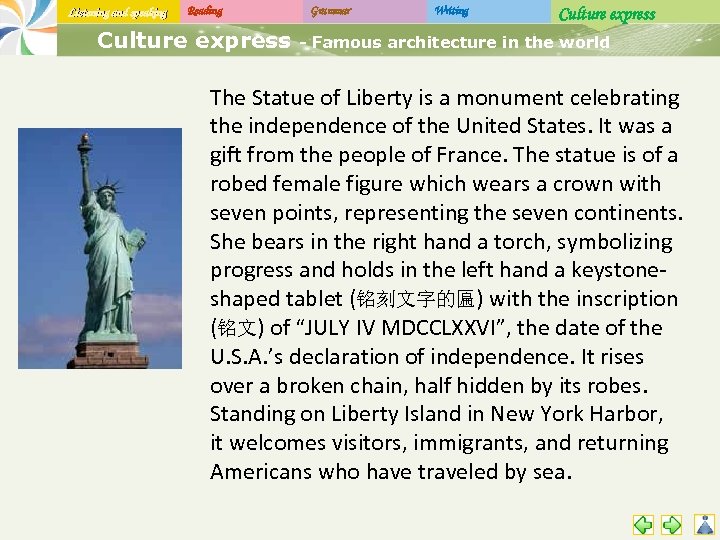 Listening and speaking Reading Culture express Grammar Writing Culture express - Famous architecture in the world The Statue of Liberty is a monument celebrating the independence of the United States. It was a gift from the people of France. The statue is of a robed female figure which wears a crown with seven points, representing the seven continents. She bears in the right hand a torch, symbolizing progress and holds in the left hand a keystoneshaped tablet (铭刻文字的匾) with the inscription (铭文) of “JULY IV MDCCLXXVI”, the date of the U. S. A. ’s declaration of independence. It rises over a broken chain, half hidden by its robes. Standing on Liberty Island in New York Harbor, it welcomes visitors, immigrants, and returning Americans who have traveled by sea.
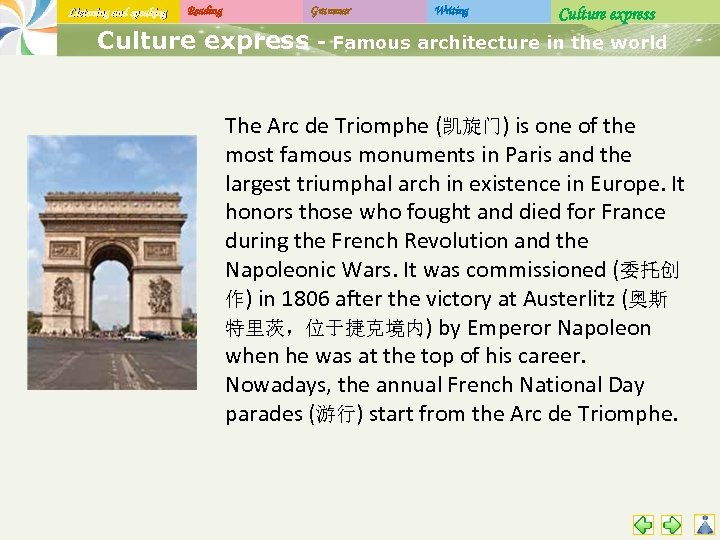 Listening and speaking Reading Culture express Grammar Writing Culture express - Famous architecture in the world The Arc de Triomphe (凯旋门) is one of the most famous monuments in Paris and the largest triumphal arch in existence in Europe. It honors those who fought and died for France during the French Revolution and the Napoleonic Wars. It was commissioned (委托创 作) in 1806 after the victory at Austerlitz (奥斯 特里茨,位于捷克境内) by Emperor Napoleon when he was at the top of his career. Nowadays, the annual French National Day parades (游行) start from the Arc de Triomphe.
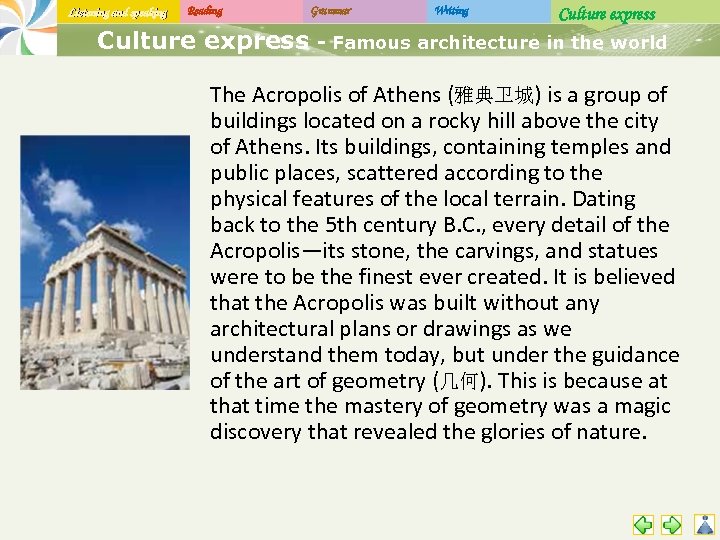 Listening and speaking Reading Culture express Grammar Writing Culture express - Famous architecture in the world The Acropolis of Athens (雅典卫城) is a group of buildings located on a rocky hill above the city of Athens. Its buildings, containing temples and public places, scattered according to the physical features of the local terrain. Dating back to the 5 th century B. C. , every detail of the Acropolis—its stone, the carvings, and statues were to be the finest ever created. It is believed that the Acropolis was built without any architectural plans or drawings as we understand them today, but under the guidance of the art of geometry (几何). This is because at that time the mastery of geometry was a magic discovery that revealed the glories of nature.
 Listening and speaking Reading Culture express Grammar Writing Culture express - Exercises Work in groups to discuss the following questions. 1. Could you list some famous buildings in America, France, and Greece apart from the ones mentioned above? Yes. For example, the Brooklyn Bridge and the Empire State Building in America; the Louvre Museum and the Eiffel Tower in France, and the Theatre of Dionysus Eleuthereus and the Temple of Hera in Greece.
 Listening and speaking Reading Culture express Grammar Writing Culture express - Exercises Work in groups to discuss the following questions. 2. Which Chinese architecture is of greatest architectural interest to you? Do you know its stories or histories? The Great Wall is of greatest architectural interest to me. It is one of the greatest wonders in Chinese history and civilization. However, many people were seized by Emperor Qin’s army and sent to build the Great Wall. One of them was Meng Jiangnv’s husband. He was forced to build the Great Wall shortly after he married Meng Jiangnv missed him so much that she traveled a long distance to the Great Wall, only to find that her husband had died and his remains were buried under the Wall. Not knowing exactly where her husband’s body was buried, Meng Jiangnv was in great sorrow.
 Listening and speaking Reading Culture express Grammar Writing Culture express - Exercises Work in groups to discuss the following questions. 2. Which Chinese architecture is of greatest architectural interest to you? Do you know its stories or histories? She cried three days and three nights in a row and her wailing touched God. All of a sudden, several miles of the Great Wall collapsed and the remains of her husband appeared. This story, to some extent, can reflect the disasters the Great Wall brought to the people of the Qin Dynasty.