


 Скачать презентацию Contemporary trends in world markets Mamurjon Rahimov mrahimov wiut
969aac09fbf790ac78b6023157efeeb4.ppt
- Количество слайдов: 42
 Contemporary trends in world markets Mamurjon Rahimov mrahimov@wiut. uz
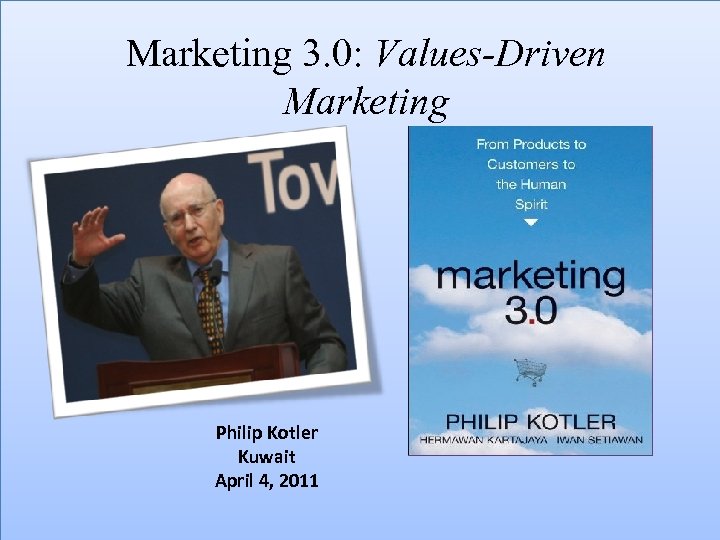 Marketing 3. 0: Values-Driven Marketing Philip Kotler Kuwait April 4, 2011
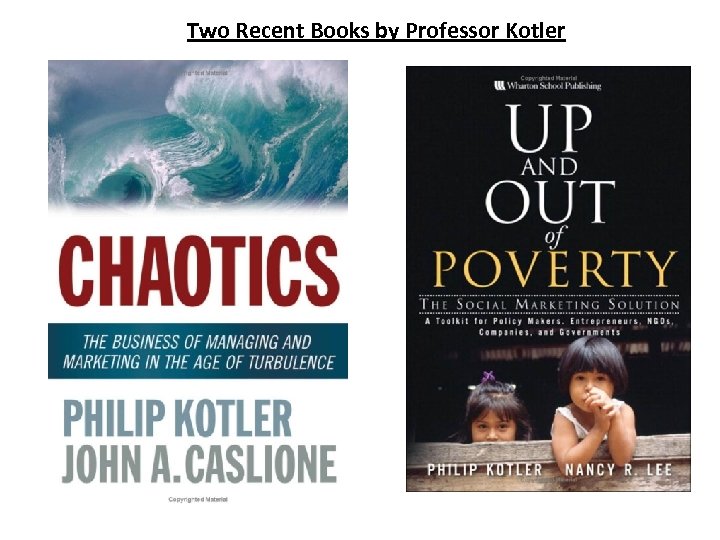 Two Recent Books by Professor Kotler
 Action-Oriented Knowledge Session One. How to deal with your company’s major business challenges and opportunities. Session Two. How to search for powerful new ideas. Session Three. How to develop a superior company reputation through sustainability thinking.
 On a scale of 1 to 3 (3 = highest), How much is this a challenge to your company? • Distrust of business • Globalization • Economic recession and turbulence • Technological advances and disruptions • Environmentalism and climate change • Customer empowerment and the new social media • Political conflict and regulatory changes
 Times Are Bad CEO’s are now playing miniature golf. Obama met with small businesses - Chrysler, Citigroup and GM, to discuss the Stimulus Package. People in Africa are donating money to Americans. The Mafia is laying off judges.

 An optimist is a person who sees an opportunity in every calamity. A pessimist is a person who sees a calamity in every opportunity. Winston Churchill
 Distrust of Business • In a 2009 survey, only 16% of respondents respect the integrity of business executives. And car salesmen and advertising executives were the least admired by the public. • Causes – – Business scandals: Enron, World Com, Tyco, Madoff, Goldman Sachs High pay to the few: CEO paid 350 times average workers salary Anti-capitalist forces Recession and falling behind • Solutions – More transparency – Better boards and management – Investing in corporate social responsibility
 Is Your Company Going to Fail? Signs to Watch for • James Collins wrote in How the Mighty Fall : – Stage 1. Successful companies get arrogant and think they can do many things. – Stage 2. They pursue growth too aggressively. – Stage 3. They ignore early warning signs of failure – Stage 4. Their failure becomes very public. – Stage 5. If they don’t reform, they finally go bankrupt. • Companies are often blind-sighted by their eagerness to build short-term growth and ignore the risks. • Most companies are short-lived.
 • Causes Globalization – Advances in information, communication, and transportation now connect the whole world – Lowering of trade barriers • Downside – – Globalization hurts as many nations as it helps Globalization increases country inequality Globalization provokes nationalism and protectionism Globalization threatens cultural traditions and values • Upside – New market opportunities if we can offer something better
 Economic Recession and Turbulence • Not all companies were hurt by the fiscal meltdown. • Distinguish between: – Recession – Disruption – Turbulence • Risk reduction strategies – – – Larger reserves Shared investments Early warning systems Scenario planning Corporate social responsibility
 Definition: DISRUPTION • A radical change in an industry, business strategy, etc. , especially involving the introduction of a new product or service that creates a new market: • E. g. Globalization and the rapid advance of technology are major causes of business disruption. Dictionary. com
 Technological Advances and Disruptions • Scientific advances and inventions – What is the impact of the birth control pill, Genome project , digitalization, cell phones, social media, robotics, nanotechnology, biotech, bioenergy… • Creative destruction – Can you avoid the fate of the music industry, publishing industry (newpapers , magazines, books), high cost airlines… • Theory of disruptive innovation – What can happen to your industry or company?
 Theory of disruptive innovation • The theory of disruptive innovation was invented by Clayton Christensen, of Harvard Business School, in his book “The Innovator’s Dilemma”. Mr Christensen used the term to describe innovations that create new markets by discovering new categories of customers. They do this partly by harnessing new technologies but also by developing new business models and exploiting old technologies in new ways. • He contrasted disruptive innovation with sustaining innovation, which simply improves existing products. Personal computers, for example, were disruptive innovations because they created a new mass market for computers; previously, expensive mainframe computers had been sold only to big companies and research universities.
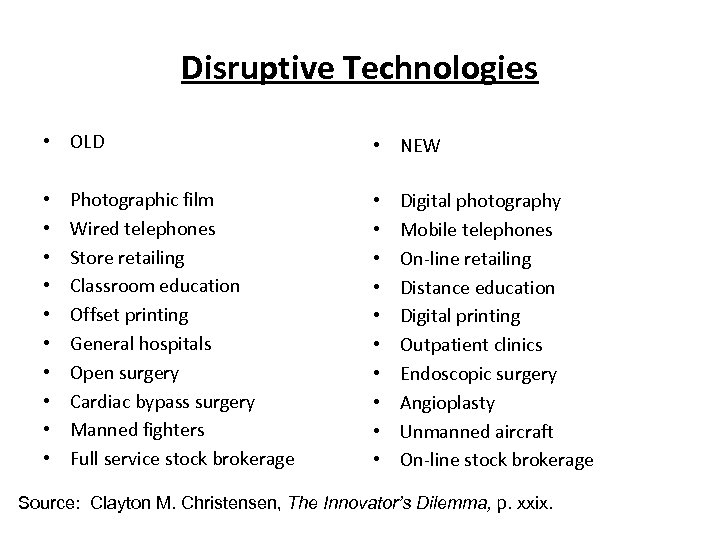 Disruptive Technologies • OLD • • • Photographic film Wired telephones Store retailing Classroom education Offset printing General hospitals Open surgery Cardiac bypass surgery Manned fighters Full service stock brokerage • NEW • • • Digital photography Mobile telephones On-line retailing Distance education Digital printing Outpatient clinics Endoscopic surgery Angioplasty Unmanned aircraft On-line stock brokerage Source: Clayton M. Christensen, The Innovator’s Dilemma, p. xxix.
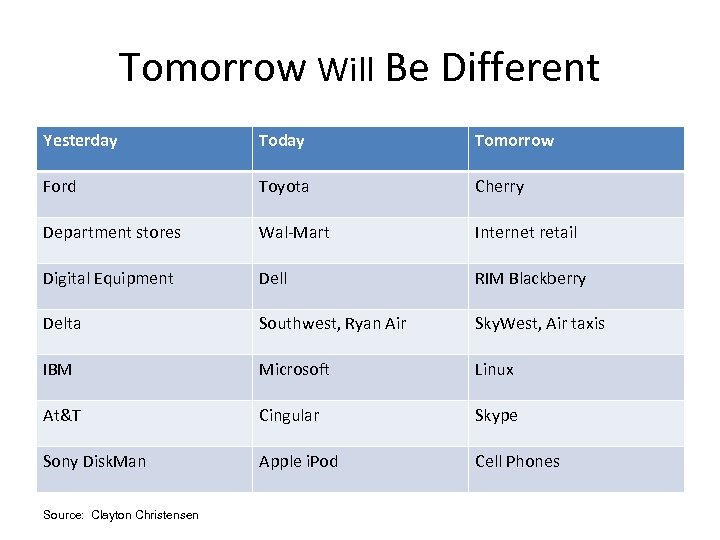 Tomorrow Will Be Different Yesterday Tomorrow Ford Toyota Cherry Department stores Wal-Mart Internet retail Digital Equipment Dell RIM Blackberry Delta Southwest, Ryan Air Sky. West, Air taxis IBM Microsoft Linux At&T Cingular Skype Sony Disk. Man Apple i. Pod Cell Phones Source: Clayton Christensen
 Environmentalism and Climate Change • Companies need to go “green” to reduce waste, pollution, and water shortage. • Those companies that go “green” early will establish a strong reputation and following. They will also save money in the long run.
 Customer Empowerment and the New Social Media • Who has the most market power? – – Wholesalers Manufacturers Retailers Customers • What are the best new ways to communicate? – – – – Blogs Facebook, Twitter Linkedin You. Tube Chat rooms Rating systems (Edwards, J. D. Power, Rotten Tomatoes, Craig’s List) Wikipedia
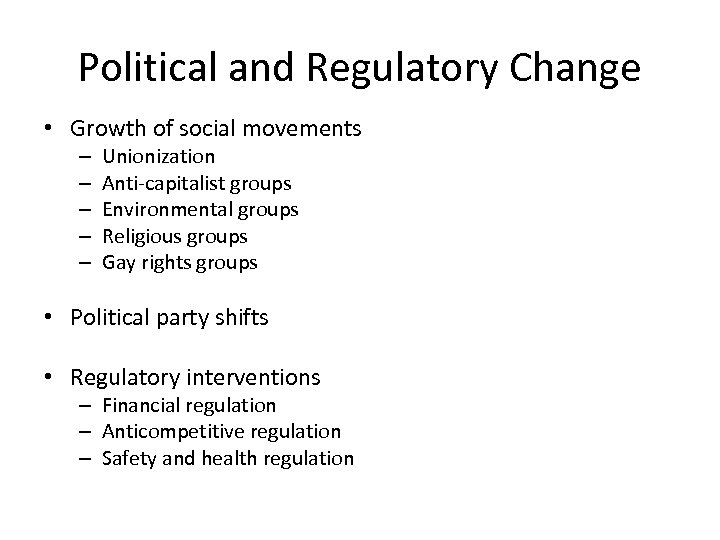 Political and Regulatory Change • Growth of social movements – – – Unionization Anti-capitalist groups Environmental groups Religious groups Gay rights groups • Political party shifts • Regulatory interventions – Financial regulation – Anticompetitive regulation – Safety and health regulation
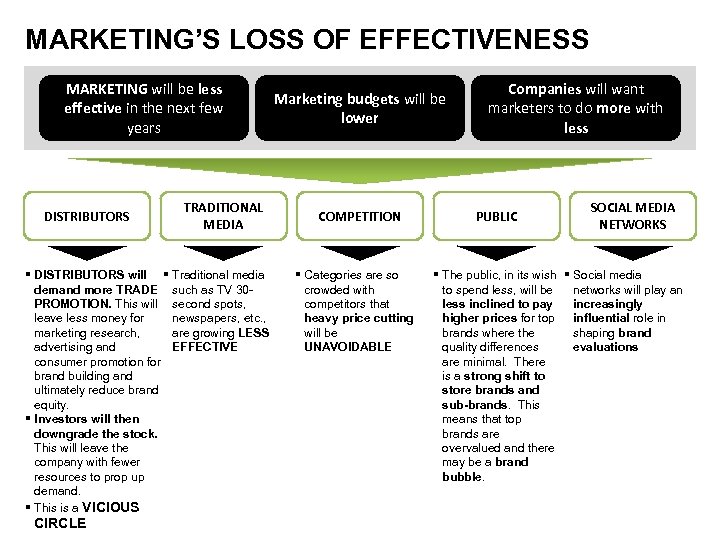 MARKETING’S LOSS OF EFFECTIVENESS MARKETING will be less effective in the next few years DISTRIBUTORS TRADITIONAL MEDIA § DISTRIBUTORS will § Traditional media demand more TRADE such as TV 30 PROMOTION. This will second spots, leave less money for newspapers, etc. , marketing research, are growing LESS advertising and EFFECTIVE consumer promotion for brand building and ultimately reduce brand equity. § Investors will then downgrade the stock. This will leave the company with fewer resources to prop up demand. § This is a VICIOUS CIRCLE Marketing budgets will be lower COMPETITION § Categories are so crowded with competitors that heavy price cutting will be UNAVOIDABLE Companies will want marketers to do more with less PUBLIC SOCIAL MEDIA NETWORKS § The public, in its wish § Social media to spend less, will be networks will play an less inclined to pay increasingly higher prices for top influential role in brands where the shaping brand quality differences evaluations are minimal. There is a strong shift to store brands and sub-brands. This means that top brands are overvalued and there may be a brand bubble.
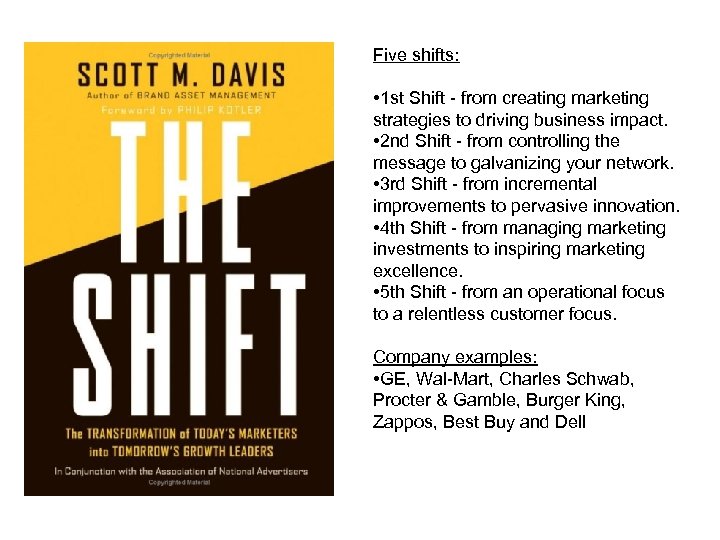 Five shifts: • 1 st Shift - from creating marketing strategies to driving business impact. • 2 nd Shift - from controlling the message to galvanizing your network. • 3 rd Shift - from incremental improvements to pervasive innovation. • 4 th Shift - from managing marketing investments to inspiring marketing excellence. • 5 th Shift - from an operational focus to a relentless customer focus. Company examples: • GE, Wal-Mart, Charles Schwab, Procter & Gamble, Burger King, Zappos, Best Buy and Dell
 Involve Your Customers In Your Planning • Four ways to view customers: – Purchasers of our product – Persons from whom we gain insight and with whom we can test our planned products – Persons who Influence others to buy our product (net promotion score NPS) – Persons who co-create product and communication ideas • Company examples of co-creation: – Lexus invites customers to build their own Lexus by going to www. Lexus. com and drawing from a complete package of available colors and options packages. – Lego and Harley Davidson have welcomed their respective enthusiasts to participate in improving their market offerings. – Doritos ran an online promotion urging fans to create 30 -second spots for Doritos and post them for on-line voting to be picked to air in one of the three Super Bowl slots. The user-generated ad won the top spot at the 21 st USA Today Super Bowl Ad Meter defeating ads made by professional agencies.
 Market to All Your Stakeholders • Our thinking has shifted from maximizing shareholder value to maximizing stakeholder value. • Stakeholders include customers, employees, channel members, and investors. – Customers: They need a feeling of gaining superior value from your offering. – Employees: They need to believe in their company’s mission, vision and values. – Channel members: They must believe that they are receiving equitable reward for their contributions. – Investors: They need assurance that the company has a viable long run plan for growth and continued profitability
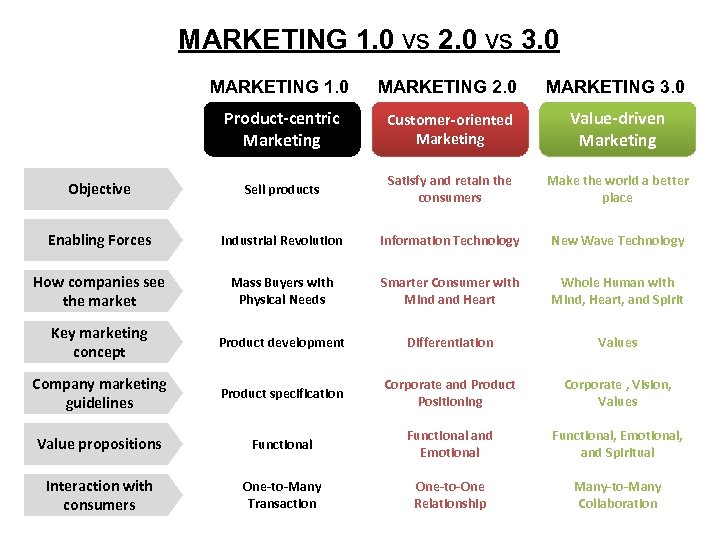 MARKETING 1. 0 vs 2. 0 vs 3. 0 MARKETING 1. 0 MARKETING 2. 0 MARKETING 3. 0 Product-centric Marketing Customer-oriented Marketing Value-driven Marketing Objective Sell products Satisfy and retain the consumers Make the world a better place Enabling Forces Industrial Revolution Information Technology New Wave Technology How companies see the market Mass Buyers with Physical Needs Smarter Consumer with Mind and Heart Whole Human with Mind, Heart, and Spirit Key marketing concept Product development Differentiation Values Company marketing guidelines Product specification Corporate and Product Positioning Corporate , Vision, Values Value propositions Functional and Emotional Functional, Emotional, and Spiritual Interaction with consumers One-to-Many Transaction One-to-One Relationship Many-to-Many Collaboration
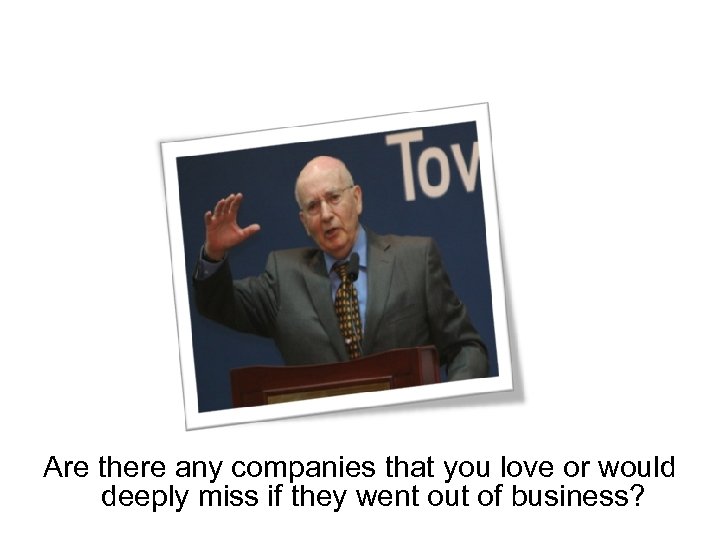 Are there any companies that you love or would deeply miss if they went out of business?
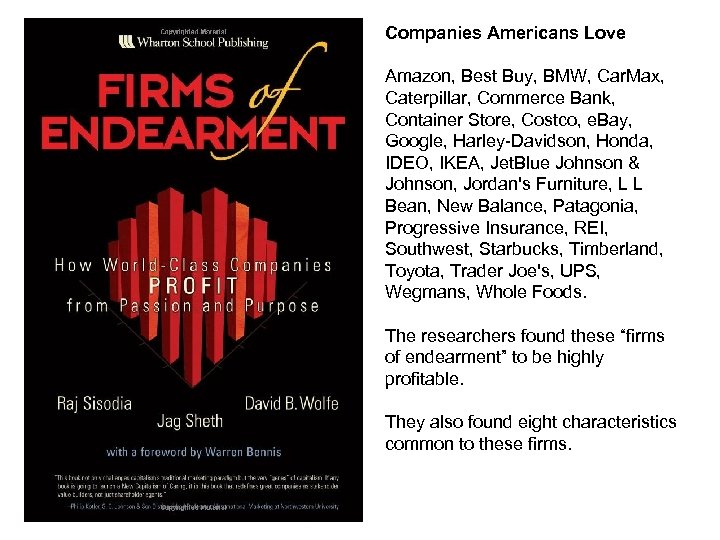 Companies Americans Love Amazon, Best Buy, BMW, Car. Max, Caterpillar, Commerce Bank, Container Store, Costco, e. Bay, Google, Harley-Davidson, Honda, IDEO, IKEA, Jet. Blue Johnson & Johnson, Jordan's Furniture, L L Bean, New Balance, Patagonia, Progressive Insurance, REI, Southwest, Starbucks, Timberland, Toyota, Trader Joe's, UPS, Wegmans, Whole Foods. The researchers found these “firms of endearment” to be highly profitable. They also found eight characteristics common to these firms.
 Characteristics of “Firms of Endearment” • • They align the interests of all stakeholder groups Their executive salaries are relatively modest They operate an open door policy to reach top management Their employee compensation and benefits are high for the category; their employee training is longer; and their employee turnover is lower They hire people who are passionate about customers They view suppliers as true partners who collaborate in improving productivity and quality and lowering costs They believe that their corporate culture is their greatest asset and primary source of competitive advantage. Their marketing costs are much lower than their peers while customer satisfaction and retention is much higher.
 How Are You Planning to Grow Profitable? • Efficiency – Finance and cost control become important (time and motion studies) • Acquisition – Finance becomes important • Organic growth – Marketing and sales become important • Innovation – R&D and technology become important
 Innovativeness is a Capability • Innovativeness is a capability; consider Sony and 3 M. • Innovation requires organizing three markets within the firm: – An idea market – A capital market – A talent market • The best innovations provide solutions to customer problems, not to the company’s product problems. • Strong market-creating innovations have a long life and create market leadership.
 Companies Need an Innovation Strategy • There are four major types of innovation in business: – – Product innovation Service innovation Marketing innovation Business model innovation • A company first needs to choose an innovation strategy. • The decision should include building an innovation culture and providing funds for training, incentivizing, and rewarding. • Each approved innovation project must have an innovation plan, budget, time line, and deadline. • A high level executive manages the innovation projects portfolio, updates their status, shares with the CEO, and they make further decisions on extending or terminating.
 Business Model Innovations • • • Amazon and Kindle Apple and i. Tunes Barnes and Nobles bookstores Dell computer Ikea Starbucks
 Marketing Innovations • Incentive innovations – – – – Credit cards Rebates Zero-interest financing Gift certificates Coupons Guarantees and warranties Loyalty awards Subscription selling (Book of the Month Club) • Retailing innovations – – – – – Self-service stores Self-checkout Coupon feeds Hypermarkets Category killer stores Differentiated stores with same chain (Best Buy) Exclusive lines of merchandise (Target: Michael Graves, Martha Stewart) Selling on TV (Home Shopping Network) Selling on the Internet • Producer innovations – Brand as a platform (Virgin, i. Tunes) – Customization
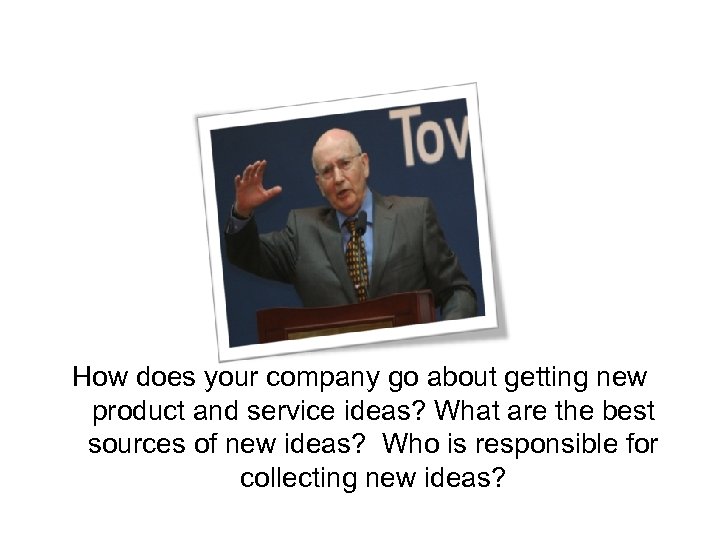 How does your company go about getting new product and service ideas? What are the best sources of new ideas? Who is responsible for collecting new ideas?
 Sources of New Ideas • Scientists and Engineers – 3 M and Philips • Employees – Whirlpool, – Shell – Samsung • Customers – Problems in present products – Dream products – Enthusiasts • Other partners in the company network
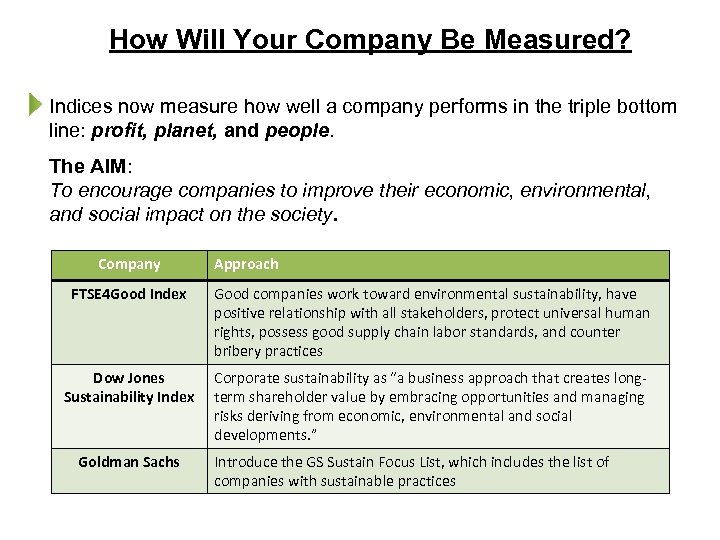 How Will Your Company Be Measured? Indices now measure how well a company performs in the triple bottom line: profit, planet, and people. The AIM: To encourage companies to improve their economic, environmental, and social impact on the society. Company Approach FTSE 4 Good Index Good companies work toward environmental sustainability, have positive relationship with all stakeholders, protect universal human rights, possess good supply chain labor standards, and counter bribery practices Dow Jones Sustainability Index Corporate sustainability as “a business approach that creates longterm shareholder value by embracing opportunities and managing risks deriving from economic, environmental and social developments. ” Goldman Sachs Introduce the GS Sustain Focus List, which includes the list of companies with sustainable practices
 The Marketing Mindset • Your company and stakeholders need to embrace a market and customer-orientation. • Your company needs a CMO who participates in formulating the company’s growth strategy. • Your company needs to define its mission, vision and values as the starting point for its transformation to Marketing 3. 0. • Your offerings must touch the customer’s mind, heart, and human spirit if they are to win over the customer. • Your company needs to practice the Triple Bottom-Line: Economic Value, Environmental Health, and Social Progress. This is the key to Profitability, Returnability, and Sustainability.
 “Within five years, if you run your business in the same way as you do now, you’re going to be out of business. ” Philip Kotler
 THANK YOU FOR YOUR ATTENTION!