


 Скачать презентацию Contemporary Physics Part 1 Lecture 4 Work
LlectureNo_3_on_Physics_1part2.pptx
- Количество слайдов: 20
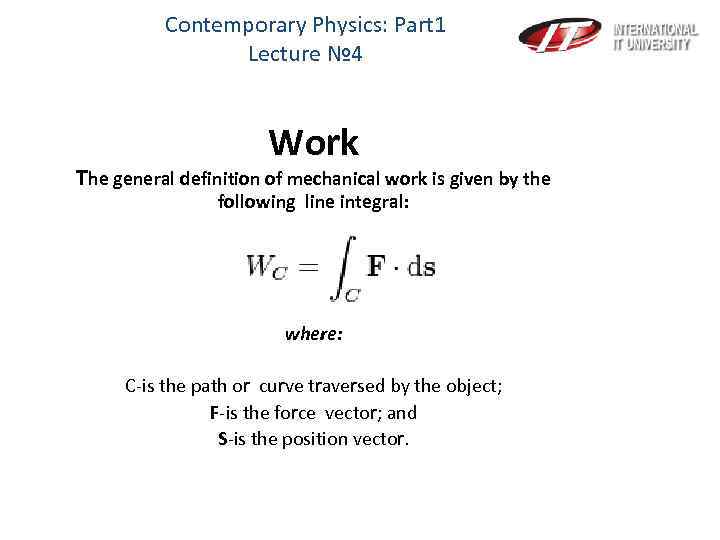 Contemporary Physics: Part 1 Lecture № 4 Work The general definition of mechanical work is given by the following line integral: where: C-is the path or curve traversed by the object; F-is the force vector; and S-is the position vector.
 Energy conservation law Energy is subject to the law of conservation of energy. According to this law, energy can neither be created (produced) nor destroyed by itself. It can only be transformed. According to energy conservation law the total inflow of energy into a system must equal the total outflow of energy from the system, plus the change in the energy contained within the system.
 1. Energy and Work In physics, mechanical work is the amount of energy transferred by a force acting through a distance. Like energy, it is a scalar quantity, with SI units of joules. The term work was first coined in 1826 by the French mathematician Gaspard Gustave Coriolis
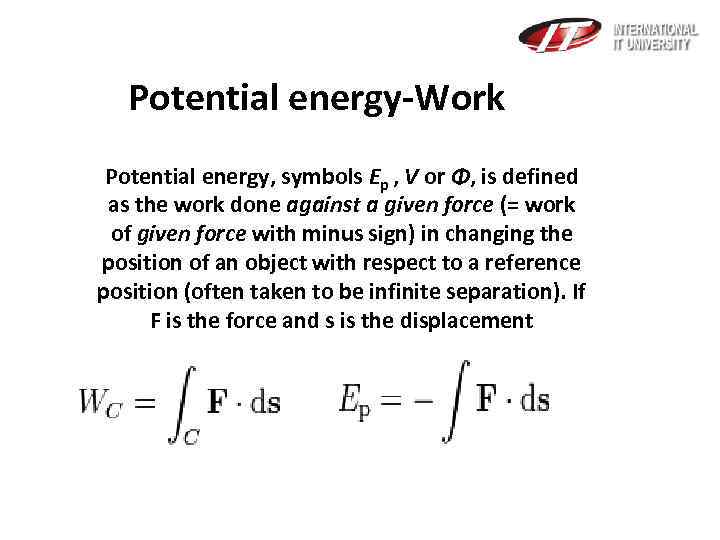 Potential energy-Work Potential energy, symbols Ep , V or Φ, is defined as the work done against a given force (= work of given force with minus sign) in changing the position of an object with respect to a reference position (often taken to be infinite separation). If F is the force and s is the displacement
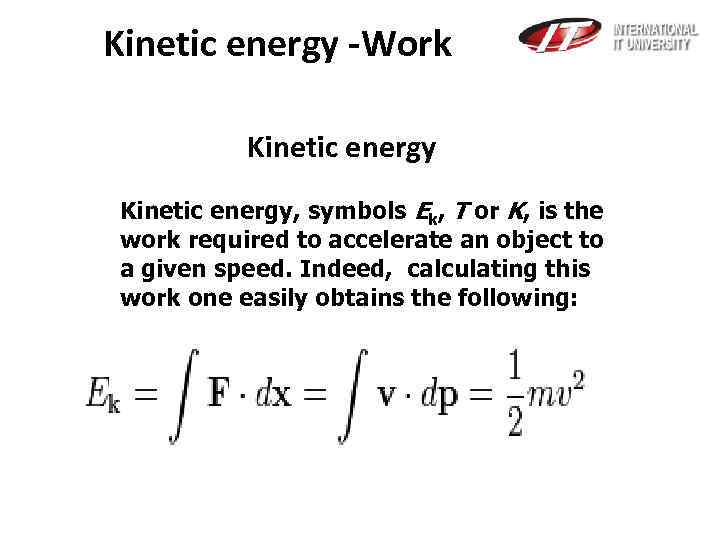 Kinetic energy -Work Kinetic energy, symbols Ek, T or K, is the work required to accelerate an object to a given speed. Indeed, calculating this work one easily obtains the following:
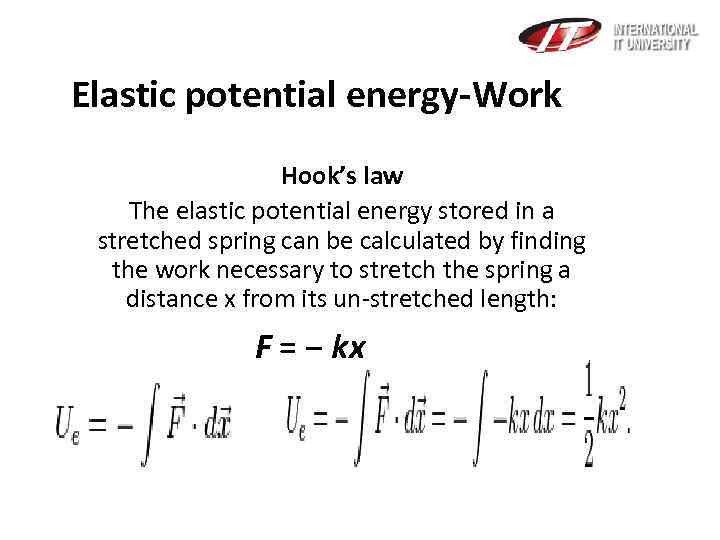 Elastic potential energy-Work Hook’s law The elastic potential energy stored in a stretched spring can be calculated by finding the work necessary to stretch the spring a distance x from its un-stretched length: F = − kx
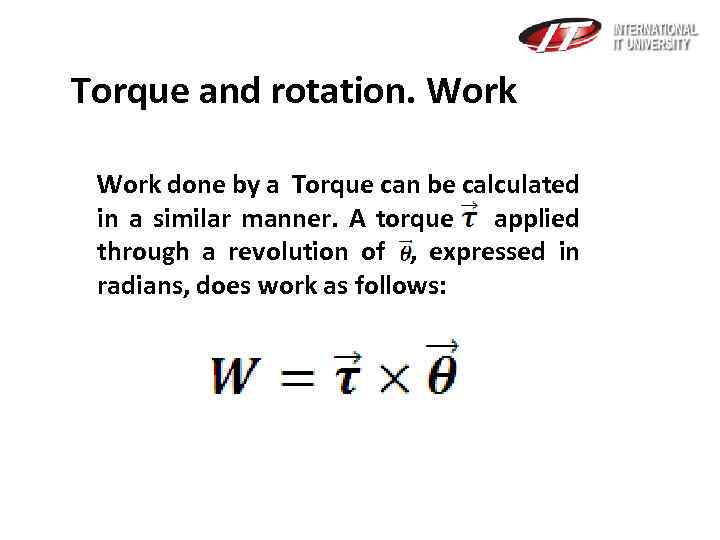 Torque and rotation. Work done by a Torque can be calculated in a similar manner. A torque applied through a revolution of , expressed in radians, does work as follows:
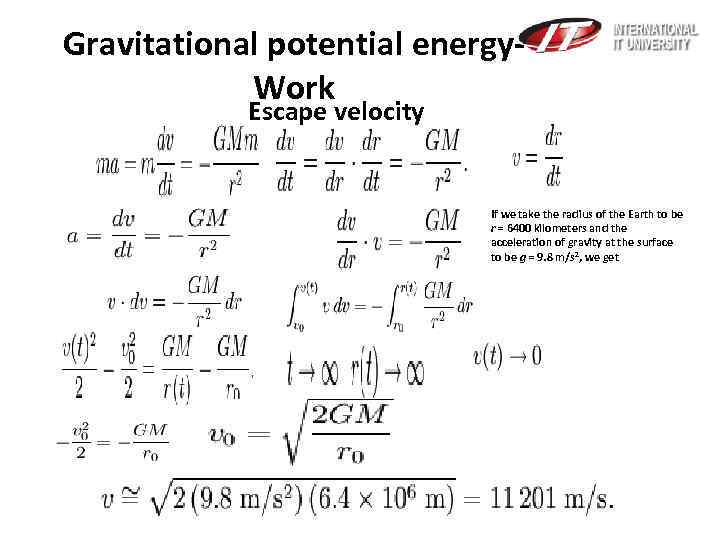 Gravitational potential energy. Work Escape velocity If we take the radius of the Earth to be r = 6400 kilometers and the acceleration of gravity at the surface to be g = 9. 8 m/s 2, we get
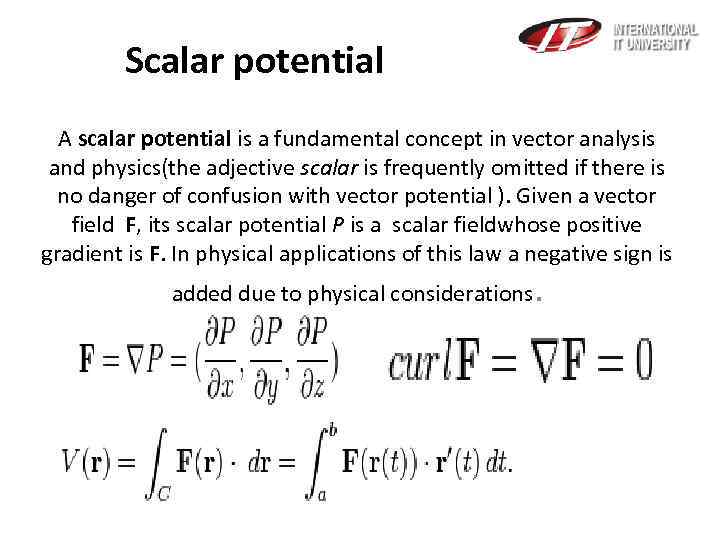 Scalar potential A scalar potential is a fundamental concept in vector analysis and physics(the adjective scalar is frequently omitted if there is no danger of confusion with vector potential ). Given a vector field F, its scalar potential P is a scalar fieldwhose positive gradient is F. In physical applications of this law a negative sign is added due to physical considerations.
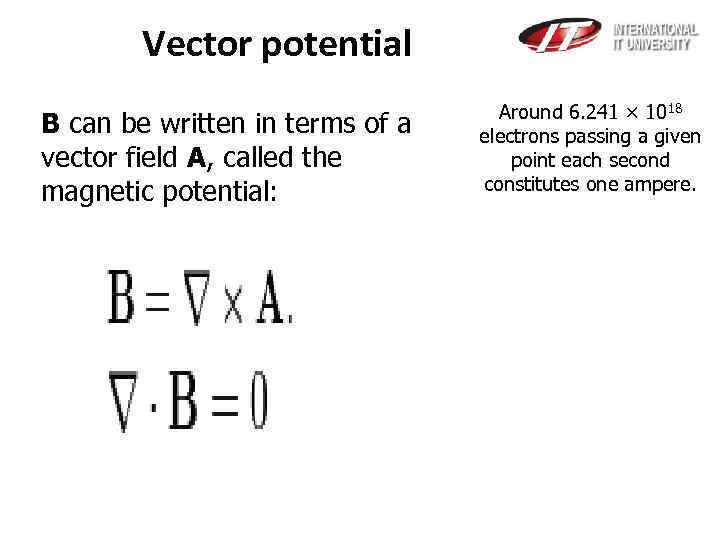 Vector potential B can be written in terms of a vector field A, called the magnetic potential: Around 6. 241 × 1018 electrons passing a given point each second constitutes one ampere.
 Path independent vector fields In vector calculas a conservative vector field is a vector field which is the gradient of a function, known as a scalar potential. Conservative vector fields have the property that the line integral from one point to another is independent of the choice of path connecting the two points: it is path independent. Conversely, path independence is equivalent to the vector field being conservative. Conservative vector fields are also irrotational, meaning that (in threedimensions) they have vanishing curl. y v
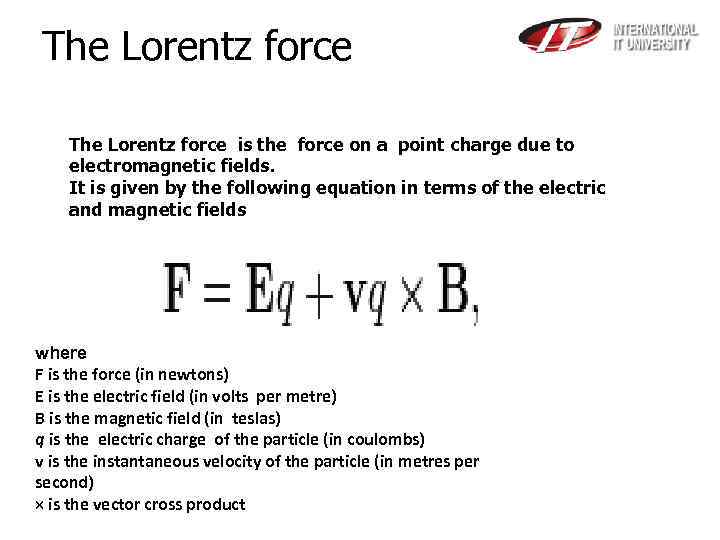 The Lorentz force is the force on a point charge due to electromagnetic fields. It is given by the following equation in terms of the electric and magnetic fields where F is the force (in newtons) E is the electric field (in volts per metre) B is the magnetic field (in teslas) q is the electric charge of the particle (in coulombs) v is the instantaneous velocity of the particle (in metres per second) × is the vector cross product
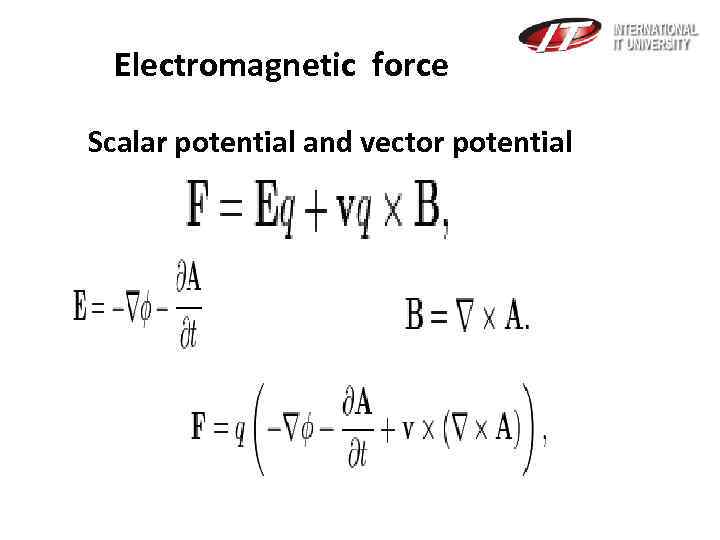 Electromagnetic force Scalar potential and vector potential
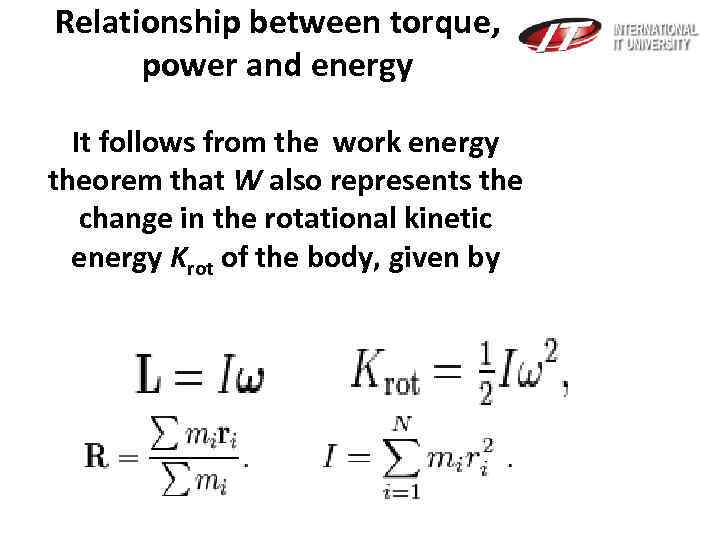 Relationship between torque, power and energy It follows from the work energy theorem that W also represents the change in the rotational kinetic energy Krot of the body, given by
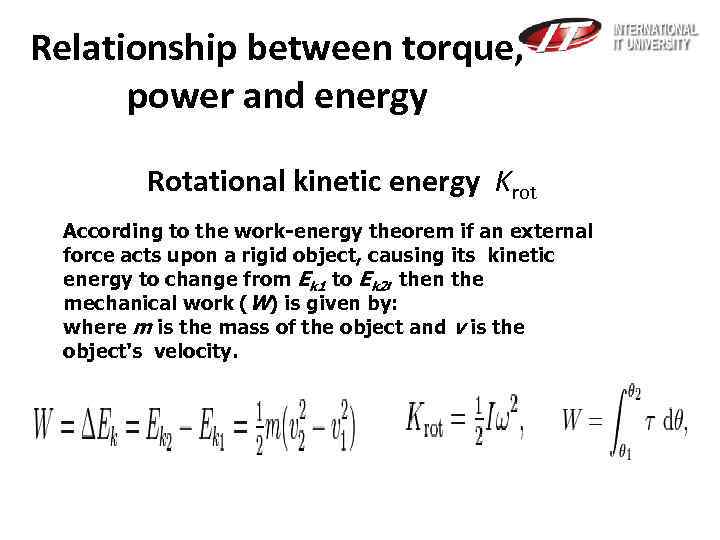 Relationship between torque, power and energy Rotational kinetic energy Krot According to the work-energy theorem if an external force acts upon a rigid object, causing its kinetic energy to change from Ek 1 to Ek 2, then the mechanical work (W) is given by: where m is the mass of the object and v is the object's velocity.
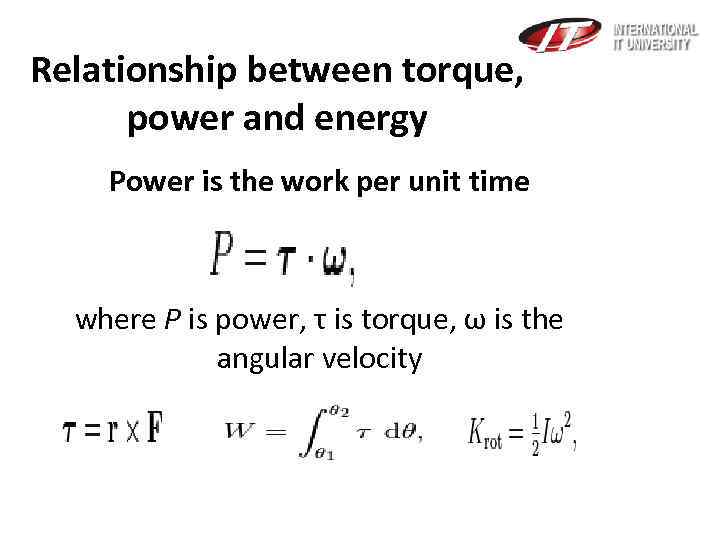 Relationship between torque, power and energy Power is the work per unit time where P is power, τ is torque, ω is the angular velocity
 Quiz The point mass is: 1. The size of the physical object might be neglected with the size of the interacting distance 2. The size of the physical object might not be neglected with the size of the interacting distance 3. The size of the physical object might be of the same order compared with the size of the interacting distance
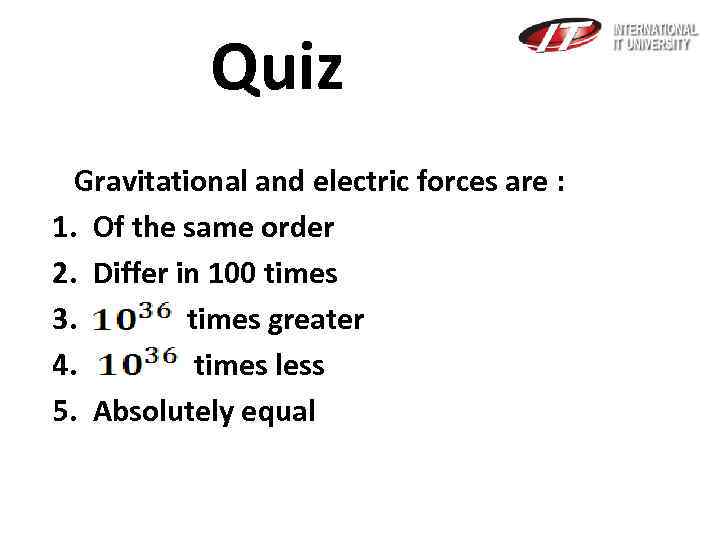 Quiz Gravitational and electric forces are : 1. Of the same order 2. Differ in 100 times 3. times greater 4. times less 5. Absolutely equal
 Quiz Elementary Charge : 1. Depends on system of reference 2. Does not depend on system of reference
 Quiz 1. 2. 3. 4. Mass of electron: Depends on the system of reference Does not depend on the system of reference Inversely proportional to its speed Proportional to its speed