 Скачать презентацию Contemporary HRM Flexibility Work organisation and flexibility
Campusm_cacheFile_1512895616.453187.ppt
- Количество слайдов: 10



Contemporary HRM Flexibility
Work organisation and flexibility… • The major influences on work organisation • Pressures for flexibility • Policy context for developments in work organisation • Objectives and expectations of employers and employees
Influences… Demand side Ø technology Ø knowledge based employment Ø shift in many Western economies to service sector Ø extent to which state has facilitated flexibility Supply side Ø increasing participation of women in labour force Ø increase in single parent families and dual career couples Ø aging population
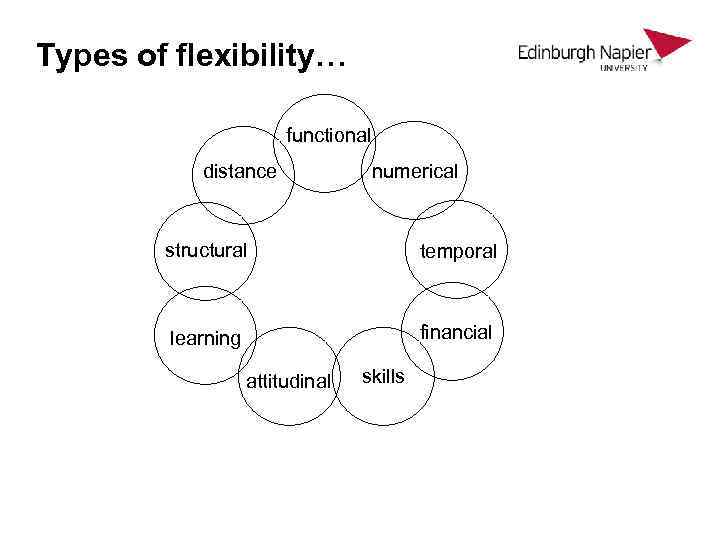
Types of flexibility… functional distance numerical structural temporal learning financial attitudinal skills
The flexible firm (Atkinson, 1984)… • Functional flexibility Ø rapid redeployment of staff Ø acquisition of new skills Ø the ‘learning organisation’ • Numerical flexibility Ø adjusting headcount quickly and cheaply Ø looser contractual relationships • Financial flexibility Ø employment costs related to state of market Ø pay systems which support functional flexibility Ø targeted on contribution
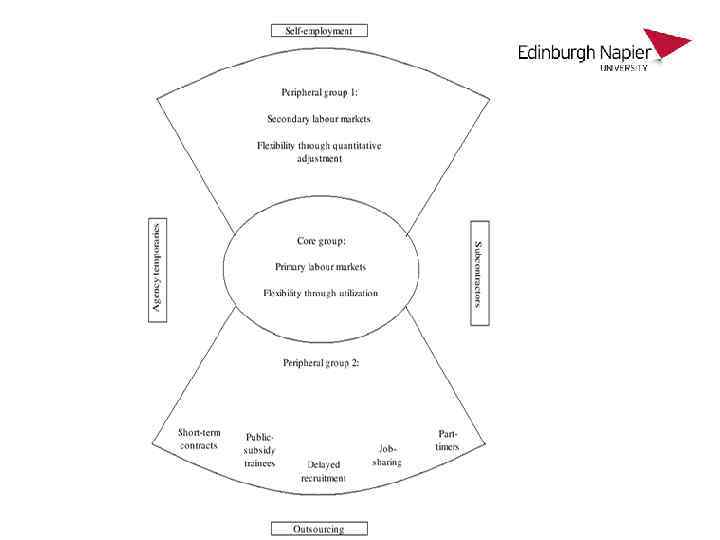
The flexible firm (Atkinson, 1984)… • Core group Ø primary labour market Ø functional flexibility • Peripheral group 1 Ø secondary labour market Ø numerical flexibility • Peripheral group 2 Ø ‘as and when’ workers Ø contacts for services Ø sub contracting
Employee driven flexibility (work-life balance)… • An individual concern or a social issue? • Indirect benefits for business • Types of flexibility preferred Ø flexible leave Ø flexible hours Ø flexible deployment of time, flexible location Ø access to care arrangements • Need to be supported by security of income and employment, access to training, i. e. no disadvantage for the employee
The reality of flexibility… • Piecemeal and limited in practice • More likely to be driven by cost reduction concerns than by expectation of strategic benefits, i. e. numerical or financial forms • Can create employee dissatisfaction and poor employee relations
Implications for employee relations… • Difficulties with labour organisation/recruitment for trade unions - “workers” not “employees” • Increased management control • Dismantling of traditional structures of wage determination, demarcation and employee job control • Increased insecurity and stress - impact on balance of power? • Emergence of ‘knowledge workers’ – individual bargaining power?
Скачать презентацию Contemporary HRM Flexibility Work organisation and flexibility
Campusm_cacheFile_1512895616.453187.ppt