


 Скачать презентацию CONTEMPORARY CHILDHOOD WHAT HAPPENS EARLY REALLY MATTERS G
63b63a5acbaad59c9cfc382bdf17682e.ppt
- Количество слайдов: 30
 CONTEMPORARY CHILDHOOD: WHAT HAPPENS EARLY REALLY MATTERS G. Reid Lyon, Ph. D. National Institute of Child Health and Human Development 1
 RESEARCH QUESTIONS • How do children develop language abilities? • How do children develop social competencies? • How can we foster children’s emotional health? • How do children learn to read? • Why do some children have difficulties learning to read? • How can we prevent reading difficulties? • How can we remediate reading difficulties? 2
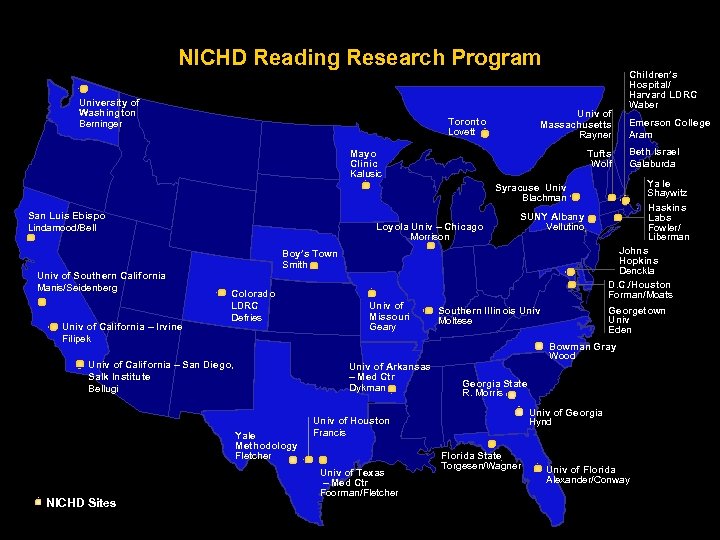 NICHD Reading Research Program University of Washington Berninger Univ of Massachusetts Rayner Toronto Lovett Mayo Clinic Kalusic Tufts Wolf Syracuse Univ Blachman San Luis Ebispo Lindamood/Bell Loyola Univ – Chicago Morrison SUNY Albany Vellutino Boy’s Town Smith Univ of Southern California Manis/Seidenberg Univ of California – Irvine Filipek Colorado LDRC Defries Univ of California – San Diego, Salk Institute Bellugi Univ of Arkansas – Med Ctr Dykman Yale Methodology Fletcher NICHD Sites 3 Univ of Missouri Geary Emerson College Aram Beth Israel Galaburda Ya le Shaywitz Haskins Labs Fowler/ Liberman Johns Hopkins Denckla D. C. /Houston Forman/Moats Georgetown Univ Eden Southern Illinois Univ Moltese Bowman Gray Wood Georgia State R. Morris Univ of Georgia Hynd Univ of Houston Francis Univ of Texas – Med Ctr Foorman/Fletcher Children’s Hospital/ Harvard LDRC Waber Florida State Torgesen/Wagner Univ of Florida Alexander/Conway
 OUR YOUNGEST CITIZENS WILL SURPRISE US • Infants, Toddlers, and preschoolers can learn more than we ever thought possible • From birth to age 3 the brains of children are rapidly forming connections between neural cells • The quality and degree of connections between neural cells are established through the quality of interactions the child has with adults, other children, and the environment • Infants before the age of 6 months can perceive and express all sounds of all languages spoken on the planet 4
 OUR YOUNGEST CITIZENS WILL SURPRISE US • Depending on the environment, vocabulary development accelerates rapidly during the second year of life. • Under the right circumstances, most 18 month olds (on average) learn 9 new words a day, every day, throughout the preschool years • By 3 years of age the child can speak in full sentences 5
 The Role of the Environment and Early Experience on Language Development • Language development requires an interplay between genes, biology, and environmental factors • Poverty and disadvantage reduce the quantity and quality of interactions with language • Limited language interactions in the home environment place children at severe risk for school failure, particularly in reading • Cultural influences every aspect of human development and must be considered in the design and implementation of any program 6
 Environmental Influences • By kindergarten a child from disadvantage typically has twice the vocabulary as a youngster born into poverty • The typical 5 -year-old from an urban environment and disadvantaged home enters kindergarten at the 5 th percentile in vocabulary • By age 16 advantaged children have four times the vocabulary as children born into poverty 7
 Major Sources of Reading Failure • Socioeconomic Factors – Poverty • Biological Factors – Genetics and Neurobiology • Instructional Factors – Predominate 8
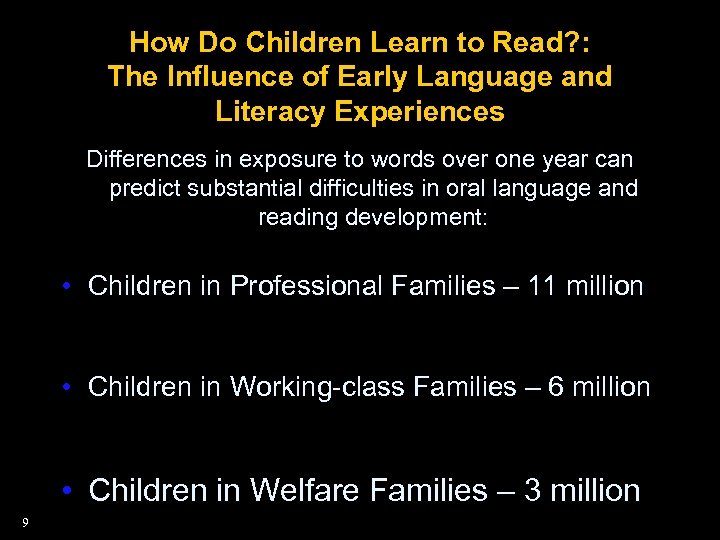 How Do Children Learn to Read? : The Influence of Early Language and Literacy Experiences Differences in exposure to words over one year can predict substantial difficulties in oral language and reading development: • Children in Professional Families – 11 million • Children in Working-class Families – 6 million • Children in Welfare Families – 3 million 9
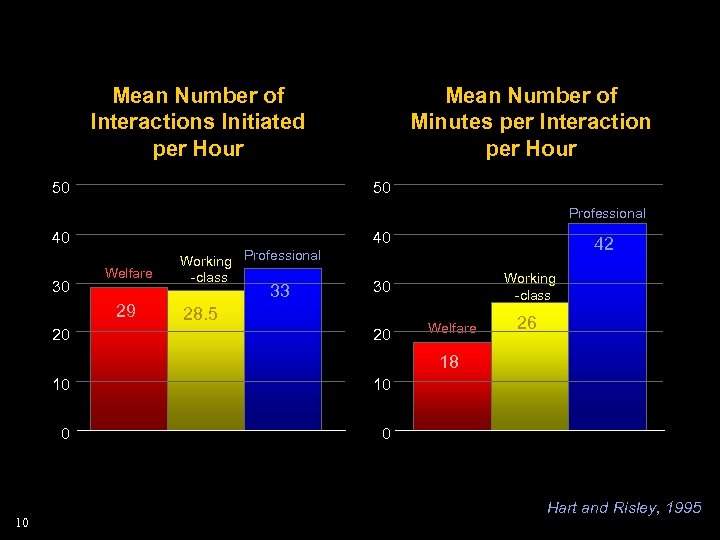 Mean Number of Interactions Initiated per Hour 50 Mean Number of Minutes per Interaction per Hour 50 Professional 40 30 40 Welfare 29 20 Working Professional -class 33 42 Working -class 30 28. 5 20 Welfare 26 18 10 0 10 10 0 Hart and Risley, 1995
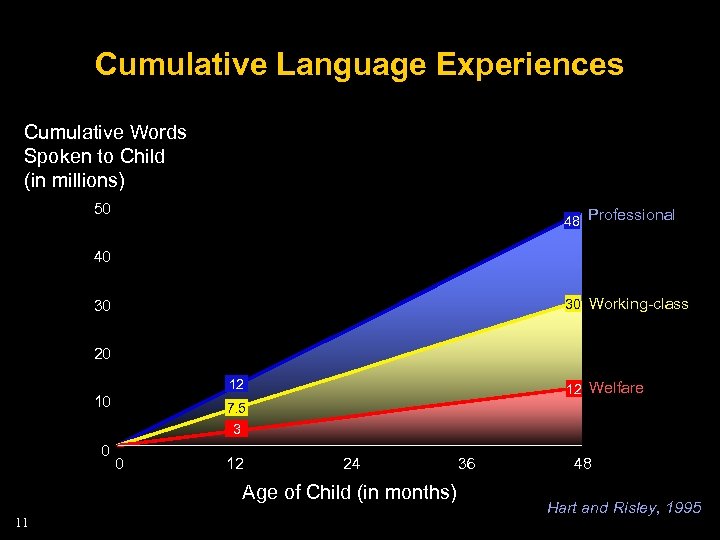 Cumulative Language Experiences Cumulative Words Spoken to Child (in millions) 50 48 Professional 40 30 Working-class 30 20 12 10 0 12 Welfare 7. 5 3 0 12 24 Age of Child (in months) 11 36 48 Hart and Risley, 1995
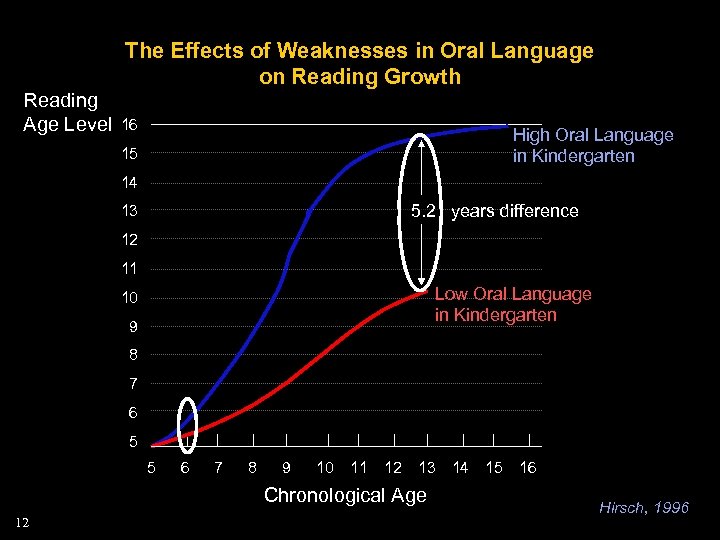 Reading Age Level The Effects of Weaknesses in Oral Language on Reading Growth 16 High Oral Language in Kindergarten 15 14 5. 2 years difference 13 12 11 Low Oral Language in Kindergarten 10 9 8 7 6 5 5 6 7 8 9 10 11 12 13 Chronological Age 12 14 15 16 Hirsch, 1996
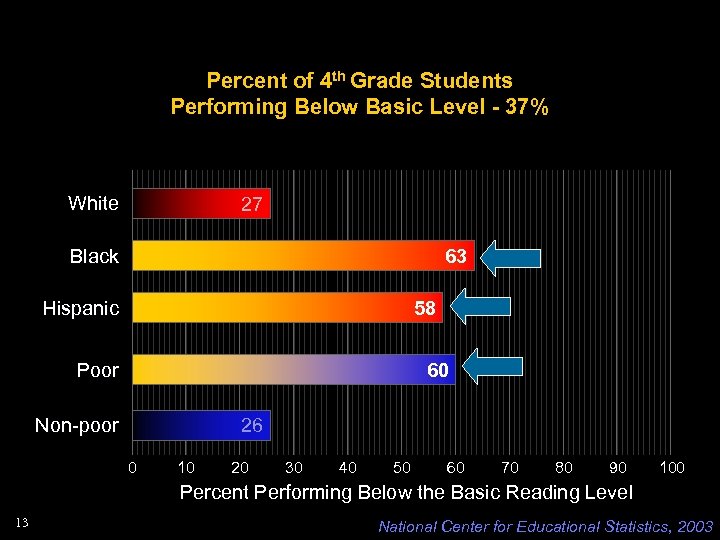 Percent of 4 th Grade Students Performing Below Basic Level - 37% White 27 Black 63 Hispanic 58 Poor 60 Non-poor 26 0 10 20 30 40 50 60 70 80 90 100 Percent Performing Below the Basic Reading Level 13 National Center for Educational Statistics, 2003
 WHAT DO KIDS NEED TO KNOW TO READ? A HECK OF A LOT 14
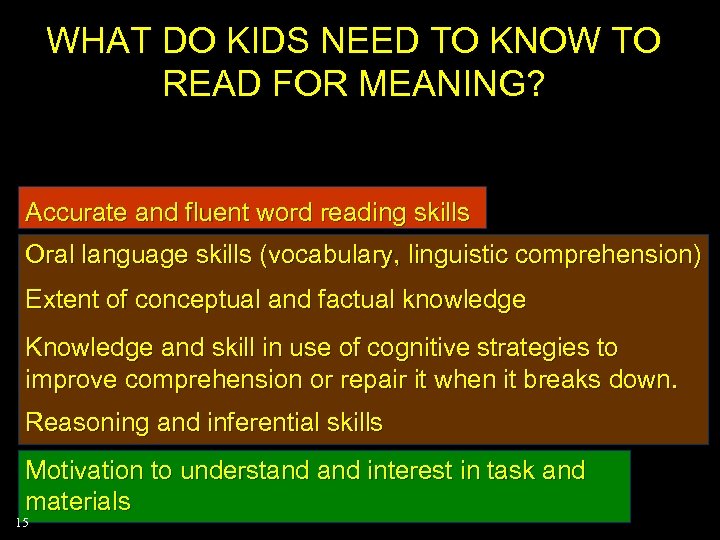 WHAT DO KIDS NEED TO KNOW TO READ FOR MEANING? Accurate and fluent word reading skills Oral language skills (vocabulary, linguistic comprehension) Extent of conceptual and factual knowledge Knowledge and skill in use of cognitive strategies to improve comprehension or repair it when it breaks down. Reasoning and inferential skills Motivation to understand interest in task and materials 15
 VIDEO 16
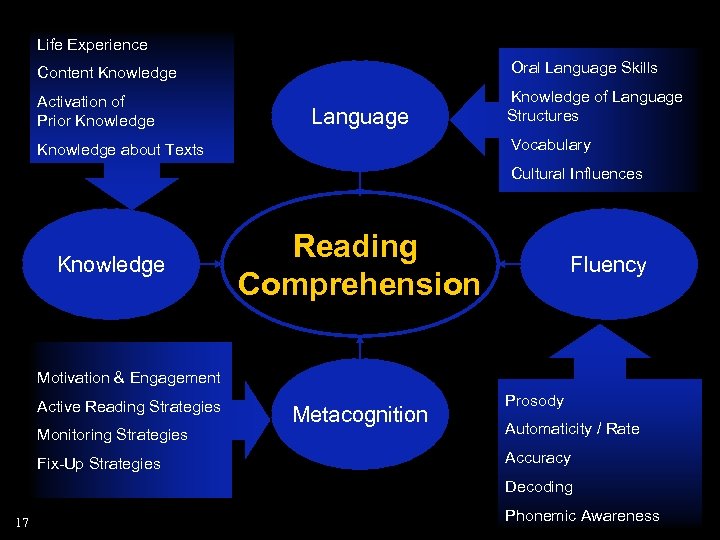 Life Experience Content Knowledge Oral Language Skills Activation of Prior Knowledge of Language Structures Language Vocabulary Knowledge about Texts Cultural Influences Knowledge Reading Comprehension Fluency Motivation & Engagement Active Reading Strategies Monitoring Strategies Fix-Up Strategies Metacognition Prosody Automaticity / Rate Accuracy Decoding 17 Phonemic Awareness
 Early Intervention is Possible • Risk characteristics present in Preschool, Kindergarten and G 1 • Print awareness, Letter knowledge, letter-sound knowledge, phonological awareness, oral language development, vocabulary, background knowledge • Assess all children and INTERVENE 18
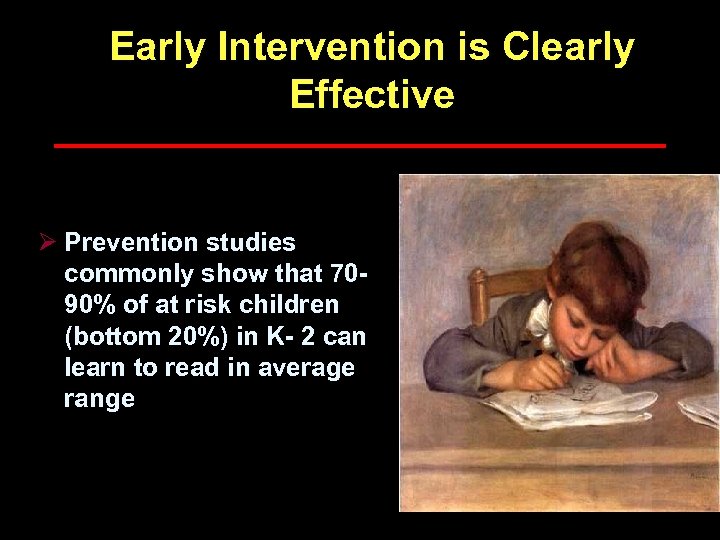 Early Intervention is Clearly Effective Ø Prevention studies commonly show that 7090% of at risk children (bottom 20%) in K- 2 can learn to read in average range
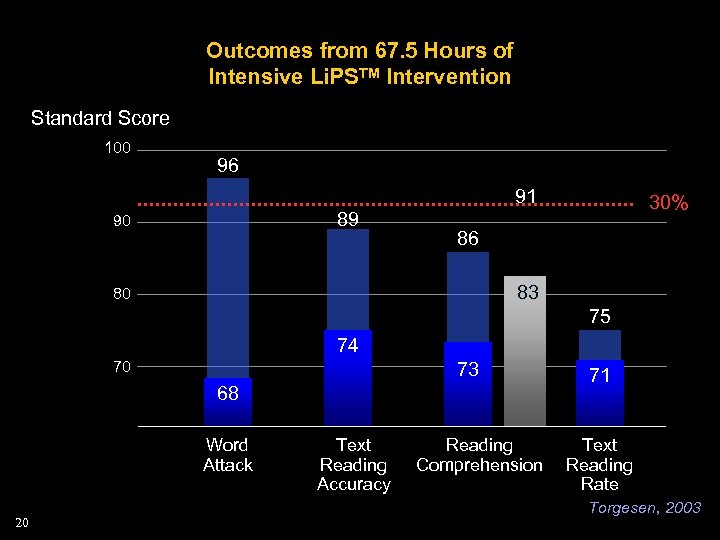 Outcomes from 67. 5 Hours of Intensive Li. PSTM Intervention Standard Score 100 96 91 89 90 30% 86 83 80 75 74 70 73 68 Word Attack 20 Text Reading Accuracy Reading Comprehension 71 Text Reading Rate Torgesen, 2003
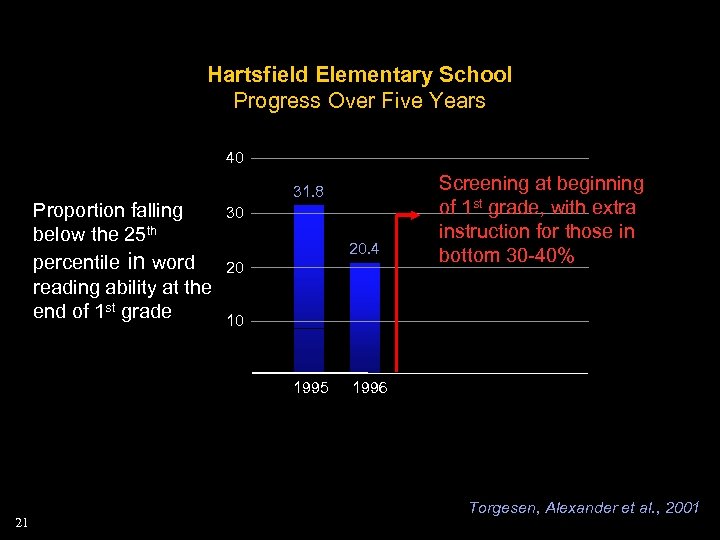 Hartsfield Elementary School Progress Over Five Years 40 Proportion falling below the 25 th percentile in word reading ability at the end of 1 st grade 31. 8 30 20. 4 20 10 1995 21 Screening at beginning of 1 st grade, with extra instruction for those in bottom 30 -40% 1996 Torgesen, Alexander et al. , 2001
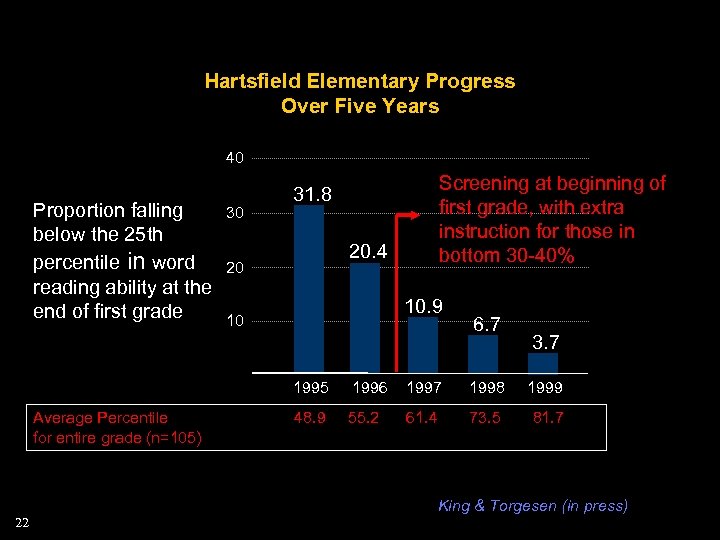 Hartsfield Elementary Progress Over Five Years 40 Proportion falling below the 25 th percentile in word reading ability at the end of first grade 30 Screening at beginning of first grade, with extra instruction for those in bottom 30 -40% 31. 8 20. 4 20 10. 9 10 6. 7 3. 7 1995 Average Percentile for entire grade (n=105) 1996 1997 1998 1999 48. 9 55. 2 61. 4 73. 5 81. 7 King & Torgesen (in press) 22
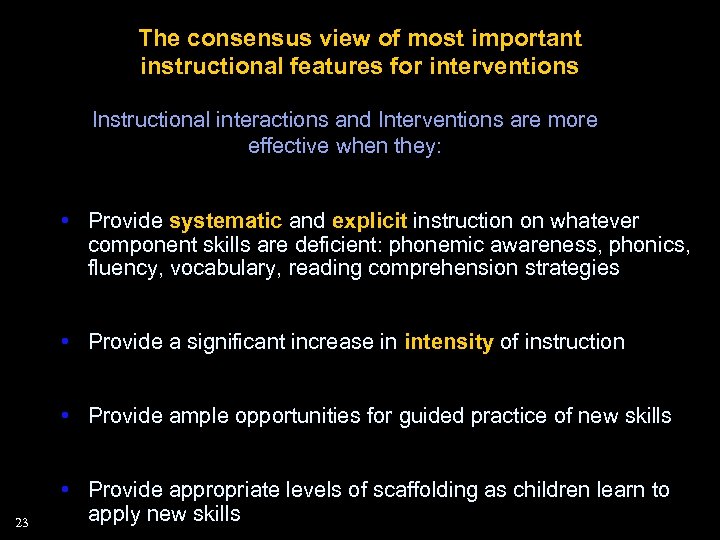 The consensus view of most important instructional features for interventions Instructional interactions and Interventions are more effective when they: • Provide systematic and explicit instruction on whatever component skills are deficient: phonemic awareness, phonics, fluency, vocabulary, reading comprehension strategies • Provide a significant increase in intensity of instruction • Provide ample opportunities for guided practice of new skills 23 • Provide appropriate levels of scaffolding as children learn to apply new skills
 Reading stimulates general cognitive growth — particularly verbal skills 24
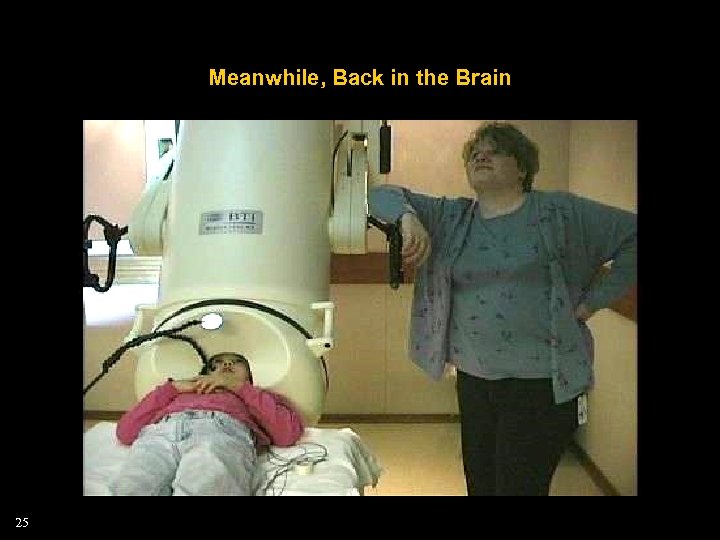 Meanwhile, Back in the Brain 25
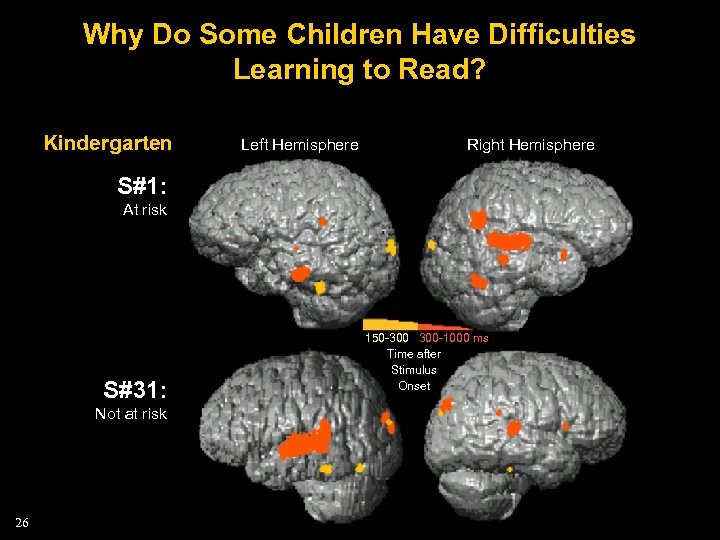 Why Do Some Children Have Difficulties Learning to Read? Kindergarten Left Hemisphere Right Hemisphere S#1: At risk S#31: Not at risk 26 150 -300 300 -1000 ms Time after Stimulus Onset
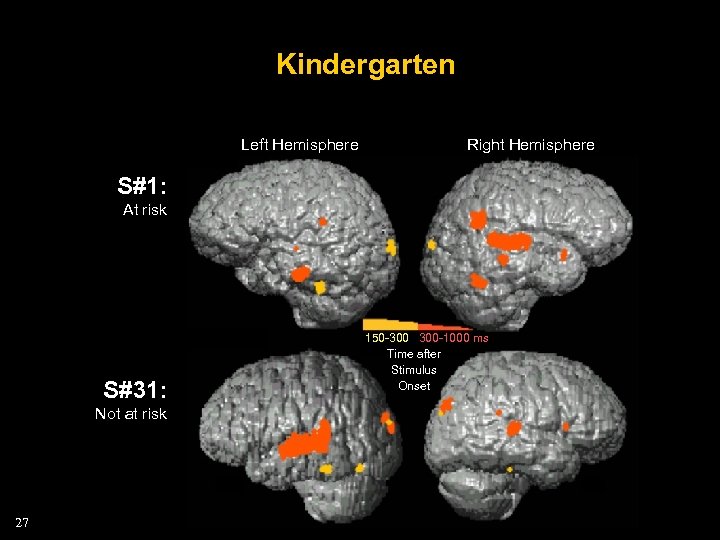 Kindergarten Left Hemisphere Right Hemisphere S#1: At risk S#31: Not at risk 27 150 -300 300 -1000 ms Time after Stimulus Onset
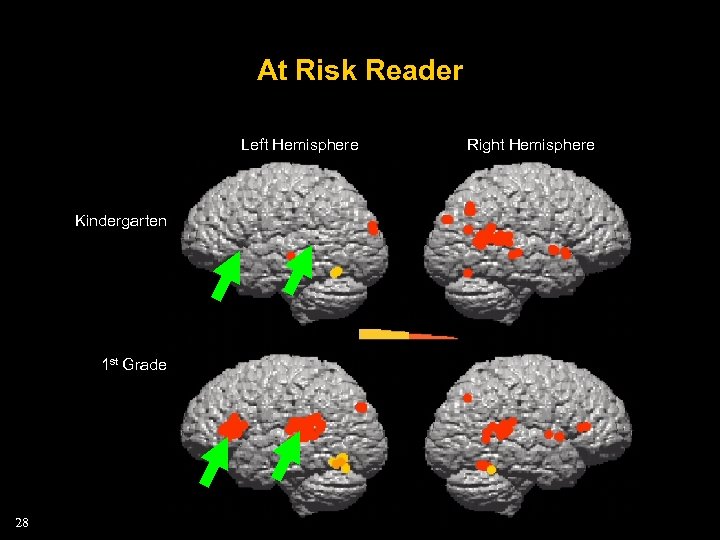 At Risk Reader Left Hemisphere Kindergarten 1 st Grade 28 Right Hemisphere
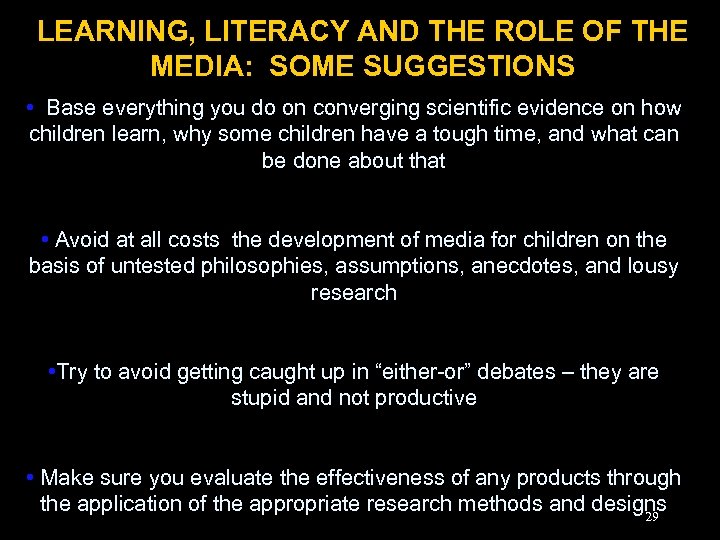 LEARNING, LITERACY AND THE ROLE OF THE MEDIA: SOME SUGGESTIONS • Base everything you do on converging scientific evidence on how children learn, why some children have a tough time, and what can be done about that • Avoid at all costs the development of media for children on the basis of untested philosophies, assumptions, anecdotes, and lousy research • Try to avoid getting caught up in “either-or” debates – they are stupid and not productive • Make sure you evaluate the effectiveness of any products through the application of the appropriate research methods and designs 29
 A CHILD’S LIFE: LEARNING, LITERACY AND THE ROLE OF THE MEDIA: G. Reid Lyon, Ph. D. National Institute of Child Health and Human Development 30