


 Скачать презентацию Contemporary and Comparative Practice in Events Lecture 2
cdf85f12b7b78b107a6aec39ff813c5c.ppt
- Количество слайдов: 11
 Contemporary and Comparative Practice in Events Lecture 2: Strategic Management for Events Jenny Flinn Jenny. Flinn@gcal. ac. uk
 Overview • The changing nature of work • Handy’s Three Rings • Defining strategic management • The strategic process • Strategic planning for events • Approaches to strategic management • Delivering strategy • Key characteristics of leadership
 The Changing Nature of Work • Impact of globalisation and increasingly competitive environment • Rethinking and reshaping the workplace • Organisations increasingly offer employment on a more flexible basis • Offers many opportunities but challenges in terms of how workforces can be managed • The events industry has long worked in this manner – Pulsating organisational structure – Transitory workforces
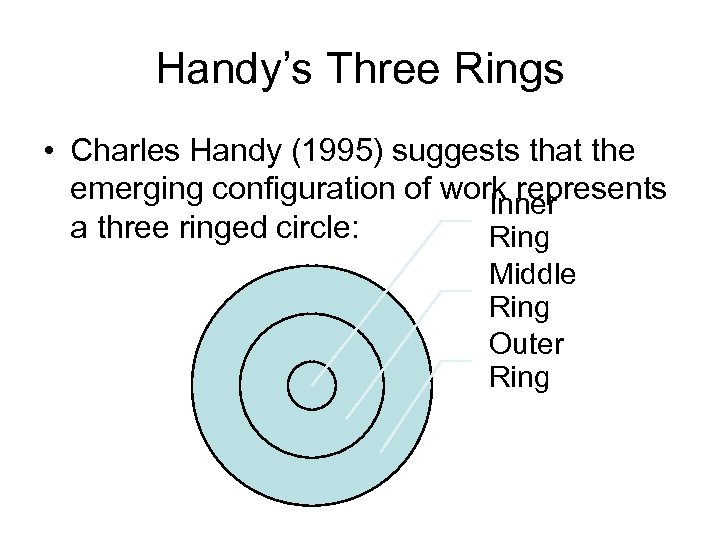 Handy’s Three Rings • Charles Handy (1995) suggests that the emerging configuration of work represents Inner a three ringed circle: Ring Middle Ring Outer Ring
 Defining Strategic Management • There are numerous definitions of strategic management but most agree that it is concerned with: – Creating long term vision – Gaining and sustaining competitive advantage • Dess &Lumpkin (2003) suggests that strategic management consists of four key attributes: – Strategic management is directed towards overall organisational goals and objectives – Strategic management involves the inclusion of multiple stakeholders in decision making – Strategic management requires the need to incorporate both short and long term perspectives – Strategic management involves the recognition of trade offs between effectiveness and efficiency
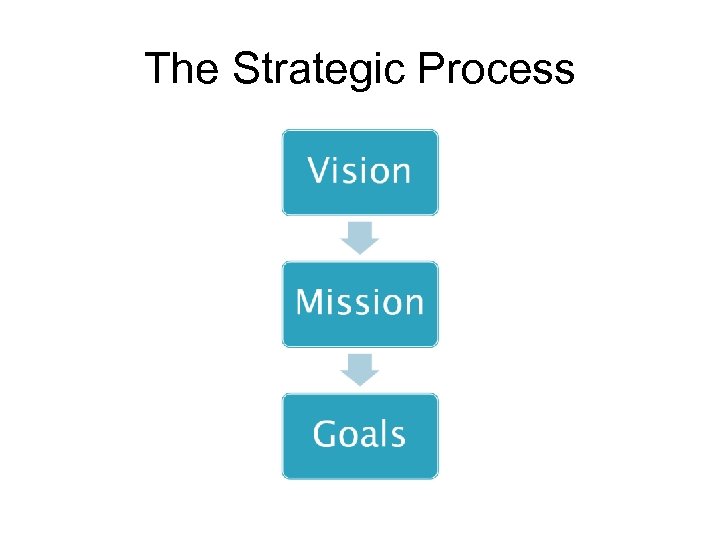 The Strategic Process
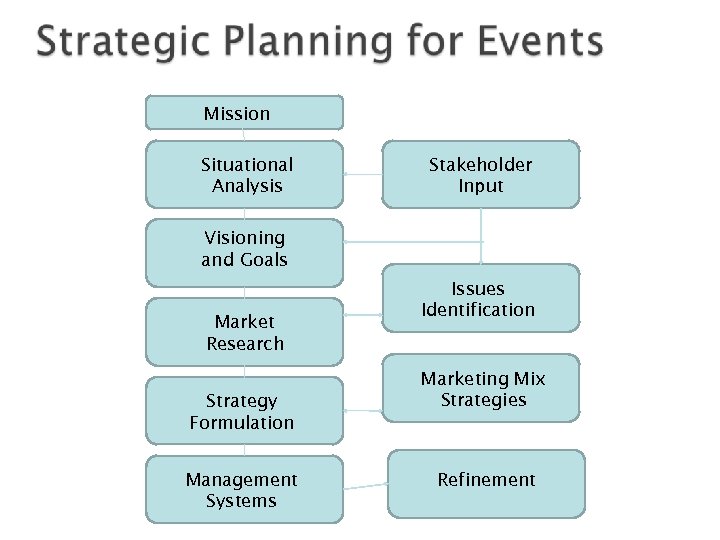 Mission Situational Analysis Stakeholder Input Visioning and Goals Market Research Strategy Formulation Management Systems Issues Identification Marketing Mix Strategies Refinement
 Approaches to Strategic Management • The prescriptive or deliberate approach • The emergent or learning approach • Competitive positioning • The resource, competence and capability approach
 Delivering Strategy • In order to delivery upon strategy strong leadership is required • Leadership must be proactive, goal oriented and focused on the creation and implementation of a creative vision (Dess &Lumpkin, 2003) • “an enlightened leader has the ability to get the members of an organisation to accept ownership for a vision as their own” (Oakley & Krug, 1991: 23)
 Key Characteristics of Leadership • Goldblatt (2002) suggests that the event leader should be in possession of the following key characteristics: – – – Integrity Confidence and persistence Collaborative decision making Problem solving Communication skills Vision
 References • Dess, G. G. &Lumpkin, G. T. (2003) Strategic Management: creating competitive advantages. New York: Mc. Graw. Hill. • Getz, D. (2007) Event Studies: theory, research and policy for planned events. Oxford: Butterworth Heinemann. • Getz, D. (1997) Event Management and Event Tourism. New York: Cognizant. • Goldblatt, J. (2002) Special Events. New York: Wiley. • Handy, C. (1995) Beyond Certainty: the changing world of organisations. London: Hutchinson. • Masterman, G. (2004) Strategic Sports Event Management: an international approach. London: Elsevier. • Mintzberg, H. (1994) The Rise and Fall of Strategic Planning. New York: The Free Press. • Oakley, E. & Krug, D. (1991) Enlightened Leadership: getting to the heart of change. New York: Simon & Schuster. • Quinn, J. B. (1978) Strategic Change: logical incrementalism. Strategic Management Journal, Vol. 10. • Van der Wagen, L. (2006) Human Resource Management for Events: managing the event workforce. Oxford: Butterworth Heinemann.