


 Скачать презентацию CONTAINERIZATION AND MODERN CARGO STOWAGE LECTURE 4 Containerization
Lecture 4 - Containers - Types & Markings.pptx
- Количество слайдов: 69
 CONTAINERIZATION AND MODERN CARGO STOWAGE LECTURE 4 Containerization Types & Markings 1
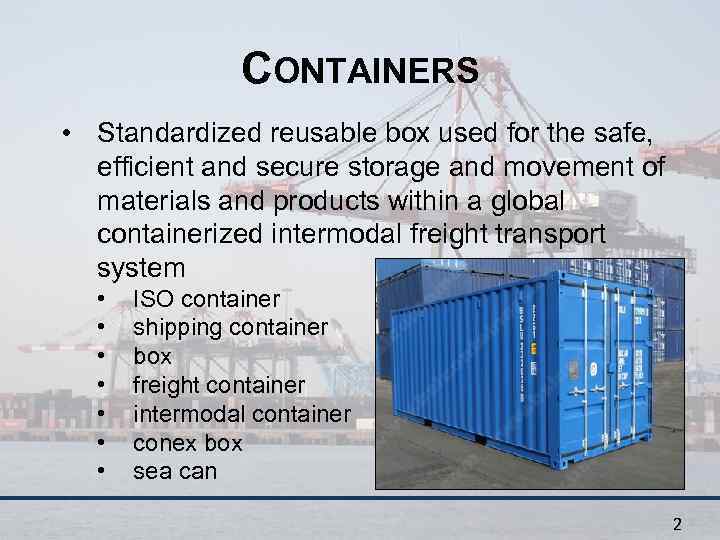 CONTAINERS • Standardized reusable box used for the safe, efficient and secure storage and movement of materials and products within a global containerized intermodal freight transport system • • ISO container shipping container box freight container intermodal container conex box sea can 2
 CONTAINERS • ISO (international Standards Organization) • Freight container is an article of transport equipment a) of a permanent character and accordingly strong enough to be suitable for repeated use b) specially designed to facilitate the carriage of goods, by one or more modes of transport, without intermediate reloading c) fitted with devices permitting its ready handling, particularly its transfer from one mode of transport to another 3
 CONTAINERS • ISO (international Standards Organization) • Freight container is an article of transport equipment d) designed as to be easy to fill and empty e) stackable f) sized such that 1) area enclosed by outer and bottom corners is at least 150 ft 3 (14 m 2) 2) at least 75 ft 3 (7 m 2) if top corners fittings 4
 CONTAINERS • Construction • Usually of corrugated weathering steel • Aluminum or fiberglass too • Steel frames • Support weight • Corner fittings, or casting, are used to lift entire weight • Wood floor • Typical container has doors fitted at one end 5
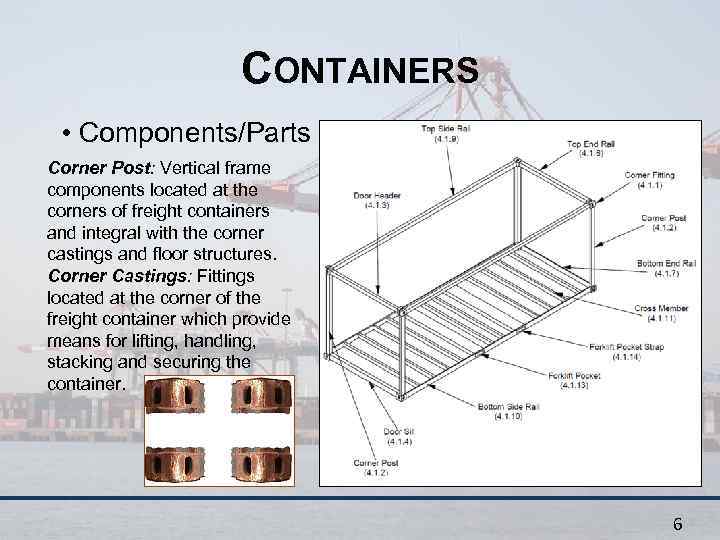 CONTAINERS • Components/Parts Corner Post: Vertical frame components located at the corners of freight containers and integral with the corner castings and floor structures. Corner Castings: Fittings located at the corner of the freight container which provide means for lifting, handling, stacking and securing the container. 6
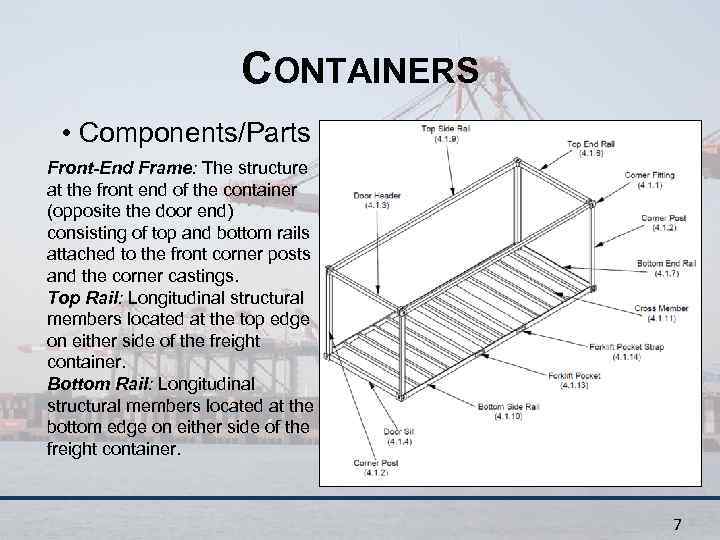 CONTAINERS • Components/Parts Front-End Frame: The structure at the front end of the container (opposite the door end) consisting of top and bottom rails attached to the front corner posts and the corner castings. Top Rail: Longitudinal structural members located at the top edge on either side of the freight container. Bottom Rail: Longitudinal structural members located at the bottom edge on either side of the freight container. 7
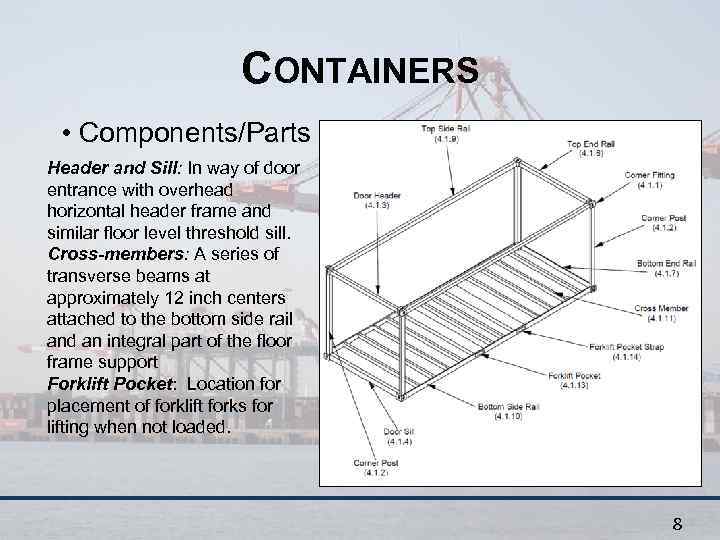 CONTAINERS • Components/Parts Header and Sill: In way of door entrance with overhead horizontal header frame and similar floor level threshold sill. Cross-members: A series of transverse beams at approximately 12 inch centers attached to the bottom side rail and an integral part of the floor frame support Forklift Pocket: Location for placement of forklift forks for lifting when not loaded. 8
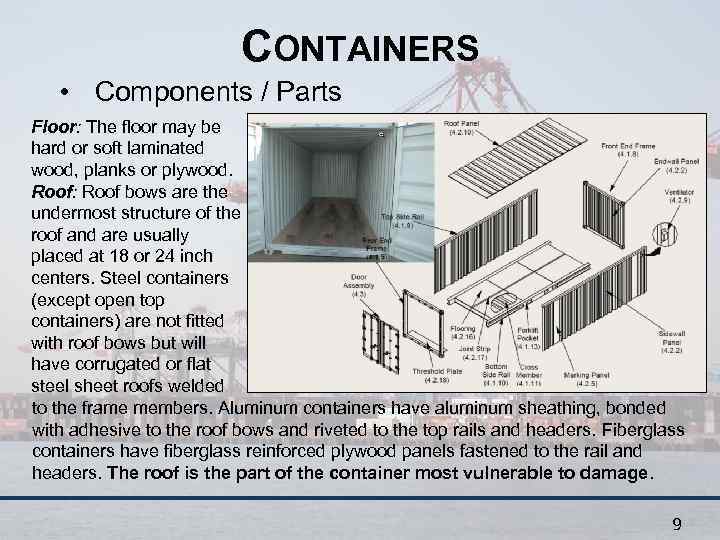 CONTAINERS • Components / Parts Floor: The floor may be hard or soft laminated wood, planks or plywood. Roof: Roof bows are the undermost structure of the roof and are usually placed at 18 or 24 inch centers. Steel containers (except open top containers) are not fitted with roof bows but will have corrugated or flat steel sheet roofs welded to the frame members. Aluminum containers have aluminum sheathing, bonded with adhesive to the roof bows and riveted to the top rails and headers. Fiberglass containers have fiberglass reinforced plywood panels fastened to the rail and headers. The roof is the part of the container most vulnerable to damage. 9
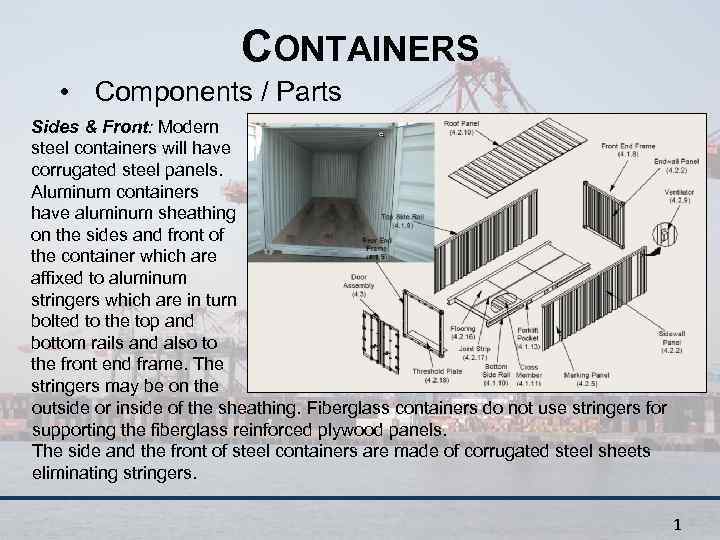 CONTAINERS • Components / Parts Sides & Front: Modern steel containers will have corrugated steel panels. Aluminum containers have aluminum sheathing on the sides and front of the container which are affixed to aluminum stringers which are in turn bolted to the top and bottom rails and also to the front end frame. The stringers may be on the outside or inside of the sheathing. Fiberglass containers do not use stringers for supporting the fiberglass reinforced plywood panels. The side and the front of steel containers are made of corrugated steel sheets eliminating stringers. 1
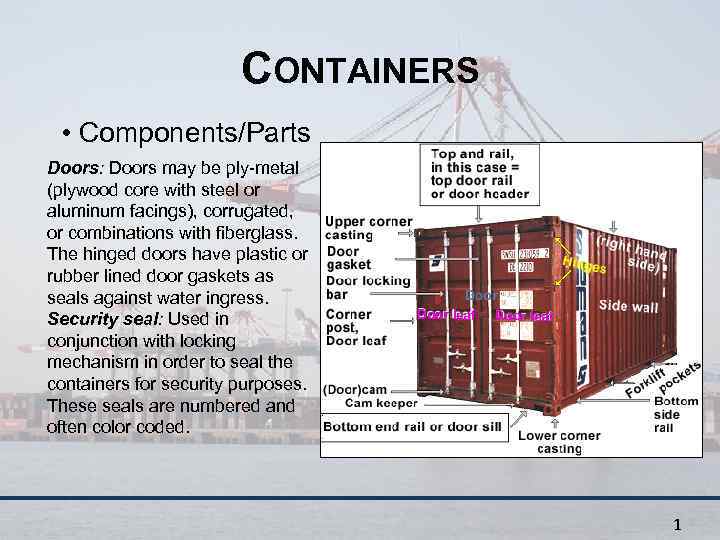 CONTAINERS • Components/Parts Doors: Doors may be ply-metal (plywood core with steel or aluminum facings), corrugated, or combinations with fiberglass. The hinged doors have plastic or rubber lined door gaskets as seals against water ingress. Security seal: Used in conjunction with locking mechanism in order to seal the containers for security purposes. These seals are numbered and often color coded. 1
 CONTAINERS • Size • ISO (international Standards Organization) standards set in late 1960 s • • • Standardized length took some time Pan-Atlantic used 33 ft. and then 35 ft. Matson used 24 ft. • Length • Standard length set at 10, 20, 30, and 40 ft. • 10 proved to small and few 30 were built • 20 and 40 as the most popular and universally common 1
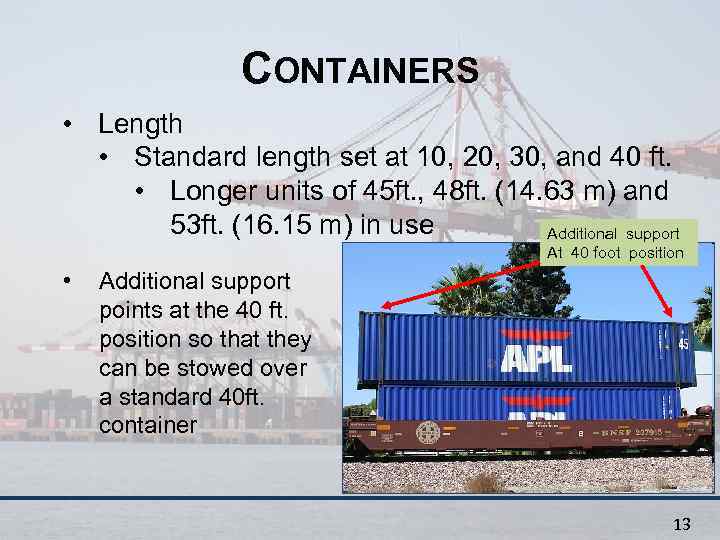 CONTAINERS • Length • Standard length set at 10, 20, 30, and 40 ft. • Longer units of 45 ft. , 48 ft. (14. 63 m) and 53 ft. (16. 15 m) in use Additional support At 40 foot position • Additional support points at the 40 ft. position so that they can be stowed over a standard 40 ft. container 13
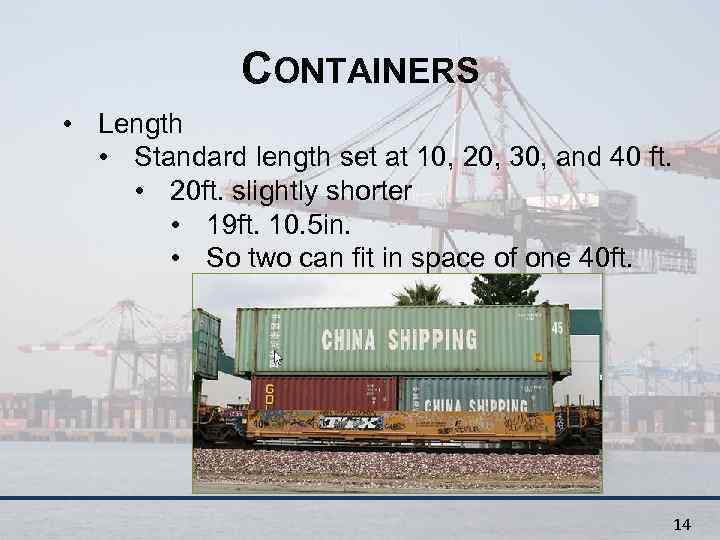 CONTAINERS • Length • Standard length set at 10, 20, 30, and 40 ft. • 20 ft. slightly shorter • 19 ft. 10. 5 in. • So two can fit in space of one 40 ft. 14
 CONTAINERS • Width • ISO containers have width of 8 ft. (2. 438 m) • “Pallet wide" containers • About 2 inches (5 cm) wider than standard containers • Accommodate Euro-pallets common in Europe • Internal width of 2440 mm for easy loading of two 1200 mm long pallets side by side 15
 CONTAINERS • Height • Standard • A standard container is 8 ft. 6 in. in height • High Cube • A high box is 9 ft. 6 in. • Even 10 ft. 6 in. in some cases. • 8 ft. height used early on • Seen rarely today 1
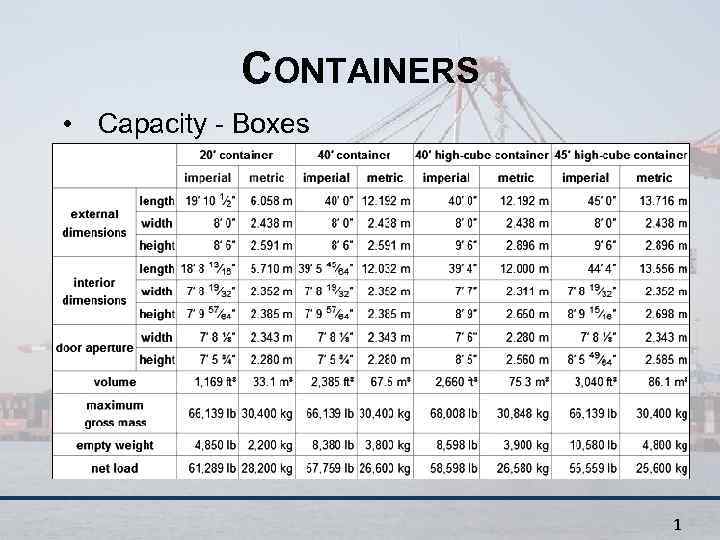 CONTAINERS • Capacity - Boxes 1
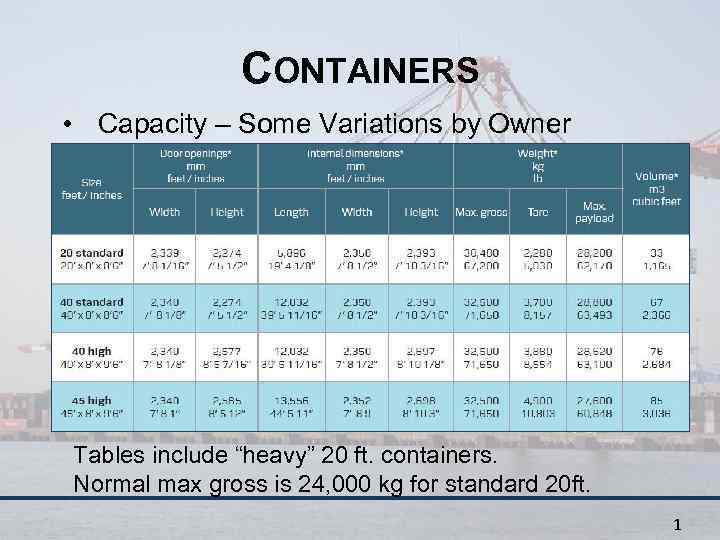 CONTAINERS • Capacity – Some Variations by Owner Tables include “heavy” 20 ft. containers. Normal max gross is 24, 000 kg for standard 20 ft. 1
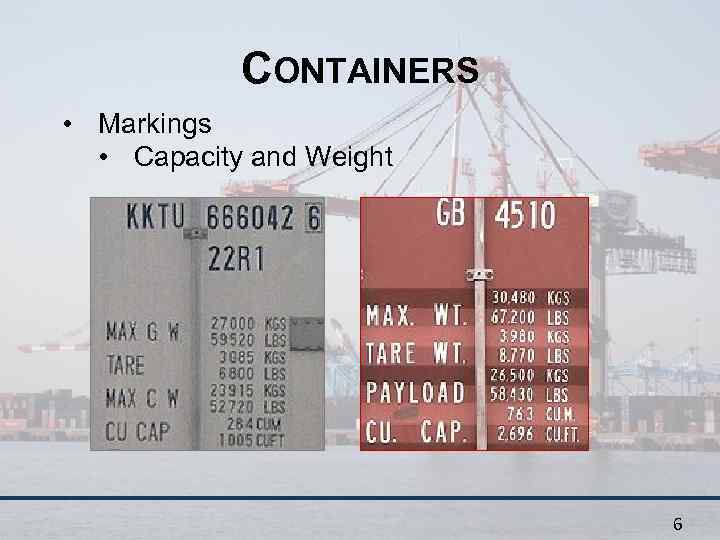
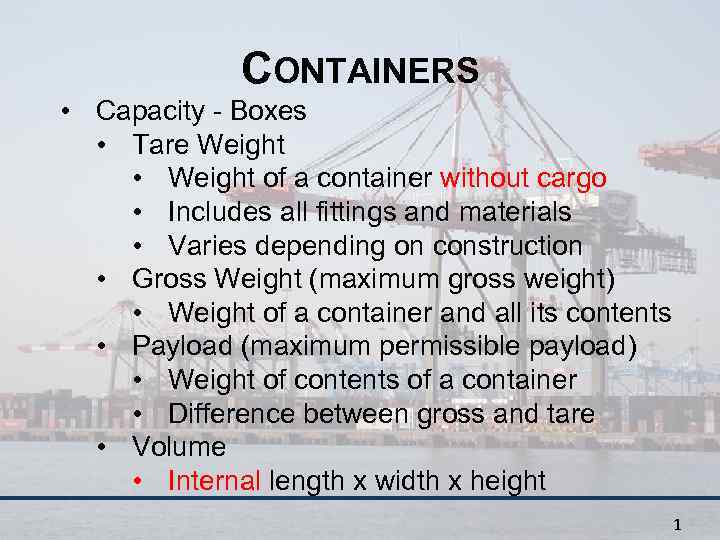 CONTAINERS • Capacity - Boxes • Tare Weight • Weight of a container without cargo • Includes all fittings and materials • Varies depending on construction • Gross Weight (maximum gross weight) • Weight of a container and all its contents • Payload (maximum permissible payload) • Weight of contents of a container • Difference between gross and tare • Volume • Internal length x width x height 1
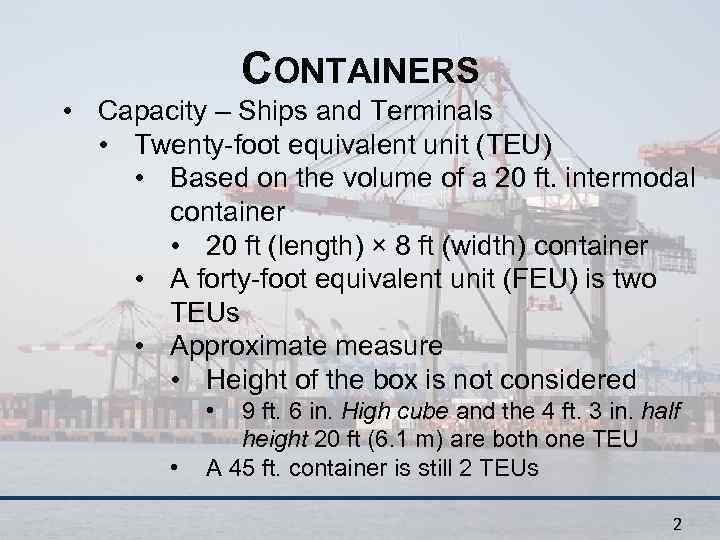 CONTAINERS • Capacity – Ships and Terminals • Twenty-foot equivalent unit (TEU) • Based on the volume of a 20 ft. intermodal container • 20 ft (length) × 8 ft (width) container • A forty-foot equivalent unit (FEU) is two TEUs • Approximate measure • Height of the box is not considered • • 9 ft. 6 in. High cube and the 4 ft. 3 in. half height 20 ft (6. 1 m) are both one TEU A 45 ft. container is still 2 TEUs 2
 CONTAINERS • Types • General purpose containers • Open-top and Half height containers • Flat rack and Platform containers • Ventilated container • Thermal Containers (mechanical / insulated) • Bulk container • Tank container • Named cargo containers (Livestock container, Automobile containers. . . ) 2
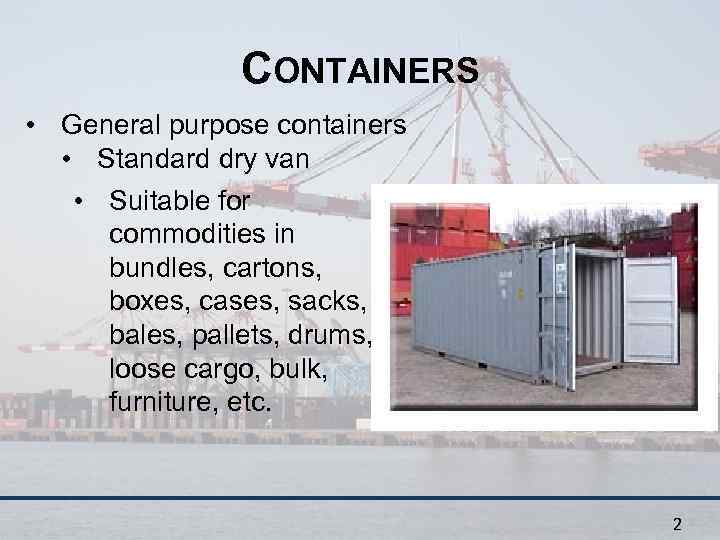 CONTAINERS • General purpose containers • Standard dry van • Suitable for commodities in bundles, cartons, boxes, cases, sacks, bales, pallets, drums, loose cargo, bulk, furniture, etc. 2
 CONTAINERS • General purpose containers • Totally enclosed and waterproof • • • Rigid roof and sides Wood floor No ventilation • May cause problems with some cargos • Carry Solid and liquid bulk cargoes with modification 2
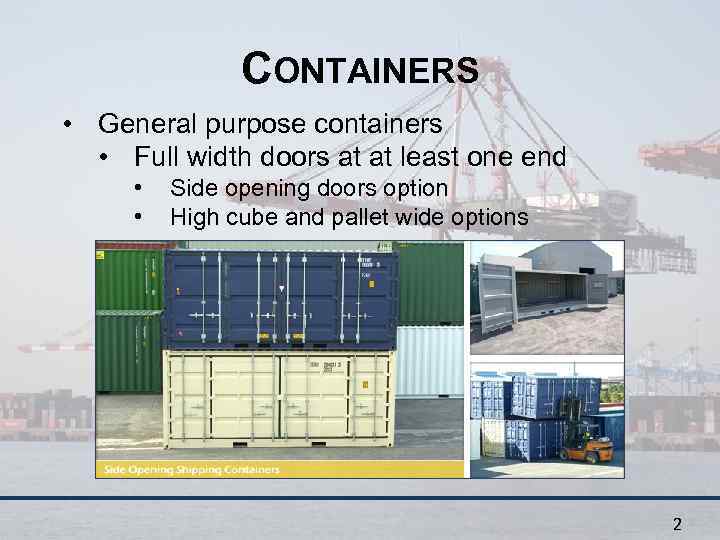 CONTAINERS • General purpose containers • Full width doors at at least one end • • Side opening doors option High cube and pallet wide options 2
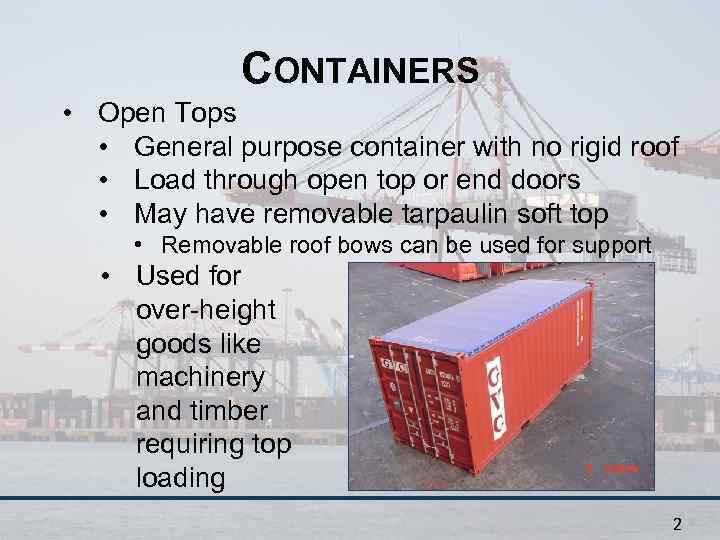 CONTAINERS • Open Tops • General purpose container with no rigid roof • Load through open top or end doors • May have removable tarpaulin soft top • Removable roof bows can be used for support • Used for over-height goods like machinery and timber requiring top loading 2
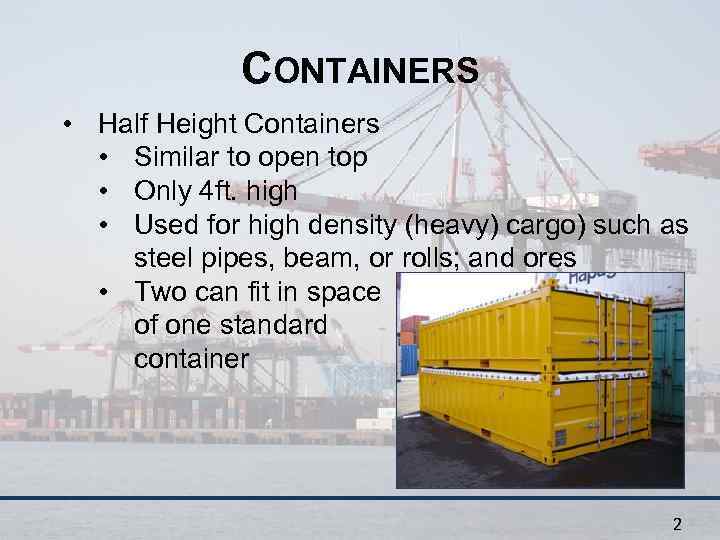 CONTAINERS • Half Height Containers • Similar to open top • Only 4 ft. high • Used for high density (heavy) cargo) such as steel pipes, beam, or rolls; and ores • Two can fit in space of one standard container 2
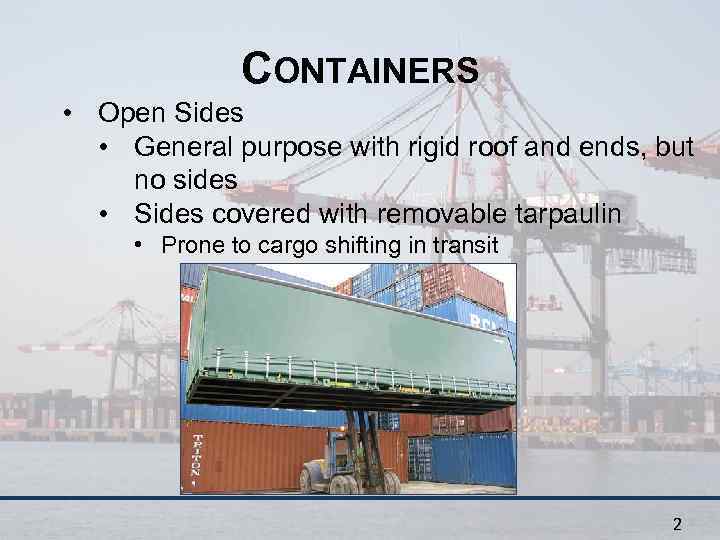 CONTAINERS • Open Sides • General purpose with rigid roof and ends, but no sides • Sides covered with removable tarpaulin • Prone to cargo shifting in transit 2
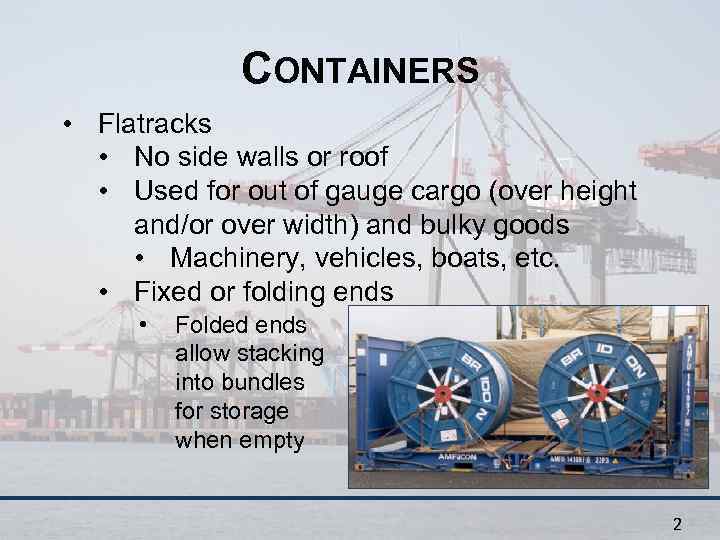 CONTAINERS • Flatracks • No side walls or roof • Used for out of gauge cargo (over height and/or over width) and bulky goods • Machinery, vehicles, boats, etc. • Fixed or folding ends • Folded ends allow stacking into bundles for storage when empty 2
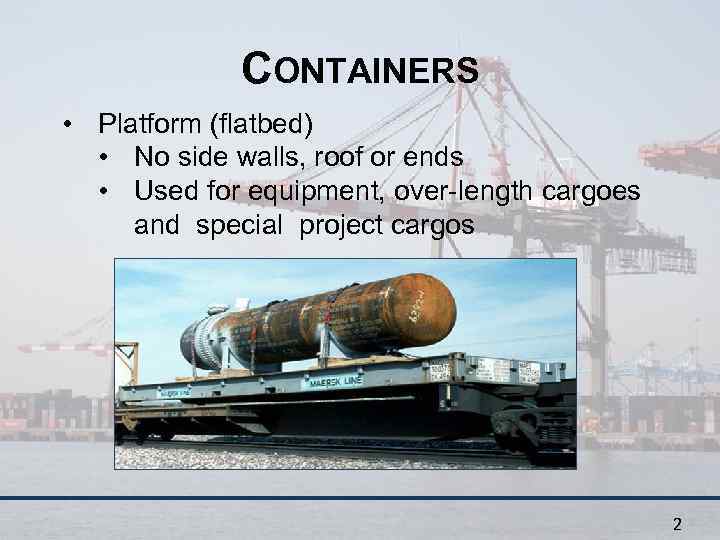 CONTAINERS • Platform (flatbed) • No side walls, roof or ends • Used for equipment, over-length cargoes and special project cargos 2
 CONTAINERS • Ventilated • General purpose containers allow exchange between inside and outside ambient air • Designed to prevent condensation on cargo • Used for fruits and vegetables, bagged coffee, tea, spices, tobacco 3
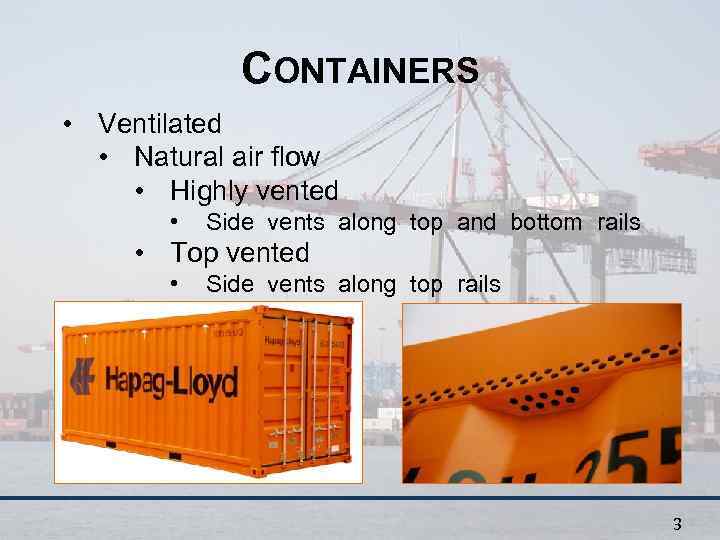 CONTAINERS • Ventilated • Natural air flow • Highly vented • Side vents along top and bottom rails • Top vented • Side vents along top rails 3
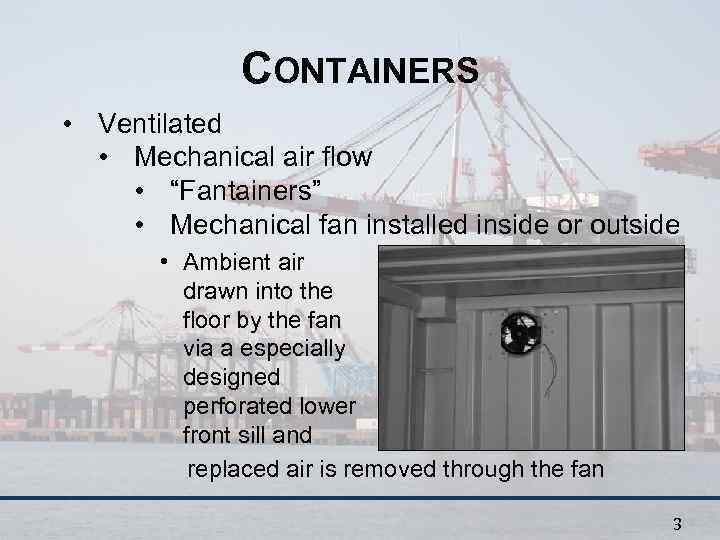 CONTAINERS • Ventilated • Mechanical air flow • “Fantainers” • Mechanical fan installed inside or outside • Ambient air drawn into the floor by the fan via a especially designed perforated lower front sill and replaced air is removed through the fan 3
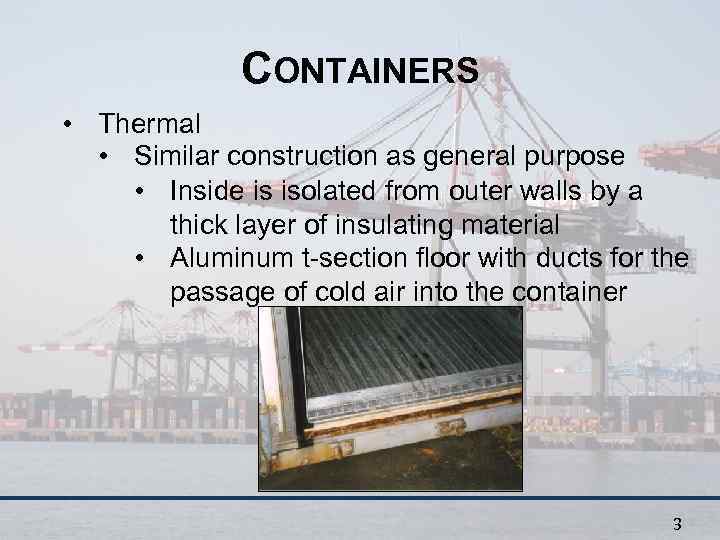 CONTAINERS • Thermal • Similar construction as general purpose • Inside is isolated from outer walls by a thick layer of insulating material • Aluminum t-section floor with ducts for the passage of cold air into the container 3
 CONTAINERS • Thermal • Used to carry cargo requiring precise temperature control • Capable of chilled, frozen, or even heated applications • Number in use/circulation has skyrocketed • Detailed discussion of reefers in later lecture 3
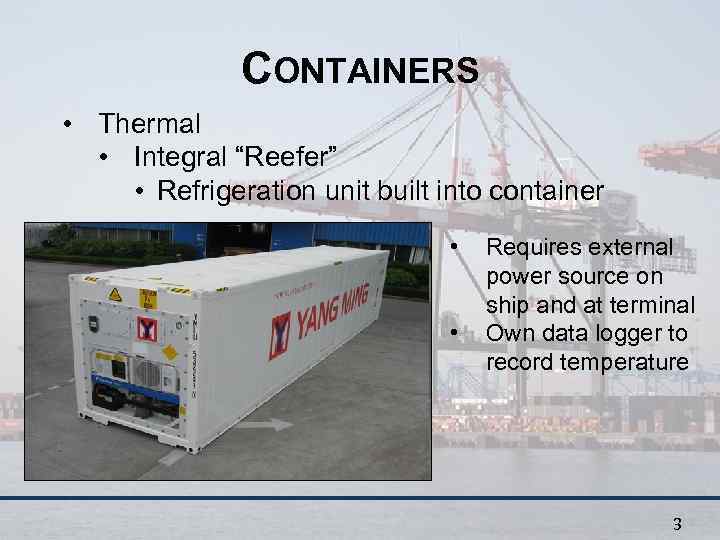 CONTAINERS • Thermal • Integral “Reefer” • Refrigeration unit built into container • • Requires external power source on ship and at terminal Own data logger to record temperature 3
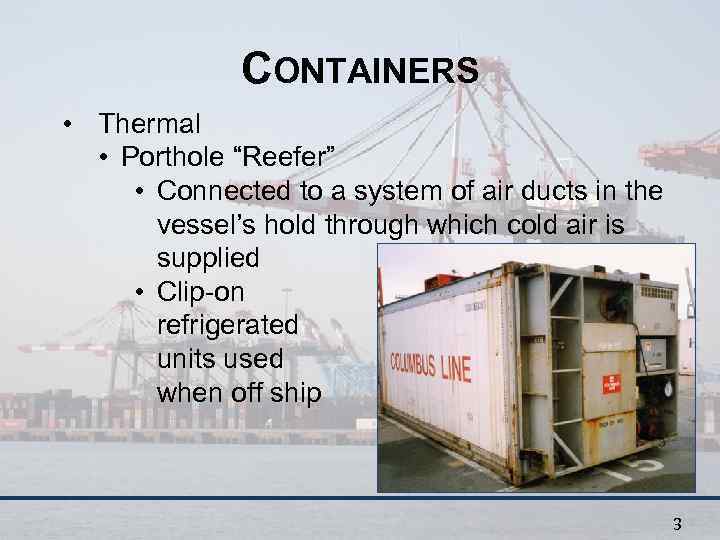 CONTAINERS • Thermal • Porthole “Reefer” • Connected to a system of air ducts in the vessel’s hold through which cold air is supplied • Clip-on refrigerated units used when off ship 3
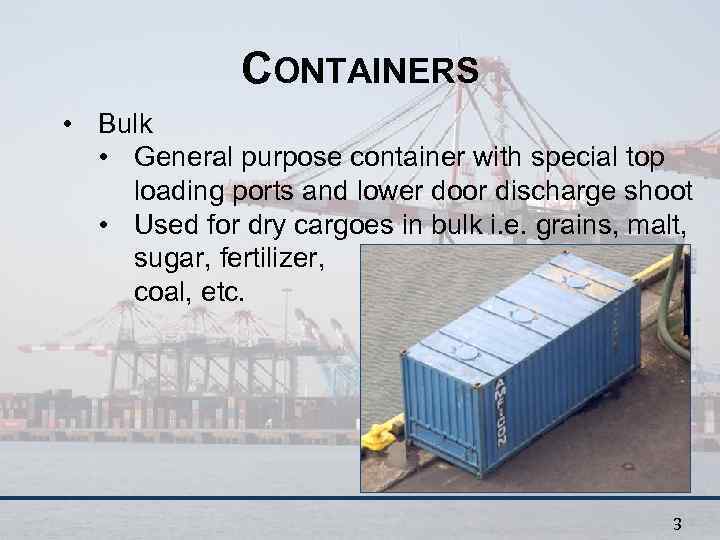 CONTAINERS • Bulk • General purpose container with special top loading ports and lower door discharge shoot • Used for dry cargoes in bulk i. e. grains, malt, sugar, fertilizer, coal, etc. 3
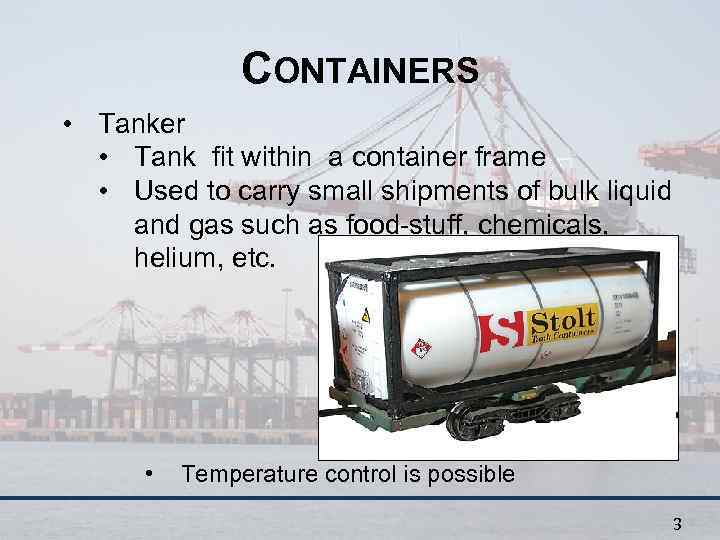 CONTAINERS • Tanker • Tank fit within a container frame • Used to carry small shipments of bulk liquid and gas such as food-stuff, chemicals, helium, etc. • Temperature control is possible 3
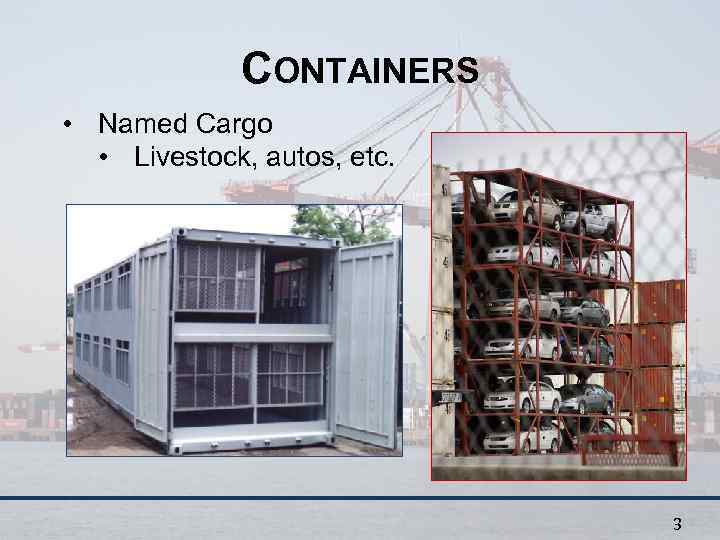 CONTAINERS • Named Cargo • Livestock, autos, etc. 3
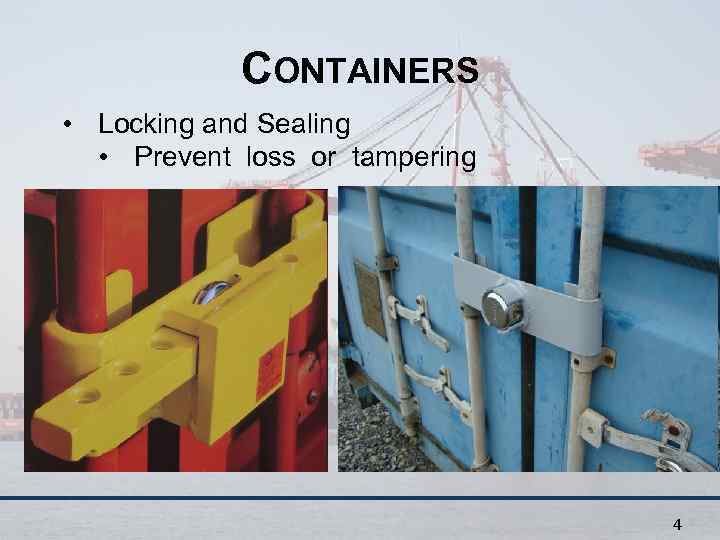 CONTAINERS • Locking and Sealing • Prevent loss or tampering 4
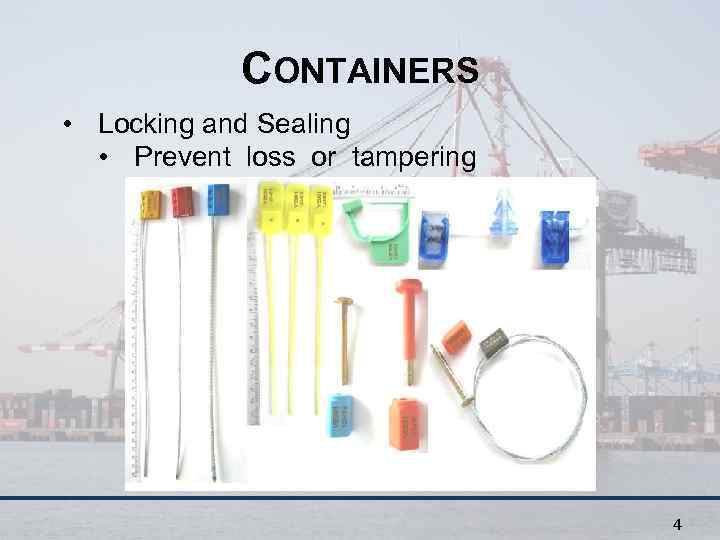 CONTAINERS • Locking and Sealing • Prevent loss or tampering 4
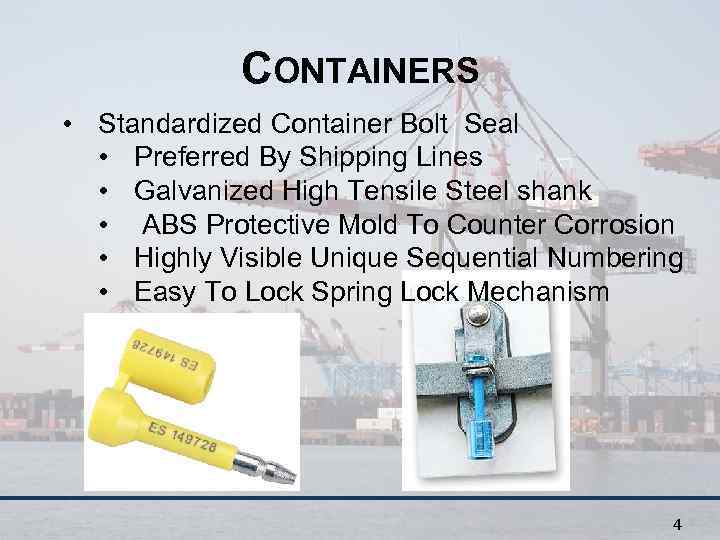 CONTAINERS • Standardized Container Bolt Seal • Preferred By Shipping Lines • Galvanized High Tensile Steel shank • ABS Protective Mold To Counter Corrosion • Highly Visible Unique Sequential Numbering • Easy To Lock Spring Lock Mechanism 4
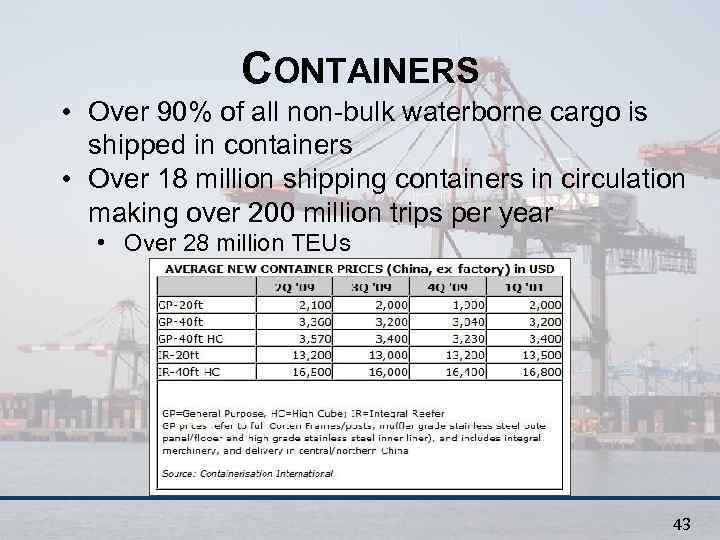 CONTAINERS • Over 90% of all non-bulk waterborne cargo is shipped in containers • Over 18 million shipping containers in circulation making over 200 million trips per year • Over 28 million TEUs 43
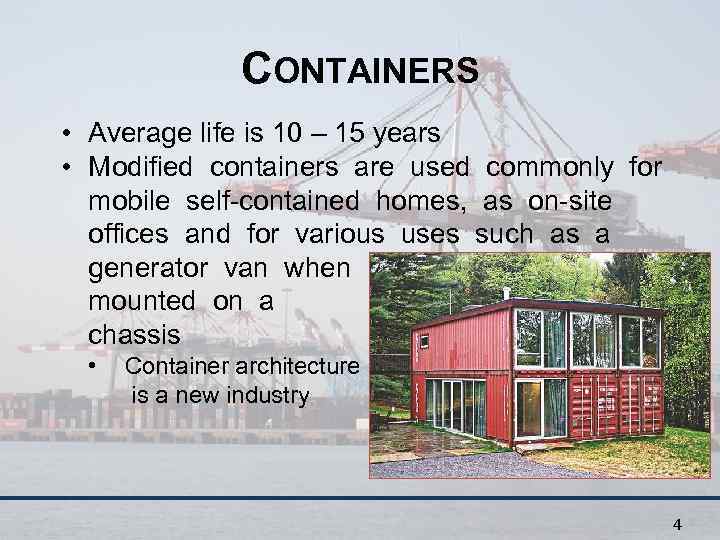 CONTAINERS • Average life is 10 – 15 years • Modified containers are used commonly for mobile self-contained homes, as on-site offices and for various uses such as a generator van when mounted on a chassis • Container architecture is a new industry 4
 CONTAINERS • Markings • ISO 6346 • International standard for coding, identification and marking of intermodal containers • Visual identification system for every container • • • a unique serial number with check digit the owner a country code a size type and equipment category any operational marks 4
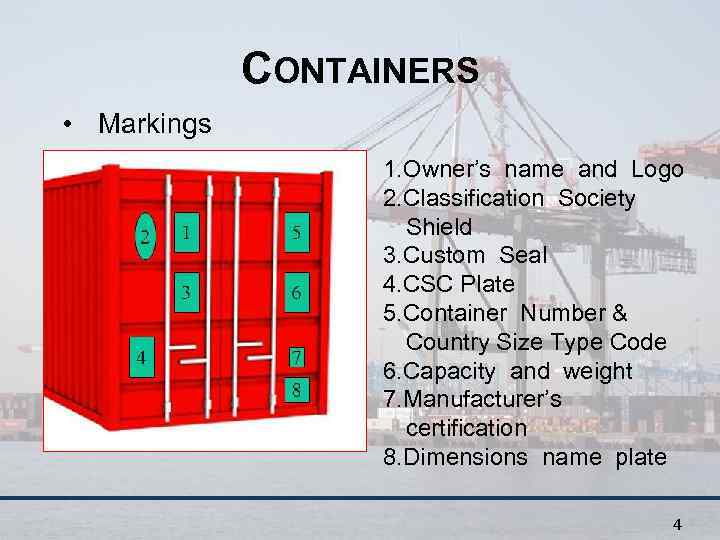 CONTAINERS • Markings 1. Owner’s name and Logo 2. Classification Society Shield 3. Custom Seal 4. CSC Plate 5. Container Number & Country Size Type Code 6. Capacity and weight 7. Manufacturer’s certification 8. Dimensions name plate 4
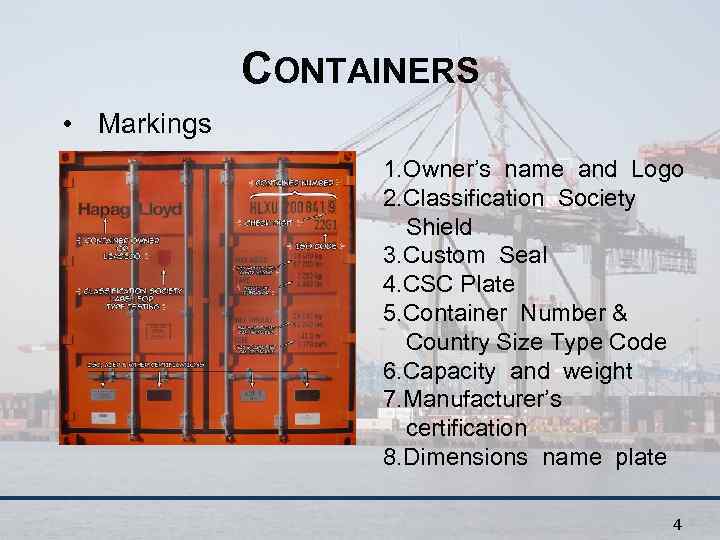 CONTAINERS • Markings 1. Owner’s name and Logo 2. Classification Society Shield 3. Custom Seal 4. CSC Plate 5. Container Number & Country Size Type Code 6. Capacity and weight 7. Manufacturer’s certification 8. Dimensions name plate 4
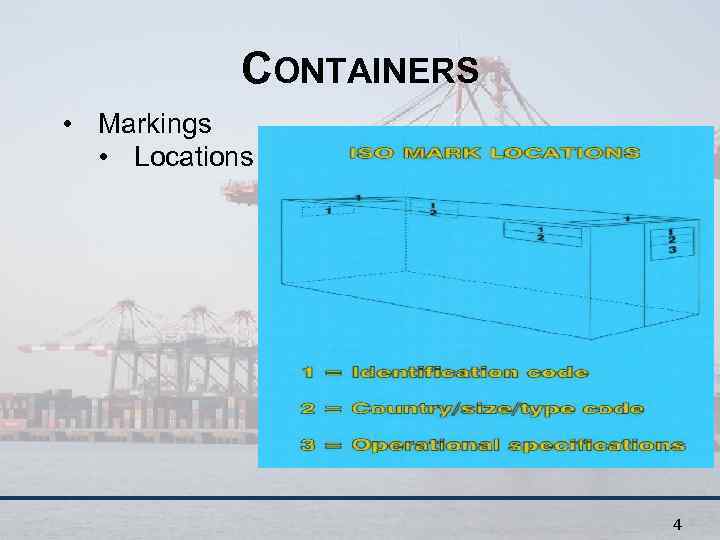 CONTAINERS • Markings • Locations 4
 CONTAINERS • Markings • Letter / Number heights • ID code minimum 100 mm high • Country/Size/Type code minimum 100 mm • Operational marks minimum 50 mm high 4
 CONTAINERS • Markings • On Line Tutorial http: //www. pier 2 pier. com/links/files/educ ational/containermarkings. php http: //www. pier 2 pier. com/links/files/edu cational/containermarkings. swf 5
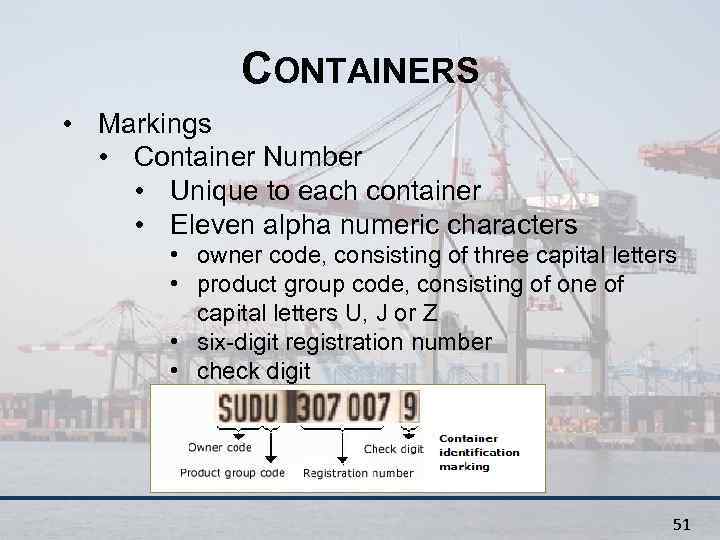 CONTAINERS • Markings • Container Number • Unique to each container • Eleven alpha numeric characters • owner code, consisting of three capital letters • product group code, consisting of one of capital letters U, J or Z • six-digit registration number • check digit 51
 CONTAINERS • Markings • Owner Code • Consists of three capital letters of the Latin alphabet to indicate the owner or principal operator of the container. • Code needs to be registered at the Bureau International des Conteneurs in Paris • Equipment Category Identifier • One of the following three capital letters • • • U for all freight containers J for detachable freight container equipment Z for trailers and chassis 5
 CONTAINERS • Markings • Serial Number • Six numeric digits • Assigned by the owner or operator • Check Digit • One numeric digit • Validates accuracy of the owner code and serial number • Can validate on line http: //42 g 1. com/validate. html 5
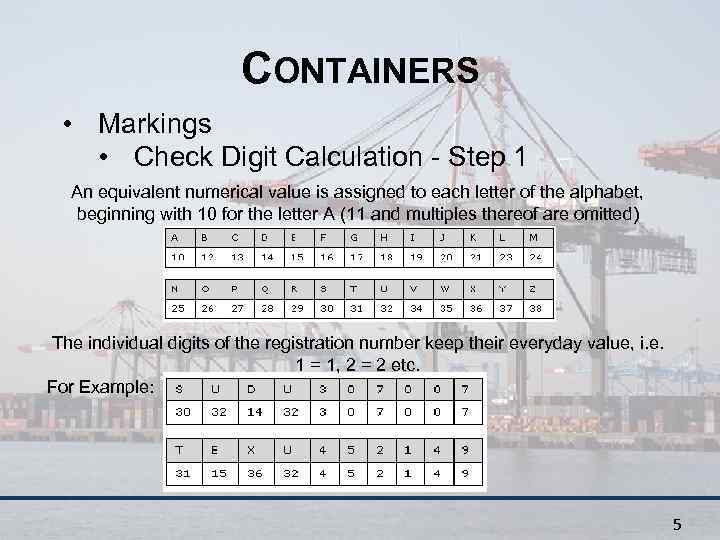 CONTAINERS • Markings • Check Digit Calculation - Step 1 An equivalent numerical value is assigned to each letter of the alphabet, beginning with 10 for the letter A (11 and multiples thereof are omitted) The individual digits of the registration number keep their everyday value, i. e. 1 = 1, 2 = 2 etc. For Example: 5
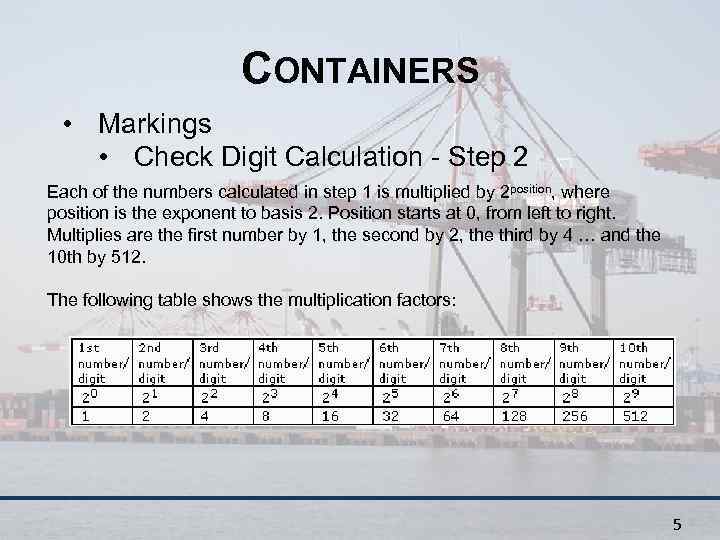 CONTAINERS • Markings • Check Digit Calculation - Step 2 Each of the numbers calculated in step 1 is multiplied by 2 position, where position is the exponent to basis 2. Position starts at 0, from left to right. Multiplies are the first number by 1, the second by 2, the third by 4 … and the 10 th by 512. The following table shows the multiplication factors: 5
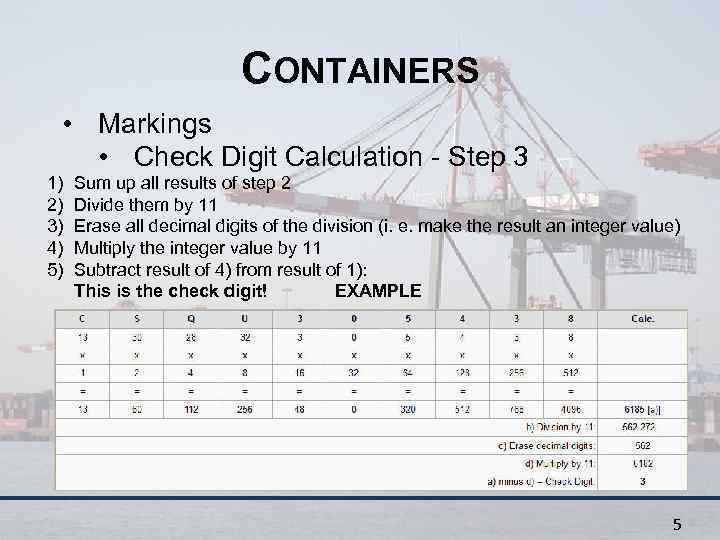 CONTAINERS • Markings • Check Digit Calculation - Step 3 1) 2) 3) 4) 5) Sum up all results of step 2 Divide them by 11 Erase all decimal digits of the division (i. e. make the result an integer value) Multiply the integer value by 11 Subtract result of 4) from result of 1): This is the check digit! EXAMPLE 5
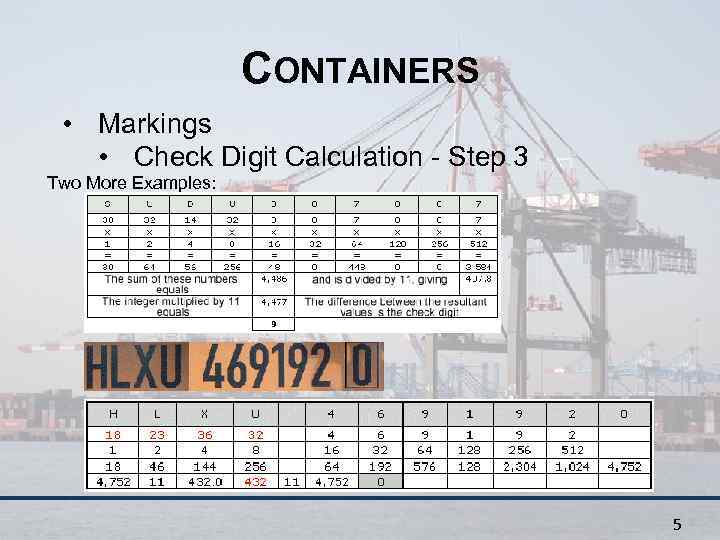 CONTAINERS • Markings • Check Digit Calculation - Step 3 Two More Examples: 5
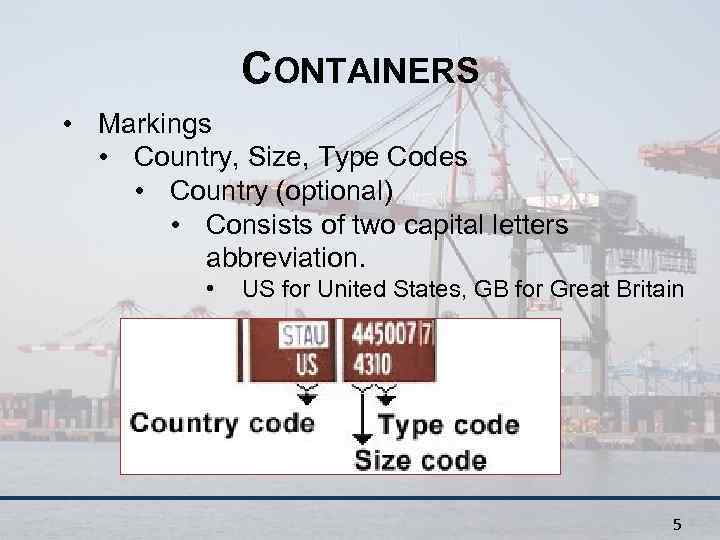 CONTAINERS • Markings • Country, Size, Type Codes • Country (optional) • Consists of two capital letters abbreviation. • US for United States, GB for Great Britain 5
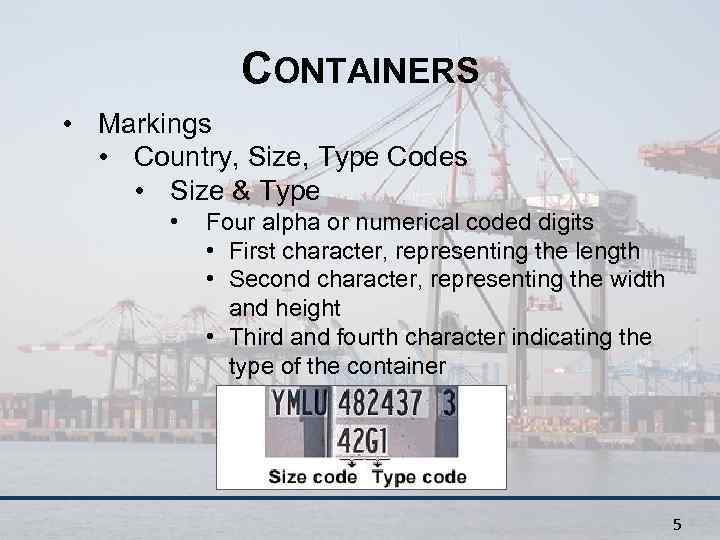 CONTAINERS • Markings • Country, Size, Type Codes • Size & Type • Four alpha or numerical coded digits • First character, representing the length • Second character, representing the width and height • Third and fourth character indicating the type of the container 5
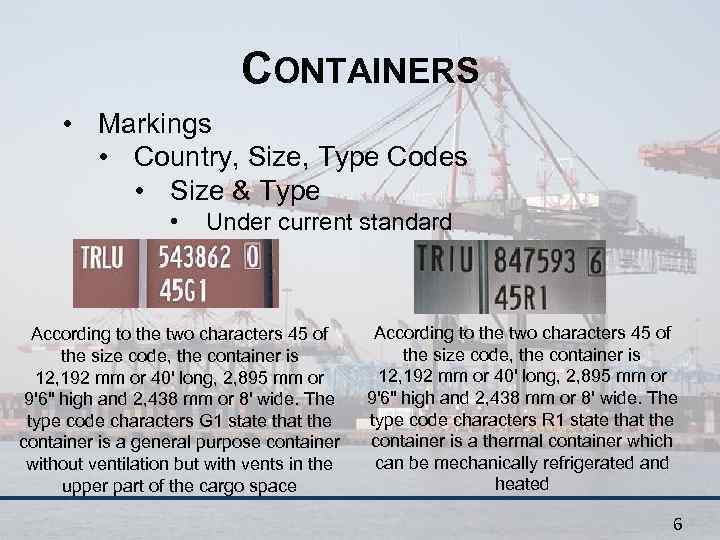 CONTAINERS • Markings • Country, Size, Type Codes • Size & Type • Under current standard According to the two characters 45 of the size code, the container is 12, 192 mm or 40' long, 2, 895 mm or 9'6" high and 2, 438 mm or 8' wide. The type code characters G 1 state that the container is a general purpose container without ventilation but with vents in the upper part of the cargo space According to the two characters 45 of the size code, the container is 12, 192 mm or 40' long, 2, 895 mm or 9'6" high and 2, 438 mm or 8' wide. The type code characters R 1 state that the container is a thermal container which can be mechanically refrigerated and heated 6
 CONTAINERS • Markings • Capacity and Weight 6
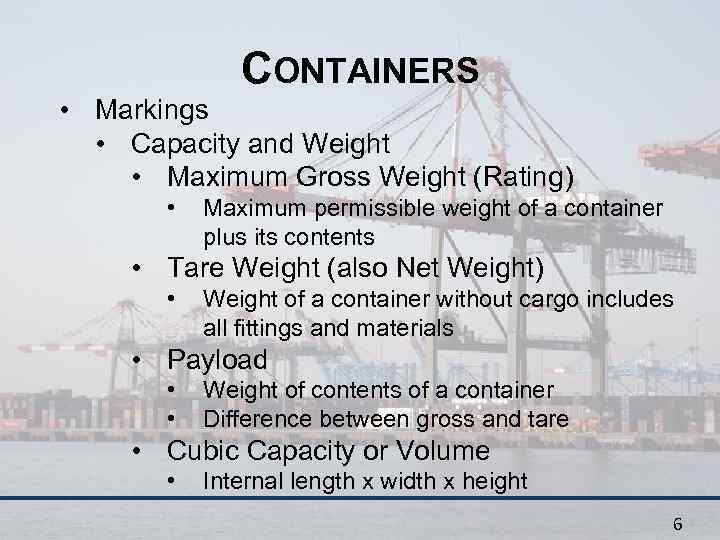 CONTAINERS • Markings • Capacity and Weight • Maximum Gross Weight (Rating) • Maximum permissible weight of a container plus its contents • Tare Weight (also Net Weight) • Weight of a container without cargo includes all fittings and materials • Payload • • Weight of contents of a container Difference between gross and tare • Cubic Capacity or Volume • Internal length x width x height 6
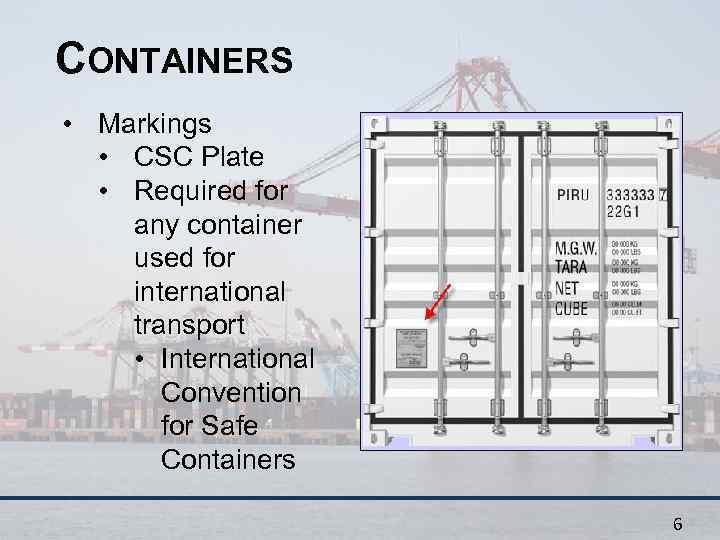 CONTAINERS • Markings • CSC Plate • Required for any container used for international transport • International Convention for Safe Containers 6
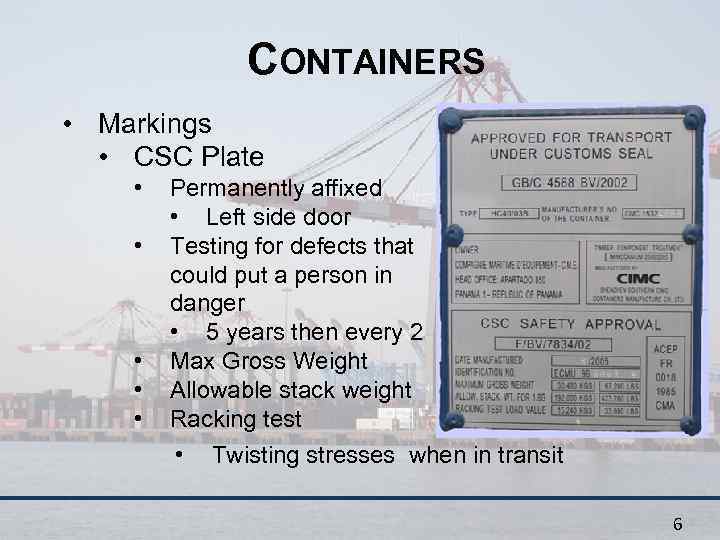 CONTAINERS • Markings • CSC Plate • • • Permanently affixed • Left side door Testing for defects that could put a person in danger • 5 years then every 2 Max Gross Weight Allowable stack weight Racking test • Twisting stresses when in transit 6
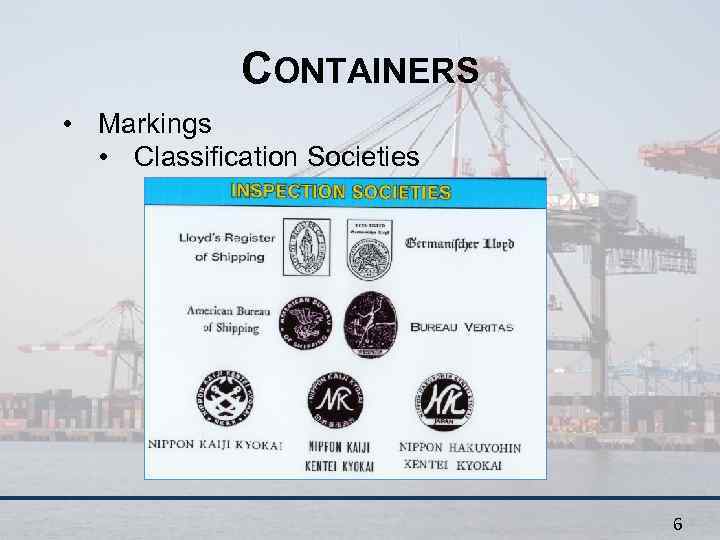 CONTAINERS • Markings • Classification Societies 6
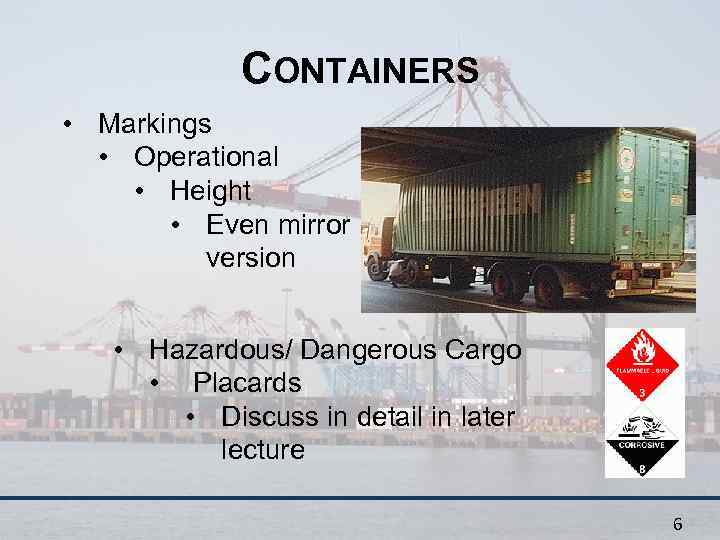 CONTAINERS • Markings • Operational • Height • Even mirror version • Hazardous/ Dangerous Cargo • Placards • Discuss in detail in later lecture 6
 CONTAINERS • Looked at the Types of Containers and their markings • Next Lecture: Terminals and ships • Assignment: Chapter 1: Marine Cargo Operations, Meurn Chapter 8: Cargo Work, House 6
 CONTAINERS References: • • • Marine Cargo Operations, Meurn, 4 th ed. 2011 Cargo Work, House, 7 th ed. , 2005 http: //www. containerhandbuch. de/ Purpose: • All materials are presented strictly for educational purposes only 6
 CONTAINERIZATION • Looked at the history of containerization by video • Next Lecture: Types of Containers and Markings • Assignment: Chapter 1: Marine Cargo Operations, Meurn Chapter 8: Cargo Work, House 69