 Скачать презентацию CONTACT INFORMATION Robin L Gorman Rapid HIV Testing
e38d97609a3ed61d9a19e0e12cb81088.ppt
- Количество слайдов: 1



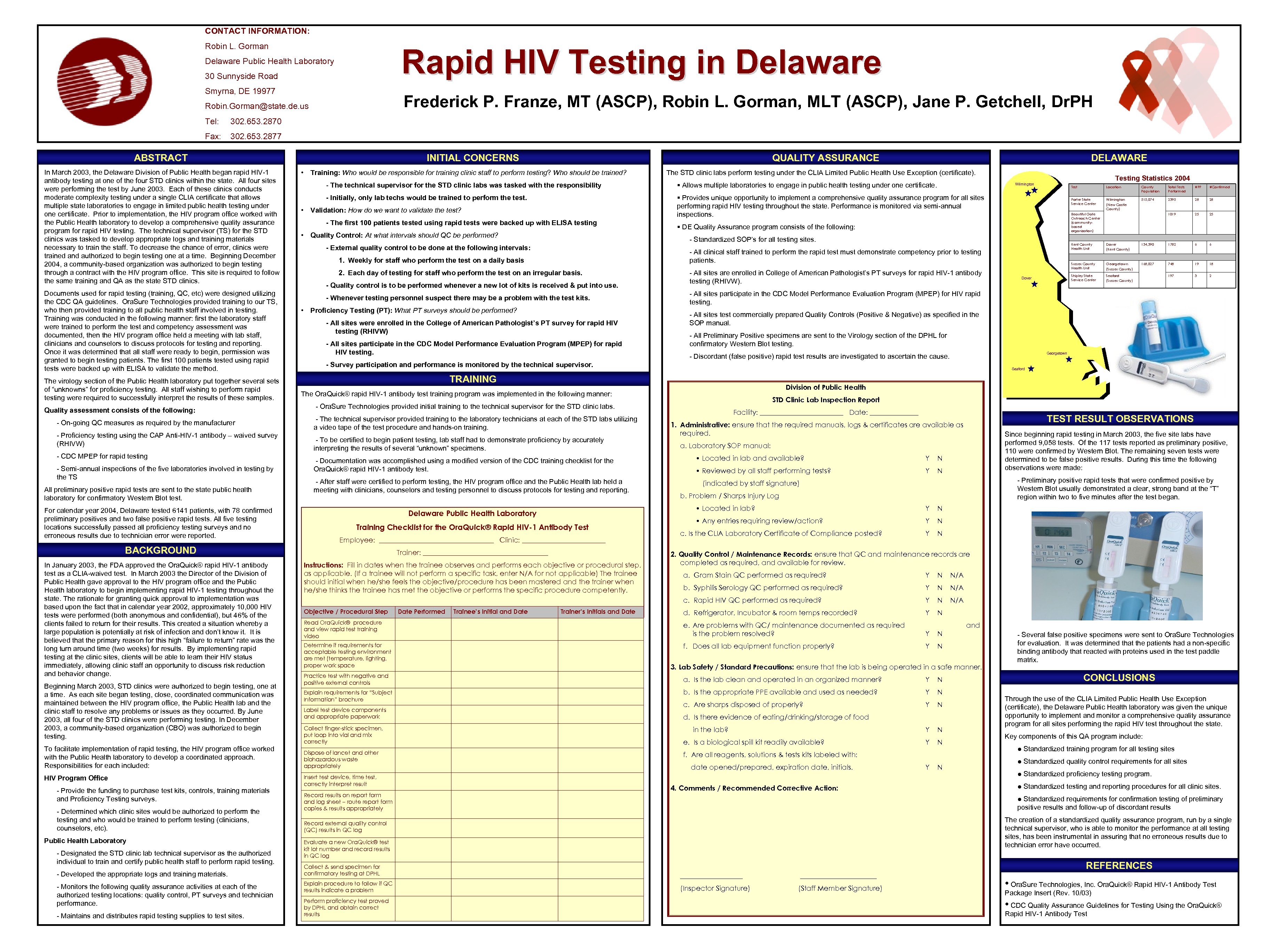
CONTACT INFORMATION: Robin L. Gorman Rapid HIV Testing in Delaware Public Health Laboratory 30 Sunnyside Road Smyrna, DE 19977 Frederick P. Franze, MT (ASCP), Robin L. Gorman, MLT (ASCP), Jane P. Getchell, Dr. PH Robin. Gorman@state. de. us Tel: 302. 653. 2870 Fax: 302. 653. 2877 ABSTRACT In March 2003, the Delaware Division of Public Health began rapid HIV-1 antibody testing at one of the four STD clinics within the state. All four sites were performing the test by June 2003. Each of these clinics conducts moderate complexity testing under a single CLIA certificate that allows multiple state laboratories to engage in limited public health testing under one certificate. Prior to implementation, the HIV program office worked with the Public Health laboratory to develop a comprehensive quality assurance program for rapid HIV testing. The technical supervisor (TS) for the STD clinics was tasked to develop appropriate logs and training materials necessary to train the staff. To decrease the chance of error, clinics were trained and authorized to begin testing one at a time. Beginning December 2004, a community-based organization was authorized to begin testing through a contract with the HIV program office. This site is required to follow the same training and QA as the state STD clinics. Documents used for rapid testing (training, QC, etc) were designed utilizing the CDC QA guidelines. Ora. Sure Technologies provided training to our TS, who then provided training to all public health staff involved in testing. Training was conducted in the following manner: first the laboratory staff were trained to perform the test and competency assessment was documented, then the HIV program office held a meeting with lab staff, clinicians and counselors to discuss protocols for testing and reporting. Once it was determined that all staff were ready to begin, permission was granted to begin testing patients. The first 100 patients tested using rapid tests were backed up with ELISA to validate the method. The virology section of the Public Health laboratory put together several sets of “unknowns” for proficiency testing. All staff wishing to perform rapid testing were required to successfully interpret the results of these samples. Quality assessment consists of the following: - On-going QC measures as required by the manufacturer - Proficiency testing using the CAP Anti-HIV-1 antibody – waived survey (RHIVW) - CDC MPEP for rapid testing - Semi-annual inspections of the five laboratories involved in testing by the TS All preliminary positive rapid tests are sent to the state public health laboratory for confirmatory Western Blot test. For calendar year 2004, Delaware tested 6141 patients, with 78 confirmed preliminary positives and two false positive rapid tests. All five testing locations successfully passed all proficiency testing surveys and no erroneous results due to technician error were reported. INITIAL CONCERNS • Training: Who would be responsible for training clinic staff to perform testing? Who should be trained? Beginning March 2003, STD clinics were authorized to begin testing, one at a time. As each site began testing, close, coordinated communication was maintained between the HIV program office, the Public Health lab and the clinic staff to resolve any problems or issues as they occurred. By June 2003, all four of the STD clinics were performing testing. In December 2003, a community-based organization (CBO) was authorized to begin testing. - Initially, only lab techs would be trained to perform the test. • Validation: How do we want to validate the test? - The first 100 patients tested using rapid tests were backed up with ELISA testing • Quality Control: At what intervals should QC be performed? 2. Each day of testing for staff who perform the test on an irregular basis. - Quality control is to be performed whenever a new lot of kits is received & put into use. - Whenever testing personnel suspect there may be a problem with the test kits. • Proficiency Testing (PT): What PT surveys should be performed? - All sites were enrolled in the College of American Pathologist’s PT survey for rapid HIV testing (RHIVW) - All sites participate in the CDC Model Performance Evaluation Program (MPEP) for rapid HIV testing. - Developed the appropriate logs and training materials. - Monitors the following quality assurance activities at each of the authorized testing locations: quality control, PT surveys and technician performance. - Maintains and distributes rapid testing supplies to test sites. - All sites are enrolled in College of American Pathologist’s PT surveys for rapid HIV-1 antibody testing (RHIVW). - After staff were certified to perform testing, the HIV program office and the Public Health lab held a meeting with clinicians, counselors and testing personnel to discuss protocols for testing and reporting. Training Checklist for the Ora. Quick® Rapid HIV-1 Antibody Test Employee: _________________ Clinic: ____________ Trainer: __________________ Instructions: Fill in dates when the trainee observes and performs each objective or procedural step, as applicable. (If a trainee will not perform a specific task, enter N/A for not applicable) The trainee should initial when he/she feels the objective/procedure has been mastered and the trainer when he/she thinks the trainee has met the objective or performs the specific procedure competently. Trainee’s Initial and Date Trainer’s Initials and Date Facility: ____________ Date: _______ • Located in lab and available? Y N • Reviewed by all staff performing tests? Y N 25 25 Kent County Health Unit 134, 390 1782 6 6 Sussex County Health Unit Georgetown (Sussex County) 168, 027 748 19 18 Shipley State Service Center Dover (Kent County) Seaford (Sussex County) 197 3 2 - Preliminary positive rapid tests that were confirmed positive by Western Blot usually demonstrated a clear, strong band at the “T” region within two to five minutes after the test began. (indicated by staff signature) b. Problem / Sharps Injury Log Y N • Any entries requiring review/action? Y N c. Is the CLIA Laboratory Certificate of Compliance posted? 2. Quality Control / Maintenance Records: ensure that QC and maintenance records are completed as required, and available for review. a. Gram Stain QC performed as required? Y N N/A b. Syphilis Serology QC performed as required? Y N N/A d. Refrigerator, Incubator & room temps recorded? Y N f. Does all lab equipment function properly? Y N and 3. Lab Safety / Standard Precautions: ensure that the lab is being operated in a safe manner. Practice test with negative and positive external controls a. Is the lab clean and operated in an organized manner? Y N Explain requirements for “Subject Information” brochure b. Is the appropriate PPE available and used as needed? Y N c. Are sharps disposed of properly? Y N Y N d. Is there evidence of eating/drinking/storage of food in the lab? e. Is a biological spill kit readily available? f. Are all reagents, solutions & tests kits labeled with: date opened/prepared, expiration date, initials. 4. Comments / Recommended Corrective Action: Y N - Several false positive specimens were sent to Ora. Sure Technologies for evaluation. It was determined that the patients had a non-specific binding antibody that reacted with proteins used in the test paddle matrix. CONCLUSIONS Through the use of the CLIA Limited Public Health Use Exception (certificate), the Delaware Public Health laboratory was given the unique opportunity to implement and monitor a comprehensive quality assurance program for all sites performing the rapid HIV test throughout the state. Key components of this QA program include: ● Standardized training program for all testing sites ● Standardized quality control requirements for all sites ● Standardized proficiency testing program. ● Standardized testing and reporting procedures for all clinic sites. ● Standardized requirements for confirmation testing of preliminary positive results and follow-up of discordant results The creation of a standardized quality assurance program, run by a single technical supervisor, who is able to monitor the performance at all testing sites, has been instrumental in assuring that no erroneous results due to technician error have occurred. Record external quality control (QC) results in QC log Evaluate a new Ora. Quick® test kit lot number and record results in QC log Perform proficiency test proved by DPHL and obtain correct results 1019 Since beginning rapid testing in March 2003, the five site labs have performed 9, 058 tests. Of the 117 tests reported as preliminary positive, 110 were confirmed by Western Blot. The remaining seven tests were determined to be false positive results. During this time the following observations were made: a. Laboratory SOP manual: Determine if requirements for acceptable testing environment are met (temperature, lighting, proper work space Explain procedure to follow if QC results indicate a problem 28 TEST RESULT OBSERVATIONS 1. Administrative: ensure that the required manuals, logs & certificates are available as required. N Collect & send specimen for confirmatory testing at DPHL 28 STD Clinic Lab Inspection Report Y Record results on report form and log sheet – route report form copies & results appropriately 2395 Division of Public Health e. Are problems with QC/ maintenance documented as required is the problem resolved? Collect finger-stick specimen, put loop into vial and mix correctly 515, 074 Seaford Read Ora. Quick® procedure and view rapid test training video Label test device components and appropriate paperwork Wilmington (New Castle County) Georgetown c. Rapid HIV QC performed as required? Date Performed #Confirmed Beautiful Gate Outreach Center (communitybased organization) - Discordant (false positive) rapid test results are investigated to ascertain the cause. • Located in lab? Delaware Public Health Laboratory #PP - All Preliminary Positive specimens are sent to the Virology section of the DPHL for confirmatory Western Blot testing. - Ora. Sure Technologies provided initial training to the technical supervisor for the STD clinic labs. - Documentation was accomplished using a modified version of the CDC training checklist for the Ora. Quick® rapid HIV-1 antibody test. Total Tests Performed - All sites test commercially prepared Quality Controls (Positive & Negative) as specified in the SOP manual. The Ora. Quick® rapid HIV-1 antibody test training program was implemented in the following manner: - To be certified to begin patient testing, lab staff had to demonstrate proficiency by accurately interpreting the results of several “unknown” specimens. County Population - All sites participate in the CDC Model Performance Evaluation Program (MPEP) for HIV rapid testing. TRAINING - The technical supervisor provided training to the laboratory technicians at each of the STD labs utilizing a video tape of the test procedure and hands-on training. Location Porter State Service Center § DE Quality Assurance program consists of the following: - Survey participation and performance is monitored by the technical supervisor. Objective / Procedural Step Test - All clinical staff trained to perform the rapid test must demonstrate competency prior to testing patients. 1. Weekly for staff who perform the test on a daily basis Insert test device, time test, correctly interpret result - Designated the STD clinic lab technical supervisor as the authorized individual to train and certify public health staff to perform rapid testing. Wilmington - Standardized SOP’s for all testing sites. - External quality control to be done at the following intervals: HIV Program Office Public Health Laboratory Testing Statistics 2004 § Provides unique opportunity to implement a comprehensive quality assurance program for all sites performing rapid HIV testing throughout the state. Performance is monitored via semi-annual inspections. Dispose of lancet and other biohazardous waste appropriately - Determined which clinic sites would be authorized to perform the testing and who would be trained to perform testing (clinicians, counselors, etc). The STD clinic labs perform testing under the CLIA Limited Public Health Use Exception (certificate). § Allows multiple laboratories to engage in public health testing under one certificate. To facilitate implementation of rapid testing, the HIV program office worked with the Public Health laboratory to develop a coordinated approach. Responsibilities for each included: - Provide the funding to purchase test kits, controls, training materials and Proficiency Testing surveys. DELAWARE - The technical supervisor for the STD clinic labs was tasked with the responsibility BACKGROUND In January 2003, the FDA approved the Ora. Quick® rapid HIV-1 antibody test as a CLIA-waived test. In March 2003 the Director of the Division of Public Health gave approval to the HIV program office and the Public Health laboratory to begin implementing rapid HIV-1 testing throughout the state. The rationale for granting quick approval to implementation was based upon the fact that in calendar year 2002, approximately 10, 000 HIV tests were performed (both anonymous and confidential), but 46% of the clients failed to return for their results. This created a situation whereby a large population is potentially at risk of infection and don’t know it. It is believed that the primary reason for this high “failure to return” rate was the long turn around time (two weeks) for results. By implementing rapid testing at the clinic sites, clients will be able to learn their HIV status immediately, allowing clinic staff an opportunity to discuss risk reduction and behavior change. QUALITY ASSURANCE REFERENCES ______________________ (Inspector Signature) (Staff Member Signature) • Ora. Sure Technologies, Inc. Ora. Quick® Rapid HIV-1 Antibody Test Package Insert (Rev. 10/03) • CDC Quality Assurance Guidelines for Testing Using the Ora. Quick® Rapid HIV-1 Antibody Test
Скачать презентацию CONTACT INFORMATION Robin L Gorman Rapid HIV Testing
e38d97609a3ed61d9a19e0e12cb81088.ppt