Скачать презентацию CONSUMPTION Consumer Markets IN RUSSIAN FEDERATION Andrew
CONSINTHERF - SLIDE.pptx
- Количество слайдов: 101
 CONSUMPTION & Consumer Markets IN RUSSIAN FEDERATION Andrew V. Galoukhin - assistant professor of Philosophy & Business Ethics
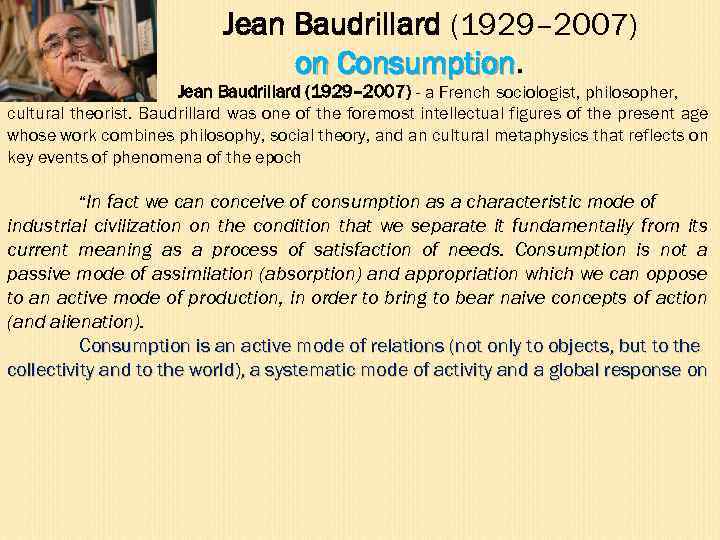 Jean Baudrillard (1929– 2007) on Consumption Jean Baudrillard (1929– 2007) - a French sociologist, philosopher, cultural theorist. Baudrillard was one of the foremost intellectual figures of the present age whose work combines philosophy, social theory, and an cultural metaphysics that reflects on key events of phenomena of the epoch “In fact we can conceive of consumption as a characteristic mode of industrial civilization on the condition that we separate it fundamentally from its current meaning as a process of satisfaction of needs. Consumption is not a passive mode of assimilation (absorption) and appropriation which we can oppose to an active mode of production, in order to bring to bear naive concepts of action (and alienation). Consumption is an active mode of relations (not only to objects, but to the collectivity and to the world), a systematic mode of activity and a global response on
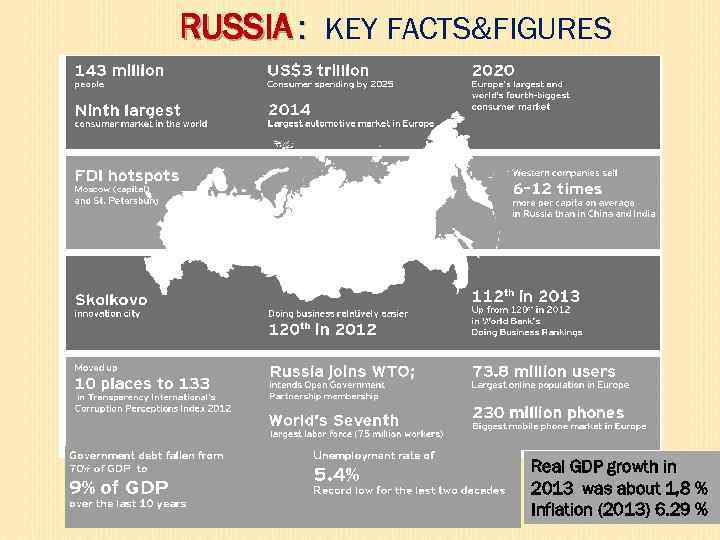 RUSSIA : KEY FACTS&FIGURES Real GDP growth in 2013 was about 1, 8 % Inflation (2013) 6. 29 %
 RUSSIA : KEY FACTS&FIGURES Russia is the world’s largest country in terms of territory, spanning nine time zones, with a population of over 143 m people, vast natural resources, and a growing middle-class Russia is potentially one of the wealthiest countries with its natural resources, a well-educated population (99. 6% adult literacy; 64% tertiary education enrollment rate), and a diverse, though declining industrial base. The country is vast – over 17 million km 2 – spreading from Europe to the Pacific. The Ural mountains divide Russia into two unequal parts, European in the west and Asian in the east. Russia is the 9 th most populated country in the world. There are more than 180 different recognzed ethnic groups in Russia, but Russians (about 80%) represent the vast majority of the population. Ethnic minorities include the Tatars (3. 9%) and the Ukrainians (1. 4%). Russia’s population : 143 657 134 –(January 1 - 2014 ) Of Russia’s 143 million population , most people live in urban areas. Most of the country‘s 11 cities of more than 1 million people are located in the European portion of Russia’s territory , including the two largest – Moscow (10. 6 - 12 mn) and Saint Petersburg (4. 6 mn). The European portion of Russia’s territory (although covering only 25% of the territory) is home to 78% of Russians. Russia’s strategic geographical location facilitates building effective international and domestic supply-production-market chains. Diverse federal and district regions offer distinct competitive advantages and favorable investment-attraction policies.
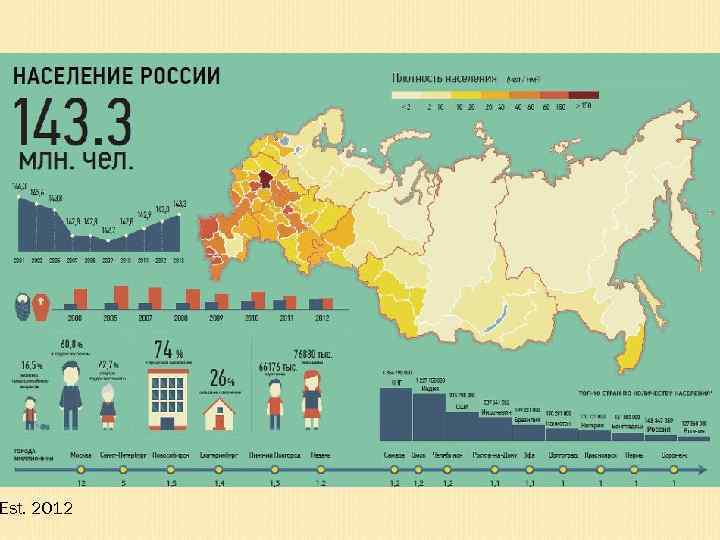 Est. 2012
 RUSSIAN ECONOMY - GENERAL PROFILE RUSSIA is rated the world’s 8 th largest economy of the world in terms of nominal volume of GDP and is the 6 th largest judged by purchasing power parity. Russia is a member of the G 8, G 20 and of the UN Security Council. Russia has a market economy with enormous natural resources, particularly oil and natural gas, and is perceived as a major emerging market economy. It is a developing economy with rich natural resources. Russia has the world's largest reserves of mineral and energy resources, and is the largest producer of oil and natural gas globally. . Oil, petroleum products, natural gas and metals account for over 20 % of Russian GDP. Services are also the biggest sector of the economy. Services account for 58 -60 percent of GDP. Within services the most important segments are: wholesale and retail trade, repair of motor vehicles, personal and household goods (17 – 20 percent of total GDP); public administration, health and education (12 percent); real estate (9 percent) and transport storage and communications (7 percent). Industry contributes 40 percent to total output. Mining (11 percent of GDP), manufacturing (13 percent) and construction (4 percent) are the most important industry segments. Agriculture accounts for the remaining 2 percent Russia’s per capita GDP (USD 17, 618) was the highest among BRIC countries.
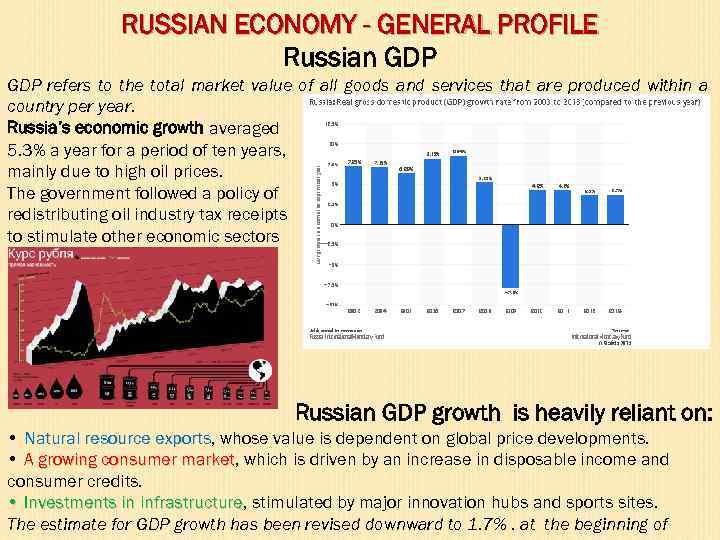 RUSSIAN ECONOMY - GENERAL PROFILE Russian GDP refers to the total market value of all goods and services that are produced within a country per year. Russia’s economic growth averaged 5. 3% a year for a period of ten years, mainly due to high oil prices. The government followed a policy of redistributing oil industry tax receipts to stimulate other economic sectors Russian GDP growth is heavily reliant on: • Natural resource exports, whose value is dependent on global price developments. exports • A growing consumer market, which is driven by an increase in disposable income and market consumer credits. • Investments in infrastructure, stimulated by major innovation hubs and sports sites. infrastructure The estimate for GDP growth has been revised downward to 1. 7%. at the beginning of
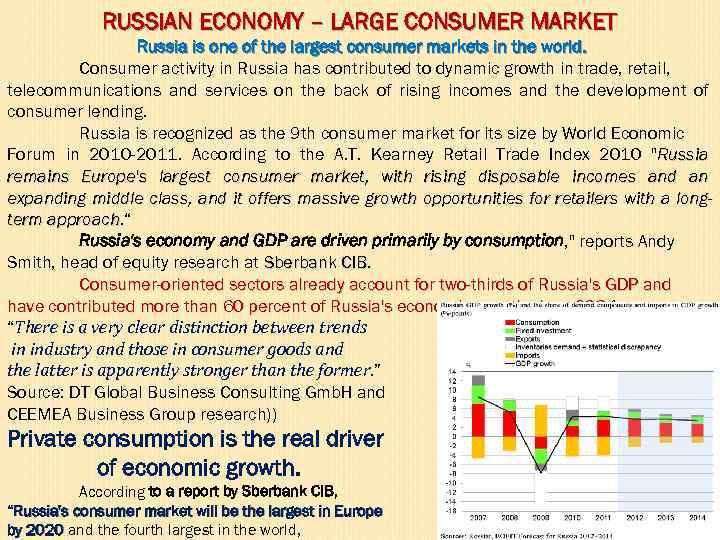 RUSSIAN ECONOMY – LARGE CONSUMER MARKET Russia is one of the largest consumer markets in the world. Consumer activity in Russia has contributed to dynamic growth in trade, retail, telecommunications and services on the back of rising incomes and the development of consumer lending. Russia is recognized as the 9 th consumer market for its size by World Economic Forum in 2010 -2011. According to the A. T. Kearney Retail Trade Index 2010 "Russia remains Europe's largest consumer market, with rising disposable incomes and an expanding middle class, and it offers massive growth opportunities for retailers with a longterm approach. “ approach Russia's economy and GDP are driven primarily by consumption, " reports Andy Smith, head of equity research at Sberbank CIB. Consumer-oriented sectors already account for two-thirds of Russia's GDP and have contributed more than 60 percent of Russia's economic growth since 2004. 200 “There is a very clear distinction between trends in industry and those in consumer goods and the latter is apparently stronger than the former. ” Source: DT Global Business Consulting Gmb. H and CEEMEA Business Group research)) Private consumption is the real driver of economic growth. According to a report by Sberbank CIB, “Russia's consumer market will be the largest in Europe by 2020 and the fourth largest in the world,
 RUSSIAN ECONOMY - some realistic estimations of the current state: BMRC – Marketing Research in Russia reports: reports Russia is a vast country with a wealth of natural resources, a well-educated population, and a diverse, but declining, industrial base, but still it continues to experience formidable difficulties in moving from its old centrally planned economy to a modern market economy. One of the biggest problems in the transitions is that Russia has failed to make any progress in restructuring its social welfare programs to target the most needy – among whom are many of the old pensioners – or to pass needed tax reform While approximately 75% of industry has now been privatized, the agricultural sector has undergone little reform since the break-up of the Soviet Union. Stockholder rights remain weak while crime and corruption are rampant in much of the economy. Many economy enterprises continue to operate without hard budget constraints, resulting in barter trade and increased inter-enterprise debts. ” [BMRC – Marketing Research in Russia] Lloyd Donaldson says: “The Russian market is not yet fully formed, has not reached a point of equilibrium. It is still extremely fluid. Social classes, particularly the middle class, are still forming. Yet there are groups of consumers eager to buy a wide range of products. ”[Lloyd Donaldson, publisher of the St Petersburg Press newspaper. ] Donaldson “Russians set out slowly, but then ride fast” Otto von Bismarck (1815 -1898)
 RUSSIAN ECONOMY & CONSUMERISM – THEIR HISTORICAL BAKGROUND THE MAIN STAGES OF THE ECONOMIC DEVELOPMENT OF POST-SOVIET RUSSIA [ I ] Initial period of transformational crisis (1990 – 1995). The period was characterized by profound economic and institutional reforms: price reforms liberalization, liquidation of state monopoly on foreign trade, privatization and other measures. These reforms were accompanied by negative trends in economy: fall of GDP, economy decrease of incomes of population and investments, high inflation rates. Inflation, started in 1992, reached its peak in 1994, and increased 10 000% by the end of 1997. Russian health and education systems, which used to be of the highest standard during the Soviet times, were slowly deteriorating. A sharp economic division of society took place. On one hand, a substantial group place of the very rich, who make up between 5 percent and 12 percent of the population, with individual annual incomes of over $60, 000 (in Moscow, $120, 000), was developing. And on the other, there was destitution of the larger part of population with incomes that were close to the poverty line.
 RUSSIAN ECONOMY & CONSUMERISM – - THEIR HISTORICAL BAKGROUND THE MAIN STAGES OF THE ECONOMIC DEVELOPMENT OF POST-SOVIET RUSSIA [II] Difficult stabilization, financial crisis (default) of 1998 and gradual recovery of the economy in 1996 – 1999. This period was marked by stabilization of GDP production, and industrial production in the first place. The year of 1997 was the first post-reform year when GDP growth was registered. But 1998 brought a new serious Financial crisis The government implemented a 1000% denomination of national currency (Ruble), turning back prices from thousands rubles to rubles. The exchange rate of US Dollar flew up from 6 to 24 rubles in less than 6 weeks. Small businesses were almost devastated. Prices for consumer goods increased in 4 -5 times with the salaries increased only on 2030%. The crisis gave a boost to the development of national industries, which could not compete with foreign goods with the low dollar rate. It contributed to improvement of foreign trade conditions in the medium term and created incentives for investments in real sector. Soon the results became visible with reviving the industrial enterprises, particularly in production of consumer goods and food processing.
 RUSSIAN ECONOMY & CONSUMERISM – - THEIR HISTORICAL BAKGROUND THE MAIN STAGES OF THE ECONOMIC DEVELOPMENT OF POST-SOVIET RUSSIA [III] Period of economic recovery (2000 – 2008). This period was characterized by growth of GDP, investments, and consumption. The government’s devaluation of the ruble during the 1998 financial crisis gave local producers significant advantages over their foreign competitors. Local consumption was boosted by the introduction of consumer loans and mortgages Among the other drivers of economic growth was an increase in the utilization of industrial capacity constructed in the Soviet period. Between 1999 and 2007 GDP rose by an average of 6. 8% annually. Real fixed capital investments increased by an annual average of 10% between 2000 and 2007, while real personal incomes rose at an average annual rate of 12%. Over these years Russia successfully paid off a substantial portion of its foreign debt and amassed the third largest foreign currency reserves after China and Japan. These achievements have raised business and investor confidence, with new business confidence opportunities emerging in such sectors as telecommunications, retail, pharmaceuticals and the power industry in particular. Between 2000 and 2008, the country posted the world’s largest annual growth in household and consumer expenditure – 11% compared to the world average of 1. 8% and Europe’s 0. 9%.
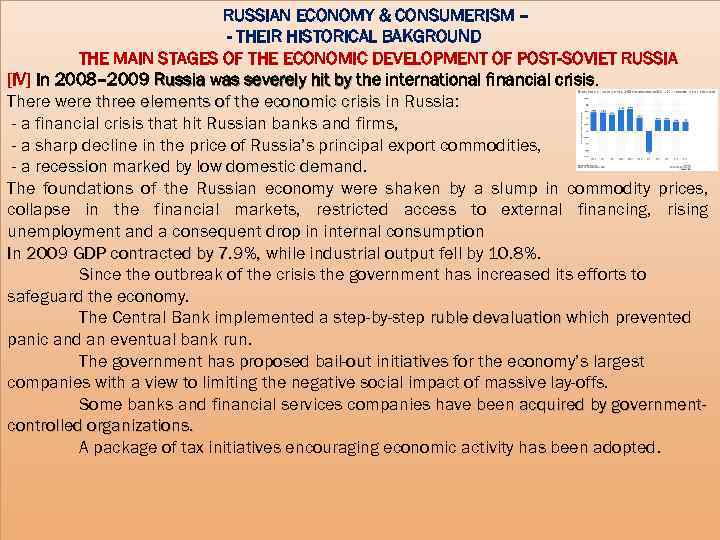 RUSSIAN ECONOMY & CONSUMERISM – - THEIR HISTORICAL BAKGROUND THE MAIN STAGES OF THE ECONOMIC DEVELOPMENT OF POST-SOVIET RUSSIA [IV] In 2008– 2009 Russia was severely hit by the international financial crisis. There were three elements of the economic crisis in Russia: - a financial crisis that hit Russian banks and firms, - a sharp decline in the price of Russia’s principal export commodities, - a recession marked by low domestic demand. The foundations of the Russian economy were shaken by a slump in commodity prices, collapse in the financial markets, restricted access to external financing, rising unemployment and a consequent drop in internal consumption In 2009 GDP contracted by 7. 9%, while industrial output fell by 10. 8%. Since the outbreak of the crisis the government has increased its efforts to safeguard the economy. The Central Bank implemented a step-by-step ruble devaluation which prevented panic and an eventual bank run. The government has proposed bail-out initiatives for the economy’s largest companies with a view to limiting the negative social impact of massive lay-offs. Some banks and financial services companies have been acquired by governmentcontrolled organizations. A package of tax initiatives encouraging economic activity has been adopted.
 RUSSIAN ECONOMY & CONSUMERISM – - THEIR HISTORICAL BAKGROUND THE MAIN STAGES OF THE ECONOMIC DEVELOPMENT OF POST-SOVIET RUSSIA [V] - Period of economic recovery with trends of stabilization and structural modernization (since 2010 up to now). During 2010– 2012 the Russian economy seemed to had stabilized. Thus, in 2010 Russia’s Gross Domestic Product grew by 4. 5 %, the world’s third highest growth rate among leading economies (4. 3 % in 2011, 3, 4% in 2012, 2– 1, 8% in 2013) GDP - composition, by end use: household consumption: 49. 2% government consumption: 18. 6% investment in fixed capital: 22% investment in inventories: 2. 6% exports of goods and services: 29. 7% imports of goods and services: -22. 1% (2012 est. ) Russia has reduced unemployment to a record low and has lowered inflation below double digit rates. Russia joined the World Trade Organization in 2012, which will reduce trade barriers in Russia foreign goods and services and help open foreign markets to Russian goods and services. At the same time, Russia has sought to cement economic ties with countries in the former Soviet space through a Customs Union with Belarus and Kazakhstan, and, in the next several years, through the creation of a new Russia-led economic bloc called the Eurasian Economic Union.
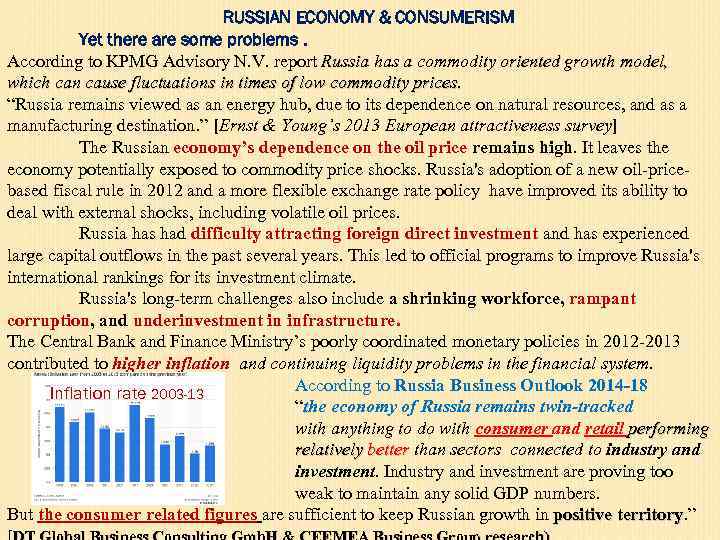 RUSSIAN ECONOMY & CONSUMERISM Yet there are some problems. According to KPMG Advisory N. V. report Russia has a commodity oriented growth model, which can cause fluctuations in times of low commodity prices. “Russia remains viewed as an energy hub, due to its dependence on natural resources, and as a manufacturing destination. ” [Ernst & Young’s 2013 European attractiveness survey] The Russian economy’s dependence on the oil price remains high. It leaves the economy potentially exposed to commodity price shocks. Russia's adoption of a new oil-pricebased fiscal rule in 2012 and a more flexible exchange rate policy have improved its ability to deal with external shocks, including volatile oil prices. Russia has had difficulty attracting foreign direct investment and has experienced large capital outflows in the past several years. This led to official programs to improve Russia's international rankings for its investment climate. Russia's long-term challenges also include a shrinking workforce, rampant corruption, and underinvestment in infrastructure. The Central Bank and Finance Ministry’s poorly coordinated monetary policies in 2012 -2013 contributed to higher inflation and continuing liquidity problems in the financial system. According to Russia Business Outlook 2014 -18 Inflation rate 2003 -13 “the economy of Russia remains twin-tracked with anything to do with consumer and retail performing relatively better than sectors connected to industry and investment. Industry and investment are proving too weak to maintain any solid GDP numbers. But the consumer related figures are sufficient to keep Russian growth in positive territory. ” territory
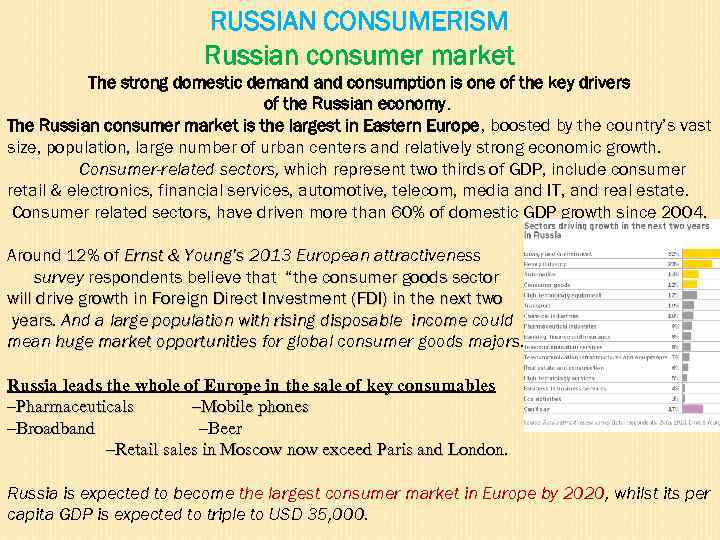 RUSSIAN CONSUMERISM Russian consumer market The strong domestic demand consumption is one of the key drivers of the Russian economy. The Russian consumer market is the largest in Eastern Europe, boosted by the country’s vast size, population, large number of urban centers and relatively strong economic growth. Consumer-related sectors, which represent two thirds of GDP, include consumer retail & electronics, financial services, automotive, telecom, media and IT, and real estate. Consumer related sectors, have driven more than 60% of domestic GDP growth since 2004. Around 12% of Ernst & Young’s 2013 European attractiveness survey respondents believe that “the consumer goods sector will drive growth in Foreign Direct Investment (FDI) in the next two years. And a large population with rising disposable income could years income mean huge market opportunities for global consumer goods majors. ” Russia leads the whole of Europe in the sale of key consumables –Pharmaceuticals –Mobile phones –Broadband –Beer –Retail sales in Moscow now exceed Paris and London. Russia is expected to become the largest consumer market in Europe by 2020, whilst its per capita GDP is expected to triple to USD 35, 000.
 RUSSIAN CONSUMER BOOM From 1998 onwards, the consumer boom in Russia was the result of nearly 10 boom years of economic prosperity and growth in credit facilities. Companies throughout the retail, banking, pharmaceuticals, mobile telecoms and other sectors are already the main beneficiaries of the consumer boom , these companies are playing an increasingly important role in the Russian economy. Nowadays consumer trends in Russia continue to change as consumer power and purchasing activities expand. Favourable conditions: • Russian consumers have no significance debt, though the situation is gradually changing. • The average mortgage debt in Russia is negligible (€ 130 person) compared with € 12, 370 in the Eurozone and € 26, 040 in the USA. • The relatively high level of nationwide savings. • The relatively low unemployment rates. • The developing consumer credit system. • The household incomes have risen significantly over the decade, and consumer expenditures as well.
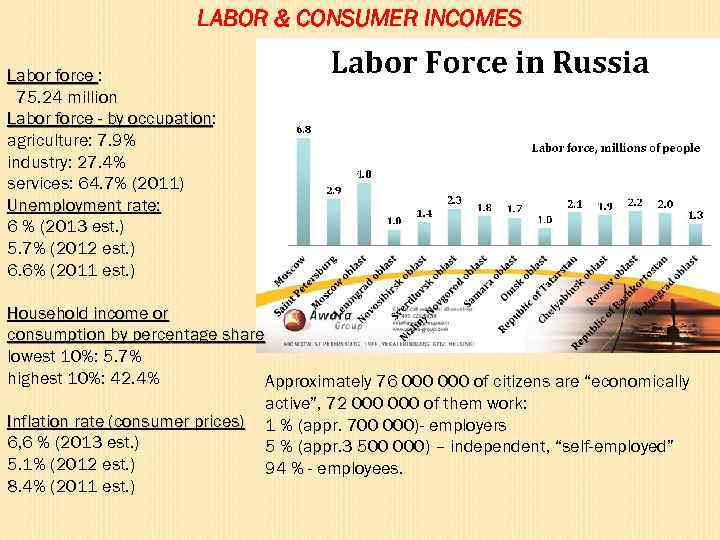 LABOR & CONSUMER INCOMES Labor force : 75. 24 million Labor force - by occupation: occupation agriculture: 7. 9% industry: 27. 4% services: 64. 7% (2011) Unemployment rate: 6 % (2013 est. ) 5. 7% (2012 est. ) 6. 6% (2011 est. ) Household income or consumption by percentage share lowest 10%: 5. 7% highest 10%: 42. 4% Approximately 76 000 of citizens are “economically active”, 72 000 of them work: Inflation rate (consumer prices) 1 % (appr. 700 000)- employers 6, 6 % (2013 est. ) 5 % (appr. 3 500 000) – independent, “self-employed” 5. 1% (2012 est. ) 94 % - employees. 8. 4% (2011 est. )
 THE GROWTH IN INCOMES The household incomes have risen significantly over the decade • The average monthly income, was less than US$200 per month in 2003. • This is now averages more than $1, 000 per month Russians aged 30 -34 held the highest average gross income of $12, 987. This age group is increasingly more equipped for the country’s transfer into a capitalist economy, with Russians that completed their education in the 2000 s typically more in demand by employers. • Russians aged 40 -44 were among the top average earners in the country with average gross income of $12, 509. • Low personal income tax (flat) rate at only 13% + very little debt = = Russians have relatively high levels of disposable income
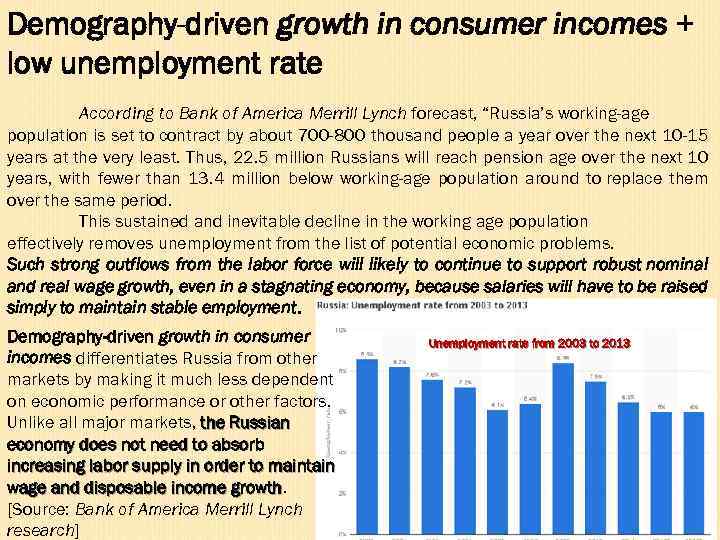 Demography-driven growth in consumer incomes + low unemployment rate According to Bank of America Merrill Lynch forecast, “Russia’s working-age population is set to contract by about 700 -800 thousand people a year over the next 10 -15 years at the very least. Thus, 22. 5 million Russians will reach pension age over the next 10 years, with fewer than 13. 4 million below working-age population around to replace them over the same period. This sustained and inevitable decline in the working age population effectively removes unemployment from the list of potential economic problems. Such strong outflows from the labor force will likely to continue to support robust nominal and real wage growth, even in a stagnating economy, because salaries will have to be raised simply to maintain stable employment. Demography-driven growth in consumer incomes differentiates Russia from other markets by making it much less dependent on economic performance or other factors. Unlike all major markets, the Russian economy does not need to absorb increasing labor supply in order to maintain wage and disposable income growth [Source: Bank of America Merrill Lynch research] Unemployment rate from 2003 to 2013
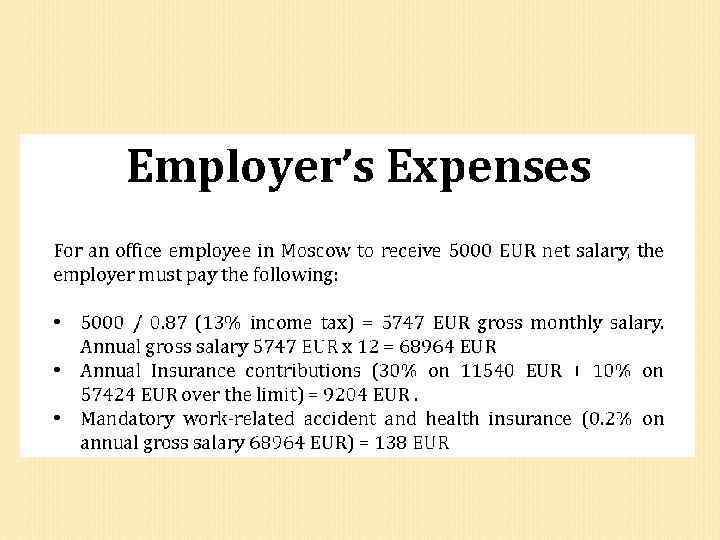
 CONSUMER INCOMES AVERAGE SALARY RATE: Moscow: average salary in July 2013 Rub. 53. 953 Moscow: average salary by Mid-2016 to rise to Rub. 70. 000 Regions: average salary in July 2013 Rub. 17000 - 33000 Official subsistence Level in Moscow 2012: Rub. 12. 000 The recent recovery in incomes (real wage growth increased 5, 4 -6 % year on year). led to an improvement in consumer confidence, which boosted demand for durable goods and non-food discretionary products in general. Government efforts to improve standards of living have already resulted in the steady increase of state pension payments and public sector salaries. The average annual pension of 36. 6 million Russian pensioners has reached USD 4500 But this effect is diminished by relatively high inflation rates Rates of growth of Nominal and Real Wages in 2012/2013: Real wages after inflation were running at 5. 9% in August and at an average of 5. 4% in 2013. As a comparison, real wages were growing 12% in the second quarter of 2012 when inflation was close to 3% and nominal wages were about 15 -16%. Nominal and real wages have “crashed” since then and real wages averaged 5 -6% in recent months as inflation hovered at about 7%; this still means that nominal wages are strong at about 11 -12%. Even though real wage levels have almost halved, these too at the current 5 -6% remain the highest in Europe (real wages in most of the Eurozone, Germany and the CEE region are 0 -1% and in the UK they have been running negative for 3 -4 years).
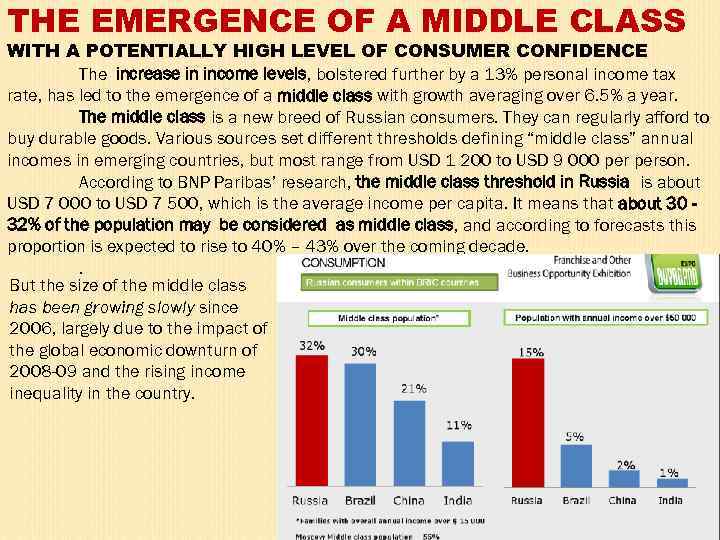 THE EMERGENCE OF A MIDDLE CLASS WITH A POTENTIALLY HIGH LEVEL OF CONSUMER CONFIDENCE The increase in income levels, bolstered further by a 13% personal income tax rate, has led to the emergence of a middle class with growth averaging over 6. 5% a year. The middle class is a new breed of Russian consumers. They can regularly afford to buy durable goods. Various sources set different thresholds defining “middle class” annual incomes in emerging countries, but most range from USD 1 200 to USD 9 000 person. According to BNP Paribas’ research, the middle class threshold in Russia is about USD 7 000 to USD 7 500, which is the average income per capita. It means that about 30 32% of the population may be considered as middle class, and according to forecasts this proportion is expected to rise to 40% – 43% over the coming decade. . But the size of the middle class has been growing slowly since 2006, largely due to the impact of the global economic downturn of 2008 -09 and the rising income inequality in the country.
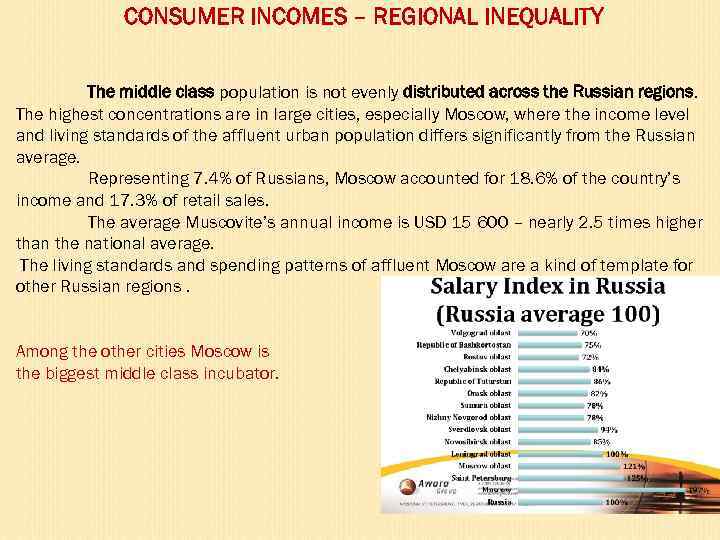 CONSUMER INCOMES – REGIONAL INEQUALITY The middle class population is not evenly distributed across the Russian regions. The highest concentrations are in large cities, especially Moscow, where the income level cities and living standards of the affluent urban population differs significantly from the Russian average. Representing 7. 4% of Russians, Moscow accounted for 18. 6% of the country’s income and 17. 3% of retail sales. The average Muscovite’s annual income is USD 15 600 – nearly 2. 5 times higher than the national average. The living standards and spending patterns of affluent Moscow are a kind of template for other Russian regions. Among the other cities Moscow is the biggest middle class incubator.
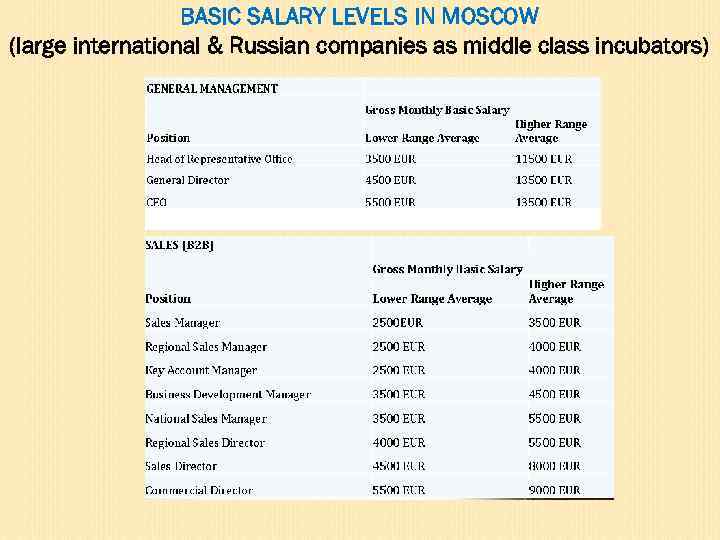 BASIC SALARY LEVELS IN MOSCOW (large international & Russian companies as middle class incubators)
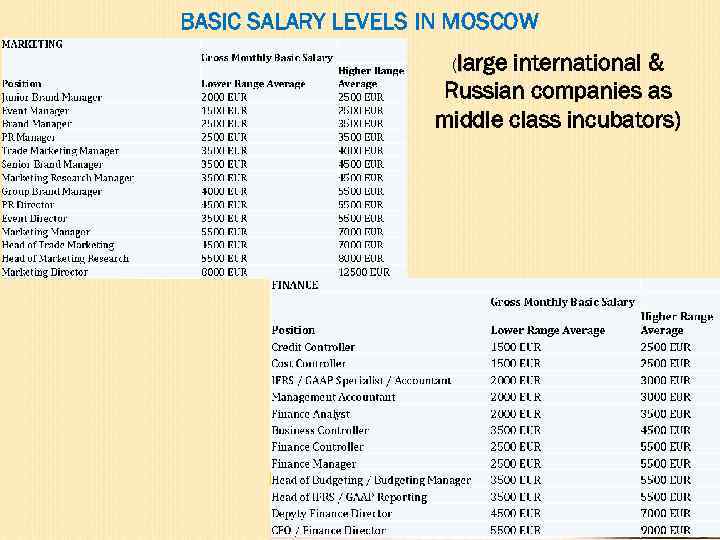 BASIC SALARY LEVELS IN MOSCOW (large international & Russian companies as middle class incubators)
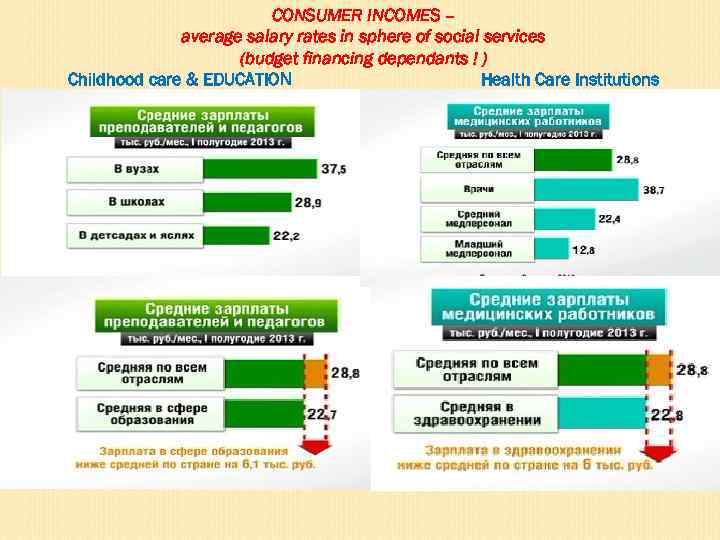 CONSUMER INCOMES – average salary rates in sphere of social services (budget financing dependants ! ) Сhildhood care & EDUCATION Health Care Institutions
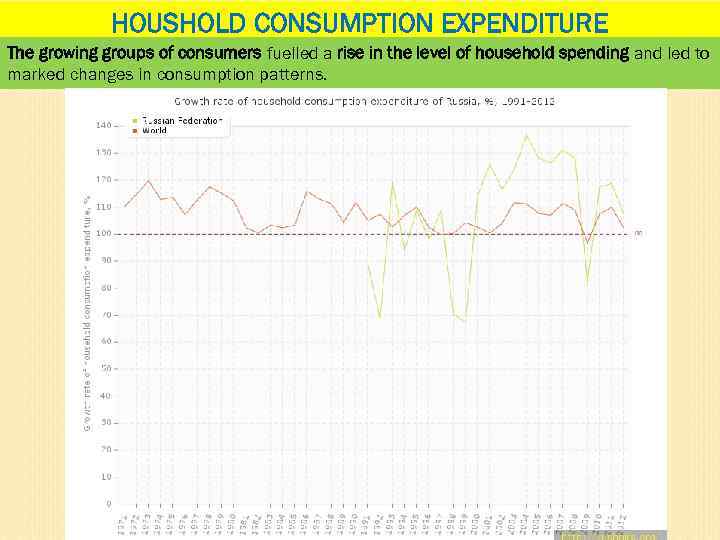 HOUSHOLD CONSUMPTION EXPENDITURE The growing groups of consumers fuelled a rise in the level of household spending and led to marked changes in consumption patterns.
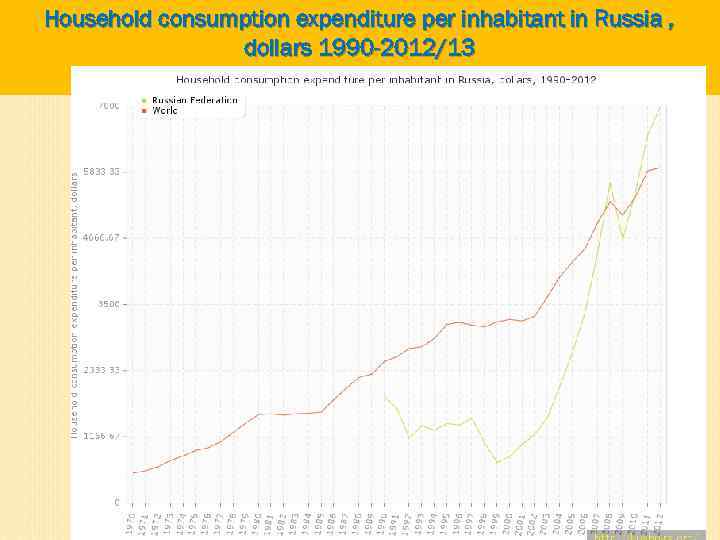 Household consumption expenditure per inhabitant in Russia , dollars 1990 -2012/13
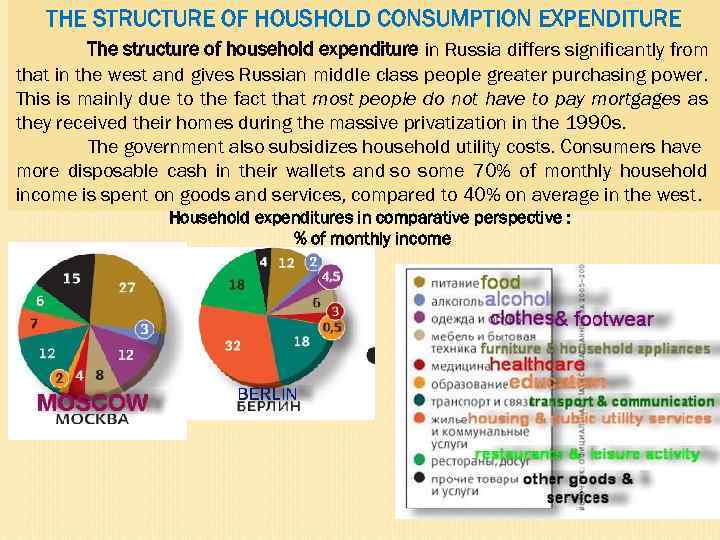 THE STRUCTURE OF HOUSHOLD CONSUMPTION EXPENDITURE The structure of household expenditure in Russia differs significantly from that in the west and gives Russian middle class people greater purchasing power. This is mainly due to the fact that most people do not have to pay mortgages as they received their homes during the massive privatization in the 1990 s. The government also subsidizes household utility costs. Consumers have more disposable cash in their wallets and so some 70% of monthly household income is spent on goods and services, compared to 40% on average in the west. Household expenditures in comparative perspective : % of monthly income
 THE STRUCTURE OF HOUSHOLD CONSUMPTION EXPENDITURE Household expenditures in comparative perspective : % of monthly income
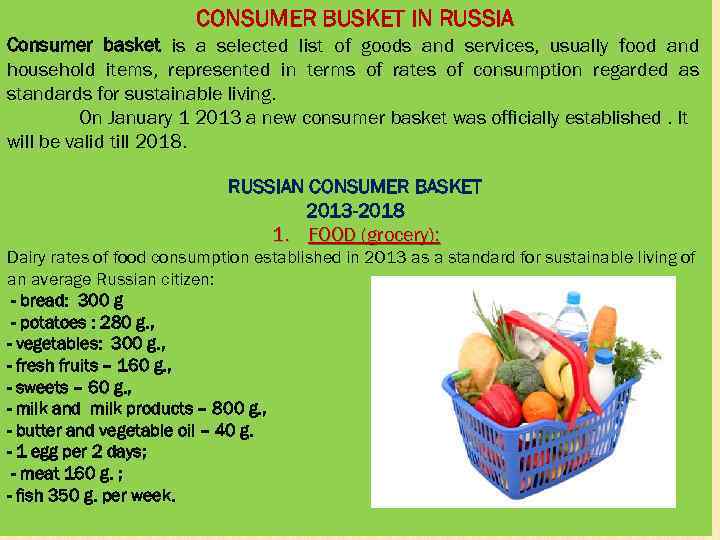 CONSUMER BUSKET IN RUSSIA Consumer basket is a selected list of goods and services, usually food and household items, represented in terms of rates of consumption regarded as standards for sustainable living. On January 1 2013 a new consumer basket was officially established. It will be valid till 2018. RUSSIAN CONSUMER BASKET 2013 -2018 1. FOOD (grocery): Dairy rates of food consumption established in 2013 as a standard for sustainable living of an average Russian citizen: - bread: 300 g - potatoes : 280 g. , - vegetables: 300 g. , - fresh fruits – 160 g. , - sweets – 60 g. , - milk and milk products – 800 g. , - butter and vegetable oil – 40 g. - 1 egg per 2 days; - meat 160 g. ; - fish 350 g. per week.
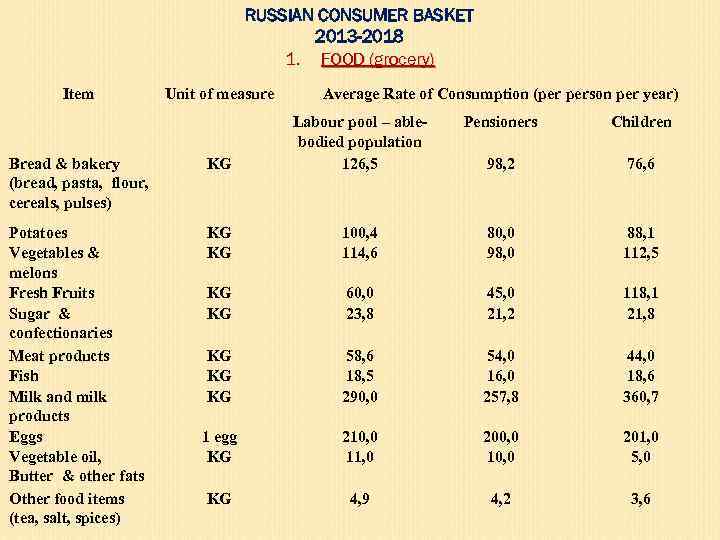 RUSSIAN CONSUMER BASKET 2013 -2018 1. FOOD (grocery) Item Unit of measure Average Rate of Consumption (per person per year) Bread & bakery (bread, pasta, flour, cereals, pulses) KG Labour pool – ablebodied population 126, 5 Pensioners Children 98, 2 76, 6 Potatoes Vegetables & melons Fresh Fruits Sugar & confectionaries Meat products Fish Milk and milk products Eggs Vegetable oil, Butter & other fats Other food items (tea, salt, spices) KG KG 100, 4 114, 6 80, 0 98, 0 88, 1 112, 5 KG KG 60, 0 23, 8 45, 0 21, 2 118, 1 21, 8 KG KG KG 58, 6 18, 5 290, 0 54, 0 16, 0 257, 8 44, 0 18, 6 360, 7 1 egg KG 210, 0 11, 0 200, 0 10, 0 201, 0 5, 0 KG 4, 9 4, 2 3, 6
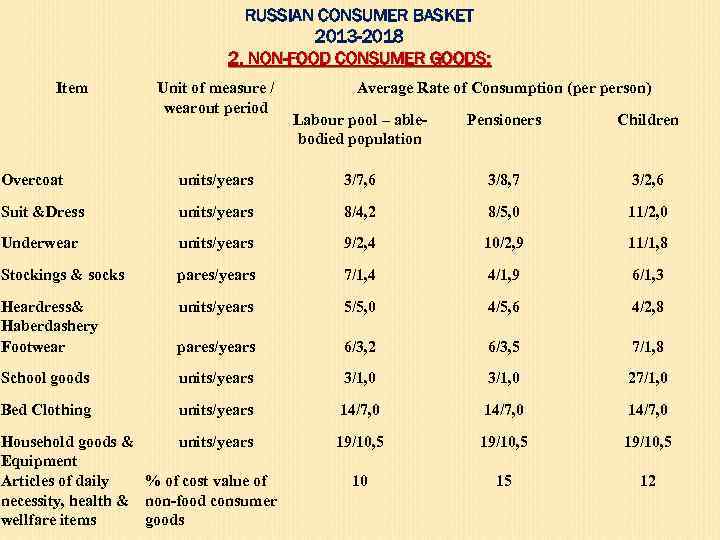 RUSSIAN CONSUMER BASKET 2013 -2018 2. NON-FOOD CONSUMER GOODS: Item Unit of measure / wearout period Average Rate of Consumption (per person) Labour pool – ablebodied population Pensioners Children Overcoat units/years 3/7, 6 3/8, 7 3/2, 6 Suit &Dress units/years 8/4, 2 8/5, 0 11/2, 0 Underwear units/years 9/2, 4 10/2, 9 11/1, 8 Stockings & socks pares/years 7/1, 4 4/1, 9 6/1, 3 Heardress& Haberdashery Footwear units/years 5/5, 0 4/5, 6 4/2, 8 pares/years 6/3, 2 6/3, 5 7/1, 8 School goods units/years 3/1, 0 27/1, 0 Bed Clothing units/years 14/7, 0 19/10, 5 10 15 12 Household goods & units/years Equipment Articles of daily % of cost value of necessity, health & non-food consumer wellfare items goods
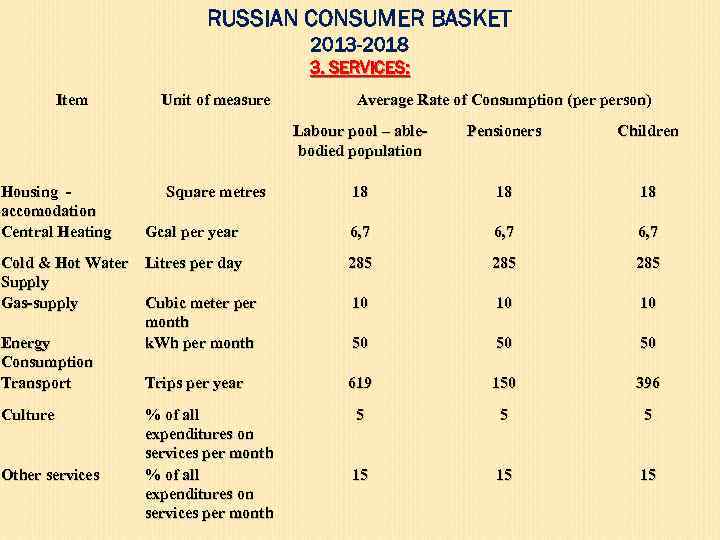 RUSSIAN CONSUMER BASKET 2013 -2018 3. SERVICES: Item Unit of measure Average Rate of Consumption (per person) Labour pool – ablebodied population Housing accomodation Central Heating Square metres Gcal per year Cold & Hot Water Litres per day Supply Gas-supply Cubic meter per month Energy k. Wh per month Consumption Transport Trips per year Culture Other services % of all expenditures on services per month Pensioners Children 18 18 18 6, 7 285 285 10 10 10 50 50 50 619 150 396 5 5 5 15 15 15
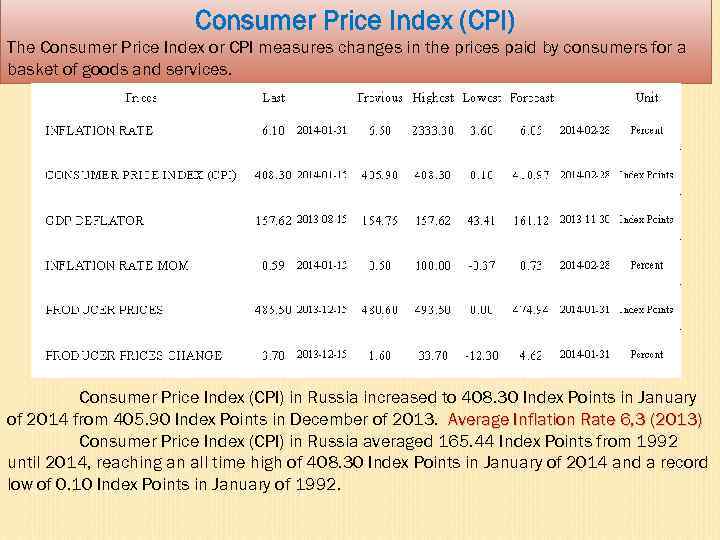 Consumer Price Index (CPI) The Consumer Price Index or CPI measures changes in the prices paid by consumers for a basket of goods and services. Consumer Price Index (CPI) in Russia increased to 408. 30 Index Points in January of 2014 from 405. 90 Index Points in December of 2013. Average Inflation Rate 6, 3 (2013) Consumer Price Index (CPI) in Russia averaged 165. 44 Index Points from 1992 until 2014, reaching an all time high of 408. 30 Index Points in January of 2014 and a record low of 0. 10 Index Points in January of 1992.
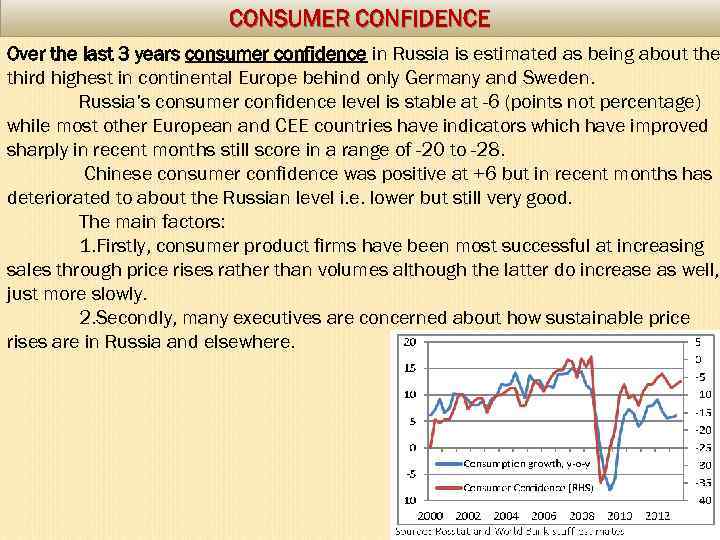 CONSUMER CONFIDENCE Over the last 3 years consumer confidence in Russia is estimated as being about the third highest in continental Europe behind only Germany and Sweden. Russia’s consumer confidence level is stable at -6 (points not percentage) while most other European and CEE countries have indicators which have improved sharply in recent months still score in a range of -20 to -28. Chinese consumer confidence was positive at +6 but in recent months has deteriorated to about the Russian level i. e. lower but still very good. The main factors: 1. Firstly, consumer product firms have been most successful at increasing sales through price rises rather than volumes although the latter do increase as well, just more slowly. 2. Secondly, many executives are concerned about how sustainable price rises are in Russia and elsewhere.
 THE PURCHASUNG POWER of The Russian Consumers The growing purchasing power of the middle class has been a key catalyst during the recent consumption boom in Russia. For the last ten years Russia posted the world’s largest annual growth in household and consumer expenditure – 11% compared to the world average of 1. 8% and Europe’s 0. 9%. Annual consumer expenditures were hit hard by the global economic downturn of 2008 -09, seeing a fall of 5. 8% in real terms in 2009, although the indicator rebounded strongly to 4. 7% real growth in 2010. Even during the crisis of 2008 -09, spending levels suffered only temporarily; they recovered rapidly in 2010 across most consumer oriented sectors, regaining pre-crisis levels in some of them. SAVINGS Surviving stage (post-financial crisis) is over; consumers again have an opportunity to keep their savings in the banks and insurance companies and to return to their pre-crisis purchasing habits. Yet Russians continue to be mistrustful of many banks and often save cash at home rather than saving through financial institutions. The Russian savings level remains high at about 8 -9% and with savings and good wage levels combined with almost record low unemployment at 5. 2%, this explains why Russian consumer confidence indicators stay among the best in Europe. The relatively high level of nationwide savings coupled with one of the world’s lowest private debt levels and relatively low unemployment has set a solid foundation to consumer trends for the foreseeable future.
 The growth of consumer credit provides additional opportunities in future consumption growth. Increased credit availability throughout the last decade has enabled far more people to finance their purchasing, yet – at less than 10% – private debt as a percentage of Russian GDP is still among the lowest in the world and has substantial further scope. Higher credit card penetration and improved consumer awareness of how to use credit effectively should increase the accessibility of money for impulse or urgent purchases. Currently Russians hold c. 71 credit cards per one thousand people, which is four times lower than the world average of c. 290 cards and 14 times below the level in Brazil, where every citizen has, on average, one credit card, according to Euromonitor. On the other hand, the high average growth of stock (35 -40 percent, y-o-y) in consumer and other household credits resulted in an increase in total household indebtedness to 25 percent of total disposable income in the first 5 months of 2013, from 17 percent in 2011 and 19 percent in 2012. This increasing debt burden puts pressure on consumption, as interest payments have now reached 5 percent, a significant share of the average ousehold’s income. And the net savings rate did not grow in the past months, fluctuating marginally around 1516 percent.
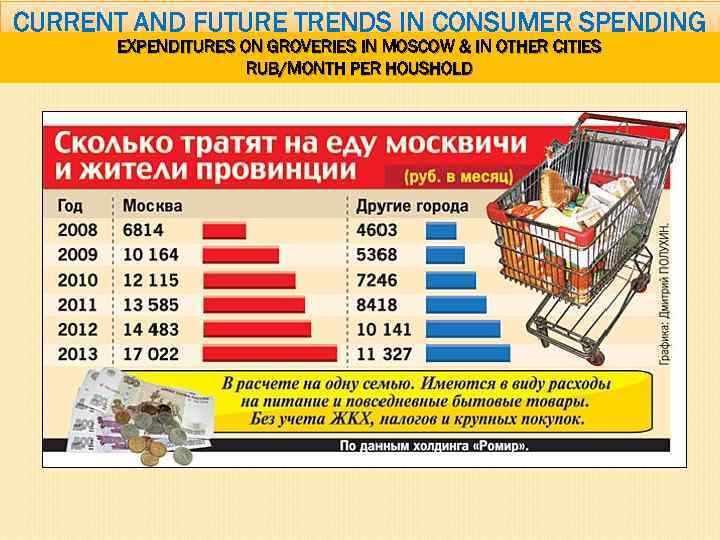 CURRENT AND FUTURE TRENDS IN CONSUMER SPENDING EXPENDITURES ON GROVERIES IN MOSCOW & IN OTHER CITIES RUB/MONTH PER HOUSHOLD
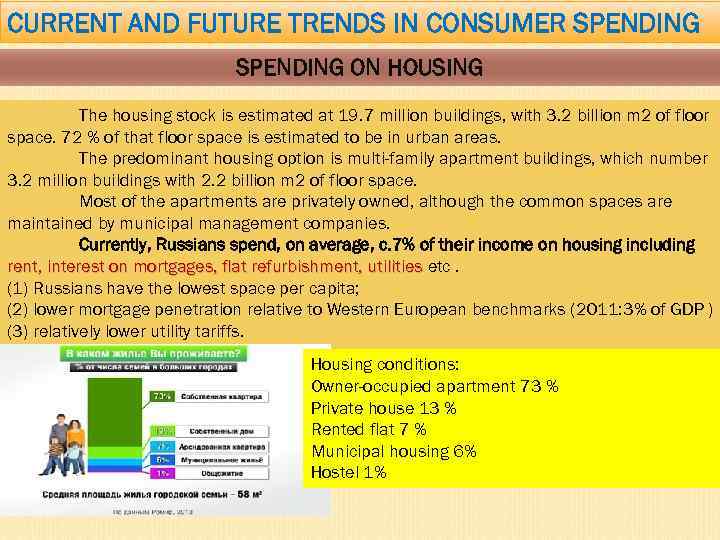 CURRENT AND FUTURE TRENDS IN CONSUMER SPENDING ON HOUSING The housing stock is estimated at 19. 7 million buildings, with 3. 2 billion m 2 of floor space. 72 % of that floor space is estimated to be in urban areas. The predominant housing option is multi-family apartment buildings, which number 3. 2 million buildings with 2. 2 billion m 2 of floor space. Most of the apartments are privately owned, although the common spaces are maintained by municipal management companies. Currently, Russians spend, on average, c. 7% of their income on housing including rent, interest on mortgages, flat refurbishment, utilities etc. (1) Russians have the lowest space per capita; (2) lower mortgage penetration relative to Western European benchmarks (2011: 3% of GDP ) (3) relatively lower utility tariffs. Housing conditions: Owner-occupied apartment 73 % Private house 13 % Rented flat 7 % Municipal housing 6% Hostel 1%
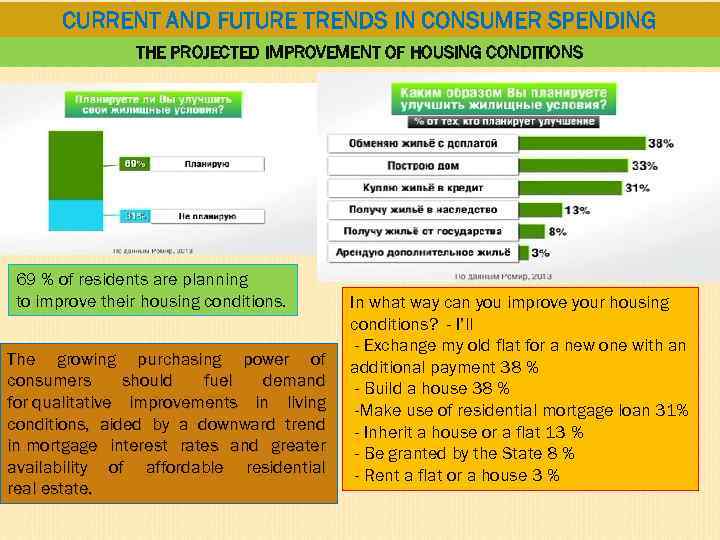 CURRENT AND FUTURE TRENDS IN CONSUMER SPENDING THE PROJECTED IMPROVEMENT OF HOUSING CONDITIONS 69 % of residents are planning to improve their housing conditions. The growing purchasing power of consumers should fuel demand for qualitative improvements in living conditions, aided by a downward trend in mortgage interest rates and greater availability of affordable residential real estate. In what way can you improve your housing conditions? - I’ll - Exchange my old flat for a new one with an additional payment 38 % - Build a house 38 % -Make use of residential mortgage loan 31% - Inherit a house or a flat 13 % - Be granted by the State 8 % - Rent a flat or a house 3 %
 CURRENT AND FUTURE TRENDS IN CONSUMER SPENDING Clothing and footwear. Because of the relatively cold climate, Russians spend a greater portion of their incomes on apparel and footwear, but still c. 60% below the level of Finland where weather conditions are similar. Alcoholic beverages and tobacco – expenditure volumes likely to decline due to: (1) government measures to curb domestic alcohol and tobacco intake; (2) stronger health trends in consumption and lifestyle; and (3) new excise duty legislation set to bring the price of alcohol and tobacco to average European levels in the medium term. Other goods and services Higher disposable incomes, if these can be achieved, will translate into greater demand for financial services (banking and insurance) and other non-food products and services Leisure and recreation The out-of-pocket spend on tourism, leisure and recreation comes account for 4% of income by Russians. • Russians are travelling and spending a significant amount of money overseas. Russians spend on average US$1, 000 per head on their holidays and 72 % of tourists pay for their holidays in cash. Higher disposable incomes should boost demand for these services, benefitting the domestic tourism industry and air carriers such as Aeroflot and Transaero. There is a trend toward larger purchases for future use and additional purchases.
 RATHER AN OPTIMISTIC FORECAST The Bank of America Merrill Lynch Economics team forecasts: “We expect the structure of spending to change, benefitting most sectors but driving discretionary spending in particular. We see per capita food expenditure growing by c. 56% (to over RUB 100, 000 pa) driven mostly by qualitative changes in consumption, but non-food spend increasing by over 120% (to over RUB 150, 000 pa) between 2011 and 2020. Nonfood retail, leisure, housing, and financial services will be major winners from the evolving Russian consumer. We forecast 116% growth in per capita expenditure on pharmaceuticals over the same period (to RUB 7, 200 pa) while expenditure on consumer electronics almost doubles (to RUB 11, 000 pa). The key market drivers will be: Disposable income growth as the key catalyst supporting consumption; fragmented nature of Russia’s retail market implies attractive medium-term potential The for organic expansion and consolidation; Non-food retail sales to pick up faster than food sales, helped by a greater slice of disposable incomes being spent on discretionary categories. ” Companies to take advantage of these trends. Most of the companies in the retail sector are likely to take advantage of structural and income growth trends. There are sectors that would benefit from a combination of income and structural growth (food retail, pharma, consumer goods). MGNT, X 5, OKEY, DIXY (among the top six grocers in Russia), PHST ( - Фармстандарт - leading Russian pharma company) and MVID (leading consumer electronics retailer) look long-term sector beneficiaries. According to the most optimistic forecasts consumer spending could almost double to $3 trillion by 2025. [Source : The Bank of America Merrill Lynch Economics team]
 Current trends in personal consumption expenditures Russian personal consumption expenditures remained relatively strong in 2013 but grew at a lower rate than in 2012. Personal consumption expenditures were up 4. 7 percent in 2013 compared to a very strong 7. 9 percent for 2012. World Bank Research Report : “Consumption, the main growth driver in the past, expanded at a much slower pace than a year ago, despite low unemployment levels and increases in wages and credit. Some of the slowdown in consumer demand can be attributed to the higher burden of interest payments for households as a result of the recent credit boom, along with stubbornly high inflation in 2013. It also reflects a lack of confidence rooted in lingering uncertainty on how the global economy and specifically, the Russian economy will play out. While investors were already in a wait-and-see mode for a while, consumers now appear to have joined them and the players in the Russian economy are sitting on the fence. ” [Source: World Bank Report] Nonetheless, domestic consumption was still relatively strong and this trend is likely to continue in 2014.
 CONSUMER MARKETS RETAILING as a consumer-oriented sector Retail trade is one of the most vigorously developing sectors of Russia’s economy. Over the past 10 years, the Russian retail and wholesale sector has changed dramatically. For instance , over 2001 -11, the Russian retail sector increased its turnover sixfold, created 5 mln new jobs, and doubled its productivity from 15% of the US level to 31% today – the best productivity gain of any major Russian manufacturing and service sector. “At the heart of this improvement has been the growth in modern retail formats, which is estimated to be three to four times as productive as traditional Russian retail formats, but still lag best in class Western peers. ” (Source: Sberbank Investment Research report). The Russian retail sector is highly fragmented compared with Western Europe – the top-three retailers command c. 20% and c. 8% in food and non-food segments versus c. 35% and c. 17%, on average, across our selected peer countries. The consolidation process is likely to continue in two key directions: directions largest federal retailers will likely cement their positions and increase their The geographical footprint through small/mid-sized M&A (mergers and acquisitions) operations. penetration of modern food retail should remain high in Moscow and St. Petersburg, The while other regions offer attractive opportunities for strong organic expansion and still enjoy low competition levels In the consumer retail sector, there an estimated 400, 000 points of sale across Russia including 70, 000 kiosks selling fast-moving food, snacks, beer and cigarettes. This is set to consolidate, and to consolidate quickly.
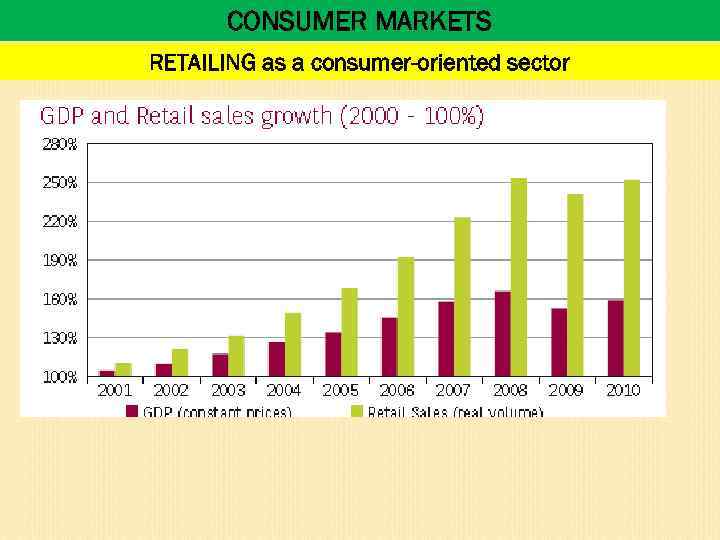 CONSUMER MARKETS RETAILING as a consumer-oriented sector
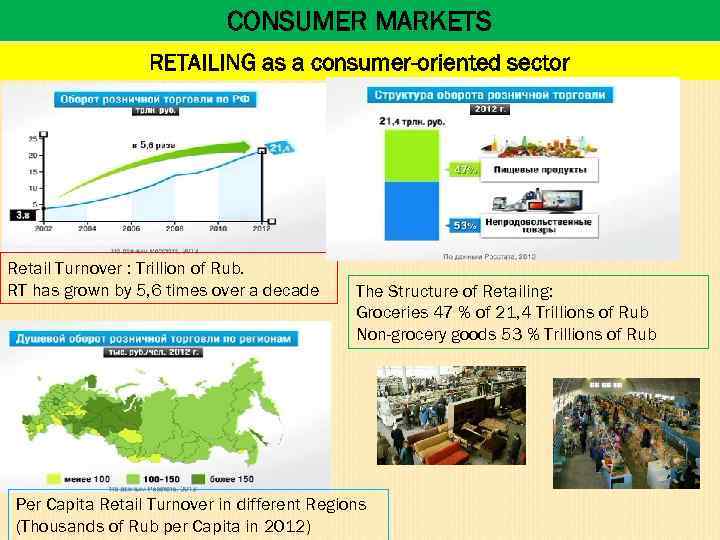 CONSUMER MARKETS RETAILING as a consumer-oriented sector Retail Turnover : Trillion of Rub. RT has grown by 5, 6 times over a decade The Structure of Retailing: Groceries 47 % of 21, 4 Trillions of Rub Non-grocery goods 53 % Trillions of Rub Per Capita Retail Turnover in different Regions (Thousands of Rub per Capita in 2012)
 FMCG - primary retail channels Russia's fast moving consumer goods (FMCG) sector — including food, cosmetics/toiletries, household supplies, and other types of consumer goods - illustrates the role of primary retail channels in Russia: grocery stores, produce markets, and supermarkets. Traditionally in Russia, most retail sales took place in independent shops and outdoor markets. Priority is given to a small, multipurpose grocery stores - 37% of spending on an average produce cart goes through this channel. Wholesale produce markets or Farmer's Markets come in second - 24%. Large-scale grocery stores or supermarkets - 12%, take third place. This last group takes up the greatest share in the following three regions: Moscow city, the North-West Region, and the Urals. St-Petersburg is characterized by a rapid growth of discount supermarket chains. The highest share of small retail stores is observed in the Urals, Siberia, and the Far East. Farmer's markets play a very important role in Moscow, the Central Federal District, as well as Southern Russia and Lower Volga. The main shopping scene for Russians (outside of Moscow and other major cities) is still in a small grocery or convenience stores or other specialized stores (reason: convenient location), as well as consumer goods markets (reason: low prices for main categories of products).
 FMCG - primary retail channels New retail formats New formats, such as discount chains, supermarkets, hypermarkets and shopping malls offering greater convenience, higher quality and wider choice have steadily been gaining ground. The supermarket format seems to have little room to expand further as current penetration in Russia is already at the European average. Close-to-home discounters (convenience store) and big-box hypermarket formats have the strongest catch-up potential from current levels. The most typical trend is a rise of new consumer channel, namely — medium-size discount supermarkets, such as Piaterochka, Kopeika, and Aldi in Moscow. So the discounter format is likely to more than triple by 2020, and hypermarkets to double their share from the current c. 11%. Hypermarket format is best placed to address evolving consumer needs, especially of the middle- to high-income consumer. Hypermarkets are expected to benefit in the long run thanks to their: Variety of offering (up to 35, 000 Stock Keeping Units vs c. 3, 000 SKUs at discounters); share of non-food SKUs (up to 60% of their product range) allowing them to tailor High their offering to satisfy middle-class households; Attractive pricing compared with discounters.
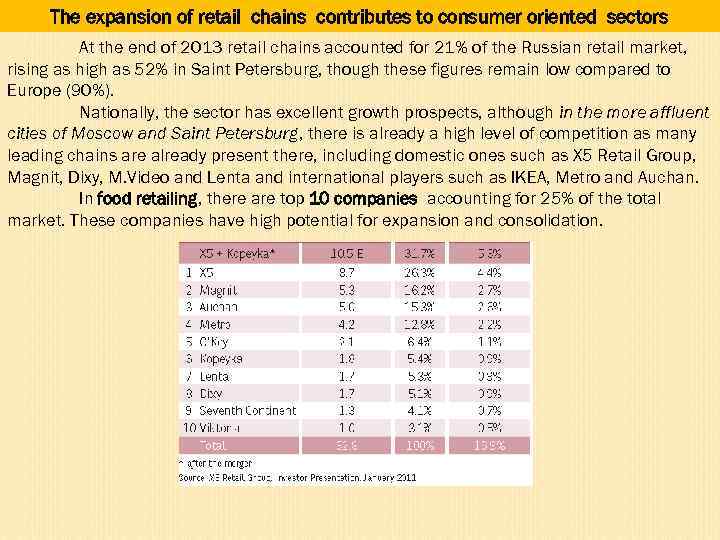 The expansion of retail chains contributes to consumer oriented sectors At the end of 2013 retail chains accounted for 21% of the Russian retail market, rising as high as 52% in Saint Petersburg, though these figures remain low compared to Europe (90%). Nationally, the sector has excellent growth prospects, although in the more affluent cities of Moscow and Saint Petersburg, there is already a high level of competition as many leading chains are already present there, including domestic ones such as X 5 Retail Group, Magnit, Dixy, M. Video and Lenta and international players such as IKEA, Metro and Auchan. In food retailing, there are top 10 companies accounting for 25% of the total market. These companies have high potential for expansion and consolidation.
 The expansion of retail chains contributes to consumer oriented sectors Burgeoning demand for high quality products, lower competition and the availability of suitable property will facilitate retail chains extending steadily outside the largest cities into the Russian regions , in the regions retail marketing is still fragmented. They also have greater capabilities of gaining market share from traditional markets, old fashioned stores and regional retail chains. CEEMEA Business Group, DT Global Business Consulting Gmb. H report cites interview with a retailer: “One retailer notes that business is good but more competitive and that Moscow may no longer represent the growth future for them. This company is growing overall at 18% but at a lower rate of 11% like-for-like and the European MD is satisfied with this. But he continued to remark at the start of this year: Moscow growth rates are not so exciting now in such a competitive environment. This city will be the hardest place to find any top-line improvement. Siberia is now doing very well for us and we plan new stores in locations where there is little or actually no competition. When we open one of our stores in a city of 500, 000 people it is a big local event and we get huge publicity”. Once the organic expansion of the Russian food retailers has peaked (2012/13 E) it is expected to moderate, hampered by the: (1) high penetration of modern retail; (2) shortage of attractive locations; (3) Retail Law, which currently restricts the maximum share of each retailer to 25% in any one district.
 WHERE TO BUY GROCERIES Low-Priced Stores of these chains are located in the suburbs of all big cities. Avos'ka (Авоська): Avos'ka (meaning shopping bag) sells cheap groceries, hygiene items, newspapers, cigarettes and household items such as plates, cups, hangers and hosiery. Shops can be found in Moscow, Nizhny Novgorod and Novosibirsk. Kopeika (Копейка): Kopeika shops are often very small and cater for local costcutters. The general line of products is similar to Avos’ka, but smaller in choice and often lower in quality. It is advisable to check the dates on bottles and packs Pyaterochka (Пятёрочка): Pyaterochka has over 2, 600 stores and 400 franchised stores across Russia selling just about anything, including pet food. Quality is somewhere between Kopeika and Avos'ka. Owned by the X 5 Retail Group, these supermarkets sell goods marked with a ‘Red Price’ label, identifying the group's products that are usually cheaper than other brands
 WHERE TO BUY GROCERIES Low to Mid-Priced Stores Auchan (Ашан): Auchan hypermarkets are popular, sell all kinds of goods and are present in all major cities and prices represent good value Dixy (Дикси): Dixy promotes itself as a chain of neighbourhood stores; friendly, cheap and local. They run 2 -for-1 promotions and organise events for kids Mid-Priced Stores Selgros Cash&Carry (Зельгрос): This German wholesale store is a new shopping mecca, open 24/7. A large selection of goods is available individually or in multi-packs of items such as chocolate bars, juices, teas, water or corn, offering good savings. Also on sale are bed sheets, office supplies, electrical and home appliances, clothes, shoes and even real Suffolk ales and stouts. Seasonal goods include Yule logs and chocolate gingerbreads at Christmas Moi Magazin (Мой магазин): One of the newest additions to the Moscow shopping scene, Moi Magazin specialises in food shopping and can be found near metro stations and in shopping malls. The range of products is similar to other mid-priced chains in price and selection, with discount cards available and stickers that can be exchanged for household supplies. Some stores also provide a dry cleaning service
 WHERE TO BUY GROCERIES Mid to Upmarket Stores of all chains can be found in various areas of cities, including city centres. Alye Parusa stores are only in Moscow and the Moscow Region. Sed'moy Continent (Седьмой Континент): Sed'moy Continent (seventh continent) was the leading upmarket shop until the arrival of Azbuka Vkusa and Globe Gourmet. Various store formats from local shops to supermarkets and hypermarkets sell a wide variety of items, although not stretching as far as clothes and home appliances. Discounts are regularly advertised including the Shock Tsena (Shocking Price) promotion. Customers can also buy a discount card (free after spending a certain amount) and collect stickers to swap for kitchen appliances and utensils. Two thirds of the 160 stores are based in Moscow, with the remainder in other regions. Home delivery is available Perekrestok (Перекрёсток): Perekryostok (Crossroads) is usually less busy, but has a very similar range to Sed'moy Continent on sale. Stickers can also be collected and a 10 percent discount card can be purchased (given free after spending a certain amount). Home delivery is available Alye Parusa (Алые паруса): Named after the eponymous story by Russian author Alexander Grin, this chain of food stores has a catering service and café, sells a rich variety of own produce and operates a delivery service for homes and offices located in the north, northwest and centre of Moscow. The famous food store in Moscow, Eliseevskiy, located on ulitsa Tverskaya, is owned by Alye Parusa.
 WHERE TO BUY GROCERIES Upmarket Stores Azbuka Vkusa (Азбука вкуса): In operation since 1997, Azbuka Vkusa (The ABC of Taste) is a place where expats may find their favourite Kettle teas, Worcestershire sauce and authentic Italian pasta alongside fresh bread, a generous selection of fruit and vegetables and regular in-house tastings of wines and cognacs. There are 49 stores across Moscow and the Moscow Region. Bakhetle (Бахетле): Bakhetle means happy in the Tatar language and this Tatar Superstore focuses on products and cuisine from this region: horse meat, sauces and bread, and cakes from local recipes. The home-like atmosphere is accompanied by the smell of freshly cooked food. Making the experience even more authentic, the staff are all from Tatarstan and traditionally decorated Tatar dishes are sold. There are 12 stores in Kazan, seven in Moscow and three in other cities. Globe Gourmet (Globus Gurme, Глобус Гурмэ): In operation since 2004, Globe Gourmet is the most upmarket and exclusive store with six locations in Moscow and one in St Petersburg. Prices can be too high to make this an option for everyday requirements, but the windowshopping is enjoyable for anyone.
 E-commerce in Russia E-commerce is now a vital part of multichannel retail strategies and is gaining importance as more Russians go online. Yet Russian consumer is not as developed and accustomed to e-commerce as the Western one (Moscow is different). Currently Russians hold c. 71 credit cards per one thousand people, which is four times lower than the world average of c. 290 cards. Moscow and St. Petersburg represent 15% of the country’s population, they account for ~60% of Russia E-Commerce sales. • This is due to: –Higher broadband penetration –Higher disposable household income –Higher population density –More favourable postal and logistics infrastructure Consumer electronics and books have the highest E-commerce penetration rate now and in the future. Key frictions to broader E-commerce penetration: low access to credit cards and safety of online payments. The expansion of online trade in Russia has been hindered by: (1) a poor logistics infrastructure; (2) consumer lack of confidence in delivery and return procedures; (3) low penetration of credit/debit cards and a preference to pay cash on delivery, etc. These still pose short-term risks to growth, but we expect this to change as the infrastructure improves and shoppers become more willing to buy online. Based on a Euromonitor forecast, the online trade will deliver a CAGR of 17% in the period 2012 -16, easily outpacing total retail market growth (CAGR 12 -16 of 10%).
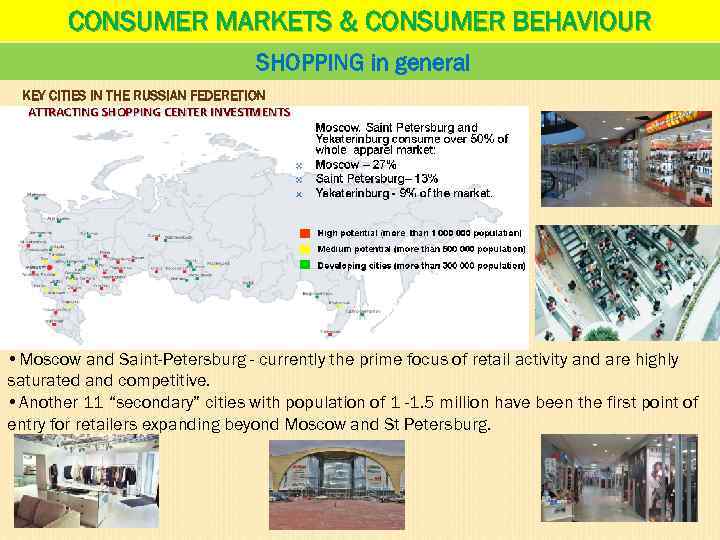 CONSUMER MARKETS & CONSUMER BEHAVIOUR SHOPPING in general KEY CITIES IN THE RUSSIAN FEDERETION • Moscow and Saint-Petersburg - currently the prime focus of retail activity and are highly saturated and competitive. • Another 11 “secondary” cities with population of 1 -1. 5 million have been the first point of entry for retailers expanding beyond Moscow and St Petersburg.
 CONSUMER MARKETS & CONSUMER BEHAVIOUR SHOPPING “People who lacked freedom of choice in the Soviet period can today enjoy choosing from an extensive range of merchandise. Consumers are becoming much better informed and more demanding. The new consumer environment, especially in the largest cities, has seen changes not only in spending patterns but, more importantly, in lifestyles and the spending culture. Better infrastructure and increased car ownership have also led to the flourishing of high volume out-of-town shopping. ” (BNP PARIBAS Investment Partners Survey) Survey A growing number of Russians are coming to consider shopping more as entertainment than just a necessity, with the increasing diversity and availability of goods and services making consumerism a way of expressing their personal identity. • Low prices for most goods does not rank first any longer. • Coming increasingly important: –Easy and quick to find what one needs –Constant product availability –Good quality-price ratio –All at one store –friendly shopping environment –good service: Russians want to enjoy their shopping.
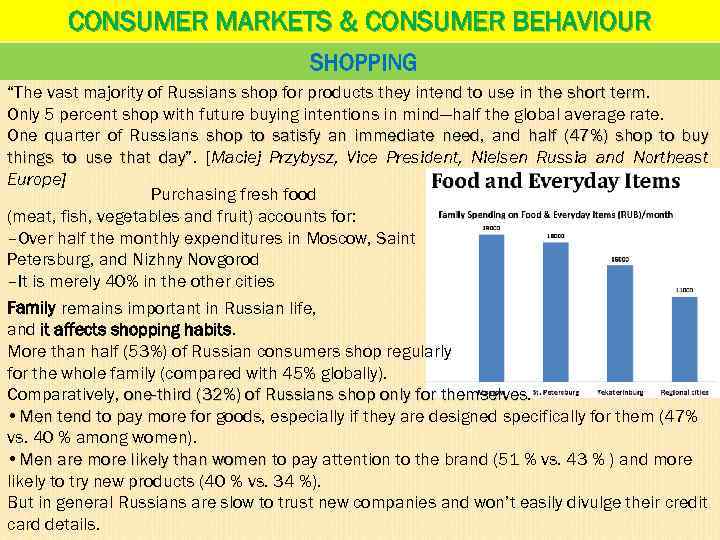 CONSUMER MARKETS & CONSUMER BEHAVIOUR SHOPPING “The vast majority of Russians shop for products they intend to use in the short term Only 5 percent shop with future buying intentions in mind—half the global average rate. One quarter of Russians shop to satisfy an immediate need, and half (47%) shop to buy need things to use that day”. [Maciej Przybysz, Vice President, Nielsen Russia and Northeast day Europe] Purchasing fresh food (meat, fish, vegetables and fruit) accounts for: –Over half the monthly expenditures in Moscow, Saint Petersburg, and Nizhny Novgorod –It is merely 40% in the other cities Family remains important in Russian life, and it affects shopping habits. More than half (53%) of Russian consumers shop regularly for the whole family (compared with 45% globally). Comparatively, one-third (32%) of Russians shop only for themselves • Men tend to pay more for goods, especially if they are designed specifically for them (47% goods vs. 40 % among women). • Men are more likely than women to pay attention to the brand (51 % vs. 43 % ) and more likely to try new products (40 % vs. 34 %). But in general Russians are slow to trust new companies and won’t easily divulge their credit card details.
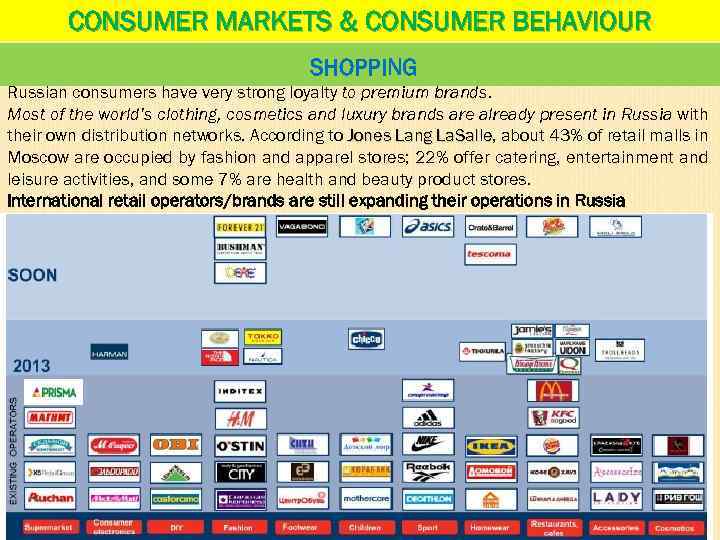 CONSUMER MARKETS & CONSUMER BEHAVIOUR SHOPPING Russian consumers have very strong loyalty to premium brands. Most of the world’s clothing, cosmetics and luxury brands are already present in Russia with their own distribution networks. According to Jones Lang La. Salle, about 43% of retail malls in La. Salle Moscow are occupied by fashion and apparel stores; 22% offer catering, entertainment and leisure activities, and some 7% are health and beauty product stores. International retail operators/brands are still expanding their operations in Russia
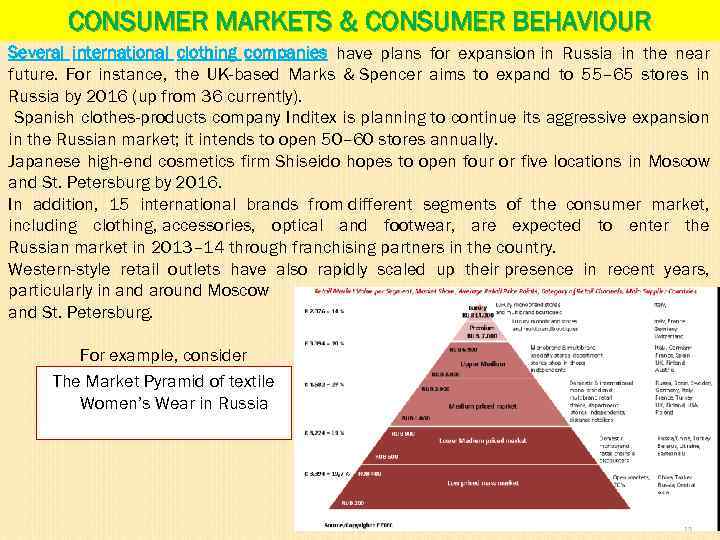 CONSUMER MARKETS & CONSUMER BEHAVIOUR Several international clothing companies have plans for expansion in Russia in the near future. For instance, the UK-based Marks & Spencer aims to expand to 55– 65 stores in Russia by 2016 (up from 36 currently). Spanish clothes-products company Inditex is planning to continue its aggressive expansion in the Russian market; it intends to open 50– 60 stores annually. Japanese high-end cosmetics firm Shiseido hopes to open four or five locations in Moscow and St. Petersburg by 2016. In addition, 15 international brands from different segments of the consumer market, including clothing, accessories, optical and footwear, are expected to enter the Russian market in 2013– 14 through franchising partners in the country. Western-style retail outlets have also rapidly scaled up their presence in recent years, particularly in and around Moscow and St. Petersburg. For example, consider The Market Pyramid of textile Women’s Wear in Russia
 CONSUMER MARKETS & CONSUMER BEHAVIOUR Several global food companies are aiming to broaden their presence in Russia. Danone-Unimilk Group plans to invest around US$700 million in the country to increase its production capacities over the next five to seven years. The Coca-Cola Company and its bottling partner, Coca-Cola Hellenic, have plans to invest US$3 billion over the next five years to broaden operations in Russia. Unilever aims to spend US$70 million to expand its Russian food plant by the end of 2014. Mc. Donald’s plans to open almost 150 restaurants in Russia over the next three years. Other global fast-food chains including Yum! Brands, Subway and Burger King are also actively expanding operations in the country. The WTO accession and the Eurasian Customs Union could further widen market access for consumer goods companies. The WTO accession will remove import tariffs and encourage the entry of foreign firms. Yet there are some problems, conditioned by the current economic situation. “At present, the key obstacle for the development of retail chains is a change in the consumer behavior model of Russian people brought about by the relative decline in the purchasing capacity of the population amid ongoing increases in retail prices”. (Ros. Business. Consulting Researh)
 CONSUMER MARKETS & CONSUMER BEHAVIOUR Russian Consumers’ Attitudes towards Branded Goods Russian consumers are generally very brand-focused. 44% of the population takes into consideration whether or not a product is a brand name
 CONSUMER MARKETS & CONSUMER BEHAVIOUR Russian Consumers’ Attitudes towards Branded Goods There is a significant difference in attitudes to domestic and foreign goods. Majority of Russians consider overseas brands in clothing and footwear more fashionable and of higher quality (except from Turkey and China). Only 23% of Russians believe domestic clothing and footwear products surpass their foreign equivalents in quality. In food products this is more often vice versa, as Russians value more local food products. 77% of the population believes Russian food brands are superior to foreign ones. Local products are believed to be healthier than international in that they are usually made of domestic ingredients, which are presumed to be healthy and habitual for local consumers, in part because they contain fewer or no preservatives. As for furniture and electronic goods, only 12% and 19% respectively estimate the quality of such products produced domestically to be better than that of their imported counterparts. Consumers also seem to be very aware of the latest technological breakthroughs, especially in the large cities of Moscow and St. Petersburg, which accounted for c. 40% of total consumer electronics sales in 2011. Owning a brand-new cell phone or home entertainment system has become a matter of social status. Attitudes towards branded goods in general, and foreign-produced brands in particular, are more positive in Moscow and in large regional cities due to the higher level of western lifestyle penetration and higher incomes. [Source: MUJI Report – a Japanese retail company ]
 the russian consumer sector (another forecast) The Russian consumer sector is holding up better than other economic ones but most consumer product companies now report slower sales growth clustering in high single digits or just over 10% growth. Real wages are holding up well year-on-year at 5. 7% while disposable income declined -1. 3% as retail sales softened to 2. 9%. Real wages holding up despite stubborn inflation at 7. 4%; this means that nominal wages are still rising by about 12%. The labour market remains tight with unemployment at a near-record low figure of 5. 2%. This means that some towns and cities have almost effectively no unemployment which ensures solid nominal wage levels. As long as this trend continues, it will act as a cushion for retail sales. But retail sales recorded a recent two year low rise in May 2013 at 2. 9%. This reflects weaker confidence indicators as the global news and falling rouble impacts spending with savings probably picking up as well. Retail food sales are averaging 1. 6% growth in 2013 while non-food retail is expanding at 6%. Consumers were using their good wages to save a bit more or to cash out of roubles into FX. The labour market is likely to ensure weaker but still good wage levels; comparatively good but softer consumer confidence indicators (the Russians are still among the most confident consumers in Europe) will also provide a cushion for consumer spending; companies may experience further downward pressure on prices and may need to accelerate affordable innovation programs. [ CEEMEA Business Group, DT Global Business Consulting Gmb. H report]
 RUSSIAN CONSUMER BEHAVIOR “Consumer behavior “- this concept is used for the representation of the typical activities and preferences of different groups of people displayed in the process of selecting, purchasing, making use of a variety of goods, services, ideas or experiences to satisfy their needs and wishes. Russians like to think of themselves as very special and different from others. They have survived numerous historical shifts, occasional periods of dictatorship, permanently fluctuating “general misfortune, ” and the drastic circumstances of collectivist living. Rationalization seems to be a problem of the country’s traditional mentality that greatly affects present-day consumption. was the impossible task achieved during the emergence of a transitional economy in Russia in the 1990 s. Consumer trends and consumer bargaining power have constantly shifted since that time as purchasing activities have expanded and become more sophisticated and unusual. Recent marketing researches show that a number of attempts have been made to classify Russian attitudes toward consumption. These attempts reflect the market structure and segmentation techniques employed. Currently, segmentation based on traditional demographics and income characteristics is transitioning more and more into analysis of customer behavior and lifestyle.
 t. Ypes of russian consumers INNOVATORS (13% or around 18% in Moscow, in comparison with an average of 8% for the country as a whole). Nearly half of the group is under 30 years old, often single. One-third of them live in megalopolises. Innovators generally are highly educated , involved in business or in top intellectual occupations. Innovators do not lose optimism, confidence and self-confidence. Innovators have high consumption potential Innovators have well-developed tastes. Innovators focus on novelty, as well as reliability, product quality, health care and active leisure. Innovators are fairly sophisticated with regard to the global market’s offerings. Innovators prefer quality products of famous and trusted brands. Innovators demand that everything be unique, exotic, and super-luxurious in their dynamic lifestyle. But innovators are not satisfied with foreign brands alone. They want more customization, limited editions of everything, and “impossible-to-get” products and services. In many ways they are ahead of the average Western consumer in purchasing objects of art, custom-made jewelry, luxury homes, exotic cars, unique yachts, and elaborate personal services. The advertising media are working hard to promote many luxury products through the innovators, as they are much better informed, thanks to a variety of global media sources.
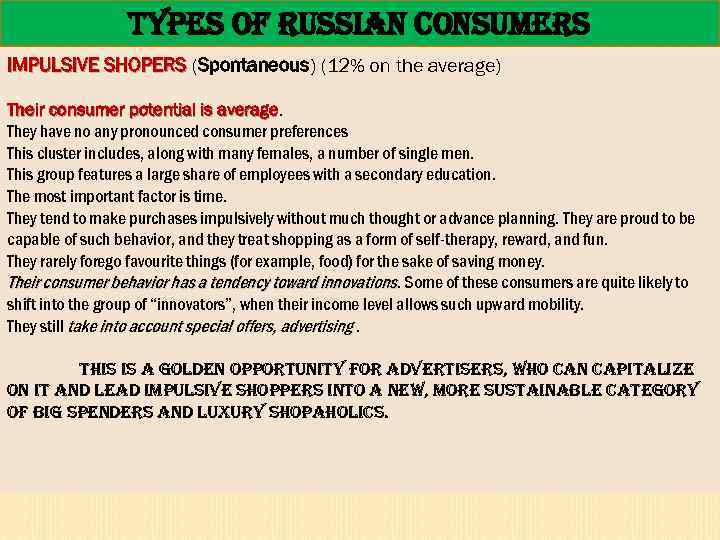 t. Ypes of russian consumers IMPULSIVE SHOPERS (Spontaneous) (12% on the average) Their consumer potential is average They have no any pronounced consumer preferences This cluster includes, along with many females, a number of single men. This group features a large share of employees with a secondary education. The most important factor is time. They tend to make purchases impulsively without much thought or advance planning. They are proud to be capable of such behavior, and they treat shopping as a form of self-therapy, reward, and fun. They rarely forego favourite things (for example, food) for the sake of saving money. Their consumer behavior has a tendency toward innovations. Some of these consumers are quite likely to shift into the group of “innovators”, when their income level allows such upward mobility. They still take into account special offers, advertising. this is a golden opportunity for advertisers, who can capitalize on it and lead impulsive shoppers into a new, more sustainable category of big spenders and luxury shopaholics.
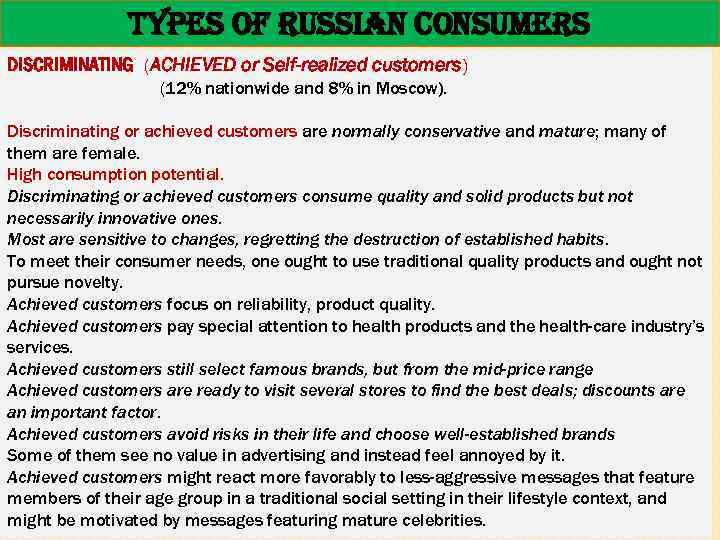 t. Ypes of russian consumers DISCRIMINATING (ACHIEVED or Self-realized customers) (12% nationwide and 8% in Moscow). Discriminating or achieved customers are normally conservative and mature; many of them are female. High consumption potential. Discriminating or achieved customers consume quality and solid products but not necessarily innovative ones. Most are sensitive to changes, regretting the destruction of established habits. To meet their consumer needs, one ought to use traditional quality products and ought not pursue novelty. Achieved customers focus on reliability, product quality. Achieved customers pay special attention to health products and the health-care industry’s services. Achieved customers still select famous brands, but from the mid-price range Achieved customers are ready to visit several stores to find the best deals; discounts are an important factor. Achieved customers avoid risks in their life and choose well-established brands Some of them see no value in advertising and instead feel annoyed by it. Achieved customers might react more favorably to less-aggressive messages that feature members of their age group in a traditional social setting in their lifestyle context, and might be motivated by messages featuring mature celebrities.
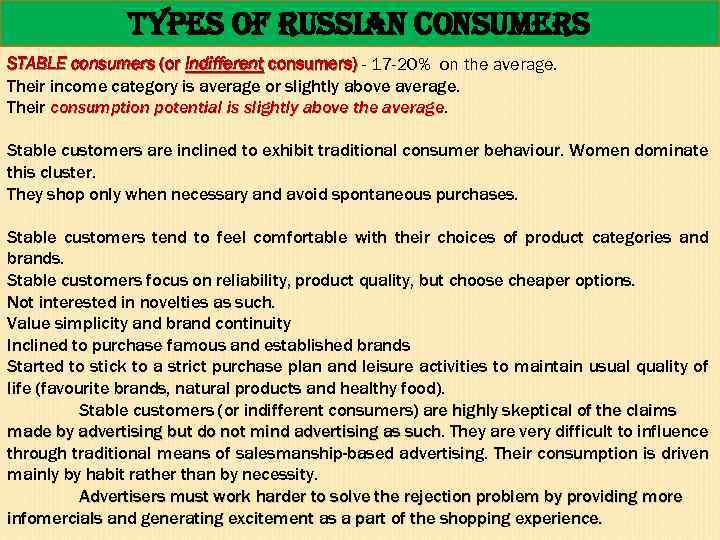 t. Ypes of russian consumers STABLE consumers (or Indifferent consumers) - 17 -20% on the average. Their income category is average or slightly above average. Their consumption potential is slightly above the average Stable customers are inclined to exhibit traditional consumer behaviour. Women dominate this cluster. They shop only when necessary and avoid spontaneous purchases. Stable customers tend to feel comfortable with their choices of product categories and brands. Stable customers focus on reliability, product quality, but choose cheaper options. Not interested in novelties as such. Value simplicity and brand continuity Inclined to purchase famous and established brands Started to stick to a strict purchase plan and leisure activities to maintain usual quality of life (favourite brands, natural products and healthy food). Stable customers (or indifferent consumers) are highly skeptical of the claims made by advertising but do not mind advertising as such. They are very difficult to influence such through traditional means of salesmanship-based advertising. Their consumption is driven mainly by habit rather than by necessity. Advertisers must work harder to solve the rejection problem by providing more infomercials and generating excitement as a part of the shopping experience.
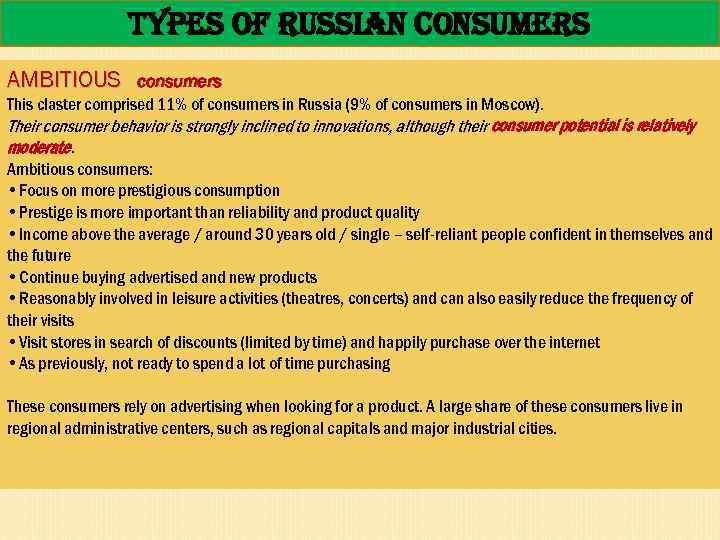 t. Ypes of russian consumers AMBITIOUS consumers This claster comprised 11% of consumers in Russia (9% of consumers in Moscow). Their consumer behavior is strongly inclined to innovations, although their consumer potential is relatively moderate. Ambitious consumers: • Focus on more prestigious consumption • Prestige is more important than reliability and product quality • Income above the average / around 30 years old / single – self-reliant people confident in themselves and the future • Continue buying advertised and new products • Reasonably involved in leisure activities (theatres, concerts) and can also easily reduce the frequency of their visits • Visit stores in search of discounts (limited by time) and happily purchase over the internet • As previously, not ready to spend a lot of time purchasing These consumers rely on advertising when looking for a product. A large share of these consumers live in regional administrative centers, such as regional capitals and major industrial cities.
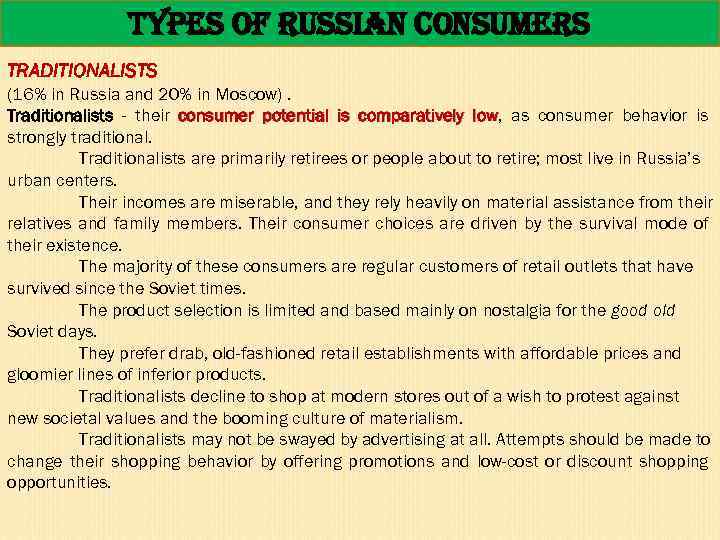 t. Ypes of russian consumers TRADITIONALISTS (16% in Russia and 20% in Moscow). Traditionalists - their consumer potential is comparatively low, as consumer behavior is low strongly traditional. Traditionalists are primarily retirees or people about to retire; most live in Russia’s urban centers. Their incomes are miserable, and they rely heavily on material assistance from their relatives and family members. Their consumer choices are driven by the survival mode of their existence. The majority of these consumers are regular customers of retail outlets that have survived since the Soviet times. The product selection is limited and based mainly on nostalgia for the good old Soviet days. They prefer drab, old-fashioned retail establishments with affordable prices and gloomier lines of inferior products. Traditionalists decline to shop at modern stores out of a wish to protest against new societal values and the booming culture of materialism. Traditionalists may not be swayed by advertising at all. Attempts should be made to change their shopping behavior by offering promotions and low-cost or discount shopping opportunities.
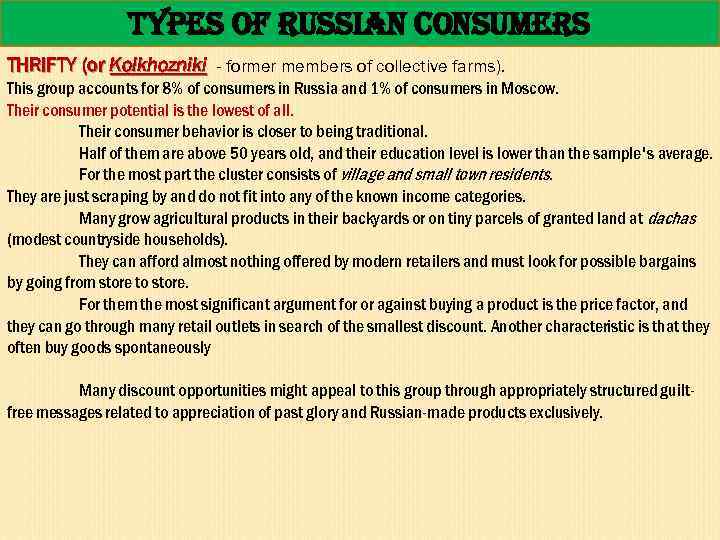 t. Ypes of russian consumers THRIFTY (or Kolkhozniki - former members of collective farms). This group accounts for 8% of consumers in Russia and 1% of consumers in Moscow. Their consumer potential is the lowest of all. Their consumer behavior is closer to being traditional. Half of them are above 50 years old, and their education level is lower than the sample's average. For the most part the cluster consists of village and small town residents. They are just scraping by and do not fit into any of the known income categories. Many grow agricultural products in their backyards or on tiny parcels of granted land at dachas (modest countryside households). They can afford almost nothing offered by modern retailers and must look for possible bargains by going from store to store. For them the most significant argument for or against buying a product is the price factor, and they can go through many retail outlets in search of the smallest discount. Another characteristic is that they often buy goods spontaneously Many discount opportunities might appeal to this group through appropriately structured guiltfree messages related to appreciation of past glory and Russian-made products exclusively.
 RUSSIAN CONSUMER BEHAVIOR A Factor of Regional Specifics Significant differences and variations of consumer behaviour can exist from region to region, in addition to potentially vast differences between the center(s) and Russia's provinces. Some businesses report finding that the real differences between neighboring regions in Russia may in fact be greater, than between neighboring European countries. Companies considering whether or not to enter the Russian market in several regions should consider preparing not just one nation-wide plan, but several business plans or a multifaceted plan to reflect the unique aspects and demands of different regions. Russia's current experience shows that those who come to the regions first and use local resources effectively are most likely to become leaders in their field.
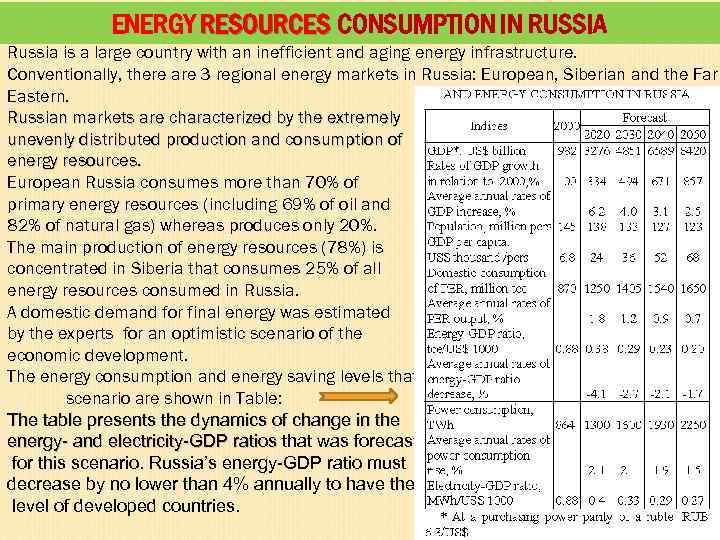 ENERGY RESOURCES CONSUMPTION IN RUSSIA Russia is a large country with an inefficient and aging energy infrastructure. Conventionally, there are 3 regional energy markets in Russia: European, Siberian and the Far Eastern. Russian markets are characterized by the extremely unevenly distributed production and consumption of energy resources. European Russia consumes more than 70% of primary energy resources (including 69% of oil and 82% of natural gas) whereas produces only 20%. The main production of energy resources (78%) is concentrated in Siberia that consumes 25% of all energy resources consumed in Russia. A domestic demand for final energy was estimated by the experts for an optimistic scenario of the economic development. The energy consumption and energy saving levels that correspond to this scenario are shown in Table: The table presents the dynamics of change in the energy- and electricity-GDP ratios that was forecasted for this scenario. Russia’s energy-GDP ratio must decrease by no lower than 4% annually to have the level of developed countries.
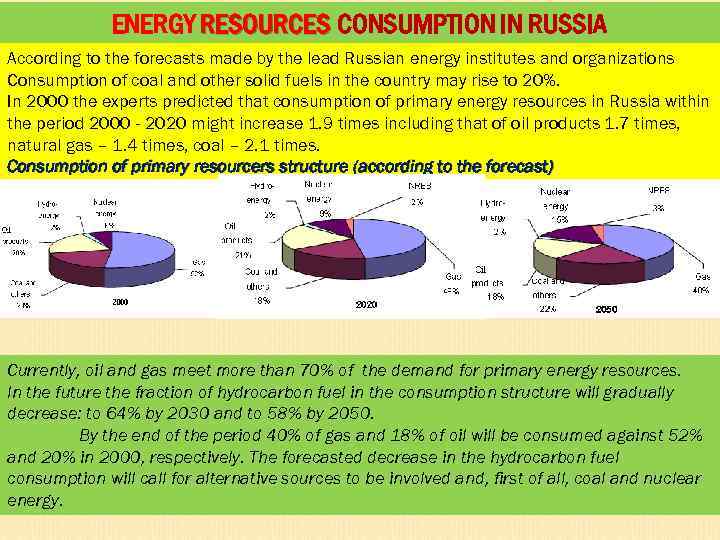 ENERGY RESOURCES CONSUMPTION IN RUSSIA According to the forecasts made by the lead Russian energy institutes and organizations Consumption of coal and other solid fuels in the country may rise to 20%. In 2000 the experts predicted that consumption of primary energy resources in Russia within the period 2000 - 2020 might increase 1. 9 times including that of oil products 1. 7 times, natural gas – 1. 4 times, coal – 2. 1 times. Consumption of primary resourcers structure (according to the forecast) Currently, oil and gas meet more than 70% of the demand for primary energy resources. In the future the fraction of hydrocarbon fuel in the consumption structure will gradually decrease: to 64% by 2030 and to 58% by 2050. By the end of the period 40% of gas and 18% of oil will be consumed against 52% and 20% in 2000, respectively. The forecasted decrease in the hydrocarbon fuel consumption will call for alternative sources to be involved and, first of all, coal and nuclear energy.
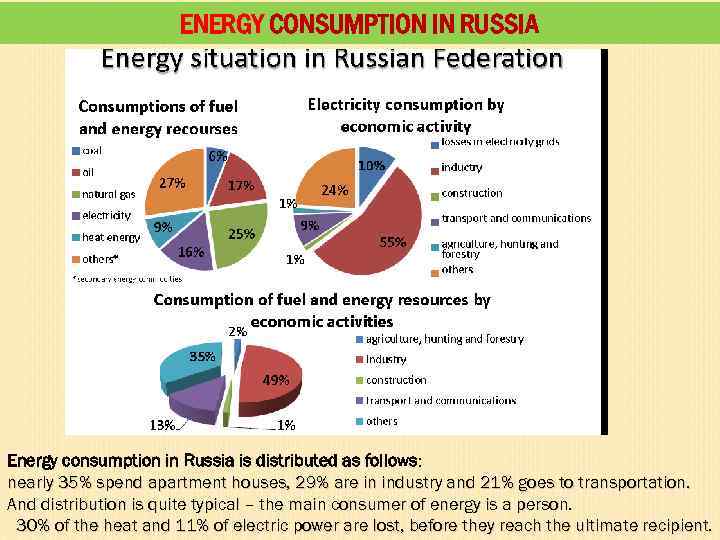 ENERGY CONSUMPTION IN RUSSIA Energy consumption in Russia is distributed as follows: nearly 35% spend apartment houses, 29% are in industry and 21% goes to transportation. And distribution is quite typical – the main consumer of energy is a person. 30% of the heat and 11% of electric power are lost, before they reach the ultimate recipient.
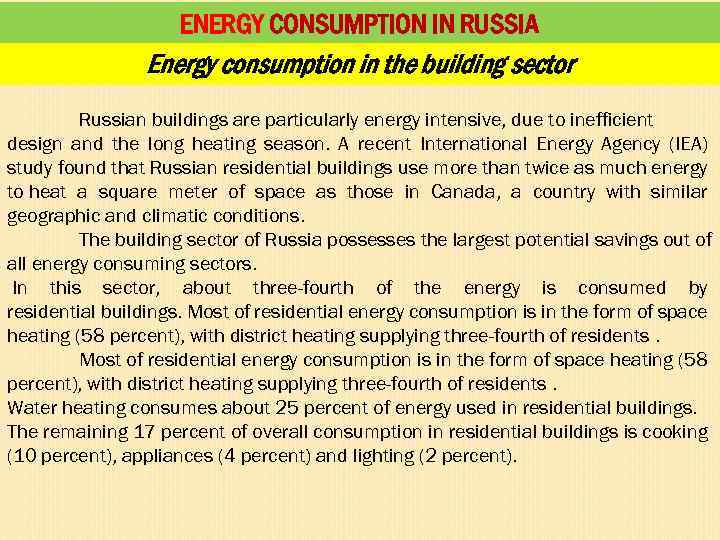 ENERGY CONSUMPTION IN RUSSIA Energy consumption in the building sector Russian buildings are particularly energy intensive, due to inefficient design and the long heating season. A recent International Energy Agency (IEA) study found that Russian residential buildings use more than twice as much energy to heat a square meter of space as those in Canada, a country with similar geographic and climatic conditions. The building sector of Russia possesses the largest potential savings out of all energy consuming sectors. In this sector, about three-fourth of the energy is consumed by residential buildings. Most of residential energy consumption is in the form of space heating (58 percent), with district heating supplying three-fourth of residents. Water heating consumes about 25 percent of energy used in residential buildings. The remaining 17 percent of overall consumption in residential buildings is cooking (10 percent), appliances (4 percent) and lighting (2 percent).
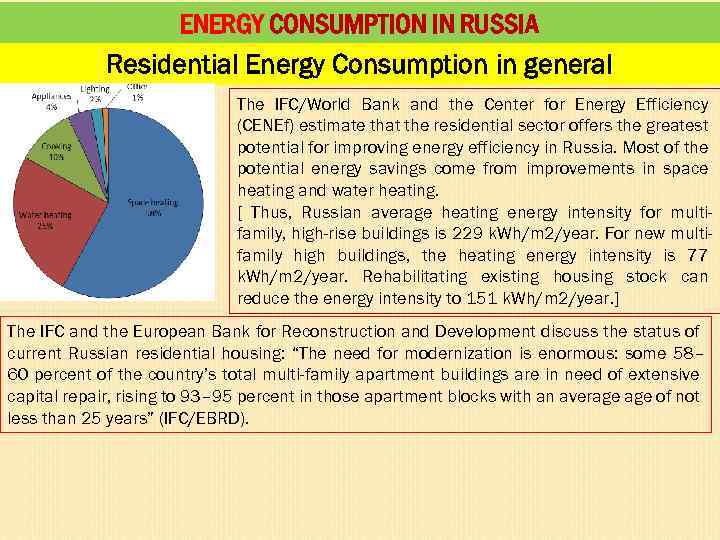 ENERGY CONSUMPTION IN RUSSIA Residential Energy Consumption in general The IFC/World Bank and the Center for Energy Efficiency (CENEf) estimate that the residential sector offers the greatest potential for improving energy efficiency in Russia. Most of the potential energy savings come from improvements in space heating and water heating. [ Thus, Russian average heating energy intensity for multifamily, high-rise buildings is 229 k. Wh/m 2/year. For new multifamily high buildings, the heating energy intensity is 77 k. Wh/m 2/year. Rehabilitating existing housing stock can reduce the energy intensity to 151 k. Wh/m 2/year. ] The IFC and the European Bank for Reconstruction and Development discuss the status of current Russian residential housing: “The need for modernization is enormous: some 58– 60 percent of the country’s total multi-family apartment buildings are in need of extensive capital repair, rising to 93– 95 percent in those apartment blocks with an average of not less than 25 years” (IFC/EBRD).
 ENERGY CONSUMPTION IN RUSSIA Energy consumption in Moscow as a city consumes about 90 million Gcal of thermal energy per year and about 35 billion k. Wh of electricity. The largest consumer of energy (in terms of fuel) is the residential sector, accounting for 52 percent. In fact, electricity consumption by households has doubled in the past decade. The industrial and construction sectors account for 18 percent, but their share has dropped significantly in recent years. The federal and the budget sphere make up an additional 15 percent of Moscow’s electricity consumption and trade and services another 10 percent. Thus, the residential sector presents one of the largest opportunities in the Moscow Region for engagement in energy efficiency projects. The city has many energy efficiency projects in residential buildings currently underway. Projects may be separated by two different streams: new buildings that comply with all energy efficiency standards according to the newly adopted energy efficiency legislation, and retrofit projects to improve the efficiency of older buildings. Modernization of energy infrastructure to modern standards will cost Russia 320 billion dollars, but according to calculations it will be paid off within four years. And this is a very important task due to the fact that till 2050 there will be a revolution on the world market of energy resources.
 ENERGY CONSUMPTION IN RUSSIA Regulating energy consumption President’s decree set a target of 2020 to reduce Russia's energy intensity, or energy consumption per unit of Gross Domestic Product (GDP), by at least 40 percent compared with 2007 levels. The 2008 decree was followed by the 2009 Federal Law No. 261 -FZ “On Energy Conservation and Increasing Energy Efficiency” and the Government Program “Energy Savings and Energy Efficiency up to 2020”. The program concedes that Russia’s energy intensity is 2. 5 times higher than the world’s average and up to 3. 5 higher than that of developed countries. The new energy efficiency legislation establishes standards for regulating energy consumption to encourage energy savings and amends existing legislation on enforcing energy-saving rules. The Government Program assumes that 44 percent of the projected energy savings will be in buildings and district heating; 22 percent will come from the oil and gas sector, including refining and transportation; 19 percent will come from improved power transmission to homes and municipal institutions like hospitals and schools; and 15 percent will be saved by the industrial sector. These developments imply that regional and municipal authorities must establish programs locally to increase the use of energy efficient technologies and energy consumption from renewable energy sources for the energy saving targets to be met within the next 15 years.
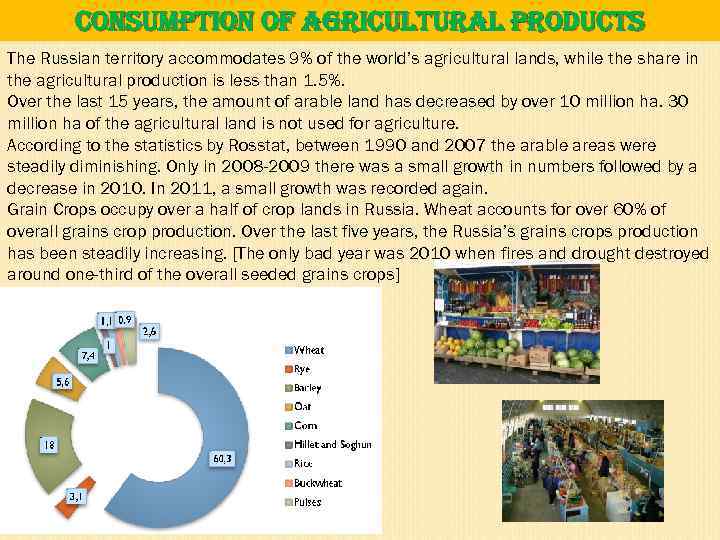 consumption of a. Gricu. Ltura. L products The Russian territory accommodates 9% of the world’s agricultural lands, while the share in the agricultural production is less than 1. 5%. Over the last 15 years, the amount of arable land has decreased by over 10 million ha. 30 million ha of the agricultural land is not used for agriculture. According to the statistics by Rosstat, between 1990 and 2007 the arable areas were steadily diminishing. Only in 2008 -2009 there was a small growth in numbers followed by a decrease in 2010. In 2011, a small growth was recorded again. Grain Crops occupy over a half of crop lands in Russia. Wheat accounts for over 60% of overall grains crop production. Over the last five years, the Russia’s grains crops production has been steadily increasing. [The only bad year was 2010 when fires and drought destroyed around one-third of the overall seeded grains crops]
 consumption of a. Gricu. Ltura. L products The production and consumption of grain crops (macro-economic indices) Wheat Soft wheat accounts for over 95% of all the wheat seeded. The annual demand for hard wheat for domestic consumption in Russia is about 1. 2 million tons; however, hard wheat production is significantly smaller, and soft wheat is ubiquitously used for all food products. That is why significant amounts of macaroni products are imported to Russia from Europe. Small amounts of hard wheat are imported to Russia from Kazakhstan. Rye A core food crop for Russia, which, together with Poland Germany, forms the leading triad in the world’s rye production. The 2011 rye crops exceeded the 2010 crops by a large margin (2, 968. 7 thousand tons vs. 1, 635. 6 thousand tons). Also, the crop lands increased almost 200 thousand ha. The domestic annual rye demand is estimated as 1. 5 million tons. Barley From barley corns, pot barley and pearl barley are produced, as well as barley flour, which is added to wheat flour when baking specific sorts of bread. The products extracted from the barley corn as malt extracts are used in textile, confectionary and pharmaceutical industries; the biggest amounts of barley are used as a valuable concentrated feed compound for pig and poultry farming. . Russia is one of the leading consumers of brewer’s malt.
 consumption of a. Gricu. Ltura. L products The production and consumption of grain crops (macro-economic indices) Barley (continued) The main consumers of barley are the leading brewing companies that account for over 35% of the amounts purchased. The first place in the purchases (19%) is occupied by the Baltika brewing company. The barley purchase share by forage feed plants is as high as 10%. Currently, 75% of the malt demand is covered by the domestically produced raw stock; however only up to one-third of the domestic brewer’s malt meets the world quality standards. The Russian brewing companies and malt producers try to abandon raw stock imports but, given the unstable quality of domestically produced barley, it is still deemed impossible. Rice is the single most consumed grain in Russia. The rice market is more than twice as large as the buckwheat market, the second most popular cereal among consumers. The demand for rice in Russia grew by 26 percent between 2006 and 2010 from 1 to 1. 3 million tons. The biggest surge in demand against a previous year was observed in 2010 and equaled 13 percent. Currently, rice consumption is rising in Russia. The rice market has the largest volume of imported rice compared to other grain markets. There is an import of those types of rice that Russia does not produce. Now it is long-grain rice and rare varieties (jasmine, basmati, Arborio).
 consumption of a. Gricu. Ltura. L products The consumption of grain Experts note that despite the numbers’ growth, grain production in Russia is still largely unbalanced. In particular, some main grains crops have been overproduced for several years already, while others have been underproduced. The internal consumption of grain crops in Russia increased from 75 -76 million tons (2009 -2010) to 77 -78 million tons (2010 -2013). According to the expert estimations, the consumption will annually grow by 2 -3 million tons. As per the data from the Russian Grain Union (RGU), between 2001 and 2010, average internal annual grain consumption was 70. 1 million tons. The main share (over 50%) was used as feedstock. Consumption by the food production industry and seeding consumption were around 30% and 16 -17%, respectively. In fact, the grain exporting capability first of all depends on the crop yield and on the amount of grain in stock by the beginning of the crop year. The estimations of future grain consumption are contradictory. One source suggests a decrease in the grain consumed for grinding flour in the upcoming 7 years, due to decreasing population and dropping bread consumption. By 2013 (as compared to 2008) the bread consumption decreased by 1. 5 million tons and totaled 12. 5 million tons. However, in the future an increase in the flour production (up to 13. 5 -14 million tons) is possible, both for export and domestic use. A decrease in the consumption can be mitigated if Russia does not tighten its migration policy.
 consumption of a. Gricu. Ltura. L products Grain Crops Processing and fluctuation of the bakery products consumption Russia has a fairly well developed flour and grit grinding industry. The flour market in Russia is shrinking Starting 2007, flour sales have been dropping every year. According to the Busines. Stat estimations, by 2014 the flour sales have droped down to 9. 3 million tons. The main reasons for the flour market to diminish are the decrease in population and the increase in the household income. These factors lower the bakery products consumption and cause the retail flour purchase (used for home-bake products) to drop. In the recent years, the flour market has been changing: bread and bakery producers cause the flour consumption to decrease, while the macaroni and pastry producers increase their flour purchase. The demand by other food industries such as the producers of pelmeni, pizza and pancakes is also growing. As for grits, the main types of grits in the Russian market are semolina, rice, buckwheat, corn grits, as well as oat, wheat, barley grits and slotted peas But, in general, in Russia, the segment of deep grain processing is undeveloped. Products with high added value of the segment are mostly imported.
 consumption of a. Gricu. Ltura. L products the production and consumption of fruits The production of fruits is developing much more slowly than the production of vegetables in Russia that occupies the 11 th place in the world in terms of fruit and vegetable production volumes. This reasons the prospects of the Russian market foreign producers. Currently, the need for fruits and berries required for the population of the Russian Federation is estimated as 11 million tons, whereas the average annual yield covers less than 36% of the need. According to analysts from the Intesco Research Group, in 2010, the per-capita consumption of fruits and berries was 54. 2 kg person at the recommended international norm of about 100 kg a year. The Russian fruit market is characterized by a sustainable growth trend. The market growth rates equal approximately 15% annually; the market predominantly grows due to the increase in the supplies of fruits from abroad. The key factors influencing the market dynamics are the level of prices for fruits and the prosperity of the population as an indicator of a general purchasing capacity, as well as seasonality and fruit quality factors.
 consumption of a. Gricu. Ltura. L products Processing of fruits and berries in Russia is underdeveloped, although the product processing market is attractive. Thus, 95% of deep-frozen fruits and berries have foreign origins. Only 18% of the harvested crop of Russian fruits is meant for processing. The largest volume is grown for the ‘fresh’ market. Fruits and berries are mainly processed for the juice industry. It uses about 15% of Russian raw materials. This is basically reasoned with climatic conditions, due to which it is impossible to develop a sufficient production of, for example, apple, plum and tomato concentrates. The juice market is at the saturation level of 3 million liters and is characterized by severe competition. The key players here are Pepsi. Co, Coca-Cola, OJSC Wimm-Bill-Dann Foods, OJSC Nidan Juices. However, in January 2011, Pepsi. Co purchased 66% of the shares of the Russian subdivision of Wimm-Bill-Dann (Wimm-Bill-Dann Foods). According to the FAS, the share of the united company in the juice market was 42 -47%.
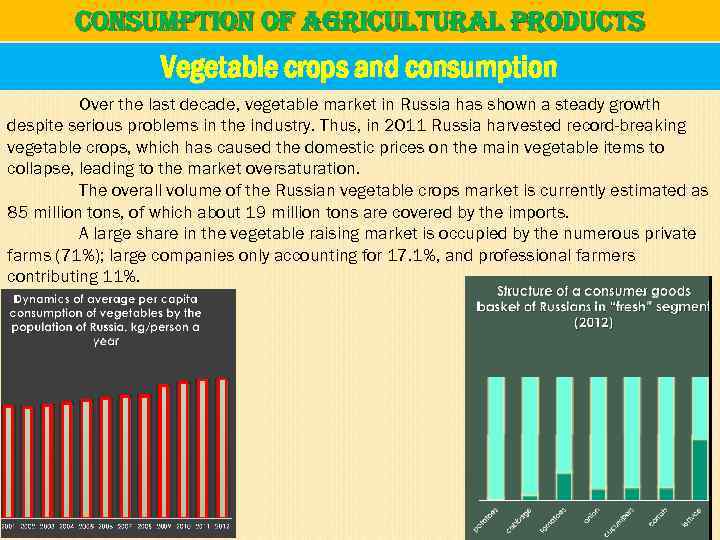 consumption of a. Gricu. Ltura. L products Vegetable crops and consumption Over the last decade, vegetable market in Russia has shown a steady growth despite serious problems in the industry. Thus, in 2011 Russia harvested record-breaking vegetable crops, which has caused the domestic prices on the main vegetable items to collapse, leading to the market oversaturation. The overall volume of the Russian vegetable crops market is currently estimated as 85 million tons, of which about 19 million tons are covered by the imports. A large share in the vegetable raising market is occupied by the numerous private farms (71%); large companies only accounting for 17. 1%, and professional farmers contributing 11%.
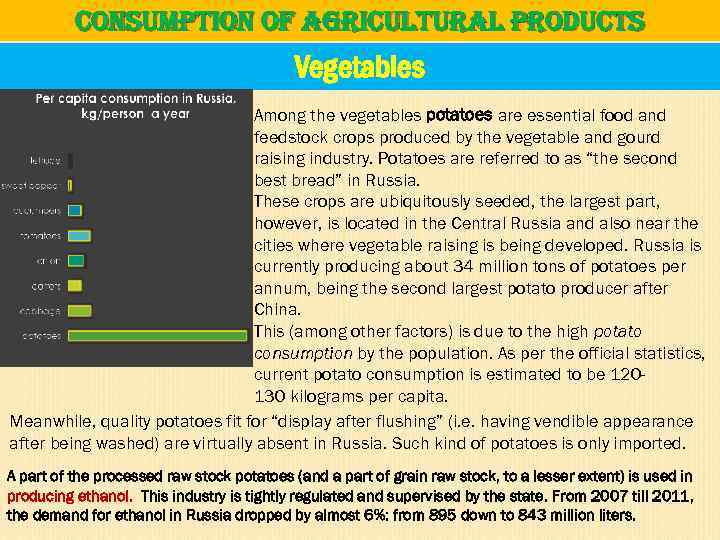 consumption of a. Gricu. Ltura. L products Vegetables Among the vegetables potatoes are essential food and feedstock crops produced by the vegetable and gourd raising industry. Potatoes are referred to as “the second best bread” in Russia. These crops are ubiquitously seeded, the largest part, however, is located in the Central Russia and also near the cities where vegetable raising is being developed. Russia is currently producing about 34 million tons of potatoes per annum, being the second largest potato producer after China. This (among other factors) is due to the high potato consumption by the population. As per the official statistics, current potato consumption is estimated to be 120130 kilograms per capita. Meanwhile, quality potatoes fit for “display after flushing” (i. e. having vendible appearance after being washed) are virtually absent in Russia. Such kind of potatoes is only imported. A part of the processed raw stock potatoes (and a part of grain raw stock, to a lesser extent) is used in producing ethanol. This industry is tightly regulated and supervised by the state. From 2007 till 2011, the demand for ethanol in Russia dropped by almost 6%: from 895 down to 843 million liters.
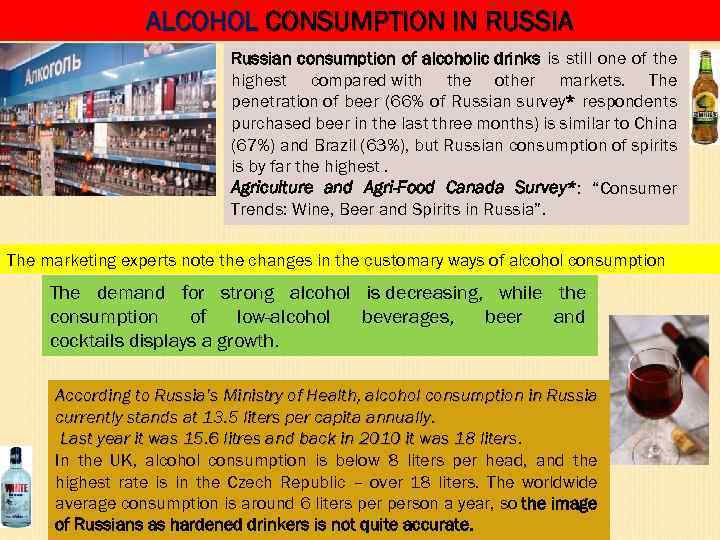 ALCOHOL CONSUMPTION IN RUSSIA Russian consumption of alcoholic drinks is still one of the highest compared with the other markets. The penetration of beer (66% of Russian survey* respondents purchased beer in the last three months) is similar to China (67%) and Brazil (63%), but Russian consumption of spirits is by far the highest. Agriculture and Agri-Food Canada Survey*: “Consumer Trends: Wine, Beer and Spirits in Russia”. The marketing experts note the changes in the customary ways of alcohol consumption The demand for strong alcohol is decreasing, while the consumption of low-alcohol beverages, beer and cocktails displays a growth. According to Russia’s Ministry of Health, alcohol consumption in Russia currently stands at 13. 5 liters per capita annually. Last year it was 15. 6 litres and back in 2010 it was 18 liters. liter In the UK, alcohol consumption is below 8 liters per head, and the highest rate is in the Czech Republic – over 18 liters. The worldwide average consumption is around 6 liters person a year, so the image of Russians as hardened drinkers is not quite accurate.
 ALCOHOL CONSUMPTION IN RUSSIA Brewing Industry & Consumption Russia is the fourth world’s annual producer of beer, losing the leadership only to the U. S. , China and Brazil. Yet the brewing industry in Russia exists in rather unfriendly conditions. On the one hand, the business activities of the breweries are tightly regulated by the state. The government is introducing limitations year after year and increasing the excise tax. On the other hand, the brewing industry faces competition from vodka and strong alcohol producers. Although vodka has long been the traditional alcoholic drink in Russia, beer has soared in popularity, with many consumers viewing it as a sort of soft drink. Beer has even been marketed as a “healthier” alternative to spirits, contributing to its casual consumption. Over the past decade, beer sales in Russia have risen more than 40% while vodka sales have fallen by nearly 30% However, in July 2011, Russian President Dmitry Medvedev signed a bill that officially classifies beer as an alcoholic drink. Previously, anything with less than 10% alcohol content was designated as “foodstuffs. ” The new bill controls the sale of beer in much the same way as spirits, with new regulations that have come into effect in 2013. The bill prohibits the sale of alcohol through unlicensed kiosks (which reportedly represent at least 30% of all beer sales in Russia), ban retail sales of alcohol between 11: 00 p. m. and 8: 00 a. m. , and restrict the advertising of alcoholic products.
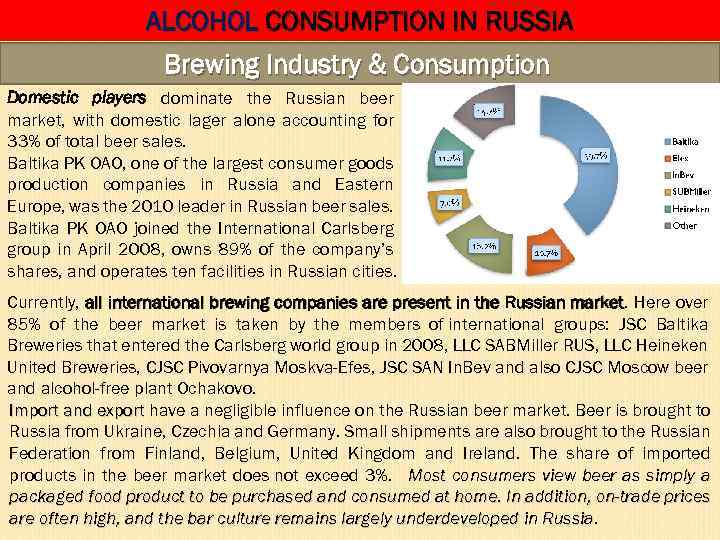 ALCOHOL CONSUMPTION IN RUSSIA Brewing Industry & Consumption Domestic players dominate the Russian beer market, with domestic lager alone accounting for 33% of total beer sales. Baltika PK OAO, one of the largest consumer goods production companies in Russia and Eastern Europe, was the 2010 leader in Russian beer sales. Baltika PK OAO joined the International Carlsberg group in April 2008, owns 89% of the company’s shares, and operates ten facilities in Russian cities. Currently, all international brewing companies are present in the Russian market. Here over Russian market 85% of the beer market is taken by the members of international groups: JSC Baltika Breweries that entered the Carlsberg world group in 2008, LLC SABMiller RUS, LLC Heineken United Breweries, CJSC Pivovarnya Moskva-Efes, JSC SAN In. Bev and also CJSC Moscow beer and alcohol-free plant Ochakovo. Import and export have a negligible influence on the Russian beer market. Beer is brought to Russia from Ukraine, Czechia and Germany. Small shipments are also brought to the Russian Federation from Finland, Belgium, United Kingdom and Ireland. The share of imported products in the beer market does not exceed 3%. Most consumers view beer as simply a packaged food product to be purchased and consumed at home. In addition, on-trade prices are often high, and the bar culture remains largely underdeveloped in Russia
 ALCOHOL CONSUMPTION IN RUSSIA Alcohol consumption has not grown over the past year. Russia's government has been trying to tackle the problem of excessive alcohol consumption among its population. The raft of measures aimed at curbing alcohol consumption was introduced in 2011. That comprises of a recently introduced ban on sales of strong alcohol at night hours, increase of excise duties and the minimum price of vodka. “There is a full ledged fight against alcohol accessibility. First it was banned to sell alcohol over 15 per cent in strength at night, as of 2013 the ban expanded on wine and beer. Moreover there age restrictions and minors under 18 years of age cannot buy alcohol. And the output of legal alcohol is falling – vodka production dropped by 13 per cent over 10 months of 2013, as well as production of beer though excise duties on beer are not as high. That means alcohol consumption is decreasing steadily. ” [Pavel Shapkin, head of the Center for the Development of a National Alcohol Policy] That is likely to lead to further declines in beer and spirit sales as they are phased in over the next couple of years.
 ALCOHOL CONSUMPTION IN RUSSIA Strong spirits still prevail and 57 percent of the Russians opt for high spirits, while only 10 prefer wine. The choice has historic roots as well as geographic explanation. “That’s a lot, bit comparable to European countries. But 60 per cent of alcohol consumed in the Czech Republic is beer, 70 per cent of alcohol consumed in Spain, Italy or France is wine. First of all they have this culture of drinking wine, secondly, it’s really cheap there. In this country almost any wine is an item of luxury. ” [Erkin Tuzmukhamedov, an author of 8 books about alcohol and owner of a Tuzmukhamedov sommelier school in Moscow] Wine in Russia is enormously expensive compared to Europe, with the cost of an average bottle from within Europe ramped up due to import taxes, transportation costs and retail surcharges. Thus, a bottle of wine priced 50 euro cents in Europe ends up being 12 euro in Russia. Nonetherless, wine is the third-most popular alcoholic beverage amongst Russian consumers, after beer and spirits.
 ALCOHOL CONSUMPTION IN RUSSIA WINE Table wine continued to dominate, growing to represent a 64% volume share of the red wine market in 2010. Premium still red wine, and high-quality red wines saw their volume shares recede marginally. The same trend was found within the white wine and rosé markets, where table wine increased its volume share to 66% and 77%, respectively. Consumers are not yet confident in the quality of domestic wines, and prefer products in the medium- to high-priced segments, of French, Spanish or Italian origin. Such Old World wines continue to hold leading positions in the Russian market in terms of sales, and also represent the leading source of Russian wine imports. France is Russia’s leading wine supplier in terms of volume (followed by Italy and Spain), and in value terms, Italy is the leading source of wine imports, followed by France and Spain. Russian consumers have become increasingly interested in New World wines (those originating from the Americas and Australasia) during the last decade. Their price-toquality ratio compares favourably to the more expensive European variations, which has contributed to growing public interest in New World wines. High-quality wines saw the strongest sales growth, as they allow consumers to trade up, while maintaining affordability. More and more, Russian consumers are associating high prices with high quality and this is creating exciting opportunities foreign wine producers that are able to cater to premium market segments
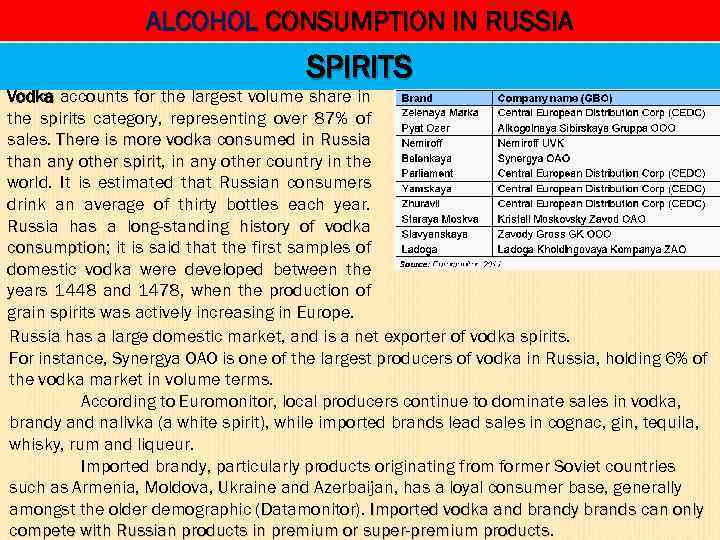 ALCOHOL CONSUMPTION IN RUSSIA SPIRITS Vodka accounts for the largest volume share in the spirits category, representing over 87% of sales. There is more vodka consumed in Russia than any other spirit, in any other country in the spirit world. It is estimated that Russian consumers drink an average of thirty bottles each year. Russia has a long-standing history of vodka consumption; it is said that the first samples of consumption domestic vodka were developed between the years 1448 and 1478, when the production of grain spirits was actively increasing in Europe. Russia has a large domestic market, and is a net exporter of vodka spirits. For instance, Synergya OAO is one of the largest producers of vodka in Russia, holding 6% of the vodka market in volume terms. According to Euromonitor, local producers continue to dominate sales in vodka, brandy and nalivka (a white spirit), while imported brands lead sales in cognac, gin, tequila, whisky, rum and liqueur. Imported brandy, particularly products originating from former Soviet countries such as Armenia, Moldova, Ukraine and Azerbaijan, has a loyal consumer base, generally amongst the older demographic (Datamonitor). Imported vodka and brandy brands can only compete with Russian products in premium or super-premium products
 ALCOHOL CONSUMPTION IN RUSSIA Legal production of vodka in Russia is falling but not because of a change in the people’s drinking habits. Increases to the excise tax on spirits with more than 9% alcohol by volume, as well as minimum selling prices implemented in 2010 for both manufacturers and retailers, put upward pressure on spirit prices. The problem is that an increase of excise duties has prompted the consumers to turn to counterfeit produce more and more often or to start production of liquors in their households. In June 2013, Russian distilleries bottled 40 percent less vodka than in the same month in 2012 and the overall production of the drink has dropped by almost a third since the beginning of the year. The increase of tax burdens makes it much more difficult for the producers to compete with burdens the illegally distilled vodka, the market share of which is already assessed at 30 percent. The consumers are turning down the vodkas that are legal but expensive and the situation results in a growing output of fake alcohol, with no less than 20 million Russians alcohol drinking surrogates at the moment. There is another trend: the Russians are displaying a growing demand for household distilleries and hooch stills. The rank-and-file consumers are thus killing two birds stills with one stone - they find an alternative to the progressively more expensive vodka and protect themselves against surrogates. The sales of these devices have jumped fivefold over the past twelve Months. Production of alcohol at private households in Russia stands at no less than 250 million litres a year. The prime cost of a litre of hooch does not exceed 40 roubles and that is why moonshining appears to be a lucrative business against the background of the official vodka selling for 170 per bottle.
 than. K you for your patience & attention