


 Скачать презентацию Consumption Autonomous consumption- The minimum level of consumption
1a86d1eb30728aaff44a20d6dcc040bb.ppt
- Количество слайдов: 157
 Consumption Autonomous consumption- The minimum level of consumption that would still exist even if a consumer had absolutely no income. (would occur regardless of a change in income)
 Saving Household The NOT spending ability to save is constrained by The amount of disposable income The Do propensity to consume households save if Yd = 0? NO
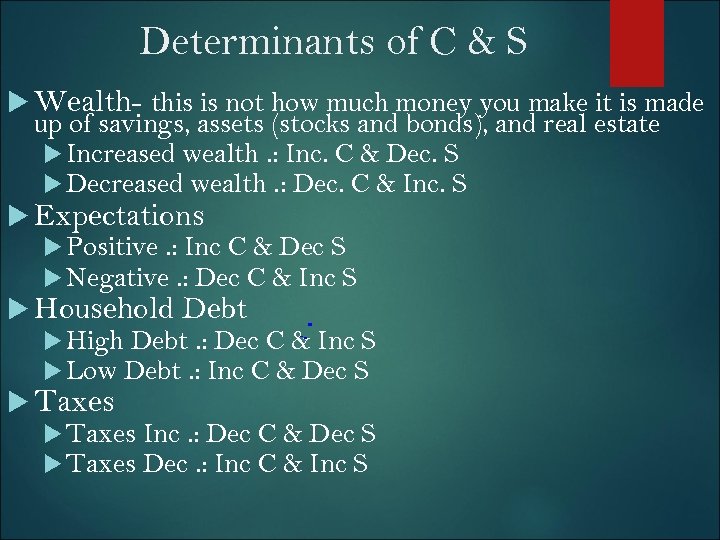 Determinants of C & S Wealth- this is not how much money you make it is made up of savings, assets (stocks and bonds), and real estate Increased wealth. : Inc. C & Dec. S Decreased wealth. : Dec. C & Inc. S Expectations Positive. : Inc C & Dec S Negative. : Dec C & Inc S Household Debt High Debt. : Dec C & Inc S Low Debt. : Inc C & Dec S Taxes Inc. : Dec C & Dec S Dec. : Inc C & Inc S
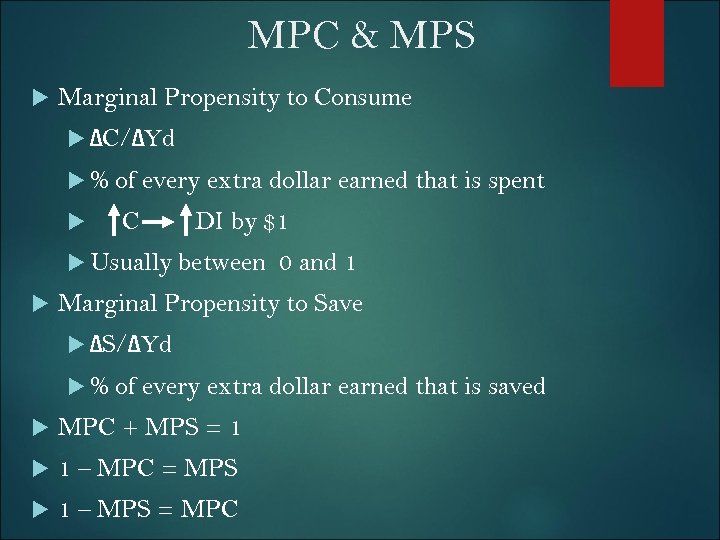 MPC & MPS Marginal Propensity to Consume ΔC/ΔYd % of every extra dollar earned that is spent C Usually DI by $1 between 0 and 1 Marginal Propensity to Save ΔS/ΔYd % of every extra dollar earned that is saved MPC + MPS = 1 1 – MPC = MPS 1 – MPS = MPC
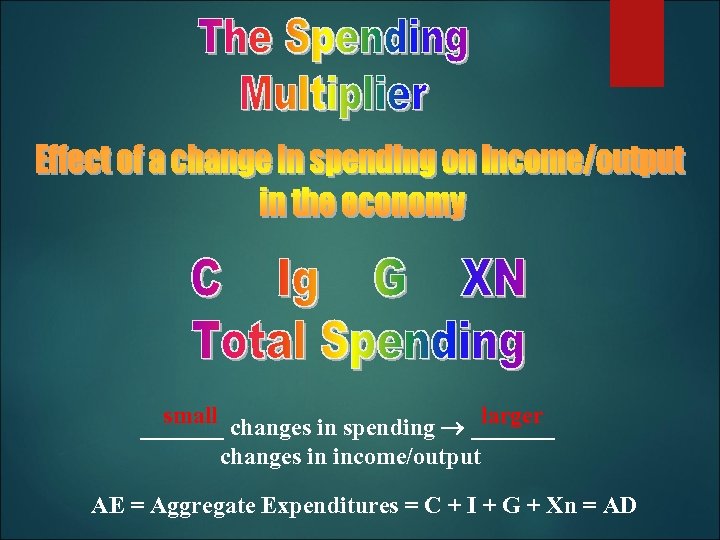 small larger _______ changes in spending _______ changes in income/output AE = Aggregate Expenditures = C + I + G + Xn = AD
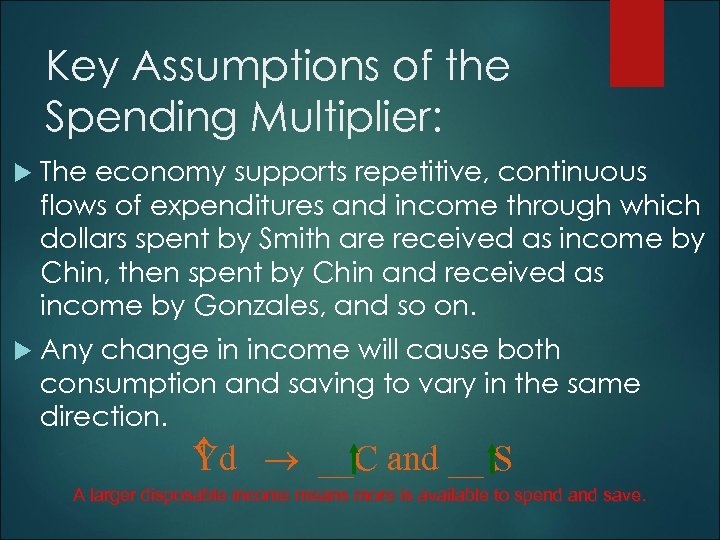 Key Assumptions of the Spending Multiplier: The economy supports repetitive, continuous flows of expenditures and income through which dollars spent by Smith are received as income by Chin, then spent by Chin and received as income by Gonzales, and so on. Any change in income will cause both consumption and saving to vary in the same direction. Y d __C and __ S A larger disposable income means more is available to spend and save.
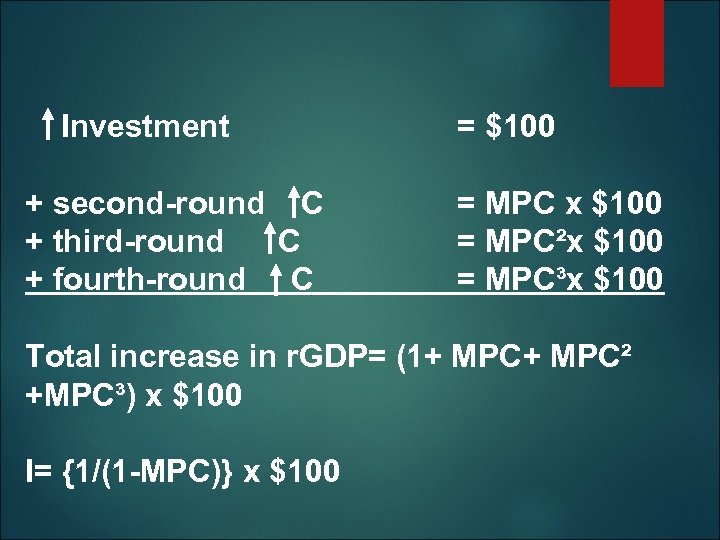 Investment + second-round C + third-round C + fourth-round C = $100 = MPC x $100 = MPC²x $100 = MPC³x $100 Total increase in r. GDP= (1+ MPC² +MPC³) x $100 I= {1/(1 -MPC)} x $100
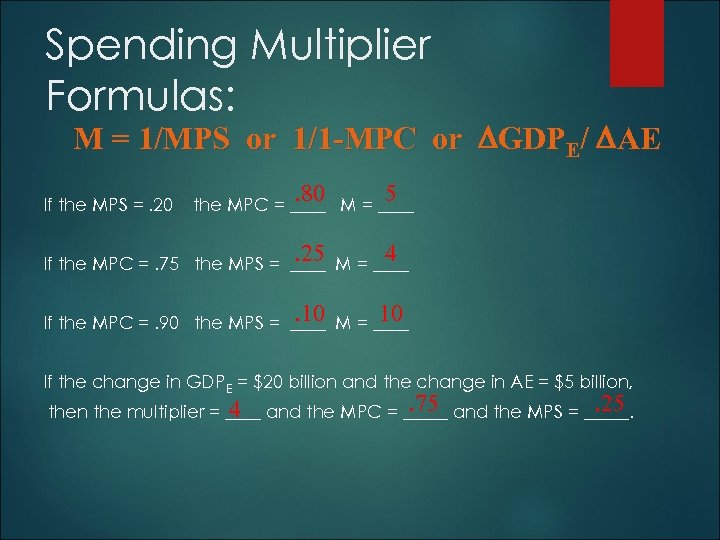 Spending Multiplier Formulas: M = 1/MPS or 1/1 -MPC or GDPE/ AE. 80 5 . 25 If the MPS =. 20 4 the MPC = ____ M = ____ If the MPC =. 75 the MPS = ____ M = ____ . 10 10 If the MPC =. 90 the MPS = ____ M = ____ If the change in GDPE = $20 billion and the change in AE = $5 billion, . 75. 25 4 then the multiplier = ____ and the MPC = _____ and the MPS = _____.
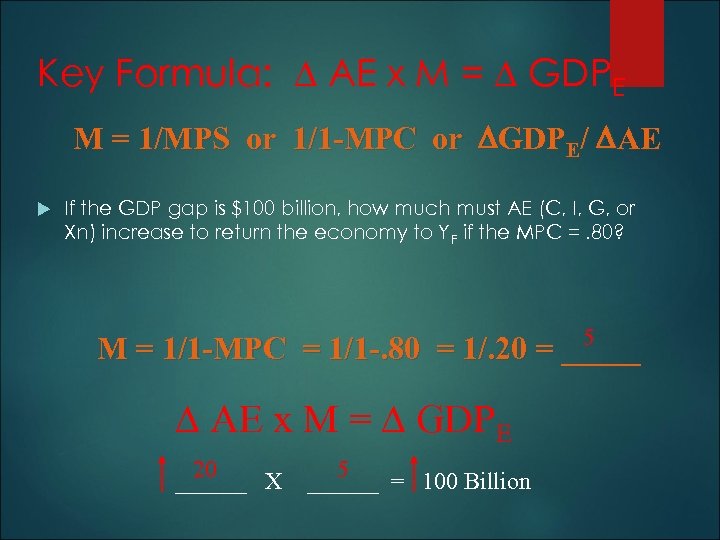 Key Formula: AE x M = GDPE M = 1/MPS or 1/1 -MPC or GDPE/ AE If the GDP gap is $100 billion, how much must AE (C, I, G, or Xn) increase to return the economy to Y F if the MPC =. 80? 5 M = 1/1 -MPC = 1/1 -. 80 = 1/. 20 = _____ AE x M = GDPE 20 ______ X 5 ______ = 100 Billion
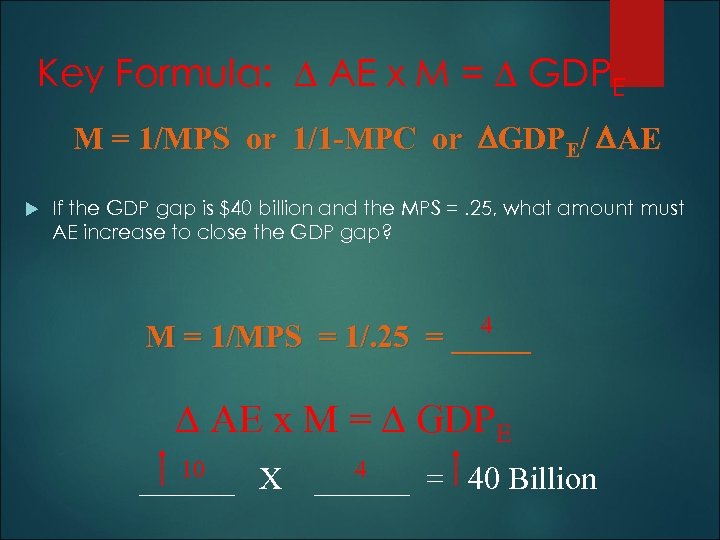 Key Formula: AE x M = GDPE M = 1/MPS or 1/1 -MPC or GDPE/ AE If the GDP gap is $40 billion and the MPS =. 25, what amount must AE increase to close the GDP gap? 4 M = 1/MPS = 1/. 25 = _____ AE x M = GDPE 10 ______ X 4 ______ = 40 Billion
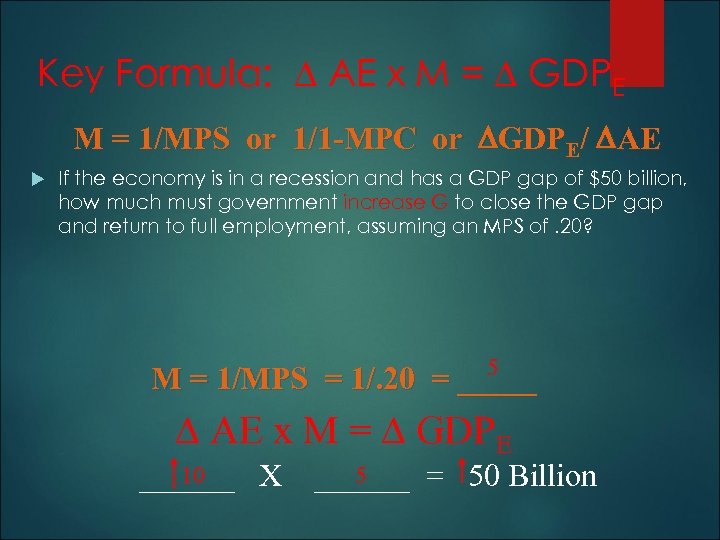 Key Formula: AE x M = GDPE M = 1/MPS or 1/1 -MPC or GDPE/ AE If the economy is in a recession and has a GDP gap of $50 billion, how much must government increase G to close the GDP gap and return to full employment, assuming an MPS of. 20? 5 M = 1/MPS = 1/. 20 = _____ AE x M = GDPE 10 ______ X 5 ______ = 50 Billion
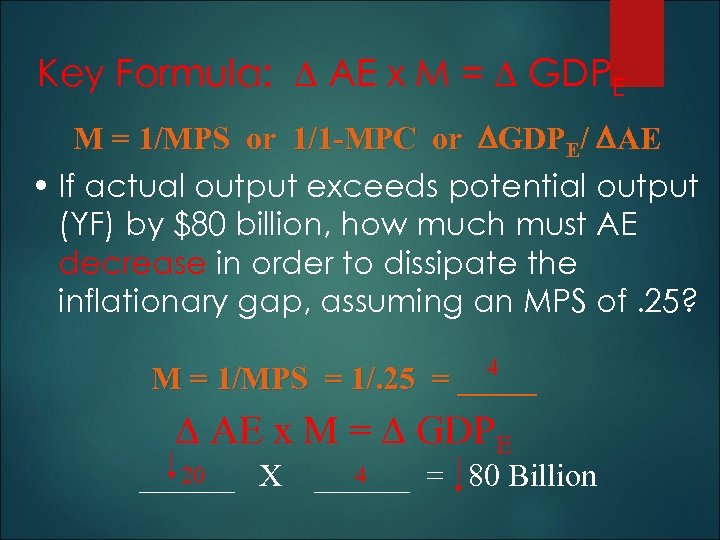 Key Formula: AE x M = GDPE M = 1/MPS or 1/1 -MPC or GDPE/ AE • If actual output exceeds potential output (YF) by $80 billion, how much must AE decrease in order to dissipate the inflationary gap, assuming an MPS of. 25? 4 M = 1/MPS = 1/. 25 = _____ AE x M = GDPE 20 ______ X 4 ______ = 80 Billion
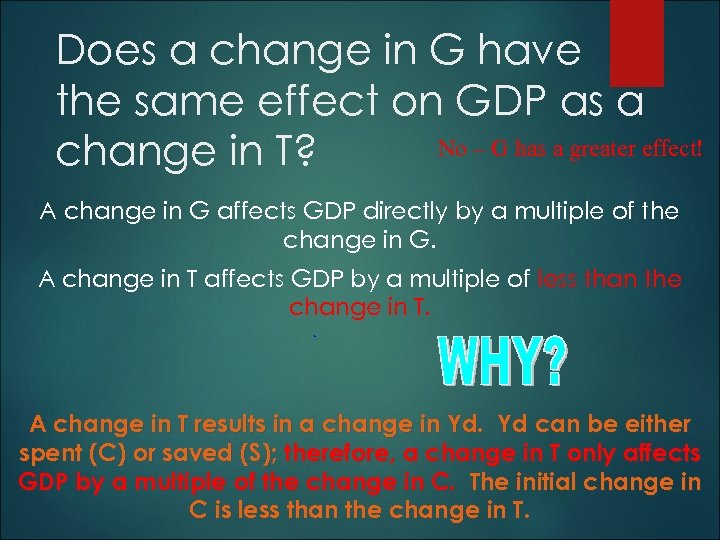 Does a change in G have the same effect on GDP as a No – G has a greater effect! change in T? A change in G affects GDP directly by a multiple of the change in G. A change in T affects GDP by a multiple of less than the change in T. A change in T results in a change in Yd. Yd can be either spent (C) or saved (S); therefore, a change in T only affects GDP by a multiple of the change in C. The initial change in C is less than the change in T.
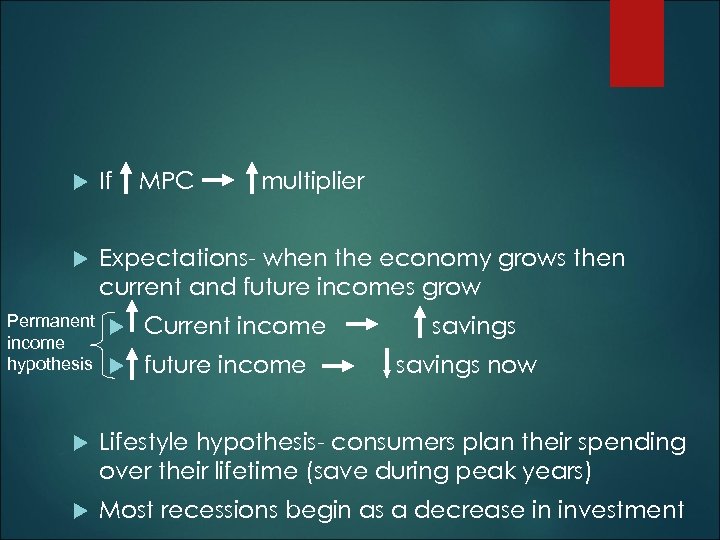 If Expectations- when the economy grows then current and future incomes grow Permanent income hypothesis MPC multiplier Current income future income savings now Lifestyle hypothesis- consumers plan their spending over their lifetime (save during peak years) Most recessions begin as a decrease in investment
 Planned investment spending Firms intend to undertake Interest rate Expected future level of r. GDP Current level of production capacity Ex. Homebuilders only build what they think they can sell and houses are more affordable and more likely to sell when the interest rate decreases Firms with investment spending projects will go ahead only if they expect a rate of return higher than the cost of funds they would borrow to finance that project
 Expected Rates of Return How does business make investment decisions? How does business determine the benefits? Expected rate of return How does business count the cost? Cost / Benefit Analysis Interest costs How does business determine the amount of investment they undertake? Compare expected rate of return to interest cost If expected return > interest cost, then invest If expected return < interest cost, then do not invest Retained earnings- past profits used to finance I
 If a firm has enough capacity to produce it is currently selling at, then it will spend only to replace existing technologies and equipment and other structures that wear out or become obsolete Current level of productive capacity has a negative impact on investment Inventory investment- value of change in total inventories held during a given period (because firms can’t accurately predict sales Unplanned inventory investment- actual sales are less than business expected, leading to an unplanned increased in inventories Actual investment spending- sum of planned investment and unplanned inventory investment If there are unplanned inventories leads to a decrease in the following months production which then leads to a slowing economy
 Growth? 5 machines break and replace all 5 5 machines break and replace 2 5 machines break and replace all 5 and add 2 more
 Investment Demand Curve (ID) What is the shape of the Investment demand curve? Downward sloping Why? When interest rates are high, fewer investments are profitable; when interest rates are low, more investments are profitable Conversely, there are few investments that yield high rates of return, and many that yield low rates of return
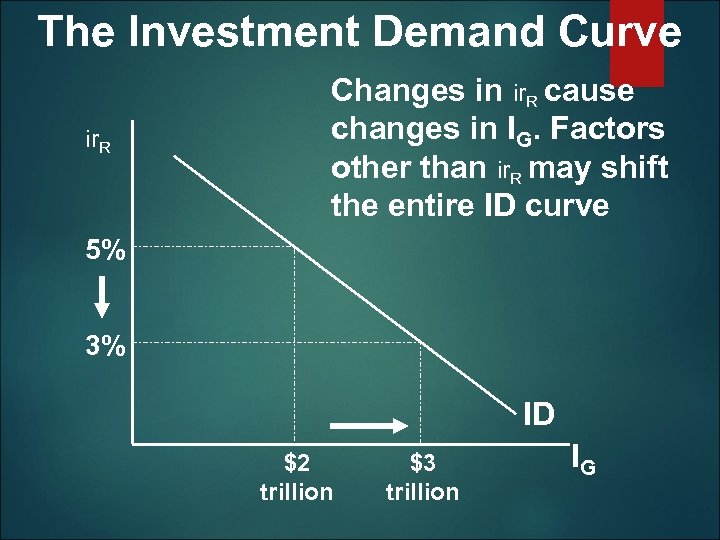 The Investment Demand Curve ir. R Changes in ir. R cause changes in IG. Factors other than ir. R may shift the entire ID curve 5% 3% ID $2 trillion $3 trillion IG
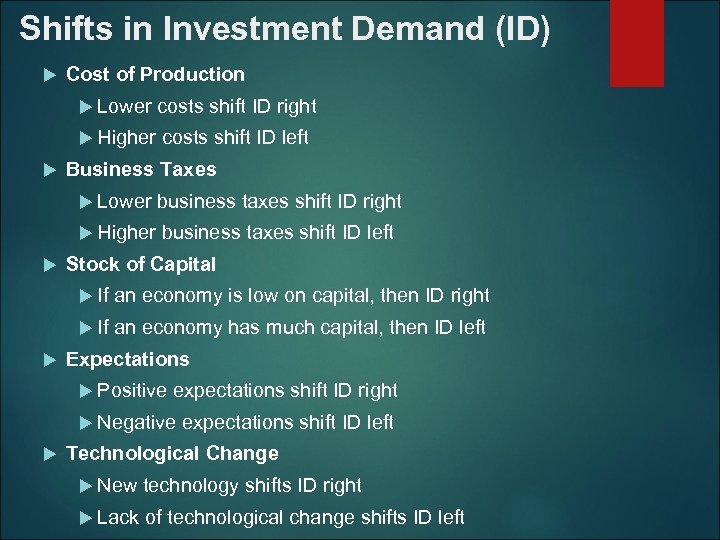 Shifts in Investment Demand (ID) Cost of Production Lower costs shift ID right Higher costs shift ID left Business Taxes Lower business taxes shift ID right Higher business taxes shift ID left Stock of Capital If an economy is low on capital, then ID right If an economy has much capital, then ID left Expectations Positive expectations shift ID right Negative expectations shift ID left Technological Change New technology shifts ID right Lack of technological change shifts ID left
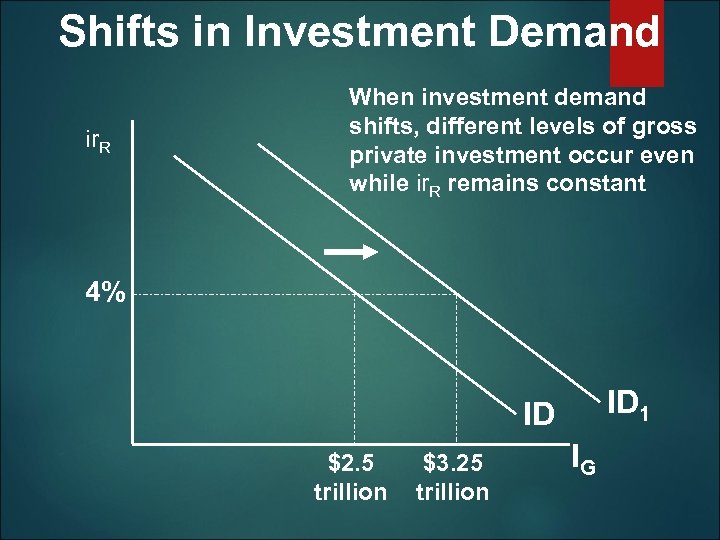 Shifts in Investment Demand ir. R When investment demand shifts, different levels of gross private investment occur even while ir. R remains constant 4% ID 1 ID $2. 5 trillion $3. 25 trillion IG
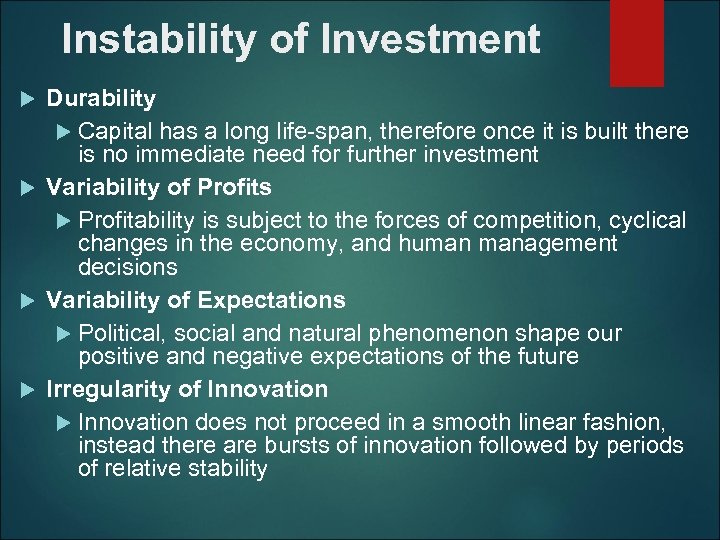 Instability of Investment Durability Capital has a long life-span, therefore once it is built there is no immediate need for further investment Variability of Profits Profitability is subject to the forces of competition, cyclical changes in the economy, and human management decisions Variability of Expectations Political, social and natural phenomenon shape our positive and negative expectations of the future Irregularity of Innovation does not proceed in a smooth linear fashion, instead there are bursts of innovation followed by periods of relative stability
 Aggregate Demand (AD) Define aggregate demand as the total demand for an economy’s output (production of goods and services) over a given period of time. Shows the amount of Real GDP that the private, public and foreign sector collectively desire to purchase at each possible price level Households (consumption), firms (investment), the public sector (government spending) or foreign households, firms, or governments (net exports). YAD = C + I + G + NX The relationship between PL and r. GDP is inverse
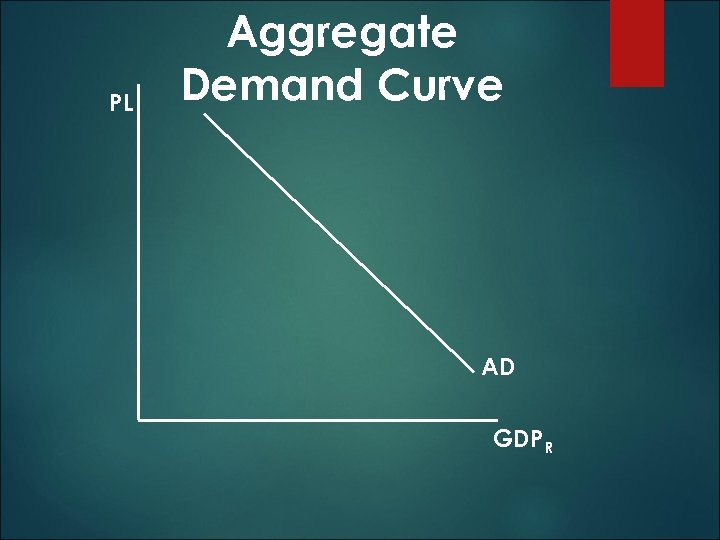 PL Aggregate Demand Curve AD GDPR
 The Wealth Effect (P and C ) Suppose P rises. § The dollars people hold buy fewer g&s, so real wealth is lower. § People feel poorer. Result: C falls. © 2015 Cengage Learning. All Rights Reserved. May not be copied, scanned, or duplicated, in whole or in part, except for use as permitted in a license distributed with a certain product or service or otherwise on a password-protected website for classroom use. 27
 The Interest-Rate Effect (P and I ) Suppose P rises. § Buying g&s requires more dollars. § To get these dollars, people sell bonds or other assets. § This drives up interest rates. Result: I falls. (Recall, I depends negatively on interest rates. ) © 2015 Cengage Learning. All Rights Reserved. May not be copied, scanned, or duplicated, in whole or in part, except for use as permitted in a license distributed with a certain product or service or otherwise on a password-protected website for classroom use. 28
 The Exchange-Rate Effect (P and NX ) Suppose P rises. § U. S. interest rates rise (the interest-rate effect). § Foreign investors desire more U. S. bonds. § Higher demand for $ in foreign exchange market. § U. S. exchange rate appreciates. § U. S. exports more expensive to people abroad, imports cheaper to U. S. residents. Result: NX falls. © 2015 Cengage Learning. All Rights Reserved. May not be copied, scanned, or duplicated, in whole or in part, except for use as permitted in a license distributed with a certain product or service or otherwise on a password-protected website for classroom use. 29
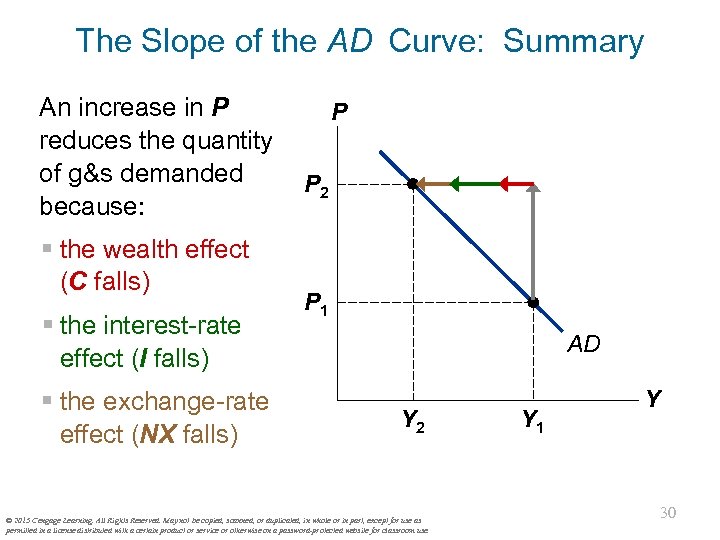 The Slope of the AD Curve: Summary An increase in P P reduces the quantity of g&s demanded P 2 because: § the wealth effect (C falls) § the interest-rate effect (I falls) § the exchange-rate effect (NX falls) P 1 AD Y 2 © 2015 Cengage Learning. All Rights Reserved. May not be copied, scanned, or duplicated, in whole or in part, except for use as permitted in a license distributed with a certain product or service or otherwise on a password-protected website for classroom use. Y 1 Y 30
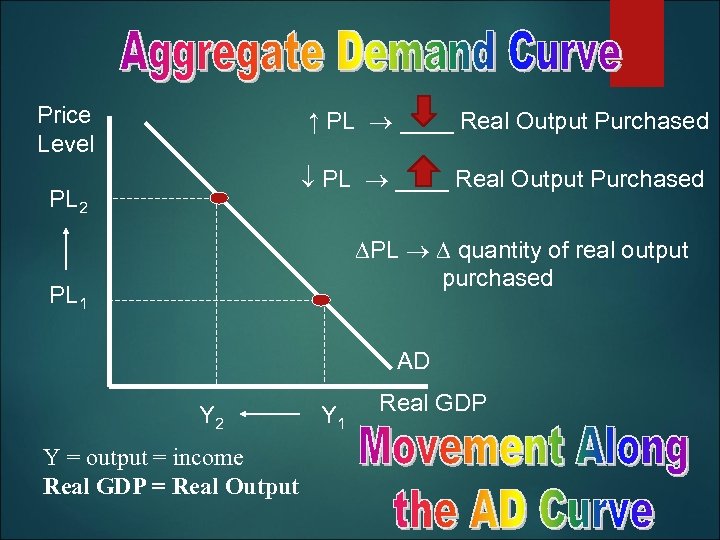 Price Level ↑ PL ____ Real Output Purchased PL 2 PL quantity of real output purchased PL 1 AD Y 2 Y 1 Y = output = income Real GDP = Real Output Real GDP
 Shifts in Aggregate Demand (AD) There are two parts to a shift in AD: A change in C, IG, G and/or XN A multiplier effect that produces a greater change than the original change in the 4 components Increases in AD = AD right Decreases in AD = AD left
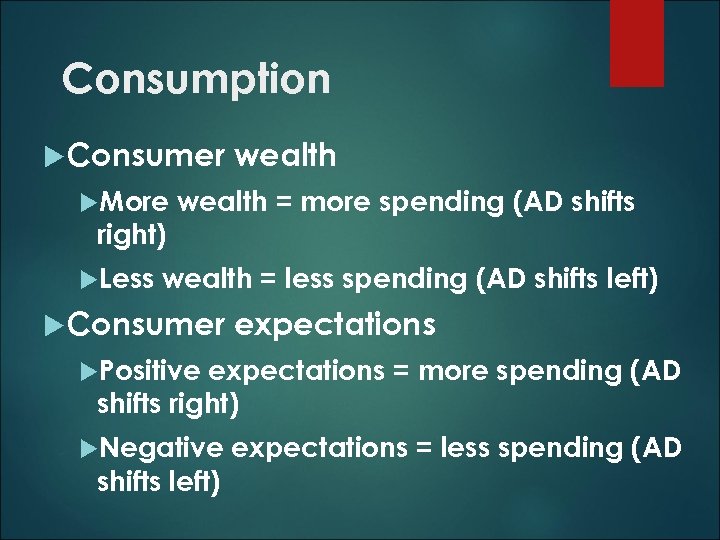 Consumption Consumer More right) Less wealth = more spending (AD shifts wealth = less spending (AD shifts left) Consumer expectations Positive expectations = more spending (AD shifts right) Negative shifts left) expectations = less spending (AD
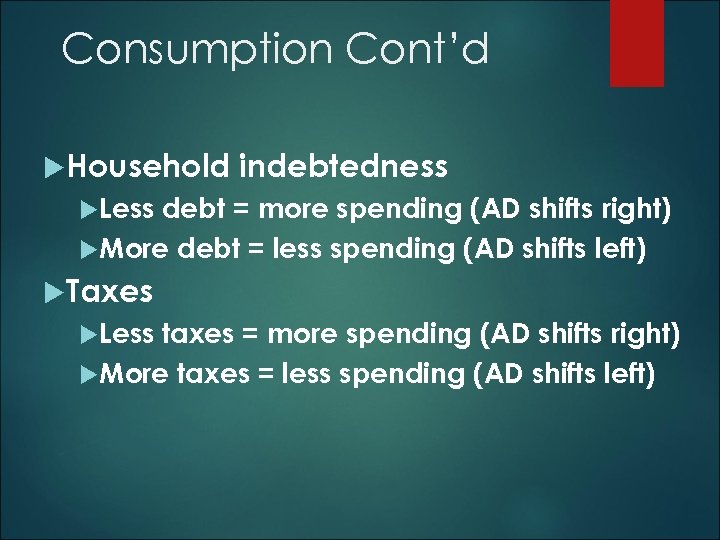 Consumption Cont’d Household indebtedness Less debt = more spending (AD shifts right) More debt = less spending (AD shifts left) Taxes Less taxes = more spending (AD shifts right) More taxes = less spending (AD shifts left)
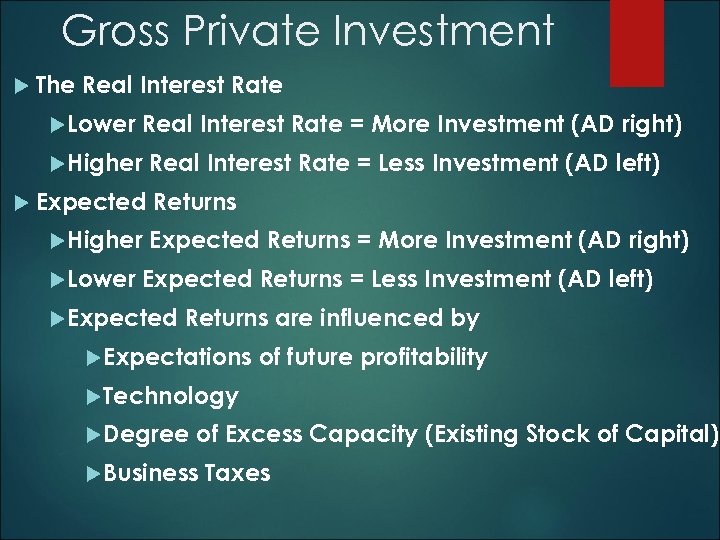 Gross Private Investment The Real Interest Rate Lower Real Interest Rate = More Investment (AD right) Higher Expected Higher Lower Real Interest Rate = Less Investment (AD left) Returns Expected Returns = More Investment (AD right) Expected Returns = Less Investment (AD left) Expected Returns are influenced by Expectations of future profitability Technology Degree of Excess Capacity (Existing Stock of Capital) Business Taxes
![AD 1 AD 2 PL Change in Consumer Spending Consumer Wealth [increases/decreases] increases decreases](https://present5.com/presentation/1a86d1eb30728aaff44a20d6dcc040bb/image-36.jpg "AD 1 AD 2 PL Change in Consumer Spending Consumer Wealth [increases/decreases] increases decreases") AD 1 AD 2 PL Change in Consumer Spending Consumer Wealth [increases/decreases] increases decreases [stocks/houses] [stable prices] Consumer Expectations [about future prices (increases/decreases) increases/decreases Consumer Expectations about future income [positive/negative] positive/negative Consumer Indebtedness [low/high] low high Personal Taxes [increase/decrease] increase decrease Real Interest Rate [stable prices] [increase/decrease] prices increase/decrease High Debt Change in Investment Spending Real Interest Rates [stable prices] [increase/decrease] prices [Positive/Negative] Profit Returns [Business taxes [increase/decrease] [Depleted/Excess] inventory stockpiles in the supply chain Depleted Excess
AD 1 AD 2 PL Change in Consumer Spending Consumer Wealth [increases/decreases] increases decreases [stocks/houses] [stable prices] Consumer Expectations [about future prices (increases/decreases) increases/decreases Consumer Expectations about future income [positive/negative] positive/negative Consumer Indebtedness [low/high] low high Personal Taxes [increase/decrease] increase decrease Real Interest Rate [stable prices] [increase/decrease] prices increase/decrease High Debt Change in Investment Spending Real Interest Rates [stable prices] [increase/decrease] prices [Positive/Negative] Profit Returns [Business taxes [increase/decrease] [Depleted/Excess] inventory stockpiles in the supply chain Depleted Excess
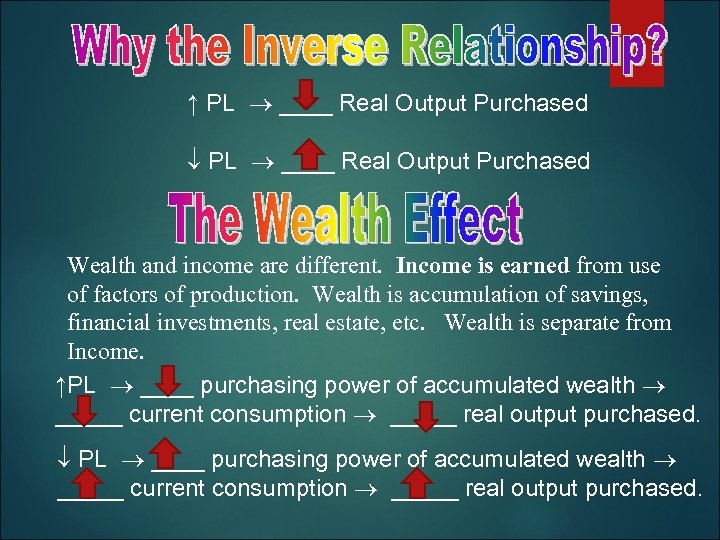 ↑ PL ____ Real Output Purchased Wealth and income are different. Income is earned from use of factors of production. Wealth is accumulation of savings, financial investments, real estate, etc. Wealth is separate from Income. ↑PL ____ purchasing power of accumulated wealth _____ current consumption _____ real output purchased.
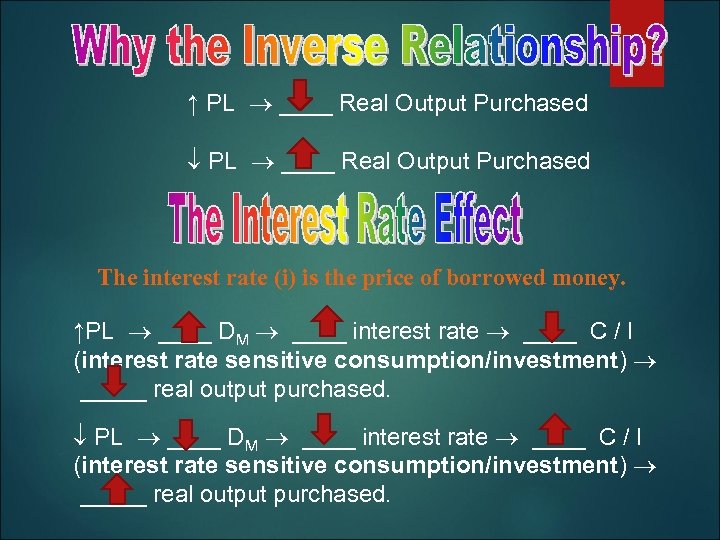 ↑ PL ____ Real Output Purchased The interest rate (i) is the price of borrowed money. ↑PL ____ DM ____ interest rate ____ C / I (interest rate sensitive consumption/investment) _____ real output purchased.
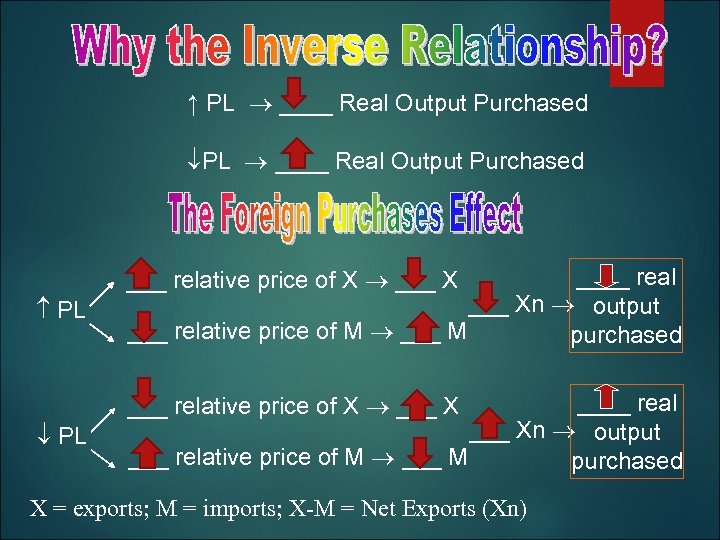 ↑ PL ____ Real Output Purchased ____ real ___ Xn output ___ relative price of M ___ M purchased ___ relative price of X ___ X PL X = exports; M = imports; X-M = Net Exports (Xn)
 Government Spending More Government Spending (AD shift right) Less Government Spending (AD shift left)
 Net Exports Exchange Rates (International value of $) Strong $ = More Imports and Fewer Exports = (AD shift left) Weak $ = Fewer Imports and More Exports = (AD shift right) Relative Income Strong Foreign Economies = More Exports = (AD shift right) Weak Foreign Economies = Less Exports = (AD shift left)
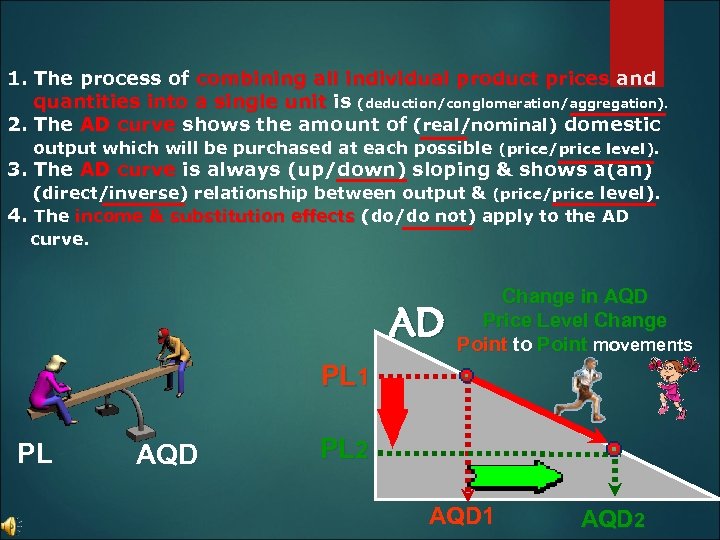 1. The process of combining all individual product prices and quantities into a single unit is (deduction/conglomeration/aggregation). 2. The AD curve shows the amount of (real/nominal) domestic output which will be purchased at each possible (price/price level). 3. The AD curve is always (up/down) sloping & shows a(an) (direct/inverse) relationship between output & (price/price level). 4. The income & substitution effects (do/do not) apply to the AD curve. AD Change in AQD Price Level Change Point to Point movements PL 1 PL AQD PL 2 AQD 1 AQD 2
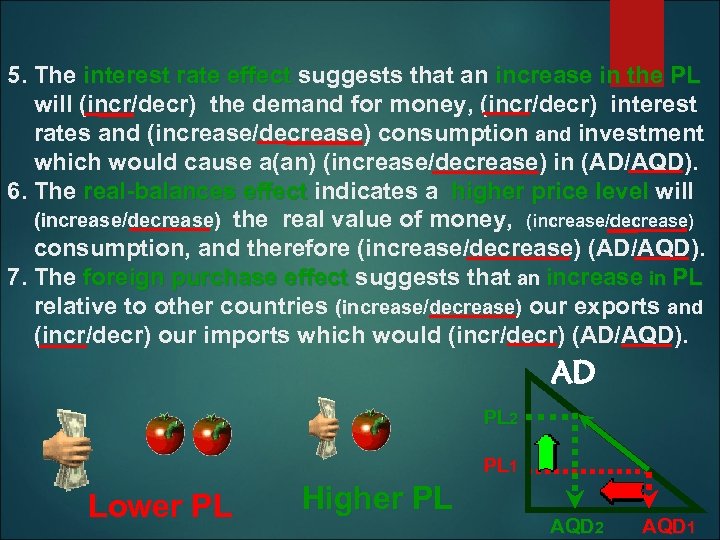 5. The interest rate effect suggests that an increase in the PL will (incr/decr) the demand for money, (incr/decr) interest rates and (increase/decrease) consumption and investment which would cause a(an) (increase/decrease) in (AD/AQD). 6. The real-balances effect indicates a higher price level will (increase/decrease) the real value of money, (increase/decrease) consumption, and therefore (increase/decrease) (AD/AQD). 7. The foreign purchase effect suggests that an increase in PL relative to other countries (increase/decrease) our exports and (incr/decr) our imports which would (incr/decr) (AD/AQD). AD PL 2 PL 1 Lower PL Higher PL AQD 2 AQD 1
![19. An increase in the price of imported resources [resource cost] would cause the](https://present5.com/presentation/1a86d1eb30728aaff44a20d6dcc040bb/image-44.jpg "19. An increase in the price of imported resources [resource cost] would cause the") 19. An increase in the price of imported resources [resource cost] would cause the (AD/AS) curve to shift (rightward/leftward). 20. A rightward shift of the PPC will shift the (AD/AS) curve to the (right/left). 21. An improvement in productivity [technological improvement] will shift the (AD/AS) curve to the (right/left). Suppose that real domestic output is 40 units, the quantity of inputs is 20 & the price of each input is $8. 22. What is the level of productivity? Productivity(__) = Output(40) 2 Inputs (20) 23. What is the per unit cost of production? Total input cost $160($8 x 20) Per unit production cost ($___) = Units of output (40) 4 24. If the price of each input increased from $8 to $12, productivity would (increase/decrease/ remain unchanged. [affects only per unit cost] 25. Increase in input price [$8 to $12] would shift the (AD/AS) curve (right/left). 26. An increase in the price of imported resources would increase per unit production cost and shift the (AD/AS) curve to the (right/left). 27. A depreciation of the dollar would cause imported inputs to be more expensive & shift the AS curve to the (right/left), however, the cost of our products would decrease so it would shift the AD curve (right/left).
19. An increase in the price of imported resources [resource cost] would cause the (AD/AS) curve to shift (rightward/leftward). 20. A rightward shift of the PPC will shift the (AD/AS) curve to the (right/left). 21. An improvement in productivity [technological improvement] will shift the (AD/AS) curve to the (right/left). Suppose that real domestic output is 40 units, the quantity of inputs is 20 & the price of each input is $8. 22. What is the level of productivity? Productivity(__) = Output(40) 2 Inputs (20) 23. What is the per unit cost of production? Total input cost $160($8 x 20) Per unit production cost ($___) = Units of output (40) 4 24. If the price of each input increased from $8 to $12, productivity would (increase/decrease/ remain unchanged. [affects only per unit cost] 25. Increase in input price [$8 to $12] would shift the (AD/AS) curve (right/left). 26. An increase in the price of imported resources would increase per unit production cost and shift the (AD/AS) curve to the (right/left). 27. A depreciation of the dollar would cause imported inputs to be more expensive & shift the AS curve to the (right/left), however, the cost of our products would decrease so it would shift the AD curve (right/left).
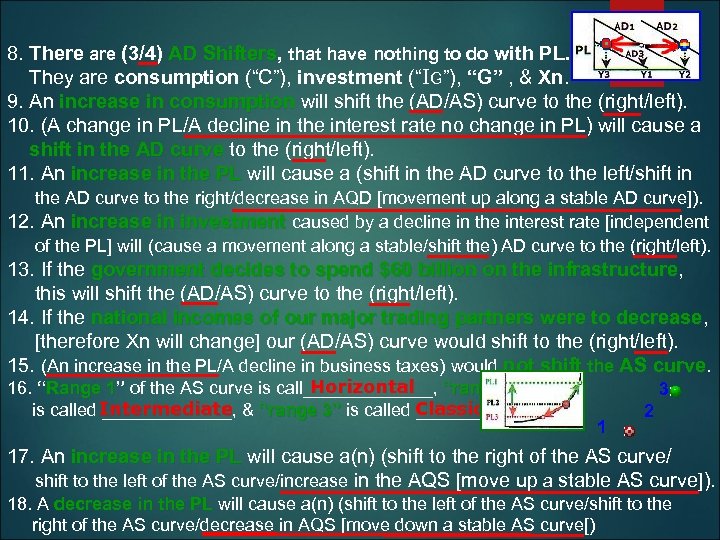 8. There are (3/4) AD Shifters, that have nothing to do with PL. Shifters They are consumption (“C”), investment (“IG”), “G” , & Xn. 9. An increase in consumption will shift the (AD/AS) curve to the (right/left). consumption 10. (A change in PL/A decline in the interest rate no change in PL) will cause a shift in the AD curve to the (right/left). curve 11. An increase in the PL will cause a (shift in the AD curve to the left/shift in PL the AD curve to the right/decrease in AQD [movement up along a stable AD curve]). 12. An increase in investment caused by a decline in the interest rate [independent investment of the PL] will (cause a movement along a stable/shift the) AD curve to the (right/left). 13. If the government decides to spend $60 billion on the infrastructure, infrastructure this will shift the (AD/AS) curve to the (right/left). 14. If the national incomes of our major trading partners were to decrease, decrease [therefore Xn will change] our (AD/AS) curve would shift to the (right/left). 15. (An increase in the PL/A decline in business taxes) would not shift the AS curve Horizontal 16. “Range 1” of the AS curve is call_______, “range 2” Classical Intermediate is called _______, & “range 3” is called _____. 3” 3 1 2 17. An increase in the PL will cause a(n) (shift to the right of the AS curve/ PL shift to the left of the AS curve/increase in the AQS [move up a stable AS curve]). 18. A decrease in the PL will cause a(n) (shift to the left of the AS curve/shift to the PL right of the AS curve/decrease in AQS [move down a stable AS curve[)
 Aggregate Supply The level of Real GDP (GDPR) that firms will produce at each Price Level (PL) Is producing a unit profitable or not? Short-Run Aggregate Supply (SRAS) Increases in the price-level will increase firm’s profits and create incentives to increase output. As the price-level falls, firm’s profits drop and this creates an incentive to reduce output. However, nomial wages and other input prices are fixed and don’t have time to adjust to price level changes
 1. The Sticky-Wage Theory § Imperfection: Nominal wages are sticky in the short run, they adjust sluggishly. § Due to labor contracts, social norms § Firms and workers set the nominal wage in advance based on PE, the price level they expect to prevail. © 2015 Cengage Learning. All Rights Reserved. May not be copied, scanned, or duplicated, in whole or in part, except for use as permitted in a license distributed with a certain product or service or otherwise on a password-protected website for classroom use. 47
 1. The Sticky-Wage Theory § If P > PE, revenue is higher, but labor cost is not. Production is more profitable, so firms increase output and employment. § Hence, higher P causes higher Y, so the SRAS curve slopes upward. © 2015 Cengage Learning. All Rights Reserved. May not be copied, scanned, or duplicated, in whole or in part, except for use as permitted in a license distributed with a certain product or service or otherwise on a password-protected website for classroom use. 48
 2. The Sticky-Price Theory § Imperfection: Many prices are sticky in the short run. § Due to menu costs, the costs of adjusting prices. § Examples: cost of printing new menus, the time required to change price tags § Firms set sticky prices in advance based on PE. © 2015 Cengage Learning. All Rights Reserved. May not be copied, scanned, or duplicated, in whole or in part, except for use as permitted in a license distributed with a certain product or service or otherwise on a password-protected website for classroom use. 49
 2. The Sticky-Price Theory § Suppose the Fed increases the money supply unexpectedly. In the long run, P will rise. § In the short run, firms without menu costs can raise their prices immediately. § Firms with menu costs wait to raise prices. Meanwhile, their prices are relatively low, which increases demand for their products, so they increase output and employment. § Hence, higher P is associated with higher Y, so the SRAS curve slopes upward. © 2015 Cengage Learning. All Rights Reserved. May not be copied, scanned, or duplicated, in whole or in part, except for use as permitted in a license distributed with a certain product or service or otherwise on a password-protected website for classroom use. 50
 3. The Misperceptions Theory § Imperfection: Firms may confuse changes in P with changes in the relative price of the products they sell. § If P rises above PE, a firm sees its price rise before realizing all prices are rising. The firm may believe its relative price is rising, and may increase output and employment. § So, an increase in P can cause an increase in Y, making the SRAS curve upward-sloping. © 2015 Cengage Learning. All Rights Reserved. May not be copied, scanned, or duplicated, in whole or in part, except for use as permitted in a license distributed with a certain product or service or otherwise on a password-protected website for classroom use. 51
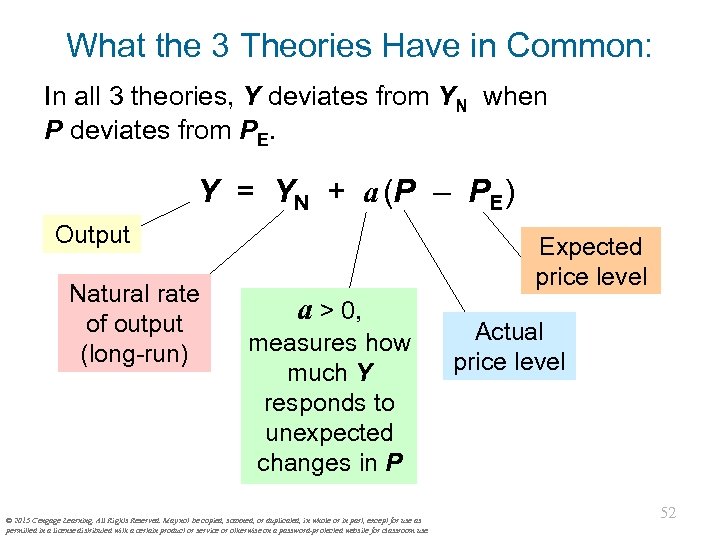 What the 3 Theories Have in Common: In all 3 theories, Y deviates from YN when P deviates from PE. Y = YN + a (P – PE) Output Natural rate of output (long-run) Expected price level a > 0, measures how much Y responds to unexpected changes in P © 2015 Cengage Learning. All Rights Reserved. May not be copied, scanned, or duplicated, in whole or in part, except for use as permitted in a license distributed with a certain product or service or otherwise on a password-protected website for classroom use. Actual price level 52
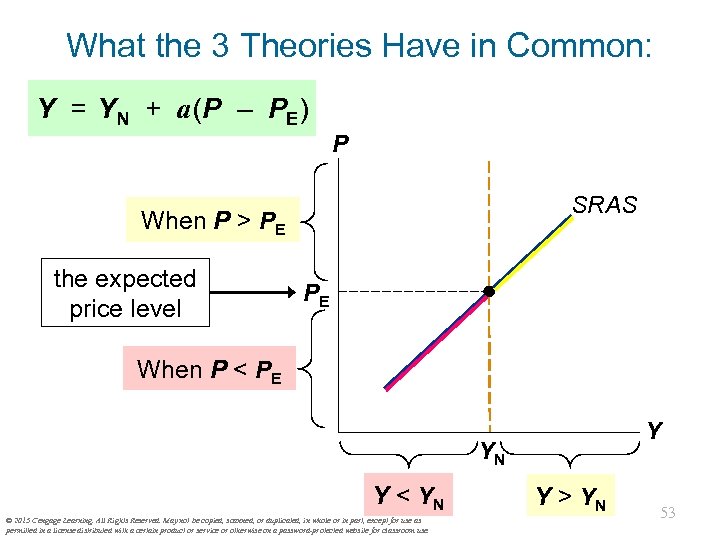 What the 3 Theories Have in Common: Y = YN + a (P – PE) P SRAS When P > PE the expected price level PE When P < PE Y YN Y < YN © 2015 Cengage Learning. All Rights Reserved. May not be copied, scanned, or duplicated, in whole or in part, except for use as permitted in a license distributed with a certain product or service or otherwise on a password-protected website for classroom use. Y > YN 53
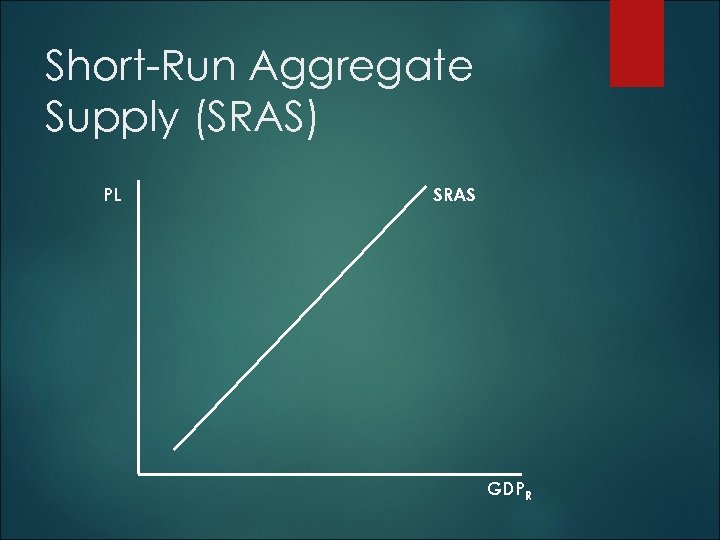 Short-Run Aggregate Supply (SRAS) PL SRAS GDPR
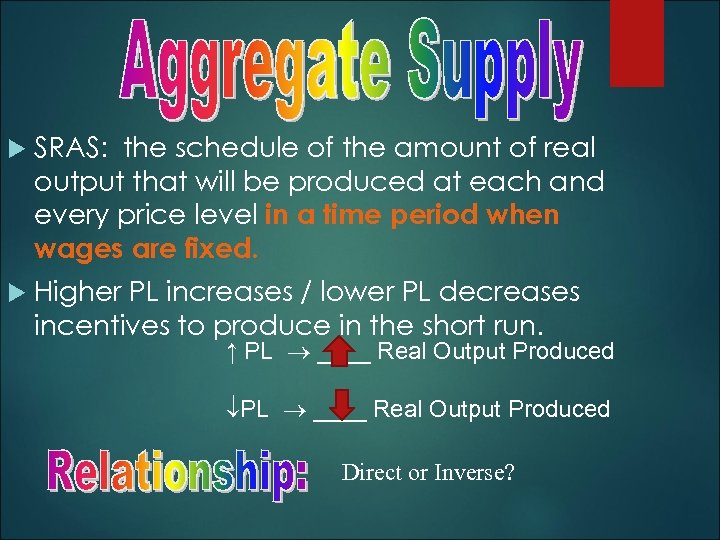 SRAS: the schedule of the amount of real output that will be produced at each and every price level in a time period when wages are fixed. Higher PL increases / lower PL decreases incentives to produce in the short run. ↑ PL ____ Real Output Produced Direct or Inverse?
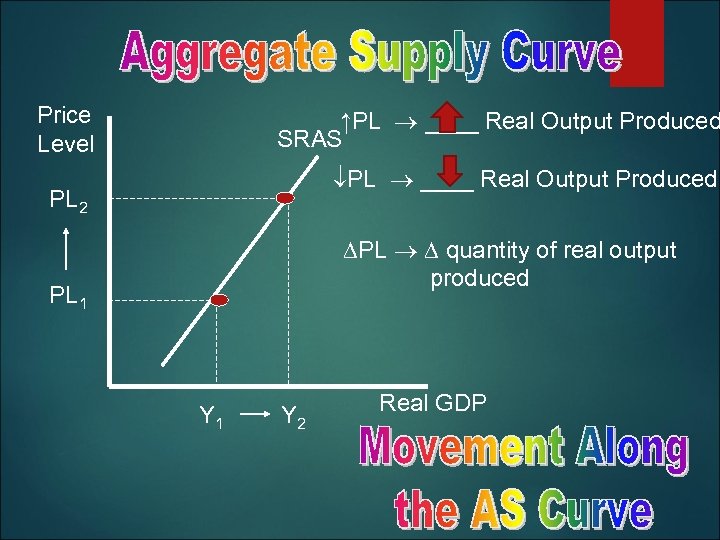 Price Level ↑PL ____ Real Output Produced SRAS PL ____ Real Output Produced PL 2 PL quantity of real output produced PL 1 Y 1 Y 2 Real GDP
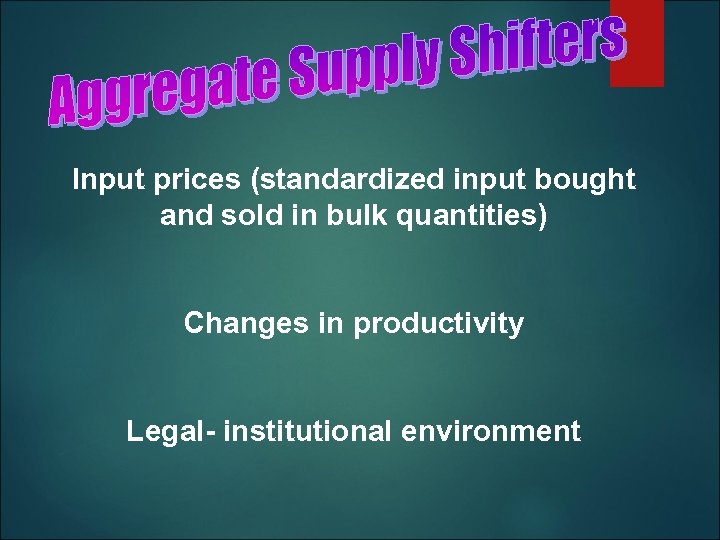 Input prices (standardized input bought and sold in bulk quantities) Changes in productivity Legal- institutional environment
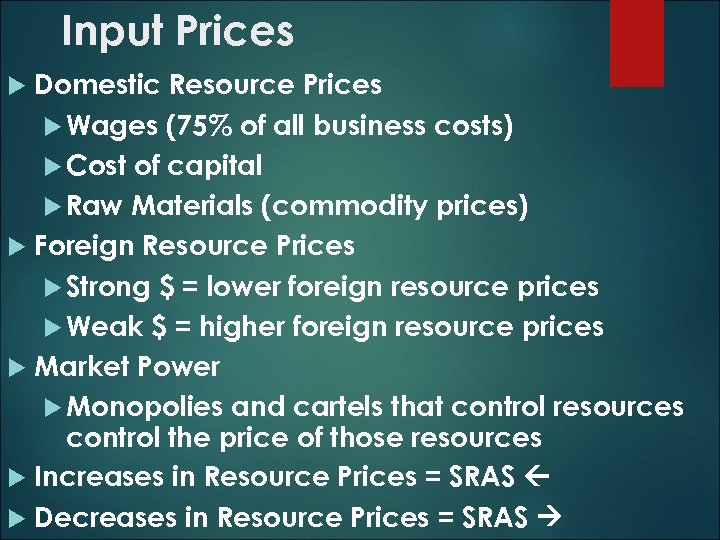 Input Prices Domestic Resource Prices Wages (75% of all business costs) Cost of capital Raw Materials (commodity prices) Foreign Resource Prices Strong $ = lower foreign resource prices Weak $ = higher foreign resource prices Market Power Monopolies and cartels that control resources control the price of those resources Increases in Resource Prices = SRAS Decreases in Resource Prices = SRAS
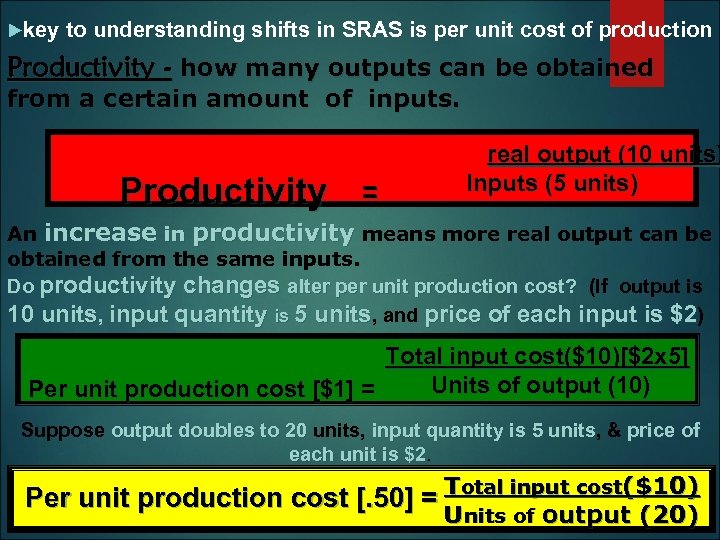 key to understanding shifts in SRAS is per unit cost of production Productivity - how many outputs can be obtained from a certain amount of inputs. Productivity = real output (10 units) Inputs (5 units) An increase in productivity means more real output can be obtained from the same inputs. Do productivity changes alter per unit production cost? (If output is 10 units, input quantity is 5 units, and price of each input is $2) Total input cost($10)[$2 x 5] Units of output (10) Per unit production cost [$1] = Suppose output doubles to 20 units, input quantity is 5 units, & price of units each unit is $2. Per unit production cost [. 50] = Total input cost($10) U nits of output (20)
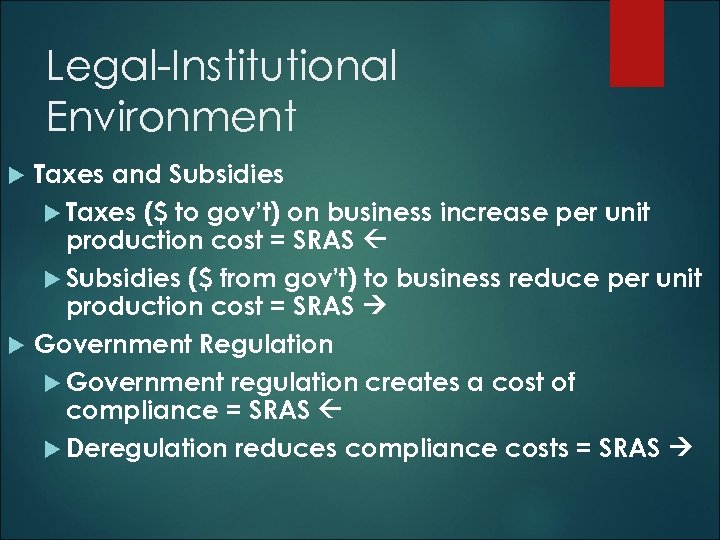 Legal-Institutional Environment Taxes and Subsidies Taxes ($ to gov’t) on business increase per unit production cost = SRAS Subsidies ($ from gov’t) to business reduce per unit production cost = SRAS Government Regulation Government regulation creates a cost of compliance = SRAS Deregulation reduces compliance costs = SRAS
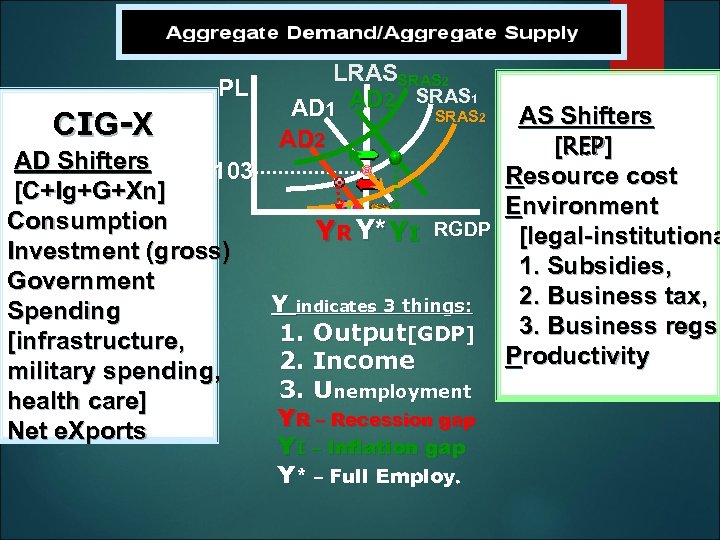 C I G -X PL LRASSRAS 2 AD 2 SRAS 1 AD 1 SRAS 2 AD Shifters 103 [C+Ig+G+Xn] Consumption YR Y* YI RGDP Investment (gross) Government Y indicates 3 things: Spending 1. Output[GDP] [infrastructure, 2. Income military spending, 3. Unemployment health care] YR – Recession gap Net e. Xports YI – Inflation gap Y* – Full Employ. AS Shifters [REP] Resource cost Environment [legal-institutiona 1. Subsidies, 2. Business tax, 3. Business regs. Productivity
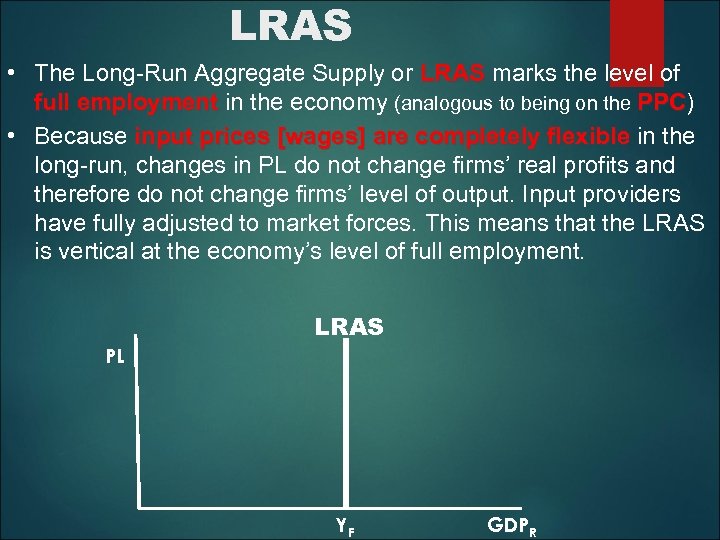 LRAS • The Long-Run Aggregate Supply or LRAS marks the level of LRAS full employment in the economy (analogous to being on the PPC) PPC • Because input prices [wages] are completely flexible in the long-run, changes in PL do not change firms’ real profits and therefore do not change firms’ level of output. Input providers have fully adjusted to market forces. This means that the LRAS is vertical at the economy’s level of full employment. LRAS PL YF GDPR
 Lr. As shifters Changes in the availability of resources- LLCE Changes in productivity Policy incentives
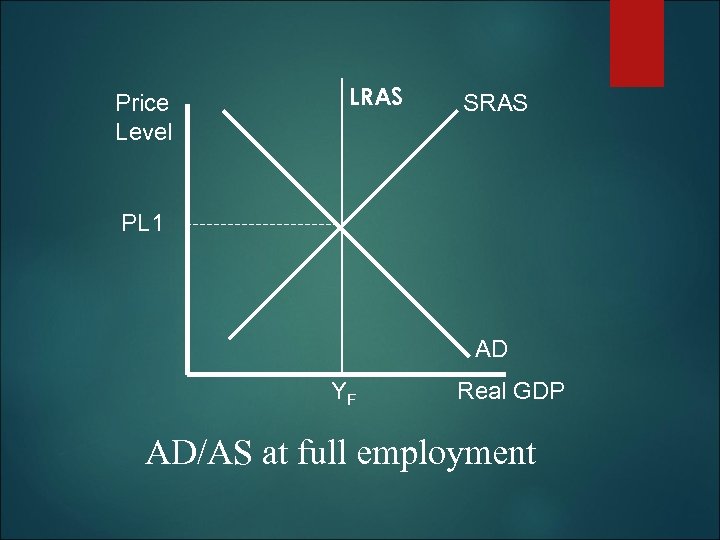 Price Level LRAS SRAS PL 1 AD YF Real GDP AD/AS at full employment
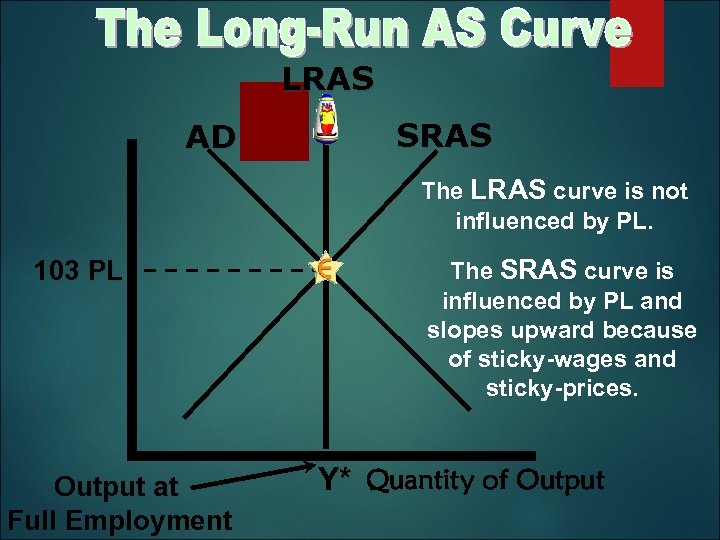 LRAS AD SRAS The LRAS curve is not influenced by PL. 103 PL Output at Full Employment The SRAS curve is influenced by PL and slopes upward because of sticky-wages and sticky-prices. Y* Quantity of Output
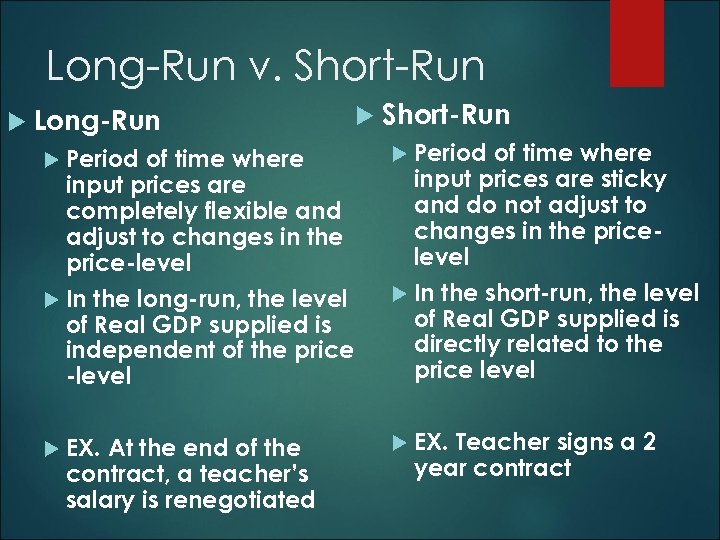 Long-Run v. Short-Run Long-Run Short-Run Period of time where input prices are completely flexible and adjust to changes in the price-level In the long-run, the level of Real GDP supplied is independent of the price -level Period EX. At the end of the contract, a teacher’s salary is renegotiated of time where input prices are sticky and do not adjust to changes in the pricelevel In the short-run, the level of Real GDP supplied is directly related to the price level Teacher signs a 2 year contract
 http: //whitenova. com/think. Ec onomics/adas. html
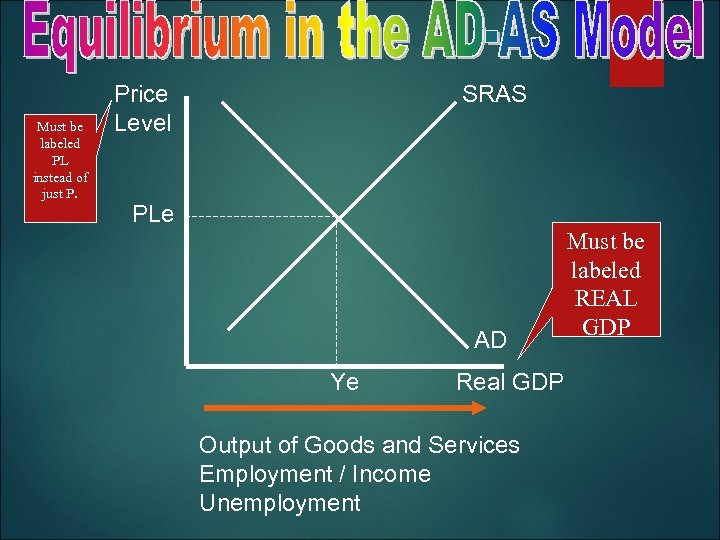 Must be labeled PL instead of just P. SRAS Price Level PLe AD Ye Real GDP Output of Goods and Services Employment / Income Unemployment Must be labeled REAL GDP
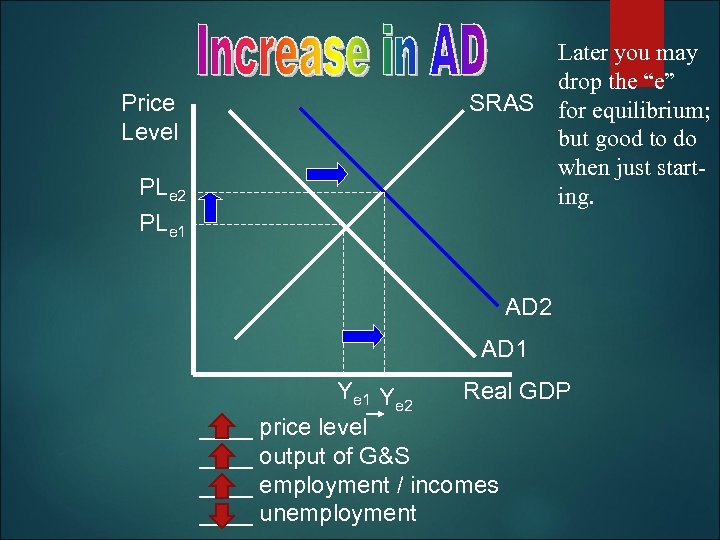 Price Level PLe 2 PLe 1 Later you may drop the “e” SRAS for equilibrium; but good to do when just starting. AD 2 AD 1 Ye 2 Real GDP ____ price level ____ output of G&S ____ employment / incomes ____ unemployment
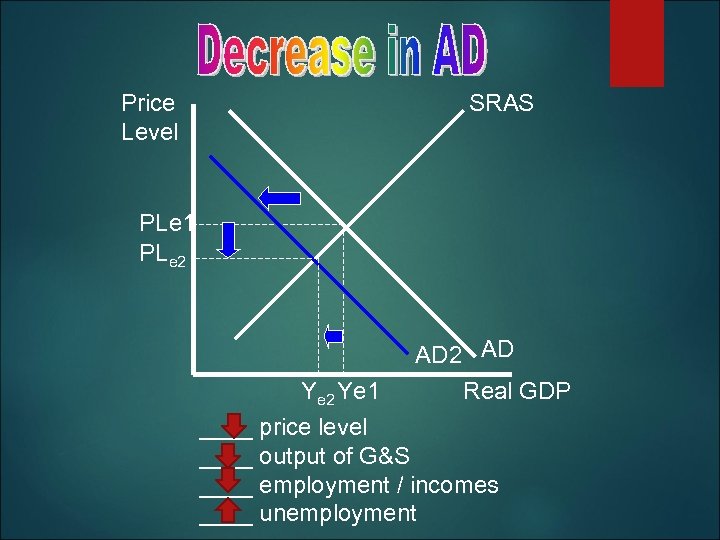 Price Level SRAS PLe 1 PLe 2 AD Real GDP Ye 2 Ye 1 ____ price level ____ output of G&S ____ employment / incomes ____ unemployment
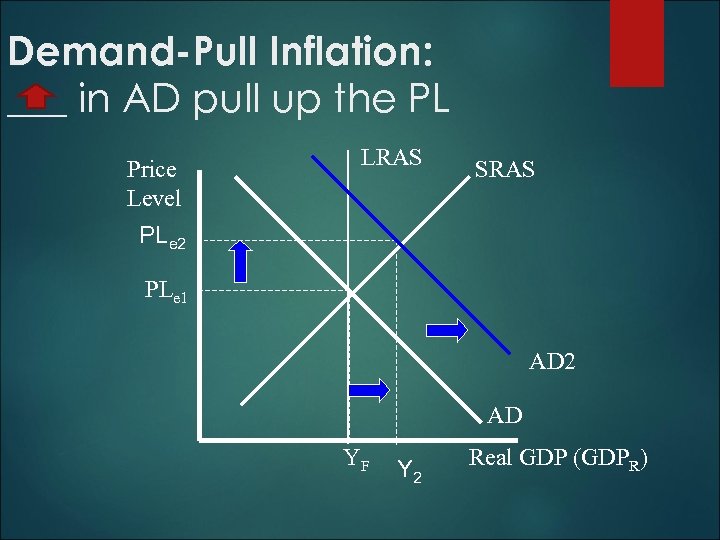 Demand-Pull Inflation: ___ in AD pull up the PL Price Level LRAS SRAS PLe 2 PLe 1 AD 2 AD YF Y 2 Real GDP (GDPR)
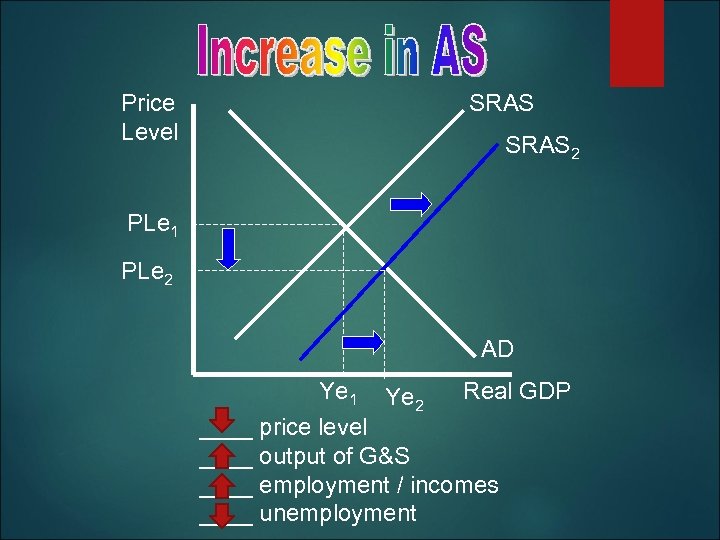 Price Level SRAS 2 PLe 1 PLe 2 AD Ye 1 Ye 2 Real GDP ____ price level ____ output of G&S ____ employment / incomes ____ unemployment
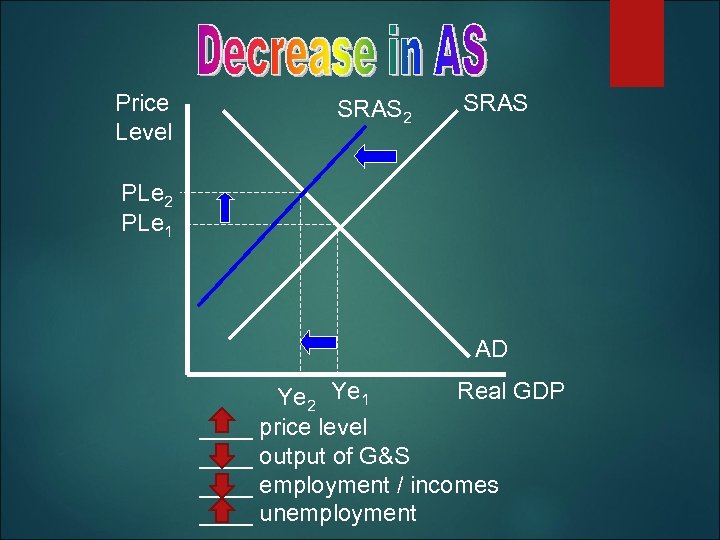 Price Level SRAS 2 SRAS PLe 2 PLe 1 AD Real GDP Ye 2 Ye 1 ____ price level ____ output of G&S ____ employment / incomes ____ unemployment
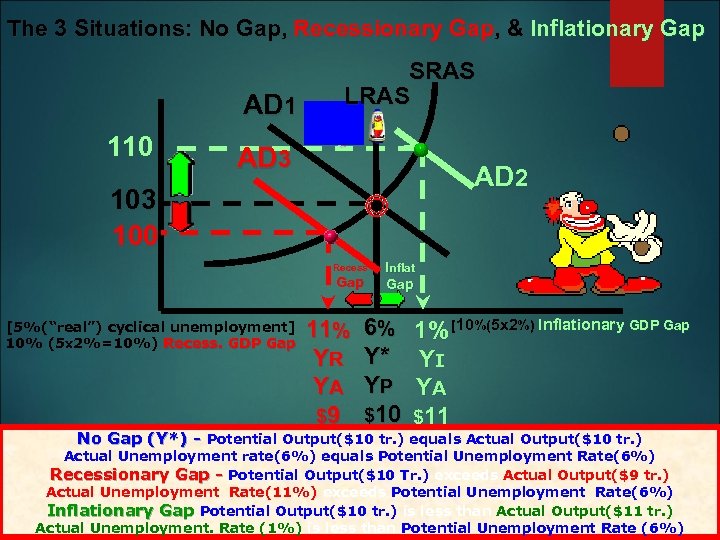 The 3 Situations: No Gap, Recessionary Gap, & Inflationary Gap AD 1 110 SRAS LRAS AD 3 AD 2 103 100 Recess Gap [5%(“real”) cyclical unemployment] 10% (5 x 2%=10%) Recess. GDP Gap 11% YR YA $9 Inflat Gap 6% Y* YP $10 1% [10%(5 x 2%) Inflationary GDP Gap YI YA $11 No Gap (Y*) - Potential Output($10 tr. ) equals Actual Output($10 tr. ) Actual Unemployment rate(6%) equals Potential Unemployment Rate(6%) Recessionary Gap - Potential Output($10 Tr. ) exceeds Actual Output($9 tr. ) Actual Unemployment Rate(11%) exceeds Potential Unemployment Rate(6%) Inflationary Gap Potential Output($10 tr. ) is less than Actual Output($11 tr. ) Actual Unemployment. Rate (1%) is less than Potential Unemployment Rate (6%)
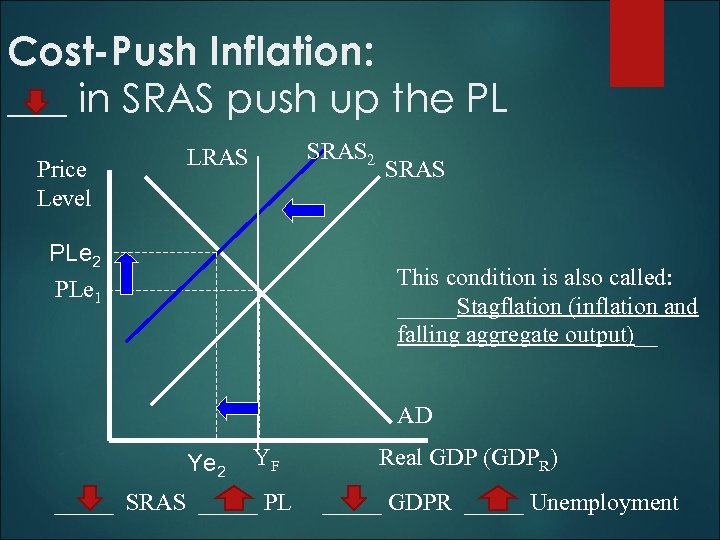 Cost-Push Inflation: ___ in SRAS push up the PL Price Level SRAS 2 LRAS PLe 2 PLe 1 SRAS This condition is also called: _____Stagflation (inflation and falling aggregate output)__ AD Ye 2 YF _____ SRAS _____ PL Real GDP (GDPR) _____ GDPR _____ Unemployment
 Negative and Positive Supply Shocks As for SHOCKS. We expect the AS curve to SHOCKS expect slowly shift to the right at a predictable rate one year to the next. Same for AD. next AD But a SHOCK to the economic system (much akin to a heart attack or car accident) attack accident cannot be accurately predicted. We all knew a hurricane would one day hit New Orleans, or that buying ocean front property in Orleans Nevada will pay-off when California slides away, Nevada away but we don't know the year or the magnitude of the event. Shocks are not predicted. Shocks predicted
![[“bad news” – job losses; “bad news” – inflation] LRAS AS 2 AD $2.](https://present5.com/presentation/1a86d1eb30728aaff44a20d6dcc040bb/image-77.jpg "[“bad news” – job losses; “bad news” – inflation] LRAS AS 2 AD $2.") [“bad news” – job losses; “bad news” – inflation] LRAS AS 2 AD $2. $4. AS 1 110 Inflating PL 1 The economy is stagnating but Stagnating 10% Y* inflating “Stagflation”
[“bad news” – job losses; “bad news” – inflation] LRAS AS 2 AD $2. $4. AS 1 110 Inflating PL 1 The economy is stagnating but Stagnating 10% Y* inflating “Stagflation”
![[“good news”–job gains; “good news”–disinflation] AS 1 AD AS 2 $4. 00 $1. 75](https://present5.com/presentation/1a86d1eb30728aaff44a20d6dcc040bb/image-78.jpg "[“good news”–job gains; “good news”–disinflation] AS 1 AD AS 2 $4. 00 $1. 75") [“good news”–job gains; “good news”–disinflation] AS 1 AD AS 2 $4. 00 $1. 75 PL 1 “Good news, lower prices” “Good news, more jobs” PL 2 Y 1 Y 2
[“good news”–job gains; “good news”–disinflation] AS 1 AD AS 2 $4. 00 $1. 75 PL 1 “Good news, lower prices” “Good news, more jobs” PL 2 Y 1 Y 2
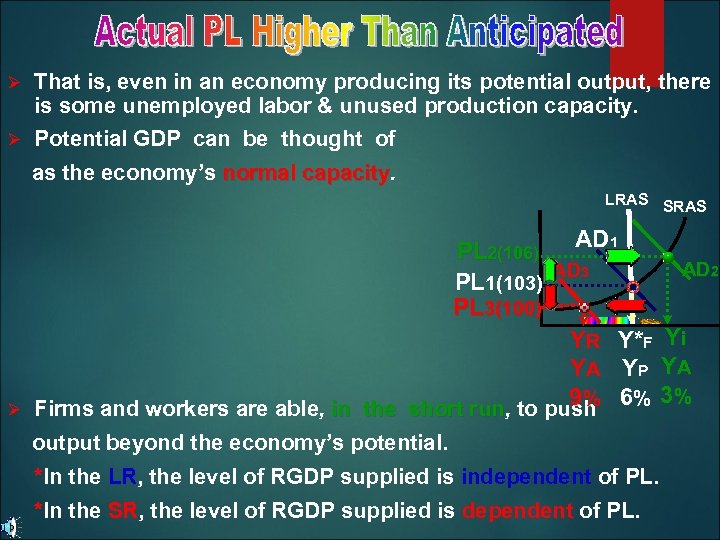 Ø That is, even in an economy producing its potential output, there output is some unemployed labor & unused production capacity. Ø Potential GDP can be thought of as the economy’s normal capacity. LRAS SRAS Ø PL 2(106) AD 1 AD 2 AD 3 PL 1(103) PL 3(100) YR Y*F Yi YA YP YA 9% 6% 3% Firms and workers are able, in the short run, to push run output beyond the economy’s potential. *In the LR, the level of RGDP supplied is independent of PL. LR *In the SR, the level of RGDP supplied is dependent of PL. SR
![LRAS Price Level AD SRAS AD 2 PL 2[106] [Production cost] E 2 What](https://present5.com/presentation/1a86d1eb30728aaff44a20d6dcc040bb/image-80.jpg "LRAS Price Level AD SRAS AD 2 PL 2[106] [Production cost] E 2 What") LRAS Price Level AD SRAS AD 2 PL 2[106] [Production cost] E 2 What if we have unanticipated inflation? inflation What happens in SR to output, employment, and price level? PL 1[103] Y YI RGDP
LRAS Price Level AD SRAS AD 2 PL 2[106] [Production cost] E 2 What if we have unanticipated inflation? inflation What happens in SR to output, employment, and price level? PL 1[103] Y YI RGDP
![LRAS Price Level PL 2[106] SRAS 2 SRAS 1 AD E 3 [Production cost]](https://present5.com/presentation/1a86d1eb30728aaff44a20d6dcc040bb/image-81.jpg "LRAS Price Level PL 2[106] SRAS 2 SRAS 1 AD E 3 [Production cost]") LRAS Price Level PL 2[106] SRAS 2 SRAS 1 AD E 3 [Production cost] With unanticipated inflation what happens to output, output employment and price level in the LR? PL 1[103] Y RGDP
LRAS Price Level PL 2[106] SRAS 2 SRAS 1 AD E 3 [Production cost] With unanticipated inflation what happens to output, output employment and price level in the LR? PL 1[103] Y RGDP
![LRAS Price Level PL 1[103] PL 3[101] AD SRAS [Production cost] With unanticipated disinflation,](https://present5.com/presentation/1a86d1eb30728aaff44a20d6dcc040bb/image-82.jpg "LRAS Price Level PL 1[103] PL 3[101] AD SRAS [Production cost] With unanticipated disinflation,") LRAS Price Level PL 1[103] PL 3[101] AD SRAS [Production cost] With unanticipated disinflation, what happens disinflation to output, employment and price level in the SR? AD 2 E 2 YR Y RGDP
LRAS Price Level PL 1[103] PL 3[101] AD SRAS [Production cost] With unanticipated disinflation, what happens disinflation to output, employment and price level in the SR? AD 2 E 2 YR Y RGDP
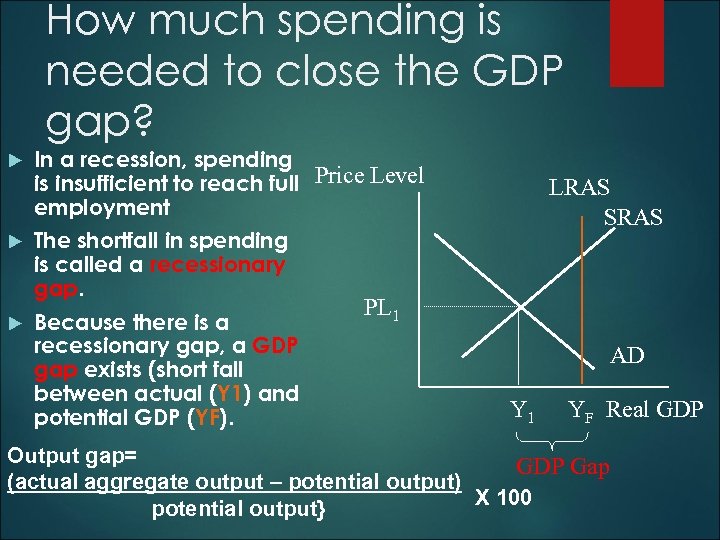 How much spending is needed to close the GDP gap? In a recession, spending is insufficient to reach full Price Level employment The shortfall in spending is called a recessionary gap. Because there is a recessionary gap, a GDP gap exists (short fall between actual (Y 1) and potential GDP (YF). LRAS SRAS PL 1 AD Y 1 YF Real GDP Output gap= GDP Gap (actual aggregate output – potential output) X 100 potential output}
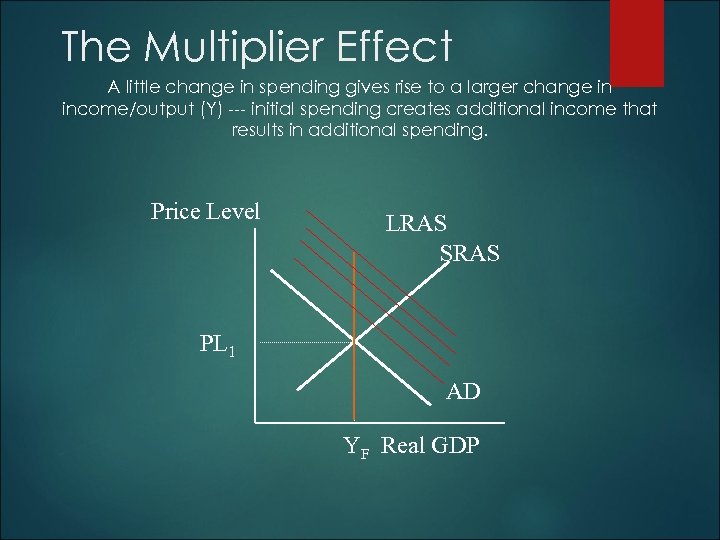 The Multiplier Effect A little change in spending gives rise to a larger change in income/output (Y) --- initial spending creates additional income that results in additional spending. Price Level LRAS SRAS PL 1 AD YF Real GDP
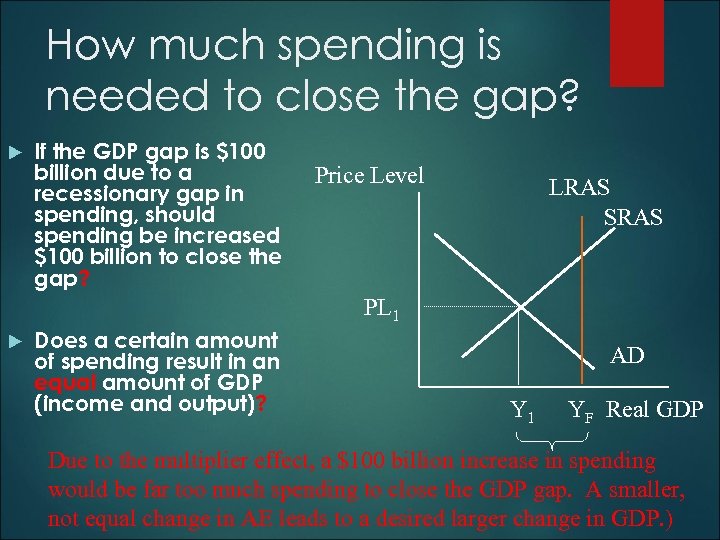 How much spending is needed to close the gap? If the GDP gap is $100 billion due to a recessionary gap in spending, should spending be increased $100 billion to close the gap? Price Level LRAS SRAS PL 1 Does a certain amount of spending result in an equal amount of GDP (income and output)? AD Y 1 YF Real GDP Due to the multiplier effect, a $100 billion increase in spending would be far too much spending to close the GDP gap. A smaller, not equal change in AE leads to a desired larger change in GDP. )
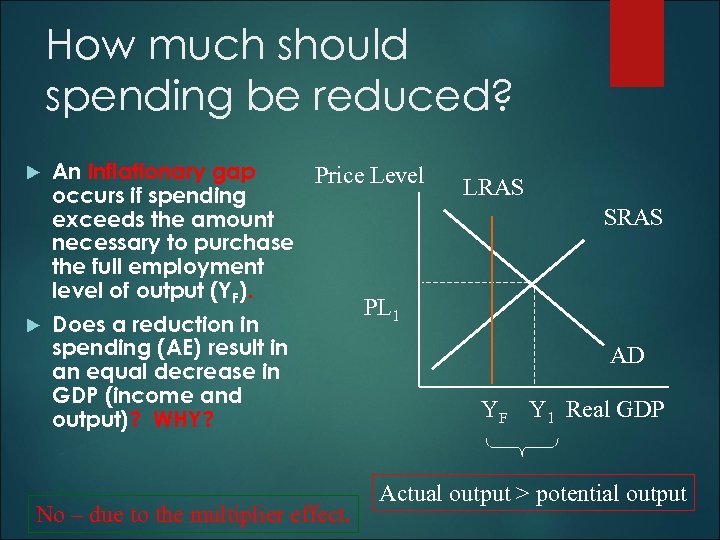 How much should spending be reduced? An inflationary gap Price Level occurs if spending exceeds the amount necessary to purchase the full employment level of output (YF). Does a reduction in spending (AE) result in an equal decrease in GDP (income and output)? WHY? No – due to the multiplier effect. LRAS SRAS PL 1 AD YF Y 1 Real GDP Actual output > potential output
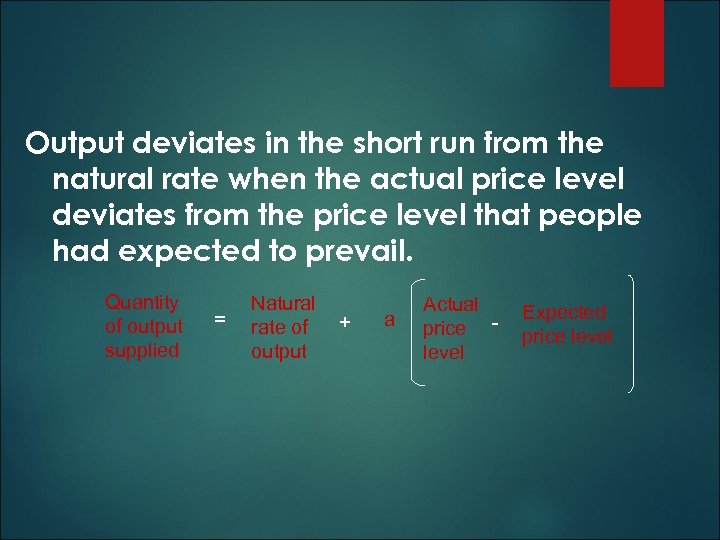 Output deviates in the short run from the natural rate when the actual price level deviates from the price level that people had expected to prevail. Quantity of output supplied = Natural rate of + output a Actual price level - Expected price level
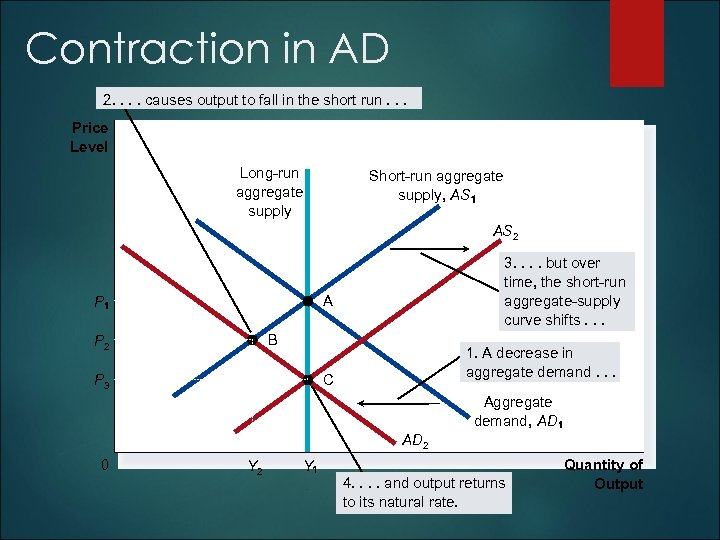 Contraction in AD 2. . causes output to fall in the short run. . . Price Level Long-run aggregate supply Short-run aggregate supply, AS AS 2 3. . but over time, the short-run aggregate-supply curve shifts. . . A P B P 2 P 3 1. A decrease in aggregate demand. . . C Aggregate demand, AD AD 2 0 Y 2 Y 4. . and output returns to its natural rate. Quantity of Output
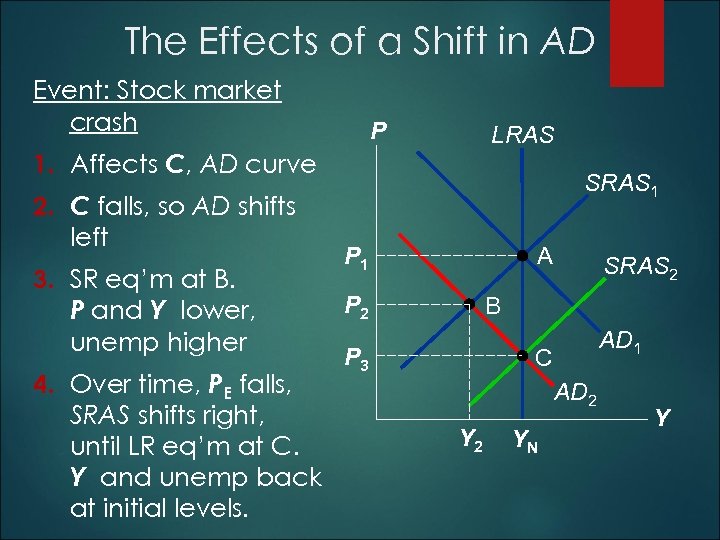 The Effects of a Shift in AD Event: Stock market crash P LRAS 1. Affects C, AD curve 2. C falls, so AD shifts left 3. SR eq’m at B. P and Y lower, unemp higher 4. Over time, PE falls, SRAS shifts right, until LR eq’m at C. Y and unemp back at initial levels. SRAS 1 A P 1 P 2 SRAS 2 B P 3 AD 1 C AD 2 YN Y
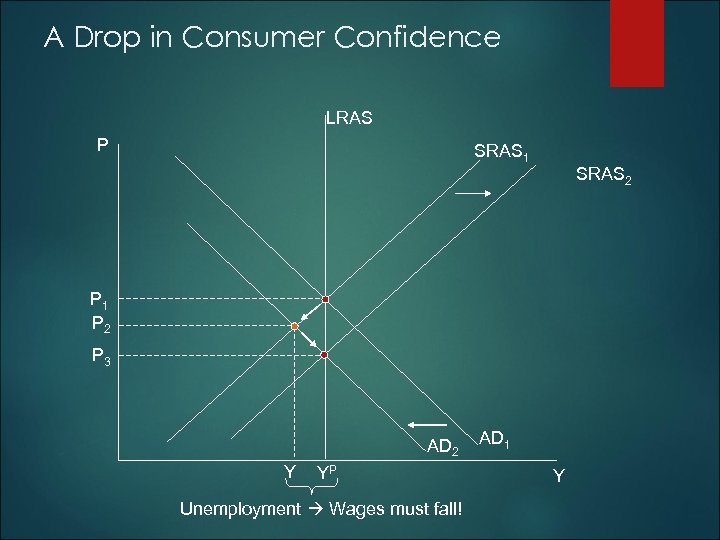 A Drop in Consumer Confidence LRAS P SRAS 1 SRAS 2 P 1 P 2 P 3 AD 2 Y YP Unemployment Wages must fall! AD 1 Y
 Policy Responses to Recession Policymakers may respond to a recession in one of the following ways: Do nothing and wait for prices and wages to adjust. Take action to increase aggregate demand by using monetary and fiscal policy. It’s harder for the government to shift AS
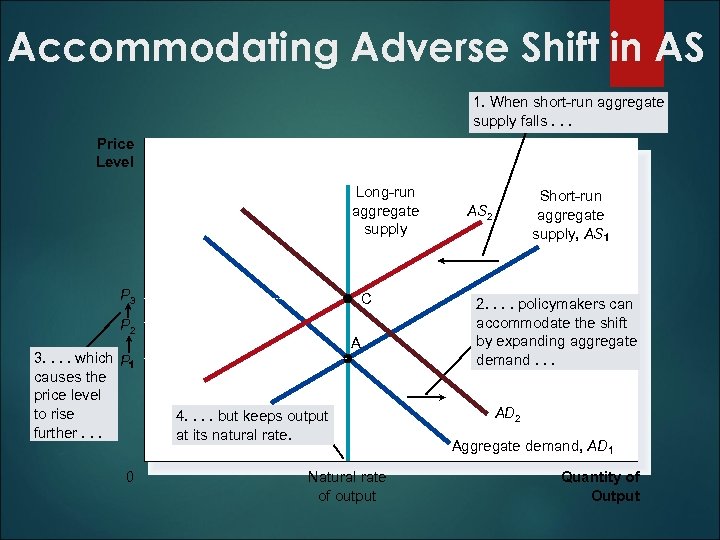 Accommodating Adverse Shift in AS 1. When short-run aggregate supply falls. . . Price Level Long-run aggregate supply P 3 C P 2 3. . which P causes the price level to rise further. . . 0 A 4. . but keeps output at its natural rate. Natural rate of output Short-run aggregate supply, AS AS 2 2. . policymakers can accommodate the shift by expanding aggregate demand. . . AD 2 Aggregate demand, AD Quantity of Output
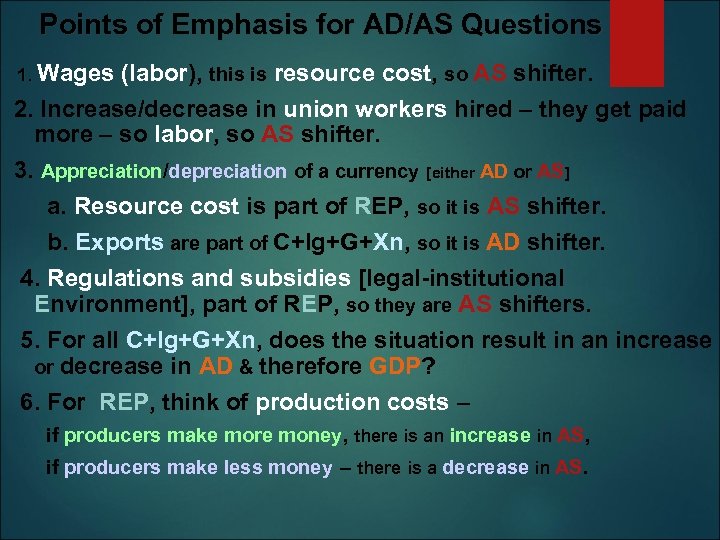 Points of Emphasis for AD/AS Questions 1. Wages (labor), this is resource cost, so AS shifter. 2. Increase/decrease in union workers hired – they get paid more – so labor, so AS shifter. 3. Appreciation/depreciation of a currency [either AD or AS] a. Resource cost is part of REP, so it is AS shifter. b. Exports are part of C+Ig+G+Xn, so it is AD shifter. 4. Regulations and subsidies [legal-institutional Environment], part of REP, so they are AS shifters. 5. For all C+Ig+G+Xn, does the situation result in an increase or decrease in AD & therefore GDP? 6. For REP, think of production costs – if producers make more money, there is an increase in AS, if producers make less money – there is a decrease in AS.
 http: //whitenova. com/think. Ec onomics/simul. html
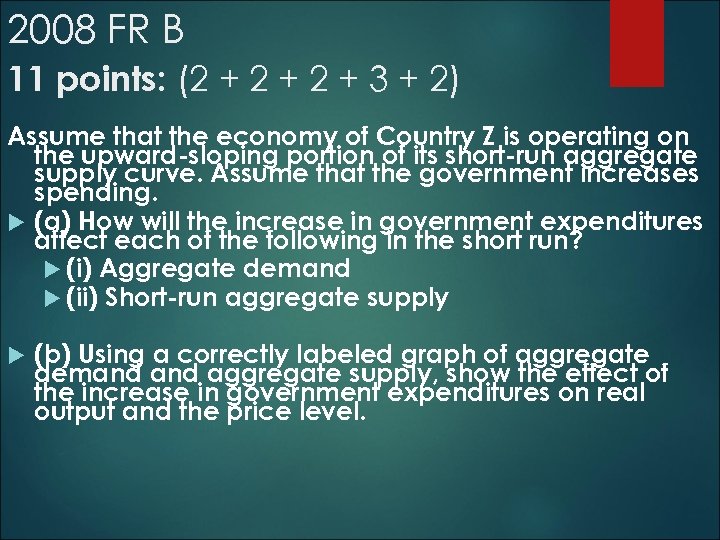 2008 FR B 11 points: (2 + 2 + 3 + 2) Assume that the economy of Country Z is operating on the upward-sloping portion of its short-run aggregate supply curve. Assume that the government increases spending. (a) How will the increase in government expenditures affect each of the following in the short run? (i) Aggregate demand (ii) Short-run aggregate supply (b) Using a correctly labeled graph of aggregate demand aggregate supply, show the effect of the increase in government expenditures on real output and the price level.
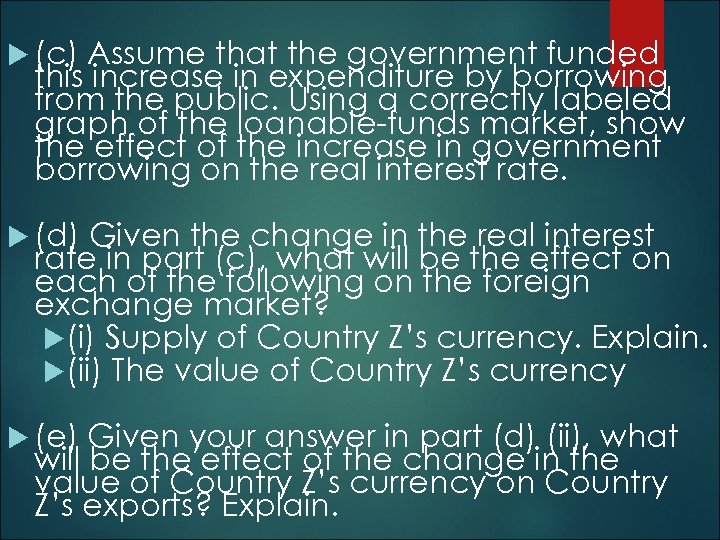 (c) Assume that the government funded this increase in expenditure by borrowing from the public. Using a correctly labeled graph of the loanable-funds market, show the effect of the increase in government borrowing on the real interest rate. (d) Given the change in the real interest rate in part (c), what will be the effect on each of the following on the foreign exchange market? (i) Supply of Country Z’s currency. Explain. (ii) The value of Country Z’s currency (e) Given your answer in part (d) (ii), what will be the effect of the change in the value of Country Z’s currency on Country Z’s exports? Explain.
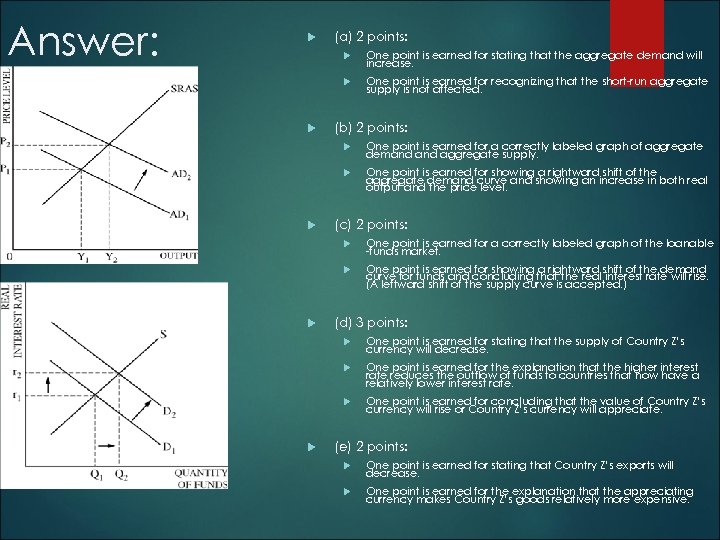 Answer: (a) 2 points: One point is earned for stating that the aggregate demand will increase. One point is earned for recognizing that the short-run aggregate supply is not affected. (b) 2 points: One point is earned for a correctly labeled graph of aggregate demand aggregate supply. One point is earned for showing a rightward shift of the aggregate demand curve and showing an increase in both real output and the price level. (c) 2 points: One point is earned for a correctly labeled graph of the loanable -funds market. One point is earned for showing a rightward shift of the demand curve for funds and concluding that the real interest rate will rise. (A leftward shift of the supply curve is accepted. ) (d) 3 points: One point is earned for the explanation that the higher interest rate reduces the outflow of funds to countries that now have a relatively lower interest rate. One point is earned for stating that the supply of Country Z’s currency will decrease. One point is earned for concluding that the value of Country Z’s currency will rise or Country Z’s currency will appreciate. (e) 2 points: One point is earned for stating that Country Z’s exports will decrease. One point is earned for the explanation that the appreciating currency makes Country Z’s goods relatively more expensive.
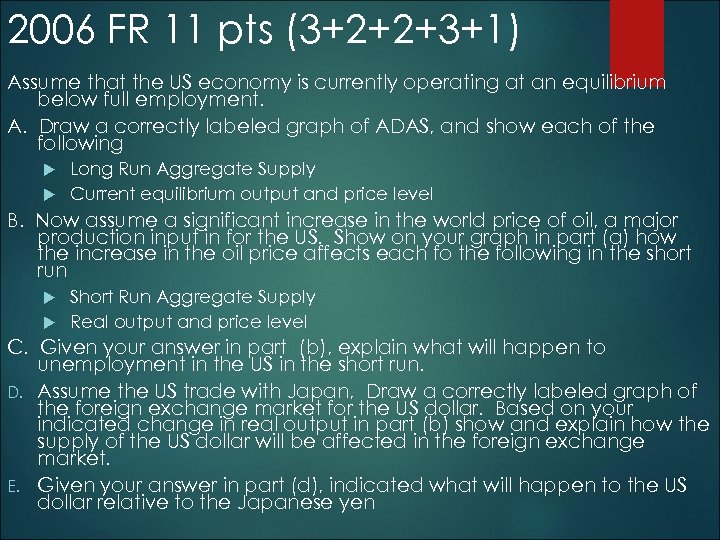 2006 FR 11 pts (3+2+2+3+1) Assume that the US economy is currently operating at an equilibrium below full employment. A. Draw a correctly labeled graph of ADAS, and show each of the following Long Run Aggregate Supply Current equilibrium output and price level B. Now assume a significant increase in the world price of oil, a major production input in for the US. Show on your graph in part (a) how the increase in the oil price affects each fo the following in the short run Short Run Aggregate Supply Real output and price level C. Given your answer in part (b), explain what will happen to unemployment in the US in the short run. D. Assume the US trade with Japan, Draw a correctly labeled graph of the foreign exchange market for the US dollar. Based on your indicated change in real output in part (b) show and explain how the supply of the US dollar will be affected in the foreign exchange market. E. Given your answer in part (d), indicated what will happen to the US dollar relative to the Japanese yen
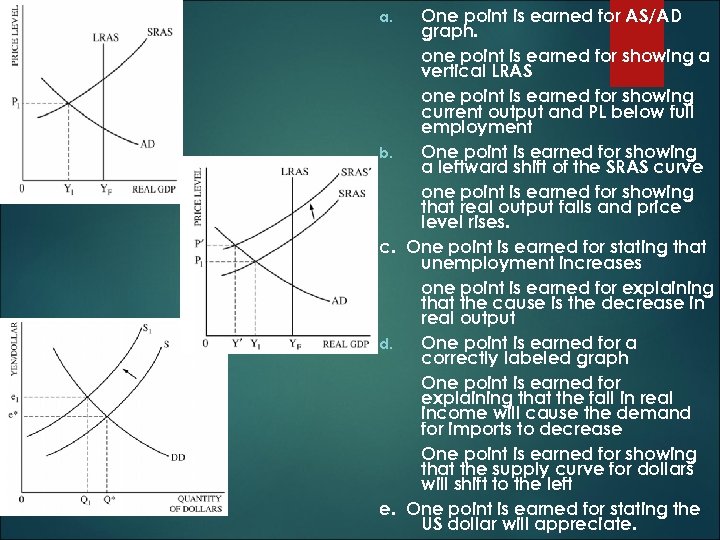 a. Answer: b. c. d. e. One point is earned for AS/AD graph. one point is earned for showing a vertical LRAS one point is earned for showing current output and PL below full employment One point is earned for showing a leftward shift of the SRAS curve one point is earned for showing that real output falls and price level rises. One point is earned for stating that unemployment increases one point is earned for explaining that the cause is the decrease in real output One point is earned for a correctly labeled graph One point is earned for explaining that the fall in real income will cause the demand for imports to decrease One point is earned for showing that the supply curve for dollars will shift to the left One point is earned for stating the US dollar will appreciate.
 and SHOULD THE GOVERNMENT INTERVENE TO CORRECT PROBLEMS IN THE ECONOMY?
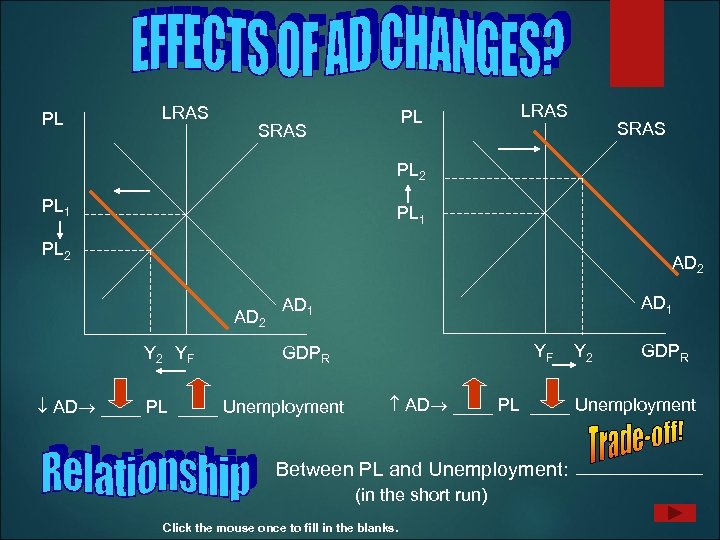 PL LRAS PL SRAS LRAS SRAS PL 2 PL 1 PL 2 AD 2 YF AD 1 YF Y 2 GDPR AD ____ PL ____ Unemployment Between PL and Unemployment: (in the short run) Click the mouse once to fill in the blanks.
 In the short run there is a TRADE-OFF between INFLATION and UNEMPLOYMENT. To reduce unemployment – inflation occurs To reduce inflation --- unemployment increases Research by an English economist named Phillips documented this relationship. As a result a new model was developed to illustrate the trade-off:
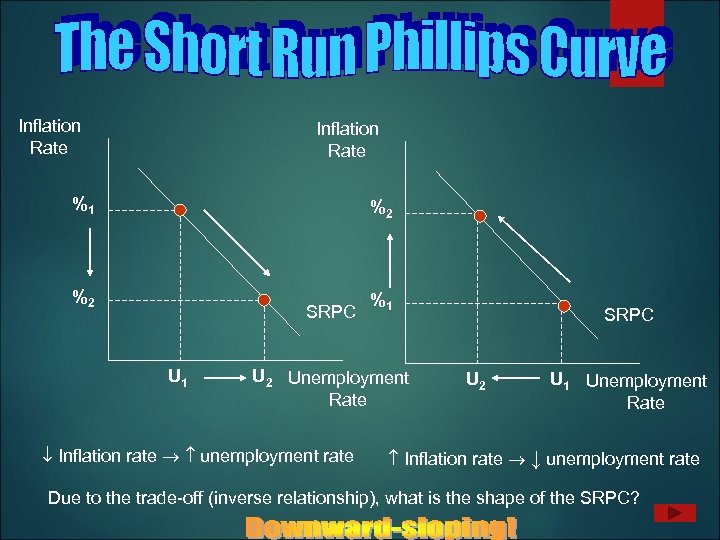 Inflation Rate %1 %2 %2 SRPC U 1 %1 U 2 Unemployment Rate Inflation rate unemployment rate SRPC U 2 U 1 Unemployment Rate Inflation rate ↓ unemployment rate Due to the trade-off (inverse relationship), what is the shape of the SRPC?
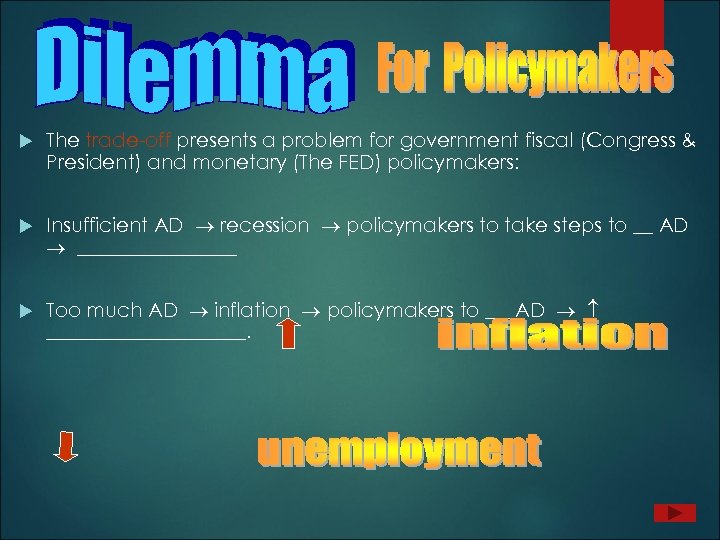 The trade-off presents a problem for government fiscal (Congress & President) and monetary (The FED) policymakers: Insufficient AD recession policymakers to take steps to __ AD ________ Too much AD inflation policymakers to ___AD __________.
 Address the problem without creating a worse problem – limit the negative effects. When stagflation first occurred in the 1970 s due to a supplyside shock ( price of oil/energy), it created a new dilemma for policymakers and called into question the credibility of the short run Phillips Curve (SRPC) relationship.
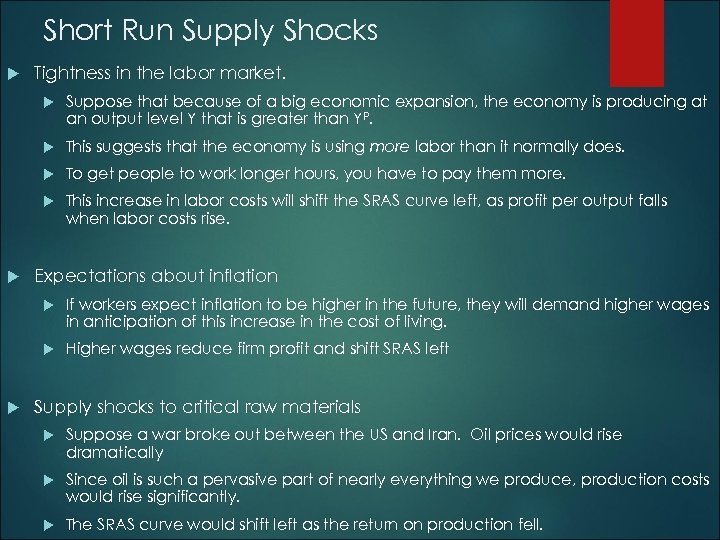 Short Run Supply Shocks Tightness in the labor market. This suggests that the economy is using more labor than it normally does. To get people to work longer hours, you have to pay them more. Suppose that because of a big economic expansion, the economy is producing at an output level Y that is greater than YP. This increase in labor costs will shift the SRAS curve left, as profit per output falls when labor costs rise. Expectations about inflation If workers expect inflation to be higher in the future, they will demand higher wages in anticipation of this increase in the cost of living. Higher wages reduce firm profit and shift SRAS left Supply shocks to critical raw materials Suppose a war broke out between the US and Iran. Oil prices would rise dramatically Since oil is such a pervasive part of nearly everything we produce, production costs would rise significantly. The SRAS curve would shift left as the return on production fell.
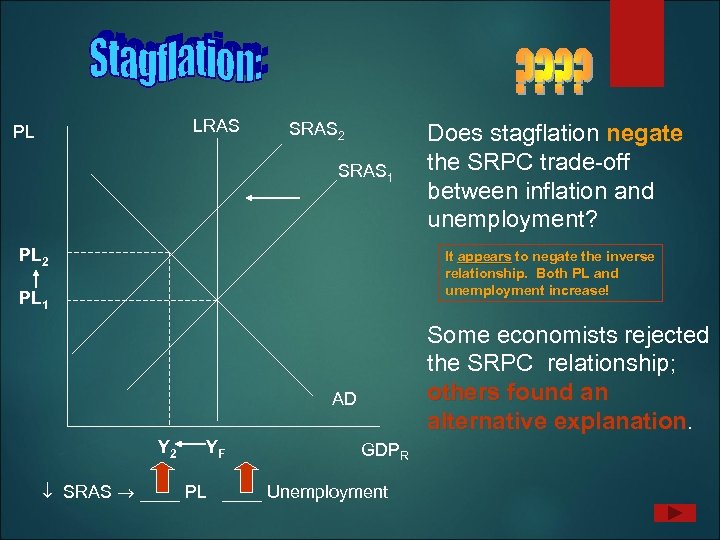 LRAS PL SRAS 2 SRAS 1 PL 2 Does stagflation negate the SRPC trade-off between inflation and unemployment? It appears to negate the inverse relationship. Both PL and unemployment increase! PL 1 Some economists rejected the SRPC relationship; others found an alternative explanation AD Y 2 YF GDPR SRAS ____ PL ____ Unemployment
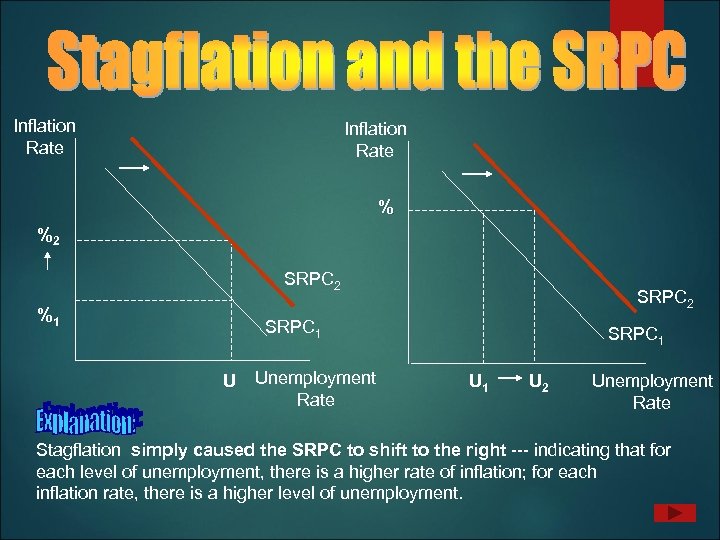 Inflation Rate % %2 SRPC 2 %1 SRPC 2 SRPC 1 U Unemployment Rate SRPC 1 U 2 Unemployment Rate Stagflation simply caused the SRPC to shift to the right --- indicating that for right each level of unemployment, there is a higher rate of inflation; for each inflation rate, there is a higher level of unemployment.
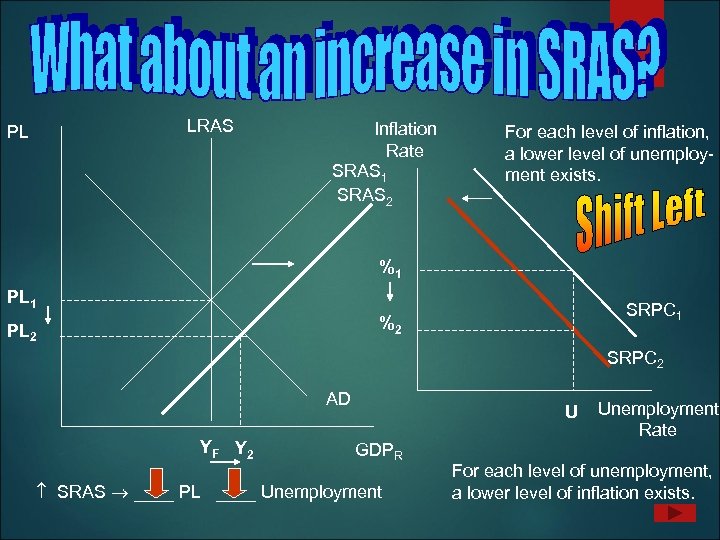 LRAS PL Inflation Rate SRAS 1 SRAS 2 For each level of inflation, a lower level of unemployment exists. %1 PL 1 SRPC 1 %2 PL 2 SRPC 2 AD YF Y 2 U GDPR SRAS ____ PL ____ Unemployment Rate For each level of unemployment, a lower level of inflation exists.
 Short Run: a period of time in which wages do NOT Run adjust to price level changes (insufficient time for adjustment) Long Run: a period of time in which wages adjust to Run price level changes; sufficient time for labor contracts changes to end and be renegotiated; sufficient time for labor to realize the impact of price level changes on real income.
 If the government chooses to let the economy fix itself (classical economics)… What is currently happening to the PL when there is inflation? Because of the higher price level businesses are making more money. Wages have remained the same in the short run! But our real wages have decreased! So we are making the less money and businesses are making more. We will go to our work place and tell our bosses: Give me a raise or I quit (they will not be able to replace you because U% is low (lower than natural rate- there are very few people looking for jobs) Because wages have increased, it is more expensive to produce, causing SRAS to shift to the left.
 The Self-Correcting Economy Suppose that a decrease in consumer confidence causes the aggregate demand curve to shift left. At current prices, there will be a surplus of production as consumers demand fewer goods and services Firms will cut both their prices and their production until the surplus inventory is sold. Output and prices fall in the short run, resulting in a recession. Eventually, lower output prices and less demand for labor will induce a fall in production costs. The SRAS curve will shift right until full employment output is restored at a lower price (assuming consumer confidence never recovered). The economy will always return to full-employment output, but how long does this adjustment process take?
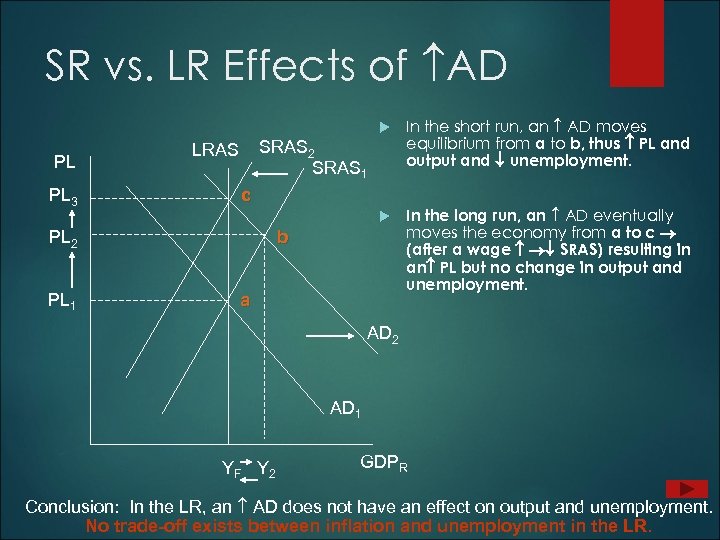 SR vs. LR Effects of AD PL PL 3 In the long run, an AD eventually moves the economy from a to c (after a wage SRAS) resulting in an PL but no change in output and unemployment. SRAS 2 SRAS 1 LRAS c PL 2 PL 1 In the short run, an AD moves equilibrium from a to b, thus PL and output and unemployment. b a AD 2 AD 1 YF Y 2 GDPR Conclusion: In the LR, an AD does not have an effect on output and unemployment. No trade-off exists between inflation and unemployment in the LR.
 If the government chooses to let the economy fix itself (classical economics)… to the PL in a recession? What is currently happening Because of the lower price level businesses are making less money. Wages have remained the same in the short run! But our real wages have increased. So we are making the more money and businesses are making less. They will tell their employees they have 2 choices: Take a wage cut or You’re fired (they will replace you because U% is high- someone will want your job at a lower wage) Because wages have decreased, it is cheaper to produce, causing SRAS to shift to the right.
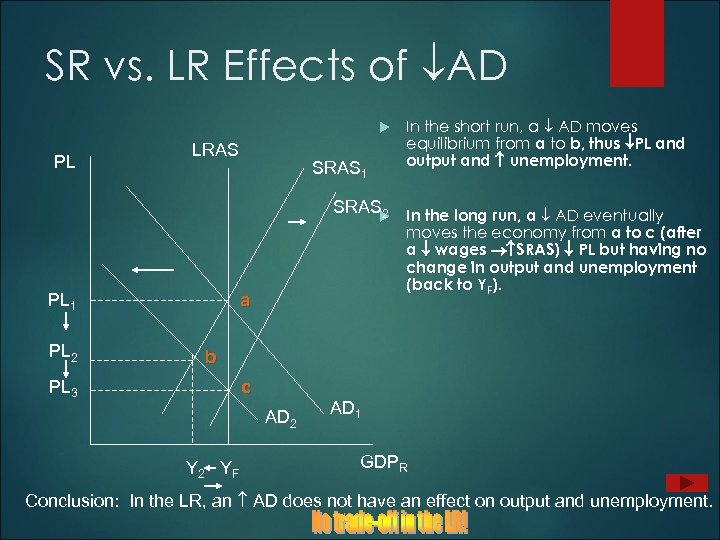 SR vs. LR Effects of AD PL LRAS SRAS 1 In the short run, a AD moves equilibrium from a to b, thus PL and output and unemployment. SRAS In the long run, a AD eventually 2 PL 1 PL 2 moves the economy from a to c (after a wages SRAS) PL but having no change in output and unemployment (back to YF). a b PL 3 c AD 2 Y 2 YF AD 1 GDPR Conclusion: In the LR, an AD does not have an effect on output and unemployment.
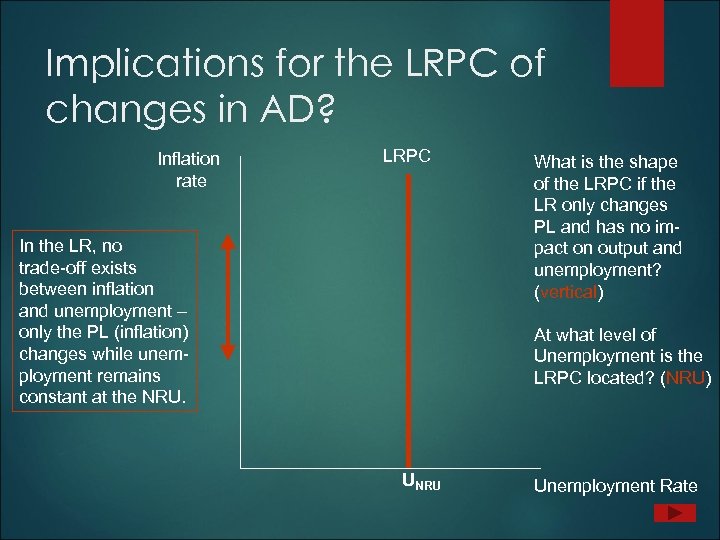 Implications for the LRPC of changes in AD? Inflation rate LRPC In the LR, no trade-off exists between inflation and unemployment – only the PL (inflation) changes while unemployment remains constant at the NRU. What is the shape of the LRPC if the LR only changes PL and has no impact on output and unemployment? (vertical) At what level of Unemployment is the LRPC located? (NRU) UNRU Unemployment Rate
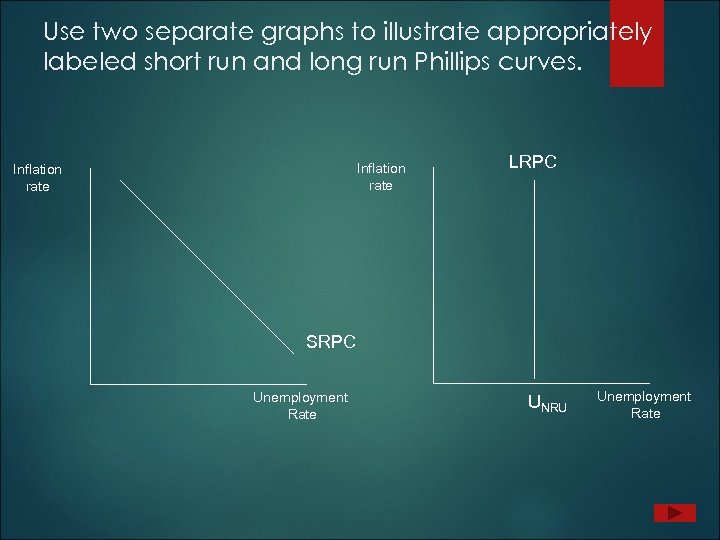 Use two separate graphs to illustrate appropriately labeled short run and long run Phillips curves. Inflation rate LRPC SRPC Unemployment Rate UNRU Unemployment Rate

![2 2 [“REP”] D ___33. Decrease in the availability of key natural resources (R)?](https://present5.com/presentation/1a86d1eb30728aaff44a20d6dcc040bb/image-119.jpg "2 2 [“REP”] D ___33. Decrease in the availability of key natural resources (R)?") 2 2 [“REP”] D ___33. Decrease in the availability of key natural resources (R)? C ___34. Increase in resource productivity (P)? A ___35. Increase in foreign spending on our products (Xn)? B ___36. Substantial reduction in government spending (G)? C ___37. Declines in the prices of imported resources (R)? B ___38. Declines in the incomes of our trading partners (Xn)? A ___39. Improvement in business profit expectations (Ig)? B ___40. Stock market plunge affects consumer wealth (C)? B ___41. There is an increase in interest rates [stable prices] (C & Ig)? A ___42. Consumer indebtedness is very low (C)? Extra: D ___43. Increased government regulations are forced on businesses (E)? C ___44. The government increases subsidies to all farmers (E)?
2 2 [“REP”] D ___33. Decrease in the availability of key natural resources (R)? C ___34. Increase in resource productivity (P)? A ___35. Increase in foreign spending on our products (Xn)? B ___36. Substantial reduction in government spending (G)? C ___37. Declines in the prices of imported resources (R)? B ___38. Declines in the incomes of our trading partners (Xn)? A ___39. Improvement in business profit expectations (Ig)? B ___40. Stock market plunge affects consumer wealth (C)? B ___41. There is an increase in interest rates [stable prices] (C & Ig)? A ___42. Consumer indebtedness is very low (C)? Extra: D ___43. Increased government regulations are forced on businesses (E)? C ___44. The government increases subsidies to all farmers (E)?
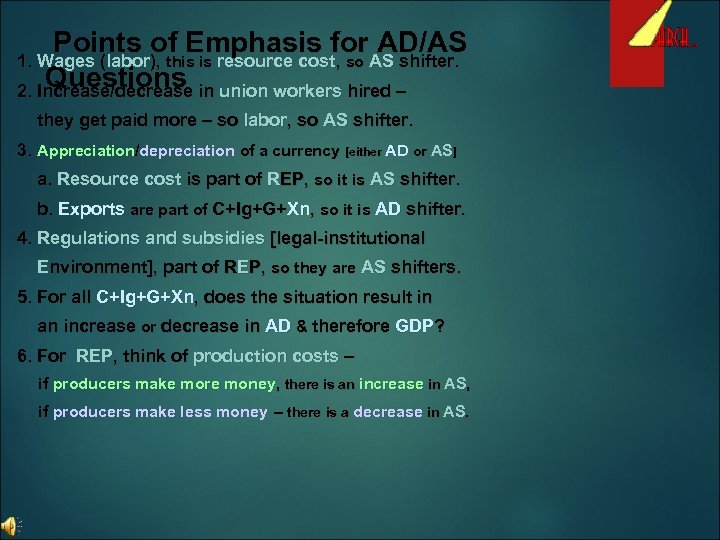 Points of Emphasis for AD/AS Questions 2. Increase/decrease in union workers hired – 1. Wages (labor), this is resource cost, so AS shifter. they get paid more – so labor, so AS shifter. 3. Appreciation/depreciation of a currency [either AD or AS] a. Resource cost is part of REP, so it is AS shifter. b. Exports are part of C+Ig+G+Xn, so it is AD shifter. 4. Regulations and subsidies [legal-institutional Environment], part of REP, so they are AS shifters. 5. For all C+Ig+G+Xn, does the situation result in an increase or decrease in AD & therefore GDP? 6. For REP, think of production costs – if producers make more money, there is an increase in AS, if producers make less money – there is a decrease in AS.
![[“REP”] B __1. Consumers fear a widespread depression __2. Britain and Japan increase their](https://present5.com/presentation/1a86d1eb30728aaff44a20d6dcc040bb/image-121.jpg "[“REP”] B __1. Consumers fear a widespread depression __2. Britain and Japan increase their") [“REP”] B __1. Consumers fear a widespread depression __2. Britain and Japan increase their purchases of U. S. A agricultural products. __3. Our exports are affected by a depreciation of the dollar A A __4. There is a huge increase in government spending for health care. __5. Interest rates increase although prices are stable. B stable B __6. 20% increase in the personal income tax C __7. An increase in labor productivity C __8. A 15% decrease in nominal wages __9. Appreciation of the dollar affects imported resources. C A __10. Canada, Mexico, & Japan come out of recession and buy more American cars
[“REP”] B __1. Consumers fear a widespread depression __2. Britain and Japan increase their purchases of U. S. A agricultural products. __3. Our exports are affected by a depreciation of the dollar A A __4. There is a huge increase in government spending for health care. __5. Interest rates increase although prices are stable. B stable B __6. 20% increase in the personal income tax C __7. An increase in labor productivity C __8. A 15% decrease in nominal wages __9. Appreciation of the dollar affects imported resources. C A __10. Canada, Mexico, & Japan come out of recession and buy more American cars
![[“REP”] A widespread fear of depression on the part of consumers A large purchase](https://present5.com/presentation/1a86d1eb30728aaff44a20d6dcc040bb/image-122.jpg "[“REP”] A widespread fear of depression on the part of consumers A large purchase") [“REP”] A widespread fear of depression on the part of consumers A large purchase of wheat by Russia, one of our trade partners Russia B ___3. Our exports are affected by an appreciation of the dollar ___4. A reduction in interest rates although price level remains constant. A B ___5. A huge cut in government expenditures for health care. A ___6. Consumer expectations of a rapid rise in the price level C ___7. The complete disintegration of OPEC, causing oil prices to fall by ½. ___8. A 10% reduction in personal income tax rates. A rates C ___9. An increase in labor productivity D ___10. A 12% increase in nominal wages. D ___11. Imported resources are affected by a depreciation of the dollar. B ___12. A sharp decline in the national incomes of our trading partners. C ___13. A decline in the % of the U. S. labor force which is unionized B ___1. ___2. A
[“REP”] A widespread fear of depression on the part of consumers A large purchase of wheat by Russia, one of our trade partners Russia B ___3. Our exports are affected by an appreciation of the dollar ___4. A reduction in interest rates although price level remains constant. A B ___5. A huge cut in government expenditures for health care. A ___6. Consumer expectations of a rapid rise in the price level C ___7. The complete disintegration of OPEC, causing oil prices to fall by ½. ___8. A 10% reduction in personal income tax rates. A rates C ___9. An increase in labor productivity D ___10. A 12% increase in nominal wages. D ___11. Imported resources are affected by a depreciation of the dollar. B ___12. A sharp decline in the national incomes of our trading partners. C ___13. A decline in the % of the U. S. labor force which is unionized B ___1. ___2. A
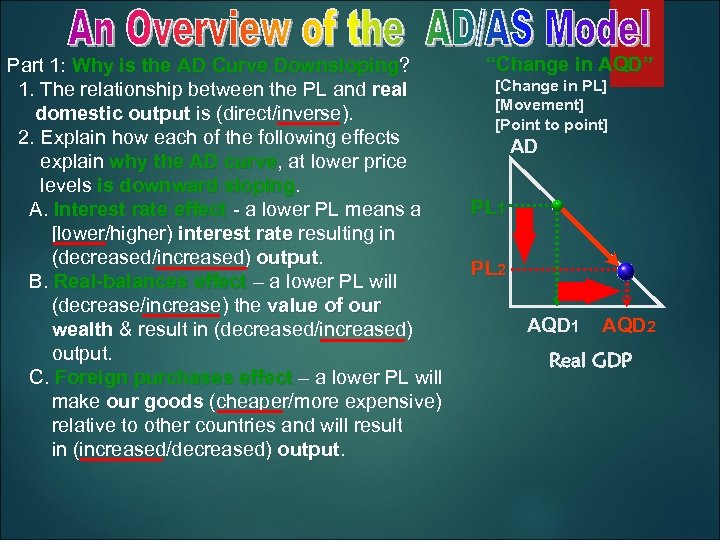 Part 1: Why is the AD Curve Downsloping? 1. The relationship between the PL and real domestic output is (direct/inverse). output 2. Explain how each of the following effects explain why the AD curve, at lower price curve levels is downward sloping A. Interest rate effect - a lower PL means a effect [lower/higher) interest rate resulting in rate (decreased/increased) output B. Real-balances effect – a lower PL will effect (decrease/increase) the value of our wealth & result in (decreased/increased) wealth output C. Foreign purchases effect – a lower PL will effect make our goods (cheaper/more expensive) goods relative to other countries and will result in (increased/decreased) output “Change in AQD” [Change in PL] [Movement] [Point to point] AD PL 1 PL 2 AQD 1 AQD 2 Real GDP
![AD Shifters (C+Ig+G+Xn) “Change in AD” [non PL/shift/whole curve] A E B “C” D](https://present5.com/presentation/1a86d1eb30728aaff44a20d6dcc040bb/image-124.jpg "AD Shifters (C+Ig+G+Xn) “Change in AD” [non PL/shift/whole curve] A E B “C” D") AD Shifters (C+Ig+G+Xn) “Change in AD” [non PL/shift/whole curve] A E B “C” D C I G -X Part 2: Shifts in AD A. Increase AD? B. Decrease AD? C. No Change in AD (movement) D. Do not shift beyond A or E PL Real GDP *We will start at AD curve “C”. D 1. Congress funds ten new military bases with $20 billion. AD__Curve__ Congress + 2. Due to consumer pessimism, businesses cut back on Ig. AD__Curve__ C pessimism Ig 3. Ten billion G revenues are sent to Texas to help on “High 10”. AD__Curve__ D 10” + 4. Foreigners increase their demand by 50% for our computers. AD__Curve__ + E Foreigners 5. Business leaders feel economy is headed for a recession. AD__Curve__ D recession 6. Stock market collapses and investors lose billions. AD__Curve__ C billions NC 7. Productivity is up for 3 rd straight year due to increases in technology. AD__Curve__ C roductivity 8. President and Congress cut defense spending by 20% AD__Curve__ B spending and there is no increase in domestic spending.
AD Shifters (C+Ig+G+Xn) “Change in AD” [non PL/shift/whole curve] A E B “C” D C I G -X Part 2: Shifts in AD A. Increase AD? B. Decrease AD? C. No Change in AD (movement) D. Do not shift beyond A or E PL Real GDP *We will start at AD curve “C”. D 1. Congress funds ten new military bases with $20 billion. AD__Curve__ Congress + 2. Due to consumer pessimism, businesses cut back on Ig. AD__Curve__ C pessimism Ig 3. Ten billion G revenues are sent to Texas to help on “High 10”. AD__Curve__ D 10” + 4. Foreigners increase their demand by 50% for our computers. AD__Curve__ + E Foreigners 5. Business leaders feel economy is headed for a recession. AD__Curve__ D recession 6. Stock market collapses and investors lose billions. AD__Curve__ C billions NC 7. Productivity is up for 3 rd straight year due to increases in technology. AD__Curve__ C roductivity 8. President and Congress cut defense spending by 20% AD__Curve__ B spending and there is no increase in domestic spending.
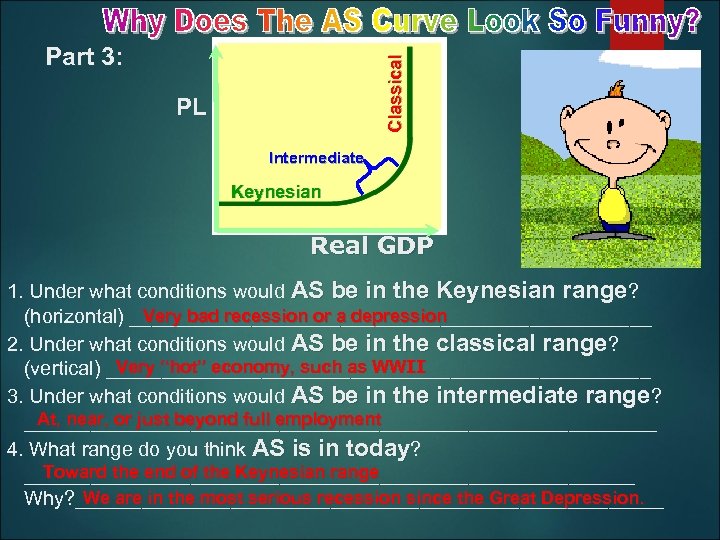 Classical Part 3: PL Intermediate Keynesian Real GDP 1. Under what conditions would AS be in the Keynesian range? Very bad recession or a depression (horizontal) ________________________ 2. Under what conditions would AS be in the classical range? Very “hot” economy, such as WWII (vertical) _________________________ 3. Under what conditions would AS be in the intermediate range? At, near, or just beyond full employment _____________________________ 4. What range do you think AS is in today? Toward the end of the Keynesian range ____________________________ We are in the most serious recession since the Great Depression. Why? ___________________________
![AS Shifters [“REP”] “Change in AS” [non PL/shift/whole curve] A E B “C” D](https://present5.com/presentation/1a86d1eb30728aaff44a20d6dcc040bb/image-126.jpg "AS Shifters [“REP”] “Change in AS” [non PL/shift/whole curve] A E B “C” D") AS Shifters [“REP”] “Change in AS” [non PL/shift/whole curve] A E B “C” D PL AD “REP” Part 4: Shifts in AS A. Increase AS? B. Decrease AS? C. No Change in AS (movement) D. Do not shift beyond A or E Real GDP *We will start at AS curve “C”. B 1. Unions grow more aggressive and wages increase. AS__Curve__ increase A 2. OPEC successful increases oil prices [resource cost]. AS__Curve__ cost B 3. Labor productivity increases dramatically. AS__Curve__ + increases + C 4. Giant natural gas discovery decreases energy prices. AS__Curve__ prices + D 5. Computer technology brings new efficiency to industry. AS__Curve__ efficiency NC D 6. Government spends $20 billion on highways. AS__Curve__ Government C 7. Government announces all auto owners must install $5, 000 AS__Curve__ install $5, 000 car engines so that all autos can be fueled by carrot juice. B 8. The international value of the dollar decreases by 20% AS__Curve__ decreases and affects prices of resources bought overseas.
AS Shifters [“REP”] “Change in AS” [non PL/shift/whole curve] A E B “C” D PL AD “REP” Part 4: Shifts in AS A. Increase AS? B. Decrease AS? C. No Change in AS (movement) D. Do not shift beyond A or E Real GDP *We will start at AS curve “C”. B 1. Unions grow more aggressive and wages increase. AS__Curve__ increase A 2. OPEC successful increases oil prices [resource cost]. AS__Curve__ cost B 3. Labor productivity increases dramatically. AS__Curve__ + increases + C 4. Giant natural gas discovery decreases energy prices. AS__Curve__ prices + D 5. Computer technology brings new efficiency to industry. AS__Curve__ efficiency NC D 6. Government spends $20 billion on highways. AS__Curve__ Government C 7. Government announces all auto owners must install $5, 000 AS__Curve__ install $5, 000 car engines so that all autos can be fueled by carrot juice. B 8. The international value of the dollar decreases by 20% AS__Curve__ decreases and affects prices of resources bought overseas.
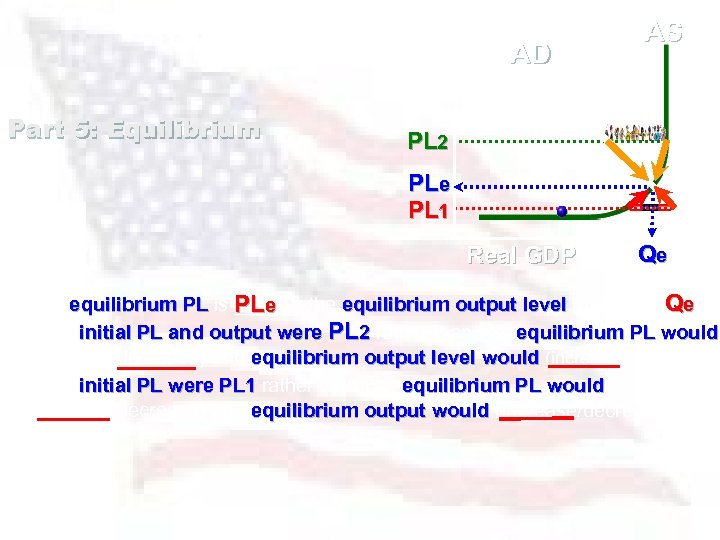 AD Part 5: Equilibrium AS PL 2 PLe PL 1 Real GDP Qe 1. The equilibrium PL is ____ & the equilibrium output level [output] is ____. Qe PL PLe level 2. If the initial PL and output were PL 2 rather than Pe, equilibrium PL would (increase/decrease) and equilibrium output level would (increase/decrease). would 3. If the initial PL were PL 1 rather than Pe, equilibrium PL would PL 1 PL (increase/decrease) and equilibrium output would (increase/decrease). output would
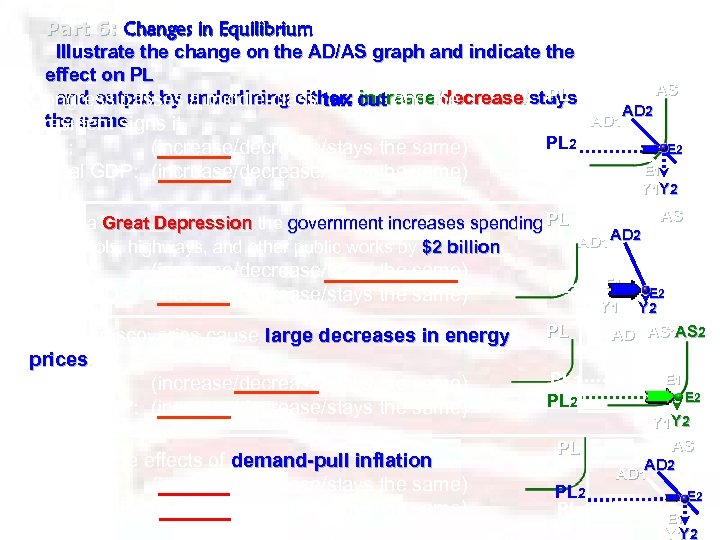 Part 6: Changes in Equilibrium Illustrate the change on the AD/AS graph and indicate the effect on PL AS PL and output by underlining either: cut either: increase/decrease/stays 1. Congress passes a middle-class tax cut and the AD 2 AD 1 the same President signs it. PL: (increase/decrease/stays the same) Real GDP: (increase/decrease/stays the same) PL 2 PL 1 2. During a Great Depression the government increases spending PL Depression on schools, highways, and other public works by $2 billion PL: (increase/decrease/stays the same) Real GDP: (increase/decrease/stays the same) 3. New oil discoveries cause large decreases in energy prices PL: (increase/decrease/stays the same) Real GDP: (increase/decrease/stays the same) 4. Illustrate the effects of demand-pull inflation PL: (increase/decrease/stays the same) Real GDP: (increase/decrease/stays the same) E 2 E 1 Y 2 AS AD 1 AD 2 PL 1 E 1 Y 1 PL E 2 Y 2 AD AS 1 AS 2 PL 1 PL 2 PL 1 E 2 Y 1 Y 2 AS AD 2 AD 1 E 2 E 1 Y 1 2 Y
![Changes in Equilibrium [Continued] 5. Illustrate the effects of cost-push inflation [Stagflation] inflation PL](https://present5.com/presentation/1a86d1eb30728aaff44a20d6dcc040bb/image-129.jpg "Changes in Equilibrium [Continued] 5. Illustrate the effects of cost-push inflation [Stagflation] inflation PL") Changes in Equilibrium [Continued] 5. Illustrate the effects of cost-push inflation [Stagflation] inflation PL AD PL: (increase/decrease/stays the same) Real GDP: (increase/decrease/stays the same) PL 2 PL 1 6. New technology and better education increase productivity PL: (increase/decrease/stays the same) Real GDP: (increase/decrease/stays the same) PL E 2 E 1 Y 2 Y 1 AD PL 2 PL 1 AS 1 AS 2 E 1 E 2 PL 1 7. New President says all AP Econ students who make “A’s” PL in econ can go to college free. [G will pick up the tab] tab PL 2 PL: (increase/decrease/stays the same) PL 1 Real GDP: (increase/decrease/stays the same) 8. With an unemployment rate at 7%, the government reduces taxes and increases government spending PL: (increase/decrease/stays the same) Real GDP: (increase/decrease/stays the same) AS 2 AS 1 Y 1 Y 2 AD 2 AS AD 1 E 2 E 1 Y 2 AS AD 2 AD 1 E 2 E 1 Y 1 2 Y
Changes in Equilibrium [Continued] 5. Illustrate the effects of cost-push inflation [Stagflation] inflation PL AD PL: (increase/decrease/stays the same) Real GDP: (increase/decrease/stays the same) PL 2 PL 1 6. New technology and better education increase productivity PL: (increase/decrease/stays the same) Real GDP: (increase/decrease/stays the same) PL E 2 E 1 Y 2 Y 1 AD PL 2 PL 1 AS 1 AS 2 E 1 E 2 PL 1 7. New President says all AP Econ students who make “A’s” PL in econ can go to college free. [G will pick up the tab] tab PL 2 PL: (increase/decrease/stays the same) PL 1 Real GDP: (increase/decrease/stays the same) 8. With an unemployment rate at 7%, the government reduces taxes and increases government spending PL: (increase/decrease/stays the same) Real GDP: (increase/decrease/stays the same) AS 2 AS 1 Y 1 Y 2 AD 2 AS AD 1 E 2 E 1 Y 2 AS AD 2 AD 1 E 2 E 1 Y 1 2 Y
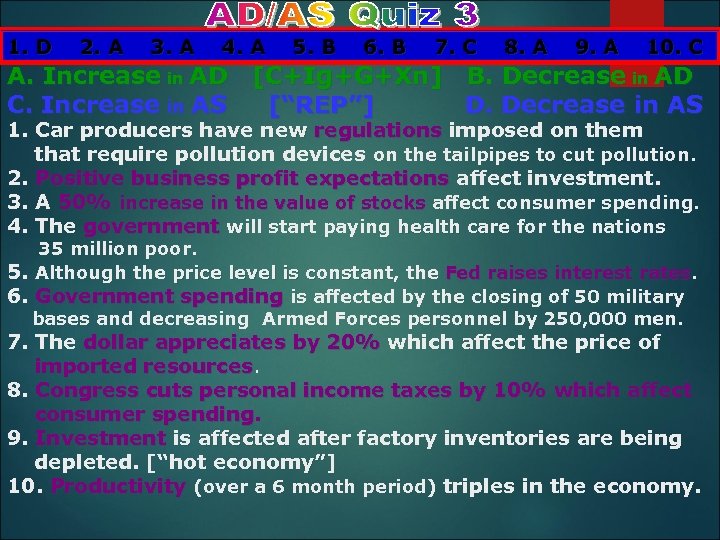 1. D 2. A 3. A 4. A 5. B 6. B 7. C 8. A 9. A 10. C A. Increase in AD [C+Ig+G+Xn] B. Decrease in AD C. Increase in AS [“REP”] D. Decrease in AS 1. Car producers have new regulations imposed on them that require pollution devices on the tailpipes to cut pollution. 2. Positive business profit expectations affect investment. 3. A 50% increase in the value of stocks affect consumer spending. 4. The government will start paying health care for the nations 35 million poor. 5. Although the price level is constant, the Fed raises interest rates. constant rates 6. Government spending is affected by the closing of 50 military bases and decreasing Armed Forces personnel by 250, 000 men. 7. The dollar appreciates by 20% which affect the price of imported resources 8. Congress cuts personal income taxes by 10% which affect consumer spending 9. Investment is affected after factory inventories are being depleted. [“hot economy”] economy” 10. Productivity (over a 6 month period) triples in the economy.
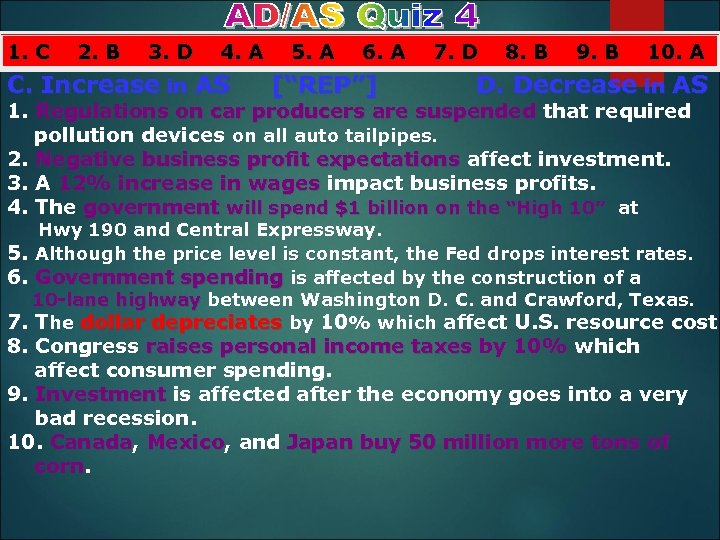 1. C 2. B 3. in AD A 5. A 6. A 7. DB. 8. B 9. B in AD A. Increase D 4. [C+Ig+G+Xn] Decrease 10. A C. Increase in AS [“REP”] D. Decrease in AS 1. Regulations on car producers are suspended that required pollution devices on all auto tailpipes. 2. Negative business profit expectations affect investment. 3. A 12% increase in wages impact business profits. 4. The government will spend $1 billion on the “High 10” at Hwy 190 and Central Expressway. 5. Although the price level is constant, the Fed drops interest rates. constant rates 6. Government spending is affected by the construction of a 10 -lane highway between Washington D. C. and Crawford, Texas. 7. The dollar depreciates by 10% which affect U. S. resource cost 8. Congress raises personal income taxes by 10% which affect consumer spending. 9. Investment is affected after the economy goes into a very bad recession 10. Canada, Mexico, and Japan buy 50 million more tons of corn
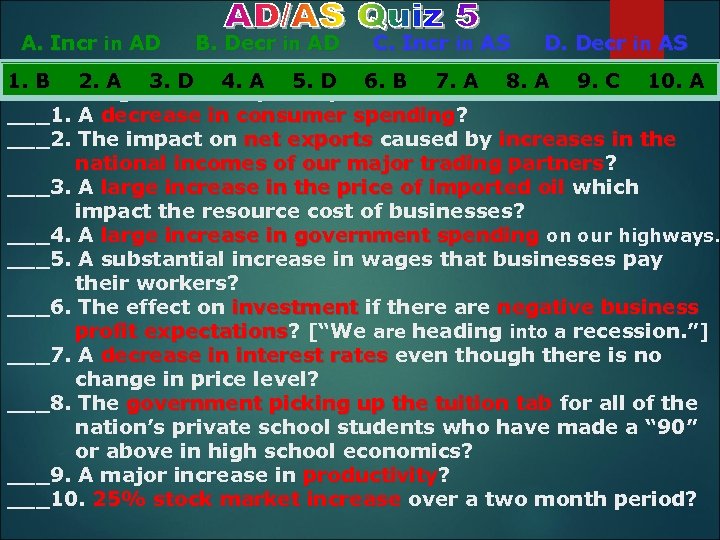 A. Incr in AD B. Decr in AD C. Incr in AS D. Decr in AS [C+Ig+G+Xn] [REP] 1. B 2. A 3. D 4. A 5. D 6. B 7. A 8. A 9. C 10. A Which diagram above portrays: ___1. A decrease in consumer spending? spending ___2. The impact on net exports caused by increases in the national incomes of our major trading partners? partners ___3. A large increase in the price of imported oil which impact the resource cost of businesses? ___4. A large increase in government spending on our highways. ___5. A substantial increase in wages that businesses pay their workers? ___6. The effect on investment if there are negative business profit expectations? [“We are heading into a recession. ”] expectations recession ___7. A decrease in interest rates even though there is no change in price level? ___8. The government picking up the tuition tab for all of the nation’s private school students who have made a “ 90” or above in high school economics? ___9. A major increase in productivity? productivity ___10. 25% stock market increase over a two month period?
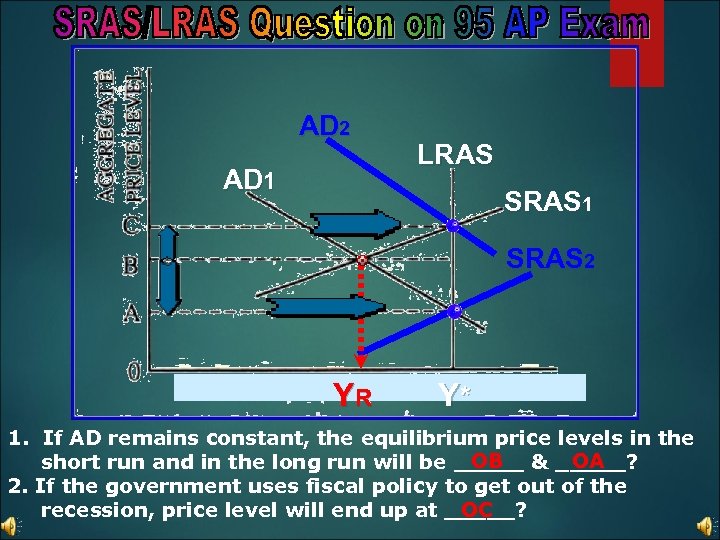 AD 2 AD 1 LRAS SRAS 1 SRAS 2 YR Y* 1. If AD remains constant, the equilibrium price levels in the OA OB short run and in the long run will be _____ & _____? 2. If the government uses fiscal policy to get out of the OC recession, price level will end up at _____?
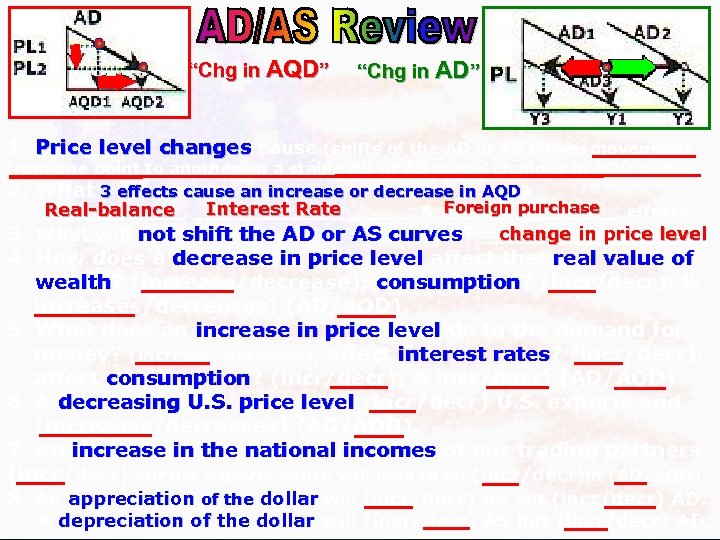 “Chg in AQD” “Chg in AD” 1. Price level changes cause (shifts of the AD or AS curve/movements from one point to another on a stable AD or AS curve[changes in AQD or AQS]. 2. What 3 effects cause an increase or decrease in AQD? AQD Foreign purchase Interest Rate Real-balance _______, __________, & ________ effects. change in price level 3. What will not shift the AD or AS curves? ________ curves 4. How does a decrease in price level affect the: real value of wealth? (increase/decrease); consumption? (incr/decr); & wealth consumption increases/decreases) (AD/AQD). 5. What does an increase in price level do to the demand for money? (increase/decrease); affect interest rates? (incr/decr); rates affect consumption? (incr/decr); & incr/decr) (AD/AQD). consumption 6. A decreasing U. S. price level (incr/decr) U. S. exports and (increases/decreases) (AD/AQD). 7. An increase in the national incomes of our trading partners (incr/decr) our net exports which will lead to an (incr/decr)in (AD/AQD). 8. An appreciation of the dollar will (incr/decr) AS but (incr/decr) AD. A depreciation of the dollar will (incr/decr) AS but (incr/decr) AD.
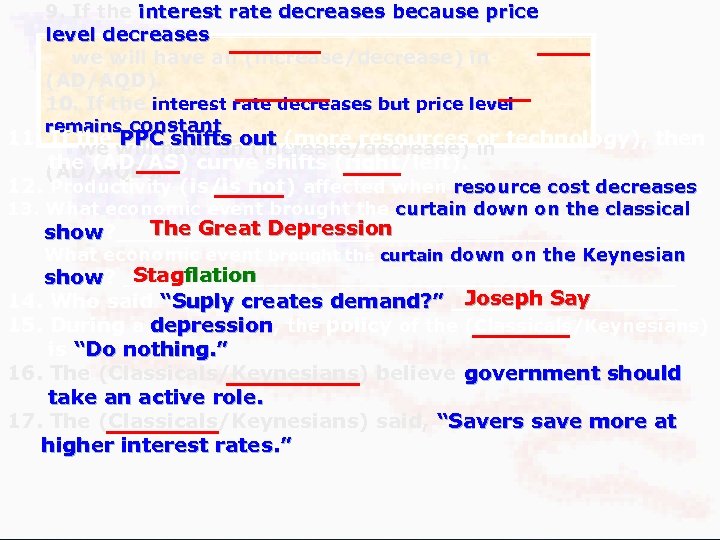 9. If the interest rate decreases because price level decreases we will have an (increase/decrease) in (AD/AQD). 10. If the interest rate decreases but price level remains constant 11. If the will have an (increase/decrease) or technology), then PPC shifts out (more resources in we the (AD/AS) curve shifts (right/left). (AD/AQD). 12. Productivity (is/is not) affected when resource cost decreases 13. What economic event brought the curtain down on the classical The Great Depression show? ____________________ show What economic event brought the curtain down on the Keynesian show? ____________________ show Stagflation Joseph Say 14. Who said “Suply creates demand? ” ________ 15. During a depression, the policy of the (Classicals/Keynesians) depression is “Do nothing. ” 16. The (Classicals/Keynesians) believe government should take an active role. 17. The (Classicals/Keynesians) said, “Savers save more at higher interest rates. ”
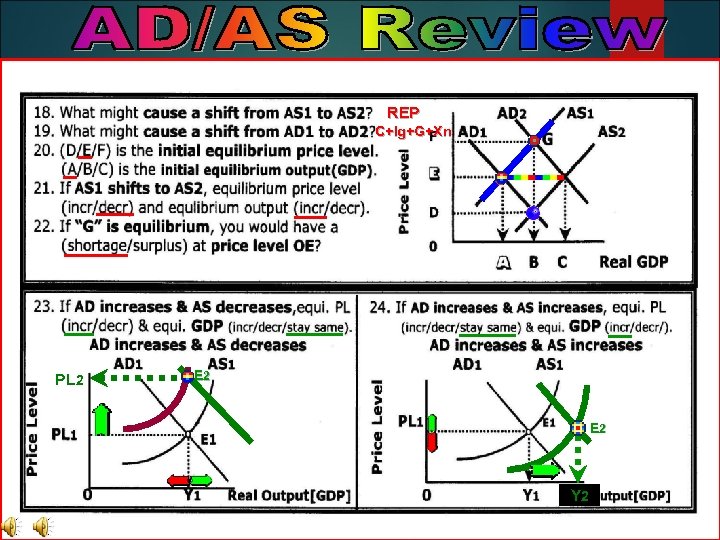 REP C+Ig+G+Xn PL 2 E 2 Y 2
![A. Increase in AD [C+Ig+G+Xn] B. Decrease in AD C. Increase in AS [“REP”]](https://present5.com/presentation/1a86d1eb30728aaff44a20d6dcc040bb/image-137.jpg "A. Increase in AD [C+Ig+G+Xn] B. Decrease in AD C. Increase in AS [“REP”]") A. Increase in AD [C+Ig+G+Xn] B. Decrease in AD C. Increase in AS [“REP”] D. Decrease in AS 1. Regulations on car producers are increased that require pollution devices on all auto tailpipes. 2. Positive business profit expectations affect investment. 3. A 10% decrease in wages impact business profits. 4. The government will spend $75 billion less as it closes 75 domestic military bases. 5. Although the price level is constant, the Fed drops interest rates. constant rates 6. Government spending is affected by the U. S. instituting nationalized healthcare. 7. The dollar appreciates by 10% which affect U. S. resource cost 8. Congress decreases personal income taxes by 20% which affect consumer spending. 9. Investment is affected after the economy goes into a very severe recession 10. The U. S. buys 50 million more tons of sugar cane imports from Brazil & they buy less of our beef and other exports. 1. D 2. A 3. C 4. B 5. A 6. A 7. C 8. A 9. B 10. B
A. Increase in AD [C+Ig+G+Xn] B. Decrease in AD C. Increase in AS [“REP”] D. Decrease in AS 1. Regulations on car producers are increased that require pollution devices on all auto tailpipes. 2. Positive business profit expectations affect investment. 3. A 10% decrease in wages impact business profits. 4. The government will spend $75 billion less as it closes 75 domestic military bases. 5. Although the price level is constant, the Fed drops interest rates. constant rates 6. Government spending is affected by the U. S. instituting nationalized healthcare. 7. The dollar appreciates by 10% which affect U. S. resource cost 8. Congress decreases personal income taxes by 20% which affect consumer spending. 9. Investment is affected after the economy goes into a very severe recession 10. The U. S. buys 50 million more tons of sugar cane imports from Brazil & they buy less of our beef and other exports. 1. D 2. A 3. C 4. B 5. A 6. A 7. C 8. A 9. B 10. B
![A. Increase in AD [C+Ig+G+Xn] B. Decrease in AD C. Increase in AS [“REP”]](https://present5.com/presentation/1a86d1eb30728aaff44a20d6dcc040bb/image-138.jpg "A. Increase in AD [C+Ig+G+Xn] B. Decrease in AD C. Increase in AS [“REP”]") A. Increase in AD [C+Ig+G+Xn] B. Decrease in AD C. Increase in AS [“REP”] D. Decrease in AS 1. U. S. factories have new regulations imposed on them that require them to cut pollution by 25%. 2. Negative business profit expectations affect investment. 3. A 20% decrease in the value of stocks affect consumer spending. 4. The government will give $60 billion to the states so they can repair their aging bridges and highways. 5. Although the price level is constant, the Fed raises interest rates. constant rates 6. Government spending is affected by the closing of 30 military bases and decreasing the Armed Forces by 150, 000 men. 7. The dollar depreciates by 20% which affect the price of imported resources 8. Congress increases personal income taxes by 13% which affect consumer spending 9. Investment is affected after factory inventories are being depleted. [“hot economy”] 10. U. S. productivity declines because of several earthquakes in California, Texas and New York. 1. D 2. B 3. B 4. A 5. B 6. B 7. D 8. B 9. A 10. D
A. Increase in AD [C+Ig+G+Xn] B. Decrease in AD C. Increase in AS [“REP”] D. Decrease in AS 1. U. S. factories have new regulations imposed on them that require them to cut pollution by 25%. 2. Negative business profit expectations affect investment. 3. A 20% decrease in the value of stocks affect consumer spending. 4. The government will give $60 billion to the states so they can repair their aging bridges and highways. 5. Although the price level is constant, the Fed raises interest rates. constant rates 6. Government spending is affected by the closing of 30 military bases and decreasing the Armed Forces by 150, 000 men. 7. The dollar depreciates by 20% which affect the price of imported resources 8. Congress increases personal income taxes by 13% which affect consumer spending 9. Investment is affected after factory inventories are being depleted. [“hot economy”] 10. U. S. productivity declines because of several earthquakes in California, Texas and New York. 1. D 2. B 3. B 4. A 5. B 6. B 7. D 8. B 9. A 10. D
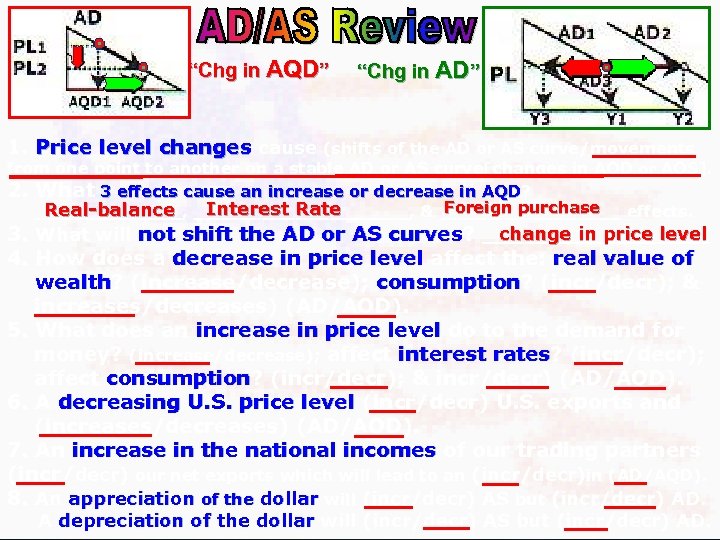 “Chg in AQD” “Chg in AD” 1. Price level changes cause (shifts of the AD or AS curve/movements from one point to another on a stable AD or AS curve[changes in AQD or AQS]. 2. What 3 effects cause an increase or decrease in AQD? AQD Foreign purchase Interest Rate Real-balance _______, __________, & ________ effects. change in price level 3. What will not shift the AD or AS curves? ________ curves 4. How does a decrease in price level affect the: real value of wealth? (increase/decrease); consumption? (incr/decr); & wealth consumption increases/decreases) (AD/AQD). 5. What does an increase in price level do to the demand for money? (increase/decrease); affect interest rates? (incr/decr); rates affect consumption? (incr/decr); & incr/decr) (AD/AQD). consumption 6. A decreasing U. S. price level (incr/decr) U. S. exports and (increases/decreases) (AD/AQD). 7. An increase in the national incomes of our trading partners (incr/decr) our net exports which will lead to an (incr/decr)in (AD/AQD). 8. An appreciation of the dollar will (incr/decr) AS but (incr/decr) AD. A depreciation of the dollar will (incr/decr) AS but (incr/decr) AD.
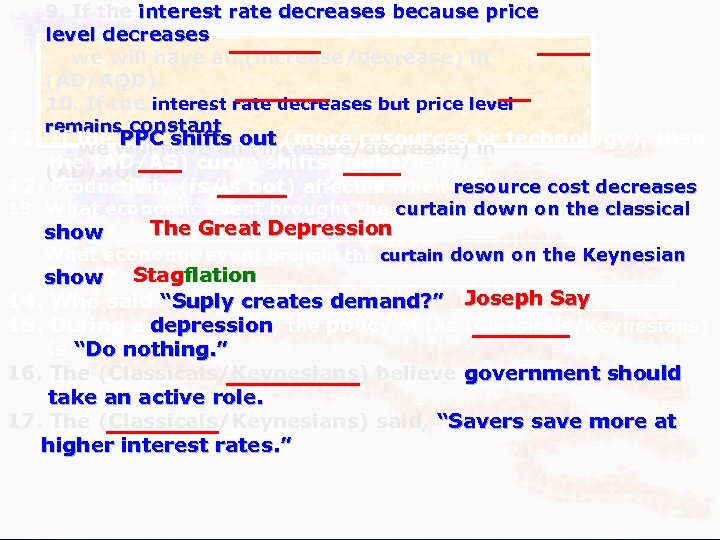 9. If the interest rate decreases because price level decreases we will have an (increase/decrease) in (AD/AQD). 10. If the interest rate decreases but price level remains constant 11. If the will have an (increase/decrease) or technology), then PPC shifts out (more resources in we the (AD/AS) curve shifts (right/left). (AD/AQD). 12. Productivity (is/is not) affected when resource cost decreases 13. What economic event brought the curtain down on the classical The Great Depression show? ____________________ show What economic event brought the curtain down on the Keynesian show? ____________________ show Stagflation Joseph Say 14. Who said “Suply creates demand? ” ________ 15. During a depression, the policy of the (Classicals/Keynesians) depression is “Do nothing. ” 16. The (Classicals/Keynesians) believe government should take an active role. 17. The (Classicals/Keynesians) said, “Savers save more at higher interest rates. ”
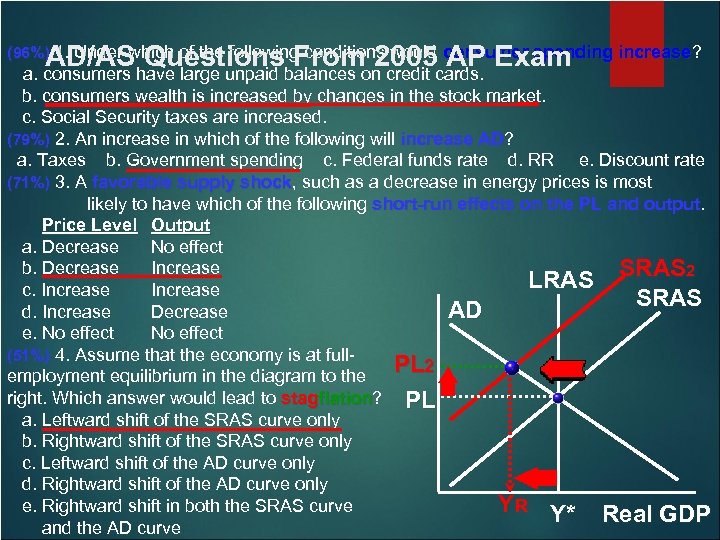 AD/AS Questions From 2005 AP Exam (96%) 1. Under which of the following conditions would consumer spending increase? increase a. consumers have large unpaid balances on credit cards. b. consumers wealth is increased by changes in the stock market. c. Social Security taxes are increased. (79%) 2. An increase in which of the following will increase AD? AD a. Taxes b. Government spending c. Federal funds rate d. RR e. Discount rate (71%) 3. A favorable supply shock, such as a decrease in energy prices is most shock likely to have which of the following short-run effects on the PL and output Price Level Output a. Decrease No effect b. Decrease Increase LRAS SRAS 2 c. Increase SRAS d. Increase Decrease AD e. No effect (51%) 4. Assume that the economy is at full. PL 2 employment equilibrium in the diagram to the right. Which answer would lead to stagflation? PL flation a. Leftward shift of the SRAS curve only b. Rightward shift of the SRAS curve only c. Leftward shift of the AD curve only d. Rightward shift of the AD curve only e. Rightward shift in both the SRAS curve YR Y* Real GDP and the AD curve
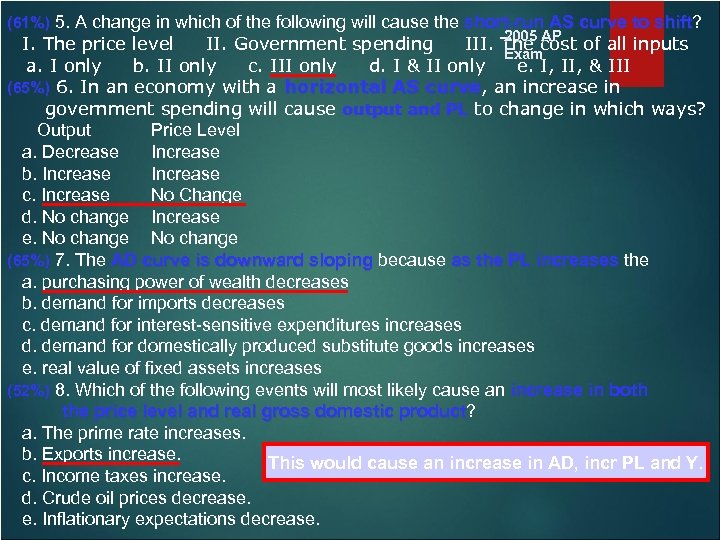 (61%) 5. A change in which of the following will cause the short-run AS curve to shift? shift 2005 AP I. The price level II. Government spending III. The cost of all inputs Exam a. I only b. II only c. III only d. I & II only e. I, II, & III (65%) 6. In an economy with a horizontal AS curve, an increase in curve government spending will cause output and PL to change in which ways? Output Price Level a. Decrease Increase b. Increase c. Increase No Change d. No change Increase e. No change (65%) 7. The AD curve is downward sloping because as the PL increases the sloping increases a. purchasing power of wealth decreases b. demand for imports decreases c. demand for interest-sensitive expenditures increases d. demand for domestically produced substitute goods increases e. real value of fixed assets increases (52%) 8. Which of the following events will most likely cause an increase in both the price level and real gross domestic product? product a. The prime rate increases. b. Exports increase. This would cause an increase in AD, incr PL and Y. c. Income taxes increase. d. Crude oil prices decrease. e. Inflationary expectations decrease.
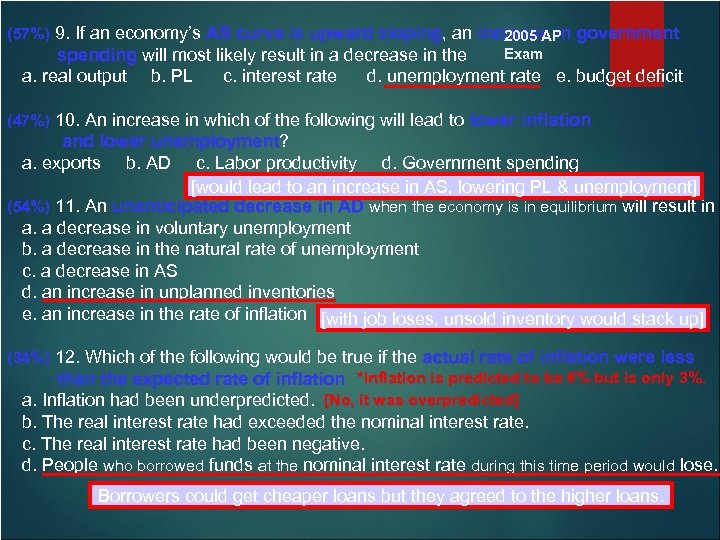 (57%) 9. If an economy’s AS curve is upward sloping, an increase in government sloping 2005 AP government Exam spending will most likely result in a decrease in the spending a. real output b. PL c. interest rate d. unemployment rate e. budget deficit (47%) 10. An increase in which of the following will lead to lower inflation and lower unemployment? unemployment a. exports b. AD c. Labor productivity d. Government spending [would lead to an increase in AS, lowering PL & unemployment] (54%) 11. An unanticipated decrease in AD when the economy is in equilibrium will result in AD a. a decrease in voluntary unemployment b. a decrease in the natural rate of unemployment c. a decrease in AS d. an increase in unplanned inventories e. an increase in the rate of inflation [with job loses, unsold inventory would stack up] (34%) 12. Which of the following would be true if the actual rate of inflation were less than the expected rate of inflation *Inflation is predicted to be 6% but is only 3%. a. Inflation had been underpredicted. [No, it was overpredicted] b. The real interest rate had exceeded the nominal interest rate. c. The real interest rate had been negative. d. People who borrowed funds at the nominal interest rate during this time period would lose. Borrowers could get cheaper loans but they agreed to the higher loans.
 AD/AS Questions shock would most likely result in 1. (58%) A contractionary supply From 2000 AP Exam shock a. an increase in AD d. a decrease in the general price level b. an increase in national income e. a decrease in employment c. an increase in GDP SRAS would shift left, incr PL, decr GDP, & decr employment. 2. (82%) If the economy is operating in the intermediate range of the AS curve and range curve if AD increases due to an increase in net exports, then the price level, output, & increases level output the unemployment rate are most likely to change in which of the following ways? rate Price Level Output Unemployment Rate a. increase b. increase decrease c. increase decrease e. decrease increase 3. (78%) The short-run AS curve is likely to shift to the left when there is an increase in curve left a. the cost of productive resources d. the federal budget deficit b. productivity e. imports c. the money supply 4. (54%) Which of the following best explains how an economy could simultaneously experience high inflation and high unemployment? unemployment a. The government increases spending without increasing taxes. b. The government increases taxes without increasing spending. c. Inflationary expectations decline. d. Women and teen-agers stay out of the labor force. e. Negative supply shocks cause factor prices to increase
 2000 AP Exam 5. (89%) The intersection of the AS & the AD curve occurs at the economy’s equilibrium level of a. real investment and the interest rate d. government expenditures & taxes b. real disposable income and unemployment e. imports and exports c. real domestic output(GDP) and the price level 6. (58%) Which of the following would cause a rightward shift of the AS curve? curve a. an increase in interest rates b. a tax increase of 50 cents per gallon for gasoline c. an across-the-board reduction of wages in the manufacturing sector d. the passage of legislation mandating a reduction in automobile pollution e. the shutdown of plants and movement of production of goods abroad 7. (38%) Which changes in the AD & AS curves is likely to result in stagflation? curves flation a. the AD curve shifts to the left when the economy is in the classical range of the AS curve. b. the AD curve shifts to the right when the economy is in the classical range of the AS curve. c. the AD curve shifts to the right when the economy is in the Keynesian range of the AS curve. d. The AS curve shifts to the left. e. The AS curve shifts to the right.
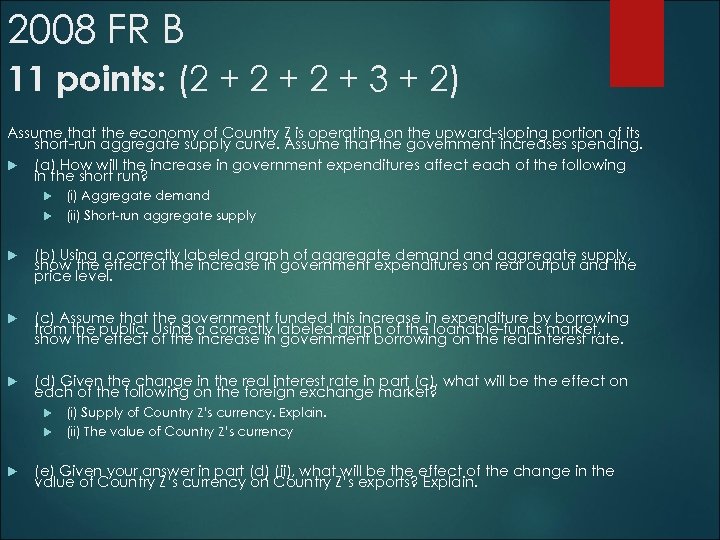 2008 FR B 11 points: (2 + 2 + 3 + 2) Assume that the economy of Country Z is operating on the upward-sloping portion of its short-run aggregate supply curve. Assume that the government increases spending. (a) How will the increase in government expenditures affect each of the following in the short run? (i) Aggregate demand (ii) Short-run aggregate supply (b) Using a correctly labeled graph of aggregate demand aggregate supply, show the effect of the increase in government expenditures on real output and the price level. (c) Assume that the government funded this increase in expenditure by borrowing from the public. Using a correctly labeled graph of the loanable-funds market, show the effect of the increase in government borrowing on the real interest rate. (d) Given the change in the real interest rate in part (c), what will be the effect on each of the following on the foreign exchange market? (i) Supply of Country Z’s currency. Explain. (ii) The value of Country Z’s currency (e) Given your answer in part (d) (ii), what will be the effect of the change in the value of Country Z’s currency on Country Z’s exports? Explain.
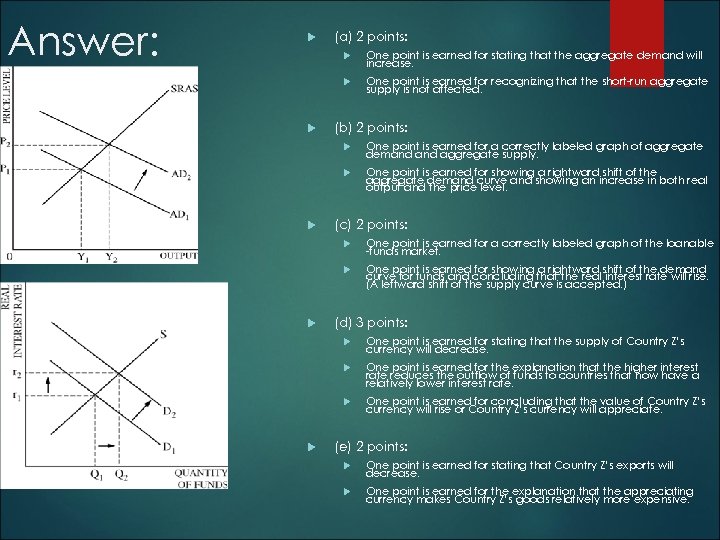 Answer: (a) 2 points: One point is earned for stating that the aggregate demand will increase. One point is earned for recognizing that the short-run aggregate supply is not affected. (b) 2 points: One point is earned for a correctly labeled graph of aggregate demand aggregate supply. One point is earned for showing a rightward shift of the aggregate demand curve and showing an increase in both real output and the price level. (c) 2 points: One point is earned for a correctly labeled graph of the loanable -funds market. One point is earned for showing a rightward shift of the demand curve for funds and concluding that the real interest rate will rise. (A leftward shift of the supply curve is accepted. ) (d) 3 points: One point is earned for the explanation that the higher interest rate reduces the outflow of funds to countries that now have a relatively lower interest rate. One point is earned for stating that the supply of Country Z’s currency will decrease. One point is earned for concluding that the value of Country Z’s currency will rise or Country Z’s currency will appreciate. (e) 2 points: One point is earned for stating that Country Z’s exports will decrease. One point is earned for the explanation that the appreciating currency makes Country Z’s goods relatively more expensive.
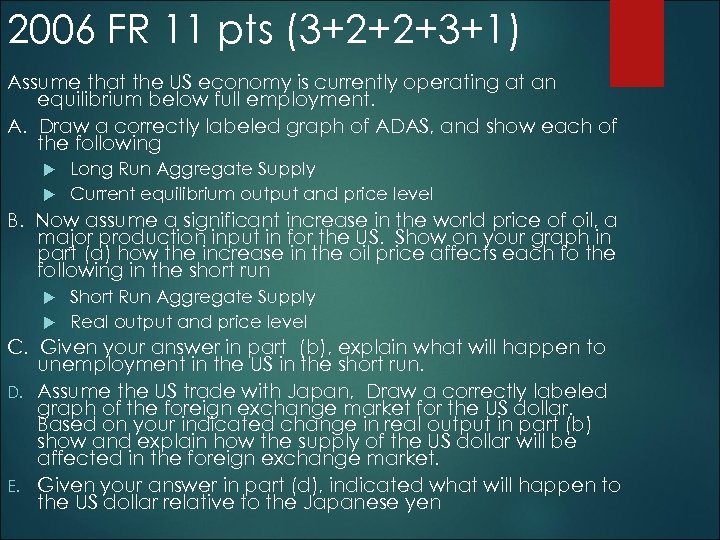 2006 FR 11 pts (3+2+2+3+1) Assume that the US economy is currently operating at an equilibrium below full employment. A. Draw a correctly labeled graph of ADAS, and show each of the following Long Run Aggregate Supply Current equilibrium output and price level B. Now assume a significant increase in the world price of oil, a major production input in for the US. Show on your graph in part (a) how the increase in the oil price affects each fo the following in the short run Short Run Aggregate Supply Real output and price level C. Given your answer in part (b), explain what will happen to unemployment in the US in the short run. D. Assume the US trade with Japan, Draw a correctly labeled graph of the foreign exchange market for the US dollar. Based on your indicated change in real output in part (b) show and explain how the supply of the US dollar will be affected in the foreign exchange market. E. Given your answer in part (d), indicated what will happen to the US dollar relative to the Japanese yen
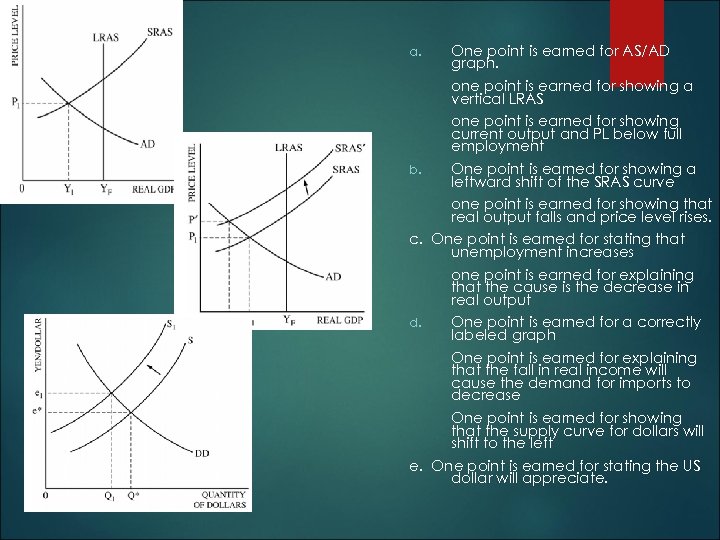 Answer: a. One point is earned for AS/AD graph. one point is earned for showing a vertical LRAS one point is earned for showing current output and PL below full employment b. One point is earned for showing a leftward shift of the SRAS curve one point is earned for showing that real output falls and price level rises. c. One point is earned for stating that unemployment increases one point is earned for explaining that the cause is the decrease in real output d. One point is earned for a correctly labeled graph One point is earned for explaining that the fall in real income will cause the demand for imports to decrease One point is earned for showing that the supply curve for dollars will shift to the left e. One point is earned for stating the US dollar will appreciate.
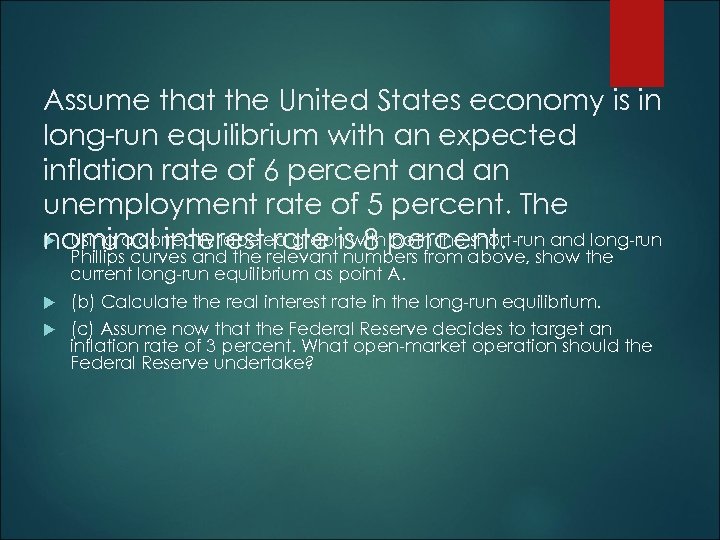 Assume that the United States economy is in long-run equilibrium with an expected inflation rate of 6 percent and an unemployment rate of 5 percent. The Using a correctly labeled graph with percent. nominal interest relevantis 8 both the above, show the rate numbers from short-run and long-run Phillips curves and the current long-run equilibrium as point A. (b) Calculate the real interest rate in the long-run equilibrium. (c) Assume now that the Federal Reserve decides to target an inflation rate of 3 percent. What open-market operation should the Federal Reserve undertake?
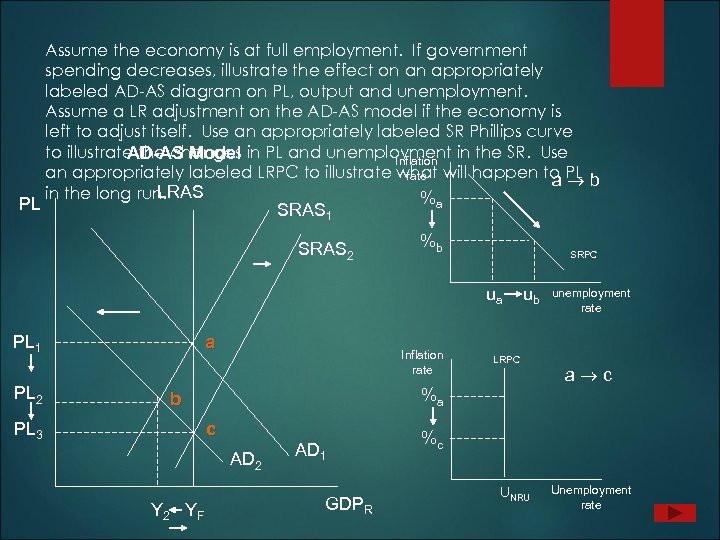 PL Assume the economy is at full employment. If government spending decreases, illustrate the effect on an appropriately labeled AD-AS diagram on PL, output and unemployment. Assume a LR adjustment on the AD-AS model if the economy is left to adjust itself. Use an appropriately labeled SR Phillips curve to illustrate the changes in PL and unemployment in the SR. Use AD-AS Model Inflation an appropriately labeled LRPC to illustrate what will happen to PL rate a b LRAS in the long run. % SRAS 1 SRAS 2 a %b SRPC ua ub PL 1 PL 2 a Inflation rate %a b PL 3 c AD 2 Y 2 YF LRPC AD 1 GDPR unemployment rate a c %c UNRU Unemployment rate
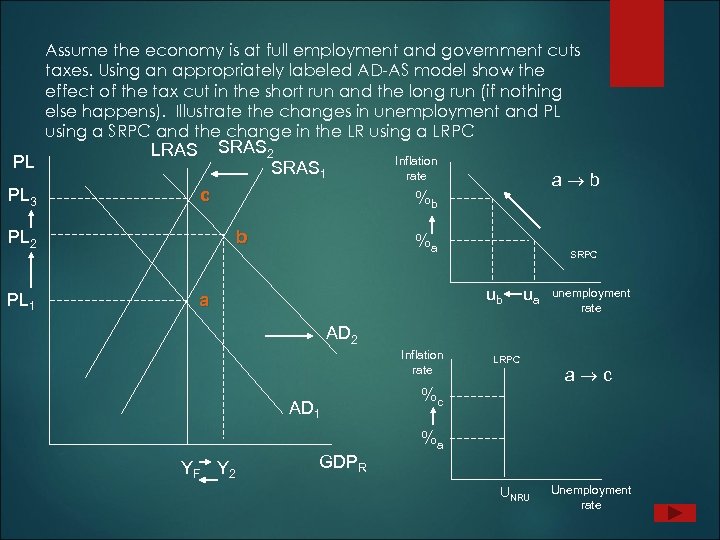 Assume the economy is at full employment and government cuts taxes. Using an appropriately labeled AD-AS model show the effect of the tax cut in the short run and the long run (if nothing else happens). Illustrate the changes in unemployment and PL using a SRPC and the change in the LR using a LRPC PL PL 3 SRAS 2 SRAS 1 LRAS c PL 1 a b %b b PL 2 Inflation rate %a SRPC ub ua a unemployment rate AD 2 Inflation rate AD 1 LRPC %c a c %a YF Y 2 GDPR UNRU Unemployment rate
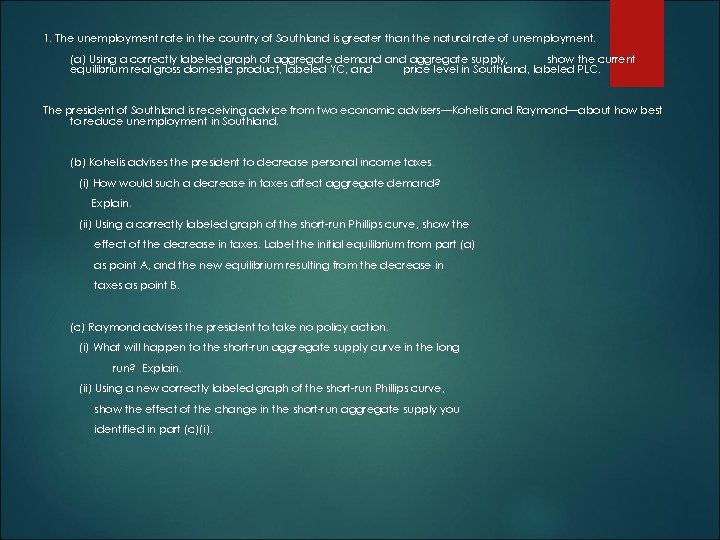 1. The unemployment rate in the country of Southland is greater than the natural rate of unemployment. (a) Using a correctly labeled graph of aggregate demand aggregate supply, show the current equilibrium real gross domestic product, labeled YC, and price level in Southland, labeled PLC. The president of Southland is receiving advice from two economic advisers—Kohelis and Raymond—about how best to reduce unemployment in Southland. (b) Kohelis advises the president to decrease personal income taxes. (i) How would such a decrease in taxes affect aggregate demand? Explain. (ii) Using a correctly labeled graph of the short-run Phillips curve, show the effect of the decrease in taxes. Label the initial equilibrium from part (a) as point A, and the new equilibrium resulting from the decrease in taxes as point B. (c) Raymond advises the president to take no policy action. (i) What will happen to the short-run aggregate supply curve in the long run? Explain. (ii) Using a new correctly labeled graph of the short-run Phillips curve, show the effect of the change in the short-run aggregate supply you identified in part (c)(i).
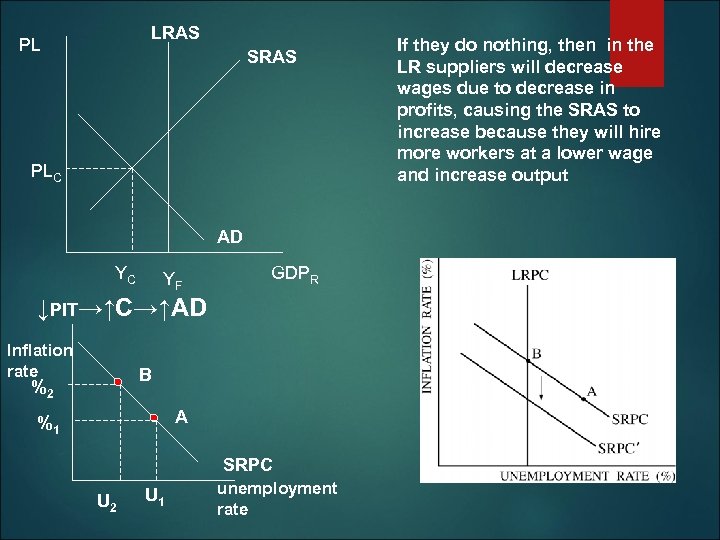 LRAS PL SRAS PLC AD YC YF GDPR ↓PIT→↑C→↑AD Inflation rate B %2 A %1 SRPC U 2 U 1 unemployment rate If they do nothing, then in the LR suppliers will decrease wages due to decrease in profits, causing the SRAS to increase because they will hire more workers at a lower wage and increase output
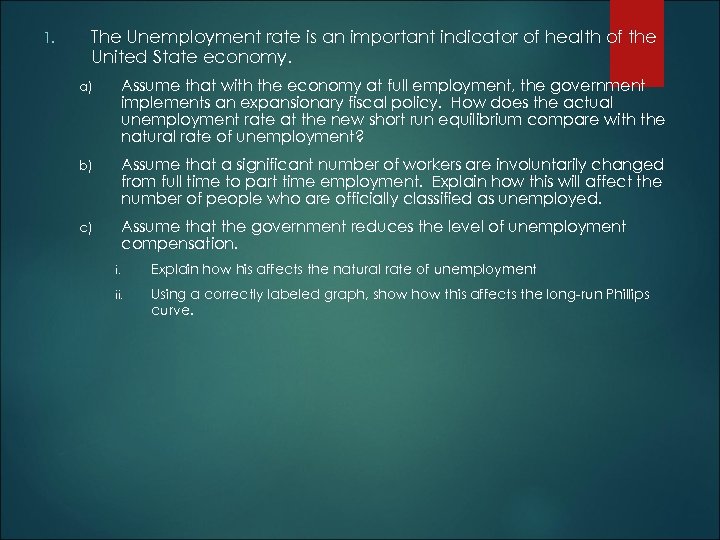 1. The Unemployment rate is an important indicator of health of the United State economy. a) Assume that with the economy at full employment, the government implements an expansionary fiscal policy. How does the actual unemployment rate at the new short run equilibrium compare with the natural rate of unemployment? b) Assume that a significant number of workers are involuntarily changed from full time to part time employment. Explain how this will affect the number of people who are officially classified as unemployed. c) Assume that the government reduces the level of unemployment compensation. i. Explain how his affects the natural rate of unemployment ii. Using a correctly labeled graph, show this affects the long-run Phillips curve.
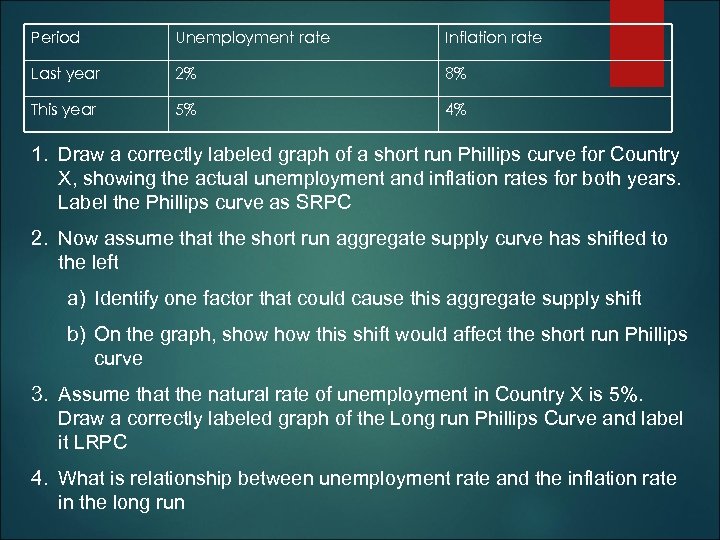 Period Unemployment rate Inflation rate Last year 2% 8% This year 5% 4% 1. Draw a correctly labeled graph of a short run Phillips curve for Country X, showing the actual unemployment and inflation rates for both years. Label the Phillips curve as SRPC 2. Now assume that the short run aggregate supply curve has shifted to the left a) Identify one factor that could cause this aggregate supply shift b) On the graph, show this shift would affect the short run Phillips curve 3. Assume that the natural rate of unemployment in Country X is 5%. Draw a correctly labeled graph of the Long run Phillips Curve and label it LRPC 4. What is relationship between unemployment rate and the inflation rate in the long run
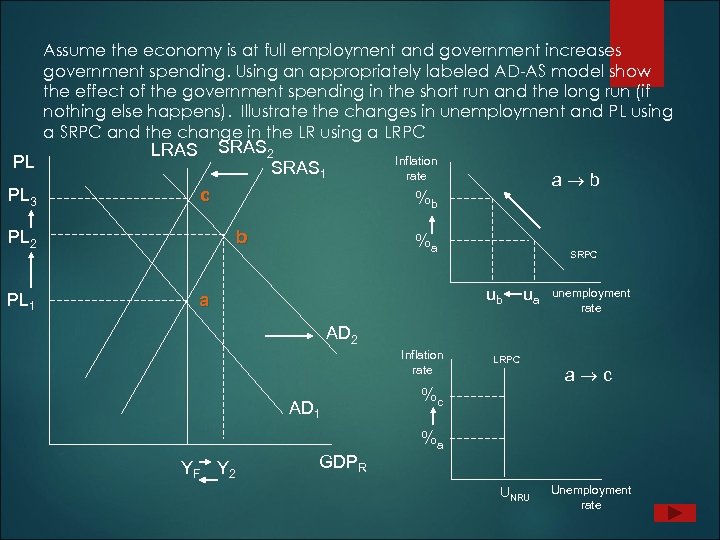 Assume the economy is at full employment and government increases government spending. Using an appropriately labeled AD-AS model show the effect of the government spending in the short run and the long run (if nothing else happens). Illustrate the changes in unemployment and PL using a SRPC and the change in the LR using a LRPC PL PL 3 SRAS 2 SRAS 1 LRAS c PL 1 a b %b b PL 2 Inflation rate %a SRPC ub ua a unemployment rate AD 2 Inflation rate AD 1 LRPC %c a c %a YF Y 2 GDPR UNRU Unemployment rate