 Скачать презентацию Consumer Surplus Brief description about the concept 1
9a4f97b94096580ca5e0dd0596d60435.ppt
- Количество слайдов: 30



Consumer Surplus Brief description about the concept (1 -2 lines) Dr. K. Narayanan Professor Department of Humanities and Social Sciences IIT Bombay
1 2 3 Definitions and Keywords 4 5 Concept of consumer surplus first formulated by Dupuit in 1844 and further refined and popularised by Marshall in his book ‘Principles of Economics’ published in 1890. It is the basis of ‘Welfare Economics’. Welfare economics: the study of how the allocation of resources affects economic well-being. Definition-: Consumer surplus is simply the difference between the price that one is willing to pay and the price one actually pays for a particular product.
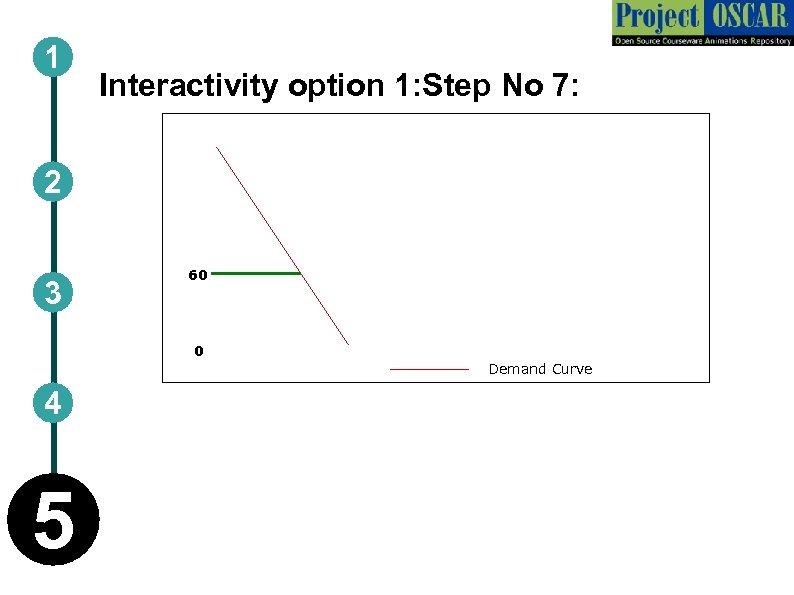
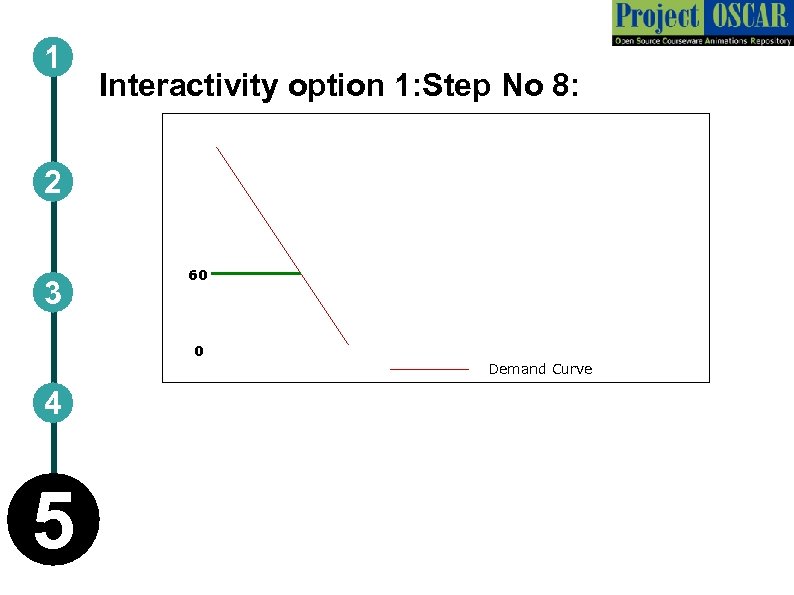
Definition Contd… ‘Excess of the price which a consumer would be willing to pay, rather than go without a thing over that he actually does pay, is the economic measure of this surplus satisfaction…it may be called consumer surplus. ’- Marshall Therefore consumer surplus equals buyers’ willingness to pay for a good minus the amount they actually pay for it, and it measures the benefit buyers get from participating in a market. Consumer surplus can be computed by finding the area below the demand curve and above the price.
1 2 3 4 5 Master Layout Consumer Surplus
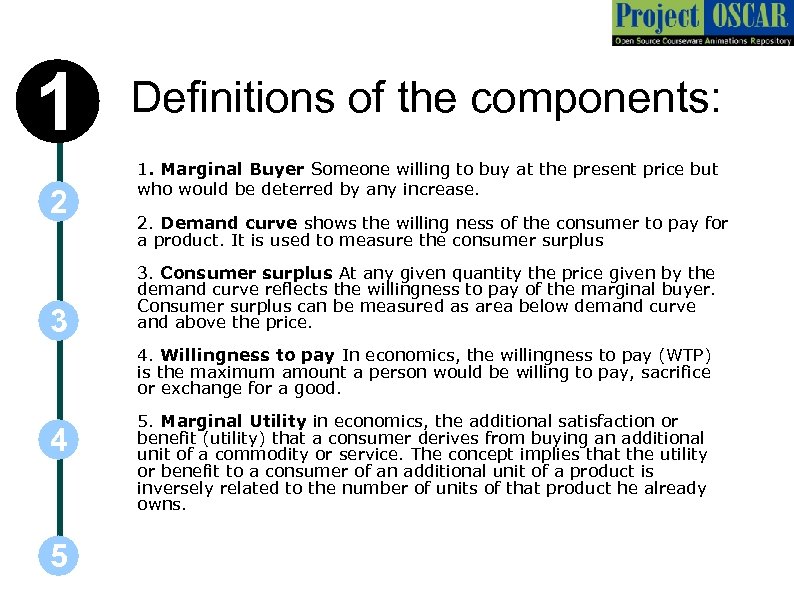
1 2 3 Definitions of the components: 1. Marginal Buyer Someone willing to buy at the present price but who would be deterred by any increase. 2. Demand curve shows the willing ness of the consumer to pay for a product. It is used to measure the consumer surplus 3. Consumer surplus At any given quantity the price given by the demand curve reflects the willingness to pay of the marginal buyer. Consumer surplus can be measured as area below demand curve and above the price. 4. Willingness to pay In economics, the willingness to pay (WTP) is the maximum amount a person would be willing to pay, sacrifice or exchange for a good. 4 5 5. Marginal Utility in economics, the additional satisfaction or benefit (utility) that a consumer derives from buying an additional unit of a commodity or service. The concept implies that the utility or benefit to a consumer of an additional unit of a product is inversely related to the number of units of that product he already owns.
1 2 3 4 5 Definitions of the components: 6. Total Utility The aggregate level of satisfaction or fulfillment that a consumer receives through the consumption of a specific good or service. Each individual unit of a good or service has its own marginal utility, and the total utility is simply the sum of all the marginal utilities of the individual units. Classical economic theory suggests that all consumers want to get the highest possible level of total utility for the money they spend. 7. Marginal Value it is what one more unit of a good is worth to you in terms of other goods. 8. Equilibrium is found where supply and demand are equal. This is the point where both sellers and buyers are happy with the price and quantity.
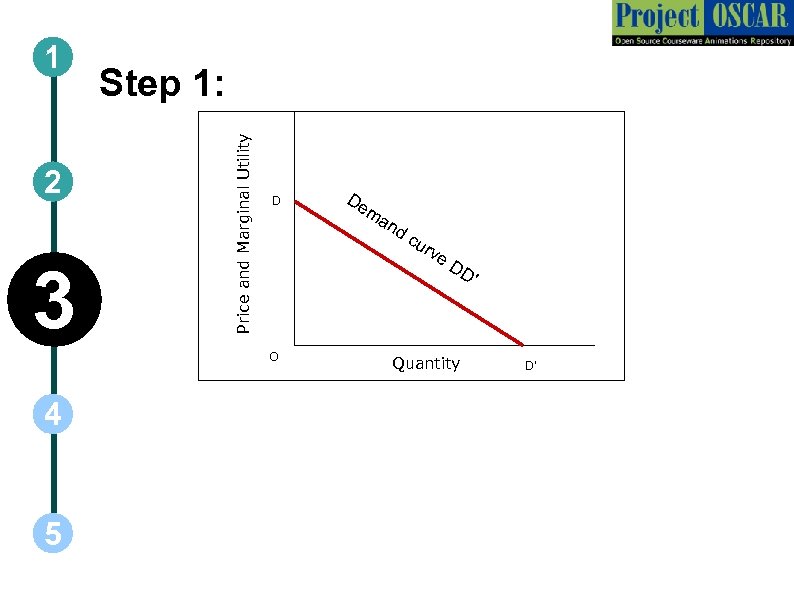
2 3 Step 1: Price and Marginal Utility 1 D O 4 5 De m an d cu rve DD ' Quantity D’
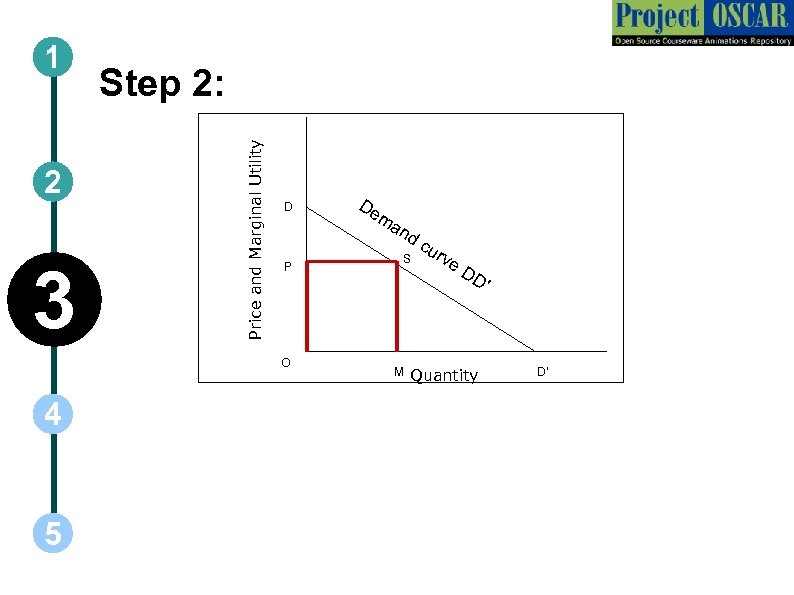
2 3 Step 2: Price and Marginal Utility 1 D P O 4 5 De m an d S M cu rve DD ' Quantity D’
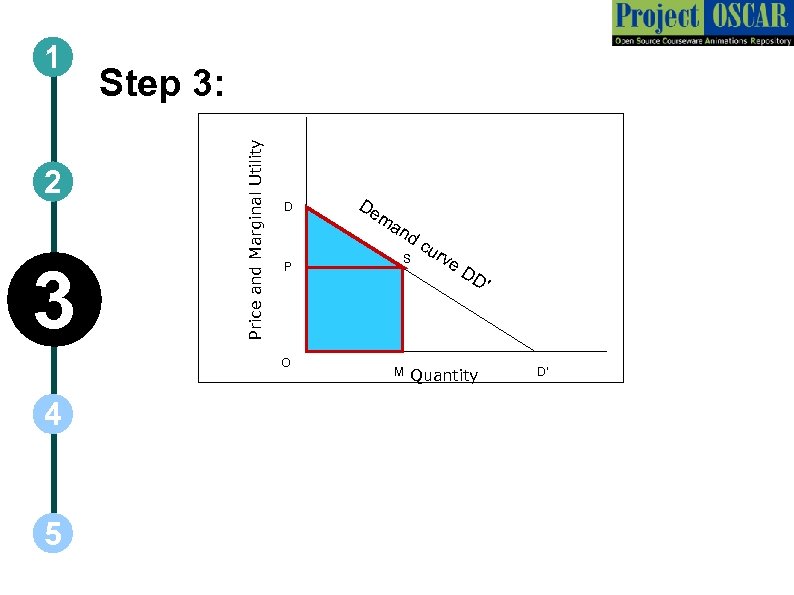
2 3 Step 3: Price and Marginal Utility 1 D P O 4 5 De m an d S M cu rve DD ' Quantity D’
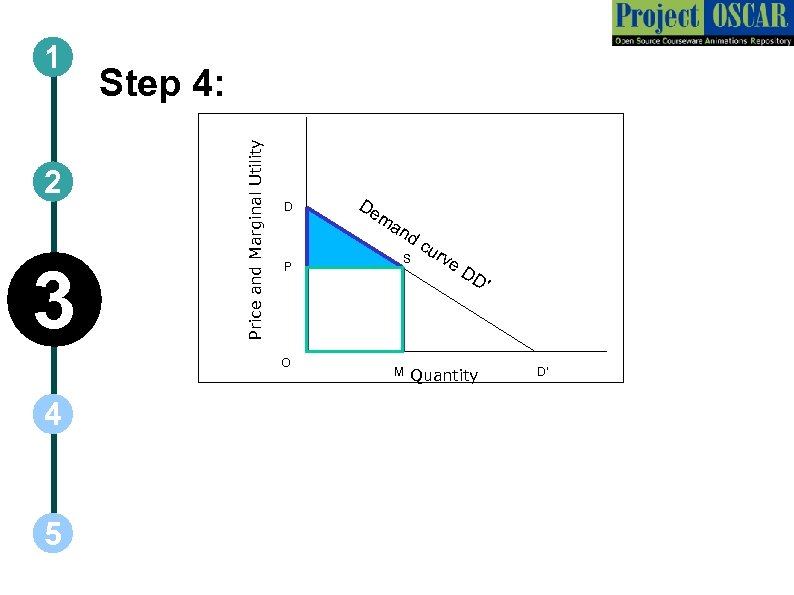
2 3 Step 4: Price and Marginal Utility 1 D P O 4 5 De m an d S M cu rve DD ' Quantity D’
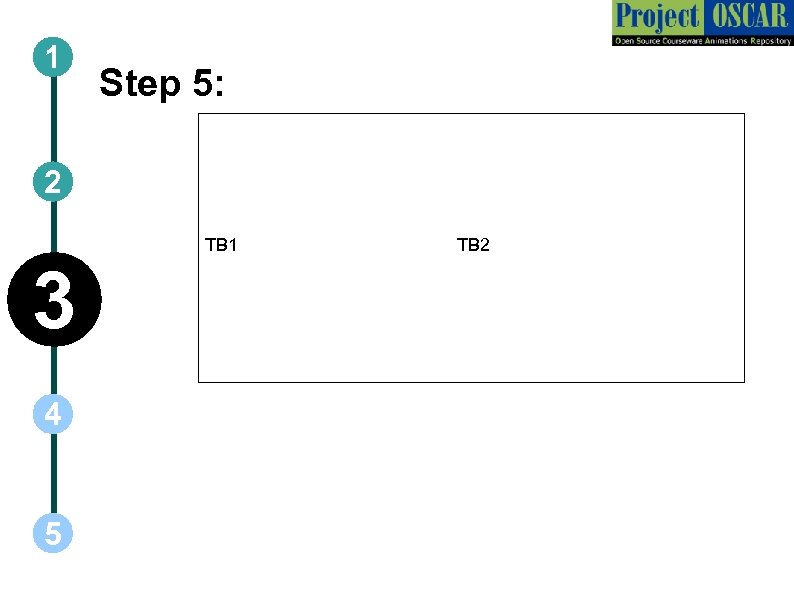
1 Step 5: 2 TB 1 3 4 5 TB 2
1 Step 6: 2 3 Demand Curve 4 5
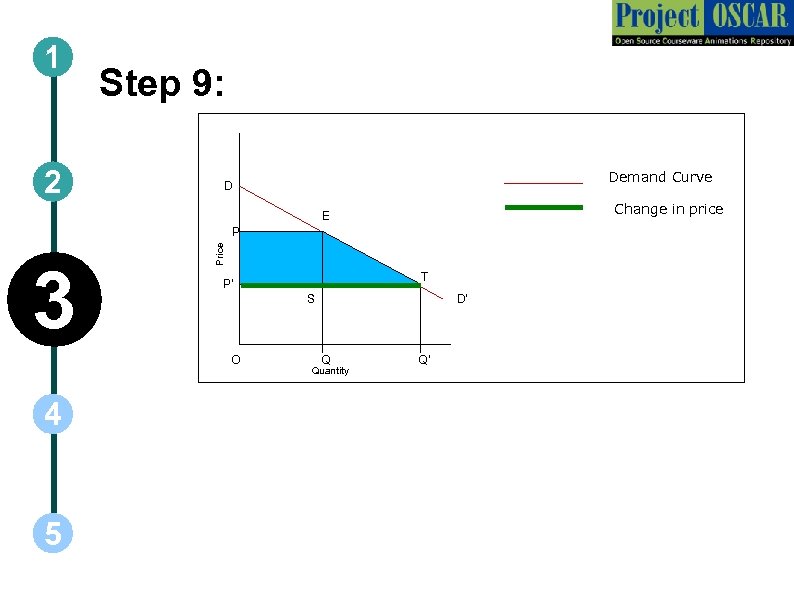
1 2 Step 9: Demand Curve D Change in price E 3 Price P 5 D’ S O 4 T P’ Q Quantity Q’
1 2 Step 10: Demand Curve Change in price 3 4 5
1 2 3 4 5 Step 14:
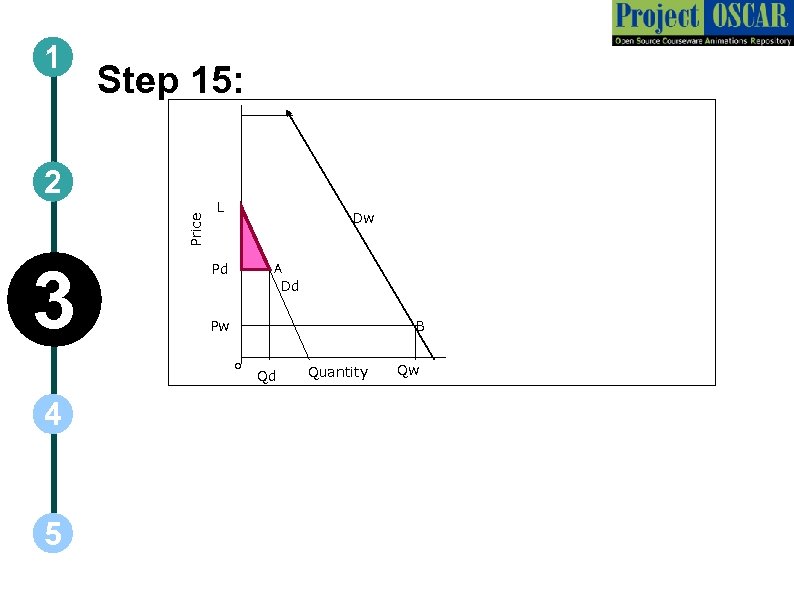
1 Step 15: Price 2 3 L Dw Pd A Dd Pw B o 4 5 Qd Quantity Qw
1 2 3 4 5 Step 16:
1 2 3 4 5 Step 17:
1 Interactivity option 1: Step No 7: 2 3 60 0 Demand Curve 4 5
1 Interactivity option 1: Step No 8: 2 3 60 0 Demand Curve 4 5
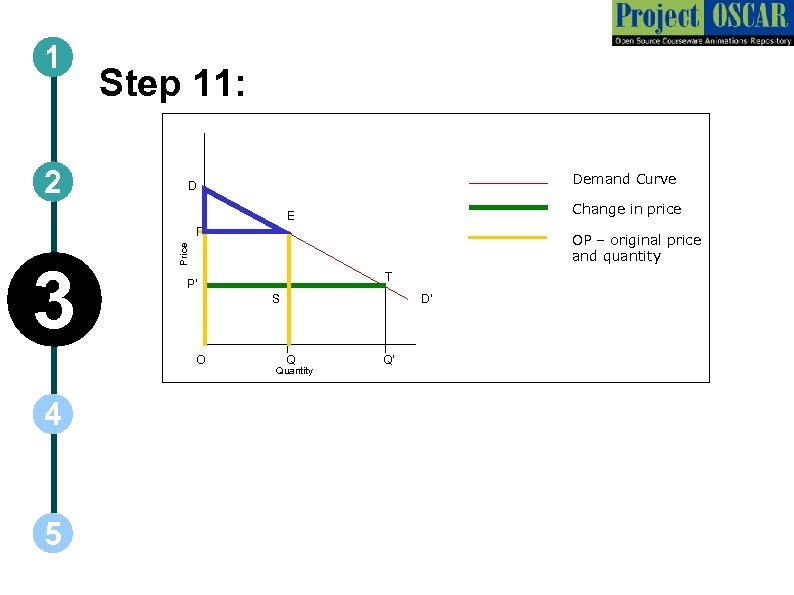
1 2 Step 11: Demand Curve D Change in price E P Price 3 5 T P’ D’ S O 4 OP – original price and quantity Q Quantity Q’
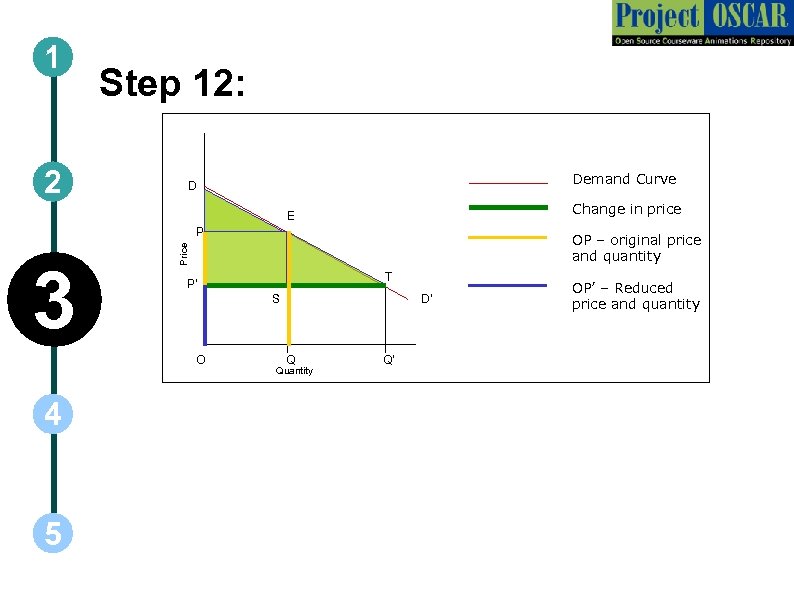
1 2 Step 12: Demand Curve D Change in price E P Price 3 5 T P’ D’ S O 4 OP – original price and quantity Q Quantity Q’ OP’ – Reduced price and quantity
1 2 Step 13: Demand Curve Change in price 3 4 5 OP – original price and quantity OP’ – Reduced price and quantity
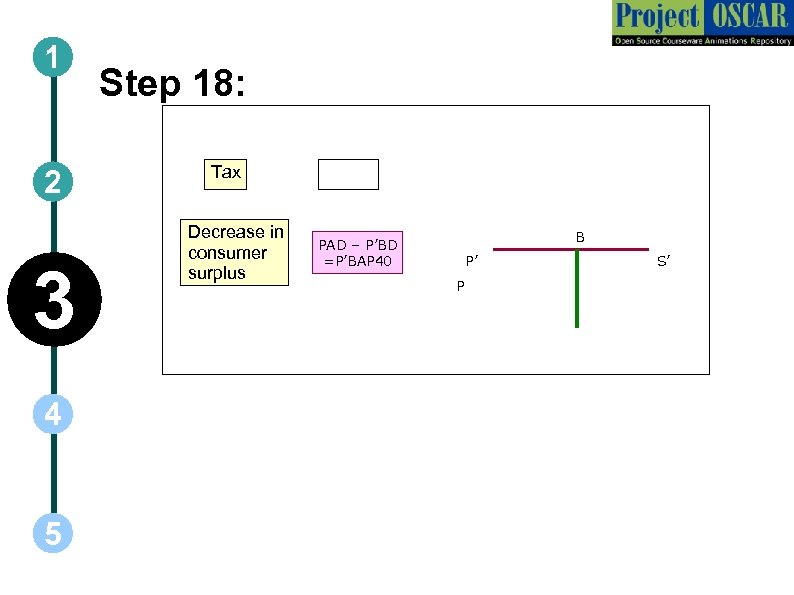
1 2 3 4 5 Step 18: Tax Decrease in consumer surplus B PAD – P’BD =P’BAP 40 P’ P S’
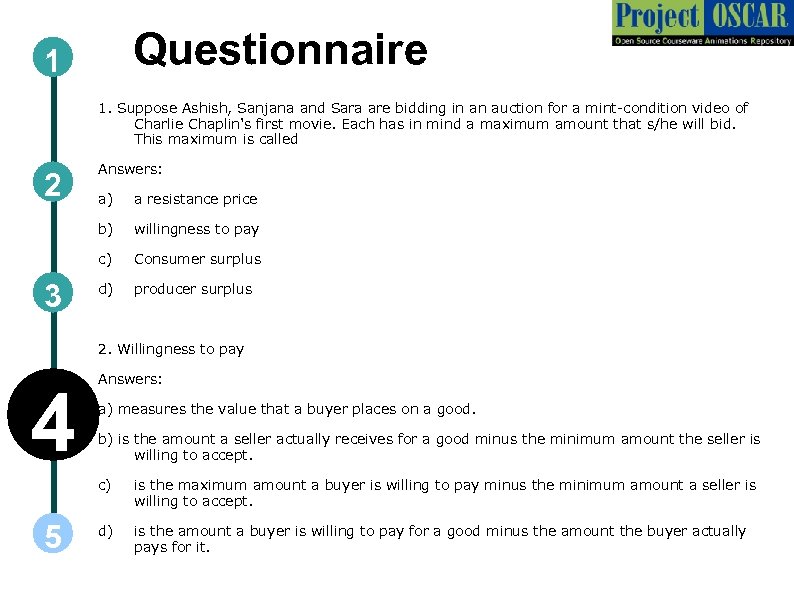
Questionnaire 1 1. Suppose Ashish, Sanjana and Sara are bidding in an auction for a mint-condition video of Charlie Chaplin's first movie. Each has in mind a maximum amount that s/he will bid. This maximum is called 2 Answers: a resistance price b) willingness to pay c) 3 a) Consumer surplus d) producer surplus 2. Willingness to pay 4 Answers: a) measures the value that a buyer places on a good. b) is the amount a seller actually receives for a good minus the minimum amount the seller is willing to accept. c) 5 is the maximum amount a buyer is willing to pay minus the minimum amount a seller is willing to accept. d) is the amount a buyer is willing to pay for a good minus the amount the buyer actually pays for it.
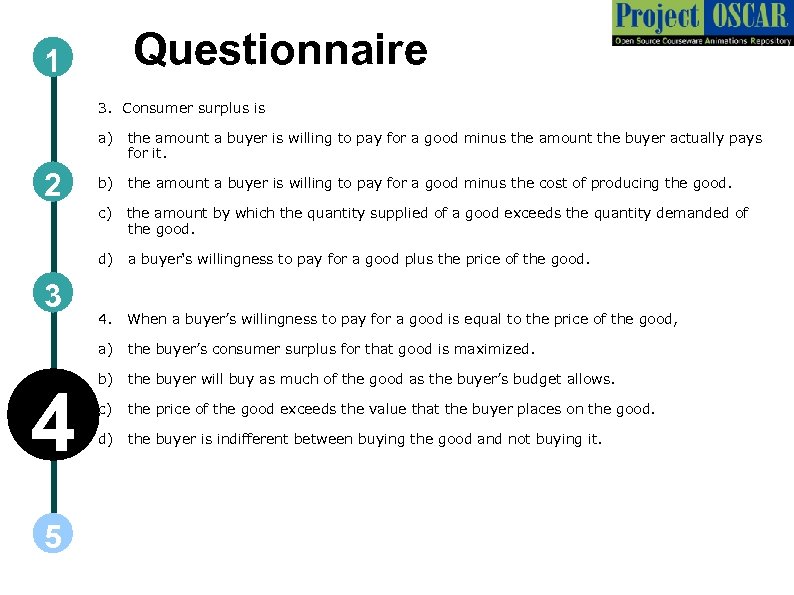
Questionnaire 1 3. Consumer surplus is a) 5 the amount by which the quantity supplied of a good exceeds the quantity demanded of the good. a buyer's willingness to pay for a good plus the price of the good. 4. When a buyer’s willingness to pay for a good is equal to the price of the good, a) 4 the amount a buyer is willing to pay for a good minus the cost of producing the good. d) 3 b) c) 2 the amount a buyer is willing to pay for a good minus the amount the buyer actually pays for it. the buyer’s consumer surplus for that good is maximized. b) the buyer will buy as much of the good as the buyer’s budget allows. c) the price of the good exceeds the value that the buyer places on the good. d) the buyer is indifferent between buying the good and not buying it.
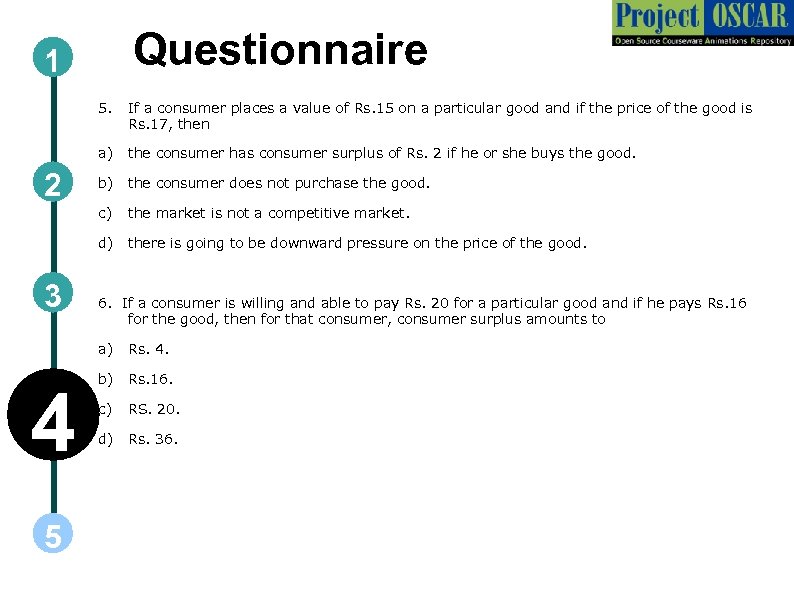
Questionnaire 1 5. a) b) the consumer does not purchase the good. the market is not a competitive market. d) 3 the consumer has consumer surplus of Rs. 2 if he or she buys the good. c) 2 If a consumer places a value of Rs. 15 on a particular good and if the price of the good is Rs. 17, then there is going to be downward pressure on the price of the good. 6. If a consumer is willing and able to pay Rs. 20 for a particular good and if he pays Rs. 16 for the good, then for that consumer, consumer surplus amounts to a) 4 5 Rs. 4. b) Rs. 16. c) RS. 20. d) Rs. 36.
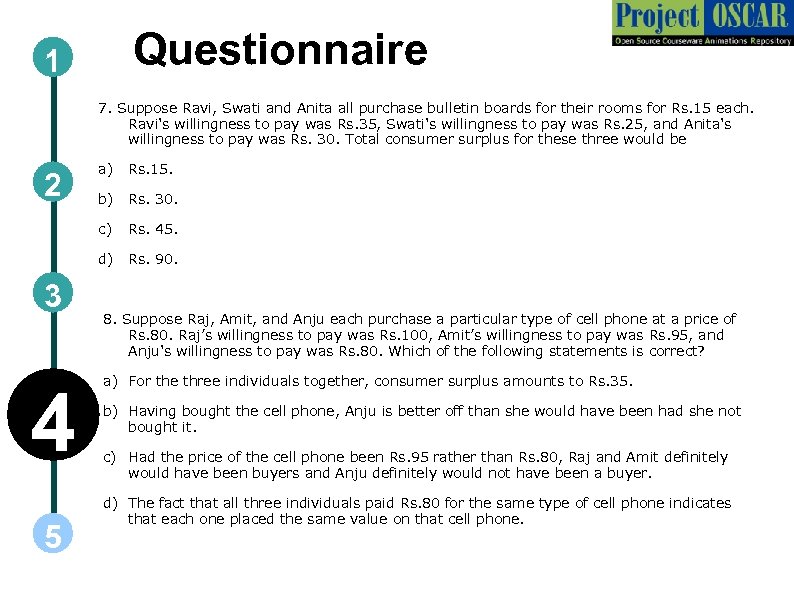
Questionnaire 1 7. Suppose Ravi, Swati and Anita all purchase bulletin boards for their rooms for Rs. 15 each. Ravi's willingness to pay was Rs. 35, Swati's willingness to pay was Rs. 25, and Anita's willingness to pay was Rs. 30. Total consumer surplus for these three would be 4 5 b) Rs. 30. Rs. 45. d) 3 Rs. 15. c) 2 a) Rs. 90. 8. Suppose Raj, Amit, and Anju each purchase a particular type of cell phone at a price of Rs. 80. Raj’s willingness to pay was Rs. 100, Amit’s willingness to pay was Rs. 95, and Anju's willingness to pay was Rs. 80. Which of the following statements is correct? a) For the three individuals together, consumer surplus amounts to Rs. 35. b) Having bought the cell phone, Anju is better off than she would have been had she not bought it. c) Had the price of the cell phone been Rs. 95 rather than Rs. 80, Raj and Amit definitely would have been buyers and Anju definitely would not have been a buyer. d) The fact that all three individuals paid Rs. 80 for the same type of cell phone indicates that each one placed the same value on that cell phone.
Links for further reading Reference websites: http: //tutor 2 u. net/economics/content/topics/marketsinaction/consumer_surplus. htm http: //www. economicshelp. org/blog/concepts/definition-of-consumer-surplus/ Books: Henderson and Quandt, 1971, ‘Micro Economic Theory - A Mathematical Approach’, 2 nd Edition. Salvator Dominick, 2003, ’Micro Economic Theory and Application’, 4 th Edition. Taylor. J. B. and Gugnani Ritika, 2008, ‘Principles of Micro Economics’, 5 th Edition. Research papers:

Thank You
Скачать презентацию Consumer Surplus Brief description about the concept 1
9a4f97b94096580ca5e0dd0596d60435.ppt