 Скачать презентацию CONSUMER PROTECTION IN THE EU Marko Baretić Ph
5c524b2fe3b442bcab4021c38747b810.ppt
- Количество слайдов: 68



CONSUMER PROTECTION IN THE EU Marko Baretić, Ph. D Civil Law Department Faculty of Law in Zagreb
OUTLINE OF THE COURSE u Introduction to the Consumer Protection • • u Development Main sources Main principles Basic features Market regulation • Product safety • Regulation of trade practices u Contract Law issues • General part (unfair contract terms, specific techniques of conclusion of cotract, warenties and associated guaranties) • Specific contracts (consumer credit, turistic products ) u Tort Law issues • Liability for defective products u Procedural Law • Protection of collective interests of consumers • Alternative disputes resolution systems
CONSUMER PROTECTION IN THE EU u Consumer protection policy develops systematically over the last 40 years • comprises of numerous measures aimed at enhancing the position of consumer at the single European market • Consumer protection law – one of the most important elements of the Consumer protection policy
CONSTITUTIONAL BASIS OF THE CONSUMER PROTECTION u The Treaty on establishing the European Economic Community (Rome Treaty) • Incidental reference to consumers in the context of agricultural policy and competition policy
CONSTITUTIONAL BASIS OF THE CONSUMER PROTECTION u Single European Act (1987) • No major changes • Inclusion of the Article 100 a – new, simplified decision making process
CONSTITUTIONAL BASIS OF THE CONSUMER PROTECTION u Treaty on the European Union (1993) • Separate heading of the Treaty (XI) and separate article (129 a) on consumer protection • Consumer protection becomes an official policy of the EU
AMSTERDAM TREATY Renumbering of the Treaty u Article 129 a becomes Article 153 u No substantial changes u Explicit mentioning of the “horizontal” nature of consumer protection policy u
NICE TREATY u No changes in comparison to the Amsterdam Treaty
LISBON TREATY Treaty on European Union and the Treaty on the Functioning of the European Union u Article 12 TFEU– consumer protection requirements shall be taken into account in defining and implementing other Union policies and activities u Article 169 TFEU (ex Article 153 of the Treaty on Establishing the EC) u
Article 169 TFEU 1. In order to promote the interests of consumers and to ensure a high level of consumer protection, the Union shall contribute to protecting the health, safety and economic interests of consumers, as well as to promoting their right to information, education and to organise themselves in order to safeguard their interests. 2. The Union shall contribute to the attainment of the objectives referred to in paragraph 1 through: (a) measures adopted pursuant to Article 114 in the context of the completion of the internal market; (b) measures which support, supplement and monitor the policy pursued by the Member States.
Article 169 TFEU 3. The European Parliament and the Council, acting in accordance with the ordinary legislative procedure and after consulting the Economic and Social Committee, shall adopt the measures referred to in paragraph 2(b). 4. Measures adopted pursuant to paragraph 3 shall not prevent any Member State from maintaining or introducing more stringent protective measures. Such measures must be compatible with the Treaties. The Commission shall be notified of them.
CHARACTERISTICS OF THE CONSUMER PROTECTION POLICY u u Aimed at protection of basic consumer rights: health, economic interests, information, education, representation Development within the completion of the internal market (indirect policy) An area of shared competence between the EU and the MS’s • The importance of the principle of subsidiarity and proportionality Concept of minimum protection (minimum harmonisation)
DEVELOPMENT OF THE CONSUMER PROTECTION LAW Indirect development (harmonization of national laws) u “soft law” initiatives u “negative law” u
INDIRECT POLICY u u u Development of the consumer protection law on the basis of Article 100 of the Rome Treaty through the “the approximation of the provisions laid down by law, regulation or administrative action in Member States which have as their object the establishing and functioning of the internal market” Mid 70 es of the 20 th century After the completion of the transitional period and establishing of the internal market, the interest shifts to social issues, like consumer protection
SOFT LAW Development through resolutions – non-binding rules u Although non-binding, the importance of the resolutions follows from the fact: u • they express political position of the institutions of the EU • the CJEU often invokes resolutions as if they were binding instruments
SOFT LAW u u Council Resolution on preliminary programme for a consumer protection and information policy (1975) Basic consumer rights enumerated: • • • the right the right heard) to protection of health and safety to protection of economic interests of redress to information and education of representation (the right to be
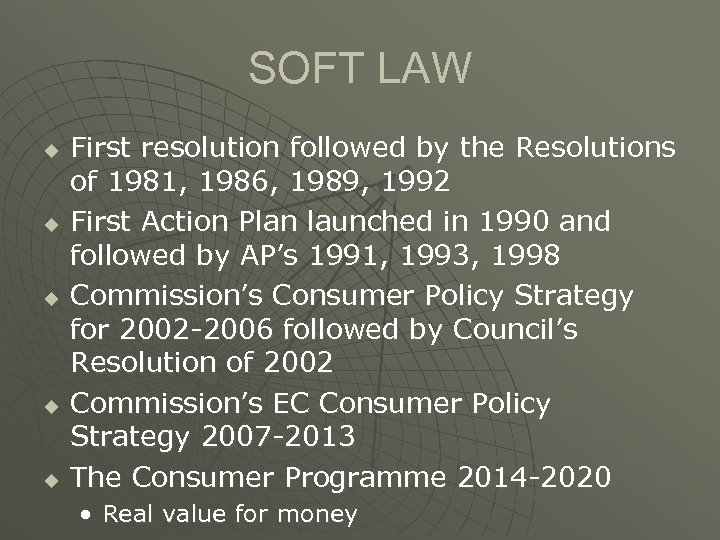
SOFT LAW u u u First resolution followed by the Resolutions of 1981, 1986, 1989, 1992 First Action Plan launched in 1990 and followed by AP’s 1991, 1993, 1998 Commission’s Consumer Policy Strategy for 2002 -2006 followed by Council’s Resolution of 2002 Commission’s EC Consumer Policy Strategy 2007 -2013 The Consumer Programme 2014 -2020 • Real value for money
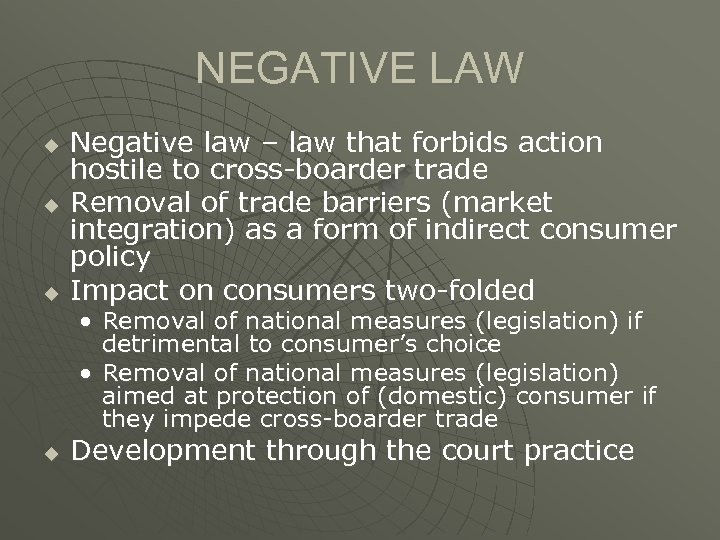
NEGATIVE LAW u u u Negative law – law that forbids action hostile to cross-boarder trade Removal of trade barriers (market integration) as a form of indirect consumer policy Impact on consumers two-folded • Removal of national measures (legislation) if detrimental to consumer’s choice • Removal of national measures (legislation) aimed at protection of (domestic) consumer if they impede cross-boarder trade u Development through the court practice
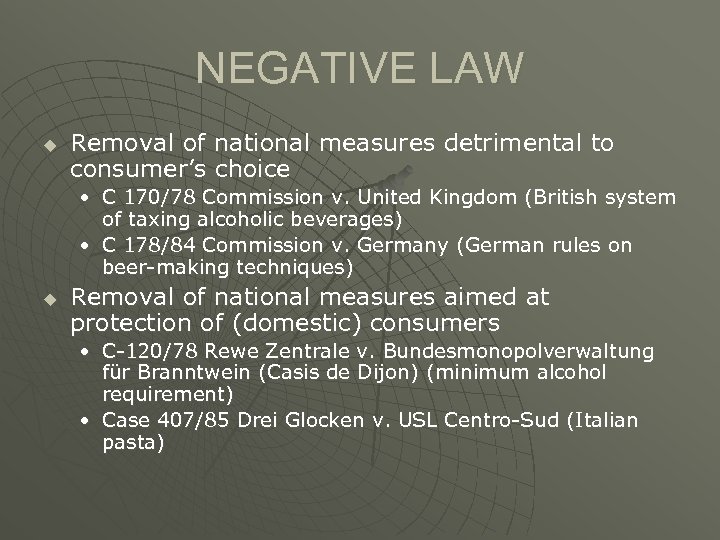
NEGATIVE LAW u Removal of national measures detrimental to consumer’s choice • C 170/78 Commission v. United Kingdom (British system of taxing alcoholic beverages) • C 178/84 Commission v. Germany (German rules on beer-making techniques) u Removal of national measures aimed at protection of (domestic) consumers • C-120/78 Rewe Zentrale v. Bundesmonopolverwaltung für Branntwein (Casis de Dijon) (minimum alcohol requirement) • Case 407/85 Drei Glocken v. USL Centro-Sud (Italian pasta)
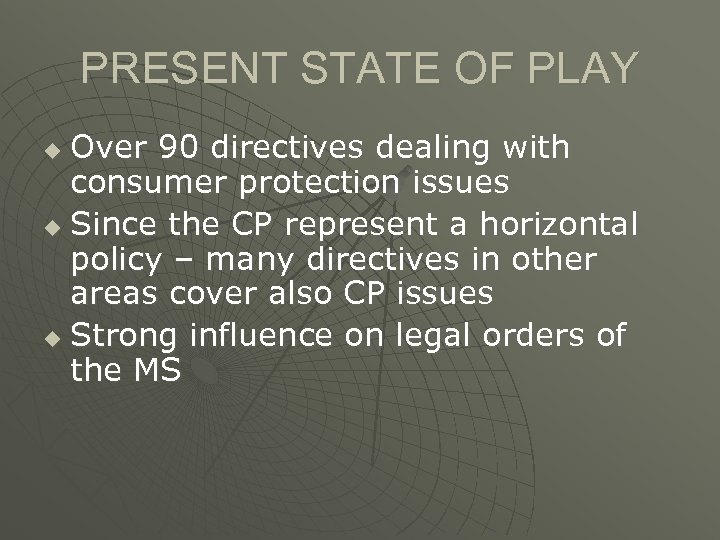
PRESENT STATE OF PLAY Over 90 directives dealing with consumer protection issues u Since the CP represent a horizontal policy – many directives in other areas cover also CP issues u Strong influence on legal orders of the MS u
PRESENT STATE OF PLAY u Directives in the field of consumer protection regulate: • technical standards aimed at protection of consumers • market conditions (especially advertising) • private law issues (especially contract law) u indirect harmonisation of the private law systems of the MS
CONSUMER ACQUIS u u Directive 2001/95/EEC on general product safety Directive 89/109/EEC on the approximation of the laws of the Member States relating to materials and articles intended to come into contact with foodstuffs Directive 2000/13/EC on the approximation of the laws of the Member States relating to the labelling, presentation and advertising of foodstuff Directive 98/6/EC on consumer protection in the indication of the prices of products offered to consumers
CONSUMER ACQUIS Directive 2006/114/EC concerning misleading and comparative advertising u Directive 2005/29/EC on unfair commercial practices u
CONSUMER ACQUIS u u Directive 85/577/EEC to protect the consumer in respect of contracts negotiated away from business premises Directive 90/314/EEC on package travel, package holidays and package tours Directive 97/7/EC on the protection of consumers in respect of distance contracts Directive 98/27/EC on injunctions for the protection of consumers’ interests
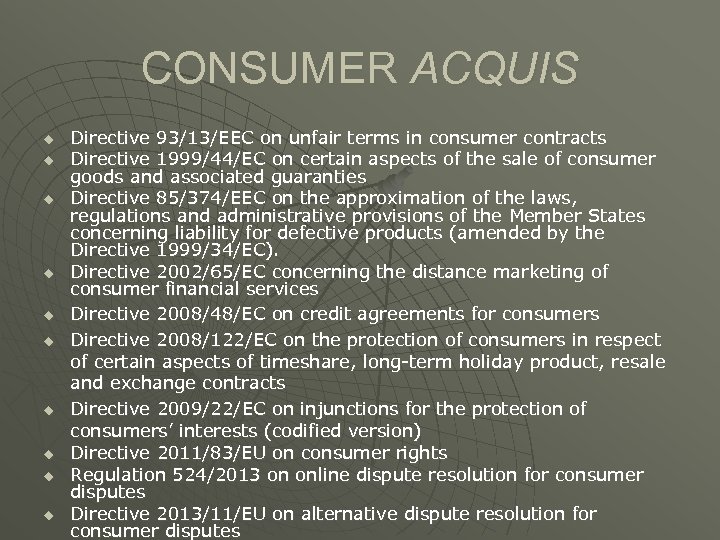
CONSUMER ACQUIS u u u u u Directive 93/13/EEC on unfair terms in consumer contracts Directive 1999/44/EC on certain aspects of the sale of consumer goods and associated guaranties Directive 85/374/EEC on the approximation of the laws, regulations and administrative provisions of the Member States concerning liability for defective products (amended by the Directive 1999/34/EC). Directive 2002/65/EC concerning the distance marketing of consumer financial services Directive 2008/48/EC on credit agreements for consumers Directive 2008/122/EC on the protection of consumers in respect of certain aspects of timeshare, long-term holiday product, resale and exchange contracts Directive 2009/22/EC on injunctions for the protection of consumers’ interests (codified version) Directive 2011/83/EU on consumer rights Regulation 524/2013 on online dispute resolution for consumer disputes Directive 2013/11/EU on alternative dispute resolution for consumer disputes
PRIVATE LAW ASPECTS OF CONSUMER PROTECTION Through the directives in the field of consumer protection, EU has influenced both public law and private law orders of the MS’s u The question of viability of public/private law division u
CONSUMER/TRADER Consumer -any natural person who acts on the market or concludes the contract for the purposes which are outside his business, trade or profession !!!!! u Trader – any natural or legal person who acts on the market or concludes the contract for the purposes relating to his business, trade or profession!!!! u
CONSUMER CONTRACT Business to Consumer (B 2 C) u Business to Business (B 2 B) u Consumer to Consumer (C 2 C) u
CHARASTERISTICS OF THE CONSUMER PROTECTION LAW Not “European law”, but rather “harmonised” law of the MS’s u Regulation based on “rationae personae” principle, rather than on “rationae materiae” principle u Vertical/horisontal approach u Significantly changed legal orders of the MS’s u
CHARACTERISTICS OF THE CONSUMER PROTECTION LAW u u u u u Information duty Right to withdraw Protection of collective interests of consumers (Semi)strict nature of the consumer protection rules Wide range of essential elements of consumer contract Special IPL rules Burden of proof Concept of minimal protection Alternative dispute settlement systems
INFORMATION DUTY Information paradigm – “well informed consumer shall be able to protect himself efficiently” u Both in pre-contractual and postcontractual stage u
WITHDRAWAL RIGHT u Right provided by • Door-to-door Directive • Distance Sale Directive • Distance Marketing of Financial Services Directive • Timeshare Directive • Consumer Credit Directive • Consumer Rights Directive
COLLECTIVE CONSUMER PROTECTION u u u Initially recognised only in few directives Today Injunctions Directive extends this type of protection to overall consumer acquis Protection of diffuse, collective interests of the entire consumer population Collectivistic v. individualistic protection Preventive protection Dilemma – to be resolved by the MS’s: court v. administrative protection
LEGAL NATURE OF CONSUMER PROTECTION RULES Not ius strictum in a classical sense u Rather (semi)strict rules u Possible to contract out these rules – but only in the interest of a consumer u Departure from the party autonomy principle u
WIDE RANGE OF ESSENTIAL ELEMENTS IN CONSUMER CONTRACT Many directives provide wide range of essential elements in consumer contracts u The problem of rational choice of essential elements u
SPECIAL IPL RULES The consumer cannot be deprived of the protection provided for by law by virtue of choice of law u This rule does not entirely excludes the possibility of contracting in choice of law clauses u
BURDEN OF PROOF u u Burden of proof as to the existence/nonexistence of certain facts shifted to the trader This rule contained within: • Distance Sale Directive • Distance Marketing of Financial Services Directive • Unfair Commercial Practices Directive
ALTERNATIVE DISPUTE SETLEMENT European Union supports and promotes alternative dispute settlement systems u ADR Directive, ODR Regulation u Good examples: u • Mediation • Ombutsmans in Nordic countries • Office of Fair Trading in the UK
CHALLANGES TO THE CONSUMER PROTECTION LAW u u u Unsystematic approach Inconsistency “Black box” argument Non-harmonised legal orders of the MS’s Obsolescence of the consumer acquis Complexity of the consumer acquis
UNSISTEMATIC APPROACH “Pointilistic” approach in making consumer protection regulation u Consumer protection acquis not based on common principles u
INCONSISTANCY u Inconsistency on two levels: • Within the same directive • between various directives
INCONSISTENCY Different approaches/different terminology in the same directive u Simultaneous use of the term “indemnity” and “compensation” in the same directive u „right of cancellation”, „right of renunciation”, „right of withdrawal” u
INCONSISTENCY u u Example: the definition of “consumer” consumer means any natural person who, in contracts covered by this Directive, is acting for purposes which are outside his trade, business or profession (Unfair Terms in Consumer Contracts Directive) consumer means a natural person who, in transactions covered by this Directive, is acting for purposes which can be regarded as outside his trade or profession (Door to door Directive) consumer is a person who agrees to take travel package (Package Travel Directive)
INCONSISTENCY u u Example of the definition of “trader” Terms used: trader, seller, supplier means any natural or legal person who, in contracts covered by this Directive, is acting in his commercial or professional capacity (Distance sale Directive) seller or supplier means any natural or legal person who, in contracts covered by this Directive, is acting for purposes relating to his trade, business or profession, whether publicly owned or privately owned (Unfair Terms Directive)
INCONSISTENCY u u Different solutions for identical situations Example: withdrawal period: • • • u 7 days (Door-to-door Directive) 10 day (Timeshare Directive) 14 days (Distance Marketing of Financial Services Directive) Problem of computation through “working days” (distance contracts) and “calendar days” (timeshare).
INCONSISTENCY In specific situations two EU instruments can be applicable which produce conflicting results. u Example: Doorstep Selling Directive and Timeshare Directive u
INCONSISTENCY u u The use of abstract legal terms such as “contract”, “damage”, “fulfilment/nonfulfilment” which are not defined at all AT THE European level Certain terms defined in one directive, but not in others • Example: definition of damage in the Defective Products Directive • The same term not defined in Package Travel Directive • The question of admissibility of analogy
INCONSISTENCY Inconsistency as a consequence of multiple language approach u Example of Unfair Terms Directive u • Pre-formulated contracts • Contrat d’ adhésion • Contrato di adesione
“BLACK BOX” ARGUMENT The CJ EU, interpreting certain directives, disregards particularities of the national legal systems of the MS’s and thus prejudice settled principles of the national legal systems u Creating the rules of the directives, EU bodies often introduce unknown (foreign) terms and institutes in national legal systems u
NON-HARMONISED LEGAL OREDERS OF THE MS’s u u u Terms and institutes from the Directives differently interpreted from country to country Minimum harmonisation system problem When implementing a directive, national legislators maintain the existing national legislation in parallel
OBSOLESCENCE OF THE CONSUMER ACQUIS Directives in the field of consumer protection mainly from the eighties of the 20 th century u No longer corresponding to the demands of modern market (digital technologies, innovative marketing techniques) u The need for amending the existing regulation u
COMPLEXITY OF THE EXISTING CONSUMER ACQUIS Text of certain directives extremely complicated and complex, and thus unintelligible u Example of the Unfair Commercial Practices Directive u
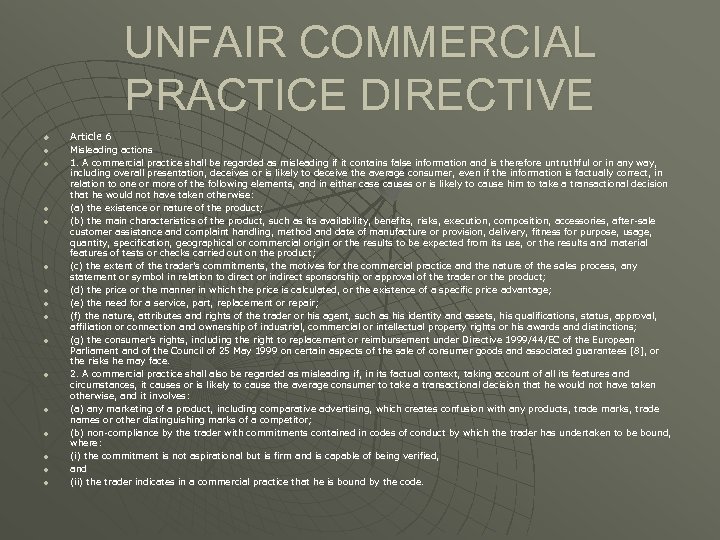
UNFAIR COMMERCIAL PRACTICE DIRECTIVE u u u u Article 6 Misleading actions 1. A commercial practice shall be regarded as misleading if it contains false information and is therefore untruthful or in any way, including overall presentation, deceives or is likely to deceive the average consumer, even if the information is factually correct, in relation to one or more of the following elements, and in either case causes or is likely to cause him to take a transactional decision that he would not have taken otherwise: (a) the existence or nature of the product; (b) the main characteristics of the product, such as its availability, benefits, risks, execution, composition, accessories, after-sale customer assistance and complaint handling, method and date of manufacture or provision, delivery, fitness for purpose, usage, quantity, specification, geographical or commercial origin or the results to be expected from its use, or the results and material features of tests or checks carried out on the product; (c) the extent of the trader's commitments, the motives for the commercial practice and the nature of the sales process, any statement or symbol in relation to direct or indirect sponsorship or approval of the trader or the product; (d) the price or the manner in which the price is calculated, or the existence of a specific price advantage; (e) the need for a service, part, replacement or repair; (f) the nature, attributes and rights of the trader or his agent, such as his identity and assets, his qualifications, status, approval, affiliation or connection and ownership of industrial, commercial or intellectual property rights or his awards and distinctions; (g) the consumer's rights, including the right to replacement or reimbursement under Directive 1999/44/EC of the European Parliament and of the Council of 25 May 1999 on certain aspects of the sale of consumer goods and associated guarantees [8], or the risks he may face. 2. A commercial practice shall also be regarded as misleading if, in its factual context, taking account of all its features and circumstances, it causes or is likely to cause the average consumer to take a transactional decision that he would not have taken otherwise, and it involves: (a) any marketing of a product, including comparative advertising, which creates confusion with any products, trade marks, trade names or other distinguishing marks of a competitor; (b) non-compliance by the trader with commitments contained in codes of conduct by which the trader has undertaken to be bound, where: (i) the commitment is not aspirational but is firm and is capable of being verified, and (ii) the trader indicates in a commercial practice that he is bound by the code.
TIME OF CHANGES Communication from the Commission to the European Parliament and the Council – A More Coherent European Contract Law – An Action Plan (2003) u Green Paper on the Review of the Consumer Acquis (2006 -2007) u
PRESENT/FUTURE Necessity of creating a new consumer acquis with the purpose of u Simplification of the regulation u Completion of the regulation u Harmonisation of the regulation u Modernisation of the regulation u
POSSIBLE DEVELOPMENT STRATEGIES u Three basic strategies proposed: • Vertical approach – revision of the existing directives • Horizontal approach – creation of one of few umbrella instruments regulating common features of the consumer acquis • Mixed, horizontal-vertical approach
VERTICAL APPROACH u u u Amendment of each directive with the aim of their modernisation and harmonisation with the current market demands Elimination of inconsistencies within particular directive and among different directives Shortcomings: • basic terms would still be defined within particular directives • volume (number) of directives would not diminish
HORIZONTAL APPROACH u u u Regulation of common elements of the consumer acquis-a, such as terms consumer, professional, withdrawal period, etc. would be extracted from the existing directives and provided for within unique “instrument” in an systematic fashion Second part of horizontal “instrument” would regulate sales contract, as most common consumer contract The application of a horizontal approach begun with Unfair Commercial Practices Directive
HORIZONTAL APPROACH u “Instrument” selection • directive • regulation • recommendation • “common frame of reference”

MIXED APPROACH Dominant horizontal approach u Vertical approach as an exception, in certain segments of the market u
LEVEL OF HARMONISATION Unsatisfactory results of the existing minimum harmonisation system u Suggested: u • maximum harmonisation system • combination of minimum harmonisation system and mutual recognition clause
NEW DIRECTIVES u u u u Directive 2005/29/EC on unfair commercial practice Directive 2008/48/EC on credit agreements for consumers Directive 2008/122/EC on the protection of consumers in respect of certain aspects of timeshare, long-term holiday product, resale and exchange contracts Directive 2011/83/EU on consumer rights Regulation 524/2013 on online dispute resolution for consumer disputes Directive 2013/11/EU on alternative dispute resolution for consumer disputes Draft Regulation on a Common European Sales Law
COMMON FRAME OF REFERENCE u u u Step forward in creation of European contract law Public “document” containing common principles, basic rules and terminology in the field of European contract law Purpose threefold: • Utilisation from the Commission in the process of the revision of the existing acquis-a and creation of a new measures • Utilisation from the national legislators and courts in order to achieve a higher degree of convergence • Basis for possible optional instrument
COMMON FRAME OF REFERENCE u Drafting on the basis of: • rules from the existing national legal orders of the MS’s which are common to all or majority of MS’s or which represent best solutions in certain situation • findings of the national courts • rules from the existing acquis and international instruments such as UN Convention on international sale of goods
INFLUENCE ON PRIVATE LAW ORDERS OF THE MS’s u u Admissibility of creation of the European Civil Code 1989 Resolution of the European Parliament on the activities for harmonisation of the private laws of the Member States 2001 Resolution of the European Parliament on approximation of the civil and commercial laws of the Member States 2001 Council Report on the need for convergence of the civil law orders of the MS’s
EUROPEAN CONTRACT LAW u u Desirable result of the efforts of the EU bodies Based on • the common frame of reference • existing acquis u New optional instrument • Draft Regulation on a Common European Sales Law
POSIBBLE OBSTACLES Claim that national civil law orders are part of the national identity u Claim that there are no common principles to support new European civil law u
POSSIBLE PATHS IN CREATING EUROPEAN CIVIL CODE Institutional path most unlikely u Suggested: u • Crawling codification • Competition between national legal systems • Harmonisation of IPL’s • Creation of the European Contract Law
Скачать презентацию CONSUMER PROTECTION IN THE EU Marko Baretić Ph
5c524b2fe3b442bcab4021c38747b810.ppt