


 Скачать презентацию Consumer Product Safety Improvement Act of 2008 Diane
4644e42df43e04ed92fc22fca0fd7a1d.ppt
- Количество слайдов: 25
 Consumer Product Safety Improvement Act of 2008 Diane M. Meyers Perkins Coie, LLP 1201 Third Avenue Seattle, Washington 206 -359 -8324 Dmeyers@perkinscoie. com This presentation reflects the views of the presenter and is presented for Discussion Purposes Only
 CPSIA Generally § Legislative response to large number of children's toy recalls in 2007 and 2008 § Passed overwhelmingly by House (424 -1) and Senate (89 -3) § Signed into law by President Bush on August 14, 2008 2
 Major Provisions § Imposes Lead Content Limits § Phases in progressively stringent lead content limits beginning in February 2009 § Imposes Phthalate Content Limits § Phases in progressively stringent phthalate limits beginning in February 2009 § Requires Third Party Testing § Expands Certification Requirements § Adopts Mandatory Toy Standards 3
 Important Definitions § Children's Products § Most provisions apply to products intended or designed primarily for children 12 years of age or younger § Children's Toys § Designed or intended for a child 12 years of age or younger for use when child plays § Child Care Articles § Designed or intended to facilitate sleep or feeding of children 3 years of age or younger or to help such children with sucking or teething 4
 Lead (Section 101) § Applies to children’s products § Makes it illegal to sell, offer for sale, manufacture, import or distribute children's products that exceed acceptable lead levels § Children's products containing more than the acceptable amount of lead will be treated as banned substances under the Federal Hazardous Substances Act § Imposes lead limit of 600 ppm on Feb 10, 2009 § Decreases acceptable lead limit to 300 ppm in August 2009 § Leaves open the possibility of further decreases 5
 Lead (continued) CPSC may, by rule, exclude a specific product or material from lead content rule. § Inaccessible component parts § CPSC will issue rule on inaccessible product components § Inaccessible component is any part not physically exposed through foreseeable use and abuse § Absorption § CPSC may exclude product if it determines no absorption of lead in the body § Electronic Devices § If it is not possible for certain devices to be sufficiently lead-free, CPSC may exclude 6
 Phthalates (Section 108) § Imposes interim ban on products containing 0. 1 percent or more of DINP, DIDP, or Dn. Op § Applies to: § Children's toys that can be placed in a child's mouth § Child care articles § Imposes permanent ban products containing 0. 1 percent or more of DEHP, DBP or BBP § Applies to: § Children's toys § Child care articles 7
 Mandatory Toy Safety Standards (Section 106) Adopts ASTM F 963 -07 as a mandatory toy safety standard § Applies to more children's products than CPSIA § Includes thirty-nine safety standards that must be followed on February 10, including standards related to: § § § Small objects Cords and elastics Wheels, tires and axles Battery-operated toys Projectile toys Toy chests Marbles Rattles Strollers Balls Yo-Yos Stuffed toys 8
 Conformity Certificates (Section 102) § Two types § General Conformity Certificate § Became effective November 12, 2008 § Certificate based on third-party testing § Becomes effective on a rolling basis § Issued with the product or shipment of products and a copy must be furnished to each distributor or retailer § Sample Certification provided on CPSC website 9
 Certification Requirements § Must certify conformity with every consumer product safety rule any similar rule, ban, standard or regulation under any other Act enforced by the CPSC, which includes: § § Federal Hazardous Substances Act (FHSA); Flammable Fabrics Act (FFA); Poison Prevention Packaging Act (PPPA); and Refrigerator Safety Act (RSA) § Certification must be based on a test of each product or a reasonable testing program and third party testing (when required) § Certification of compliance with industry standards is not required by CPSIA unless the standard is enforced by the CPSC 10
 Third Party Testing (Section 102) § CPSC required to develop accreditation procedure based on statutory timelines, e. g. : § § Lead paint Cribs and pacifiers Small parts Metal jewelry December 2008 January 2009 February 2009 March 2009 § Third party testing applicable 90 days after accreditation notice published § Manufacturer must submit samples to third party testing body before importing for consumption or warehousing or distributing in commerce 11
 Warning and Tracking Labels § Tracking labels (Section 103) § Requires information regarding the manufacturer, date and location of production and batch and run numbers § Must be permanently affixed to all children's products and packaging manufactured after August 14, 2009 § Warning labels (Section 105) § Expands warning requirements § Requires warnings in Internet advertisements, catalog ads and other materials § Internet § Catalog ads December 12, 2008 February 10, 2009 12
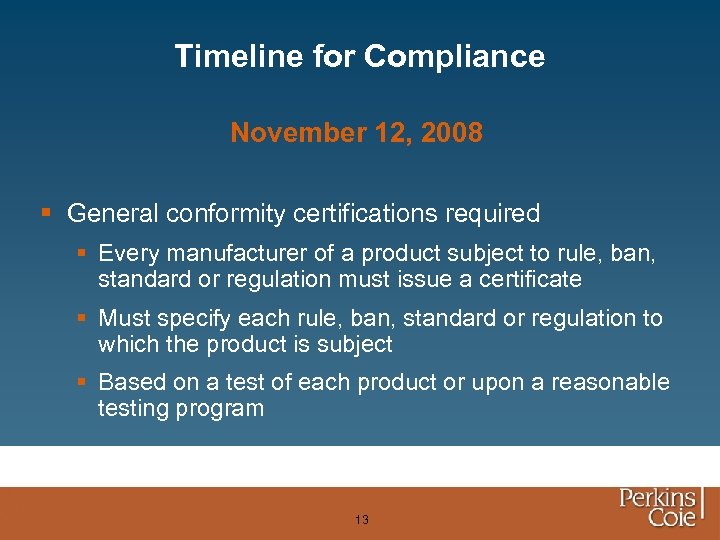 Timeline for Compliance November 12, 2008 § General conformity certifications required § Every manufacturer of a product subject to rule, ban, standard or regulation must issue a certificate § Must specify each rule, ban, standard or regulation to which the product is subject § Based on a test of each product or upon a reasonable testing program 13
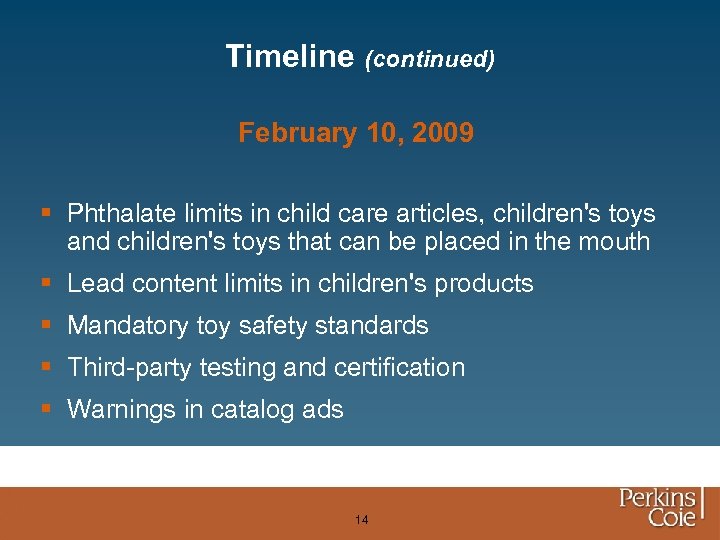 Timeline (continued) February 10, 2009 § Phthalate limits in child care articles, children's toys and children's toys that can be placed in the mouth § Lead content limits in children's products § Mandatory toy safety standards § Third-party testing and certification § Warnings in catalog ads 14
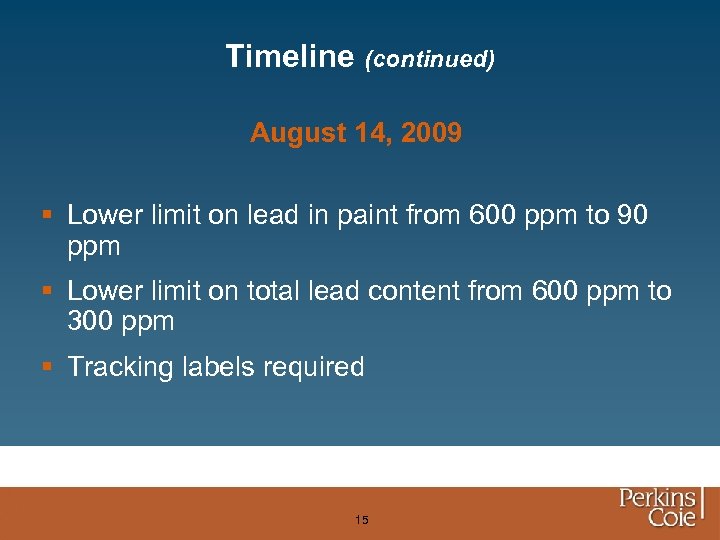 Timeline (continued) August 14, 2009 § Lower limit on lead in paint from 600 ppm to 90 ppm § Lower limit on total lead content from 600 ppm to 300 ppm § Tracking labels required 15
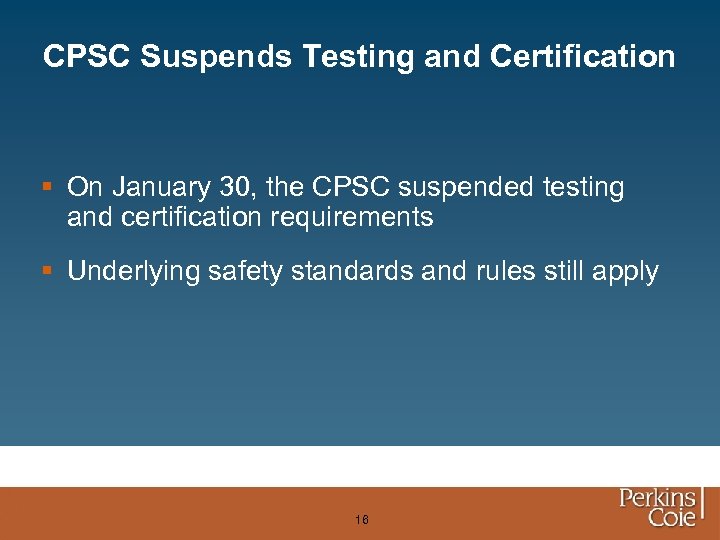 CPSC Suspends Testing and Certification § On January 30, the CPSC suspended testing and certification requirements § Underlying safety standards and rules still apply 16
 Important Regulatory Responsibilities Remain In Place § Suspension does not apply to: § Lead paint ban if made after Dec 21, 2008 § Cribs and pacifiers if made after Jan 20, 2009 § Products subject to small parts ban if made after Feb 15, 2009 § Lead content in metal components of children’s jewelry if made after March 23, 2009 § Certification requirements applicable to ATV’s made after April 13, 2009 § Pre-CPSIA testing and certification requirements § Pool drain cover requirements § State Attorneys General can still enforce § Litigation over CPSC authority to issue stay is likely 17
 Applicability to Inventory § Lead content limits apply to existing product inventory as of February 10, 2009 § Phthalate content limits may not apply to existing product inventory on February 10, 2009, but this is the subject of litigation 18
 Impact on State Product Liability Law § Some states have more stringent safety laws that their attorneys general may try to enforce § E. g. , California AG advised that CA would enforce its broader phthalate ban § Common law and state statutory claims may not be preempted § States may petition CPSC for exemption from some CPSIA provisions 19
 Penalties § Civil § Increased to $100, 000 (increased cap to $15 million) § Criminal § Increased to $500, 000 § Permits imprisonment and forfeiture of assets § Retailers or distributors who hold a general conformity certificate (or third-party testing certificate when required) are protected 20
 Other Provisions § Enforcement by state attorneys general § Administrative changes § Searchable database § Increases CPSC budget and staff § Industry-sponsored travel ban § § Recall provisions Import-Export Provisions Whistleblower protection ATV standard 21
 Some Practical Problems § Unsold inventory § Children's books, including library books § Destructive testing of one-of-a-kind goods § Second-hand sales of products § Lack of clarity regarding accessible components § Lack of clarity regarding stay § Lead times for manufacturers § Components 22
 What's next? § CPSC to issue guidance and rulemaking § Third party certification § Component testing § Excluding from regulation certain products § Legislative changes considered § Pending litigation 23
 For More Information § CPSC website: § www. cpsc. gov § Contact Diane Meyers or one of the attorneys in Perkins Coie's Product Liability Practice 24
 Diane Meyers is an associate in Perkins Coie's Product Liability practice. She assists clients with complex litigation, including work on product liability cases worldwide for The Boeing Company and other aviation manufacturers. She counsels clients on lawsuit avoidance, including compliance with consumer product safety laws and regulations. Before joining Perkins Coie, Diane worked as an associate for Osborn Maledon in Phoenix, where she assisted on a variety of commercial, employment, appellate and regulatory litigation and counseling matters. Diane enjoys cheering on the Irish and the Red Sox and playing Ultimate Frisbee in her spare time. 25