


 Скачать презентацию Consumer Fraud Fighting White Collar Crime The
e36ef36b594db740fbc9cf06d81f6dc8.ppt
- Количество слайдов: 62










 Consumer Fraud Fighting White Collar Crime
 The clever con artist is an excellent actor, who disarms his/her victims with “nice guy/gal” approach. But behind this friendly exterior is a shrewd judge of people, who chooses his/her victims carefully. They are skilled at isolating potential victims and breaking down their resistance to a proposal. Each conquest is part of a game, in which the con-artist must “best” another person.
 n They are trusting n They are polite n They are isolated n They are more likely to have cash.



 Weapons of choice for con-artists
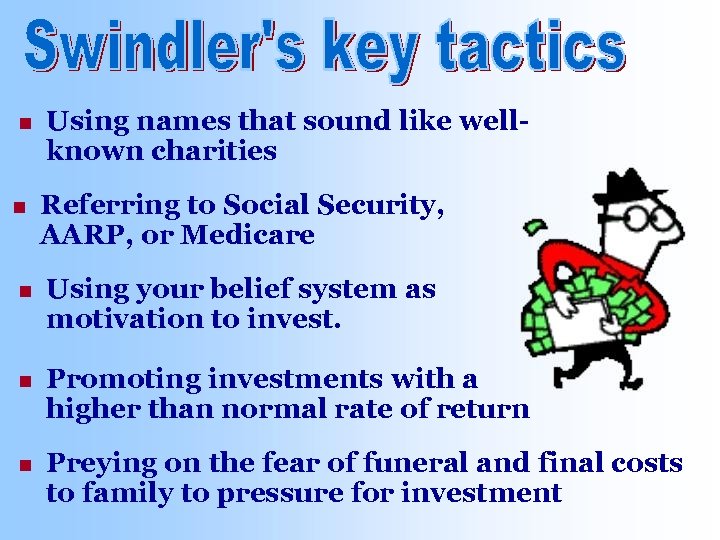 n n Using names that sound like wellknown charities Referring to Social Security, AARP, or Medicare n Using your belief system as motivation to invest. n Promoting investments with a higher than normal rate of return n Preying on the fear of funeral and final costs to family to pressure for investment
 n “…I’ll take you to your bank. ” n “…Last chance!” n “…secret offer. ” n “…Cash Only. ” n “…return is free from taxes. ” n “…invest today or you’ll miss the opportunity!” n “Just Trust me. ”

 n n Seek information about common scams. Stay informed. Share the information with others. Don’t be a “courtesy victim” Save your good manners for friends and family Ask tough questions and get everything in writing. NEVER provide your credit card number, bank account, or social security number until you know that the offer is legitimate.
 n NEVER pay cash. Always pay by check and never make it out to an individual n DON’T SIGN ANYTHING unless you have had sufficient time to review the documents. n n Keep a logbook and diary of all your contact with the person. Copy and file any documents that they send to you. Don’t seek companionship from someone whose sole interest is getting their hands on your money.
 n Remember that there is never a reason to rush into investing. n Do not allow yourself to be pushed or pressured into a decision n Read the fine print n “Don’t call me, I’ll call you” n Never buy anything that you do not fully understand. n Verify the identity of anyone claiming to be a government official or associated with a company.
 n Never make a withdrawal from your account on the request of a stranger or recent acquaintance. n Always ask for his/her license n Always talk to your attorney or family before investing. n Compare the offer with products that are similar n Review your bills, credit card statements, and bank statements every month.

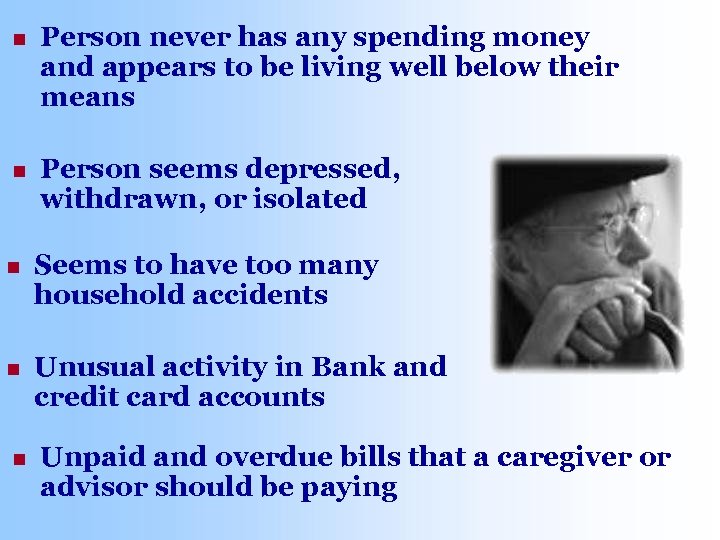 n Person never has any spending money and appears to be living well below their means n Person seems depressed, withdrawn, or isolated n Seems to have too many household accidents n Unusual activity in Bank and credit card accounts n Unpaid and overdue bills that a caregiver or advisor should be paying
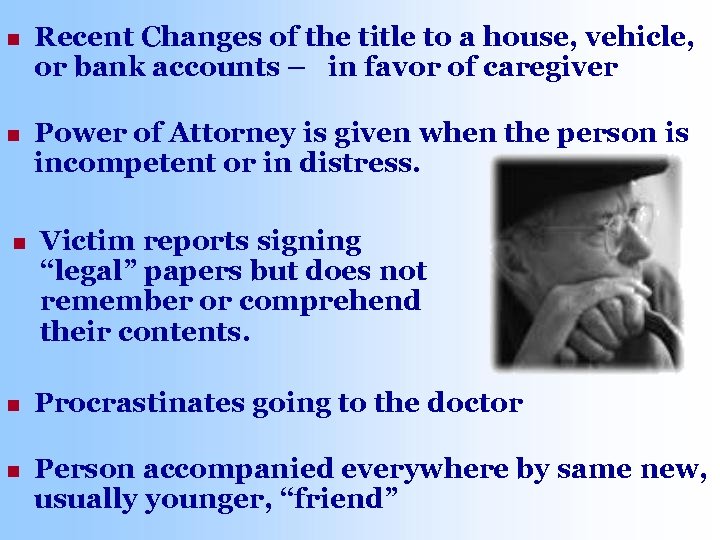 n Recent Changes of the title to a house, vehicle, or bank accounts – in favor of caregiver n Power of Attorney is given when the person is incompetent or in distress. n Victim reports signing “legal” papers but does not remember or comprehend their contents. n Procrastinates going to the doctor n Person accompanied everywhere by same new, usually younger, “friend”
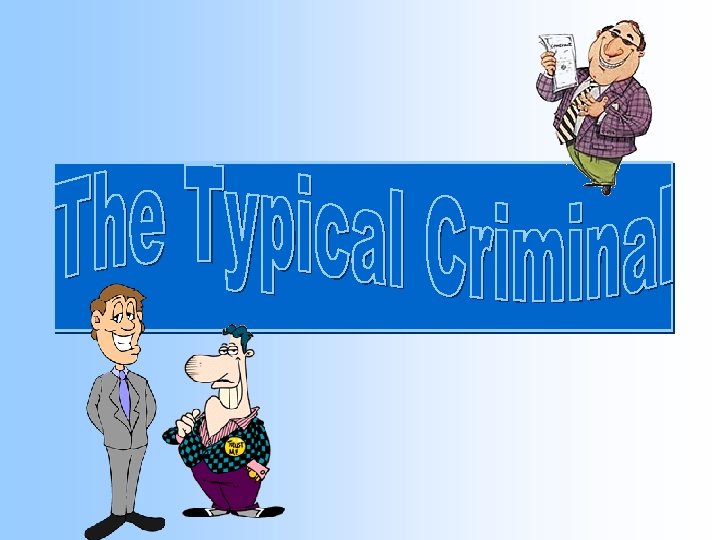
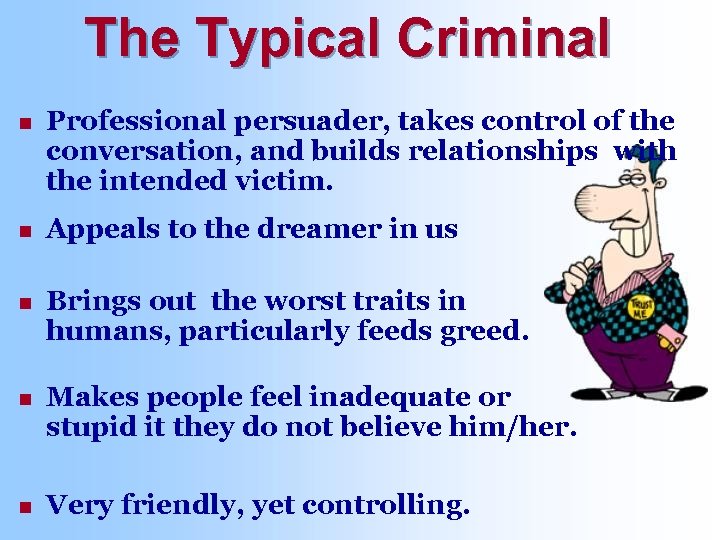 The Typical Criminal n Professional persuader, takes control of the conversation, and builds relationships with the intended victim. n Appeals to the dreamer in us n Brings out the worst traits in humans, particularly feeds greed. n Makes people feel inadequate or stupid it they do not believe him/her. n Very friendly, yet controlling.
 What is it? n A “pyramid scheme” is an illegal multi-level marketing program where the product (if there is a product) is only of secondary importance n Pyramid schemes promise big returns in a short amount of time for doing nothing but handing over money and recruiting other to do the same.
 How does it work? n Victims make an initial investment, which gives them the right to recruit others n For each person that they recruit, they receive money, gifts, or bonuses. n The new recruit then makes an initial investment to get their right to recruit n Money coming in from new recruits is used to pay off early investors
 The End Result n A pyramid scheme is impossible to maintain and eventually the pyramid will collapse. n The scheme gets too big and the promoter cannot raise enough money to pay earlier investors n A vast majority of participants in a pyramid scheme lose all or a high percentage of their money. n The promoter of a pyramid scheme can get fines up to $100, 000 and 10 years in jail.
 Impossible to Sustain 16 2 36 3 216 4 1, 296 5 7, 776 6 46, 656 7 279, 936 8 1, 679, 616 More than Montana’s Population 9 10, 077, 696 10 60, 466, 176 11 362, 797, 056 More than the U. S. Population 12 2, 176, 782, 336 13 13, 060, 694, 016 More than the World Population

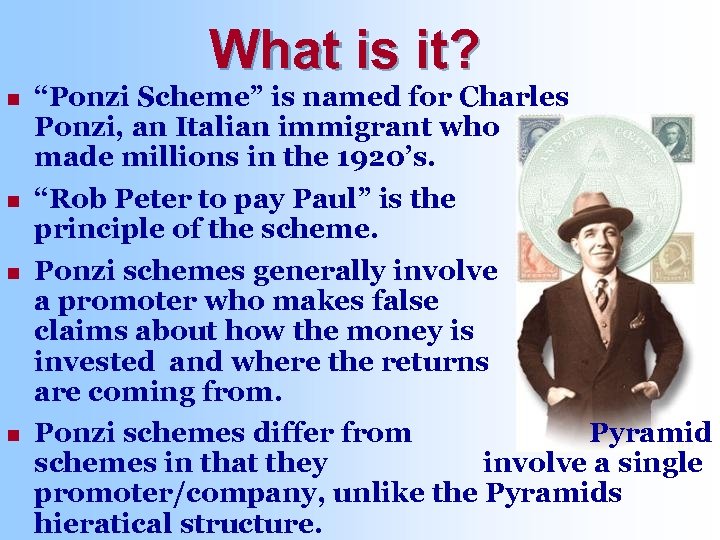 What is it? n n “Ponzi Scheme” is named for Charles Ponzi, an Italian immigrant who made millions in the 1920’s. “Rob Peter to pay Paul” is the principle of the scheme. Ponzi schemes generally involve a promoter who makes false claims about how the money is invested and where the returns are coming from. Ponzi schemes differ from Pyramid schemes in that they involve a single promoter/company, unlike the Pyramids hieratical structure.
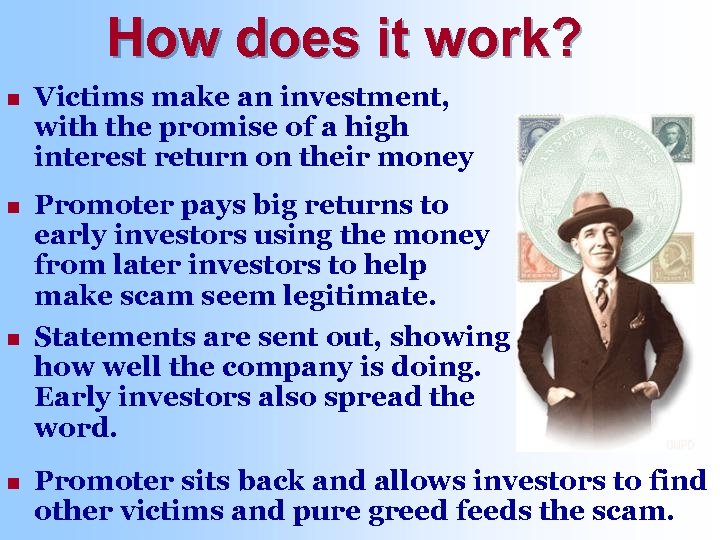 How does it work? n Victims make an investment, with the promise of a high interest return on their money n Promoter pays big returns to early investors using the money from later investors to help make scam seem legitimate. Statements are sent out, showing how well the company is doing. Early investors also spread the word. n n Promoter sits back and allows investors to find other victims and pure greed feeds the scam.
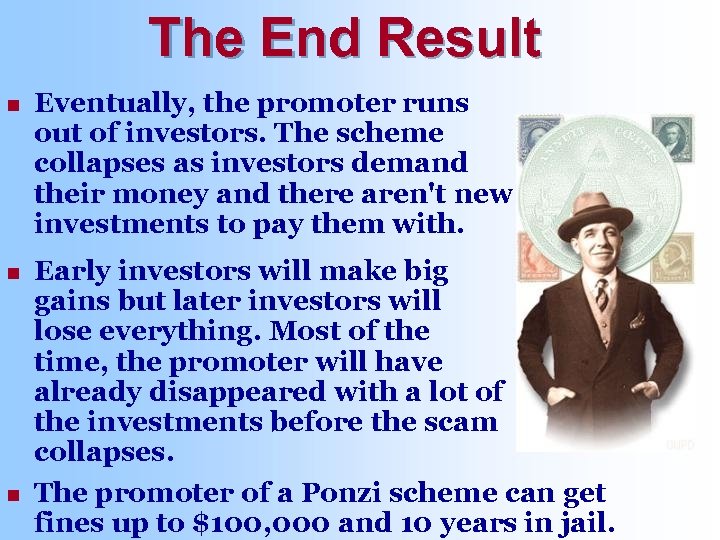 The End Result n Eventually, the promoter runs out of investors. The scheme collapses as investors demand their money and there aren't new investments to pay them with. n Early investors will make big gains but later investors will lose everything. Most of the time, the promoter will have already disappeared with a lot of the investments before the scam collapses. The promoter of a Ponzi scheme can get fines up to $100, 000 and 10 years in jail. n
 What is it? n A variation of the “pyramid scheme” n Also known by names such as: The Original Dinner Party, Friends Helping Friends, Airplane Club, the Ya-Ya Girls, Circle of Friends, Women empowering Women and Chain Letter n Variations of the Gifting club offer a product to incoming recruits in exchange for money and then the new recruit has the right to sell the products to someone else and thereby recruit another person into the scheme.
 How does it work? n Victims are told that the cash they invest is a gift, not taxable, and that this makes the scheme legal. Some clubs require members to sign a form stating the money is an unconditional gift. n Investors recruit new people into the “club. ” As new recruits are enrolled, the person at the top of the pyramid receives their “gift” and leaves the scam and so everyone moves up the pyramid and “closer to their gift” n A variation has members selling a product and they turn over the profit of their first sale to the person that recruited them.
 The End Result n n Gifting Clubs are pyramid schemes. They must continually recruit ever-increasing numbers of new members to survive. When the club fails to recruit, it collapses. Or law enforcement ends the illegal activity A vast majority of participants in a gifting circle never see their big payoff , instead they lose all the money that they paid into the club to enrich a few members The promoter of a Gifting scheme can get fines up to $100, 000 and 10 years in jail.

 What is it? n A scam that targets a specific group. Often the targets are religious, ethnic, or professional groups. n The swindler takes advantage of the tight knit structure of the group. n The criminal often makes comments that convey the basic message of “you can trust me, I’m like you. ”
 How does it work? n Affinity fraud often works with a pyramid scam, a gifting circle is especially prevalent. n The scam may be based on dire predictions of the future and the need to prepare for an emergency or disaster. n Group leaders are the most often targeted. Criminals will ensure that the leader receives a big payoff from the scam because the leader will begin to spread the word and entice group members to become involved in the scam.
 The End Result n Victims of affinity fraud rarely recoup their financial damages. n Emotional damage is often more excruciating as victims have been scammed by a person that they trusted. n Many groups lose membership and even become defunct after a case of affinity fraud in the group. n The perpetrator of Affinity fraud can get fines up to $100, 000 and 10 years in jail, depending on what type of fraud was committed.

 What is it? n Mining/Precious Metals n Oil and Gas n Offshore Investments n Promissory Notes
 Spot the Scam n Terms like “investment of a lifetime” and “high return with low risk” are used. n Swindlers will often use emotion instead of facts to sway investors. n The criminal avoids providing any written materials about the investment. n People who sell investments must be licensed in the state of Montana to do so. Check their license
 Mining/Precious Metals n The lure of Gold, silver, precious metals, and gems is the age-old ally of a criminal trying to persuade investors. n People perceive an investment in “tangible” things, like gold and silver as safer investing. Usually involves a claim of finding an “old mine, ” a untapped oil/gas resource, ” or a “stockpile of gems, ” Investors are warned that secrecy is key to the profits. n Huge returns on the investment Short period of turnaround a “sure thing” investment are promised. n
 Offshore Investment n Chronic in the internet era n Swindlers will normally employ a shell company off shore but the investments rarely stays within that shell company for very long. n Investors are told that they can avoid taxes and that their money will grow faster and have a higher return. n Frequently comes with some type of credit card or ATM card.
 Promissory Notes n Sounds Simple and Safe. n Investors are promised very high, even double digit returns. n n Criminals will often try to persuade a legitimately licensed/registered producer or other professional to sell the notes for them. The notes are backed up by an insurance company that is offshore.
 Suspicious Activities n Investor statement shows unauthorized activity n Excessive trading and/or Churning n No action is taken after talking to a manager or compliance department n Broker tells investor to make checks out to a different entity or firm n Investor is put into products not associated with broker or firm

 1. Where did you get my name? 2. Can you send me written materials about this offer? 3. Explain all the risks involved in this investment. 4. What governmental agency supervises your activity? 5. Would you be willing to explain this offer to my Attorney / Accountant / Banker?
 6. How long have you and your company been in business? 7. How much of this money will go to fees and commissions? 8. Where will my money be held, exactly? 9. What type of written statements does your company provide and how often will I receive them? 10. Who are your company’s principles and can you provide references for them?
 Stop by the Booth! www. Invest. Smart. MT. org 1 -800 -6035
 Consumer Fraud Fighting White Collar Crime
 For more information or assistance, please call (406) 444 -2040 or toll-free (800) 332 - 6148 State Auditor John Morrison