 Скачать презентацию Consumer Behaviour Second Edition Martin Evans Ahmad Jamal
d247f54e7033dcaddf5f44f03882812b.ppt
- Количество слайдов: 40



Consumer Behaviour, Second Edition Martin Evans, Ahmad Jamal Gordon Foxall Cardiff Business School ISBN: 978 -0 -470 -99465 -8 © 2009 John Wiley & Sons Ltd. www. wileyeurope. com/college/evans Chapters 7 & 8 1
Social Group, Tribal and Household Buying Influences Culture © 2009 John Wiley & Sons Ltd. www. wileyeurope. com/college/evans 2
Chapter Objectives • To understand the nature of social group influence in consumer behaviour • To be able to apply different types of group influence to consumer behaviour and marketing • To appreciate the dynamic nature of society and its effects on groups such as tribalism • To analyse and evaluate how families buy through different stages of development and change • To assess relative contributions of family members to the buying process • To explore the nature of pester and parent power and discuss some of the ethical issues in targeting to children • To define the notion of culture and explain its importance to marketing communication and consumer behaviour © 2009 John Wiley & Sons Ltd. www. wileyeurope. com/college/evans 3
Social Groups • Primary group – with whom a person interacts frequently and whose norms are considered important • Secondary group – with whom a person interacts frequently and whose norms are considered weakly important • Membership groups – in which an individual is claiming to be a member is recognized as such by the leader and/or the key members of the group • Symbolic group – with which a person identifies him/herself without a formal membership, voluntarily adopting its norms and values © 2009 John Wiley & Sons Ltd. www. wileyeurope. com/college/evans 4
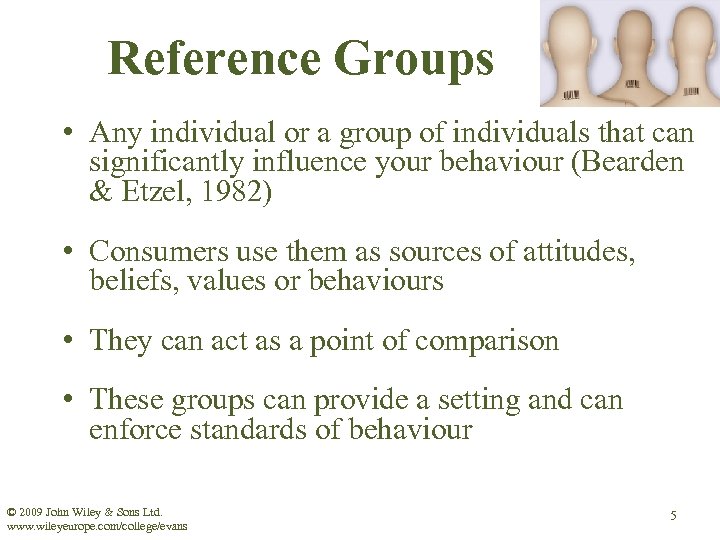
Reference Groups • Any individual or a group of individuals that can significantly influence your behaviour (Bearden & Etzel, 1982) • Consumers use them as sources of attitudes, beliefs, values or behaviours • They can act as a point of comparison • These groups can provide a setting and can enforce standards of behaviour © 2009 John Wiley & Sons Ltd. www. wileyeurope. com/college/evans 5
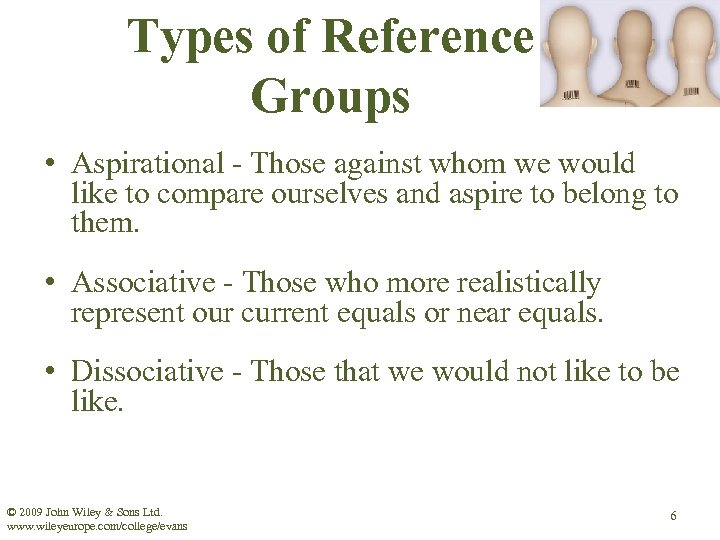
Types of Reference Groups • Aspirational - Those against whom we would like to compare ourselves and aspire to belong to them. • Associative - Those who more realistically represent our current equals or near equals. • Dissociative - Those that we would not like to be like. © 2009 John Wiley & Sons Ltd. www. wileyeurope. com/college/evans 6
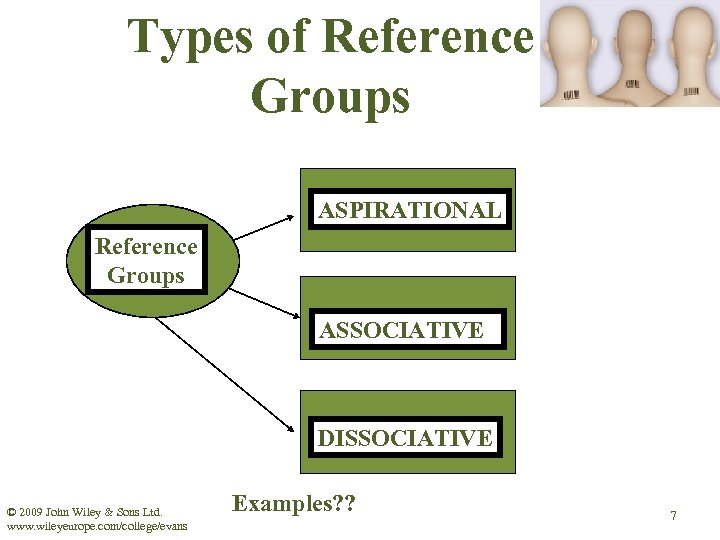
Types of Reference Groups ASPIRATIONAL Reference Groups ASSOCIATIVE DISSOCIATIVE © 2009 John Wiley & Sons Ltd. www. wileyeurope. com/college/evans Examples? ? 7
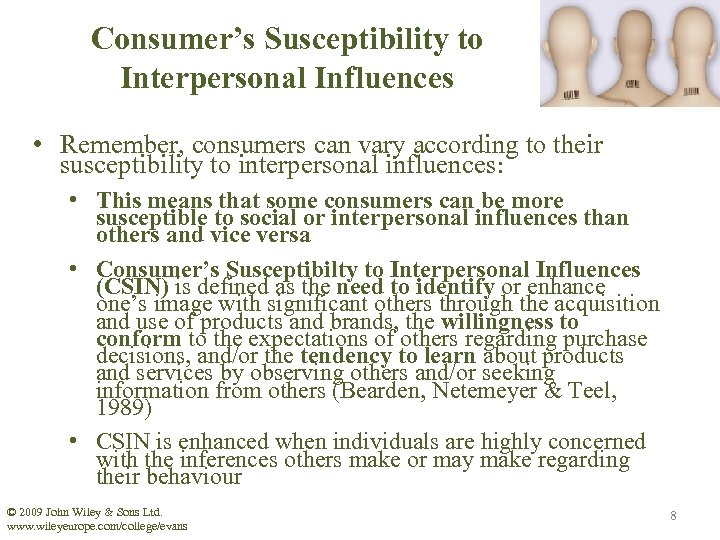
Consumer’s Susceptibility to Interpersonal Influences • Remember, consumers can vary according to their susceptibility to interpersonal influences: • This means that some consumers can be more susceptible to social or interpersonal influences than others and vice versa • Consumer’s Susceptibilty to Interpersonal Influences (CSIN) is defined as the need to identify or enhance one’s image with significant others through the acquisition and use of products and brands, the willingness to conform to the expectations of others regarding purchase decisions, and/or the tendency to learn about products and services by observing others and/or seeking information from others (Bearden, Netemeyer & Teel, 1989) • CSIN is enhanced when individuals are highly concerned with the inferences others make or may make regarding their behaviour © 2009 John Wiley & Sons Ltd. www. wileyeurope. com/college/evans 8
Tribes • The tribe metaphor is used to depict the current functioning of our society – the way consumers behave collectively and produce social forces • Tribe – an ephemeral and unstable group of consumers who are joined together by sharing emotions, feelings and passions on a relatively small scale. Members are connected to each other through family ties. © 2009 John Wiley & Sons and Cova, 2001; 2006 Source: Cova Ltd. www. wileyeurope. com/college/evans 9
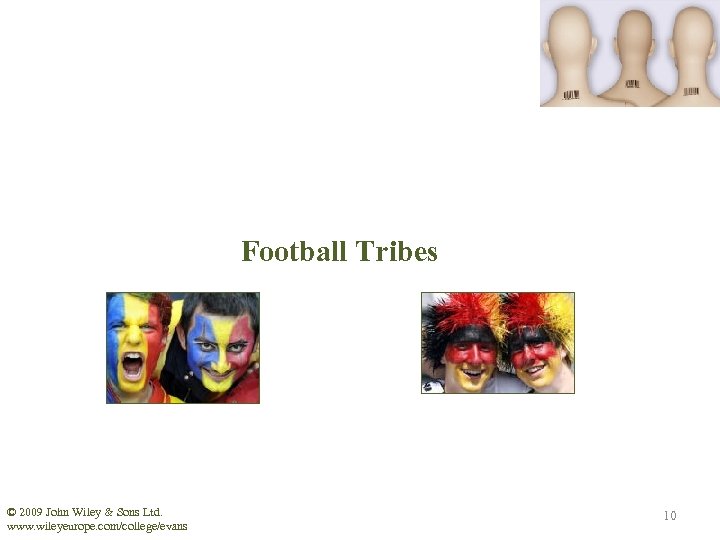
Football Tribes © 2009 John Wiley & Sons Ltd. www. wileyeurope. com/college/evans 10
Tribes • They differ from reference groups in that they do not focus on the normative influences of the group or of individual group members on each other. Instead tribes concentrate on the bonding or linking element that keeps individuals in the group • They translate a need to belong not just to one, but to several groups simultaneously Source: Cova and Cova, 2001; 2006 © 2009 John Wiley & Sons Ltd. www. wileyeurope. com/college/evans 11
Tribes Making Up Brand Communities • Group of runners who meet at the Niketown store in Boston on Wednesdays • Saturn car owners who meet for reunions and barbecues • Harley Davidson Owner Groups • Saab Owners © 2009 John Wiley & Sons Ltd. www. wileyeurope. com/college/evans 12
Family Influences • Family members can act as a reference group • Extended family Two spouses, children including grown up children, grandparents all living together as one family unit • This provides a different environment for interaction and interpersonal influence • Multiple sources of influences based on observation and interaction • Influence of family members on consumption is higher; family members are of greater importance than outsiders © 2009 John Wiley & Sons Ltd. www. wileyeurope. com/college/evans 13
Family Influences • Nuclear family Comprises two spouses and a small number of children • Intergenerational offspring The effect of family in the socialisation of offspring; this includes impact on individual’s norms, attitudes and values Source: Childers and Rao (1992) © 2009 John Wiley & Sons Ltd. www. wileyeurope. com/college/evans 14
Stages in Family Life Cycle • Bachelor • Newly married couples • Full nest 1 (with pre-school children) • Full nest 1 (lone parent) • Middle age, no children (aged 35– 44) • Full nest 2 (school-aged children) • Full nest 2 (lone parents) • Launching families (with non-dependent children) • Launching families (lone parent) • Empty nest 1 (childless aged 45– 60) • Empty nest 2 (retired) • Solitary survivor (under 65) • Solitary survivor (retired) Think of the different requirements and life styles of each - & how marketing should cater for each segment… © 2009 John Wiley & Sons Ltd. www. wileyeurope. com/college/evans 15
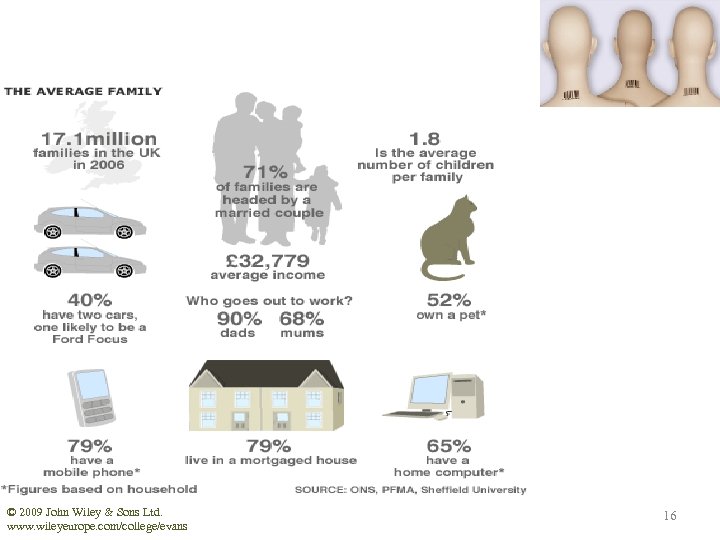
© 2009 John Wiley & Sons Ltd. www. wileyeurope. com/college/evans 16
Noteworthy Non-Traditional Stages of FLC Childless couples: - It is increasingly acceptable for married couples to elect not to have children. - Contributing forces are more career-oriented married women and delayed marriages. Couples who marry later in life (in their late 30 s or later) - More career-oriented men and women and greater occurrence of couples living together. - Likely to have fewer or even no children. © 2009 John Wiley & Sons Ltd. www. wileyeurope. com/college/evans 17
• Couples who have first child later in life (in their late 30 s or later): • Likely to have fewer children. • Stress quality lifestyle: “Only the best is good enough” Single parents • High divorce rates (about 50%) contribute to a portion of single-parent households • A single parent may adopt one or more children © 2009 John Wiley & Sons Ltd. www. wileyeurope. com/college/evans 18
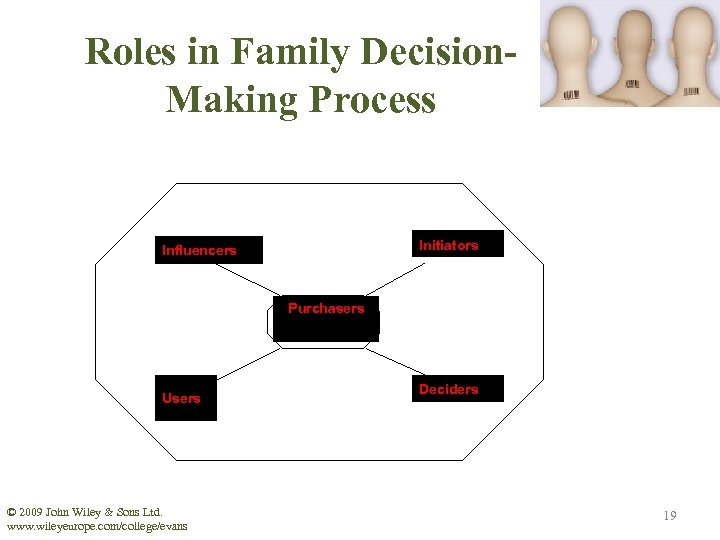
Roles in Family Decision. Making Process Initiators Influencers Purchasers Users © 2009 John Wiley & Sons Ltd. www. wileyeurope. com/college/evans Deciders 19
Family Influences Children & Pester Power A current issue of the role of children in household buying. They are an important segment for marketers (not just for kids products). Marketers are being criticised for how they target children. © 2009 John Wiley & Sons Ltd. www. wileyeurope. com/college/evans 20
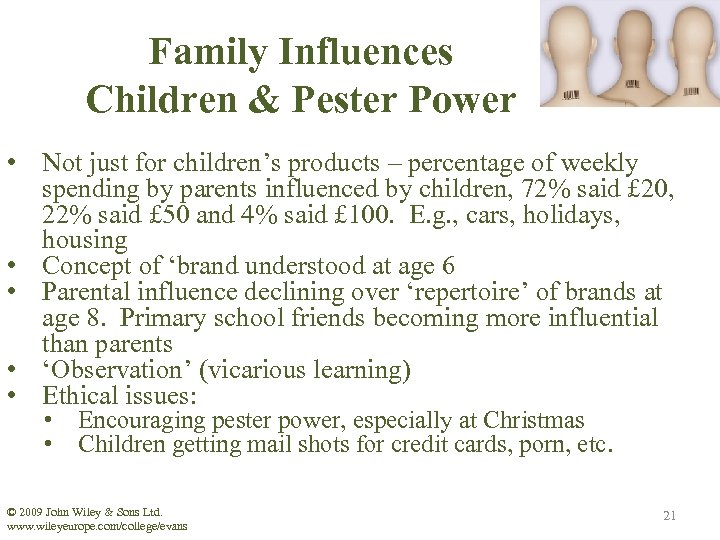
Family Influences Children & Pester Power • Not just for children’s products – percentage of weekly spending by parents influenced by children, 72% said £ 20, 22% said £ 50 and 4% said £ 100. E. g. , cars, holidays, housing • Concept of ‘brand understood at age 6 • Parental influence declining over ‘repertoire’ of brands at age 8. Primary school friends becoming more influential than parents • ‘Observation’ (vicarious learning) • Ethical issues: • • Encouraging pester power, especially at Christmas Children getting mail shots for credit cards, porn, etc. © 2009 John Wiley & Sons Ltd. www. wileyeurope. com/college/evans 21
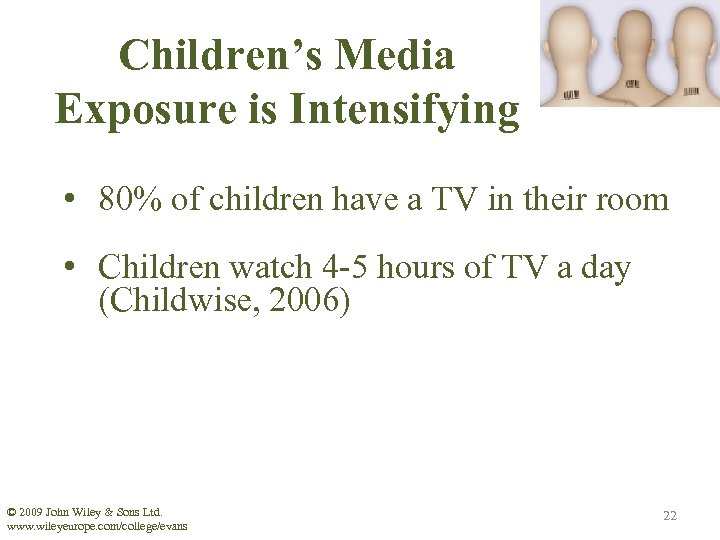
Children’s Media Exposure is Intensifying • 80% of children have a TV in their room • Children watch 4 -5 hours of TV a day (Childwise, 2006) © 2009 John Wiley & Sons Ltd. www. wileyeurope. com/college/evans 22
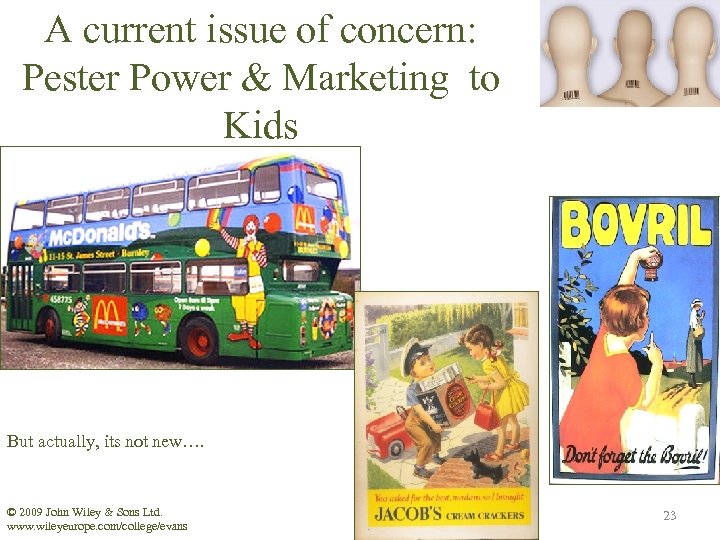
A current issue of concern: Pester Power & Marketing to Kids But actually, its not new…. © 2009 John Wiley & Sons Ltd. www. wileyeurope. com/college/evans 23
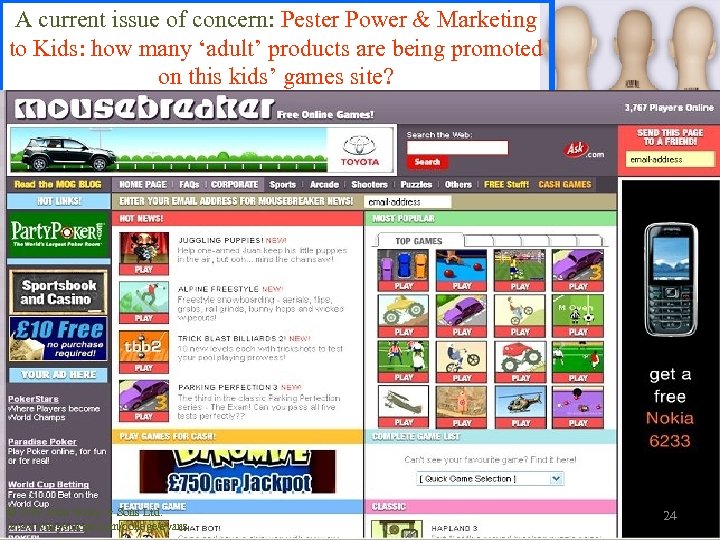
A current issue of concern: Pester Power & Marketing to Kids: how many ‘adult’ products are being promoted on this kids’ games site? © 2009 John Wiley & Sons Ltd. www. wileyeurope. com/college/evans 24
Culture is defined as…. “civilization and the social norms on which civilized societies are based (Bridgewater & Egan, 2004, p. 23) ”, …. “patterns of thought and manners which are widely shared” (Child & Kieser, 1977, p. 2) . . “collective programming of the mind” (Hofstede, 1980, p. 13).
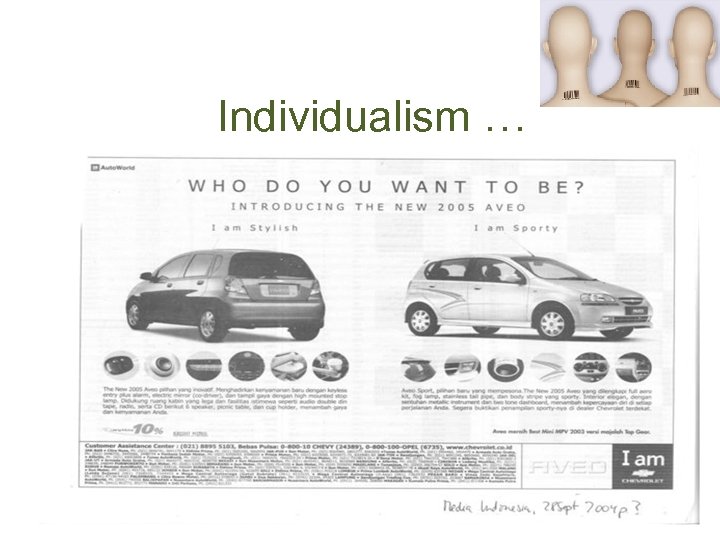
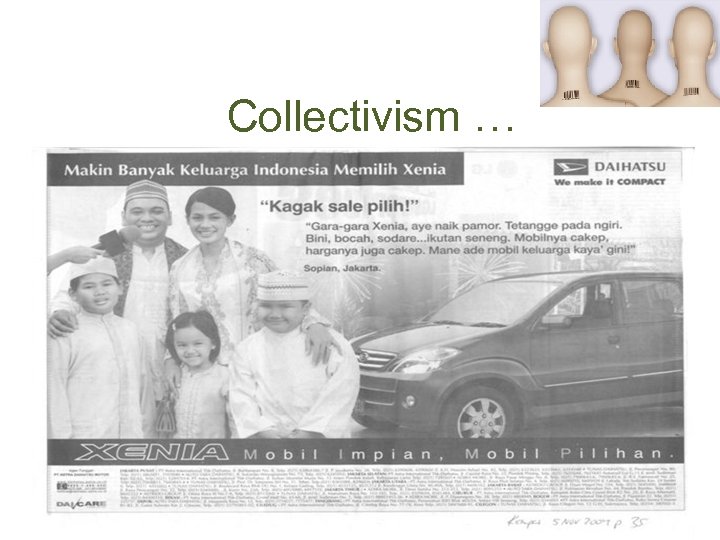
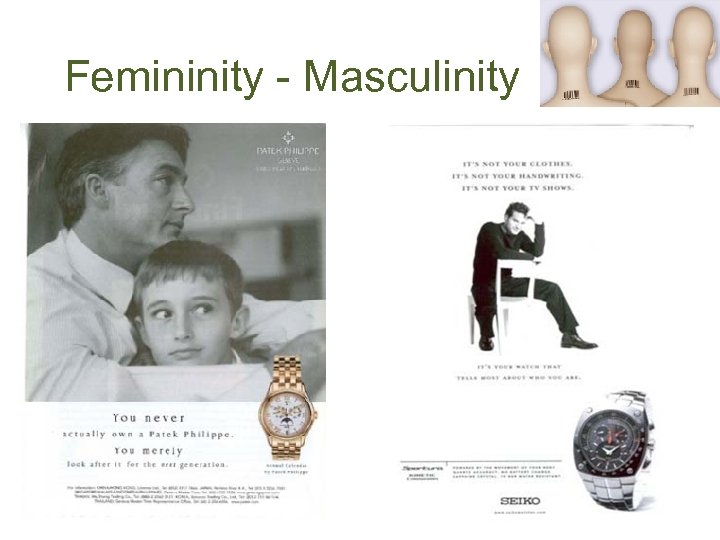
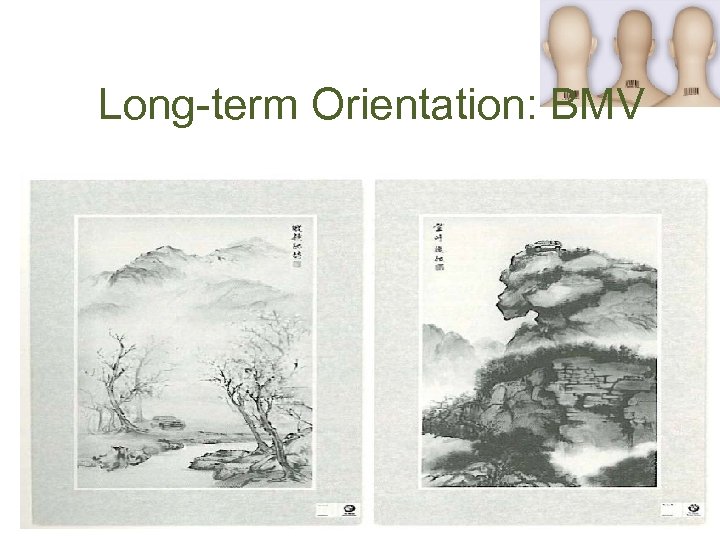
What do we know about culture so far… • Hall (1960) suggests that societies may vary with respect to their conception of: time, space, objects, friendship & family. • International marketers should take into account cultural variations of the basis of: language, religion, ethnicity, education systems, symbols • National cultures can be classified along the dimensions proposed by Hofstede (1994): power distance, uncertainty avoidance, masculinity-femininity, individualismcollectivism, long-term vs. short term orientation
• Consumption is a cultural-bound process and marketers use cultural cues to communicate effectively with consumers and catch their attention

High Degrees of Uncertainty • Promoting a toothpaste in Greece involved the use of the technique “celebrity endorsement”

Power Distance: Mercedes in Asia
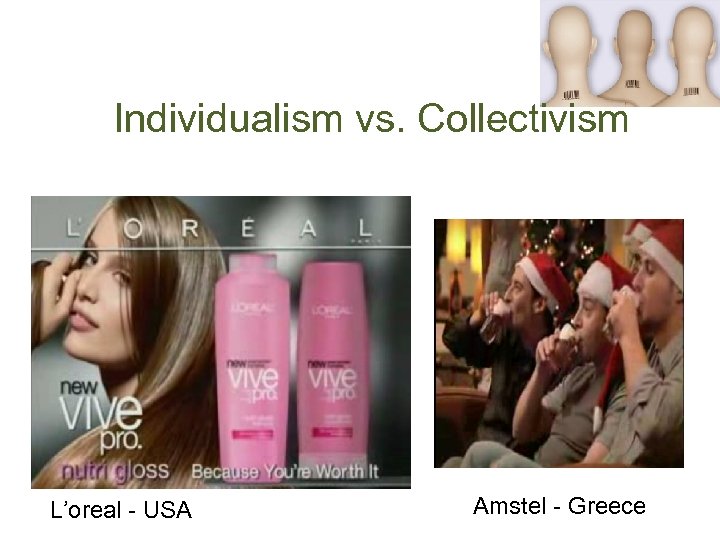
Individualism vs. Collectivism L’oreal - USA Amstel - Greece
Individualism …
Collectivism …
Femininity - Masculinity
Long-term Orientation: BMV
List of Readings • Childers, Terry L. , Rao, Akshay R. . (1992), The influence of familial and peer based reference groups on consumer decisions, Journal of Consumer Research, Vol. 19 (2), pp. 198 -211. • Bearden, W. O. , Netemeyer, R. G. , and Teel, J. E. , (1989), Measurement of Consumer Susceptibility to Interpersonal Influence, Journal of Consumer Research, 15 (March), 473 -81. • Cova, B. , and Cova. V. , (2001), Tribal aspects of posmodern consumption research, Journal of Consumer Behaviour, Vol. 1 (1), pp. 67 -76. • Cova, B. and Pace, S. (2006), Brand community of convenience products: new forms of customer empowerment – the case of ‘my Nutella The Community, European Journal of Marketing. Vol. 40 (9/10), pp. 1087 -1102. • Muniz A. M. , Jr, O'Guinn, T. C. , (2001), Brand community, Journal of Consumer Research, Vol. 27 (4), pp. 412 -431. • Mc. William, G. , (2000), Building stronger brands through online communities, Sloan Management Review, Vol. 41 (3), pp. 43 -52. © 2009 John Wiley & Sons Ltd. www. wileyeurope. com/college/evans 35
List of Readings • Cova, B. and Pace, S. (2006), Brand community of convenience products: new forms of customer empowerment – the case of ‘my Nutella The Community, European Journal of Marketing. Vol. 40 (9/10), pp. 10871102. • Muniz A. M. , Jr, O'Guinn, T. C. , (2001), Brand community, Journal of Consumer Research, Vol. 27 (4), pp. 412 -431. • Mc. William, G. , (2000), Building stronger brands through online communities, Sloan Management Review, Vol. 41 (3), pp. 43 -52. © 2009 John Wiley & Sons Ltd. www. wileyeurope. com/college/evans 36
List of Readings • • Evans M, Wedande G, Ralston L and van t’Hul S (2001) Consumer Interaction in the Virtual Era: Some Solutions from Qualitative Research, with Qualitative Market Research: An International Journal, Vol 4 No 3 150 -159 Belch & Willis (2002) Family Decision Making at the turn of the century: has the changing structure of households impacted the family decision-making process? Journal of Consumer Behaviour, Vol 2 No 2 111 -124 (in Evans et al (2006) Schaninger C M and Lee D H (2002) A New Full Nest Classification Approach, Psychology and Marketing 19. 1 25 -58 General Household Survey (Guest Lib) © 2009 John Wiley & Sons Ltd. www. wileyeurope. com/college/evans 37
List of Readings • • • Social Trends (Guest Lib) www. onlinecommunityreport. com Schor J (2004) Born to Buy, Scribner • Palan, K. M. , and Wilkes R. E. , (1997), Adolescent-parent interaction in family decision making, Journal of Consumer Research, Vol. 24 (2), pp. 159 -170. • Moschis, G. P. , (1985), The role of family communication in consumer socialization of children and adolescents, Journal of Consumer Research, Vol. 11(4), pp. 898 -913. © 2009 John Wiley & Sons Ltd. www. wileyeurope. com/college/evans 38
List of Readings • Beatty, S. E. , and Talpade, S. (1994), Adolescent influence in family decision making: a replication with extension, Journal of Consumer Research, Vol. 21 (2), pp. 332 -341. • Commuri, S. , and Gentry, J. W. , (2005), Resource Allocation in Households with Women as Chief Wage Earners, Journal of Consumer Research, Vol. 32 (2), pp. 185 -195. • Qualls, W. J. , (1987), Household decision behaviour: the impact of husbands’ and wives’ sex role orientation, Journal of Consumer Research Vol. 14 (2), pp. 264 -279. • Childers, T. L. , and Rao, A. R. , The influence of familial and peer based reference groups on consumer decisions, Journal of Consumer Research, Vol. 19 (2), pp. 198 -212. © 2009 John Wiley & Sons Ltd. www. wileyeurope. com/college/evans 39
List of Readings • • • Brown, S. (1999) Postmodernism: The End of Marketing? IN Brownlie D, Saren M Wensley R and Whittington R (1999) Rethinking Marketing, Sage Brown, S. (1993) Postmodern Marketing? European Journal of Marketing, 27. 4 19 -34 Firat A F and Dholakia N (2006) Theoretical and Philosophical Implications of Postmodern Debates: Some Challenges to Modern Marketing, Marketing Theory 6. 2 123 -162 Brown S (2003) Postmodern Marketing : Everything must Go! In Baker M Ed (2003) The Marketing Book, Butterworth Heinemann Brown, S. (2001) Marketing For Muggles: Harry Potter and the Retro Revolution. Journal of Marketing Management, Vol. 17, No 5 -6, July, pp 463 -480. Brown S (2000) Postmodern Marketing IN Baker M (Ed) 2000) Marketing Theory, Thomson © 2009 John Wiley & Sons Ltd. www. wileyeurope. com/college/evans 40
Скачать презентацию Consumer Behaviour Second Edition Martin Evans Ahmad Jamal
d247f54e7033dcaddf5f44f03882812b.ppt