 Скачать презентацию Consumer Behaviour Culture Week 4 Lecture 1 Chapter
0334b8a62b25b3fe464f04d8fbd797a1.ppt
- Количество слайдов: 51



Consumer Behaviour Culture Week 4 Lecture 1 Chapter 2 Bangor Transfer Abroad Programme
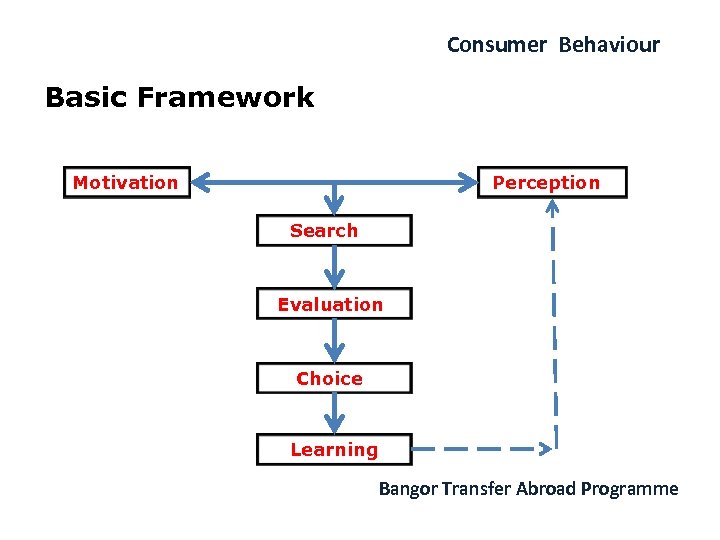
Consumer Behaviour Basic Framework Motivation Perception Search Evaluation Choice Learning Bangor Transfer Abroad Programme
What is culture? It is a combination and mixture of v. Values v. Non verbal communications v. Demographics v. Language It is not just music and art
What is culture? In other words it is based upon v. Knowledge – Education v. Beliefs' - Religion v. Mores – morals v. Customs v. Any other capabilities and habits acquired / learned by members of a society.
Cultural Norms • Must comply with • Optional – nice to conform • Not significant
Orientation of culture • Other • Environment • Self • Hofstede
Consumer Behaviour Other Orientation • Individual vs Collective • Youth vs Age • Family - Extended vs Limited • Masculine vs Feminine • Competition vs Co-operation • Diversity vs Uniformity Bangor Transfer Abroad Programme
Consumer Behaviour Environment Orientation • Cleanliness • Performance and Status • Tradition vs Change • Risk – taking vs Security • Attitudes to Problems • Nature – live with or change Bangor Transfer Abroad Programme
Consumer Behaviour Self Orientation • Lifestyle – physical / active • Sensual gratification / abstinence • Hedonism - materialistic • Work ethic – hard work / Leisure • Gratification – want it now or save for later • Religion vs Secular… Bangor Transfer Abroad Programme
Consumer Behaviour Sub Cultures Globalisation of Brands – media Teen culture T Shirts Music Jeans and Mc. D Middle Classes – Designer Clothes, Hotels Wealthy Pensioners – equivalent ppp Foreign Travel Bangor Transfer Abroad Programme
Consumer Behaviour Cultural Variations in Non Verbal Communications Time Space Etiquette – politeness Artefacts – Symbols Relationships Agreements Bangor Transfer Abroad Programme
CULTURE, • Hofstede’s Dimensions • Globalization and anti-globalization • Western vs. Asian culture
Hofstede’s Cultural Dimensions • • • Individualism (vs. collectivism) Power distance Masculine vs. feminine Strong vs. weak uncertainty avoidance Short vs. long term orientation (Confucianist dynamics) – “The Foolish Old Man Who Moved the Mountain” Based on interviews with IBM executives throughout the World--1980 s
Consumer Behaviour There is an ancient Chinese fable called "The Foolish Old Man Who Removed the Mountains". It tells of an old man who lived in northern China long, long ago and was known as the Foolish Old Man of North Mountain. His house faced south and beyond his doorway stood the two great peaks, Taihang and Wangwu, obstructing the way. He called his sons, and hoe in hand they began to dig up these mountains with great determination. Another graybeard, known as the Wise Old Man, saw them and said derisively, "How silly of you to do this! It is quite impossible for you few to dig up those two huge mountains. " The Foolish Old Man replied, "When I die, my sons will carry on; when they die, there will be my grandsons, and then their sons and grandsons, and so on to infinity. High as they are, the mountains cannot grow any higher and with every bit we dig, they will be that much lower. Why can't we clear them away? " Having refuted the Wise Old Man's wrong view, he went on digging every day, unshaken in his conviction. God was moved by this, and he sent down two angels, who carried the mountains away on their backs. Today, two big mountains lie like a dead weight on the Chinese people. One is imperialism, the other is feudalism. The Chinese Communist Party has long made up its mind to dig them up. We must persevere and work unceasingly, and we, too, will touch God's heart. Our God is none other than the masses of the Chinese people. If they stand up and dig together with us, why can't these two mountains be cleared away? Bangor Transfer Abroad Programme
Individualism vs. collectivism • The extent to which – Individuals as opposed to groups are rewarded – It is desirable to “stand out” from others • In collectivism, the unit of responsibility can be (sometimes depending on context) – Work group – Family – Nation, community, or society as a whole
Power Distance • The extent to which “rank” is important in work and relationships • Rank can be based on – Position – Family/ethnic status – Age • Implications for – Strategy formation – Delegation – Correcting mistakes
“Masculine” vs. “Feminine” • “Masculine” values: Dominating environment, “conquering” nature, “progress” – E. g. , damming, tunnels, land development, land reclamation • “Feminine” values: Harmony, preserving environment – E. g. , environmental impact, working around nature
Uncertainty Avoidance • Low uncertainty avoidance – Willingness to • Take risks – Investments – Social situations – Consider new ideas • High uncertainty avoidance – Reliance on authority for decision making
Long vs. short term orientation • Not included in Hofstede’s original work • Complications—is U. S. shortsighted? – Short term financial performance – Investment in new technologies; firms with high price/earnings ratios • Net present value (NPV) analysis/discounted cash flows • Economic structure – Accountability to stockholders; disclosure of information
Characteristics of Culture • Comprehensive • Acquired (learned) • Manifested in boundaries of acceptable thought and behavior--norms and sanctions • Conscious awareness limited (frequently taken for granted) • Dynamic vs. static
Homogeneity of Culture—Some Dimensions • • Linguistic Religious Ethnic Climatic Geographic Institutional/political Social/income Source: Usinier and Lee, 2005
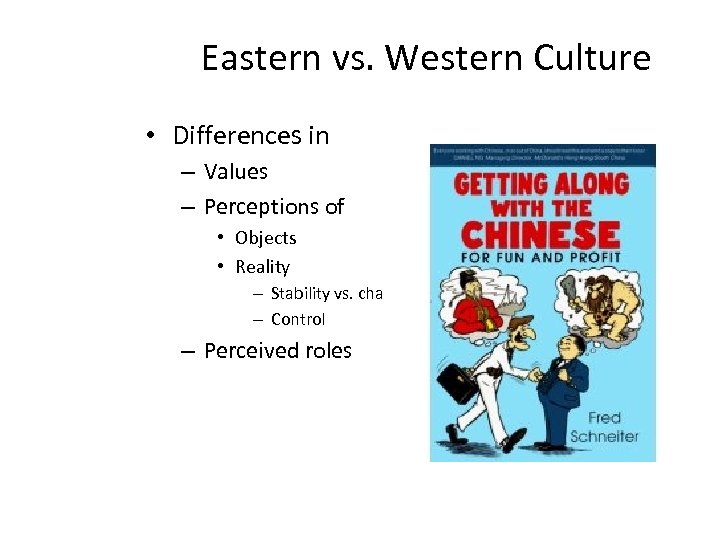
Eastern vs. Western Culture • Differences in – Values – Perceptions of • Objects • Reality – Stability vs. change – Control – Perceived roles
Time Issues in Culture • Time as tangible, valuable commodity – “Time is money” vs. – Traditional means of relations • Monochronic vs. polychronic approach to combining events • Eating times – – Regularity vs. flexibility Social purpose Meal purpose and content Distribution of food consumption across the day • Life as “single continuous event” vs. a series of repeating cycles – Impact of religion, attachment to nature’s cycles • Preferred temporal orientation – Past – Present – Future
Relating to Outsiders • Perceptions of outsiders • Tendency to perceive —may be seen as “out-groups” as more homogeneous than – “barbarian” one’s own group—the – “lazy” Sherif Boys’ Camp – “backward” studies – “inefficient” vs. “uncultured” • Locus of in-group—may – profane (relative to independ on context group’s religion) Source: Usinier and Lee, 2005
Acculturation, Not Assimilation • Assimilation: – A group leaves culture and customs behind adopts culture and customs of another group • Acculturation: – A group adopts or borrows customs and traits from another culture
Acculturation is Defined as… • “Change resulting from contact between cultures” • “The process by which people adopt or borrow customs and traits from another culture” • “A merging of cultures as a result of prolonged contact” • “Mutual influence of different cultures in close contact” Source: “Acculturation” Microsoft Encarta Online Encyclopedia 2000 Strategy Research Corp. Webster New World Dictionary, Third College Edition
Key Indicators of Acculturation • Language • Values
Cultural “borrowing” • Adoption of elements from other cultures— e. g. , – Language and writing systems – Products (e. g. , jeans, pizza) • Adjustments/adaptations • Hidden process; origin may be unknown to contemporary members of the culture Source: Usinier and Lee, 2005
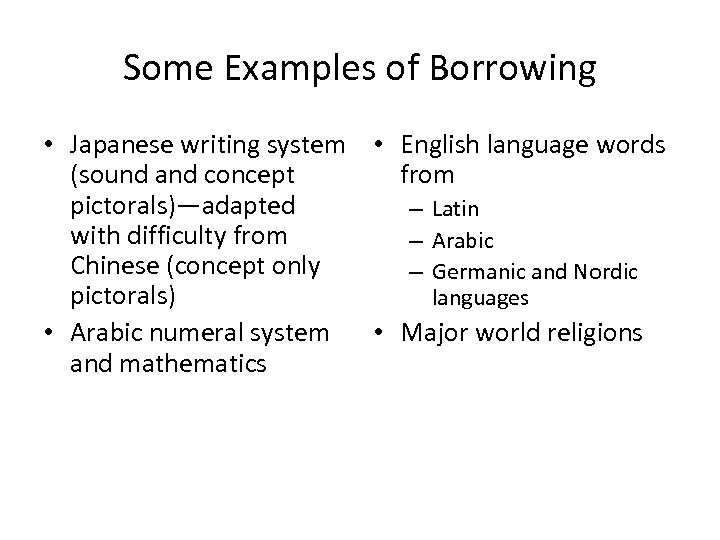
Some Examples of Borrowing • Japanese writing system • English language words (sound and concept from pictorals)—adapted – Latin with difficulty from – Arabic Chinese (concept only – Germanic and Nordic pictorals) languages • Arabic numeral system • Major world religions and mathematics
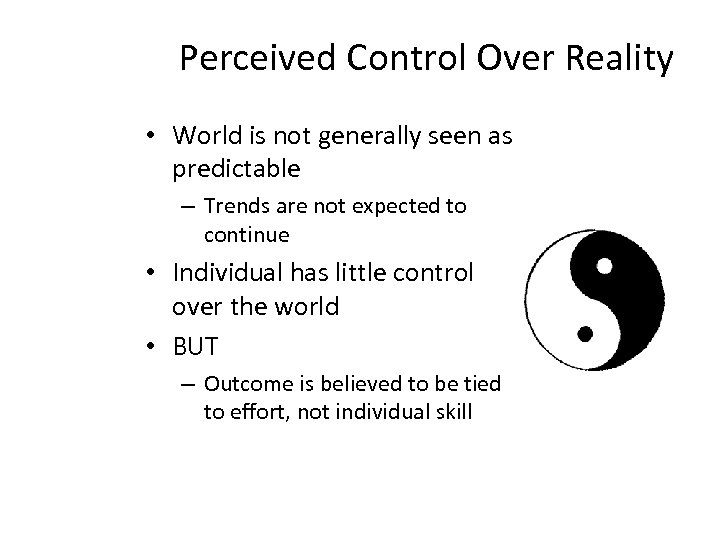
Perceived Control Over Reality • World is not generally seen as predictable – Trends are not expected to continue • Individual has little control over the world • BUT – Outcome is believed to be tied to effort, not individual skill
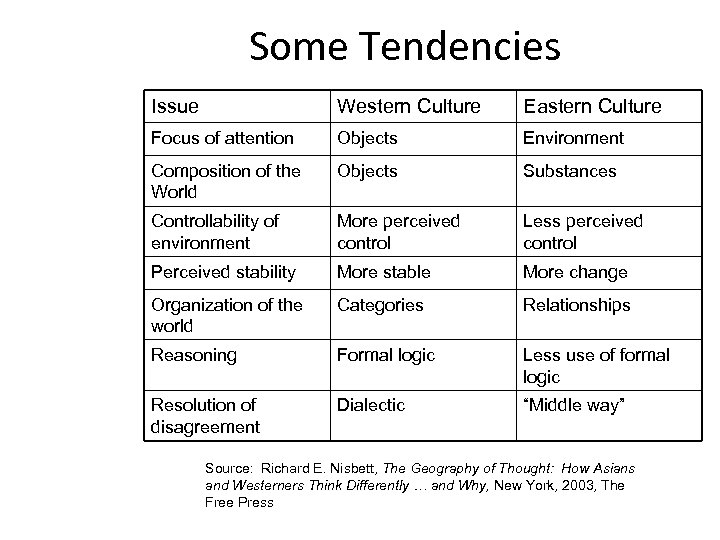
Some Tendencies Issue Western Culture Eastern Culture Focus of attention Objects Environment Composition of the World Objects Substances Controllability of environment More perceived control Less perceived control Perceived stability More stable More change Organization of the world Categories Relationships Reasoning Formal logic Less use of formal logic Resolution of disagreement Dialectic “Middle way” Source: Richard E. Nisbett, The Geography of Thought: How Asians and Westerners Think Differently … and Why, New York, 2003, The Free Press
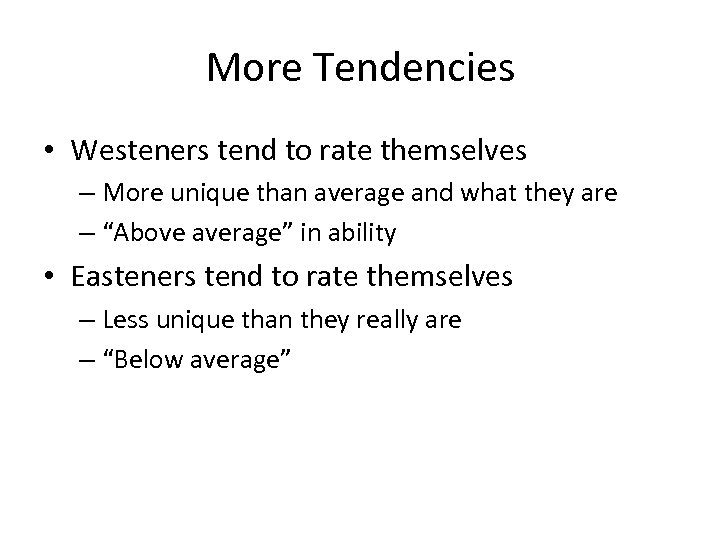
More Tendencies • Westeners tend to rate themselves – More unique than average and what they are – “Above average” in ability • Easteners tend to rate themselves – Less unique than they really are – “Below average”
Parenting • Western – Child given choices – In play, parent asks questions about objects • Eastern – – Choices made for the child Child reared to stay with mother most of the time Parent asks questions about feelings Feelings in disciplinary talks • “The farmer feels bad that you did not eat everything…” • “The toy is crying because you threw it. ”
Teaching Language to Children • Emphasis is on verbs, not on – Nouns – Adjectives, adverbs (except if related to emotions)
Categorization • Tendency to group into categories based on members that go together (e. g. , monkey/banana rather than monkey/panda)
Proverbs • Western: “The early bird gets the worm” • Eastern: – “The first bird in the flock gets shot” – “A nail that stands out will be hammered down. ”
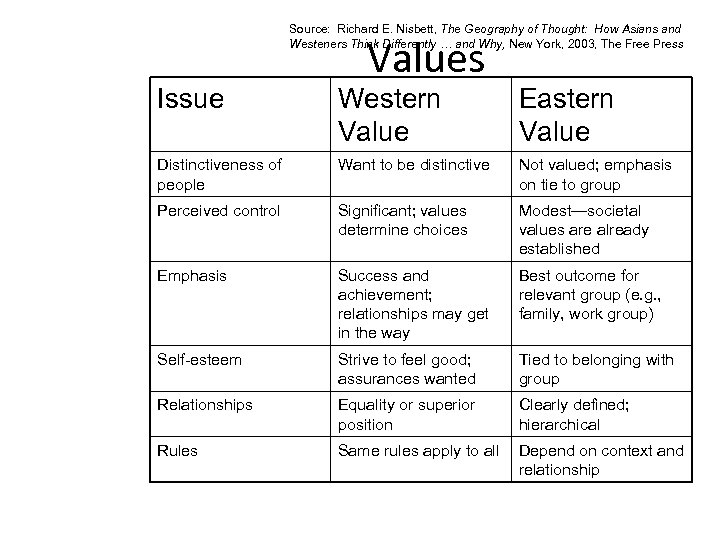
Source: Richard E. Nisbett, The Geography of Thought: How Asians and Westeners Think Differently … and Why, New York, 2003, The Free Press Values Issue Western Value Eastern Value Distinctiveness of people Want to be distinctive Not valued; emphasis on tie to group Perceived control Significant; values determine choices Modest—societal values are already established Emphasis Success and achievement; relationships may get in the way Best outcome for relevant group (e. g. , family, work group) Self-esteem Strive to feel good; assurances wanted Tied to belonging with group Relationships Equality or superior position Clearly defined; hierarchical Rules Same rules apply to all Depend on context and relationship
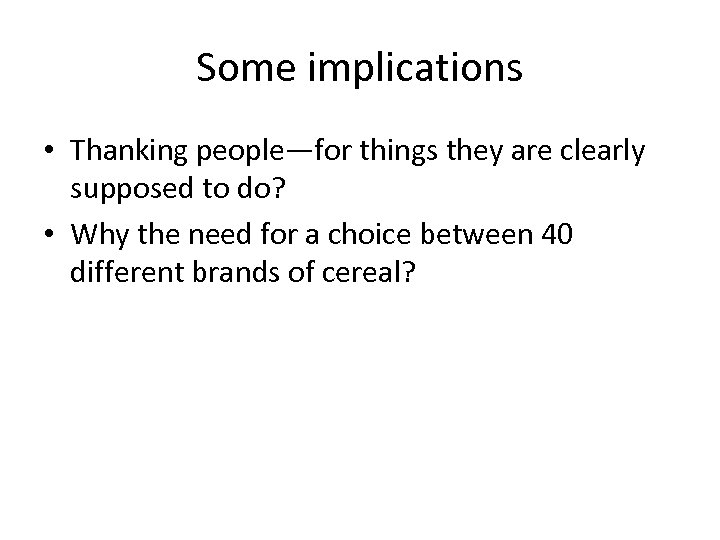
Some implications • Thanking people—for things they are clearly supposed to do? • Why the need for a choice between 40 different brands of cereal?
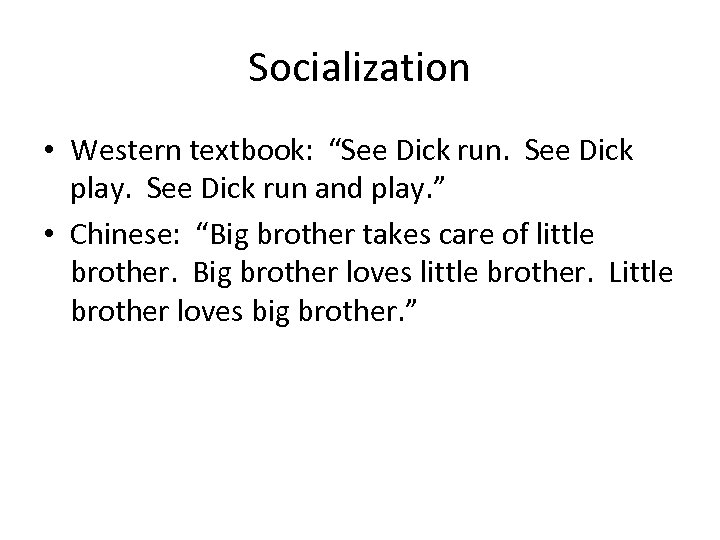
Socialization • Western textbook: “See Dick run. See Dick play. See Dick run and play. ” • Chinese: “Big brother takes care of little brother. Big brother loves little brother. Little brother loves big brother. ”
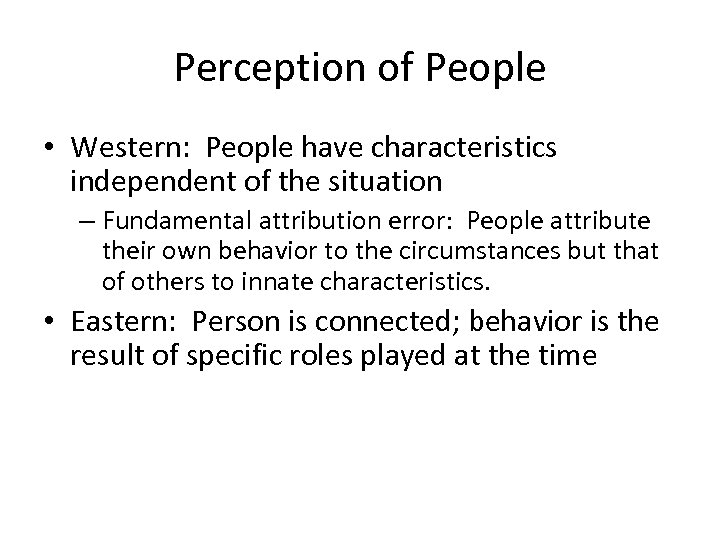
Perception of People • Western: People have characteristics independent of the situation – Fundamental attribution error: People attribute their own behavior to the circumstances but that of others to innate characteristics. • Eastern: Person is connected; behavior is the result of specific roles played at the time
Contrasting Advertising Perspectives (Aithison 2002) • Western – “Atomistic”—broken down to smallest component parts – “Unique selling propositions” – “How to” – Positioning – May be “dull and boring” – “Copy focused” • Asian – Holistic – “Everything relates to everything else” – How things “fit together” and “relate” – Visual and oral Jim Aitchison, How Asia Advertises, New York: Wiley, 2002.
Advertising Content Comparisons • American: – Individual benefit and pleasure (e. g. , “Make your way through the crowd) • Korean – Collective values (e. g. , “We have a way of bringing people together)
“Priming” and learning in a culture • U. S. professor in Hong Kong started letter apologizing for his unworthiness for the job • U. S. manager left room so that an employee could “snoop” on unfavorable report
Debate and Conflict • “The first person to raise his voice has lost the argument. ” (Chinese proverb) • Use of indirection and projection • Face-to-face vs. anonymous comments • Western adversarial “rule of law” based on consistent universal ideals vs. solution for the case at hand in context
Resolving Disputes • Not based on – Universal principles – Formal logic (not because of inability but because this is not a “mature way” to resolve disputes) • Emphasis on – Compromise – Discouragement of bringing about conflict • Inherent belief that “contradicting” statements can each have some truth (attraction to paradoxes)
Relationships, Education, and Work • Western – – Standing out; being “better” Self perceived favorably Self-esteem building Work longer on successful job • Eastern – – – Harmony Must “weed out” personal characteristics that might annoy others Taught self-criticism Not recognized in profession until after many years of practice Work longer on unsuccessful job
Chinese Involvement in Product Selection • Low for products consumed individually in private—emphasis on price and quality • Higher for products consumed in public setting —social significance becomes more important —e. g. , – Status – Harmony with others
Mexican vs. U. S. culture • Cautions – Mexico is a large, heterogeneous country – “Urban” areas vs. indigenous cultures – Large regional variations – Some differences based on income and lifestyle – Some impact of religion
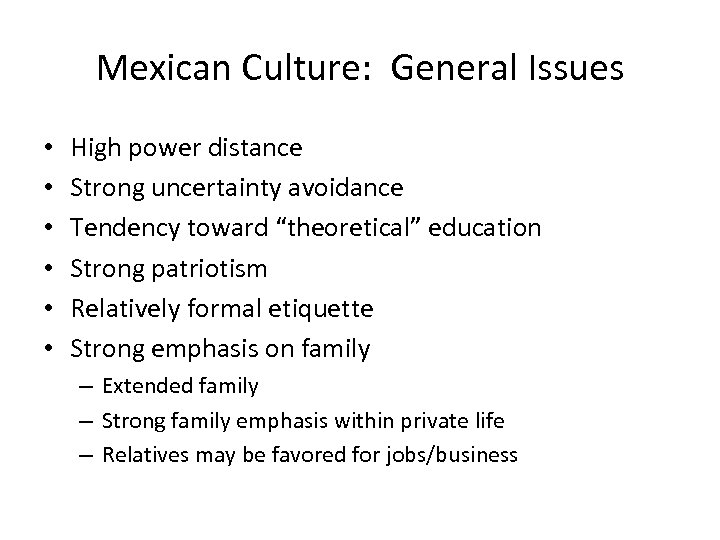
Mexican Culture: General Issues • • • High power distance Strong uncertainty avoidance Tendency toward “theoretical” education Strong patriotism Relatively formal etiquette Strong emphasis on family – Extended family – Strong family emphasis within private life – Relatives may be favored for jobs/business
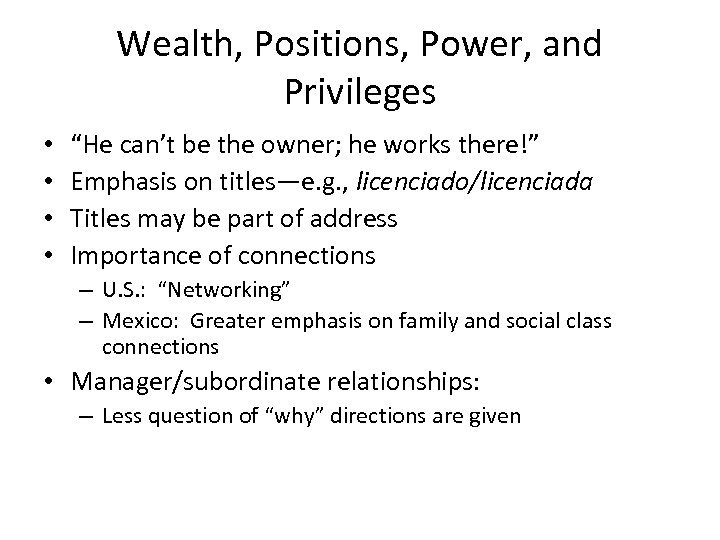
Wealth, Positions, Power, and Privileges • • “He can’t be the owner; he works there!” Emphasis on titles—e. g. , licenciado/licenciada Titles may be part of address Importance of connections – U. S. : “Networking” – Mexico: Greater emphasis on family and social class connections • Manager/subordinate relationships: – Less question of “why” directions are given
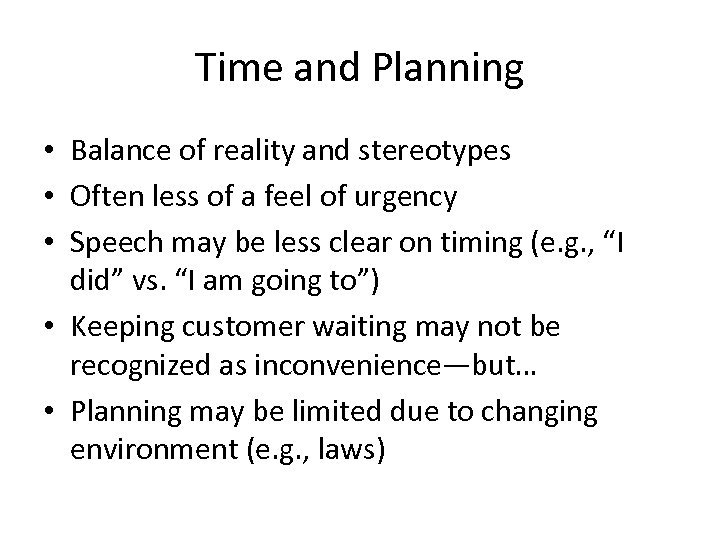
Time and Planning • Balance of reality and stereotypes • Often less of a feel of urgency • Speech may be less clear on timing (e. g. , “I did” vs. “I am going to”) • Keeping customer waiting may not be recognized as inconvenience—but… • Planning may be limited due to changing environment (e. g. , laws)
Скачать презентацию Consumer Behaviour Culture Week 4 Lecture 1 Chapter
0334b8a62b25b3fe464f04d8fbd797a1.ppt