 Скачать презентацию Consumer Behavior Research Methods MAR 3503 January 12
933a1aeb99a696fc2b110a9022ae0121.ppt
- Количество слайдов: 32



Consumer Behavior Research Methods MAR 3503 January 12, 2012
Why is research important? • Pringles • Pampers • Eye level
Perspectives on consumer behavior research • Psychology: The scientific study of behavior – Cognitive psychology: perception, learning, thought, memory, judgment – Social psychology: influence of other people, both direct (persuasion) and indirect (being a person among others) • Economics: The study of how societies and people manage scarce resources – Microeconomics: allocation of individual resources – Macroeconomics: system-level factors that affect resource allocation
Perspectives on consumer behavior research • Sociology – The study of social institutions and group relationships • Other perspectives – History – Cultural anthropology – Lots more • Notice difference between “macro” and “micro” orientations
The science of (consumer) behavior • Research helps us… – Understand: “What happened? ” – Predict: “What will happen? ” • Predictions require an understanding of WHY something happened • Important terms to know: – Data: classified observations of behavior; your results – Hypotheses: a predicted relationship between variables
Types of research questions • Applied research – Answers specific questions about a product, a store, a market, etc. – This research is conducted… • In house • By an external market research firm • By watchdog agencies
Types of research questions • Basic research – Answers questions independent of specific products, etc – Questions like… • • What affects your perception of taste? What makes a spokesperson credible? How can attitudes be changed? How do peer groups exert influence? – This research is conducted… • At universities • By governmental agencies • In “think tanks” – Hopefully, basic research can be applied to many products, consumers, and situations
Three kinds of research • Descriptive – Basic purpose: To observe and record behavior – How? Case studies, surveys, or observation
Research methods: Observation • Watching how people interact with some aspect of their environment (i. e. , a product) • Can be unobtrusive – Watching shoppers in stores • Can be very intrusive – Watching people in their homes • Advantages? • Disadvantages?
Research methods: Focus groups • A group gathers, led by a trained moderator, to discuss a product (or an ad, etc. ) • Can be done over the phone or online, even – Frees you from location restraints and gives people more freedom to disagree with the group – But you lose valuable data like body language, nonverbal reactions • Advantages? • Disadvantages?
Research methods: Surveys/interviews • Each person responds to a preset list of questions – One-on-one, by mail, by phone, by computer • They might ask… – Quantitative questions: • Have you tried this product? How often? How long ago? – Qualitative questions: • What do you think of this product? • Advantages? • Disadvantages?
Three kinds of research • Descriptive – Basic purpose: To observe and record behavior – How? Case studies, surveys, or observation – Possible problems • What if you observe a weird sample? • What if you don’t watch the right things, or worse, watch only what you want (confirmation bias)? – Ask the right questions, or the answers you get will be uninformative
Danger of surveys and focus groups • The biggest disadvantages of both • 1. Introspection cannot always tell us “why” – Ex. Shoppers were presented with 4 identical pairs of socks, displayed left to right – They preferred the stocking on the right 4 x as much as the stocking on the left – NO ONE believed their preferences were driven by the position of the socks – Experimenters were able to manipulate choices, but people weren’t able to report why they made the choices they did Nisbett & Wilson, 1977
Danger of surveys and focus groups • 2. Memory is error-prone – Subtle changes in question wording can influence reporting of behaviors – A. How many products have you tried? 1, 5, 10? • Average answer for A: – VERSUS – B. How many products have you tried? 1, 2, 3? • Average answer for B: Loftus, 1975
So now what? • • Asking people why may lead you astray Even asking them what can lead to problems “Self-report” isn’t always enough To understand changes in behavior, we must be more systematic – See how changes along a selected dimension are associated with changes in behavior
Three kinds of research • Correlational – Basic purpose: To detect naturally occurring relationships; to see how well one variable predicts another – How? Computing statistical relationships, in surveys, etc. – Ex. Smoking and cancer, etc.
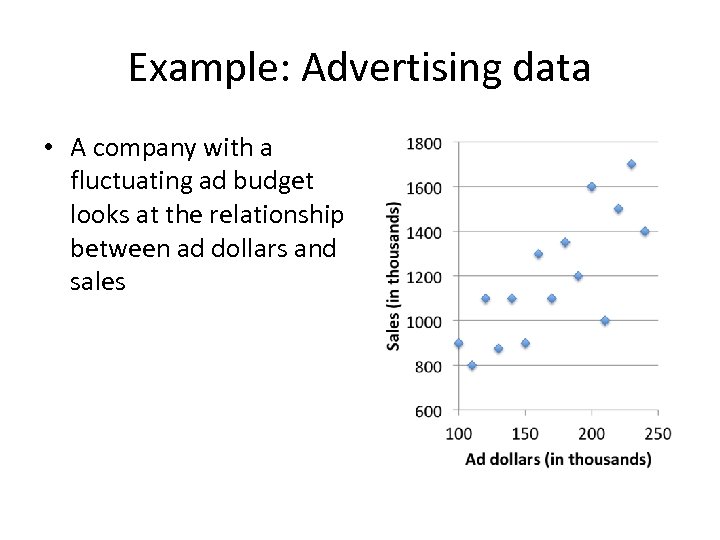
Example: Advertising data • A company with a fluctuating ad budget looks at the relationship between ad dollars and sales
Three kinds of research • Correlational – Basic purpose: To detect naturally occurring relationships; to see how well one variable predicts another – How? Computing statistical relationships, in surveys, etc. – Ex. Smoking and cancer, etc. – Possible problems • Doesn’t specify cause and effect! – Kids with bigger shoes are smarter? • Also, doesn’t specify cause and effect!
The third variable • We know that watching violence on TV and aggression in kids is correlated • But what causes what?
Three kinds of research • Experimental – The crème de la crème of consumer behavior research – Basic purpose: To explore cause and effect – How? Manipulate one or more factors; use random assignment; always have a control group • Independent vs. dependent variables—know which is which!
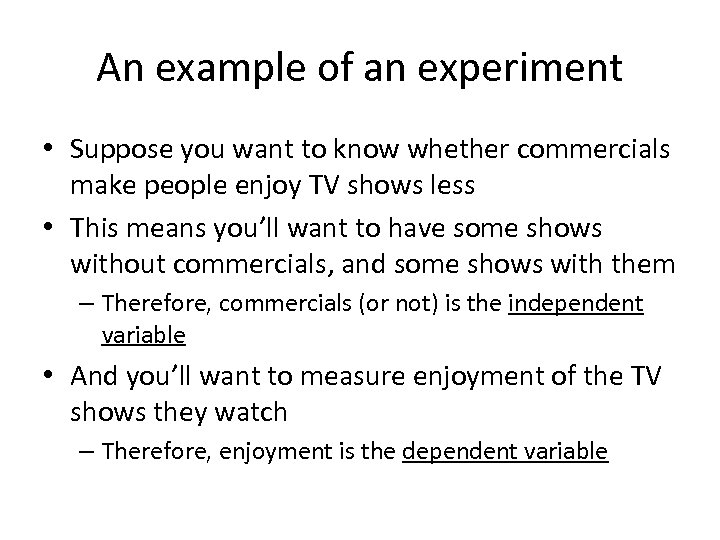
An example of an experiment • Suppose you want to know whether commercials make people enjoy TV shows less • This means you’ll want to have some shows without commercials, and some shows with them – Therefore, commercials (or not) is the independent variable • And you’ll want to measure enjoyment of the TV shows they watch – Therefore, enjoyment is the dependent variable
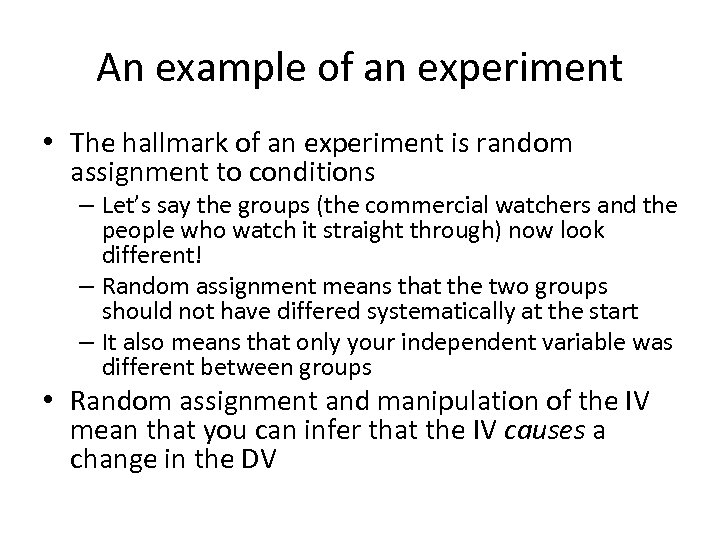
An example of an experiment • The hallmark of an experiment is random assignment to conditions – Let’s say the groups (the commercial watchers and the people who watch it straight through) now look different! – Random assignment means that the two groups should not have differed systematically at the start – It also means that only your independent variable was different between groups • Random assignment and manipulation of the IV mean that you can infer that the IV causes a change in the DV
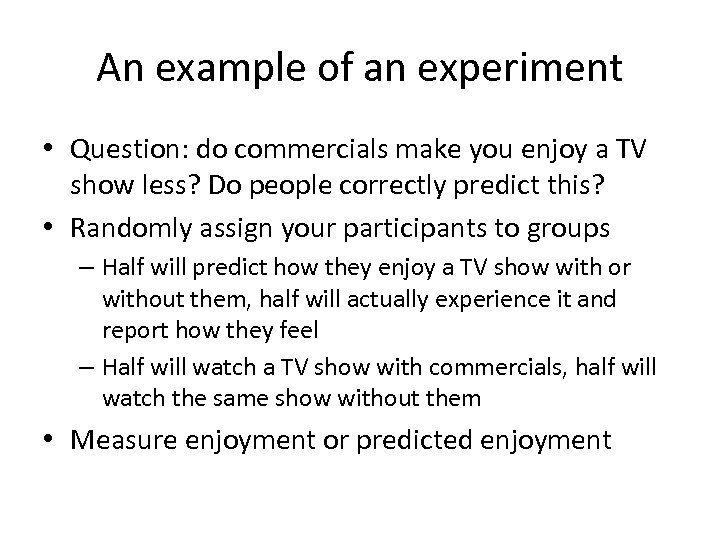
An example of an experiment • Question: do commercials make you enjoy a TV show less? Do people correctly predict this? • Randomly assign your participants to groups – Half will predict how they enjoy a TV show with or without them, half will actually experience it and report how they feel – Half will watch a TV show with commercials, half will watch the same show without them • Measure enjoyment or predicted enjoyment
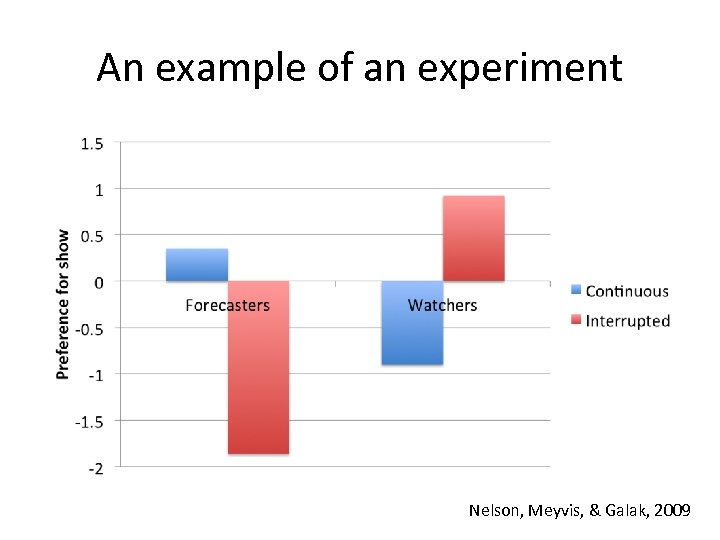
An example of an experiment Nelson, Meyvis, & Galak, 2009
Three kinds of research • Experimental – The crème de la crème of consumer behavior research – Basic purpose: To explore cause and effect – How? Manipulate one or more factors; use random assignment; always have a control group • Independent vs. dependent variables—know which is which! – Can be done large- or small-scale, in lab or in field – Possible problems • Sometimes not possible ethically • …or practically
Ethics in research • Need to protect participants – Obtain informed consent • Dilemma—how much to tell participants ahead of time? – Protect privacy • “Mere-measurement” effect—innocuous questions may themselves influence behavior – Half of participants in sample were surveyed as to their intentions to purchase a car in the next few months – All participants (including those who weren’t surveyed) were contacted six months later
Things to watch out for… • Temptation to resist research results – May clash with intuition • “I know (or I am) an exception” – Most results are general trends—not every person, every time! • Yet, it’s important to be a critical consumer of research – Don’t believe every result you read • Look for leading questions • Look for good experimental design and random assignment
Confirmation bias • We “normally see things and not the holes between them” (Kurt Koffka) • We are more sensitive to the presence (vs. absence) of features and objects, the occurrence (vs. non-occurrence) of events • When evaluating evidence or seeking information regarding a hypothesis, people are often biased toward information regarding the presence of the feature in question
Confirmation bias causes • Positive-test strategy: When we look for the presence of cases that confirm the hypothesis, e. g. , when trying to determine if someone is an extrovert, look for evidence of extraversion • Ambiguous Information: Biased conclusions especially likely when stimuli are complex such that cases exist to fit the hypothesis, regardless of whether the hypothesis is true—e. g. , horoscopes, palm reading
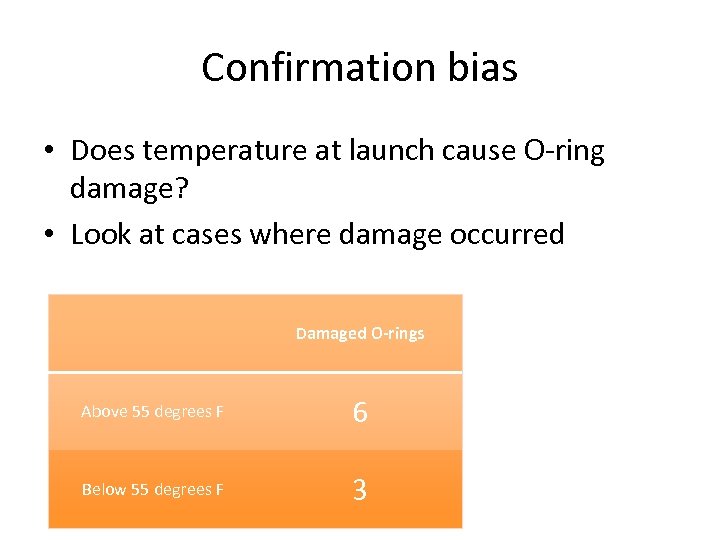
Confirmation bias • Does temperature at launch cause O-ring damage? • Look at cases where damage occurred Damaged O-rings Above 55 degrees F 6 Below 55 degrees F 3
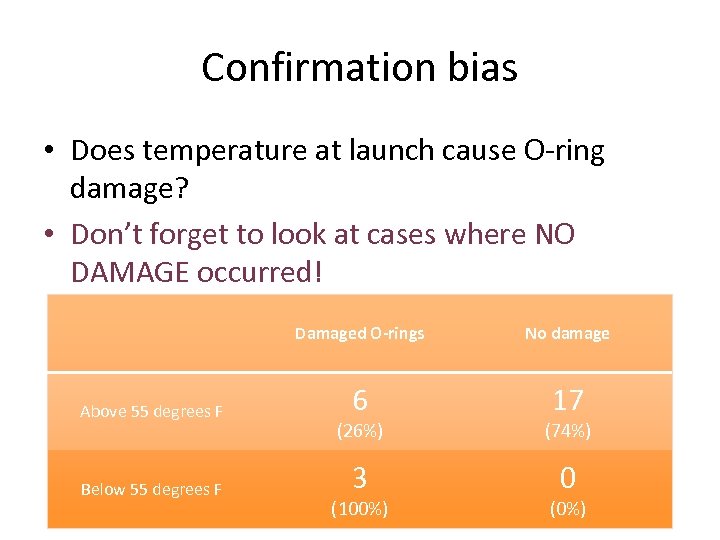
Confirmation bias • Does temperature at launch cause O-ring damage? • Don’t forget to look at cases where NO DAMAGE occurred! Damaged O-rings Above 55 degrees F Below 55 degrees F No damage 6 17 (26%) (74%) 3 0 (100%) (0%)
Summary • Research is vital—intuition can’t always be trusted • Consumer research – …arises from many disciplines – …involves basic and applied questions • Observations, focus groups, and surveys may be useful, but they rely on people’s (potentially incorrect) assessments of “why” • Correlational studies and experiments systematically associate changes in marketing strategy with changes in behavior – But only an experiment can truly isolate the cause of those changes • Don’t seek to confirm your ideas—seek to disconfirm them! • Next time: How do we get consumers’ attention?
Скачать презентацию Consumer Behavior Research Methods MAR 3503 January 12
933a1aeb99a696fc2b110a9022ae0121.ppt