


 Скачать презентацию Consumer adoption of new technological products implications
ce755725da30ae9cbd3eea021598bdf0.ppt
- Количество слайдов: 23
 Consumer adoption of new technological products – implications for take-up of low carbon technologies Qing Wang, Reader in Marketing and Innovation, Warwick Business School
 Agenda Low-carbon technological products or services Conceptual lenses for studying the adoption of low -carbon technological products or services The characteristics of really new products or services Uncertainty Temporal construal Future-based vs. present-based benefit Findings and implications
 Low carbon technological products or services
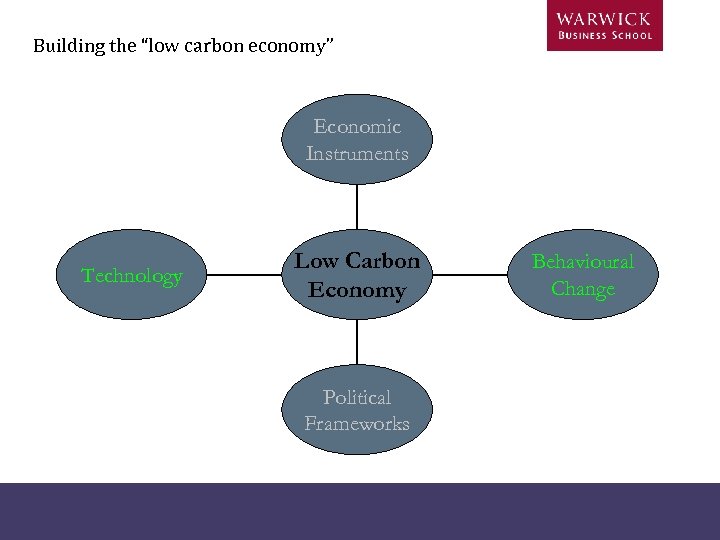 Building the “low carbon economy” Economic Instruments Technology Low Carbon Economy Political Frameworks Behavioural Change
 Examples of low-carbon technologies Carbon capture and storage Renewable energy Bio-fuels Electric vehicles Energy efficient buildings and appliances
 Positive characteristics of low-carbon technologies Enhancing – Technologies that optimize energy use by making existing processes more efficient: E. g. boiler technologies for domestic heating system, variable speed drive technologies for industrial motors. Enabling – Technologies that save energy by allowing us to do things differently: E. g. hybrid vehicles, solar panels, wind farms. Transforming – Technologies that lead to alternative, lowcarbon business models: E. g. elimination of paper-based communication, teleworking, teleconferencing.
 Negative characteristics of low-carbon technologies High cost (e. g. domestic solar panels) High technical uncertainty and cost-benefit tradeoff still unclear (e. g. electric vehicle) Supporting infrastructure not yet established Users (both consumers and business users) have to switch to new ways of doing things and change behaviour/routine significantly
 Conceptual lenses for studying the adoption of low carbon technological products or services
 What makes a product or process really-new? “RNPs” are innovations that defy straightforward classification in terms of existing product concepts or production processes. “Consumer learning for RNPs involves developing new preferences and the use of which requires significant behavioural changes. Business learning for RNPs involves radical re-thinking of the current business models and the implementation of which requires significant change of organisation routines and processes. Many low-carbon technology products or services, such as renewable energy and electric vehicles belong to this category.
 The characteristics of really new products or processes Compared to incrementally-new products or processes, consumers/businesses perceive (see Hoeffler 2003): greater ability to do things that one can’t easily do now with existing ways (desirability) greater uncertainty about consumption/production benefits (undercut desirability); greater uncertainty about cost-benefit tradeoffs in utility functions (undercut desirability) greater need to change one’s behavior or organization routine in order to attain the potential benefits of the new product or process (feasibility).
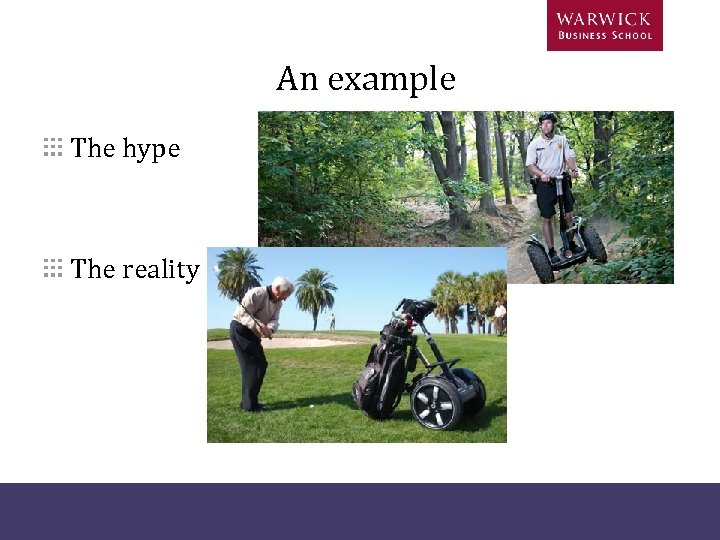 An example The hype The reality
 What’s the cause of the failure? Research evidence (e. g. Weinberg and Hauser 1996) has shown that it is: Hard for consumers to estimate the benefit and tradeoffs of really new products. Hard for firms to estimate market demand using conventional methods.
 Uncertainty Perceived absence of relevant information leads to lower evaluations as a penalty for uncertainty. Consumers’ perceptions of feature importance decline with uncertainty. Novel attributes lead to lower evaluations of highcomplexity products. Thus, consumers are less likely to form purchase intentions for newer products.
 Temporal Construal People represent temporally distant actions in terms of abstract, high-level considerations of the desirability of the action. They represent more near-term actions in terms of concrete, low-level considerations of the action’s feasibility (see Trope and Liberman 2003). Thus, consumers are less likely to follow through on their intentions to buy really new products (see Alexander, Lynch and Wang, 2008).
 Future-based vs. present-based benefit Benefits can be classified into those that are present-based and those that are future-based, which in turn influence consumer adoption decision (see Gad, Dacko and Wang, forthcoming). Present-based benefits represent gains which occur in the short-term, providing an immediate return during product consumption. Future-emphasized benefits signify gains that occur in the long-term, beyond the end of product consumption.
 A example of the organic food (Marwa, Dacko and Wang, forthcoming) Future-based benefit: healthier living, environmental responsibility. An growing inclination of people to move away from a chemically-treated world of food products, with rising concerns about the potential health and environmental hazards of genetically modified (GM) food products (see Wilson, Evans, Leppard and Syrette, 2004). Present-based benefits: better taste; satisfy curiosity; fit in socially; peace of mind.
 The case of low-carbon technologies The three biggest environmental problems that we now face: pollution, climate change, resource degradation Present-emphasized benefit: reducing pollution and improve the air quality we breath in and out every day; Future-emphasized benefits: climate change and resource degradation
 Some findings and implications for managers and policy makers
 Implication No. 1: product newness, positioning and intention measures The negative dimensions of perceived product newness (uncertain, unknown, unfamiliar, infeasible, etc. ) can become a significant barrier for adoption. Therefore marketing and PR effort should try to position new products closer to existing categories when possible. Standard market research measurement techniques must be modified for really new products or service in that intention-to-purchase deflators should be larger.
 Implication No. 2: long term benefit, product knowledge and usage Long term or future-emphasized benefits are significantly and positively correlated with level of product involvement, level of product knowledge and expertise, and level of usage. Thus, increasing the perceived relevance of the new product, increasing product familiarity and encouraging trial use are all possible effective ways to encourage adoptions of low-carbon technological products and services.
 Thanks and Questions?
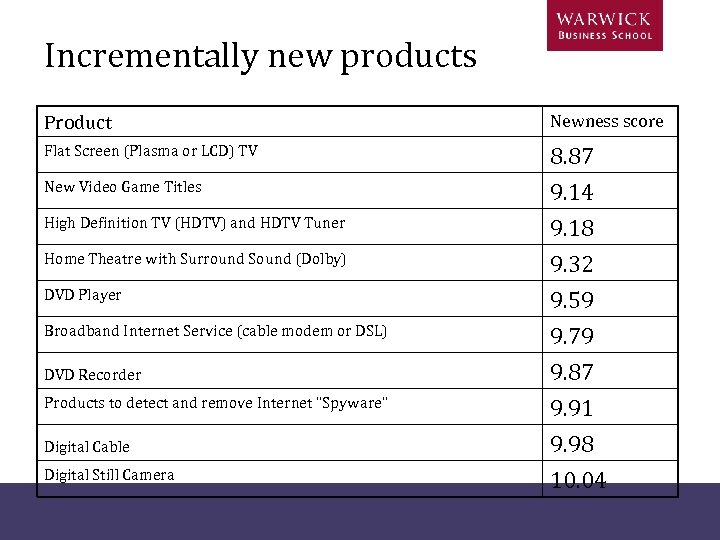 Incrementally new products Product Newness score Flat Screen (Plasma or LCD) TV 8. 87 New Video Game Titles 9. 14 9. 18 9. 32 9. 59 High Definition TV (HDTV) and HDTV Tuner Home Theatre with Surround Sound (Dolby) DVD Player Broadband Internet Service (cable modem or DSL) DVD Recorder Products to detect and remove Internet "Spyware" Digital Cable Digital Still Camera 9. 79 9. 87 9. 91 9. 98 10. 04
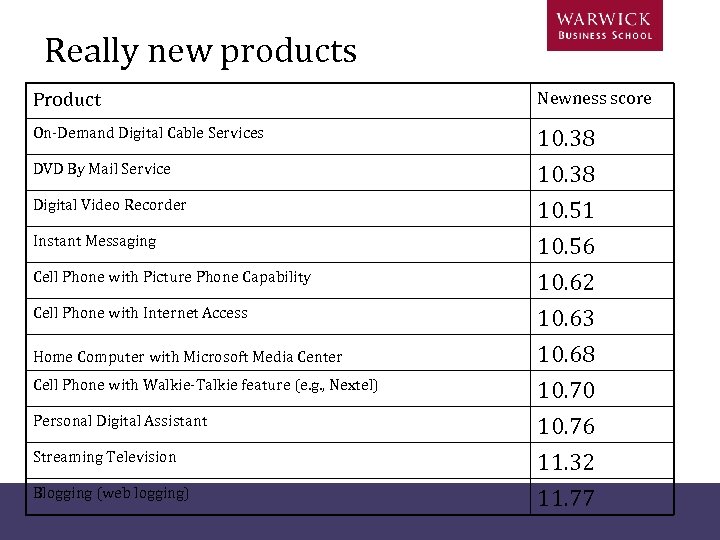 Really new products Product Newness score On-Demand Digital Cable Services 10. 38 10. 51 DVD By Mail Service Digital Video Recorder Instant Messaging Cell Phone with Picture Phone Capability Cell Phone with Internet Access Home Computer with Microsoft Media Center Cell Phone with Walkie-Talkie feature (e. g. , Nextel) Personal Digital Assistant Streaming Television Blogging (web logging) 10. 56 10. 62 10. 63 10. 68 10. 70 10. 76 11. 32 11. 77