 Скачать презентацию Construction Management Green G PRO Professional Building Skills Training
b6b96c160881c8db2d46cb702f1f021c.ppt
- Количество слайдов: 56



Construction Management Green G|PRO Professional Building Skills Training
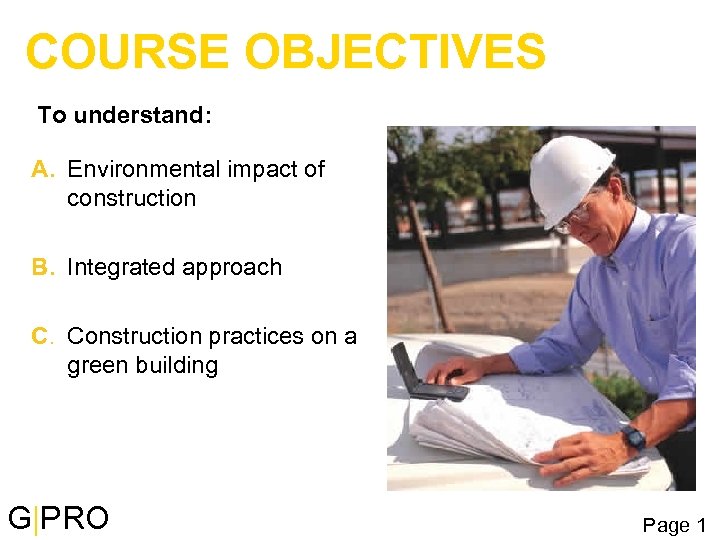
COURSE OBJECTIVES To understand: A. Environmental impact of construction B. Integrated approach C. Construction practices on a green building G|PRO Page 1
GPRO Certificate Holders G|PRO
1 G|PRO CONSTRUCTION MANAGEMENT & GREEN BUILDING Page 2
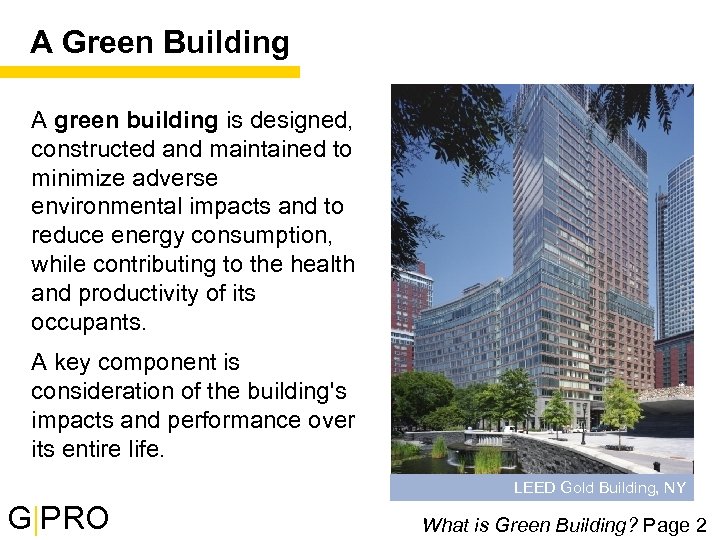
A Green Building A green building is designed, constructed and maintained to minimize adverse environmental impacts and to reduce energy consumption, while contributing to the health and productivity of its occupants. A key component is consideration of the building's impacts and performance over its entire life. LEED Gold Building, NY G|PRO What is Green Building? Page 2
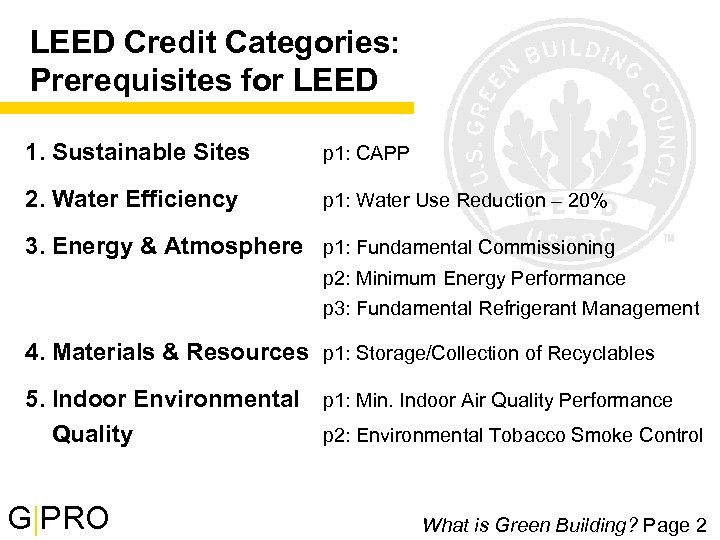
LEED Credit Categories: Prerequisites for LEED 1. Sustainable Sites p 1: CAPP 2. Water Efficiency p 1: Water Use Reduction – 20% 3. Energy & Atmosphere p 1: Fundamental Commissioning p 2: Minimum Energy Performance p 3: Fundamental Refrigerant Management 4. Materials & Resources p 1: Storage/Collection of Recyclables 5. Indoor Environmental p 1: Min. Indoor Air Quality Performance Quality p 2: Environmental Tobacco Smoke Control G|PRO What is Green Building? Page 2
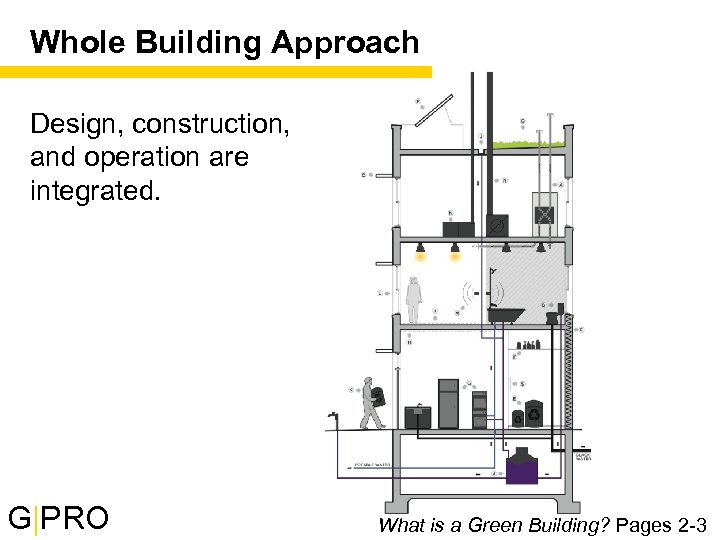
Whole Building Approach Design, construction, and operation are integrated. G|PRO What is a Green Building? Pages 2 -3
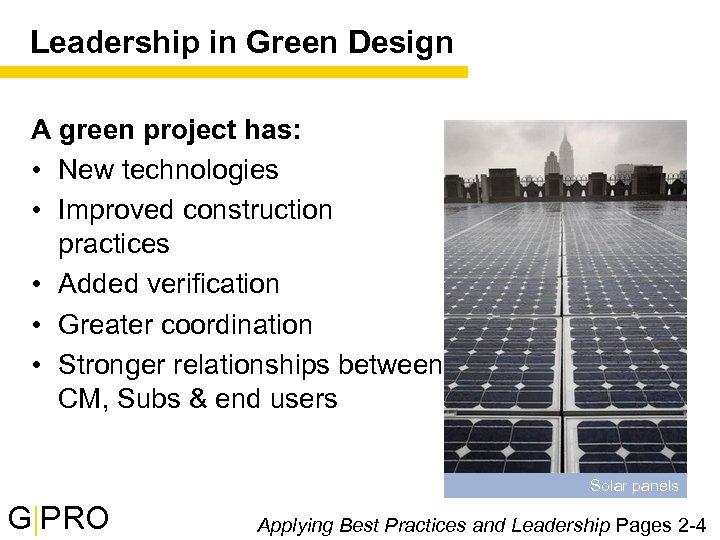
Leadership in Green Design A green project has: • New technologies • Improved construction practices • Added verification • Greater coordination • Stronger relationships between CM, Subs & end users Solar panels G|PRO Applying Best Practices and Leadership Pages 2 -4
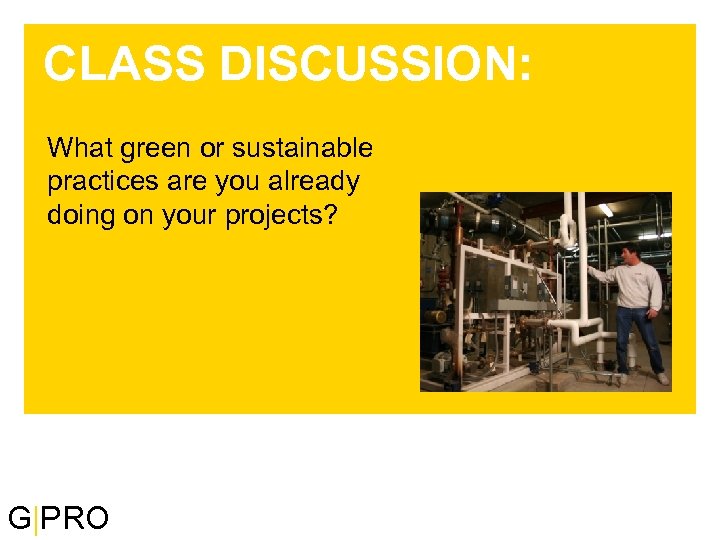
CLASS DISCUSSION: What green or sustainable practices are you already doing on your projects? G|PRO
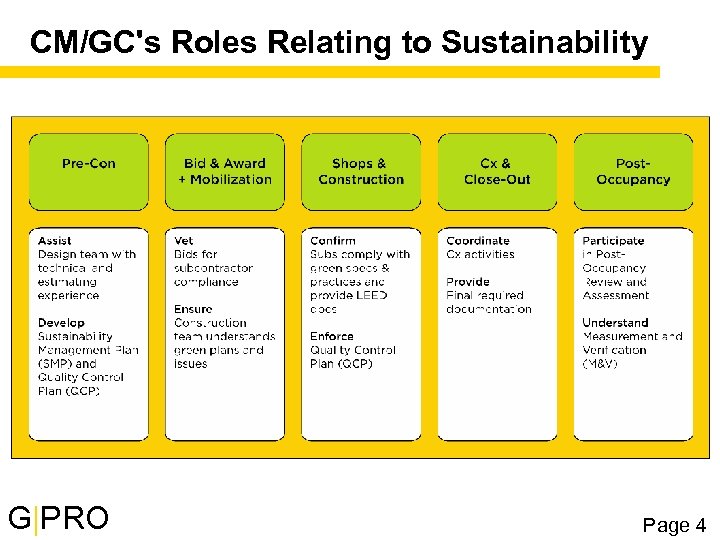
CM/GC's Roles Relating to Sustainability G|PRO Page 4
TEST YOURSELF: 1. How does the sustainability concept of integration affect the construction process and the CM/GC's role? G|PRO Page 4
2 G|PRO PRE-CON SERVICES: Sustainability Planning in the Design Phase Page 5
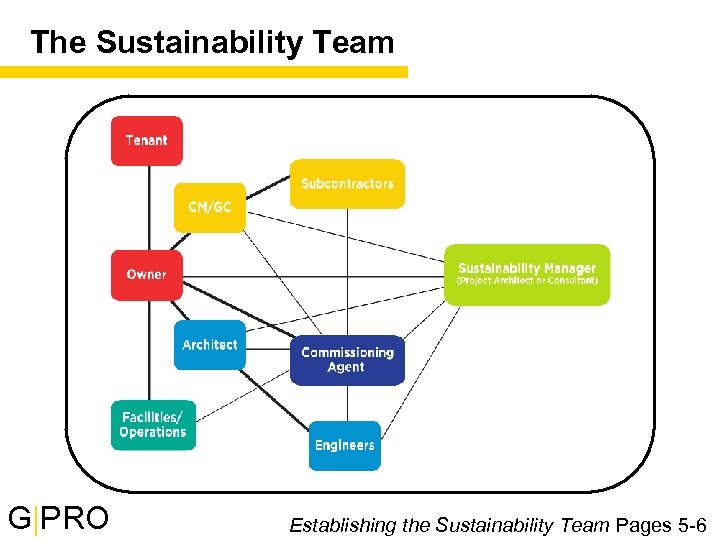
The Sustainability Team G|PRO Establishing the Sustainability Team Pages 5 -6
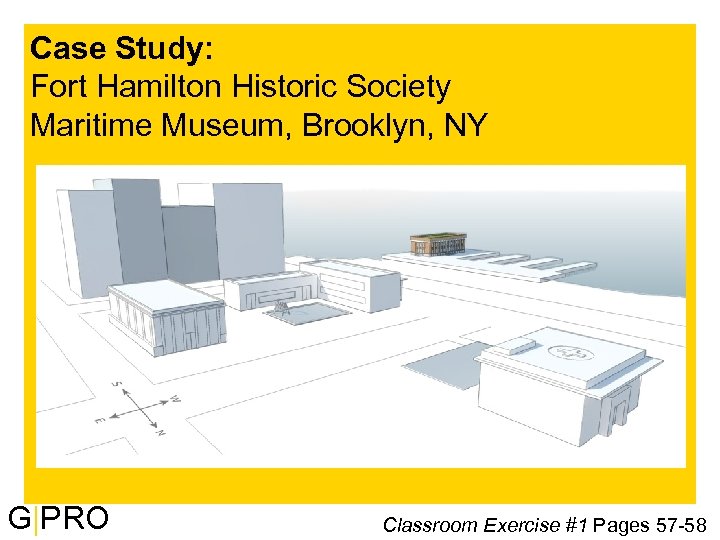
Case Study: Fort Hamilton Historic Society Maritime Museum, Brooklyn, NY G|PRO Classroom Exercise #1 Pages 57 -58
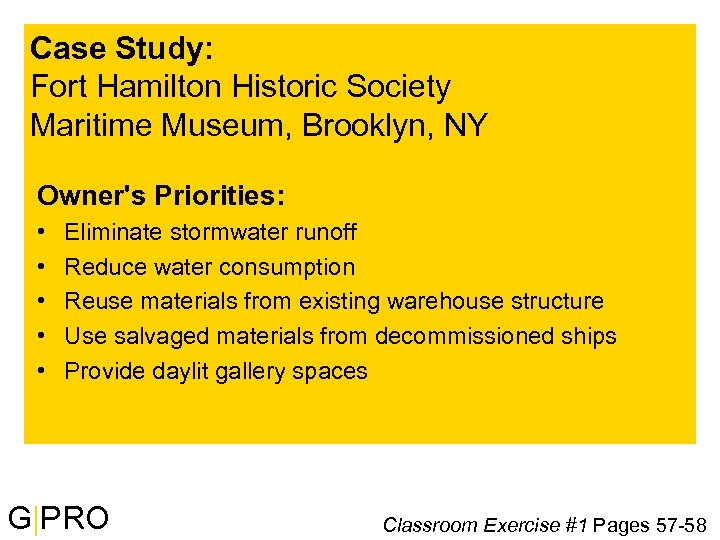
Case Study: Fort Hamilton Historic Society Maritime Museum, Brooklyn, NY Owner's Priorities: • • • Eliminate stormwater runoff Reduce water consumption Reuse materials from existing warehouse structure Use salvaged materials from decommissioned ships Provide daylit gallery spaces G|PRO Classroom Exercise #1 Pages 57 -58
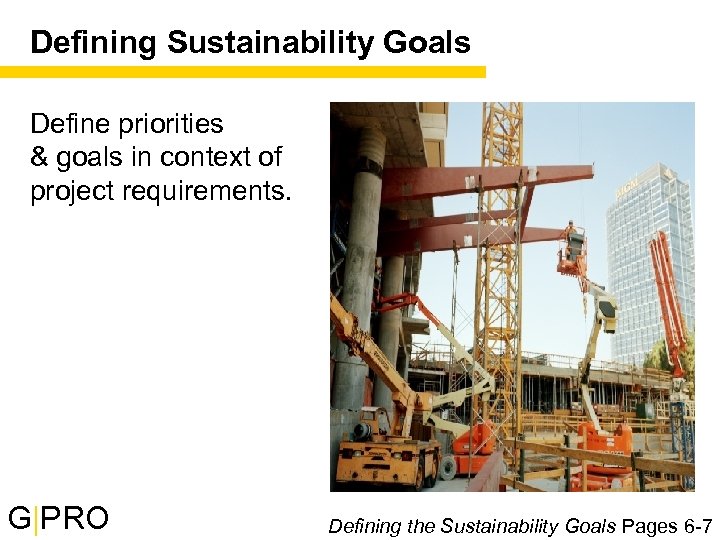
Defining Sustainability Goals Define priorities & goals in context of project requirements. G|PRO 16 Defining the Sustainability Goals Pages 6 -7
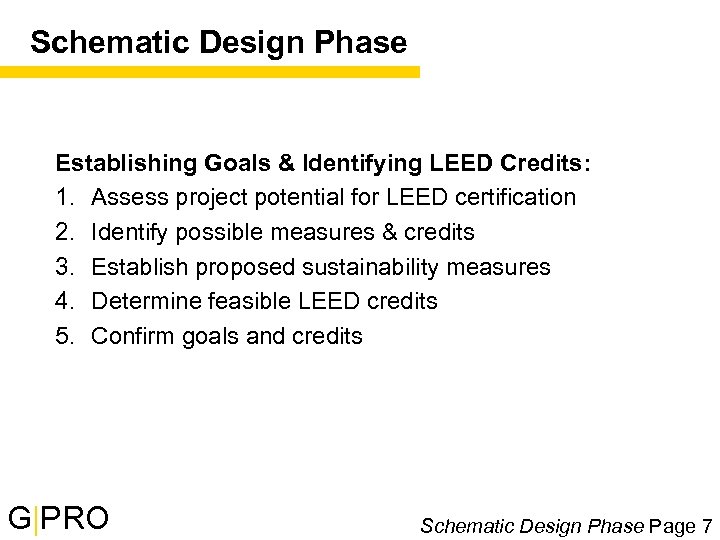
Schematic Design Phase Establishing Goals & Identifying LEED Credits: 1. Assess project potential for LEED certification 2. Identify possible measures & credits 3. Establish proposed sustainability measures 4. Determine feasible LEED credits 5. Confirm goals and credits G|PRO 17 Schematic Design Phase Page 7
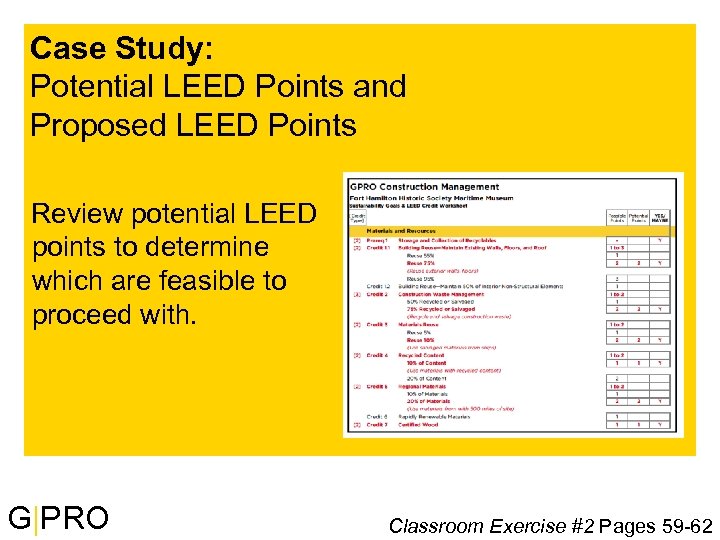
Case Study: Potential LEED Points and Proposed LEED Points Review potential LEED points to determine which are feasible to proceed with. G|PRO Classroom Exercise #2 Pages 59 -62
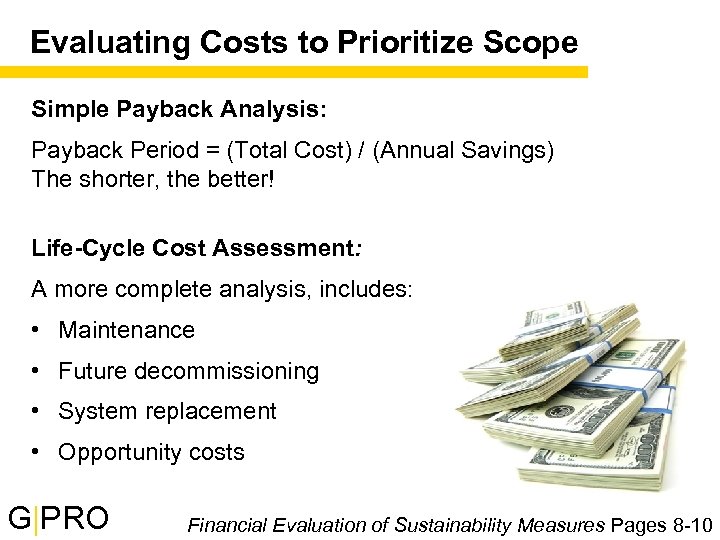
Evaluating Costs to Prioritize Scope Simple Payback Analysis: Payback Period = (Total Cost) / (Annual Savings) The shorter, the better! Life-Cycle Cost Assessment: A more complete analysis, includes: • Maintenance • Future decommissioning • System replacement • Opportunity costs G|PRO Financial Evaluation of Sustainability Measures Pages 8 -10
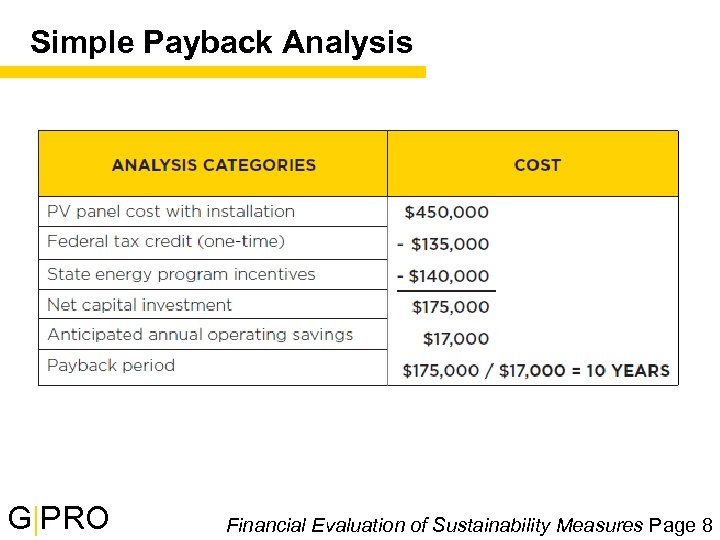
Simple Payback Analysis ÷ G|PRO Financial Evaluation of Sustainability Measures Page 8
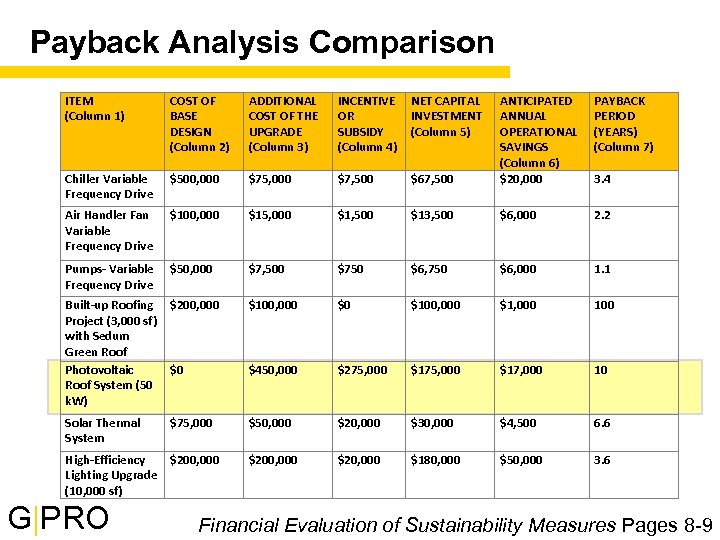
Payback Analysis Comparison ITEM (Column 1) COST OF BASE DESIGN (Column 2) ADDITIONAL COST OF THE UPGRADE (Column 3) INCENTIVE OR SUBSIDY (Column 4) NET CAPITAL INVESTMENT (Column 5) PAYBACK PERIOD (YEARS) (Column 7) $67, 500 ANTICIPATED ANNUAL OPERATIONAL SAVINGS (Column 6) $20, 000 Chiller Variable Frequency Drive $500, 000 $75, 000 $7, 500 Air Handler Fan Variable Frequency Drive $100, 000 $15, 000 $1, 500 $13, 500 $6, 000 2. 2 Pumps- Variable Frequency Drive $50, 000 $7, 500 $750 $6, 000 1. 1 Built-up Roofing Project (3, 000 sf) with Sedum Green Roof Photovoltaic Roof System (50 k. W) $200, 000 $100, 000 $1, 000 100 $0 $450, 000 $275, 000 $17, 000 10 Solar Thermal System $75, 000 $50, 000 $20, 000 $30, 000 $4, 500 6. 6 High-Efficiency Lighting Upgrade (10, 000 sf) $200, 000 $20, 000 $180, 000 $50, 000 3. 6 G|PRO 3. 4 Financial Evaluation of Sustainability Measures Pages 8 -9
Value Engineering Green projects have less wiggle room. Substitutions with lower "first costs" may cost a lot more in the long run. G|PRO Value Engineering Page 11
Incentives Analysis • Primary responsibility by owner or A/E • Funding can come from local, state, federal or utilities • Factor funding into payback analysis process • A/E will rely on CM/GC for data and scheduling info G|PRO Analyzing Sustainability Incentives Page 11
TEST YOURSELF: 1. What is the CM/GC's role on the Sustainability Team (ST)? 2. How is the CM/GC involved in identifying sustainability goals and target LEED credits? 3. Why and how do you conduct and evaluate a simple payback analysis? 4. What is the CM/GC's role in analyzing sustainability incentives? G|PRO Page 11
3 G|PRO SUSTAINABILITY MANAGEMENT PLAN Page 12
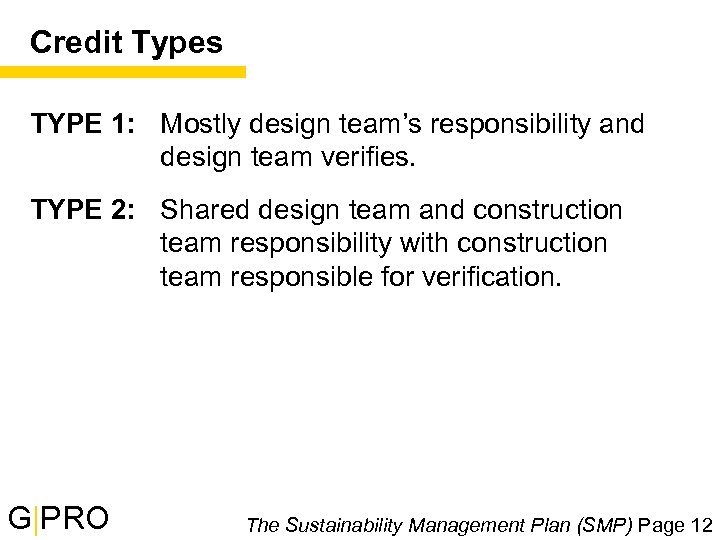
Credit Types TYPE 1: Mostly design team’s responsibility and design team verifies. TYPE 2: Shared design team and construction team responsibility with construction team responsible for verification. G|PRO The Sustainability Management Plan (SMP) Page 12 26
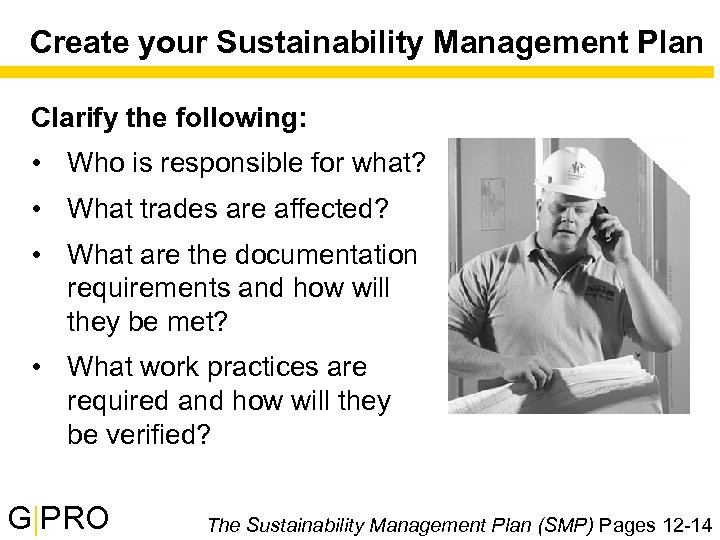
Create your Sustainability Management Plan Clarify the following: • Who is responsible for what? • What trades are affected? • What are the documentation requirements and how will they be met? • What work practices are required and how will they be verified? G|PRO The Sustainability Management Plan (SMP) Pages 12 -14
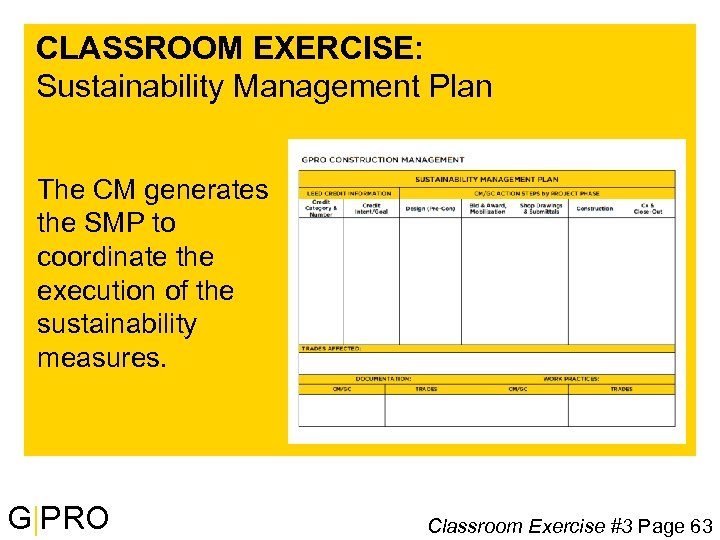
CLASSROOM EXERCISE: Sustainability Management Plan The CM generates the SMP to coordinate the execution of the sustainability measures. G|PRO Classroom Exercise #3 Page 63
CLASSROOM EXERCISE: Now make the argument to the Owner about how you plan to achieve each credit. G|PRO Classroom Exercise #3 Page 63
Sometimes Points are Eliminated Delete Solar Thermal System: Financial criteria: Proposed solar system will have a long payback period (increasing water efficiency means less hot water being used) Site logistics: Turns out that the solar thermal system doesn't have adequate southern exposure G|PRO
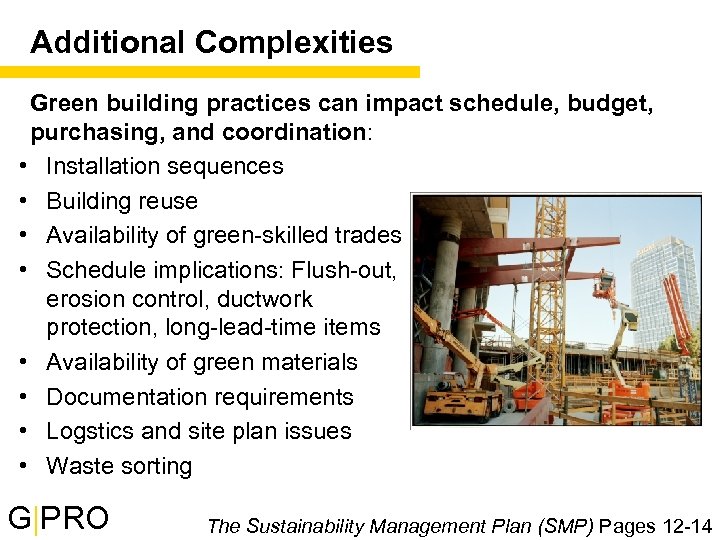
Additional Complexities Green building practices can impact schedule, budget, purchasing, and coordination: • Installation sequences • Building reuse • Availability of green-skilled trades • Schedule implications: Flush-out, erosion control, ductwork protection, long-lead-time items • Availability of green materials • Documentation requirements • Logstics and site plan issues • Waste sorting G|PRO 31 The Sustainability Management Plan (SMP) Pages 12 -14
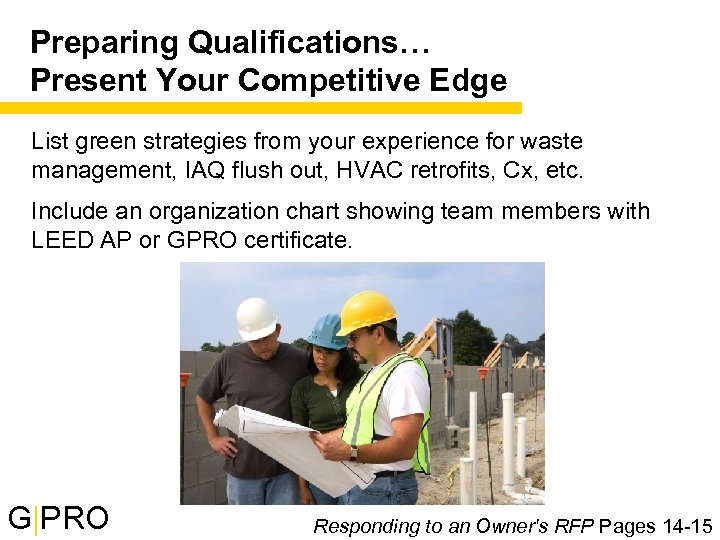
Preparing Qualifications… Present Your Competitive Edge List green strategies from your experience for waste management, IAQ flush out, HVAC retrofits, Cx, etc. Include an organization chart showing team members with LEED AP or GPRO certificate. G|PRO Responding to an Owner's RFP Pages 14 -15
TEST YOURSELF: 1. What elements should you include in your Sustainability Management Plan? 2. When updating your Sustainability Management Plan, what critical elements need to be confirmed? G|PRO Page 15
4 G|PRO TRADE BID & AWARD: Incorporating Sustainability Strategies Page 16
Bid Issues to Explain to Subs • Dispelling the myth of LEED record keeping • Regional, recycled, and FSC certified requirements • Issues that may involve more than one credit • Building flush-out schedule • Cx (commissioning) milestones & inspections G|PRO Vetting Bids to Ensure Sustainability Scope is Covered Page 18
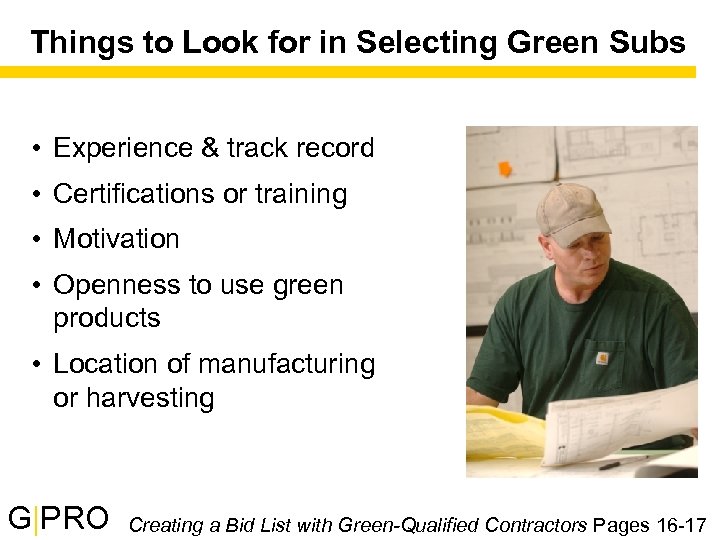
Things to Look for in Selecting Green Subs • Experience & track record • Certifications or training • Motivation • Openness to use green products • Location of manufacturing or harvesting G|PRO Creating a Bid List with Green-Qualified Contractors Pages 16 -17
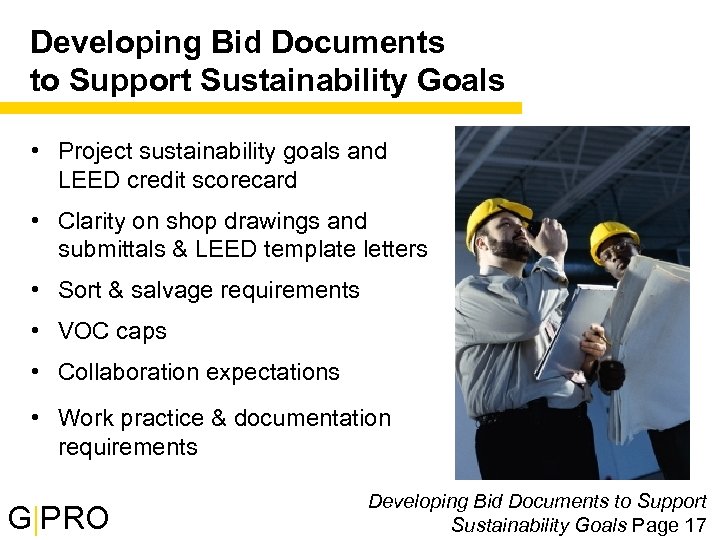
Developing Bid Documents to Support Sustainability Goals • Project sustainability goals and LEED credit scorecard • Clarity on shop drawings and submittals & LEED template letters • Sort & salvage requirements • VOC caps • Collaboration expectations • Work practice & documentation requirements G|PRO Developing Bid Documents to Support Sustainability Goals Page 17
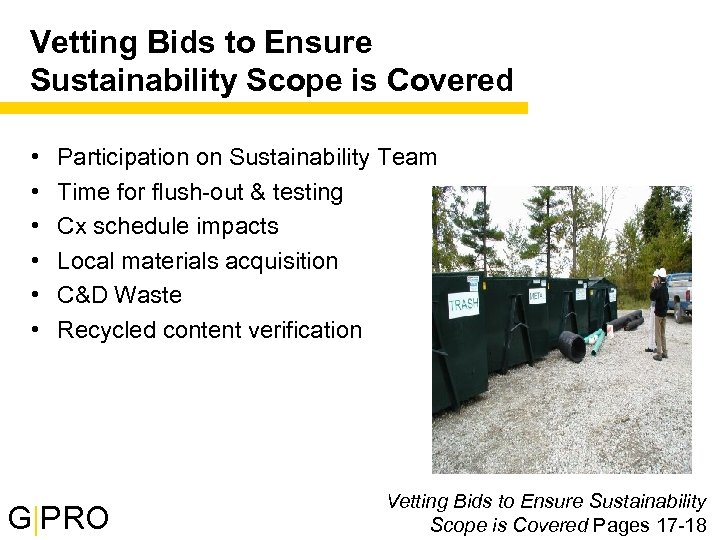
Vetting Bids to Ensure Sustainability Scope is Covered • • • Participation on Sustainability Team Time for flush-out & testing Cx schedule impacts Local materials acquisition C&D Waste Recycled content verification G|PRO Vetting Bids to Ensure Sustainability Scope is Covered Pages 17 -18
CLASS DISCUSSION: What questions would you ask the trades to ensure that they understand the sustainable requirements? Use the SMP as your guide. G|PRO
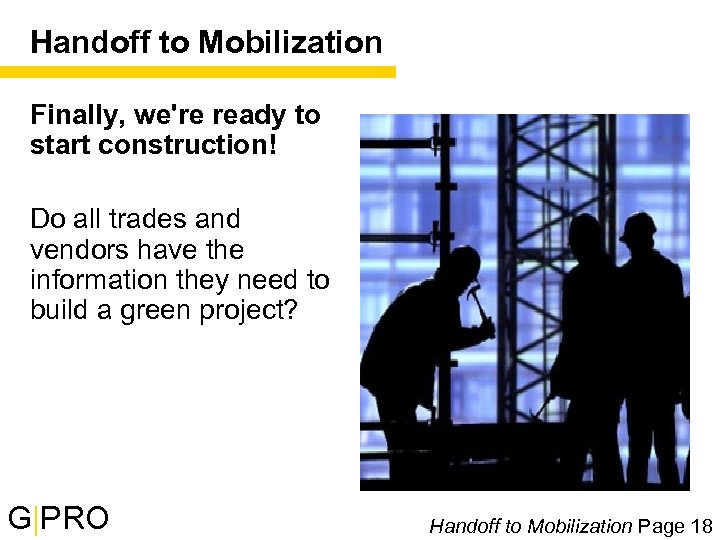
Handoff to Mobilization Finally, we're ready to start construction! Do all trades and vendors have the information they need to build a green project? G|PRO 40 Handoff to Mobilization Page 18
TEST YOURSELF: 1. What should the CM/GC consider when selecting green subcontractors? 2. What are the unique elements of bid documents on a green project? 3. How does the vetting of green bids differ from standard practice? 4. What are the green issues that the CM/GC is responsible for in preparing for mobilization? G|PRO Page 18
5 G|PRO MOBILIZATION Page 19
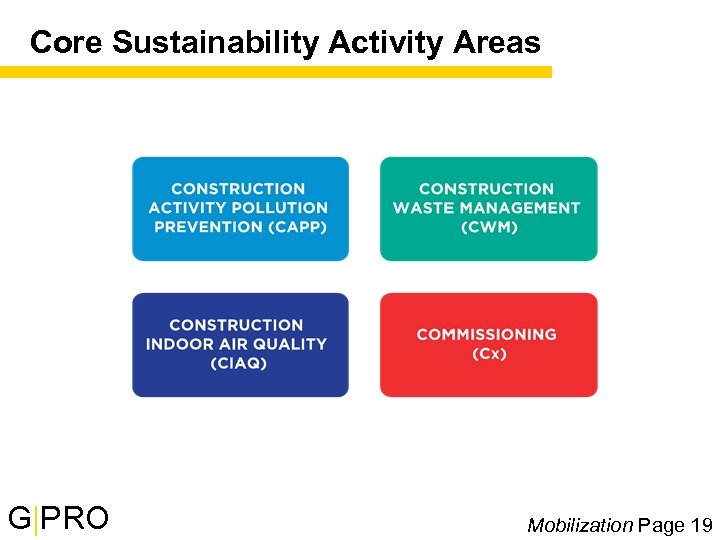
Core Sustainability Activity Areas G|PRO Mobilization Page 19
Construction Activity Pollution Prevention (CAPP) LEED Prerequisite (SSp 1) Intent: Reduce pollution from construction activities by controlling soil erosion, waterway sedimentation, and airborne dust generation Contractor Requirements: Erosion & Sedimentation Control Plan (ESC) that includes: • Silt fences • Sedimentation traps • Earth dikes • Temporary seed/mulch • Concrete wash-out • Dust watering G|PRO 1. Construction Activities Pollution Prevention (CAPP) Pages 20 -21
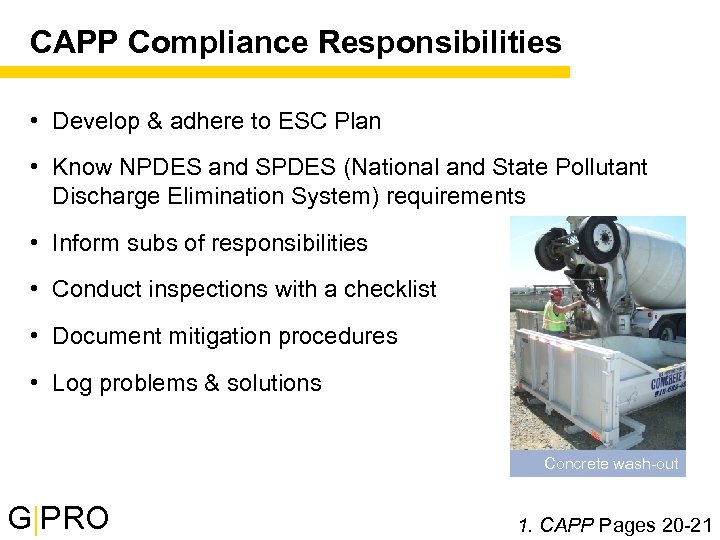
CAPP Compliance Responsibilities • Develop & adhere to ESC Plan • Know NPDES and SPDES (National and State Pollutant Discharge Elimination System) requirements • Inform subs of responsibilities • Conduct inspections with a checklist • Document mitigation procedures • Log problems & solutions Concrete wash-out G|PRO 1. CAPP Pages 20 -21
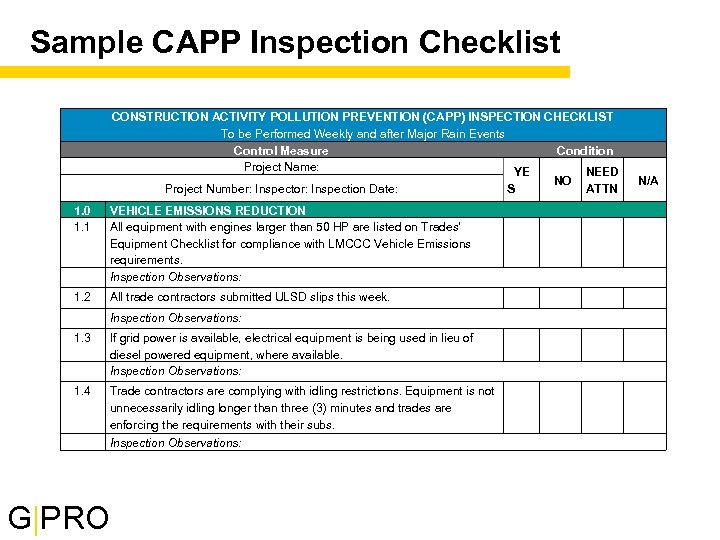
Sample CAPP Inspection Checklist CONSTRUCTION ACTIVITY POLLUTION PREVENTION (CAPP) INSPECTION CHECKLIST To be Performed Weekly and after Major Rain Events Control Measure Condition Project Name: YE NEED NO Project Number: Inspector: Inspection Date: S ATTN 1. 0 1. 1 VEHICLE EMISSIONS REDUCTION All equipment with engines larger than 50 HP are listed on Trades’ Equipment Checklist for compliance with LMCCC Vehicle Emissions requirements. Inspection Observations: 1. 2 All trade contractors submitted ULSD slips this week. Inspection Observations: 1. 3 If grid power is available, electrical equipment is being used in lieu of diesel powered equipment, where available. Inspection Observations: 1. 4 Trade contractors are complying with idling restrictions. Equipment is not unnecessarily idling longer than three (3) minutes and trades are enforcing the requirements with their subs. Inspection Observations: G|PRO N/A
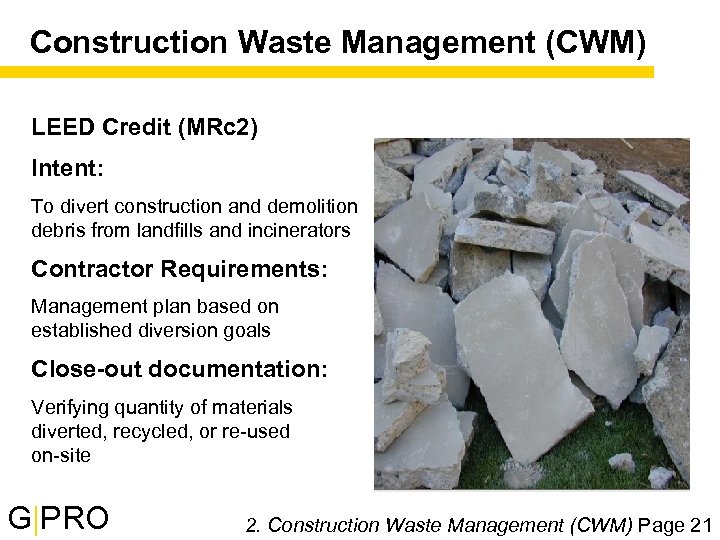
Construction Waste Management (CWM) LEED Credit (MRc 2) Intent: To divert construction and demolition debris from landfills and incinerators Contractor Requirements: Management plan based on established diversion goals Close-out documentation: Verifying quantity of materials diverted, recycled, or re-used on-site G|PRO 2. Construction Waste Management (CWM) Page 21
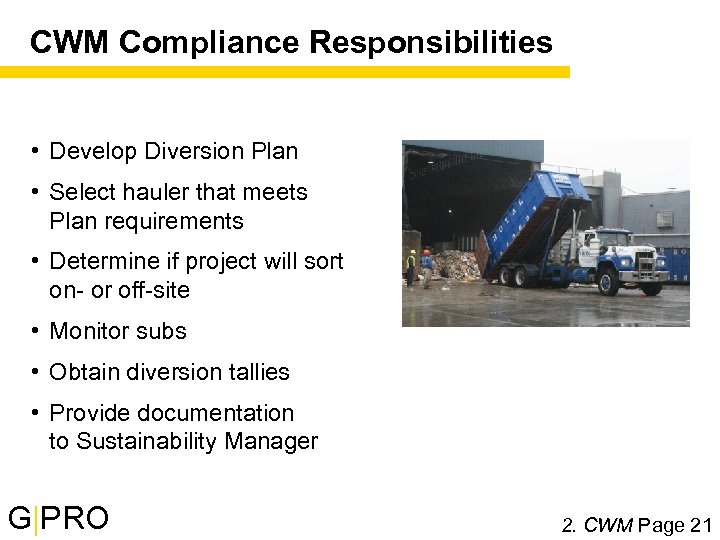
CWM Compliance Responsibilities • Develop Diversion Plan • Select hauler that meets Plan requirements • Determine if project will sort on- or off-site • Monitor subs • Obtain diversion tallies • Provide documentation to Sustainability Manager G|PRO 2. CWM Page 21
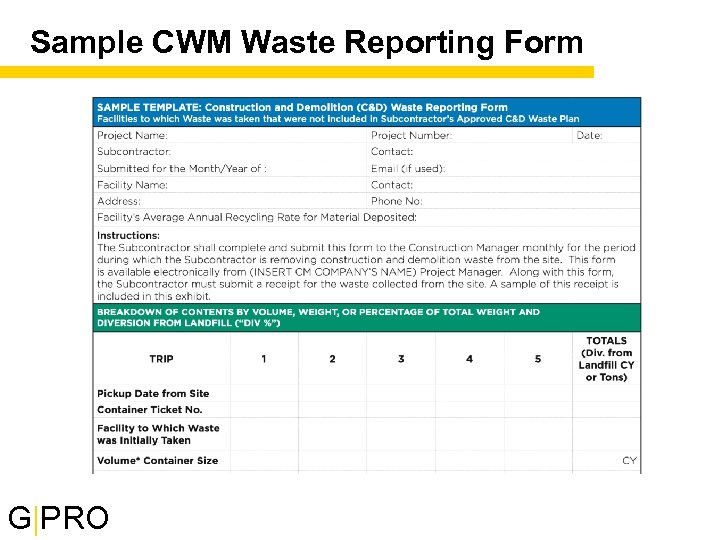
Sample CWM Waste Reporting Form G|PRO
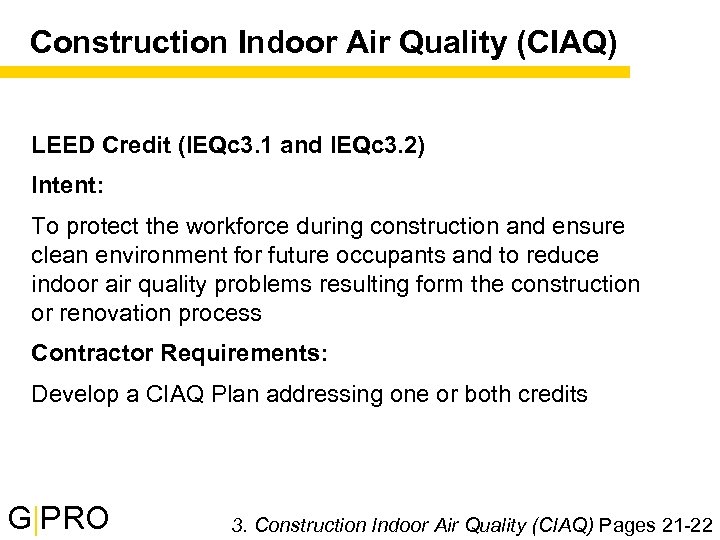
Construction Indoor Air Quality (CIAQ) LEED Credit (IEQc 3. 1 and IEQc 3. 2) Intent: To protect the workforce during construction and ensure clean environment for future occupants and to reduce indoor air quality problems resulting form the construction or renovation process Contractor Requirements: Develop a CIAQ Plan addressing one or both credits G|PRO 3. Construction Indoor Air Quality (CIAQ) Pages 21 -22
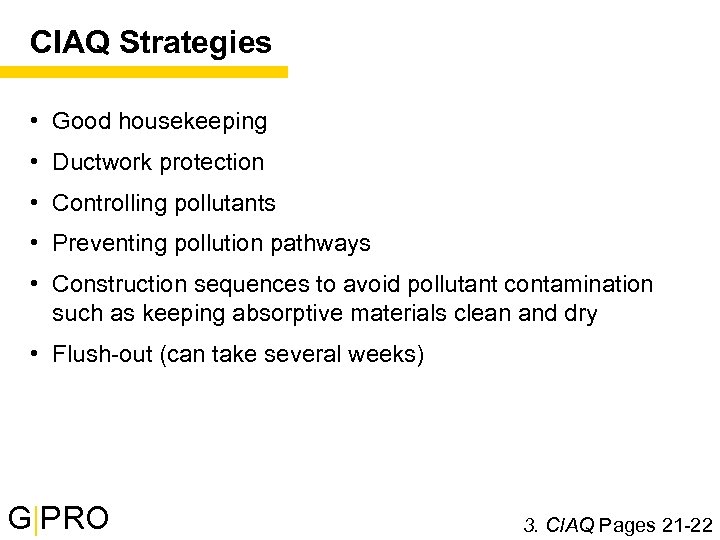
CIAQ Strategies • Good housekeeping • Ductwork protection • Controlling pollutants • Preventing pollution pathways • Construction sequences to avoid pollutant contamination such as keeping absorptive materials clean and dry • Flush-out (can take several weeks) G|PRO 3. CIAQ Pages 21 -22 51
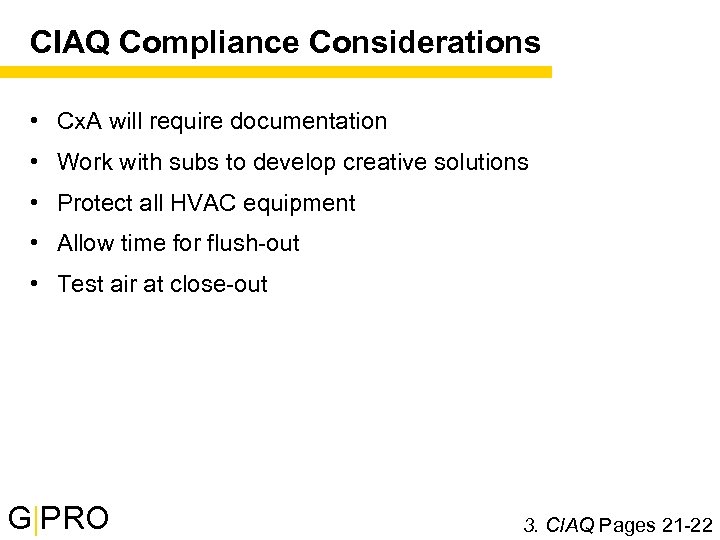
CIAQ Compliance Considerations • Cx. A will require documentation • Work with subs to develop creative solutions • Protect all HVAC equipment • Allow time for flush-out • Test air at close-out G|PRO 3. CIAQ Pages 21 -22 52
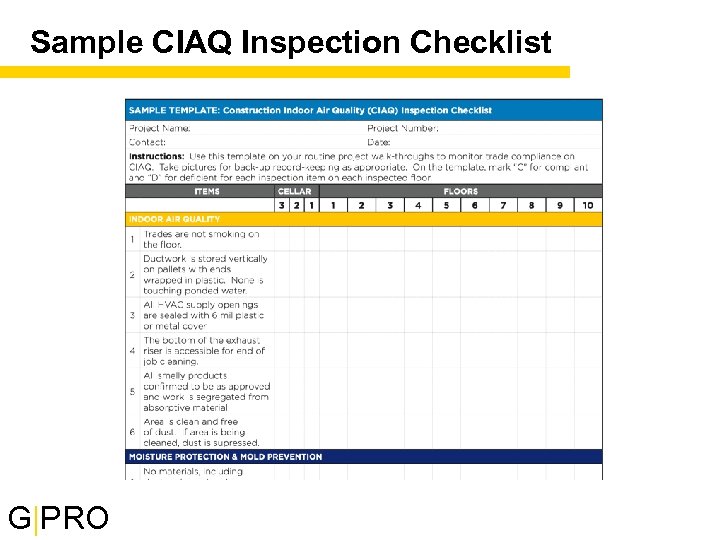
Sample CIAQ Inspection Checklist G|PRO
Commissioning (Cx) LEED Prerequisite (EAp 1) and credit (EAc 3) for fundamental and enhanced commissioning. Intent: To verify that the building’s energy-related systems are installed, calibrated, and perform according to the project’s requirements Contractor Requirements: 1. Ensure subs conform to installation requirements 2. Assist in testing activities G|PRO 4. Commissioning (Cx) Pages 22 -23 54
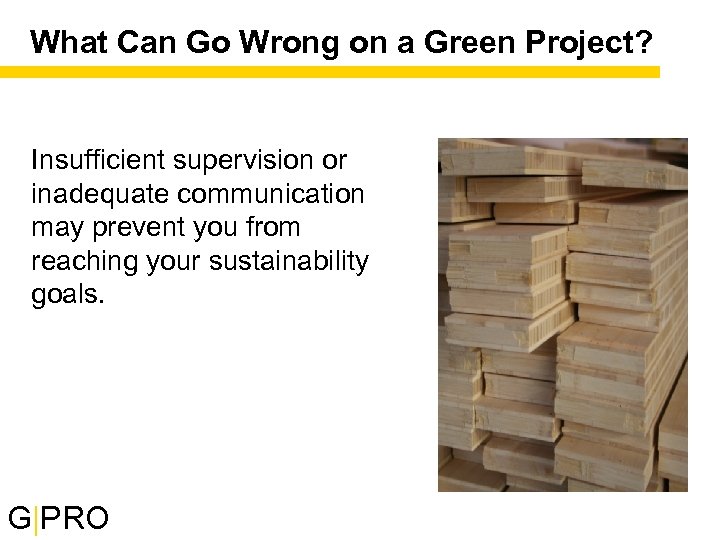
What Can Go Wrong on a Green Project? Insufficient supervision or inadequate communication may prevent you from reaching your sustainability goals. G|PRO
TEST YOURSELF: 1. What is the intent of each of the four core sustainable construction activity areas? 2. What are the CM/GC’s primary compliance considerations for each core area? G|PRO Page 23
Скачать презентацию Construction Management Green G PRO Professional Building Skills Training
b6b96c160881c8db2d46cb702f1f021c.ppt