 Скачать презентацию Construction contracts BÁLINT BORKA DENIS KASHIN GURSHAN SINGH
Construction contracts.pptx
- Количество слайдов: 18



Construction contracts BÁLINT BORKA DENIS KASHIN GURSHAN SINGH OLLI-PEKKA PEITSALO DARIA SHUTOVA SERGEY SMIRNOV ANNA DASHICHEVA
Definition Construction Contracts provide requirements on the allocation of contract revenue and contract costs to accounting periods in which construction work is performed. Contract revenues and expenses are recognized by reference to the stage of completion of contract activity where the outcome of the construction contract can be estimated reliably, otherwise revenue is recognized only to the extent of recoverable contract costs incurred.
Types of contracts 1. Lump Sum Contact 2. Unit Price Contract 3. Schedule of Rates Contract 4. Cost plus Percentage of Cost 5. Cost plus Fixed Fee 6. Target Cost with Variable Fees Contract 7. Guaranteed Maximum Price Contract (GMP)
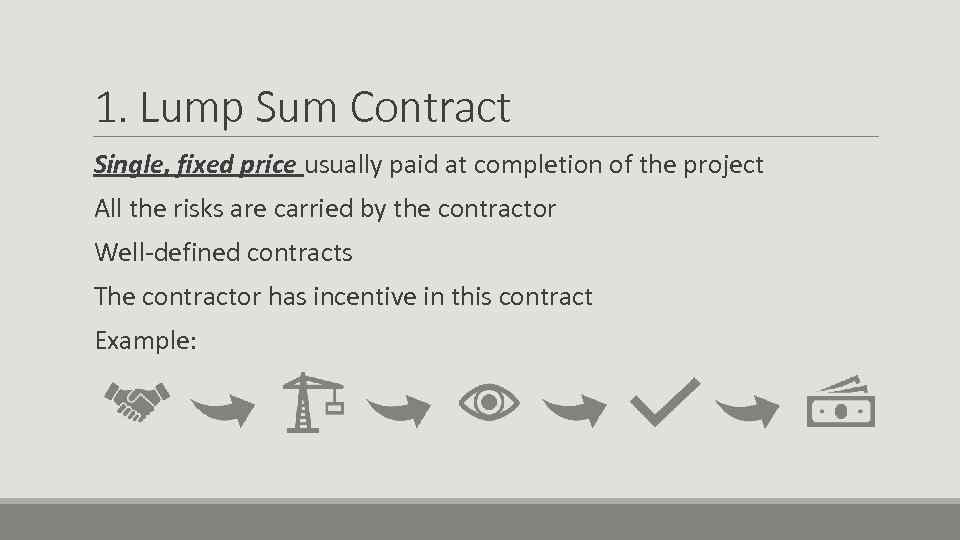
1. Lump Sum Contract Single, fixed price usually paid at completion of the project All the risks are carried by the contractor Well-defined contracts The contractor has incentive in this contract Example:
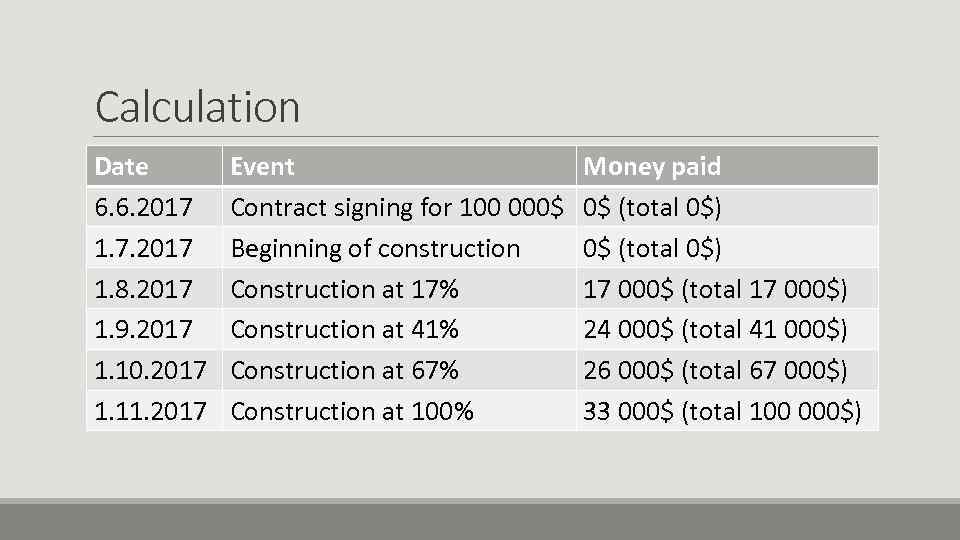
Calculation Date 6. 6. 2017 1. 7. 2017 1. 8. 2017 1. 9. 2017 1. 10. 2017 1. 11. 2017 Event Contract signing for 100 000$ Beginning of construction Construction at 17% Construction at 41% Construction at 67% Construction at 100% Money paid 0$ (total 0$) 17 000$ (total 17 000$) 24 000$ (total 41 000$) 26 000$ (total 67 000$) 33 000$ (total 100 000$)
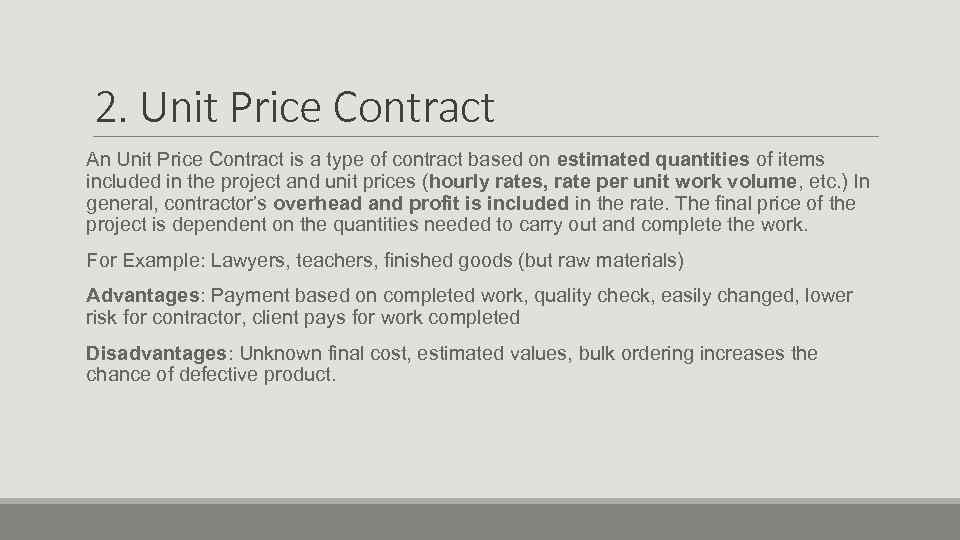
2. Unit Price Contract An Unit Price Contract is a type of contract based on estimated quantities of items included in the project and unit prices (hourly rates, rate per unit work volume, etc. ) In general, contractor’s overhead and profit is included in the rate. The final price of the project is dependent on the quantities needed to carry out and complete the work. For Example: Lawyers, teachers, finished goods (but raw materials) Advantages: Payment based on completed work, quality check, easily changed, lower risk for contractor, client pays for work completed Disadvantages: Unknown final cost, estimated values, bulk ordering increases the chance of defective product.
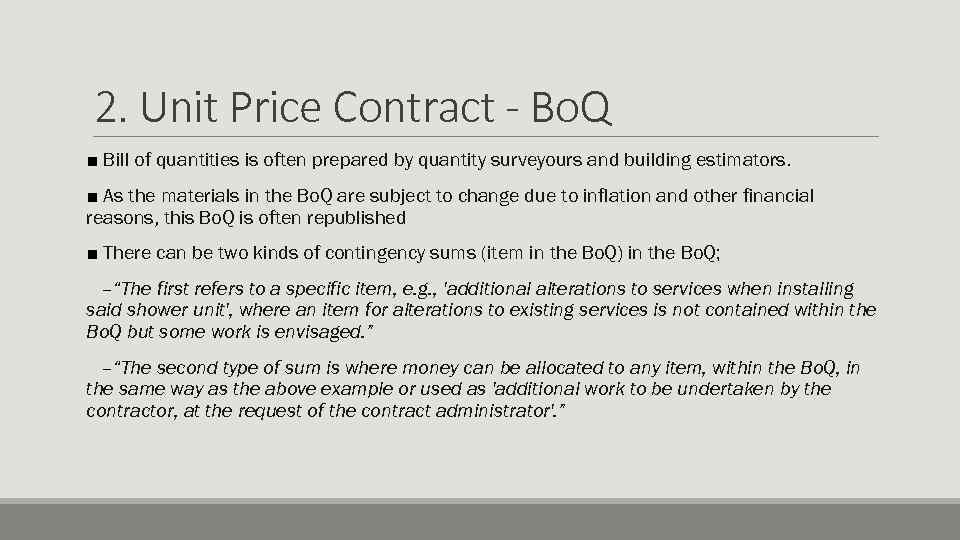
2. Unit Price Contract - Bo. Q ■ Bill of quantities is often prepared by quantity surveyours and building estimators. ■ As the materials in the Bo. Q are subject to change due to inflation and other financial reasons, this Bo. Q is often republished ■ There can be two kinds of contingency sums (item in the Bo. Q) in the Bo. Q; –“The first refers to a specific item, e. g. , 'additional alterations to services when installing said shower unit', where an item for alterations to existing services is not contained within the Bo. Q but some work is envisaged. ” –“The second type of sum is where money can be allocated to any item, within the Bo. Q, in the same way as the above example or used as 'additional work to be undertaken by the contractor, at the request of the contract administrator'. ”
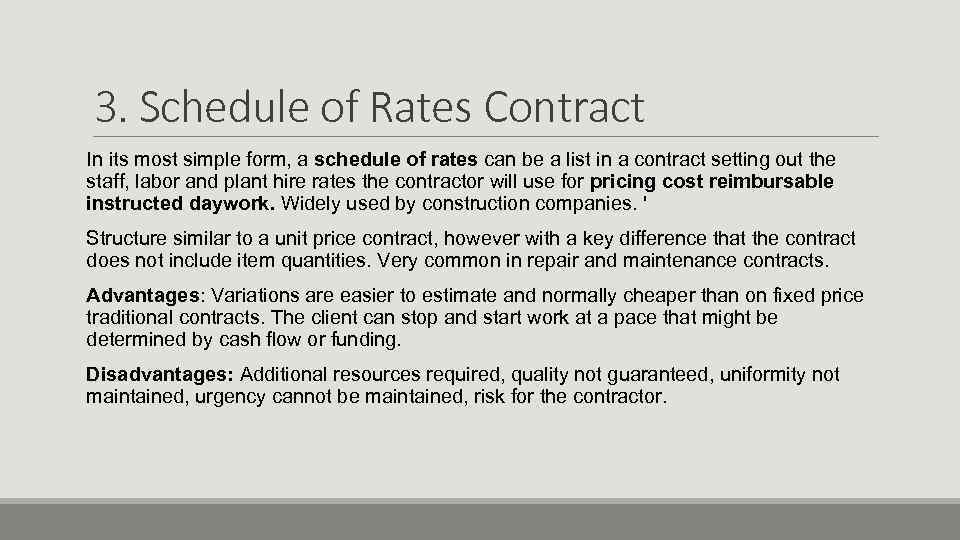
3. Schedule of Rates Contract In its most simple form, a schedule of rates can be a list in a contract setting out the staff, labor and plant hire rates the contractor will use for pricing cost reimbursable instructed daywork. Widely used by construction companies. ' Structure similar to a unit price contract, however with a key difference that the contract does not include item quantities. Very common in repair and maintenance contracts. Advantages: Variations are easier to estimate and normally cheaper than on fixed price traditional contracts. The client can stop and start work at a pace that might be determined by cash flow or funding. Disadvantages: Additional resources required, quality not guaranteed, uniformity not maintained, urgency cannot be maintained, risk for the contractor.
COST-PLUS CONTRACTS A cost-plus contract, also termed a cost reimbursement contract, is a contract where a contractor is paid for all of its allowed expenses to a set limit plus additional payment to allow for a profit. Types of cost-plus contracts: v. Cost plus percentage of cost v. Cost plus fixed-fee (CPFF) v. Cost-plus-incentive fee (CPIF) v. Cost-plus-award fee (CPAF)
4. Cost plus Percentage of Cost It is an agreement by a client to reimburse a construction company for building expenses stated in a contract plus an amount of profit as a percentage of the contract’s full price. Main aspects: vit cover all direct and indirect costs voverhead costs (by percentage or computed as one of the costs) vall expenses must be supported by documentation of the contractor’s spending vused in construction, research and development activities because it is difficult to determine in advance how much a job should cost
4. Cost plus Percentage of Cost Advantages: vconstruction can start before design is completed vfinal cost may be less than a fixed price contract because contractors do not have to inflate the price to cover their risk vthe cost to the client should represent a fair price (in case if the contractor is efficient) vis often used when long-term quality is a much higher concern than cost
4. Cost plus Percentage of Cost Disadvantages: vthere is limited certainty as to what the final cost will be vrequires additional oversight and administration to ensure that only permissible costs are paid and that the contractor is exercising adequate overall cost controls vminimum efficiency maximizes the profit vthere is less incentive to be efficient compared to a fixed-price contract Formula of price: P = CONTRACT’S FULL PRICE (costs, which can be limited) + % (profit, stated in contract)
5. Cost plus Fixed Fee It is a cost-reimbursement contract that provides for payment to the contractor of a negotiated fee that is fixed at the inception of the contract. Advantages: vthe fixed fee does not vary with actual cost vno incentive for the contractor to inflate costs vminimization of terms of performance of a contract Disadvantages: vthe determination/nomination of fees also requires additional oversight and administration and need a fairly detailed description of work must be made vminimum incentive for contractor to control costs
6. Target Cost with Variable Fees Contract Target cost - an approach to determine a product’s life-cycle cost which should be sufficient to develop specified functionality and quality, while ensuring its desired profit. It involves setting a target cost by subtracting a desired profit margin from a competitive market price. Main points Agreement of the owner and a contractor on target estimate of construction. All details about bonuses or penalties are included in the agreement and tied to the target figure. The work in the agreement must be certain and clearly defined If the target is set on cost -> sharing of savings If the target is set on time -> fixed sum of money for each day.
6. Target Cost with Variable Fees Contract Advantages 1. Contractors are very motivated to finish the work as fast as possible. 2. Owner can benefit from motivated constructor, because the work is very efficient. Disadvantages 1. There could be a lot of difficulties regarding the determination of the target cost (cost inflation, big variety). 2. cost control could be quiet difficult or costly.
7. Guaranteed Maximum Price Contract (GMP) A guaranteed maximum price (GMP) is a form of agreement with a contractor in which it is agreed that the contract sum will not exceed a specified maximum. 1. If the actual cost of the works is higher than the guaranteed maximum price -> contractor must bear the additional cost. 2. If the cost is lower than the guaranteed maximum price -> contract should set out whether the savings made go to the client, to the contractor or are shared. If they are shared -> can create a target cost agreement, where the contractor is incentivised to make savings, but the client has the security of a cost cap. As a consequence the contractor is likely to tender a higher price. However, a guaranteed maximum price is not a panacea, and the price is not necessarily fixed.
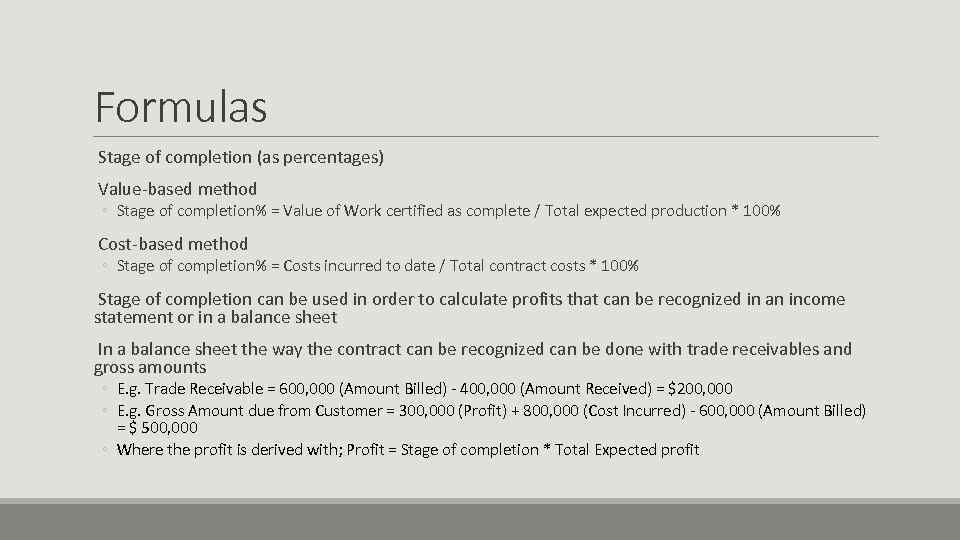
Formulas Stage of completion (as percentages) Value-based method ◦ Stage of completion% = Value of Work certified as complete / Total expected production * 100% Cost-based method ◦ Stage of completion% = Costs incurred to date / Total contract costs * 100% Stage of completion can be used in order to calculate profits that can be recognized in an income statement or in a balance sheet In a balance sheet the way the contract can be recognized can be done with trade receivables and gross amounts ◦ E. g. Trade Receivable = 600, 000 (Amount Billed) - 400, 000 (Amount Received) = $200, 000 ◦ E. g. Gross Amount due from Customer = 300, 000 (Profit) + 800, 000 (Cost Incurred) - 600, 000 (Amount Billed) = $ 500, 000 ◦ Where the profit is derived with; Profit = Stage of completion * Total Expected profit

Thank you for your attention
Скачать презентацию Construction contracts BÁLINT BORKA DENIS KASHIN GURSHAN SINGH
Construction contracts.pptx