 Скачать презентацию Construction Commissioning and Performance of a Hadron Blind
183899c5a6f9f2edd529770e541a4f6f.ppt
- Количество слайдов: 13



Construction, Commissioning and Performance of a Hadron Blind Detector for the PHENIX Experiment at RHIC Itzhak Tserruya Weizmann Institute of Science, Rehovot, Israel for the HBD group: BNL (Physics): B. Azmoun, A. Milov, R. Pisani, T. Sakaguchi, A. Sickles, S. Stoll, C. Woody BNL (Instrumentation): J. Harder, P. O’Connor, V. Radeka, B. Yu Columbia Univ : C-Y. Chi SUNY: W. Anderson, A. Drees, Z. Citron, M. Durham, T. Hemmick, R. Hutter, B. Jacak, J. Kamin Weizmann: A. Dubey, Z. Fraenkel, A. Kozlov, M. Naglis, I. Ravinovich, D. Sharma, I. Tserruya IEEE 2007, October 29, 2007, Hawaii Itzhak Tserruya
Outline Ø Motivation Ø Concept Ø Construction Ø Performance Itzhak Tserruya IEEE-NSS, Hawaii, October 29, 2007 2
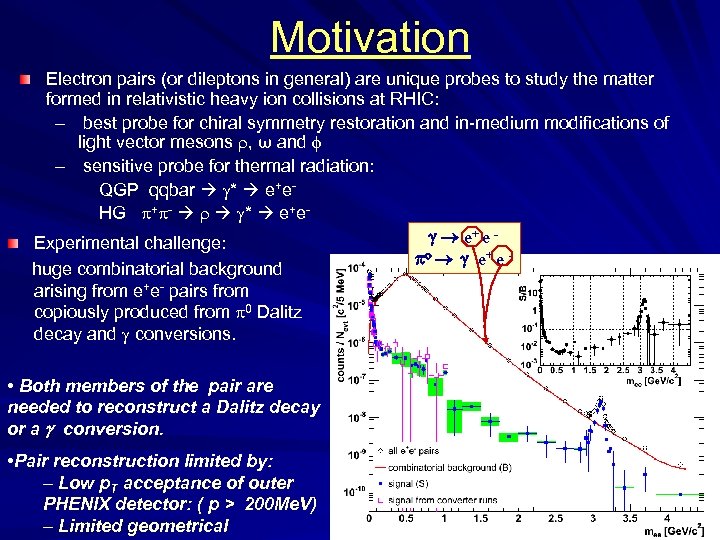
Motivation Electron pairs (or dileptons in general) are unique probes to study the matter formed in relativistic heavy ion collisions at RHIC: – best probe for chiral symmetry restoration and in-medium modifications of light vector mesons , ω and – sensitive probe for thermal radiation: QGP qqbar * e+e. HG + - * e+e e+ e Experimental challenge: po e+ e huge combinatorial background arising from e+e- pairs from copiously produced from 0 Dalitz decay and conversions. • Both members of the pair are needed to reconstruct a Dalitz decay or a conversion. • Pair reconstruction limited by: – Low p. T acceptance of outer PHENIX detector: ( p > 200 Me. V) – Limited geometrical
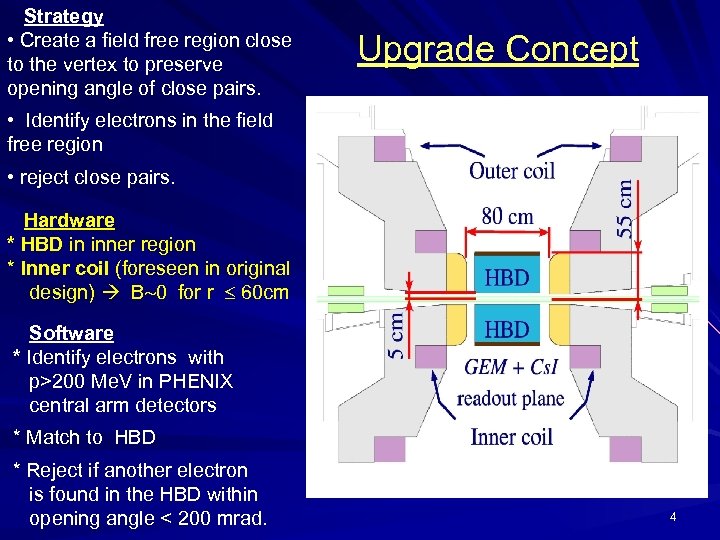
Strategy • Create a field free region close to the vertex to preserve opening angle of close pairs. Upgrade Concept • Identify electrons in the field free region • reject close pairs. Hardware * HBD in inner region * Inner coil (foreseen in original design) B 0 for r 60 cm Software * Identify electrons with p>200 Me. V in PHENIX central arm detectors * Match to HBD * Reject if another electron is found in the HBD within opening angle < 200 mrad. 4
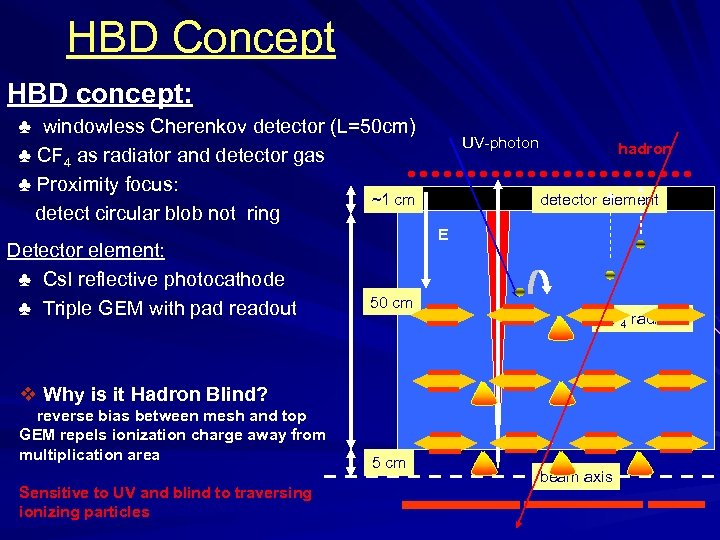
HBD Concept HBD concept: ♣ windowless Cherenkov detector (L=50 cm) ♣ CF 4 as radiator and detector gas ♣ Proximity focus: ~1 cm detect circular blob not ring Detector element: ♣ Cs. I reflective photocathode ♣ Triple GEM with pad readout UV-photon hadron detector element E 50 cm CF 4 radiator v Why is it Hadron Blind? reverse bias between mesh and top GEM repels ionization charge away from multiplication area Sensitive to UV and blind to traversing ionizing particles 5 cm beam axis
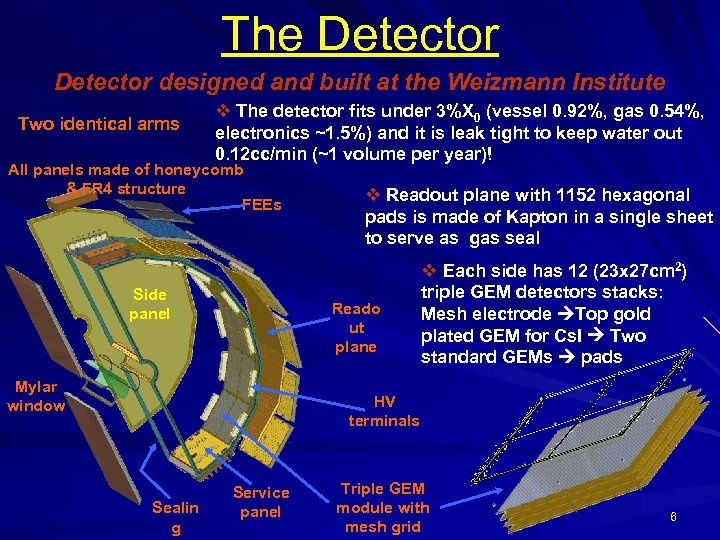
The Detector designed and built at the Weizmann Institute Two identical arms v The detector fits under 3%X 0 (vessel 0. 92%, gas 0. 54%, electronics ~1. 5%) and it is leak tight to keep water out 0. 12 cc/min (~1 volume per year)! All panels made of honeycomb & FR 4 structure FEEs Side panel v Readout plane with 1152 hexagonal pads is made of Kapton in a single sheet to serve as gas seal Reado ut plane Mylar window v Each side has 12 (23 x 27 cm 2) triple GEM detectors stacks: Mesh electrode Top gold plated GEM for Cs. I Two standard GEMs pads HV terminals Sealin g Service panel Triple GEM module with mesh grid 6
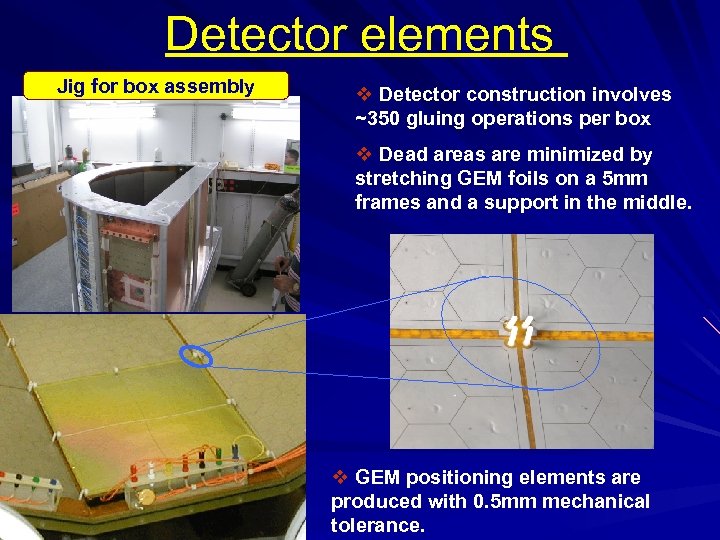
Detector elements Jig for box assembly v Detector construction involves ~350 gluing operations per box v Dead areas are minimized by stretching GEM foils on a 5 mm frames and a support in the middle. v GEM positioning elements are produced with 0. 5 mm mechanical tolerance.
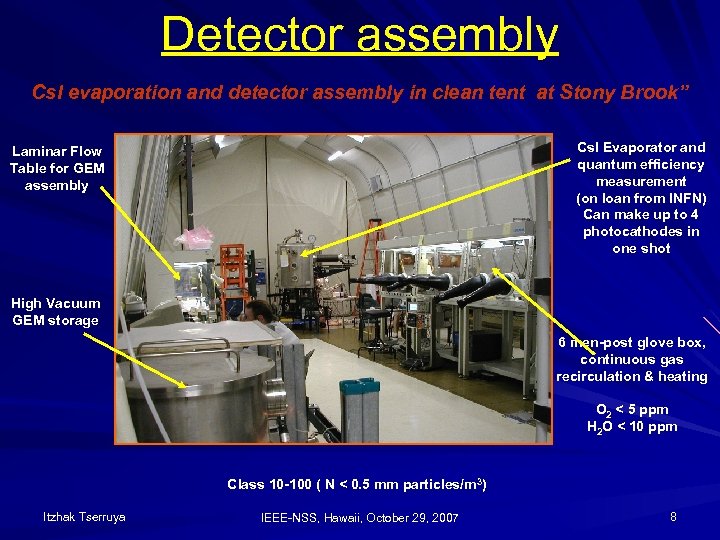
Detector assembly Cs. I evaporation and detector assembly in clean tent at Stony Brook” Cs. I Evaporator and quantum efficiency measurement (on loan from INFN) Can make up to 4 photocathodes in one shot Laminar Flow Table for GEM assembly High Vacuum GEM storage 6 men-post glove box, continuous gas recirculation & heating O 2 < 5 ppm H 2 O < 10 ppm Class 10 -100 ( N < 0. 5 mm particles/m 3) Itzhak Tserruya IEEE-NSS, Hawaii, October 29, 2007 8
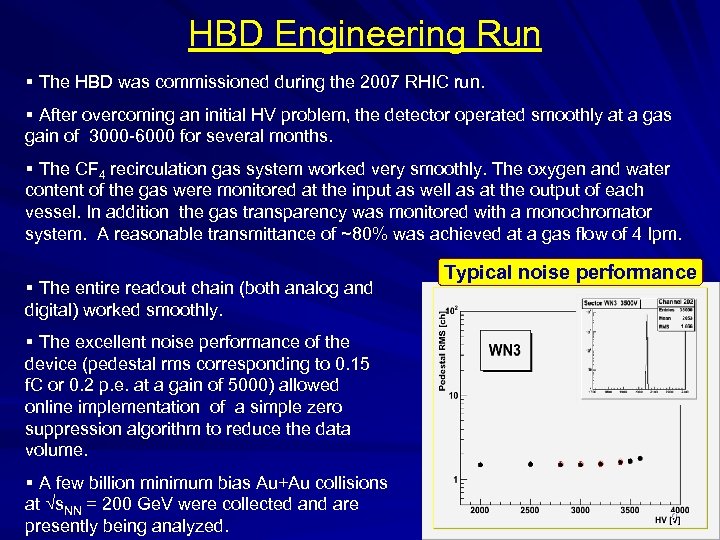
HBD Engineering Run § The HBD was commissioned during the 2007 RHIC run. § After overcoming an initial HV problem, the detector operated smoothly at a gas gain of 3000 -6000 for several months. § The CF 4 recirculation gas system worked very smoothly. The oxygen and water content of the gas were monitored at the input as well as at the output of each vessel. In addition the gas transparency was monitored with a monochromator system. A reasonable transmittance of ~80% was achieved at a gas flow of 4 lpm. § The entire readout chain (both analog and digital) worked smoothly. Typical noise performance § The excellent noise performance of the device (pedestal rms corresponding to 0. 15 f. C or 0. 2 p. e. at a gain of 5000) allowed online implementation of a simple zero suppression algorithm to reduce the data volume. § A few billion minimum bias Au+Au collisions at √s. NN = 200 Ge. V were collected and are presently being analyzed. 9
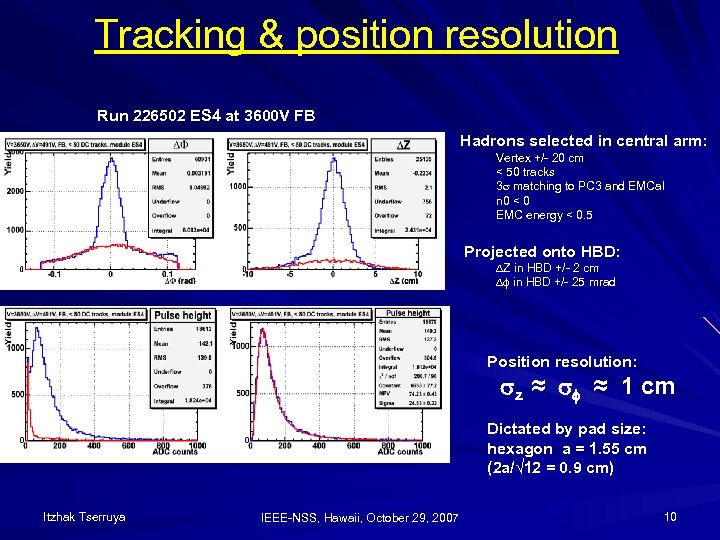
Tracking & position resolution Run 226502 ES 4 at 3600 V FB Hadrons selected in central arm: Vertex +/- 20 cm < 50 tracks 3 matching to PC 3 and EMCal n 0 < 0 EMC energy < 0. 5 Projected onto HBD: Z in HBD +/- 2 cm in HBD +/- 25 mrad Position resolution: z ≈ ≈ 1 cm Dictated by pad size: hexagon a = 1. 55 cm (2 a/√ 12 = 0. 9 cm) Itzhak Tserruya IEEE-NSS, Hawaii, October 29, 2007 10
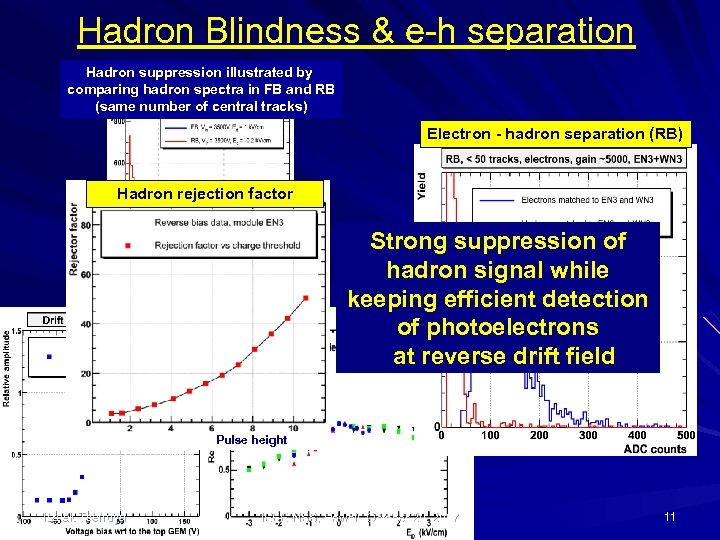
Hadron Blindness & e-h separation Hadron suppression illustrated by comparing hadron spectra in FB and RB (same number of central tracks) Electron - hadron separation (RB) Hadron rejection factor Pulse height Strong suppression of hadron signal while keeping efficient detection of photoelectrons at reverse drift field Pulse height Itzhak Tserruya IEEE-NSS, Hawaii, October 29, 2007 11
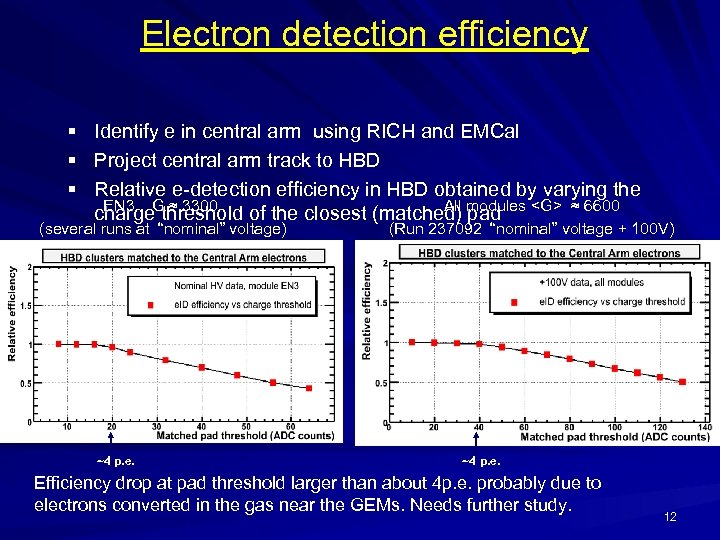
Electron detection efficiency § § § Identify e in central arm using RICH and EMCal Project central arm track to HBD Relative e-detection efficiency in HBD obtained by varying the EN 3 ≈ 3300 All charge. Gthreshold of the closest (matched) modules <G> ≈ 6600 pad (several runs at “nominal” voltage) ~4 p. e. (Run 237092 “nominal” voltage + 100 V) ~4 p. e. § Efficiency drop at pad threshold larger than about 4 p. e. probably due to electrons converted in the gas near the GEMs. Needs further study. 12
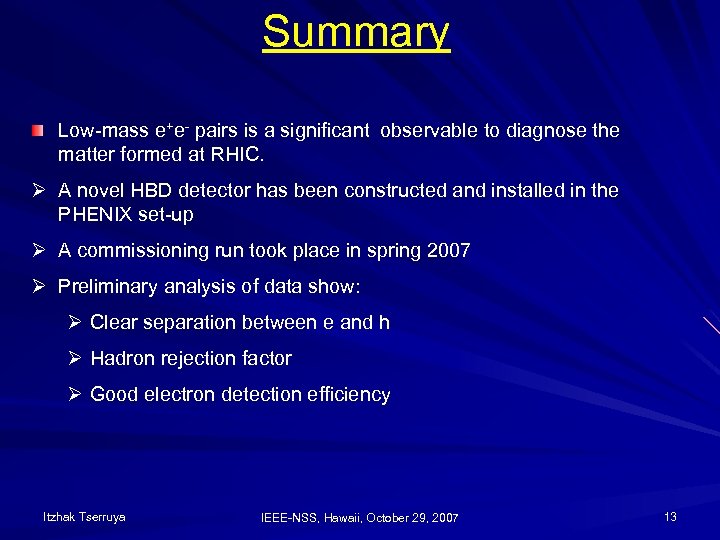
Summary Low-mass e+e- pairs is a significant observable to diagnose the matter formed at RHIC. Ø A novel HBD detector has been constructed and installed in the PHENIX set-up Ø A commissioning run took place in spring 2007 Ø Preliminary analysis of data show: Ø Clear separation between e and h Ø Hadron rejection factor Ø Good electron detection efficiency Itzhak Tserruya IEEE-NSS, Hawaii, October 29, 2007 13
Скачать презентацию Construction Commissioning and Performance of a Hadron Blind
183899c5a6f9f2edd529770e541a4f6f.ppt