 Скачать презентацию CONSTRUCTION BUSINESS AUTOMATION SYSTEM CBAS By Dong —
8a94fd01f279c8983cee07b80c7f639a.ppt
- Количество слайдов: 1



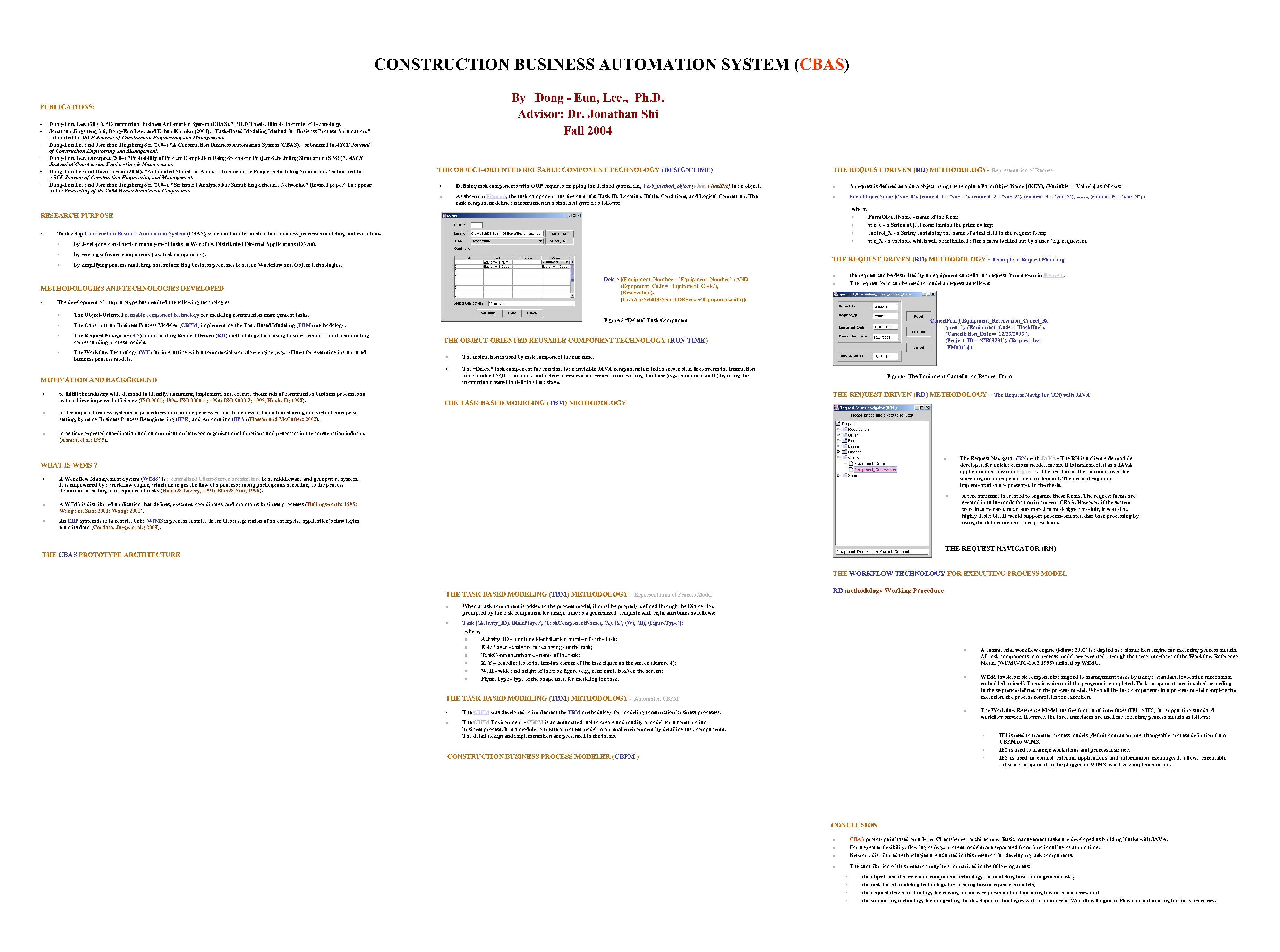
CONSTRUCTION BUSINESS AUTOMATION SYSTEM (CBAS) By Dong - Eun, Lee. , Ph. D. Advisor: Dr. Jonathan Shi Fall 2004 PUBLICATIONS: • • Dong-Eun, Lee. (2004). “Construction Business Automation System (CBAS). " PH. D Thesis, Illinois Institute of Technology. Jonathan Jingsheng Shi, Dong-Eun Lee , and Erhan Kuruku (2004). "Task-Based Modeling Method for Busienss Process Automation. " submitted to ASCE Journal of Construction Engineering and Management. Dong-Eun Lee and Jonathan Jingsheng Shi (2004) "A Construction Business Automation System (CBAS). " submitted to ASCE Journal of Construction Engineering and Management. Dong-Eun, Lee. (Accepted 2004) "Probability of Project Completion Using Stochastic Project Scheduling Simulation (SPSS)". ASCE Journal of Construction Engineering & Management. Dong-Eun Lee and David Arditi (2004). "Automated Statistical Analysis In Stochastic Project Scheduling Simulation. " submitted to ASCE Journal of Construction Engineering and Management. Dong-Eun Lee and Jonathan Jingsheng Shi (2004). "Statistical Analyses For Simulating Schedule Networks. " (Invited paper) To appear in the Proceeding of the 2004 Winter Simulation Conference. • • THE OBJECT-ORIENTED REUSABLE COMPONENT TECHNOLOGY (DESIGN TIME) • Defining task components with OOP requires mapping the defined syntax, i. e. , Verb_method_object [what, what. Else] to an object. As shown in Figure 3, the task component has five controls: Task ID, Location, Table, Conditions, and Logical Connection. The task component define an instruction in a standard syntax as follows: n THE REQUEST DRIVEN (RD) METHODOLOGYn A request is defined as a data object using the template Form. Object. Name [(KEY), (Variable = `Value`)] as follows: n Form. Object. Name [(‘var_0’), (control_1 = ‘var_1’), (control_2 = ‘var_2’), (control_3 = ‘var_3’), ……, (control_N = ‘var_N’)]; where, RESEARCH PURPOSE • • To develop Construction Business Automation System (CBAS), which automate construction business processes modeling and execution. • by reusing software components (i. e. , task components). • • by developing construction management tasks as Workflow Distributed i. Nternet Applications (DNAs). • by simplifying process modeling, and automating business processes based on Workflow and Object technologies. METHODOLOGIES AND TECHNOLOGIES DEVELOPED • The development of the prototype has resulted the following technologies • The Object-Oriented reusable component technology for modeling construction management tasks. • The Construction Business Process Modeler (CBPM) implementing the Task Based Modeling (TBM) methodology. • The Request Navigator (RN) implementing Request Driven (RD) methodology for raising business requests and instantiating corresponding process models. • The Workflow Technology (WT) for interacting with a commercial workflow engine (e. g. , i-Flow) for executing instantiated business process models. MOTIVATION AND BACKGROUND n n to fulfill the industry wide demand to identify, document, implement, and execute thousands of construction business processes so as to achieve improved efficiency (ISO 9001; 1994, ISO 9000 -1; 1994; ISO 9000 -2; 1993, Hoyle, D; 1998). n Cancel. Frm[(`Equipment_Reservation_Cancel_Re quest_`), (Equipment_Code = `Back. Hoe`), (Cancellation_Date = `12/23/2003`), (Project_ID = `CE 03231`), (Request_by = `PM 001`)] ; THE OBJECT-ORIENTED REUSABLE COMPONENT TECHNOLOGY (RUN TIME) n The instruction is used by task component for run time. The “Delete” task component for run time is an invisible JAVA component located in server side. It converts the instruction into standard SQL statement, and deletes a reservation record in an existing database (e. g. , equipment. mdb) by using the instruction created in defining task stage. Figure 6 The Equipment Cancellation Request Form THE REQUEST DRIVEN (RD) METHODOLOGY - to decompose business systems or procedures into atomic processes so as to achieve information sharing in a virtual enterprise setting, by using Business Process Reengineering (BPR) and Automation (BPA) (Hassan and Mc. Caffer; 2002). to achieve expected coordination and communication between organizational functions and processes in the construction industry (Ahmad et al; 1995). WHAT IS Wf. MS ? A Workflow Management System (Wf. MS) is a centralized Client/Server architecture base middleware and groupware system. It is empowered by a workflow engine, which manages the flow of a process among participants according to the process definition consisting of a sequence of tasks (Hales & Lavery, 1991; Ellis & Nutt, 1996). n n n The Request Navigator (RN) with JAVA THE TASK BASED MODELING (TBM) METHODOLOGY n • Example of Request Modeling the request can be described by an equipment cancellation request form shown in Figure 6. The request form can be used to model a request as follows: n Figure 3 “Delete” Task Component • • Form. Object. Name - name of the form; var_0 - a String object containining the primary key; control_X - a String containing the name of a text field in the request form; var_X - a variable which will be initialized after a form is filled out by a user (e. g, requester). THE REQUEST DRIVEN (RD) METHODOLOGY Delete [(Equipment_Number = `Equipment_Number` ) AND (Equipment_Code = `Equipment_Code`), (Reservation), (C: AAASch. DBSearch. DBServerEquipment. mdb)]; Representation of Request A Wf. MS is distributed application that defines, executes, coordinates, and maintains business processes (Hollingsworth; 1995; Wang and Sun; 2001; Wang; 2001). An ERP system is data centric, but a Wf. MS is process centric. It enables a separation of an enterprise application’s flow logics from its data (Cardoso. Jorge. et al. ; 2003). The Request Navigator (RN) with JAVA - The RN is a client side module developed for quick access to needed forms. It is implemented as a JAVA application as shown in Figure 7. The text box at the bottom is used for searching an appropriate form in demand. The detail design and implementation are presented in thesis. A tree structure is created to organize these forms. The request forms are created in tailor made fashion in current CBAS. However, if the system were incorporated to an automated form designer module, it would be highly desirable. It would support process-oriented database processing by using the data controls of a request from. THE REQUEST NAVIGATOR (RN) THE CBAS PROTOTYPE ARCHITECTURE THE WORKFLOW TECHNOLOGY FOR EXECUTING PROCESS MODEL THE TASK BASED MODELING (TBM) METHODOLOGY n n Representation of Process Model RD methodology Working Procedure When a task component is added to the process model, it must be properly defined through the Dialog Box prompted by the task component for design time as a generalized template with eight attributes as follows: Task [(Activity_ID), (Role. Player), (Task. Component. Name), (X), (Y), (W), (H), (Figure. Type)]; where, n n n Activity_ID - a unique identification number for the task; Role. Player - assignee for carrying out the task; Task. Component. Name - name of the task; X, Y – coordinates of the left-top corner of the task figure on the screen (Figure 4); W, H - wide and height of the task figure (e. g. , rectangule box) on the screen; Figure. Type - type of the shape used for modeling the task. THE TASK BASED MODELING (TBM) METHODOLOGY • n n n Automated CBPM n The CBPM was developed to implement the TBM methodology for modeling construction business processes. The CBPM Environment - CBPM is an automated tool to create and modify a model for a construction business process. It is a module to create a process model in a visual environment by detailing task components. The detail design and implementation are presented in thesis. A commercial workflow engine (i-flow; 2002) is adopted as a simulation engine for executing process models. All task components in a process model are executed through the three interfaces of the Workflow Reference Model (WFMC-TC-1003 1995) defined by Wf. MC. Wf. MS invokes task components assigned to management tasks by using a standard invocation mechanism embedded in itself. Then, it waits until the program is completed. Task components are invoked according to the sequence defined in the process model. When all the task components in a process model complete the execution, the process completes the execution. The Workflow Reference Model has five functional interfaces (IF 1 to IF 5) for supporting standard workflow service. However, the three interfaces are used for executing process models as follows: • • CONSTRUCTION BUSINESS PROCESS MODELER (CBPM ) • IF 1 is used to transfer process models (definitions) as an interchangeable process definition from CBPM to Wf. MS. IF 2 is used to manage work items and process instance. IF 3 is used to control external applications and information exchange. It allows executable software components to be plugged in Wf. MS as activity implementation. CONCLUSION n CBAS prototype is based on a 3 -tier Client/Server architecture. Basic management tasks are developed as building blocks with JAVA. For a greater flexibility, flow logics (e. g. , process models) are separated from functional logics at run time. Network distributed technologies are adopted in this research for developing task components. n The contribution of this research may be summarized in the following areas: n n • • the object-oriented reusable component technology for modeling basic management tasks, the task-based modeling technology for creating business process models, the request-driven technology for raising business requests and instantiating business processes, and the supporting technology for integrating the developed technologies with a commercial Workflow Engine (i-Flow) for automating business processes.
Скачать презентацию CONSTRUCTION BUSINESS AUTOMATION SYSTEM CBAS By Dong —
8a94fd01f279c8983cee07b80c7f639a.ppt