


 Скачать презентацию Constraint Programming Planning and Scheduling with Time and
049502eedc6f11c9092c5314b9beeb3c.ppt
- Количество слайдов: 126
 Constraint Programming, Planning and Scheduling with Time and Resource Constraints Claude Le Pape - ILOG S. A. Disclaimer: not (at all) a complete overview of the field! 1 C. Le Pape
 Outline • Constraint Programming • Constraint-Based Scheduling • Cooperative Problem-Solving 2 C. Le Pape
 Constraint Programming • Explicit problem definition • Separation between problem definition and problem solving • Systematic deduction of the consequences of made decisions (constraint propagation) Partial constraint propagation è development of heuristic search algorithms to generate and optimize solutions • Incremental constraint propagation (with global fix point semantics) • Localized definition of the constraint propagation process (each constraint propagates independently of other constraints) è many different types of constraints viewed as as many sub-problems 3 C. Le Pape
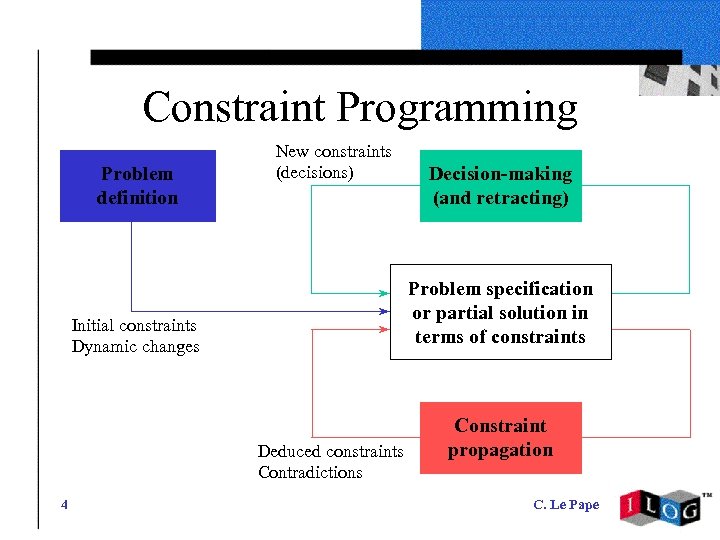 Constraint Programming Problem definition New constraints (decisions) Problem specification or partial solution in terms of constraints Initial constraints Dynamic changes Deduced constraints Contradictions 4 Decision-making (and retracting) Constraint propagation C. Le Pape
![Example: Propagation Variables: x in [1. . 3] y in [1. . 3] z](https://present5.com/presentation/049502eedc6f11c9092c5314b9beeb3c/image-5.jpg "Example: Propagation Variables: x in [1. . 3] y in [1. . 3] z") Example: Propagation Variables: x in [1. . 3] y in [1. . 3] z in [1. . 3] Constraints: x - y = 1 y < z x != z x - y = 1 y < z x in [2. . 3] y in [1. . 2] z in [2. . 3] x != z 5 x in [2. . 3] y in [1. . 2] z in [1. . 3] x in [2. . 3] y in [1. . 2] z in [2. . 3] C. Le Pape
Example: Propagation Variables: x in [1. . 3] y in [1. . 3] z in [1. . 3] Constraints: x - y = 1 y < z x != z x - y = 1 y < z x in [2. . 3] y in [1. . 2] z in [2. . 3] x != z 5 x in [2. . 3] y in [1. . 2] z in [1. . 3] x in [2. . 3] y in [1. . 2] z in [2. . 3] C. Le Pape
![Example: Decision-Making Variables: x in [2. . 3] y in [1. . 2] z](https://present5.com/presentation/049502eedc6f11c9092c5314b9beeb3c/image-6.jpg "Example: Decision-Making Variables: x in [2. . 3] y in [1. . 2] z") Example: Decision-Making Variables: x in [2. . 3] y in [1. . 2] z in [2. . 3] y = 2 Constraints: x - y = 1 y < z x != z x = 3 y = 2 z = 3 FAILURE Backtrack y = 1 6 x = 2 y = 1 z = 3 C. Le Pape
Example: Decision-Making Variables: x in [2. . 3] y in [1. . 2] z in [2. . 3] y = 2 Constraints: x - y = 1 y < z x != z x = 3 y = 2 z = 3 FAILURE Backtrack y = 1 6 x = 2 y = 1 z = 3 C. Le Pape
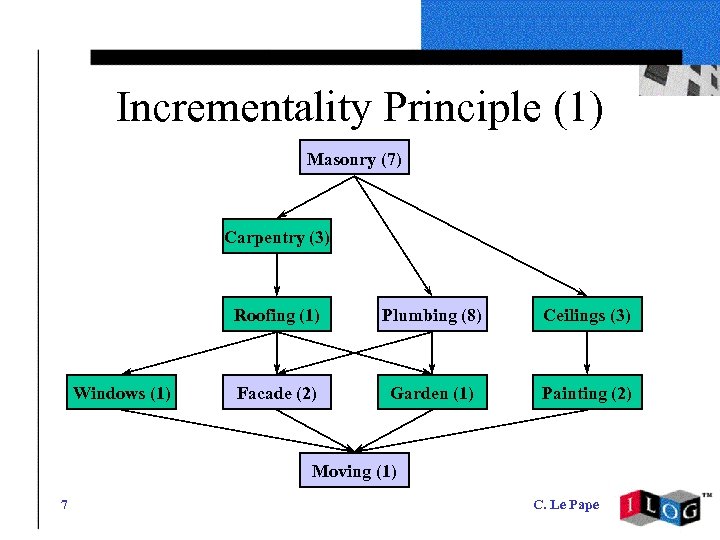 Incrementality Principle (1) Masonry (7) Carpentry (3) Roofing (1) Windows (1) Plumbing (8) Ceilings (3) Facade (2) Garden (1) Painting (2) Moving (1) 7 C. Le Pape
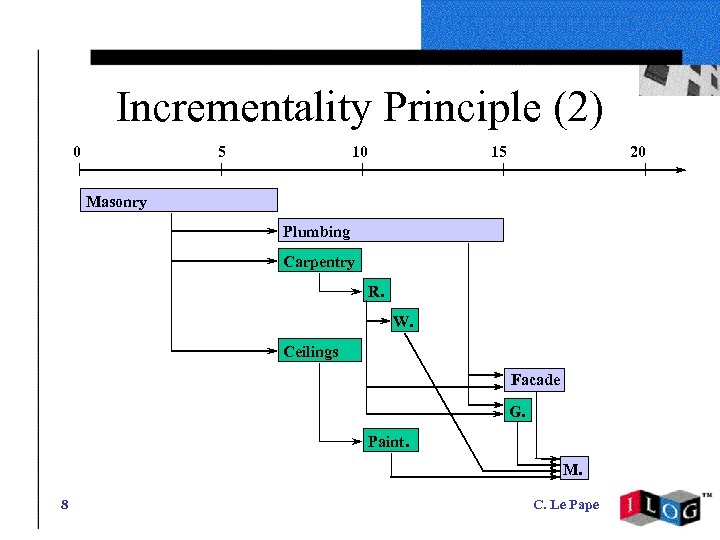 Incrementality Principle (2) 0 5 10 15 20 Masonry Plumbing Carpentry R. W. Ceilings Facade G. Paint. M. 8 C. Le Pape
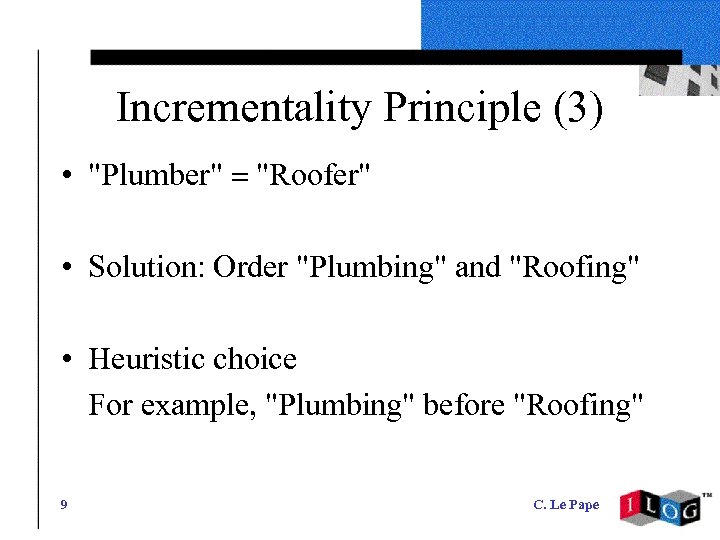 Incrementality Principle (3) • "Plumber" = "Roofer" • Solution: Order "Plumbing" and "Roofing" • Heuristic choice For example, "Plumbing" before "Roofing" 9 C. Le Pape
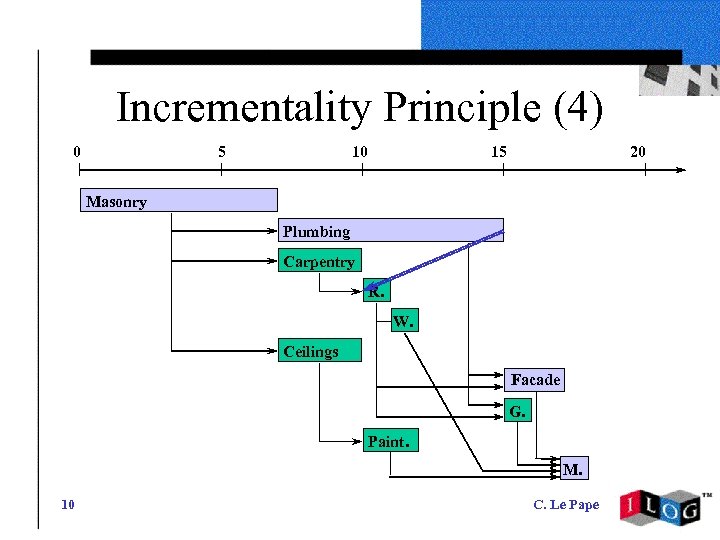 Incrementality Principle (4) 0 5 10 15 20 Masonry Plumbing Carpentry R. W. Ceilings Facade G. Paint. M. 10 C. Le Pape
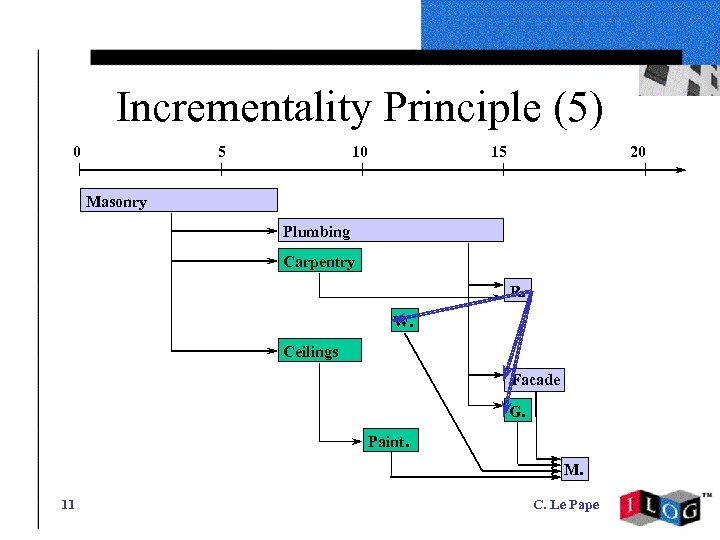 Incrementality Principle (5) 0 5 10 15 20 Masonry Plumbing Carpentry R. W. Ceilings Facade G. Paint. M. 11 C. Le Pape
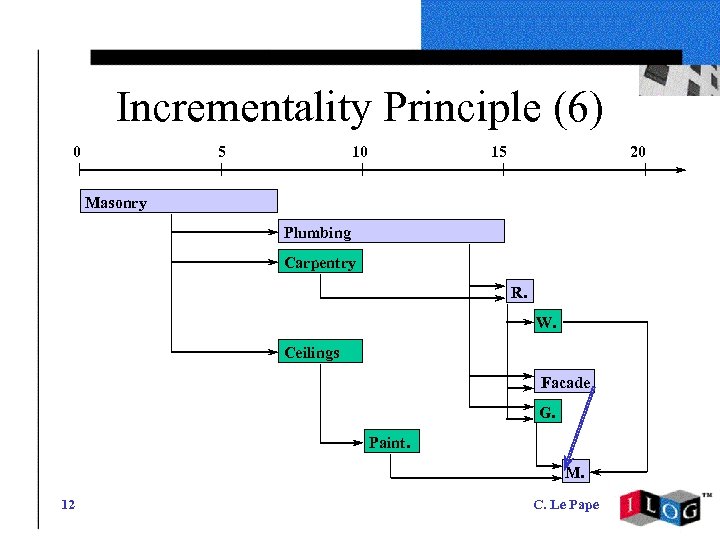 Incrementality Principle (6) 0 5 10 15 20 Masonry Plumbing Carpentry R. W. Ceilings Facade G. Paint. M. 12 C. Le Pape
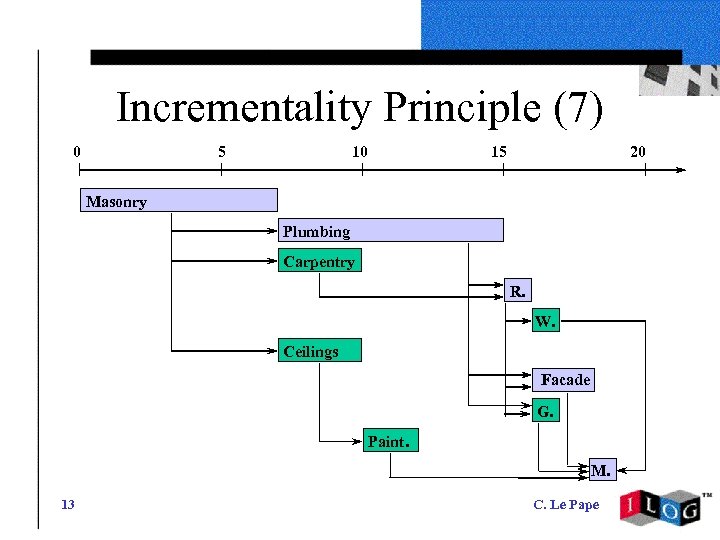 Incrementality Principle (7) 0 5 10 15 20 Masonry Plumbing Carpentry R. W. Ceilings Facade G. Paint. M. 13 C. Le Pape
 Incrementality Principle (8) Constraint propagation consists in incrementally updating characteristics of a partial problem solution when an additional constraint is added These characteristics may be: – indicators of contradictions – domains of variables (relational propagation) – the overall set of constraints (logic/algebraic propagation) 14 C. Le Pape
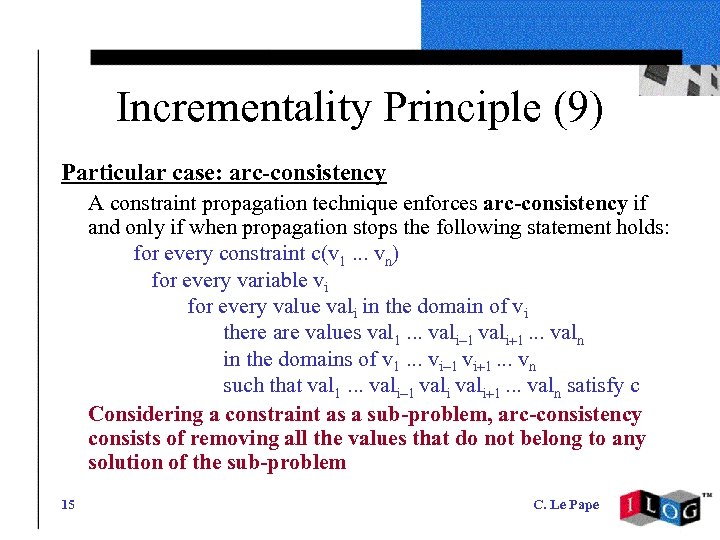 Incrementality Principle (9) Particular case: arc-consistency A constraint propagation technique enforces arc-consistency if and only if when propagation stops the following statement holds: for every constraint c(v 1. . . vn) for every variable vi for every value vali in the domain of vi there are values val 1. . . vali-1 vali+1. . . valn in the domains of v 1. . . vi-1 vi+1. . . vn such that val 1. . . vali-1 vali+1. . . valn satisfy c Considering a constraint as a sub-problem, arc-consistency consists of removing all the values that do not belong to any solution of the sub-problem 15 C. Le Pape
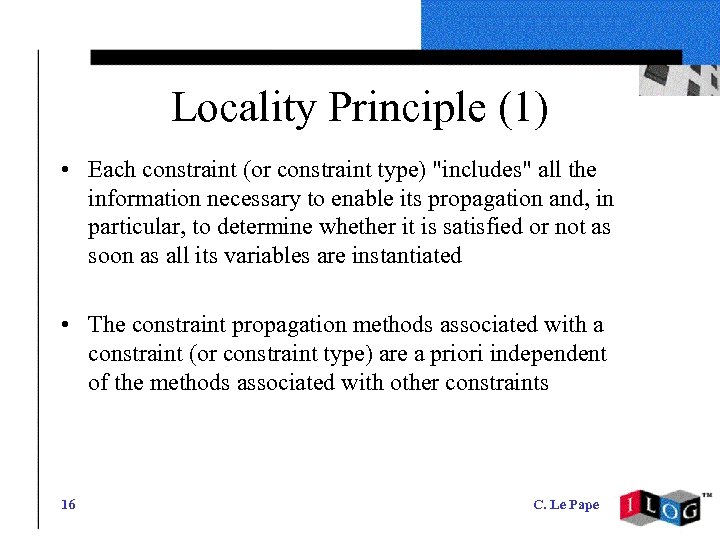 Locality Principle (1) • Each constraint (or constraint type) "includes" all the information necessary to enable its propagation and, in particular, to determine whether it is satisfied or not as soon as all its variables are instantiated • The constraint propagation methods associated with a constraint (or constraint type) are a priori independent of the methods associated with other constraints 16 C. Le Pape
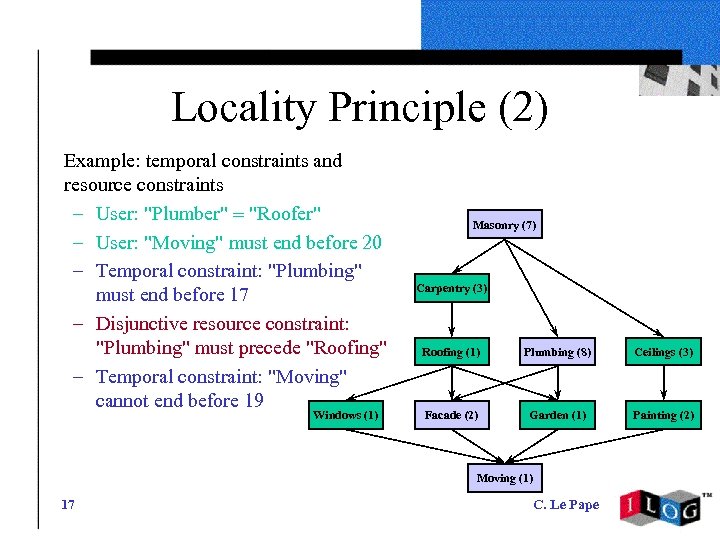 Locality Principle (2) Example: temporal constraints and resource constraints – User: "Plumber" = "Roofer" – User: "Moving" must end before 20 – Temporal constraint: "Plumbing" must end before 17 – Disjunctive resource constraint: "Plumbing" must precede "Roofing" – Temporal constraint: "Moving" cannot end before 19 Windows (1) Masonry (7) Carpentry (3) Roofing (1) Plumbing (8) Ceilings (3) Facade (2) Garden (1) Painting (2) Moving (1) 17 C. Le Pape
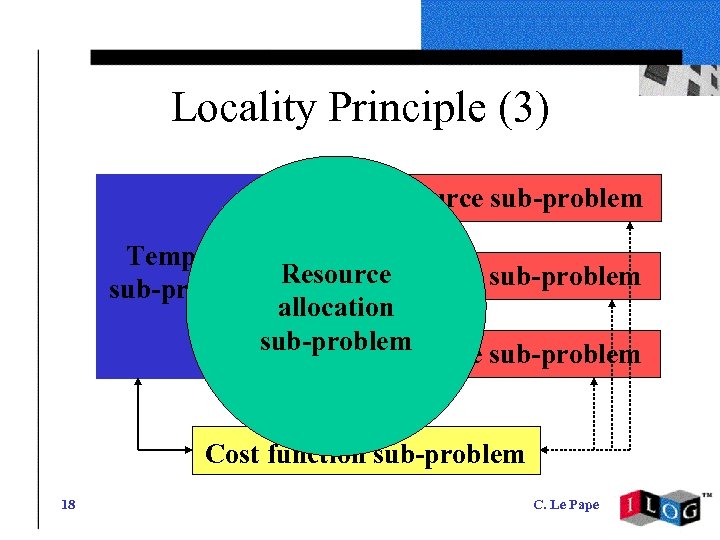 Locality Principle (3) Resource sub-problem Temporal Resource sub-problem allocation sub-problem Resource sub-problem Cost function sub-problem 18 C. Le Pape
 Outline • Constraint Programming • Constraint-Based Scheduling • Cooperative Problem-Solving 19 C. Le Pape
 Outline • Constraint Programming • Constraint-Based Scheduling – Scheduling Problems – Propagation of Temporal Constraints – Propagation of Resource Constraints – Examples of Applications • Cooperative Problem-Solving 20 C. Le Pape
 Scheduling Problems "Scheduling is the allocation of resources over time to perform a collection of tasks" [Baker 74] – Pure scheduling problems: assignment of start and end times to activities (each activity requires given resources with given capacities) – Pure resource allocation problems: assignment of resources to activities (the start and end times of each activity are given) – Joint scheduling and resource allocation problems: assignment of resources and start and end times to activities 21 C. Le Pape
 Scheduling Problems • Transportation – Traffic scheduling and control (aircrafts, buses, trains, trucks) – Loading and unloading (aircrafts, ships, trucks) – Crew rostering • Production and maintenance • Manpower planning and timetabling (shifts, courses, exams) • Project or mission scheduling • Network planning and routing • Computer or printer job scheduling • Mixture planning, rack configuration, textile cutting, . . . 22 C. Le Pape
 Variety of Scheduling Problems • • • 23 Activities Resources Constraints Optimization criteria Problem size Time available to make a decision C. Le Pape
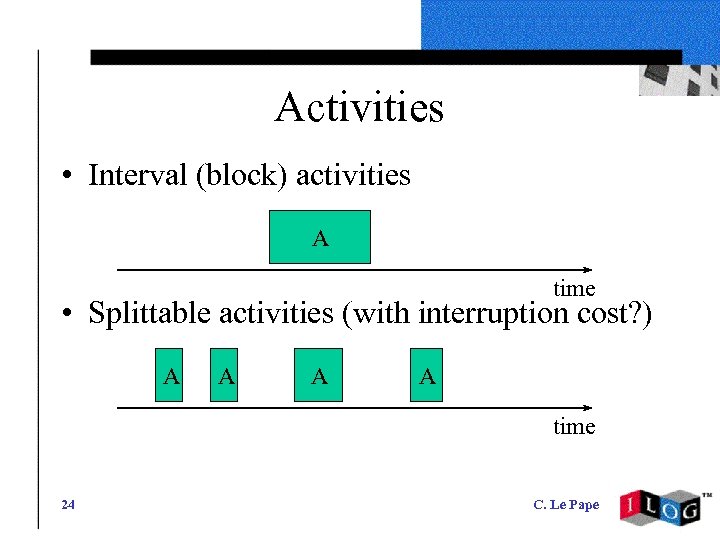 Activities • Interval (block) activities A time • Splittable activities (with interruption cost? ) A A time 24 C. Le Pape
 Resources • Unary resources – one person – one machine • Discrete resources – a group of people with the same capabilities • State resources – an oven with different possible temperatures • Energetic resources – a limited number of human-days each week • Required, provided, consumed or produced by activities 25 C. Le Pape
 Constraints • Temporal constraints – Fixed or variable durations – Precedence constraints – Minimal and maximal delays • Resource constraints – Fixed capacity – Variable capacity (time versus capacity tradeoffs) – Variable capacity over time • Specific constraints 26 C. Le Pape
 Capacity Constraints • Periods during which a resource is not fully available – Maintenance periods – Vacations – Forbidden states (at night) • Periods during which some minimal amount must be required or provided 27 C. Le Pape
 Optional/Variable Requirements • Optional activities – Resource alternatives – Sub-contracts 28 C. Le Pape
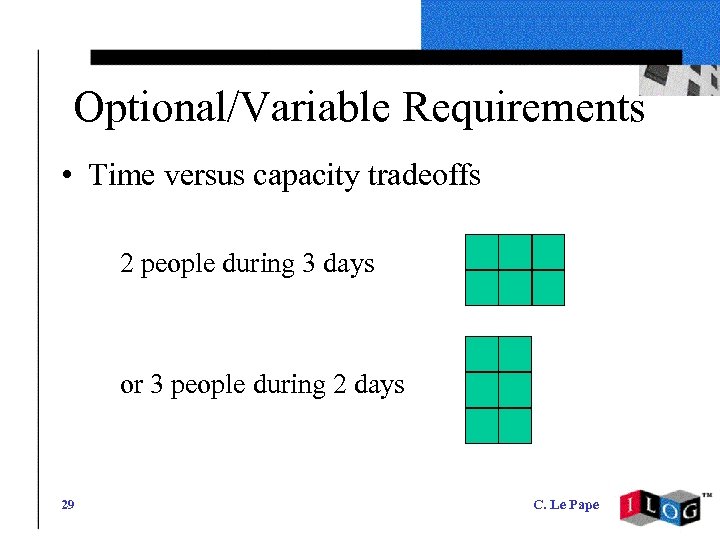 Optional/Variable Requirements • Time versus capacity tradeoffs 2 people during 3 days or 3 people during 2 days 29 C. Le Pape
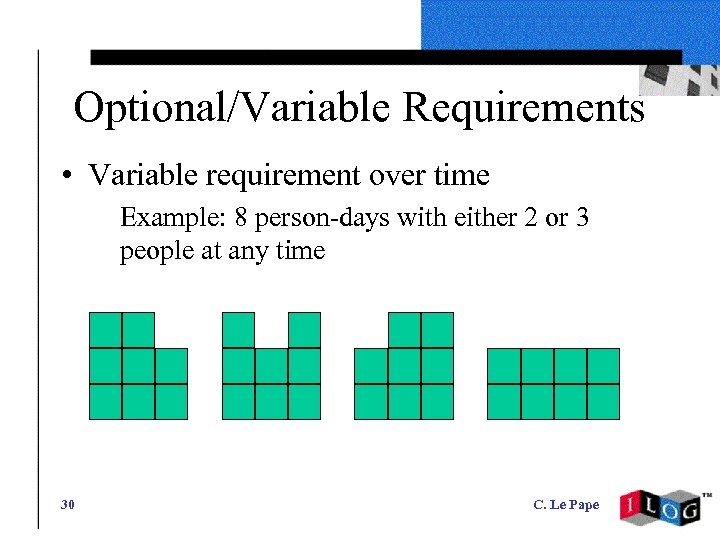 Optional/Variable Requirements • Variable requirement over time Example: 8 person-days with either 2 or 3 people at any time 30 C. Le Pape
 Transition Times • Tool setup between two tasks on the same machine • State change (oven temperature, color used in a painting shop) • Cleaning 31 C. Le Pape
 Percentage Constraints • a% of activity A on resource RA must be done before (or after): – B starts – B ends – b% of activity B on resource RB are done • Often complements variable requirements over time 32 C. Le Pape
 Synchronization Constraints • When A executes, B requires (at least, at most) c 1 units of resource R • When A does not execute, B requires (at least, at most) c 2 units of resource R 33 C. Le Pape
 Optimization Criteria • No optimization criterion • A well-defined criterion – – Project makespan Number of activities performed within given delays Maximal or average tardiness or earliness Peak or average resource utilization • A combination of well-defined criteria • Preferences (soft constraints) • Optimization versus robustness 34 C. Le Pape
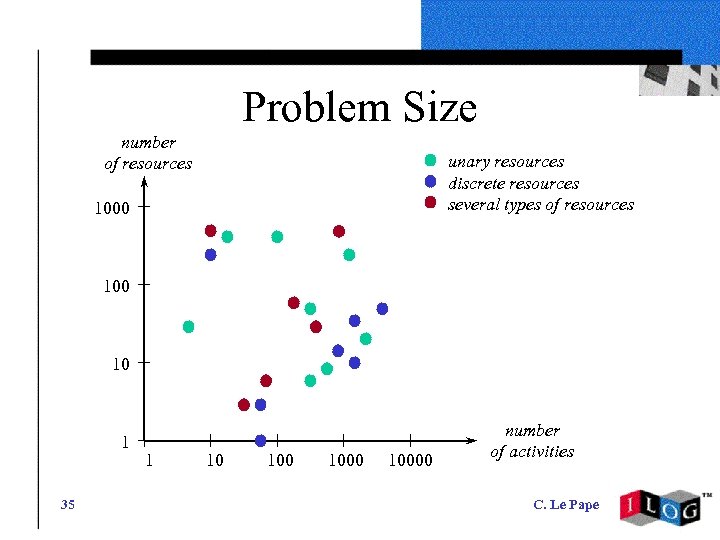 Problem Size number of resources unary resources discrete resources several types of resources 1000 10 1 35 1 10 10000 number of activities C. Le Pape
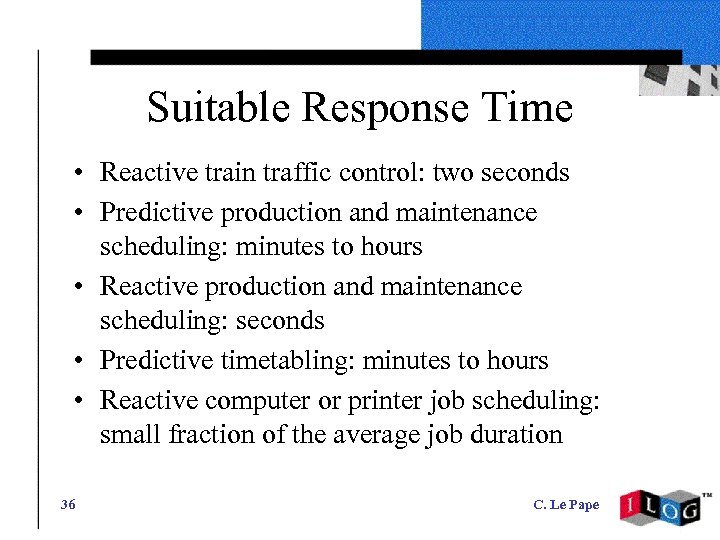 Suitable Response Time • Reactive train traffic control: two seconds • Predictive production and maintenance scheduling: minutes to hours • Reactive production and maintenance scheduling: seconds • Predictive timetabling: minutes to hours • Reactive computer or printer job scheduling: small fraction of the average job duration 36 C. Le Pape
 Outline • Constraint Programming • Constraint-Based Scheduling – Scheduling Problems – Propagation of Temporal Constraints – Propagation of Resource Constraints – Examples of Applications • Cooperative Problem-Solving 37 C. Le Pape
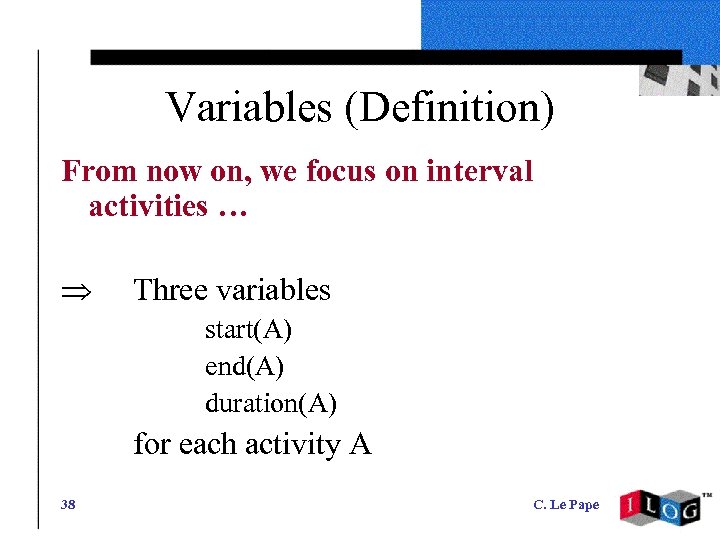 Variables (Definition) From now on, we focus on interval activities … Three variables start(A) end(A) duration(A) for each activity A 38 C. Le Pape
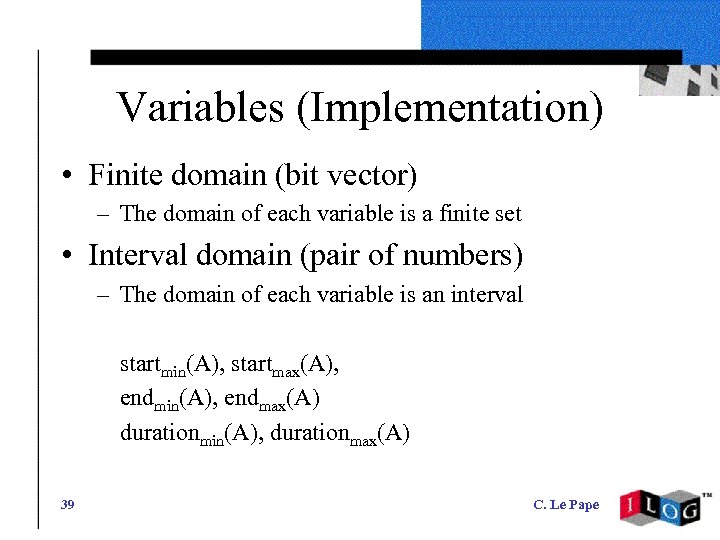 Variables (Implementation) • Finite domain (bit vector) – The domain of each variable is a finite set • Interval domain (pair of numbers) – The domain of each variable is an interval startmin(A), startmax(A), endmin(A), endmax(A) durationmin(A), durationmax(A) 39 C. Le Pape
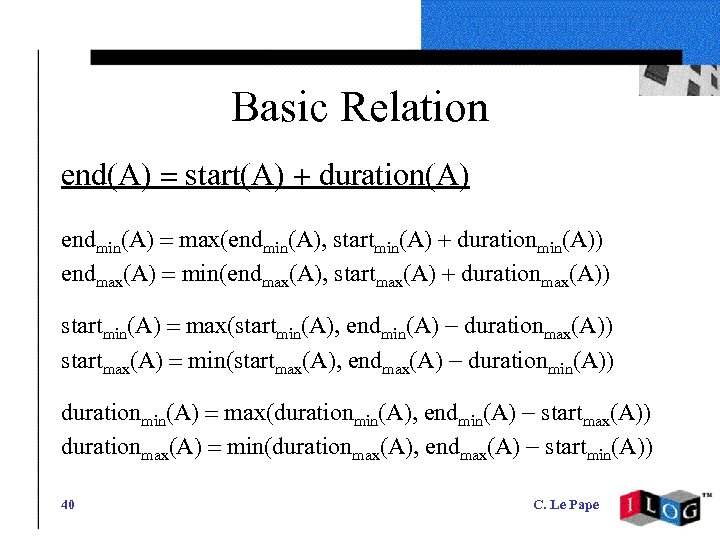 Basic Relation end(A) = start(A) + duration(A) endmin(A) = max(endmin(A), startmin(A) + durationmin(A)) endmax(A) = min(endmax(A), startmax(A) + durationmax(A)) startmin(A) = max(startmin(A), endmin(A) - durationmax(A)) startmax(A) = min(startmax(A), endmax(A) - durationmin(A)) durationmin(A) = max(durationmin(A), endmin(A) - startmax(A)) durationmax(A) = min(durationmax(A), endmax(A) - startmin(A)) 40 C. Le Pape
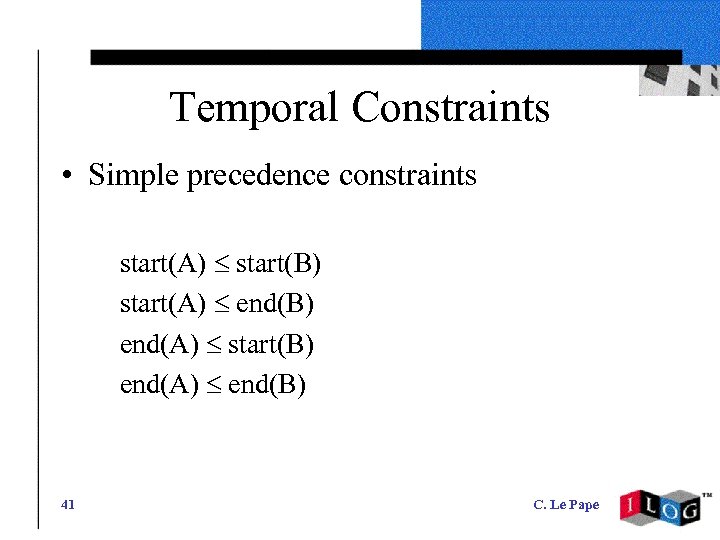 Temporal Constraints • Simple precedence constraints start(A) £ start(B) start(A) £ end(B) end(A) £ start(B) end(A) £ end(B) 41 C. Le Pape
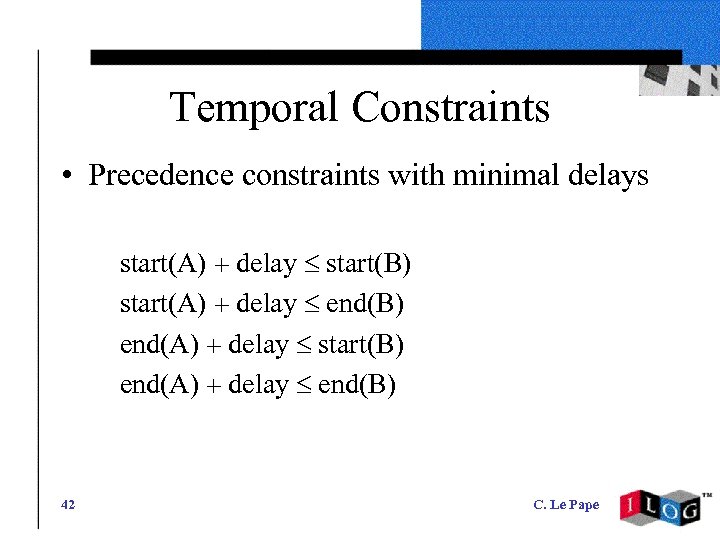 Temporal Constraints • Precedence constraints with minimal delays start(A) + delay £ start(B) start(A) + delay £ end(B) end(A) + delay £ start(B) end(A) + delay £ end(B) 42 C. Le Pape
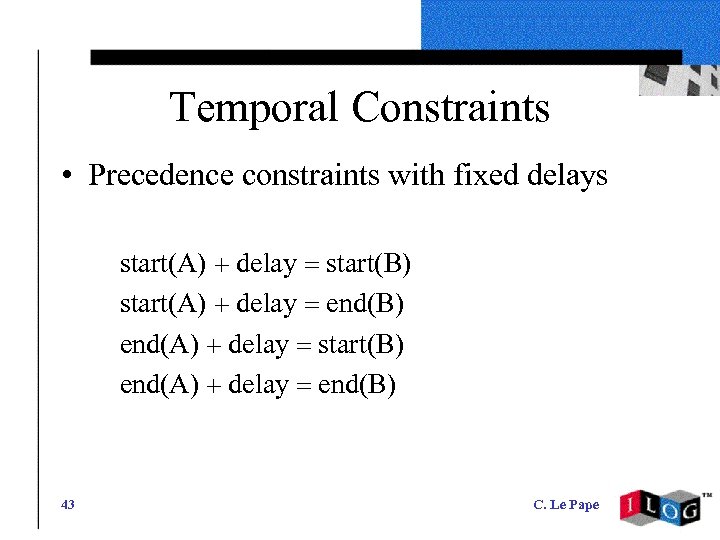 Temporal Constraints • Precedence constraints with fixed delays start(A) + delay = start(B) start(A) + delay = end(B) end(A) + delay = start(B) end(A) + delay = end(B) 43 C. Le Pape
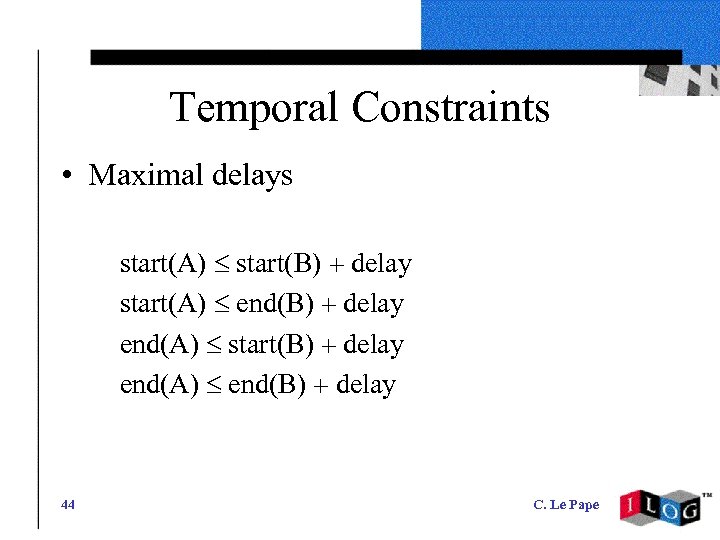 Temporal Constraints • Maximal delays start(A) £ start(B) + delay start(A) £ end(B) + delay end(A) £ start(B) + delay end(A) £ end(B) + delay 44 C. Le Pape
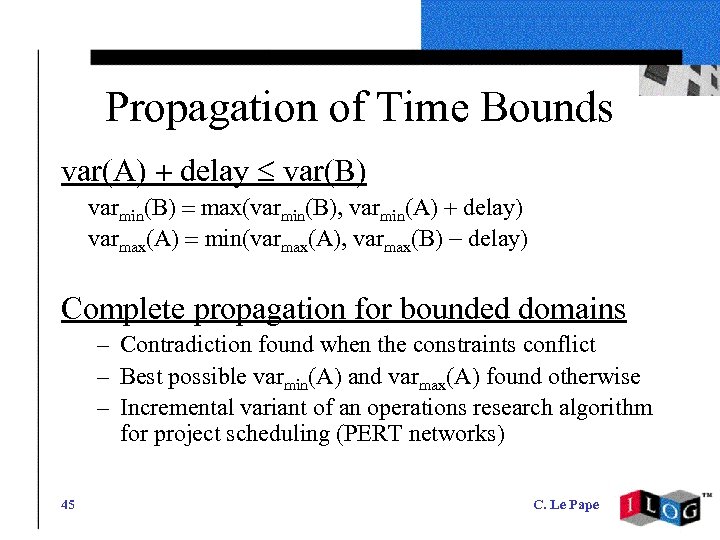 Propagation of Time Bounds var(A) + delay £ var(B) varmin(B) = max(varmin(B), varmin(A) + delay) varmax(A) = min(varmax(A), varmax(B) - delay) Complete propagation for bounded domains – Contradiction found when the constraints conflict – Best possible varmin(A) and varmax(A) found otherwise – Incremental variant of an operations research algorithm for project scheduling (PERT networks) 45 C. Le Pape
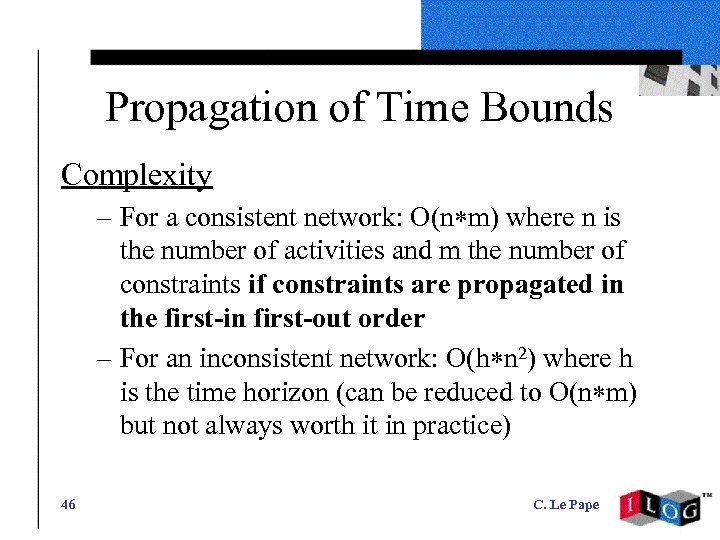 Propagation of Time Bounds Complexity – For a consistent network: O(n*m) where n is the number of activities and m the number of constraints if constraints are propagated in the first-in first-out order – For an inconsistent network: O(h*n 2) where h is the time horizon (can be reduced to O(n*m) but not always worth it in practice) 46 C. Le Pape
![Minimal and Maximal Distances • [x + dxy £ y] and [y + dyz](https://present5.com/presentation/049502eedc6f11c9092c5314b9beeb3c/image-47.jpg "Minimal and Maximal Distances • [x + dxy £ y] and [y + dyz") Minimal and Maximal Distances • [x + dxy £ y] and [y + dyz £ z] implies [x + (dxy + dyz) £ z] • Useful to solve disjunctions of temporal constraints [x - 5 £ y] [y + 2 £ z] [z + 4 £ x] OR [v + 3 £ w] 47 C. Le Pape
Minimal and Maximal Distances • [x + dxy £ y] and [y + dyz £ z] implies [x + (dxy + dyz) £ z] • Useful to solve disjunctions of temporal constraints [x - 5 £ y] [y + 2 £ z] [z + 4 £ x] OR [v + 3 £ w] 47 C. Le Pape
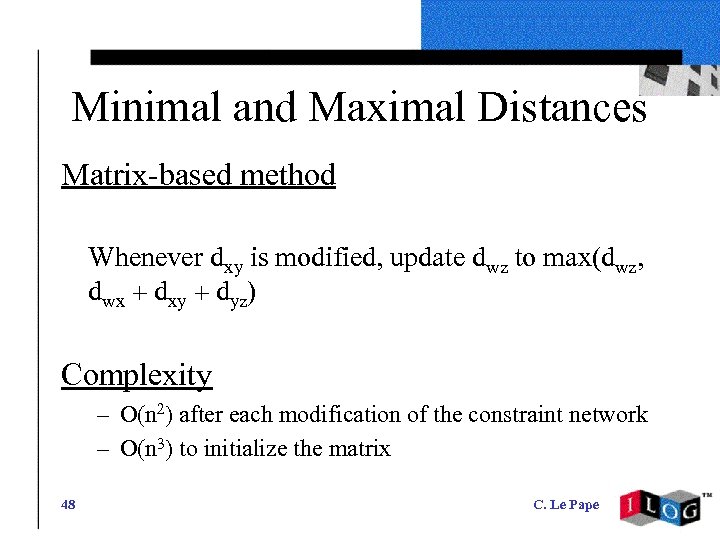 Minimal and Maximal Distances Matrix-based method Whenever dxy is modified, update dwz to max(dwz, dwx + dxy + dyz) Complexity – O(n 2) after each modification of the constraint network – O(n 3) to initialize the matrix 48 C. Le Pape
 Outline • Constraint Programming • Constraint-Based Scheduling – Scheduling Problems – Propagation of Temporal Constraints – Propagation of Resource Constraints – Examples of Applications • Cooperative Problem-Solving 49 C. Le Pape
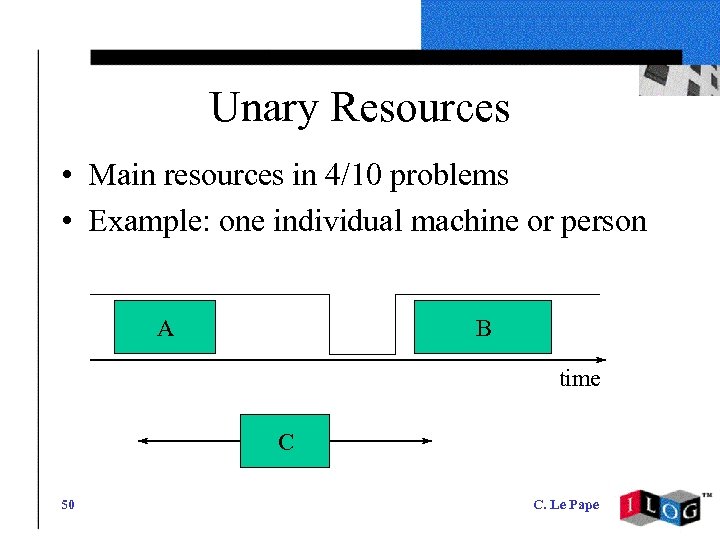 Unary Resources • Main resources in 4/10 problems • Example: one individual machine or person A B time C 50 C. Le Pape
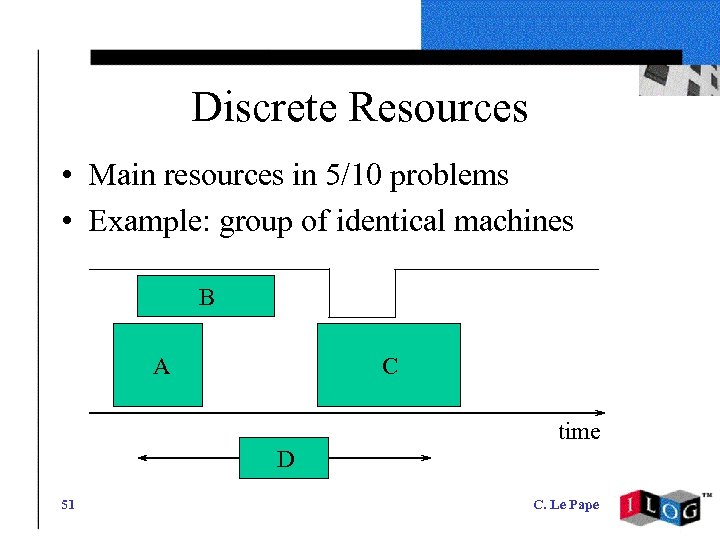 Discrete Resources • Main resources in 5/10 problems • Example: group of identical machines B A C time D 51 C. Le Pape
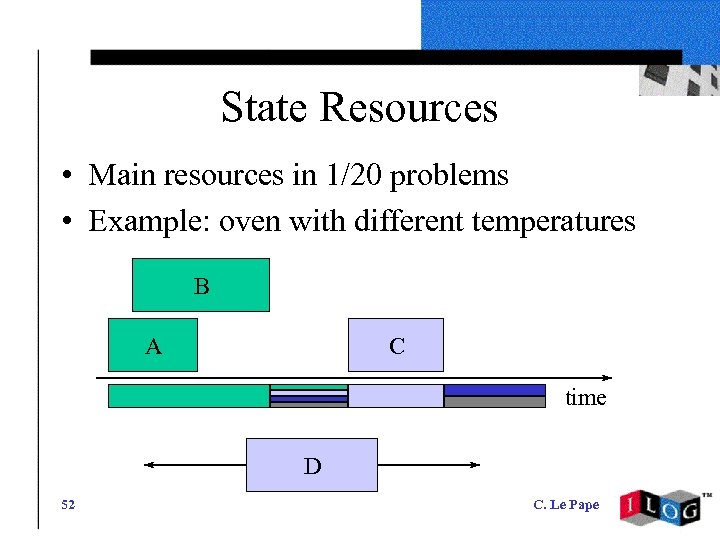 State Resources • Main resources in 1/20 problems • Example: oven with different temperatures B A C time D 52 C. Le Pape
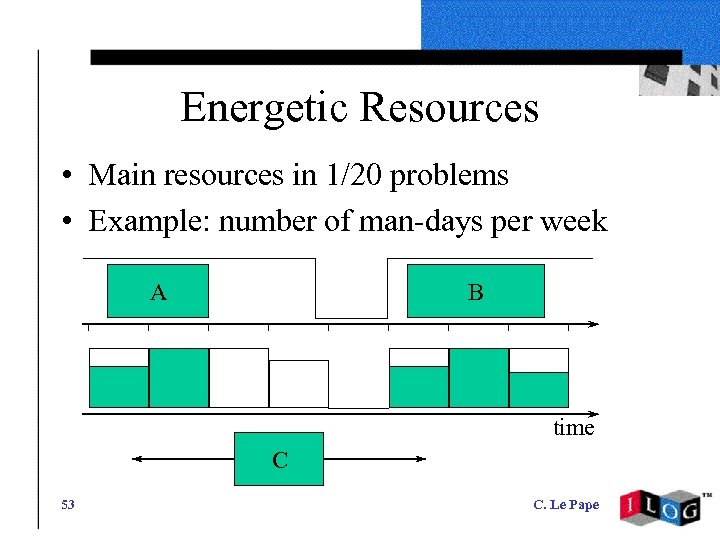 Energetic Resources • Main resources in 1/20 problems • Example: number of man-days per week A B time C 53 C. Le Pape
 Constraint Propagation Models • • 54 Explicit time-tables Disjunctive constraints Energetic reasoning Edge finding (task intervals) C. Le Pape
![Explicit Time-Tables (UD) • WA(t) = [start(A) £ t < end(A)] •](https://present5.com/presentation/049502eedc6f11c9092c5314b9beeb3c/image-55.jpg "Explicit Time-Tables (UD) • WA(t) = [start(A) £ t < end(A)] •") Explicit Time-Tables (UD) • WA(t) = [start(A) £ t < end(A)] • "t, SA [WA(t) * capacity(A)] £ capacity(t) A C B time C 55 C. Le Pape
Explicit Time-Tables (UD) • WA(t) = [start(A) £ t < end(A)] • "t, SA [WA(t) * capacity(A)] £ capacity(t) A C B time C 55 C. Le Pape
![Explicit Time-Tables (S) • WA(t) = [start(A) £ t < end(A)] •](https://present5.com/presentation/049502eedc6f11c9092c5314b9beeb3c/image-56.jpg "Explicit Time-Tables (S) • WA(t) = [start(A) £ t < end(A)] •") Explicit Time-Tables (S) • WA(t) = [start(A) £ t < end(A)] • "t, WA(t) implies [state(A) = state(t)] B D A C time D 56 C. Le Pape
Explicit Time-Tables (S) • WA(t) = [start(A) £ t < end(A)] • "t, WA(t) implies [state(A) = state(t)] B D A C time D 56 C. Le Pape
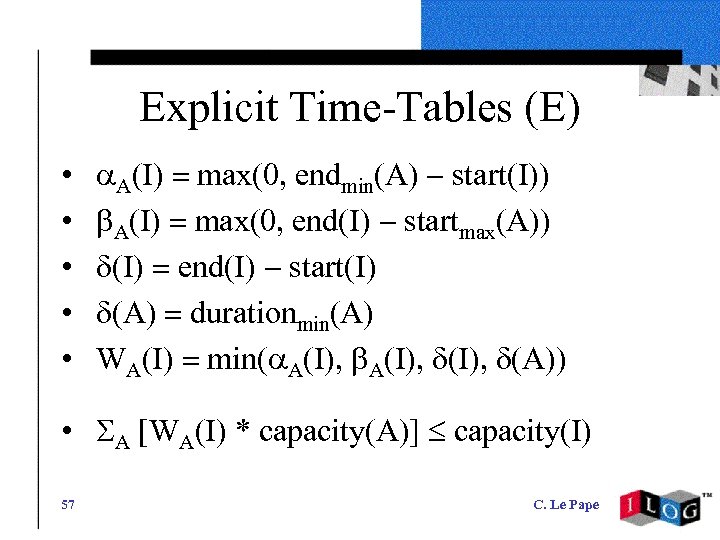 Explicit Time-Tables (E) • • • a. A(I) = max(0, endmin(A) - start(I)) b. A(I) = max(0, end(I) - startmax(A)) d(I) = end(I) - start(I) d(A) = durationmin(A) WA(I) = min(a. A(I), b. A(I), d(A)) • SA [WA(I) * capacity(A)] £ capacity(I) 57 C. Le Pape
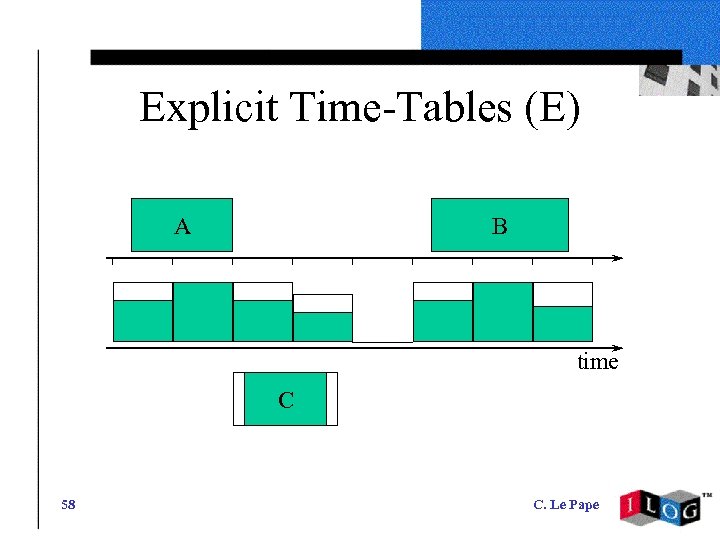 Explicit Time-Tables (E) A B time C 58 C. Le Pape
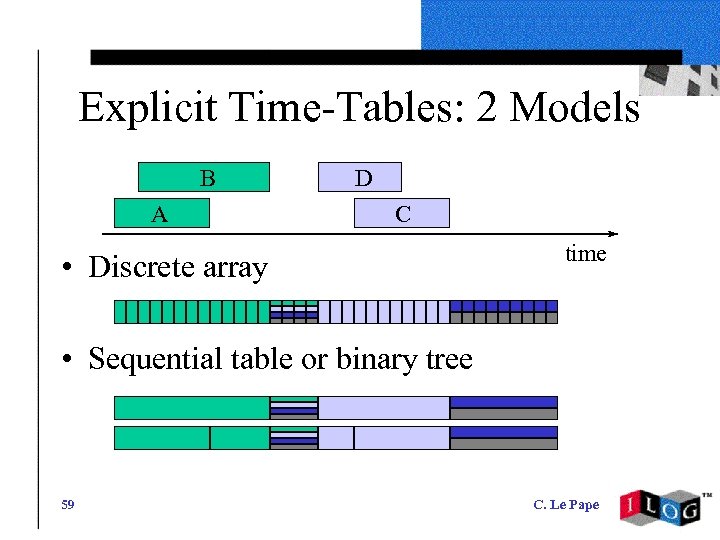 Explicit Time-Tables: 2 Models B A D C • Discrete array time • Sequential table or binary tree 59 C. Le Pape
 Explicit Time-Tables: Extensions • Minimal capacity constraints (UDE) • Default state (S) • Constraints between time-tables or between time-tables and other variables (UDES) 60 C. Le Pape
![Disjunctive Constraints (U) • [end(A) £ start(B)] OR [end(B) £ start(A)] • • 61](https://present5.com/presentation/049502eedc6f11c9092c5314b9beeb3c/image-61.jpg "Disjunctive Constraints (U) • [end(A) £ start(B)] OR [end(B) £ start(A)] • • 61") Disjunctive Constraints (U) • [end(A) £ start(B)] OR [end(B) £ start(A)] • • 61 [endmin(A) > startmax(B)] implies [end(B) £ start(A)] [endmin(B) > startmax(A)] implies [end(A) £ start(B)] C. Le Pape
Disjunctive Constraints (U) • [end(A) £ start(B)] OR [end(B) £ start(A)] • • 61 [endmin(A) > startmax(B)] implies [end(B) £ start(A)] [endmin(B) > startmax(A)] implies [end(A) £ start(B)] C. Le Pape
 Disjunctive Constraints (U) • Optional activities – Resource alternatives – Sub-contracts • Transition times – Tool setups – Color changes – Cleaning 62 C. Le Pape
![Disjunctive Constraints (U) • 63 [end(A) + ttime(A, B) £ start(B)] OR [end(B) +](https://present5.com/presentation/049502eedc6f11c9092c5314b9beeb3c/image-63.jpg "Disjunctive Constraints (U) • 63 [end(A) + ttime(A, B) £ start(B)] OR [end(B) +") Disjunctive Constraints (U) • 63 [end(A) + ttime(A, B) £ start(B)] OR [end(B) + ttime(B, A) £ start(A)] OR [duration(A) = 0] OR [duration(B) = 0] OR [capacity(A) = 0] OR [capacity(B) = 0] C. Le Pape
Disjunctive Constraints (U) • 63 [end(A) + ttime(A, B) £ start(B)] OR [end(B) + ttime(B, A) £ start(A)] OR [duration(A) = 0] OR [duration(B) = 0] OR [capacity(A) = 0] OR [capacity(B) = 0] C. Le Pape
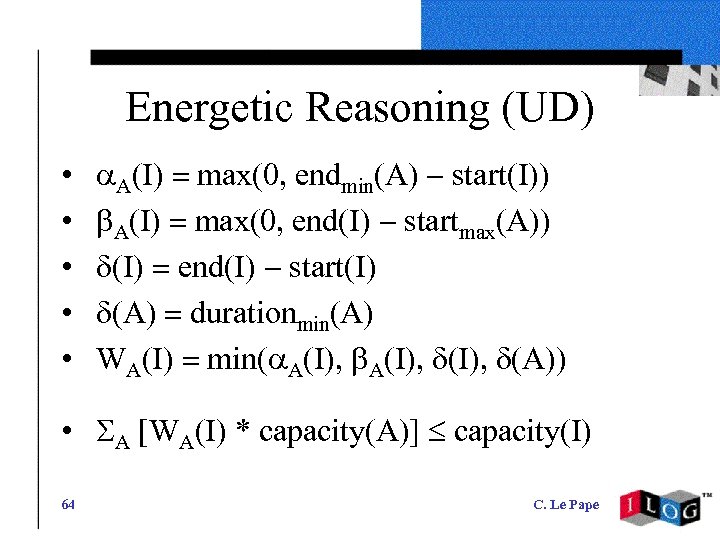 Energetic Reasoning (UD) • • • a. A(I) = max(0, endmin(A) - start(I)) b. A(I) = max(0, end(I) - startmax(A)) d(I) = end(I) - start(I) d(A) = durationmin(A) WA(I) = min(a. A(I), b. A(I), d(A)) • SA [WA(I) * capacity(A)] £ capacity(I) 64 C. Le Pape
![Energetic Reasoning (UD) • Habographs [Beck 92] – Intervals: [id. . jd) or [b](https://present5.com/presentation/049502eedc6f11c9092c5314b9beeb3c/image-65.jpg "Energetic Reasoning (UD) • Habographs [Beck 92] – Intervals: [id. . jd) or [b") Energetic Reasoning (UD) • Habographs [Beck 92] – Intervals: [id. . jd) or [b + id. . b + jd) • Energetic resources [Le Pape 94] – Intervals: [id. . (i+1)d) or [b + id. . b + (i+1)d) • Energetic reasoning rules [Lopez 91] – Intervals: [startmin(A). . endmax(B)) or [startmin(A). . x) 65 C. Le Pape
Energetic Reasoning (UD) • Habographs [Beck 92] – Intervals: [id. . jd) or [b + id. . b + jd) • Energetic resources [Le Pape 94] – Intervals: [id. . (i+1)d) or [b + id. . b + (i+1)d) • Energetic reasoning rules [Lopez 91] – Intervals: [startmin(A). . endmax(B)) or [startmin(A). . x) 65 C. Le Pape
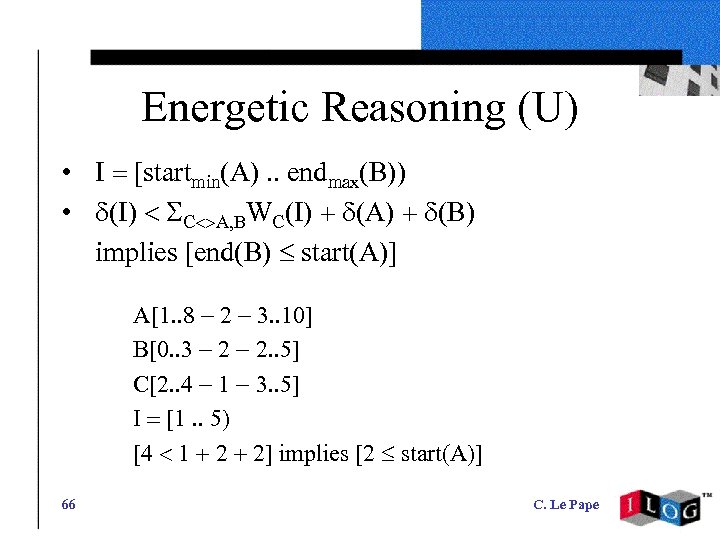 Energetic Reasoning (U) • I = [startmin(A). . endmax(B)) • d(I) < SC<>A, BWC(I) + d(A) + d(B) implies [end(B) £ start(A)] A[1. . 8 - 2 - 3. . 10] B[0. . 3 - 2. . 5] C[2. . 4 - 1 - 3. . 5] I = [1. . 5) [4 < 1 + 2] implies [2 £ start(A)] 66 C. Le Pape
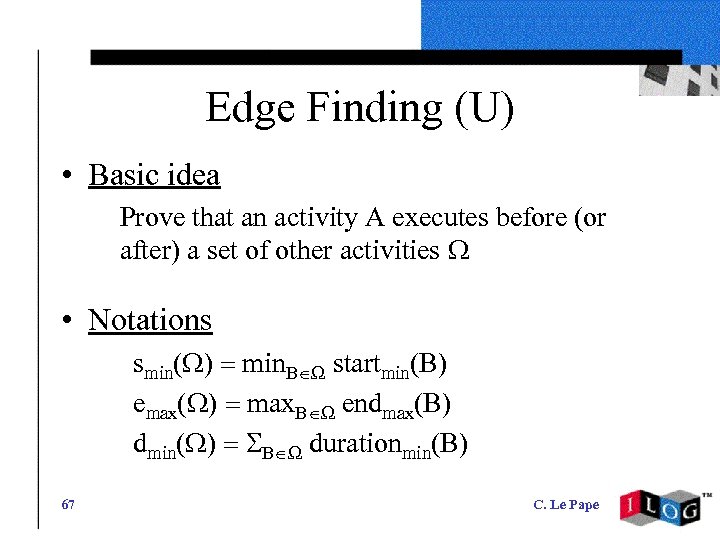 Edge Finding (U) • Basic idea Prove that an activity A executes before (or after) a set of other activities W • Notations smin(W) = min. BÎW startmin(B) emax(W) = max. BÎW endmax(B) dmin(W) = SBÎW durationmin(B) 67 C. Le Pape
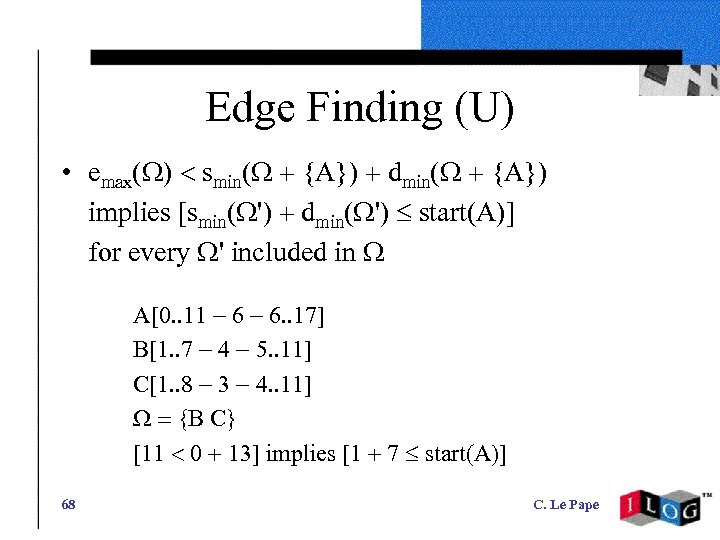 Edge Finding (U) • emax(W) < smin(W + {A}) + dmin(W + {A}) implies [smin(W') + dmin(W') £ start(A)] for every W' included in W A[0. . 11 - 6. . 17] B[1. . 7 - 4 - 5. . 11] C[1. . 8 - 3 - 4. . 11] W = {B C} [11 < 0 + 13] implies [1 + 7 £ start(A)] 68 C. Le Pape
![Edge Finding (U) • Jackson's Preemptive Schedule [Pinson 88] [Carlier & Pinson 90/94] –](https://present5.com/presentation/049502eedc6f11c9092c5314b9beeb3c/image-69.jpg "Edge Finding (U) • Jackson's Preemptive Schedule [Pinson 88] [Carlier & Pinson 90/94] –") Edge Finding (U) • Jackson's Preemptive Schedule [Pinson 88] [Carlier & Pinson 90/94] – O(n 2) O(n*log(n)) • Iterative algorithm [Nuijten 94] – O(n 2) with no specific data structure • Task intervals [Caseau & Laburthe 94] – O(n 3) – Incremental – More deductions è more precise time-bounds 69 C. Le Pape
Edge Finding (U) • Jackson's Preemptive Schedule [Pinson 88] [Carlier & Pinson 90/94] – O(n 2) O(n*log(n)) • Iterative algorithm [Nuijten 94] – O(n 2) with no specific data structure • Task intervals [Caseau & Laburthe 94] – O(n 3) – Incremental – More deductions è more precise time-bounds 69 C. Le Pape
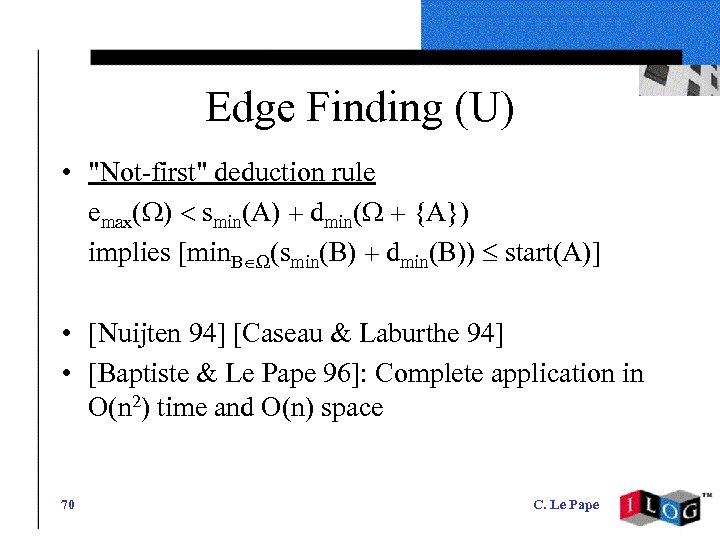 Edge Finding (U) • "Not-first" deduction rule emax(W) < smin(A) + dmin(W + {A}) implies [min. BÎW(smin(B) + dmin(B)) £ start(A)] • [Nuijten 94] [Caseau & Laburthe 94] • [Baptiste & Le Pape 96]: Complete application in O(n 2) time and O(n) space 70 C. Le Pape
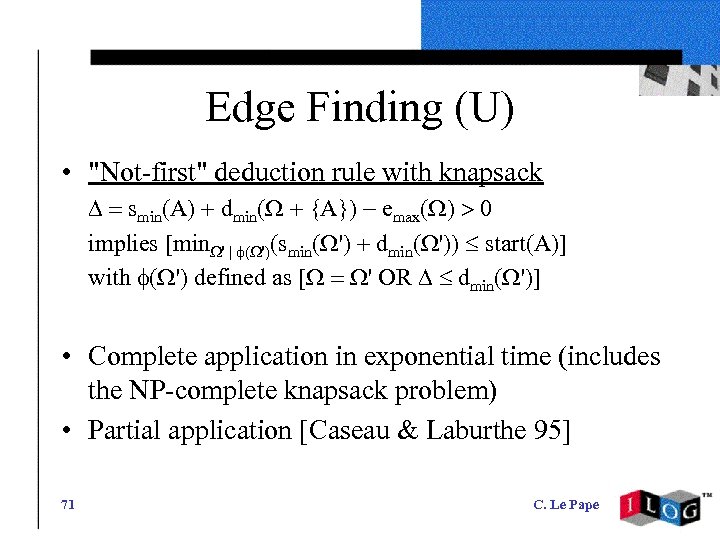 Edge Finding (U) • "Not-first" deduction rule with knapsack D = smin(A) + dmin(W + {A}) - emax(W) > 0 implies [min. W' | f(W')(smin(W') + dmin(W')) £ start(A)] with f(W') defined as [W = W' OR D £ dmin(W')] • Complete application in exponential time (includes the NP-complete knapsack problem) • Partial application [Caseau & Laburthe 95] 71 C. Le Pape
 Comparison • Theoretical results – Unique fix point semantics – Modeling power – Time and space complexity – Pruning power • Experimental results 72 C. Le Pape
 Outline • Constraint Programming • Constraint-Based Scheduling – Scheduling Problems – Propagation of Temporal Constraints – Propagation of Resource Constraints – Examples of Applications • Cooperative Problem-Solving 73 C. Le Pape
 MSS: Problem Definition (1) Molding Shop Scheduling • 2 types of cast-iron (standard and special) • For each cast-iron type: – available quantity every hour • 3 molding machines • For each machine: – shifts – breaks (lunch, maintenance) – periods during which the machine can manufacture only some types of parts 74 C. Le Pape
 MSS: Problem Definition (2) • 30 types of parts • For each part type: – cast-iron type – one or more possible machines • For each (part, machine) pair: – – – 75 production speed cast-iron consumption minimal and maximal batch size maximal break duration (one break per batch allowed) minimal production time before and after the break C. Le Pape
 MSS: Problem Definition (3) • 200 orders for parts • For each order: – part type – number of parts – due-date • Optimization criterion – relaxation of due-dates – closer due-dates are more important than further due-dates 76 C. Le Pape
 MSS: Problem Representation (1) • Part type = Discrete resource – Produced by activities – Due-dates è minimal production constraints • Machine = State resource – Part type produced at time t = state at time t – Default state 0 out of shifts and during breaks • Cast-iron type = Energetic resource 77 C. Le Pape
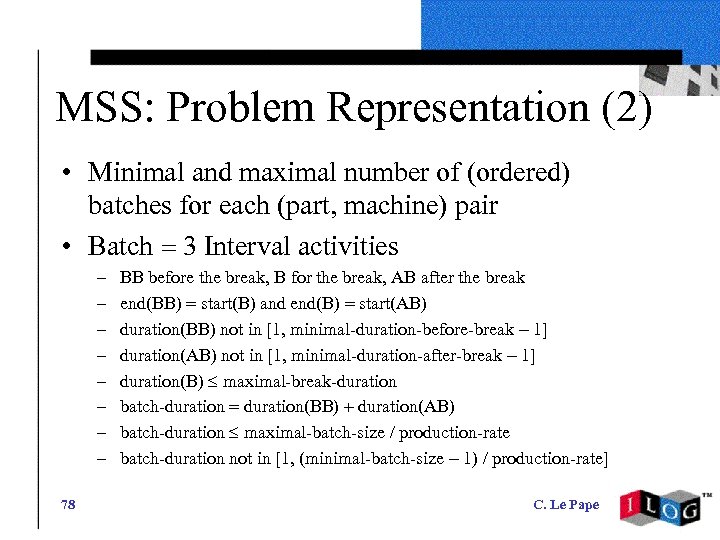 MSS: Problem Representation (2) • Minimal and maximal number of (ordered) batches for each (part, machine) pair • Batch = 3 Interval activities – – – – 78 BB before the break, B for the break, AB after the break end(BB) = start(B) and end(B) = start(AB) duration(BB) not in [1, minimal-duration-before-break - 1] duration(AB) not in [1, minimal-duration-after-break - 1] duration(B) £ maximal-break-duration batch-duration = duration(BB) + duration(AB) batch-duration £ maximal-batch-size / production-rate batch-duration not in [1, (minimal-batch-size - 1) / production-rate] C. Le Pape
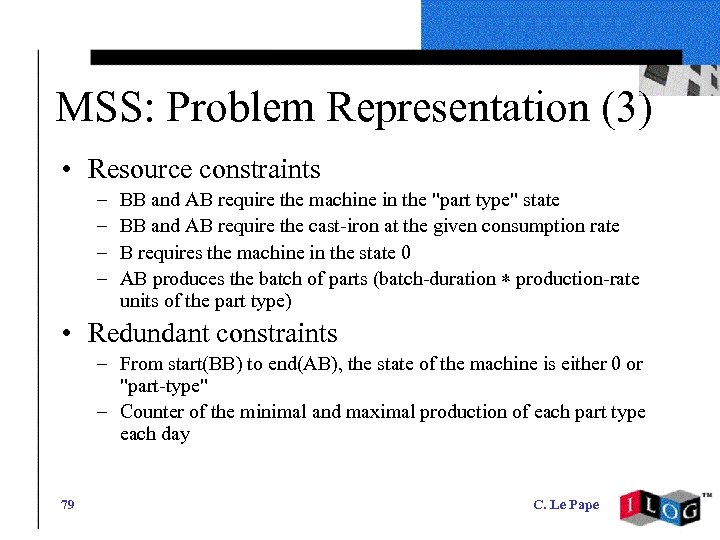 MSS: Problem Representation (3) • Resource constraints – – BB and AB require the machine in the "part type" state BB and AB require the cast-iron at the given consumption rate B requires the machine in the state 0 AB produces the batch of parts (batch-duration * production-rate units of the part type) • Redundant constraints – From start(BB) to end(AB), the state of the machine is either 0 or "part-type" – Counter of the minimal and maximal production of each part type each day 79 C. Le Pape
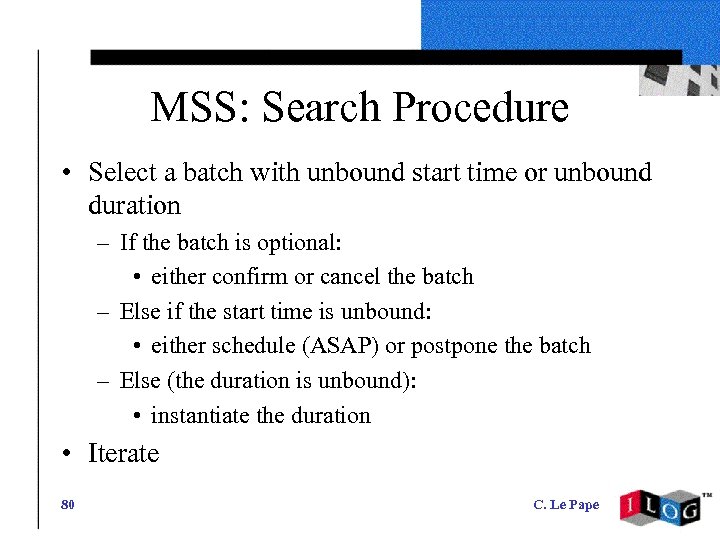 MSS: Search Procedure • Select a batch with unbound start time or unbound duration – If the batch is optional: • either confirm or cancel the batch – Else if the start time is unbound: • either schedule (ASAP) or postpone the batch – Else (the duration is unbound): • instantiate the duration • Iterate 80 C. Le Pape
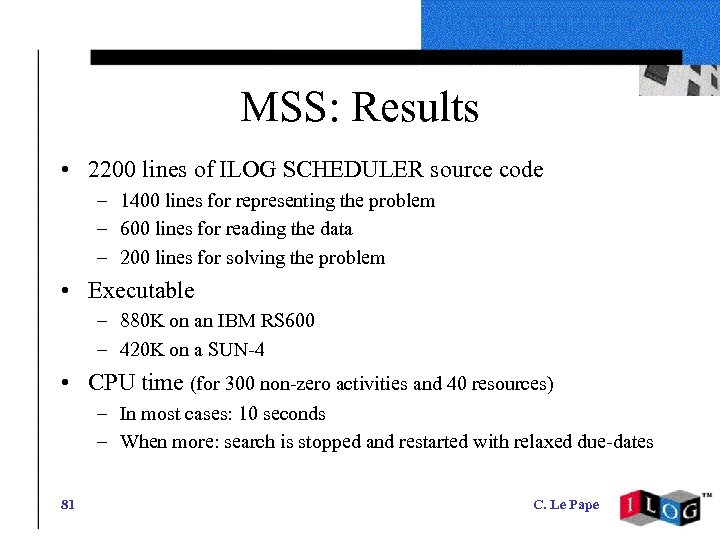 MSS: Results • 2200 lines of ILOG SCHEDULER source code – 1400 lines for representing the problem – 600 lines for reading the data – 200 lines for solving the problem • Executable – 880 K on an IBM RS 600 – 420 K on a SUN-4 • CPU time (for 300 non-zero activities and 40 resources) – In most cases: 10 seconds – When more: search is stopped and restarted with relaxed due-dates 81 C. Le Pape
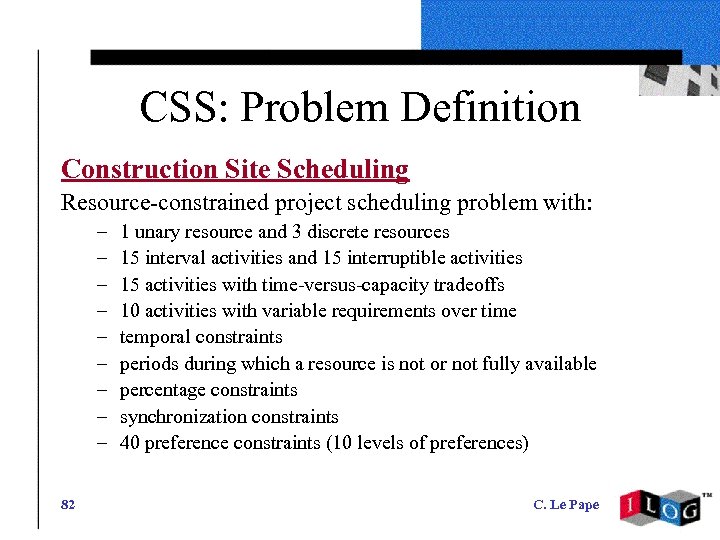 CSS: Problem Definition Construction Site Scheduling Resource-constrained project scheduling problem with: – – – – – 82 1 unary resource and 3 discrete resources 15 interval activities and 15 interruptible activities 15 activities with time-versus-capacity tradeoffs 10 activities with variable requirements over time temporal constraints periods during which a resource is not or not fully available percentage constraints synchronization constraints 40 preference constraints (10 levels of preferences) C. Le Pape
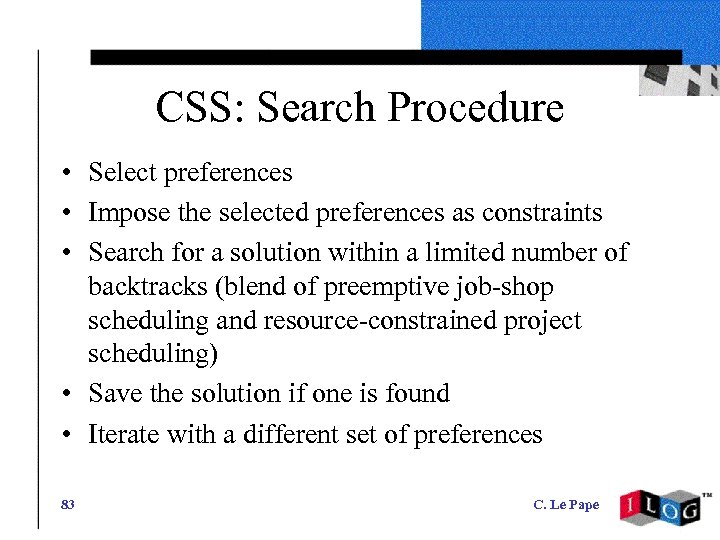 CSS: Search Procedure • Select preferences • Impose the selected preferences as constraints • Search for a solution within a limited number of backtracks (blend of preemptive job-shop scheduling and resource-constrained project scheduling) • Save the solution if one is found • Iterate with a different set of preferences 83 C. Le Pape
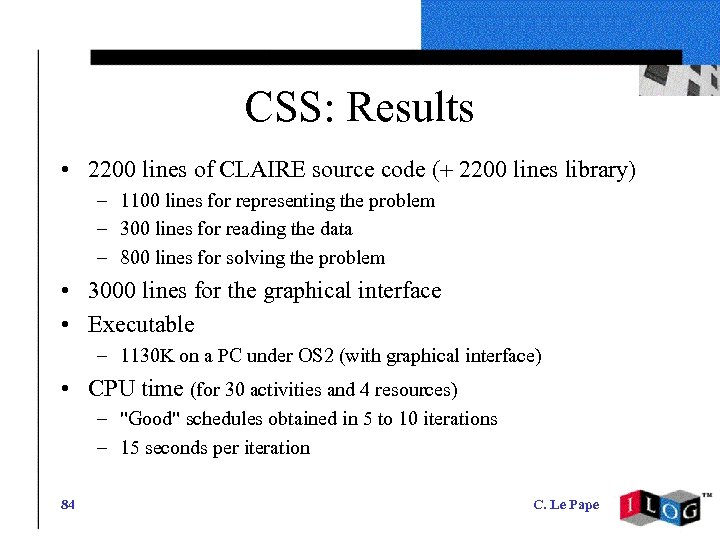 CSS: Results • 2200 lines of CLAIRE source code (+ 2200 lines library) – 1100 lines for representing the problem – 300 lines for reading the data – 800 lines for solving the problem • 3000 lines for the graphical interface • Executable – 1130 K on a PC under OS 2 (with graphical interface) • CPU time (for 30 activities and 4 resources) – "Good" schedules obtained in 5 to 10 iterations – 15 seconds per iteration 84 C. Le Pape
 Outline • Constraint Programming • Constraint-Based Scheduling • Cooperative Problem-Solving 85 C. Le Pape
 Outline • Constraint Programming • Constraint-Based Scheduling • Cooperative Problem-Solving – Introduction – Problem Decomposition – Constraint Propagation – Search 86 C. Le Pape
 Problem Solving • Two main other classes of techniques – Linear Programming and Mixed Integer Programming – Local Search 87 C. Le Pape
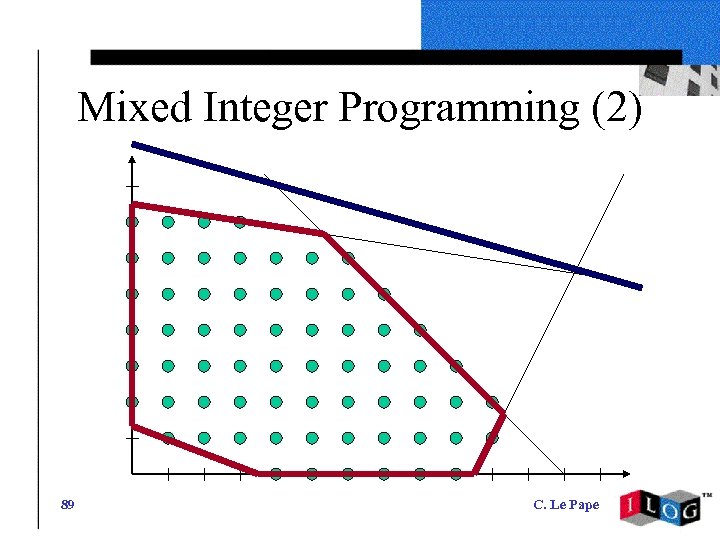
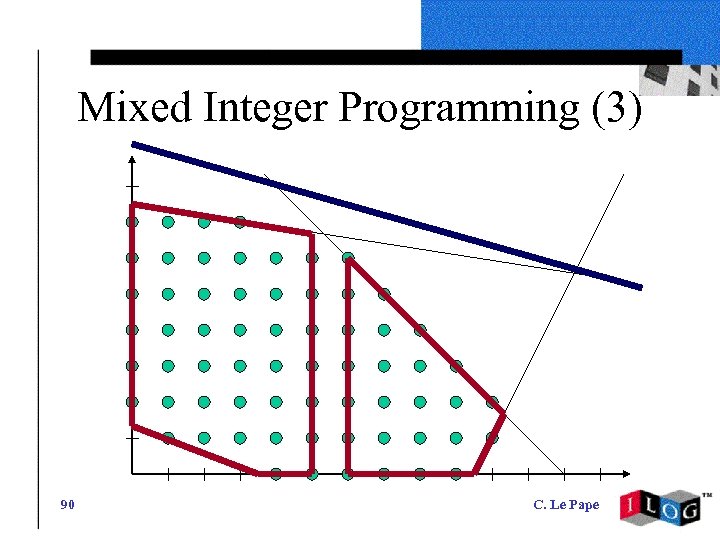
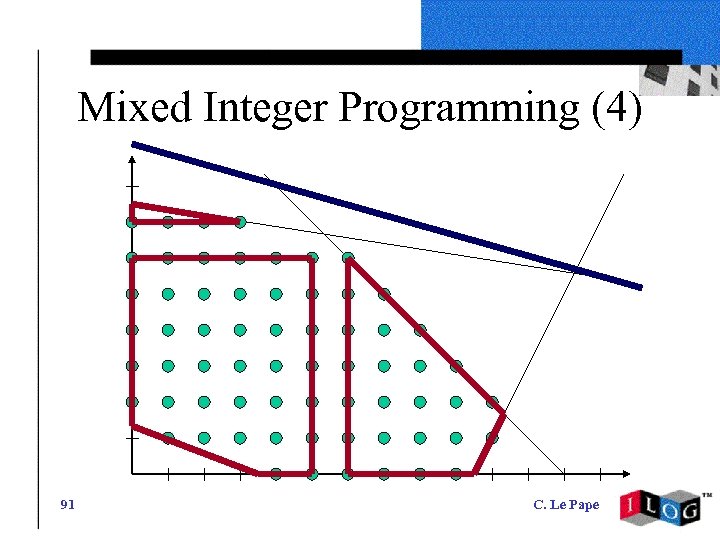
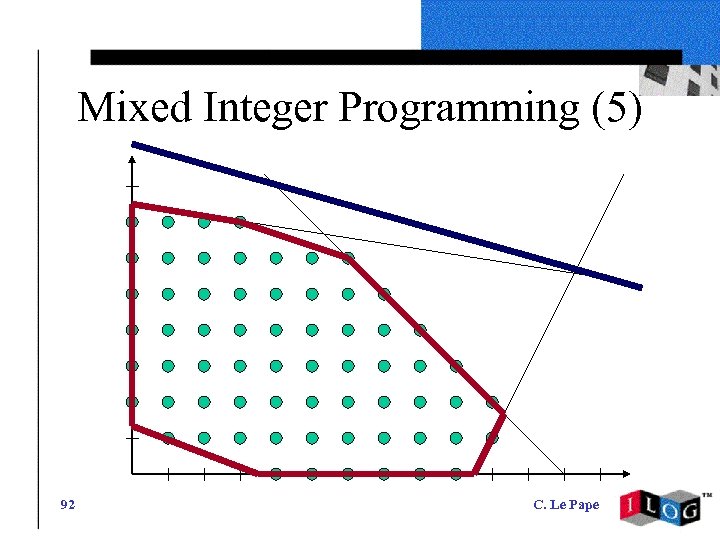
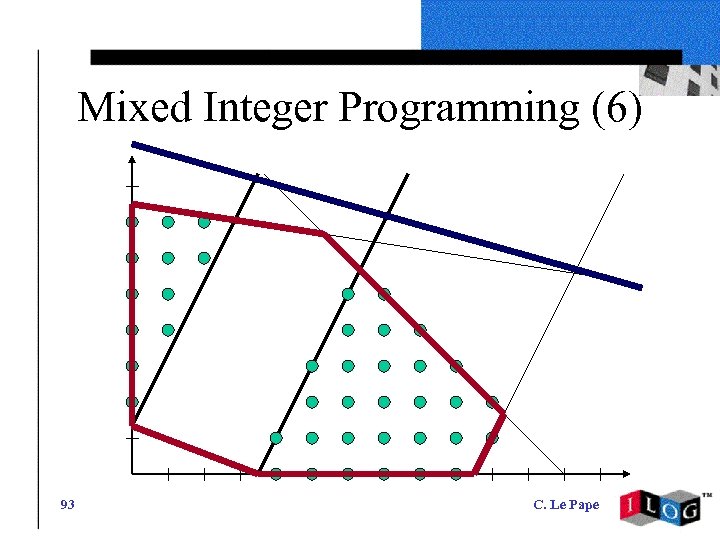
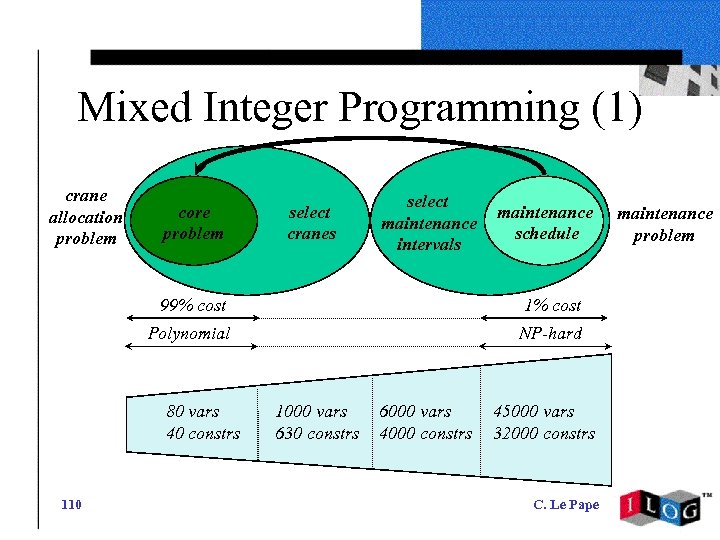
 Mixed Integer Programming (1) • Explicit problem definition – Linear constraints – Real (floating point) and integer variables – One optimization criterion • Separation between problem definition and problem solving • The continuous relaxation (when fractional values are allowed for integer variables) is solvable in polynomial time Ø Bound on optimization criterion Ø Guidance for solving the MIP problem by branch-and-bound (rounding, cuts, …) 88 C. Le Pape
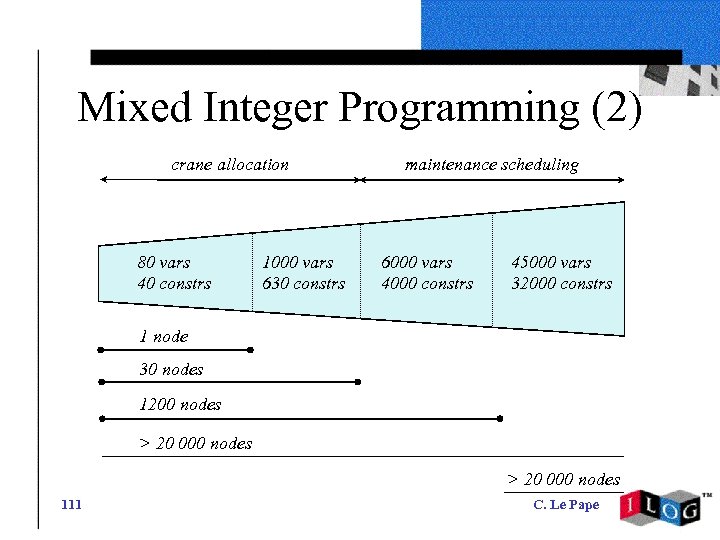
 Mixed Integer Programming (2) 89 C. Le Pape
 Mixed Integer Programming (3) 90 C. Le Pape
 Mixed Integer Programming (4) 91 C. Le Pape
 Mixed Integer Programming (5) 92 C. Le Pape
 Mixed Integer Programming (6) 93 C. Le Pape
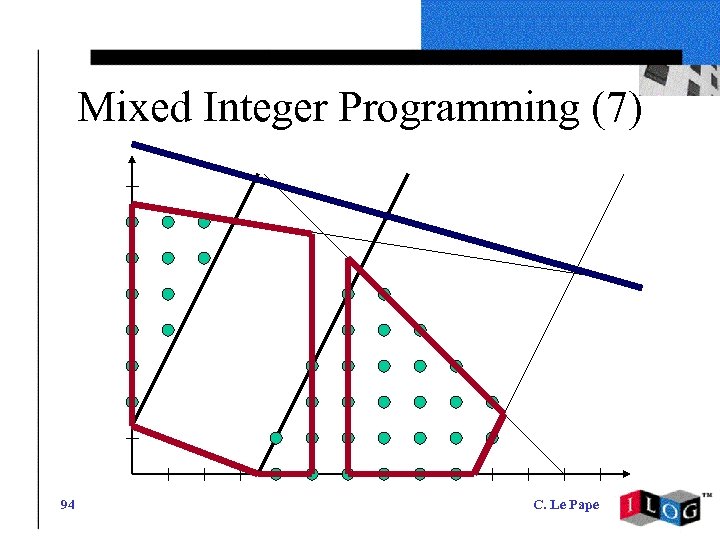 Mixed Integer Programming (7) 94 C. Le Pape
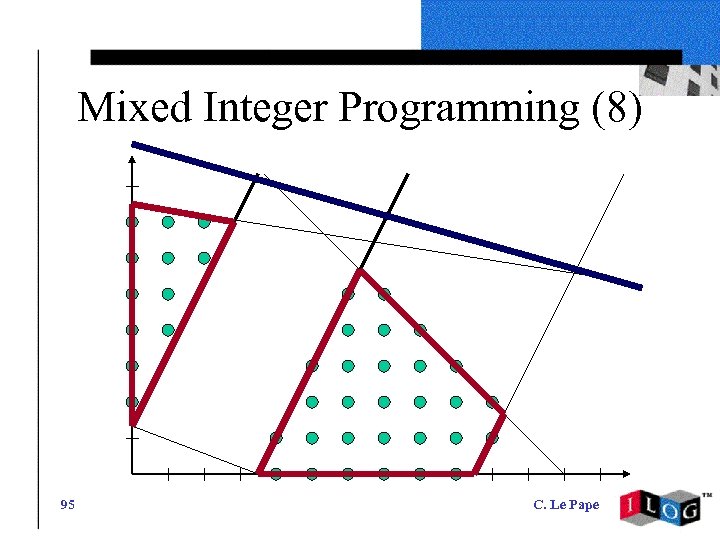 Mixed Integer Programming (8) 95 C. Le Pape
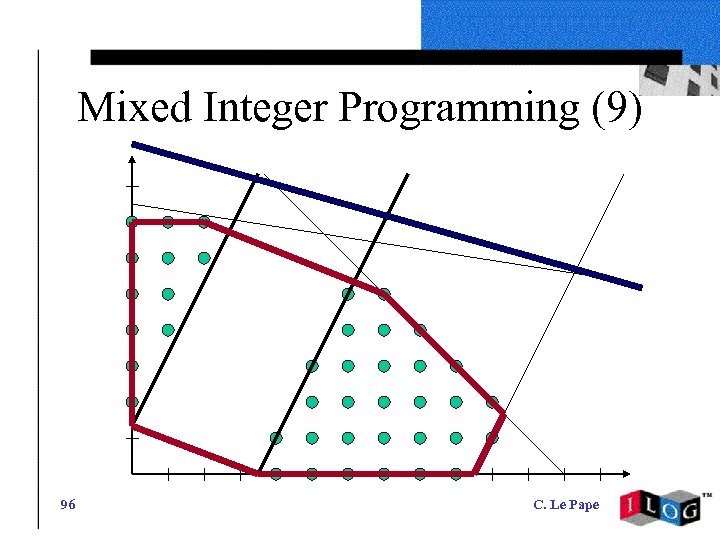 Mixed Integer Programming (9) 96 C. Le Pape
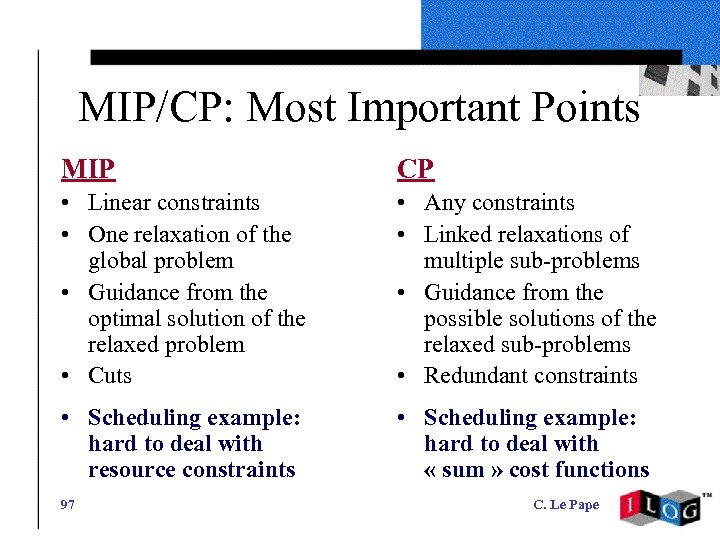 MIP/CP: Most Important Points MIP CP • Linear constraints • One relaxation of the global problem • Guidance from the optimal solution of the relaxed problem • Cuts • Any constraints • Linked relaxations of multiple sub-problems • Guidance from the possible solutions of the relaxed sub-problems • Redundant constraints • Scheduling example: hard to deal with resource constraints • Scheduling example: hard to deal with « sum » cost functions 97 C. Le Pape
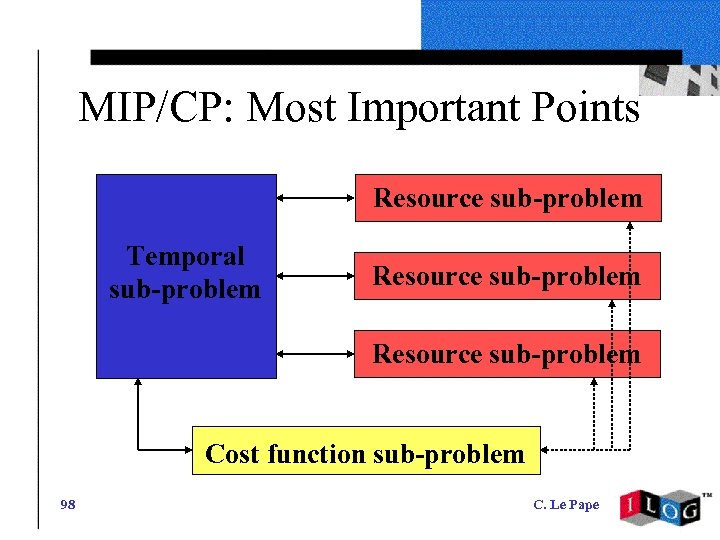 MIP/CP: Most Important Points Resource sub-problem Temporal sub-problem Resource sub-problem Cost function sub-problem 98 C. Le Pape
 Local Search • Operators to move from solutions to other (neighbor) solutions (or from populations of solutions to populations of solutions) • Search control strategy (meta-heuristic) • Many different types: simulated annealing, tabu search, genetic algorithms, … 99 C. Le Pape
 Main Issues (1) • Mixed Integer Programming – Is the continuous relaxation a good approximation of the convex envelope of the solutions? – Can the formulation of the problem be iteratively modified to make the optimal solution of the continuous relaxation converge toward the optimal solution of the initial problem? 100 C. Le Pape
 Main Issues (2) • Constraint Programming – Are the critical constraints propagating well? – Is a tight bound on the optimization criterion efficiently translated (by propagation) into constraints that effectively guide the search toward a solution? 101 C. Le Pape
 Main Issues (3) • Local Search – Is the neighborhood topology consistent with the optimization criterion? – Are the operators connecting (in a few steps) good solutions with better solutions, without downgrading the solution too much in intermediate steps? 102 C. Le Pape
 Outline • Constraint Programming • Constraint-Based Scheduling • Cooperative Problem-Solving – Introduction – Problem Decomposition – Constraint Propagation – Search 103 C. Le Pape
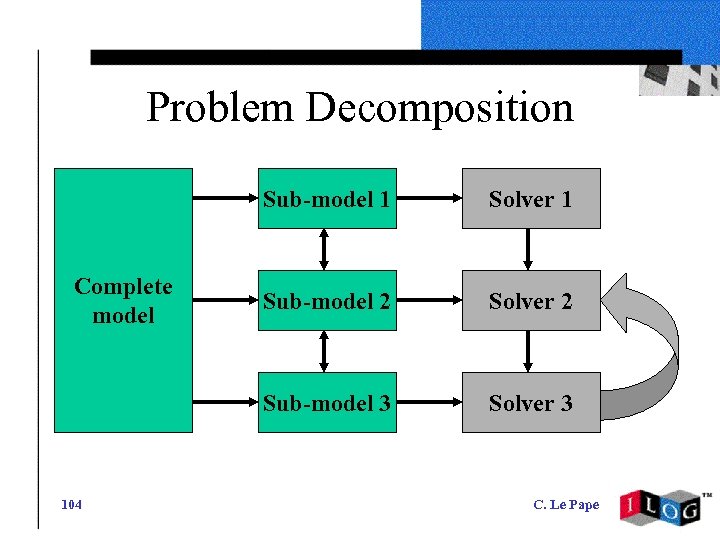 Problem Decomposition Sub-model 1 104 Sub-model 2 Solver 2 Sub-model 3 Complete model Solver 1 Solver 3 C. Le Pape
 Sequential Decomposition • Solve sub-problem 1 • Impose the solution of sub-problem 1 and solve sub-problem 2 • Infer characteristics of « good » solutions of sub-problem 1 • Iterate 105 C. Le Pape
 Column Generation • Generate candidate solution components • Find the optimal combination of these components • Infer characteristics of « good » solution components to add • Iterate 106 C. Le Pape
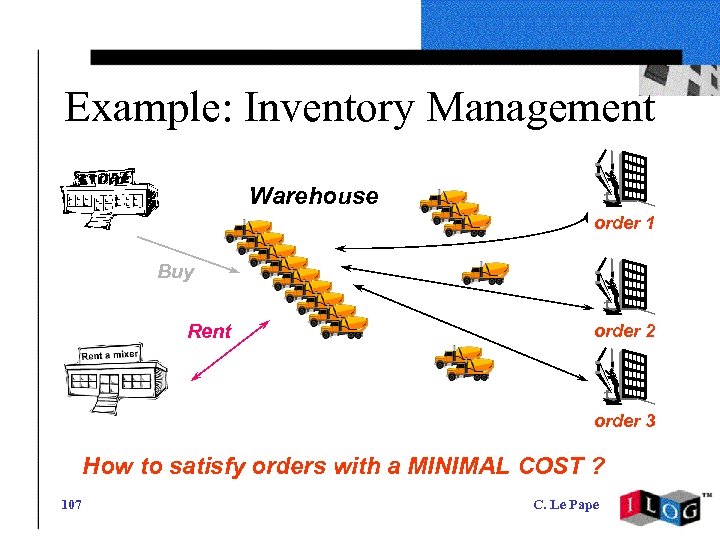 Example: Inventory Management Warehouse order 1 Buy Rent order 2 order 3 How to satisfy orders with a MINIMAL COST ? 107 C. Le Pape
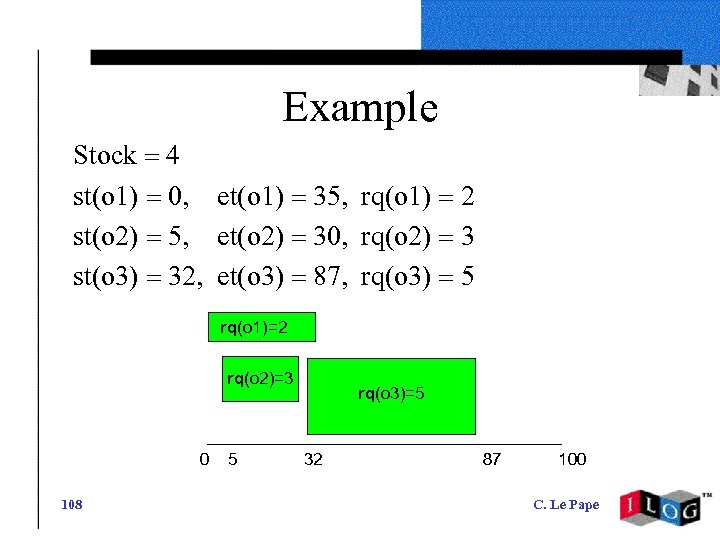 Example Stock = 4 st(o 1) = 0, et(o 1) = 35, rq(o 1) = 2 st(o 2) = 5, et(o 2) = 30, rq(o 2) = 3 st(o 3) = 32, et(o 3) = 87, rq(o 3) = 5 rq(o 1)=2 rq(o 2)=3 0 108 5 rq(o 3)=5 32 87 100 C. Le Pape
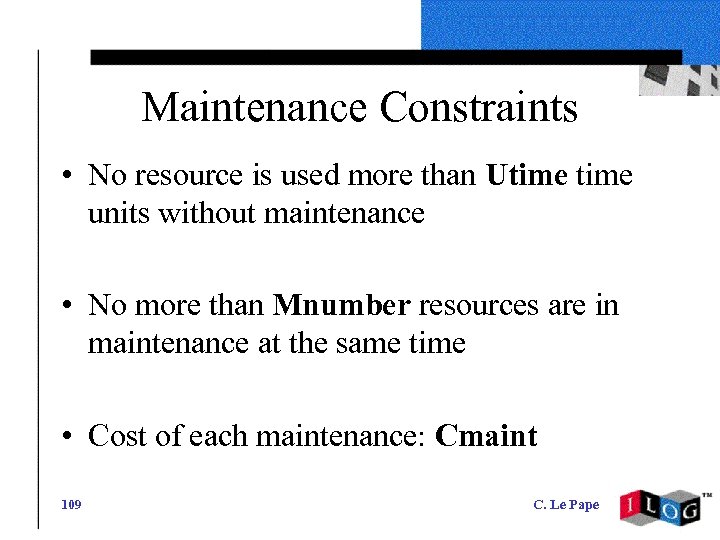 Maintenance Constraints • No resource is used more than Utime units without maintenance • No more than Mnumber resources are in maintenance at the same time • Cost of each maintenance: Cmaint 109 C. Le Pape
 Mixed Integer Programming (1) crane allocation problem core problem select cranes select maintenance intervals maintenance schedule 99% cost 1% cost Polynomial NP-hard 80 vars 40 constrs 110 1000 vars 630 constrs 6000 vars 4000 constrs 45000 vars 32000 constrs C. Le Pape maintenance problem
 Mixed Integer Programming (2) crane allocation 80 vars 40 constrs 1000 vars 630 constrs maintenance scheduling 6000 vars 4000 constrs 45000 vars 32000 constrs 1 node 30 nodes 1200 nodes > 20 000 nodes 111 C. Le Pape
 Hybrid Algorithms (1) LINEAR PROGRAMMING Solve the (core) resource allocation problem HEURISTIC ALGORITHM Select resource items for each order CONSTRAINT PROGRAMMING Solve the resulting maintenance scheduling problem On failure, tighten the resource allocation problem and iterate 112 C. Le Pape
 Hybrid Algorithms (2) Tightness of the crane allocation problem: • Extend the duration of all tasks (add the maintenance duration) • Extend the duration of the conflict task Tightness: Resource allocation cost: Maint. scheduling cost: dur(o) + 1*dur(m) dur(o) + 2*dur(m) dur(o) + 3*dur(m) dur(o) + 4*dur(m) 87 927 919 88 022 342 89 123 491 90 211 387 91 910 152 2501 Final result: 4. 5% above the lower bound 87 927 919 113 C. Le Pape
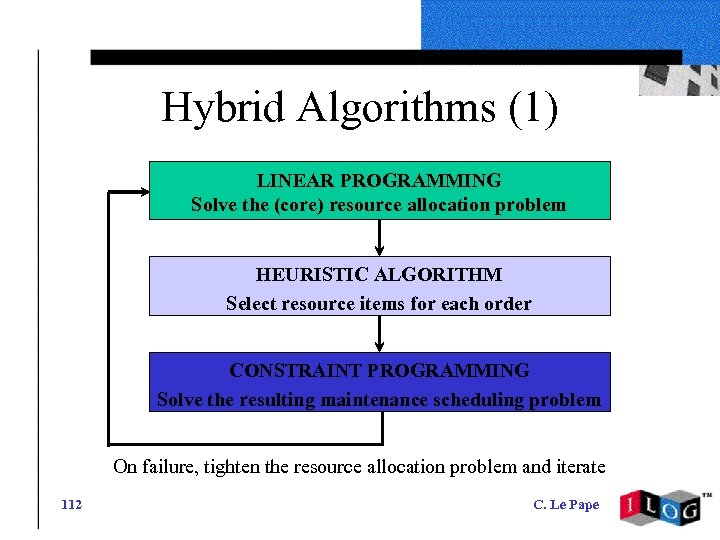
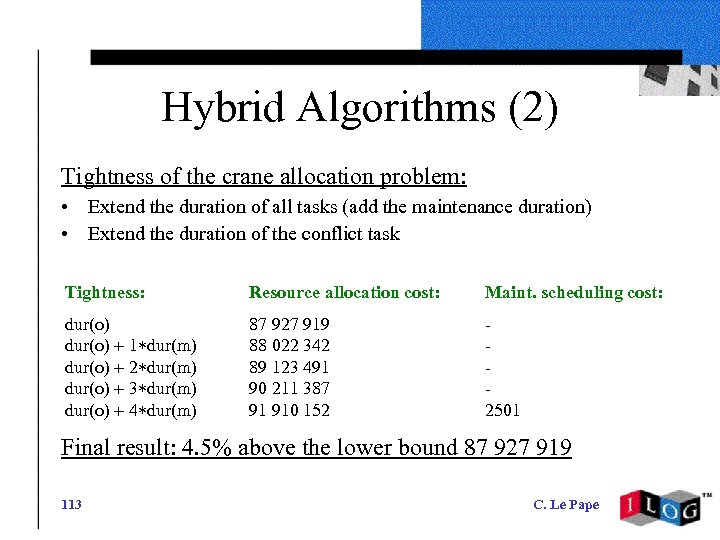
 Hybrid Algorithms (3) • Other hybrid algorithms, including column generation, provided « good » solutions • Some instances remain « hard » • Details available in [Caseau & Kökény 98, Baptiste et al. 98] 114 C. Le Pape
 Outline • Constraint Programming • Constraint-Based Scheduling • Cooperative Problem-Solving – Introduction – Problem Decomposition – Constraint Propagation – Search 115 C. Le Pape
 LP as a Global Constraint • Collection of linear constraints (general or of a particular form) treated as a global constraint – Detect conflicts – Find variables with fixed values – Find bounds of variables – Infer additional constraints (cuts) 116 C. Le Pape
 Objective Functions • Minimize COST = F(V 1, V 2, …, Vn) • Apply linear programming (or an operations research algorithm) to a relaxation of the problem – Global lower bound at the root of the search tree – Lower bound LB at each node of the search tree – Characteristics of solutions with COST < LB + D inferred from the optimal solution of the relaxed problem and « reduced costs » 117 C. Le Pape
 Outline • Constraint Programming • Constraint-Based Scheduling • Cooperative Problem-Solving – Introduction – Problem Decomposition – Constraint Propagation – Search 118 C. Le Pape
 Example: Vehicle Routing • Efficient local search algorithms – No specific constraint – Incremental computation of tour length and cost from a solution to its neighbors • Constraint programming for specific constraints – Use constraints to test and reject « bad » neighbors – Enlarge the neighborhood if there is no valid neighbor – Find the valid neighbor with the smallest cost • References – [Pesant & Gendreau 96, Shaw 98, Kilby, Prosser & Shaw 00] – [Caseau & Laburthe 99, Caseau et al. 01] 119 C. Le Pape
 Examples: Scheduling • Forget and extend – Random fragments [Baptiste, Le Pape & Nuijten 95, Nuijten & Le Pape 98] – Chosen fragments [Caseau et al. 01] • Minimal perturbation – [El Sakkout & Wallace 00] 120 C. Le Pape
 Conclusion (1) • Already a significant number of applications • Credo: hybrid problem-solving techniques will enable the resolution of problems that are still open today – More efficient exact resolution – Better lower and upper bounds in given CPU time – More robust algorithms 121 C. Le Pape
 Conclusion (2) • Main difficulties – Identification of promising combinations of techniques – Implementation and test of several of these combinations • Guidelines and tools are needed – Modeling – Combination of sub-models – Testing and interpretation of test results 122 C. Le Pape
 References (1) Disclaimer: not (at all) a complete bibliography! • • • 123 K. R. Baker. Introduction to Sequencing and Scheduling. John Wiley and Sons, 1974. Ph. Baptiste, C. Le Pape and W. Nuijten. Constraint-Based Optimization and Approximation for Job Shop Scheduling. IJCAI'95 Workshop on Intelligent Manufacturing Systems, 1995. Ph. Baptiste and C. Le Pape. Edge-Finding Constraint Propagation Algorithms for Disjunctive and Cumulative Scheduling. 15 th Workshop of the U. K. Planning Special Interest Group, 1996. Ph. Baptiste, Y. Caseau, T. Kökény, C. Le Pape and R. Rodosek. Creating and Evaluating Hybrid Algorithms for Inventory Management Problems. 4 th National Meeting on Practical Approaches to NP‑Complete Problems, 1998. H. Beck. Constraint Monitoring in TOSCA. AAAI Spring Symposium on Practical Approaches to Planning and Scheduling, 1992. C. Le Pape
 References (2) • • • 124 J. Carlier and E. Pinson. A Practical Use of Jackson's Preemptive Schedule for Solving the Job-Shop Problem. Annals of Operations Research, 26: 269 -287, 1990. J. Carlier and E. Pinson. Adjustment of Heads and Tails for the Job-Shop Problem. European Journal of Operational Research, 78(2): 146 -161, 1994. Y Caseau and F. Laburthe. Improved CLP Scheduling with Task Intervals. 11 th International Conference on Logic Programming, 1994. Y. Caseau and F. Laburthe. Disjunctive Scheduling with Task Intervals. Technical Report, Ecole Normale Supérieure, 1995. Y. Caseau and T. Kökény. An Inventory Management Problem. Constraints, 3(4): 363 -373, 1998. Y. Caseau and F. Laburthe. Heuristics for Large Constrained Vehicle Routing Problems. Journal of Heuristics, 5: 281 -303, 1999. C. Le Pape
 References (3) • • • 125 Y. Caseau, F. Laburthe, C. Le Pape and B. Rottembourg. Combining Local and Global Search in a Constraint Programming Environment. Knowledge Engineering Review, to appear. H. El Sakkout and M. Wallace. Probe Backtrack Search for Minimal Perturbation in Dynamic Scheduling. Constraints, 5(4): 359 -388, 2000. P. Kilby, P. Prosser and P. Shaw. A Comparison of Traditional and Constraint-based Heuristic Methods on Vehicle Routing Problems with Side Constraints, 5(4): 389 -414, 2000. C. Le Pape. Implementation of Resource Constraints in ILOG SCHEDULE: A Library for the Development of Constraint‑Based Scheduling Systems. Intelligent Systems Engineering, 3(2): 55 -66, 1994. P. Lopez. Approche énergétique pour l'ordonnancement de tâches sous contraintes de temps et de ressources. Thèse de l'Université Paul Sabatier, 1991. C. Le Pape
 References (4) • • • 126 W. Nuijten. Time and Resource Constrained Scheduling: A Constraint Satisfaction Approach. Ph. D Thesis, Eindhoven University of Technology, 1994. W. Nuijten and C. Le Pape. Constraint-Based Job Shop Scheduling with ILOG Scheduler. Journal of Heuristics, 3: 271 -286, 1998. G. Pesant and M. Gendreau. A View of Local Search in Constraint Programming. 2 nd International Conference on Principles and Practice of Constraint Programming, 1996. E. Pinson. Le problème de job-shop. Thèse de l'Université Paris VI, 1988. P. Shaw. Using Constraint Programming and Local Search Methods to Solve Vehicle Routing Problems. 4 th International Conference on Principles and Practice of Constraint Programming, 1998. C. Le Pape