


 Скачать презентацию Constitution of Pylyp Orlyk 1710 Pacts and
Constitution of Pylyp Orlyk.pptx
- Количество слайдов: 9
 Constitution of Pylyp Orlyk 1710
 Pacts and Constitutions of Rights and Freedoms of the Zaporizhian Host It established a democratic standard for the separation of powers in government between the legislative, executive, and judiciary branches, well before the publication of Montesquieu's Spirit of the Laws. The Constitution limited the executive authority of the hetman, and established a democratically elected Cossack parliament called the General Council.
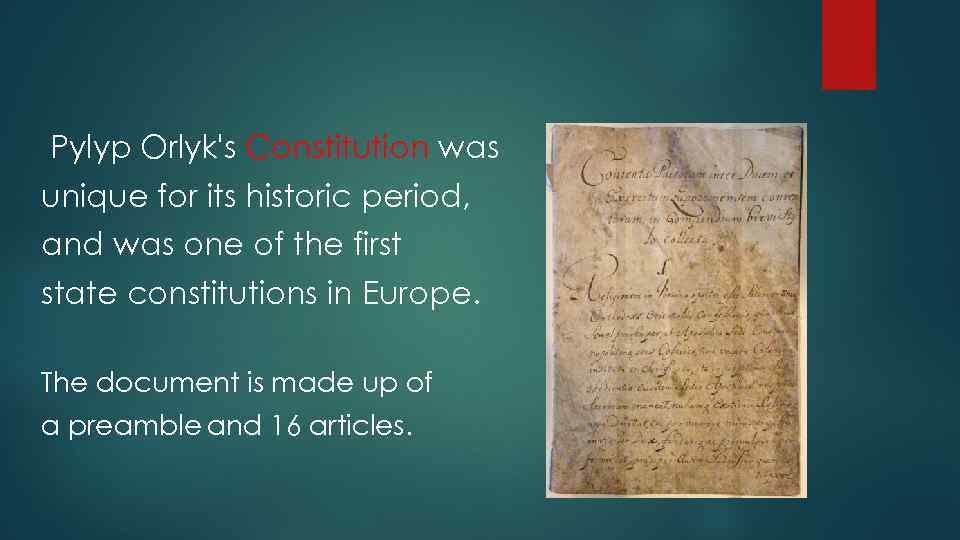 Pylyp Orlyk's Constitution was unique for its historic period, and was one of the first state constitutions in Europe. The document is made up of a preamble and 16 articles.
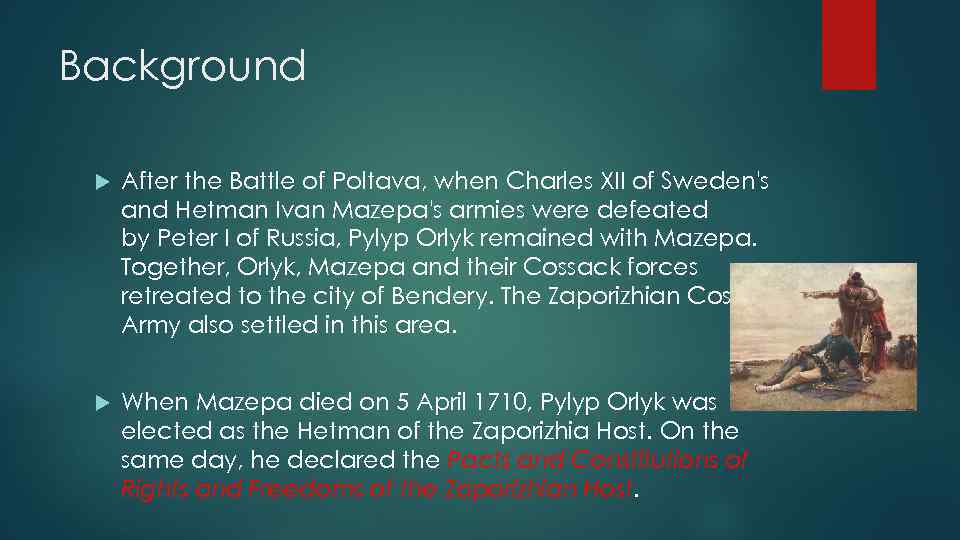 Background After the Battle of Poltava, when Charles XII of Sweden's and Hetman Ivan Mazepa's armies were defeated by Peter I of Russia, Pylyp Orlyk remained with Mazepa. Together, Orlyk, Mazepa and their Cossack forces retreated to the city of Bendery. The Zaporizhian Cossack Army also settled in this area. When Mazepa died on 5 April 1710, Pylyp Orlyk was elected as the Hetman of the Zaporizhia Host. On the same day, he declared the Pacts and Constitutions of Rights and Freedoms of the Zaporizhian Host.
 Articles of Constitution Preamble - The preamble briefly discusses Cossack history, their Khazar origin, the rise of the Zaporizhian Sich and its downfall when after under Bohdan Khmelnytsky it rebelled against the Polish-Lithuanian Commonwealth and ended up serving Imperial Russia. - According to the introduction, Moscow limited and nullified rights and freedoms of the Zaporizhian Host and eventually subjugated the free Cossack nation.
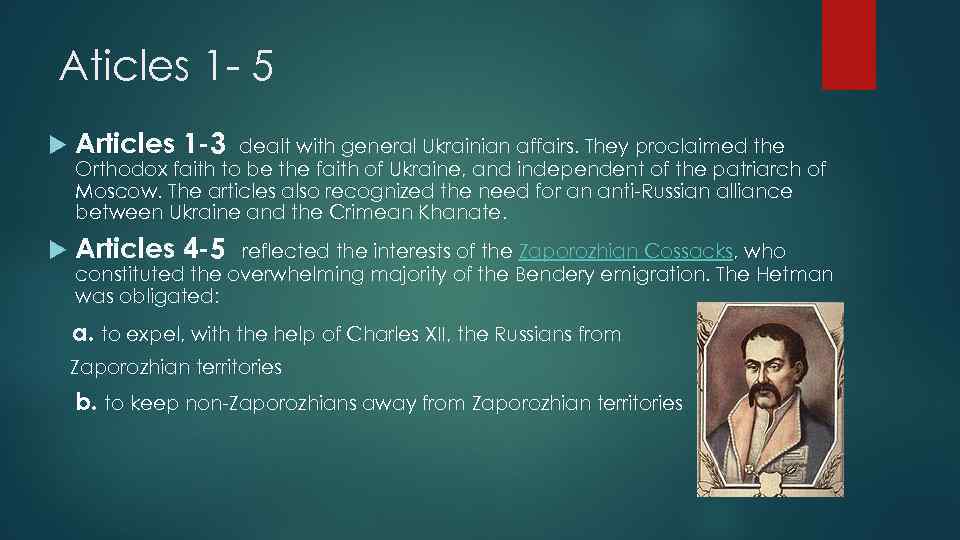 Aticles 1 - 5 Articles 1 -3 dealt with general Ukrainian affairs. They proclaimed the Articles 4 -5 Orthodox faith to be the faith of Ukraine, and independent of the patriarch of Moscow. The articles also recognized the need for an anti-Russian alliance between Ukraine and the Crimean Khanate. reflected the interests of the Zaporozhian Cossacks, who constituted the overwhelming majority of the Bendery emigration. The Hetman was obligated: a. to expel, with the help of Charles XII, the Russians from Zaporozhian territories b. to keep non-Zaporozhians away from Zaporozhian territories
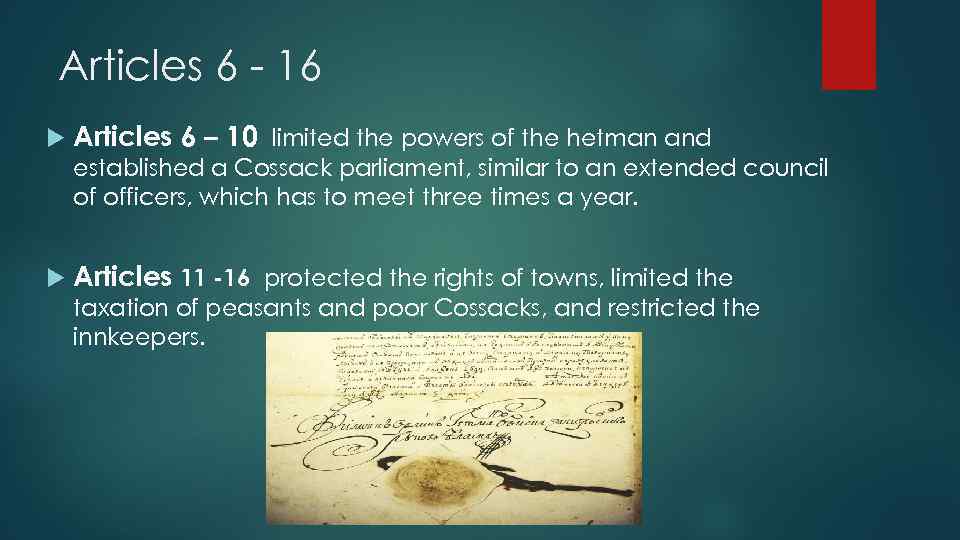 Articles 6 - 16 Articles 6 – 10 limited the powers of the hetman and established a Cossack parliament, similar to an extended council of officers, which has to meet three times a year. Articles 11 -16 protected the rights of towns, limited the taxation of peasants and poor Cossacks, and restricted the innkeepers.
 Conclusion Pylyp Orlyk was one of the greatest freedom fighters in Ukraine’s history. Orlyk’s hope of a fast liberation for Ukraine turned out to be unrealizable. In 1714 Orlyk left Bender to travel around Europe. After 1722 he was forced to go to Turkey, where he spent his last 20 years.
 THAKS FOR YOUR ATTENTION