


 Скачать презентацию Considerations for agriculture in a changing climate Farm
3e310752b9ebb4dea4d32deaafc3bb9b.ppt
- Количество слайдов: 25
 Considerations for agriculture in a changing climate Farm Advisory System Training Climate Change & Bioenergy Section Department of Agriculture, Food and the Marine 12 th October 2017
 Presentation Outline What is climate change? The impact of climate change on Irish Agriculture Irelands Greenhouse Gas (GHG) emissions A comparison of GHG emissions: Ireland v EU International and National climate change policy Agricultural measures supporting climate action Research Summary Conclusions
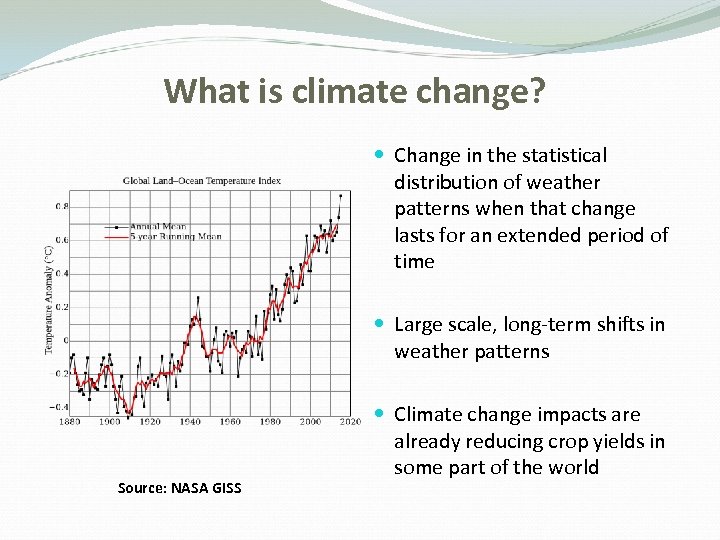 What is climate change? Change in the statistical distribution of weather patterns when that change lasts for an extended period of time Large scale, long-term shifts in weather patterns Source: NASA GISS Climate change impacts are already reducing crop yields in some part of the world
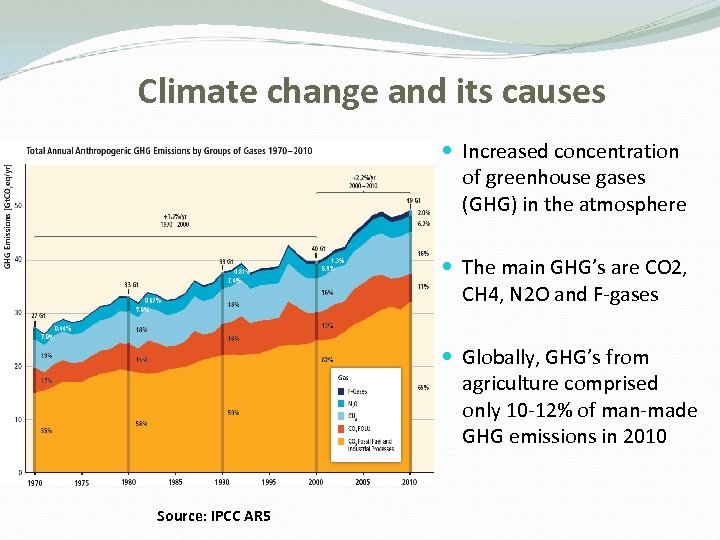 Climate change and its causes Increased concentration of greenhouse gases (GHG) in the atmosphere The main GHG’s are CO 2, CH 4, N 2 O and F-gases Globally, GHG’s from agriculture comprised only 10 -12% of man-made GHG emissions in 2010 Source: IPCC AR 5
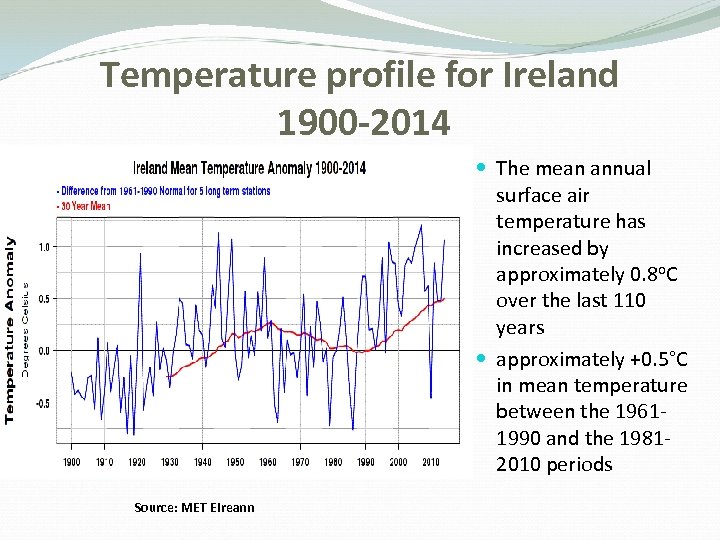 Temperature profile for Ireland 1900 -2014 The mean annual surface air temperature has increased by approximately 0. 8 o. C over the last 110 years approximately +0. 5°C in mean temperature between the 19611990 and the 19812010 periods Source: MET Eireann
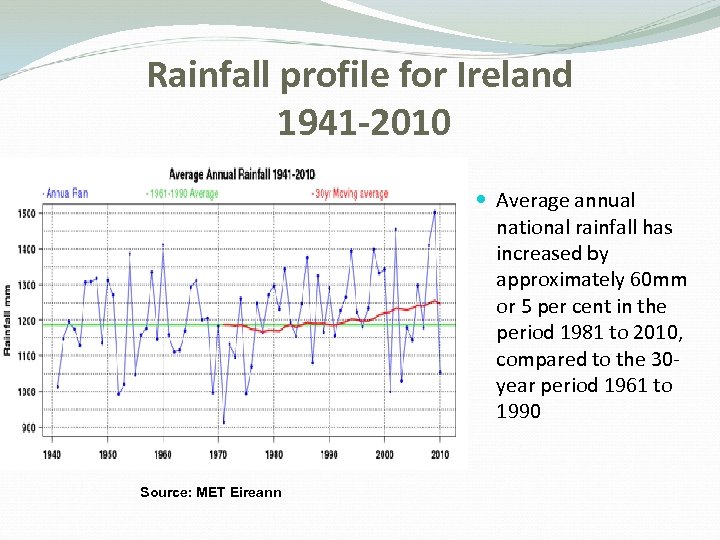 Rainfall profile for Ireland 1941 -2010 Average annual national rainfall has increased by approximately 60 mm or 5 per cent in the period 1981 to 2010, compared to the 30 year period 1961 to 1990 Source: MET Eireann
 Impact of climate change on Irish agriculture Higher risk of disruption of agricultural activities Precipitation may occur in more intense downpours Agricultures vulnerability to seasonal extremes have been highlighted in the past Flooding in winter 2015/2016 Fodder Crisis winter 2012/ spring 2013 Extreme events are likely to increase in intensity Agricultural management systems may need to adapt to future climatic trends
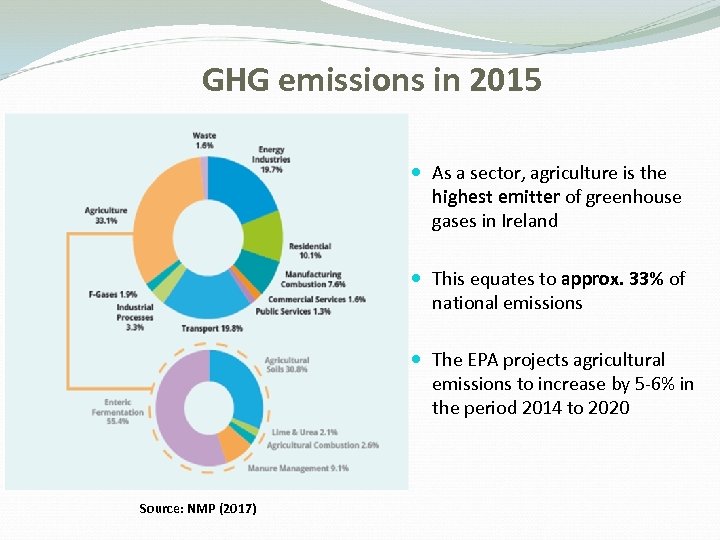 GHG emissions in 2015 As a sector, agriculture is the highest emitter of greenhouse gases in Ireland This equates to approx. 33% of national emissions The EPA projects agricultural emissions to increase by 5 -6% in the period 2014 to 2020 Source: NMP (2017)
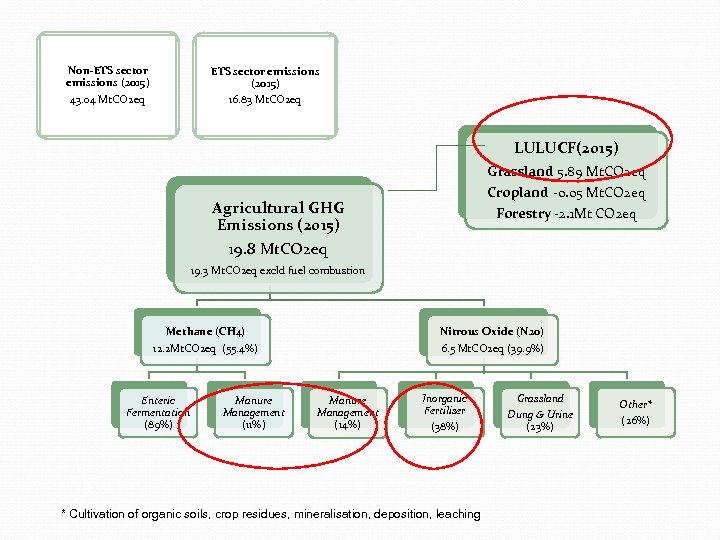 Non-ETS sector emissions (2015) 43. 04 Mt. CO 2 eq ETS sector emissions (2015) 16. 83 Mt. CO 2 eq LULUCF(2015) Grassland 5. 89 Mt. CO 2 eq Cropland -0. 05 Mt. CO 2 eq Forestry -2. 1 Mt CO 2 eq Agricultural GHG Emissions (2015) 19. 8 Mt. CO 2 eq 19. 3 Mt. CO 2 eq excld fuel combustion Methane (CH 4) 12. 2 Mt. CO 2 eq (55. 4%) Enteric Fermentation (89%) Manure Management (11%) Nitrous Oxide (N 20) 6. 5 Mt. CO 2 eq (39. 9%) Manure Management (14%) Inorganic Fertiliser (38%) * Cultivation of organic soils, crop residues, mineralisation, deposition, leaching Grassland Dung & Urine (23%) Other* (26%)
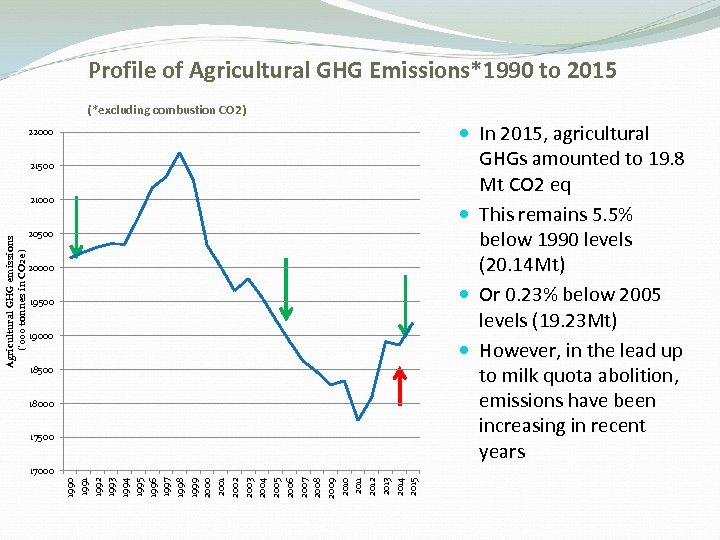 Profile of Agricultural GHG Emissions*1990 to 2015 (*excluding combustion CO 2) In 2015, agricultural GHGs amounted to 19. 8 Mt CO 2 eq This remains 5. 5% below 1990 levels (20. 14 Mt) Or 0. 23% below 2005 levels (19. 23 Mt) However, in the lead up to milk quota abolition, emissions have been increasing in recent years 22000 21500 20000 19500 19000 18500 18000 17500 17000 1991 1992 1993 1994 1995 1996 1997 1998 1999 2000 2001 2002 2003 2004 2005 2006 2007 2008 2009 2010 2011 2012 2013 2014 2015 Agricultural GHG emissions ('000 tonnes in CO 2 e) 21000
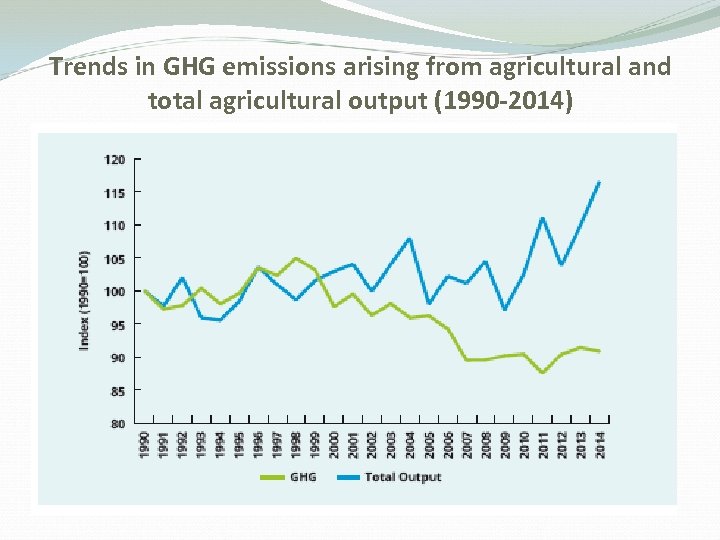 Trends in GHG emissions arising from agricultural and total agricultural output (1990 -2014)
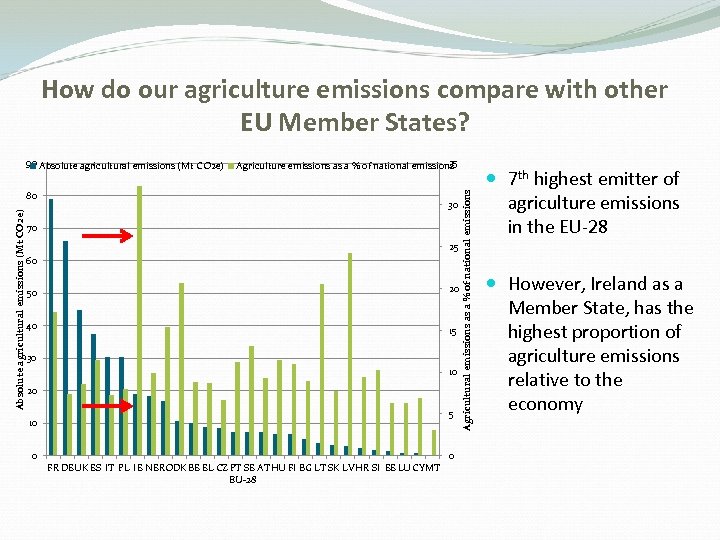 How do our agriculture emissions compare with other EU Member States? 35 Agriculture emissions as a % of national emissions Absolute agricultural emissions (Mt CO 2 e) 80 30 70 25 60 50 20 40 15 30 10 20 5 10 0 0 FR DEUK ES IT PL IE NERODKBE EL CZ PT SE ATHU FI BG LT SK LVHR SI EE LU CYMT EU-28 Agricultural emissions as a % of national emissions 90 Absolute agricultural emissions (Mt CO 2 e) 7 th highest emitter of agriculture emissions in the EU-28 However, Ireland as a Member State, has the highest proportion of agriculture emissions relative to the economy
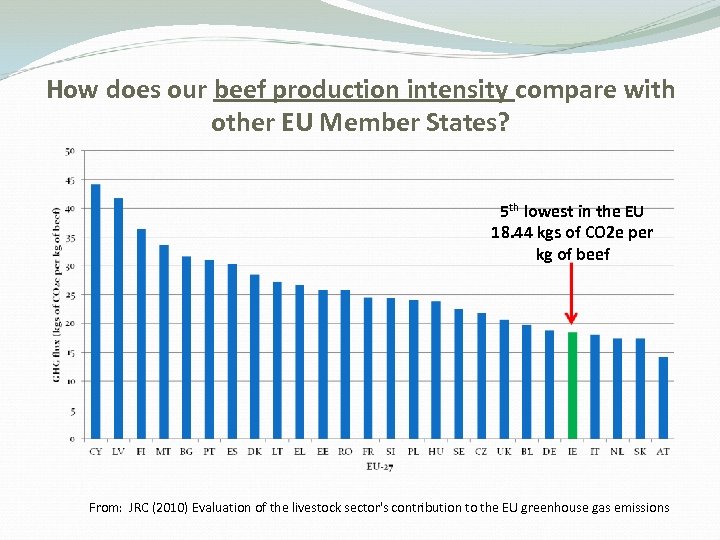 How does our beef production intensity compare with other EU Member States? 5 th lowest in the EU 18. 44 kgs of CO 2 e per kg of beef From: JRC (2010) Evaluation of the livestock sector's contribution to the EU greenhouse gas emissions
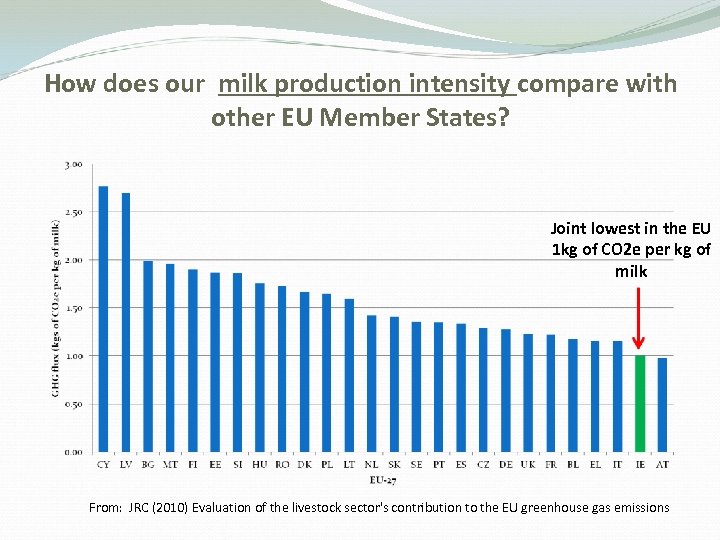 How does our milk production intensity compare with other EU Member States? Joint lowest in the EU 1 kg of CO 2 e per kg of milk From: JRC (2010) Evaluation of the livestock sector's contribution to the EU greenhouse gas emissions
 The Paris Agreement Global commitment to transition to a lowemission economy, holding the increase in the global temperature to well below 2 °C Highlights need to harness the potential of land use to contribute to global GHG mitigation efforts Acknowledgement of the importance of food security Entered into force 4 November 2016
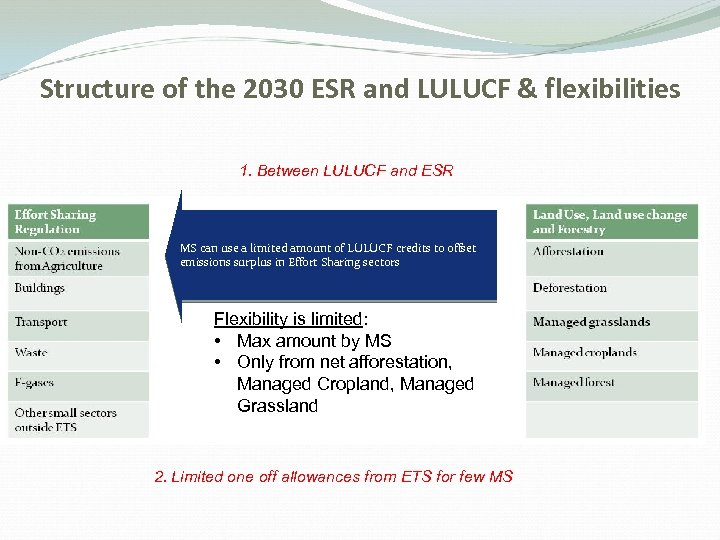 Structure of the 2030 ESR and LULUCF & flexibilities 1. Between LULUCF and ESR MS can use a limited amount of LULUCF credits to offset emissions surplus in Effort Sharing sectors Flexibility is limited: • Max amount by MS • Only from net afforestation, Managed Cropland, Managed Grassland 2. Limited one off allowances from ETS for few MS
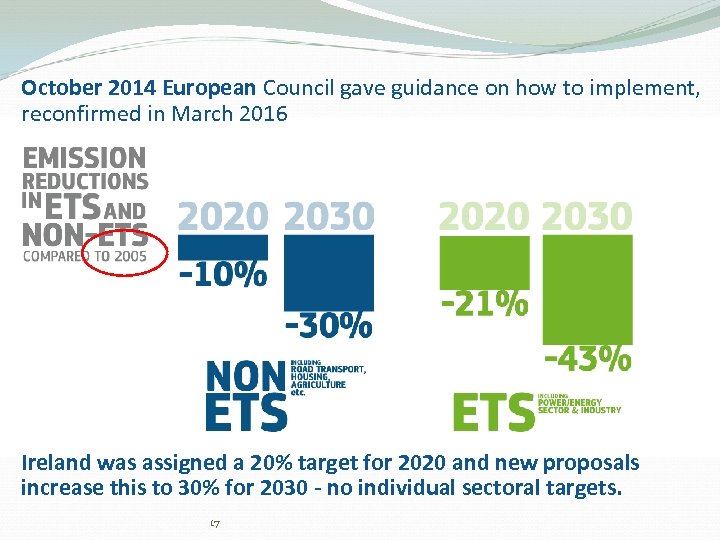 October 2014 European Council gave guidance on how to implement, reconfirmed in March 2016 Ireland was assigned a 20% target for 2020 and new proposals increase this to 30% for 2030 - no individual sectoral targets. 17
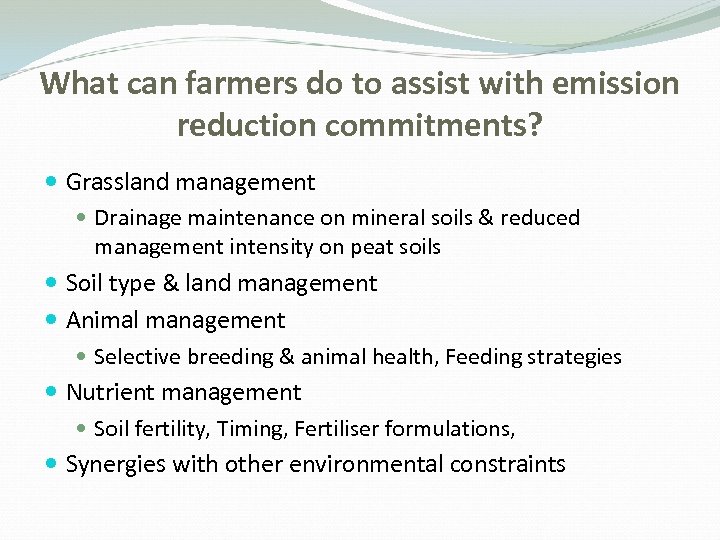 What can farmers do to assist with emission reduction commitments? Grassland management Drainage maintenance on mineral soils & reduced management intensity on peat soils Soil type & land management Animal management Selective breeding & animal health, Feeding strategies Nutrient management Soil fertility, Timing, Fertiliser formulations, Synergies with other environmental constraints
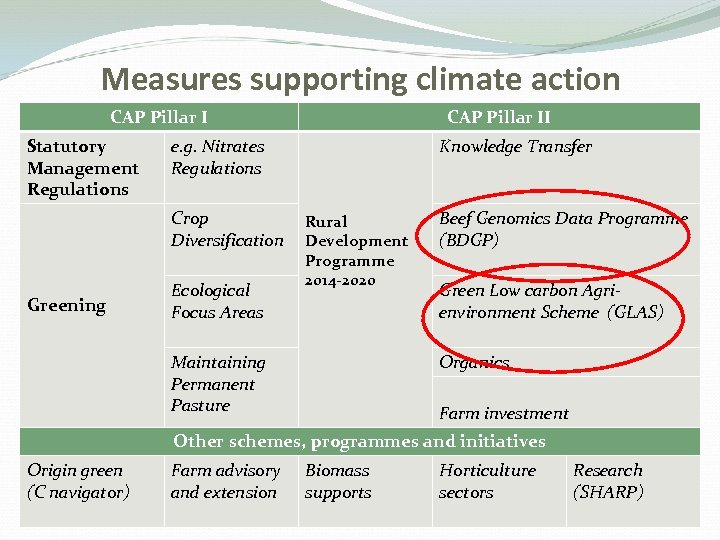 Measures supporting climate action CAP Pillar I Statutory Management Regulations e. g. Nitrates Regulations Crop Diversification Greening CAP Pillar II Ecological Focus Areas Knowledge Transfer Rural Development Programme 2014 -2020 Maintaining Permanent Pasture Beef Genomics Data Programme (BDGP) Green Low carbon Agrienvironment Scheme (GLAS) Organics Farm investment Other schemes, programmes and initiatives Origin green (C navigator) Farm advisory and extension Biomass supports Horticulture sectors Research (SHARP)
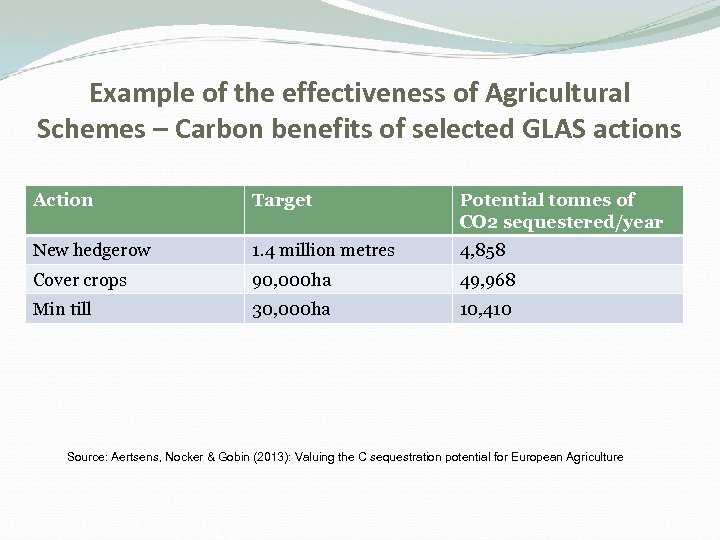 Example of the effectiveness of Agricultural Schemes – Carbon benefits of selected GLAS actions Action Target Potential tonnes of CO 2 sequestered/year New hedgerow 1. 4 million metres 4, 858 Cover crops 90, 000 ha 49, 968 Min till 30, 000 ha 10, 410 Source: Aertsens, Nocker & Gobin (2013): Valuing the C sequestration potential for European Agriculture
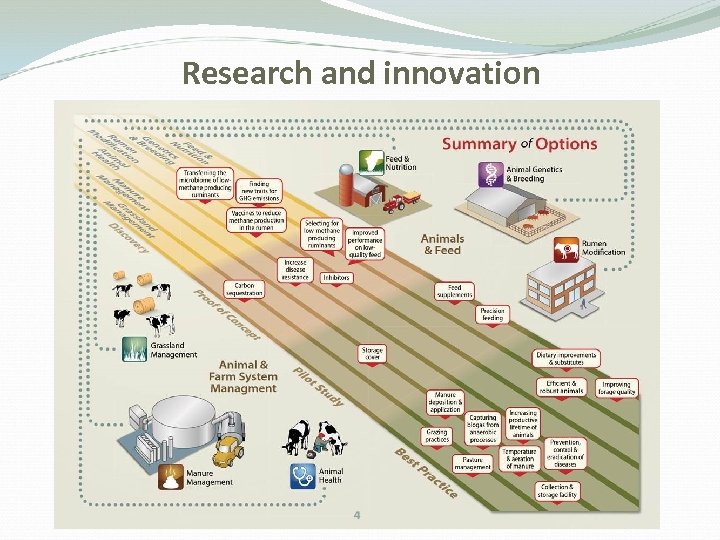 Research and innovation
 Summary - What Irish Agriculture is doing to address Climate Change: Recognising the multiple objectives of agriculture and land use in a vibrant rural economy Promoting sustainable intensification of food production to reduce the carbon intensity of food production and to contribute to both food security and greenhouse gas mitigation objectives such as through Efficient multi trait animal breeding strategies Efficient use and recycling of nutrients which optimise nitrogen use efficiency and reduce losses of reactive nitrogen to the environment
 Summary - What Irish Agriculture is doing to address Climate Change: Exploring feeding strategies that maximise the efficiency of grass based production systems Support of improvements to animal health and welfare Support of ICT In agriculture to aid delivery of sustainable intensification Encouraging sustainable land management that contribute to , climate change mitigation and sustainably manage soil and forest carbon stocks; and Seek to move as far along the road to carbon neutrality as is possible in cost-effective terms, while not compromising the capacity for sustainable food production, in accordance with the Paris Agreement and the goal in Article 4 of achieving a balance between anthropogenic emissions by sources and removals by sinks of greenhouse gases in the second half of this century.
 Conclusions The unique role of agriculture & forestry in the global climate change response is increasingly recognized Ireland is at a good starting point - Food. Wise 2025 National Climate Action and Low Carbon Development Act 2015 National mitigation plan and sectoral adaptation plan best served by ambitious approaches to minimising emissions and improved resilience ‘…fostering climate resilience and low greenhouse gas emissions development, in a manner that does not threaten food production’ (Paris Agreement, 2015)
 Thank you