


 Скачать презентацию Consideration Master title style of a Change in
d671dc77c17c73c2f06a9538645f1c18.ppt
- Количество слайдов: 28
 Consideration Master title style of a Change in the Click to edit Physical Therapist Regulatory Designator Click to edit Master subtitle style 1
 Meeting Agenda • Issue background and history • Click to edit Master title style Questions to be answered • Pros, cons, barriers, and opportunities Click to change designator • Processto edit Master subtitle style • Discussion 2
 Definitions • Academic degree/designation/credential • The credential earned as a result of completion of an academic degree program • E. g. , DPT, BSPT, MSPT, Ph. D, Ed. D, etc. • Specified by institution and profession Click to edit Master title style Click to edit Master subtitle style • Regulatory designator • The credential earned as a result of licensure • E. g. , “PT” is the regulatory designator for all licensed physical therapists; consistent with current HOD policy • Specified in state law • Other designators for PT have included LPT and RPT 3
 History of Issue • RC 26 -05 Consideration of the professional (regulatory) designation change to “DPT” Click to edit Master title style – That the APTA investigate the appropriateness of changing the regulatory designation of the physical to edit Master subtitle style all Click therapist from “PT” to “DPT” in jurisdictions, with a report to the 2006 HOD, which shall include but not be limited to: Ø Strengths, weaknesses, opportunities and barriers for implementing the regulatory change Ø Criteria for implementation Ø Mechanisms for implementation 4
 Regulatory Designator • BOD appointed Task Force that met 12/05 • Task Force report was provided title style Click to edit Master to the BOD and 2006 HOD for consideration • Task Force Members Click to PT, DPT (AZ, originator of motion) – Karen Donahue, edit Master subtitle style – Averell R. “Tootie” Overby, PT, Dr. PH (OH, PT with licensure board experience) – Barbara Sanders, PT, Ph. D (TX, PT educator in non-DPT program) – Joe Smith, PT, BSED (MT, PT with BS professional degree) – Ann Tyminski (MD, non-PT licensing board administrator) – Connie Hauser, PT, DPT (KY, BOD liaison) 5
 Task Force Recommendations • The regulatory designator should be changed to be consistent with Vision 2020 • The regulatory designator should not be “DPT” because “DPT” is a recognized academic degree Click to edit Master for the use of the • Guidelines should be developedsubtitle style term “doctor” in clinical practice* • The Association should make a statement that the minimal entry-level academic degree should be the DPT • All state practice acts will have to be changed to reflect the change in designator and to provide title protection Click to edit Master title style 6
 Task Force Conclusions • Change the regulatory designator to “PTD” or something other than “DPT” thattitle style Click to edit Master indicates physical therapy is a doctoring profession • At the point in time in which the majority of licensed Click to edit have earned a DPT degree physical therapists Master subtitle style and/or CAPTE changes the evaluative criteria to reflect the minimum degree is a doctoral degree, the APTA should promote changing the regulatory designator in all jurisdictions 7
 OTHER PROFESSIONS • Physicians(MD)/Podiatrists(DPM)/Dentists (DDS or DMD) – changed the degree and designator together at the same time in the early 1900’s • Optometrists (OD) – award first doctoral degrees in 1920’s; not offered by all Schools of Optometry until Click to edit Master subtitle style 1960’s; grandfathered the degree and designator at the same time • Pharmacists – endorse Doctor of Pharmacy (Pharm. D) as sole entry-level degree in 1992 Click to edit Master title style • Only Pharm. D programs accredited since 2003 • Pharmacists decide not to change regulatory designator from RPh 8
 Entry-Level Current Status • 164 DPT professional programs (9/1/06) (78%) to edit Master title style Click • 1 developing DPT professional program • 2 programs approved to subtitle style Click to edit Master convert to DPT • 21 programs have expressed intent to convert to the DPT in 2009 or earlier • 209 of 210 programs (99%) either are or will be offering the DPT professional degree by 2009 9
 Transition DPT Current Status • 64 Transition DPT programs (10/06) Click to edit Master programs • 4 developing Transition DPTtitle style (10/06) • 2, 724 graduates Master subtitle style Click to edit (10/05) • 9, 147 students who have or were currently enrolled (10/05) • There may be currently approximately 10, 000 who have the DPT degree 10
 Questions to be Answered 1. Should the regulatory designator remain the same? (Yes or No) Click whatedit Master title style to should it change? (DPT, PTD, etc. ) 2. If no, to 3. What are the conditions that should be met in order for the change to be pursued? style Click to edit Master subtitle (A critical mass of DPT graduates (e. g. , 50, 000), etc. ) 11
 Questions to be Answered 4. If the designator changes to reflect a doctoring profession, which option do you favor for managing Click to edit Master title style individuals who have not earned a DPT degree? A. Include all licensed physical therapists regardless of degree Click to edit Master subtitle style B. Apply the change only to those who have earned the DPT degree C. Include those with the DPT degree and those who can demonstrate competence equivalent to the DPT D. Other method (please describe) 12
 PROS in Favor of Changing the Regulatory Designator to Indicate PT is a Doctoring Profession • Establishes the clinical doctoral degree as the minimal level of practice • Regulatory designator would remain the same for all PTs, maintaining consistency and uniformity for the public Click to edit Master subtitle to all (assuming the new designator would applystylelicensees as is the current case) • Success of other professions who have moved to the doctoring level (e. g. , optometry, podiatry, pharmacy) • Create enhanced public perception of qualifications and preparation of the PT • For those who have earned the DPT, the regulatory title would be consistent with their educational achievement 13 Click to edit Master title style
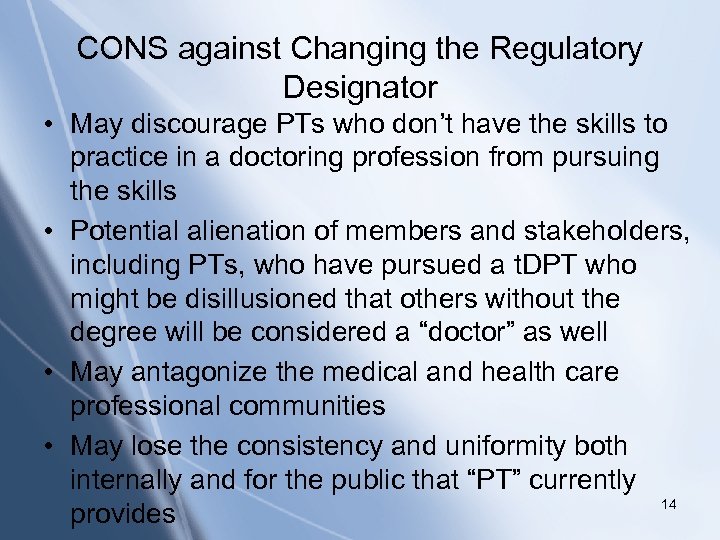 CONS against Changing the Regulatory Designator • May discourage PTs who don’t have the skills to practice in a doctoring profession from pursuing Click the skills to edit Master title style • Potential alienation of members and stakeholders, including PTs, edit Master subtitlet. DPT who Click to who have pursued a style might be disillusioned that others without the degree will be considered a “doctor” as well • May antagonize the medical and health care professional communities • May lose the consistency and uniformity both internally and for the public that “PT” currently 14 provides
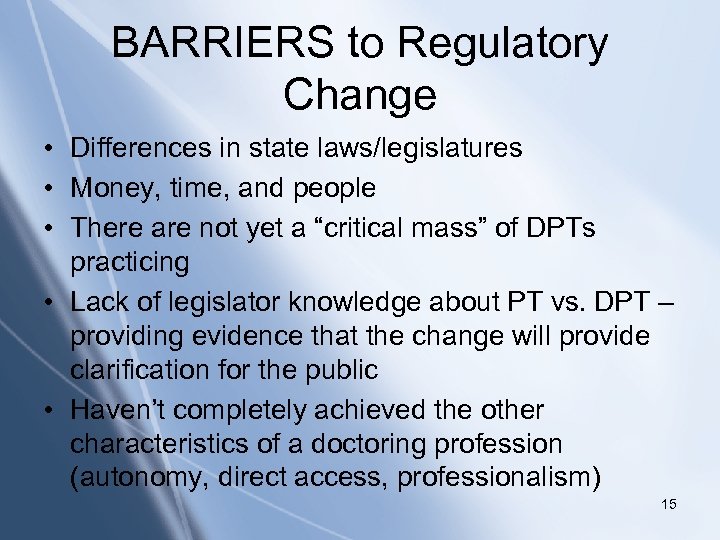 BARRIERS to Regulatory Change • Differences in state laws/legislatures Click to and people • Money, time, edit Master title style • There are not yet a “critical mass” of DPTs practicing Click to edit Master subtitle style • Lack of legislator knowledge about PT vs. DPT – providing evidence that the change will provide clarification for the public • Haven’t completely achieved the other characteristics of a doctoring profession (autonomy, direct access, professionalism) 15
 OPPORTUNITIES Created by the Process • Chance to develop consensus among members and nonmembers • Chance to incorporate/educate about “who we are” (branding) • Chance to educate legislatorssubtitle style are Click to edit Master about who PTs • Chance to create tools to ensure continued competency and thus raise the level of practice consistent with a doctoring profession Click to edit Master title style • Opportunity for APTA to work with educational institutions to enhance post-professional education and to upgrade the knowledge, skills and behaviors of practitioners consistent with a doctoring profession 16
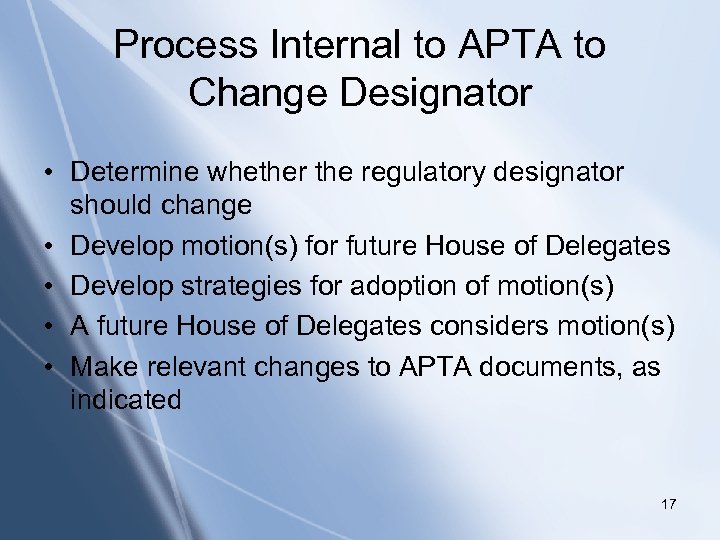 Process Internal to APTA to Change Designator • Determine whether the regulatory designator Click to edit Master title style should change • Develop motion(s) for future House of Delegates Click to edit for adoption of motion(s) • Develop strategies Master subtitle style • A future House of Delegates considers motion(s) • Make relevant changes to APTA documents, as indicated 17
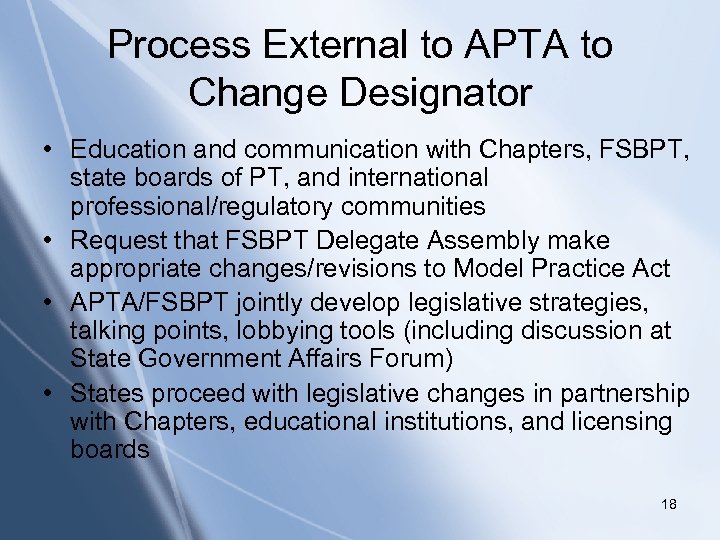 Process External to APTA to Change Designator • Education and communication with Chapters, FSBPT, state boards of PT, and international professional/regulatory communities • Request that FSBPT Delegate Assembly make appropriate changes/revisionssubtitle style Click to edit Master to Model Practice Act • APTA/FSBPT jointly develop legislative strategies, talking points, lobbying tools (including discussion at State Government Affairs Forum) • States proceed with legislative changes in partnership with Chapters, educational institutions, and licensing boards Click to edit Master title style 18
 Next Steps • Go to www. apta. org, click on Advocacy, Click to edit Master State Government Affairs title style • Complete on-line survey on DPT as Regulatory Designator subtitle style Click to edit Master • Generate discussion among groups of PTs • Talk to delegates to HOD 19
 Questions to be Answered 1. Should the regulatory designator remain the same? (Yes or No) Click whatedit Master title style to should it change? (DPT, PTD, etc. ) 2. If no, to 3. What are the conditions that should be met in order for the change to be pursued? style Click to edit Master subtitle (A critical mass of DPT graduates (e. g. , 50, 000), etc. ) 20
 Questions to be Answered 4. If the designator changes to reflect a doctoring profession, which option do you favor for managing Click to edit Master title style individuals who have not earned a DPT degree? A. Include all licensed physical therapists regardless of degree B. Apply the change. Master subtitlehave earned the Click to edit only to those who style DPT degree C. Include those with the DPT degree and those who can demonstrate competence equivalent to the DPT D. Other method (please describe) 21
 Click to edit Master title style Thanks for sharing your views!! Click to edit Master subtitle style 22
 Click to edit Master title style Click to edit Master subtitle style 23
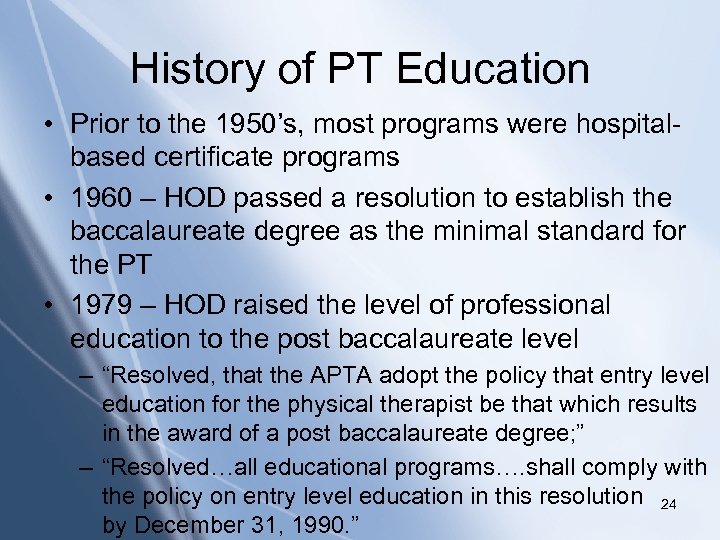 History of PT Education • Prior to the 1950’s, most programs were hospitalbased certificate programs Click to edit a resolution to establish • 1960 – HOD passed. Master title stylethe baccalaureate degree as the minimal standard for the PT Click to edit Master subtitle style • 1979 – HOD raised the level of professional education to the post baccalaureate level – “Resolved, that the APTA adopt the policy that entry level education for the physical therapist be that which results in the award of a post baccalaureate degree; ” – “Resolved…all educational programs…. shall comply with the policy on entry level education in this resolution 24 by December 31, 1990. ”
 History of PT Education • Before 1979, 7 post baccalaureate programs existed (all at masters degree level) Click to edit Master title style • Strong opposition to the move to post baccalaureate education was present Click to edit Master subtitle style throughout the next decade from many stakeholders, including APTA members and academic leaders • 22 years (1979 to January 1, 2002) required for all programs to convert from baccalaureate to masters degree 25
 Professional and Societal Factors • Since 1980, changes in the legislative area and in the health care industry expanded the Click to edit Master title style role of PT into new areas • 1983 - AMA edit Master subtitle style Click to ceased accrediting PT programs; CAPTE became solely responsible for accrediting all PT programs • 1995 - APTA Guide to Physical Therapist Practice published, reflecting the depth and breadth in practice and in the educational 26 preparation required to enter practice
 DPT • 1992 – First post-professional “transition” DPT program at USC Click to edit Master title style • 1993 – First entry-level DPT program (first graduates in 7/96) at Creighton Click to edit Master subtitle style University • 1998 – CAPTE published new accreditation standards requiring PT education to culminate in the awarding of a postbaccalaureate degree 27
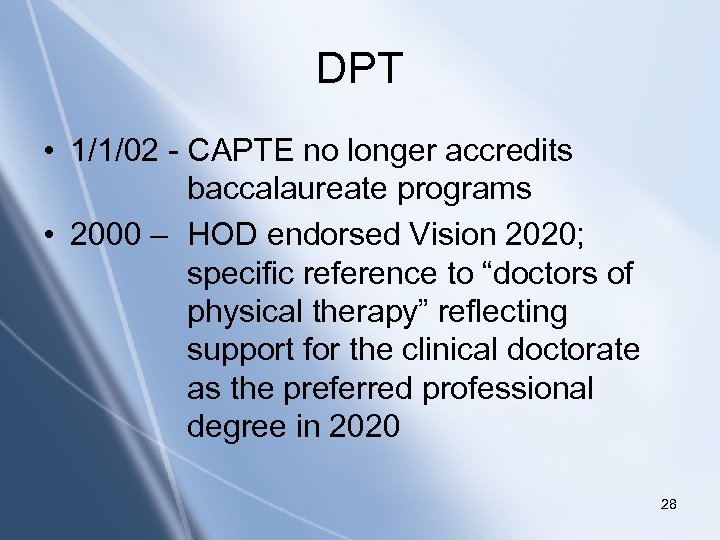 DPT • 1/1/02 - CAPTE no longer accredits Click baccalaureate programs style to edit Master title • 2000 – HOD endorsed Vision 2020; specific Master subtitle style Click to edit reference to “doctors of physical therapy” reflecting support for the clinical doctorate as the preferred professional degree in 2020 28