


 Скачать презентацию Conservation Cores Reducing the Energy of Mature Computations
a26d4d8c6a113fd1e21fb60d92d41b96.ppt
- Количество слайдов: 30
 Conservation Cores: Reducing the Energy of Mature Computations Ganesh Venkatesh, Jack Sampson, Nathan Goulding, Saturnino Garcia, Vladyslav Bryksin, Jose Lugo-Martinez, Steven Swanson, Michael Bedford Taylor Department of Computer Science and Engineering, University of California, San Diego 1
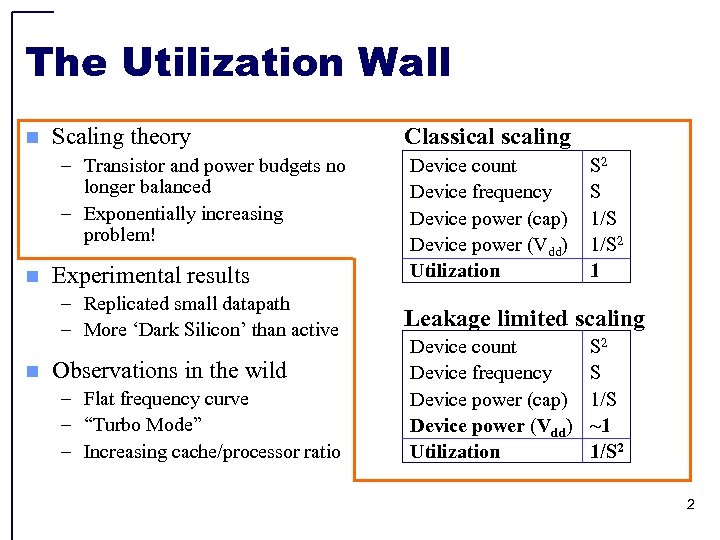 The Utilization Wall n Scaling theory – Transistor and power budgets no longer balanced – Exponentially increasing problem! n Experimental results – Replicated small datapath – More ‘Dark Silicon’ than active n Observations in the wild – Flat frequency curve – “Turbo Mode” – Increasing cache/processor ratio Classical scaling Device count Device frequency Device power (cap) Device power (Vdd) Utilization S 2 S 1/S 2 1 Leakage limited scaling Device count Device frequency Device power (cap) Device power (Vdd) Utilization S 2 S 1/S ~1 1/S 2 2
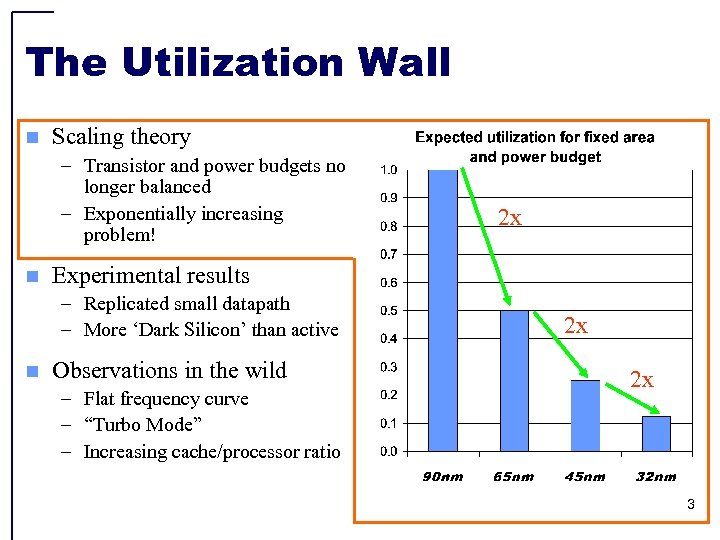 The Utilization Wall n Scaling theory – Transistor and power budgets no longer balanced – Exponentially increasing problem! n Experimental results – Replicated small datapath – More ‘Dark Silicon’ than active n 2 x Observations in the wild – Flat frequency curve – “Turbo Mode” – Increasing cache/processor ratio 2 x 2 x 3
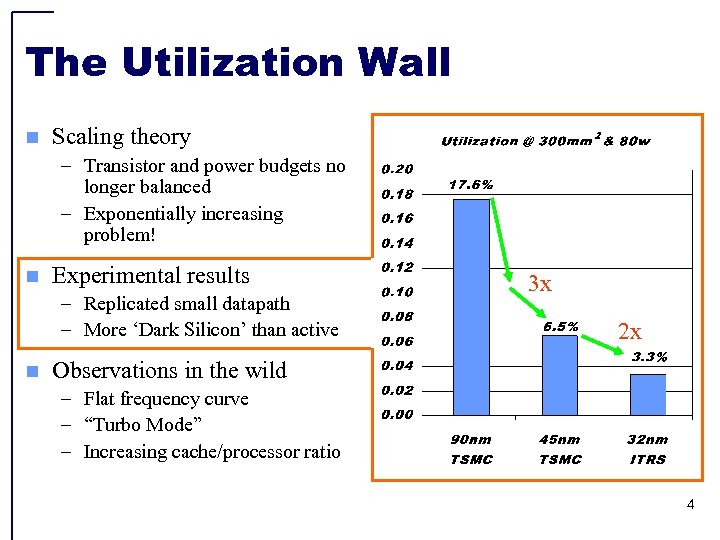 The Utilization Wall n Scaling theory – Transistor and power budgets no longer balanced – Exponentially increasing problem! n Experimental results – Replicated small datapath – More ‘Dark Silicon’ than active n 3 x 2 x Observations in the wild – Flat frequency curve – “Turbo Mode” – Increasing cache/processor ratio 4
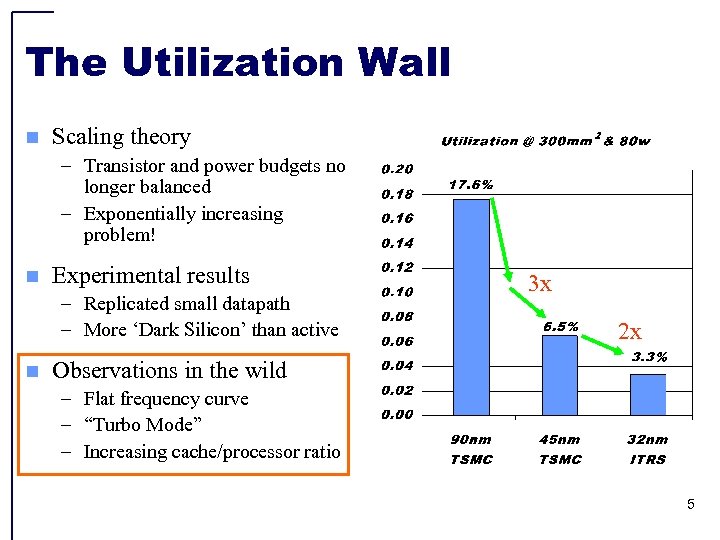 The Utilization Wall n Scaling theory – Transistor and power budgets no longer balanced – Exponentially increasing problem! n Experimental results – Replicated small datapath – More ‘Dark Silicon’ than active n 3 x 2 x Observations in the wild – Flat frequency curve – “Turbo Mode” – Increasing cache/processor ratio 5
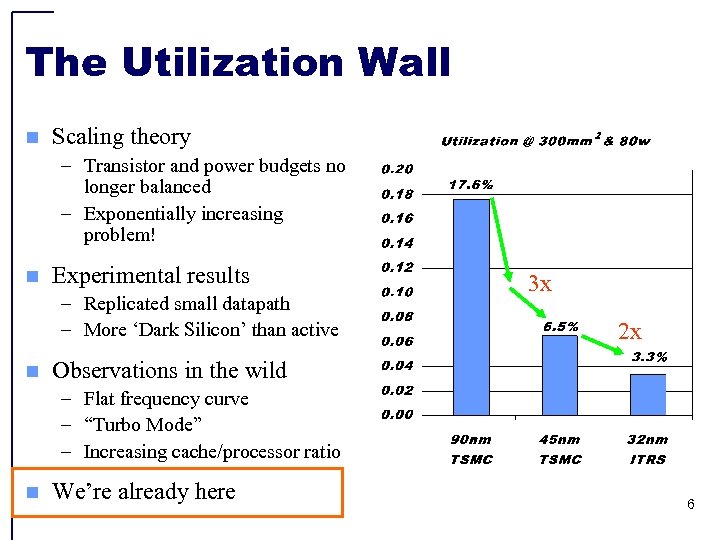 The Utilization Wall n Scaling theory – Transistor and power budgets no longer balanced – Exponentially increasing problem! n Experimental results – Replicated small datapath – More ‘Dark Silicon’ than active n 3 x 2 x Observations in the wild – Flat frequency curve – “Turbo Mode” – Increasing cache/processor ratio n We’re already here 6
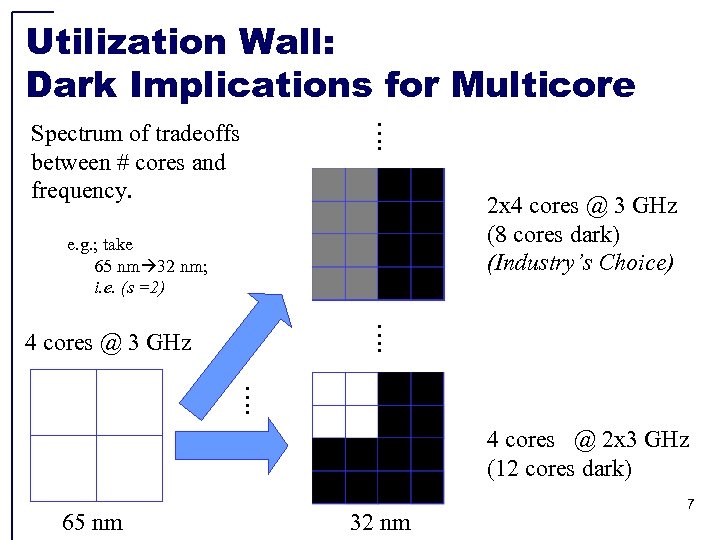 Spectrum of tradeoffs between # cores and frequency. . … Utilization Wall: Dark Implications for Multicore 2 x 4 cores @ 3 GHz (8 cores dark) (Industry’s Choice). … e. g. ; take 65 nm 32 nm; i. e. (s =2) . … 4 cores @ 3 GHz 4 cores @ 2 x 3 GHz (12 cores dark) 65 nm 32 nm 7
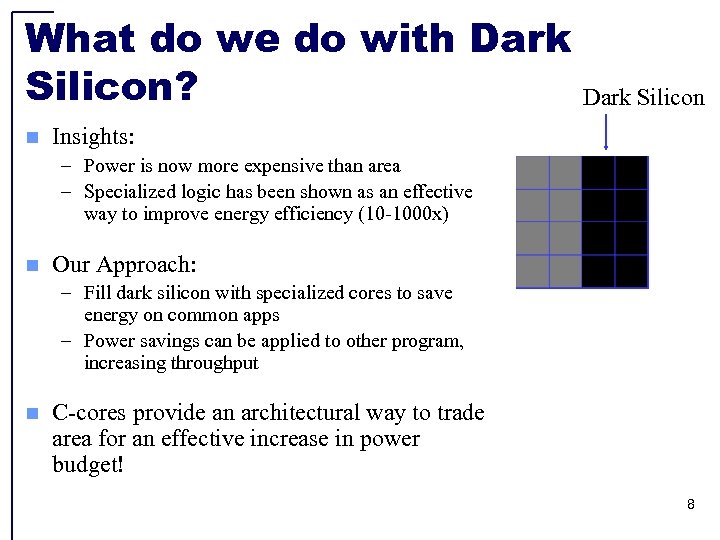 What do we do with Dark Silicon? n Dark Silicon Insights: – Power is now more expensive than area – Specialized logic has been shown as an effective way to improve energy efficiency (10 -1000 x) n Our Approach: – Fill dark silicon with specialized cores to save energy on common apps – Power savings can be applied to other program, increasing throughput n C-cores provide an architectural way to trade area for an effective increase in power budget! 8
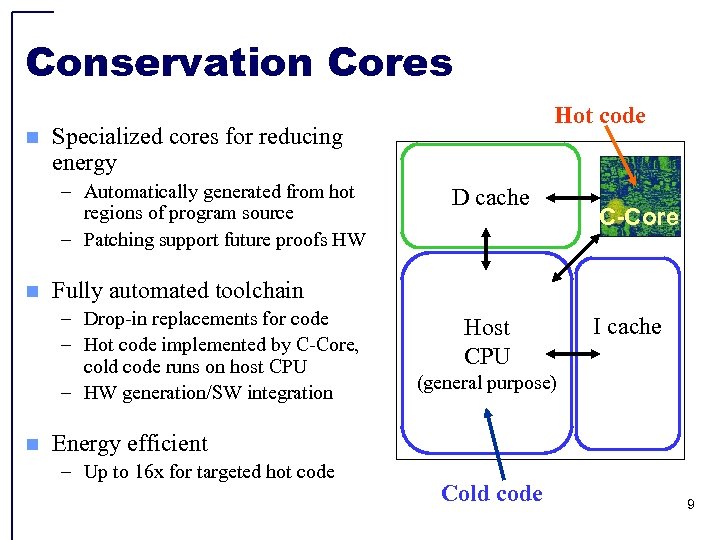 Conservation Cores n Specialized cores for reducing energy – Automatically generated from hot regions of program source – Patching support future proofs HW n D cache C-Core Fully automated toolchain – Drop-in replacements for code – Hot code implemented by C-Core, cold code runs on host CPU – HW generation/SW integration n Hot code Host CPU I cache (general purpose) Energy efficient – Up to 16 x for targeted hot code Cold code 9
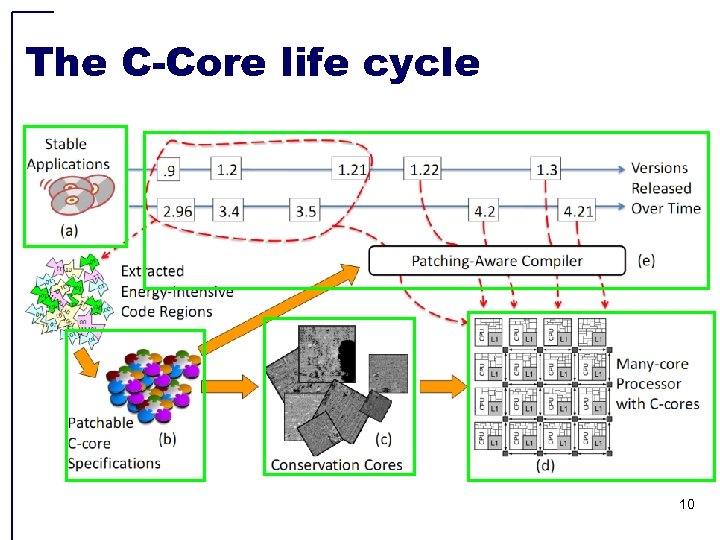 The C-Core life cycle 10
 Outline n The Utilization Wall n Conservation n Patchable Core Architecture & Synthesis Hardware n Results n Conclusions 11
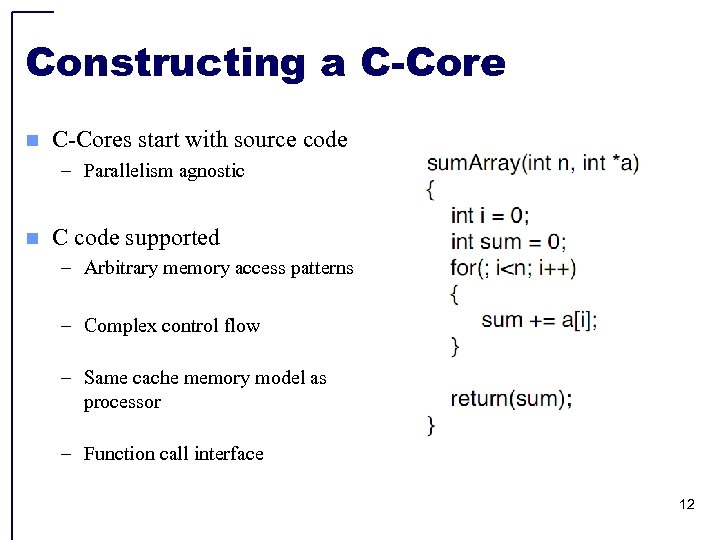 Constructing a C-Core n C-Cores start with source code – Parallelism agnostic n C code supported – Arbitrary memory access patterns – Complex control flow – Same cache memory model as processor – Function call interface 12
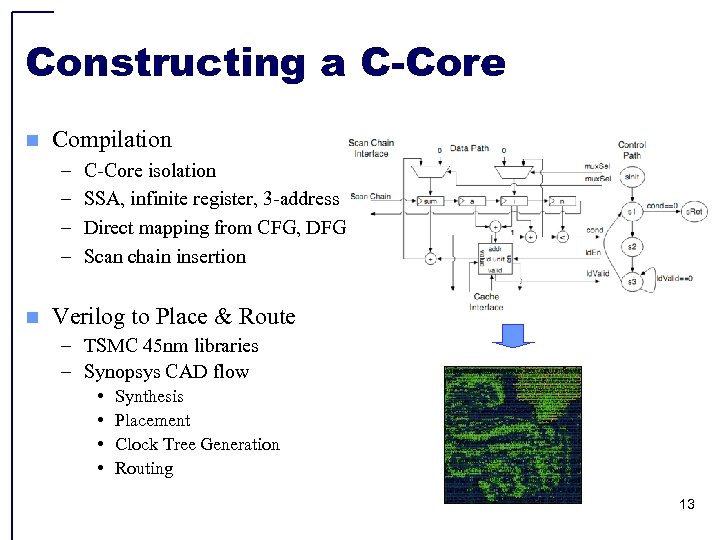 Constructing a C-Core n Compilation – – n C-Core isolation SSA, infinite register, 3 -address Direct mapping from CFG, DFG Scan chain insertion Verilog to Place & Route – TSMC 45 nm libraries – Synopsys CAD flow • • Synthesis Placement Clock Tree Generation Routing 13
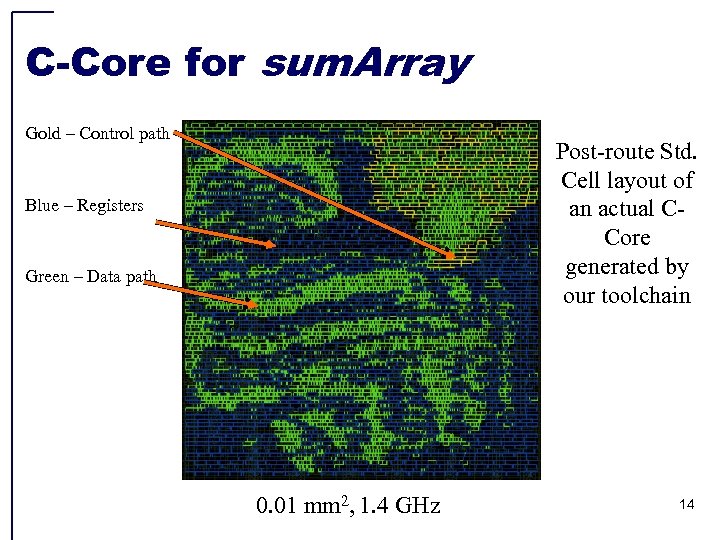 C-Core for sum. Array Gold – Control path Post-route Std. Cell layout of an actual CCore generated by our toolchain Blue – Registers Green – Data path 0. 01 mm 2, 1. 4 GHz 14
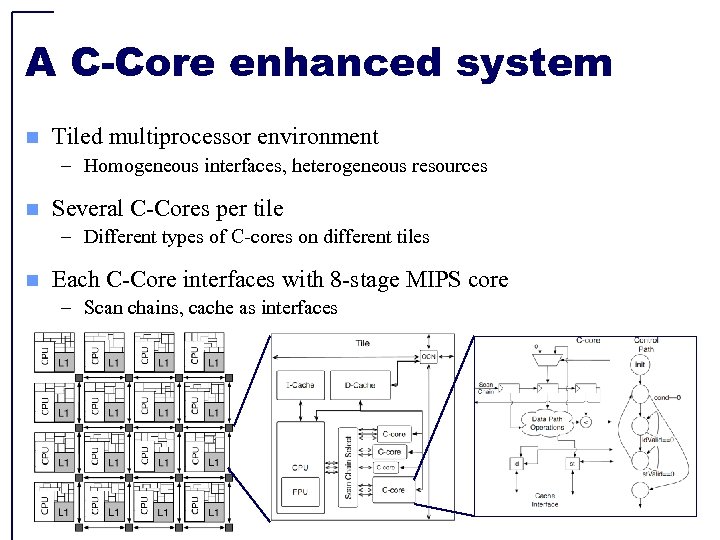 A C-Core enhanced system n Tiled multiprocessor environment – Homogeneous interfaces, heterogeneous resources n Several C-Cores per tile – Different types of C-cores on different tiles n Each C-Core interfaces with 8 -stage MIPS core – Scan chains, cache as interfaces 15
 Outline n The Utilization Wall n Conservation n Patchable Core Architecture & Synthesis Hardware n Results n Conclusions 16
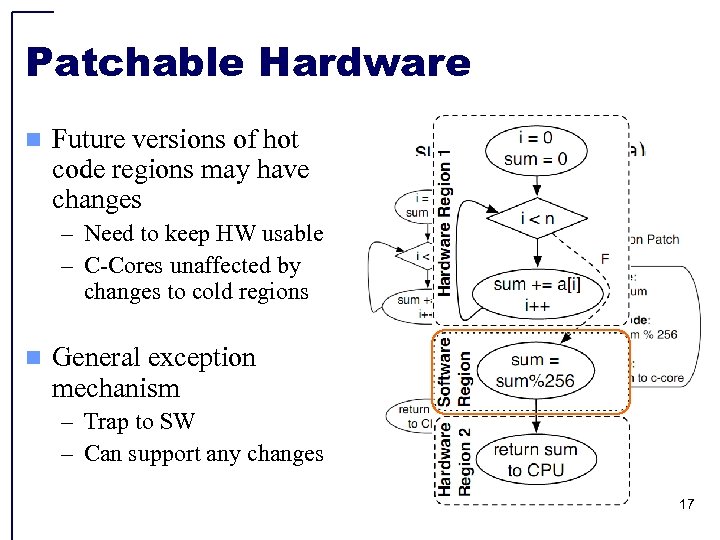 Patchable Hardware n Future versions of hot code regions may have changes – Need to keep HW usable – C-Cores unaffected by changes to cold regions n General exception mechanism – Trap to SW – Can support any changes 17
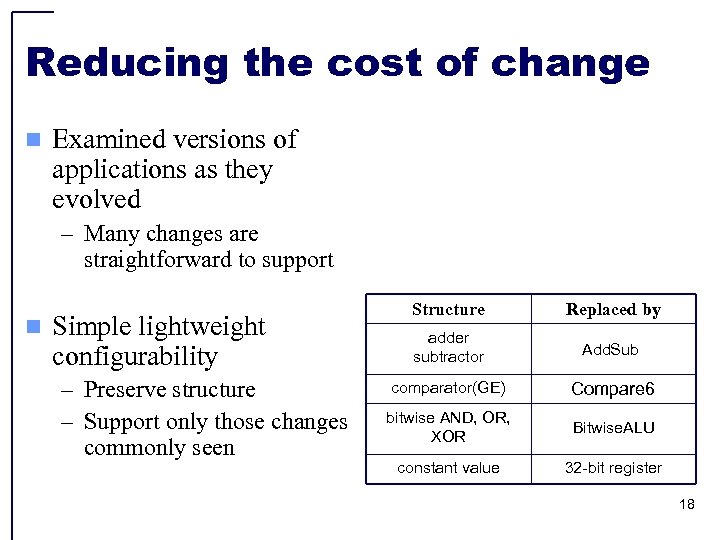 Reducing the cost of change n Examined versions of applications as they evolved – Many changes are straightforward to support n Simple lightweight configurability – Preserve structure – Support only those changes commonly seen Structure Replaced by adder subtractor Add. Sub comparator(GE) Compare 6 bitwise AND, OR, XOR Bitwise. ALU constant value 32 -bit register 18
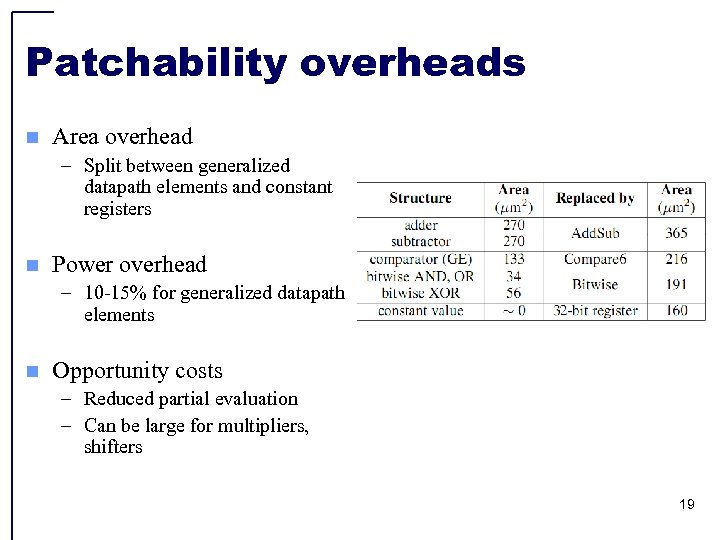 Patchability overheads n Area overhead – Split between generalized datapath elements and constant registers n Power overhead – 10 -15% for generalized datapath elements n Opportunity costs – Reduced partial evaluation – Can be large for multipliers, shifters 19
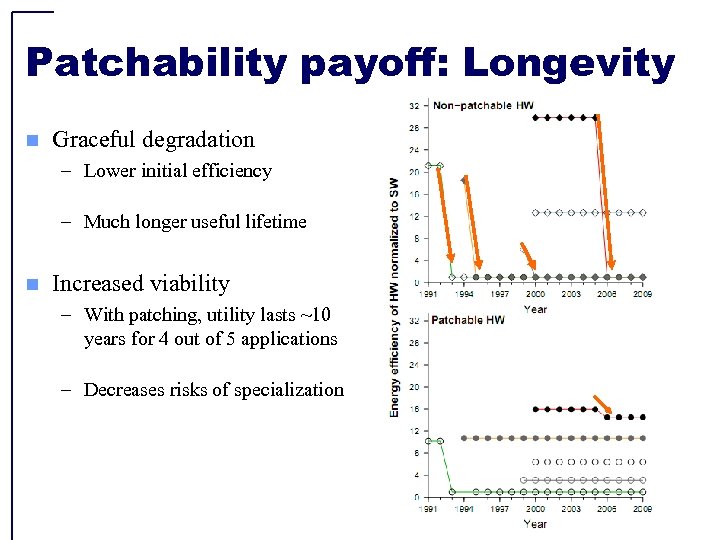 Patchability payoff: Longevity n Graceful degradation – Lower initial efficiency – Much longer useful lifetime n Increased viability – With patching, utility lasts ~10 years for 4 out of 5 applications – Decreases risks of specialization 20
 Outline n The Utilization Wall n Conservation n Patchable Core Architecture & Synthesis Hardware n Results n Conclusions 21
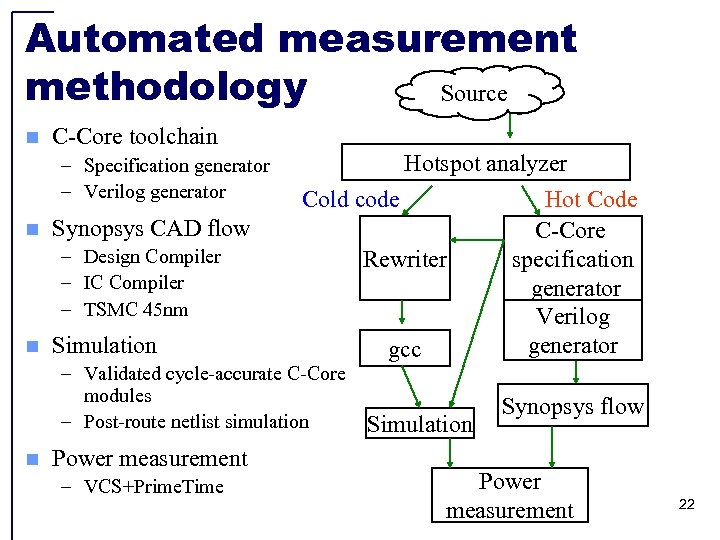 Automated measurement methodology Source n C-Core toolchain – Specification generator – Verilog generator n Hotspot analyzer Cold code Synopsys CAD flow – Design Compiler – IC Compiler – TSMC 45 nm n Simulation – Validated cycle-accurate C-Core modules – Post-route netlist simulation n Power measurement – VCS+Prime. Time Rewriter gcc Simulation Hot Code C-Core specification generator Verilog generator Synopsys flow Power measurement 22
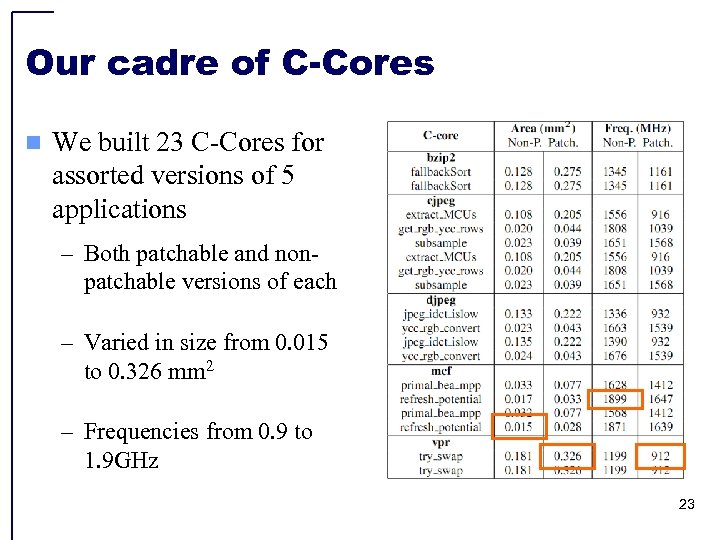 Our cadre of C-Cores n We built 23 C-Cores for assorted versions of 5 applications – Both patchable and nonpatchable versions of each – Varied in size from 0. 015 to 0. 326 mm 2 – Frequencies from 0. 9 to 1. 9 GHz 23
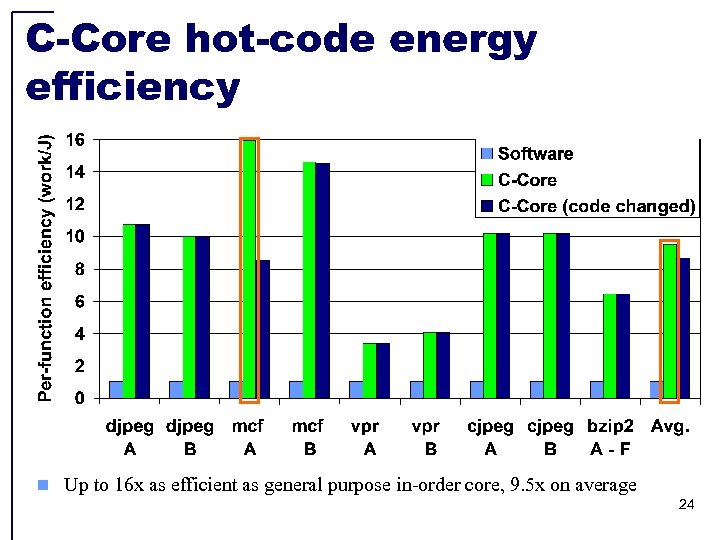 C-Core hot-code energy efficiency n Up to 16 x as efficient as general purpose in-order core, 9. 5 x on average 24
 System energy efficiency n C-Cores very efficient for targeted hot code n Amdahl’s Law limits total system efficiency 25
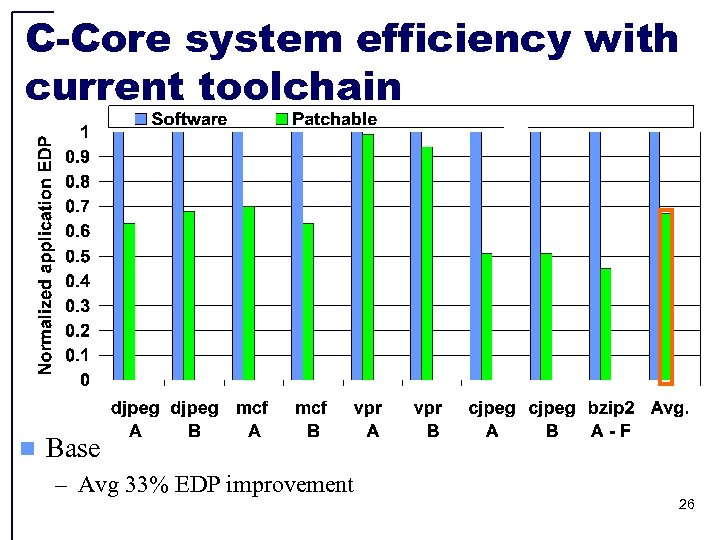 C-Core system efficiency with current toolchain n Base – Avg 33% EDP improvement 26
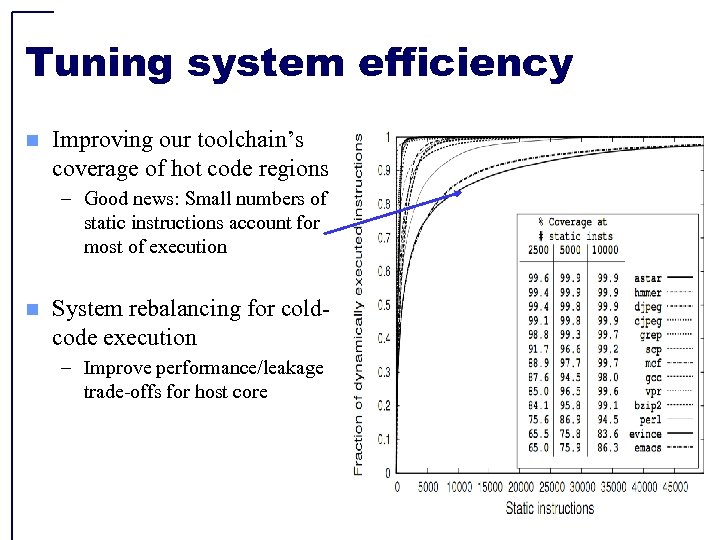 Tuning system efficiency n Improving our toolchain’s coverage of hot code regions – Good news: Small numbers of static instructions account for most of execution n System rebalancing for coldcode execution – Improve performance/leakage trade-offs for host core 27
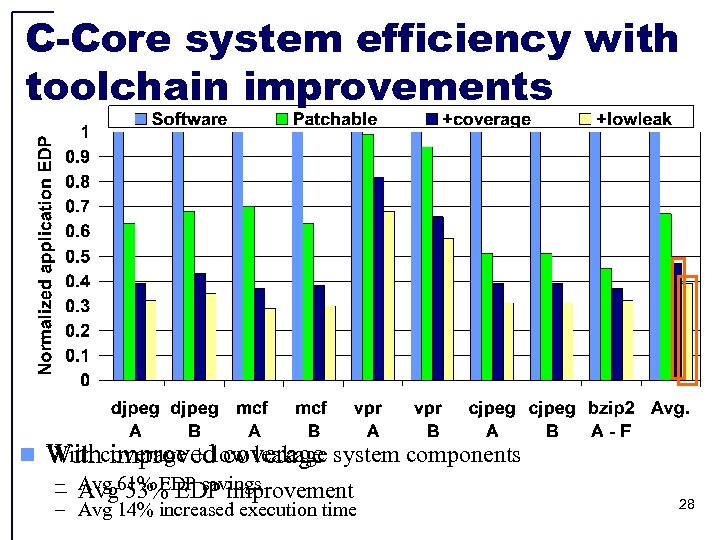 C-Core system efficiency with toolchain improvements n Withcoverage + low leakage system components n With improved coverage – Avg 61% EDP savings – Avg 53% EDP improvement – Avg 14% increased execution time 28
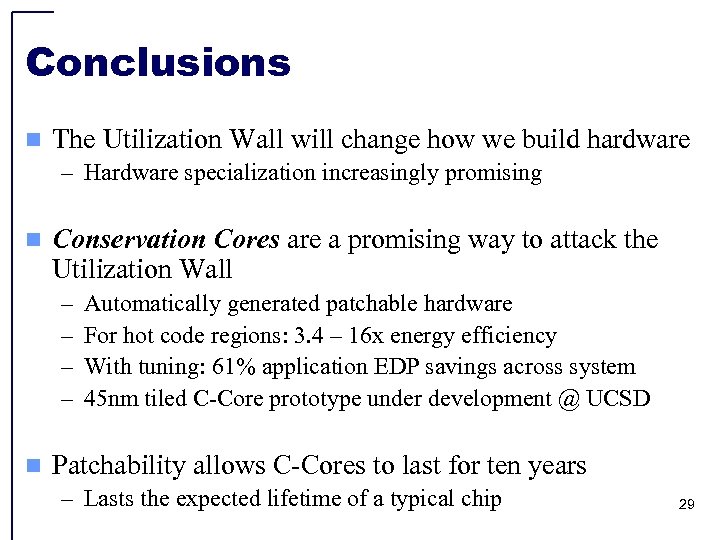 Conclusions n The Utilization Wall will change how we build hardware – Hardware specialization increasingly promising n Conservation Cores are a promising way to attack the Utilization Wall – – n Automatically generated patchable hardware For hot code regions: 3. 4 – 16 x energy efficiency With tuning: 61% application EDP savings across system 45 nm tiled C-Core prototype under development @ UCSD Patchability allows C-Cores to last for ten years – Lasts the expected lifetime of a typical chip 29
 30
30