


 Скачать презентацию Consensus modules modules present across multiple data sets
c9c754c4218929a71e8f00ba1094dda8.ppt
- Количество слайдов: 29
 Consensus modules: modules present across multiple data sets Peter Langfelder and Steve Horvath Eigengene networks for studying the relationships between co-expression modules. BMC Systems Biology 2007, 1: 54
 Why consensus modules? Given several independent data sets, find modules that are present in all (or a specified majority) of the data sets Rationale Find co-expression patterns common to multiple studied conditions Find common, robustly defined modules across several independent data sets (e. g. , from GEO) that study the same conditions
 Finding consensus modules Modules group together densely interconnected genes Consensus modules group together genes densely connected in all conditions Our solution: find the consensus gene-gene similarity and use it with clustering to find modules
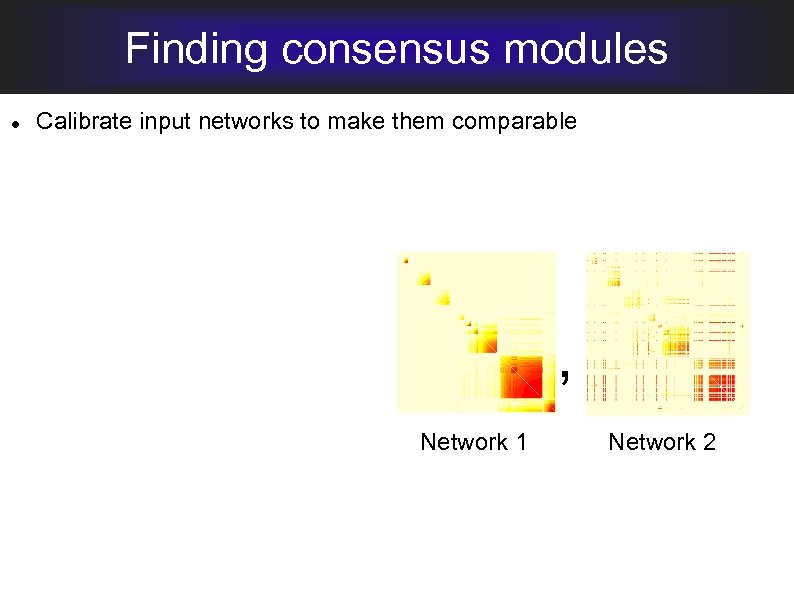 Finding consensus modules Calibrate input networks to make them comparable , Network 1 Network 2
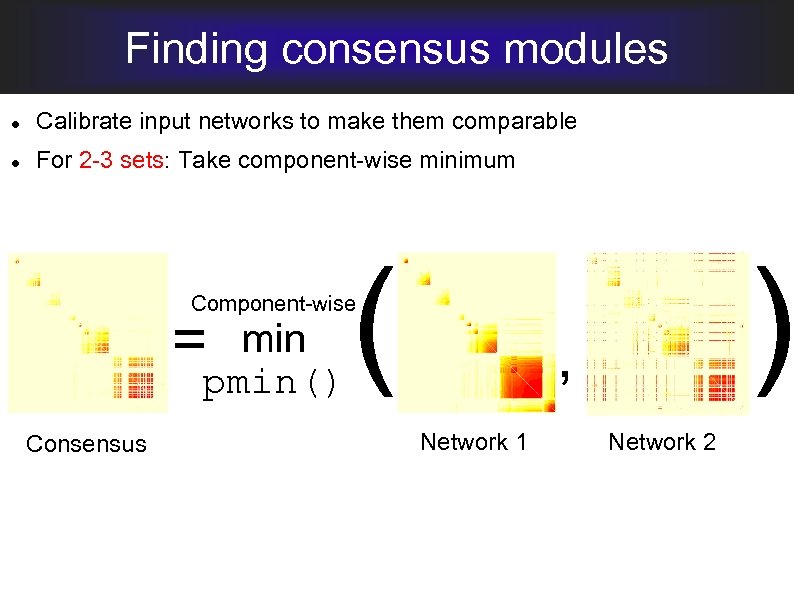 Finding consensus modules Calibrate input networks to make them comparable For 2 -3 sets: Take component-wise minimum ( ) Component-wise = min pmin() Consensus , Network 1 Network 2
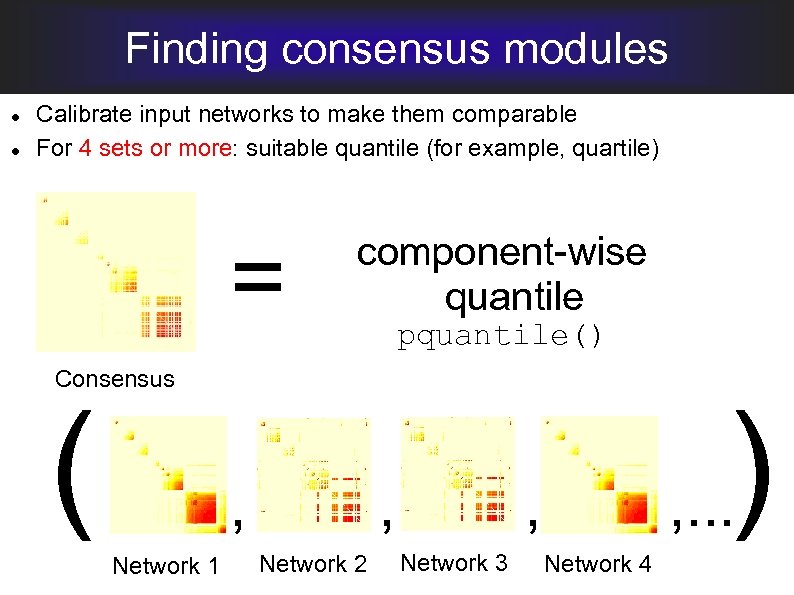 Finding consensus modules Calibrate input networks to make them comparable For 4 sets or more: suitable quantile (for example, quartile) = component-wise quantile pquantile() Consensus ( , Network 1 , Network 2 ) , . . . , Network 3 Network 4
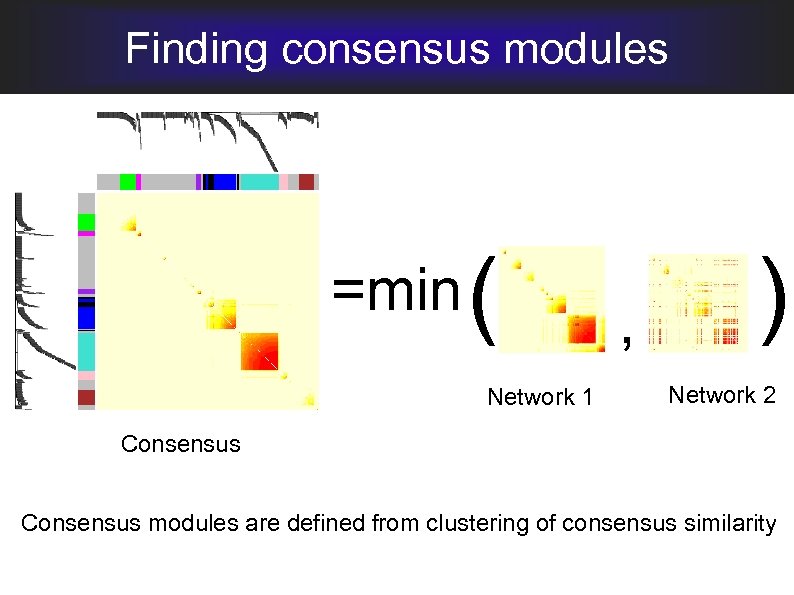 Finding consensus modules =min ( Network 1 , ) Network 2 Consensus modules are defined from clustering of consensus similarity
 R implementation: blockwise. Consensus. Modules Input: Expression data in "multi-set" format Options for splitting data into smaller blocks if there are too many genes to be handled in one block ("blockwise") Network construction options for constructing individual networks Network calibration options Consensus quantile
 R implementation: blockwise. Consensus. Modules Output: Gene clustering tree (or trees if the data was split into blocks) Module eigengenes Consensus module labels, Other diagnostic output Introductory tutorial: Consensus analysis of female and male liver expression data (Tutorial II) at labs. genetics. ucla. edu/horvath/Coexpression. Network/Rpackages/WGCNA/Tutorials
 Consensus modules vs. Module preservation statistics Consensus modules are by construction present (i. e. , preserved) in all (or most) input data sets If a module identified in a reference data set is strongly preserved in test data set(s), it would also be a consensus module among the reference and test sets Consensus module construction treats all data sets the same; module preservation statistics require a reference and a test data set(s) Consensus modules are best suited to answer a different set of questions than module preservation statistics
 Application 1: Consensus modules across multiple lung cancer data sets
 Eight publicly available lung cancer sets 4 independent data sets described in Shedden et al, Gene expression-based survival prediction in lung adenocarcinoma: a multi-site, blinded validation study. Nat Med. 2008 Aug; 14(8): 822 -7. Epub 2008 Jul 20. (Affy U 133 A) Bild et al, Oncogenic pathway signatures in human cancers as a guide to targeted therapies. Nature. 2006 Jan 19; 439(7074): 353 -7 (Affy U 133 plus 2) Tomida el al, Relapse-related molecular signature in lung adenocarcinomas identifies patients with dismal prognosis. J Clin Oncol 2009 Jun 10; 27(17): 2793 -9. (Agilent-014850) Takeuchi et al, Expression profile-defined classification of lung adenocarcinoma shows close relationship with underlying major genetic changes and clinicopathologic behaviors. J Clin Oncol. 2006 Apr 10; 24(11): 1679 -88 (Agilent 21. 6 K custom array) Roepman et al, An immune response enriched 72 -gene prognostic profile for early-stage non-small-cell lung cancer. Clin Cancer Res. 2009 Jan 1; 15(1): 284 -90 (Agilent-012391)
 Eight publicly available lung cancer sets Concordance between the sets is poor Difficult to find genes consistently related to survival time For consistency: restrict analysis to adenocarcinoma Since we have 8 sets, we use the quartile instead of the minimum in consensus network construction
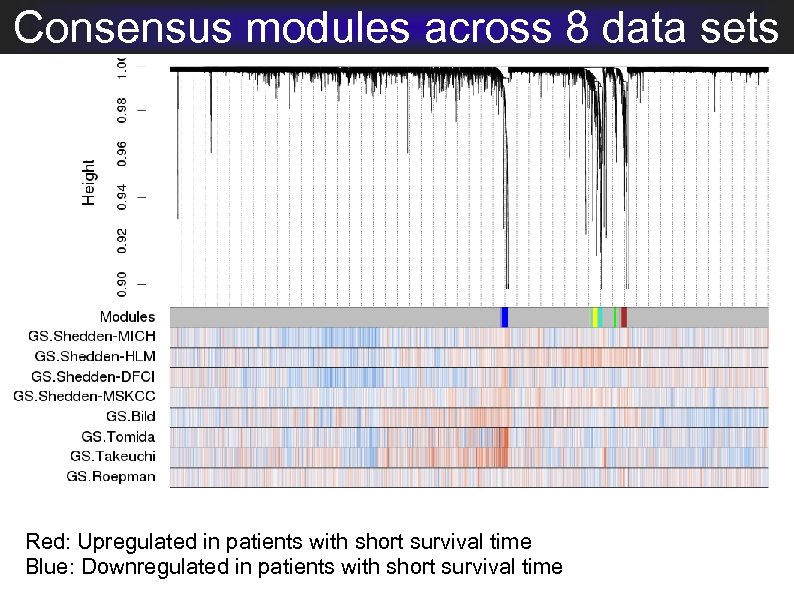 Consensus modules across 8 data sets Red: Upregulated in patients with short survival time Blue: Downregulated in patients with short survival time
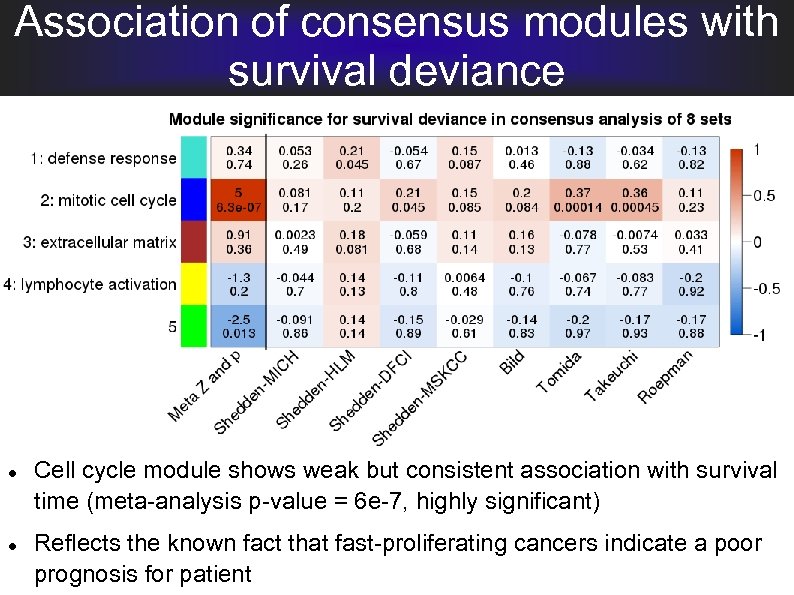 Association of consensus modules with survival deviance Cell cycle module shows weak but consistent association with survival time (meta-analysis p-value = 6 e-7, highly significant) Reflects the known fact that fast-proliferating cancers indicate a poor prognosis for patient
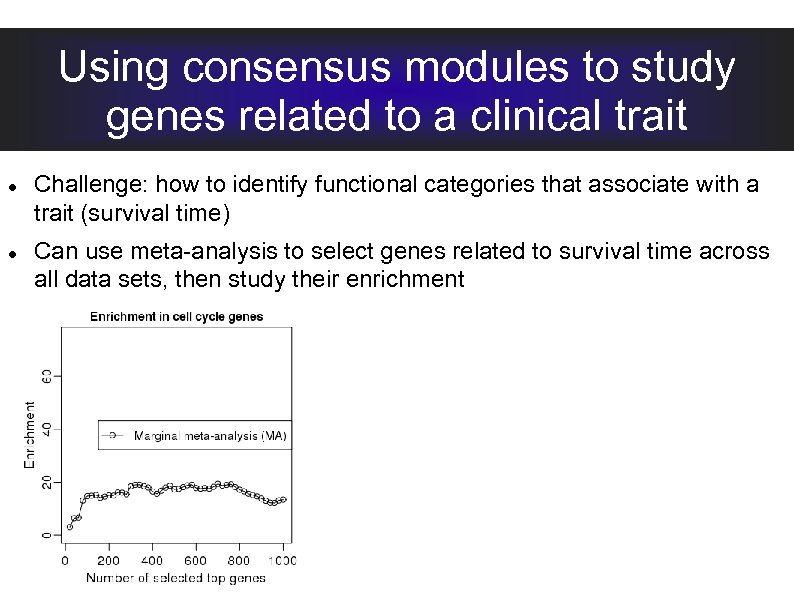 Using consensus modules to study genes related to a clinical trait Challenge: how to identify functional categories that associate with a trait (survival time) Can use meta-analysis to select genes related to survival time across all data sets, then study their enrichment
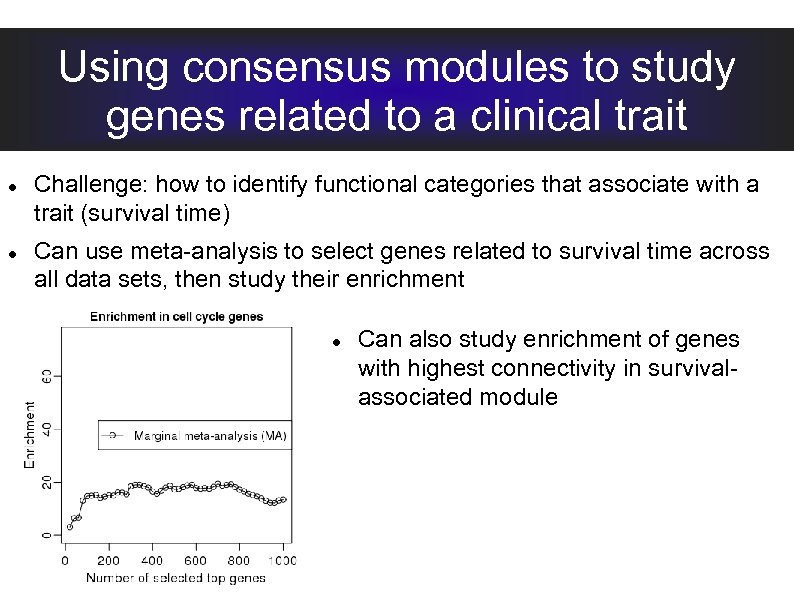 Using consensus modules to study genes related to a clinical trait Challenge: how to identify functional categories that associate with a trait (survival time) Can use meta-analysis to select genes related to survival time across all data sets, then study their enrichment Can also study enrichment of genes with highest connectivity in survivalassociated module
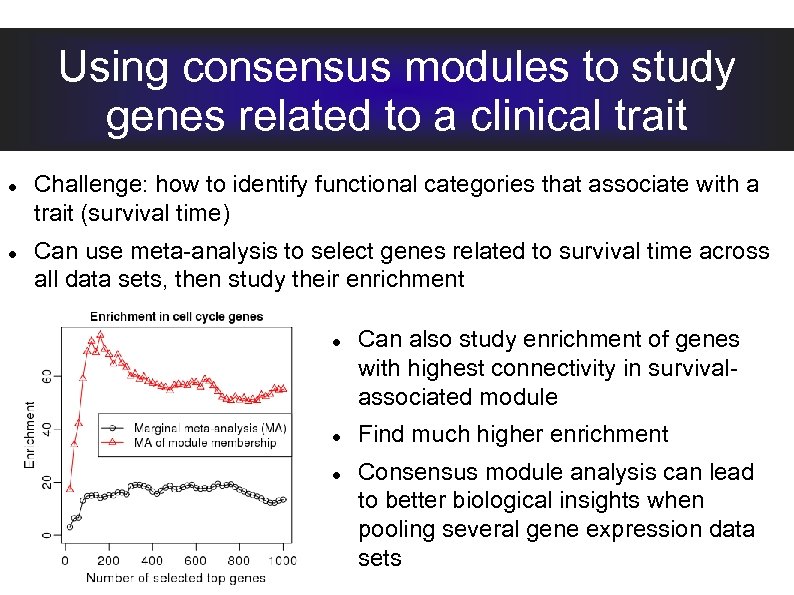
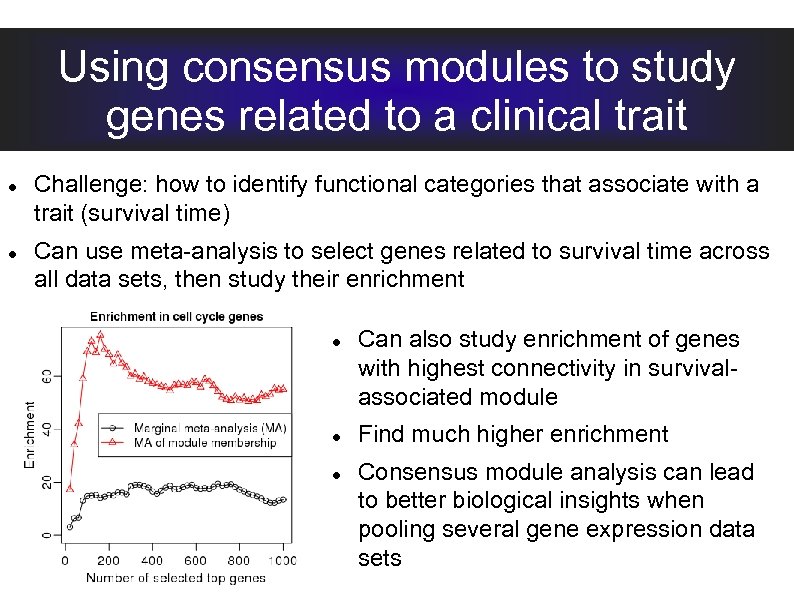 Using consensus modules to study genes related to a clinical trait Challenge: how to identify functional categories that associate with a trait (survival time) Can use meta-analysis to select genes related to survival time across all data sets, then study their enrichment Can also study enrichment of genes with highest connectivity in survivalassociated module Find much higher enrichment Consensus module analysis can lead to better biological insights when pooling several gene expression data sets
 Using consensus modules to study genes related to a clinical trait Challenge: how to identify functional categories that associate with a trait (survival time) Can use meta-analysis to select genes related to survival time across all data sets, then study their enrichment Can also study enrichment of genes with highest connectivity in survivalassociated module Find much higher enrichment Consensus module analysis can lead to better biological insights when pooling several gene expression data sets
 Application 2: Consensus modules across 4 brain regions in Huntington's Disease patients and controls
 Data Huntington's disease primarily affects motor skills Biggest changes are observed in Caudate Nucleus (CN), much smaller changes in Cortex and Cerebellum (CB) Disease causes dying of neurons and increase in astrocytes/ oligondendrocytes (inflammatory response) Hodges et al (2006): Measured expression in Caudate Nucleus, Motor Cortex, Association Cortex, Cerebellum in HD patients and controls Here: consensus analysis of the 4 data sets Hodges A et al, Regional and cellular gene expression changes in human Huntington's disease brain. Hum Mol Genet. 2006 Mar 15; 15(6): 965 -77
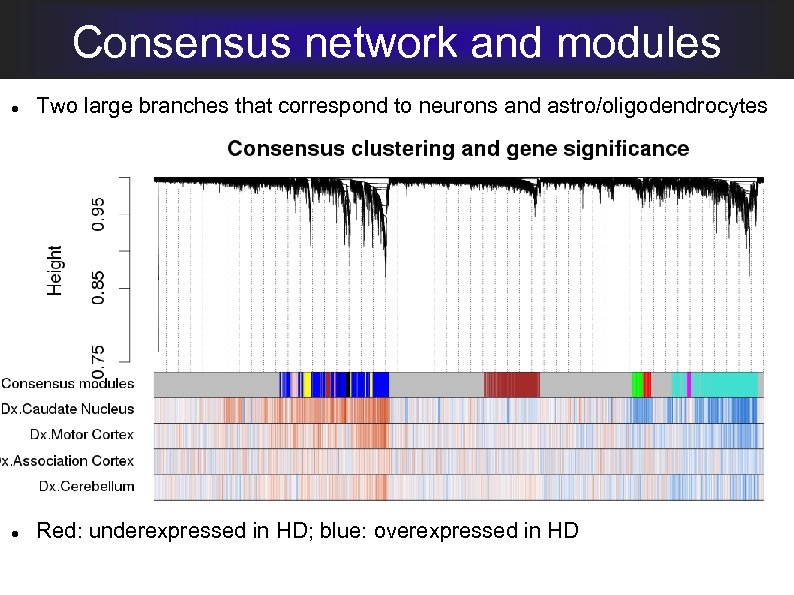 Consensus network and modules Two large branches that correspond to neurons and astro/oligodendrocytes Red: underexpressed in HD; blue: overexpressed in HD
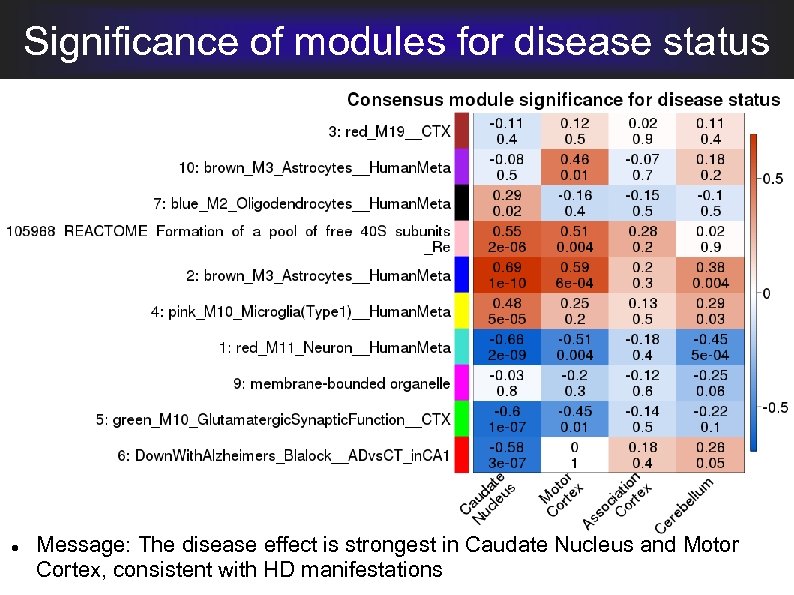 Significance of modules for disease status Message: The disease effect is strongest in Caudate Nucleus and Motor Cortex, consistent with HD manifestations
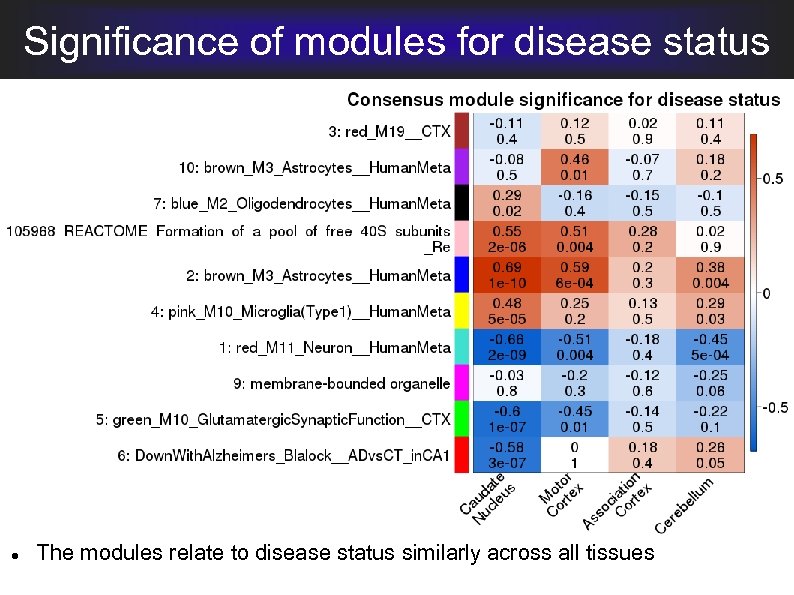 Significance of modules for disease status The modules relate to disease status similarly across all tissues
 Study meta-networks built from eigengenes of consensus modules Recall: modules are represented by their eigengenes (singular vectors obtained from SVD) Each consensus module has one eigengene in each data set In each data set: correlation among module eigengenes gives a birdeye view of the entire gene network: a correlation matrix of 12 k genes is reduced to a correlation matrix of 10 eigengenes Correlation of eigengenes reflects how the underlying pathways, processes, cell types, etc work together It may be interesting to study how eigengene correlation changes between data sets Langfelder and Horvath, Eigengene networks for studying the relationships between co-expression modules. BMC Systems Biology 2007, 1: 54
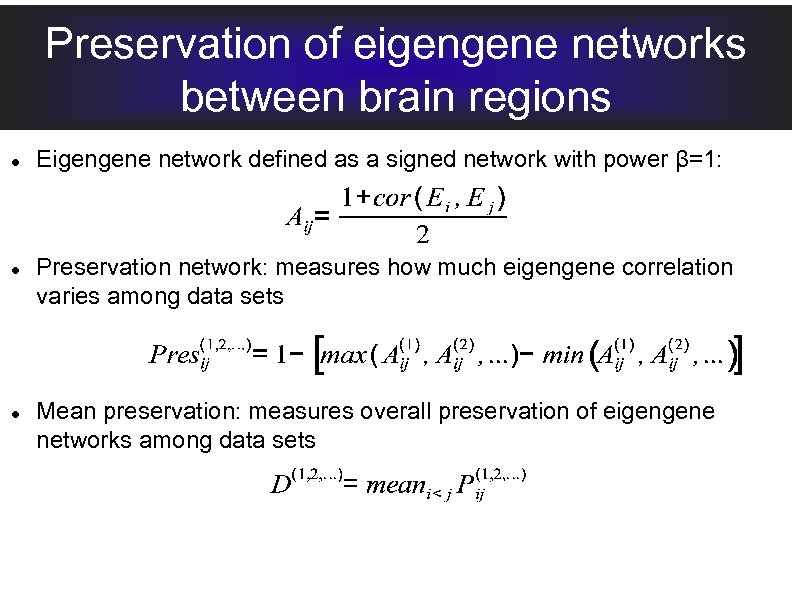 Preservation of eigengene networks between brain regions Eigengene network defined as a signed network with power β=1: Preservation network: measures how much eigengene correlation varies among data sets Mean preservation: measures overall preservation of eigengene networks among data sets
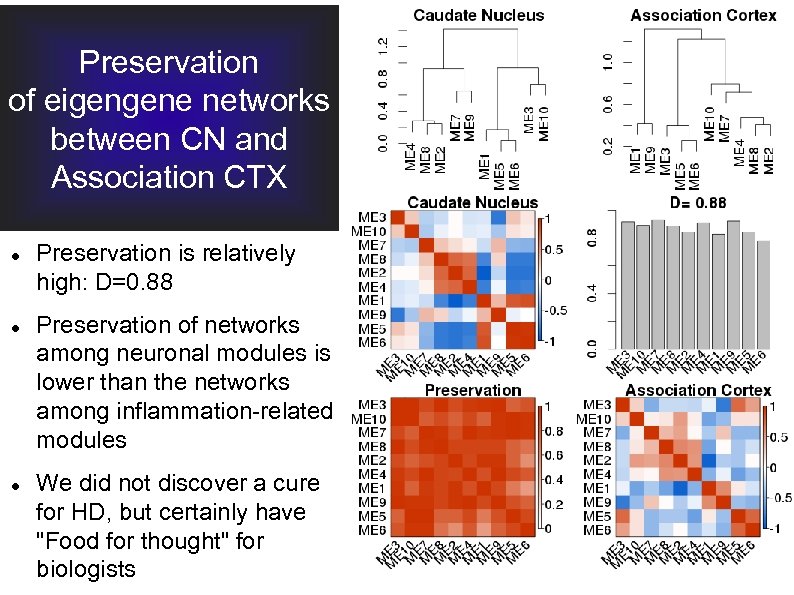 Preservation of eigengene networks between CN and Association CTX Preservation is relatively high: D=0. 88 Preservation of networks among neuronal modules is lower than the networks among inflammation-related modules We did not discover a cure for HD, but certainly have "Food for thought" for biologists
 What have we learned? Cancer application: consensus analysis identifies a module consistently related to survival time The module provides a cleaner biological interpretation than genes identified using standard meta-analysis Huntington's disease application: Consensus module analysis shows that HD affects different brain regions in a broadly similar manner but also shows differences in the way the regions are affected Consensus eigengene network analysis provides a way to study commonalities and differences in network organization of gene expression or other genomic data
 References Consensus modules and eigengene networks: Langfelder P, Horvath S (2007) Eigengene networks for studying the relationships between co-expression modules. BMC Systems Biology 1: 54 labs. genetics. ucla. edu/horvath/htdocs/Coexpression. Network/Eigengene. Network/ Cancer application of consensus modules: Langfelder P, Mischel PS, Horvath S (2013) When Is Hub Gene Selection Better than Standard Meta-Analysis? PLo. S ONE 8(4): e 61505. labs. genetics. ucla. edu/horvath/Coexpression. Network/Meta. Analysis/