 Скачать презентацию Conquering Complex and Changing Systems Object-Oriented Software Engineering
5057502812a971560f2a5db0f2431553.ppt
- Количество слайдов: 115




Conquering Complex and Changing Systems Object-Oriented Software Engineering Chapter 7, Object Design
Object Design ¨ ¨ ¨ Object design is the process of adding details to the requirements analysis and making implementation decisions The object designer must choose among different ways to implement the analysis model with the goal to minimize execution time, memory and other measures of cost. Requirements Analysis: Use cases, functional and dynamic model deliver operations for object model Object Design: We iterate on where to put these operations in the object model Object Design serves as the basis of implementation UNB CS 3013 Software Engineering II lectures adapted from Bernd Bruegge & Allen Dutoit, Object-Oriented Software Engineering: Conquering Complex and Changing Systems 2
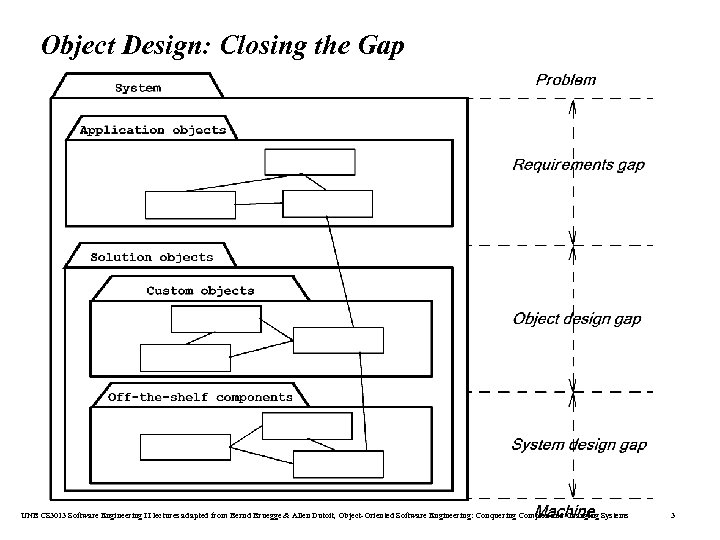
Object Design: Closing the Gap UNB CS 3013 Software Engineering II lectures adapted from Bernd Bruegge & Allen Dutoit, Object-Oriented Software Engineering: Conquering Complex and Changing Systems 3
Object Design Issues ¨ ¨ ¨ ¨ Full definition of associations Full definition of classes Choice of algorithms and data structures Detection of new application-domain independent classes (example: Cache) Optimization Increase of inheritance Decision on control Packaging UNB CS 3013 Software Engineering II lectures adapted from Bernd Bruegge & Allen Dutoit, Object-Oriented Software Engineering: Conquering Complex and Changing Systems 4
Terminology of Activities ¨ Object-Oriented Methodologies w System Design t Decomposition into subsystems w Object Design t t ¨ Implementation language chosen Data structures and algorithms chosen SA/SD uses different terminology: w Preliminary Design t t Decomposition into subsystems Data structures are chosen w Detailed Design t t Algorithms are chosen Data structures are refined Implementation language is chosen Typically in parallel with preliminary design, not separate stage UNB CS 3013 Software Engineering II lectures adapted from Bernd Bruegge & Allen Dutoit, Object-Oriented Software Engineering: Conquering Complex and Changing Systems 5
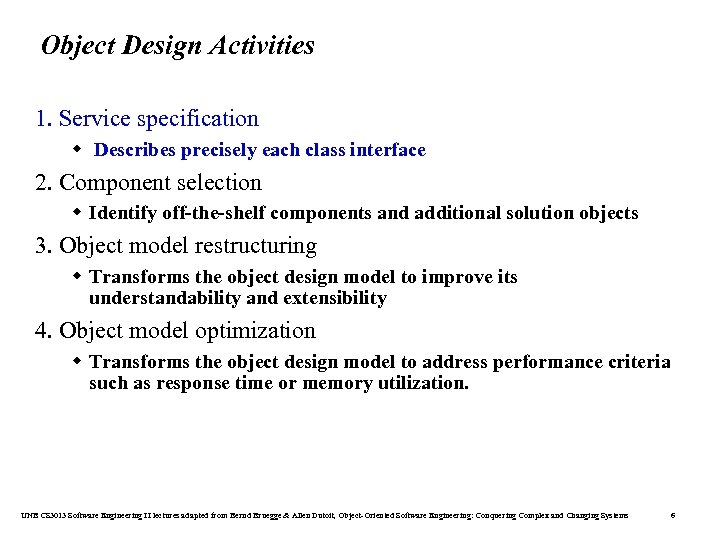
Object Design Activities 1. Service specification w Describes precisely each class interface 2. Component selection w Identify off-the-shelf components and additional solution objects 3. Object model restructuring w Transforms the object design model to improve its understandability and extensibility 4. Object model optimization w Transforms the object design model to address performance criteria such as response time or memory utilization. UNB CS 3013 Software Engineering II lectures adapted from Bernd Bruegge & Allen Dutoit, Object-Oriented Software Engineering: Conquering Complex and Changing Systems 6
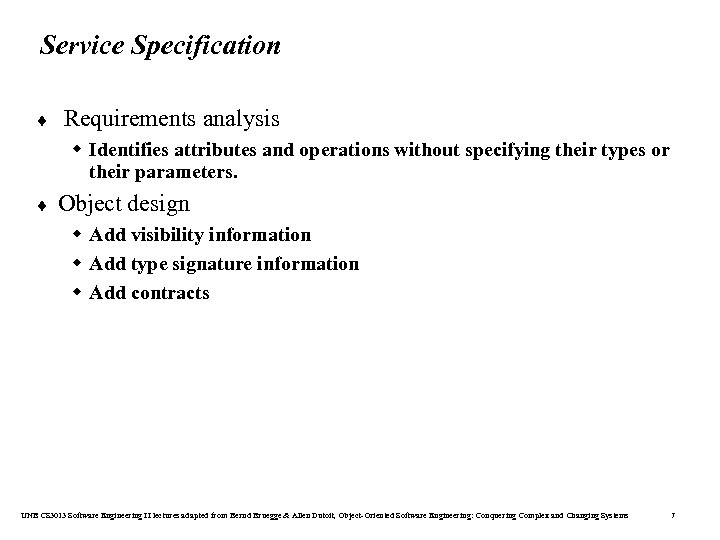
Service Specification ¨ Requirements analysis w Identifies attributes and operations without specifying their types or their parameters. ¨ Object design w Add visibility information w Add type signature information w Add contracts UNB CS 3013 Software Engineering II lectures adapted from Bernd Bruegge & Allen Dutoit, Object-Oriented Software Engineering: Conquering Complex and Changing Systems 7
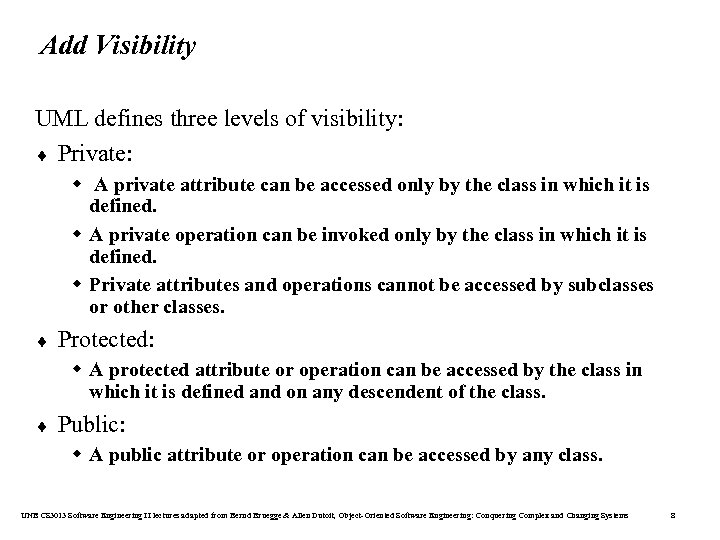
Add Visibility UML defines three levels of visibility: ¨ Private: w A private attribute can be accessed only by the class in which it is defined. w A private operation can be invoked only by the class in which it is defined. w Private attributes and operations cannot be accessed by subclasses or other classes. ¨ Protected: w A protected attribute or operation can be accessed by the class in which it is defined and on any descendent of the class. ¨ Public: w A public attribute or operation can be accessed by any class. UNB CS 3013 Software Engineering II lectures adapted from Bernd Bruegge & Allen Dutoit, Object-Oriented Software Engineering: Conquering Complex and Changing Systems 8
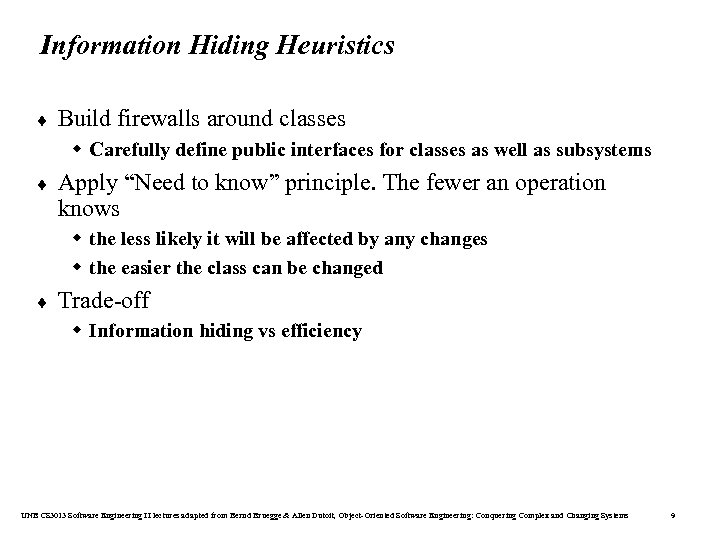
Information Hiding Heuristics ¨ Build firewalls around classes w Carefully define public interfaces for classes as well as subsystems ¨ Apply “Need to know” principle. The fewer an operation knows w the less likely it will be affected by any changes w the easier the class can be changed ¨ Trade-off w Information hiding vs efficiency UNB CS 3013 Software Engineering II lectures adapted from Bernd Bruegge & Allen Dutoit, Object-Oriented Software Engineering: Conquering Complex and Changing Systems 9
Information Hiding Design Principles ¨ Only the operations of a class are allowed to manipulate its attributes w Access attributes only via operations. ¨ Hide external objects at subsystem boundary w Define abstract class interfaces which mediate between system and external world as well as between subsystems ¨ Do not apply an operation to the result of another operation. w Write a new operation that combines the two operations. UNB CS 3013 Software Engineering II lectures adapted from Bernd Bruegge & Allen Dutoit, Object-Oriented Software Engineering: Conquering Complex and Changing Systems 10
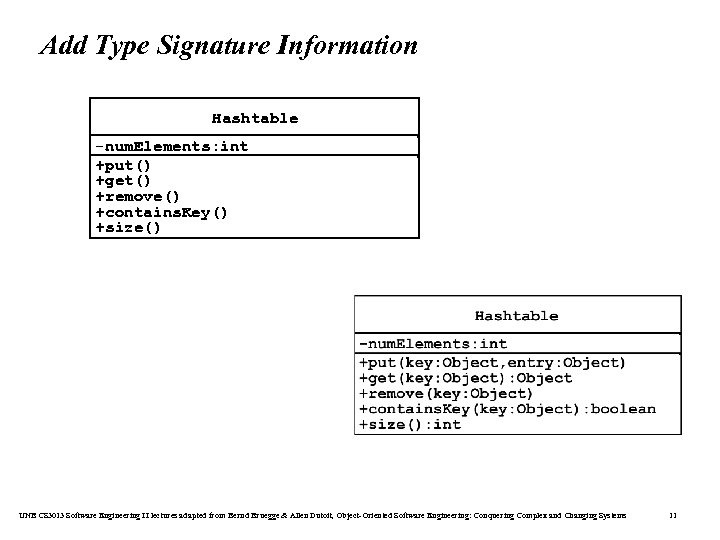
Add Type Signature Information Hashtable -num. Elements: int +put() +get() +remove() +contains. Key() +size() UNB CS 3013 Software Engineering II lectures adapted from Bernd Bruegge & Allen Dutoit, Object-Oriented Software Engineering: Conquering Complex and Changing Systems 11
Contracts ¨ ¨ Contracts on a class enable caller and callee to share the same assumptions about the class. Contracts include three types of constraints: w Invariant: A predicate that is always true for all instances of a class. Invariants are constraints associated with classes or interfaces. Invariants are used to specify consistency constraints among class attributes. w Precondition: A predicate that must be true before an operation is invoked. Preconditions are associated with a specific operation. Preconditions are used to specify constraints that a caller must meet before calling an operation. w Postcondition: A predicate that must be true after an operation is invoked. Postconditions are associated with a specific operation. Postconditions are used to specify constraints that the object must ensure after the invocation of the operation. UNB CS 3013 Software Engineering II lectures adapted from Bernd Bruegge & Allen Dutoit, Object-Oriented Software Engineering: Conquering Complex and Changing Systems 12
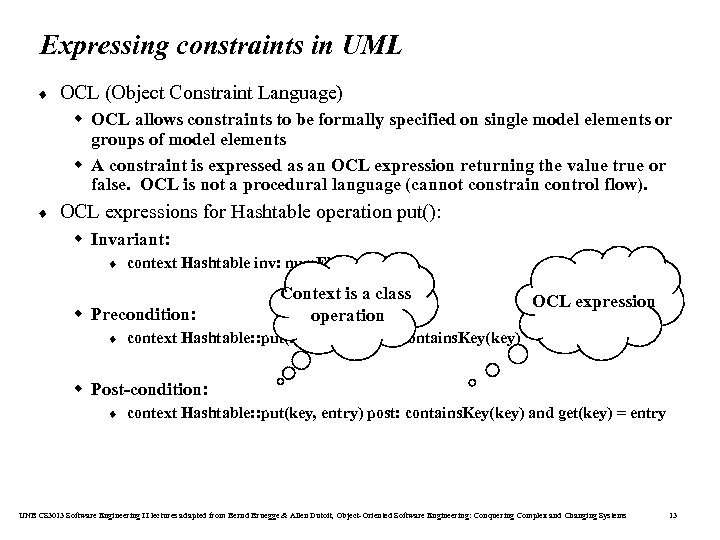
Expressing constraints in UML ¨ OCL (Object Constraint Language) w OCL allows constraints to be formally specified on single model elements or groups of model elements w A constraint is expressed as an OCL expression returning the value true or false. OCL is not a procedural language (cannot constrain control flow). ¨ OCL expressions for Hashtable operation put(): w Invariant: t context Hashtable inv: num. Elements >= 0 w Precondition: t Context is a class operation OCL expression context Hashtable: : put(key, entry) pre: !contains. Key(key) w Post-condition: t context Hashtable: : put(key, entry) post: contains. Key(key) and get(key) = entry UNB CS 3013 Software Engineering II lectures adapted from Bernd Bruegge & Allen Dutoit, Object-Oriented Software Engineering: Conquering Complex and Changing Systems 13
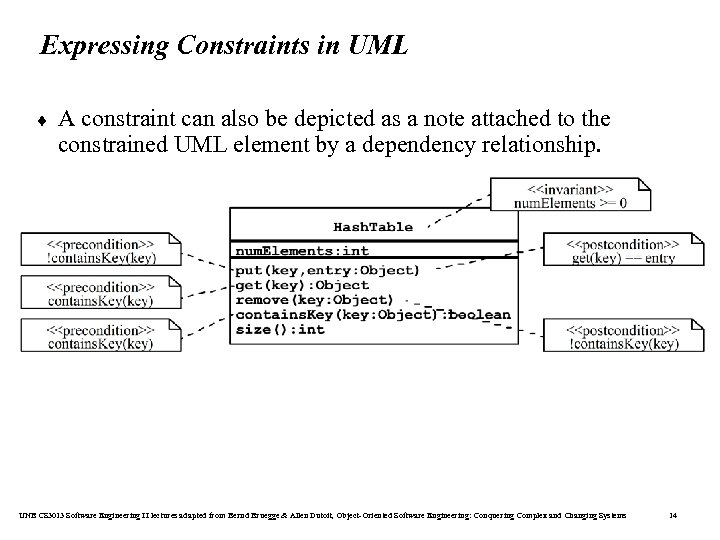
Expressing Constraints in UML ¨ A constraint can also be depicted as a note attached to the constrained UML element by a dependency relationship. UNB CS 3013 Software Engineering II lectures adapted from Bernd Bruegge & Allen Dutoit, Object-Oriented Software Engineering: Conquering Complex and Changing Systems 14
Object Design Areas 1. Service specification w Describes precisely each class interface 2. Component selection w Identify off-the-shelf components and additional solution objects 3. Object model restructuring w Transforms the object design model to improve its understandability and extensibility 4. Object model optimization w Transforms the object design model to address performance criteria such as response time or memory utilization. UNB CS 3013 Software Engineering II lectures adapted from Bernd Bruegge & Allen Dutoit, Object-Oriented Software Engineering: Conquering Complex and Changing Systems 15
Component Selection ¨ ¨ Select existing off-the-shelf class libraries, frameworks or components Adjust the class libraries, framework or components w Change the API if you have the source code. w Use the adapter or bridge pattern if you don’t have access UNB CS 3013 Software Engineering II lectures adapted from Bernd Bruegge & Allen Dutoit, Object-Oriented Software Engineering: Conquering Complex and Changing Systems 16
Reuse. . . ¨ Look for existing classes in class libraries w JSAPI, JTAPI, . . ¨ Select data structures appropriate to the algorithms w Container classes w Arrays, lists, queues, stacks, sets, trees, . . . ¨ Define new internal classes and operations only if necessary w Complex operations defined in terms of lower-level operations might need new classes and operations UNB CS 3013 Software Engineering II lectures adapted from Bernd Bruegge & Allen Dutoit, Object-Oriented Software Engineering: Conquering Complex and Changing Systems 17
Object Design Areas 1. Service specification w Describes precisely each class interface 2. Component selection w Identify off-the-shelf components and additional solution objects 3. Object model restructuring w Transforms the object design model to improve its understandability and extensibility 4. Object model optimization w Transforms the object design model to address performance criteria such as response time or memory utilization. UNB CS 3013 Software Engineering II lectures adapted from Bernd Bruegge & Allen Dutoit, Object-Oriented Software Engineering: Conquering Complex and Changing Systems 18
Restructuring Activities This Lecture ¨ ¨ ¨ Realizing associations Revisiting inheritance to increase reuse Revising inheritance to remove implementation dependencies UNB CS 3013 Software Engineering II lectures adapted from Bernd Bruegge & Allen Dutoit, Object-Oriented Software Engineering: Conquering Complex and Changing Systems 19
Increase Inheritance ¨ ¨ Rearrange and adjust classes and operations to prepare for inheritance Abstract common behavior out of groups of classes w If a set of operations or attributes are repeated in 2 classes the classes might be special instances of a more general class. ¨ Be prepared to change a subsystem (collection of classes) into a superclass in an inheritance hierarchy. UNB CS 3013 Software Engineering II lectures adapted from Bernd Bruegge & Allen Dutoit, Object-Oriented Software Engineering: Conquering Complex and Changing Systems 20
Building a super class from several classes ¨ Prepare for inheritance. All operations must have the same signature but often the signatures do not match: w Some operations have fewer arguments than others: Use overloading (Possible in Java) w Similar attributes in the classes have different names: Rename attribute and change all the operations. w Operations defined in one class but no in the other: Use virtual functions and class function overriding. ¨ ¨ Abstract out the common behavior (set of operations with same signature) and create a superclass out of it. Superclasses are desirable. They w increase modularity, extensibility and reusability w improve configuration management UNB CS 3013 Software Engineering II lectures adapted from Bernd Bruegge & Allen Dutoit, Object-Oriented Software Engineering: Conquering Complex and Changing Systems 21
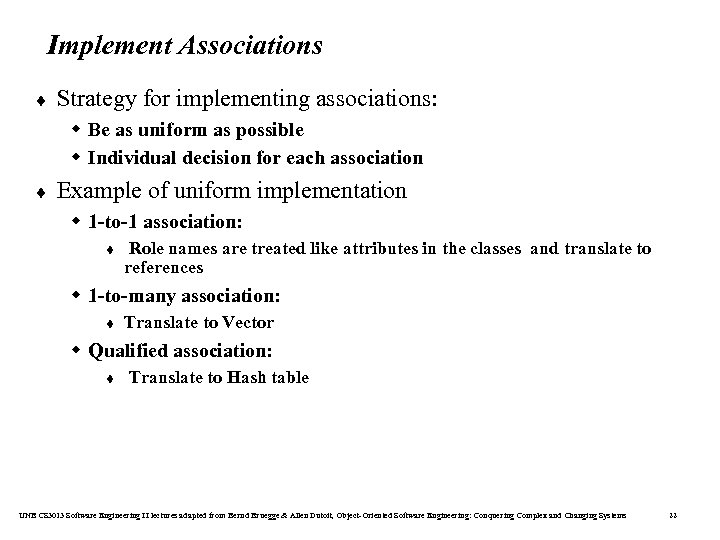
Implement Associations ¨ Strategy for implementing associations: w Be as uniform as possible w Individual decision for each association ¨ Example of uniform implementation w 1 -to-1 association: t Role names are treated like attributes in the classes and translate to references w 1 -to-many association: t Translate to Vector w Qualified association: t Translate to Hash table UNB CS 3013 Software Engineering II lectures adapted from Bernd Bruegge & Allen Dutoit, Object-Oriented Software Engineering: Conquering Complex and Changing Systems 22
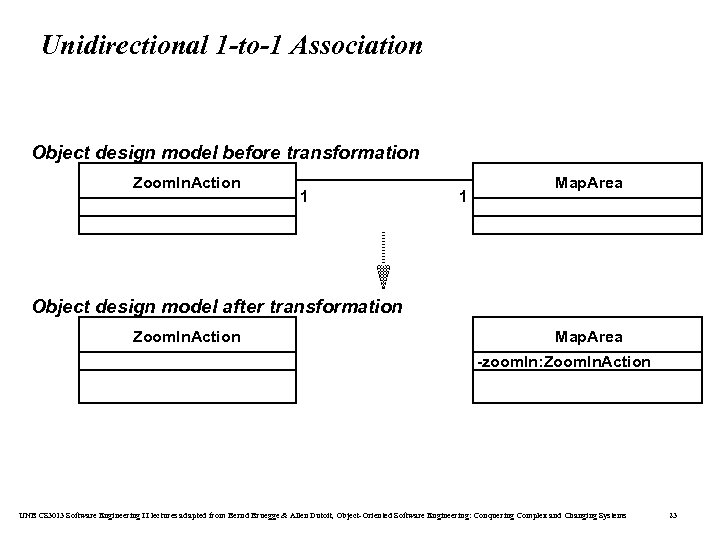
Unidirectional 1 -to-1 Association Object design model before transformation Zoom. In. Action 1 1 Map. Area Object design model after transformation Zoom. In. Action Map. Area -zoom. In: Zoom. In. Action UNB CS 3013 Software Engineering II lectures adapted from Bernd Bruegge & Allen Dutoit, Object-Oriented Software Engineering: Conquering Complex and Changing Systems 23
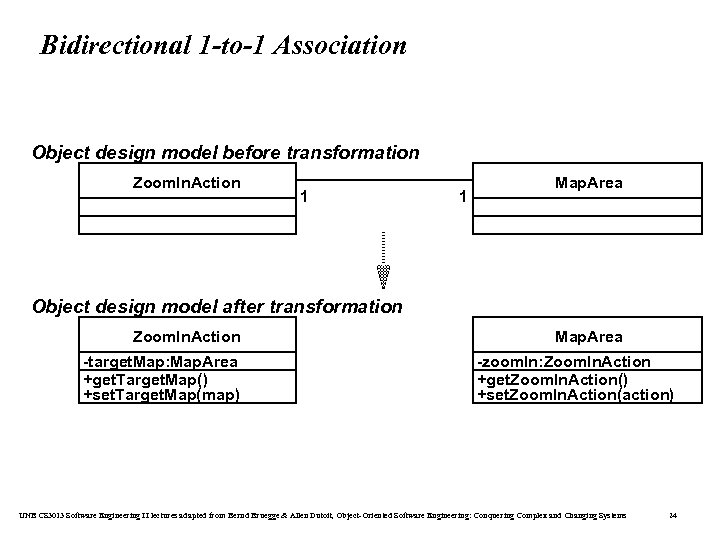
Bidirectional 1 -to-1 Association Object design model before transformation Zoom. In. Action 1 1 Map. Area Object design model after transformation Zoom. In. Action -target. Map: Map. Area +get. Target. Map() +set. Target. Map(map) Map. Area -zoom. In: Zoom. In. Action +get. Zoom. In. Action() +set. Zoom. In. Action(action) UNB CS 3013 Software Engineering II lectures adapted from Bernd Bruegge & Allen Dutoit, Object-Oriented Software Engineering: Conquering Complex and Changing Systems 24
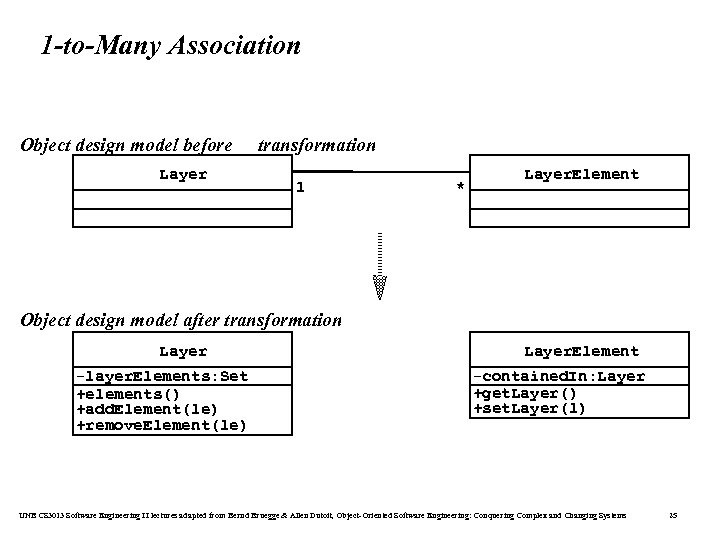
1 -to-Many Association Object design model before Layer transformation 1 * Layer. Element Object design model after transformation Layer -layer. Elements: Set +elements() +add. Element(le) +remove. Element(le) Layer. Element -contained. In: Layer +get. Layer() +set. Layer(l) UNB CS 3013 Software Engineering II lectures adapted from Bernd Bruegge & Allen Dutoit, Object-Oriented Software Engineering: Conquering Complex and Changing Systems 25
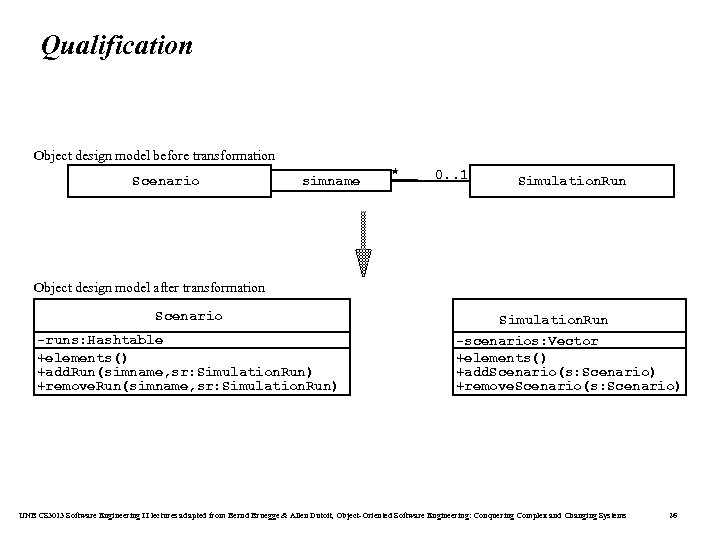
Qualification Object design model before transformation Scenario simname * 0. . 1 Simulation. Run Object design model after transformation Scenario -runs: Hashtable +elements() +add. Run(simname, sr: Simulation. Run) +remove. Run(simname, sr: Simulation. Run) Simulation. Run -scenarios: Vector +elements() +add. Scenario(s: Scenario) +remove. Scenario(s: Scenario) UNB CS 3013 Software Engineering II lectures adapted from Bernd Bruegge & Allen Dutoit, Object-Oriented Software Engineering: Conquering Complex and Changing Systems 26
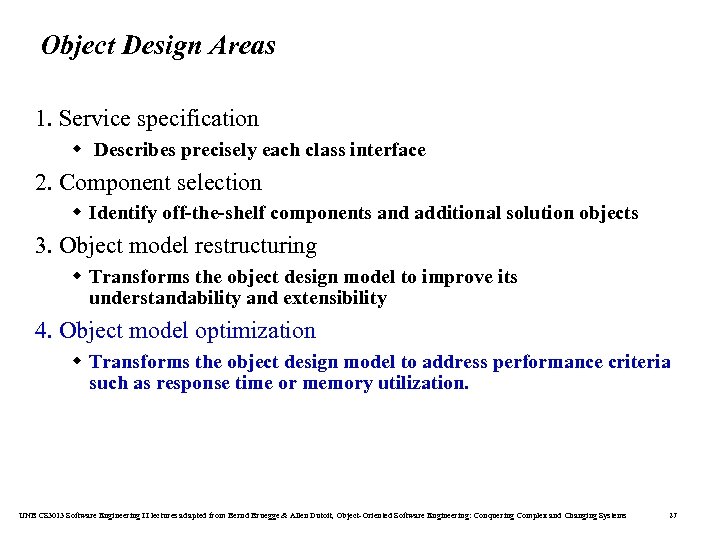
Object Design Areas 1. Service specification w Describes precisely each class interface 2. Component selection w Identify off-the-shelf components and additional solution objects 3. Object model restructuring w Transforms the object design model to improve its understandability and extensibility 4. Object model optimization w Transforms the object design model to address performance criteria such as response time or memory utilization. UNB CS 3013 Software Engineering II lectures adapted from Bernd Bruegge & Allen Dutoit, Object-Oriented Software Engineering: Conquering Complex and Changing Systems 27
Design Optimizations ¨ Design optimizations are an important part of the object design phase: w The requirements analysis model is semantically correct but often too inefficient if directly implemented. ¨ Optimization activities during object design: 1. Add redundant associations to minimize access cost 2. Rearrange computations for greater efficiency 3. Store derived attributes to save computation time ¨ As an object designer you must strike a balance between efficiency and clarity. w Optimizations will make your models more obscure UNB CS 3013 Software Engineering II lectures adapted from Bernd Bruegge & Allen Dutoit, Object-Oriented Software Engineering: Conquering Complex and Changing Systems 28
Design Optimization Activities 1. Add redundant associations: w What are the most frequent operations? ( Sensor data lookup? ) w How often is the operation called? (30 times a month, every 50 milliseconds) 2. Rearrange execution order w Eliminate dead paths as early as possible (Use knowledge of distributions, frequency of path traversals) w Narrow search as soon as possible w Check if execution order of loop should be reversed 3. Turn classes into attributes UNB CS 3013 Software Engineering II lectures adapted from Bernd Bruegge & Allen Dutoit, Object-Oriented Software Engineering: Conquering Complex and Changing Systems 29
Implement Application domain classes ¨ ¨ To collapse or not collapse: Attribute or association? Object design choices: w Implement entity as embedded attribute w Implement entity as separate class with associations to other classes ¨ Associations are more flexible than attributes but often introduce unnecessary indirection. UNB CS 3013 Software Engineering II lectures adapted from Bernd Bruegge & Allen Dutoit, Object-Oriented Software Engineering: Conquering Complex and Changing Systems 30
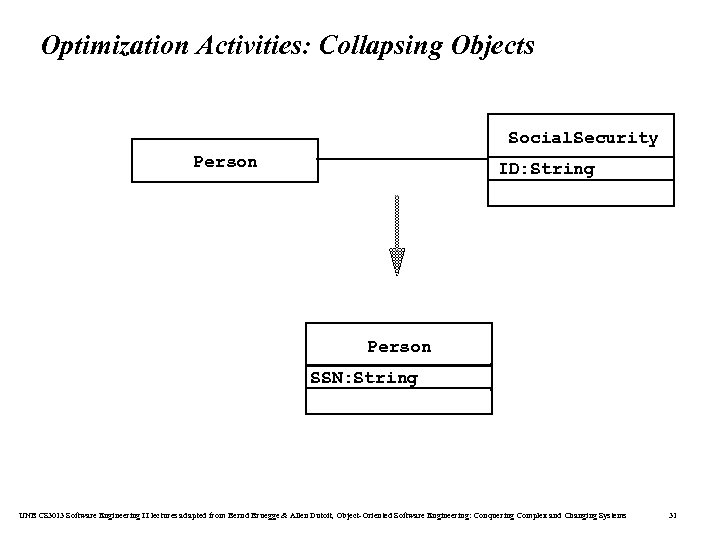
Optimization Activities: Collapsing Objects Social. Security Person ID: String Person SSN: String UNB CS 3013 Software Engineering II lectures adapted from Bernd Bruegge & Allen Dutoit, Object-Oriented Software Engineering: Conquering Complex and Changing Systems 31
To Collapse or not to Collapse? ¨ Collapse a class into an attribute if the only operations defined on the attributes are Set() and Get(). UNB CS 3013 Software Engineering II lectures adapted from Bernd Bruegge & Allen Dutoit, Object-Oriented Software Engineering: Conquering Complex and Changing Systems 32
Design Optimizations (continued) Store derived attributes w Example: Define new classes to store information locally (database cache) ¨ Problem with derived attributes: w Derived attributes must be updated when base values change. w There are 3 ways to deal with the update problem: t t t Explicit code: Implementor determines affected derived attributes (push) Periodic computation: Recompute derived attribute occasionally (pull) Active value: An attribute can designate set of dependent values which are automatically updated when active value is changed (notification, data trigger) UNB CS 3013 Software Engineering II lectures adapted from Bernd Bruegge & Allen Dutoit, Object-Oriented Software Engineering: Conquering Complex and Changing Systems 33
![Optimization Activities: Delaying Complex Computations Image filename: String data: byte[] width() height() paint() Image](https://present5.com/presentation/5057502812a971560f2a5db0f2431553/image-34.jpg "Optimization Activities: Delaying Complex Computations Image filename: String data: byte[] width() height() paint() Image")
Optimization Activities: Delaying Complex Computations Image filename: String data: byte[] width() height() paint() Image filename: String width() height() paint() Image. Proxy filename: String width() height() paint() image 1 0. . 1 Real. Image data: byte[] width() height() paint() UNB CS 3013 Software Engineering II lectures adapted from Bernd Bruegge & Allen Dutoit, Object-Oriented Software Engineering: Conquering Complex and Changing Systems 34
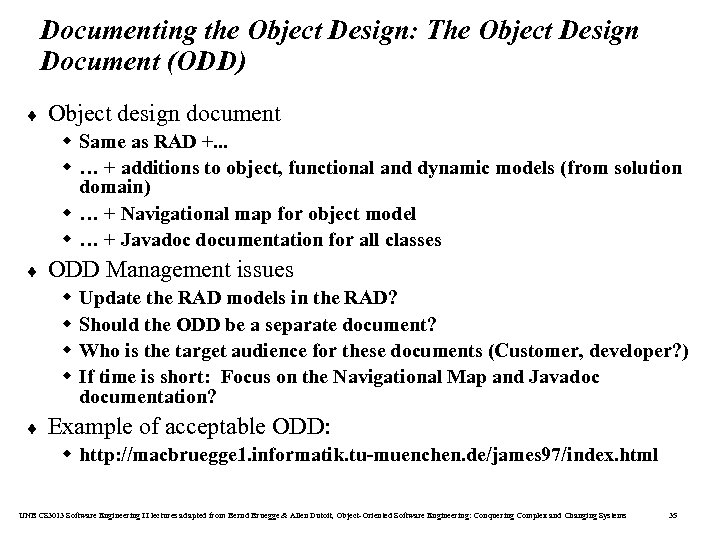
Documenting the Object Design: The Object Design Document (ODD) ¨ Object design document w Same as RAD +. . . w … + additions to object, functional and dynamic models (from solution domain) w … + Navigational map for object model w … + Javadoc documentation for all classes ¨ ODD Management issues w w ¨ Update the RAD models in the RAD? Should the ODD be a separate document? Who is the target audience for these documents (Customer, developer? ) If time is short: Focus on the Navigational Map and Javadoc documentation? Example of acceptable ODD: w http: //macbruegge 1. informatik. tu-muenchen. de/james 97/index. html UNB CS 3013 Software Engineering II lectures adapted from Bernd Bruegge & Allen Dutoit, Object-Oriented Software Engineering: Conquering Complex and Changing Systems 35
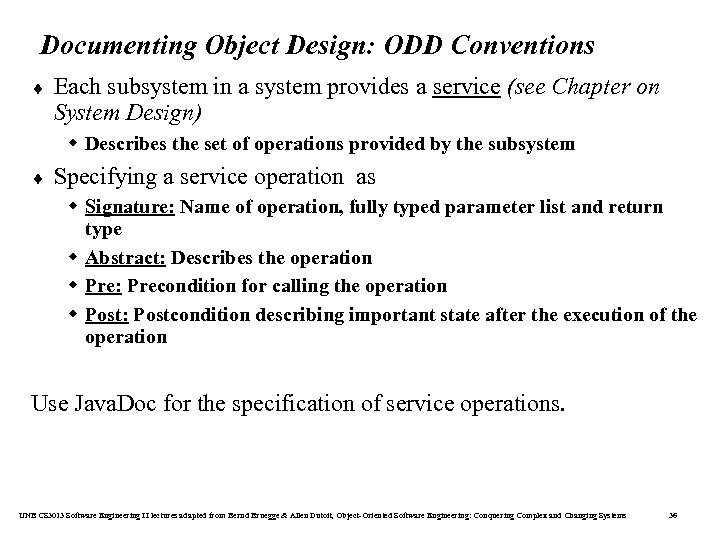
Documenting Object Design: ODD Conventions ¨ Each subsystem in a system provides a service (see Chapter on System Design) w Describes the set of operations provided by the subsystem ¨ Specifying a service operation as w Signature: Name of operation, fully typed parameter list and return type w Abstract: Describes the operation w Pre: Precondition for calling the operation w Post: Postcondition describing important state after the execution of the operation Use Java. Doc for the specification of service operations. UNB CS 3013 Software Engineering II lectures adapted from Bernd Bruegge & Allen Dutoit, Object-Oriented Software Engineering: Conquering Complex and Changing Systems 36
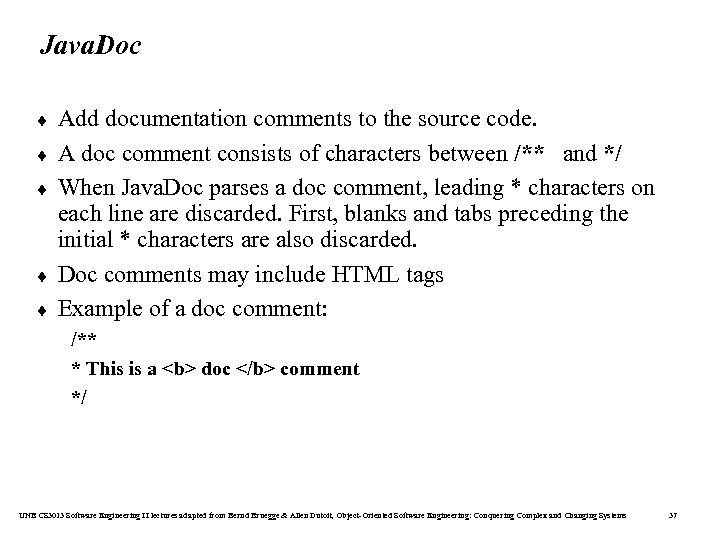
Java. Doc ¨ ¨ ¨ Add documentation comments to the source code. A doc comment consists of characters between /** and */ When Java. Doc parses a doc comment, leading * characters on each line are discarded. First, blanks and tabs preceding the initial * characters are also discarded. Doc comments may include HTML tags Example of a doc comment: /** * This is a <b> doc </b> comment */ UNB CS 3013 Software Engineering II lectures adapted from Bernd Bruegge & Allen Dutoit, Object-Oriented Software Engineering: Conquering Complex and Changing Systems 37
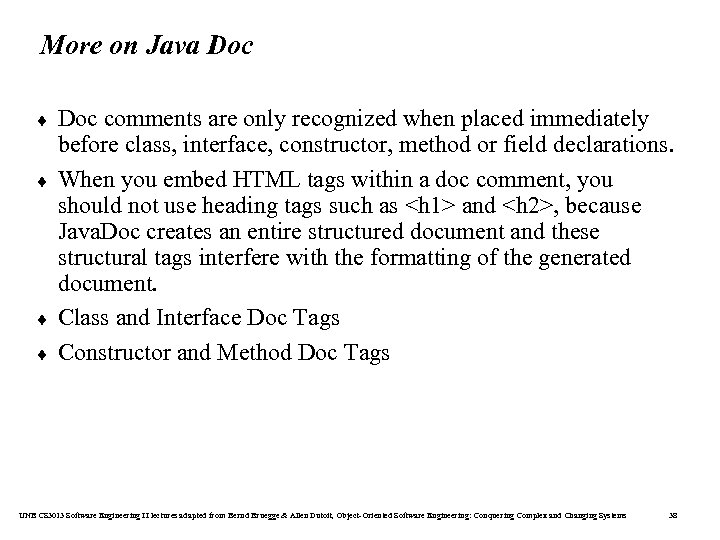
More on Java Doc ¨ ¨ Doc comments are only recognized when placed immediately before class, interface, constructor, method or field declarations. When you embed HTML tags within a doc comment, you should not use heading tags such as <h 1> and <h 2>, because Java. Doc creates an entire structured document and these structural tags interfere with the formatting of the generated document. Class and Interface Doc Tags Constructor and Method Doc Tags UNB CS 3013 Software Engineering II lectures adapted from Bernd Bruegge & Allen Dutoit, Object-Oriented Software Engineering: Conquering Complex and Changing Systems 38
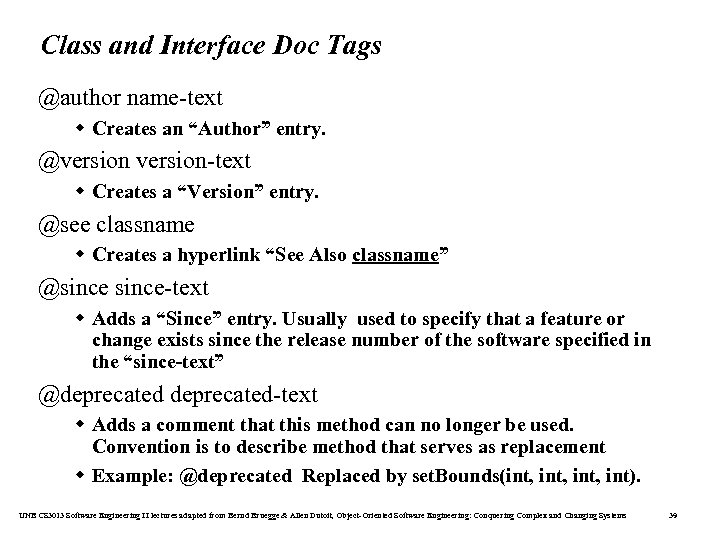
Class and Interface Doc Tags @author name-text w Creates an “Author” entry. @version-text w Creates a “Version” entry. @see classname w Creates a hyperlink “See Also classname” @since-text w Adds a “Since” entry. Usually used to specify that a feature or change exists since the release number of the software specified in the “since-text” @deprecated-text w Adds a comment that this method can no longer be used. Convention is to describe method that serves as replacement w Example: @deprecated Replaced by set. Bounds(int, int). UNB CS 3013 Software Engineering II lectures adapted from Bernd Bruegge & Allen Dutoit, Object-Oriented Software Engineering: Conquering Complex and Changing Systems 39
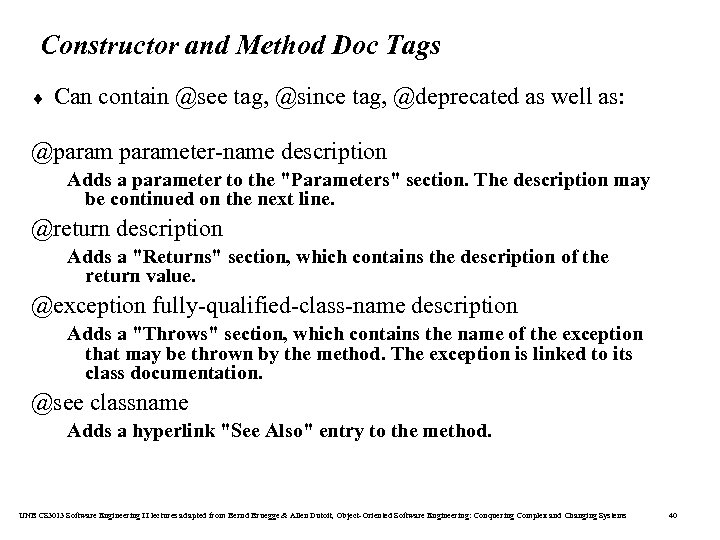
Constructor and Method Doc Tags ¨ Can contain @see tag, @since tag, @deprecated as well as: @parameter-name description Adds a parameter to the "Parameters" section. The description may be continued on the next line. @return description Adds a "Returns" section, which contains the description of the return value. @exception fully-qualified-class-name description Adds a "Throws" section, which contains the name of the exception that may be thrown by the method. The exception is linked to its class documentation. @see classname Adds a hyperlink "See Also" entry to the method. UNB CS 3013 Software Engineering II lectures adapted from Bernd Bruegge & Allen Dutoit, Object-Oriented Software Engineering: Conquering Complex and Changing Systems 40
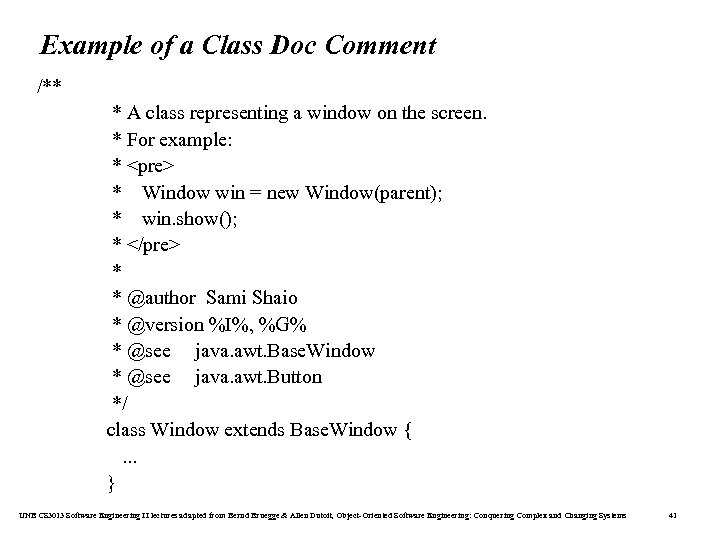
Example of a Class Doc Comment /** * A class representing a window on the screen. * For example: * <pre> * Window win = new Window(parent); * win. show(); * </pre> * * @author Sami Shaio * @version %I%, %G% * @see java. awt. Base. Window * @see java. awt. Button */ class Window extends Base. Window {. . . } UNB CS 3013 Software Engineering II lectures adapted from Bernd Bruegge & Allen Dutoit, Object-Oriented Software Engineering: Conquering Complex and Changing Systems 41
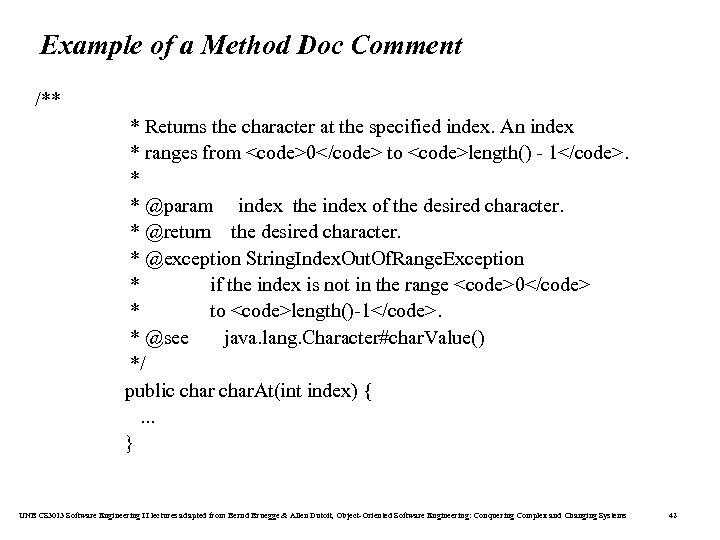
Example of a Method Doc Comment /** * Returns the character at the specified index. An index * ranges from <code>0</code> to <code>length() - 1</code>. * * @param index the index of the desired character. * @return the desired character. * @exception String. Index. Out. Of. Range. Exception * if the index is not in the range <code>0</code> * to <code>length()-1</code>. * @see java. lang. Character#char. Value() */ public char. At(int index) {. . . } UNB CS 3013 Software Engineering II lectures adapted from Bernd Bruegge & Allen Dutoit, Object-Oriented Software Engineering: Conquering Complex and Changing Systems 42
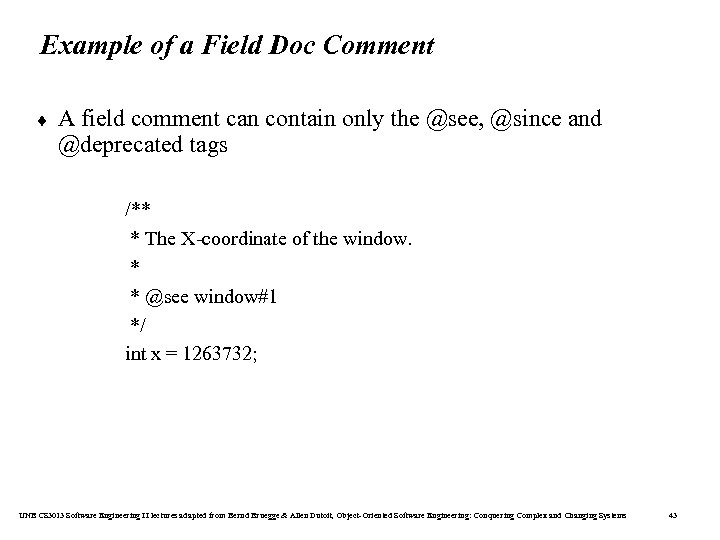
Example of a Field Doc Comment ¨ A field comment can contain only the @see, @since and @deprecated tags /** * The X-coordinate of the window. * * @see window#1 */ int x = 1263732; UNB CS 3013 Software Engineering II lectures adapted from Bernd Bruegge & Allen Dutoit, Object-Oriented Software Engineering: Conquering Complex and Changing Systems 43
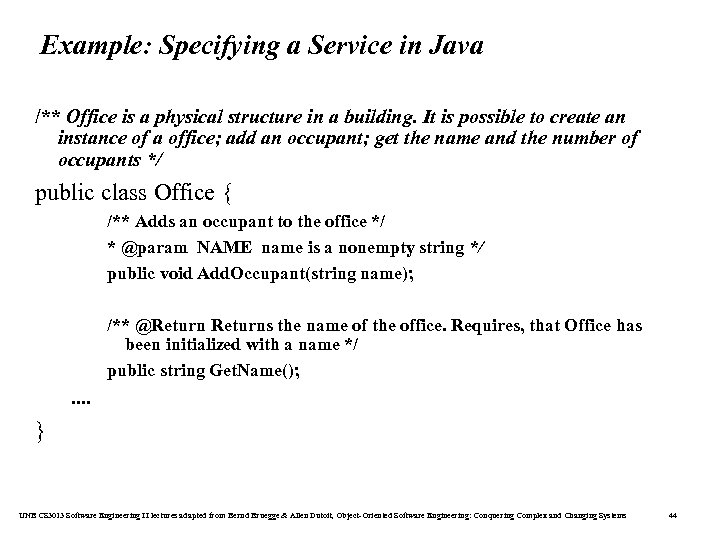
Example: Specifying a Service in Java /** Office is a physical structure in a building. It is possible to create an instance of a office; add an occupant; get the name and the number of occupants */ public class Office { /** Adds an occupant to the office */ * @param NAME name is a nonempty string */ public void Add. Occupant(string name); /** @Returns the name of the office. Requires, that Office has been initialized with a name */ public string Get. Name(); . . } UNB CS 3013 Software Engineering II lectures adapted from Bernd Bruegge & Allen Dutoit, Object-Oriented Software Engineering: Conquering Complex and Changing Systems 44
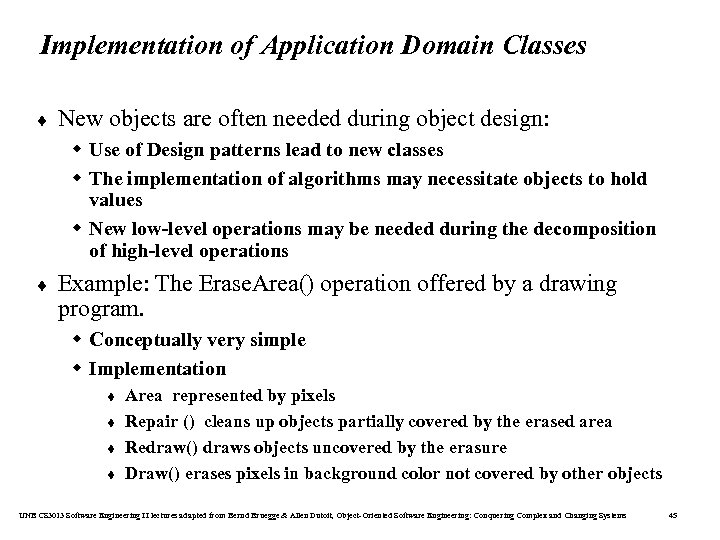
Implementation of Application Domain Classes ¨ New objects are often needed during object design: w Use of Design patterns lead to new classes w The implementation of algorithms may necessitate objects to hold values w New low-level operations may be needed during the decomposition of high-level operations ¨ Example: The Erase. Area() operation offered by a drawing program. w Conceptually very simple w Implementation t t Area represented by pixels Repair () cleans up objects partially covered by the erased area Redraw() draws objects uncovered by the erasure Draw() erases pixels in background color not covered by other objects UNB CS 3013 Software Engineering II lectures adapted from Bernd Bruegge & Allen Dutoit, Object-Oriented Software Engineering: Conquering Complex and Changing Systems 45
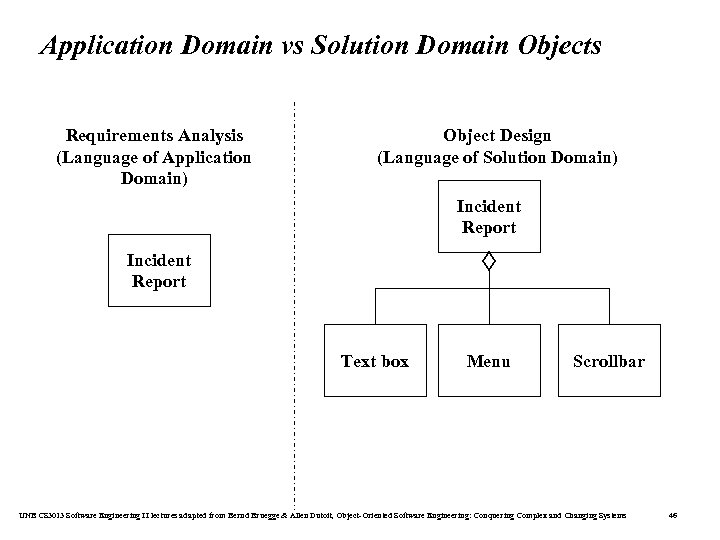
Application Domain vs Solution Domain Objects Requirements Analysis (Language of Application Domain) Object Design (Language of Solution Domain) Incident Report Text box Menu Scrollbar UNB CS 3013 Software Engineering II lectures adapted from Bernd Bruegge & Allen Dutoit, Object-Oriented Software Engineering: Conquering Complex and Changing Systems 46
Package it all up ¨ ¨ Pack up design into discrete physical units that can be edited, compiled, linked, reused Construct physical modules w Ideally use one package for each subsystem w System decomposition might not be good for implementation. ¨ Two design principles for packaging w Minimize coupling: t t t Classes in client-supplier relationships are usually loosely coupled Large number of parameters in some methods mean strong coupling (> 4 -5) Avoid global data w Maximize cohesiveness: t Classes closely connected by associations => same package UNB CS 3013 Software Engineering II lectures adapted from Bernd Bruegge & Allen Dutoit, Object-Oriented Software Engineering: Conquering Complex and Changing Systems 47
Packaging Heuristics ¨ ¨ Each subsystem service is made available by one or more interface objects within the package Start with one interface object for each subsystem service w Try to limit the number of interface operations (7+-2) ¨ ¨ ¨ If the subsystem service has too many operations, reconsider the number of interface objects If you have too many interface objects, reconsider the number of subsystems Difference between interface objects and Java interfaces w Interface object : Used during requirements analysis, system design and object design. Denotes a service or API w Java interface: Used during implementation in Java (A Java interface may or may not implement an interface object) UNB CS 3013 Software Engineering II lectures adapted from Bernd Bruegge & Allen Dutoit, Object-Oriented Software Engineering: Conquering Complex and Changing Systems 48
Summary ¨ ¨ ¨ Object design closes the gap between the requirements and the machine. Object design is the process of adding details to the requirements analysis and making implementation decisions Object design includes: 1. Service specification 2. Component selection 3. Object model restructuring 4. Object model optimization ¨ Object design is documented in the Object Design Document, which can be generated using tools such as Java. Doc. UNB CS 3013 Software Engineering II lectures adapted from Bernd Bruegge & Allen Dutoit, Object-Oriented Software Engineering: Conquering Complex and Changing Systems 49
Conquering Complex and Changing Systems Object-Oriented Software Engineering Chapter 9, Testing
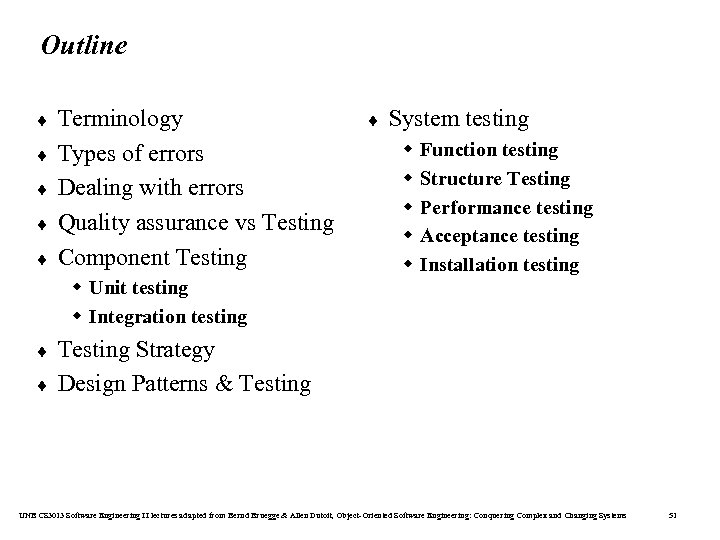
Outline ¨ ¨ ¨ Terminology Types of errors Dealing with errors Quality assurance vs Testing Component Testing ¨ System testing w w w Function testing Structure Testing Performance testing Acceptance testing Installation testing w Unit testing w Integration testing ¨ ¨ Testing Strategy Design Patterns & Testing UNB CS 3013 Software Engineering II lectures adapted from Bernd Bruegge & Allen Dutoit, Object-Oriented Software Engineering: Conquering Complex and Changing Systems 51
Terminology ¨ ¨ Reliability: The measure of success with which the observed behavior of a system confirms to some specification of its behavior. Failure: Any deviation of the observed behavior from the specified behavior. Error: The system is in a state such that further processing by the system will lead to a failure. Fault (Bug): The mechanical or algorithmic cause of an error. There are many different types of errors and different ways how we can deal with them. UNB CS 3013 Software Engineering II lectures adapted from Bernd Bruegge & Allen Dutoit, Object-Oriented Software Engineering: Conquering Complex and Changing Systems 52
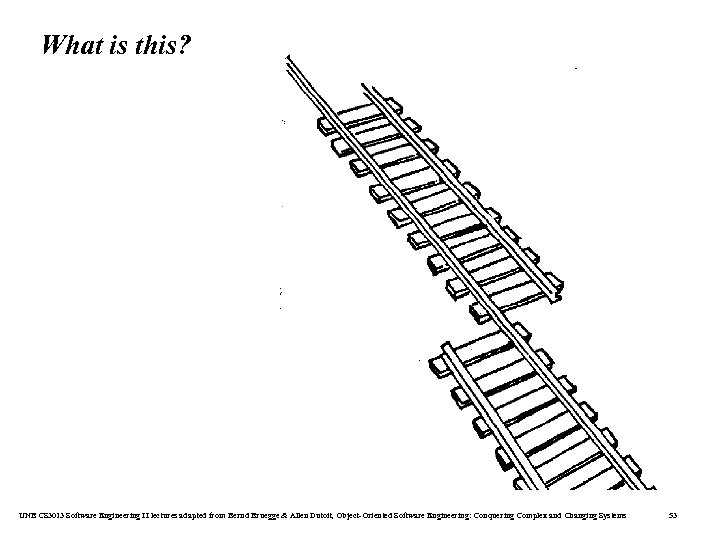
What is this? UNB CS 3013 Software Engineering II lectures adapted from Bernd Bruegge & Allen Dutoit, Object-Oriented Software Engineering: Conquering Complex and Changing Systems 53
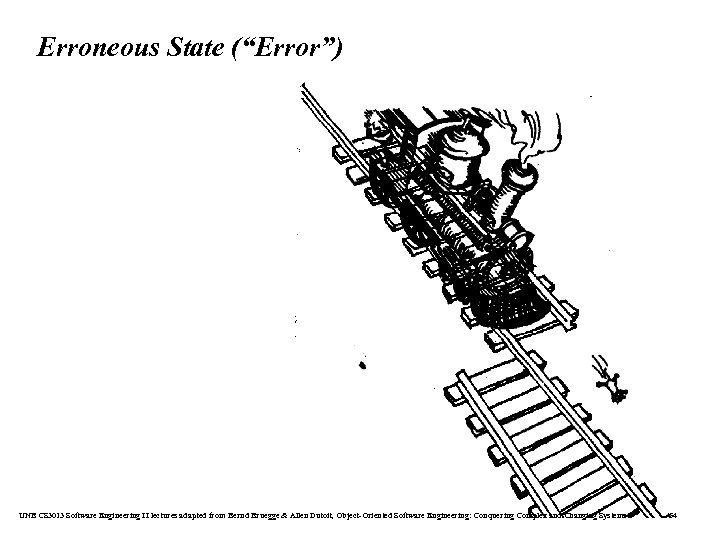
Erroneous State (“Error”) UNB CS 3013 Software Engineering II lectures adapted from Bernd Bruegge & Allen Dutoit, Object-Oriented Software Engineering: Conquering Complex and Changing Systems 54
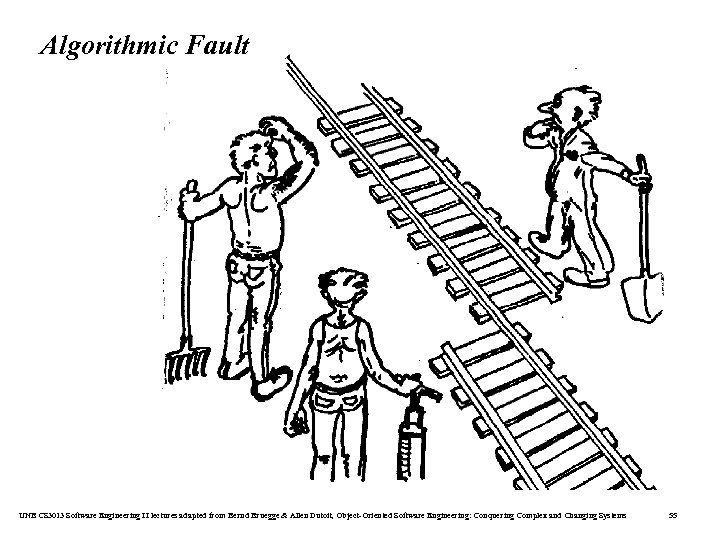
Algorithmic Fault UNB CS 3013 Software Engineering II lectures adapted from Bernd Bruegge & Allen Dutoit, Object-Oriented Software Engineering: Conquering Complex and Changing Systems 55
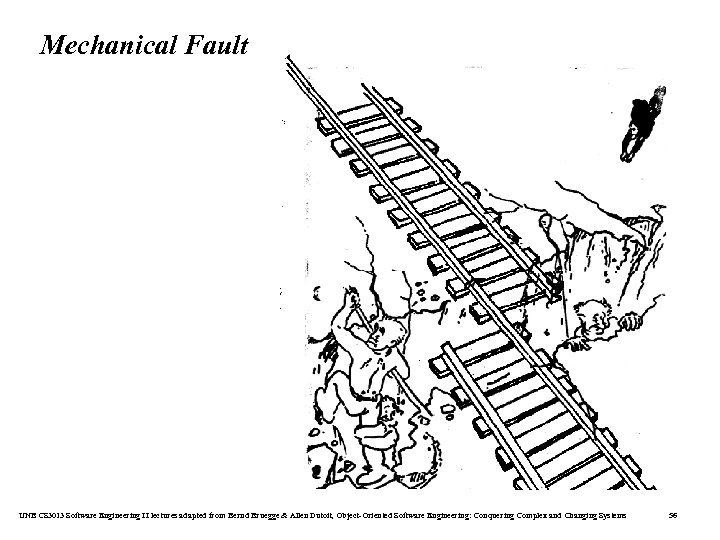
Mechanical Fault UNB CS 3013 Software Engineering II lectures adapted from Bernd Bruegge & Allen Dutoit, Object-Oriented Software Engineering: Conquering Complex and Changing Systems 56
How do we deal with Errors and Faults? UNB CS 3013 Software Engineering II lectures adapted from Bernd Bruegge & Allen Dutoit, Object-Oriented Software Engineering: Conquering Complex and Changing Systems 57
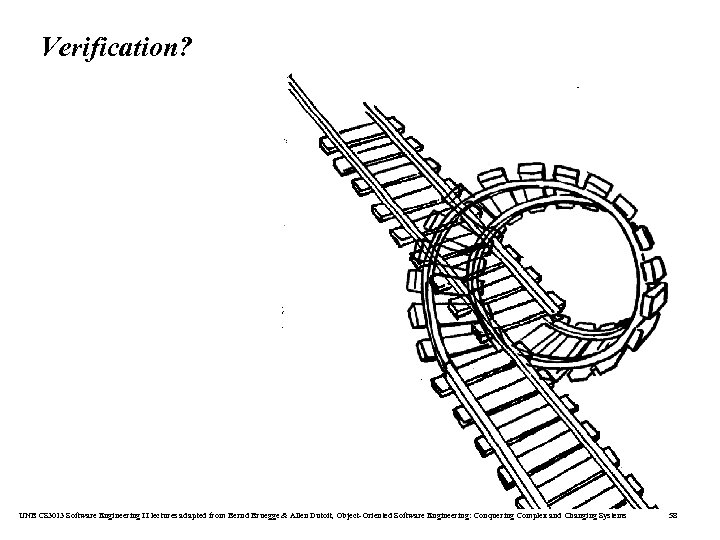
Verification? UNB CS 3013 Software Engineering II lectures adapted from Bernd Bruegge & Allen Dutoit, Object-Oriented Software Engineering: Conquering Complex and Changing Systems 58
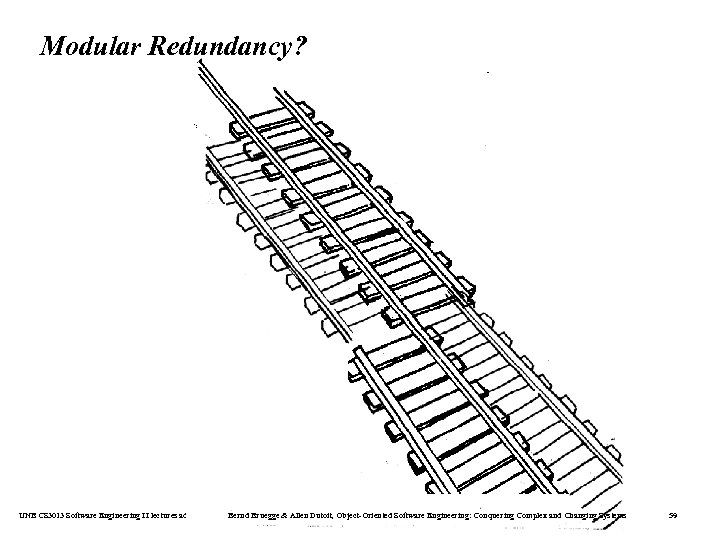
Modular Redundancy? UNB CS 3013 Software Engineering II lectures adapted from Bernd Bruegge & Allen Dutoit, Object-Oriented Software Engineering: Conquering Complex and Changing Systems 59
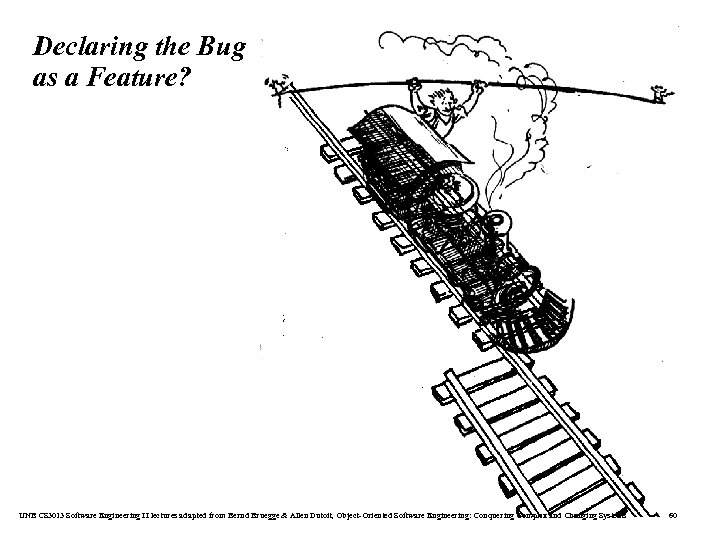
Declaring the Bug as a Feature? UNB CS 3013 Software Engineering II lectures adapted from Bernd Bruegge & Allen Dutoit, Object-Oriented Software Engineering: Conquering Complex and Changing Systems 60
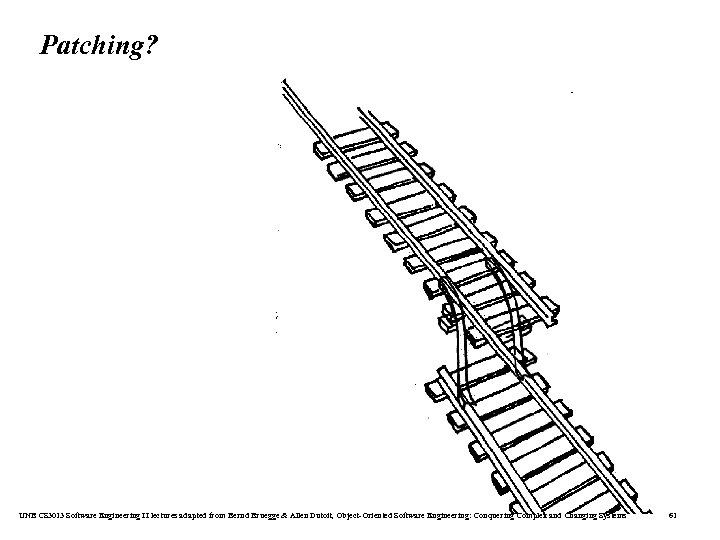
Patching? UNB CS 3013 Software Engineering II lectures adapted from Bernd Bruegge & Allen Dutoit, Object-Oriented Software Engineering: Conquering Complex and Changing Systems 61
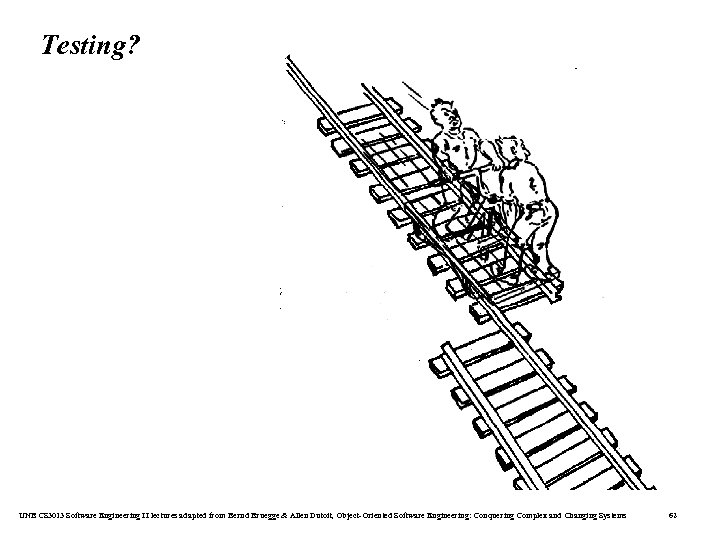
Testing? UNB CS 3013 Software Engineering II lectures adapted from Bernd Bruegge & Allen Dutoit, Object-Oriented Software Engineering: Conquering Complex and Changing Systems 62
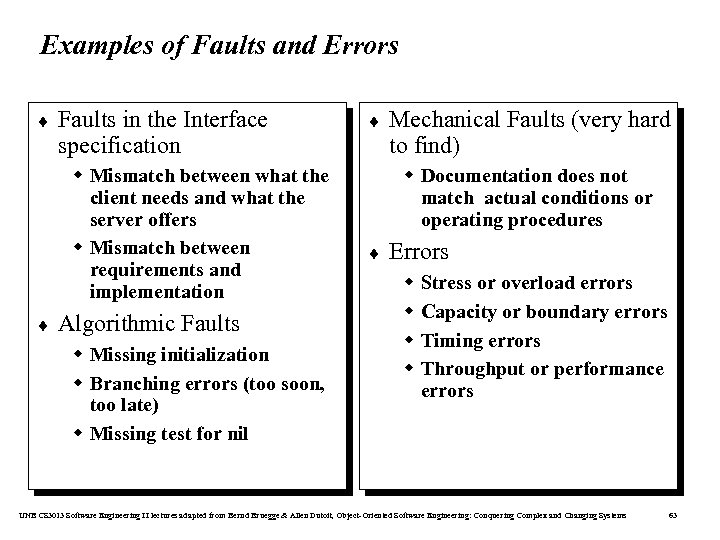
Examples of Faults and Errors ¨ Faults in the Interface specification w Mismatch between what the client needs and what the server offers w Mismatch between requirements and implementation ¨ Algorithmic Faults w Missing initialization w Branching errors (too soon, too late) w Missing test for nil ¨ Mechanical Faults (very hard to find) w Documentation does not match actual conditions or operating procedures ¨ Errors w w Stress or overload errors Capacity or boundary errors Timing errors Throughput or performance errors UNB CS 3013 Software Engineering II lectures adapted from Bernd Bruegge & Allen Dutoit, Object-Oriented Software Engineering: Conquering Complex and Changing Systems 63
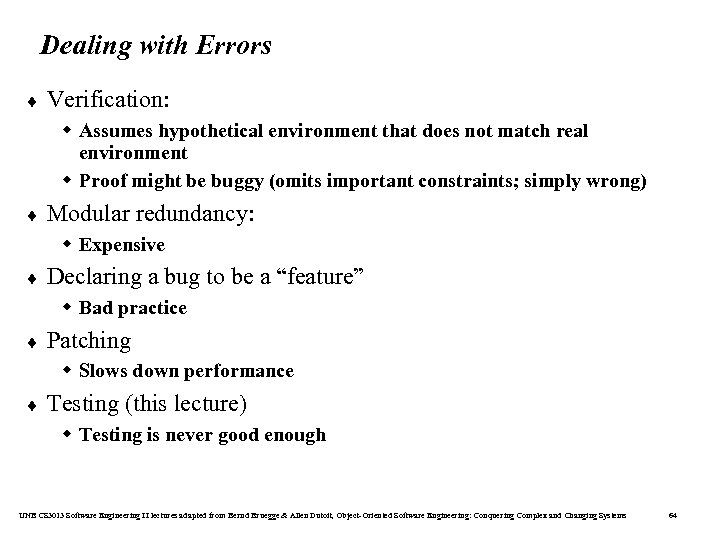
Dealing with Errors ¨ Verification: w Assumes hypothetical environment that does not match real environment w Proof might be buggy (omits important constraints; simply wrong) ¨ Modular redundancy: w Expensive ¨ Declaring a bug to be a “feature” w Bad practice ¨ Patching w Slows down performance ¨ Testing (this lecture) w Testing is never good enough UNB CS 3013 Software Engineering II lectures adapted from Bernd Bruegge & Allen Dutoit, Object-Oriented Software Engineering: Conquering Complex and Changing Systems 64
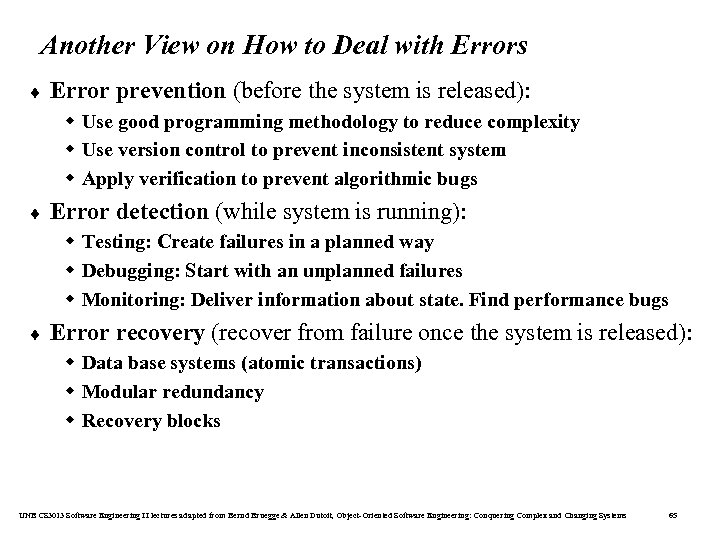
Another View on How to Deal with Errors ¨ Error prevention (before the system is released): w Use good programming methodology to reduce complexity w Use version control to prevent inconsistent system w Apply verification to prevent algorithmic bugs ¨ Error detection (while system is running): w Testing: Create failures in a planned way w Debugging: Start with an unplanned failures w Monitoring: Deliver information about state. Find performance bugs ¨ Error recovery (recover from failure once the system is released): w Data base systems (atomic transactions) w Modular redundancy w Recovery blocks UNB CS 3013 Software Engineering II lectures adapted from Bernd Bruegge & Allen Dutoit, Object-Oriented Software Engineering: Conquering Complex and Changing Systems 65
Some Observations ¨ It is impossible to completely test any nontrivial module or any system w Theoretical limitations: Halting problem w Practial limitations: Prohibitive in time and cost ¨ Testing can only show the presence of bugs, not their absence (Dijkstra) UNB CS 3013 Software Engineering II lectures adapted from Bernd Bruegge & Allen Dutoit, Object-Oriented Software Engineering: Conquering Complex and Changing Systems 66
Testing takes creativity ¨ ¨ Testing often viewed as dirty work. To develop an effective test, one must have: t t t ¨ Detailed understanding of the system Knowledge of the testing techniques Skill to apply these techniques in an effective and efficient manner Testing is done best by independent testers w We often develop a certain mental attitude that the program should in a certain way when in fact it does not. ¨ Programmer often stick to the data set that makes the program work w "Don’t mess up my code!" ¨ A program often does not work when tried by somebody else. w Don't let this be the end-user. UNB CS 3013 Software Engineering II lectures adapted from Bernd Bruegge & Allen Dutoit, Object-Oriented Software Engineering: Conquering Complex and Changing Systems 67
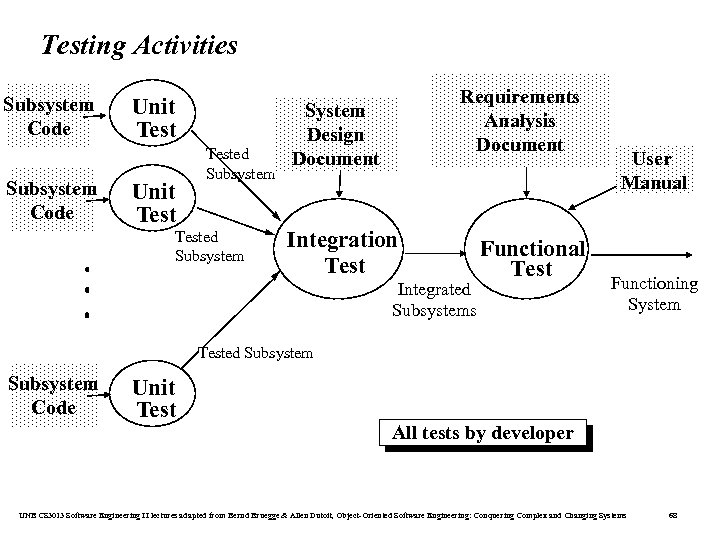
Testing Activities Subsystem Code Unit Tested Subsystem Requirements Analysis Document System Design Document Integration Test Integrated Subsystems Functional Test User Manual Functioning System Tested Subsystem Code Unit Test All tests by developer UNB CS 3013 Software Engineering II lectures adapted from Bernd Bruegge & Allen Dutoit, Object-Oriented Software Engineering: Conquering Complex and Changing Systems 68
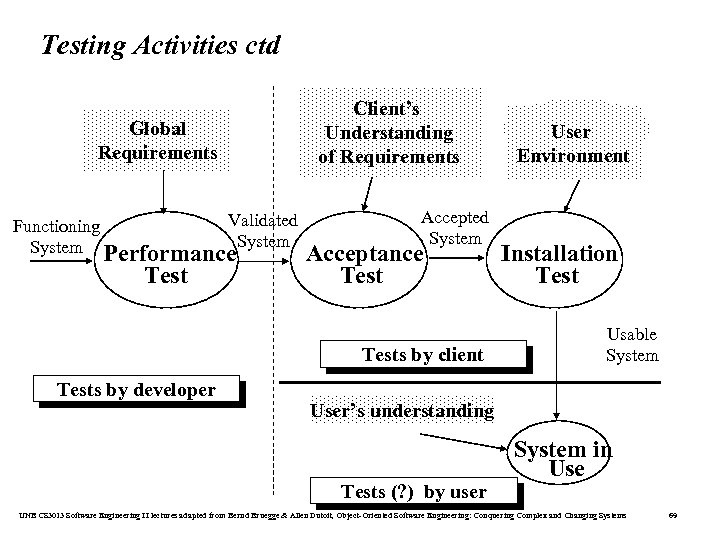
Testing Activities ctd Global Requirements Validated Functioning System Performance. System Test Client’s Understanding of Requirements Accepted System Acceptance Tests by client Tests by developer User Environment Installation Test Usable System User’s understanding Tests (? ) by user System in Use UNB CS 3013 Software Engineering II lectures adapted from Bernd Bruegge & Allen Dutoit, Object-Oriented Software Engineering: Conquering Complex and Changing Systems 69
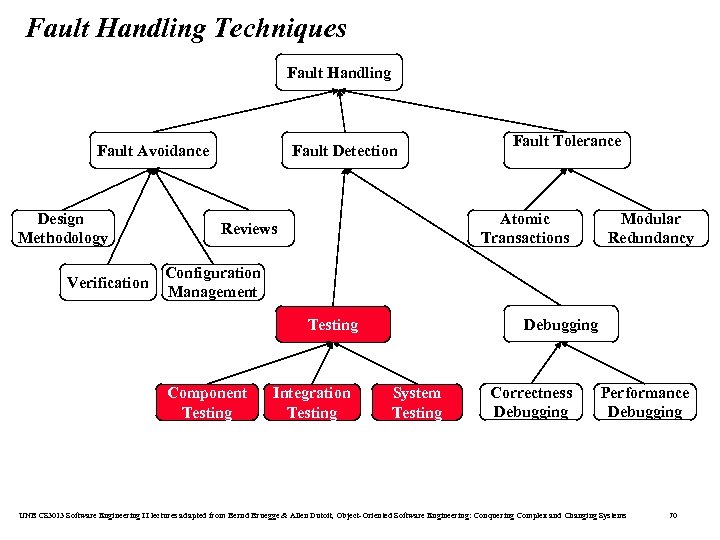
Fault Handling Techniques Fault Handling Fault Avoidance Design Methodology Verification Fault Detection Fault Tolerance Atomic Transactions Reviews Modular Redundancy Configuration Management Debugging Testing Component Testing Integration Testing System Testing Correctness Debugging Performance Debugging UNB CS 3013 Software Engineering II lectures adapted from Bernd Bruegge & Allen Dutoit, Object-Oriented Software Engineering: Conquering Complex and Changing Systems 70
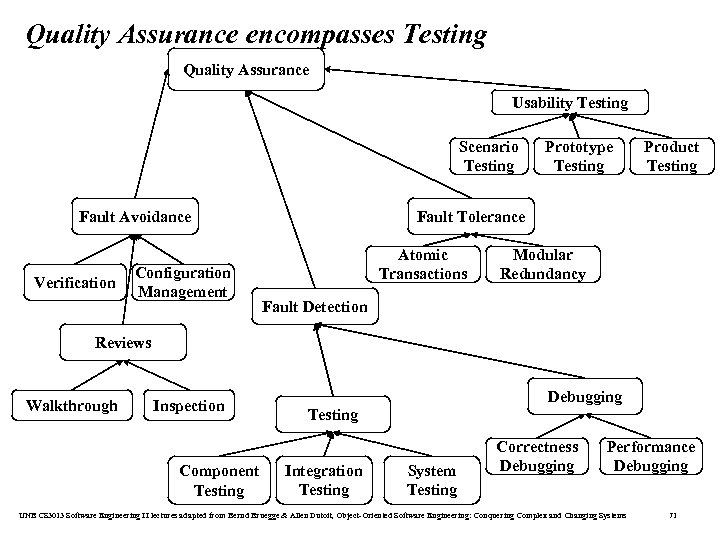
Quality Assurance encompasses Testing Quality Assurance Usability Testing Scenario Testing Fault Avoidance Verification Configuration Management Prototype Testing Product Testing Fault Tolerance Atomic Transactions Modular Redundancy Fault Detection Reviews Walkthrough Inspection Component Testing Debugging Testing Integration Testing System Testing Correctness Debugging Performance Debugging UNB CS 3013 Software Engineering II lectures adapted from Bernd Bruegge & Allen Dutoit, Object-Oriented Software Engineering: Conquering Complex and Changing Systems 71
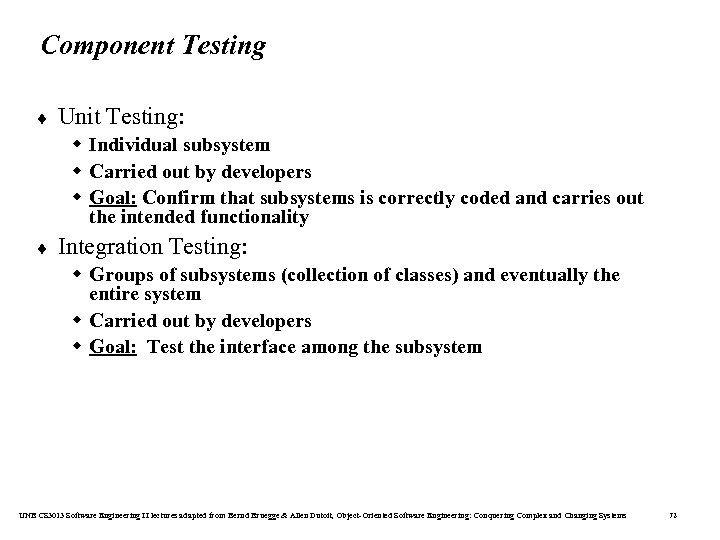
Component Testing ¨ Unit Testing: w Individual subsystem w Carried out by developers w Goal: Confirm that subsystems is correctly coded and carries out the intended functionality ¨ Integration Testing: w Groups of subsystems (collection of classes) and eventually the entire system w Carried out by developers w Goal: Test the interface among the subsystem UNB CS 3013 Software Engineering II lectures adapted from Bernd Bruegge & Allen Dutoit, Object-Oriented Software Engineering: Conquering Complex and Changing Systems 72
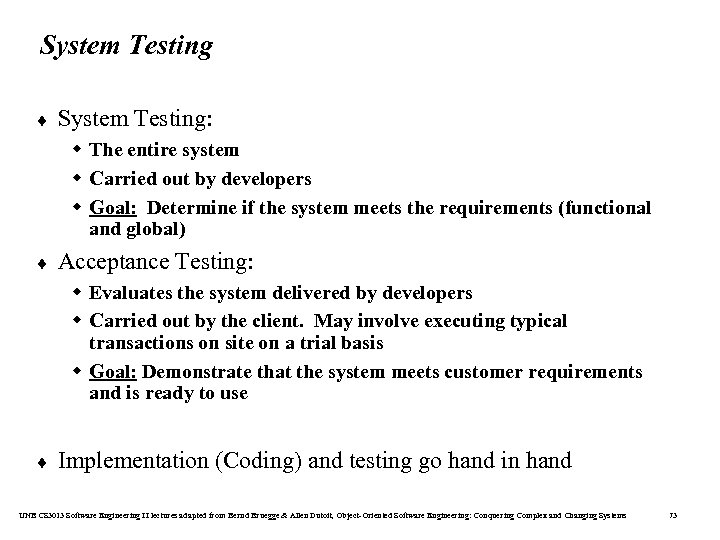
System Testing ¨ System Testing: w The entire system w Carried out by developers w Goal: Determine if the system meets the requirements (functional and global) ¨ Acceptance Testing: w Evaluates the system delivered by developers w Carried out by the client. May involve executing typical transactions on site on a trial basis w Goal: Demonstrate that the system meets customer requirements and is ready to use ¨ Implementation (Coding) and testing go hand in hand UNB CS 3013 Software Engineering II lectures adapted from Bernd Bruegge & Allen Dutoit, Object-Oriented Software Engineering: Conquering Complex and Changing Systems 73
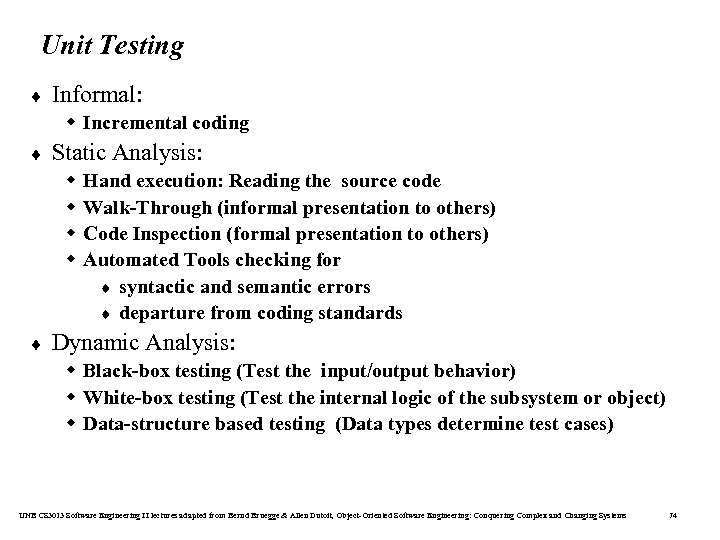
Unit Testing ¨ Informal: w Incremental coding ¨ Static Analysis: w w ¨ Hand execution: Reading the source code Walk-Through (informal presentation to others) Code Inspection (formal presentation to others) Automated Tools checking for t syntactic and semantic errors t departure from coding standards Dynamic Analysis: w Black-box testing (Test the input/output behavior) w White-box testing (Test the internal logic of the subsystem or object) w Data-structure based testing (Data types determine test cases) UNB CS 3013 Software Engineering II lectures adapted from Bernd Bruegge & Allen Dutoit, Object-Oriented Software Engineering: Conquering Complex and Changing Systems 74
Black-box Testing ¨ Focus: I/O behavior. If for any given input, we can predict the output, then the module passes the test. w Almost always impossible to generate all possible inputs ("test cases") ¨ Goal: Reduce number of test cases by equivalence partitioning: w Divide input conditions into equivalence classes w Choose test cases for each equivalence class. (Example: If an object is supposed to accept a negative number, testing one negative number is enough) UNB CS 3013 Software Engineering II lectures adapted from Bernd Bruegge & Allen Dutoit, Object-Oriented Software Engineering: Conquering Complex and Changing Systems 75
Black-box Testing (Continued) ¨ Selection of equivalence classes (No rules, only guidelines): w Input is valid across range of values. Select test cases from 3 equivalence classes: t t t Below the range Within the range Above the range w Input is valid if it is from a discrete set. Select test cases from 2 equivalence classes: t t ¨ Valid discrete value Invalid discrete value Another solution to select only a limited amount of test cases: w Get knowledge about the inner workings of the unit being tested => white-box testing UNB CS 3013 Software Engineering II lectures adapted from Bernd Bruegge & Allen Dutoit, Object-Oriented Software Engineering: Conquering Complex and Changing Systems 76
White-box Testing ¨ ¨ Focus: Thoroughness (Coverage). Every statement in the component is executed at least once. Four types of white-box testing w w Statement Testing Loop Testing Path Testing Branch Testing UNB CS 3013 Software Engineering II lectures adapted from Bernd Bruegge & Allen Dutoit, Object-Oriented Software Engineering: Conquering Complex and Changing Systems 77
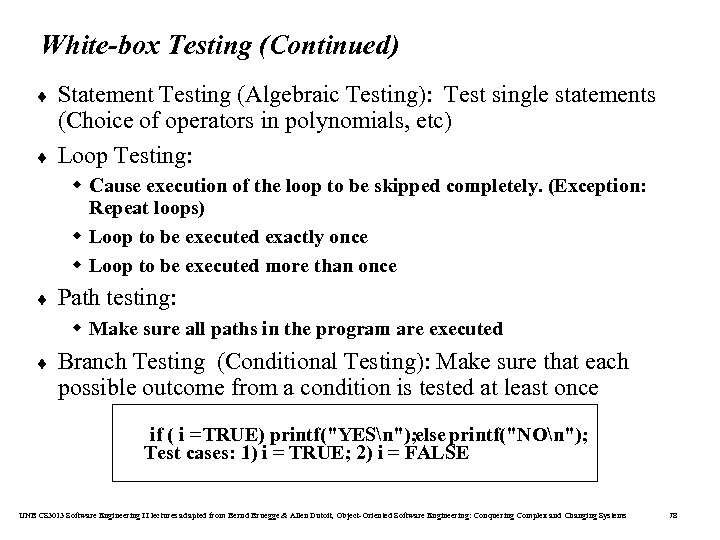
White-box Testing (Continued) ¨ ¨ Statement Testing (Algebraic Testing): Test single statements (Choice of operators in polynomials, etc) Loop Testing: w Cause execution of the loop to be skipped completely. (Exception: Repeat loops) w Loop to be executed exactly once w Loop to be executed more than once ¨ Path testing: w Make sure all paths in the program are executed ¨ Branch Testing (Conditional Testing): Make sure that each possible outcome from a condition is tested at least once if ( i = TRUE) printf("YESn"); else printf("NOn"); Test cases: 1) i = TRUE; 2) i = FALSE UNB CS 3013 Software Engineering II lectures adapted from Bernd Bruegge & Allen Dutoit, Object-Oriented Software Engineering: Conquering Complex and Changing Systems 78
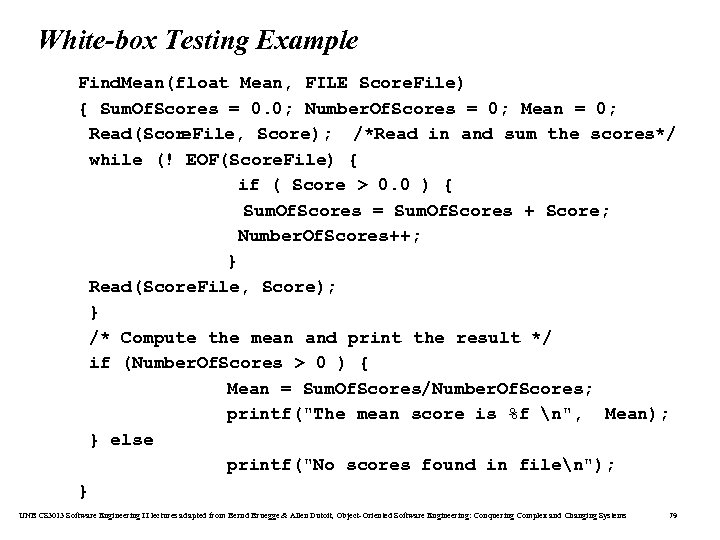
White-box Testing Example Find. Mean(float Mean, FILE Score. File) { Sum. Of. Scores = 0. 0; Number. Of. Scores = 0; Mean = 0; Read(Scor e. File, Score); /*Read in and sum the scores*/ while (! EOF(Score. File) { if ( Score > 0. 0 ) { Sum. Of. Scores = Sum. Of. Scores + Score; Number. Of. Scores++; } Read(Score. File, Score); } /* Compute the mean and print the result */ if (Number. Of. Scores > 0 ) { Mean = Sum. Of. Scores/Number. Of. Scores; printf("The mean score is %f n", Mean); } else printf("No scores found in filen"); } UNB CS 3013 Software Engineering II lectures adapted from Bernd Bruegge & Allen Dutoit, Object-Oriented Software Engineering: Conquering Complex and Changing Systems 79
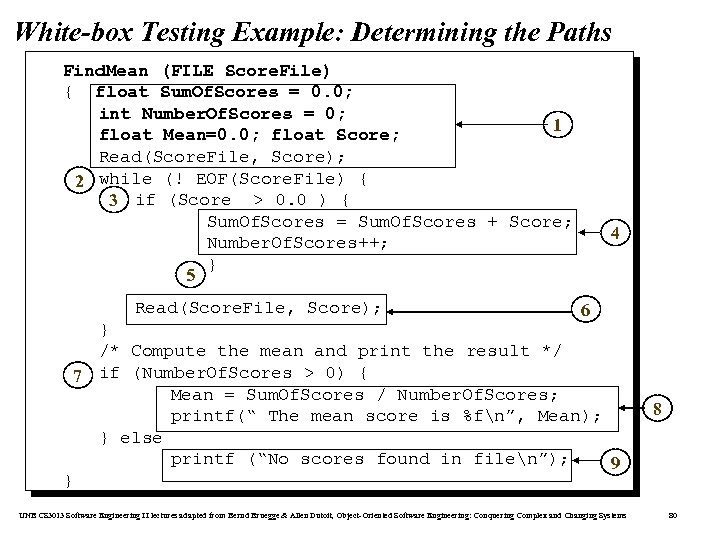
White-box Testing Example: Determining the Paths Find. Mean (FILE Score. File) { float Sum. Of. Scores = 0. 0; int Number. Of. Scores = 0; 1 float Mean=0. 0; float Score; Read(Score. File, Score); 2 while (! EOF(Score. File) { 3 if (Score > 0. 0 ) { Sum. Of. Scores = Sum. Of. Scores + Score; Number. Of. Scores++; } 5 Read(Score. File, Score); 4 6 } /* Compute the mean and print the result */ 7 if (Number. Of. Scores > 0) { Mean = Sum. Of. Scores / Number. Of. Scores; printf(“ The mean score is %fn”, Mean); } else printf (“No scores found in filen”); 9 } UNB CS 3013 Software Engineering II lectures adapted from Bernd Bruegge & Allen Dutoit, Object-Oriented Software Engineering: Conquering Complex and Changing Systems 8 80
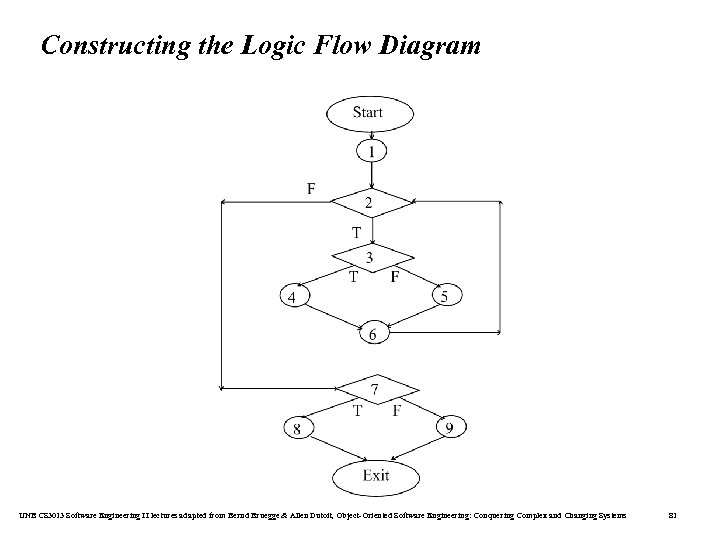
Constructing the Logic Flow Diagram UNB CS 3013 Software Engineering II lectures adapted from Bernd Bruegge & Allen Dutoit, Object-Oriented Software Engineering: Conquering Complex and Changing Systems 81
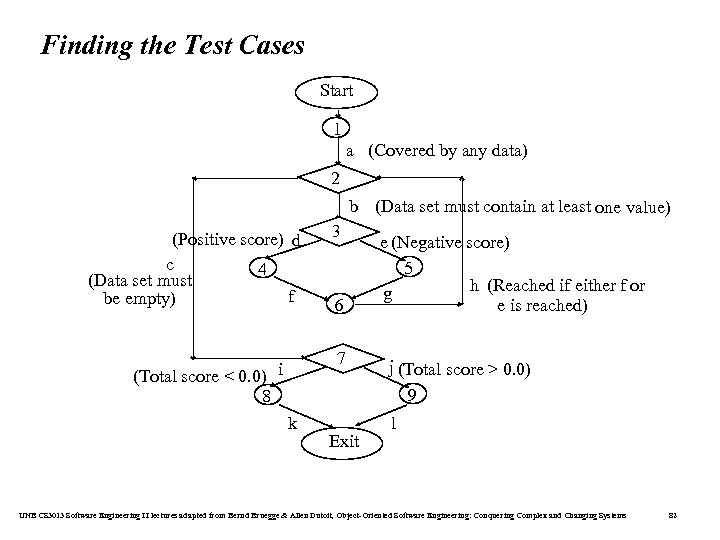
Finding the Test Cases Start 1 a (Covered by any data) 2 b (Data set must contain at least one value) (Positive score) d c 4 (Data set must f be empty) 3 6 7 (Total score < 0. 0) i 8 e (Negative score) 5 h (Reached if either f or g e is reached) j (Total score > 0. 0) 9 k Exit l UNB CS 3013 Software Engineering II lectures adapted from Bernd Bruegge & Allen Dutoit, Object-Oriented Software Engineering: Conquering Complex and Changing Systems 82
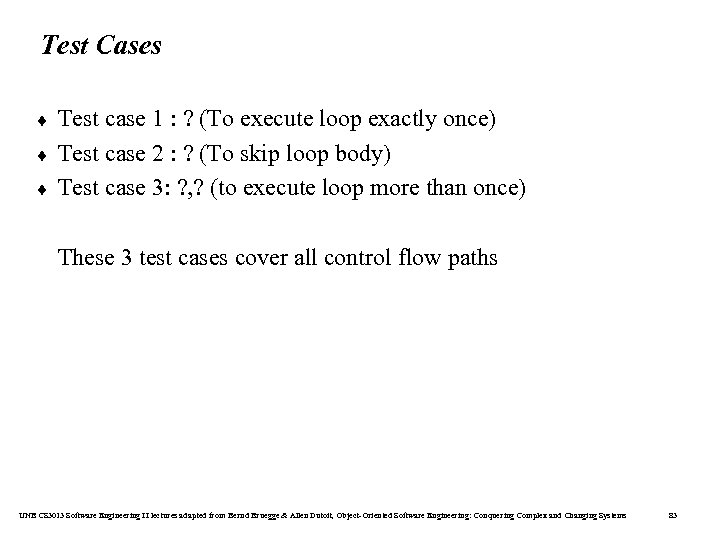
Test Cases ¨ ¨ ¨ Test case 1 : ? (To execute loop exactly once) Test case 2 : ? (To skip loop body) Test case 3: ? , ? (to execute loop more than once) These 3 test cases cover all control flow paths UNB CS 3013 Software Engineering II lectures adapted from Bernd Bruegge & Allen Dutoit, Object-Oriented Software Engineering: Conquering Complex and Changing Systems 83
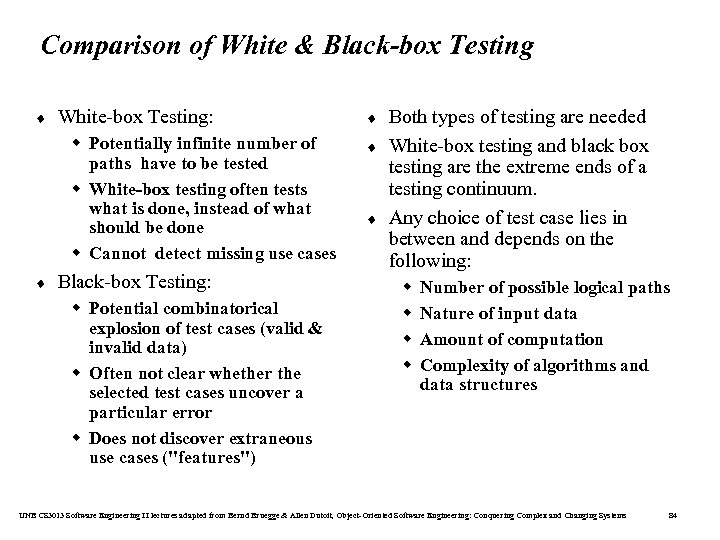
Comparison of White & Black-box Testing ¨ White-box Testing: w Potentially infinite number of paths have to be tested w White-box testing often tests what is done, instead of what should be done w Cannot detect missing use cases ¨ Black-box Testing: w Potential combinatorical explosion of test cases (valid & invalid data) w Often not clear whether the selected test cases uncover a particular error w Does not discover extraneous use cases ("features") ¨ ¨ ¨ Both types of testing are needed White-box testing and black box testing are the extreme ends of a testing continuum. Any choice of test case lies in between and depends on the following: w w Number of possible logical paths Nature of input data Amount of computation Complexity of algorithms and data structures UNB CS 3013 Software Engineering II lectures adapted from Bernd Bruegge & Allen Dutoit, Object-Oriented Software Engineering: Conquering Complex and Changing Systems 84
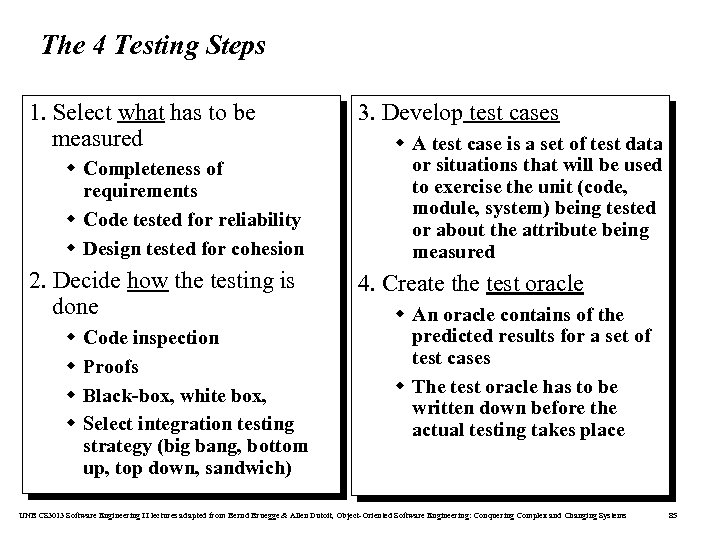
The 4 Testing Steps 1. Select what has to be measured w Completeness of requirements w Code tested for reliability w Design tested for cohesion 2. Decide how the testing is done w w Code inspection Proofs Black-box, white box, Select integration testing strategy (big bang, bottom up, top down, sandwich) 3. Develop test cases w A test case is a set of test data or situations that will be used to exercise the unit (code, module, system) being tested or about the attribute being measured 4. Create the test oracle w An oracle contains of the predicted results for a set of test cases w The test oracle has to be written down before the actual testing takes place UNB CS 3013 Software Engineering II lectures adapted from Bernd Bruegge & Allen Dutoit, Object-Oriented Software Engineering: Conquering Complex and Changing Systems 85
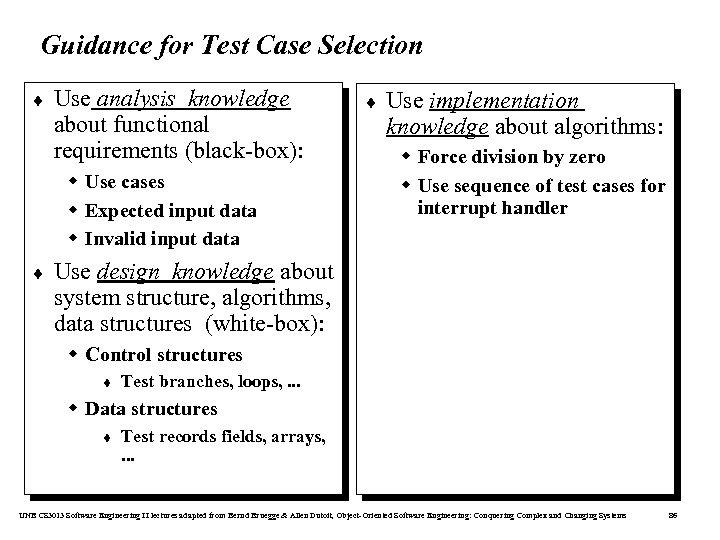
Guidance for Test Case Selection ¨ Use analysis knowledge about functional requirements (black-box): w Use cases w Expected input data w Invalid input data ¨ ¨ Use implementation knowledge about algorithms: w Force division by zero w Use sequence of test cases for interrupt handler Use design knowledge about system structure, algorithms, data structures (white-box): w Control structures t Test branches, loops, . . . w Data structures t Test records fields, arrays, . . . UNB CS 3013 Software Engineering II lectures adapted from Bernd Bruegge & Allen Dutoit, Object-Oriented Software Engineering: Conquering Complex and Changing Systems 86
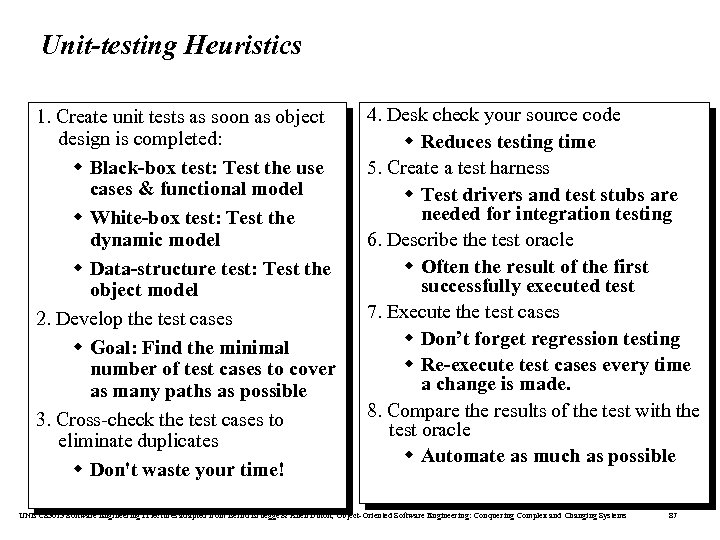
Unit-testing Heuristics 1. Create unit tests as soon as object design is completed: w Black-box test: Test the use cases & functional model w White-box test: Test the dynamic model w Data-structure test: Test the object model 2. Develop the test cases w Goal: Find the minimal number of test cases to cover as many paths as possible 3. Cross-check the test cases to eliminate duplicates w Don't waste your time! 4. Desk check your source code w Reduces testing time 5. Create a test harness w Test drivers and test stubs are needed for integration testing 6. Describe the test oracle w Often the result of the first successfully executed test 7. Execute the test cases w Don’t forget regression testing w Re-execute test cases every time a change is made. 8. Compare the results of the test with the test oracle w Automate as much as possible UNB CS 3013 Software Engineering II lectures adapted from Bernd Bruegge & Allen Dutoit, Object-Oriented Software Engineering: Conquering Complex and Changing Systems 87
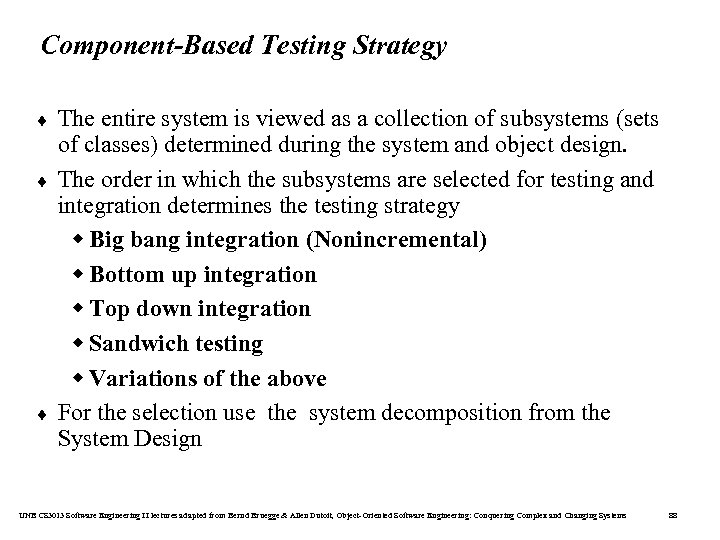
Component-Based Testing Strategy ¨ ¨ ¨ The entire system is viewed as a collection of subsystems (sets of classes) determined during the system and object design. The order in which the subsystems are selected for testing and integration determines the testing strategy w Big bang integration (Nonincremental) w Bottom up integration w Top down integration w Sandwich testing w Variations of the above For the selection use the system decomposition from the System Design UNB CS 3013 Software Engineering II lectures adapted from Bernd Bruegge & Allen Dutoit, Object-Oriented Software Engineering: Conquering Complex and Changing Systems 88
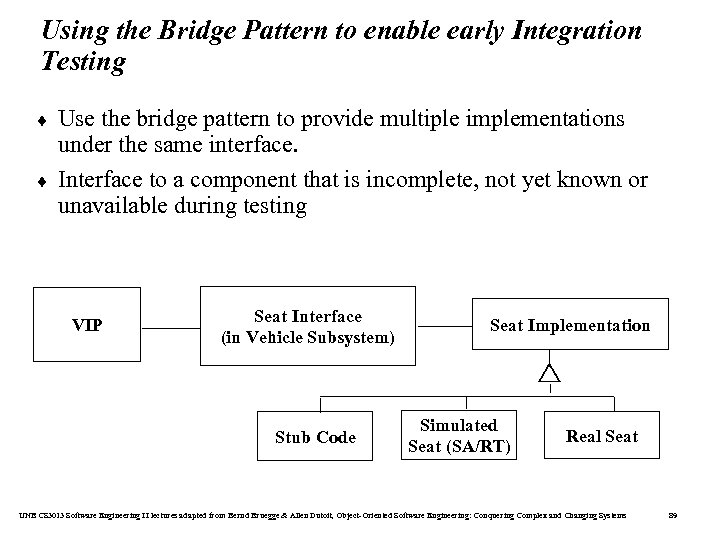
Using the Bridge Pattern to enable early Integration Testing ¨ ¨ Use the bridge pattern to provide multiple implementations under the same interface. Interface to a component that is incomplete, not yet known or unavailable during testing VIP Seat Interface (in Vehicle Subsystem) Stub Code Seat Implementation Simulated Seat (SA/RT) Real Seat UNB CS 3013 Software Engineering II lectures adapted from Bernd Bruegge & Allen Dutoit, Object-Oriented Software Engineering: Conquering Complex and Changing Systems 89
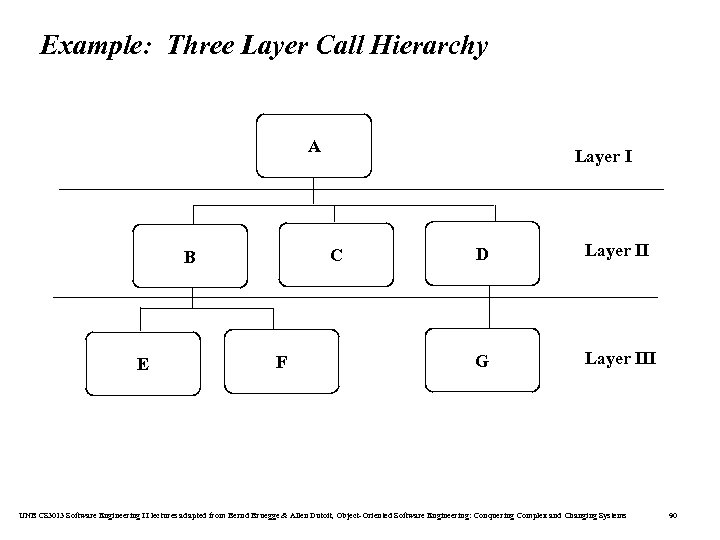
Example: Three Layer Call Hierarchy A C B E Layer I F D Layer II G Layer III UNB CS 3013 Software Engineering II lectures adapted from Bernd Bruegge & Allen Dutoit, Object-Oriented Software Engineering: Conquering Complex and Changing Systems 90
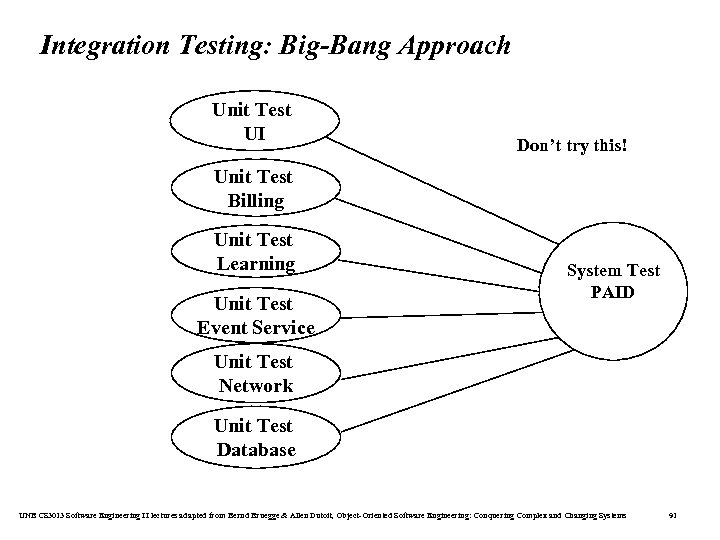
Integration Testing: Big-Bang Approach Unit Test UI Don’t try this! Unit Test Billing Unit Test Learning Unit Test Event Service System Test PAID Unit Test Network Unit Test Database UNB CS 3013 Software Engineering II lectures adapted from Bernd Bruegge & Allen Dutoit, Object-Oriented Software Engineering: Conquering Complex and Changing Systems 91
Bottom-up Testing Strategy ¨ ¨ The subsystem in the lowest layer of the call hierarchy are tested individually Then the next subsystems are tested that call the previously tested subsystems This is done repeatedly until all subsystems are included in the testing Special program needed to do the testing, Test Driver: w A routine that calls a particular subsystem and passes a test case to it UNB CS 3013 Software Engineering II lectures adapted from Bernd Bruegge & Allen Dutoit, Object-Oriented Software Engineering: Conquering Complex and Changing Systems 92
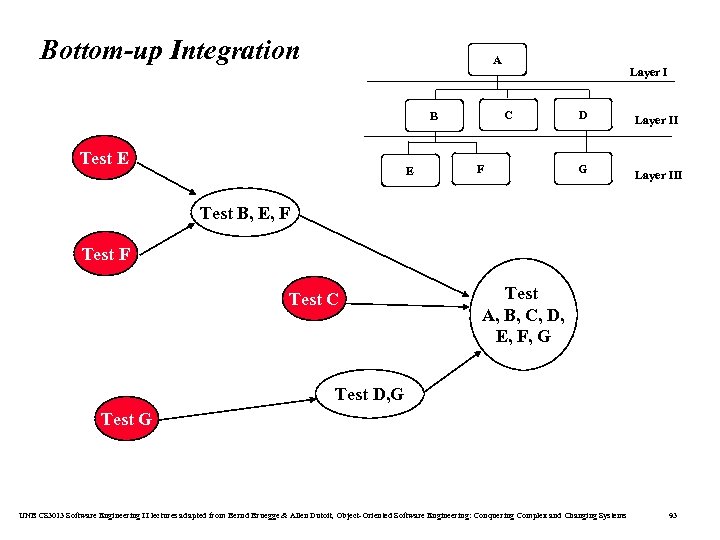
Bottom-up Integration A C B Test E E Layer I F D G Layer III Test B, E, F Test C Test A, B, C, D, E, F, G Test D, G Test G UNB CS 3013 Software Engineering II lectures adapted from Bernd Bruegge & Allen Dutoit, Object-Oriented Software Engineering: Conquering Complex and Changing Systems 93
Pros and Cons of bottom up integration testing ¨ ¨ Bad for functionally decomposed systems: w Tests the most important subsystem last Useful for integrating the following systems w Object-oriented systems w real-time systems with strict performance requirements UNB CS 3013 Software Engineering II lectures adapted from Bernd Bruegge & Allen Dutoit, Object-Oriented Software Engineering: Conquering Complex and Changing Systems 94
Top-down Testing Strategy ¨ ¨ Test the top layer or the controlling subsystem first Then combine all the subsystems that are called by the tested subsystems and test the resulting collection of subsystems Do this until all subsystems are incorporated into the test Special program is needed to do the testing, Test stub : w A program or a method that simulates the activity of a missing subsystem by answering to the calling sequence of the calling subsystem and returning back fake data. UNB CS 3013 Software Engineering II lectures adapted from Bernd Bruegge & Allen Dutoit, Object-Oriented Software Engineering: Conquering Complex and Changing Systems 95
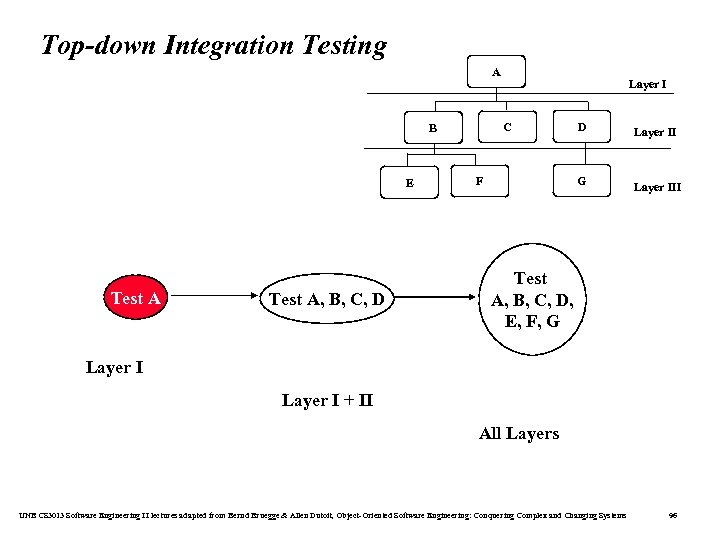
Top-down Integration Testing A C B E Test A, B, C, D Layer I D G F Layer III Test A, B, C, D, E, F, G Layer I + II All Layers UNB CS 3013 Software Engineering II lectures adapted from Bernd Bruegge & Allen Dutoit, Object-Oriented Software Engineering: Conquering Complex and Changing Systems 96
Pros and Cons of top-down integration testing ¨ ¨ Test cases can be defined in terms of the functionality of the system (functional requirements) Writing stubs can be difficult: Stubs must allow all possible conditions to be tested. Possibly a very large number of stubs may be required, especially if the lowest level of the system contains many methods. One solution to avoid too many stubs: Modified top-down testing strategy w Test each layer of the system decomposition individually before merging the layers w Disadvantage of modified top-down testing: Both, stubs and drivers are needed UNB CS 3013 Software Engineering II lectures adapted from Bernd Bruegge & Allen Dutoit, Object-Oriented Software Engineering: Conquering Complex and Changing Systems 97
Sandwich Testing Strategy ¨ ¨ ¨ Combines top-down strategy with bottom-up strategy The system is view as having three layers w A target layer in the middle w A layer above the target w A layer below the target w Testing converges at the target layer How do you select the target layer if there are more than 3 layers? w Heuristic: Try to minimize the number of stubs and drivers UNB CS 3013 Software Engineering II lectures adapted from Bernd Bruegge & Allen Dutoit, Object-Oriented Software Engineering: Conquering Complex and Changing Systems 98
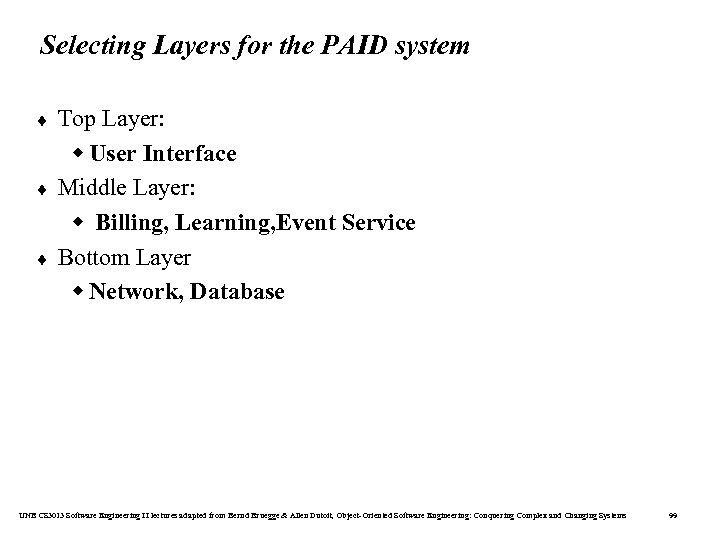
Selecting Layers for the PAID system ¨ ¨ ¨ Top Layer: w User Interface Middle Layer: w Billing, Learning, Event Service Bottom Layer w Network, Database UNB CS 3013 Software Engineering II lectures adapted from Bernd Bruegge & Allen Dutoit, Object-Oriented Software Engineering: Conquering Complex and Changing Systems 99
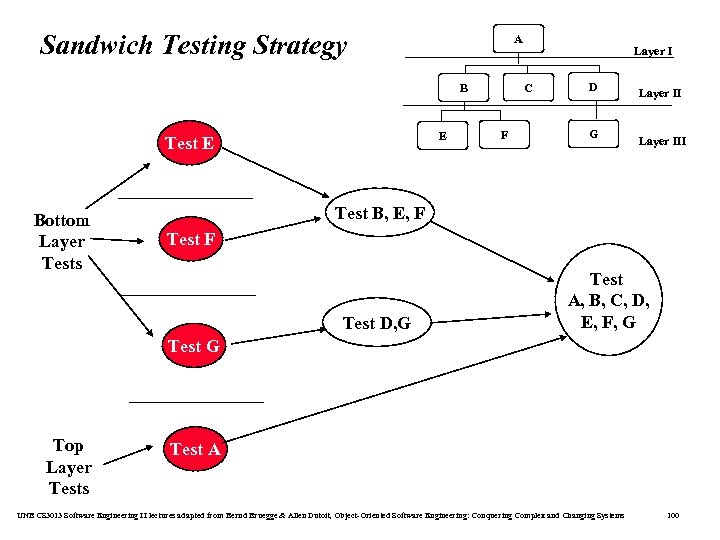
Sandwich Testing Strategy A C B E Test E Bottom Layer Tests Layer I F D G Layer III Test B, E, F Test D, G Test A, B, C, D, E, F, G Test G Top Layer Tests Test A UNB CS 3013 Software Engineering II lectures adapted from Bernd Bruegge & Allen Dutoit, Object-Oriented Software Engineering: Conquering Complex and Changing Systems 100
Pros and Cons of Sandwich Testing ¨ ¨ ¨ Top and Bottom Layer Tests can be done in parallel Does not test the individual subsystems thoroughly before integration Solution: Modified sandwich testing strategy UNB CS 3013 Software Engineering II lectures adapted from Bernd Bruegge & Allen Dutoit, Object-Oriented Software Engineering: Conquering Complex and Changing Systems 101
Modified Sandwich Testing Strategy ¨ ¨ Test in parallel: w Middle layer with drivers and stubs w Top layer with stubs w Bottom layer with drivers Test in parallel: w Top layer accessing middle layer (top layer replaces drivers) w Bottom accessed by middle layer (bottom layer replaces stubs) UNB CS 3013 Software Engineering II lectures adapted from Bernd Bruegge & Allen Dutoit, Object-Oriented Software Engineering: Conquering Complex and Changing Systems 102
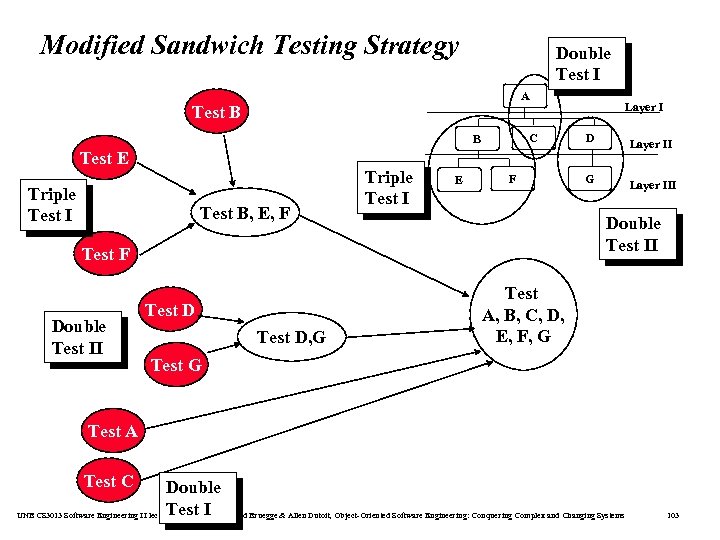
Modified Sandwich Testing Strategy Double Test I A Test B C B Test E Triple Test I Test B, E, F Triple Test I E F Double Test II Test D, G D Layer II G Layer III Double Test II Test F Test D Layer I Test A, B, C, D, E, F, G Test A Test C Double Test from Bernd Bruegge & Allen Dutoit, Object-Oriented Software Engineering: Conquering Complex and Changing Systems UNB CS 3013 Software Engineering II lectures adapted. I 103
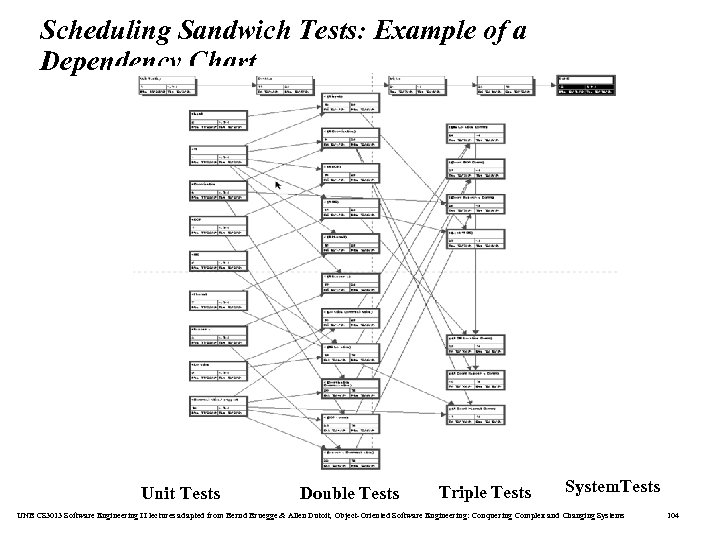
Scheduling Sandwich Tests: Example of a Dependency Chart Unit Tests Double Tests Triple Tests System. Tests UNB CS 3013 Software Engineering II lectures adapted from Bernd Bruegge & Allen Dutoit, Object-Oriented Software Engineering: Conquering Complex and Changing Systems 104
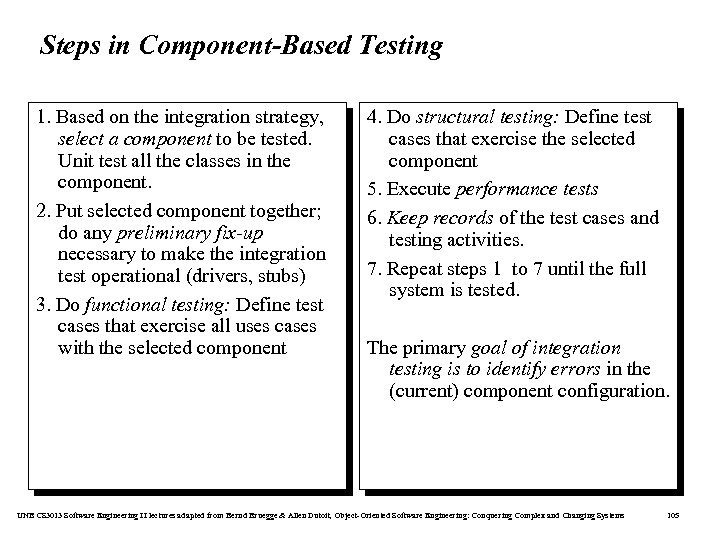
Steps in Component-Based Testing 1. Based on the integration strategy, select a component to be tested. Unit test all the classes in the component. . 2. Put selected component together; do any preliminary fix-up necessary to make the integration test operational (drivers, stubs) 3. Do functional testing: Define test cases that exercise all uses cases with the selected component 4. Do structural testing: Define test cases that exercise the selected component 5. Execute performance tests 6. Keep records of the test cases and testing activities. 7. Repeat steps 1 to 7 until the full system is tested. The primary goal of integration testing is to identify errors in the (current) component configuration. UNB CS 3013 Software Engineering II lectures adapted from Bernd Bruegge & Allen Dutoit, Object-Oriented Software Engineering: Conquering Complex and Changing Systems 105
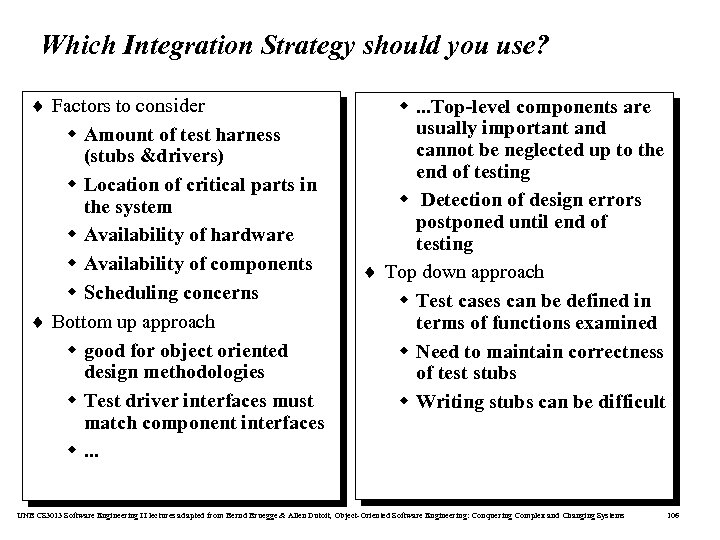
Which Integration Strategy should you use? ¨ Factors to consider w Amount of test harness (stubs &drivers) w Location of critical parts in the system w Availability of hardware w Availability of components w Scheduling concerns ¨ Bottom up approach w good for object oriented design methodologies w Test driver interfaces must match component interfaces w. . . Top-level components are usually important and cannot be neglected up to the end of testing w Detection of design errors postponed until end of testing ¨ Top down approach w Test cases can be defined in terms of functions examined w Need to maintain correctness of test stubs w Writing stubs can be difficult UNB CS 3013 Software Engineering II lectures adapted from Bernd Bruegge & Allen Dutoit, Object-Oriented Software Engineering: Conquering Complex and Changing Systems 106
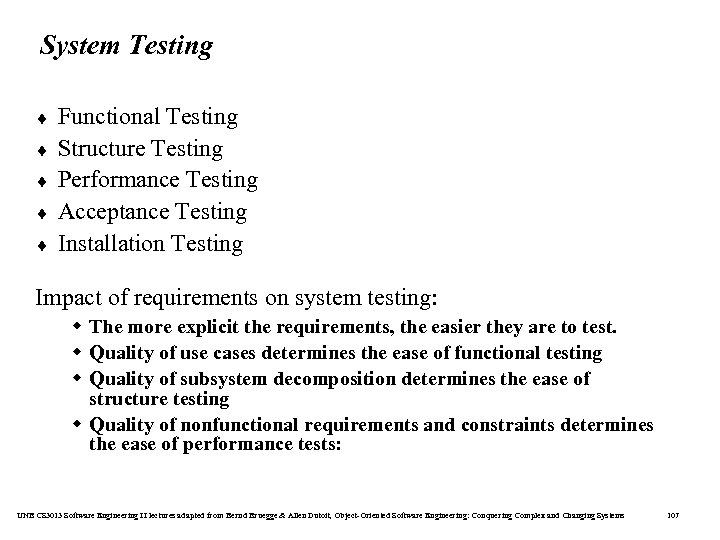
System Testing ¨ ¨ ¨ Functional Testing Structure Testing Performance Testing Acceptance Testing Installation Testing Impact of requirements on system testing: w The more explicit the requirements, the easier they are to test. w Quality of use cases determines the ease of functional testing w Quality of subsystem decomposition determines the ease of structure testing w Quality of nonfunctional requirements and constraints determines the ease of performance tests: UNB CS 3013 Software Engineering II lectures adapted from Bernd Bruegge & Allen Dutoit, Object-Oriented Software Engineering: Conquering Complex and Changing Systems 107
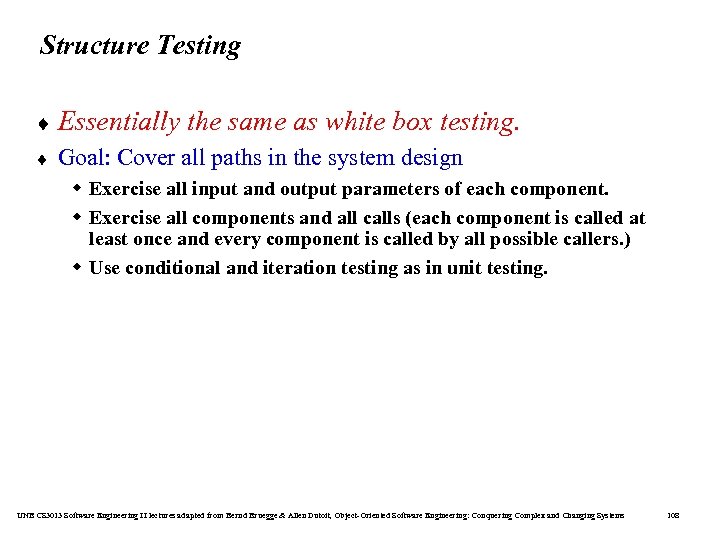
Structure Testing ¨ Essentially ¨ the same as white box testing. Goal: Cover all paths in the system design w Exercise all input and output parameters of each component. w Exercise all components and all calls (each component is called at least once and every component is called by all possible callers. ) w Use conditional and iteration testing as in unit testing. UNB CS 3013 Software Engineering II lectures adapted from Bernd Bruegge & Allen Dutoit, Object-Oriented Software Engineering: Conquering Complex and Changing Systems 108
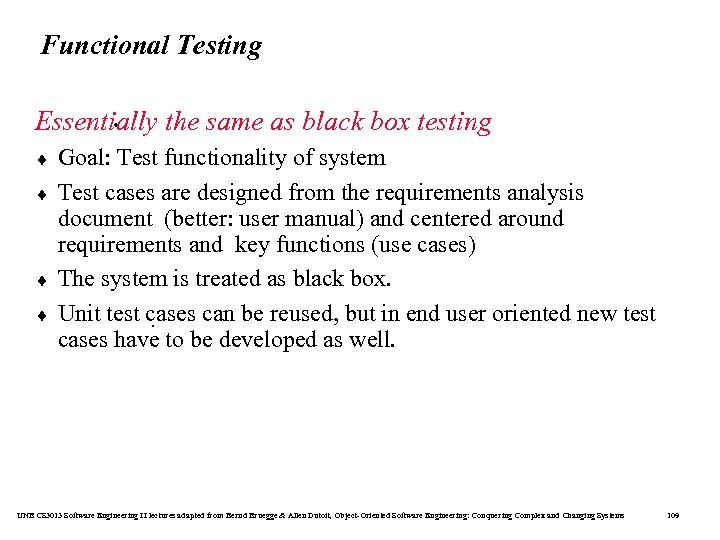
Functional Testing. Essentially the same as black box testing ¨ ¨ Goal: Test functionality of system Test cases are designed from the requirements analysis document (better: user manual) and centered around requirements and key functions (use cases) The system is treated as black box. Unit test cases can be reused, but in end user oriented new test. cases have to be developed as well. UNB CS 3013 Software Engineering II lectures adapted from Bernd Bruegge & Allen Dutoit, Object-Oriented Software Engineering: Conquering Complex and Changing Systems 109
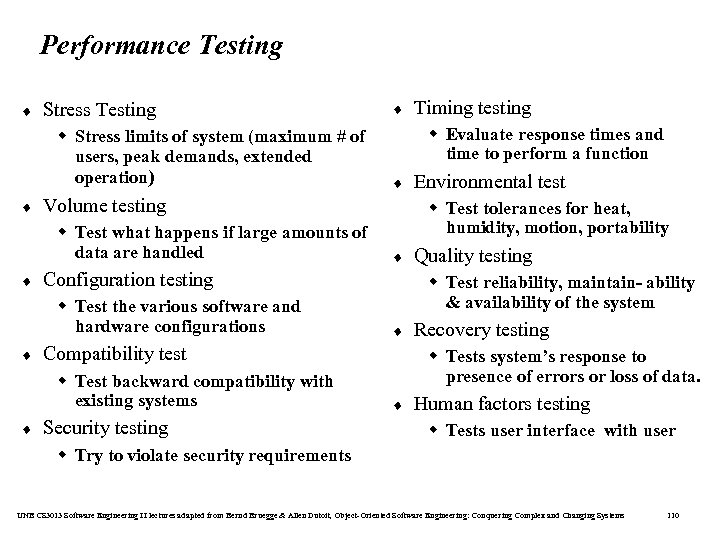
Performance Testing ¨ Stress Testing w Stress limits of system (maximum # of users, peak demands, extended operation) ¨ ¨ Security testing Environmental test w Test tolerances for heat, humidity, motion, portability ¨ Quality testing w Test reliability, maintain- ability & availability of the system ¨ Compatibility test w Test backward compatibility with existing systems ¨ ¨ Configuration testing w Test the various software and hardware configurations Timing testing w Evaluate response times and time to perform a function Volume testing w Test what happens if large amounts of data are handled ¨ ¨ Recovery testing w Tests system’s response to presence of errors or loss of data. ¨ Human factors testing w Tests user interface with user w Try to violate security requirements UNB CS 3013 Software Engineering II lectures adapted from Bernd Bruegge & Allen Dutoit, Object-Oriented Software Engineering: Conquering Complex and Changing Systems 110
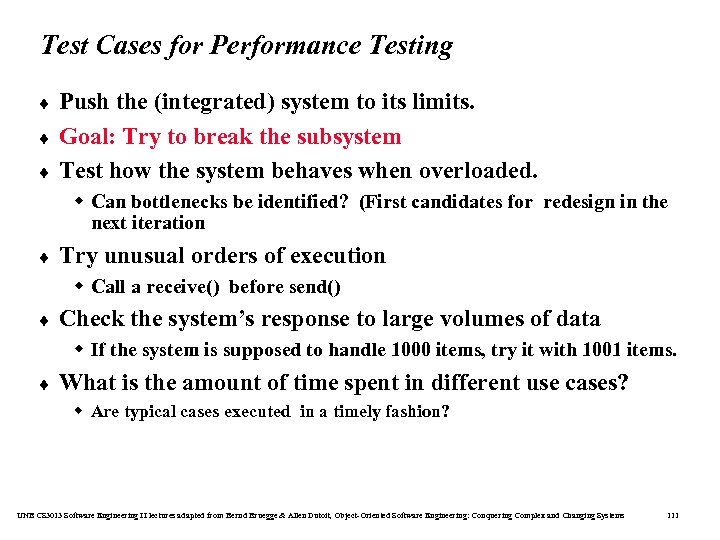
Test Cases for Performance Testing ¨ ¨ ¨ Push the (integrated) system to its limits. Goal: Try to break the subsystem Test how the system behaves when overloaded. w Can bottlenecks be identified? (First candidates for redesign in the next iteration ¨ Try unusual orders of execution w Call a receive() before send() ¨ Check the system’s response to large volumes of data w If the system is supposed to handle 1000 items, try it with 1001 items. ¨ What is the amount of time spent in different use cases? w Are typical cases executed in a timely fashion? UNB CS 3013 Software Engineering II lectures adapted from Bernd Bruegge & Allen Dutoit, Object-Oriented Software Engineering: Conquering Complex and Changing Systems 111
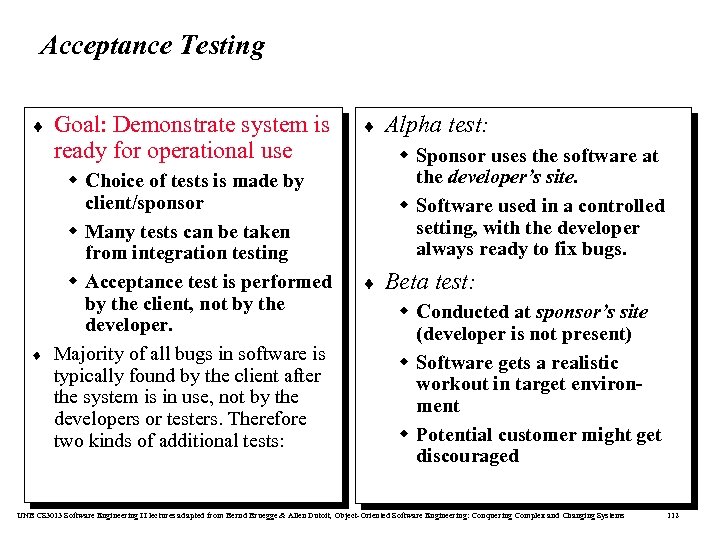
Acceptance Testing ¨ ¨ Goal: Demonstrate system is ready for operational use w Choice of tests is made by client/sponsor w Many tests can be taken from integration testing w Acceptance test is performed by the client, not by the developer. Majority of all bugs in software is typically found by the client after the system is in use, not by the developers or testers. Therefore two kinds of additional tests: ¨ Alpha test: w Sponsor uses the software at the developer’s site. w Software used in a controlled setting, with the developer always ready to fix bugs. ¨ Beta test: w Conducted at sponsor’s site (developer is not present) w Software gets a realistic workout in target environment w Potential customer might get discouraged UNB CS 3013 Software Engineering II lectures adapted from Bernd Bruegge & Allen Dutoit, Object-Oriented Software Engineering: Conquering Complex and Changing Systems 112
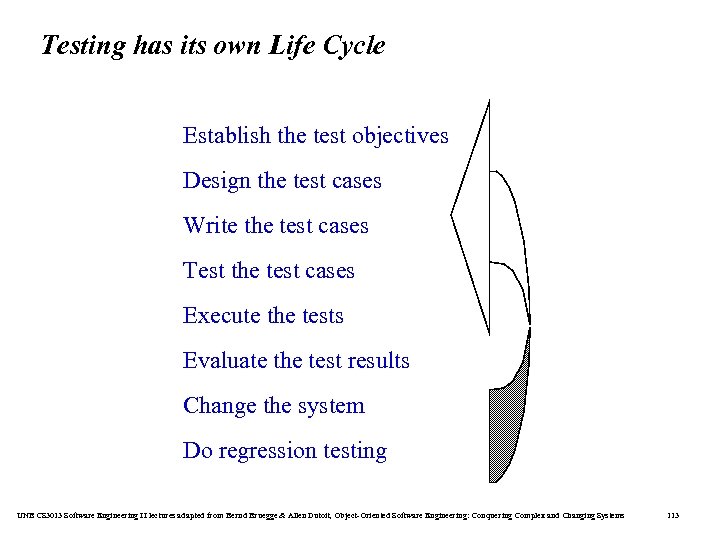
Testing has its own Life Cycle Establish the test objectives Design the test cases Write the test cases Test the test cases Execute the tests Evaluate the test results Change the system Do regression testing UNB CS 3013 Software Engineering II lectures adapted from Bernd Bruegge & Allen Dutoit, Object-Oriented Software Engineering: Conquering Complex and Changing Systems 113
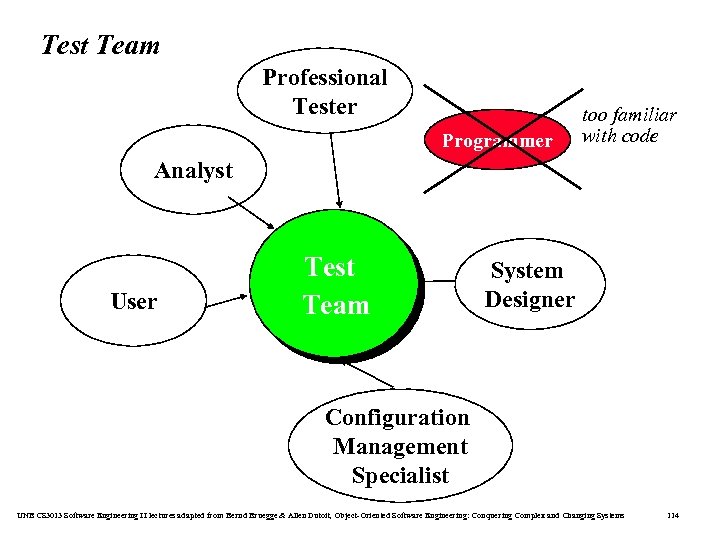
Test Team Professional Tester Programmer too familiar with code Analyst User Test Team System Designer Configuration Management Specialist UNB CS 3013 Software Engineering II lectures adapted from Bernd Bruegge & Allen Dutoit, Object-Oriented Software Engineering: Conquering Complex and Changing Systems 114
Summary ¨ Testing is still a black art, but many rules and heuristics are available ¨ Testing consists of component-testing (unit testing, integration testing) and system testing Design Patterns can be used for component-based testing Testing has its own lifecycle ¨ ¨ UNB CS 3013 Software Engineering II lectures adapted from Bernd Bruegge & Allen Dutoit, Object-Oriented Software Engineering: Conquering Complex and Changing Systems 115
Скачать презентацию Conquering Complex and Changing Systems Object-Oriented Software Engineering
5057502812a971560f2a5db0f2431553.ppt