 Скачать презентацию Conquering Complex and Changing Systems Object-Oriented Software Engineering
630c5118127c0639e9d7b3fc9bed67a0.ppt
- Количество слайдов: 38



Conquering Complex and Changing Systems Object-Oriented Software Engineering Chapter 5, Analysis: Object Modeling
Outline ¨ ¨ ¨ ¨ From use cases to objects Object modeling Class vs instance diagrams Attributes Operations and methods Links and associations Examples of associations Two special associations w Aggregation w Inheritance Bernd Bruegge & Allen Dutoit Object-Oriented Software Engineering: Conquering Complex and Changing Systems 2
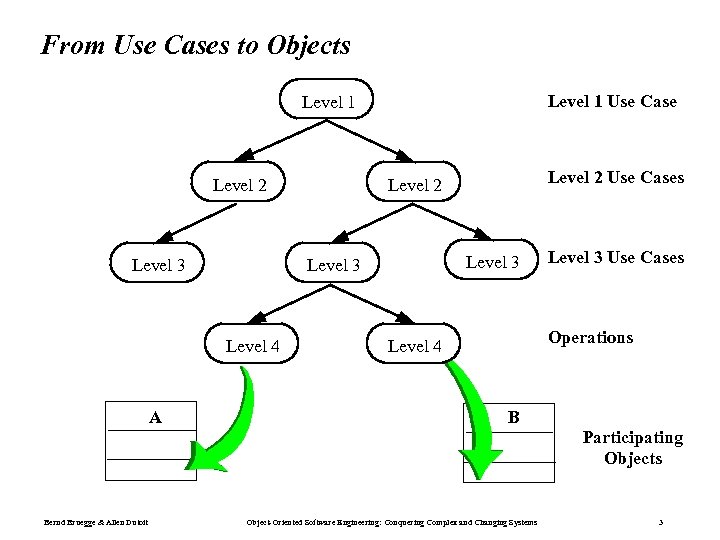
From Use Cases to Objects Level 1 Use Case Level 1 Level 2 Level 3 A Level 3 Level 4 Level 2 Use Cases Level 2 Level 3 Use Cases Operations Level 4 B Participating Objects Bernd Bruegge & Allen Dutoit Object-Oriented Software Engineering: Conquering Complex and Changing Systems 3
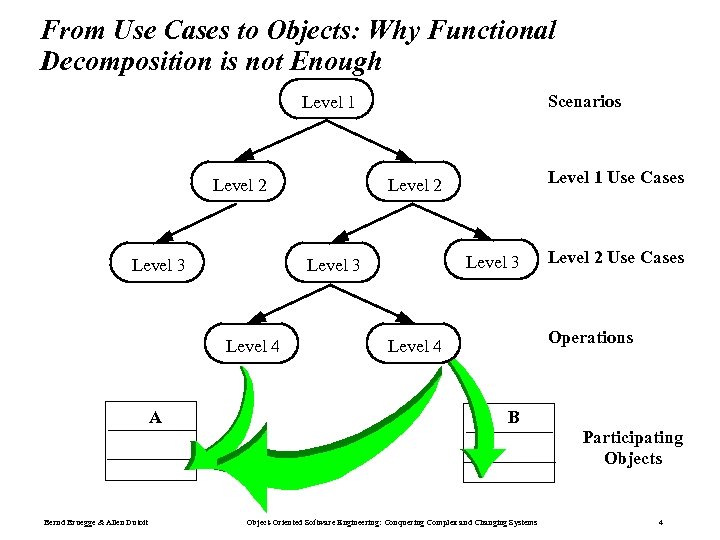
From Use Cases to Objects: Why Functional Decomposition is not Enough Scenarios Level 1 Level 2 Level 3 A Level 3 Level 4 Level 1 Use Cases Level 2 Use Cases Operations Level 4 B Participating Objects Bernd Bruegge & Allen Dutoit Object-Oriented Software Engineering: Conquering Complex and Changing Systems 4
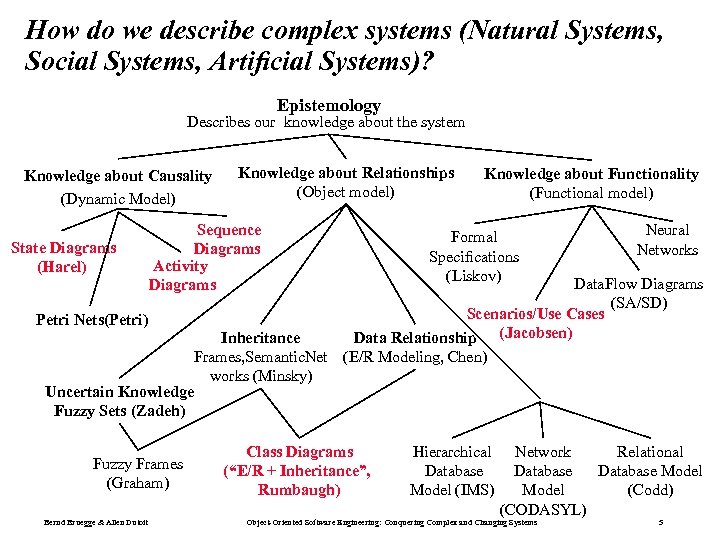
How do we describe complex systems (Natural Systems, Social Systems, Artificial Systems)? Epistemology Describes our knowledge about the system Knowledge about Causality (Dynamic Model) State Diagrams (Harel) Sequence Diagrams Activity Diagrams Petri Nets(Petri) Uncertain Knowledge Fuzzy Sets (Zadeh) Fuzzy Frames (Graham) Bernd Bruegge & Allen Dutoit Knowledge about Relationships (Object model) Knowledge about Functionality (Functional model) Formal Specifications (Liskov) Neural Networks Data. Flow Diagrams (SA/SD) Scenarios/Use Cases Inheritance Data Relationship (Jacobsen) Frames, Semantic. Net (E/R Modeling, Chen) works (Minsky) Class Diagrams (“E/R + Inheritance”, Rumbaugh) Hierarchical Database Model (IMS) Network Relational Database Model (Codd) (CODASYL) Object-Oriented Software Engineering: Conquering Complex and Changing Systems 5
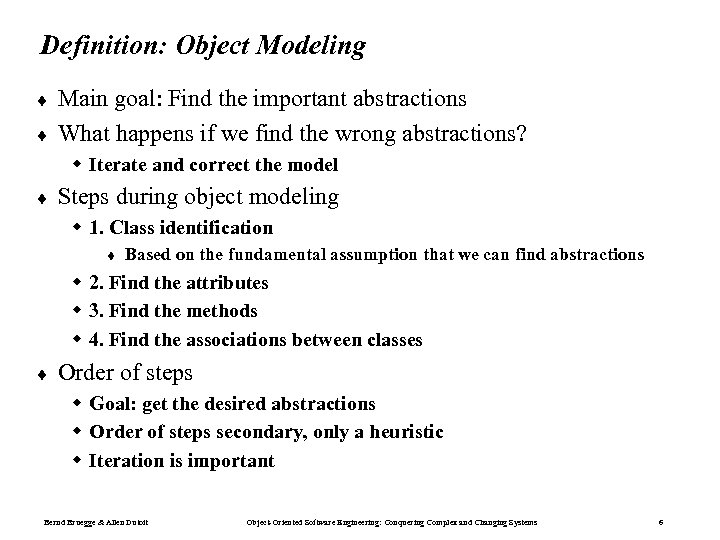
Definition: Object Modeling ¨ ¨ Main goal: Find the important abstractions What happens if we find the wrong abstractions? w Iterate and correct the model ¨ Steps during object modeling w 1. Class identification t Based on the fundamental assumption that we can find abstractions w 2. Find the attributes w 3. Find the methods w 4. Find the associations between classes ¨ Order of steps w Goal: get the desired abstractions w Order of steps secondary, only a heuristic w Iteration is important Bernd Bruegge & Allen Dutoit Object-Oriented Software Engineering: Conquering Complex and Changing Systems 6
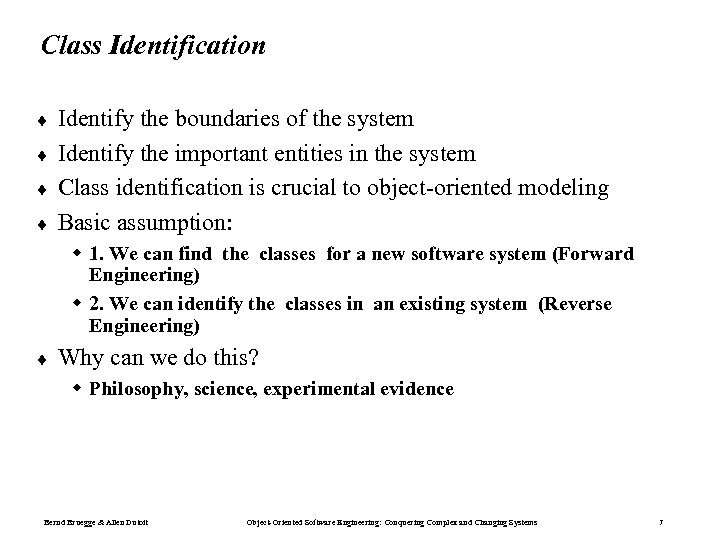
Class Identification ¨ ¨ Identify the boundaries of the system Identify the important entities in the system Class identification is crucial to object-oriented modeling Basic assumption: w 1. We can find the classes for a new software system (Forward Engineering) w 2. We can identify the classes in an existing system (Reverse Engineering) ¨ Why can we do this? w Philosophy, science, experimental evidence Bernd Bruegge & Allen Dutoit Object-Oriented Software Engineering: Conquering Complex and Changing Systems 7
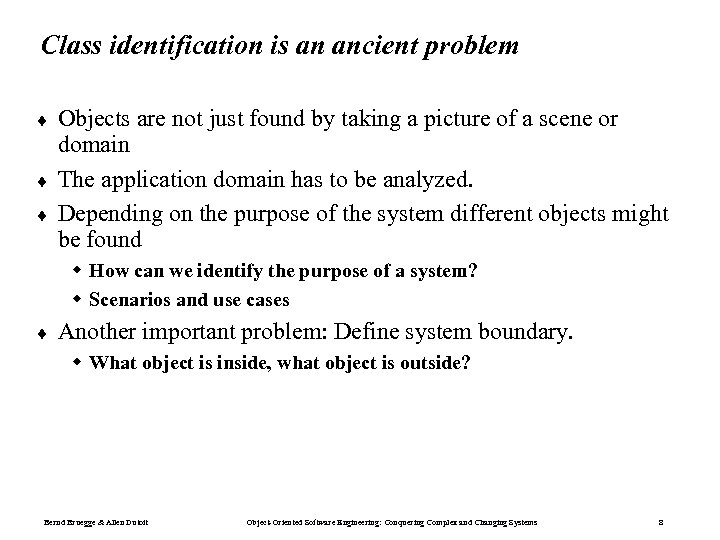
Class identification is an ancient problem ¨ ¨ ¨ Objects are not just found by taking a picture of a scene or domain The application domain has to be analyzed. Depending on the purpose of the system different objects might be found w How can we identify the purpose of a system? w Scenarios and use cases ¨ Another important problem: Define system boundary. w What object is inside, what object is outside? Bernd Bruegge & Allen Dutoit Object-Oriented Software Engineering: Conquering Complex and Changing Systems 8
Pieces of an Object Model ¨ ¨ Classes Associations (Relations) w Part of- Hierarchy (Aggregation) w Kind of-Hierarchy (Generalization) ¨ Attributes w w ¨ Detection of attributes Application specific Attributes in one system can be classes in another system Turning attributes to classes Methods w Detection of methods w Generic methods: General world knowledge, design patterns w Domain Methods: Dynamic model, Functional model Bernd Bruegge & Allen Dutoit Object-Oriented Software Engineering: Conquering Complex and Changing Systems 9
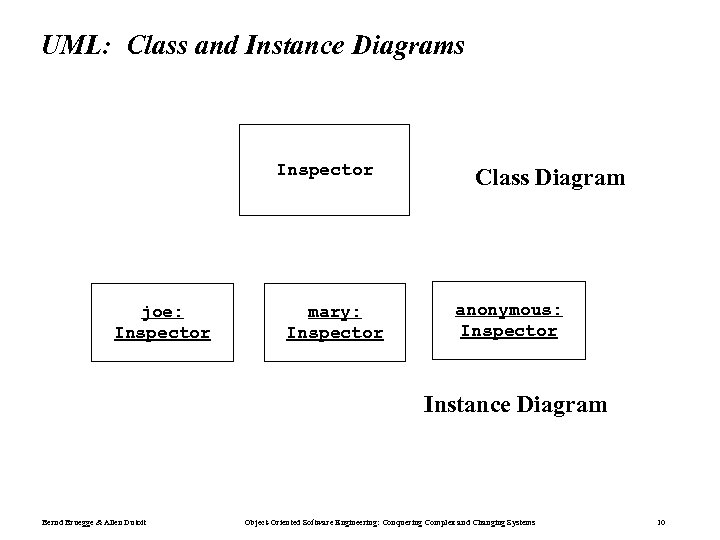
UML: Class and Instance Diagrams Inspector joe: Inspector mary: Inspector Class Diagram anonymous: Inspector Instance Diagram Bernd Bruegge & Allen Dutoit Object-Oriented Software Engineering: Conquering Complex and Changing Systems 10
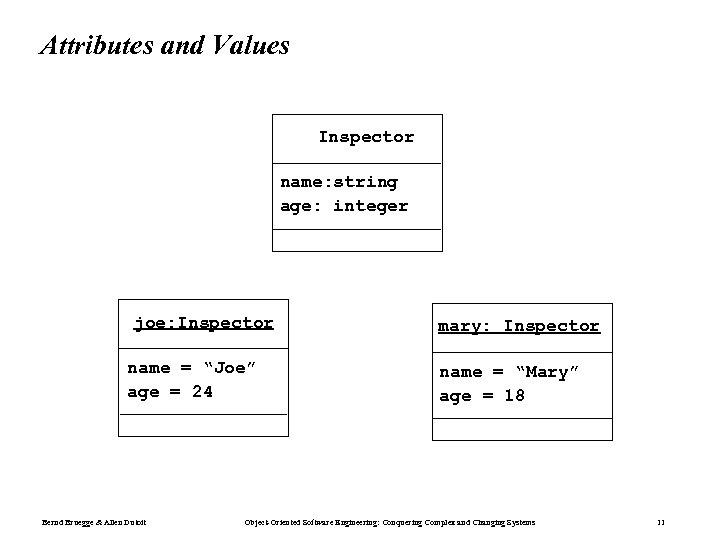
Attributes and Values Inspector name: string age: integer joe: Inspector name = “Joe” age = 24 Bernd Bruegge & Allen Dutoit mary: Inspector name = “Mary” age = 18 Object-Oriented Software Engineering: Conquering Complex and Changing Systems 11
Links and Associations ¨ ¨ Links and associations establish relationships among objects and classes. Link: w A connection between two object instances. A link is like a tuple. w A link is an instance of an association ¨ Association: w Basically a bidirectional mapping. w One-to-one, many-to-one, one-to-many, w An association describes a set of links like a class describes a set of objects. Bernd Bruegge & Allen Dutoit Object-Oriented Software Engineering: Conquering Complex and Changing Systems 12
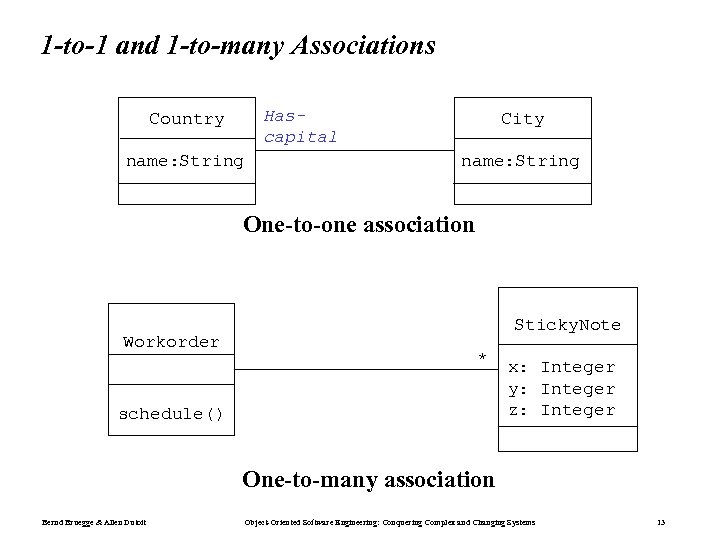
1 -to-1 and 1 -to-many Associations Hascapital Country name: String City name: String One-to-one association Workorder Sticky. Note * schedule() x: Integer y: Integer z: Integer One-to-many association Bernd Bruegge & Allen Dutoit Object-Oriented Software Engineering: Conquering Complex and Changing Systems 13
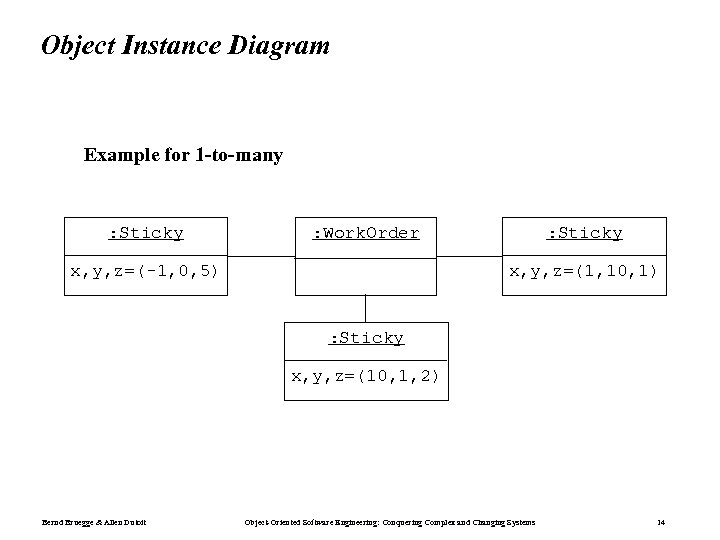
Object Instance Diagram Example for 1 -to-many : Sticky : Work. Order x, y, z=(-1, 0, 5) : Sticky x, y, z=(1, 10, 1) : Sticky x, y, z=(10, 1, 2) Bernd Bruegge & Allen Dutoit Object-Oriented Software Engineering: Conquering Complex and Changing Systems 14
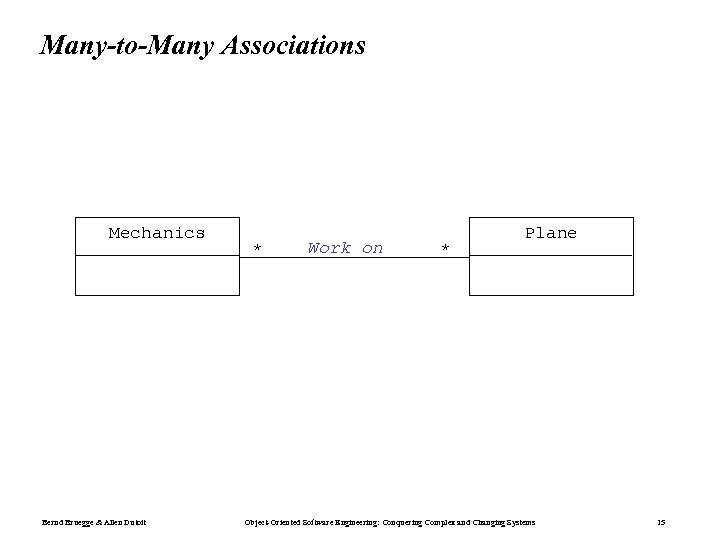
Many-to-Many Associations Mechanics Bernd Bruegge & Allen Dutoit * Work on * Plane Object-Oriented Software Engineering: Conquering Complex and Changing Systems 15
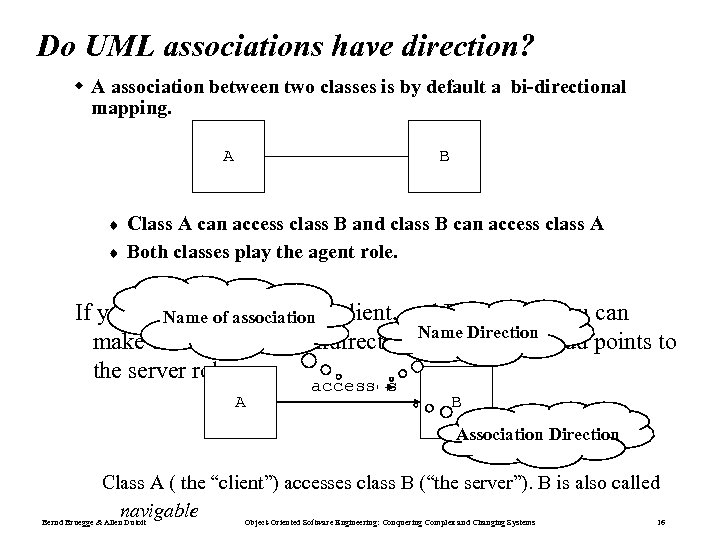
Do UML associations have direction? w A association between two classes is by default a bi-directional mapping. A t t B Class A can access class B and class B can access class A Both classes play the agent role. If you want to of association a client, and B a server, you can Name to make A Name Direction make the association unidirectional. The arrowhead points to the server role: A accesses B Association Direction Class A ( the “client”) accesses class B (“the server”). B is also called navigable Bernd Bruegge & Allen Dutoit Object-Oriented Software Engineering: Conquering Complex and Changing Systems 16
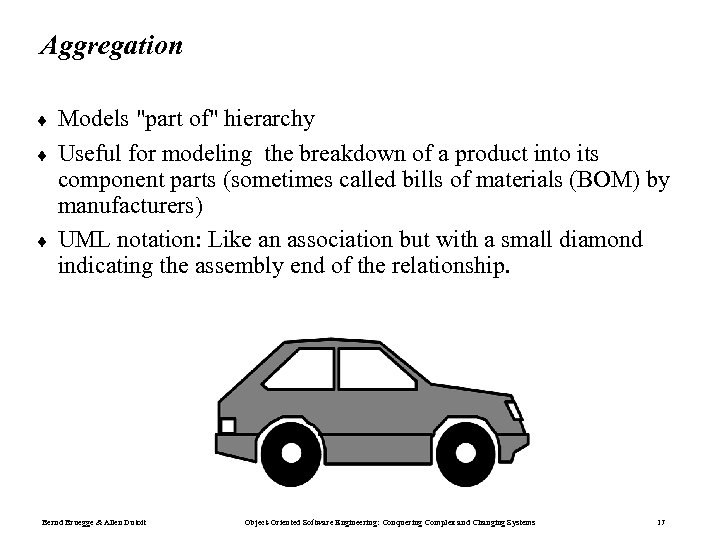
Aggregation ¨ ¨ ¨ Models "part of" hierarchy Useful for modeling the breakdown of a product into its component parts (sometimes called bills of materials (BOM) by manufacturers) UML notation: Like an association but with a small diamond indicating the assembly end of the relationship. Bernd Bruegge & Allen Dutoit Object-Oriented Software Engineering: Conquering Complex and Changing Systems 17
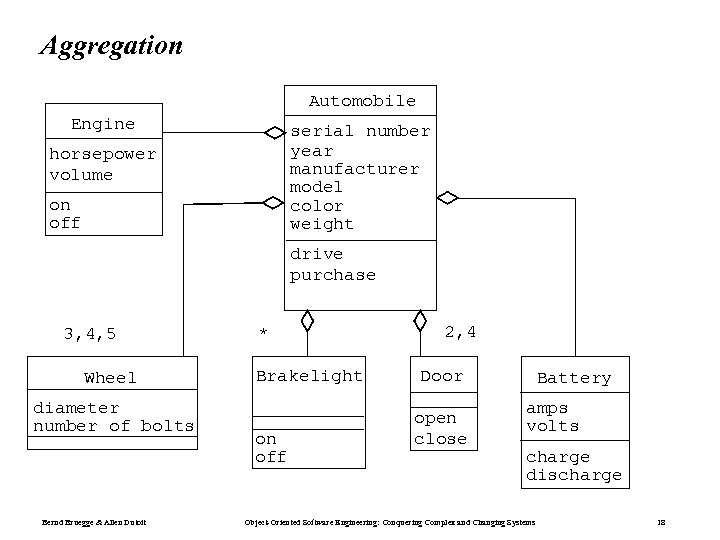
Aggregation Automobile Engine serial number year manufacturer model color weight horsepower volume on off drive purchase 3, 4, 5 Wheel diameter number of bolts Bernd Bruegge & Allen Dutoit * Brakelight on off 2, 4 Door open close Battery amps volts charge discharge Object-Oriented Software Engineering: Conquering Complex and Changing Systems 18
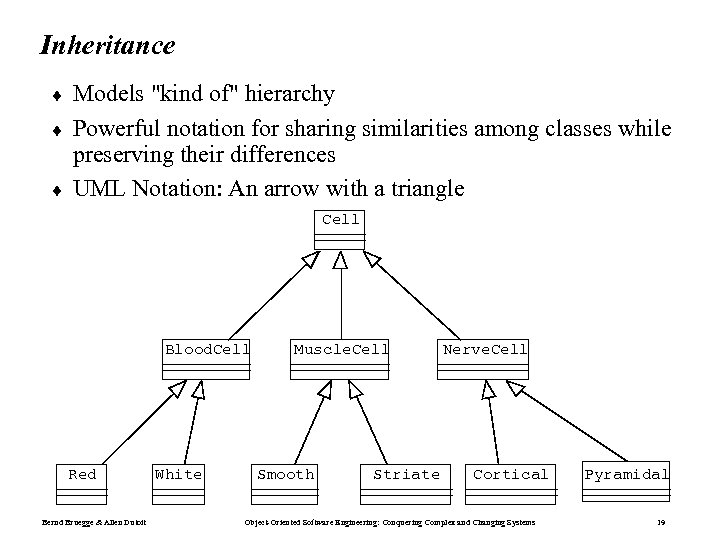
Inheritance ¨ ¨ ¨ Models "kind of" hierarchy Powerful notation for sharing similarities among classes while preserving their differences UML Notation: An arrow with a triangle Cell Blood. Cell Red Bernd Bruegge & Allen Dutoit White Muscle. Cell Smooth Striate Nerve. Cell Cortical Object-Oriented Software Engineering: Conquering Complex and Changing Systems Pyramidal 19
Aggregation vs Inheritance ¨ Both associations describe trees (hierarchies) w Aggregation tree describes a-part-of relationships (also called and-relationship) w Inheritance tree describes "kind-of" relationships (also called or-relationship) ¨ Aggregation relates instances (involves two or more different objects) ¨ Inheritance relates classes (a way to structure the description of a single object) Bernd Bruegge & Allen Dutoit Object-Oriented Software Engineering: Conquering Complex and Changing Systems 20
Other Associations ¨ Uses: w A subsystem uses another subsystem (System Design) ¨ Contains: w Sometimes called “spatial aggregation” w. . . contains. . . w Example: A UML package contains another UML package ¨ Parent/child relationship: w. . . is father of. . . w. . . is mother of. . . ¨ Seniority: w. . . is older than. . . w. . . is more experienced than. . . Bernd Bruegge & Allen Dutoit Object-Oriented Software Engineering: Conquering Complex and Changing Systems 21
Object Types ¨ Entity Objects w Represent the persistent information tracked by the system (Application domain objects, “Business objects”) ¨ Boundary Objects w Represent the interaction between the user and the system ¨ Control Objects: w Represent the control tasks performed by the system ¨ Having three types of objects leads to models that are more resilient to change. w The boundary of a system changes more likely than the control w The control of the system change more likely than the application domain ¨ Object types originated in Smalltalk: w Model, View, Controller (MV) Bernd Bruegge & Allen Dutoit Object-Oriented Software Engineering: Conquering Complex and Changing Systems 22
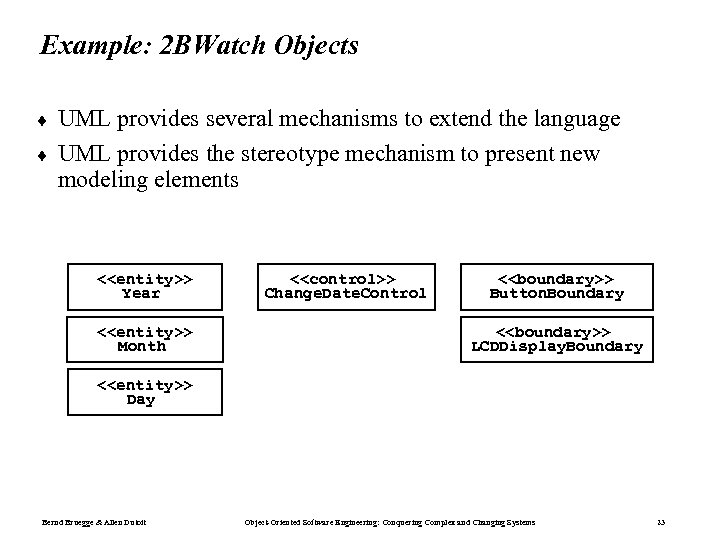
Example: 2 BWatch Objects ¨ ¨ UML provides several mechanisms to extend the language UML provides the stereotype mechanism to present new modeling elements <<entity>> Year <<entity>> Month <<control>> Change. Date. Control <<boundary>> Button. Boundary <<boundary>> LCDDisplay. Boundary <<entity>> Day Bernd Bruegge & Allen Dutoit Object-Oriented Software Engineering: Conquering Complex and Changing Systems 23
Roles ¨ ¨ ¨ A role name is the name that uniquely identifies one end of an association. A role name is written next to the association line near the class that plays the role. When do you use role names? w Necessary for associations between two objects of the same class w Also useful to distinguish between two associations between the same pair of classes ¨ When do you not use role names? w If there is only a single association between a pair of distinct classes, the names of the classes serve as good role names Bernd Bruegge & Allen Dutoit Object-Oriented Software Engineering: Conquering Complex and Changing Systems 24
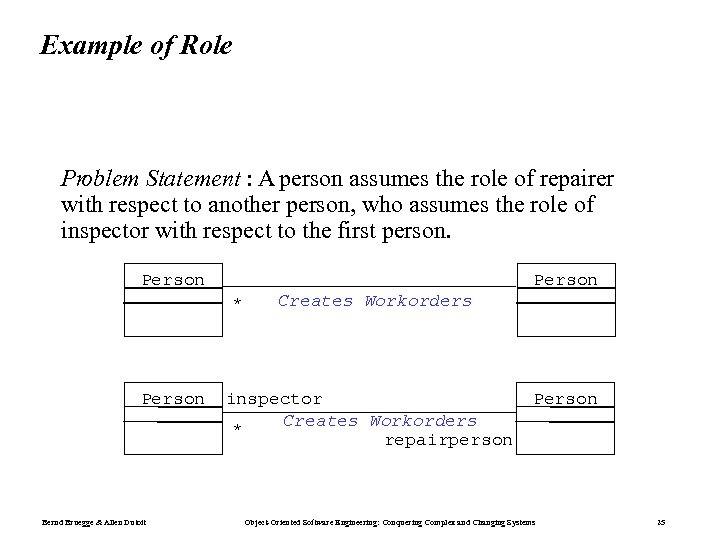
Example of Role Problem Statement : A person assumes the role of repairer with respect to another person, who assumes the role of inspector with respect to the first person. Person * Person Bernd Bruegge & Allen Dutoit Creates Workorders inspector Creates Workorders * repairperson Person Object-Oriented Software Engineering: Conquering Complex and Changing Systems 25
Roles in Associations ¨ Client Role: w An object that can operate upon other objects but that is never operated upon by other objects. ¨ Server Role: w An object that never operates upon other objects. It is only operated upon by other objects. ¨ Agent Role: w An object that can both operate upon other objects and be operated upon by other objects. An agent is usually created to do some work on behalf of an actor or another agent. Bernd Bruegge & Allen Dutoit Object-Oriented Software Engineering: Conquering Complex and Changing Systems 26
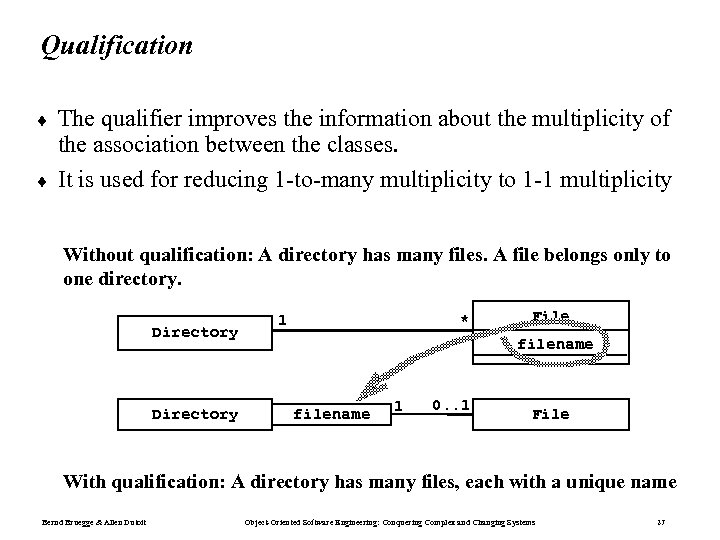
Qualification ¨ ¨ The qualifier improves the information about the multiplicity of the association between the classes. It is used for reducing 1 -to-many multiplicity to 1 -1 multiplicity Without qualification: A directory has many files. A file belongs only to one directory. Directory 1 * File filename 1 0. . 1 File With qualification: A directory has many files, each with a unique name Bernd Bruegge & Allen Dutoit Object-Oriented Software Engineering: Conquering Complex and Changing Systems 27
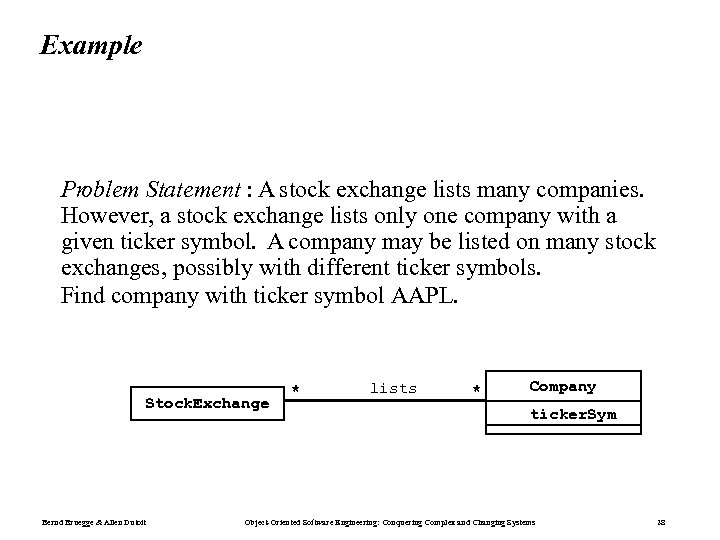
Example Problem Statement : A stock exchange lists many companies. However, a stock exchange lists only one company with a given ticker symbol. A company may be listed on many stock exchanges, possibly with different ticker symbols. Find company with ticker symbol AAPL. Stock. Exchange Bernd Bruegge & Allen Dutoit * lists * Company ticker. Sym Object-Oriented Software Engineering: Conquering Complex and Changing Systems 28
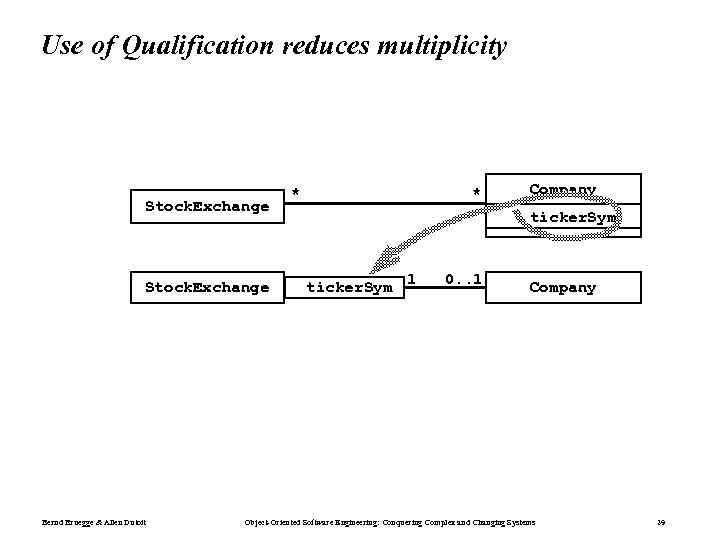
Use of Qualification reduces multiplicity Stock. Exchange Bernd Bruegge & Allen Dutoit * * Company ticker. Sym 1 0. . 1 Company Object-Oriented Software Engineering: Conquering Complex and Changing Systems 29
How do you find classes? ¨ ¨ ¨ ¨ Learn about problem domain: Observe your client Apply general world knowledge and intuition Take the flow of events and find participating objects in use cases Apply design patterns Try to establish a taxonomy Do a textual analysis of scenario or flow of events (Abbott Textual Analysis, 1983) Nouns are good candidates for classes Bernd Bruegge & Allen Dutoit Object-Oriented Software Engineering: Conquering Complex and Changing Systems 30
![Mapping parts of speech to object model components [Abbot 1983] Part of speech Model](https://present5.com/presentation/630c5118127c0639e9d7b3fc9bed67a0/image-31.jpg "Mapping parts of speech to object model components [Abbot 1983] Part of speech Model")
Mapping parts of speech to object model components [Abbot 1983] Part of speech Model component Example Proper noun object Jim Smith Improper noun class Toy, doll Doing verb method Buy, recommend being verb inheritance is-a (kind-of) having verb aggregation has an modal verb constraint must be adjective attribute 3 years old transitive verb method enter intransitive verb method (event) depends on Bernd Bruegge & Allen Dutoit Object-Oriented Software Engineering: Conquering Complex and Changing Systems 31
Example: Scenario from Problem Statement ¨ ¨ ¨ Jim Smith enters a store with the intention of buying a toy for his 3 year old child. Help must be available within less than one minute. The store owner gives advice to the customer. The advice depends on the age range of the child and the attributes of the toy. Jim selects a dangerous toy which is unsuitable for the child. The store owner recommends a more yellow doll. Bernd Bruegge & Allen Dutoit Object-Oriented Software Engineering: Conquering Complex and Changing Systems 32
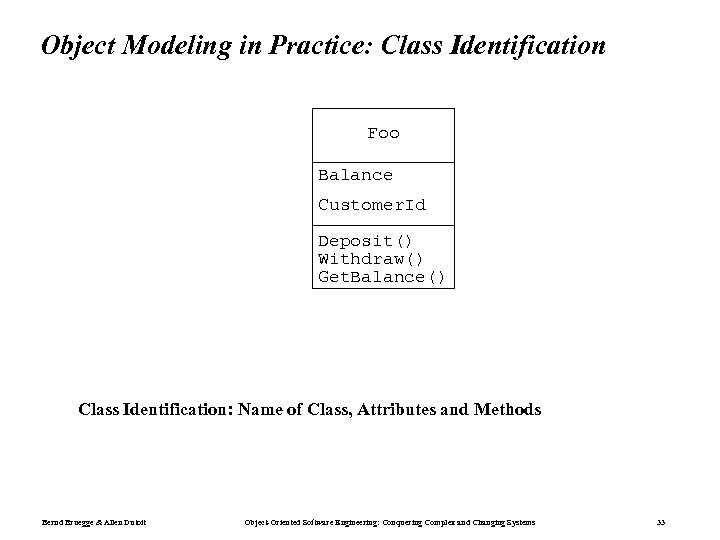
Object Modeling in Practice: Class Identification Foo Balance Customer. Id Deposit() Withdraw() Get. Balance() Class Identification: Name of Class, Attributes and Methods Bernd Bruegge & Allen Dutoit Object-Oriented Software Engineering: Conquering Complex and Changing Systems 33
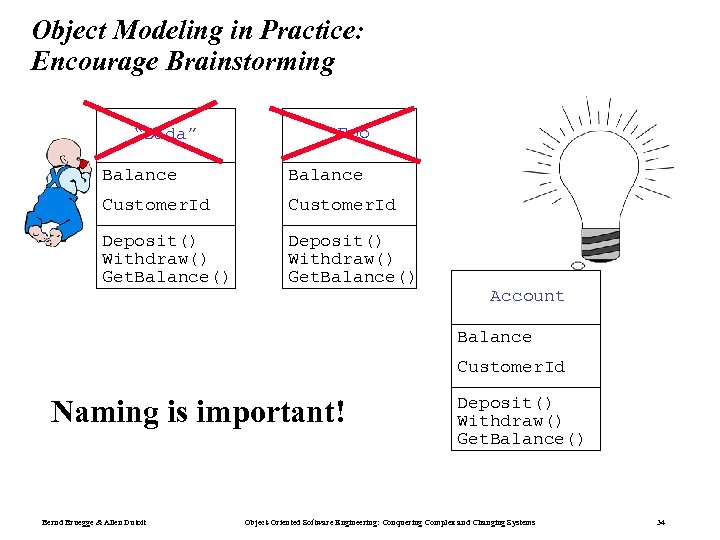
Object Modeling in Practice: Encourage Brainstorming “Dada” Foo Balance Customer. Id Deposit() Withdraw() Get. Balance() Account Balance Customer. Id Naming is important! Bernd Bruegge & Allen Dutoit Deposit() Withdraw() Get. Balance() Object-Oriented Software Engineering: Conquering Complex and Changing Systems 34
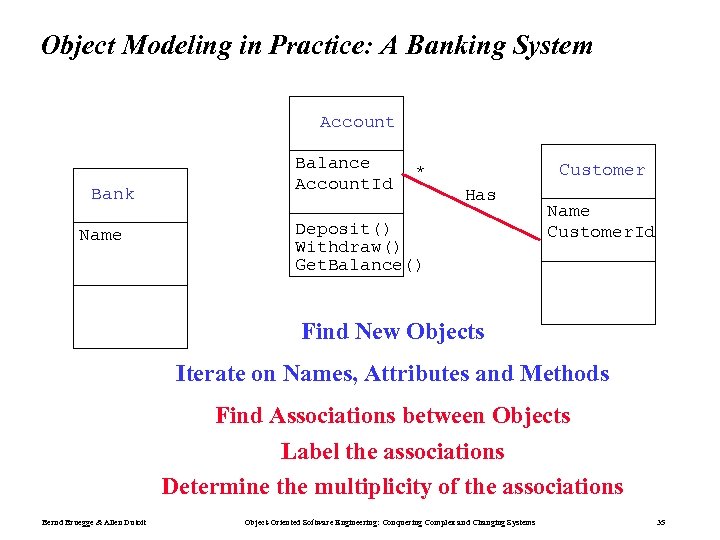
Object Modeling in Practice: A Banking System Account Bank Name Balance Account. Id Customer * Has Deposit() Withdraw() Get. Balance() Name Customer. Id Find New Objects Iterate on Names, Attributes and Methods Find Associations between Objects Label the associations Determine the multiplicity of the associations Bernd Bruegge & Allen Dutoit Object-Oriented Software Engineering: Conquering Complex and Changing Systems 35
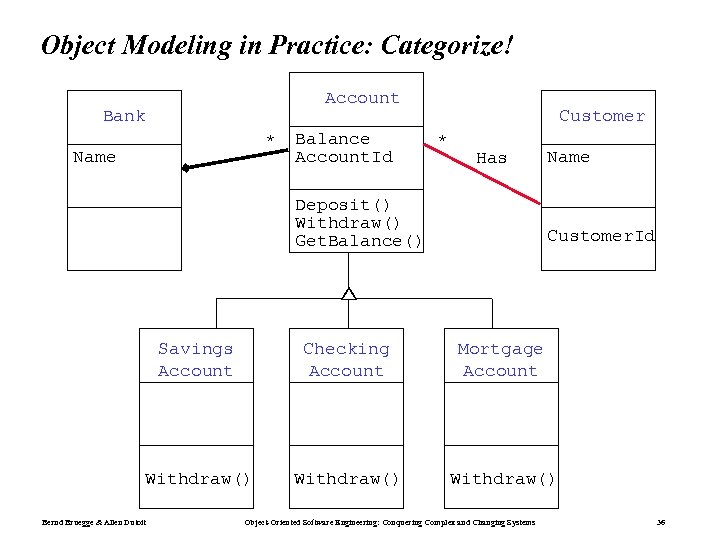
Object Modeling in Practice: Categorize! Account Bank * Name Balance Account. Id Customer * Has Deposit() Withdraw() Get. Balance() Name Customer. Id Savings Account Checking Account Mortgage Account Withdraw() Bernd Bruegge & Allen Dutoit Object-Oriented Software Engineering: Conquering Complex and Changing Systems 36
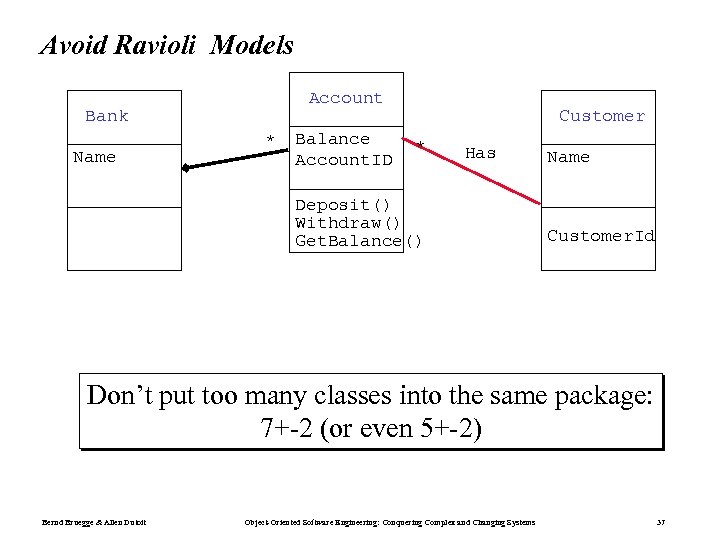
Avoid Ravioli Models Account Bank Name * Balance Account. ID Customer * Has Deposit() Withdraw() Get. Balance() Name Customer. Id Don’t put too many classes into the same package: 7+-2 (or even 5+-2) Bernd Bruegge & Allen Dutoit Object-Oriented Software Engineering: Conquering Complex and Changing Systems 37
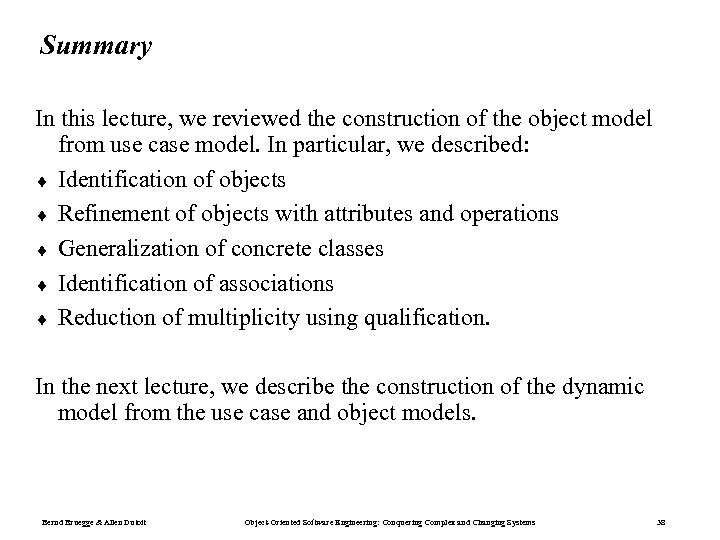
Summary In this lecture, we reviewed the construction of the object model from use case model. In particular, we described: ¨ Identification of objects ¨ Refinement of objects with attributes and operations ¨ Generalization of concrete classes ¨ Identification of associations ¨ Reduction of multiplicity using qualification. In the next lecture, we describe the construction of the dynamic model from the use case and object models. Bernd Bruegge & Allen Dutoit Object-Oriented Software Engineering: Conquering Complex and Changing Systems 38
Скачать презентацию Conquering Complex and Changing Systems Object-Oriented Software Engineering
630c5118127c0639e9d7b3fc9bed67a0.ppt