 Скачать презентацию Conquering Complex and Changing Systems Object-Oriented Software Engineering
cb0d5cac32a51d7c4601cae767c0e5f2.ppt
- Количество слайдов: 19



Conquering Complex and Changing Systems Object-Oriented Software Engineering Chapter 6, System Design Lecture 1 Utdrag ur Bruegges OH-bilder första delen av kapitel 6 Hela hittas på följande adress: ftp: //ftp. prenhall. com/pub/esm/the_apt_series. s-042/bruegge/Object_Oriented_Software_Engineering/lectures/ch 6 lect 1. ppt
Design “There are two ways of constructing a software design: One way is to make it so simple that there are obviously no deficiencies, and the other way is to make it so complicated that there are no obvious deficiencies. ” - C. A. R. Hoare Bernd Bruegge & Allen Dutoit Object-Oriented Software Engineering: Conquering Complex and Changing Systems 2
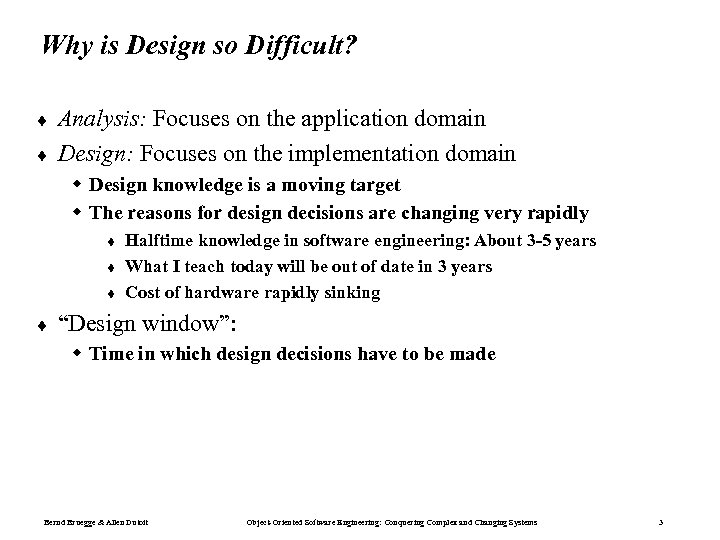
Why is Design so Difficult? ¨ ¨ Analysis: Focuses on the application domain Design: Focuses on the implementation domain w Design knowledge is a moving target w The reasons for design decisions are changing very rapidly t t t ¨ Halftime knowledge in software engineering: About 3 -5 years What I teach today will be out of date in 3 years Cost of hardware rapidly sinking “Design window”: w Time in which design decisions have to be made Bernd Bruegge & Allen Dutoit Object-Oriented Software Engineering: Conquering Complex and Changing Systems 3
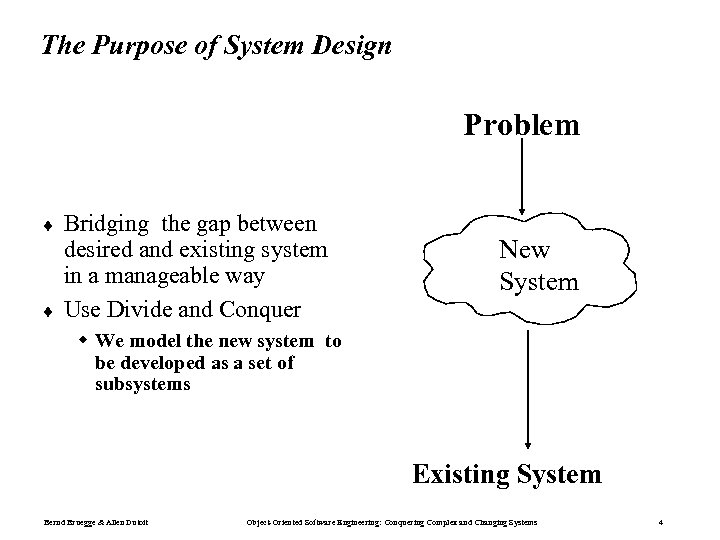
The Purpose of System Design Problem ¨ ¨ Bridging the gap between desired and existing system in a manageable way Use Divide and Conquer New System w We model the new system to be developed as a set of subsystems Existing System Bernd Bruegge & Allen Dutoit Object-Oriented Software Engineering: Conquering Complex and Changing Systems 4
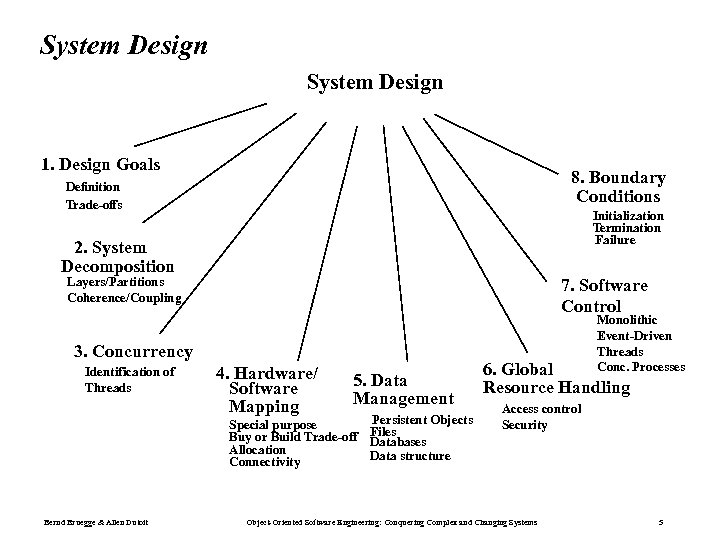
System Design 1. Design Goals 8. Boundary Conditions Definition Trade-offs Initialization Termination Failure 2. System Decomposition Layers/Partitions Coherence/Coupling 7. Software Control 3. Concurrency Identification of Threads 4. Hardware/ Software Mapping 5. Data Management Persistent Objects Special purpose Files Buy or Build Trade-off Databases Allocation Data structure Connectivity Bernd Bruegge & Allen Dutoit Monolithic Event-Driven Threads Conc. Processes 6. Global Resource Handling Access control Security Object-Oriented Software Engineering: Conquering Complex and Changing Systems 5
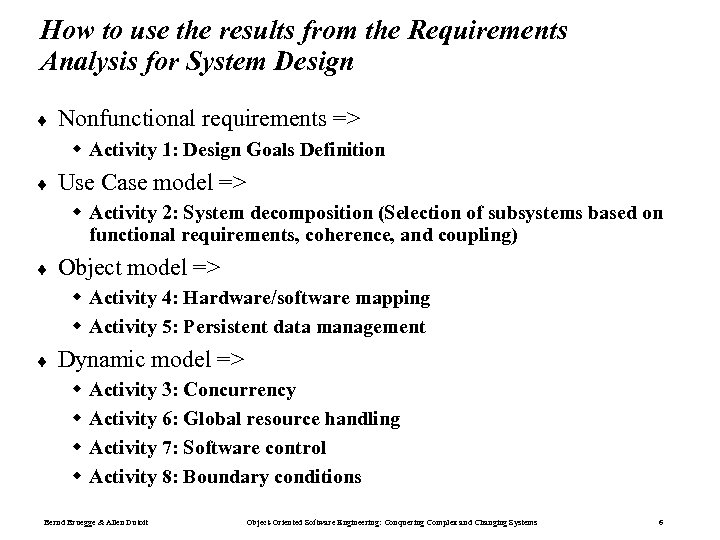
How to use the results from the Requirements Analysis for System Design ¨ Nonfunctional requirements => w Activity 1: Design Goals Definition ¨ Use Case model => w Activity 2: System decomposition (Selection of subsystems based on functional requirements, coherence, and coupling) ¨ Object model => w Activity 4: Hardware/software mapping w Activity 5: Persistent data management ¨ Dynamic model => w w Activity 3: Concurrency Activity 6: Global resource handling Activity 7: Software control Activity 8: Boundary conditions Bernd Bruegge & Allen Dutoit Object-Oriented Software Engineering: Conquering Complex and Changing Systems 6
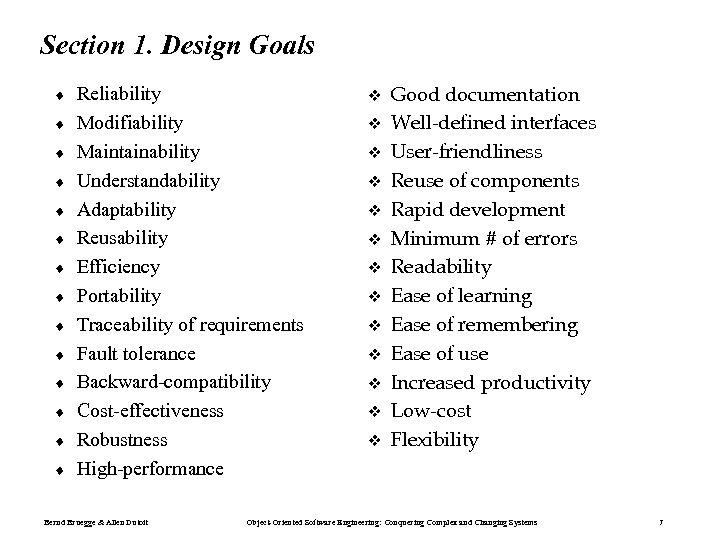
Section 1. Design Goals ¨ ¨ ¨ ¨ Reliability Modifiability Maintainability Understandability Adaptability Reusability Efficiency Portability Traceability of requirements Fault tolerance Backward-compatibility Cost-effectiveness Robustness High-performance Bernd Bruegge & Allen Dutoit Good documentation Well-defined interfaces User-friendliness Reuse of components Rapid development Minimum # of errors Readability Ease of learning Ease of remembering Ease of use Increased productivity Low-cost Flexibility Object-Oriented Software Engineering: Conquering Complex and Changing Systems 7
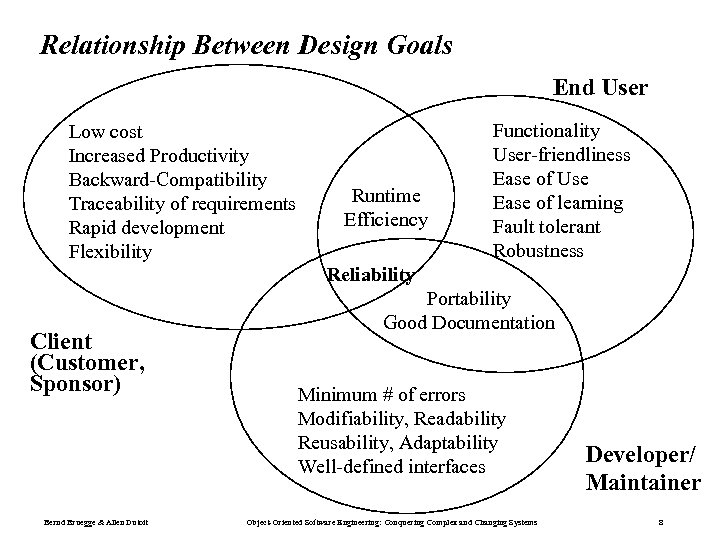
Relationship Between Design Goals End User Low cost Increased Productivity Backward-Compatibility Traceability of requirements Rapid development Flexibility Runtime Efficiency Functionality User-friendliness Ease of Use Ease of learning Fault tolerant Robustness Reliability Client (Customer, Sponsor) Bernd Bruegge & Allen Dutoit Portability Good Documentation Minimum # of errors Modifiability, Readability Reusability, Adaptability Well-defined interfaces Object-Oriented Software Engineering: Conquering Complex and Changing Systems Developer/ Maintainer 8
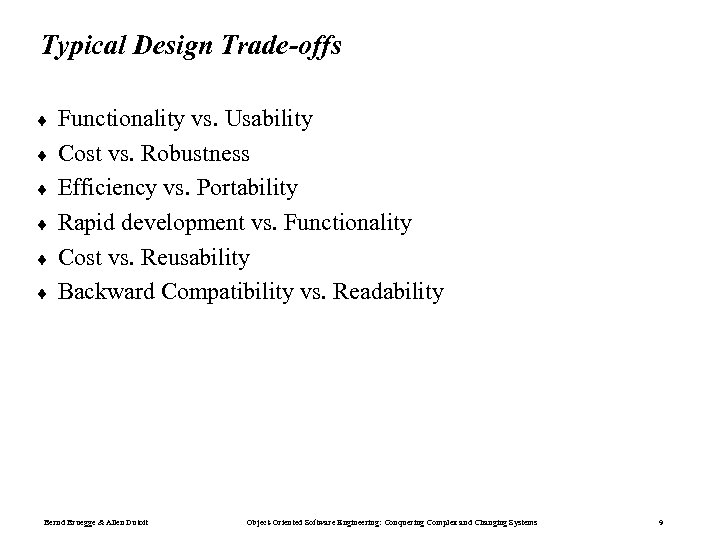
Typical Design Trade-offs ¨ ¨ ¨ Functionality vs. Usability Cost vs. Robustness Efficiency vs. Portability Rapid development vs. Functionality Cost vs. Reusability Backward Compatibility vs. Readability Bernd Bruegge & Allen Dutoit Object-Oriented Software Engineering: Conquering Complex and Changing Systems 9
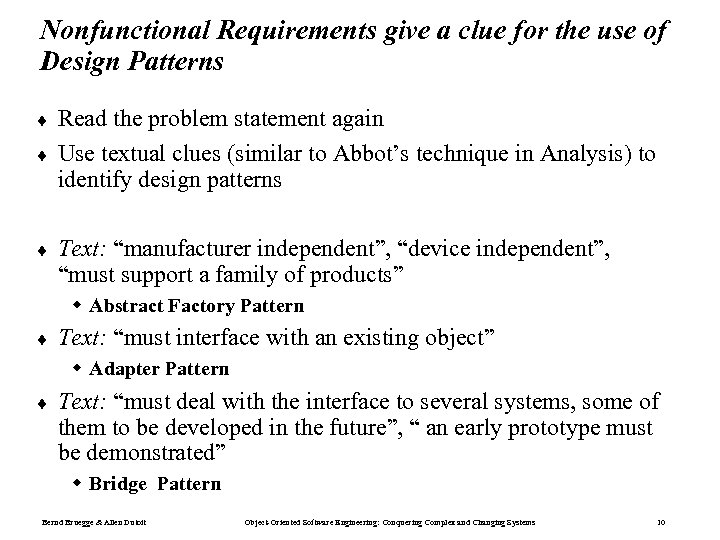
Nonfunctional Requirements give a clue for the use of Design Patterns ¨ ¨ ¨ Read the problem statement again Use textual clues (similar to Abbot’s technique in Analysis) to identify design patterns Text: “manufacturer independent”, “device independent”, “must support a family of products” w Abstract Factory Pattern ¨ Text: “must interface with an existing object” w Adapter Pattern ¨ Text: “must deal with the interface to several systems, some of them to be developed in the future”, “ an early prototype must be demonstrated” w Bridge Pattern Bernd Bruegge & Allen Dutoit Object-Oriented Software Engineering: Conquering Complex and Changing Systems 10
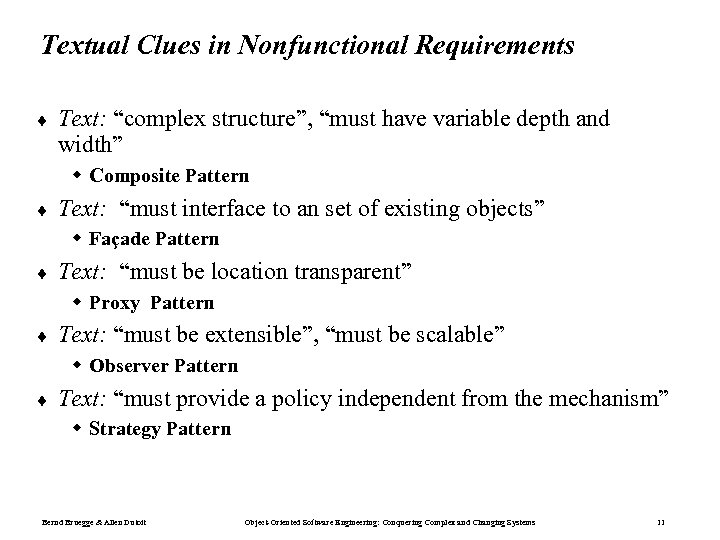
Textual Clues in Nonfunctional Requirements ¨ Text: “complex structure”, “must have variable depth and width” w Composite Pattern ¨ Text: “must interface to an set of existing objects” w Façade Pattern ¨ Text: “must be location transparent” w Proxy Pattern ¨ Text: “must be extensible”, “must be scalable” w Observer Pattern ¨ Text: “must provide a policy independent from the mechanism” w Strategy Pattern Bernd Bruegge & Allen Dutoit Object-Oriented Software Engineering: Conquering Complex and Changing Systems 11
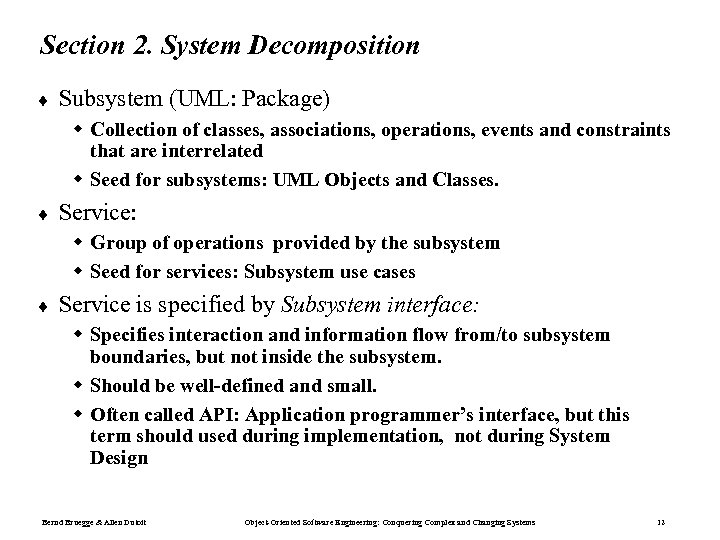
Section 2. System Decomposition ¨ Subsystem (UML: Package) w Collection of classes, associations, operations, events and constraints that are interrelated w Seed for subsystems: UML Objects and Classes. ¨ Service: w Group of operations provided by the subsystem w Seed for services: Subsystem use cases ¨ Service is specified by Subsystem interface: w Specifies interaction and information flow from/to subsystem boundaries, but not inside the subsystem. w Should be well-defined and small. w Often called API: Application programmer’s interface, but this term should used during implementation, not during System Design Bernd Bruegge & Allen Dutoit Object-Oriented Software Engineering: Conquering Complex and Changing Systems 12
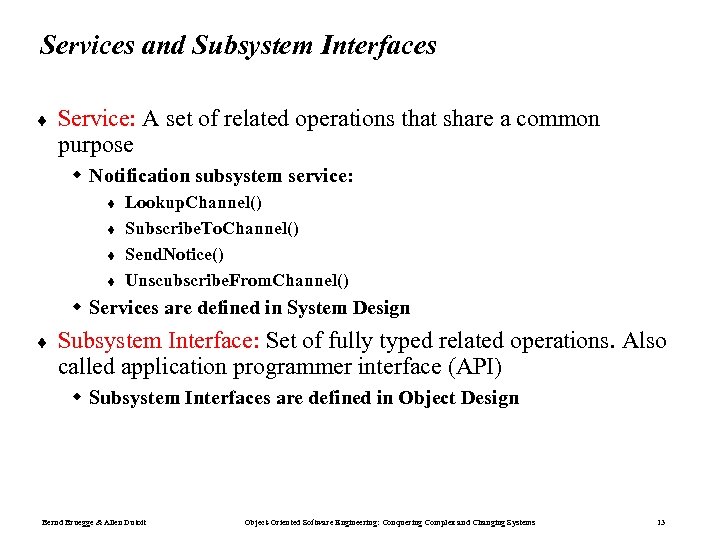
Services and Subsystem Interfaces ¨ Service: A set of related operations that share a common purpose w Notification subsystem service: t t Lookup. Channel() Subscribe. To. Channel() Send. Notice() Unscubscribe. From. Channel() w Services are defined in System Design ¨ Subsystem Interface: Set of fully typed related operations. Also called application programmer interface (API) w Subsystem Interfaces are defined in Object Design Bernd Bruegge & Allen Dutoit Object-Oriented Software Engineering: Conquering Complex and Changing Systems 13
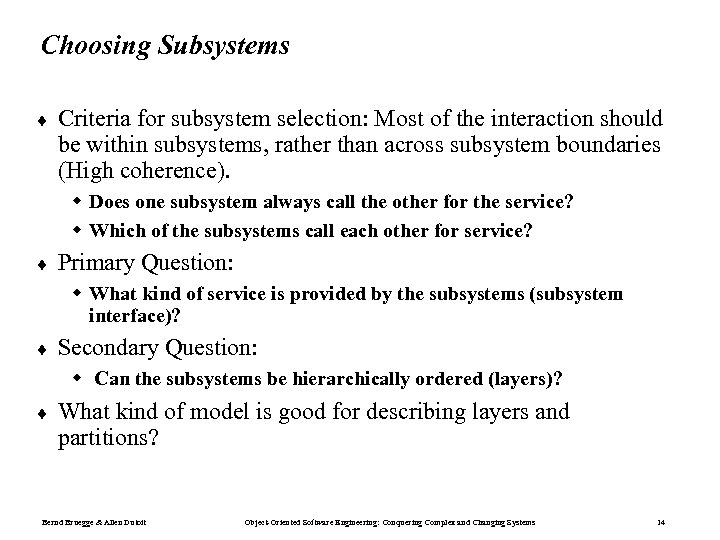
Choosing Subsystems ¨ Criteria for subsystem selection: Most of the interaction should be within subsystems, rather than across subsystem boundaries (High coherence). w Does one subsystem always call the other for the service? w Which of the subsystems call each other for service? ¨ Primary Question: w What kind of service is provided by the subsystems (subsystem interface)? ¨ Secondary Question: w Can the subsystems be hierarchically ordered (layers)? ¨ What kind of model is good for describing layers and partitions? Bernd Bruegge & Allen Dutoit Object-Oriented Software Engineering: Conquering Complex and Changing Systems 14
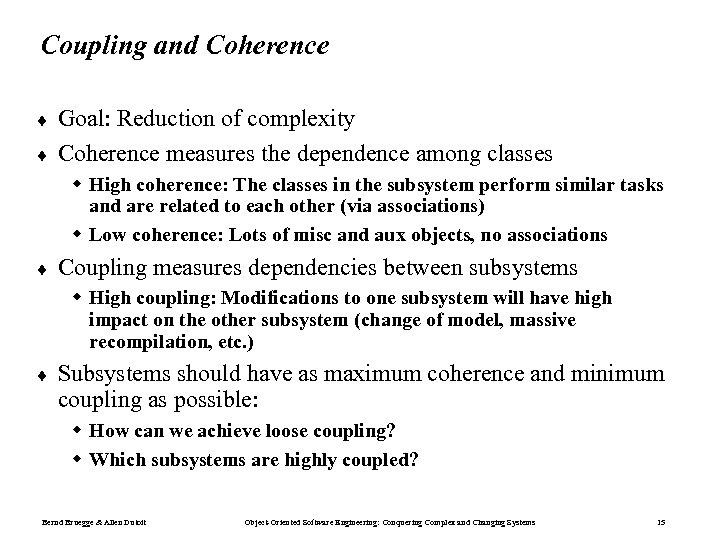
Coupling and Coherence ¨ ¨ Goal: Reduction of complexity Coherence measures the dependence among classes w High coherence: The classes in the subsystem perform similar tasks and are related to each other (via associations) w Low coherence: Lots of misc and aux objects, no associations ¨ Coupling measures dependencies between subsystems w High coupling: Modifications to one subsystem will have high impact on the other subsystem (change of model, massive recompilation, etc. ) ¨ Subsystems should have as maximum coherence and minimum coupling as possible: w How can we achieve loose coupling? w Which subsystems are highly coupled? Bernd Bruegge & Allen Dutoit Object-Oriented Software Engineering: Conquering Complex and Changing Systems 15
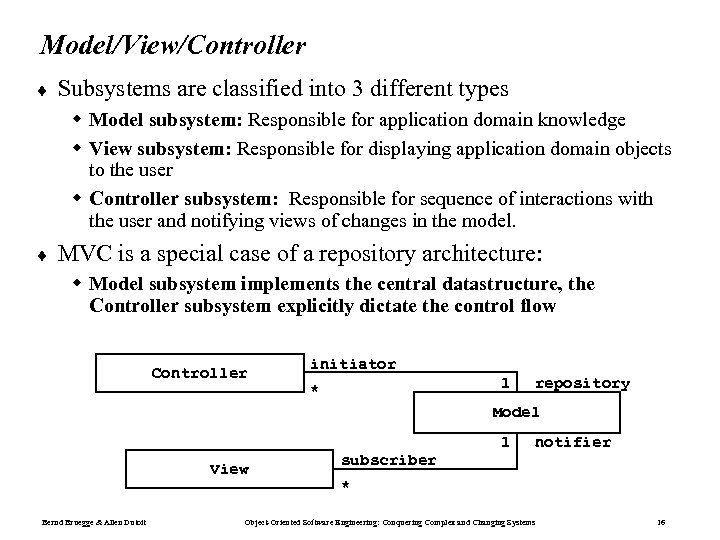
Model/View/Controller ¨ Subsystems are classified into 3 different types w Model subsystem: Responsible for application domain knowledge w View subsystem: Responsible for displaying application domain objects to the user w Controller subsystem: Responsible for sequence of interactions with the user and notifying views of changes in the model. ¨ MVC is a special case of a repository architecture: w Model subsystem implements the central datastructure, the Controller subsystem explicitly dictate the control flow Controller initiator 1 * repository Model View Bernd Bruegge & Allen Dutoit subscriber 1 notifier * Object-Oriented Software Engineering: Conquering Complex and Changing Systems 16
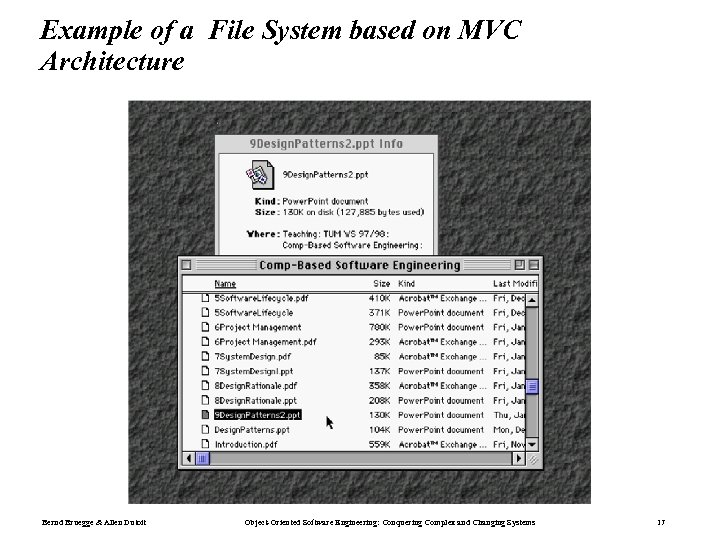
Example of a File System based on MVC Architecture Bernd Bruegge & Allen Dutoit Object-Oriented Software Engineering: Conquering Complex and Changing Systems 17
Summary ¨ System Design w Reduces the gap between requirements and the machine w Decomposes the overall system into manageable parts ¨ Design Goals Definition w Describes and prioritizes the qualities that are important for the system w Defines the value system against which options are evaluated ¨ Subsystem Decomposition w Results into a set of loosely dependent parts which make up the system Bernd Bruegge & Allen Dutoit Object-Oriented Software Engineering: Conquering Complex and Changing Systems 18
OOMPA del b ¨ Nu fortsätter vi med den dynamiska modellen f 6 b. pdf Bernd Bruegge & Allen Dutoit Object-Oriented Software Engineering: Conquering Complex and Changing Systems 19
Скачать презентацию Conquering Complex and Changing Systems Object-Oriented Software Engineering
cb0d5cac32a51d7c4601cae767c0e5f2.ppt