


 Скачать презентацию Connecting the Earth to the Sun Students Monitor
2a49900487b0e6657805b9a12c7ee0c5.ppt
- Количество слайдов: 1
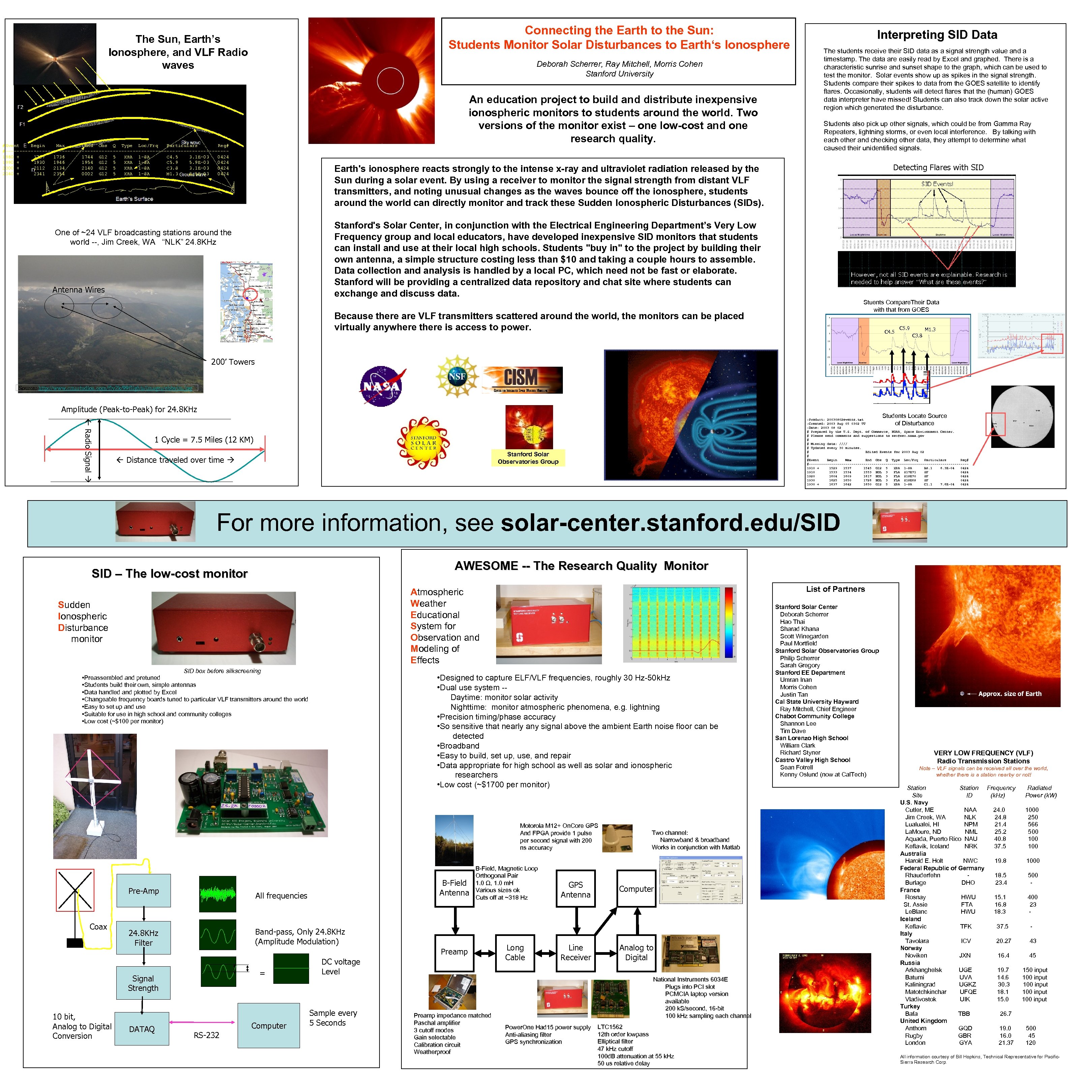 Connecting the Earth to the Sun: Students Monitor Solar Disturbances to Earth‘s Ionosphere The Sun, Earth’s Ionosphere, and VLF Radio waves Deborah Scherrer, Ray Mitchell, Morris Cohen Stanford University An education project to build and distribute inexpensive ionospheric monitors to students around the world. Two versions of the monitor exist – one low-cost and one research quality. #Event Begin Max End Obs Q Type Loc/Frq Particulars Reg# #---------------------------------------1960 + 1727 1736 1744 G 12 5 XRA 1 -8 A C 4. 5 3. 1 E-03 0424 1990 + 1930 1946 1954 G 12 5 XRA 1 -8 A C 5. 9 E-03 0424 2000 + 2112 2134 2140 G 12 5 XRA 1 -8 A C 3. 8 3. 1 E-03 0424 2040 + 2341 2354 0002 G 12 5 XRA 1 -8 A M 1. 3 8. 5 E-03 0424 Interpreting SID Data The students receive their SID data as a signal strength value and a SID Excel and timestamp. The data are easily read by. Events! graphed. There is a characteristic sunrise and sunset shape to the graph, which can be used to test the monitor. Solar events show up as spikes in the signal strength. Students compare their spikes to data from the GOES satellite to identify C 5. 9 C 4. 5 flares that the M 1. 3 GOES flares. Occasionally, students will detect (human) data interpreter have missed! Students can also C 3. 8 down the solar active track region which generated the disturbance. Students also pick up other signals, which could be from Gamma Ray Repeaters, lightning storms, or even local interference. By talking with each other and checking other data, they attempt to determine what caused their unidentified signals. Detecting Flares with SID Earth's ionosphere reacts strongly to the intense x-ray and ultraviolet radiation released by the Sun during a solar event. By using a receiver to monitor the signal strength from distant VLF transmitters, and noting unusual changes as the waves bounce off the ionosphere, students around the world can directly monitor and track these Sudden Ionospheric Disturbances (SIDs). Stanford's Solar Center, in conjunction with the Electrical Engineering Department’s Very Low Frequency group and local educators, have developed inexpensive SID monitors that students can install and use at their local high schools. Students "buy in" to the project by building their own antenna, a simple structure costing less than $10 and taking a couple hours to assemble. Data collection and analysis is handled by a local PC, which need not be fast or elaborate. Stanford will be providing a centralized data repository and chat site where students can exchange and discuss data. One of ~24 VLF broadcasting stations around the world --, Jim Creek, WA “NLK” 24. 8 KHz Antenna Wires Stuents Compare. Their Data with that from GOES Because there are VLF transmitters scattered around the world, the monitors can be placed virtually anywhere there is access to power. C 4. 5 C 5. 9 M 1. 3 C 3. 8 200’ Towers Source: http: //www. cmsstudios. com/fly 2 k/99 flights/images/ebbyjm. jpg Amplitude (Peak-to-Peak) for 24. 8 KHz Radio Signal Students Locate Source of Disturbance : Product: 20030802 events. txt : Created: 2003 Aug 05 0302 UT : Date: 2003 08 02 # Prepared by the U. S. Dept. of Commerce, NOAA, Space Environment Center. # Please send comments and suggestions to sec@sec. noaa. gov # # Missing data: //// # Updated every 30 minutes. # Edited Events for 2003 Aug 02 # #Event Begin Max End Obs Q Type Loc/Frq Particulars Reg# #---------------------------------------1910 + 1529 1537 1545 G 12 5 XRA 1 -8 A B 8. 1 6. 3 E-04 0424 1910 1533 1534 1553 HOL 3 FLA S 17 E 71 SF 0424 1920 1604 1609 1617 HOL 3 FLA S 18 E 70 SF 0424 1930 1625 1650 1726 HOL 3 FLA S 18 E 68 SF 0424 1930 + 1637 1642 1650 G 12 5 XRA 1 -8 A C 1. 1 7. 6 E-04 0424 1 Cycle = 7. 5 Miles (12 KM) Stanford Solar Observatories Group Distance traveled over time For more information, see solar-center. stanford. edu/SID AWESOME -- The Research Quality Monitor SID – The low-cost monitor List of Partners Atmospheric Weather Educational System for Observation and Modeling of Effects Sudden Ionospheric Disturbance monitor SID box before silkscreening • Designed to capture ELF/VLF frequencies, roughly 30 Hz-50 k. Hz • Dual use system -Daytime: monitor solar activity Nighttime: monitor atmospheric phenomena, e. g. lightning • Precision timing/phase accuracy • So sensitive that nearly any signal above the ambient Earth noise floor can be detected • Broadband • Easy to build, set up, use, and repair • Data appropriate for high school as well as solar and ionospheric researchers • Low cost (~$1700 per monitor) • Preassembled and pretuned • Students build their own, simple antennas • Data handled and plotted by Excel • Changeable frequency boards tuned to particular VLF transmitters around the world • Easy to set up and use • Suitable for use in high school and community colleges • Low cost (~$100 per monitor) Motorola M 12+ On. Core GPS And FPGA provide 1 pulse per second signal with 200 ns accuracy Pre-Amp Coax All frequencies Band-pass, Only 24. 8 KHz (Amplitude Modulation) 24. 8 KHz Filter Preamp = Signal Strength 10 bit, Analog to Digital Conversion DATAQ B-Field Antenna B-Field, Magnetic Loop Orthogonal Pair 1. 0 Ω, 1. 0 m. H Various sizes ok Cuts off at ~318 Hz RS-232 Computer DC voltage Level Sample every 5 Seconds Preamp impedance matched Paschal amplifier 3 cutoff modes Gain selectable Calibration circuit Weatherproof Long Cable GPS Antenna Line Receiver Two channel: Narrowband & broadband Works in conjunction with Matlab Computer Analog to Digital National Instruments 6034 E Plugs into PCI slot PCMCIA laptop version available 200 k. S/second, 16 -bit 100 k. Hz sampling each channel Power. One Had 15 power supply Anti-aliasing filter GPS synchronization LTC 1562 12 th order lowpass Elliptical filter 47 k. Hz cutoff 100 d. B attenuation at 55 k. Hz 50 us relative delay Stanford Solar Center Deborah Scherrer Hao Thai Sharad Khana Scott Winegarden Paul Mortfield Stanford Solar Observatories Group Philip Scherrer Sarah Gregory Stanford EE Department Umran Inan Morris Cohen Justin Tan Cal State University Hayward Ray Mitchell, Chief Engineer Chabot Community College Shannon Lee Tim Dave San Lorenzo High School William Clark Richard Styner Castro Valley High School Sean Fotrell Kenny Oslund (now at Cal. Tech) VERY LOW FREQUENCY (VLF) Radio Transmission Stations Note – VLF signals can be received all over the world, whethere is a station nearby or not! Station Frequency Site ID (k. Hz) U. S. Navy Cutler, ME NAA 24. 0 Jim Creek, WA NLK 24. 8 Lualualei, HI NPM 21. 4 La. Moure, ND NML 25. 2 Aquada, Puerto Rico NAU 40. 8 Keflavik, Iceland NRK 37. 5 Australia Harold E. Holt NWC 19. 8 Federal Republic of Germany Rhauderfehn 18. 5 Burlage DHO 23. 4 France Rosnay HWU 15. 1 St. Assie FTA 16. 8 Le. Blanc HWU 18. 3 Iceland Keflavic TFK 37. 5 Italy Tavolara ICV 20. 27 Norway Noviken JXN 16. 4 Russia Arkhanghelsk UGE 19. 7 Batumi UVA 14. 6 Kaliningrad UGKZ 30. 3 Matotchkinchar UFQE 18. 1 Vladivostok UIK 15. 0 Turkey Bafa TBB 26. 7 United Kingdom Anthorn GQD 19. 0 Rugby GBR 16. 0 London GYA 21. 37 Radiated Power (k. W) 1000 250 566 500 100 1000 500 400 23 43 45 150 input 100 input 500 45 120 All information courtesy of Bill Hopkins, Technical Representative for Pacific. Sierra Research Corp.