


 Скачать презентацию Connecting the Dots From Reading Research to Practice
fca49631b409f6e6c1c0da10670c783d.ppt
- Количество слайдов: 118
 Connecting the Dots From Reading Research to Practice Margie Hourihan forbetterschools@yahoo. com Aden Associates tiffany. aden@gmail. com
 Objectives Effective Instruction Big 5 Common Core & Literacy Components and Strategies of the Big 5 Using Data to Drive Instruction Types of Groupings Planning for Instruction
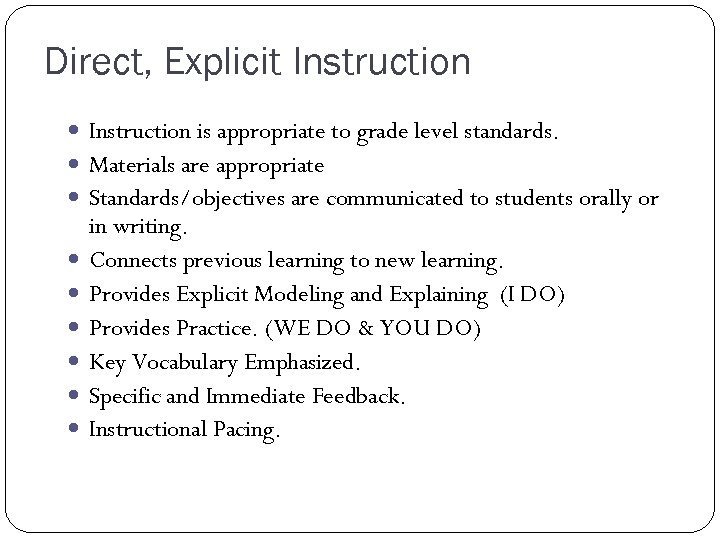 Direct, Explicit Instruction is appropriate to grade level standards. Materials are appropriate Standards/objectives are communicated to students orally or in writing. Connects previous learning to new learning. Provides Explicit Modeling and Explaining (I DO) Provides Practice. (WE DO & YOU DO) Key Vocabulary Emphasized. Specific and Immediate Feedback. Instructional Pacing.
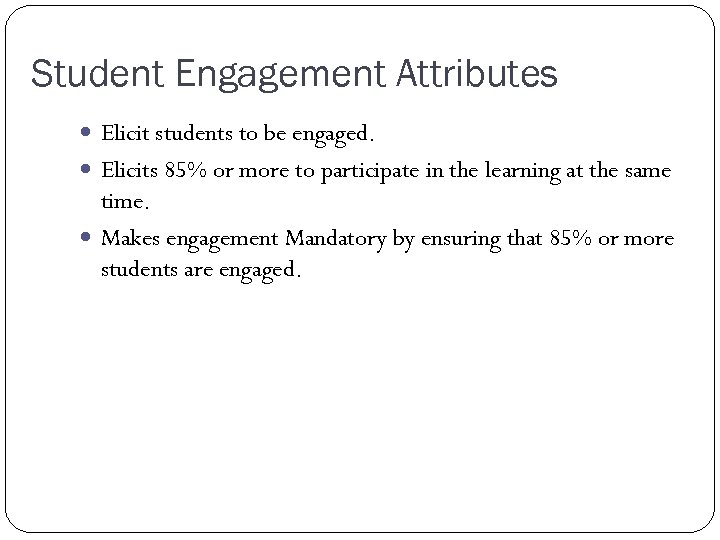 Student Engagement Attributes Elicit students to be engaged. Elicits 85% or more to participate in the learning at the same time. Makes engagement Mandatory by ensuring that 85% or more students are engaged.
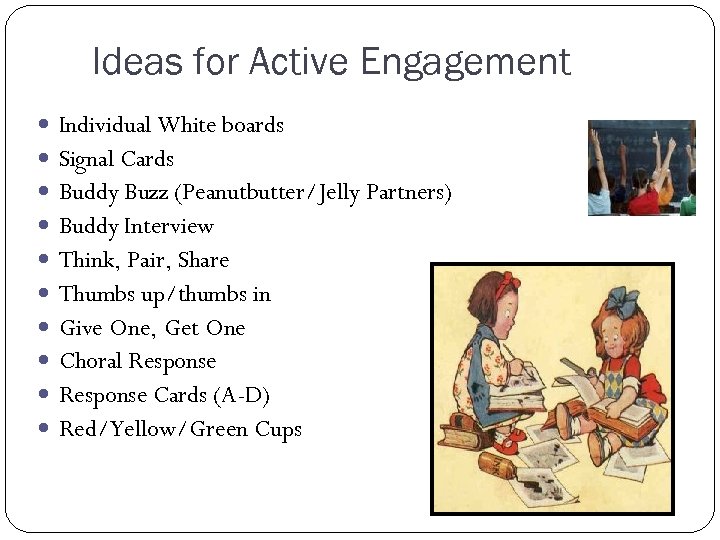 Ideas for Active Engagement Individual White boards Signal Cards Buddy Buzz (Peanutbutter/Jelly Partners) Buddy Interview Think, Pair, Share Thumbs up/thumbs in Give One, Get One Choral Response Cards (A-D) Red/Yellow/Green Cups
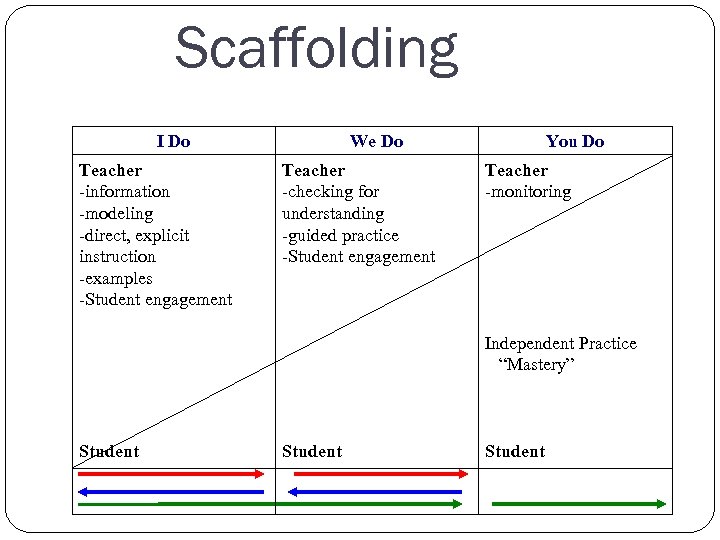 Scaffolding I Do Teacher -information -modeling -direct, explicit instruction -examples -Student engagement We Do Teacher -checking for understanding -guided practice -Student engagement You Do Teacher -monitoring Independent Practice “Mastery” Student
 Common Core Standards
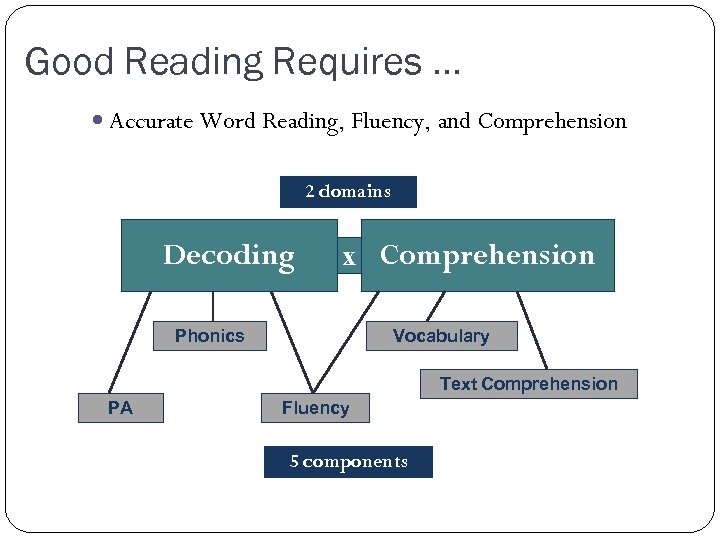 Good Reading Requires … Accurate Word Reading, Fluency, and Comprehension 2 domains Decoding x Comprehension Phonics Vocabulary Text Comprehension PA Fluency 5 components
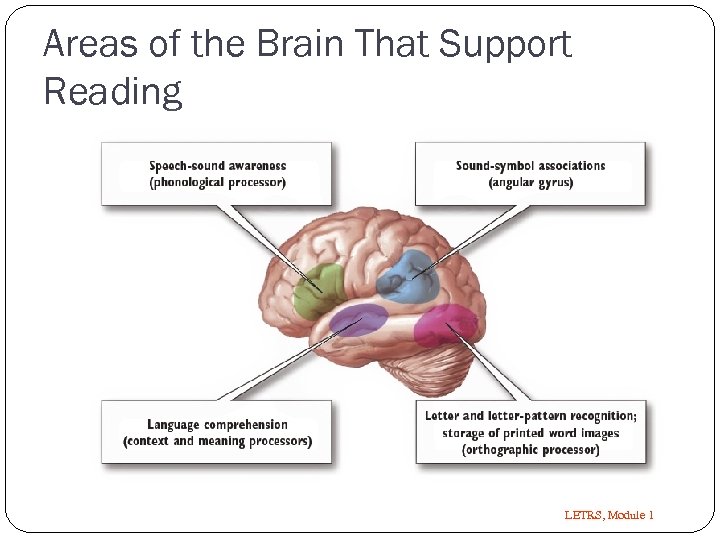 Areas of the Brain That Support Reading LETRS, Module 1
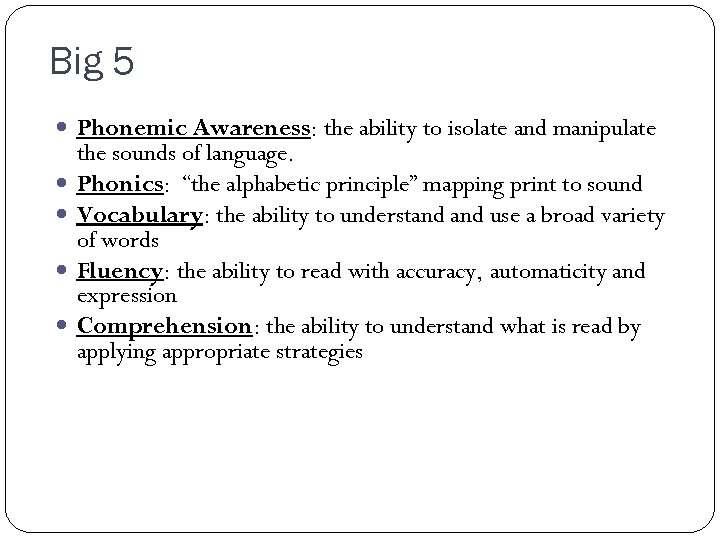 Big 5 Phonemic Awareness: the ability to isolate and manipulate the sounds of language. Phonics: “the alphabetic principle” mapping print to sound Vocabulary: the ability to understand use a broad variety of words Fluency: the ability to read with accuracy, automaticity and expression Comprehension: the ability to understand what is read by applying appropriate strategies
 Phonemic Awareness the ability to isolate and manipulate the sounds of language.
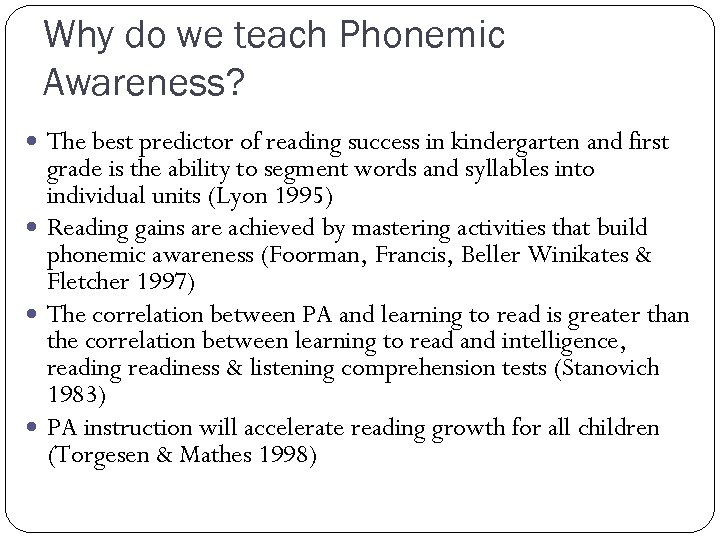 Why do we teach Phonemic Awareness? The best predictor of reading success in kindergarten and first grade is the ability to segment words and syllables into individual units (Lyon 1995) Reading gains are achieved by mastering activities that build phonemic awareness (Foorman, Francis, Beller Winikates & Fletcher 1997) The correlation between PA and learning to read is greater than the correlation between learning to read and intelligence, reading readiness & listening comprehension tests (Stanovich 1983) PA instruction will accelerate reading growth for all children (Torgesen & Mathes 1998)
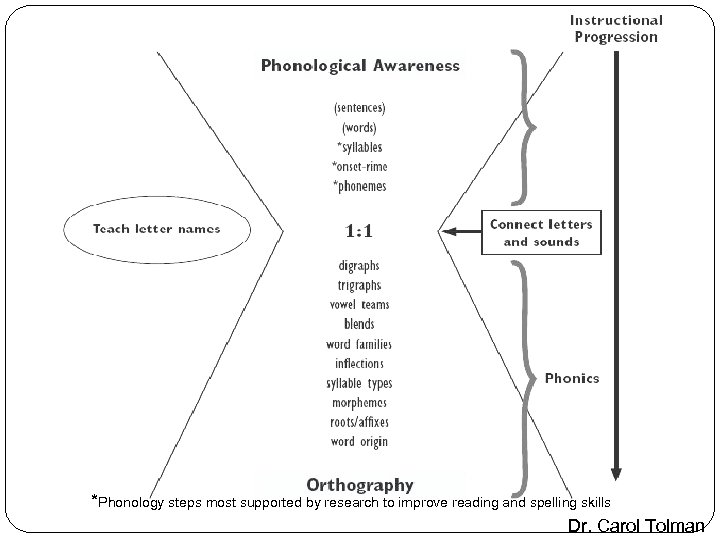 *Phonology steps most supported by research to improve reading and spelling skills Dr. Carol Tolman
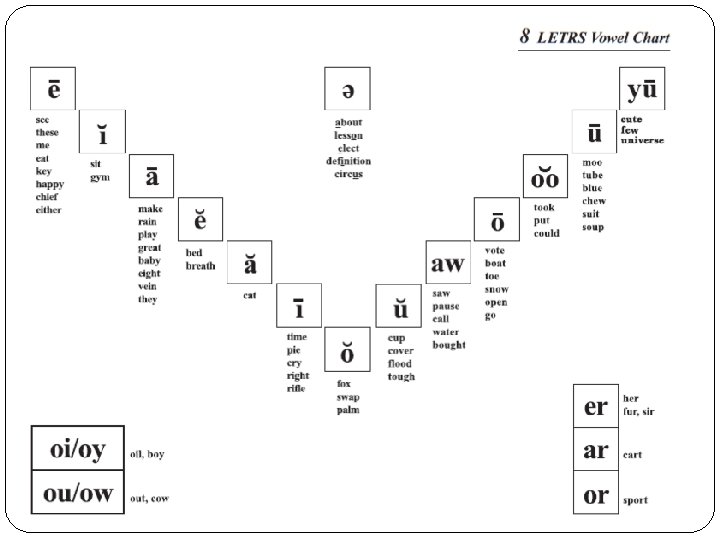
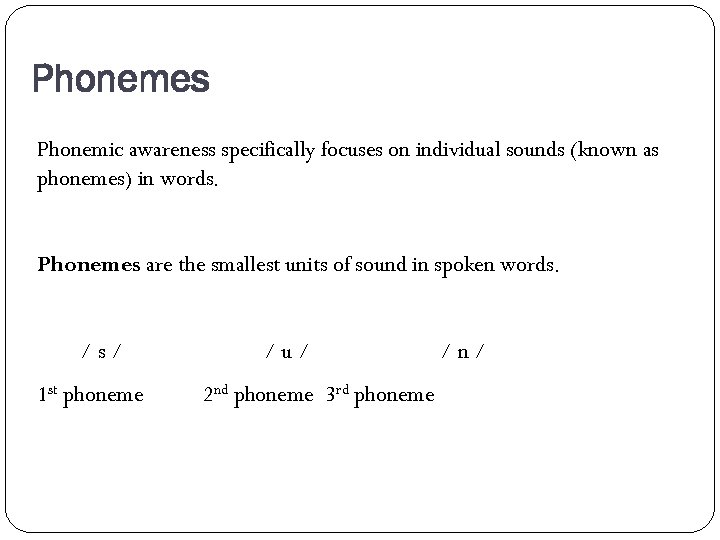 Phonemes Phonemic awareness specifically focuses on individual sounds (known as phonemes) in words. Phonemes are the smallest units of sound in spoken words. /s/ 1 st phoneme /u/ 2 nd phoneme 3 rd phoneme /n/
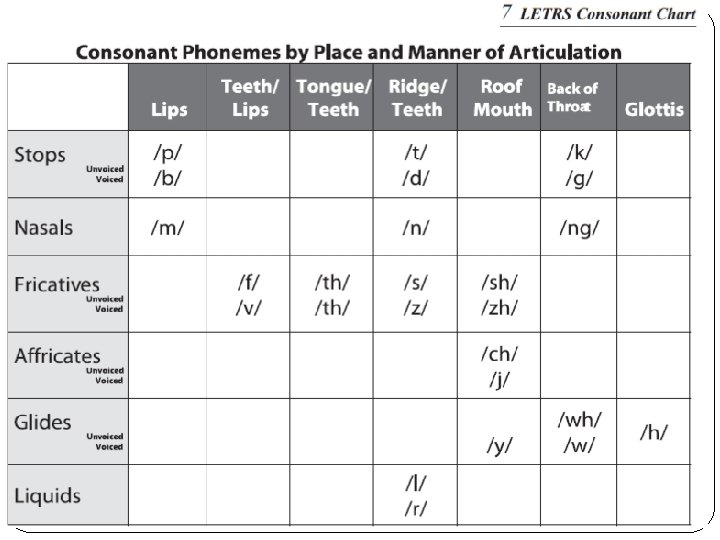
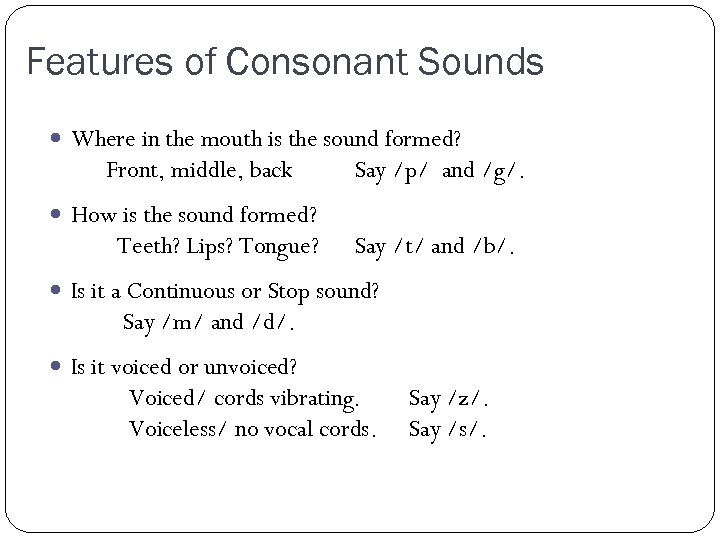 Features of Consonant Sounds Where in the mouth is the sound formed? Front, middle, back Say /p/ and /g/. How is the sound formed? Teeth? Lips? Tongue? Say /t/ and /b/. Is it a Continuous or Stop sound? Say /m/ and /d/. Is it voiced or unvoiced? Voiced/ cords vibrating. Voiceless/ no vocal cords. Say /z/. Say /s/.
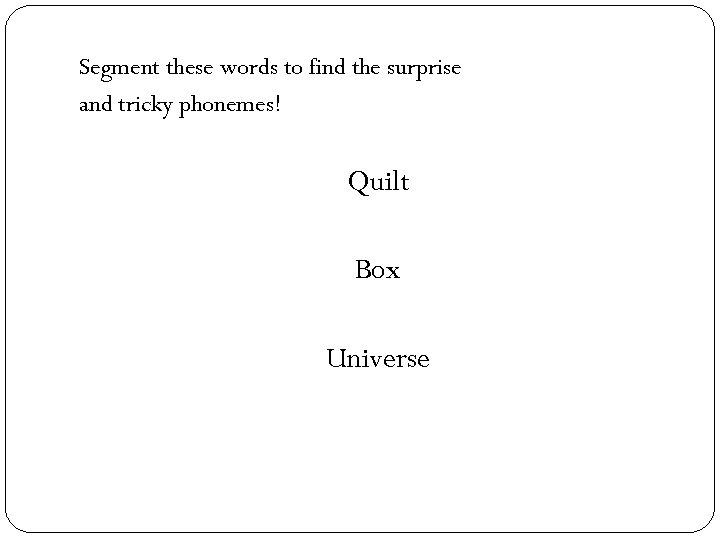 Segment these words to find the surprise and tricky phonemes! Quilt Box Universe
 Back to Back Activity Students pair up and stand back to back. Teacher says a word. Students each count syllables on their fingers. On count of three turn to partner and compare answers. All students display answers to teacher. Let’s try it!
 Phonics “the alphabetic principle” mapping print to sound Grapheme - letter representing phoneme: a written symbol, letter, or combination of letters that represents a single sound
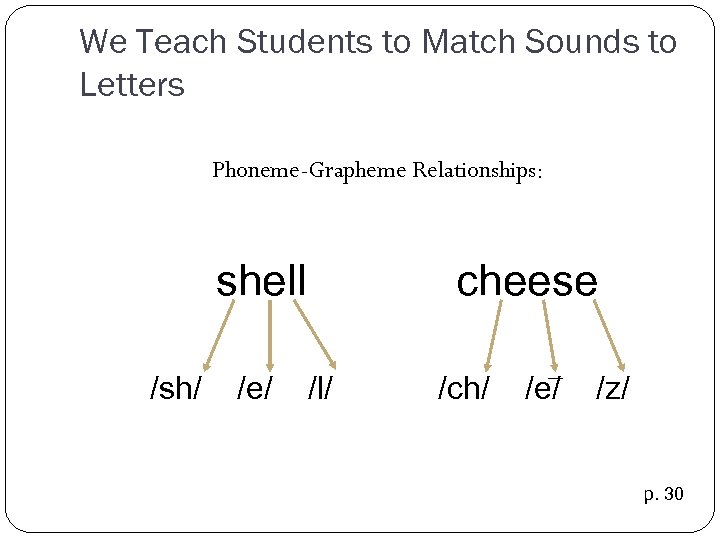 We Teach Students to Match Sounds to Letters Phoneme-Grapheme Relationships: shell /sh/ /e/ cheese /l/ /ch/ /e/ /z/ p. 30
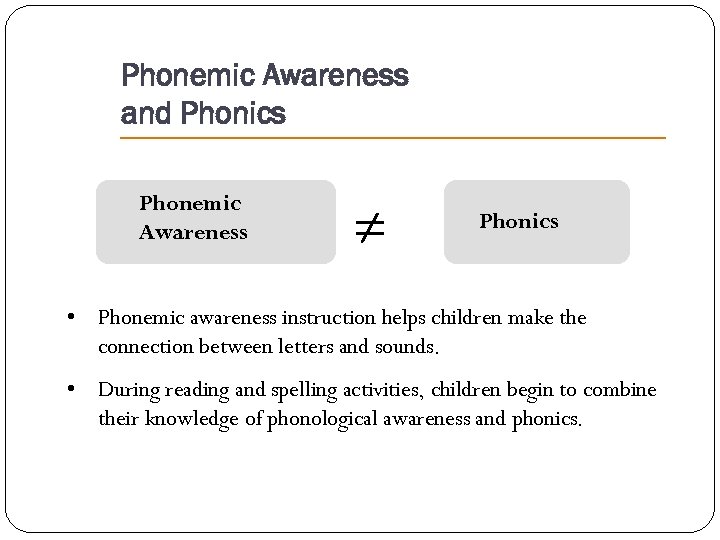 Phonemic Awareness and Phonics Phonemic Awareness ≠ Phonics • Phonemic awareness instruction helps children make the connection between letters and sounds. • During reading and spelling activities, children begin to combine their knowledge of phonological awareness and phonics.
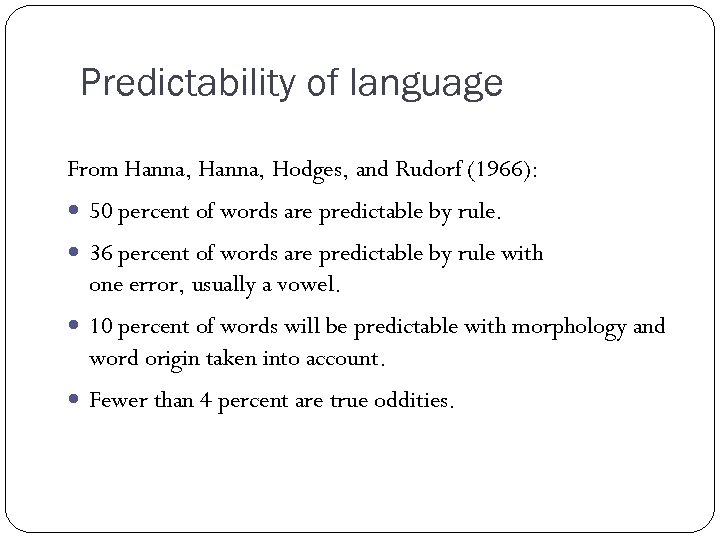 Predictability of language From Hanna, Hodges, and Rudorf (1966): 50 percent of words are predictable by rule. 36 percent of words are predictable by rule with one error, usually a vowel. 10 percent of words will be predictable with morphology and word origin taken into account. Fewer than 4 percent are true oddities.
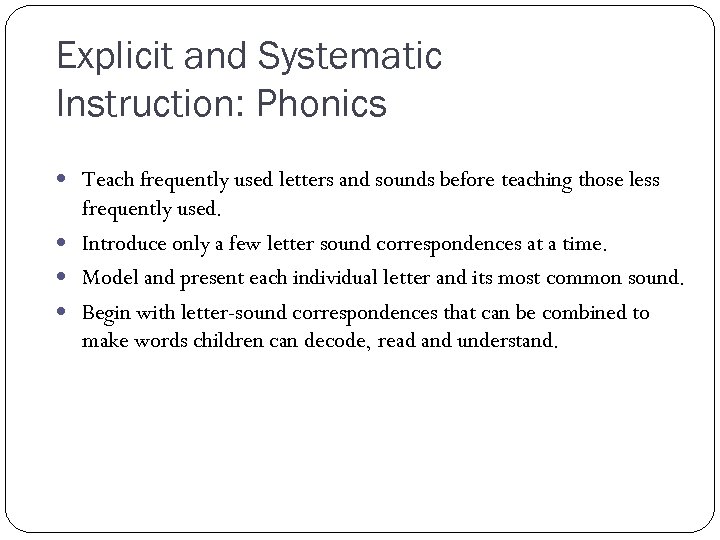 Explicit and Systematic Instruction: Phonics Teach frequently used letters and sounds before teaching those less frequently used. Introduce only a few letter sound correspondences at a time. Model and present each individual letter and its most common sound. Begin with letter-sound correspondences that can be combined to make words children can decode, read and understand.
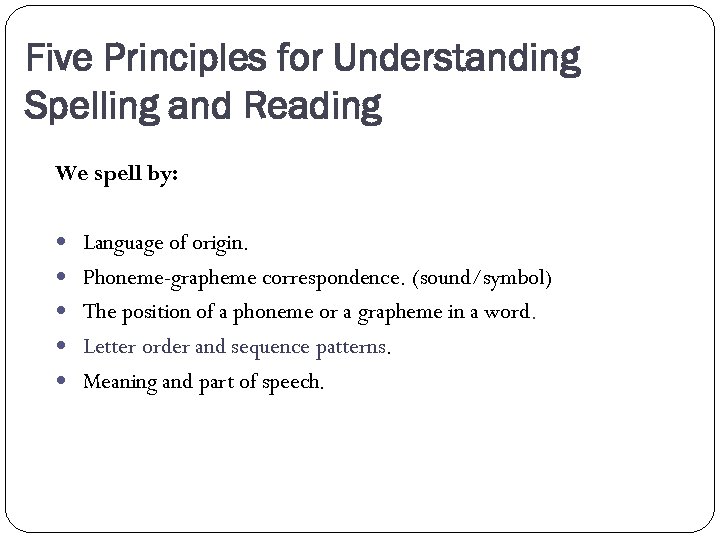
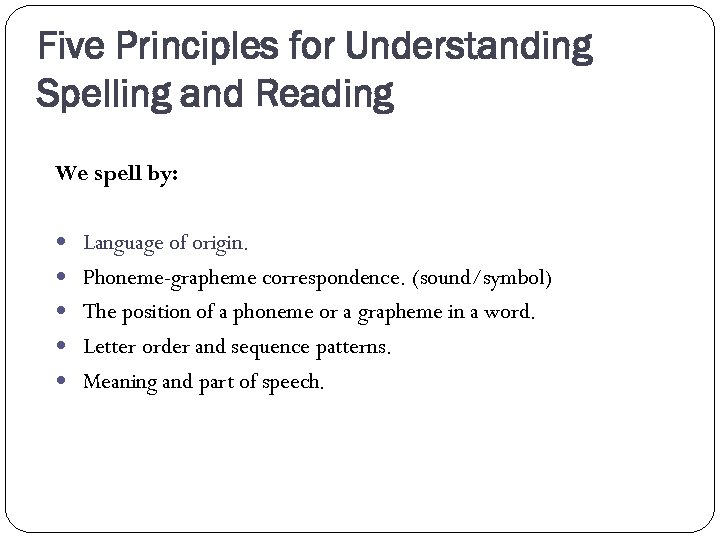 Five Principles for Understanding Spelling and Reading We spell by: Language of origin. Phoneme-grapheme correspondence. (sound/symbol) The position of a phoneme or a grapheme in a word. Letter order and sequence patterns. Meaning and part of speech.
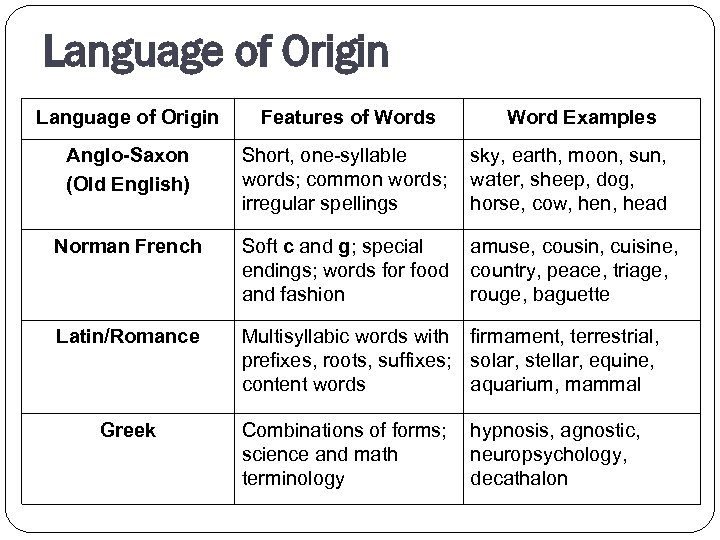 Language of Origin Features of Words Anglo-Saxon (Old English) Short, one-syllable words; common words; irregular spellings sky, earth, moon, sun, water, sheep, dog, horse, cow, hen, head Norman French Soft c and g; special endings; words for food and fashion amuse, cousin, cuisine, country, peace, triage, rouge, baguette Latin/Romance Multisyllabic words with firmament, terrestrial, prefixes, roots, suffixes; solar, stellar, equine, content words aquarium, mammal Greek Combinations of forms; science and math terminology Word Examples hypnosis, agnostic, neuropsychology, decathalon
 Five Principles for Understanding Spelling and Reading We spell by: Language of origin. Phoneme-grapheme correspondence. (sound/symbol) The position of a phoneme or a grapheme in a word. Letter order and sequence patterns. Meaning and part of speech.
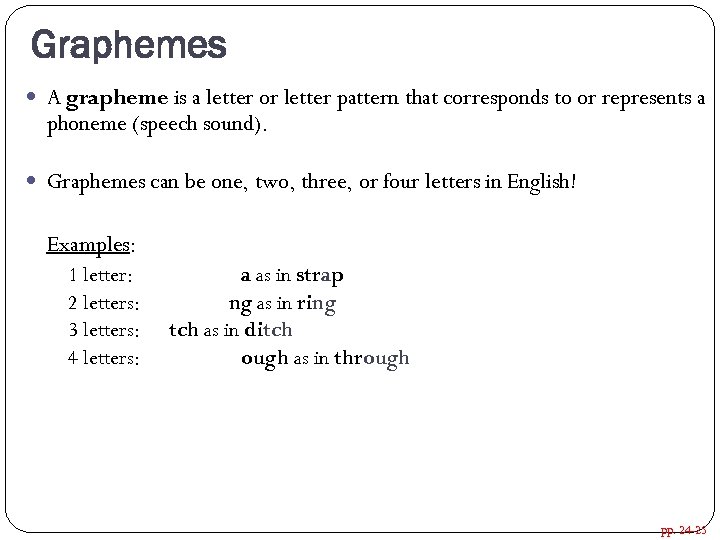 Graphemes A grapheme is a letter or letter pattern that corresponds to or represents a phoneme (speech sound). Graphemes can be one, two, three, or four letters in English! Examples: 1 letter: 2 letters: 3 letters: 4 letters: a as in strap ng as in ring tch as in ditch ough as in through pp. 24 -25
 Closer. J Kto NZ P Q R S T U V W X Y Z ABCDEFGHI LM O “I win because j is closer to z than c. ” j c
 Phoneme-Grapheme Mapping
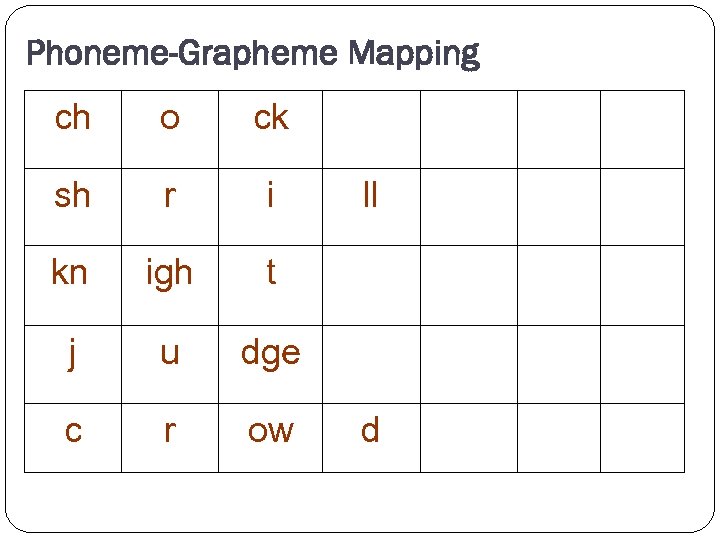 Phoneme-Grapheme Mapping ch o ck sh r i kn igh t j u dge c r ow ll d
 Word Building
 Five Principles for Understanding Spelling and Reading We spell by: Language of origin. Phoneme-grapheme correspondence. (sound/symbol) The position of a phoneme or a grapheme in a word. Letter order and sequence patterns. Meaning and part of speech.
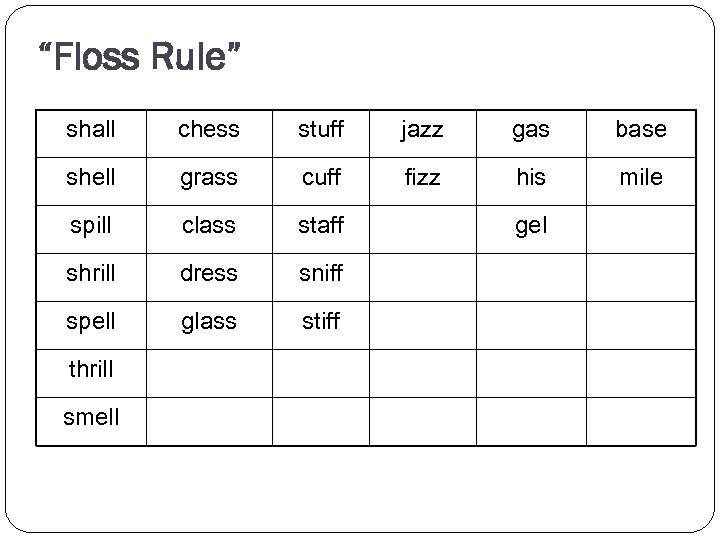 “Floss Rule” shall chess stuff jazz gas base shell grass cuff fizz his mile spill class staff shrill dress sniff spell glass stiff thrill smell gel
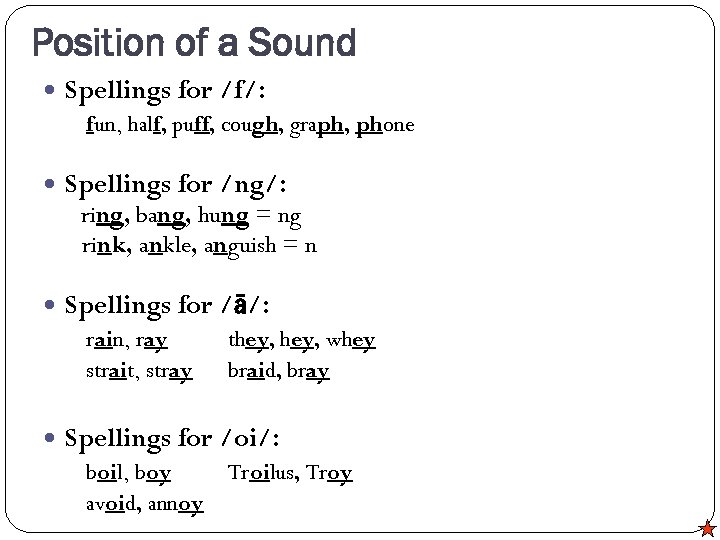 Position of a Sound Spellings for /f/: fun, half, puff, cough, graph, phone Spellings for /ng/: ring, bang, hung = ng rink, ankle, anguish = n Spellings for /ā/: rain, ray they, whey strait, stray braid, bray Spellings for /oi/: boil, boy Troilus, Troy avoid, annoy
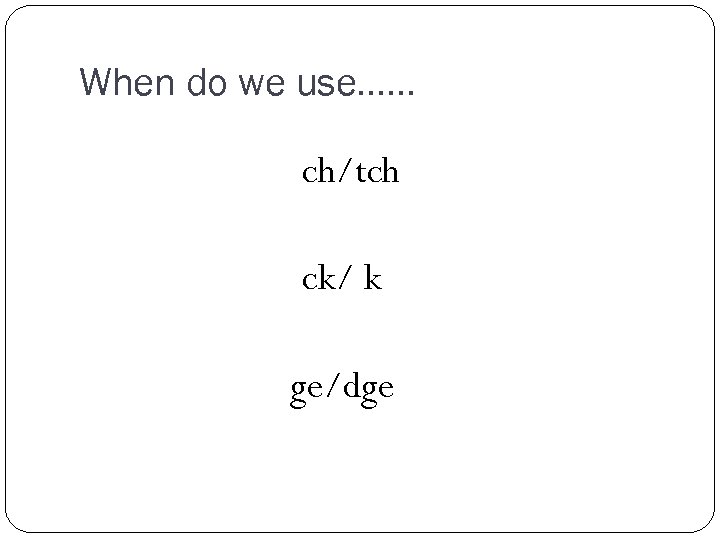 When do we use…… ch/tch ck/ k ge/dge
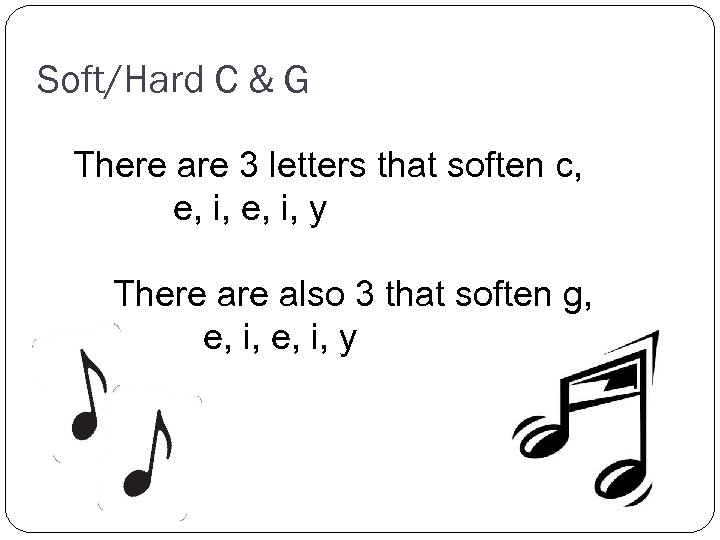 Soft/Hard C & G There are 3 letters that soften c, e, i, y There also 3 that soften g, e, i, y
 Five Principles for Understanding Spelling and Reading We spell by: Language of origin. Phoneme-grapheme correspondence. (sound/symbol) The position of a phoneme or a grapheme in a word. Letter order and sequence patterns. Meaning and part of speech.
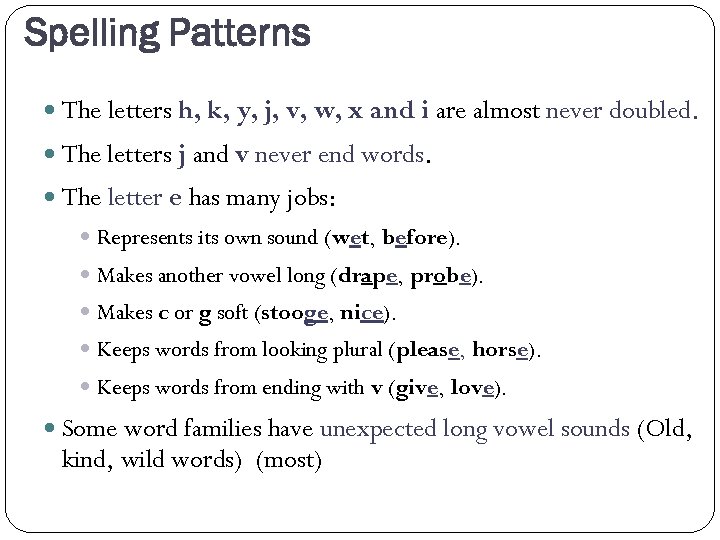 Spelling Patterns The letters h, k, y, j, v, w, x and i are almost never doubled. The letters j and v never end words. The letter e has many jobs: Represents its own sound (wet, before). Makes another vowel long (drape, probe). Makes c or g soft (stooge, nice). Keeps words from looking plural (please, horse). Keeps words from ending with v (give, love). Some word families have unexpected long vowel sounds (Old, kind, wild words) (most)
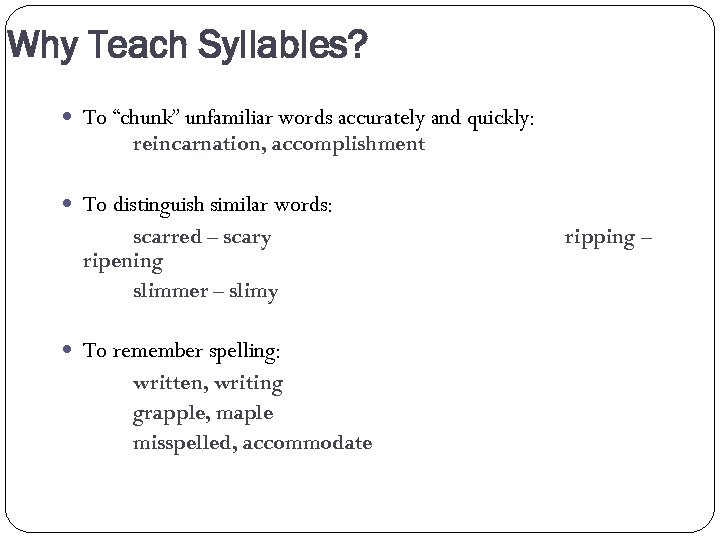 Why Teach Syllables? To “chunk” unfamiliar words accurately and quickly: reincarnation, accomplishment To distinguish similar words: scarred – scary ripening slimmer – slimy To remember spelling: written, writing grapple, maple misspelled, accommodate ripping –
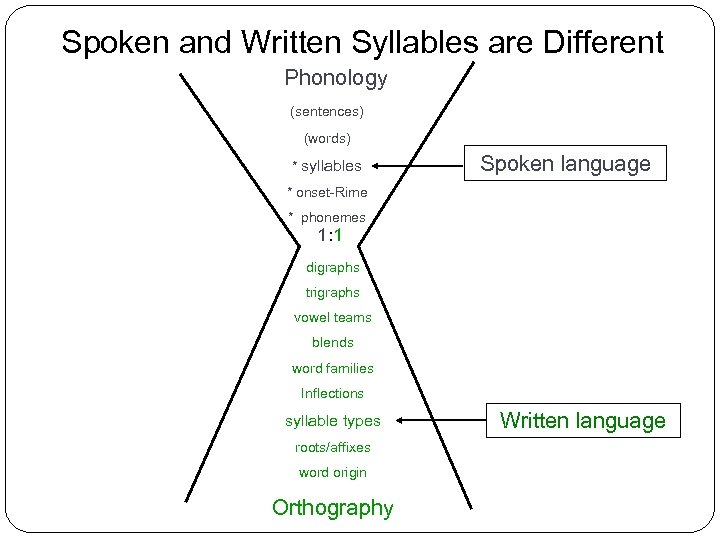 Spoken and Written Syllables are Different Phonology (sentences) (words) * syllables Spoken language * onset-Rime * phonemes 1: 1 digraphs trigraphs vowel teams blends word families Inflections syllable types roots/affixes word origin Orthography Written language
 Clapping vs. Duck Lips

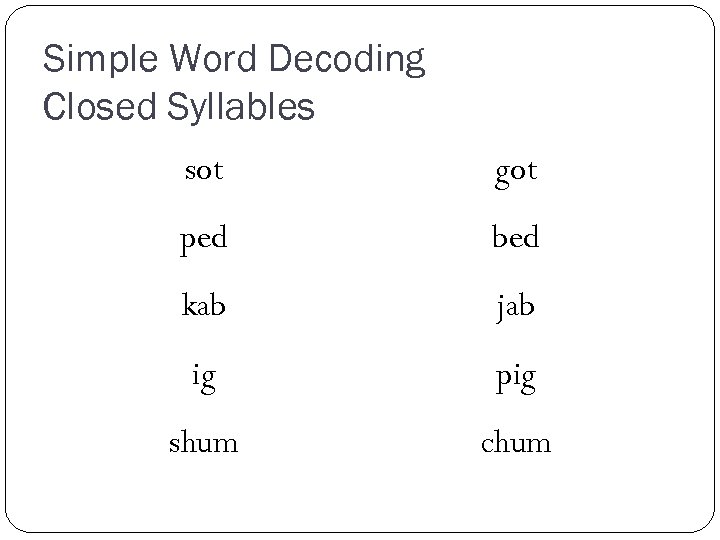 Simple Word Decoding Closed Syllables sot got ped bed kab jab ig pig shum chum
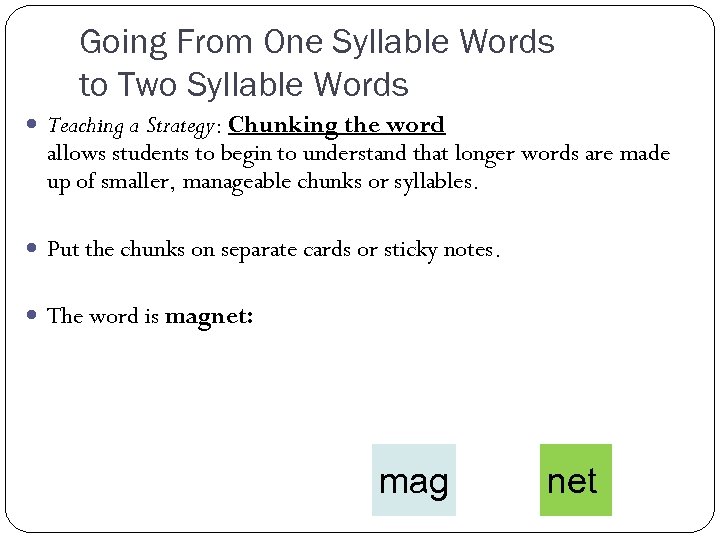 Going From One Syllable Words to Two Syllable Words Teaching a Strategy: Chunking the word allows students to begin to understand that longer words are made up of smaller, manageable chunks or syllables. Put the chunks on separate cards or sticky notes. The word is magnet: + mag net
 Five Principles for Understanding Spelling and Reading We spell by: Language of origin. Phoneme-grapheme correspondence. (sound/symbol) The position of a phoneme or a grapheme in a word. Letter order and sequence patterns. Meaning and part of speech.
 Meaning morphemes - meaning based parts.
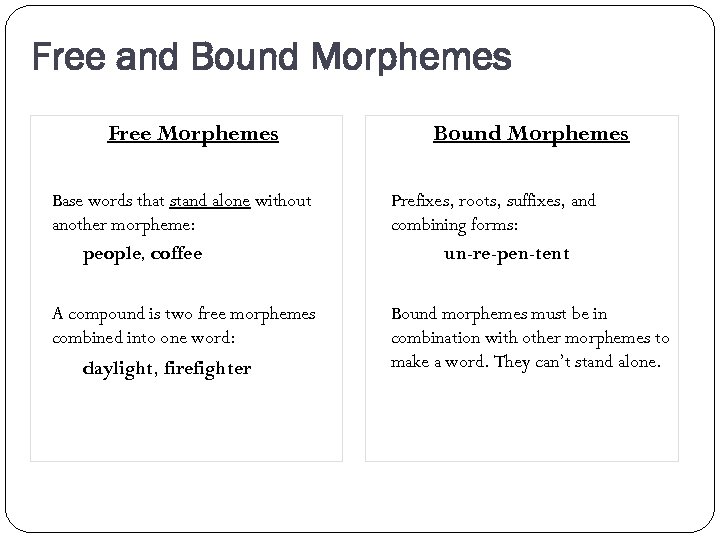 Free and Bound Morphemes Free Morphemes Bound Morphemes Base words that stand alone without another morpheme: people, coffee Prefixes, roots, suffixes, and combining forms: un-re-pen-tent A compound is two free morphemes combined into one word: Bound morphemes must be in combination with other morphemes to make a word. They can’t stand alone. daylight, firefighter
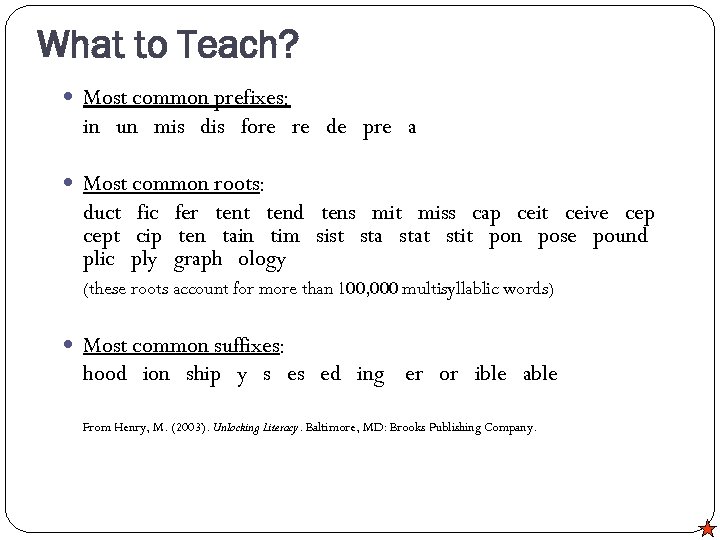 What to Teach? Most common prefixes: in un mis dis fore re de pre a Most common roots: duct fic fer tent tend tens mit miss cap ceit ceive cept cip ten tain tim sist stat stit pon pose pound plic ply graph ology (these roots account for more than 100, 000 multisyllablic words) Most common suffixes: hood ion ship y s es ed ing er or ible able From Henry, M. (2003). Unlocking Literacy. Baltimore, MD: Brooks Publishing Company.
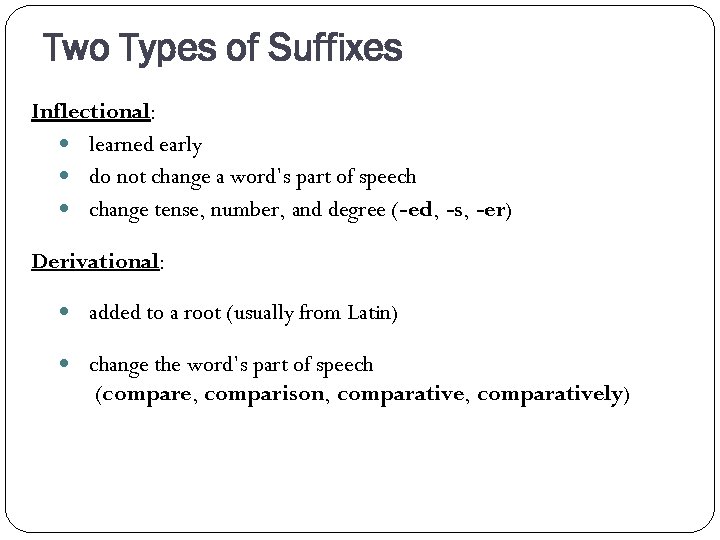 Two Types of Suffixes Inflectional: learned early do not change a word’s part of speech change tense, number, and degree (-ed, -s, -er) Derivational: added to a root (usually from Latin) change the word’s part of speech (compare, comparison, comparatively)
 Past Tense Inflections Plural Inflections The Doubling Rule p. 67
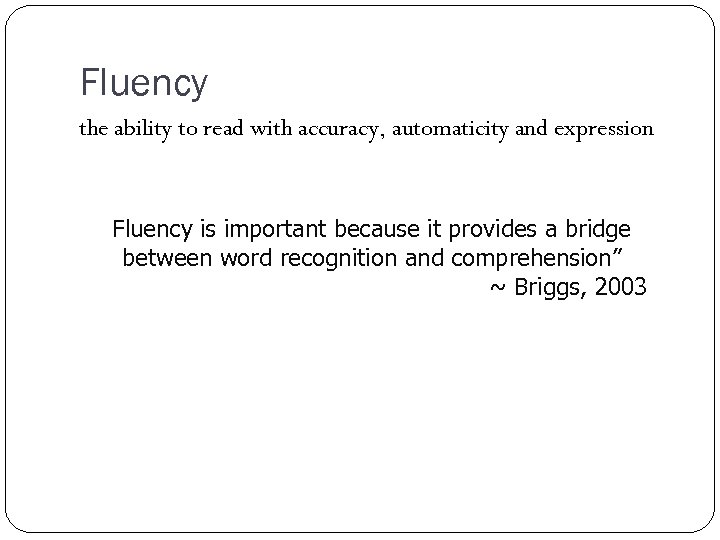 Fluency the ability to read with accuracy, automaticity and expression Fluency is important because it provides a bridge between word recognition and comprehension” ~ Briggs, 2003
 Teaching Tip: Once Accurate, Add Fluency! Add fluency drills at these levels: – – – sub-word phrase sentence connected text
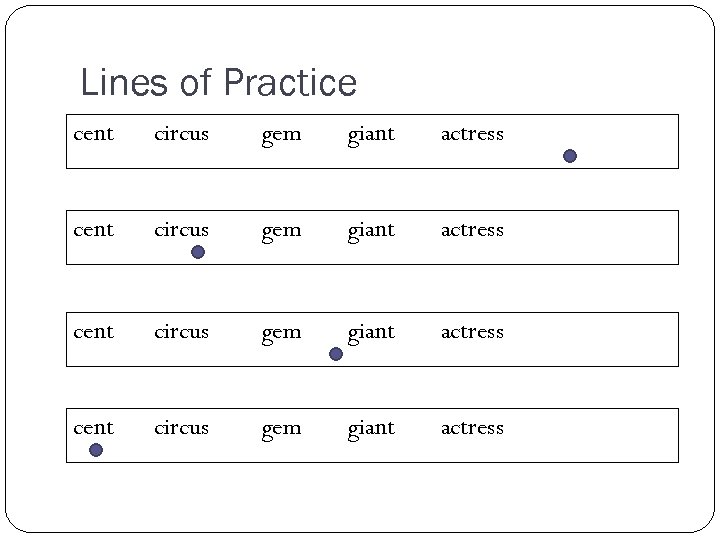 Lines of Practice cent circus gem giant actress
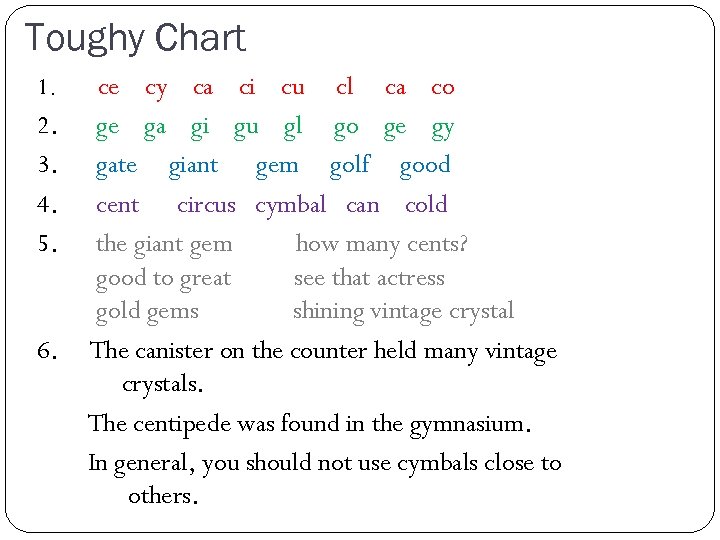 Toughy Chart 1. 2. 3. 4. 5. 6. ce cy ca ci cu cl ca co ge ga gi gu gl go ge gy gate giant gem golf good cent circus cymbal can cold the giant gem how many cents? good to great see that actress gold gems shining vintage crystal The canister on the counter held many vintage crystals. The centipede was found in the gymnasium. In general, you should not use cymbals close to others.
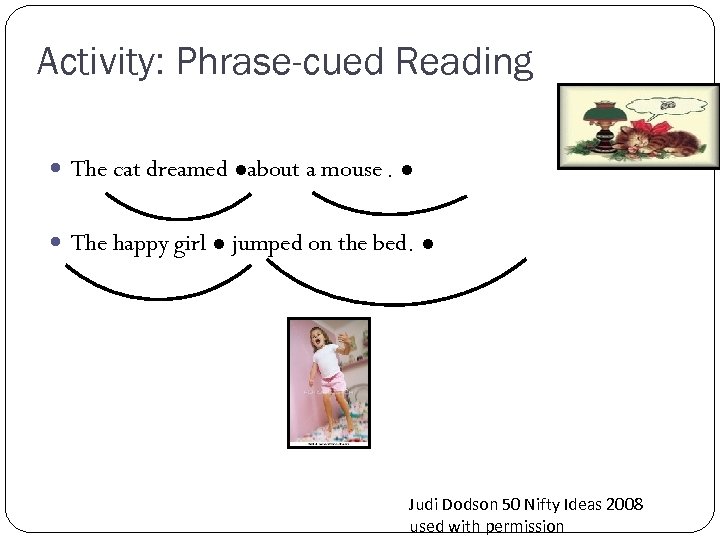 Activity: Phrase-cued Reading The cat dreamed about a mouse. The happy girl jumped on the bed. Judi Dodson 50 Nifty Ideas 2008 used with permission
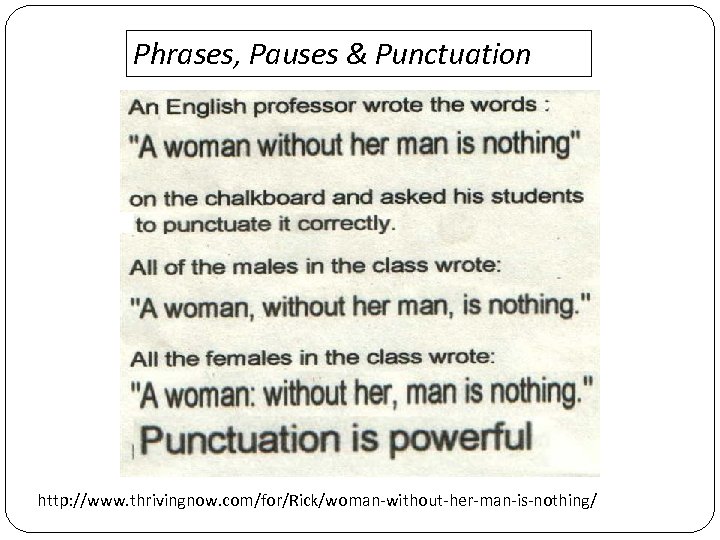 Phrases, Pauses & Punctuation http: //www. thrivingnow. com/for/Rick/woman-without-her-man-is-nothing/
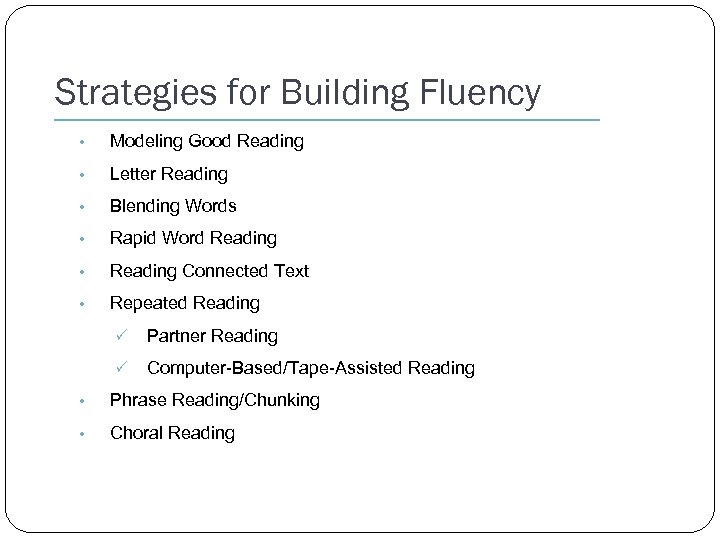 Strategies for Building Fluency • Modeling Good Reading • Letter Reading • Blending Words • Rapid Word Reading • Reading Connected Text • Repeated Reading P Partner Reading P Computer-Based/Tape-Assisted Reading • Phrase Reading/Chunking • Choral Reading
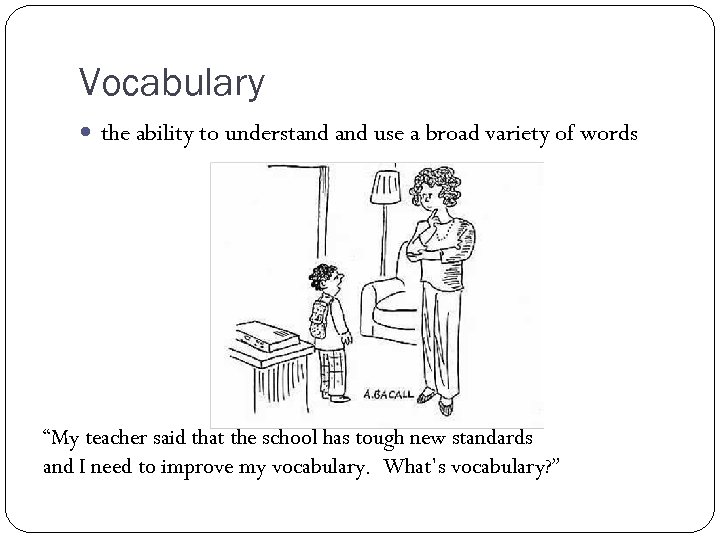 Vocabulary the ability to understand use a broad variety of words “My teacher said that the school has tough new standards and I need to improve my vocabulary. What’s vocabulary? ”
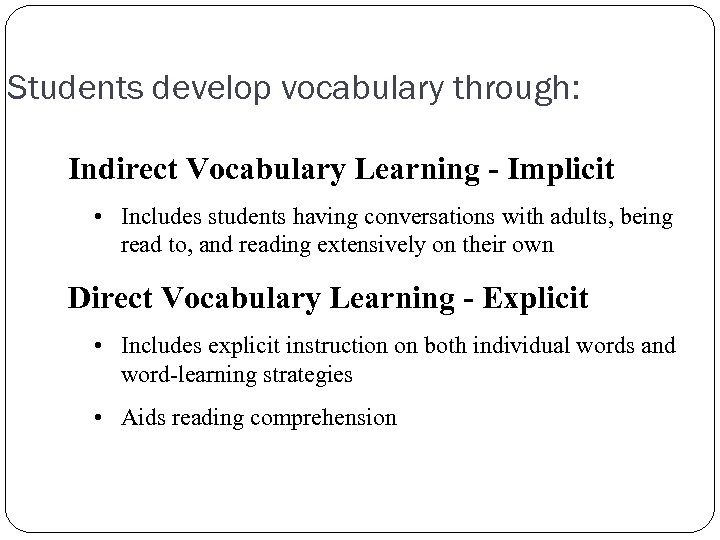 Students develop vocabulary through: Indirect Vocabulary Learning - Implicit • Includes students having conversations with adults, being read to, and reading extensively on their own Direct Vocabulary Learning - Explicit • Includes explicit instruction on both individual words and word-learning strategies • Aids reading comprehension
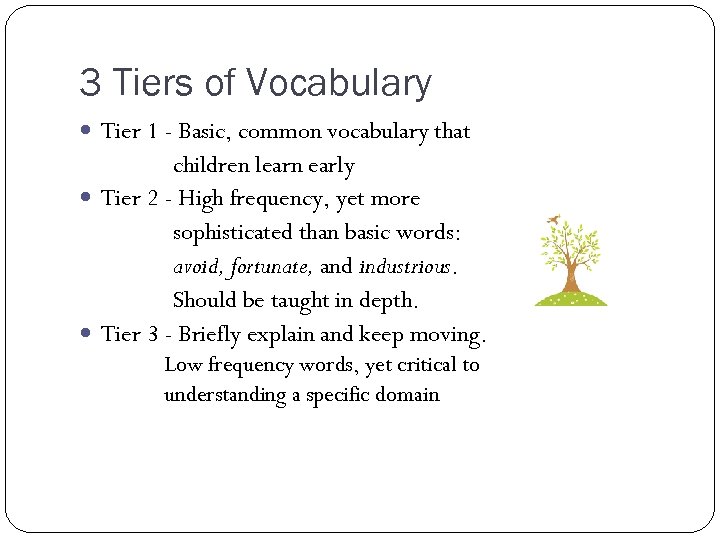 3 Tiers of Vocabulary Tier 1 - Basic, common vocabulary that children learn early Tier 2 - High frequency, yet more sophisticated than basic words: avoid, fortunate, and industrious. Should be taught in depth. Tier 3 - Briefly explain and keep moving. Low frequency words, yet critical to understanding a specific domain
 Teach Using an Instructional Routine
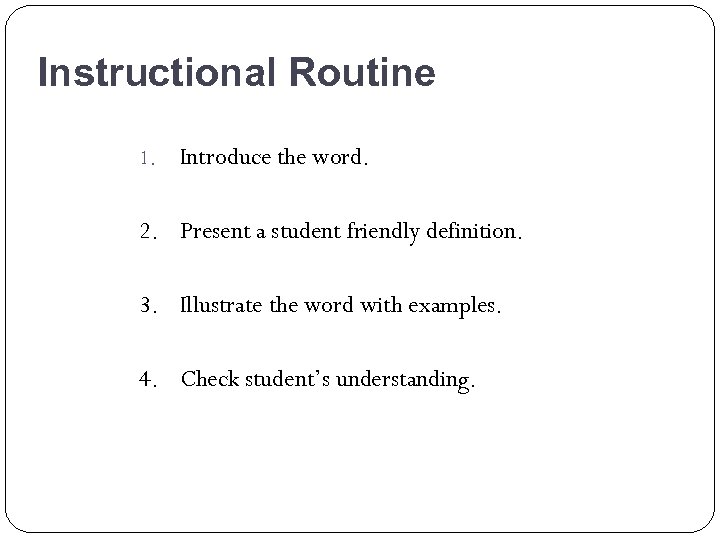 Instructional Routine 1. Introduce the word. 2. Present a student friendly definition. 3. Illustrate the word with examples. 4. Check student’s understanding.
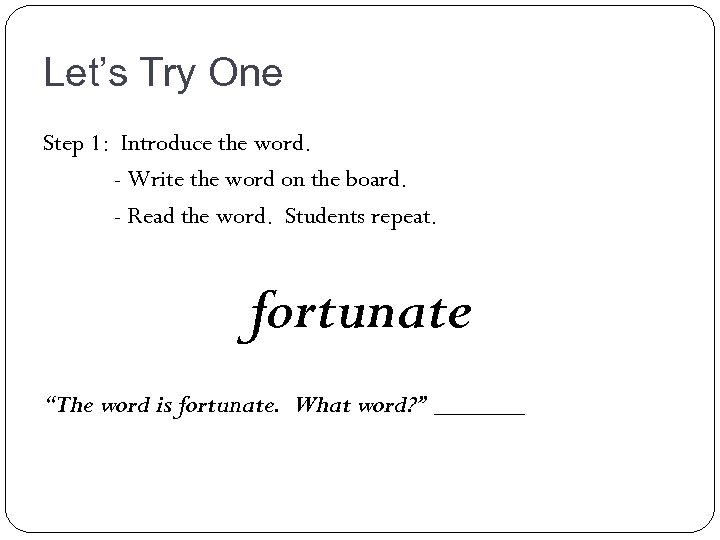 Let’s Try One Step 1: Introduce the word. - Write the word on the board. - Read the word. Students repeat. fortunate “The word is fortunate. What word? ” _______
 Step 2: Present a Student-Friendly Definition - tell students the explanation, or - have them read it with you. “Someone who is fortunate has something good happen to them, or is in a good situation. So if someone has something good happen to them, they are ______. ”
 Step 3: Illustrate the word with examples. - concrete examples - visual representations - verbal examples I have been fortunate to find a career that I love. She felt fortunate in being able to take her children on a vacation this year. We've been more fortunate than a lot of other districts. By a fortunate coincidence, a passer-by heard her cries for help. We should all consider the plight of the less fortunate.
 Step 4: Check Students’ Understanding - Deep Processing Questions - Examples and Non Examples - Students Generate Examples - Sentence Starter
 Option 1: Ask deep processing questions. What in your life has been an example of fortunate? Option 2: Have students discern between examples and non examples. Say “That would be fortunate. ” if you think this is an example. If not, don’t say anything. - losing your job - winning the lottery - test results come back okay from the doctor - your husband cleaning the house for you “just because”
 Option 3: Have students generate their own examples. “Tell your partner a time when you felt fortunate. ” Option 4: Provide students with a story starter. Have them say a complete sentence. “When I fell off my bike, I felt fortunate because……. “
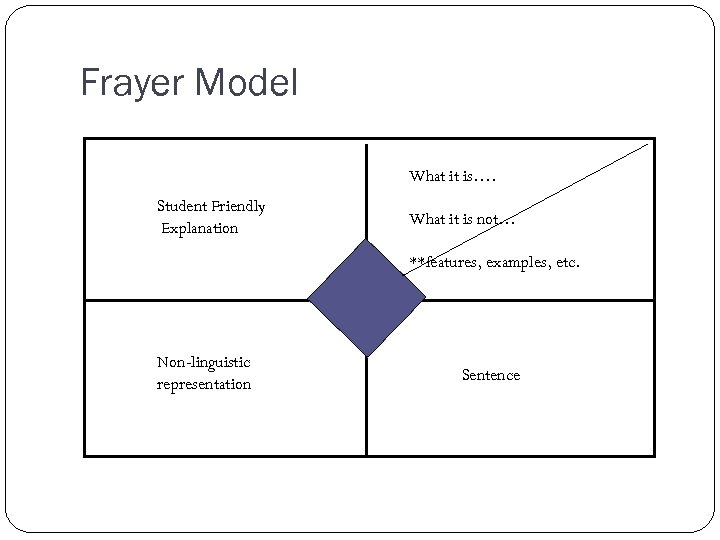 Frayer Model What it is…. Student Friendly Explanation What it is not… **features, examples, etc. Non-linguistic representation Sentence
 Things associated with: education professional development schools administration state standards assessments students success
 Things Associated with
 Snowball Fight!!!!! With your partner, use your core to find a vocabulary word. One one paper, write the word On the other paper, write the student friendly definition.
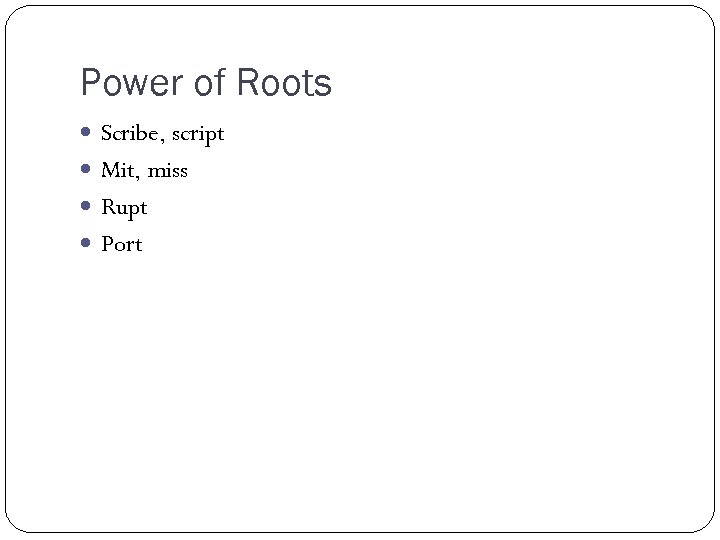 Power of Roots Scribe, script Mit, miss Rupt Port
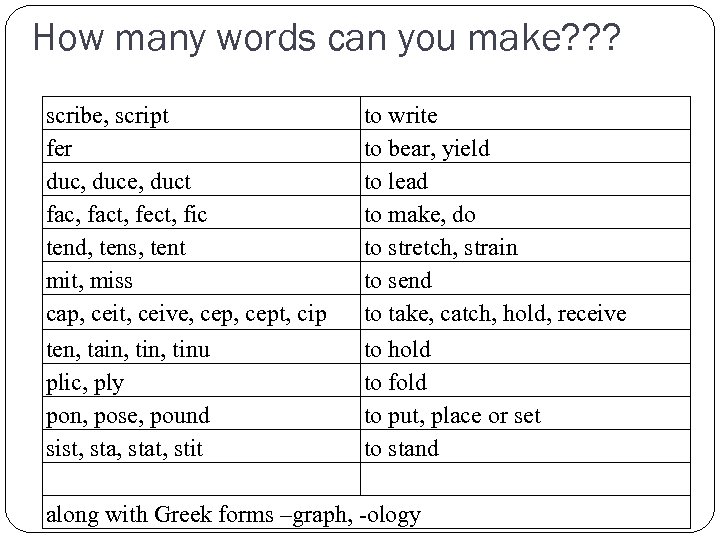 How many words can you make? ? ? scribe, script fer duc, duce, duct fac, fact, fect, fic tend, tens, tent mit, miss cap, ceit, ceive, cept, cip ten, tain, tinu plic, ply pon, pose, pound sist, stat, stit to write to bear, yield to lead to make, do to stretch, strain to send to take, catch, hold, receive to hold to fold to put, place or set to stand along with Greek forms –graph, -ology
 Comprehension the ability to understand what is read by applying appropriate strategies
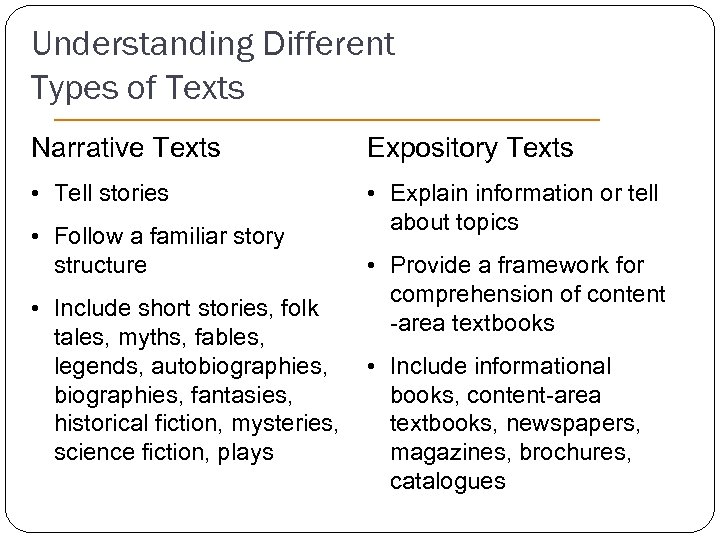 Understanding Different Types of Texts Narrative Texts Expository Texts • Tell stories • Explain information or tell about topics • Follow a familiar story structure • Include short stories, folk tales, myths, fables, legends, autobiographies, fantasies, historical fiction, mysteries, science fiction, plays • Provide a framework for comprehension of content -area textbooks • Include informational books, content-area textbooks, newspapers, magazines, brochures, catalogues
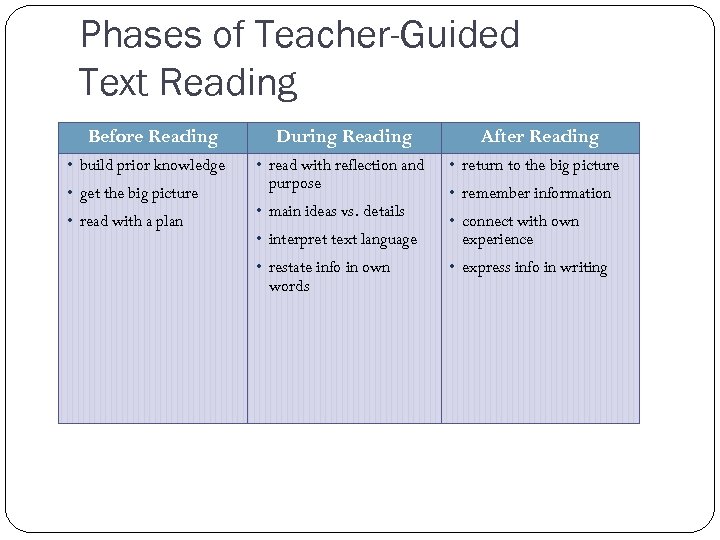 Phases of Teacher-Guided Text Reading Before Reading • build prior knowledge • get the big picture • read with a plan During Reading • read with reflection and purpose • main ideas vs. details • interpret text language • restate info in own words After Reading • return to the big picture • remember information • connect with own experience • express info in writing
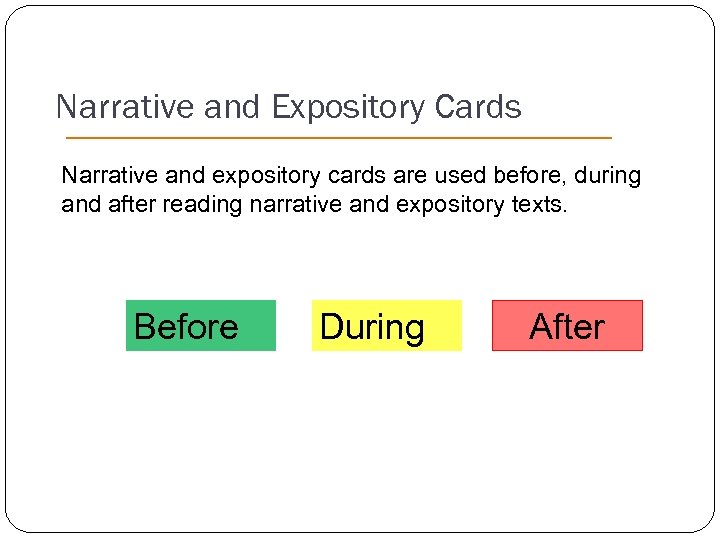 Narrative and Expository Cards Narrative and expository cards are used before, during and after reading narrative and expository texts. Before During After
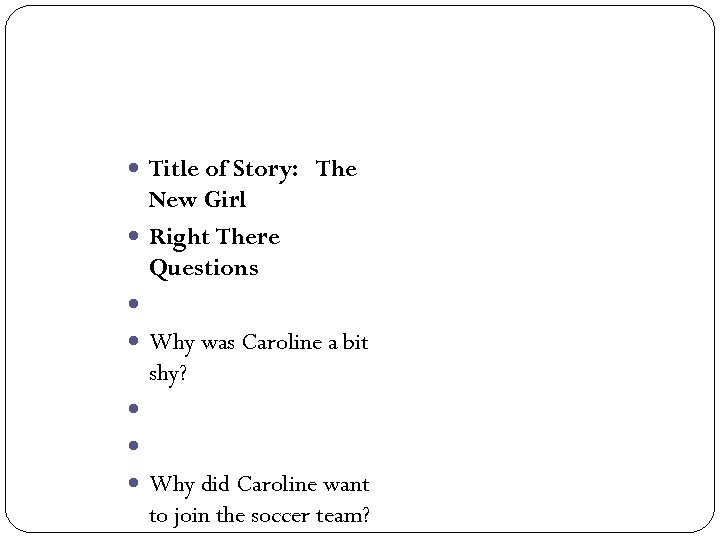 Title of Story: The New Girl Right There Questions Why was Caroline a bit shy? Why did Caroline want to join the soccer team?
 Putting it all Together: Comprehension Based Small Group Lesson
 Summarizing Let’s take a look at a simple way to introduce the act of summarizing. You will each need 9 3 X 5 cards for this activity.
 Activity: Card Pyramid Read a passage. Put the main idea of the passage on one card. Lay it on the table. Put the supporting ideas on cards for the next layer of the pyramid. Lay these under the main idea. Write 2 or 3 details for each supporting detail on cards for the last layer of the pyramid. Lay these under the supporting ideas.
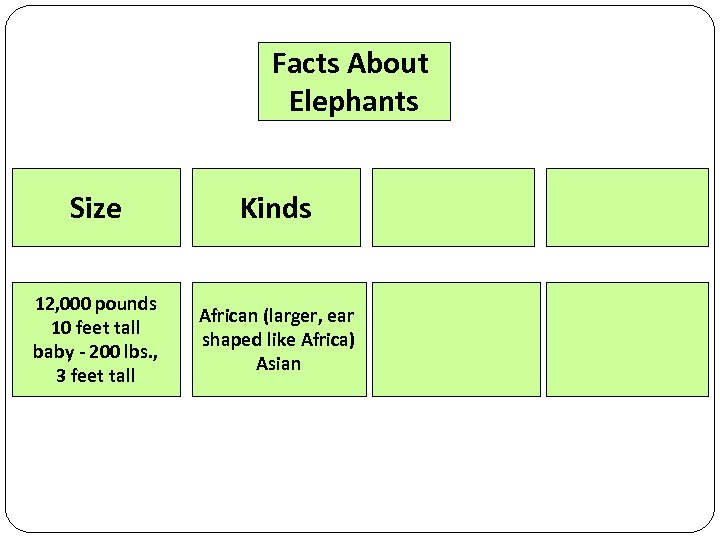 Facts About Elephants Size Kinds 12, 000 pounds 10 feet tall baby - 200 lbs. , 3 feet tall African (larger, ear shaped like Africa) Asian
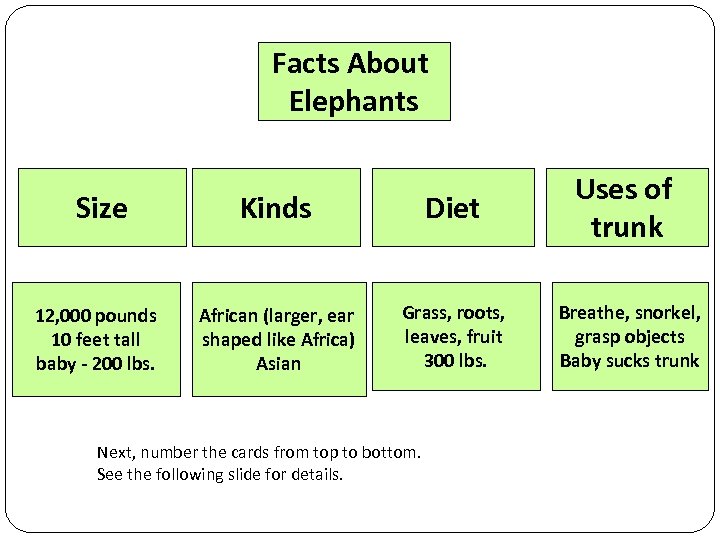 Facts About Elephants Size 12, 000 pounds 10 feet tall baby - 200 lbs. Kinds Diet African (larger, ear shaped like Africa) Asian Grass, roots, leaves, fruit 300 lbs. Next, number the cards from top to bottom. See the following slide for details. Uses of trunk Breathe, snorkel, grasp objects Baby sucks trunk
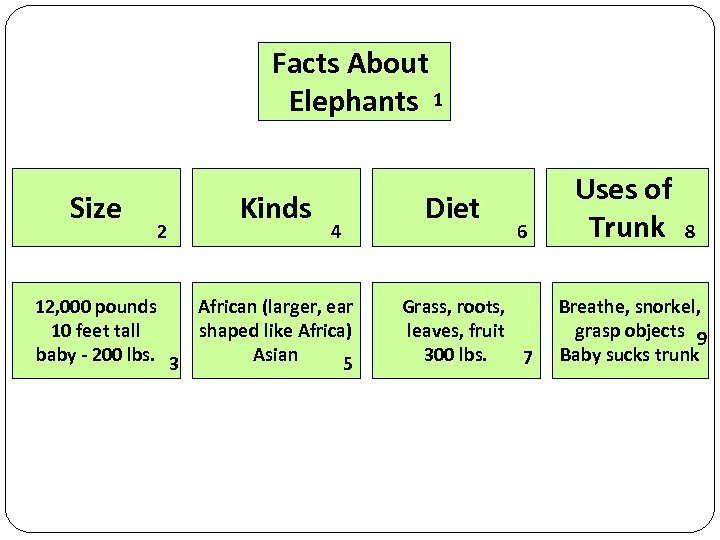 Facts About Elephants 1 Size 2 Kinds 4 12, 000 pounds African (larger, ear 10 feet tall shaped like Africa) baby - 200 lbs. 3 Asian 5 Diet 6 Grass, roots, leaves, fruit 300 lbs. 7 Uses of Trunk 8 Breathe, snorkel, grasp objects 9 Baby sucks trunk
 Summarizing You are now ready to create a summary! Pick up your cards in order, get up, and work with one other person you have not worked with yet this week. Tell an oral summary by using your cards in order. Next, create a written summary from your cards.
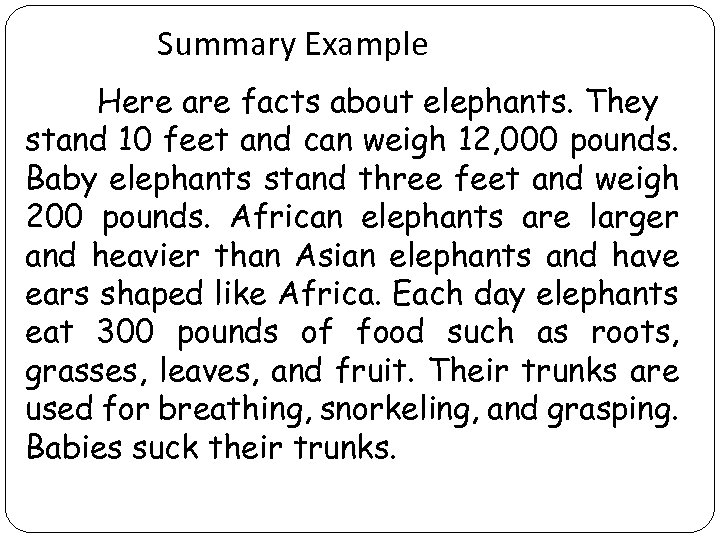 Summary Example Here are facts about elephants. They stand 10 feet and can weigh 12, 000 pounds. Baby elephants stand three feet and weigh 200 pounds. African elephants are larger and heavier than Asian elephants and have ears shaped like Africa. Each day elephants eat 300 pounds of food such as roots, grasses, leaves, and fruit. Their trunks are used for breathing, snorkeling, and grasping. Babies suck their trunks.
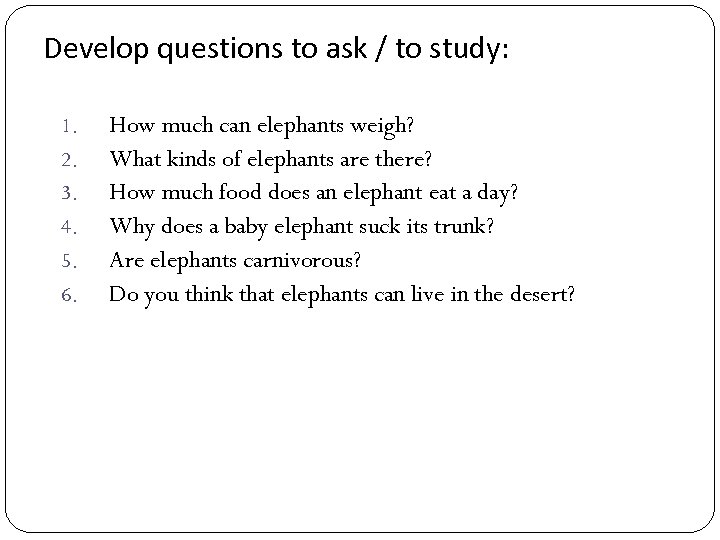 Develop questions to ask / to study: 1. 2. 3. 4. 5. 6. How much can elephants weigh? What kinds of elephants are there? How much food does an elephant eat a day? Why does a baby elephant suck its trunk? Are elephants carnivorous? Do you think that elephants can live in the desert?
 The Importance of Comprehension “Even teachers in the primary grades can begin to build the foundation for reading comprehension. Reading is a complex process that develops over time… emphasize text comprehension from the beginning, rather than waiting until students have mastered ‘the basics’ of reading… Beginning readers, as well as more advanced readers, must understand that the ultimate goal of reading is comprehension. ” --National Institute for Literacy, 2001, p. 55
 Data Analysis to Drive Instruction
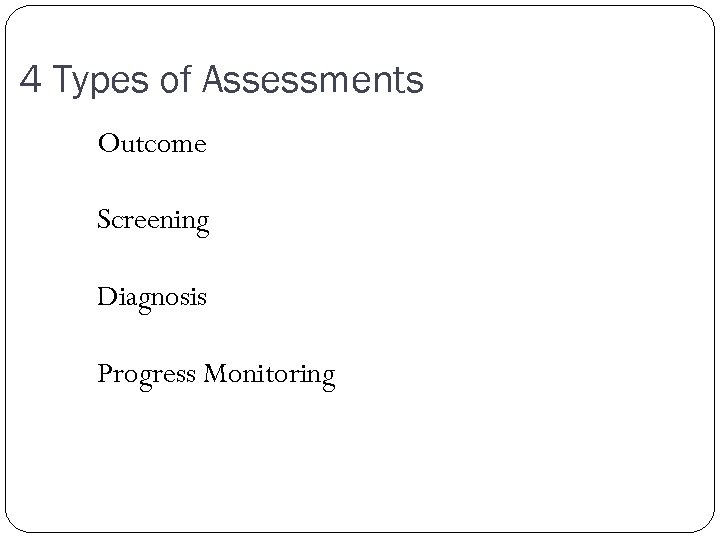 4 Types of Assessments Outcome Screening Diagnosis Progress Monitoring
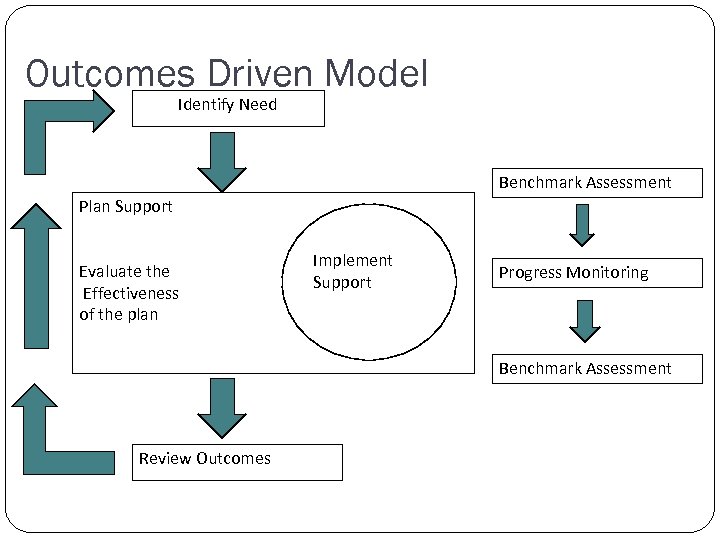 Outcomes Driven Model Identify Need Benchmark Assessment Plan Support Evaluate the Effectiveness of the plan Implement Support Progress Monitoring Benchmark Assessment Review Outcomes 94
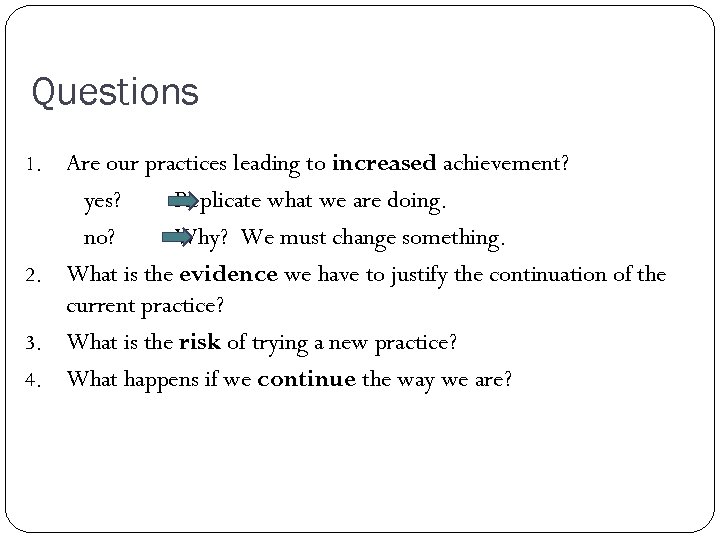 Questions Are our practices leading to increased achievement? yes? Replicate what we are doing. no? Why? We must change something. 2. What is the evidence we have to justify the continuation of the current practice? 3. What is the risk of trying a new practice? 4. What happens if we continue the way we are? 1.
 Making Assessments Meaningful
 Changing our approach: 1. Use assessments as a source of information for both students and teachers 2. Follow assessments with high quality instruction 3. Give second chances for success.
 Sources of Information No surprises Well aligned extensions of instructional activities Concepts and skills emphasized in class Criteria for performance Aligned with state and district standards
 Corrective Instructional alternatives Alterable variables Rescuing vs. Reteaching Minor errors vs. major learning problems
 Second Chances Cannot be one –shot, do or die Determine the effectiveness of the corrective process Provide additional opportunities for success
 Four research based findings regarding effective classroom assessment
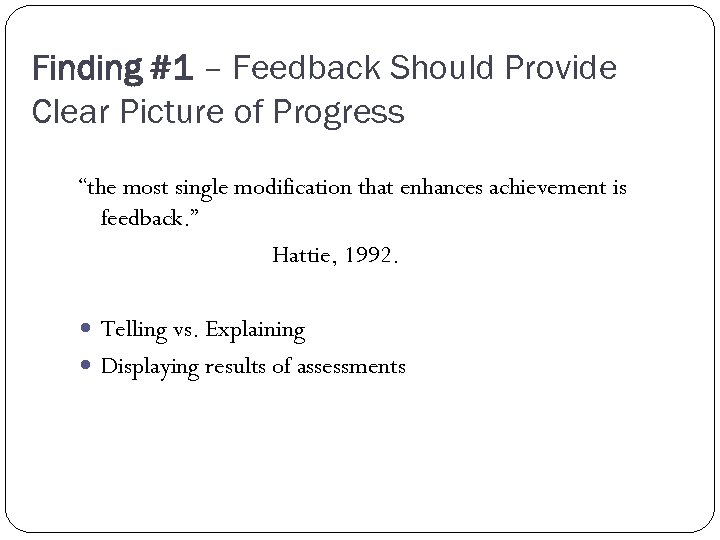 Finding #1 – Feedback Should Provide Clear Picture of Progress “the most single modification that enhances achievement is feedback. ” Hattie, 1992. Telling vs. Explaining Displaying results of assessments
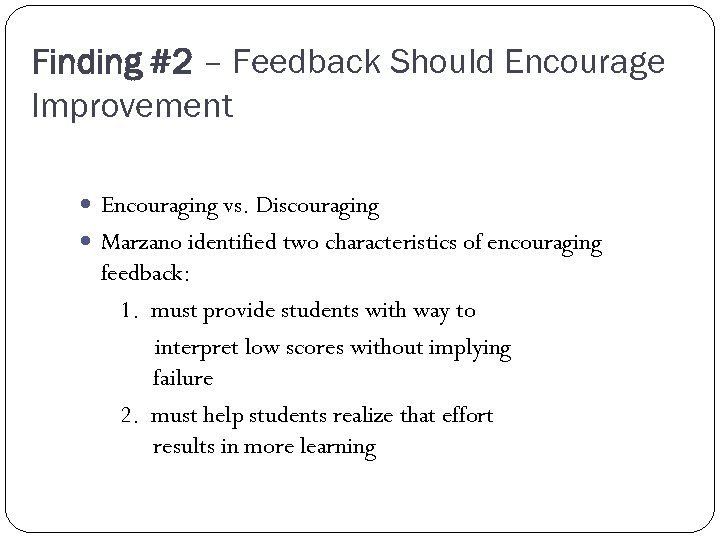 Finding #2 – Feedback Should Encourage Improvement Encouraging vs. Discouraging Marzano identified two characteristics of encouraging feedback: 1. must provide students with way to interpret low scores without implying failure 2. must help students realize that effort results in more learning
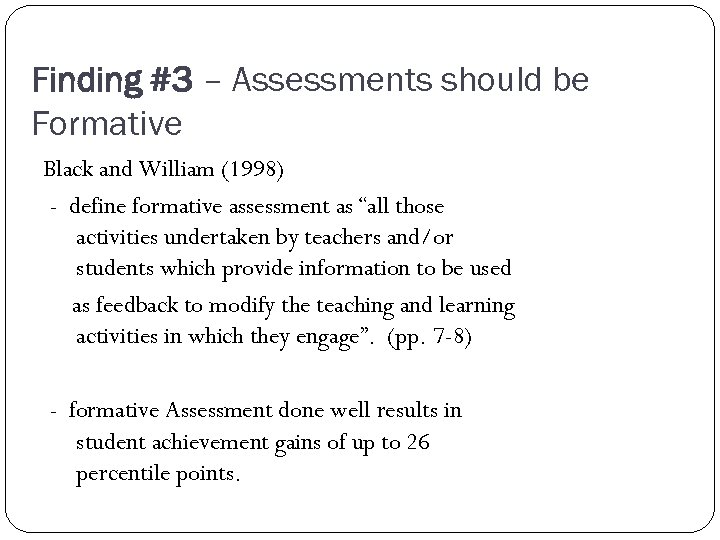 Finding #3 – Assessments should be Formative Black and William (1998) - define formative assessment as “all those activities undertaken by teachers and/or students which provide information to be used as feedback to modify the teaching and learning activities in which they engage”. (pp. 7 -8) - formative Assessment done well results in student achievement gains of up to 26 percentile points.
 Finding #4 – Assessments should be Frequent Systematic use of classroom assessments – weekly or more frequently can have a strong positive effect on student achievement.
 Students learn nothing from a successful performance. Instead, they learn when their performance is less than successful, for then they can gain direction about how to improve. Wiggins, 1998 Educative Assessment
 Using Formative Assessments to Drive Instruction
 Everything we do requires using knowledge in some way, not just knowing it. Susan M. Brookhart, 2010 How to Assess Higher Order Thinking Skills
 Assessment FOR learning’s three questions: 1. Where am I going? 2. Where am I now? 3. How can I close the gap? Stiggins, 2006
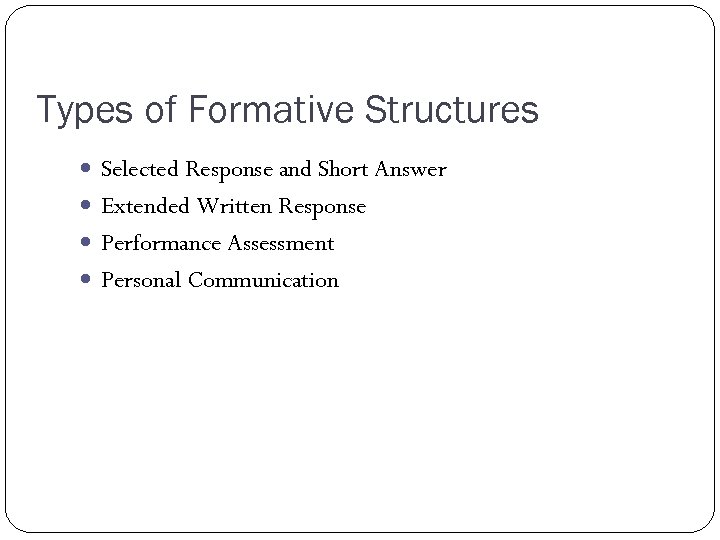 Types of Formative Structures Selected Response and Short Answer Extended Written Response Performance Assessment Personal Communication
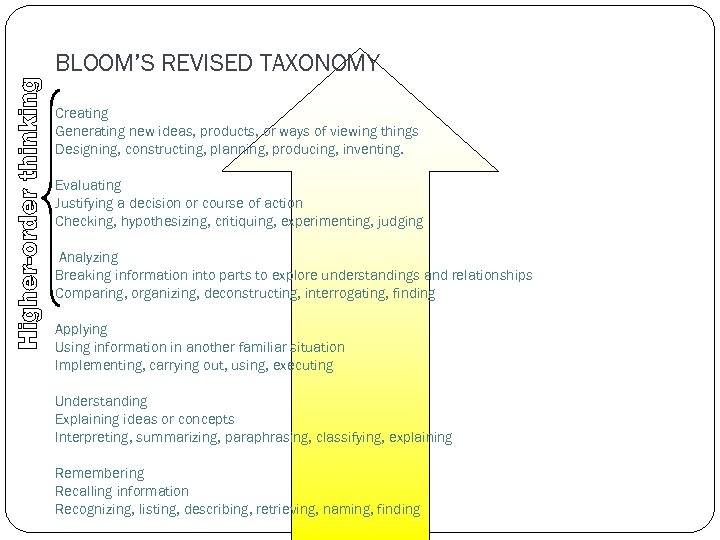 BLOOM’S REVISED TAXONOMY Creating Generating new ideas, products, or ways of viewing things Designing, constructing, planning, producing, inventing. Evaluating Justifying a decision or course of action Checking, hypothesizing, critiquing, experimenting, judging Analyzing Breaking information into parts to explore understandings and relationships Comparing, organizing, deconstructing, interrogating, finding Applying Using information in another familiar situation Implementing, carrying out, using, executing Understanding Explaining ideas or concepts Interpreting, summarizing, paraphrasing, classifying, explaining Remembering Recalling information Recognizing, listing, describing, retrieving, naming, finding
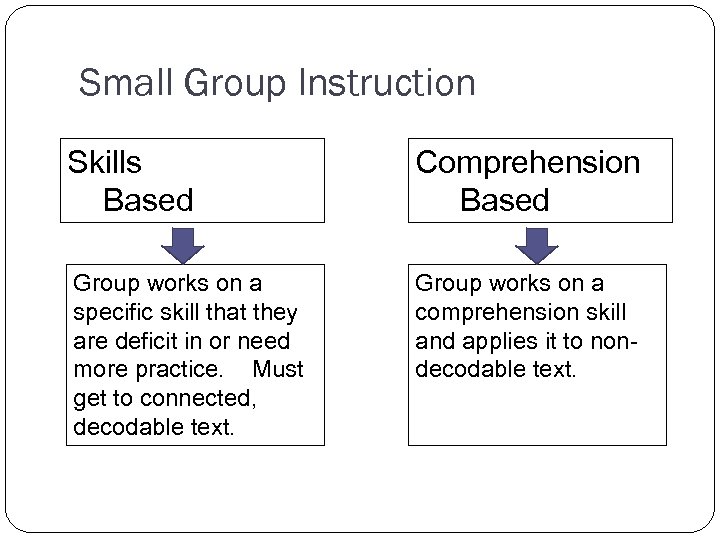 Small Group Instruction Skills Based Comprehension Based Group works on a specific skill that they are deficit in or need more practice. Must get to connected, decodable text. Group works on a comprehension skill and applies it to nondecodable text.
 Phonics Focused Lessons
 Comprehension Focused Lessons
 Planning for Instruction
 Do you believe in Me? ? ?
 Commitment - a promise to do something or to behave in a particular way - the hard work and loyalty that someone gives to an organization, activity etc - something that you have promised you will do or that you have to do
 Thank you for making a commitment to make a difference in the lives of the students you teach!!!